Slashdot Mirror
Domain: pdx.edu
Stories and comments across the archive that link to pdx.edu.
Comments · 164
-
Re:There are likely thousands of security problems
It's not needed. Remember the Lisp machines? And Haskell can be used to make an Operating system. So we don't need C anymore.
-
Re:Because we all know
It takes more than 20 years for ice this thick
Evidence please..? Or are you just making this up on the basis of your own prejudices.
to melt to a shelving point..
Ah, I think you're answering my question here. Ice shelves don't 'melt to a shelving point.' Meltwater collects at the surface, then migrates rapidly to the base, causing breakup.
Do please try to avoid the trap of your own small-scale assumptions.
-
Re:For the record...
All SCSI requires termination, this isn't an apple thing. Apple did use that strange 25 pin SCSI connection which quickly became standard, not that it mattered much since other then high end workstations and servers, nobody else used SCSI because they were too cheap.
No, no no. The DB25 SCSI was on practically all the Macs from the Plus on up. There was something weird about the SCSI BUS, not the connector, on the IIfx and it required a special terminator. Until powerbooks it was the only black SCSI terminator apple shipped (to differentiate it.) Pictures here. Other bits:
The terminator for the IIfx is black and physically looks different from the standard gray terminator. The IIfx terminator should cost about $20 from third party vendors. (See list of possible vendors at the end) If the Iifx has a third party (non-Apple) hard drive installed internally, there are some special issues to deal with. Normally these drives come with a resistor pack that provides termination. Even with this built in termination you still need a special filter for proper termination. To achieve this you must plug the SCSI cable directly to the logic board in the Iifx and place an internal SCSI filter (Apple P/N 590-4516) between the cable connector and the hard drive. If for some reason you remove the internal drive (or someone else has), you should install both the Internal SCSI filter AND an Internal SCSI termination Block (Apple P/N 590-4515) If you are out on a site and find yourself without the internal termination block you can insert a regular passthrough terminator at the beginning of your SCSI chain and make sure there is a black terminator at the end. (http://www.schmidt.org/macscsi.html)
And lots of woes including SCSI termination here:
I'd read that the IIfx required special termination for SCSI chains. We were plagued with 2 or 3 rather mysterious crashes per day, often resulting in serious damage to the operating system. The kids in my class got very good at documenting what happened in and just proceeding a system trashing crash. I'd initially got around this by chaining an external CD-ROM drive borrowed from our LC III to a Zip drive. That solved the termination problem well enough that I could install items from a CD. It still was just a stopgap fix until I received some helpful reader emails about the SCSI problem after the original posting of this piece. Larry Prall wrote and pointing me to the exact terminator I needed from Cyberian Outpost (Outpost # 43610. SCSI Terminator II-Black, $15.95). As the part was backordered, and we finished the school year with the IIfx being a rather fickle, undependable machine. (http://www.mathdittos2.com/columns/bh/bh990511.h
t ml)Trust me. The IIfx was just wonky. It's all especially funny when I think about my old Sun hardware that would run with or without the external terminator.
-
Re:Paraffin/LOX hybrids
Their test-fires have gone quite well; in addition to testing paraffin/GOX, they've also test-fired salami/GOX, which actually provided more thrust than the paraffin prototype tested that particular day.
Before or after Mythbusters did their with salami powered rocket engine?
Well before. Mythbusters revisited the confederate rocket myth with a salami rocket on April 26, 2006, whereas we test-fired a salami on September 11, 2004 in the Black Rock Desert of Nevada. -
Paraffin/LOX hybrids
I work with the Portland State Aerospace Society. We build open source rockets, in every sense of the term: you can find all the details of our work on our site, including software, avionics designs, airframe schematics, and engine/propulsion work. We currently use ammonium perchlorate engines, and we do indeed have to deal with these issues, which prove quite onerous. For this reason, our propulsion team currently has as their primary project the development of a hybrid paraffin and liquid oxygen motor. Both of these components have no regulatory issues whatsoever: the paraffin wax came from a craft store, and the liquid oxygen came from a welding supply store (or with the right equipment, you could make it yourself). Their test-fires have gone quite well; in addition to testing paraffin/GOX, they've also test-fired salami/GOX, which actually provided more thrust than the paraffin prototype tested that particular day.
That just leaves us having to deal with any restrictions on active guidance that get thrown our way, which we'll deal with when we finish our active-guidance prototype. -
Paraffin/LOX hybrids
I work with the Portland State Aerospace Society. We build open source rockets, in every sense of the term: you can find all the details of our work on our site, including software, avionics designs, airframe schematics, and engine/propulsion work. We currently use ammonium perchlorate engines, and we do indeed have to deal with these issues, which prove quite onerous. For this reason, our propulsion team currently has as their primary project the development of a hybrid paraffin and liquid oxygen motor. Both of these components have no regulatory issues whatsoever: the paraffin wax came from a craft store, and the liquid oxygen came from a welding supply store (or with the right equipment, you could make it yourself). Their test-fires have gone quite well; in addition to testing paraffin/GOX, they've also test-fired salami/GOX, which actually provided more thrust than the paraffin prototype tested that particular day.
That just leaves us having to deal with any restrictions on active guidance that get thrown our way, which we'll deal with when we finish our active-guidance prototype. -
Re:Google Geocode API inaccurate.
A toolset I have developed to automate some aspects of mash-up development uses the Yahoo geo-coding web-service API, but displays mash-ups using the Google Maps API. The combination works rather well. (An overview of the toolset is available at http://sparce.cs.pdx.edu/mash-o-matic/.) Ontok has published a comparison of geo-coders (somewhat stale by now) http://www.ontok.com/geocode/compare/.
-
Re:OT: Aluminium Kayak
Feathercraft Kahuna. I love it.
http://www.feathercraft.com/
It goes on planes, in trains, in your trunk or in its backpack. These things are just incredibly well designed - RF-welded urethane skin (no leaks), internal sponsons, hatches that work like drybags and a seat that's super comfortable. The aluminum frame is beautiful, and has neat tricks like using two of the deck bars as a lever to tighten the other frame pieces before they're put in place.
My girlfriend (who also got one) had previously paddled fiberglass boats and thought that folding kayaks were silly and no good. She said something like "why would anyone want one of those?" When I asked her what specific reasons she had against it, she couldn't come up with anything other than "well, that's what everyone says". We embarked on a kayak-testing plan over a couple of months testing lots of kayaks at various demo days and symposiums and renting/demoing kayaks from local dealers. These were all fiberglass boats. I got her to try a Feathercraft when she was in Seattle for work near Folding Kayak Adventures (http://www.foldingkayak.com - tell them I sent you). Her response after trying two of them in 2-3 foot waves on Lake Washington (and just after trying lots of different fiberglass boats) was "why would anyone ever want a rigid boat?". The sensation of being in it is like being gently cradled in a hammock while floating along. It's fun. Once we had it narrowed down to Feathercraft we spent 2 days at a symposium trying every model they make multiple times to figure out which one to get. With unlimited funds, I would get more than one.
If you want one that's more rollable, try the new Wisper. I wanted one with a deployable rudder since they're cool (Feathercraft came up with the first flip rudder that's now used on lots of kayaks) and I also wanted to use it with a downwind sail. The clip-on skeg on the Wisper works, but is less-than elegant (you should be able do all your non-sail turns without a rudder or skeg, anyway). You don't have to put the rudder on the Kahuna on days you don't need it. A Feathercraft employee I spoke with at a symposium (he makes them - they're all made by hand) who has his pick of kayaks to take out and use whenever he wants said that the Kahuna was his previous favorite, but now he uses the Wisper all the time.
I've also test-paddled the Khatsalano. It was even more fun, in a 'oh-my-god-this-is-fast-and-tippy-and-I-can't-stop -grinning' kind of way. I decided that the Kahuna was a better all-around kayak for trips (easier to pack), but that a Khats could be in my future for insanely fun day-trips (or with carefully packed gear in tiny dry bags) once my skills were up to it. We took a class from a local BCU (British Canoe Union) 4-star coach who has a friend with a Khatsalano. His opinion: It's a Real Kayak(tm). Traditional kayaks are skin-on-frame, after all. See http://web.cecs.pdx.edu/~walpole/kayaking.html for lots of pictures.
See also Ralph Diaz's book on folding kayaks (The Complete Folding Kayaker), and the web site http://www.foldingkayaks.org/
Comparisons to plastic boats: Plastic boats are cheap. If you bang them into rocks you don't care. But they're cheap and get brittle over time, and are heavy. They also get dents. Aesthetically, they're kind of blah. But cheap. Repairing holes polyethelene is a pain. Roto-molded boats are most common, but companies like Eddyline are making weird plastic/fiberglass hybrids.
Fiberglass boats: Before the 1950's everyone used wooden-framed folding kayaks in trains. After the 1950's, fiberglass took off. They're light and strong. Kevlar is ligher and stronger. A nice boat costs arond US$3000. This is the same price as the Feathercraft Kahuna fully tricked out. You don't want to bang your fiberglass boat into rocks, either. It's pretty easy to repair. -
ed, em, en, ex, vi (Was: Re:Which came first?)
That would be Bill Joy, originally. Back then (~1976), he probably used ex, which was an extended rewrite of en, itself an improvement on em by George Coulouris. Em was Editor for Mortals, since only immortals could use ed. I've used ed. The horror! The horror! 8^)
All the programs from ed to ex were line editors. Vi contained ex, but also was a screen editor using termcap.
(For details, see Bill Joy's greatest gift to man - the vi editor and Interview with Bill Joy.)
-
relay computer
This isn't something one could easily acquire or build, but I recently saw a demo of an 8-bit relay computer built by one of the professors at my school. It is constructed from 415 relays (electrically actuated mechanical switches) wired together, and is capable of addition, and, or, xor, not, conditional jumps, shift left and a few other misclaneous instructions I can't recall.
-
Re:A plug for GNU Radio
We've done some interesting stuff with USRPs. They're a lot of fun. With respect to the story about SDR wireless networking, check out our open-source 802.11 implementation for the USRPs. Early days yet, but we're making fairly rapid progress.
-
Re:That's a pretty bold statement...
For starters mathematics isn't a science - it tells us nothing about the physical world, mathematics is a tool, nothing more, nothing less. I have the highest esteem for mathematics, but it's not science.
Stephen Wolfram and many other mathematicians would disagree. Mathematics has moved on since you took Calculus 101.
Recent work on complex systems indicates that mathematical fundamentals have a more direct influence on the shape of the physical world than the current generation of physicists accepts. This is expected because mathematics is formulated using our experiences of the physical world. Wolfram's book was righly criticised in Nature and is extremely long winded. However, it is the most significant book which attempts to demonstrate this direct influence which is not written by Mandlebrot.
Many physicists think that mathematics is nothing more than a tool, albeit an essential one. The closest analogy to this assertation that I can think of would be a technician describing a physics textbook as 'just a tool' because he is using it to force down a switch on a broken oscilloscope. In this situation, the textbook reveals how the oscilloscope is constructed but it can also be used to get things working. -
Re: Non-registration article text> My guess is that Feynman would have been more apprehensive than most to say that he understood quantum mechanics.
Here's a quote attributed to him:No, you're not going to be able to understand it [...] You see, my physics students don't understand it either. That's because I don't understand it. [...] The theory of quantum electrodynamics describes Nature as absurd from the point of view of common sense. And it agrees fully with an experiment. So I hope you can accept Nature as She is -- absurd.
(Quoted on page 11 of this slide set on quantum computing [81 page PDF].)
There's also a "shut up and calculate" meme that some physicists push in opposition to all the familiar attempts to interpret QM, which seems to be in line with what Feynman was saying.
BTW, the slide set is aimed at non-physicists, and uses CS-style concepts at a level of abstraction just above QM itself, so interested Slashdotters with a bit of CS and Math background may find them interesting as a demystified introduction to quantum computation. Also, the author of the slides (Marek Perkowski) has an article in the latest issue of the IEEE Computational Intelligence Society's newsletter, in which he suggests that ordinary non-physicist CSers can do worthwhile research in the field of quantum computation now, by means of simulators for these abstractions, though the conceptual and software toolkit is still very limited. (Your research may involve inventing your own tools, but for most of us that's more nearly feasible than learning the physics and getting access to the tools for real experiments.) -
Re:That's not true.I'm stuck with MREs and freeze dried crap.
There are other options. Like meaty travel companions and a big knife.
Ah yes, the "long pork". Al Packer may have been on to something...
-
Advice from My O-Chem professorHe hunted the web for this for us. Pretty Picture
It has all of the reactions we needed to know for the final and such. The layout could be a little bit better, but you can edit it to suit your specs.
Oh.. BTW... Dr. Wamser at Portland Staue is not just the best O-chem prefessor out there. He is the best prof I have ever had.
-
Re:Ok, real response
If you want to try monitoring your high-bandwidth campus network let me recommend our open source solution, Ourmon. We've been using it for several years with good results.
-
Re:OSH?
Open hardware is like open source; it's about designs, schematics, PCB layouts, FPGA codes, etc. There are several existing open hardware projects at Portland State, notably Portland State Aerospace Society's rockets and a Software-Defined Radio project built on the open-hardware Universal Software Radio Peripheral. More are expected.
-
Re:OSH?
Open hardware is like open source; it's about designs, schematics, PCB layouts, FPGA codes, etc. There are several existing open hardware projects at Portland State, notably Portland State Aerospace Society's rockets and a Software-Defined Radio project built on the open-hardware Universal Software Radio Peripheral. More are expected.
-
Re:Why was Oregon U Chosen?For one thing, we are home to the OSDL and Linus Torvalds. PSU and OSU have pretty good Computer Science programs. Intel and Tektronix have huge campuses here. There's no shortage of computing professionals in Oregon.
I'm just surprised Portland State and Oregon State don't have anything about it on their front pages.
-
Re:The biggest limiting factor seemed to be...
Heh. My undergrad degree is in Physics. Trust me, the situation for undergraduate researchers is better in CS.
Come join us at Portland State. I promise we will find many cool things for you to do; no promises, but some of them might even pay. Our strong undergrads usually find pretty nice jobs when they get out, and many of them work in the tech business while they're in.
-
Re:The biggest limiting factor seemed to be...
See my previous post. I donate my time for the benefit of my students in great huge wads all the time. I just have to choose which projects I do it for carefully: both for my own sanity, and to make sure the students themselves receive maximum benefit. My students involved in PSAS and XCB have reaped serious benefits from their free work---IMHO much more than if they'd put the same effort into the space elevator contest.
-
Re:The biggest limiting factor seemed to be...
It's great for research students to work for free on projects. I just want them to be my projects, not someone else's. See my PSAS and SDR stuff for examples of where I've successfully deployed students to learn, have fun, gain experience, and pad their CVs. See my Summer of Code site for an example of where they've actually gotten paid to do it.
Sadly, changing the prize from $50K to $100K doesn't change the economics much. In my previous post I was estimating (perhaps wildly wrongly) that this year's prize had an expected worth of $5K; that would make the expected value of next year's prize $10K if the larger money didn't attract a larger, stronger field of contestants.
-
Re:The biggest limiting factor seemed to be...
It's great for research students to work for free on projects. I just want them to be my projects, not someone else's. See my PSAS and SDR stuff for examples of where I've successfully deployed students to learn, have fun, gain experience, and pad their CVs. See my Summer of Code site for an example of where they've actually gotten paid to do it.
Sadly, changing the prize from $50K to $100K doesn't change the economics much. In my previous post I was estimating (perhaps wildly wrongly) that this year's prize had an expected worth of $5K; that would make the expected value of next year's prize $10K if the larger money didn't attract a larger, stronger field of contestants.
-
Re:The biggest limiting factor seemed to be...
It's great for research students to work for free on projects. I just want them to be my projects, not someone else's. See my PSAS and SDR stuff for examples of where I've successfully deployed students to learn, have fun, gain experience, and pad their CVs. See my Summer of Code site for an example of where they've actually gotten paid to do it.
Sadly, changing the prize from $50K to $100K doesn't change the economics much. In my previous post I was estimating (perhaps wildly wrongly) that this year's prize had an expected worth of $5K; that would make the expected value of next year's prize $10K if the larger money didn't attract a larger, stronger field of contestants.
-
802.11b SDR
For some steps toward 802.11b SDR, check out my student's Summer of Code project. Volunteers gratefully accepted!
An issue we didn't recognize when starting out is that 802.11b actually wants 120MHz or more of bandwidth for a single low-speed channel; it really does spread a lot. Our current hardware really only gives us 60MHz, which will capture the main lobe, which should be enough. Eventually, we might have to go to a hybrid "soft" radio where the despreading is done with some kind of front-end magic, although obviously this is a last-resort solution.
-
802.11b SDR
For some steps toward 802.11b SDR, check out my student's Summer of Code project. Volunteers gratefully accepted!
An issue we didn't recognize when starting out is that 802.11b actually wants 120MHz or more of bandwidth for a single low-speed channel; it really does spread a lot. Our current hardware really only gives us 60MHz, which will capture the main lobe, which should be enough. Eventually, we might have to go to a hybrid "soft" radio where the despreading is done with some kind of front-end magic, although obviously this is a last-resort solution.
-
WebCT = Zero Innovation and that OneCard thing...
There's been little real innovation in them in the past few years so the OS ones have a static target to shoot for and lots of schools are really, really sick of the companies backing them.
Geez, isn't that the truth? I've been using WebCT at Portland Community College for over four years. It's not a bad application, but is in dire need of some enhancements. For instance, whilst registering for classes, there isn't a way to look up the classes you're interested in, and selecting it to register. I need to open up another web session, go to the PCC.edu website, find the CRN, copy it, paste it into WebCT, and then see whether or not there's room. This is far, far too many steps.
BB will survive by diversifying and moving to financial services- they sell a one-card system (doors, meals, vending machine, bookstore, etc) that is also a credit card, and they get a cut of every purchase.
Geez, I hope this isn't related to the PortlandState OneCard (from the creepily named Higher One company):
http://www.psuone.pdx.edu/onecardinfo.html
I, for one, really really do not like the idea of this card. It's a debit MasterCard that's also used to provide access to campus facilities. Sorry, but that just seems like too valuable of a number to just be swiping through your random card reader around campus. I could see a "man-in-the-middle" style of compromise on this system (passively recording the debit card numbers for later use).
All financial aid disbursements are put into this card as well. Ergo, the fine folks at HigherOne, who I'm pretty sure are being paid by PSU, are making both fees for providing this 'service' to PSU, as well as money off of the interest on this card. Boo!
Oh, and that's $20 to you if you're not interested in having this card:
http://www.psuone.pdx.edu/faq01.html#4 -
WebCT = Zero Innovation and that OneCard thing...
There's been little real innovation in them in the past few years so the OS ones have a static target to shoot for and lots of schools are really, really sick of the companies backing them.
Geez, isn't that the truth? I've been using WebCT at Portland Community College for over four years. It's not a bad application, but is in dire need of some enhancements. For instance, whilst registering for classes, there isn't a way to look up the classes you're interested in, and selecting it to register. I need to open up another web session, go to the PCC.edu website, find the CRN, copy it, paste it into WebCT, and then see whether or not there's room. This is far, far too many steps.
BB will survive by diversifying and moving to financial services- they sell a one-card system (doors, meals, vending machine, bookstore, etc) that is also a credit card, and they get a cut of every purchase.
Geez, I hope this isn't related to the PortlandState OneCard (from the creepily named Higher One company):
http://www.psuone.pdx.edu/onecardinfo.html
I, for one, really really do not like the idea of this card. It's a debit MasterCard that's also used to provide access to campus facilities. Sorry, but that just seems like too valuable of a number to just be swiping through your random card reader around campus. I could see a "man-in-the-middle" style of compromise on this system (passively recording the debit card numbers for later use).
All financial aid disbursements are put into this card as well. Ergo, the fine folks at HigherOne, who I'm pretty sure are being paid by PSU, are making both fees for providing this 'service' to PSU, as well as money off of the interest on this card. Boo!
Oh, and that's $20 to you if you're not interested in having this card:
http://www.psuone.pdx.edu/faq01.html#4 -
Re:Answering "Why Emergency Internet Access?" postI've seen a working internet connected network where the nearest utilities were 10-20 miles away (see the fun here. They were using some sort of satellite internet (Direct TV, I think) and a portable generator. There were something like eight to a dozen laptops (and a couple of regular PCs) connected to this network and the bandwidth appeared ample. They kept the network running continuously and without incident for around two full days.
My point here is that you really don't need that much infrastructure for internet connectivity.
-
We're done with TWiki
I also recently had my TWiki-based wiki farm broken into, for the 3rd time in 4 years, despite trying to stay up to date at least with Debian releases. Fortunately, I had each wiki set up to run suexec as an individual user, so the damage was reasonably well contained.
Since TWiki's security problems seem intractable (giant Perl codebase that's very difficult to audit and doesn't seem to have been designed to handle security) I decided that enough is enough and followed freedesktop.org's lead in moving the whole farm to MoinMoin. MoinMoin is written in Python rather than Perl, and seems to be better thought out in terms of security, although I had to hack up the source some to get what I wanted. Some open source migration tools will be made available shortly.
I wouldn't recommend to anyone that they run a publically-viewable TWiki installation at this point.
-
Re:Too bad
The sections of the GPL you quote do indeed establish that programs that make use of GPLed code fall under the GPL, and thus must follow its terms. But this: "...and the compulsion to provide source code to anyone who asks free of charge plus any reasonable copying and/or distribution fees..." just isn't true and isn't supported by the quoted material. The GPL does compel you to distribute the source code to anyone who receives the binary on which it is based. See the GPL FAQ for details.
"Nobody likes having their source code used as if it was simply public domain. How would you like to have your source code used by anyone in anyway they want without having to give you anything in return?" Uh, I've been giving my work on e.g. Nickle, XCB, and PSAS away for over 20 years. I actually like it pretty well.
"Have you actually read the GPL or any other OSI approved licenses?" Read them, taught them, talked them over with lawyers including FSF's Eben Moglen. Let me recommend Larry Rosen's Open Source Licensing: Software Freedom and Intellectual Property Law as a resource to you as you explore the world of open source licensing further.
-
Re:We can't even agree on global warming
IQ isn't exactly a bell curve. It resembles something more like the blackbody radiation spectra
It's a bell curve. see this reference
BB radiation is quite different
-
Re:Libre, *not* gratis.
There are 1,000's of US citizen's (sorry for being US-centric) going to foreign countries to adpot as there is a severe SHORTAGE of children that can be adopted.
There are thousands of US citizens going to foreign countries to adopt INFANTS and VERY YOUNG CHILDREN. There are 100,000+ adoptable children that have no permanaent family situation in institutions in the US. Please take a look here http://www.rtc.pdx.edu/FPinHTML/FocalPointSP01/pgF Psp01Human.shtml
If a child is of school age and has entered a state's child welfare system it's very unlikely that the child will ever be adopted by a family. -
Re:Bill Gates on US Education
They aren't required to have an array of skills and experiance.
A typical path in the US is a BA in English or Communications or something else light and Liberal Arts.
Heres a list for the University here in Portland Oregon for the General Middle Grade program
"Candidates must have a bachelor's degree from an accredited college or university and a strong academic record; in most cases, a 3.0 cumulative GPA is necessary. They must also submit passing scores on a basic educational skills test and a subject area test. Admission to the GTEP is selective and competitive. High value is placed on interpersonal skills, experience in working with children, academic achievement, course work preparation, potential to meet the needs of pupils, social development, and motivation."
http://www.ed.pdx.edu/ci/gtep_prereq.shtml
"Early Childhood, Early Elementary, and Middle School (multiple subjects):
Prerequisites:
Psy 311 - Human Development
Art 312 - Art in the Elementary School
Mus 381 - Music Fundamentals
Lib 428 - Children's Literature
Mth 211, 212 - Foundations of Elementary Mathematics (8 credits minimum)
Passing scores on:
ORELA* and
CBEST** or PPST***
Highly recommended:
Ed 420 - Introduction to Education
CI 432 - Computer Applications
Middle School (single subject) and High School Education:
Prerequisites:
Psy 311 - Human Development
Academic Advisor Review Form
Passing scores on:
Praxis II Subject Assessments and Subject Area Test(s) in the area you wish to teach and
CBEST** or PPST***
Highly recommended:
Ed 420 - Introduction to Education
CI 432 - Computer Applications
Teachers should only be paid very well if they bring a set of skills into the Classroom and can teach. High saleries aren't going to fix the problem, a fundamental change in how K-12s work will fix the problem.
The other big problem is the National Educational Association here in the States.
"The National Education Association recently had its annual convention, where it called for President Bush to withdraw our troops from Iraq, vowed to defeat the Central American Free Trade Agreement, and resolved to educate about the need for debt cancellation in underdeveloped countries."
http://www.nea.org/annualmeeting/raaction/nbi.html
Number one item for discussion..."New Business Item 2 (Revised)
NEA affirms and supports the decision of the Executive Committee to participate in the national Wal-Mart Consumer Education Campaign initiated by the United Food and Commercial Workers International Union. Further, NEA strongly encourages state and local affiliates and individual NEA members to participate in this campaign."
Thats going to help Billy read won't it?
-
Re:Rumours are: Keith Packard of X.org going too
At least this will give Keith more time to work on our rocket. I hope he and Jim both quickly find day jobs to support their outstanding work on the X Window System.
The timing is pretty awful for this research group; many of them were presenting their work at the this conference. "Welcome back! Here is the box of stuff from your office."
-
Almost 30 years of prior art?
That both designs display using a Miller column browser (with different content!) and can show an image won't be sufficient.
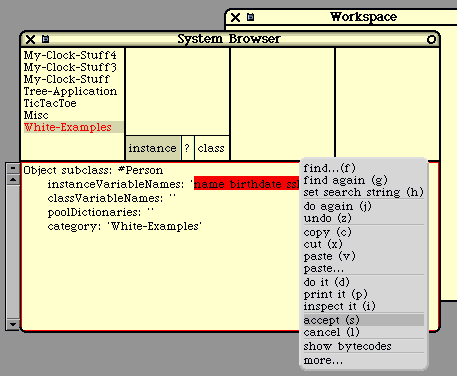
So that's what it's called. This user interface predates the Macintosh, in fact it predates the Xerox Star office system that inspired the Macintosh. It comes from the Smalltalk class browser. -
Re:Why is this news?
This flower is not that special for us here in Indonesia. It stinks.. and we plenty of this flower kind in Indonesia. If you've heard Raflessia Arnoldi, a giant stink flower http://www.emp.pdx.edu/htliono/images/p8.jpg which originated also from Indonesia is more special.
-
Netlab instead ?
In my Machine Learning class at Portland State U, we've been using the Netlab toolbox from Aston University Neural Computing Research Group, which is a set of Matlab libraries and programs. I haven't used Matlab's own neural network tools or done any of this stuff in my working life, but NetLab is at least a good learning tool, and is itself GPL.
Several people in the class have speculated how much work it would require to port NetLab to Octave, but AFAIK nobody's actually taken a look. I downloaded it to my linux box but haven't tried to do anything yet myself.
From the Netlab page: "The Netlab library includes software implementations of a wide range of data analysis techniques, many of which are not yet available in standard neural network simulation packages. Netlab works with Matlab version 5.0 and higher but only needs core Matlab (i.e. no other toolboxes are required). It is not compatible with earlier versions of Matlab." -
Re:Static code verifications, anyone?
Well, it appears to be worth next to nothing. What we have there is some guy looking at a few of his projects and deciding he doesn't need static type checking. And it's not completely clear if he makes this claim because he's not making type errors, or because his type errors are being caught by his unit tests.
He also makes a somewhat odd set of claims that:
a) He doesn't make type errors.
b) Dynamically typed code is easier to develop because he doesn't have to deal with build time type issues.
But... if he wasn't making type errors, then why would he have build time issues with static type-checking? I suppose I might be missing something, but what?
In any case this isn't even up to the fuzzy quality of Haskell vs. Ada vs. C++ vs. Awk vs. -
Re:Abe Lincoln and the 4'8" gauge railroads(Thanks for responding! I had fun looking this up. I might even do a paper on de facto standards for my Artificial Life course.)
No, true - or at least more true in this context than false. The cited article notes that this is:... perhaps more fairly labelled as "True, but for trivial and unremarkable reasons." Marvelling that the width of modern roadways is similar to the width of ancient roadways is sort of like getting excited over a notion such as "modern clothes sizes are based upon standards developed by medieval tailors.
IMHO, this is an excellent example of a de facto standard. Nobody seems to know if the Romans (or Babylonians or Egyptians?) officially adopted a standard, however one can argue that the width of wagons, chariots, gates, roads, streets and even the size of horses must have influenced each other, generating at the systems level a commonality of compatible "standards" - de facto.
I haven't found a citation with regard to what Lincoln wanted to do, so I leave that for another time.
This page at the US Army Transportation Museum is an interesting short history of the impact of railroads on the Civil War. It cites the same de facto history toward the end of the article. It is possible that the Army is wrong about this - this story was very popular amongst the DoD staffers, according to Puffert (see below.)
It is certain that this was a major national issue regarding the construction of the "Pacific Railroad". The first Pacific Railroad Act was passed in 1862. Section 12 specifies that "The track, upon the entire line of railroad and branches shall be of uniform width, to be determined by the President of the United States,
The FAQ notes that Central Pacific asked Lincoln to establish the gauge at five feet. This was because, "The railroads already existing in California with which the CPRR might likely connect were laid with a 5' 0" track gauge." This transcription of a telegram to Lincoln requesting the 5'0" gauge cites a separate communication from "eminent engineers" in favor of the 5'0" gauge, while this image is of a similar telegram objecting to the 5'0" gauge.
The 1863 Amendment establishes the gauge at 4' 8.5". However the history is not cited in the act. (My own speculation - a factor not specifically mentioned is that the Confederacy used a 5'0" gauge. If the Union began using a 5'0" gauge, then the Confederacy could conceivably use Union track to their benefit. This could have tipped some military minds in the decision. But I don't know the military's position on this topic.)
On the other hand, according to this 1996 analysis by researcher Douglas Puffert, the groove ruts that supposedly drove the whole thing don't seem to always be the same width, but nobody's done the research. Puffert notes that the early US railroad engineers copied the gauge of the Liverpool & Manchester railroad, which was based on the 4'8" track width commonly used in the mines - but 1/2" wider to allow for more wheel play. (There's more here, read if you're interested.)
From my own limited - but not trivial - experience around horses and buggies etc., I am comfortable with the idea that -
Our antenna thingy
For a different take on the antenna "gun", check out our "Trackmaster 2000" 802.11/ATV rocket tracking antenna for the PSAS launch vehicle.
-
Our antenna thingy
For a different take on the antenna "gun", check out our "Trackmaster 2000" 802.11/ATV rocket tracking antenna for the PSAS launch vehicle.
-
Re:Fair point actually
some wondeful-but-yet-to-be-conceived-of OS that gets written in 2009
You mean the hurd? -
In other news...
- WiFi VoIP tested in cold weather.
- WiFi VoIP tested for use during full moon.
- WiFi VoIP: can it work for brunettes?
Seriously. What possible reason would WiFi VoIP work any differently at 80MPH than in the rest Earth reference frame?
P.S. Before you say "Doppler Shift", go do the math and examine the chip specs. We have: we hope to shortly demonstrate 802.11b at Mach 2.
-
Advantages
I refer the reader here.
-
Re:damn those ham operators!
they're always screwing my wifi over, ugh! to think, you wish they'd just all grow old and die!
Become a ham operator, and you can massively boost the transmit power on WiFi cards by using a channel that overlaps with a HAM band. We do that to communicate from a Debian-based rocket to the ground from several miles up, using a 1-Watt WiFi power amplifier.
(Of course, no WEP, SSH, or any other form of encryption is allowed.) -
Re:It's gotta be about more than cashand I have never heard anything but good words about Apple from the OSS community.
Perhaps not from the OSS community, but the Free Software community has certainly had run-ins with Apple. Apple's New Look and Feel is an example. That's mostly ancient (i.e. before-WWW) history, so it's hard to find links.
-
Rocket fueled Debian
-
Re:Still not new
I would hope it would be good for surf-zone kayaking, too. Generally, people out kayaking don't want to be bothered with music, but communication is a huge issue. Those "waterproof" FRS radios don't work past your first wet exit, which is when you need them most.
-
hippie heating!
The building that I live in at Portland State University is a "green rated" building. Besides all the recirculated heat etc, it also uses collected rain water to do things like flush the pottys.
One of the advantages I guess to living in a state with dirt cheap electricity and *way* too much water