Slashdot Mirror
Domain: planetary.org
Stories and comments across the archive that link to planetary.org.
Stories · 129
-
China's Chang'e 3 Lander and Yutu Rover Camera Data Released
AmiMoJo writes: Detailed high resolution images from the recent Chinese moon mission have been released. Links to the original Chinese sites hosting the images are available, but Emily Lakdawalla of the Planetary Society has kindly organized them in English. Images show the lander, the rover and the surface of the earth. An interactive map is also available, built from data collected by the mission. -
China's Chang'e 3 Lander and Yutu Rover Camera Data Released
AmiMoJo writes: Detailed high resolution images from the recent Chinese moon mission have been released. Links to the original Chinese sites hosting the images are available, but Emily Lakdawalla of the Planetary Society has kindly organized them in English. Images show the lander, the rover and the surface of the earth. An interactive map is also available, built from data collected by the mission. -
Planetary Exploration In 2016 (planetary.org)
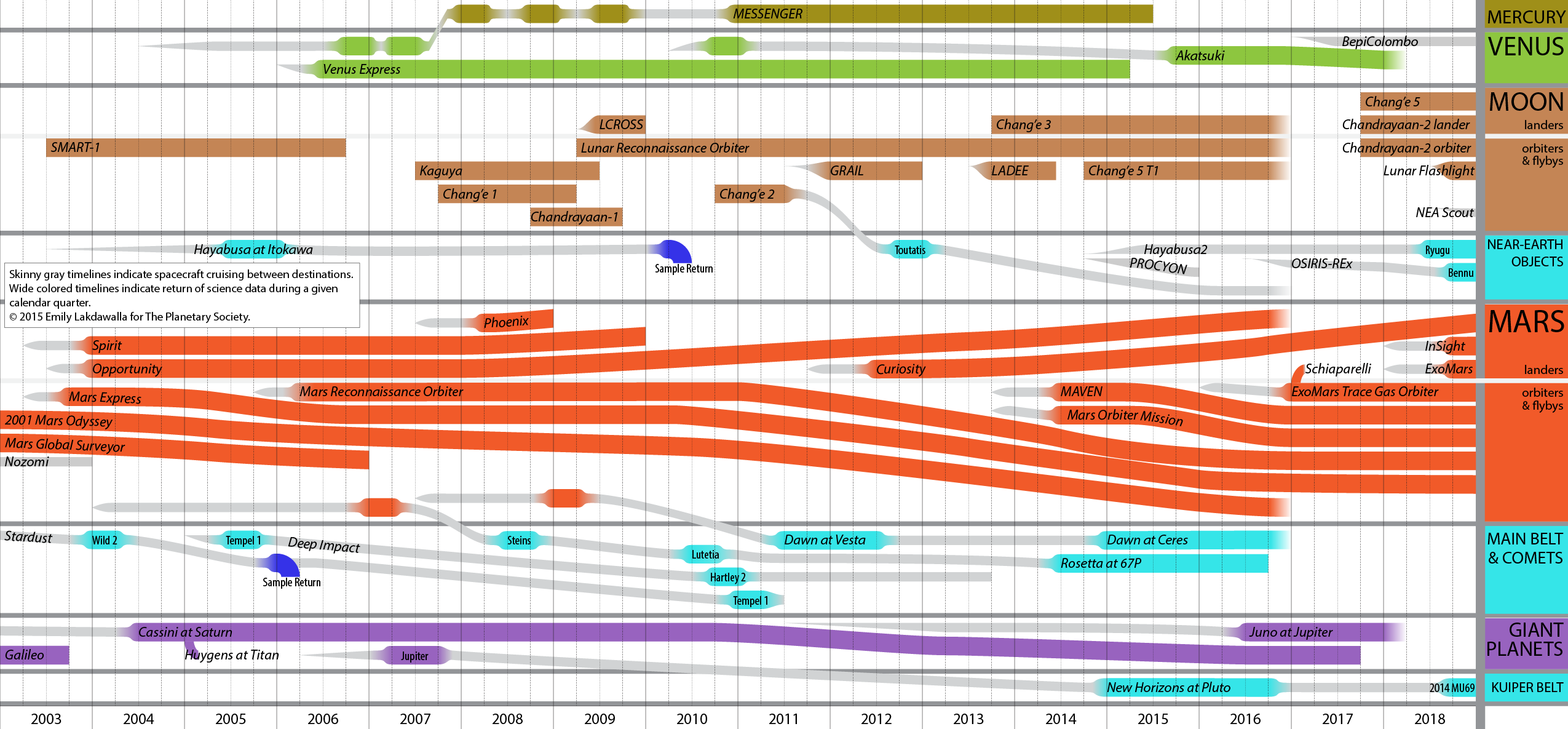
An anonymous reader writes: Emily Lakdawalla at the Planetary Society blog has put together a post about all of the space missions set to return data from planets, moons, and other bodies in the solar system this year. She's also assembled some cool visualizations of when the missions are active at their locations of interest. In summary: "Akatsuki is at Venus, Lunar Reconnaissance Orbiter and two Chang'e missions at the Moon, two rovers and five orbiters are active at Mars, Dawn is at Ceres, Rosetta is at 67P, Cassini is at Saturn, and although New Horizons is far past Pluto, it'll be sending back new Pluto science data for most of the year, so I'm counting that as still doing science. Another two missions (Hayabusa2 and Juno) are in their cruise phase; Juno arrives at Jupiter in August. Two (ExoMars Trace Gas Orbiter and OSIRIS-Rex) or three (if you count the Schiaparelli lander separately) will launch this year, with their science starting after 2016." -
SpaceX Lands Falcon 9 Rocket At Cape Canaveral (planetary.org)
Rei writes: At 8:40 PM today, SpaceX successfully launched and relanded the first stage of its Falcon 9 rocket at Cape Canaveral, as well as delivering to orbit the last portion of ORBCOMM's communication satellite constellation. This also marks SpaceX's return to flight and the first launch of the "Full Thrust" Falcon 9 v1.1 with densified (extremely chilled) propellants. The company will now shift its efforts toward catching up on its backlog, investigating and refurbishing its landed first stage, and preparing for the maiden flight of the Falcon Heavy rocket this spring. Congratulations to everyone at SpaceX! -
Budget Agreement Boosts US Science (sciencemag.org)
sciencehabit writes: The National Institutes of Health (NIH) leads the way among U.S science agencies getting increases in the final 2016 spending bill released today. NIH is the winner in absolute dollars. It gets a bump of $2 billion, or 6.6%, from its current budget of $30.1 billion. Spending on science programs at NASA would grow by 6.6%, to $5.6 billion, and rise by 5.6% in the Department of Energy's (DOE's) Office of Science, to $5.35 billion. The National Science Foundation would receive an additional $119 million, or 1.6%, to $7.46 billion, and the Advanced Research Projects Agency-Energy would get a 6% boost, to $291 million. NASA in particular got great allocations for planetary science and commercial crew. -
New Horizons Phones Home After Pluto Flyby -- Craft Healthy, Data Recorded
Tablizer was one of several readers to note that the New Horizons probe has completed its flyby of Pluto and radioed home to confirm that it went without incident. Mission Ops manager Alice Bowman said the spacecraft was healthy, full of data, and sharing telemetry. The images New Horizon collected haven't been downloaded yet, but NASA decided to tide us over by releasing this high-resolution view from the day before. It was taken when the probe was still 768,000 kilometers away with a resolution of 3.8km per pixel. (Closest approach was approximately 12,500km.) They also released an exaggerated-color image of Pluto and Charon which highlights the non-uniformity of both worlds.
Pictures from closest approach are not yet available. Expect another post late Wednesday or early Thursday with those images. The reason for this is that New Horizons can't take pictures and send them to us at the same time, so imaging activity is interspersed with downlinks to Earth to transmit data. Emily Lakdawalla has posted a downlink schedule. On Wednesday afternoon (ET), the probe will transmit three images of Pluto that were taken from 77,000km away, with a resolution of 0.4 km per pixel. They'll be the first three pieces of a mosaic of Pluto's surface, and the dwarf planet will fill all three frames. It will take a full 16 months for New Horizons to transmit all the data it collects. (Lakdawalla also added Pluto to a montage of the biggest non-planets in the solar system. New Horizon's measurements indicate Pluto is slightly larger than we thought. It's now considered the largest of the Kuiper Belt objects.) -
New Horizons Phones Home After Pluto Flyby -- Craft Healthy, Data Recorded
Tablizer was one of several readers to note that the New Horizons probe has completed its flyby of Pluto and radioed home to confirm that it went without incident. Mission Ops manager Alice Bowman said the spacecraft was healthy, full of data, and sharing telemetry. The images New Horizon collected haven't been downloaded yet, but NASA decided to tide us over by releasing this high-resolution view from the day before. It was taken when the probe was still 768,000 kilometers away with a resolution of 3.8km per pixel. (Closest approach was approximately 12,500km.) They also released an exaggerated-color image of Pluto and Charon which highlights the non-uniformity of both worlds.
Pictures from closest approach are not yet available. Expect another post late Wednesday or early Thursday with those images. The reason for this is that New Horizons can't take pictures and send them to us at the same time, so imaging activity is interspersed with downlinks to Earth to transmit data. Emily Lakdawalla has posted a downlink schedule. On Wednesday afternoon (ET), the probe will transmit three images of Pluto that were taken from 77,000km away, with a resolution of 0.4 km per pixel. They'll be the first three pieces of a mosaic of Pluto's surface, and the dwarf planet will fill all three frames. It will take a full 16 months for New Horizons to transmit all the data it collects. (Lakdawalla also added Pluto to a montage of the biggest non-planets in the solar system. New Horizon's measurements indicate Pluto is slightly larger than we thought. It's now considered the largest of the Kuiper Belt objects.) -
New Horizons Phones Home After Pluto Flyby -- Craft Healthy, Data Recorded
Tablizer was one of several readers to note that the New Horizons probe has completed its flyby of Pluto and radioed home to confirm that it went without incident. Mission Ops manager Alice Bowman said the spacecraft was healthy, full of data, and sharing telemetry. The images New Horizon collected haven't been downloaded yet, but NASA decided to tide us over by releasing this high-resolution view from the day before. It was taken when the probe was still 768,000 kilometers away with a resolution of 3.8km per pixel. (Closest approach was approximately 12,500km.) They also released an exaggerated-color image of Pluto and Charon which highlights the non-uniformity of both worlds.
Pictures from closest approach are not yet available. Expect another post late Wednesday or early Thursday with those images. The reason for this is that New Horizons can't take pictures and send them to us at the same time, so imaging activity is interspersed with downlinks to Earth to transmit data. Emily Lakdawalla has posted a downlink schedule. On Wednesday afternoon (ET), the probe will transmit three images of Pluto that were taken from 77,000km away, with a resolution of 0.4 km per pixel. They'll be the first three pieces of a mosaic of Pluto's surface, and the dwarf planet will fill all three frames. It will take a full 16 months for New Horizons to transmit all the data it collects. (Lakdawalla also added Pluto to a montage of the biggest non-planets in the solar system. New Horizon's measurements indicate Pluto is slightly larger than we thought. It's now considered the largest of the Kuiper Belt objects.) -
Pluto Probe Back To Normal, Cause of Snafu Found
Tablizer writes: NASA has provided an update to the problem with the New Horizons probe that will fly by Pluto next week. "The investigation into the anomaly that caused New Horizons to enter "safe mode" on July 4 has concluded that no hardware or software fault occurred on the spacecraft. The underlying cause of the incident was a hard-to-detect timing flaw in the spacecraft command sequence that occurred during an operation to prepare for the close flyby. No similar operations are planned for the remainder of the Pluto encounter. -
ESA Still Searching For Philae; May Have Zeroed In On a Possible Location
hypnosec writes with the news that the European Space Agency may have located the agency's Philae lander. The official Rosetta blog says Fortunately, it was possible to narrow down the lander’s final location by using the radio signals sent between Philae and Rosetta as part of the CONSERT experiment after the final touchdown. Combining data on the signal travel time between the two spacecraft with the known trajectory of Rosetta and the current best shape model for the comet, the CONSERT team have been able to establish the location of Philae to within an ellipse roughly 16 x 160 metres in size, just outside the rim of the Hatmehit depression. That means just a few candidates for Philae's current location, based on imaging performed by Rosetta's OSIRIS camera. -
Ground Crew Back In Touch With LightSail Solar Spacecraft
Yesterday, we noted that the Planetary Society's solar-sail powered craft had lost radio contact with its controllers here on Earth; Engadget reports that the group has issued an update, and the news is good. From the Society's release: "The solar sailing spacecraft test mission, a precursor to a 2016 mission, has now resumed contact after a suspected software glitch affected communications. The LightSail team will soon determine when to attempt deployment of the spacecraft’s Mylar solar sails." -
Crowdfunded, Solar-powered Spacecraft Goes Silent
Last week saw the successful launch of the Planetary Society's LightSail spacecraft, the solar-powered satellite that runs Linux and was crowdfunded on Kickstarter. The spacecraft worked flawlessly for two days, but then fell silent, and the engineering team has been working hard on a fix ever since. They've pinpointed the problem: a software glitch. "Every 15 seconds, LightSail transmits a telemetry beacon packet. The software controlling the main system board writes corresponding information to a file called beacon.csv. If you're not familiar with CSV files, you can think of them as simplified spreadsheets—in fact, most can be opened with Microsoft Excel. As more beacons are transmitted, the file grows in size. When it reaches 32 megabytes—roughly the size of ten compressed music files—it can crash the flight system." Unfortunately, the only way to clear that CSV file is to reboot LightSail. It can be done remotely, but as anyone who deals with crashing computers understands, remote commands don't always work. The command has been sent a few dozen times already, but LightSail remains silent. The best hope may now be that the system spontaneously reboots on its own. -
Crowdfunded, Solar-powered Spacecraft Goes Silent
Last week saw the successful launch of the Planetary Society's LightSail spacecraft, the solar-powered satellite that runs Linux and was crowdfunded on Kickstarter. The spacecraft worked flawlessly for two days, but then fell silent, and the engineering team has been working hard on a fix ever since. They've pinpointed the problem: a software glitch. "Every 15 seconds, LightSail transmits a telemetry beacon packet. The software controlling the main system board writes corresponding information to a file called beacon.csv. If you're not familiar with CSV files, you can think of them as simplified spreadsheets—in fact, most can be opened with Microsoft Excel. As more beacons are transmitted, the file grows in size. When it reaches 32 megabytes—roughly the size of ten compressed music files—it can crash the flight system." Unfortunately, the only way to clear that CSV file is to reboot LightSail. It can be done remotely, but as anyone who deals with crashing computers understands, remote commands don't always work. The command has been sent a few dozen times already, but LightSail remains silent. The best hope may now be that the system spontaneously reboots on its own. -
Crowdfunded, Solar-powered Spacecraft Goes Silent
Last week saw the successful launch of the Planetary Society's LightSail spacecraft, the solar-powered satellite that runs Linux and was crowdfunded on Kickstarter. The spacecraft worked flawlessly for two days, but then fell silent, and the engineering team has been working hard on a fix ever since. They've pinpointed the problem: a software glitch. "Every 15 seconds, LightSail transmits a telemetry beacon packet. The software controlling the main system board writes corresponding information to a file called beacon.csv. If you're not familiar with CSV files, you can think of them as simplified spreadsheets—in fact, most can be opened with Microsoft Excel. As more beacons are transmitted, the file grows in size. When it reaches 32 megabytes—roughly the size of ten compressed music files—it can crash the flight system." Unfortunately, the only way to clear that CSV file is to reboot LightSail. It can be done remotely, but as anyone who deals with crashing computers understands, remote commands don't always work. The command has been sent a few dozen times already, but LightSail remains silent. The best hope may now be that the system spontaneously reboots on its own. -
Planetary Society Wants To Launch a Crowd-Funded Solar Sail
jan_jes writes to note that The Planetary Society is attempting to crowdfund its own version of the light-powered space-craft popularized by Carl Sagan as a "solar sailer." (YouTube video, with the Society's CEO Bill Nye.) The current model is a CubeSat no bigger than a breadbox with four sails. If the team manages to raise enough money, LightSail will be sent to orbit aboard a SpaceX Falcon Heavy rocket in 2016. LightSail will be released into an orbit with an altitude of 720 kilometers (450 miles), high enough to escape most of the planet's atmospheric drag. Their crowdfunding goal has been far surpassed (more than $476,000 at this writing), but more can't hurt; maybe NASA could use some of the surplus. -
Planetary Society Wants To Launch a Crowd-Funded Solar Sail
jan_jes writes to note that The Planetary Society is attempting to crowdfund its own version of the light-powered space-craft popularized by Carl Sagan as a "solar sailer." (YouTube video, with the Society's CEO Bill Nye.) The current model is a CubeSat no bigger than a breadbox with four sails. If the team manages to raise enough money, LightSail will be sent to orbit aboard a SpaceX Falcon Heavy rocket in 2016. LightSail will be released into an orbit with an altitude of 720 kilometers (450 miles), high enough to escape most of the planet's atmospheric drag. Their crowdfunding goal has been far surpassed (more than $476,000 at this writing), but more can't hurt; maybe NASA could use some of the surplus. -
Opportunity Rover Reaches Martian Day 4,000 of Its 90-Day Mission
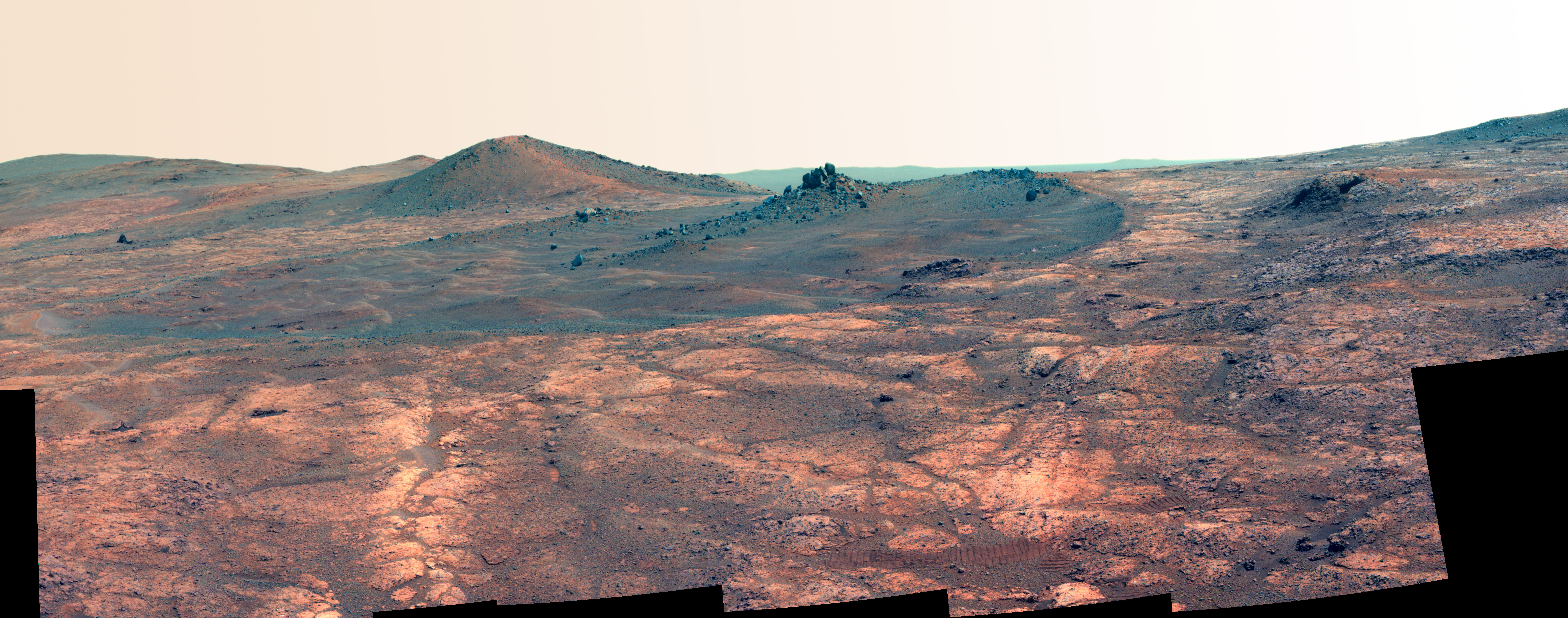
An anonymous reader writes: Let's take a moment to appreciate the incredible engineering, scientific, and planning skill that went into the construction and deployment of the Opportunity rover. It landed on Mars with the goal of surviving 90 sols (Martian days), and it has just logged its 4,000th sol of harvesting valuable data and sending it back to us. The Planetary Society blog has posted a detailed update on Opportunity's status, and its team's plans for the future. The rover's hardware, though incredibly resilient, is wearing down. They reformatted its flash drive to block off a corrupted sector, and that solved some software problems that had cropped up. They're currently trying to figure out why the rover unexpectedly rebooted itself. Those events are incredibly dangerous to the rover's survival, so their highest priority right now is diagnosing that issue.
Fortunately, weather on Mars is good where the rover is, and it's still able to harvest upwards of 500 Watt-hours of energy from its solar panels. Opportunity recently completed a marathon on Mars and took an impressive picture of the Spirit of St. Louis crater, and the rover will soon be on its way to enormous clay deposits that could provide valuable information about where we can look for water when we eventually put people on Mars. As always, you can look through Opportunity's images at the official website. -
Opportunity Rover Reaches Martian Day 4,000 of Its 90-Day Mission
An anonymous reader writes: Let's take a moment to appreciate the incredible engineering, scientific, and planning skill that went into the construction and deployment of the Opportunity rover. It landed on Mars with the goal of surviving 90 sols (Martian days), and it has just logged its 4,000th sol of harvesting valuable data and sending it back to us. The Planetary Society blog has posted a detailed update on Opportunity's status, and its team's plans for the future. The rover's hardware, though incredibly resilient, is wearing down. They reformatted its flash drive to block off a corrupted sector, and that solved some software problems that had cropped up. They're currently trying to figure out why the rover unexpectedly rebooted itself. Those events are incredibly dangerous to the rover's survival, so their highest priority right now is diagnosing that issue.
Fortunately, weather on Mars is good where the rover is, and it's still able to harvest upwards of 500 Watt-hours of energy from its solar panels. Opportunity recently completed a marathon on Mars and took an impressive picture of the Spirit of St. Louis crater, and the rover will soon be on its way to enormous clay deposits that could provide valuable information about where we can look for water when we eventually put people on Mars. As always, you can look through Opportunity's images at the official website. -
SpaceX To Try a First Stage Recovery Again On April 13
schwit1 writes: In its next launch on Monday, SpaceX will once again try to safely land its first stage on an ocean barge, allowing the reuse of that stage in later flights. "Following first stage separation, thrusters flip the rocket so the engines are pointing in the direction of travel. First, there’s a boostback burn to refine the rocket’s trajectory, causing the rocket to fly through its own exhaust (the space shuttle's risky Return-to-Launch-Site abort scenario relied on a similar maneuver). While the vehicle is still traveling faster than the speed of sound, four grid fins deploy, steering the rocket as it plummets toward the ocean. An entry burn slows the rocket further, and landing legs unfold. A final engine burn settles the Falcon onto [the barge]." Monday afternoon is certainly going to be an exciting day for space cadets. First, at 4 pm (Eastern) the head of ULA will reveal the design of the company's new rocket. Then, at 4:33 pm (Eastern), SpaceX will launch Dragon to ISS while attempting to return the first stage safely. -
Planetary Society Pushes For Mars Orbital Mission Before NASA Landing
MarkWhittington writes The Planetary Society announced Thursday the results of the "Humans Orbiting Mars" workshop that brought in a number of space experts to develop helpful suggestions for how NASA can fulfill its mandate to send humans to Mars in the 2030s and return them safely to the Earth. The plan is to send a mission to orbit Mars in 2033 in advance of the landing mission in the late 2030s. The workshop believes that this could be done for a NASA budget that increases about two percent a year after the International Space Station is decommissioned in 2024. -
Report: NASA May Miss SLS Launch Deadline
An anonymous reader writes: A post at the Planetary Society's blog summarizes a report from NASA's Office of Inspector General which says the agency will struggle to get launch facilities up and running in time for the Space Launch System's November 2018 launch deadline. "Ground systems are a critical piece of the SLS-Orion infrastructure. All three elements are tightly integrated, with ground systems requiring significant input from the rocket and capsule designs." To be more specific, NASA has found 462 separate inter-dependencies, less than two-thirds of which have been resolved so far. "The Mobile Launcher must be moved into the Vehicle Assembly Building for testing prior to the delivery of SLS and Orion. When it comes time to stack the rocket and capsule for the first flight, there may be a 'learning curve,' said the OIG, where engineers work through unforeseen glitches." They're also worried about having to develop all the software to run these systems before the hardware is in place to test. -
NASA's Dawn Spacecraft Becomes First To Orbit a Dwarf Planet
The Grim Reefer writes with news that at 7:39 AM EST (12:39 UTC) today, NASA's Dawn spacecraft was captured by the gravity of dwarf planet Ceres. Mission controllers at NASA's Jet Propulsion Laboratory (JPL) in Pasadena, California received a signal from the spacecraft at 5:36 a.m. PST (8:36 a.m. EST) that Dawn was healthy and thrusting with its ion engine, the indicator Dawn had entered orbit as planned. "Since its discovery in 1801, Ceres was known as a planet, then an asteroid and later a dwarf planet," said Marc Rayman, Dawn chief engineer and mission director at JPL. "Now, after a journey of 3.1 billion miles (4.9 billion kilometers) and 7.5 years, Dawn calls Ceres home." In addition to being the first spacecraft to visit a dwarf planet, Dawn also has the distinction of being the first mission to orbit two extraterrestrial targets. From 2011 to 2012, the spacecraft explored the giant asteroid Vesta, delivering new insights and thousands of images from that distant world. Ceres and Vesta are the two most massive residents of our solar system's main asteroid belt between Mars and Jupiter. Further details available from the Planetary Society. -
One Astronomer's Quest To Reinstate Pluto As a Planet
sarahnaomi writes: Most of us grew up believing that tiny, distant Pluto was the outermost planet in our solar system. Then, one day, the scientific powers that be decreed that it wasn't. But it seems the matter is far from settled. David Weintraub—who describes Pluto's exile as a stunt organized by a "very small clique of Pluto-haters"—would have the dwarf world rejoin the ranks of our Solar System's fully-fledged planets today. But solid evidence that Pluto deserves the title may come in July, when NASA's New Horizons spacecraft slingshots around the icy rock and sends us back a detailed picture of its composition. Pluto's planethood was revoked by majority vote on the final day of the 2006 IAU conference. Over 2,500 astronomers attended the meeting throughout the week, but only 394 votes ultimately decided Pluto's fate: 237 in favor of demoting the planet and 157 against. -
SpaceX Landing Attempt Video Released
An anonymous reader writes: Last week, SpaceX attempted to land a Falcon 9 rocket on an autonomous ocean platform after successfully launching supplies to the ISS. It didn't work, but Elon Musk said they were close. Now, an amazing video has been recovered from an onboard camera, and it shows just how close it was. You can see the rocket hitting the platform while descending at an angle, then breaking up. Musk said a few days ago that not only do they know what the problem was, but they've already solved it. The rocket's guiding fins require hydraulic fluid to operate. They had enough fluid to operate for 4 minutes, but ran out just prior to landing. Their next launch already carries 50% more hydraulic fluid, so it shouldn't be an issue next time. -
Culberson As Chair of NASA Fundng Subcommittee Makes Europa Mission More Likely
MarkWhittington writes: As many have expected, Rep. John Culberson (R-TX) has been elevated to chair the House Appropriations Subcommittee for Commerce, Justice, and Science. The subcommittee has charge of NASA funding, something of keen interest for the congressman, whose Houston district is close to the Johnson Spaceflight Center. Moreover, Culberson's enthusiasm for space exploration goes far beyond what would be expected from a Texas representative.
Culberson is a champion of a mission to Europa, a moon of Jupiter. Europa is an ice-covered moon that is thought to conceal an ocean of water, warmed by tidal forces, which might contain life. Using the heavy-lift Space Launch System, NASA could launch a large-scale probe to study Europa and ascertain whether it harbors alien life or not. Culberson's elevation makes such a mission far more likely to occur. -
Philae Lands Successfully On Comet
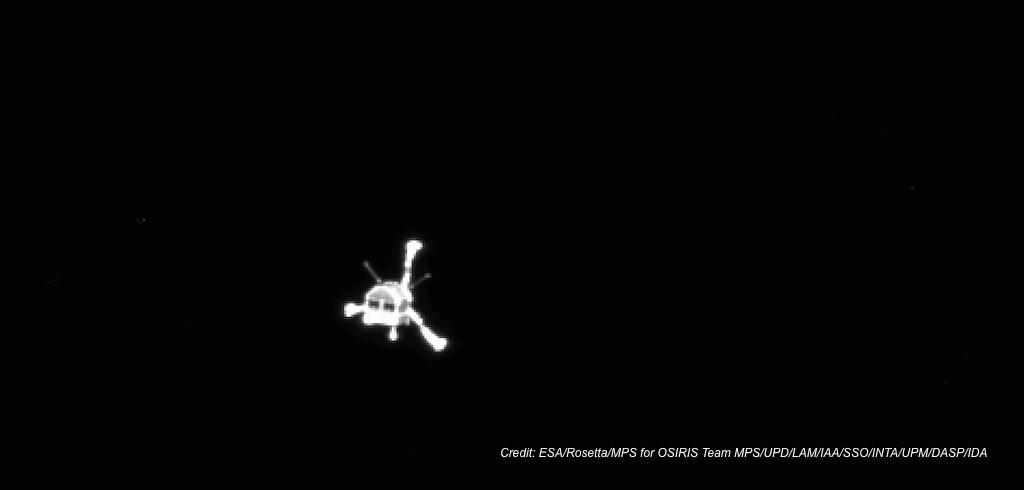
The European Space Agency has confirmed that the Philae probe has successfully landed on the comet 67P/Churyumov–Gerasimenko and established contact with headquarters. The harpoons have deployed and reeled in the slack, and the landing gear has retracted. (Edit: They're now saying the harpoons didn't fire after all.) There are no photos from the surface yet, but the Rosetta probe snapped this picture of Philae after initial separation, and Philae took this picture of Rosetta. Emily Lakdawalla has a timeline of the operation (cached). She notes that there was a problem with the gas thruster mounted on top of the lander. The purpose of the thruster was to keep the lander on the comet after landing, since there was a very real possibility that it could bounce off. (The comet's local gravity is only about 10^-3 m/s^2.) The pins that were supposed to puncture the wax seal on the jet were unable to do so for reasons unknown. Still, the jet did not seem to be necessary. The official ESA Rosetta site will be continually updating as more data comes back. -
Philae Lands Successfully On Comet
The European Space Agency has confirmed that the Philae probe has successfully landed on the comet 67P/Churyumov–Gerasimenko and established contact with headquarters. The harpoons have deployed and reeled in the slack, and the landing gear has retracted. (Edit: They're now saying the harpoons didn't fire after all.) There are no photos from the surface yet, but the Rosetta probe snapped this picture of Philae after initial separation, and Philae took this picture of Rosetta. Emily Lakdawalla has a timeline of the operation (cached). She notes that there was a problem with the gas thruster mounted on top of the lander. The purpose of the thruster was to keep the lander on the comet after landing, since there was a very real possibility that it could bounce off. (The comet's local gravity is only about 10^-3 m/s^2.) The pins that were supposed to puncture the wax seal on the jet were unable to do so for reasons unknown. Still, the jet did not seem to be necessary. The official ESA Rosetta site will be continually updating as more data comes back. -
Rosetta's Philae Probe To Land On Comet Tomorrow
An anonymous reader writes: After more than 10 years travelling, the Rosetta mission will take its next, momentous step by landing the Philae probe on comet 67P/Churyumov-Gerasimenko tomorrow. How f!@#$%ing cool is that?! Follow the landing live using the webcast, blog, or Twitter feed. (Keep in mind there's a 28-minute delay due to the time it takes the radio signals to reach Earth). Here's the scheduling info: "For the primary landing scenario, targeting Site J, Rosetta will release Philae at 08:35 GMT/09:35 CET at a distance of 22.5 km from the center of the comet, landing about seven hours later. The one-way signal travel time between Rosetta and Earth on 12 November is 28 minutes 20 seconds, meaning that confirmation of the landing will arrive at Earth ground stations at around 16:00 GMT/17:00 CET. If a decision is made to use the backup Site C, separation will occur at 13:04 GMT/14:04 CET, 12.5 km from the center of the comet. Landing will occur about four hours later, with confirmation on Earth at around 17:30 GMT/18:30 CET. The timings are subject to uncertainties of several minutes." -
China Completes Its First Lunar Return Mission
China's Chang'e 5-T1 mission to the moon has not only taken some beautiful pictures of the Earth from the craft's perspective (hat tip to reader Taco Cowboy) but as of Friday evening (continental U.S. time) returned a capsule to Earth. (The capsule landed in Inner Mongolia.) From the linked article: Prior to re-entering the Earths atmosphere, the unnamed probe was travelling at 11.2 kilometres per second (25,000 miles per hour), a speed that can generate temperatures of more than 1,500 degrees Celsius (2,700 degrees Fahrenheit), the news agency reported. To slow it down, scientists let the craft "bounce" off Earths atmosphere before re-entering again and landing. ... The module would have been 413,000 kilometres from Earth at its furthest point on the mission, SASTIND said at the time. The mission was launched to test technology to be used in the Change-5, Chinas fourth lunar probe, which aims to gather samples from the moons surface and will be launched around 2017, SASTIND previously said. -
A Look At Orion's Launch Abort System
An anonymous reader writes: With the construction of Orion, NASA's new manned spacecraft, comes the creation of a new Launch Abort System — the part of the vehicle that will get future astronauts back to Earth safely if there's a problem at launch. The Planetary Society's Jason Davis describes it: "When Orion reaches the apex of its abort flight, it is allowed to make its 180-degree flip. The capsule of astronauts, who have already realized they will not go to space today, experience a brief moment of weightlessness before the capsule starts falling back to Earth, heat shield down. The jettison motor fires, pulling the LAS away from Orion. ... Orion, meanwhile, sheds its Forward Bay Cover, a ring at the top of the capsule protecting the parachutes. Two drogue chutes deploy, stabilizing the wobbling capsule. The drogues pull out Orion's three main chutes, no doubt eliciting a sigh of relief from the spacecraft's occupants." -
Rosetta Takes Stunning Self-Portrait 10 Miles From Comet's Surface
astroengine writes: At a distance of only 10 miles from comet 67P/Churyumov-Gerasimenko's surface, the European Rosetta mission has captured yet another dazzling self portrait with the dark comet lurking in the background. But the orbiter couldn't have snapped this picture without the help of a little friend — the attached Philae lander that is currently undergoing preparations for its historic comet surface landing in November. -
How President Nixon Saved/Wrecked the American Space Program
MarkWhittington writes John Callahan posted an accountof a talk given by space historian John Logsdon on the Planetary Society blog in which he described how President Richard Nixon changed space policy. The talk covered the subject of an upcoming book, After Apollo: Richard Nixon and the American Space Program. Logsdon argued that Nixon had a far more lasting effect on NASA and the American space program than did President Kennedy, most famous for starting the Apollo project that landed men on the moon.
Nixon came to office just in time to preside over the Apollo 11 lunar mission. At that time, the space program was a national priority due to the Kennedy goal of landing a man on the moon by the end of the 1960s. However by the time Neil Armstrong made that first footstep, public support for large-scale space projects had diminished. Nixon, therefore, made a number of policy decisions that redound to this very day. -
NASA's Competition For Dollars
An anonymous reader writes: We often decry the state of funding to NASA. Its limited scope has kept us from returning to the moon for over four decades, maintained only a minimal presence in low-Earth orbit, and failed to develop a capable asteroid defense system. But why is funding such a problem? Jason Callahan, who has worked on several of NASA's annual budgets, says it's not just NASA's small percentage of the federal budget that keeps those projects on the back burner, but also competition for funding between different parts of NASA as well. "[NASA's activities include] space science, including aeronautics research (the first A in NASA), technology development, education, center and agency management, construction, maintenance, and the entire human spaceflight program. The total space science budget has rarely exceeded $5 billion, and has averaged just over half that amount. Remember that space science is more than just planetary: astrophysics, heliophysics, and Earth science are all funded in this number. Despite this, space science accounts for an average of 17 percent of NASA's total budget, though it has significant fluctuations. In the 1980s, space science was a mere 11½ percent of NASA's budget, but in the 2000s, it made up 27 percent." -
NASA's Competition For Dollars
An anonymous reader writes: We often decry the state of funding to NASA. Its limited scope has kept us from returning to the moon for over four decades, maintained only a minimal presence in low-Earth orbit, and failed to develop a capable asteroid defense system. But why is funding such a problem? Jason Callahan, who has worked on several of NASA's annual budgets, says it's not just NASA's small percentage of the federal budget that keeps those projects on the back burner, but also competition for funding between different parts of NASA as well. "[NASA's activities include] space science, including aeronautics research (the first A in NASA), technology development, education, center and agency management, construction, maintenance, and the entire human spaceflight program. The total space science budget has rarely exceeded $5 billion, and has averaged just over half that amount. Remember that space science is more than just planetary: astrophysics, heliophysics, and Earth science are all funded in this number. Despite this, space science accounts for an average of 17 percent of NASA's total budget, though it has significant fluctuations. In the 1980s, space science was a mere 11½ percent of NASA's budget, but in the 2000s, it made up 27 percent." -
Wheel Damage Adding Up Quickly For Mars Rover Curiosity
An anonymous reader writes: The folks in charge of the Mars rover Curiosity have been trying to solve an increasingly urgent problem: what to do about unexpected wheel damage. The team knew from the start that wear and tear on the wheels would slowly accumulate, but they've been surprised at how quickly the wheels have degraded over the past year. Emily Lakdawalla at the Planetary Society blog has posted a detailed report on the team's conclusions as to what's causing the damage and how they can mitigate it going forward. Quoting: "The tears result from fatigue. You know how if you bend a metal paper clip back and forth repeatedly, it eventually snaps? Well, when the wheels are driving over a very hard rock surface — one with no sand — the thin skin of the wheels repeatedly bends. The wheels were designed to bend quite a lot, and return to their original shape. But the repeated bending and straightening is fatiguing the skin, causing it to fracture in a brittle way. The bending doesn't happen (or doesn't happen as much) if the ground gives way under the rover's weight, as it does if it's got the slightest coating of sand on top of rock. It only happens when the ground is utterly impervious to the rover's weight — hard bedrock. The stresses from metal fatigue are highest near the tips of the chevron features, and indeed a lot of tears seem to initiate close to the chevron features." -
Why NASA's Budget "Victory" Is Anything But
StartsWithABang (3485481) writes 'Earlier this week, attempts to cut NASA's budget were defeated, and it looks like the largest space agency in the world will actually be getting nearly a 2% budget increase overall. While common news outlets are touting this as a great budget victory, the reality is that this is shaping up to be just another year of pathetic funding levels, putting our greatest dreams of exploring and understanding the Universe on hold. A sobering read for anyone who hasn't realized what we could be doing.' -
Software Upgrade At 655 Million Kilometers
An anonymous reader writes "The Rosetta probe was launched in 2004 with a mission that required incredible planning and precision: land on a comet. After a decade in space, the probe woke from hibernation in January. Now, Rosetta has spotted its target. 'Rosetta is currently around 5 million kilometers from the comet, and at this distance it is still too far away to resolve – its light is seen in less than a pixel and required a series of 60–300 second exposures taken with the wide-angle and narrow-angle camera. The data then traveled 37 minutes through space to reach Earth, with the download taking about an hour per image.' Now it's time to upgrade the probe's software. Since it's currently 655,000,000 kilometers from Earth, the operation needs to be flawless. 'When MIDAS is first powered up, it boots into "kernel mode" – the kernel manages a very robust set of basic operations for communicating with the spacecraft and the ground and for managing the more complex main program. From kernel mode we can upload patches to the main software, verify the current contents, or even load an entirely new version.' The Rosetta blog is continually being updated with progress on the mission, and the Planetary Society has more information as well. The probe will arrive at the comet in August, and will attempt landing in November." -
Small World Discovered Far Beyond Pluto
astroengine writes: "After a decade of searching, astronomers have found a second dwarf-like planet far beyond Pluto and its Kuiper Belt cousins, a presumed no-man's land that may turn out to be anything but. How Sedna, which was discovered in 2003, and its newly found neighbor, designated 2012 VP 2113 by the Minor Planet Center, came to settle in orbits so far from the sun is a mystery. Sedna comes no closer than about 76 times as far from the sun as Earth, or 76 astronomical units. The most distant leg of its 11,400-year orbit is about 1,000 astronomical units. Newly found VP 2113's closest approach to the sun is about 80 astronomical units and its greatest distance is 452 astronomical units (abstract). The small world is roughly 280 miles (450 kilometers) wide, less than half the estimated diameter of Sedna." -
Waves Spotted On Titan
minty3 writes "Planetary scientists believe they have observed waves rippling on one of Titan's seas. The findings, presented on March 17 at the Lunar and Planetary Science Conference, describes how the Cassini spacecraft captured images of sunlight glinting off the Punga Mare (abstract), suggesting they are not reflective sunlight but waves." The Planetary Society recently posted a nice breakdown of the basics about Titan's lakes: "To flow with liquid, those river valleys must have been filled with methane that came from higher elevations; it had to rain methane on Titan. Rainfall runs off, and then what? It must pool somewhere. What we learned from the Cassini orbiter at Saturn is that there are lakes on Titan. ... Rainfall, river runoff, lakes, evaporation into clouds, rainfall again. Cassini has seen clouds make storms on Titan. We have seen the whole cycle -- it's just like Earth's water cycle, but with a completely different substance [methane], and much, much colder." -
Computing a Winner, Fusion a Loser In US Science Budget
sciencehabit writes "President Barack Obama has released a $3.901 trillion budget request to Congress, including proposals for a host of federal research agencies. Science Magazine has the breakdown, including a big win for advanced computing, a big cut for fusion, and status quo for astronomy. 'In the proposed budget, advanced computing would see its funding soar 13.2% to $541 million. BES, the biggest DOE program, would get a boost of 5.5% to $1.807 billion. BER would get a 3% bump to $628 million, and nuclear physics would enjoy a 4.3% increase to $594 million. In contrast, the fusion program would take a 17.6% cut to $416 million—$88 million less than it's getting this year. Although far from final, the numbers suggest another big dip for a program that has enjoyed a roller coaster ride in recent years. In its proposed 2013 budget, DOE called for slashing spending on domestic fusion research to help pay for the increasing U.S. contribution to the international fusion experiment, ITER, in Cadarache, France.'" The Association of American Universities has issued a letter disapproving of the amount of research funding. The Planetary Society has broken down the proposed NASA budget. -
NASA Forgets How To Talk To ICE/ISEE-3 Spacecraft
Hugh Pickens DOT Com writes "Randall Munroe's XKCD cartoon on the ICE/ISEE-3 spacecraft inspired me to do a little research on why Nasa can no long communicate with the International Cometary Explorer. Launched in 1978 ISEE-3 was the first spacecraft to be placed in a halo orbit at one of Earth-Sun Lagrangian points (L1). It was later (as ICE) sent to visit Comet Giacobini-Zinner and became the first spacecraft to do so by flying through a comet's tail passing the nucleus at a distance of approximately 7800 km. ICE has been in a heliocentric orbit since then, traveling just slightly faster than Earth and it's finally catching up to us from behind, and will return to Earth in August. According to Emily Lakdawalla, it's still functioning, broadcasting a carrier signal that the Deep Space Network successfully detected in 2008 and twelve of its 13 instruments were working when we last checked on its condition, sometime prior to 1999.
Can we tell the spacecraft to turn back on its thrusters and science instruments after decades of silence and perform the intricate ballet needed to send it back to where it can again monitor the Sun? Unfortunately the answer to that question appears to be no. 'The transmitters of the Deep Space Network, the hardware to send signals out to the fleet of NASA spacecraft in deep space, no longer includes the equipment needed to talk to ISEE-3. These old-fashioned transmitters were removed in 1999.' Could new transmitters be built? Yes, but it would be at a price no one is willing to spend. 'So ISEE-3 will pass by us, ready to talk with us, but in the 30 years since it departed Earth we've lost the ability to speak its language,' concludes Lakdawalla. 'I wonder if ham radio operators will be able to pick up its carrier signal — it's meaningless, I guess, but it feels like an honorable thing to do, a kind of salute to the venerable ship as it passes by.'" -
NASA Forgets How To Talk To ICE/ISEE-3 Spacecraft
Hugh Pickens DOT Com writes "Randall Munroe's XKCD cartoon on the ICE/ISEE-3 spacecraft inspired me to do a little research on why Nasa can no long communicate with the International Cometary Explorer. Launched in 1978 ISEE-3 was the first spacecraft to be placed in a halo orbit at one of Earth-Sun Lagrangian points (L1). It was later (as ICE) sent to visit Comet Giacobini-Zinner and became the first spacecraft to do so by flying through a comet's tail passing the nucleus at a distance of approximately 7800 km. ICE has been in a heliocentric orbit since then, traveling just slightly faster than Earth and it's finally catching up to us from behind, and will return to Earth in August. According to Emily Lakdawalla, it's still functioning, broadcasting a carrier signal that the Deep Space Network successfully detected in 2008 and twelve of its 13 instruments were working when we last checked on its condition, sometime prior to 1999.
Can we tell the spacecraft to turn back on its thrusters and science instruments after decades of silence and perform the intricate ballet needed to send it back to where it can again monitor the Sun? Unfortunately the answer to that question appears to be no. 'The transmitters of the Deep Space Network, the hardware to send signals out to the fleet of NASA spacecraft in deep space, no longer includes the equipment needed to talk to ISEE-3. These old-fashioned transmitters were removed in 1999.' Could new transmitters be built? Yes, but it would be at a price no one is willing to spend. 'So ISEE-3 will pass by us, ready to talk with us, but in the 30 years since it departed Earth we've lost the ability to speak its language,' concludes Lakdawalla. 'I wonder if ham radio operators will be able to pick up its carrier signal — it's meaningless, I guess, but it feels like an honorable thing to do, a kind of salute to the venerable ship as it passes by.'" -
Chang'e-3 Lunar Rover Landing Slated For 13:40 UTC Saturday
savuporo writes "The Chinese Chang'e-3 probe will be landing on the moon [Saturday], 13:40 UTC. CCTV is likely to carry the event live as they did for initial launch. According to technical overview of the mission scenario and instruments, the landing will be fully autonomous with active landing hazard avoidance, which is the first time this has been attempted on any planetary landing. More real-time updates can be found on Twitter with ChangE3 hash tag and NASASpaceFlight forums live event section." -
Comet ISON Survives Perihelion (Barely)
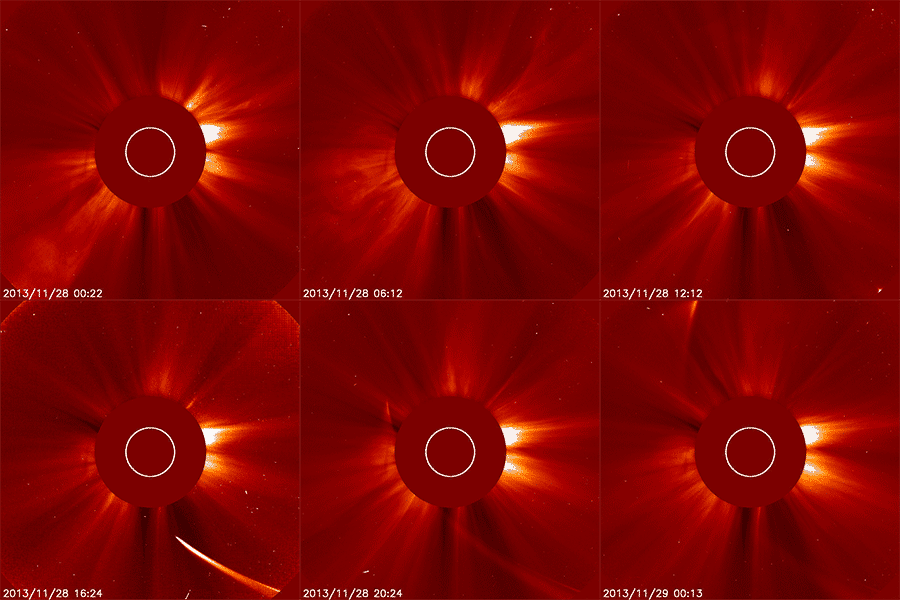
An anonymous reader sends this update from NightSkyInfo: "Yesterday, when Comet ISON plunged through the solar atmosphere and behind SOHO's coronagraph (the black disk designed to block out the direct light from the Sun), its nucleus dwindled away to nothing and most of the tail simply evaporated. Everyone assumed that the comet completely disintegrated and died a fiery death. However, several hours after perihelion, ISON began to brighten up again. It is now distinctly evident on live images from SOHO, looks like a comet, and continues to brighten as it moves farther away from the Sun." Experts are unwilling to say precisely how intact the comet is — we'll need more data to make a conclusion about that — but astrophysicist Karl Battams says this is their best guess: 'As comet ISON plunged towards to the Sun, it began to fall apart, losing not giant fragments but at least a lot of reasonably sized chunks. There's evidence of very large dust in the form of that long thin tail we saw in the LASCO C2 images. Then, as ISON plunged through the corona, it continued to fall apart and vaporize, and lost its coma and tail completely just like Lovejoy did in 2011. (We have our theories as to why it didn't show up in the SDO images but that's not our story to tell - the SDO team will do that.) Then, what emerged from the Sun was a small but perhaps somewhat coherent nucleus, that has resumed emitting dust and gas for at least the time being. In essence, the tail is growing back, as Lovejoy's did.' Here's a GIF of the comet rounding the Sun (put together by Emily Lakdawalla). -
Comet ISON Survives Perihelion (Barely)
An anonymous reader sends this update from NightSkyInfo: "Yesterday, when Comet ISON plunged through the solar atmosphere and behind SOHO's coronagraph (the black disk designed to block out the direct light from the Sun), its nucleus dwindled away to nothing and most of the tail simply evaporated. Everyone assumed that the comet completely disintegrated and died a fiery death. However, several hours after perihelion, ISON began to brighten up again. It is now distinctly evident on live images from SOHO, looks like a comet, and continues to brighten as it moves farther away from the Sun." Experts are unwilling to say precisely how intact the comet is — we'll need more data to make a conclusion about that — but astrophysicist Karl Battams says this is their best guess: 'As comet ISON plunged towards to the Sun, it began to fall apart, losing not giant fragments but at least a lot of reasonably sized chunks. There's evidence of very large dust in the form of that long thin tail we saw in the LASCO C2 images. Then, as ISON plunged through the corona, it continued to fall apart and vaporize, and lost its coma and tail completely just like Lovejoy did in 2011. (We have our theories as to why it didn't show up in the SDO images but that's not our story to tell - the SDO team will do that.) Then, what emerged from the Sun was a small but perhaps somewhat coherent nucleus, that has resumed emitting dust and gas for at least the time being. In essence, the tail is growing back, as Lovejoy's did.' Here's a GIF of the comet rounding the Sun (put together by Emily Lakdawalla). -
Comet ISON Approaches Perihelion
New submitter BugNuker writes "Comet ISON has been speeding towards the sun, and while doing so, it has been getting brighter. There was hope that ISON would be 'Comet of the Century' material. That does not seem to be the case, but it still exists and it's still very interesting. Recently, ISON has undergone some outbursts, making it a near naked-eye object. ISON is still approaching perihelion (it will get there at 18:25 UTC on 28 November). For now, we can keep watching the STEREO spacecraft images for more evidence." Emily Lakdawalla of the Planetary Society put together this animated GIF of the comet from images taken by the STEREO-A spacecraft. Karl Battams put together a fascinating GIF as well. The Planetary Society has a list of information feeds and scheduled events for keeping tabs on ISON. -
Comet ISON Approaches Perihelion
New submitter BugNuker writes "Comet ISON has been speeding towards the sun, and while doing so, it has been getting brighter. There was hope that ISON would be 'Comet of the Century' material. That does not seem to be the case, but it still exists and it's still very interesting. Recently, ISON has undergone some outbursts, making it a near naked-eye object. ISON is still approaching perihelion (it will get there at 18:25 UTC on 28 November). For now, we can keep watching the STEREO spacecraft images for more evidence." Emily Lakdawalla of the Planetary Society put together this animated GIF of the comet from images taken by the STEREO-A spacecraft. Karl Battams put together a fascinating GIF as well. The Planetary Society has a list of information feeds and scheduled events for keeping tabs on ISON. -
Another Science Facility Bites the Dust, Temporarily
An anonymous reader writes "Today, the latest victim of the U.S. government shutdown, the National Radio Astronomy Observatory shut its doors and essentially mothballed all three of its radio telescope facilities: the Very Large Array or VLA (think Jodie Foster, Contact); the Green Bank Telescope, and the Very Long Baseline Array or VLBA. While the ALMA telescope is not yet affected (mainly due to it being run by a consortium of European, Japanese, Chilean and U.S. organizations), the U.S. funds for that will soon also dry up. Not only does this furlough most of the ~550 employees, it has also thrown a monkey wrench into many long-term carefully planned observations (to the tune of wasting half a million dollars and a year's worth of work). Emily Lakdawalla of the Planetary Society also has a commentary on the closure — and a plea to 'stop the madness.'" -
Asteroid 2012 DA14 Approaches
Today at about 19:25 UTC (2:25 PM EST), Asteroid 2012 DA14 will make its closest approach to Earth, passing a mere 27,650 kilometers above the surface — closer than our satellites in geosynchronous orbit. NASA is broadcasting a live-steam showing the asteroid from an Observatory, and will have coverage on NASA TV starting about a half-hour before closest approach. The Planetary Society will be broadcasting a live webcast, and Phil Plait will be hosting a Google+ Hangout. NASA has also compiled a nice post filled with information about the asteroid, including trajectory diagrams, animated videos of the path, and answers to question about 2012 DA14. You can also watch it move at 50x actual speed through a telescope. They take pains to note that there is no danger of the asteroid striking the planet today, or any time in the forseeable future. Its next notably close approach in 2046 will only bring it about a million kilometers away. What makes 2012 DA14 significant is that it's rather large — it's 45 meters across and weighs about 130,000 metric tons. It's also moving about 7.8 kilometers per second relative to Earth. "To view the asteroid, you will need a good pair of binoculars, or even better, a moderately powered telescope. During the closest approach, and dependant on local weather, the asteroid will be visible from parts of Europe, Africa and Asia. The asteroid will appear to be moving relatively quickly as it crosses the sky from the south to the north." NASA says this morning's meteor event in Russia was unrelated. -
NASA Prepares Probes For Suicide Mission
Press2ToContinue writes "According to a NASA news release, 'Twin lunar-orbiting NASA spacecraft that have allowed scientists to learn more about the internal structure and composition of the moon are being prepared for their controlled descent and impact on a mountain near the moon's north pole at about 2:28 p.m. PST (5:28 p.m. EST) Monday, Dec. 17. Ebb and Flow, the Gravity Recovery and Interior Laboratory (GRAIL) mission probes, are being sent purposely into the lunar surface because their low orbit and low fuel levels preclude further scientific operations. The duo's successful prime and extended science missions generated the highest resolution gravity field map of any celestial body. The map will provide a better understanding of how Earth and other rocky planets in the solar system formed and evolved. Both spacecraft will hit the surface at 3,760 mph (1.7 kilometers per second). No imagery of the impact is expected because the region will be in shadow at the time.' That's too bad; observing the impacts could provide valuable feedback. For example, a spectrographic analysis of the impact dust cloud could reveal additional density and compositional element information for the lunar polar surfaces." Emily Lakdawalla at the Planetary Society has more information about the violent end to GRAIL's mission. If the probes were going to hit the surface of the Moon vertically, they would probably leave a crater about 3 or 4 meters in diameter. However, they are actually coming in at a very slight angle: 1.5 degrees from the horizontal, though the mountain itself has a 20-degree slope. Despite the darkness at the impact site, NASA will attempt to monitor the crashes using the Lunar Reconnaissance Orbiter.