Slashdot Mirror
Domain: ppic.org
Stories and comments across the archive that link to ppic.org.
Comments · 37
-
Re:Do you think CA is storing ANY excess water?Correct.
But California already has dams at the best locations and new dams will be costly to build and operate. The state also has opportunities to increase storage in its groundwater basins, in some cases at relatively low cost. Coordinating surface and groundwater operations - principally by moving water out of reservoirs and into aquifers during wet periods - can increase the total amount of water stored.
-
Why not used by police?
In my city, package theft, bike theft, car break ins are rampant. The police, no surprise, say that the are too busy with working more important crimes. This, though overall crime is way down (use this state chart as a place holder https://www.ppic.org/publicati...) and, again no surprise, the hiring of police officers is way up.
Why can't the police do a similar thing as this guy? Maybe without the glitter and and fart spray, but perhaps something similar to dye packs used in banks, though less powerful. It should be cheap and easy to GPS track a bait bike, package or take a picture when a bait car is broken into. The problem in my city is that the chance of a thief being caught, and then prosecuted are infinitesimally small. Making some examples of thieves and giving people a second thought as to whether or not their target is a honey pot would put these crimes of opportunity way down.
-
Re:"backwater" places
A lack of college degrees does not in any way indicate a low level of intelligence. Actually, it doesn't indicate much of anything that matters, really.
The national income average is irrelevant; income only matters relative to the cost of living in a given area. I would be willing to bet the the cost of living there is vastly lower.
As for the percentage of people living below the poverty line, this might be somewhat eye-opening: http://www.ppic.org/publicatio...
-
Re:Even So Cal is Blue ... see county map
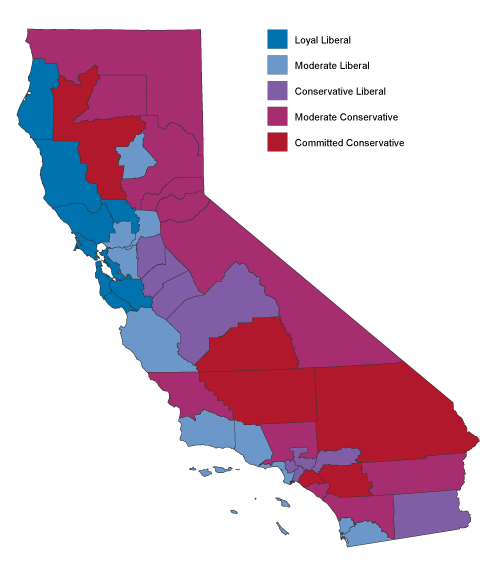
Without taking too much of my own time up looking, this seems like a much better map to look at: http://www.ppic.org/content/im... from the Public Policy Institute of California, which draws data from multiple sources.
Perhaps you could take a slightly greater amount of time and read the captions of your own reference rather than just look at the colors. What you falsely consider "red" is label "conservative liberals", ie the moderate democrats I referred to. Your citation backs up my position. Don't let the "redness" or the label for "conservative liberals" confuse you and don't let the size of the actual red zones confuse you, those red zones are rather light on population.
-
Re:Even So Cal is Blue ... see county map
"Irrelevent, the legislature/governor have little to nothing to do with that."
Irrelevant? Strength of government is a key statistical indicator for economic prosperity. There are few more significant ones in fact.
As for one party control, I never said that multiparty politics weren't the most healthy, I only pointed out that single party politics seems to have almost universally worked out well for the last six decades for blue states and (again, almost universally) hasn't worked out well during the same period for red in terms of economic conditions.
As for me being ignorant, your link made be laugh. You're using a single vote on a single position to show the political ideology of a region. Since you're new to statistics I'll take the time to explain to you that making broad generalizations based on a single data point rarely makes for accurate conclusions. Basically, all your link does is do what its title says it does, show how regions of California voted in the 2016 presidential election. Without taking too much of my own time up looking, this seems like a much better map to look at: http://www.ppic.org/content/im... from the Public Policy Institute of California, which draws data from multiple sources. Maybe next time you call some one ignorant make sure you aren't making an ass out of yourself.
To bring in a bit of anecdotal info as well, I can personally tell you from growing up and still living in California, once you get out of LA, Southern California gets fairly conservative (admittedly, its own unique flavor of conservatism). It's how we ended up with Reagan for governor among other things.
-
Re:Which billionaire is funding this one?
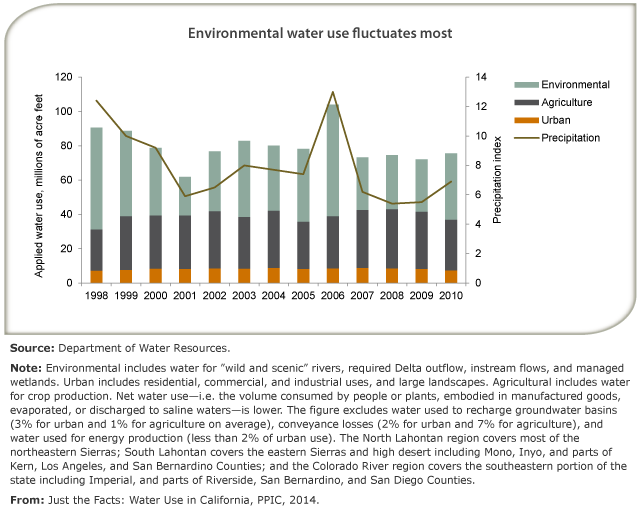
Nah, only about 4-5% goes to almonds. Half the water goes to delta smelt and scenic rivers.
-
Re:Which billionaire is funding this one?
No, the Kochs and Mercers didn't even enter my mind until I read your comment.
The outnumbered conservatives in California wanting this for themselves makes perfect sense to me.
The people packed into the dense urban areas around Los Angeles and San Francisco have different needs and wants than the people in more rural areas.
Look at these maps to get some idea of why there are people who would like to split.
LK
-
Re:Non story
California sends half its fresh water directly out to the ocean without use other than scenic rivers and other environmental desires (like delta smelt) . Agriculture is second place, at 40%, and urban is about 10%. Reduce the scenic rivers demand, and we'd have plenty of fresh water.
Except that pretty much completely wrong. The outflow from the rivers keeps saltwater from intruding into ground water and pumping stations:
Due to the drought and very low snowmelt, there simply isn’t enough natural runoff from the Sierra Nevada to keep salinity out of the Delta. Controlling salinity is essential because the Delta provides fresh water to 23 million Californians and 3 million acres of farmland.
Although water deliveries from the Delta have been reduced to historic lows because of drought, officials want to keep salinity out of the Delta because, once it intrudes, the salty water can take weeks or months to flush out. As the summer wears on, sufficient water for that task in upstream reservoirs could run out.
Under state law, salinity also must be controlled to protect water quality for users who divert directly from the Delta. This includes farmers on Delta islands as well several urban water consumers.
-
Re:Non story
California sends half its fresh water directly out to the ocean without use other than scenic rivers and other environmental desires (like delta smelt). Agriculture is second place, at 40%, and urban is about 10%. Reduce the scenic rivers demand, and we'd have plenty of fresh water.
-
Re:Generate as much clean energy as you can
Actually, Statewide, average water use is roughly 50% environmental, 40% agricultural, and 10% urban. It's environmental concerns, like delta smelt and trying to maintain scenic rivers, that suck up half our State's fresh water supply.
-
Re:Don't be mistaken
Why did California scrap their proposed single-payer plan a few months ago? Because it would have bankrupted the state. California!
Knowing California Democrats it's because they couldn't make the math work in such a way that illegals got full coverage at no charge while the US citizens paid for it all. Currently several million illegal immigrants live in CA and if you count the anchor babies the number more than doubles. Hard to make the math work with so many extra to carry.
Citations:
http://www.dailynews.com/2017/... http://www.ppic.org/publicatio...
-
Re:Fine
Really? The 2015 salmon fishery in California had a commercial value of $8.1 million. California's agriculture was around $46 billion in 2013 So AG is about 5700 times as large as the salmon fishery. Since half the surface water in California is used for Environmental purposes, and AG is only about 40%, then it would seem we could add about $46 billion in more AG by re-purposing that delta smelt flow...
-
Re:Silicon Valley is all about "What the fuck?!"
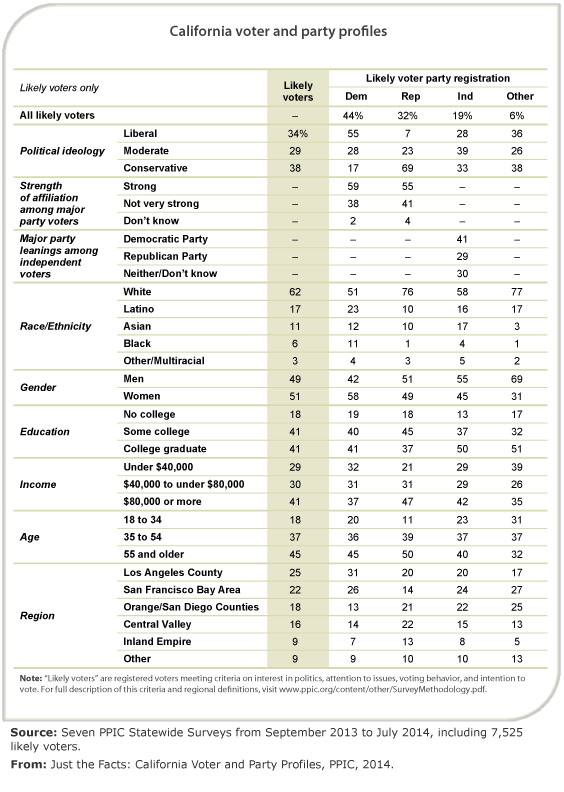
Oh, bless your heart. Someone told you that Republicans were scarce in California, and you believed them... Why? 31% of voters in California are Republicans, compared to 45% Democrats. In fact, according to the Public Policy Institute of California more Californians identify as Conservative than Liberal: 36% vs 35%. It's just that, thanks to the magic of the Electoral College, their opinions and votes don't matter in presidential elections. Bribes, of course, are always welcome from anyone though. Er, "campaign contributions."
-
Most people around here are from somewhere else.
Same is true of California, well, not "most", except that in California they're not displaced New England snowbirds. One-in-four Californians are foreign-born (about 10M people), and about 1/4th of those is an illegal alien, i.e. every fifteenth "Californian" is an illegal alien.
Not that there's anything wrong with legal immigrants living in California or anywhere else they chose to live, but I do wish California would make a significant effort to prevent *illegal* aliens from voting in US elections. Yes, yes..."There's no proof illegal aliens voted..." but that's at least partly because asking anyone to prove they are entitled to vote (and I might add, a valid, legal resident of the district in which they are attempting to vote) is somehow racist.
http://www.ppic.org/main/publi...
California is home to more than 10 million immigrants—one in four of the foreign-born population nationwide. In 2011, 27% of California’s population was foreign-born, about twice the U.S. percentage. Foreign-born residents represented more than 30% of the population of seven California counties: Santa Clara, San Francisco, Los Angeles, San Mateo, Imperial, Alameda, and Orange. And half of the children in California had at least one immigrant parent.
Most immigrants in California are documented residents.Almost half (47%) of California’s immigrants are naturalized U.S. citizens, and another 26% have some other legal status (including green cards and visas). According to the Department of Homeland Security, about 27% of immigrants in California are undocumented.
-
Re:Keep beating that drum
Jonathan Kozol is an idiot. We spend more on education than any other country. More Money isn't the answer. Innovation and Competition (Something public schools are not allowed to have) are. http://www.cbsnews.com/news/us... http://nces.ed.gov/programs/co... http://www.ppic.org/main/publi....
-
The bottom line
Urban: 11% Agriculture: 39% Environmental: 51% http://www.ppic.org/main/publi... Urban is already doing what it can to save, which is not really known because I see a bunch of ads for saving water at home recently where I live in Orange County, CA. The finger should be pointed at Agriculture. Don't force what you can't grow at the cost of the citizens funding the imbalance.
-
Re:Rainwater collection
You are one of the few mentioning rainwater collection. Well done. Average rainfall is California is around 10 inches per year. Google says California has 163,696 square miles of area. 1 furlong per fortnight = 0.000166309524 m/s. Carry the naught. [This is to appease Europeans, and hillbillies, alike] 3,800,000,000,000 cubic feet of water fall on California each year. 7.5 US gallons per cubic foot. 28 trillion gallons in total. Total water usage, average to a per capita is around 2,000 gallons per person. California population is around 37M. 28 T / (37M * 2K) = 425. One year's California rainfall could service the entire state's water needs for 425 years. Recovering one-quarter of one percent of the rain that falls on the state each year would provide enough water for everyone for the entire year.
Your statistics are based on normal weather patterns. California's weather has been anything but normal for the last six or seven years. NO rain has been falling. NONE. The reservior is entirely dry. Just sand. Therefore your hypothesis is entirely useless.
-
Rainwater collection from homes (or roads)
Average SF home is over 2,000 sq. ft. Assume a roof size, conservatively, of 1,000 sq. ft.
10 inches of rain on 1,000 sq. ft. is around 6,000 gallons available per household per year.
Coastal usage per person is around 145 gallons per day.
You could provide for 12% of residential water needs just by people not sending their roof water to the sewer system.
Imagine if we reused the water that lands on roadways...172,000 miles of highway, average width of ~10 feet...68 billion gallons of water wasted each year...almost what the entire state uses in a year. -
Rainwater collection
You are one of the few mentioning rainwater collection. Well done.
Average rainfall is California is around 10 inches per year. Google says California has 163,696 square miles of area.
1 furlong per fortnight = 0.000166309524 m/s. Carry the naught. [This is to appease Europeans, and hillbillies, alike]
3,800,000,000,000 cubic feet of water fall on California each year. 7.5 US gallons per cubic foot. 28 trillion gallons in total.
Total water usage, average to a per capita is around 2,000 gallons per person.
California population is around 37M.
28 T / (37M * 2K) = 425.
One year's California rainfall could service the entire state's water needs for 425 years.
Recovering one-quarter of one percent of the rain that falls on the state each year would provide enough water for everyone for the entire year. -
Re:Here's a better idea
That is not what he suggested. He suggested "setting" a price for water. Letting the price of water float is a different idea that requires that private people be allowed to own and trade water.
He said setting a market rate. Using a market rate clearly implies letting the market set the rate. It does not imply setting an arbitrary rate.
The truth is that water rights are a very complicated issue. Water falls on a combination of private and public land. You obviously can't go full-libertarian and have downstream users at the full mercy of upstream landowners, and things get even dicier when multiple governments (or even nations) are involved.
These complications are already being dealth with by the California government. California has a wide range of short term, long term, and permanent contracts to ensure public use of water in the state. Here are some details on the California water market if you are interested. The problem of obtaining the water and paying whoever owns the water is already a solved problem.
We are only discussing how to divvy the water out. That is a much simpler problem. There would probably be complications as the state's current contracts expire and the land owners want a cut of the extra money, but I'm sure eminent domain could be used to prevent any excessive profiteering.
-
Re:Why not?
You could get almost everyone to move out and you'd still have a major water supply issue. Most of the water that gets used is for agricultural purposes, something that isn't going to change even with a major population decline.
-
Re: Lifestyle
Citations? Here're mine:
USA uses about 1500 m3/capita/year, which is similar to New Zealand (1200 m3/capita/year) and Canada (1400 m3/capita/year). Compare with California alone, we're at 178 gallons/capita/day which is 245 m3/capita/year. That's lower than most countries.
Look, dude...
Your 1st link is total consumption. Agricultural + municipal + industrial.
In your 2nd link, the "178 gallons/day" figure is for municipal use only.
Pro-tip: when you get such massive discrepancies (1 to 6 !) between two similar populations, especially when one includes the other, it's worth checking it up a bit more carefully.
-
Re:Gardening not Showering
California's urban water usage is 10% of the total water usage. Of that 10% half is used for landscaping.
http://www.ppic.org/main/publi... -
Re:What a wonderful unit!Actually it's even worse than that 178 gallons per capita per day ~ 670 liters. A lot of that is probably due to watering lawns though, something you don't need to do much in the UK I imagine. Swimming pool evaporation is another one you don't have much of.
I wonder where the rest of the difference goes? Less efficient clothes and dish washing machines maybe?
-
Re: Lifestyle
Citations? Here're mine:
USA uses about 1500 m3/capita/year, which is similar to New Zealand (1200 m3/capita/year) and Canada (1400 m3/capita/year). Compare with California alone, we're at 178 gallons/capita/day which is 245 m3/capita/year. That's lower than most countries.
-
Re:Real-time market approach
You, obviously, don't understand time of use metering. In a regulated utility (which most are in the United States at least), TOU metering would result in higher prices for usage at times that the spot price is high (due to higher demand) than when it's low. Utilities typically buy contracts and/or have their own generating capacity for much of their anticipated usage and can predict those costs fairly well so TOU pricing would be fairly predictable (the more predictable, the higher that predictable price will be typically be -- these contracts can be modeled, in part, as options). On the margins though where demand spikes (such as due to unseasonably cloudy weather that, increasingly, will result in low solar yields and spikes in demand from customers relative to their anticipated demand), they often need to go to the spot market.
For some time variants of TOU metering has been commonly available to businesses in areas I've worked -- and there's no question that businesses alter their usage in response. Residential users are not, generally, as accustomed to this yet but will be in the future just as they are now familiar with higher rates for toll lanes based on near instantaneous congestion levels. The days of "contracted fixed rates" being the only (or the most rational) choice for consumers are numbered and utilizing less predictable sources of power (wind and solar in particular) will accelerate this transition.
This is all from the United States viewpoint of course where there may be a stronger tendency to use markets to solve problems than in some other countries.
I can sell that at the spot market or power down my plant.
Your choice if you pay the price I will charge you for it.
That is correct -- but you (and all the other suppliers acting independently in their best interests) are making similar decisions -- which then impacts the spot price as you (and all the other producers acting in independently in their best interests) offer more power on the spot market for the next hour. The utilities nearly always have to buy the power if it's available at a rational price due to regulators. These markets can break down of course as they did in the winter of 2000/2001 in California - it's worth at least skimming this report [PDF] for some analysis of this disaster.
-
Re:I see 2 problems
So how about you get off your ass and change the laws governing how ridiculous your taxes are?
No, you don't ACTUALLY want that do you? My guess is that you're happy to take all the benefits those taxes provide, but somehow think its okay to not actually participate in paying them.California has one of the highest tax burdens in the country. It's even worse if you factor in average income. Graduated income taxes means states with higher incomes naturally have a higher tax burden. The #1-3 tax burden states are all in the top 5 in income. But California at #4 in tax burden is 15th in income.
It's not about being unwilling to pay taxes for services. It's about the state being inefficient at providing those services. Any shortfall is viewed not as a spending problem, but a revenue one; meaning the inefficiencies are allowed to remain while taxation goes up relative to other states. Most of what I've seen in my two decades here has been creative phantom budget cuts which really only push the costs to future years, and hiding new taxes in places the public won't notice. If the government spent half as much creative effort trying to actually streamline spending, things wouldn't be so bad.
Unfortunately, voting doesn't make much difference because the districts have been gerrymandered (that tends to happen when one party controls a state for a long time). The breakdown of likely voters in California favors Democrats by only about 60% to 40%. But in the legislature Democrats hold 69% of the Assembly and 68% of the Senate (down from 78% after the latest election). The last time the state had anything close to proportional representation was in the late 1990s after governor Pete Wilson (R) vetoed the districts drawn by the legislature. The State Supreme Court ended up redrawing the districts, and the breakdown of elected legislators was much closer to the will of the voters (who were about 55%/45% in favor of Democrats back then). -
Re:Screwed...
That's about all they have....and oh half the state is on welfare.
I bet you don't know that California's welfare caseload today is about half of what it was when Ronald Reagan left office. The percentage of Californians on welfare is under 4%, according to that left-wing website Forbes.
http://www.ppic.org/main/publi...
Man, you gotta break that Fox News habit.
-
Re:Is that even legal?
And it has those high paying jobs with health care benefits that California just can't seem to keep around.>
Flatly untrue. The high unemployment is at the low wage end of the scale, causing the income inequality in California to skyrocket precisely because it is not the high paying jobs most affected. Those at the low end of the economic scale also comprise most of those leaving the state: http://www.ppic.org/content/pubs/report/R_1211SBR.pdf
In fact, California is by far the principal beneficiary of venture capital, which is flowing in precisely because the high paying jobs have not disappeared. Indeed California's share of high tech and manufacturing jobs has remained unchanged: http://articles.latimes.com/2012/apr/05/business/la-fi-mo-california-far-away-leader-20120405
Sorry to burst your California hatin' bubble.
-
As this seems to be the week of unpopular facts...
85% of California students speak fluent Spanish [PDF]
Related? Unrelated? You be the judge.
-
Re:Attention People of California
A careful study was done of the effects of term limits in California. You can read about the results here (warning, PDF) The end result, "Careerism remains a constant in California politics." It has also filled the legislature with fewer people of experience.....it takes time to get the hang of being a legislator. Also, it has given more power to lobbyists, who stay around without any term limits, and end up knowing the system far better than the politicians they are trying to influence.
Read the link, see what you think for yourself. -
Re:WE should end free trade.
It reminds me of the talk about protecting 'American' jobs, all the anti-visa and anti-immigration groups calling for protectionism of American worker
My question is this, if you do not feel any sort of loyalty to the fellow citizens of your country, why the heck should they feel any loyalty to you?
By supporting immigrants he is supporting his fellow citizens. Immigrants create jobs. Let's take a look over at Silicon Valley [pdf], many tech businesses are started by immigrants thus creating jobs. Sergey Brin, cofounder of Google, is from the Soviet Union. How many jobs has Google created? I think what most scares Americans are the unskilled immigrants from Latin America. However most Americans graduate from high school and acquire some skills. Most of those immigrants though dropped out of school and are unskilled.
Falcon
-
Re:I hate EU
-
Re:As long as...
California does not have a good track record for keeping private data private. See this link from the Sacramento Bee to read about how the state's 250,000 civil servants had their personnel records stolen in 2002 by hackers who have never been caught. And the sysadmins of the compromised database servers didn't even notify them for three months (because they were busy "investigating" the security breach).
This doesn't give me much confidence in the ability of government bureaucrats to maintain the security and integrity of a highly valuable database. You've seen how well they handle your tax dollars; just wait until they have control of your DNA records! -
California != "low tax at any price"!!!California has one on the highest tax burdens in the USA. Which is why corporations and middle- and upper-income are pretty much fleeing the state. You know, those things that drive the economy...
-
Including college and special interest.A little googling found this:
This would include special interest programs and the university budgets.
I would put some of the special interest money under a welfare title. I would put colleges under a different title. If you would rather have ignorant people, don't educate. Don't worry about, you already got your education, forget about the saps with kids.
California is such a great state to teach in...oh wait there is a teacher shortage in California. I guess the teachers can't buy enough mansions from the poor record executives.
-
Read this...According to this study, Movin' Out: Domestic Migration to and from California in the 1990s, California has had a net outflow every year in the 1990s.
The top states for Californians to move to were:
Washington - 534,000
Texas - 523,000
Arizona - 449,000
Oregon - 374,000
Neveda - 320,000