Slashdot Mirror
Domain: rpi.edu
Stories and comments across the archive that link to rpi.edu.
Comments · 372
-
my 1970 program is still used.
I've been programming since 1966 (grade 9 student). PNPOLY, a little program that I wrote in 1970, is still used. I get a couple of emails a year about it. It tests whether a point is in a polygon. Translated from Fortran II to C, it's 8 lines of executable code. The documentation is about 10x longer, but people still get it wrong.
https://wrf.ecse.rpi.edu//Rese...
Now I'm inventing very fast parallel geometry algorithms, teaching computer engineering, and just graduated my 18th PhD student. My code is generally freely available for nonprofit research and education, see https://wrf.ecse.rpi.edu/nikol...
HW I have used (at least a little):
DEC PDP 1, 8, 10, 11, Vax 11/780; IBM 1620, 7094, 360, 370, 5100; Prime; Lisp Machine; Motorola 6811, 68000, 68010, 68020; Sequent Balance; CM-2; Intel 8051, 8086, Pentium, Xeon; Sun Sparc; AMD Opteron.
Wordlengths: 8, 12, 16, 32, 36 (containing 5 7-bit chars plus 1 spare bit) -
my 1970 program is still used.
I've been programming since 1966 (grade 9 student). PNPOLY, a little program that I wrote in 1970, is still used. I get a couple of emails a year about it. It tests whether a point is in a polygon. Translated from Fortran II to C, it's 8 lines of executable code. The documentation is about 10x longer, but people still get it wrong.
https://wrf.ecse.rpi.edu//Rese...
Now I'm inventing very fast parallel geometry algorithms, teaching computer engineering, and just graduated my 18th PhD student. My code is generally freely available for nonprofit research and education, see https://wrf.ecse.rpi.edu/nikol...
HW I have used (at least a little):
DEC PDP 1, 8, 10, 11, Vax 11/780; IBM 1620, 7094, 360, 370, 5100; Prime; Lisp Machine; Motorola 6811, 68000, 68010, 68020; Sequent Balance; CM-2; Intel 8051, 8086, Pentium, Xeon; Sun Sparc; AMD Opteron.
Wordlengths: 8, 12, 16, 32, 36 (containing 5 7-bit chars plus 1 spare bit) -
Not much can be done.
Light travels at 299,792,458 meters per second and Earth has a circumference of 40,075,000 meters. Unfortunately, light is impeded to about 66% it's original speed when traveling through glass which includes fiber.
Assuming you only have to travel a quart of the way to connect to Hawaii (check a map!), that's a 20,037,500 meter round trip.;
20,037,500 / (299,792,458 * 2/3) = 0.10025685836 secondsAdd to that the response times of routers and you got yourself a 120ms ping.
Until we get faster than light communications, you're SOL if you are half a world away... or even a quarter.
-
On breeding friendlier corporations and AIs
Part of something I posted in 2000 to Doug Engelbart's "Unifinshed Revolution II" colloquium touching on corporations as "AIs":
http://www.dougengelbart.org/c...========= machine intelligence is already here =========
I personally think machine evolution is unstoppable, and the best hope for humanity is the noble cowardice of creating refugia and trying, like the duckweed, to create human (and other) life faster than other forces can destroy it.Note, I'm not saying machine evolution won't have a human component -- in that sense, a corporation or any bureaucracy is already a separate machine intelligence, just not a very smart or resilient one. This sense of the corporation comes out of Langdon Winner's book "Autonomous Technology: Technics out of control as a theme in political thought".
http://www.rpi.edu/~winner/You may have a tough time believing this, but Winner makes a convincing case. He suggests that all successful organizations "reverse-adapt" their goals and their environment to ensure their continued survival. These corporate machine intelligences are already driving for better machine intelligences -- faster, more efficient, cheaper, and more resilient. People forget that corporate charters used to be routinely revoked for behavior outside the immediate public good, and that corporations were not considered persons until around 1886 (that decision perhaps being the first major example of a machine using the political/social process of its own ends).
http://www.adbusters.org/magaz...Corporate charters are granted supposedly because society believe it is in the best interest of *society* for corporations to exist. But, when was the last time people were able to pull the "charter" plug on a corporation not acting in the public interest? It's hard, and it will get harder when corporations don't need people to run themselves.
http://www.adbusters.org/magaz...
http://www.adbusters.org/campa...I'm not saying the people in corporations are evil -- just that they often have very limited choices of actions. If a corporate CEOs do not deliver short term profits they are removed, no matter what they were trying to do. Obviously there are exceptions for a while -- William C. Norris of Control Data was one of them, but in general, the exception proves the rule. Fortunately though, even in the worst machines (like in WWII Germany) there were individuals who did what they could to make them more humane ("Schindler's List" being an example).
Look at how much William C. Norris http://www.neii.com/wnorris.ht... of Control Data got ridiculed in the 1970s for suggesting the then radical notion that "business exists to meet society's unmet needs". Yet his pioneering efforts in education, employee assistance plans, on-site daycare, urban renewal, and socially-responsible investing are in part what made Minneapolis/St.Paul the great area it is today. Such efforts are now being duplicated to an extent by other companies. Even the company that squashed CDC in the mid 1980s (IBM) has adopted some of those policies and directions. So corporations can adapt when they feel the need.
Obviously, corporations are not all powerful. The world still has some individuals who have wealth to equal major corporations. There are several governments that are as powerful or more so than major corporations. Individuals in corporations can make persuasive pitches about their future directions, and individuals with controlling shares may be able to influence what a corporation does (as far as the market allows). In the long run, many corporations are trying to coexist w
-
Re:Credibility of Climate Science
Successful predictions include surface warming and stratospheric cooling coincident with a rise in CO2 levels, and stronger warming effects at the poles. Are you under the misapprehension that producing fine-grained projections of global temperature is the only thing that climate scientists do?
The challenge I put forth asked for correctness of just 80% for any cited prediction
Studies usually already include their error margins. If a prediction comes in within its own error margin, that is a successful test. Surely you don't apply your own arbitrary standards to other physical sciences? As it happens, results within the error margins of prediction are true for Hansen et all (1988), linked previously, for Plass (1956), Arrhenius (linked previously), and most accurately by Sawyer (1972), who managed to get both the magnitude of increased emissions and the resulting temperature increase exactly correct. I apparently wasn't clear when I gave you the temperature predictions earlier for Sawyer, Plass, and Hansen. I assumed that you would be able to find a graph of global temperatures for the 20th Century. Here's a graph for you, which corroborates their findings. I hope it's not too much trouble to be able to look at my previous posts for the numbers.
Also, Arrhenius (1896) and Callendar (30s-40s) were confirmed in the mid-50s with CO2 and temperature measurements. You could also consider Plass and Kaplan (1952) to be confirmation of the previous work on the matter. Also, you will note that Hansen's spacial distribution of the temperature anomaly was very accurate. Looking at graphs in the 1995 IPCC report their prediction (p40) of the warming trend matches the observed warming through to the present quite well.
We see scary predictions published — even on Slashdot — about once a week.
If you're getting your scientific information from the popular press, you're probably being misinformed in some manner. In my experience newspaper articles are rarely peer reviewed, and I don't think I've seen very many cited, or that have citations. As it happens, I believe most of the articles on Slashdot are concerned with weather events and annual records.
does this mean, you admit, no predictions I seek have been made until "just recently"?
What you want isn't actually a test of the science in the way you think it is. Global climate models cannot be used to disprove AGW any more than epidemiological models can be used to disprove the germ theory of disease, and Kerbal Space Program is similarly not a test of relativity. Economists can construct models to show that rapid expansions of the monetary supply cause harmful inflation, and there is empirical evidence to support this idea. Constructing a model to predict the exact effects of the Fed's Quantitative Easing program would be something of a challenge. Failure to model something accurately means that your model is inaccurate, not that the theory is wrong. Are climate models inaccurate? Of course they are! Every model is inaccurate. All of science is inaccurate, it's inherent to empirical observation. The question is to what degree they are useful, and to begin to be able to answer that, I would suggest you start here or
-
Re:She has a point.
You have no idea what you're talking about. Nobody uses just Lena, they use a suite of test images for subjective analysis.
As for the context...honestly, if you don't know what it's like to be a woman living in a male-dominated world, it's not really your place to be able to say "it's just a face" or complain about how "feminazis make a shitshow out of everything." I don't personally object to the image's content. But I absolutely understand why others would. And that's what makes the difference in maturity level.
This doesn't demonstrate maturity, but rather submission.
-
LEDs have better spectrum than CFL, but still crap
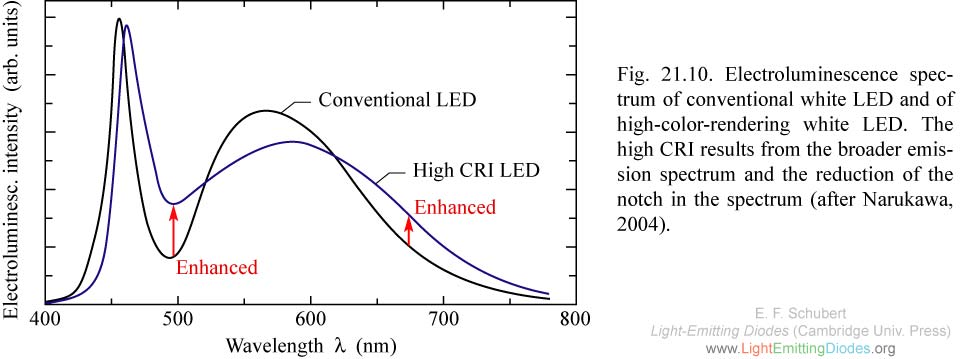
Even high CRI (color rendering index) LED lighting has a nasty spike in the blue region. See: http://www.ecse.rpi.edu/~schub... This is very different than the smooth blackbody spectrum of solar radiation, though not nearly as bad as the many narrow spikes of a CFL bulb. Color reproduction still suffers, even if not as much as in the case of fluorescents. Compare to a high-end incandescent bulb (such as used in museums and galleries, and in my house), which use filtering reflectors to match daylight spectrum very closely. You can only do this with the smooth spectra of blackbody radiators (such as incandescents) because we lack sufficiently specific (narrow band) filters to deal with the spikes in LEDs, fluorescents, and HIDs, at least without going to extreme expense. So for those of us to whom it matters that artificial lighting should strive to reproduce natural lighting reasonably well, incandescents remain a necessity. At the same time, I do realize that to others efficiency matters, and that is becoming an increasingly significant factor, especially through the actions of the anti-nuclear power lobby.
-
This is why corporations should have *no* privacy
http://www.corporatecrimerepor...
Fines or imprisoning CEOs do little to change the pattern of relationships and values and policies that make an organization what it is, any more than a human body loosing some skill cells or even brain cells usually changes how a person behaves very much.
Seriously, why should any corporate communications have any expectation of privacy? Corporations with "limited liability" are chartered for the public interest. 150 years ago, US Americans put such creatures on very short leashes because they had seen what trouble resulted from big British corporations in the American colonies. Individuals have now lost pretty much all informational privacy due to large corporations and the current internet. Why should bigger more powerful creatures than humans like corporation have more privacy in practice than humans? See also David Brin's "The Transparent Society". Any argument that corporations need privacy (like for salaries or payments for services) for some sort of commercial advantage is trumped by the public interest in understanding what corporations are doing and also that if all corporations were transparent there would be a level playing field. Granted, it would require new ways of doing business, but books like "Honest Business" also extol the value of "open books". Or perhaps corporations should be forced to choose -- if they want limited liability for shareholders then they need to be transparent; if every shareholder accepts full responsibility for all actions of the organization, then they can have privacy?
And see also my comments from 2000, the relevant section copied below (sadly a lot of links there have rotted):
http://www.dougengelbart.org/c...========= machine intelligence is already here =========
I personally think machine evolution is unstoppable, and the best hope
for humanity is the noble cowardice of creating refugia and trying, like
the duckweed, to create human (and other) life faster than other forces
can destroy it. [Well, I now in 2014 think there are also other options, like symbiosis, maybe friendly AI, and in general trying to be nicer to each other like with a basic income in hopes that leads to a happier singularity...]Note, I'm not saying machine evolution won't have a human component --
in that sense, a corporation or any bureaucracy is already a separate
machine intelligence, just not a very smart or resilient one. This sense
of the corporation comes out of Langdon Winner's book "Autonomous
Technology: Technics out of control as a theme in political thought".
http://www.rpi.edu/~winner/
You may have a tough time believing this, but Winner makes a convincing
case. He suggests that all successful organizations "reverse-adapt"
their goals and their environment to ensure their continued survival.These corporate machine intelligences are already driving for better
machine intelligences -- faster, more efficient, cheaper, and more
resilient. People forget that corporate charters used to be routinely
revoked for behavior outside the immediate public good, and that
corporations were not considered persons until around 1886 (that
decision perhaps being the first major example of a machine using the
political/social process of its own ends).
http://www.adbusters.org/magaz...
Corporate charters are granted supposedly because society believe it is
in the best interest of *society* for corporations to exist.But, when was the last time people were able to pull the "charter" plug
on a corporation not acting in the public interest? It's hard, and it
will get harder when corporations don't ne -
Re:China, it figures...
Well, those primitive African tribes went far beyond that. They invented fractals.
-
Re:How deep is the loveDon't know how deep the h20 goes, though it seems to be planetwide...
“Mars has kind of a global layer, a layer of surface soil that has been mixed and distributed by frequent dust storms. So a scoop of this stuff is basically a microscopic Mars rock collection,” said Leshin. “If you mix many grains of it together, you probably have an accurate picture of typical martian crust. By learning about it in any one place, you’re learning about the entire planet.”
-
Two for one?
Can we measure two benefits?
1) Create Biofuel
2) Clean the environment
Example 1: Cattails remove toxins & pollution from wetlands, stormwater. http://www.scer.rpi.edu/bwe/?p=369
Example 2: Sunflowers decontaminate radioactive soil. http://www.ecaa.ntu.edu.tw/weifang/cea/sunflowers.htm
Example 3: Algae blooms http://www.npr.org/2013/08/11/211130501/the-algae-is-coming-but-its-impact-is-felt-far-from-water
-
Re:Oh no, it's Selmer Bringsjord
Have you read the book, Dear Anonymous Coward? This guy did, and hated it for good reasons:
I've looked at some of Bringsjord's "serious" academic writings (unlike the pop sci book you cherrypicked). It's clear why he's in a cognitive science department and not a serious theoretician. For example, he boldly proposes that he has "solved" P=NP using not math but "digital physics", and offers nothing substantial (like, oh, a *proof*).
http://kryten.mm.rpi.edu/scb_pnp_solved22.pdf
There's a place for cognitive scientists -- in poetry journals and not science or engineering labs. God only knows why ilk like you thinks the US military should fund postmodernist dilettantes like Bringsjord.
-
Oh no, it's Selmer Bringsjord
Look who's pushing for this program. It's Selmer Bringsjord, a professor at Renssalaer who wants to build Skynet and Terminators. For real. From his 1997 paper: "Our engineers must be given the resources to produce the perfected marriage of a trio: pervasive, all-seeing sensors; automated reasoners; and autonomous, lethal robots. In short, we need small machines that can see and hear in every corner; machines smart enough to understand and reason over the raw data that these sensing machines perceive; and machines able to instantly and infallibly fire autonomously on the strength of what the reasoning implies."
Yes, he really published that. The next paragraph is even worse:
If you are wearing explosives of any kind outside a subterranean environment, you will be spotted by intelligent unmanned airborne sensors, and will be instantly immobilized by a laser or particle beam from overhead. If you are working with explosives underground (or toiling to enrich uranium), sensors on and beneath the surface of the Earth will find you, and you will be killed soon thereafter by AI-guided bunker-boring bombs. If you are a murderous dicta- tor like Sadam or Stalin or Amin, or a leader (e.g., Ahmadinejad or Kim Jong II) heading in the direction of such evil, a supersonic robot jet no bigger than a dragonfly will take off in the States, thousands of miles from your "impregnable" lair, and streak in a short time directly into your body, depositing a fatal poison like Polonium therein. If you, alone or along with equally doomed cronies, seek to seize a jetliner with a plan to blow it up or use it as a missile, one biometric scan of your retina before boarding, and lightning-quick reasoning behind the scenes will ag you as a end, and you will be quickly greeted by law enforcement, and escorted into a system of interrogation that uses sensors to read secret information directly from your brain: lying will be silly. Want to bring a backpack bomb somewhere, and leave it behind? The contents of your pack will be sensed the second you bring it toward civilization, and it will be vaporized. Interested in the purchase of handguns for Cho-like mayhem? The slightest blip in your back- ground will be discovered in a second, and you will be out of luck. In fact, guns can themselves bear the trio: If you have one, and wish to fire it, it must sense your identity and location and purpose, and run a check to clear the trigger pull | all in a nanosecond."
Read his paper. This guy is scary. And Congress is listening to him.
-
True -- I agree, 10,000Hz flicker is detectable
This is true, 10Khz is detectabable, agreed by this paper
- http://www.lrc.rpi.edu/programs/solidstate/assist/pdf/AR-Flicker.pdf (10,000 Hz detected)The last one has a rather interesting diagram where PWM, in certain cases, up to 10,000Hz, is detected via a stroboscopic / phantom array effect (not too different from wagon wheel effect).
-
Flicker up to 10,000Hz sometimes detectable (link)
You ideally need PWM >10000 Hz.
- http://opensiuc.lib.siu.edu/cgi/viewcontent.cgi?article=1538&context=tpr (500 Hz detected)
- http://www.lrc.rpi.edu/programs/solidstate/assist/flicker.asp (300 Hz detected)
- http://www.lrc.rpi.edu/programs/solidstate/assist/pdf/AR-Flicker.pdf (10,000 Hz detected)The last one has a rather interesting diagram where PWM, in certain cases, up to 10,000Hz, is detected via a stroboscopic / phantom array effect (not too different from wagon wheel effect).
-
Flicker up to 10,000Hz sometimes detectable (link)
You ideally need PWM >10000 Hz.
- http://opensiuc.lib.siu.edu/cgi/viewcontent.cgi?article=1538&context=tpr (500 Hz detected)
- http://www.lrc.rpi.edu/programs/solidstate/assist/flicker.asp (300 Hz detected)
- http://www.lrc.rpi.edu/programs/solidstate/assist/pdf/AR-Flicker.pdf (10,000 Hz detected)The last one has a rather interesting diagram where PWM, in certain cases, up to 10,000Hz, is detected via a stroboscopic / phantom array effect (not too different from wagon wheel effect).
-
Re:can you put the paper online?
I didn't realize that it was acceptable to post it before the conference even happened. But you're right so here it is.
-
Frank C. Keil Did This In the 70's!
Semantic and Conceptual Development: An Ontological Perspective, 1979, Harvard University Press.
Glad to see more independent verification of Keil's work!8-))
-
Re:Skeptic is ok...
> far too many of the people who call themselves "skeptics" are in fact not skeptics at all
Sadly yes.
i.e. see Sofka's excellent "Myths of Skepticism" whitepaper.
http://homepages.rpi.edu/~sofkam/papers/skeptik.htmlor Wu's very interesting essay which despite it being on a different topic altogether lays out the problems of pseudoskeptics.
http://www.debunkingskeptics.com/Introduction.htmGreat quote BTW !
-
Re:On your desktop in 11 years
Supercomputers measure double precision FLOPS while the GPGPU vendor cheat and report single precision.
Ah, OK, Radeon is then 1 TFlop for double precision (which is new to the Radeon). So four Radeon 7970's beat the top 1999 supercomputer.
-
Re:All our resources are still here
Its not in the florescent tubes or LED or whatever your LCD screen uses for illumination.
Actually, it is. Indium is used in the production of low-power led devices, and has been for decades (long before modern led-based screens). You can find a lot of information on Wikipedia, but also check http://www.lrc.rpi.edu/programs/futures/LF-LEDs/index.asp for an overview (they specifically mention white leds)
-
Classic Projection
They make fun of creationists but don't notice that this stuff is no different. Arrogant, libtards most of em.
Psychologists call that projection. It is one of the key ego defence mechanisms, and is present surprisingly often in politically motivated speech, due to the cognitive bubble.
Somebody is being an arrogant %&*#-tard. It must be the 1000s of scientists of all political persuasions, who have dedicated their lives to what Karl Rove pejoratively referred to as the reality based community.
Of course you have the "truth", and your mind is firewalled to uncomfortable ideas. -
Re:clock skew?
We're already here essentially at standard PCB sizes, and very close for chips. At C (which electrical signals don't get to), you're pretty limited. This doesn't even account for things like rise-time, frequency dependent effects on resistance/capacitance, etc. For lots of grimy details: Modeling of semiconducter Interconnects . Full disclosure, I went to RPI, but this just happened to be the first paper I googled.
Clock regeneration works for chip-to-chip or device-to-device clocking, but those clocks also usually aren't run as fast as dedicated on-die chip clocks (note: this is the difference between bus clocks and chip clocks on modern motherboards). When you have complete control of your clock tree on a single device, it's laid out so that it is as balanced as possible from the source. i.e. the routing delays are the same to every device the clock is interacting with, this is a balanced clock tree.
As clock frequencies go up and feature sizes shrink, we'll see more asynchronous independent sub-system on the same chip. But it's a hard problem, with lots of compromises, and that asynchronous circuitry takes up space and power. And even if the transistor can switch fast enough, a digital signal has rise time, settling time, etc. that all need to be accounted for and affect the design. At the frequencies we're talking about, it's just as much microwave/rf engineering as it is digital.
-
Re:Grant whores and PR scientists
To expand upon your great post, at the risk of getting modded down, since people confuse passion and integrity:
A fantastic read is "Myths of Skepticism"
http://www.rpi.edu/~sofkam/talk/talk.htmlFeynman already warned about how Science was turning into a religion.
http://www.lhup.edu/~DSIMANEK/cargocul.htmHe wasn't the first, Planck said it ~50 years earlier.
"Science advanced one funeral at a time", paraphrasing Max Planck's "A new scientific truth does not triumph by convincing its opponents and making them see the light, but rather because its opponents eventually die, and a new generation grows up that is familiar with it."The worse are the "pseudo skeptics" -- those who "pretends to be a skeptic but is so closed-minded that they have become a fundamentalist; unable to accept any other perspective - their mind is already made up by ignoring any (potential new) evidence, such as that liar Randi, a magician pretending to be a Scientist.
http://www.debunkingskeptics.com/Page30.htm#RealSkeptics"Simply put, one unwon public challenge by a debunker and magician does NOT invalidate the countless millions of paranormal experiences throughout world history, nor does it refute the years of replicable psi research done by Ganzfeld or PEAR experiments, among others."
A perfect example of how Science has become Religion is Astronomy. They make _several_ assumptions that will turn out to be false once they have more information. They "assume" Dark Matter and Dark Energy Energy exists but they have never observed it. They assume the laws of physics are constant throughout the universe; that is a very dangerous precedent when you have only directly explored %0.0000000001 of it.
While it is fine to come to conclusions before the evidence is in BUT it would behoove BOTH the scientist and public by being honest and upfront with the usual disclaimer: "With our current understanding, this is our best guess (theory) for how we think things work." To pretend otherwise is sheer dogma.
The greatest problem with a few Scientists is that they believe their Holy Scientific Principle is the ONLY way to achieve truth. What Science does is remove one _falsehood_ at a time. There are other methods that add truth one level at a time.
Great post BTW.
-
Phynd at RPI
I knew one of the maintainers of Phynd when I was at RPI. It was a simple indexing program that would crawl the public shares on the campus network and create a searchable dB with a simple web interface. Worked quite nicely, all thing considered, but since it also picked up any illegally shared items it was hit by RIAA during the initial anti-share crackdown. They were probably legally ok (index service, not a repository), but the suit was settled since that was the easier (and likely less expensive, given lawyer costs) option.
-
Re:expected outcome
Something like that unfortunately actually happened to our old family station wagon (Oldsmobile?) around 1970. Basically, the car had issues on the trip (we might have even stopped for some repair) and the rear axle somehow eventually caused heating (sparks?) that caused the flammable rearmost seat to catch fire eventually, which happened overnight and smoked up and then burned much of the interior of the car. This happened on a long car trip to take my sister to college just after we had reached the destination. Fortunately, the car was parked outside in a hotel parking lot, and someone else at the hotel noticed the flames when they got going and they were extinguished quickly. Unfortunately, the car had all my sister's clothes and other items for starting undergrad college which had not yet been unloaded, essentially ruining them. That rough start was a contributing factor to ending her promising college career as a "doctor of tomorrow" pretty much before it got started at RPI's then new BA/MD program.
http://www.rpi.edu/dept/bio/undergraduate/physician.htmlAlthough I was told much later that some harassment by an administrator there who did not think women should be doctors was probably a bigger compounding factor. I'm sure RPI is much more progressive 40 years later now. Also, I think her roommates then and some others tried to help make up some for her losing all her clothes and belongings. I was pretty young then, so I don't know all the details. But in some ways, perhaps losing a career is much worse than losing a house?
BTW, more reasons to be cautious about tying your hopes in life to college:
http://p2pfoundation.net/backups/p2p_research-archives/2009-October/005379.htmlAnd how medical programs got so bad in the first place that some women had to become pioneers again:
http://en.wikipedia.org/wiki/Flexner_Report
"One of the consequences of Flexner's advocacy of university-based medical education was that medical education became much more expensive, putting such education out of reach of all but upper-class white males. The small "proprietary" schools Flexner condemned, which were contended to be have been based in generations-old folk traditions rather than relatively recent western science, did admit African-Americans, women, and students of limited financial means. These students usually could not afford six to eight years of university education, and were often simply denied admission to medical schools affiliated with universities. While many such doctors continued to practice, they did so under proscribed circumstances and for less pay. It also made it more difficult for people of color, residents of rural areas, and for those of limited means generally to obtain medical care in any form."We were of "limited means" then ourselves, or so I was told, so my father had to keep old cars going as best as he could.
So, it can be true that we tend to ignore what goes wrong with older technology. Right now, people are all worried about the first time a "self-driving" car will kill someone in an accident, ignoring that 35,000 or so people are killed in the USA in car accidents every year, and maybe 1.2 million people die a year across the globe from car accidents, and self-driving vehicles will probably greatly reduce that number. One reason is especially because many accidents happen at night, and cars can use sensors to see better than people in the dark and won't fall asleep at the wheel. Also, self-driving cars can talk to each other and negotiate right of way, and so on.
-
Even older than that
It was first developed, to the best of my knowledge, jointly by researchers at RPI and Rice in Jan 2008. Here's their presentation and here's a link showing the date.
In fact, their material is ten times darker than the one apparently developed by NASA, with a reflectivity of 0.05% compared to NASA's 0.5%.
-
Re:International coordination?
The Russians have both more experience and more reliable launch systems: http://www.ewp.rpi.edu/hartford/~cedenc/SMRE/Project/Space%20Shuttle%20Vehicle%20Reliability.pdf
You're the one being stupid.
-
Re:Not much air
-
Re:Why?
And if they're going to implement another image format, why don't they do it right and pick some form of embedded zerotree wavelet? Those beat the pants off JPEG (and most other DCT codecs) while being perfectly progressive (i.e. you can truncate the picture data itself at any point and get the same result as you would if you had compressed to that size).
Instead we'll get yet another block coding format, for what? So that Google can use it to leverage WebM? -
Re:What is Lustre File System
Obviously, we have internal benchmarks that tend to show that Lustre is good but I can't talk about specifics on those. What I can do, though, is link to this: http://www.cs.rpi.edu/~chrisc/COURSES/PARALLEL/SPRING-2009/papers/MADbench2-2009.pdf
The stuff that I found most interesting is on page 12. The machines named Jaguar and Franklin are Cray's running Lustre. Bassi and Jacquard are both running GPFS. On page 15 they claim that they can make up for the deficiency in Lustre's default settings for shared access to a single file by tuning it.
Unsurprisingly, the type of operation you're doing ends up determining which filesystem is best for your application.
In terms of scalability, from the Wikipedia page for the Jaguar system at Oak Ridge National Labs (a large Cray XT5), their Lustre filesystem is 10 petabytes with read/write performance of approximately 240GB/sec (not sure what benchmark was used to get that number).
-
Re:Energy Density
Researchers at Rensselaer Polytechnic Institute produced "paper batteries" on nanocomposite paper with an energy density of about 13Wh/kg back in 2007. You can see the paper here.
-
Bogus info from Tired
Tired Magazine blows it again.
The article from Tired is bogus. The "remote generation of terahertz radiation" is described in this paper. They generate terahertz radiation at the target by hitting it with a big enough pulse to heat it up into a plasma. This is a classic spectroscopy technique; hit something with a big laser pulse and look at the spectra coming back.
Nobody is going to look into pockets that way, unless they burn through first. It may be useful for analyzing toxic and hazardous materials from a distance. A possible application is something that first responders point at a spill from a distance, and it comes back with an analysis. Assuming the energy transfer can be made small enough so as not to ignite anything.
-
Re:1 sensor per balloon - 3 colors per sensor
3 colors == greater precision than 2. You know, like traffic lights.
And you can't really create gradients from single LED light sources situated at the same spot.
You might do that by putting the LEDs on opposite sides of the balloon, adding voltage control, wiring...I.e. making it unnecessarily more complicated, with the additional "bonus" of making the reading of the pollution levels unreadable.
Ever notice how most human-readable non-alphanumeric indicators don't come graded in gradients ranging from -256 to +256? -
Re:My take
> Same with FTL. Our current method of going faster is to simply accelerate more. General relativity tells us that that approach won't work even for reaching C, much less exceeding it.
> So, we need a workaround.You DO realize we live in more then 4 dimensions, right?
The physical dimension is only the "bottom" that we are normally perceptive too. The speed of light is not a barrier in higher realms, and is easily "broken" in them.
The workaround is:
1. Shift to another dimension
2. Travel
3. Shift back to physical dimension> A pet hypothesis of mine is that perhaps as an object with mass approaches C, conventional laws of physics break down and we need a whole new set of physics to figure out what happens at those velocities.
Yes, the same way conventional laws of physics break down at the micro (Quantum Mechanics), they break down at the macro (General Relativity).> sense that they don't violate what we know about physics.
That's the biggest hurdle at the moment. Scienctists knows jack about physics and meta-physics outside the normal 4D as they are still missing 2 fundamental forces. Until we can answer _basic_ questions such as: "What is electricity? What is gravity? What is magnetism? What is light? What is time? What is the soul? What is the source of all these things?" our understanding will be limited to simply _using_ them.> The empirical evidence strongly suggests that traveling at or above C is, indeed, impossible.
Humans are currently limited to sub-light speed until the 24th century, as they have not learned how to be responsible with what they _already_ have. When you still have people who live like kings and throw whatever they don't want away (America), people whose daily existance is starvation (Africa), people arguing over who's God is "right" by killing everyone who doesn't agree with them (Islam), ignorant pseudo skeptics who have made a Religion of out atheism (Randi) ( http://michaelprescott.freeservers.com/skeptic.htm, http://www.rpi.edu/~sofkam/talk/talk.html, http://www.debunkingskeptics.com/Introduction.htm ), the brainwashing of the public school education, er, sorry indoctrination system ( http://www.johntaylorgatto.com/chapters/index.htm ) humanity will never make progress on _External_ knowledge until they first learn the source of ALL (internal) wisdom: KNOW THYSELF.As we spiritually grow up, FTL and time-travel will naturally open up.
--
"Mind, not Space" is the FINAL frontier -
Real university online courses
I took online classes (paid for by my employer) at RPI towards my masters in electric power engineering. The classes were either streamed live video and audio of class actually having real students in it, or on a tape delay of a few hours. Homeworks were the same for in class and online students. We even had group projects and presentations to do. A lot of that was done over the phone and with conferencing software online.
Many real (not for profit) universities allow the general public to take any online classes they want, provided you pay full price (or your employer does). The quality of learning may be higher than for profit universities, and you'll probably have more freedom to choose the courses you want. And like most post grad programs, you probably pick to specialize in what ever you want, provided the courses are relevant to it. -
find a good brick-n-mortar school that does online
Lots of good schools also have online components. The same profs that teach in the classroom usually also run the online courses. In fact, the online component is sometimes either a recording of in-class lecture or a live video feed, accessed via videocon or over the internet. I got a MS from RPI (http://rpi.edu/) that was challenging and useful. I in no way felt disconnected during my degree program there. Professors were fairly responsive and engaged in personal discussion whenever I felt the need.
It's a good school, so the type of students enrolled were generally high-achieving. Group work went fine, and if someone wasn't pulling their weight, the rest of us in the group let them know it and straightened 'em out.
So if the degree is important to you, find a school with a good reputation that has the online program you're looking for.
-
Re:Religion
> Rationalism is not an ideology. It cannot be.
It mostly certainly can be.
See: Pseudo-skepticism.
http://www.rpi.edu/~sofkam/talk/talk.html_Anything_ can be turned into a religion.
-
Re:LED Light Bulbs
LEDs are highly directional, thus they make a better replacement for a spotlight than for a standard bulb (diffusers waste power, lowering efficiency)
LEDs are a (nearly) point light source that happens to be integrated into a plastic lens. This lens can be made in a number of different shapes - the ones with the familiar raised-sphere top work as a convex lens to focus the light into a relatively narrow beamwidth, but if you put the diode at the center of that sphere, you get an even radiation pattern instead.
-
I want to play!
I thought the game sounded like fun so I looked it up. You can find it here: http://cogworks.cogsci.rpi.edu/?view=modules.research.spec&id=74 The page is down, so you may need to check the Google Cache. It does not appear to be available to the general public.
-
Re:It HurtsFrom the link that you posted:
“For the Noah's Ark Hypothesis to be correct, one has to speculate that there was no flowing of water between the Black Sea and the Marmara Sea before the speculated great deluge. We have found this to be incorrect.”[9]
Rensselaer Polytechnic Institute (2002-09-01). "Noah’s Flood Hypothesis May Not Hold Water". Press release. http://news.rpi.edu/update.do?artcenterkey=245.
The proposed deluge has been connected with various Great Flood myths, notably Noah's Flood. Based on their interpretation of the Bible, the Christian apologetics ministry Answers in Genesis have stated that "Noah's Flood was not a local flood in the Black Sea area, but a world-wide flood that has left its mark on every continent on this planet"; the proposed date of the Black Sea deluge does not match what they believe to be the date of the biblical flood.[16]
"Proof of Noah’s Flood at the Black Sea?". Answers in Genesis. http://www.answersingenesis.org/docs/4168.asp. Retrieved 2006-03-08. -
Re:It HurtsFrom the link that you posted:
“For the Noah's Ark Hypothesis to be correct, one has to speculate that there was no flowing of water between the Black Sea and the Marmara Sea before the speculated great deluge. We have found this to be incorrect.”[9]
Rensselaer Polytechnic Institute (2002-09-01). "Noah’s Flood Hypothesis May Not Hold Water". Press release. http://news.rpi.edu/update.do?artcenterkey=245.
The proposed deluge has been connected with various Great Flood myths, notably Noah's Flood. Based on their interpretation of the Bible, the Christian apologetics ministry Answers in Genesis have stated that "Noah's Flood was not a local flood in the Black Sea area, but a world-wide flood that has left its mark on every continent on this planet"; the proposed date of the Black Sea deluge does not match what they believe to be the date of the biblical flood.[16]
"Proof of Noah’s Flood at the Black Sea?". Answers in Genesis. http://www.answersingenesis.org/docs/4168.asp. Retrieved 2006-03-08. -
Re:Star Trek
-
Re:It will be a very difficult project
All of those can be accomplished in Fortran 90/95. There is even direct language support for the third requirement (private members of derived types), and I do it all the time; it works just like other public/private declarations, just placed inside the type definition. Inheritance and polymorphism (I'm guessing this is what dynamic binding means from a quick look at Wikipedia) are a bit trickier, but the techniques have been worked out and documented by these fellows (Viktor Decyk's page is also quite helpful). If you prefer to avoid typing out a certain necessary amount of boilerplate to do this, you could use Drew McCormack's forpedo preprocessor (described in detail on MacResearch). So, it's not necessary to wait for 2003, and in fact, many people haven't but have managed to write and maintain very large codes in Fortran 90/95. Good luck!
-
Re:More backwards thinking
presumably use an infinite precision data type
I was thinking more along the lines of a 'rational' data type (store numerator and denominator as integers). But I'm not the GP, so I can't speak for him.
But your post makes me think... something simultaneously along the lines of and diametrically opposed to what you've been saying. I wonder if being given just unsigned bytes and having to write code to handle all more complicated cases would be a good instructional experience. I think it would. Pretend the floating-point units aren't there; really make the kids think about mantissas and exponents, and different ways to represent numbers, instead of having the CPU automagically do it all for them.
(Though this shouldn't be an intro course.)
I guess this is the spirit of this course.
(Disclaimer: Not an RPI grad; didn't take the course. Just saw a Youtube video about it. But it looked like a good way to go.)
-
From NAND to TetrisI guess this really depends on how interested your kid actually is in learning the internals of computers. It might be a good idea to start with a "high level" tool, and I'm not talking about using Python or some such thing, but using Alice and/or LEGO Mindstorm. I've played with Mindstorms myself in a robotics course and I can vouch that you can do a lot of fun and interesting things with it. There's even a C-like programming language and compiler that you can switch to when the "block interface" becomes boring and your kid gets interested in learning more "orthodox" programming.
Once he has a solid knowledge of basic programming and if he's still interested in learning more of the basics of how computers work and if you are willing to dedicate quite a lot of time and effort to destroying the social life of your kid once and for all and turning him into a full blown geek I'd recommend that you take a look at a course that has been called "From NAND to Tetris" in which students are given a NAND logic gate and must construct their own (simulated) computer out of that by gradually building on top of that NAND gate. Eventually they end up implementing a simple game, such as tetris or snake in a computer that they build from the ground up.
Here are some links for this material:
A short introduction to the course: http://www.youtube.com/watch?v=JtXvUoPx4Qs
A long introduction to the course (Google Tech Talk) http://video.google.com/videoplay?docid=7654043762021156507
The course material itself: http://www.cs.rpi.edu/news/colloquia/December8_2005.htmlAbove all else I think you need to be sensitive to your kids needs and longings. Who knows, maybe he will not be interested in all about learning the internals of computers but more interested in the usability and design of interfaces (I know, your worst nightmare I'm sure). My point is, don't push him into a direction that isn't to his liking.
-
MTBF assumes drives are replaced every few years
MTBF is only valid during the "lifetime" of a drive. (For example, "lifetime" might mean the five years during which a drive is under warranty.) Thus, the MTBF is the mean time before failure if you replace the drive every five years with other drives with identical MTBF. Thus the 100-some year MTBF doesn't mean that an individual drive will last 100+ years, it means that your scheme of replacing every 5 years will work for an average time of 100+ years.
Of course, I think this is another deceptive definition from the hard drive industry... To me, the drive's lifetime ends when it fails, not "5 years".
Source: http://www.rpi.edu/~sofkam/fileserverdisks.html -
How about Greek?
That reminds me of a true story. A long time ago, I attended RPI, which (at the time at least) had a radio station not known for its large audience. The programming was often very specialized, and one such show was hosted by Greek students. Not fraternity-style Greeks, but real Greeks -- the kind who use "pi" and "sigma" to spell words.
I should also add that the community of Greek students on the RPI campus was quite small. It was so small at the time that the vice-president of the Greek Students' Association was Italian. (I am not making this up.)
At any moment, their radio show was estimated to have an audience of about six. And sure enough, or at least so I was told, one of its DJs muttered, on the air, in perfectly audible Greek, "Hey, help me figure out how to control this fucking thing!"
Yes, WRPI did get an angry off-campus phone call.
Thffpt. Does anyone know how to say "life sucks, wear a helmet" in Greek?
-
Bringsjord
I'm sure some of you did a look up on Bringsjord. I find it interesting that this psychology professor has some of the best education that money can buy but has a problem with, in his words, the "Free software Movement". The fertilizer statements pile up if you read this http://www.rpi.edu/~brings/sb_idiocy_fsm.pdf.
More to the topic,
Wow. He figured out how to create a 4-year old mind that is still flawed in many ways and has to take over a 100 teraflops to figure out an answer to simple questions. This isn't news this is a bastardization of everything I thought Slashdot stood for.
I would hope some Terrorist might find some fertilizer for Bringsjord. Moron. -
Re:Link to SourceHere is a link to the RPI article that talks about this. Credit where credit is due. Not credit for an article by "news.au". Honestly, this *is* interesting... but is it too much to ask the Slashdot editors to check for original links for stories? And here I am, unable to write the link code properly.