Slashdot Mirror
Domain: sciencedirect.com
Stories and comments across the archive that link to sciencedirect.com.
Comments · 763
-
Re:4-methylimidazole
Dark beers contain 3 to 424 micrograms per liter of 4-methylimidazole, compared to soft drinks which have been found to have 37 to 613 micrograms per liter.
-
Re:60s and 70s
Not really. It's fools who've taken LSD and believe that any adverse side effects affect 100% of those who take it that perpetuate the belief that it is BS. If 44 people who've taken LSD and have persistent hallucinations and continue to have abnormal EEG patterns then it's a valid side effect.
-
Shouldn't be surprising at all, really
I'm not one of those people who scoff at scientific research that confirms what they already "knew" but I'm not all that surprised by this. If you think about what physicists and other scientists actually do, at its core, it must reduce to some combination of constraint satisfaction, tree search or some other statistical search or optimization, all of which are NP-Hard in the worst case. Another prominent method that physicists use on some level, is probabilistic inference, which is also NP-Hard. Unless the knowledge comes from a supernatural insight, the quest to find a better physical model of reality must be subject to the same fundamental constraints that any other optimization problem is.
-
Re:I'm no lunatic, but ... ?
I am not an astronomer but here is some info based on some basic understanding and our friend Google. Maybe someone else can contribute more.
Short answer:
1) We can see some things on the moon, especially some mirrors we left there, I think we can see the lunar lander too.
2) Just watch this video it rocks. You can match the light from a telescope against the light seen absorbed or emitted from atoms and molecules in the laboratory to tell what is out there.
http://www.youtube.com/watch?v=l4yg4HTm3uk&feature=relatedLong answer:
First of all, we have indeed gone back and taken closeups of the Moon lots of times. You can see the lander. Also, NASA left mirrors called retroreflectors on the moon that reflect light back to you from any angle, and you can bounce a beam of light off them.
http://en.wikipedia.org/wiki/Retroreflector
http://ucsdnews.ucsd.edu/newsrel/science/04-15MoonLight.aspRegarding your main question, when light strikes an atom it may be absorbed or reflected. If absorbed, an electron of the atom is boosted into a higher energy state and when that electron drops back down it emits light of a given wavelength that matches the drop in energy of that electron. It works similarly with molecules made of lots of atoms.
If you spread the light you get from the telescope through a prism, you can see the spectrum of the light and it will show lines at wavelengths matching these electron transitions, so you will see lines representing the elements or molecules that are out there.
If you are looking in the microwave part of the spectrum you may see a microwave emission that comes from the vibration and rotation of asymmetric molecules like carbon monoxide.
And there are nebulae out in space that are being irradiated by ultraviolet light from nearby hot stars, which emit their own characteristic wavelengths, these are emission nebulae.
http://en.wikipedia.org/wiki/Emission_nebulaSo you can do experiments in the lab to see what wavelengths are absorbed and emitted by a given molecule, and try to match that to the wavelengths you see in the telescope.
Anyway, apparently for the buckyball molecules C60 and C70 (that's 60 or 70 carbon atoms in each spherical molecule) there are certain peaks in the spectra seen at energy levels 3.7eV, 4.7eV, and 5.7eV. These actual energy levels are in fact due to physical properties of the molecules, for example the difference between the C60 and C70 spectra has to do with the difference in shapes, one is a soccer ball and the other is a rugby ball.
(Source: http://arxiv.org/abs/cond-mat/9401055)Apparently when they discovered C60 (buckminsterfullerene) in 1991 they were found characteristic emission lines in the infrared part of the spectrum that matched C60 and no other known substance.
http://www.sciencedirect.com/science/article/pii/0009261491902455Finally there seems to be a characteristic spectrum you get when these balls start stacking to make ordered arrays like pyramids or what have you. That's what they found. I guess they could see what shape the substance is in the lab with a scanning-tunnelling microscope (hey that's a pyramid) or maybe just theorize what a pyramid of buckyballs should look like, and then they happen to find the same wavelength in a telescope. Maybe the process was just the reverse of what I just described and they finally figured out what that wierd spectrum was.
This page explains a lot about how astronomers can tell what kinds of atoms and molecules are in space:
http://stars.astro.illinois.e -
Re:"a fraudulent religious organization"
Of course not, anecdotes aren't data. I was just pointing out that his atheistic gangsters are unlikely to exist in the real world, and are therefore not useful for debate. But if you were to approach the subject scientifically, you'd find that religosity is negatively correlated with both education and IQ.
-
Re:Biofilms
Certainly. In addition to research performed by my own research group, the "Big Daddy" of biofilm research is Bill Costerton. His group puts out oodles of papers on the subject. This was merely the first that popped up in a Google Scholar search, though it is one that we have referenced for our own publications: http://www.sciencedirect.com/science/article/pii/S0140673601053211
-
Re:How "An Inconvenient Truth" can it get
The fact that there was someone there to look at the formation of the plume means that it is not entirely unexpected, as in "someone got their project funded, and thus made a reasonable case for it".
Of course this would be found/discussed in fairly technical papers. If you trust journalists to do science reporting right, I have a bridge on the Moon to sell.
http://www.sciencedirect.com/science/article/pii/0924796395000062 for example dates from 16 years ago.
http://onlinelibrary.wiley.com/doi/10.1034/j.1600-0889.2001.530504.x/abstract is from 11
years ago and directly related. Hint: sciencedirect or google scholar are a better way to get scientific information/papers than plain google. -
Re:Not just that
I'm not an expert on thermal imaging, but the paper that first discussed it was in 2001 and used AVHRR imaging. The lake apparently drains periodically and then refills later, but so do most "persistent" lava lakes.
Here's the paper:
http://www.sciencedirect.com/science/article/pii/S0377027301002372
-
Re:pandemic == marketing hype
Death due to influenza (or pneumonia) varies seasonally but tends to be in the 7% range (of all death types). (Probably only 2% to 8% of those P&I deaths are actually one of the major strains of influenza - also from the CDC). Serious adverse reactions to a flu vaccine is typically less than 20 per 1,000,000. Death is a very small subset of serious adverse reactions.
I'm not going to walk the numbers all the way to apples and apples because it should be obvious from here.
-
Re:R and D of nuclear reactors
I think he's saying, fuck it, in that event let the crew evacuate and let it melt down and to hell with it. Just leave it entombed well underground. I would assume he's not thinking of three feet of earth here, but REALLY WELL underground. That's not too different from what was done with underground nuclear tests. Believe me, the pressure due to a melted down nuclear reactor is not even close to the pressure of an exploding nuclear weapon, and that was pretty fully contained, so what do you think the problem would be.
Certainly, with respect to an accident, but ideally to use the reactor for its entire operational lifetime and when it's decommissioned leave it in place to cool and decay, perhaps even sealed into the earth. Because Nuclear power is energy intensive *after* the energy has been produced and they have to be cooled whilst in a decommissioned state also allowing time for the highly active radionuclides to decay. Thus the disposal of the reactor is designed into it, the longer it stays in lace the cooler it gets.
You need an analysis to prove this either way, but I would suggest that the added cost of building underground would not be prohibitive (heck, the Iranians are doing it). The added cost per plant would probably be less unfavorable than having one above ground disaster out of every few hundred or so above-ground plants.
Studies of the Yucca mountain hydrology revealed that the passage cl-36 from atmospheric nuclear testing took less that 50 years in ground water through Yucca mountain so the reality of Yucca is it is inappropriate to contain *any* kind of radioactive products. Yucca is pumice and volcanic ash, you *need* granite if you want a serious facility. Even the Swedish test facility is better designed than Yucca and the design of the actual facility shows the U.S how it *should* be done.
I would suggest that the only real issue would be ground water contamination in the threat of a contained disaster, and I am not minimizing that. It has to be shown one way or another to be not a major factor in any such installation.
And that would be an absolutely appropriate thing to raise. One of the reasons to choose Granite is that it captures the radionuclides from the groundwater that has contacted these isotopes. I've seen some promising research of this discovery but I'm afraid I cannot provide a link at this time. Roughly though the DOE's original policy using the 'Defense in Depth' approach to the specification for building a spent fuel containment facility. The reason to choose that specific geology (in addition to being stable) was also to have the geologic chemistry of the rock able to mitigate the effect of ground water traveling through the facility and carrying radioactive isotopes into the water table.
It's a great starting place for siting a reactor facility what better way to guarantee it's engineered as much as possible to minimise release of radionuclides.
-
Re:Babylon is in Central/Southern Africa?
Well I certainly can't speak to the linguistics aspect, but I didn't recognize date and population size numbers to be totally made up; there is some research (peer reviewed at least -- this isn't my area) putting initial expansion ~65K to 100K years ago [1,2] and some supporting a tight population bottleneck down to a few thousand individuals (*effective population size) at that point as well [2, 3].
1. http://www.pnas.org/content/103/25/9381.full
2. http://www.sciencedirect.com/science/article/pii/S0047248498902196
3. http://www.nature.com/nature/journal/v475/n7357/full/nature10231.html?WT.ec_id=NATURE-20110728 -
Re:Cell jammerThere is a difference between conversation by cell phone and those with passengers. Passengers are in the same vehicle as you, on the side that more often gets smooshed.
Also, when I was sitting in on the public talks that our province held while they were considering the banning of cell phones one of the "experts" brought up an interesting point. The person on the other side of the phone has no visual context of what you are doing. A passenger is more likely to pause during periods where you are concentrating on a specific action such as left hand turns or merging. We just do not notice it as much because its rather natural.
Here's a study to back it up.
http://www.sciencedirect.com/science/article/pii/S1369847805000057
For fun here's a study that doesn't
http://www.sciencedirect.com/science/article/pii/S1369847805000471 (mind you, they were instructed to talk in monotone and a constant pace)
-
Re:Cell jammerThere is a difference between conversation by cell phone and those with passengers. Passengers are in the same vehicle as you, on the side that more often gets smooshed.
Also, when I was sitting in on the public talks that our province held while they were considering the banning of cell phones one of the "experts" brought up an interesting point. The person on the other side of the phone has no visual context of what you are doing. A passenger is more likely to pause during periods where you are concentrating on a specific action such as left hand turns or merging. We just do not notice it as much because its rather natural.
Here's a study to back it up.
http://www.sciencedirect.com/science/article/pii/S1369847805000057
For fun here's a study that doesn't
http://www.sciencedirect.com/science/article/pii/S1369847805000471 (mind you, they were instructed to talk in monotone and a constant pace)
-
Re:While they're at it
95% of drivers think they are above average.
It's actually 80%, and that's meaningless by itself since it doesn't tell us whether the sample was representative, what the baseline for "average" is, or what the extremes are. Hypothetically, if 90 percent of drivers could navigate 100% of situations and accidents, then I wouldn't care that 30% are wrong when they say they're above average. Without knowing what constitutes an average driver, or at what point below (or above) average they constitute a high risk, or how well skill correlates with actual accidents. All we can take away from that with any certainty is exactly what it says: "80% of drivers surveyed said they were above average," which is no better than saying "80% of people surveyed answered our question."
But anyway, I actually agree that all talking and texting should be prohibited. The person on the phone doesn't have the same situational awareness as a passenger or the same disincentives against being a distraction. He doesn't provide an extra set of eyes, can't tell when it's appropriate to STFU, and can only decrease the amount of attention the driver can devote to his primary task. The requirement for "hands free" talking is ridiculous, as the distraction has almost nothing to do with whether or not one hand is occupied. After all, you can still get a drivers license with one arm.
-
Moon may not be necessary.
There's recent evidence that a large moon to stabilize may not be necessary. See http://www.universetoday.com/91331/life-on-alien-planets-may-not-require-a-large-moon-after-all/ for a summary and http://www.sciencedirect.com/science/article/pii/S0019103511004064 for the actual paper. The issue is that while the lack of a moon will result in less stability in general the level of wobbling will be small and slow. There's also been in general growing evidence that habitable planets are more common than one might think otherwise. One recent study indicates that around a third of all sun-like stars have a planet in the habitable zone. http://blogs.discovermagazine.com/badastronomy/2011/09/29/new-study-13-of-sun-like-stars-might-have-terrestrial-planets-in-their-habitable-zones/ http://arxiv.org/PS_cache/arxiv/pdf/1109/1109.4682v1.pdf (keep in mind that being in the habitable zone is not sufficient for life. Our system has three planets in that zone, Earth, Mars and Venus, and only one of them supports complex life.) There's also been recent work which shows that for red dwarf stars there habitable zones are much larger than was previously expected (essentially water ice preferentially absorbs light from just the right wavelengths that red stars emit so that the outer zone is longer).
In general, the Fermi question is a serious concern. It is a concern not just for the deep implications it has but for the practical implications for our survival. In particular, it is possible that there's a lack of intelligent life out there because life finds ways to wipe itself out. Carl Sagan for example was worried that an explanation for the Fermi paradox was that species inevitably kill themselves with nuclear war before they get off their home planets. That particular worry seems less founded right now, but other worries, like exhaustion of resources, bad nanotech and others exist. Worse, if there is such a set of very risky technologies, they have to arise quickly so that species which encounter them don't generally have time to even anticipate the risk enough. Also, if this is a common problem then that means that it needs to arise soon in our future, say the next hundred years. That's because the technology has to arise in general before one stars spreading out to space. I suspect that intelligent life is rare due to the all the difficulties, not due to civilizations destroying themselves. But the possibility that self-elimination is the problem is deeply disturbing. More resources need to be put into dealing with existential risk.
-
Re:They're claiming it's not thermal damage
I found the full article. It's probably pay walled. My institution has pretty good access.
The article isn't that impressive and I find it lacking in a few places. Still, it looks very easy to retry, which is the important thing. I'd like to see this done in a much more controlled manner. It's just plain silly to use a laptop instead as a radio source. -
Nobody yet ?
The most amazing fact about pancake flipping related problems is: Who was one of the pioneers in that domain with a 1978 paper ? Ok, don't tell me that you are reading slashdot and don't know the answer.
-
Re:When I was a kid we didn't have autism spectrum
Sauce?
I recommend the satay.
I expect you're correct, but do you have a source for the change-in-roasting-method claim?
This isn't exactly it, but perhaps in the discussion or references:
http://www.sciencedirect.com/science/article/pii/S0091674901535575
I don't quite recall the details - might have been that we used to fry more, and now do more dry-roasting, but I recall a temperature change as well.
-
Shungite
http://www.koksu.kz/koksu/gb_en/ecology.html
Gamma rays shielding. A layer of shaly shungite provides a more effective level of shielding than equally thick layers of concrete or aluminium. Shungite shields can be used in the areas of potential ecological disasters, such as oil pipelines, gas-condensate reservoirs, handling grounds for combustible materials, sump and sewage tanks, etc. A promising area of shungite application is seen to be the construction of chemical and radioactive waste storages.
http://lists.drizzle.com/pipermail/rockhounds/2009-January/027781.html
Shungite occurs in rocks as 1 mm to 20 cm clasts of lustrous shungite that probably represent redeposited, oxidised oil derived from oil spills.
http://www.sciencedirect.com/science/article/pii/S016913680300043X
The shungite-bearing rocks were accumulated within a volcanic continental rift setting, in a non-euxinic, brackish-water, lagoonal environment developed on the rifted margin of the Archaean craton. The occurrences of shungite-bearing rocks represent a combination of a petrified oil field, petrified organosiliceous diapirs and oil spills. -
Re:OH, Goodie!
unless someone is already designing airplanes that run on liquid hydrogen,
Over thirty years ago: http://www.sciencedirect.com/science/article/pii/0360319979900211prototyping nuclear powered cargo ships,
Over fifty years ago: http://en.wikipedia.org/wiki/NS_Savannah
See also: http://en.wikipedia.org/wiki/List_of_civilian_nuclear_shipsand planning out transcontinental electric rail lines.
Being done along east and west coast corridors, problematic across large stretches of the west where the electrical infrastructure may be inadequate.Of course, given the slow rate of progress implied by some of the above dates, we may still not be able to move from hydrocarbons in less than fifty years -- although things can change fast if there are sustained price rises (rather than the current era of geopolitically driven artificial price hikes and drops).
-
Re:Redundent..
Great, the "eco-industrial complex" and "Big Green."
We thought the AGW Denialism Batshit Generator Engine was running at max power, but it was just warming up...
Yeah, like they invented this whole ad campaign which featured blowing up children in a classroom while their peers scream in terror. Oh wait, that was all us AGW realists. But we know we're morally superior because we bought carbon offsets, amiright? That's absolutely doing something, not just a scam that's a rewrite of the old Catholic practice of purchasing indulgences. Because AGW is definitely not a religion, and we're entirely justified in using the term AGW "deniers" to liken them to holocaust deniers, because we know they're all racists anyway.
-
Re:two is company, three is "every else"
A 10-second Google search turns up the following quote at the top of a Wikipedia article: Bacterial cells are much smaller than human cells, and there are at least ten times as many bacteria as human cells in the body (approximately 10^14 versus 10^13).[6][7]
Because Wikipedia isn't a primary source, it's necessary to examine the peer-reviewed references to verify this claim:
The adult human organism is said to be composed of approximately 10^13 eukaryotic animal cells (27). That statement is only an expression of a particular point of view. The various body surfaces and the gastrointestinal canals of humans may be colonized by as many as 10^14 indigenous prokaryotic and eukaryotic microbial cells (70). These microbes profoundly influence some of the physiological processes of their animal host (49, 103). From another point of view, therefore, the normal human organism can be said to be composed of over 10^14 cells, of which only about 10% are animal cells. The vast majority of the microbial cells in that mass reside someplace in the gastrointestinal tract (70).
-
The actual souce
-
Your post is an example of idiocracyThis is more important than just baldness. Did you read the fucking article? Of course not. Second to last line:
By defining the role of the understudied adipocyte lineage cells in the skin, we have identified that these cells dynamically promote epithelial stem cell activity. Whether cells of the adipocyte lineage also play a role in other processes in the skin, such as tumorigenesis and wound healing, is not known.
This is important information on cell signaling, the implications of which are still unknown. This might be a step in curing cancer, or treating burn victims. The most immediate and attention-grabbing is potential baldness treatment, but that's not the full use of this research.
Anyway, we can already prevent both of those diseases. The continued spread of malaria and HIV is not a failure on the part of researchers. Malaria could be prevented for 3 billion dollars. HIV could be prevented with education and condoms. Baldness, on the other hand, cannot be prevented without expensive drugs, if even then. -
Re:Death With Dignity
Homo sapiens has had more impact on biodiversity than any other species. The Great Oxidation Event lasted hundreds of millions of years and, while we have no means of establishing a survey of taxa from that era, it was most likely the result of a very large number of species, and indeed is such a long period of time that many speciation events could readily have occurred. Further, the autotrophs that released the oxygen in the first place had no means of affecting many of the anaerobes that live deep underground—and we do.
Here are your citations for humanity's impact. Suffice it to say that many of them will still be noticeable in a few million years:
- Climate Change, Human Impacts, and the Resilience of Coral Reefs
- Consequences of changing biodiversity
- A continent transformed: Human impact on the natural vegetation of Australia, which went on for something like sixty million years before we screwed it up.
- Tropical forest recovery: legacies of human impact and natural disturbances
- The Future of Biodiversity, the abstract for which starts: "Recent extinction rates are 100 to 1000 times their pre-human levels in well-known, but taxonomically diverse groups from widely different environments. If all species currently deemed "threatened" become extinct in the next century, then future extinction rates will be 10 times recent rates. Some threatened species will survive the century, but many species not now threatened will succumb. Regions rich in species found only within them (endemics) dominate the global patterns of extinction."
- Urbanization, Biodiversity, and Conservation
- Biodiversity inventories, indicator taxa and effects of habitat modification in tropical forest (PDF)
I don't know why you then decided to compare humanity's effect on biodiversity to that of mass extinction events, but let me explain to you why they are completely different.
When an extinction event occurs, there is a single source of pressure that living organisms must accommodate, or at most a couple: the sky is darker, the air is colder, the atmosphere is now filled with water rather than ammonia, et cetera. Humans have not been exerting this kind of pressure at all. We systematically destroy ecosystems, replacing hundreds of species of plants and animals with just one or two (which are, naturally, attuned to depend on us feeding, fertilizing, irrigating, and sheltering them) and we poison the water, air and soil with thousands of chemicals and chemical cocktails (an issue which is now so bad it's affecting us.)
This is too much for evolution to handle. Especially due to chemical poisoning, many of the hardiest species most likely to survive a natural disaster have been snared by exotic and unexpected genetic vulnerabilities. DDT was found to act as a sex hormone in birds, for example, causing males to develop female genitalia. As a South African, I'm sure you're aware that it's still in use, combating Malaria, even though it has been banned in many countries.
We are whittling down biodiversity in ways that the Great Oxygen Catastrophe didn't. It selected one major branch of the tree, the organisms that depended on a reducing atmosphere, and marginalized them, creating room for the healthy and d
-
Religion can spread disease more directly
There have been examples of transmission of disease during the Haj. http://www.sciencedirect.com/science/article/pii/016344539090577U Christian missionaries have spread disease among native populations around the world.
-
Re:Find a way to turn off the THC reaction?
"an individual is getting high and receives a call that their friend or family member was in an accident or some other tragedy. They are in a need to get to that friend/family member. If they could do something to suppress the high affect, they would have less "problems" getting to their friend."
Have you ever been high? If you are in a high adreneline situation, you sober right the fuck up pretty quick. Weed isn't that hardcore of a drug that you can just get lost in like heroin or ketamine. Even when drunk, i have "scared" myself sober in emergency situations.
So I think your hypothetical situation is a very silly justification for massaging this incredebile find to your own ends.
Also FYI, every animal on this planet, down to the lowliest sea slug has canabanoid receptors.
Source: http://www.sciencedirect.com/science/article/pii/S0378111905007067
http://www.google.ca/search?hl=en&safe=off&q=sea+slug+endocannabinoid+system&btnG=Search
For more information, I highly recomend the Horizon documentary Cannibis the Evil Weed which has the above as well as more information.
-
Correct Link
-
Re:No credibility
Considering that such materials were commonly sold for residential housing use back in the 70s and 80s, I'd say you were spot on.
2001: http://www.toolbase.org/Technology-Inventory/HVAC/phase-change-materials
1999: http://freespace.virgin.net/m.eckert/index.htm
1998: http://www.sciencedirect.com/science/article/pii/S0040603198003682
1997: http://www.sciencedirect.com/science/article/pii/S0196890496000726 -
Re:No credibility
Considering that such materials were commonly sold for residential housing use back in the 70s and 80s, I'd say you were spot on.
2001: http://www.toolbase.org/Technology-Inventory/HVAC/phase-change-materials
1999: http://freespace.virgin.net/m.eckert/index.htm
1998: http://www.sciencedirect.com/science/article/pii/S0040603198003682
1997: http://www.sciencedirect.com/science/article/pii/S0196890496000726 -
Re:A pox on all their houses
For that matter, can you point me to the articles that Freeman Dyson has published on AGW.
Here you go. That's not the point, though. The point is that computer models do a poor job of modeling the earth. That is not even controversial......the only controversial part is whether they are good enough to tell us something about global warming.
-
Gold accumulation
http://www.sciencedirect.com/science/article/pii/S0254058410009041
Another article in Googlespace suggests that gold nanoparticles stay inside blood vessels normally and come out where the vessel is leaky, as happens in tumors.
-
Re:"Speed of Light"
By "Speed of Light" - is a constant (C). The Theory of Relativity doesn't state "light can't move faster than light" - it really states "nothing can move faster than 'C' - including light - which can travel at 'C' (in a vaccum)."
Since light moves as fast as "C", the call "C", "Speed of Light".
Anyway - its not really news. If they found it could move faster, that would be news!
Year 1900 called, Nikola Tesla is getting bored rolling in grave. Some progress has been done though..
Superluminal energy transmission in the Goos–Hanchen shift of total reflection
Research Highlights:
We give an example that energy can travel faster than light for the first time.http://www.sciencedirect.com/science/article/pii/S0030401810013593
-
Much delayed VLBI satellite
VLBI fans, rejoice ! Really, after the Japanese VSOP mission, it has been a long wait for this one (first proposed in the 1980's). Together with antennas on the ground, RadioAstron should provide the highest resolution of any human telescope, anywhere, at any wavelength. (Here are some more technical details.)
The USA pioneered the use of this technology (the first space VLBI, in the 1980's, used a NASA TDRSS communication satellite that was underused after the Challenger disaster), and Irwin Shapiro suggested putting VLBI terminals on the Moon well before that, but here is another case where the USA can't seem to actually get its stuff into the orbit.
-
Brain Workshop
Brain Workshop is a free, open-source program which can make you smarter. It implements the dual n-back task, which has been shown to improve people's performance on IQ tests in three separate studies.
-
Re:Not impressed
i'm wondering about possibly building neural net-type quantum computers by creating a crystal lattice circuit design using this 3-d printer with cerium-monophosphide (notice: document behind paywall) instead of silicon. fuck that, i'm just going to write a sci-fi novel about it instead.
-
It's much more complex than that.
Honey is not antiseptic due simply to a high sugar rate.
This page says that honey is antiseptic in various ways and that some types of honey are more antiseptic than others. And this research seems to suggest that a part of the antibacterial activity might be of plant origin and the major part of the antibacterial activity of honeydew honey is of bee origin.
Put simply: It's complex, and we don't know it all yet.
Medical grade types of honey are still being discovered. "Medical grade honey"? Yes, this article claims that eight species of problematic wound pathogens, including those with high levels of innate or acquired antibiotic resistance, were killed by 4.0–14.8% honey , meaning that they're effective even when diluted.
It's an intersting read, especially the 1st article.
-
Re:advertisements
Oh, I'm not saying that there necessarily is, just that announcing that there is not seems like an extremely bold claim with little supporting evidence. Your comparison with the "other" taste is interesting, because attraction-repulsion responses in infants when exposed to gustatory stimuli are well documented. The presence of innate preferences in one form of stimuli indicate to me that other innate preferences are more likely to exist than not. (Some evidence appears to exist for color preference in infants, for instance.)
The assertion of the GGP was that since there are animals that prefer one thing to another thing based on shininess, and since those animals are not exposed to advertising, it might also be possible for a human to prefer something over something else because of shininess or whiteness or stripedness or anything that is not advertising. It's a pretty benign claim.
-
Re:Try Homeopathy
-
Re:subtle issuesBack when I was doing biomolecular NMR research, I would regularly have to crawl under a 16.4 T magnet to calibrate the pulse sequences. All the fillings in my mouth would ache like I was getting my first set of braces in middle-school again. Freaky.
Back to TFA - only an abstract is posted, so I can't read about the proposed mechanism, but as all the people who work with MRI's have pointed out this amount of effect on blood viscosity at such a "low" field strength is hard to imagine unless there is something unusual about the shape or duration of the pulse that makes it substantially different from the static field in an MRI. Previous work with static fields has shown maybe a 1% change at 1T field strengths, with the more significant, 15-20% changes not evident until 5T or so (which is much higher than a typical clinical-use MRI, although some research MRIs certainly are in this range)
see fig 5 of this article if you have institutional access for the work cited above http://www.sciencedirect.com/science/article/pii/S030488530001249X
similarly, the WHO summary of health effects of exposure to magnetic fields only cautions against cardiovascular effects for fields > 8T http://www.who.int/mediacentre/factsheets/fs299/en/index.html
-
Re:There is plenty of scientific evidence
Sorry for being a bit abrasive earlier on. On reflection I realized there is a simpler way to explain why experiment and observation must be considered primary: they look at reality whereas a theory is only a model of reality.
you should be able to see the effects with isolated cells, for one
I remembered that an Austrian study used the same comet assay methodology as Lai and Singh on cell lines, and found you a link to the abstract.
-
Bug antennae
Antennae are for bugs.
Funny you should mention that.
Apparently insects have similar antenna systems in their antennae to detect pheromones by their infrared signature. Also electret excitation structures attached other antenna structures to emit tuned infrared when pumped by grooming.
Here's one reference.
-
Re:In the fly...
Wrong. Invertebrate model organisms are how most discoveries about the mammalian brain started off and continue to be how we discover the basics. On the most obvious level, THIS IS A NEURON. Same type of cell your brain is made up of.
Most of the important early discoveries in the invertebrate nervous system that were shown to hold in the mammalian brain had to do with the dynamics of individual neurons, not systems. The important discovery here is at the system level, not the single neuron level. While quite a few people would disagree, I couldn't care less about the dynamics of the insect olfactory bulb if they do not translate to the primate brain.
As far as one individual meganeuron in your head, maybe not. I think the histologists of the past would have realized if there were giant neurons similar to this. In the 1800's, they were using advanced staining techniques to show the shape of cells, I think if one neuron were synapsing with that many neurons, it would have shown up with golgi staining back then, or with the brainbow mouse [scienceblogs.com] more recently.
The average neuron in cerebral cortex makes on the order of 10,000 synapses. I would not be surprised if you can find neurons that make more than 50,000, particularly in small regions with a large number of long-range projections (e.g., VTA and striatum). I would be surprised if anything goes wrong if you kill a single one, which was my point. I'd also be very surprised if they don't fire action potentials.
FWIW, tracing the full extent of the synaptic connections of a single neuron in a mammalian brain is hard with any of these techniques, because you are typically labeling a large number of cells and trying to trace them through a large number of slices. Ed Callaway has a solution for labeling all presynaptic neurons targeting a single neuron, but I'm not aware of any good solutions for targeting postsynaptic cells.
The concept of bottlenecking information when sparsity is necessary: that probably IS a valuable lesson for human brains. It probably isn't a single cell, but the concept is still possible with a smaller number of cells.
This is possible, but I would say "maybe" and not "probably." There are computational principles that seem to apply in some brains but not others. (For example, intracellular recordings suggest that sequential firing during singing in songbird HVC is probably generated by synfire chains whereas sequential firing in the hippocampus during navigation likely has a more complex basis.) It's possible this principle holds in the mammalian olfactory bulb, although I would think a relatively large population of neurons would be involved. But, I would be surprised if it holds in neocortex. Most neocortical neurons are not all that sparse in comparison to neurons in archicortex, and connectivity patterns in neocortex are vastly different. The point is, we really don't know how sparseness is achieved in our own brains, and this article doesn't really add much on its own, although it suggests a path for further investigation. Since the article summary conveniently ignores the fact that this work was performed in an insect model, it makes it appear as if this strategy is used throughout the human brain, when this is very far from established.
-
Re:I thought Hydrogen was out and electricity was
Personally I think H2 is too difficult to handle. I think after a few cars blowup, the consumers will flee. -or- If the manufacturers do manage to make safe, impervious hydrogen cars, the pricetag will be so high (~$100,000) that nobody will be able to afford it. The same flaw that plagues pure EVs.
Because conventional gas tanks never explode, gas engines never catch fire, and we're paying a fair price for perfectly safe gasoline storage and transport?
Never mind the studies showing that hydrogen is safer than gasoline in real-world situations. It's not the safety mechanisms that make the present technology cost $100,000 per car, it's the fuel cells themselves, and the cost will only come down over time because of mass-production and technology advances.
-
Re:Efficiency
What is the overall efficiency of a Hydrogen powered car (including the energy cost to extract the hydrogen) as opposed to one that runs directly off of fossil fuels?
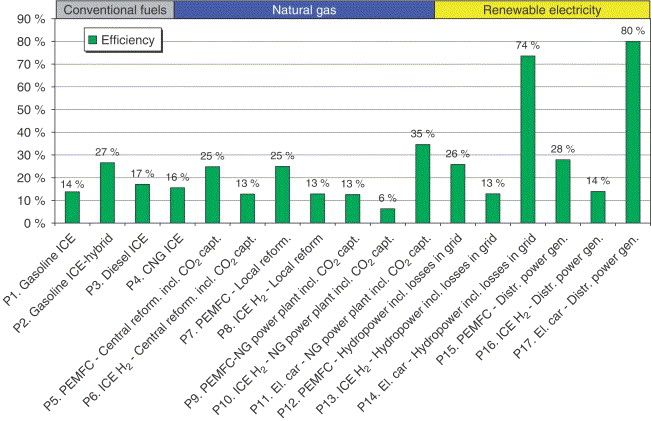
From below, I posted about the efficiency. Here is a graph from this research paper. To sum it up, if you're burning the H2 in an ICE, you're only making the situation worse. PEMFCs can be a little better than ICE vehicles, but they pale in comparison to electric cars.
Thanks, I had always suspected that was the case, I'm glad to finally see some real numbers!
-
Efficiency
What is the overall efficiency of a Hydrogen powered car (including the energy cost to extract the hydrogen) as opposed to one that runs directly off of fossil fuels?
From below, I posted about the efficiency. Here is a graph from this research paper. To sum it up, if you're burning the H2 in an ICE, you're only making the situation worse. PEMFCs can be a little better than ICE vehicles, but they pale in comparison to electric cars.
-
Well-to-wheels efficiency
To add information to this discussion, here's the net system efficiency, well-to-wheel, of different energy sources:
LinkThat graph is from this paper:
LinkAll issues of fuel cost, fuel cell vehicle cost, safety, ozone damage, infrastructure cost, and so forth aside, one of the big complaints about hydrogen is that it's just not that efficient.
-
They're hiding in the block-lists, not empty space
They reorder full blocks to encode data in the orderings within the list of blocks for a given file. That's why they "do not require storage of any additional information on the filesystem" and why "a capacity of up to 24 bits/cluster can be achieved on a half-empty disk".
If they wrote to additional blocks they (1) would be adding additional data to the filesystem, (2) would have no limit to the data that could be hidden and (3) would lose it as soon as one started writing additional information to the disk and used the empty blocks.See instead the abstract from Science Direct:
http://www.sciencedirect.com/science?_ob=ArticleURL&_udi=B6V8G-51BBKRS-1&_user=10&_coverDate=01%2F31%2F2011&_rdoc=1&_fmt=high&_orig=gateway&_origin=gateway&_sort=d&_docanchor=&view=c&_acct=C000050221&_version=1&_urlVersion=0&_userid=10&md5=ee913861b3d05b46b905bd4d52ca9380&searchtype=a -
Re:Tell me when you can put a man on Mars tomorrow
I liked Dr. Roth's EFBT design, though it's unlikely it will move forward again..
-
Re:Duh!
Though there have at this point been a couple of studies showing a link between violent media exposure and aggressive behavior.