Slashdot Mirror
Domain: sgi.com
Stories and comments across the archive that link to sgi.com.
Comments · 1,509
-
Re:propack
Here is the page you wanted. You have to put up with 'scalable, reliable blah di blah di blah' (is that bumf a legal requirement for computer companies now?) on the first page, but there's quite a bit of useful info on it. I think I might give it a go when I've got a bit of spare time.
-
TUX !
I just want the cute little TUX screenmate from SGI to work on linux
-
Ditch it. Get a Formac.
Assuming you're using it to drive a 1600SW, you should get rid of it and get a Formac ProFormance 3. According to the reports I've read on the net, using the RevIV with a Mac is just painful. (The ProFormance 4 is just coming out now , but I don't know if works with the 1600SW {it should since it has LVDS output and can handle well over 1600 x 1024}. If it does, that might be an even better choice, though spendy {~$600).)
eBay has two Proformance 3s for sale at this time, one for $50. While you're there, you can sell your RevIV for $50 to $100, depnding on how good your ad is.
Yet-another-option(tm): Take advantage of Formac's trade-up-deal-for-unhappy-RevIV-owners(tm). -
Re:DirectX and new feeatures
The September OpenGL Architecture Review Board (ARB) meeting was held on Tuesday and Wednesday, so I'll pass along a few observations.
- Running an open standard in these days of hyperactive lawyers is a pain. One concern is that people adding new functionality to OpenGL (or even reviewing specifications for it) might sneak in some proprietary intellectual property. If this made it into the standard unchallenged, the owner could then reap a substantial windfall by suing anyone unlucky enough to implement it.
The way this problem is solved is to require anyone active in the ARB to sign an agreement stating that they'll simply disclose any proprietary interest they might have in features that are being considered for use in the API.
This is a good deal, in my opinion; you don't actually have to give up your rights to any intellectual property you might own, and you gain insurance that no one else will "submarine" a patented technology into the API. I encourage anyone who's interested in participating in the development of OpenGL to sign the agreement. See the ARB FAQ link on this subject for more information.
The flip-side is that if you haven't signed the agreement, you can't be included in the discussions, so there's no easy way to know what's actually going on. For example, you couldn't know much about the new features going into the API.
- As far as features go, everyone should understand that what really counts is what's supported by the hardware. OpenGL and D3D actually have similar ways of exposing these features. Microsoft puts things into the D3D API whether or not the hardware vendors can actually support them, and then adds capability bits and pipeline validation queries so that applications can determine at runtime whether the features will work. The ARB and individual vendors put extensions into OpenGL, and then add the names of the extensions to the extensions string so that applications can determine at runtime whether the features will work.
You get the idea -- the bottom line is really pretty similar for the two APIs. Just because a feature is "in" D3D doesn't mean it actually works; just like in OpenGL, you need to test to see what works and be prepared to adapt your code to run on a particular chip or card.
This isn't a bad thing, in my opinion. As long as the hardware vendors are developing new features, there'll be differences between them that app developers have to live with. But the competition exposes new ideas and the market will eventually encourage the ones that are useful.
- Just for the record, things discussed at this ARB meeting included programmable vertex processing, rendering to textures, encapsulating vertex data in objects that can be processed faster by T&L hardware, advanced pixel processing, and new memory management schemes for textures and other objects. You'll probably see this stuff being usable in OpenGL about the time hardware actually supports it, just like D3D.
Oh, yeah, Fahrenheit. Long story there. Bottom line as I understand it: As far as Microsoft is concerned, D3D8 or 9 essentially is the Fahrenheit Low-Level API. SGI isn't participating in that effort any longer. The Fahrenheit Scene-Graph API exists, and you can actually buy it from Microsoft, but there's no support for it, so its future is uncertain.
Allen
- Running an open standard in these days of hyperactive lawyers is a pain. One concern is that people adding new functionality to OpenGL (or even reviewing specifications for it) might sneak in some proprietary intellectual property. If this made it into the standard unchallenged, the owner could then reap a substantial windfall by suing anyone unlucky enough to implement it.
-
Re:DirectX and new feeatures
The September OpenGL Architecture Review Board (ARB) meeting was held on Tuesday and Wednesday, so I'll pass along a few observations.
- Running an open standard in these days of hyperactive lawyers is a pain. One concern is that people adding new functionality to OpenGL (or even reviewing specifications for it) might sneak in some proprietary intellectual property. If this made it into the standard unchallenged, the owner could then reap a substantial windfall by suing anyone unlucky enough to implement it.
The way this problem is solved is to require anyone active in the ARB to sign an agreement stating that they'll simply disclose any proprietary interest they might have in features that are being considered for use in the API.
This is a good deal, in my opinion; you don't actually have to give up your rights to any intellectual property you might own, and you gain insurance that no one else will "submarine" a patented technology into the API. I encourage anyone who's interested in participating in the development of OpenGL to sign the agreement. See the ARB FAQ link on this subject for more information.
The flip-side is that if you haven't signed the agreement, you can't be included in the discussions, so there's no easy way to know what's actually going on. For example, you couldn't know much about the new features going into the API.
- As far as features go, everyone should understand that what really counts is what's supported by the hardware. OpenGL and D3D actually have similar ways of exposing these features. Microsoft puts things into the D3D API whether or not the hardware vendors can actually support them, and then adds capability bits and pipeline validation queries so that applications can determine at runtime whether the features will work. The ARB and individual vendors put extensions into OpenGL, and then add the names of the extensions to the extensions string so that applications can determine at runtime whether the features will work.
You get the idea -- the bottom line is really pretty similar for the two APIs. Just because a feature is "in" D3D doesn't mean it actually works; just like in OpenGL, you need to test to see what works and be prepared to adapt your code to run on a particular chip or card.
This isn't a bad thing, in my opinion. As long as the hardware vendors are developing new features, there'll be differences between them that app developers have to live with. But the competition exposes new ideas and the market will eventually encourage the ones that are useful.
- Just for the record, things discussed at this ARB meeting included programmable vertex processing, rendering to textures, encapsulating vertex data in objects that can be processed faster by T&L hardware, advanced pixel processing, and new memory management schemes for textures and other objects. You'll probably see this stuff being usable in OpenGL about the time hardware actually supports it, just like D3D.
Oh, yeah, Fahrenheit. Long story there. Bottom line as I understand it: As far as Microsoft is concerned, D3D8 or 9 essentially is the Fahrenheit Low-Level API. SGI isn't participating in that effort any longer. The Fahrenheit Scene-Graph API exists, and you can actually buy it from Microsoft, but there's no support for it, so its future is uncertain.
Allen
- Running an open standard in these days of hyperactive lawyers is a pain. One concern is that people adding new functionality to OpenGL (or even reviewing specifications for it) might sneak in some proprietary intellectual property. If this made it into the standard unchallenged, the owner could then reap a substantial windfall by suing anyone unlucky enough to implement it.
-
Modular computers
I would love to see a computer which you can just snap together from parts and increase in ram, processors, storage, and such without any limitation, and without turning off machines.
Like the SGI 3000? Granted, the modules are pretty big... -
Companies and KeggersCome work for SGI. We have a beer bust every Friday.
-
Re:MPAA is doing this NOWThis reminds me of Web That Smut!
The idea of the game is that you start at a web page of a competitor's choice and compete to find smut the fewest number of links away.
Bookmark pages, search engines, etc, are off limits as they make the game too easy.
-
Re:Hah!
SGI is the only company that I know of that uses their unrealeased (read beta) IRIX 6.5.x as of current on their production servers before release. Sort of like eating it, all of it and liking it before the customer's even get a taste.
-
Obligatory Karma Whoring LinkIt's actally a file browser. SGI have that program free to download for IRIX v5.3 and below from their website here:
There are also a few similar OpenGL file managers for Linux here:
-
Weta Digital isn't the only one
Big Idea made the same decision not too long ago.
I never bothered to figure out what the cost/performance ratio was between the two platforms. I just knew that Linux was a lot cheaper.
The thing that suprises me is that they only have 16 boxes... and that this is newsworthy. We have 42 (with almost exactly the same config) and plan on ordering more in the near future.
One other difference is that they are using RenderMan and we are using Maya's renderer, which has recently been ported to Linux. For the type of work that we do, Maya is more than enough for us. Also, we hardly have any frame times of an hour... if we do, I yell and scream to get it cut down. The difference is that we are only rendering to 724x486. The use a higher resolution for the big screen, we only have to wory about NTSC for now.
The prices quoted in the article seem to be inflated a bit too. Unless they are quoted in the NZ dollar and that is about a 2-1 with the American. Octanes should be about $20k in the States. Linux boxes similarly configured, from VA, which we use, instead of SGI, are in the $5-6k range.
The performance boost that we have got from adding the Linux boxes is amazing. We went from being able to render on 50 MIPS CPU's 14 hours a day to rendering on an aditional 84 Intel CPU's 24 hours a day. The comparison in render speed is about 1-1, slightly infavor of the MIPS chip.
When it is all said and done, a move like this should be a no brainer to any studio. Rendering needs horsepower and system memory, both of which are cheaper in the Intel world. SysAdmins need Unix for ease of administrating and lack of down time... every studio I know considers the render system to be H.A. (high availablity). When things go down, projects get delayed... and that is a big no no in the production world (think of all the billboards you see with release dates on them... months in advance). Linux is a great choice for this.
The only drawback is that the SGI boxes have the ccNuma interface, which is great for single frame renders.
I know that I have posted many times on
FWIW: Our next two videos are the first to use our Linux render farm. Esther is at least 3/4 rendered on Linux boxes and Penguins will be mostly, if not all, rendered on Linux boxes.
-Tim Toll
Render Architect
Big Idea Productions -
A tactic that might just work...
As some bright spark pointed out (#443), the people that should really be taking our message to the MPAA are the big open-source baddies, like SGI, VA Linux, Penguin Computing, IBM etc. that Hollywood actually depends on to some extent.
I've made a start by finding SGI's feedback section, and have posted to both their open source and community areas. Might I humbly suggest that others also write to this and the other companies. As he pointed out, just a few letters from these companies may have significantly more effect than hundreds written by us.
And to those who work at these companies - if you can get away with writing to the MPAA on company letterhead, please do so!
If anyone is interested, my letter went something like this:
As a highly-regarded company and a leader in Open Source software, I thought SGI might be concerned (as I am) at recent claims that tar SGI and others, made by the MPAA in their recent opposition brief in one of the DVD cases.
An example is the opening sentence of the brief: "Defendant Pavlovich is a leader in the so-called "open source" movement, which is dedicated to the proposition that material, copyrighted or not, should be made available over the Internet for free."
As SGI is not, in fact, dedicated to piracy - indeed is highly esteemed in Hollywood - I feel that a simple letter of concern from your company to the MPAA would be an enormous (and greatly appreciated) contribution to our efforts to maintain the reputation of "open source" as a commercially acceptable practise.
A copy of the brief is at http://cryptome.org/dvd-v-521-opq.htm
Sincerely,
J. Fisher
Lead Designer
eCOSM Ltd. -
Re:buncha inbred kitties
I'd have to agree with you. Everything I learned in my high school biology class indicates that you need a wide base of DNA to avoid all the problems that incest brings. Let's be honest, how many dead thylcines do they have just laying around to pull genetic matter from? not a whole lot I'd guess. And How large a population will they have to create to avoid inbreeding? Pretty large I'd say. Anybody know the mathamematical formula for this?
Who are you? Where are we going? And what's with the handbasket?
Purple Power -
Re:A Microsoft World
Actually, that UNIX system in Jurassic Park was using a real interface. It's called "fsn", and it was developed by SGI. Unfortunately, it's only available for Irix...
-
Full-spectrum lights + windows & egronomics
kinda like my office. i really have to be thankful that my employers worked with me on the lighting in my office. i've left a company or two in large part because of the conditions of work (flourescent lights, bad chairs, bad monitors, etc)
my current setup is pretty rigged:
Lumichrome 1XX CRI 98/6500K (go for teh UV, you can pick up the missing IR with full-spectrum incandescents)
Aeron Ergonomic Chair from Herman-Miller
Effektiv funrishings
SGI Flatpanel monitor Split keyboardfrom Microsoft
Logitech Mouse
3 windows that face north
i'm not bringing all this up to show off my setup here, but moreover so that people can see what a reasonable healty office stocks.
we also use 4200k (i think) flourescents for general hallways/etc.
much of this equipment is a little pricey - i had to split some of it with my employers. but unless you're employers outright don't care about your health then they shoudl at least be amenable to you bringing in your own equipment. you'll pay extra for the quality, but when you're in you're office you'll know where that money went. -
Re:My office space...
The irony of managers having offices and the knowledge workers having cubes is that that's the exact opposite of what each group needs. Managers spend their time interacting with others -- making phone calls, interviewing, meeting, etc.
. . .
Knowledge workers, however, have the opposite needs. They spend their time focused on a single task for extended periods of time.
. . .
Unfortunately, I have yet to see an organization that hasn't been afflicted by the office royalty syndrome...Then come work for SGI! At HQ the policy is basically that engineers get private offices (contractors have to double-up), but managers and above all have cubes. Heck, I've even seen VP levels with high-wall cubes. But the people who really need the peace-and-quiet, namely engineers, have their owrn offices and love it.
But it's even better out in the Twin Cities where we work at the former Cray Research facilities. Aside from some sales-droids and the receptionist, everyone has their own comfortable-size office. And almost every one of those offices has a window either to the outside or to large internal atriums. Throw in an Aeron chair for whoever wants one and the friendliest and most competent group of coworkers you could ever imagine, and it's just the absolute best working environment you can ever ask for.
It's nice to know that your employer really does understand the needs of the creative elements of their workforce.
-
Re: cc:NUMAAn interesting bit was the cc:NUMA architecture for high end clustering. I wonder what will become of it?
Maybe you've never heard of a company called SGI. They're down right now, but not necessarily out. Their new Orign 3000 server line uses a cc:NUMA architecure. They hope to run Linux on these someday, but Intel has been jerking them around with Itanium delays.
I suspect that Cray is also using cc:NUMA technology (which they got from SGI) in their next computer, the SV2.
-
Tied to Motif?From the FAQ:
What are the prerequisites for building the Open Inventor software? Linux (glibc 2.x) or IRIX, X11R6, Motif, C++ compiler and OpenGL.
Does anyone know how closely tied it is to Motif? Is it the whole thing, or just a small part? How hard would it be to use it in, say, a GTK+ program without dragging Motif (or even Lesstif) along with it?
(I would download it myself and take a look, but their server seems to be
-
WOOHOO!
I use Blender at home (because I only mess with this stuff for my own amusement). So as soon as I read this I thought "Can Blender and Inventor share tech, now that they are both open"? The only thing that would keep that from happening is license problems.
But Inventor is LGPL! Woohoo! http://oss.sgi.com/projects/inven tor/license.html
-- -
Re:half way across the river? change horses!
Q: What are these same companies contributing to these "core values" of Linux? A: With the partial exception of IBM, nothing.
Just some examples to show that these companies make valuable code contributions to the free software comunity:
HP
Mauve
A free (GPL) test suite for the Java[tm].
Compaq
iPAQ port
Compaq Ports Linux to iPAQ Handheld Computer.
They should also be mentioned for their Linux work regarding 64bit processor architectures (Alpha, Intel).
SUN
StarOffice
Under the motto: Lets use the best of breed components (read filters) in our GNOME office suite. And let us not forget their donations to the Debian developers for the UltraSparc port.
SGI
SGI OSS Projects
Look at this long project list
- Just my Euro 0.02c -
Re:Number of colour...uhm
Now if only SGI would make a gaming console...
-
Memory management policy
I think Guillaume's nice discussion about some of the drawbacks of Gtk-- mixed memory management policy is fine as far as it goes, but I would like to add some points.
First, there are really many alternatives to choose to decide what kind of memory management to use for a C++ program. Telling is that the C++ standardization committee could only agree on one memory management class (auto_ptr<>). It uses gross hacks for ensuring the type checker does the right thing (And I'm not convinced it's right as it is).
Ok, to get to my real point, here is a list of all memory management policies I could remember having seen used in C++:
1) explicit deallocation (programmer responsible for deleting; e.g. C++ plain pointers)
2) strict ownership (e.g. a creation function returning a smart pointer )
3) transferrable ownership (e.g. auto_ptr)
4) Stack (objects created first are deleted last)
5) Static allocation (memory for object always exists)
6) no deallocation (sometimes you just can leave memory as leaks)
7) garbage collection (The garbage collector takes care of deallocation)
8) Cluster allocator (see "Ruminations on C++" by Andrew Koenig; basically objects are deallocated in clusters, and whenever the cluster is deallocated, all the objects in it are deallocated as well).
9) reference counting with explicit ref/unref.
10) Intrusive reference counting (the objects being pointed to contain a reference count)
11) Non-intrusive reference counting (the reference count is separate from the object, e.g. like boost shared_ptr template)
12) Handle-Body idiom (you write a specialized handle for managing memory for your class)
13) Container-managed (like Gtk-- manage())
14) Containment (like Gtk-- containment based solution)
15) Library-owned objects (library only returns references without ownership to users)
16) Distributed garbage collection
17) Evictor (the objects are maintained in a fixed size array, and the least used objects are deleted when new objects are created that would o verflow the array When the object is next needed after being deleted, it's re-created).
18) Copy semantics (you always do a copy)
19) Lazy copy semantics (you make a copy when you have to)
20) Reaper (The memory is scanned at fixed intervals for freed-up objects, and any objects marked to be deleted are freed).
21) Shared memory allocation
22) Persistent allocation (You mmap() some disk space for your objects, and leave it there to allow it to be used on subsequent invocations of your program)
23) Class allocator (overloading operator new and operator delete for allocating small objects efficiently)
24) Self-managed allocation (the object deallocates itself)
25) Singleton (The object is allocated when it's first used, and deallocated at the end of the program)
26) Mixture of several of the above policies
The design space for memory allocation of C++ objects is really HUGE. So it's no wonder there is some disagreement on what is the preferred way to handle memory management, especially as many of these alternatives are actually contradictory in that it is hard to combine many of these strategies.
I personally prefer auto_ptr combined with a non-intrusive reference counted pointer class and creation functions that return memory wrapped in auto_ptr. You do need some solution for putting references to objects in containers, plain auto_ptr doesn't work for that. -
Re:What we truly need is Linux(tm) in a Lego(tm)
-
Re:I see why they ditched Cray
Nice machines though, even if a bit long in the tooth (the O2000 is fourish years old, the O3000's should be announced anytime now, go look at comp.arch)
It happened roughly a week ago, during SIGGRAPH 2000. The Origin 3000 is a beaty. See here for details. -
Re:sgi stuff is SLOW (SO What?
Linux runs quite well on Indy. My Distro is available, and there is Debian port in the works. See also The SGI site and The Unofficial site. There's even X available now for some configurations. This port isn't production-ready but it's certainly ok for casual use.
-
Predictions for the future ...All industrial strength servers will migrate towards 19" racks or cubes (e.g SGI Origin 3000).
All consumer electronics will tend towards book-sized consoles (e.g Sony, Bose speakers)
Business machines will remain boring and beige
why? you 'canna break the laws of physics and economics. What are the physical limitations of chips? Heat dissipation which means for a given level of technology (process shrink) they generate a certain thermal volume (aside it's rather interesting that the C-bricks modules SGI designed for their O3000 are deliberately oversized to handling the heat given off by the coming IA-64 processors
Deskside cubes are usually aimed to a) fit under a desk or b) migrate to a within an internal rack space so the physical dimensions are constrained, especially when you consider physical access to cables and the reset button.
Laws of economics dictate that for low-priced consumer items a larger fraction of cost is contained in the distribution system (think return/repair/replacement/etc). Hence a tendency is to reduce to form-factors which existing packaging/mailing tends to fit (e.g A3 sized padded envelops). Hence convenience is key so form factors will tend to standardise around a few common shapes (e.g. CD-case size).
One can point out to parallels with the rail industry where tracks were designed to handle carriages adapted from trolleys which had axis build from cart hoists/rigs which had width dependent on navigating the ruts on the original British roads. Hence width of modern railway tracks have their ancestry derived from Roman times! In a similar regard, you will see many shapes constrained by 19" rack form factor and CD-cases. The supporting infrastructure is so prevalent that it will have to be a really radical advance to justify a physical change.
Oh, as for boring and beige do you expect that an average penny-pinching company wants to waste money on something like aesthetics that's going to be obsolete in 2-3 years time? Of course Mac fans like to "think different"
LL
-
Use a Trusted OS.
Script kiddies don't have enough bandwidth to DoS a major provider, so they use rootkits to crack systems and then use the cracked system as a launchpad for their DDoS attacks, right? Well, maybe a solution is for companies to use a Trusted OS like Argus PitBull, Trusted BSD, (admittedly incomplete) OB1, Trusted Solaris, HP's virtual vault, or find a better match for yourself.
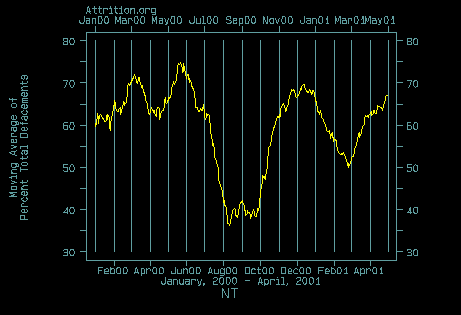
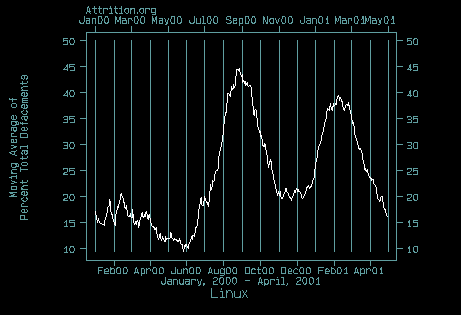
Why people use WinNT as a server platform is beyond me. Something like 65% of web-site defacements listed at Attrition.org are WinNT based. That's insane. Linux is something like 20%. I was very surprised at HOW MANY sites are hacked. The internet's infrastructure needs to be improved, sure. But how about securing your system properly?! Argus has even announced a Linux port for their products; it's the only TOS that I've seen even mention Linux. And, maybe someone should push the Linux Kernel developers to finish implementing the Capabilities and ACL stuff that at least partially exists in the kernel (or in patches); this would allow application coders to write non-suid programs that would still have some of the root capabilities (just the ones they need).
I'm not saying that the sys admins are to blame. These decisions are generally not simple technical ones. However, everyone needs to be educated about the products that are available to protect themselves and others (in the case of DDoS's). If you're a sys admin, educate yourself and pass it on to your boss. They may not get it, but you should at least try.
Just my $0.02.
$ flames > -
Re:Still the king of graphics?Ahh, ok. I wasn't aware SGI still had any in-house graphics designers left.
I found a page on sgi.com giving a bit on the difference between VPro/Intel and VPro/Irix.
-
Re:Not a cluster?
Oh yeah, one other thing. The multiple OSes running on one "system" is what sgi calls partitioning. This is where a customer might have a 4x32p system running during the daytime and reboot to a 128p system for night time batch. However, when in 4x32p mode, it looks like 4 different systems (like each of the nodes in a beowulf) -- bigsys1, bigsys2, bigsys3, and bigsys4. When in 128p mode, its just a single bigsys.
-
What software is available for it?
So what software is available for it? This is going to be about useless unless there is some useful software ported to it. I doubt that we are going to see Maya, SoftImage, or any Discreet Logic tools on it anytime soon. Granted, big companies like Digital Domain and ILM can dedicate some programmers to porting in house tools, but why would they want to? For the same amount that it would cost them to pay for the developers time, they can buy a couple more SGIs. I'll be curious to see what the future brings for this product.
-
And it runs quake!
-
Techy Question: About those shadows...Perhaps a little offtopic, but what amazes me most are the shadows. For example, take a look at the Tr anquility Arena shot 3 and the Ba sic silicon shot 4. From an OpenGL standpoint, shadows such as these would be difficult to generate in realtime, especially since they are "soft shadows". Now I know about the technique of rendering shadow volumes using the stencil buffer, but shadow volumes are still hard shadows, and some cards, like the Voodoo 3, aren't even gifted with a hardware stencil buffer.
I'm guessing that either:
- They use shadow maps.
- They have a prerendered shadow texture that goes with each level, and then is projected, somehow, into place (I don't know anything about projective textures)
- They use shadow maps.
-
Techy Question: About those shadows...Perhaps a little offtopic, but what amazes me most are the shadows. For example, take a look at the Tr anquility Arena shot 3 and the Ba sic silicon shot 4. From an OpenGL standpoint, shadows such as these would be difficult to generate in realtime, especially since they are "soft shadows". Now I know about the technique of rendering shadow volumes using the stencil buffer, but shadow volumes are still hard shadows, and some cards, like the Voodoo 3, aren't even gifted with a hardware stencil buffer.
I'm guessing that either:
- They use shadow maps.
- They have a prerendered shadow texture that goes with each level, and then is projected, somehow, into place (I don't know anything about projective textures)
- They use shadow maps.
-
Information, maybe even usefull.First off, you may want to see if there is a FreeBSD or Debian port available for the Challenge XL (MIPS). There is some downloads for IRIX on the SGI website HERE
Here is a link on how to install KDE on IRIX, it may be worth a try to put a new face on IRIX.
Here is a blurb about what the Challenge XL was intednded to be used for: (copied from this website you may find helpful)
ChallengeXL The CHALLENGE XL network resource server is a compute and throughput powerhouse for deskside and data center applications in the database, digital media, integer compute real-time and high-performance file serving markets. The CHALLENGE XL can handle extraordinary data management tasks, shifting yesterday's compute paradigm from high-cost mainframes to the industry-leading performance of today's cost-effective symmetric multi-processors. The powerful, flexible CHALLENGE XL system architecture is based on a 1.2GB/second sustained bus, which minimizes time-wasting contention between I/O, memory and compute subsystems. The system supports from two to thirty-six MIPS® R10000 TM CPUs, multiple gigabytes of CPU memory, and up to six 320MB/second POWER Channel-2TM I/O subsystems. The CHALLENGE server's flexible hardware and software configurability allows performance optimization, as well as tangible growth paths to meet future computing demands. The server comes standard with one 320MB/second POWER Channel-2 subsystem. Each POWER Channel-2 subsystem contains an EthernetTM controller, two 20MB/second Fast/Wide 16-bit SCSI-II controllers (configurable as single-ended or differential) a 50MB/second VME controller, two 19.2KB RS232 serial ports, a 38.4KB RS422 serial port, a parallel port, and supports up to two optional daughter boards (HIO modules). External storage is provided via the CHALLENGE Vault XL. With this product, the CHALLENGE servers can support up to 5.6TB of on-line, non-RAID storage and 17.4TB of RAID-5 and RAID-3 storage. The CHALLENGE XL server is ideal for cutting edge data warehousing applications. With CPU and I/O expandability to meet the needs of interactive terabyte databases, this system can be grown to manage the data extraction and data hygiene needs of each customer. HIO-based SCSI expansion provides higher database performance by reducing I/O interrupt overhead. Large secondary cache also increase overall database performance. In addition CHALLENGE uses the IRIX symmetric multi-processing operating system in conjunction with the XFSTM, a native log-based filesystem. This provides a high level of data integrity, quick data recovery, and a robust environment suitable for the parallelism and throughput requirements of data warehousing. The CHALLENGE XL serves the realm of extreme data as a deployable machine unmatched in CPU and I/O throughput capabilities. Complementing these hardware strengths are software advances, which create industry-leading file server performance for the enterprise. For the most creative graphics workstation users manipulating a range of digital media data, IRIX offers deterministic I/O, large file and partition sizes, and intuitive data management through the IRIXPro suite of flexible GUI-based administration tools. Performance-hungry supercomputer sites requiring powerful front-end servers with direct and buffered I/O capabilities also enjoy efficient utilization of high-performance networks (HiPPI, FDDI) and sparse file support.
-
SGI's web site and picture for the Origin 2400.
The web site for that SGI-made beauty is here (http://www.sgi.com/origin/2000/), and a picture of it is here (http://www.sgi.com/origin/2000/ima g es/2400L.jpg).
-
SGI's web site and picture for the Origin 2400.
The web site for that SGI-made beauty is here (http://www.sgi.com/origin/2000/), and a picture of it is here (http://www.sgi.com/origin/2000/ima g es/2400L.jpg).
-
Re:Questions
Well, to answer question 1, SGI wants $20K for a used system with fewer, slower processors ( Link here ).
--
Email address is real. -
oops (Re:"Redhat Linux")
I forgot -- SGI isn't just a prime partner of Alias/Wavefront, anymore. They're now the friggin OWNERS! All the more reason to follow the SGI lead into the Linux(RedHat) world.
-
Re:Remote Display can be put into something New!
I really hate to point this out but there was a benchmark at Linux Games that shows Windows beating Linux in 3d accelaration with several different cards. Personally I think this has a lot to do with X.
You're absolutely right - it has a lot to do with X. MS Windows programs running on local windows machines have direct access to the graphics hardware. DirectX / OpenGL libraries have direct memory mapped interfaces with your graphics card.
When a traditional (indirect) OpenGL 3D game runs on X (via the GLX extensions) it undergoes translation to X window calls, X protocol encode and gets queued to the X server at which point (in a very basic not-at-all-aware-of-what-happens program) we block - stall completely. We wait for a context switch to the X server before doing a protocol decode and finally transferring the graphics request to hardware. Lastly we have to wait for another context switch before we can carry on with whatever processing we were gonna do. At the minute GLX is (almost) entirely based on this scheme.
Perhaps the largest XFree86 development project at the minute is Precision Insight's Direct Rendering Infrastructure. This will give X a similar mechanism to Windows for accessing 3D hardware. See Precision Insight's Design Docs or SGI's take on how graphics hardware should be accessed. Youll see that for the particular case that people whinge about (why can't local programs just have local hardware access?) this is precisely what is needed.
Even more remarkable is that the DRI retains all the network transparency assosciated with X for indirect rendering; using direct rendering when available on the local machine. Im not to sure of the framerate you'd get if you ran 3D games over PCAnywhere; or whether itd be worthy of the title 'framerate'. -
Alternatives
Some alternatives to X11 that I've come across:
D11 - Proposed replacement for X11 (from 1995), but I don't think it made it past the idea/proposal stage.
Berlin - Under development, "Latest News: June 12, 2000: 0.2 is out".
See also: Berlin page at Sourceforge
-
Re:This vs. The SGI Flatpanel 1600SW
The question I have is: what video card (besides the #9) supports the SGI's funky (yet wonderful) 1600x1024 resolution?
The first crop of SGI Intel-based workstations, the 320 and 540 series, supported the 1600SW out of the box with their Cobalt chipset. The SGI O2 could also drive it with a special adapter.
It's really kind of sad that the industry went with the other digitial signalling technology, which is encumbered by patents and limited in resolution. Check out SGI's whitepapers on the subject. I think the new MultiLink Adapter is way overpriced. They should include it with the monitor IMHO.
-
Just the thing...
...to go with your SGI Onyx2, which is basically an Origin Supercomputer with a bunch of graphic adapters (which SGI prefers to call "rendering subsystems" or "pipes"). Since Onyx2's often have 16 pipes (with a gig of texture ram!), you would need to buy 4 of these LCD displays. Yeah, that's a lot of cash, but only a fraction of the cost of the Onyx2!
-
Just the thing...
...to go with your SGI Onyx2, which is basically an Origin Supercomputer with a bunch of graphic adapters (which SGI prefers to call "rendering subsystems" or "pipes"). Since Onyx2's often have 16 pipes (with a gig of texture ram!), you would need to buy 4 of these LCD displays. Yeah, that's a lot of cash, but only a fraction of the cost of the Onyx2!
-
Re:And for reference?
From SGI's FAQ:
Q. How much does a complete, fully integrated SGI Reality Center solution cost?
A.The cost is variable, depending upon the size of your facility and your need for custom applications development. SGI Reality Center facilities, complete with installation and integration, start at under U.S. $300,000. -
Re:And for reference?
No - that's just nice - this is godly!
--
Email address is real. -
IRIX 3D File manager
But the girl uses IRIX old 3d file manager to
navigate the system. To bad it wont work on newer
versions of IRIX since I cant run on our
O2's at school.. buhhh!!!
http://www.sgi.com/fun/freeware/3 d_navigator.html
is the url for the software..
"One World, One Web, One Program" - Microsoft Promotional Ad -
Re:Pie charts
Yes. It is called Maya (http://www.aw.sgi.com) and costs a bundle. Maya's interface is really well thought out though. Really built for people using mouse and keyboard at the same time etc. Nice stuff.
-
yes there is, but mostly hand held
There are some great innovation going on when it comes to user interface design. I work as a researcher in sweden and here a lot of people are working on new hand healed devises and how to make new user interfaces for small screens(mostly because Ericson and Nokia are nordic, two of the leading cell phone manufacturers in the world). So a lot is happening in that area.
A god place to look for innovation is ACM chi (computer human interaction), a org where you can find a lot of fun stuff. A lot of the research that is going on is about how to integrate computers in to our life's, so that you don't need to interact whit them directly, they them self should be context sensitive to their environment and respond to your needs and filter out the information you need. this is usually called "augmented reality"
So what about regular user interfaces? well in my opinion there is way to little innovation when it comes to computer applications and the open source community has not been as innovative as one would think, but i what to give one link to Alias|Wavefront. If you look at there hi-end cad/animation software you will find so much of innovation that will make you hate most of our common software's interfaces
Eskil -
How quick?
According to the press release at SGI the O2 was only released four days ago... or am I mistaken on this one?
-
Re:Honest Question