Slashdot Mirror
Domain: slashdot.org
Stories and comments across the archive that link to slashdot.org.
Stories · 37,380
-
Silicon Valley Workers May Pursue Salary-Fixing Lawsuit
First time accepted submitter amartha writes with news that a lawsuit alleging Silicon Valley companies of colluding to lower wages is going forward as a class action. From the article: "Roughly 60,000 Silicon Valley workers won clearance to pursue a lawsuit accusing Apple Inc, Google Inc, and others of conspiring to drive down pay by not poaching each other's staff, after a federal appeals court refused to let the defendants appeal a class certification order." -
Notorious Patent Troll Sues Federal Trade Commission
Fnord666 writes with news that the notorious scanner patent troll MPHJ Technology caught the eye of the FTC, and decided to file a preemptive lawsuit (PDF) against the Federal government. From the article: As the debate over so-called "patent trolls" has flared up in Congress, MPHJ became the go-to example for politicians and attorneys general trying to show that patent abuse has spun out of control. ... The FTC was going to sue under Section 5 of the FTC Act, which bars deceptive trade practices. MPHJ says that the FTC is greatly overstepping its bounds. The patent-licensing behavior doesn't even amount to 'commerce' by the standards of the FTC Act, because the letters are not 'the offer of a good or sale for service,' argues MPHJ. Furthermore, MPHJ has a First Amendment right to notify companies that it believes its patents are being infringed." -
Code.org: Give Us More H-1B Visas Or the Kids Get Hurt
theodp writes "Fresh off their wildly-hyped Hour of Code, Code.org headed to Washington last Thursday where H-1B visas were prescribed as the cure for U.S. kids' STEM ills. 'The availability of computer science to all kids is an issue that warrants immediate and aggressive action,' Code.org told Congress. "Comprehensive immigration reform efforts that tie H-1B visa fees to a new STEM education fund,' suggested Code.org co-founder Hadi Partovi, is 'among the policies that we feel can be changed to support the teaching and learning of more computer science in K-12 schools. We hope you can be allies in our endeavors on Capitol Hill.' Also testifying with Partovi was inventor and US FIRST founder Dean Kamen, who also pitched the benefits of H-1B visas (PDF). 'We strongly encourage Congress to pass legislation that directs H-1B visa fees to enable underserved inner-city and rural schools to participate in FIRST,' Kamen testified. 'Specifically, these fees should support efforts to enable underserved inner-city and rural schools to participate in FIRST.'" -
Ask Slashdot: How Can I Improve My Memory For Study?
First time accepted submitter Sensei_knight writes "How serendipitous! Today I see Slashdot also has an article linking caffeine to long-term memory, but I digress. Recently I returned to college in my 30s, after battling a childhood sleep disorder, and I now discover staying awake might be the least of my troubles. Now that I failed a few classes I'm trying to analyze and overcome the causes of this recent disaster. Two things are obvious: First, it takes me way too long to complete tasks (as if suffering from time dilation) — tests take me approximately twice the amount of time to finish [and the amount of time it takes to study and do homework is cumulative and unsustainable]. Secondly, I just can't seem to remember a whole lot. I know sleep and memory are very closely related, perhaps that's why I have never been able to commit the times tables to memory. My research on the subject of memory has not been very fruitful, therefore I want to ask for input into which angle/direction I should look into next. As for cognitive speed, I have completely drawn a blank." -
How Quickly Will the Latest Arms Race Accelerate?
First time accepted submitter tranquilidad writes "Russia was concerned enough about the U.S. development of a Prompt Global Strike (PGS) capability in 2010 that they included restrictions in the New Start treaty (previously discussed on Slashdot). It now appears that China has entered the game with their 'Ultra-High Speed Missile Vehicle.' While some in the Russian press may question whether fears of the PGS are 'rational' it appears that the race is on to develop the fastest weapons delivery system. The hypersonic arms race is focused on 'precise targeting, very rapid delivery of weapons, and greater survivability against missile and space defenses' with delivery systems traveling between Mach 5 and Mach 10 after being launched from 'near space.'" -
I Became a Robot With Google Glass
Nerval's Lobster writes "Videographer and journalist Boonsri Dickinson took the second generation of Google Glass out for a spin, and came back with some thoughts (and a video) on the hardware (basically unchanged from the first generation) and the new XE12 software upgrade (which includes many new features, such as the 'eye wink' option for snapping photos). New apps in the tiny-but-growing Glass app store include Compass, which allows you to find interesting landmarks; Field Trip, which allows you to walk around and look up local history; Video Voyager, a tool for sharing videos based on your location; and Strava Run, which visualizes your fitness habits. 'Glass has potential to take off as a new platform because it's not a phone,' she writes. 'The hands-free approach could expand its use to venues as diverse as the operating room and kitchen, unlocking new ways of using the data overlays to augment the real world.' Interesting features aside, though, her experience with the device raises the usual privacy questions: 'For the most part, Glass is a good prototype for this new kind of computer: but do we really need it, and are we ready for it?'" -
EA Caves: SimCity Offline Mode Coming
iONiUM writes "After EA staunchly denied any offline mode, it would seem the disastrous SimCity launch and continual gamer community anger (as well as a CEO firing), EA finally caved and has now going to make an offline mode. However, the obvious question still remains: is it too little too late?" -
EA Caves: SimCity Offline Mode Coming
iONiUM writes "After EA staunchly denied any offline mode, it would seem the disastrous SimCity launch and continual gamer community anger (as well as a CEO firing), EA finally caved and has now going to make an offline mode. However, the obvious question still remains: is it too little too late?" -
EA Caves: SimCity Offline Mode Coming
iONiUM writes "After EA staunchly denied any offline mode, it would seem the disastrous SimCity launch and continual gamer community anger (as well as a CEO firing), EA finally caved and has now going to make an offline mode. However, the obvious question still remains: is it too little too late?" -
EA Caves: SimCity Offline Mode Coming
iONiUM writes "After EA staunchly denied any offline mode, it would seem the disastrous SimCity launch and continual gamer community anger (as well as a CEO firing), EA finally caved and has now going to make an offline mode. However, the obvious question still remains: is it too little too late?" -
EA Caves: SimCity Offline Mode Coming
iONiUM writes "After EA staunchly denied any offline mode, it would seem the disastrous SimCity launch and continual gamer community anger (as well as a CEO firing), EA finally caved and has now going to make an offline mode. However, the obvious question still remains: is it too little too late?" -
Supreme Court Refuses To Hear Newegg Patent Case
NormalVisual writes "'It's a really tough time to be a patent owner', said Soverain Software, LLC president Katharine Wolanyk, after the Supreme Court refused to hear their appeal after the U.S. Court of Appeals for the Federal Circuit invalidated three of Soverain's shopping cart patents. Soverain had sued Newegg for allegedly infringing the patents in question, and had won in the U.S. District Court for the Eastern District of Texas. Newegg later had the decision overturned on appeal, with the court ruling that the patents in question were obvious, and thus invalid." -
How Reactive Programming Differs From Procedural Programming
Nerval's Lobster writes "A recent post on Reactive Programming triggered discussions about what is and isn't considered Reactive Logic. In fact, many have already discovered that Reactive Programming can help improve quality and transparency, reduce programming time and decrease maintenance. But for others, it raises questions like: How does Reactive differ from conventional event-oriented programming? Isn't Reactive just another form of triggers? What kind of an improvement in coding can you expect using Reactive and why? So to help clear things up, columnist and Espresso Logic CTO Val Huber offers a real-life example that he claims will show the power and long-term advantages Reactive offers. 'In this scenario, we'll compare what it takes to implement business logic using Reactive Programming versus two different conventional procedural Programming models: Java with Hibernate and MySQL triggers,' he writes. 'In conclusion, Reactive appears to be a very promising technology for reducing delivery times, while improving system quality. And no doubt this discussion may raise other questions on extensibility and performance for Reactive Programming.' Do you agree?" -
How Reactive Programming Differs From Procedural Programming
Nerval's Lobster writes "A recent post on Reactive Programming triggered discussions about what is and isn't considered Reactive Logic. In fact, many have already discovered that Reactive Programming can help improve quality and transparency, reduce programming time and decrease maintenance. But for others, it raises questions like: How does Reactive differ from conventional event-oriented programming? Isn't Reactive just another form of triggers? What kind of an improvement in coding can you expect using Reactive and why? So to help clear things up, columnist and Espresso Logic CTO Val Huber offers a real-life example that he claims will show the power and long-term advantages Reactive offers. 'In this scenario, we'll compare what it takes to implement business logic using Reactive Programming versus two different conventional procedural Programming models: Java with Hibernate and MySQL triggers,' he writes. 'In conclusion, Reactive appears to be a very promising technology for reducing delivery times, while improving system quality. And no doubt this discussion may raise other questions on extensibility and performance for Reactive Programming.' Do you agree?" -
How Reactive Programming Differs From Procedural Programming
Nerval's Lobster writes "A recent post on Reactive Programming triggered discussions about what is and isn't considered Reactive Logic. In fact, many have already discovered that Reactive Programming can help improve quality and transparency, reduce programming time and decrease maintenance. But for others, it raises questions like: How does Reactive differ from conventional event-oriented programming? Isn't Reactive just another form of triggers? What kind of an improvement in coding can you expect using Reactive and why? So to help clear things up, columnist and Espresso Logic CTO Val Huber offers a real-life example that he claims will show the power and long-term advantages Reactive offers. 'In this scenario, we'll compare what it takes to implement business logic using Reactive Programming versus two different conventional procedural Programming models: Java with Hibernate and MySQL triggers,' he writes. 'In conclusion, Reactive appears to be a very promising technology for reducing delivery times, while improving system quality. And no doubt this discussion may raise other questions on extensibility and performance for Reactive Programming.' Do you agree?" -
Book Review: The Digital Crown
benrothke writes "With Adobe Flash, it's possible to quickly get a pretty web site up and running; something that many firms do. But if there is no content behind the flashy web page, it's unlikely anyone will return. In The Digital Crown: Winning at Content on the Web, author Ahava Leibtag does a fantastic job on showing how to ensure that your web site has what it takes to get visitors to return, namely great content." Read below for the rest of Ben's review. The Digital Crown: Winning at Content on the Web author Ahava Leibtag pages 358 publisher Morgan Kaufmann rating 10/10 reviewer Ben Rothke ISBN 978-0124076747 summary Invaluable resource and reference for building an effective web content strategy Make no mistake, creating good content for a large organization is a massive job. But for those organizations that are serious about doing it right, the book provides the extensive details all of the steps required to create content that will bring customers back to your web site.
Leibtag writes in the introduction that the reason so many websites and other digital strategy projects fail is because the people managing them don't focus on what really matters. They begin changing things for the sake of change and to simply update, without first asking why. They also forget to ask what the updates will accomplish. What this does is create a focus on the wrong priorities. Leibtag notes that the obvious priority is content.
So what is this thing called content? The book defines it as all of the information assets of your company that you want to share with the world.
The book is based around 7 rules, which form the foundation of an effective and comprehensive content strategy, namely:
1. Start with Your Audience
2. Involve Stakeholders Early and Often
3. Keep it Iterative
4. Create Multidisciplinary Content Teams
5. Make Governance Central
6. Workflow that Works
7. Invest in Professionals and Trust Them
Chapter 1 (freely available here) takes a high-level look at where branding and content meet, and details the need for a strategic content initiative.
An interesting point the book makes in chapter 2 which is pervasive throughout the book is to avoid using the term users. Rather refer to them as customers. Leibtag feels that the term users as part of a content strategy, makes them far too removed and abstract. Dealing with them as customers makes them real people and changes the dynamics of the content project. Of course, this transition has to be authentic. Simply performing a find/replace of user/customer in your documentation is not what the author intended; nor will such an approach work.
The book is heavy on understanding requirements and has hundreds of questions that need to be asked before creating content. The book is well worth it for that content alone.
It also stresses the importance of getting all stakeholders involved in the content creation process. As part of the requirements gathering process, the book details 3 roadmap steps which much be done in order to facilitate an effective strategy.
The book notes that content is much more than web pages. Content includes various formats, platforms and channels. An effective strategy must take al lof these into account. The book notes that there are hundreds of possible formats for content. While it is impossible to deal with every possible option; an organization must know what they are in order to ensure they are creating content that is appropriate for their customers.
By the time you hit page 100, it becomes quite clear that content is something that Leibtag is both passionate about and has extensive experience with. An important point she makes is that it is crucial not for focus on design right away in the project, as it eats up way too much time. The key is to focus the majority of your efforts on the content.
The dilemma that the book notes is that during the requirements gathering process, far too many organizations are imagining a gorgeous web site with all kinds of bells and whistles, beautiful colors and pictures. That in turn moves them to spend (i.e., waste) a tremendous amount of time on design; which leads them to neglect contact creation and migration.
The book details multichannel publishing, which is the ability to publish your content on any device and any channel. This is a significant detail, as customers will be accessing your site from desktops with huge screens and bandwidth to mobile devices with smaller screens and often limited bandwidth. This requires you to adapt and change your content publishing process. This is clearly not a trivial endeavor. But doing it right, which the book shows how to do, will payoff in the long run.
Another mistake firms make is that they often think content can be done by just a few people. The book notes that it is an imperative to create multidisciplinary content teams, since web content will touch every part of the organization, and needs their respective input.
One of the multidisciplinary content teams that must be involved is governance. The book notes that governance standards help you set a consistent customer experience across all channels. By following them, you can avoid replicating content, muddying your main messages and confusing your customers. Governance is also critical in setting internal organizational controls.
Leibtag lays out what needs to be done in extreme detail. She makes it quite clear that there are no quick fixes that can be done to create good content. Creating an effective content marketing strategy and architecture is complex, expensive and challenging. But for most organizations, it is also absolutely necessary for them in order to compete.
The author is the head of a content strategy and content marketing consultancy firm. Like all good consultants, they focus on getting answers to the questions clients often don't even know to ask. With that, the book has myriad questions and requirements that you must answer before you embark on getting your content online.
The book also provides numerous case studies of sites that understand the importance of content and designed their site accordingly. After reading the book, the way you look at web sites will be entirely different. You will likely find the sites you intuitively return to coincidentally happened to be those very sites that have done it right and have the content you want.
My only critique of the book is that the author quotes herself and references other articles she wrote far too often. While these articles have valid content, this can come across as somewhat overly promotional. Aside from that, the book is about as good as anything could get on the topic.
For firms that are serious about content and looking for an authoritative reference on how to build out their content and do it right, The Digital Crown: Winning at Content on the Web is certain to be an invaluable resource.
Reviewed by Ben Rothke.
You can purchase The Digital Crown: Winning at Content on the Web from amazon.com. Slashdot welcomes readers' book reviews (sci-fi included) -- to see your own review here, read the book review guidelines, then visit the submission page. -
Book Review: The Digital Crown
benrothke writes "With Adobe Flash, it's possible to quickly get a pretty web site up and running; something that many firms do. But if there is no content behind the flashy web page, it's unlikely anyone will return. In The Digital Crown: Winning at Content on the Web, author Ahava Leibtag does a fantastic job on showing how to ensure that your web site has what it takes to get visitors to return, namely great content." Read below for the rest of Ben's review. The Digital Crown: Winning at Content on the Web author Ahava Leibtag pages 358 publisher Morgan Kaufmann rating 10/10 reviewer Ben Rothke ISBN 978-0124076747 summary Invaluable resource and reference for building an effective web content strategy Make no mistake, creating good content for a large organization is a massive job. But for those organizations that are serious about doing it right, the book provides the extensive details all of the steps required to create content that will bring customers back to your web site.
Leibtag writes in the introduction that the reason so many websites and other digital strategy projects fail is because the people managing them don't focus on what really matters. They begin changing things for the sake of change and to simply update, without first asking why. They also forget to ask what the updates will accomplish. What this does is create a focus on the wrong priorities. Leibtag notes that the obvious priority is content.
So what is this thing called content? The book defines it as all of the information assets of your company that you want to share with the world.
The book is based around 7 rules, which form the foundation of an effective and comprehensive content strategy, namely:
1. Start with Your Audience
2. Involve Stakeholders Early and Often
3. Keep it Iterative
4. Create Multidisciplinary Content Teams
5. Make Governance Central
6. Workflow that Works
7. Invest in Professionals and Trust Them
Chapter 1 (freely available here) takes a high-level look at where branding and content meet, and details the need for a strategic content initiative.
An interesting point the book makes in chapter 2 which is pervasive throughout the book is to avoid using the term users. Rather refer to them as customers. Leibtag feels that the term users as part of a content strategy, makes them far too removed and abstract. Dealing with them as customers makes them real people and changes the dynamics of the content project. Of course, this transition has to be authentic. Simply performing a find/replace of user/customer in your documentation is not what the author intended; nor will such an approach work.
The book is heavy on understanding requirements and has hundreds of questions that need to be asked before creating content. The book is well worth it for that content alone.
It also stresses the importance of getting all stakeholders involved in the content creation process. As part of the requirements gathering process, the book details 3 roadmap steps which much be done in order to facilitate an effective strategy.
The book notes that content is much more than web pages. Content includes various formats, platforms and channels. An effective strategy must take al lof these into account. The book notes that there are hundreds of possible formats for content. While it is impossible to deal with every possible option; an organization must know what they are in order to ensure they are creating content that is appropriate for their customers.
By the time you hit page 100, it becomes quite clear that content is something that Leibtag is both passionate about and has extensive experience with. An important point she makes is that it is crucial not for focus on design right away in the project, as it eats up way too much time. The key is to focus the majority of your efforts on the content.
The dilemma that the book notes is that during the requirements gathering process, far too many organizations are imagining a gorgeous web site with all kinds of bells and whistles, beautiful colors and pictures. That in turn moves them to spend (i.e., waste) a tremendous amount of time on design; which leads them to neglect contact creation and migration.
The book details multichannel publishing, which is the ability to publish your content on any device and any channel. This is a significant detail, as customers will be accessing your site from desktops with huge screens and bandwidth to mobile devices with smaller screens and often limited bandwidth. This requires you to adapt and change your content publishing process. This is clearly not a trivial endeavor. But doing it right, which the book shows how to do, will payoff in the long run.
Another mistake firms make is that they often think content can be done by just a few people. The book notes that it is an imperative to create multidisciplinary content teams, since web content will touch every part of the organization, and needs their respective input.
One of the multidisciplinary content teams that must be involved is governance. The book notes that governance standards help you set a consistent customer experience across all channels. By following them, you can avoid replicating content, muddying your main messages and confusing your customers. Governance is also critical in setting internal organizational controls.
Leibtag lays out what needs to be done in extreme detail. She makes it quite clear that there are no quick fixes that can be done to create good content. Creating an effective content marketing strategy and architecture is complex, expensive and challenging. But for most organizations, it is also absolutely necessary for them in order to compete.
The author is the head of a content strategy and content marketing consultancy firm. Like all good consultants, they focus on getting answers to the questions clients often don't even know to ask. With that, the book has myriad questions and requirements that you must answer before you embark on getting your content online.
The book also provides numerous case studies of sites that understand the importance of content and designed their site accordingly. After reading the book, the way you look at web sites will be entirely different. You will likely find the sites you intuitively return to coincidentally happened to be those very sites that have done it right and have the content you want.
My only critique of the book is that the author quotes herself and references other articles she wrote far too often. While these articles have valid content, this can come across as somewhat overly promotional. Aside from that, the book is about as good as anything could get on the topic.
For firms that are serious about content and looking for an authoritative reference on how to build out their content and do it right, The Digital Crown: Winning at Content on the Web is certain to be an invaluable resource.
Reviewed by Ben Rothke.
You can purchase The Digital Crown: Winning at Content on the Web from amazon.com. Slashdot welcomes readers' book reviews (sci-fi included) -- to see your own review here, read the book review guidelines, then visit the submission page. -
Windows 9 Already? Apparently, Yes.
Nerval's Lobster writes "A little over a year after Microsoft released Windows 8, and a mere three months after it pushed out a major update with Windows 8.1, rumors abound that Windows 9 is already on its way. According to Paul Thurrott's Supersite for Windows, Microsoft will begin discussing the next version of Windows (codenamed 'Threshold,' at least for the moment) at April's BUILD conference. 'Threshold is more important than any specific updates, he wrote. 'Windows 8 is tanking harder than Microsoft is comfortable discussing in public, and the latest release, Windows 8.1, which is a substantial and free upgrade with major improvements over the original release, is in use on less than 25 million PCs at the moment.' Microsoft intends Threshold to clean up at least a portion of Windows 8's mess. Development on the latest operating system will supposedly begin in late April, which means developers who attend BUILD won't have access to an early alpha release—in fact, it could be quite some time before Microsoft locks down any new features, although it might double down on Windows 8's controversial 'Modern' (previously known as 'Metro') design interface. Yet if Thurrott's reporting proves correct, Microsoft isn't abandoning the new Windows interface that earned such a lackluster response—it's betting that the format, once tweaked, will somehow revive the operating system's fortunes. With Ballmer leaving the company and a major reorganization underway, it'll be the next Microsoft CEO's task to make sure that Windows 9 is a hit; in fact, considering that rumored 2015 release date, shepherding the OS could become that executive's first major test." -
Government Lab Uses Smartphones To Measure Gamma Ray Exposure
KentuckyFC writes "Back in 2008, Slashdot reported that researchers were developing ways of turning cellphones into radiation detectors. Since then a few apps have even appeared that claim to do this. However, convincing evidence that they work as advertised is hard to come by. Now government researchers at Idaho National Labs have created their own app that uses an ordinary smartphone as a gamma ray detector, put it through its paces in the lab and published the results. The pixels in smartphone cameras can detect gamma rays in the same way as they pick up visible light. So when the lens is covered, the image should reveal evidence of gamma ray exposure once other noise has been removed, such as that from heat and current leakage. These guys have tested several types of Android smartphone with a variety of gamma ray sources at various different doses. The researchers say the phones give a reasonable measure of radiation dose, can detect the direction of source (by comparing the measurements from the front and back cameras) and can even measure the energy of the gamma rays by measuring the length of the tracks that appear in the image. While the results do not match the quality of bespoke detectors, that may not matter since in many circumstances cellphones are likely to be the only sensors that are available. That could be useful for emergency services, air travelers wanting to monitor their extra radiation dose on routes over the arctic and people who live in areas with a higher than average background radiation level." -
Bennett Haselton: Google+ To Gmail Controversy Missing the Point
Bennett Haselton writes "Google created controversy by announcing that Google+ users will now be able to send email to Gmail users even without having those Gmail users' email addresses. I think this debate misses the point, because it's unlikely to create a deluge of unsolicited email to Gmail users, as long as Google can throttle outgoing messages from Google+ users and terminate abusive accounts. The real controversy should be over the fact that Google+ users can search a public database of the names of all Gmail users in the first place. And limiting the ability of Google+ users to write to those Gmail accounts, won't do anything to address that." Read below to see what Bennett has to say.To begin with, remember that on Facebook (which I no longer use, but which I keep up with) does allow you to search for other members' names and send them messages even if they have not yet accepted your friend request. Facebook users are generally not shy when it comes to complaining about problems with the site, but I've never heard Facebook users complaining about junk messages from strangers. (It's true that if you get a message from a user outside of your friends list, it gets routed to the "Other" folder of your Facebook inbox. But similarly, Google says that messages from strangers on Google+ will get routed to a Gmail user's "Social" tab of the inbox.)
So I expect the amount of actual unsolicited emails from Google+ users to Gmail users to be almost a complete non-issue, for the same reason that it's not an issue on Facebook. I assume the reason that Facebook users get so few junk messages, is that Facebook can limit the number of outgoing messages sent per day by any one account (although I don't know what that limit is), and can shut down accounts that are reported for abuse. Yes, a spammer could continually create new accounts to send more messages, but if you create too many Facebook accounts from the same IP address, and each account created from that IP address gets flagged for abuse, Facebook might start disallowing new accounts created from that IP. You could switch your IP address continually, but at a certain point, spammers must have decided that creating disposable Facebook accounts for spamming purposes wasn't worth the trouble, because the simple fact is that they don't do it. So Gmail users are not in danger of buried in spam from Google+ accounts. (By contrast, conventional email spam grew to unmanageable proportions because anybody with an email server could send out millions of messages per day, unless their provider cut them off.)
On the other hand, I think we should be more concerned about the fact that anyone who creates a Gmail address automatically has a Google+ account created for them. This doesn't just mean that any of Google's claims about the "number of Google+ users" are inflated, if they're including everyone who signs up for a Gmail account. (That's a valid complaint, but it's between Google and their shareholders, since the rest of us don't need to care how many users Google+ actually has.) More importantly, it means that all of those users become part of a public database that is searchable by name.
As a test, I went to Gmail.com and created a new user account, entering the first and last name "Zanzibar Higglesbrain" which I figured was probably unique. (Fan fiction authors: knock yourselves out.) Then I logged back in under my own Google+ account, went to the people search page, searched for "Zanzibar Higglesbrain", and found 1 match. (I didn't even need the exact name -- entering "Zanzibar Hi" into the people search box, listed Mr. Higglesbrain among the results.)
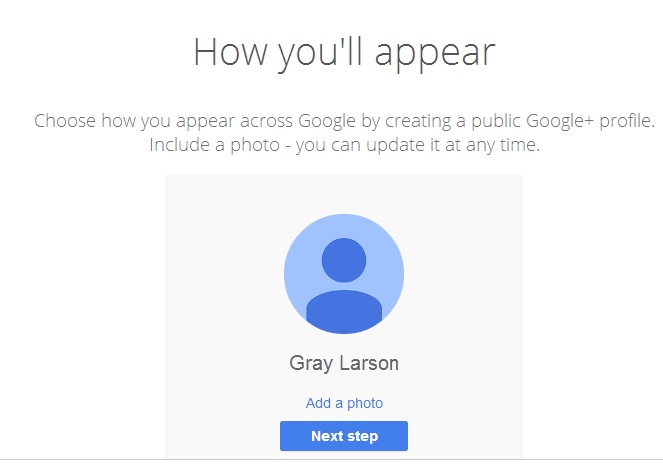
Now, when I created the Higglesbrain account, how much up-front notice was I given that I would be adding myself to a public database? I went through the normal signup process, viewed through the eyes of a novice -- after typing in Gmail.com, I was redirected to a page on accounts.google.com with the innocuous title "Create your Google Account", and entered my personal information. On the next page is the somewhat confusingly worded message (I've also posted a screen shot here):
How you'll appear
Choose how you appear across Google by creating a public Google+ profile.
Include a photo - you can update it at any time.
[Link:] Add a photo
[Button:] Next stepThis message is misleadingly worded because the phrase "by creating a public Google+ profile" implies that's something you can do, optionally, if you want to. It doesn't really disclose the fact that the profile is being created for you as a side effect of signing up for Gmail. The wording might be interpreted, rather, to mean that your profile will only be created if you upload a photo (which is not the case; your profile gets created regardless). And besides -- what if the user is a novice who went to Gmail.com because they saw all their friends using Gmail.com addresses, and have never even heard of "Google+"? If they haven't consented to their name being added to a publicly searchable database, it shouldn't be their responsibility to know what "Google+" is, so that they can object to their name being listed there.
After you click the "Next step" button, the final page in the account creation process says:
Welcome, [firstname]
Your new email address is [address]
Thanks for creating a Google Account. Use it to subscribe to channels on YouTube, video chat for free, save favorite places on Maps, and lots more.Note what's conspicuously missing from this message: It doesn't mention Google+ at all, much less the fact that you have unwittingly "joined" it, where other users can find you.
I can think of a couple of scenarios where a user might object to their name being listed in a searchable user database, apart from just "on general principles". If you have a stalker in your past, and they find your name on Google+, it confirms for them that you're probably still alive, that you're probably active on the Internet, and that you're still going by the name that they knew you under. Or, if you have a very unique first name, anyone who knows it could search on Google+ to find your last name, even if you didn't want them to. Similarly, if you have a very unique last name, someone could use the search feature to find the names of your children and other relatives with the same last name, at least those of them that are using Gmail.
And this lack of user consent is a more serious problem on Gmail/Google+ than on Facebook, because most Facebook users create a profile with the general expectation that other Facebook users can find them. Some Facebook users had chosen not to make their accounts searchable -- and Facebook justifiably received a firestorm of criticism for removing that feature and forcing those users' profiles to become publicly searchable after all -- but the overwhelming majority of Facebook users had joined with the understanding that their profiles could be found by others. That's not a valid assumption about Gmail users -- if someone creates a Gmail.com email address, there's no reason to think that they believed they were joining a publicly searchable name database.
Google has tried to mollify people's concerns about emails from strangers on Google+, by specifying that anyone not already in your Google+ circles will only be able to send one message to your Gmail inbox, and will not be able to send more messages until you reply. But this misunderstands the privacy implications in, for example, the stalker scenario. If a stalker ex "Bob" really did find your name on Google+, they might try to tease out a reply by creating a Google+ account under the name of a friend "Alice" you and your ex had in common, and sending you a generic "How have you been doing lately?" message. Since that message probably won't raise any alarm bells (the message isn't asking for anything like a current address or phone number), you might not realize that just by replying, you've already done the damage (the stalker now knows your email address, plus the fact that it's still an actively used account).
Similarly, although you can modify your Gmail settings to prevent strangers on Google+ from messaging you, the ability to change a setting to fix a problem only helps a user if the user realizes when the problem is happening. For example, if the problem resulting from this new feature switch were a deluge of spam from strangers on Google+, then more and more users would get frustrated and look for information about how to stop the flood of spam, and most of them would find out about this setting and switch it off. But for combatting the stalker problem, this setting is useless, because by definition if a stalker finds you on Google+ (and tricks you into replying to a message and revealing your email address), you wouldn't know about that problem until the damage has already been done, at which point it's too late to solve it by changing a setting.
The only way to avoid this risk to people's privacy, would be for Google to ask Gmail users at the time they create a Gmail account: "Do you also want to create a Google+ account, yes or no? This means you will have a publicly searchable profile, and people who know your name will be able to find you." Some people would like to be found, some people would rather not be, and this would allow them to sort themselves properly.
But instead, we have an untold number of zombie Google+ accounts created whenever someone signs up for Gmail, which serve no purpose except to make it possible to find people who never confirmed that they wanted to be found -- all most likely for the reason given by Chris Taylor at Mashable, so that "Larry Page gets to claim increased Google+ user numbers on the next quarterly earnings call."
-
Experiment Shows Caffeine Boosts Long Term Memory
An anonymous reader writes "A team of researchers at Johns Hopkins has published results demonstrating that caffeine seems to boost long-term memory. In a double-blind study, participants were shown a series of images soon after taking either a caffeine pill or a placebo; 24 hours later they were tested on a similar, but not identical, series of images. Those who took the caffeine pill were more likely to correctly classify images as being different, identical, or similar to those seen the previous day; researchers refer to this as a 'pattern separation' test. The beneficial effect of caffeine on the long-term memory of honey bees was covered by Slashdot earlier." -
Kazakh Professor Claims Solution of Another Millennium Prize Problem
An anonymous reader writes "Kazakh news site BNews.kz reports that Mukhtarbay Otelbaev, Director of the Eurasian Mathematical Institute of the Eurasian National University, is claiming to have found the solution to another Millennium Prize Problems. His paper, which is called 'Existence of a strong solution of the Navier-Stokes equations' and is freely available online (PDF in Russian), may present a solution to the fundamental partial differentials equations that describe the flow of incompressible fluids for which, until now, only a subset of specific solutions have been found. So far, only one of the seven Millennium problems was solved — the Poincaré conjecture, by Grigori Perelman in 2003. If Otelbaev's solution is confirmed, not only it might be the first time that the $1 million offered by the Clay Millennium Prize will find a home (Perelman refused the prize in 2010), but also engineering libraries will soon have to update their Fluid Mechanic books." -
Kazakh Professor Claims Solution of Another Millennium Prize Problem
An anonymous reader writes "Kazakh news site BNews.kz reports that Mukhtarbay Otelbaev, Director of the Eurasian Mathematical Institute of the Eurasian National University, is claiming to have found the solution to another Millennium Prize Problems. His paper, which is called 'Existence of a strong solution of the Navier-Stokes equations' and is freely available online (PDF in Russian), may present a solution to the fundamental partial differentials equations that describe the flow of incompressible fluids for which, until now, only a subset of specific solutions have been found. So far, only one of the seven Millennium problems was solved — the Poincaré conjecture, by Grigori Perelman in 2003. If Otelbaev's solution is confirmed, not only it might be the first time that the $1 million offered by the Clay Millennium Prize will find a home (Perelman refused the prize in 2010), but also engineering libraries will soon have to update their Fluid Mechanic books." -
Nintendo Defeats and Assumes Control of 'Patent Troll's' Portfolio After Victory
the simurgh sends this news from Gamespot: "Nintendo has acquired the entire patent portfolio of now-defunct IA Labs following its victory in court, the Japanese gaming giant has announced. Nintendo obtained the patents during a sheriff's sale in Montgomery County, Maryland on Tuesday. IA Labs originally sued Nintendo for patent infringement in 2010, claiming the Mario maker's Wii controller and Wii Fit technology infringed on two separate IA Labs patents. Nintendo successfully defended itself as part of a court battle in 2012, also winning various fees related to the case. IA Labs appealed the ruling, but an appellate court sided with Nintendo in June 2013. At this point, IA Labs was ordered to pay Nintendo additional fees, and when the company failed to do so, a sheriff's sale was commenced." -
Dell Joins Steam Machine Initiative With Alienware System
MojoKid writes "Plenty of OEMs have lifted the veil on their planned Steam Machine products, but Dell really seems to want to break free of the pack with their Alienware-designed, small form factor machine that they unveiled at CES this week. It's surprisingly tiny, sleek and significantly smaller than the average game console, weighing only about 4 — 6 pounds fully configured. Dell had a prototype of the machine on hand that is mechanically exact, complete with IO ports and lighting accents. Dell also had a SteamOS-driven system running, though it was actually a modified Alienware system powering the action with Valve's innovative Steam Controller. In first-person shooters like Metro: Last Night that Dell was demonstrating, the left circular pad can be setup for panning and aiming in traditional AWSD fashion, while the right pad can be used for forward and back movement with triggers set up for firing and aiming down sights. You can, however, customize control bindings to your liking and share profiles and bindings with friends on the Steam network. What's notable about Dell's unveiling is that the Steam Machines initiative gained critical mass with a major OEM like Dell behind the product offering, in addition to the handful of boutique PC builders that have announced products thus far." -
Target Admits Data Breach May Have Up To 110 Million Victims
Nerval's Lobster writes "Retail giant Target continues to drastically downplay the impact of the massive data breach it suffered during December, even while admitting the number of customers affected is nearly twice as large as it had previously estimated. Target admitted today the massive data breach it suffered during the Christmas shopping season was more than twice as large and far more serious than previously disclosed. A Jan. 10 press release admits the number of customers affected by the second-largest corporate data breach in history had increased from 40 million to 70 million, and that the data stolen included emails, phone numbers, street addresses and other information absent from the stolen transactional data that netted thieves 40 million debit- and credit-card numbers and PINs. 'As part of Target's ongoing forensic investigation, it has been determined that certain guest information — separate from the payment card data previously disclosed — was taken during the data breach' according to Target's statement. 'This theft is not a new breach, but was uncovered as part of the ongoing investigation.' The new revelation does represent a new breach, however, or at least the breach of an unrelated system during the period covered during the same attack, according to the few details Target has released. Most analysts and news outlets have blamed the breach on either the security of Target's Windows-based Point-of-Sale systems or the company's failure to fulfill its security obligations under the Payment Card Industry Data Security Standard (PCI DSS)." -
White House Reportedly Dismissing Key Healthcare.gov Contractor
Nerval's Lobster writes "Months after a problem-riddled rollout of the Healthcare.gov Website, the White House is dismissing a key contractor, CGI Federal, that built much of the portal, according to The Washington Post. The newspaper suggested the federal government is on the verge of signing a new contract with a replacement, Accenture, which has some experience in building online health-insurance portals on the state level. 'We are in discussions with potential clients all the time but it is not appropriate to discuss with the media contracts we may or may not be discussing,' an Accenture spokesperson is quoted as saying. Unnamed sources 'familiar with the matter' informed the Post of CGI Federal's dismissal, and suggested that it has much to do with continuing anger over the botched introduction of Healthcare.gov, as well as the pace of continuing repairs to the Website. As their contract is due to expire anyway at the end of February, government officials reportedly decided that it was the perfect time to pull the plug with a minimum of legal ramifications." -
It's Official: Registrars Cannot Hold Domains Hostage Without a Court Order
Stunt Pope writes "Back when the City of London Police issued those 'takedown requests' to domain registrars, most complied. However, as previously reported here, easyDNS didn't. A bunch of the taken-down domains wanted to move to easyDNS. One problem: their registrar wouldn't let them. It took awhile, but easyDNS fought it. They've finally gotten a ruling (PDF) under the ICANN policy that ordered the hostage domains transferred." -
Google Co-Opts Whale-Watching Boat To Ferry Employees
theodp writes "Purportedly intended to defuse tensions over gentrification that have led to blockades and vandalism of Google's ubiquitous shuttles (video), which make use of public San Francisco bus stops (map), Wired reports that Google is now chartering a ferry to take its workers from SF to Silicon Valley. 'We certainly don't want to cause any inconvenience to SF residents, and we're trying alternative ways to get Googlers to work,' Google explained. Inconveniencing whale-seeking visitors to The Aquarium of the Pacific, however, is apparently not considered evil. After learning that Google had co-opted the $4 million, 83-foot, 150-passenger whale-watching catamaran MV/Triumphant to ferry as few as 30-40 Googlers to work, some expressed concerns on Facebook that Google would be The Grinch That Stole Whale Watching Season (not to worry; the boat's slated to make its 'triumphant' return to Long Beach after Google's '30-day trial')." -
IBM Dumping $1 Billion Into New Watson Group
Nerval's Lobster writes "IBM believes its Watson supercomputing platform is much more than a gameshow-winning gimmick: its executives are betting very big that the software will fundamentally change how people and industries compute. In the beginning, IBM assigned 27 core researchers to the then-nascent Watson. Working diligently, those scientists and developers built a tough 'Jeopardy!' competitor. Encouraged by that success on live television, Big Blue devoted a larger team to commercializing the technology—a group it made a point of hiding in Austin, Texas, so its members could better focus on hardcore research. After years of experimentation, IBM is now prepping Watson to go truly mainstream. As part of that upgraded effort (which includes lots of hype-generating), IBM will devote a billion dollars and thousands of researchers to a dedicated Watson Group, based in New York City at 51 Astor Place. The company plans on pouring another $100 million into an equity fund for Watson's growing app ecosystem. If everything goes according to IBM's plan, Watson will help kick off what CEO Ginni Rometty refers to as a third era in computing. The 19th century saw the rise of a "tabulating" era: the birth of machines designed to count. In the latter half of the 20th century, developers and scientists initiated the 'programmable' era—resulting in PCs, mobile devices, and the Internet. The third (potential) era is 'cognitive,' in which computers become adept at understanding and solving, in a very human way, some of society's largest problems. But no matter how well Watson can read, understand and analyze, the platform will need to earn its keep. Will IBM's clients pay lots of money for all that cognitive power? Or will Watson ultimately prove an overhyped sideshow?" -
Bitcoin Payments Go Live At Overstock — Two Quarters Early
New submitter citab writes with news that "the first major retailer is now accepting bitcoins!" In December, Overstock.com announced that they would begin accepting Bitcoin for payment as early as the end of second quarter 2014, but decided to make it a priority task to avoid having someone else beat them to it. From the article: "Last Tuesday, the company struck a deal to handle Bitcoin payments through a service operated by the suddenly hot San Francisco startup Coinbase, and since then, a team of Overstock engineers has worked almost every waking hour to prepare the site for what is undeniably a key moment in the digital currency’s short history. ... [Overstock CEO] Byrne believes this can ultimately boost the company’s bottom line, but that’s not his only aim. For Byrne, a rather opinionated libertarian who’s unafraid to take his company places others fear to tread, embracing the cryptocurrency is as much a political statement as a business decision. Like so many others, he believes Bitcoin can free the world from the control of big banks and big government. 'It helps us fight the machine,' he says." -
Pirate Bay Founder's Custody Extended to February 5th
The Pirate Bay co-founder Warg has been held in solitary confinement since being turned over by Sweden to Denmark in December. Yesterday, he appeared in a closed court session where the judge ordered he continue to be held until at least February 5th. From the article: "In an attempt to free the Swede, or at least improve his circumstances, a petition was launched recently, directed at the Danish Prime Minister. Initially there were only a few hundred backers but when a banner was added to the homepage of The Pirate Bay this quickly grew to more than 50,000. Among other things, the petition demands that Gottfrid is given free access to books and other reading material." Although kept from computers and books, he is at least no longer being held in solitary confinement as of last week. -
Security Experts Call For Boycott of RSA Conference In NSA Protest
Hugh Pickens DOT Com writes "ZDNet reports that at least eight security researchers or policy experts have withdrawn from RSA's annual security conference in protest over the sponsor's alleged collaboration with the National Security Agency. Last month, it was revealed that RSA had accepted $10 million from the NSA to use a flawed default cipher in one of its encryption tools. The withdrawals from the highly regarded conference represent early blowback by experts who have complained that the government's surveillance efforts have, in some cases, weakened computer security, even for innocent users. Jeffrey Carr, a security industry veteran who works in analyzing espionage and cyber warfare tactics, took his cancellation a step further calling for a boycott of the conference, saying that RSA had violated the trust of its customers. 'I can't imagine a worse action, short of a company's CEO getting involved in child porn,' says Carr. 'I don't know what worse action a security company could take than to sell a product to a customer with a backdoor in it.' Organizers have said that next month's conference in San Francisco will host 560 speakers, and that they expect more participants than the 24,000 who showed up last year. 'Though boycotting the conference won't have a big impact on EMC's bottom line, the resulting publicity will,' says Dave Kearns. 'Security is hard enough without having to worry that our suppliers — either knowingly or unknowingly — have aided those who wish to subvert our security measures.'" -
Algorithm Aims To Predict Fiction Bestsellers
benonemusic writes "Three computer scientists at Stony Brook University in New York believe they have found some rules through a computer program that might predict which fiction books will be successful. Their algorithm had as much as an 84 percent accuracy rate when applied to already published manuscripts in Project Gutenberg and other sources. Among their findings was that more successful books relied on verbs describing thought processes rather than actions and emotions. However, some disagree with the findings. Author Ron Hansen said style is not the key, but instead readers' interest in the topics in the book." There has been work done already on finding the formula for a hit song, and using analytics to craft a blockbuster movie. -
Algorithm Aims To Predict Fiction Bestsellers
benonemusic writes "Three computer scientists at Stony Brook University in New York believe they have found some rules through a computer program that might predict which fiction books will be successful. Their algorithm had as much as an 84 percent accuracy rate when applied to already published manuscripts in Project Gutenberg and other sources. Among their findings was that more successful books relied on verbs describing thought processes rather than actions and emotions. However, some disagree with the findings. Author Ron Hansen said style is not the key, but instead readers' interest in the topics in the book." There has been work done already on finding the formula for a hit song, and using analytics to craft a blockbuster movie. -
Blackhole Exploit Kit Successor Years Away
msm1267 writes "The Blackhole Exploit Kit has been out of commission since October when its alleged creator, a hacker named Paunch, was arrested in Russia. The kit was a favorite among cybercriminals who took advantage of its frequent updates and business model to distribute financial malware to great profit. Since the arrest of Paunch, however, a viable successor has yet to emerge--and experts believe one will not in the short term. This is partially the reason for the increase in outbreaks of ransomware such as CryptoLocker as hackers aggressively attempt to recover lost profits." -
KDE Releases Frameworks 5 Tech Preview
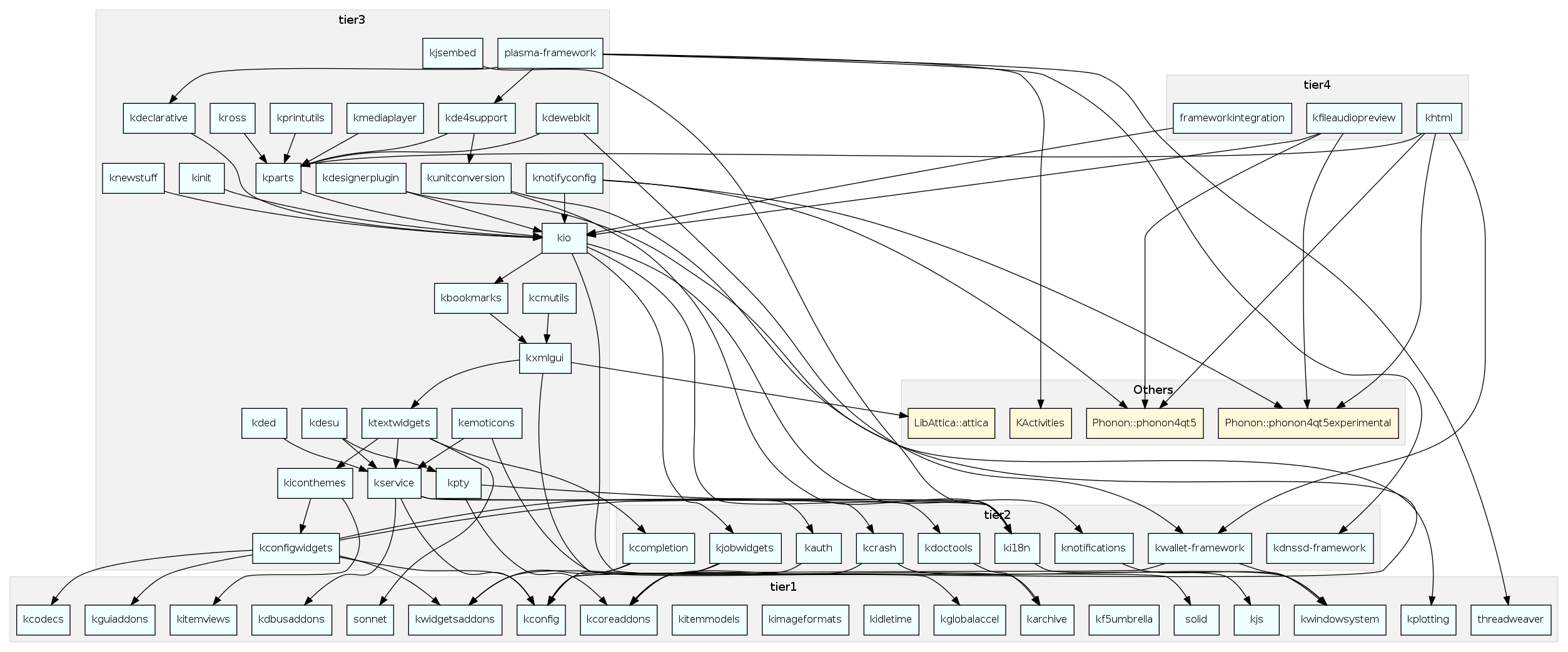
KDE Community writes "The KDE Community is proud to announce a Tech Preview of KDE Frameworks 5. Frameworks 5 is the result of almost three years of work to plan, modularize, review and port the set of libraries previously known as KDElibs or KDE Platform 4 into a set of Qt Addons with well-defined dependencies and abilities, ready for Qt 5. This gives the Qt ecosystem a powerful set of drop-in libraries providing additional functionality for a wide variety of tasks and platforms, based on over 15 years of KDE experience in building applications. Today, all the Frameworks are available in Tech Preview mode; a final release is planned for the first half of 2014. Some Tech Preview addons (notably KArchive and Threadweaver) are more mature than others at this time." Check out that dependency graph. -
David Pogue and Yahoo's "Normals" Problem
Nerval's Lobster writes "In a keynote talk at this year's Consumer Electronics Show (CES) in Las Vegas, David Pogue (Yahoo's freshly minted technology columnist) suggested that the new 'Yahoo Tech' Website — a key part of the company's latest rebranding — would be targeted at 'normal' people as opposed to 'gearheads.' Based on a map that flashed on the giant screen behind him, which showed the 'normals' clustered in the middle of the country and the 'gearheads' restricted to the coasts, it's clear that Yahoo has embraced a divisive strategy that tries to equate Yahoo's brands with some sort of mythical 'middlebrow' audience that exists within clearly defined borders. (During his presentation, Pogue also flashed a slide that made fun of competing tech-news brands: The Verge was rendered as 'The Urge,' for example, while Gizmodo became 'Gizmoody.') The problem is that rigid audience of 'normals' doesn't exist, at least not in the way that Yahoo envisions. Large numbers of well-educated technology consumers — 'gearheads,' in Pogue's parlance — exist all over the country; to say otherwise is like suggesting that Wyoming is 100 percent Republican, or that everybody who lives in Florida hates snow. In other words, Yahoo's approach to tech content isn't merely schismatic; it's willfully unaware of the variety that exists among technology fans." -
23-Year-Old X11 Server Security Vulnerability Discovered
An anonymous reader writes "The recent report of X11/X.Org security in bad shape rings more truth today. The X.Org Foundation announced today that they've found a X11 security issue that dates back to 1991. The issue is a possible stack buffer overflow that could lead to privilege escalation to root and affects all versions of the X Server back to X11R5. After the vulnerability being in the code-base for 23 years, it was finally uncovered via the automated cppcheck static analysis utility." There's a scanf used when loading BDF fonts that can overflow using a carefully crafted font. Watch out for those obsolete early-90s bitmap fonts. -
End of Moore's Law Forcing Radical Innovation
dcblogs writes "The technology industry has been coasting along on steady, predictable performance gains, as laid out by Moore's law. But stability and predictability are also the ingredients of complacency and inertia. At this stage, Moore's Law may be more analogous to golden handcuffs than to innovation. With its end in sight, systems makers and governments are being challenged to come up with new materials and architectures. The European Commission has written of a need for 'radical innovation in many computing technologies.' The U.S. National Science Foundation, in a recent budget request, said technologies such as carbon nanotube digital circuits will likely be needed, or perhaps molecular-based approaches, including biologically inspired systems. The slowdown in Moore's Law has already hit high-performance computing. Marc Snir, director of the Mathematics and Computer Science Division at the Argonne National Laboratory, outlined in a series of slides the problem of going below 7nm on chips, and the lack of alternative technologies." -
Sony Announces Game Streaming Service
You may remember Gaikai, a company built on the idea of cloud-based gaming. The idea was that a remote server would run the game and stream all graphics and sound to a player's device, which would allow underpowered or obsolete machines to run modern, graphically demanding games on high settings. In 2012, Sony purchased Gaikai. Now, they've announced at CES that their cloud gaming tech (dubbed 'PlayStation Now') is just about ready for the public. CES attendees will be able to try it out, and Sony will begin a closed beta test in the U.S. later this month. Full release is planned for summer. It will first support streaming to PS3s, PS4s, and certain Sony TV models. Later, it will expand more broadly to various non-Sony "internet-connected devices." Players will have the option to rent games or to subscribe for continued access. Forbes reports, "According to Sony, gamers who own disc- or digital-based games will not have access to those games via PS Now free of charge." -
Why CES Is a Bad Scene For Startups
Nerval's Lobster writes "If you're a small-to-midsize tech company, CES isn't exactly the best place to get noticed. Every January, thousands of developers and startup executives flood Vegas with dreams of a big score. But they're not headed to the poker and blackjack tables in pursuit of that filthy lucre—instead, many of them have dropped thousands of dollars on a booth at the Consumer Electronics Show (CES), arguably the highest-profile technology conference of the year. (In addition to the tens of thousands of dollars it costs to reserve a space on the convention-hall floor, that money goes to demo units, flying employees to Vegas, and much, much more.) If they haven't managed to secure a spot in one of the Convention Center's massive halls, they've set up a demonstration area in a suite at some hotel on the Strip. And if they're too under-capitalized or unprepared for a hotel, they're lurking in the Convention Center parking lot. Seriously. It's a little insane. But in a certain way, you can't blame the startups: at some point, someone told them that CES is the best way to get their company noticed, even if it means blowing the equivalent of three employees' yearly salaries. On paper, the get-a-booth strategy makes sense—aside from SXSW, CES hosts possibly the greatest concentration of tech journalists in a relatively small space. What many first-timers don't realize (until it's too late) is that startups have a hard time standing out amidst the chaos: there are too many companies at too many booths attempting to sell (at top volume) too many variations of the same core ideas. If that wasn't bad enough, a fair portion of those companies are trying to draw attention with flashing screens, giveaways, music pumping at top volume, and other gimmicks. (Hey, it's Vegas.) So not only does your Nike FuelBand knockoff need to compete against a hundred other 'smart bracelets' on display, but you somehow need to make yourself visible despite the plus-size Elvis impersonator belting out 'Don't Be Cruel' in front of that chip-vendor's booth a few steps away. That's just the sort of quixotic endeavor that would drive even the most stalwart startup founder to drinking before 9 A.M." -
Linksys Resurrects WRT54G In a New Router
jones_supa writes "A year after purchasing the Linksys home networking division from Cisco, Belkin today brought back the design of what it called 'the best-selling router of all time' but with the latest wireless technology. We are talking about the classic WRT54G, the router in blue/black livery, first released in December 2002. Back in July 2003, a Slashdot post noted that Linksys had 'caved to community pressure' after speculation that it was violating the GPL free software license, and it released open source code for the WRT54G. The router received a cult following and today the model number of the refreshed model will be WRT1900AC. The radio is updated to support 802.11ac (with four antennas), the CPU is a more powerful 1.2GHz dual core, and there are ports for eSATA and USB mass storage devices. Linksys is also providing early hardware along with SDKs and APIs to the developers of OpenWRT, with plans to have support available when the router becomes commercially available. The WRT1900AC is also the first Linksys router to include a Network Map feature designed to provide a simpler way of managing settings of each device connected to the network. Announced at Consumer Electronics Show, the device is planned to be available this spring for an MSRP of $299.99." -
Interview: Alan Adler Answers Your Questions About Coffee and Throwing Objects
A while ago you had the chance to ask inventor Alan Adler about making the perfect cup of coffee and throwing things really far. Below you'll find his best coffee brewing tips and the answers to those questions. How did you get interested in making thrown toys and brewing coffee?
by samzenpus
The two things that you're known best for are the Aerobie toys and the AeroPress. Were these things that always interested you or did you stumble into engineering them.
Adler: In the case of the Pro Ring, it was a deliberate effort to try to design a flying disc that was better aerodynamically. Better in the sense of lower drag, because lower drag would mean that you could throw it farther and also easier. For the coffee maker, again, it was a deliberate effort. I got to thinking that the way I made coffee did not make a good single cup of coffee. I and a lot of other people I know seem to want to just make a cup of coffee as opposed to a whole carafe full. Most people, including me, use an automatic drip machine, and when I tried various recipes to make one cup of coffee that way, it didn't work very well.
I started experimenting with various methods. I began mostly using a pour over on top of a mug, and experimenting with temperature and amount of coffee. I found there was a big improvement in taste quality when I lowered the temperature, but I was troubled by the fact that pour over was taking about four or five minutes to run through. I had read that the longer you drag out the coffee brewing process, the more bitter the taste of the brew.
I got the idea of making a cylindrical chamber where I could apply air pressure and push the liquid through rapidly. I made a prototype in my shop in early February of 2004. The very first prototype tasted better than anything I had ever made with a cone filter. So I knew I was on track and I really spent all of 2004 perfecting the design, experimenting with various types of seals, and various diameters and lengths, and spent nearly a year getting production [tooling] made so that we could go into production.
Aerobie Drones?
by CanHasDIY
After reading the article about the Aerobie setting a world record as the farthest flying thrown object in human history (uber-neat, BTW), I wondered: Do you think there's any way that such a design would work as a small drone platform? Perhaps something that can be thrown from the hand, then perpetuate flight at least semi-autonomously?
Adler: I haven't come up with anything that is practical. Every idea I considered, I think is really inferior to a relatively conventional airplane, a configuration that's not rotating.
The Physics of the Aerobie
by MonkeyDancer
The Aerobie Pro Ring is one of the best skill toy inventions ever created.Can you tell us about the physics and engineering challenges that you had to overcome to break the world record?
Adler: I spent about eight years on the project. Not all of those eight years were with rings. I wasted quite a few years trying to make a better disc.
The ring is really a superior shape. It's better than a disc, and it's better because it flies and behaves sort of like two thin airfoils one after another. The front half of the ring is behaving like a leading air foil and the rear half of the ring is behaving like another airfoil. A very efficient airplane, like a glider, has long thin wings opposed to short fat wings. And by going to the shape, we have something that's like two long thin wings.
The front half of the ring naturally wants to develop greater lift, because it's flying in undisturbed air. When an airfoil develops lift, the process of doing that forces air behind it downward a bit. For every action there has to be a reaction, and in this case, the reaction pushes that air downward, so the rear half of the ring is at a disadvantage. It's flying in air that has been pushed downward a little bit by the front half. A ring or a disc or anything that's spinning, won't fly straight unless the lift is balanced evenly between the front and the rear. The challenge was to figure out how to do that, and I had a partial success in 1980 when I developed a ring that I licensed to Parker Brothers called a Skyro. The Skyro was a little bit like an Aerobie, but it didn't have that little rim around the outer perimeter. it was so efficient that it set a new record for a human thrown object. It first set a record of 750 feet and in less than a year later, upped that record to 850.
During that time, I met Mr. Norris McWhirter, the co-editor of the Guinness Book, and he was quite fascinated by the records that we set throwing that device. However, it was really only stable at one air speed, and I had developed equations that told me if I could make an airflow that satisfied certain equations, I could make a ring that was stable over a wider range of airspeeds. By stable, I mean it would fly straight, whether it was flying fast or slow. I had a breakthrough in January of 1984 when I came up with that little rim around the outer perimeter. I call it a spoiler lift.
Will Aerobee do a Milk Steamer as well?
by billstewart
I'm guessing the answer is probably no, because it's not something that's easy to do in plastic, and in a hotel room you can get by with heating the milk in a microwave, while there are other devices out there for stove tops or camping stoves. But I'd love to see one if there's a practical way to do it.
Adler: No. What could we contribute over and above an already manufactured milk steaming machine? There are some really nice kettles on the market that allow people to dial whatever temperature they want as opposed to just boiling water. When we first started, there were only a couple on the market, but now there are probably a dozen different kettles, and they're useful not only for the AeroPress but also for brewing tea.
Metal filter for Aeropress
by hawkinspeter
I've been using a metal filter with my Aeropress(es) for a few years now and was wondering if you're ever going to sell a version with a permanent filter? Also, how about a redesign to make the upside-down method a bit easier? (The upside-down method allows for better control over the steep time).
Adler: I had a bunch of metal filters fabricated by the photo-etching process which is a sort of a relative of the way silicon chips are made. The process allows you to make very, very fine holes, but they never tasted as good as paper filtering.
Along the way, I discovered that coffee that's made with metal filters, or maybe we should say coffee that is not made with a paper filter, contains two harmful oils, called cafestol and kahweol. They've been discovered to be the most powerful blood cholesterol raising substances ever found. So the people who drink coffee that's made with a metal filter typically have LDL cholesterol, which is about ten percent higher than people who drink paper filter coffee.
So I decided that even though some people said that they wanted a metal filter AeroPress, I couldn't with a good conscience produce it. However, there are a number of filters on the market from other manufacturers now. I asked the guy who runs The World Aeropress Championships if they were permitting metal filters in Aeropress competitions, which are judged solely on taste, and he said, yes, we allow them, but no metal filter brew has ever won a single heat.
Re:Glass or steel Aeropress?
by Anonymous Coward
Was the Aeropress world championships something started by the company and what is the best recipe to come out of it?
Adler: It has been going on for about five years, and it was the invention of Tim Wendelboe who runs a cafe in Oslo, Norway. He's also the Norwegian importer for the AeroPress, and he held the first two championships in Oslo. Tim Varney worked for him, and sort of took it over, and then they decided to start moving it around to different countries, regions, and cities.
These championships just sort of sprang out of the grass roots all over the place. We have tried to step back from it and tried to be supportive in the sense that we often make trophies, but we don't tell them how to run it. I'm very happy with the way they run it. They judge it on taste, and I think that's the way it should be judged.
Now as far as recipes go. I think if you look at the winning recipes, over the years, they approximate what we tell people to do in our instruction booklet. We suggest people brew right side up with 175 degree water. Most of the winners have been in that ballpark. Occasionally, somebody will win with a variation on that, but I think it's fair that most people win with something that's pretty close to the normal process.
What's AeroNext?
by timothy
Both the Aerobie and the AeroPress embody design traits I really like: they're durable, have few pieces, and work simply by dint of ordinary (vs. extraordinary) human-muscle power. Basically, they remind me of simple machines. (As in the wedge, the lever, etc.) What are your favorite likely areas for further improvement?
Will you come up with good improvements on ...
- Flashlights? (Muscle-powered flashlights have gotten much better, thanks to LEDs, but they still mostly suck.)
- Sailboats or kayaks? (What could modern materials and thinking bring to small person-powered / wind-powered watercraft?)
- On that front, paddles / oars ... wrt ergonomics and efficiency, I think there is a long way to go ...
- Whistles? (Pealess whistles have come a long way, but progress isn't over)
- Waterguns? (Where is the next SuperSoaker-style leap?)
- Bicyle fairings? (A semi-standardized clear fairing would be useful for lots of people, esp. as some big U.S. cities improve their cycling infrastructure.)
- Juicers? (A human powered AeroJuicer sounds like a good idea to me ...)
Not to say that for any of the above items that there aren't smart people working in the field ... but Hey, there were lots of coffee makers and coffee making methods before the Aeropress, too.
p.s. What about smaller and bigger AeroPresses, for light travel and for bigger gatherings? :)
Adler: I haven't worked in any of those areas.
With regards to a small model, I think that the savings wouldn't justify the investment because the existing one is pretty small.
With regard to a bigger model, I've experimented with it at length, and perhaps someday I will bring one out. I feel that the present AeroPress really meets 80% of the average person's brewing needs. Because it is capable of brewing three or four cups if you want to. We get a lot of letters from people who say that they brew a few cups and then maybe three or four hours later in the day, they do it again, and before the AeroPress, they were brewing, let's say six cups in a drip machine. Towards the end of that six cups, it tasted awfully stale.
Perfect Coffee
by samzenpus
There are almost as many different ideas about how to make a cup of coffee as there are coffee drinkers. What advice would you give someone trying to make a perfect cup?
Adler: We get a lot of resistance on two fronts relative to the AeroPress. There are people who buy AeroPresses who use it differently, and the first way they use it differently is they don't use 175 degree water. They say, oh you can't possibly brew coffee at 175 degrees. My answer always is, well, you can use any temperature your heart desires, but you owe it to yourself to try 175, because whenever we do blind tasting, whether it be for just average people or professional coffee tasters, they invariably choose 175. I would say that the average person who had an AeroPress, has never tried 175, even once. They go hotter, and you get answers like 'I don't use boiling water. I boil it, and then I wait a minute before I brew.' Well, with the average kettle, if you wait a minute, the temperature goes from 212 to 210. It takes 17 minutes for the average size kettle to go down from boiling to 175.
You're really missing out on a wonderful tasting coffee if you don't at least try a lower temperature. I have never found a single person, who when given a test between 175 and higher temperatures, has chosen the higher temperatures.
I gave a talk at Google about a year ago, where I said that there are a lot of people who would rather jump off of the Golden Gate Bridge than to dilute their coffee, and that created a good laugh. But we tell people to brew their concentrate, according to our instructions. At that point they are brewing something as strong as espresso and then, if they want a cup of American coffee, to add water to it.
The idea of pouring water into the brewed concentrate makes peoples shiver in fear. They think somehow that they are going to wreck it, and so they do things like, push water through the same bed of grounds. A typical user will put in a scoop of coffee and then fill the AeroPress with water to the very top and push it through as opposed to what we say, which is just fill to the number one, and push that through, and then add water afterward.
It's a little like the temperature thing, most people have never tried that, and it tastes better. The reason it tastes better is you're not forcing a lot of water through the same grounds and extracting more bitterness. So once again, I tell people you can make it anyway your heart desires, but at least try the way we recommend, because I think you'll like what you taste. -
Is Earth Weighed Down By Dark Matter?
Nerval's Lobster writes "There may be a giant ring of dark matter invisibly encircling the Earth, increasing its mass and pulling much harder on orbiting satellites than anything invisible should pull, according to preliminary research from a scientist specializing the physics of GPS signaling and satellite engineering. The dark-matter belt around the Earth could represent the beginning of a radically new understanding of how dark matter works and how it affects the human universe, or it could be something perfectly valid but less exciting despite having been written up by New Scientist and spreading to the rest of the geek universe on the basis of a single oral presentation of preliminary research at a meeting of the American Geophysical Union in December. The presentation came from telecom- and GPS satellite expert Ben Harris, an assistant professor of mechanical and aerospace engineering at the University of Texas- Arlington, who based his conclusion on nine months' worth of data that could indicate Earth's gravity was pulling harder on its ring of geostationary GPS satellites than the accepted mass of the Earth would normally allow. Since planets can't gain weight over the holidays like the rest of us, Harris' conclusion was that something else was adding to the mass and gravitational power of Earth – something that would have to be pretty massive but almost completely undetectable, which would sound crazy if predominant theories about the composition of the universe didn't assume 80 percent of it was made up of invisible dark matter. Harris calculated that the increase in gravity could have come from dark matter, but would have had to be an unexpectedly thick collection of it – one ringing the earth in a band 120 miles thick and 45,000 miles wide. Making elaborate claims in oral presentations, without nailing down all the variables that could keep a set of results from being twisted into something more interesting than the truth is a red flag for any scientific presentation, let alone one making audacious claims about the way dark matter behaves or weight of the Earth, according to an exasperated counterargument from Matthew R. Francis, who earned a Ph.D. in physics and astronomy from Rutgers in 2005, held visiting and assistant professorships at several Northeastern universities and whose science writing has appeared in Ars Technica, The New Yorker, Nautilus, BBC Future and others including his own science blog at Galileo's Pendulum." -
Why a Cure For Cancer Is So Elusive
Hugh Pickens DOT Com writes "George Johnson writes in the NYT that cancer is on the verge of overtaking heart disease as the No. 1 cause of death and although cancer mortality has actually been decreasing bit by bit in recent decades, the decline has been modest compared with other threats. The diseases that once killed earlier in life — bubonic plague, smallpox, influenza, tuberculosis — were easier obstacles. For each there was a single infectious agent, a precise cause that could be confronted. But there are reasons to believe that cancer will remain much more resistant because it is not so much a disease as a phenomenon, the result of a basic evolutionary compromise. As a body lives and grows, its cells are constantly dividing, copying their DNA — this vast genetic library — and bequeathing it to the daughter cells. They in turn pass it to their own progeny: copies of copies of copies. Along the way, errors inevitably occur. Some are caused by carcinogens but most are random misprints. Mutations are the engine of evolution. Without them we never would have evolved. The trade-off is that every so often a certain combination will give an individual cell too much power. It begins to evolve independently of the rest of the body and like a new species thriving in an ecosystem, it grows into a cancerous tumor. 'Given a long enough life, cancer will eventually kill you — unless you die first of something else (PDF). That would be true even in a world free from carcinogens and equipped with the most powerful medical technology,' concludes Johnson. 'Maybe someday some of us will live to be 200. But barring an elixir for immortality, a body will come to a point where it has outwitted every peril life has thrown at it. And for each added year, more mutations will have accumulated. If the heart holds out, then waiting at the end will be cancer.'" -
US Coast Guard Ship To Attempt Rescue of 2 Icebreakers In Antarctica
PolygamousRanchKid writes "A U.S. Coast Guard heavy icebreaker left Australia for Antarctica on Sunday to rescue more than 120 crew members aboard two icebreakers trapped in pack ice near the frozen continent's eastern edge, officials said. The 399-foot cutter, the Polar Star, is responding to a Jan. 3 request from Australia, Russia and China to assist the Russian and Chinese ships because 'there is sufficient concern that the vessels may not be able to free themselves from the ice,' the Coast Guard said in a statement. The Australian Maritime Safety Authority's Rescue Coordination Centre, which oversaw the rescue, said the Polar Star, the Coast Guard's only active heavy polar icebreaker, would take about seven days to reach Commonwealth Bay, depending on weather. Under international conventions observed by most countries, ships' crews are obliged to take part in such rescues and the owners carry the costs." -
Counterpoint: Why Edward Snowden May Not Deserve Clemency
Hugh Pickens DOT Com writes "Fred Kaplan, the Edward R. Murrow press fellow at the Council on Foreign Relation, writes at Slate that if Edward Snowden's stolen trove of beyond-top-secret documents had dealt only with the domestic surveillance by the NSA, then some form of leniency might be worth discussing. But Snowden did much more than that. 'Snowden's documents have, so far, furnished stories about the NSA's interception of email traffic, mobile phone calls, and radio transmissions of Taliban fighters in Pakistan's northwest territories; about an operation to gauge the loyalties of CIA recruits in Pakistan; about NSA email intercepts to assist intelligence assessments of what's going on inside Iran; about NSA surveillance of cellphone calls 'worldwide,' an effort that 'allows it to look for unknown associates of known intelligence targets by tracking people whose movements intersect.' Kaplan says the NYT editorial calling on President Obama to grant Snowden 'some form of clemency' paints an incomplete picture when it claims that Snowden 'stole a trove of highly classified documents after he became disillusioned with the agency's voraciousness.' In fact, as Snowden himself told the South China Morning Post, he took his job as an NSA contractor, with Booz Allen Hamilton, because he knew that his position would grant him 'to lists of machines all over the world [that] the NSA hacked.' Snowden got himself placed at the NSA's signals intelligence center in Hawaii says Kaplan for the sole purpose of pilfering extremely classified documents. 'It may be telling that Snowden did not release mdash; or at least the recipients of his cache haven't yet published — any documents detailing the cyber-operations of any other countries, especially Russia or China,' concludes Kaplan. 'If it turned out that Snowden did give information to the Russians or Chinese (or if intelligence assessments show that the leaks did substantial damage to national security, something that hasn't been proved in public), then I'd say all talk of a deal is off — and I assume the Times editorial page would agree.'" -
Object Blocking Giant Tunnel Borer Was an 8" Diameter Pipe
An anonymous reader writes "A few weeks ago we discussed news that a tunnel boring machine measuring 57.5 feet in diameter was halted underneath Seattle after running into a mysterious object. Project engineers have now figured out what the object is: an 8-inch-diameter pipe. In 2002, researchers for another project — the replacement of the Alaskan Way viaduct — drilled down into the ground to take water samples. They used the 115-ft-long pipe as a well casing. As it turns out, this well site was listed in the contract specifications given to all bidders for the tunnel's construction. In addition, the crew manning the machine noticed that it was chewing up pieces of metal, and they removed part of the pipe and kept going. Only later did they realize that significant damage had been done to the machine's cutting face. Officials aren't sure how long repairs will take, or how much they will cost." -
U.S. Waived Laws To Keep F-35 On Track With China-made Parts
An anonymous reader sends this report from Reuters: "The Pentagon repeatedly waived laws banning Chinese-built components on U.S. weapons in order to keep the $392 billion Lockheed Martin Corp F-35 fighter program on track in 2012 and 2013, even as U.S. officials were voicing concern about China's espionage and military buildup. According to Pentagon documents reviewed by Reuters, chief U.S. arms buyer Frank Kendall allowed two F-35 suppliers, Northrop Grumman Corp and Honeywell International Inc, to use Chinese magnets for the new warplane's radar system, landing gears and other hardware. Without the waivers, both companies could have faced sanctions for violating federal law and the F-35 program could have faced further delays."