Slashdot Mirror
Domain: slashdot.org
Stories and comments across the archive that link to slashdot.org.
Stories · 37,380
-
Hotmail & Yahoo Mail Using Secret Domain Blacklist
Frequent contributor Bennett Haselton writes: "Hotmail and Yahoo Mail are apparently sharing a secret blacklist of domain names such that any mention of these domains will cause a message to be bounced back to the sender as spam. I found out about this because — surprise! — some of my new proxy site domains ended up on the blacklist. Hotmail and Yahoo are stonewalling, but here's what I've dug up so far — and why you should care." Read on for much more on how Bennett figured out what's going on, and why it's a hard problem to solve.On December 7th I sent out a normal batch of emails to the Circumventor mailing list, where I send out new proxy sites for getting around Internet filters. I registered seven new domains and sent each domain to one seventh of the list; the list contains about 420,000 addresses, so each one went to about 60,000 people. (Each new site is only sent to a random subset of the list, so that a blocking company can't just subscribe one address to the list and block all new sites as soon as they're mailed out.)
The list is also comprised of 100%-verified-opt-in addresses, meaning that a new subscriber has to reply to a confirmation message in order to be added to the list. That's considered the gold standard for responsible mailing, but major email providers keep finding new ways to block the emails as "spam," which sometimes provide interesting insights into how the filters work behind the scenes.
After the last mailing, for example, all of my newly registered domains got disabled by the registrar because two of the domains had been incorrectly blacklisted by the Spamhaus Domain Block List. It took two days to discover the problem and then several hours to trace the problem to Spamhaus, although once I found Spamhaus's automated form I was able to get the domains un-blacklisted immediately. So the registrar re-enabled the domains a few hours later, although the traffic to the domains never returned to its previous levels. Spamhaus, meanwhile, continues to claim the DBL is a "zero false-positive" list, and has yet to acknowledge the error or contact me to help get to the bottom of how it happened. Well, they know how to reach me.
At least this time around, my domains didn't get disabled. Instead, the messages rolled out for a few hours with no problem (replies from users indicated that at least some hotmail.com and yahoo.com users were receiving them), until bounces abruptly started coming in from hotmail.com and yahoo.com addresses saying:
----- Transcript of session follows -----
... while talking to mta5.am0.yahoodns.net.:
>>> DATA
<<< 550 Message Contains SPAM Content
554 5.0.0 Service unavailableAfter pummeling my address with bounce messages (to the point where my own Gmail account started bouncing because it was getting hammered with so many bounce messages from Hotmail and Yahoo), when the dust finally settled, I tried reproducing the error by sending test messages from my server's IP address to a test Hotmail account. It turns out that out of the seven different URLs that I had been mailing to our users, four of the domains in those URLs would generate a "550 Message Contains SPAM Content" error when sent from my IP to a Hotmail address, and the other three did not. The message didn't have to contain the banned domain in the From: address; the message would get blocked if it even mentioned the domain anywhere in the message body. (This only happened when sending from my own IP address at peacefire.org. It didn't happen if I tried sending a message from my Gmail account to a Hotmail address, even if the message contained one of the four banned domain names, so the issue probably won't reproduce if you try sending a test message yourself.)
But interestingly, Yahoo Mail started bouncing my messages at about the same time — out of the seven domain names, the same four domain names were being bounced by Yahoo Mail as by Hotmail, also with the error "550 Message Contains SPAM Content." That's far too unlikely to be a coincidence, so it looks as if Hotmail and Yahoo Mail are using a common secret blacklist of domain names that cause a message to be blocked as spam. (As it happens, the other three domains were also being bounced by Yahoo Mail with the error "Message Contains SUSPECT Content" — as opposed to "SPAM Content" — while those three domains were not blocked by Hotmail at all. That of course is aggravating, but the real clue lies in the fact that both Yahoo Mail and Hotmail were giving "SPAM Content" errors to the exact same subset of domains.)
I don't want to publish the list of all seven domain names here, so as not to make it too easy for censorware companies to block them all, but one of the four blacklisted domains was 'golflanding.com.' (All of the new domains I register are nonsensical two-word combinations, since those are the only .com domains that are likely to be (1) still available and (2) easy to remember.) As soon as it seemed like Hotmail and Yahoo Mail were working off of a common blacklist, I checked to see if Spamhaus had screwed up again and listed our domains, but none of the seven domains were on Spamhaus's lists.
I looked up golflanding.com on the blacklistalert.org service, which checks against all major spam blacklists, but no hits were listed there either (except for on some defunct services which haven't been updated in years).
So if Hotmail and Yahoo Mail are both using the domain blacklist, perhaps it's a list compiled by one company and then licensed to the other, or perhaps it's a third-party list not widely known to the public. (Hotmail uses their own SmartScreen filter, but I've found nothing online about Yahoo using it as well.) It's conceivable that one or more of the domains might have gotten blacklisted as a result of Hotmail or Yahoo users clicking their "This is spam" button. However, Hotmail allows newsletter publishers to view data about what percent of their messages to Hotmail users are being flagged by users as "spam," and when I looked up the stats for our IP, they showed a "complaint rate" of less than 0.1% (usually the rest of people hitting 'Junk Mail' to unsubscribe from the list). Assuming that the complaint rates are similar for Yahoo Mail, it's unlikely that the domains got blacklisted as a result of user complaints, unless the blacklist trigger has a ridiculously low complaint threshold.
Neither the Hotmail postmaster site nor the Yahoo postmaster site mention anything about a list of domain names that could cause a message to be blocked for mentioning the domains in the message body. Yahoo Mail does provide a support form for newsletter publishers to send inquiries about why their mail is being blocked; I submitted that on Saturday and started a thread with email "support," although so far their response has just been to copy and paste articles from the Postmaster site, with tips like "Send email only to those that want it." Each time, I reply saying, No, this is not the problem, the problem is that the domains in the messages are getting incorrectly blacklisted, and each time, support cheerfully sends me another article. If I'm not literally talking to a bot, I might as well be.
I opened a similar ticket with Hotmail, and they sent me a form letter saying that the emails were being blocked because of SmartScreen, and that as a matter of policy, they would refuse to fix any errors being made by the SmartScreen filter. Waiting to see if I get a reply from a human next.
So why should you care? Well, for one thing, if you care about users in China and Iran being able to receive proxies to get around their Internet blockers, right now Hotmail and Yahoo are thwarting these proxies more effectively than those countries' own censors are. Yes, these are real people who really do write back to me after a mailing goes out, telling me about how they were able to use the proxies to receive banned political information, and sometimes how long the proxy lasted before the censors blocked it. This week, they had to do without.
But more importantly, this is an example of a general problem: That there are certain types of issues, like blocking of legitimate mail by spam filters, where the "free market" does not deliver the best experience to consumers, and the costs get passed on to everybody. Sometimes the problems could be solved with some effort, but the effort does not get made, because people believe that the free market will solve the problem, or that it already has.
In theory, if consumers have enough information about different companies and their services, the companies can compete to provide the best product to users. The problem is that if one type of information is systematically hidden from users — in this case, the fact that their mail provider is blocking mails from reaching them — then the "theory" falls apart. Since spam getting into your inbox is a visible problem, but missed email messages are an invisible problem, Hotmail's incentive is not to give the user the best experience, but rather to err on the side of blocking legitimate messages — even if the user might prefer to get slightly more spam, than to miss one important email that they were waiting for.
This means we're not just talking about a few messages getting caught in filters, which could happen even in an efficient marketplace. We're talking about a permanent equilibrium where the user gets a sub-par experience by default — a trade-off that causes them to miss more messages than they want to — and senders have to pay the cost of overcoming the marketplace inefficiencies. (Which means if the sender is a business you buy from or a charity you support, the costs get passed on to you.)
Pretty much the entire financial cost of sending email, is attributable to the failure of the "free market" to motivate email providers to deliver non-spam emails into their user's inboxes. If a company or organization uses an email list hosting company like AWeber or Constant Contact to email their users, they pay a fee of about $1 per month for every 100 users on their list (which would run me about $4,000 per month). That fee doesn't go towards bandwidth — even a 1-million-subscriber list, emailed once a month, would use less than 3 GB per month of bandwidth, which is what GeoCities was was giving away for free 10 years ago. What you're paying for is the fact that AWeber and Constant Contact have friends in the right places at Hotmail, Yahoo, and Gmail, so if your mails are getting blocked, they know the people to call to fix the problem. If you run your own list instead of paying a hosting fee to AWeber or Constant Contact, you'll end up paying other costs indirectly, through loss of income when your messages don't reach recipients, or in time and money spent trying to fix the issue. (I have to take this option anyway, since I send different URLs to different random subsets of my list, which is not supported by AWeber or Constant Contact.)
On the other hand, if the market actually "worked" — if email providers did reliably deliver non-spam messages to their users — a company or charity could run their own list for virtually zero cost, and would be able to keep all of that money. (I incur no up-front fees for running my own list; all of the costs are the time spent trying to get Yahoo, Gmail, and Hotmail to stop blocking it.) So every time you donate to a charity or buy from an online retailer, a little bit of that money goes towards the cost of that organization having to fight past marketplace failures in order to get their email to you.
I don't think there's an easy algorithmic solution, like crowdsourcing Facebook complaints or using random-sample voting on Digg. Generally, I just think we need more awareness of the fact that, under certain conditions (including those surrounding email deliverability), the "free market" is virtually guaranteed to arrive at a non-optimal solution. One manifestation of that awareness would be if Hotmail, Yahoo Mail, and Gmail created public points of contact where legitimate email publishers could find out why their emails were blocked, and had real humans responding to the messages and fixing the problems. By default, the imperfect information in the marketplace leads toward an equilibrium that errs on the side of blocking too much legitimate email, so anything that pushes the equilibrium back towards more legitimate messages getting delivered will improve the experience for users and lower costs for senders.
Besides, there's a more basic ethical issue here. If you're Hotmail and you tell your users that you're providing them with "email accounts," then those users expect those accounts to work — including having the ability to receive mails from mailing lists that they've signed up for. Helping legitimate emails get through to users is not just a matter of addressing a marketplace inefficiency, it's a matter of honesty.
Larry Lessig's book "Code is Law" describes how default choices built into the architecture of the Internet and other environments — the "code" — can steer our behavior in ways that we might not choose otherwise. I'm making essentially the same point in saying that some problems are not fixed by market forces, because people are not aware of the problem at all. I think the evidence and the reasoning are straightforward in this case, but it's hard to convince people who have adopted it as an axiom that whatever the free market arrives at, must be the solution. My favorite single sentence in Lessig's book was, "Put your Ayn Rand away." I could imagine the years of pushing against dogmatic fanaticism that led him to write that sentence, and I knew how he felt.
-
Hotmail & Yahoo Mail Using Secret Domain Blacklist
Frequent contributor Bennett Haselton writes: "Hotmail and Yahoo Mail are apparently sharing a secret blacklist of domain names such that any mention of these domains will cause a message to be bounced back to the sender as spam. I found out about this because — surprise! — some of my new proxy site domains ended up on the blacklist. Hotmail and Yahoo are stonewalling, but here's what I've dug up so far — and why you should care." Read on for much more on how Bennett figured out what's going on, and why it's a hard problem to solve.On December 7th I sent out a normal batch of emails to the Circumventor mailing list, where I send out new proxy sites for getting around Internet filters. I registered seven new domains and sent each domain to one seventh of the list; the list contains about 420,000 addresses, so each one went to about 60,000 people. (Each new site is only sent to a random subset of the list, so that a blocking company can't just subscribe one address to the list and block all new sites as soon as they're mailed out.)
The list is also comprised of 100%-verified-opt-in addresses, meaning that a new subscriber has to reply to a confirmation message in order to be added to the list. That's considered the gold standard for responsible mailing, but major email providers keep finding new ways to block the emails as "spam," which sometimes provide interesting insights into how the filters work behind the scenes.
After the last mailing, for example, all of my newly registered domains got disabled by the registrar because two of the domains had been incorrectly blacklisted by the Spamhaus Domain Block List. It took two days to discover the problem and then several hours to trace the problem to Spamhaus, although once I found Spamhaus's automated form I was able to get the domains un-blacklisted immediately. So the registrar re-enabled the domains a few hours later, although the traffic to the domains never returned to its previous levels. Spamhaus, meanwhile, continues to claim the DBL is a "zero false-positive" list, and has yet to acknowledge the error or contact me to help get to the bottom of how it happened. Well, they know how to reach me.
At least this time around, my domains didn't get disabled. Instead, the messages rolled out for a few hours with no problem (replies from users indicated that at least some hotmail.com and yahoo.com users were receiving them), until bounces abruptly started coming in from hotmail.com and yahoo.com addresses saying:
----- Transcript of session follows -----
... while talking to mta5.am0.yahoodns.net.:
>>> DATA
<<< 550 Message Contains SPAM Content
554 5.0.0 Service unavailableAfter pummeling my address with bounce messages (to the point where my own Gmail account started bouncing because it was getting hammered with so many bounce messages from Hotmail and Yahoo), when the dust finally settled, I tried reproducing the error by sending test messages from my server's IP address to a test Hotmail account. It turns out that out of the seven different URLs that I had been mailing to our users, four of the domains in those URLs would generate a "550 Message Contains SPAM Content" error when sent from my IP to a Hotmail address, and the other three did not. The message didn't have to contain the banned domain in the From: address; the message would get blocked if it even mentioned the domain anywhere in the message body. (This only happened when sending from my own IP address at peacefire.org. It didn't happen if I tried sending a message from my Gmail account to a Hotmail address, even if the message contained one of the four banned domain names, so the issue probably won't reproduce if you try sending a test message yourself.)
But interestingly, Yahoo Mail started bouncing my messages at about the same time — out of the seven domain names, the same four domain names were being bounced by Yahoo Mail as by Hotmail, also with the error "550 Message Contains SPAM Content." That's far too unlikely to be a coincidence, so it looks as if Hotmail and Yahoo Mail are using a common secret blacklist of domain names that cause a message to be blocked as spam. (As it happens, the other three domains were also being bounced by Yahoo Mail with the error "Message Contains SUSPECT Content" — as opposed to "SPAM Content" — while those three domains were not blocked by Hotmail at all. That of course is aggravating, but the real clue lies in the fact that both Yahoo Mail and Hotmail were giving "SPAM Content" errors to the exact same subset of domains.)
I don't want to publish the list of all seven domain names here, so as not to make it too easy for censorware companies to block them all, but one of the four blacklisted domains was 'golflanding.com.' (All of the new domains I register are nonsensical two-word combinations, since those are the only .com domains that are likely to be (1) still available and (2) easy to remember.) As soon as it seemed like Hotmail and Yahoo Mail were working off of a common blacklist, I checked to see if Spamhaus had screwed up again and listed our domains, but none of the seven domains were on Spamhaus's lists.
I looked up golflanding.com on the blacklistalert.org service, which checks against all major spam blacklists, but no hits were listed there either (except for on some defunct services which haven't been updated in years).
So if Hotmail and Yahoo Mail are both using the domain blacklist, perhaps it's a list compiled by one company and then licensed to the other, or perhaps it's a third-party list not widely known to the public. (Hotmail uses their own SmartScreen filter, but I've found nothing online about Yahoo using it as well.) It's conceivable that one or more of the domains might have gotten blacklisted as a result of Hotmail or Yahoo users clicking their "This is spam" button. However, Hotmail allows newsletter publishers to view data about what percent of their messages to Hotmail users are being flagged by users as "spam," and when I looked up the stats for our IP, they showed a "complaint rate" of less than 0.1% (usually the rest of people hitting 'Junk Mail' to unsubscribe from the list). Assuming that the complaint rates are similar for Yahoo Mail, it's unlikely that the domains got blacklisted as a result of user complaints, unless the blacklist trigger has a ridiculously low complaint threshold.
Neither the Hotmail postmaster site nor the Yahoo postmaster site mention anything about a list of domain names that could cause a message to be blocked for mentioning the domains in the message body. Yahoo Mail does provide a support form for newsletter publishers to send inquiries about why their mail is being blocked; I submitted that on Saturday and started a thread with email "support," although so far their response has just been to copy and paste articles from the Postmaster site, with tips like "Send email only to those that want it." Each time, I reply saying, No, this is not the problem, the problem is that the domains in the messages are getting incorrectly blacklisted, and each time, support cheerfully sends me another article. If I'm not literally talking to a bot, I might as well be.
I opened a similar ticket with Hotmail, and they sent me a form letter saying that the emails were being blocked because of SmartScreen, and that as a matter of policy, they would refuse to fix any errors being made by the SmartScreen filter. Waiting to see if I get a reply from a human next.
So why should you care? Well, for one thing, if you care about users in China and Iran being able to receive proxies to get around their Internet blockers, right now Hotmail and Yahoo are thwarting these proxies more effectively than those countries' own censors are. Yes, these are real people who really do write back to me after a mailing goes out, telling me about how they were able to use the proxies to receive banned political information, and sometimes how long the proxy lasted before the censors blocked it. This week, they had to do without.
But more importantly, this is an example of a general problem: That there are certain types of issues, like blocking of legitimate mail by spam filters, where the "free market" does not deliver the best experience to consumers, and the costs get passed on to everybody. Sometimes the problems could be solved with some effort, but the effort does not get made, because people believe that the free market will solve the problem, or that it already has.
In theory, if consumers have enough information about different companies and their services, the companies can compete to provide the best product to users. The problem is that if one type of information is systematically hidden from users — in this case, the fact that their mail provider is blocking mails from reaching them — then the "theory" falls apart. Since spam getting into your inbox is a visible problem, but missed email messages are an invisible problem, Hotmail's incentive is not to give the user the best experience, but rather to err on the side of blocking legitimate messages — even if the user might prefer to get slightly more spam, than to miss one important email that they were waiting for.
This means we're not just talking about a few messages getting caught in filters, which could happen even in an efficient marketplace. We're talking about a permanent equilibrium where the user gets a sub-par experience by default — a trade-off that causes them to miss more messages than they want to — and senders have to pay the cost of overcoming the marketplace inefficiencies. (Which means if the sender is a business you buy from or a charity you support, the costs get passed on to you.)
Pretty much the entire financial cost of sending email, is attributable to the failure of the "free market" to motivate email providers to deliver non-spam emails into their user's inboxes. If a company or organization uses an email list hosting company like AWeber or Constant Contact to email their users, they pay a fee of about $1 per month for every 100 users on their list (which would run me about $4,000 per month). That fee doesn't go towards bandwidth — even a 1-million-subscriber list, emailed once a month, would use less than 3 GB per month of bandwidth, which is what GeoCities was was giving away for free 10 years ago. What you're paying for is the fact that AWeber and Constant Contact have friends in the right places at Hotmail, Yahoo, and Gmail, so if your mails are getting blocked, they know the people to call to fix the problem. If you run your own list instead of paying a hosting fee to AWeber or Constant Contact, you'll end up paying other costs indirectly, through loss of income when your messages don't reach recipients, or in time and money spent trying to fix the issue. (I have to take this option anyway, since I send different URLs to different random subsets of my list, which is not supported by AWeber or Constant Contact.)
On the other hand, if the market actually "worked" — if email providers did reliably deliver non-spam messages to their users — a company or charity could run their own list for virtually zero cost, and would be able to keep all of that money. (I incur no up-front fees for running my own list; all of the costs are the time spent trying to get Yahoo, Gmail, and Hotmail to stop blocking it.) So every time you donate to a charity or buy from an online retailer, a little bit of that money goes towards the cost of that organization having to fight past marketplace failures in order to get their email to you.
I don't think there's an easy algorithmic solution, like crowdsourcing Facebook complaints or using random-sample voting on Digg. Generally, I just think we need more awareness of the fact that, under certain conditions (including those surrounding email deliverability), the "free market" is virtually guaranteed to arrive at a non-optimal solution. One manifestation of that awareness would be if Hotmail, Yahoo Mail, and Gmail created public points of contact where legitimate email publishers could find out why their emails were blocked, and had real humans responding to the messages and fixing the problems. By default, the imperfect information in the marketplace leads toward an equilibrium that errs on the side of blocking too much legitimate email, so anything that pushes the equilibrium back towards more legitimate messages getting delivered will improve the experience for users and lower costs for senders.
Besides, there's a more basic ethical issue here. If you're Hotmail and you tell your users that you're providing them with "email accounts," then those users expect those accounts to work — including having the ability to receive mails from mailing lists that they've signed up for. Helping legitimate emails get through to users is not just a matter of addressing a marketplace inefficiency, it's a matter of honesty.
Larry Lessig's book "Code is Law" describes how default choices built into the architecture of the Internet and other environments — the "code" — can steer our behavior in ways that we might not choose otherwise. I'm making essentially the same point in saying that some problems are not fixed by market forces, because people are not aware of the problem at all. I think the evidence and the reasoning are straightforward in this case, but it's hard to convince people who have adopted it as an axiom that whatever the free market arrives at, must be the solution. My favorite single sentence in Lessig's book was, "Put your Ayn Rand away." I could imagine the years of pushing against dogmatic fanaticism that led him to write that sentence, and I knew how he felt.
-
Revamped Google Maps Finally Available On iOS
hcs_$reboot writes "After the disastrous Apple Maps replacement over Google Maps in September, Google has a Maps app on iOS approved and released by Apple today. The app includes turn-by-turn directions, vector-based graphics and live traffic data. It's available from the Apple Store for iPhone and iPod touch (and iPad — iPhone format)." Adds reader snowtigger: "It's a sharper looking, vector-based map that loads quickly and provides smooth tilting and rotating of 2D and 3D views. Google also released the Google Maps SDK for iOS, and a simple URL scheme to help developers use Google Maps when building their beautiful and innovative apps. The new Google Maps app is available for the iPhone and iPod Touch (4th gen) iOS 5.1 and higher, in more than 40 countries and 29 languages." SlashCloud points out that Apple's own maps will be forced to improve as a consequence: "Directions will become more accurate, major towns and landmarks will appear in their proper places. But now that a free, standalone Google Maps app is available for download from Apple’s App Store, will iOS users even give those improving Apple Maps a chance?" -
Revamped Google Maps Finally Available On iOS
hcs_$reboot writes "After the disastrous Apple Maps replacement over Google Maps in September, Google has a Maps app on iOS approved and released by Apple today. The app includes turn-by-turn directions, vector-based graphics and live traffic data. It's available from the Apple Store for iPhone and iPod touch (and iPad — iPhone format)." Adds reader snowtigger: "It's a sharper looking, vector-based map that loads quickly and provides smooth tilting and rotating of 2D and 3D views. Google also released the Google Maps SDK for iOS, and a simple URL scheme to help developers use Google Maps when building their beautiful and innovative apps. The new Google Maps app is available for the iPhone and iPod Touch (4th gen) iOS 5.1 and higher, in more than 40 countries and 29 languages." SlashCloud points out that Apple's own maps will be forced to improve as a consequence: "Directions will become more accurate, major towns and landmarks will appear in their proper places. But now that a free, standalone Google Maps app is available for download from Apple’s App Store, will iOS users even give those improving Apple Maps a chance?" -
Schmidt On Why Tax Avoidance is Good, Robot Workers, and Google Fiber
Bruce66423 writes "Eric Schmidt said that a £2.5 billion tax avoidance 'is called capitalism' and seems totally unrepentant. He added, 'I am very proud of the structure that we set up. We did it based on the incentives that the governments offered us to operate.' One must admit to being impressed by his honesty." Schmidt also says that if you want a job in the future you'll have to learn to "outrace the robots," and that Google Fiber is the most interesting project they have going. -
Guatemala Deports McAfee To the US
Reuters reports that John McAfee's troubles in Central America seem to be coming to an end. After a Guatemalan judge ordered McAfee's release yesterday, the country's immigration authorities have now deported him, putting him on a plane to Miami this afternoon. McAfee told ABC News, "They took me out of my cell and put me on a freaking airplane. I had no choice in the matter." Which is not to say he's unhappy with the outcome: "It was the most gracious expulsion I've ever experienced. Compared to my past two wives that expelled me this isn't a terrible trip." -
Australian Uni's Underground, Robot-Staffed Library
angry tapir writes "As part of a $1 billion upgrade of its city campus, the University of Technology, Sydney is installing an underground automated storage and retrieval system (ASRS) for its library collection. The ASRS is in response to the need to house a growing collection and free up physical space for the new 'library of the future', which is to open in 2015 to 2016, so that people can be at the center of the library rather than the books. The ASRS, which will connect to the new library, consists of six 15-meter high robotic cranes that operate bins filled with books. When an item is being stored or retrieved, the bins will move up and down aisles as well as to and from the library. Items will be stored in bins based on their spine heights. About 900,000 items will be stored underground, starting with 60 per cent of the library's collection and rising to 80 per cent. About 250,000 items purchased from the last 10 years will be on open shelves in the library. As items age, they will be relegated to the underground storage facility. The University of Chicago has invested in a similar system." -
Dell Announces Private Cloud Built On OpenStack
Nerval's Lobster writes "At this year's Dell World conference, Dell announced that its new private cloud will be based on the open-source OpenStack, an Infrastructure-as-a-Service developed by Rackspace and NASA that launched in 2010. Dell released a statement supporting the open nature of OpenStack: 'While Dell will continue to offer outstanding overall solutions for any type of cloud that customers want to run, the company believes the open and compatible nature of OpenStack allows customers to take advantage of hybrid capabilities to move workloads between private and public clouds.' Michael Dell did not disclose the reasoning behind the decision. Back in 2011, his company announced that VMware technology would provide the foundation for its first public cloud. VMware also sits behind the Dell Cloud Dedicated Service, which delivers managed private cloud IaaS." -
UT Professor Resigns Over Fracking Conflict of Interest
eldavojohn writes "Dr. Charles 'Chip' Groat, lead author of a study claiming there was no link between fracking and water contamination, has resigned at the University of Texas along with Dr. Raymond Orbach, the head of UT's Energy Institute. The reason is that Groat served on the board of a drilling company and received compensation totaling over $1.5 million from that entity over the last five years including time he spent writing the study. After the Public Accountability Initiative gave the UT report a thorough beating for failing to mention this it sparked UT to recommend the report's withdrawal. PAI said the original report was 'based on literature surveys, incident reports and conjecture' and criticized UT's press from downplaying the many caveats. PAI also said conclusions of the original report were 'tentative,' that the press coverage was 'inappropriately selective' and 'seemed to suggest that public concerns were without scientific basis and largely resulted from media bias.' This study was also covered by Slashdot via MSNBC quoting Groat and calling fracking safe in theory but not in practice." -
Intel Announces Atom S1200 SoC For High Density Servers
MojoKid writes "Intel has been promising it for months, and now the company has officially announced the Intel Atom S1200 SoC. The ultra low power chip is designed for the datacenter and provides a high-density solution designed to lower TCO and improve scalability. The 64-bit, dual-core (four total threads with Hyper-Threading technology) Atom S1200 underpins the third generation of Intel's commercial microservers and feature a mere 6W TDP that allows a density of over 1,000 nodes per rack. The chip also includes ECC and supports Intel Virtualization technology. Intel saw a need for a processor that can handle many simultaneous lightweight workloads, such as dedicated web hosting for sites that individually have minimal requirements, basic L2 switching, and low-end storage needs. Intel did not divulge pricing, but regardless, this device will provide direct competition for AMD's SeaMicro server platform." Amazing that it supports ECC since Intel seems committed to making you pay through the nose for stuff like that. -
Guatemala Judge Orders McAfee Released
An anonymous reader points out an AP report which says a judge in Guatemala has ordered the release of John McAfee from a detention center. "Lawyer Telesforo Guerra said the judge notified him verbally of the ruling, but added that it may take a day for formal written notification to win McAfee's release, possibly as soon as Wednesday." McAfee, on the run from Belizean police, was arrested in Guatemala several days ago after making himself known to authorities. He did so because a pair of reporters who were interviewing him posted a photo which included metadata on the photo's location. In a live broadcast on Sunday, McAfee expressed a desire to return to the U.S. "I simply would like to live comfortably day by day, fish, swim, enjoy my declining years. My long-term plan was simply to get away from Belize, think, and decide what to do." -
Hurt Locker Studio Begins Requesting Canadian ISP's Subscriber Info
New submitter Nerdolicious writes "Ars Technica reports that Voltage Pictures, the studio behind the infamous Hurt Locker debacle, has requested subscriber information for thousands of TekSavvy customers in relation to alleged copyright infringements. In their official blog, TekSavvy clarifies the situation and provides further reassurance that they will not release any private customer information without a court order. They have also posted the legal documents containing both the official notice and list of films that are the subjects of the alleged infringements. However, several questions remain to be answered: will Canadian courts be amicable to these tactics after changes to copyright law were made specifically to prevent the predatory legal entanglement of Canadian citizens? Will the studio actually attempt to pursue the situation beyond the proliferation of threatening extortion letters? How would the already-clogged courts react to what amounts to denial-of-service attack on the judicial system?" -
Laser Fusion Put On a Slow Burn By US Government
gbrumfiel writes "Those hoping to laser their way out of the energy crisis will have to wait a little longer. The U.S. government has unveiled its new plan for laser fusion, and it's not going to happen anytime soon. It all comes down to problems at the National Ignition Facility (NIF), the world's most powerful laser at Lawrence Livermore Lab in California. For the past six years researchers at NIF have been trying to use the laser to spark a fusion reaction in a tiny pellet of hydrogen fuel. Like all fusion, it's tougher than it looks, and their campaign came up short. That left Congress a little bit miffed, so they asked for a new plan. The new plan calls for a more methodical study of fusion, along with a broader approach to achieving it with the NIF. In three years or so, they should know whether the NIF will ever work." -
Air Force Sends Mystery Mini-Shuttle Back To Space
dsinc sends this quote from an AP report about the U.S. Air Force's X-37B spaceplane: "The Air Force launched the unmanned spacecraft Tuesday hidden on top of an Atlas V rocket. It's the second flight for this original X-37B spaceplane. It circled the planet for seven months in 2010. A second X-37B spacecraft spent more than a year in orbit. These high-tech mystery machines — 29 feet long — are about one-quarter the size of NASA's old space shuttles and can land automatically on a runway. The two previous touchdowns occurred in Southern California; this one might end on NASA's three-mile-long runway once reserved for the space agency's shuttles. The military isn't saying much, if anything, about this new secret mission. In fact, launch commentary ended 17 minutes into the flight. But one scientific observer, Harvard University's Jonathan McDowell of the Harvard-Smithsonian Center for Astrophysics, speculates the spaceplane is carrying sensors designed for spying and likely is serving as a testbed for future satellites." -
Air Force Sends Mystery Mini-Shuttle Back To Space
dsinc sends this quote from an AP report about the U.S. Air Force's X-37B spaceplane: "The Air Force launched the unmanned spacecraft Tuesday hidden on top of an Atlas V rocket. It's the second flight for this original X-37B spaceplane. It circled the planet for seven months in 2010. A second X-37B spacecraft spent more than a year in orbit. These high-tech mystery machines — 29 feet long — are about one-quarter the size of NASA's old space shuttles and can land automatically on a runway. The two previous touchdowns occurred in Southern California; this one might end on NASA's three-mile-long runway once reserved for the space agency's shuttles. The military isn't saying much, if anything, about this new secret mission. In fact, launch commentary ended 17 minutes into the flight. But one scientific observer, Harvard University's Jonathan McDowell of the Harvard-Smithsonian Center for Astrophysics, speculates the spaceplane is carrying sensors designed for spying and likely is serving as a testbed for future satellites." -
Blizzard Has a Version of Diablo 3 Running On Consoles
skade88 points out comments from Blizzard exec Rob Pardo, who says the company has internal builds of Diablo 3 running on consoles. It's been known for months that Blizzard has been working on something like this, but now we have the first indication of how far along the project is. Pardo said, "We're still kind of exploring it. We've got builds up and running on it. We're hoping to get it far enough along where we can make it an official project, but we're not quite ready to release stuff about it. But it's looking pretty cool." According to lead designer Jay Wilson, we'll start seeing information on "the next big Diablo thing" next year, which probably refers to an expansion. -
Live Interview: Luke Leighton of Rhombus Tech
Today we're doing a live interview from 18:30 GMT until 20:30 GMT with long time contributor Luke Leighton of Rhombus Tech. An advocate of Free Software, he's been round the loop that many are now also exploring: looking for mass-volume Factories in China and ARM processor manufacturers that are truly friendly toward Free Software (clue: there aren't any). He's currently working on the first card for the EOMA-68 modular computer card specification based around the Allwinner A10, helping the KDE Plasma Active Team with their upcoming Vivaldi Tablet, and even working to build devices around a new embedded processor with the goal of gaining the FSF's Hardware Endorsement. Ask him anything. (It's no secret that he's a Slashdot reader, so expect answers from lkcl.) -
Live Interview: Luke Leighton of Rhombus Tech
Today we're doing a live interview from 18:30 GMT until 20:30 GMT with long time contributor Luke Leighton of Rhombus Tech. An advocate of Free Software, he's been round the loop that many are now also exploring: looking for mass-volume Factories in China and ARM processor manufacturers that are truly friendly toward Free Software (clue: there aren't any). He's currently working on the first card for the EOMA-68 modular computer card specification based around the Allwinner A10, helping the KDE Plasma Active Team with their upcoming Vivaldi Tablet, and even working to build devices around a new embedded processor with the goal of gaining the FSF's Hardware Endorsement. Ask him anything. (It's no secret that he's a Slashdot reader, so expect answers from lkcl.) -
Live Interview: Luke Leighton of Rhombus Tech
Today we're doing a live interview from 18:30 GMT until 20:30 GMT with long time contributor Luke Leighton of Rhombus Tech. An advocate of Free Software, he's been round the loop that many are now also exploring: looking for mass-volume Factories in China and ARM processor manufacturers that are truly friendly toward Free Software (clue: there aren't any). He's currently working on the first card for the EOMA-68 modular computer card specification based around the Allwinner A10, helping the KDE Plasma Active Team with their upcoming Vivaldi Tablet, and even working to build devices around a new embedded processor with the goal of gaining the FSF's Hardware Endorsement. Ask him anything. (It's no secret that he's a Slashdot reader, so expect answers from lkcl.) -
Linux 3.7 Released
The wait is over; diegocg writes "Linux kernel 3.7 has been released. This release adds support for the new ARM 64-bit architecture, ARM multiplatform — the ability to boot into different ARM systems using a single kernel; support for cryptographically signed kernel modules; Btrfs support for disabling copy-on-write on a per-file basis using chattr; faster Btrfs fsync(); a new experimental 'perf trace' tool modeled after strace; support for the TCP Fast Open feature in the server side; experimental SMBv2 protocol support; stable NFS 4.1 and parallel NFS; a vxlan tunneling protocol that allows to transfer Layer 2 ethernet packets over UDP; and support for the Intel SMAP security feature. Many small features and new drivers and fixes are also available. Here's the full list of changes." -
Google CEO Larry Page Talks Apple, Android, Google+
Nerval's Lobster writes "Fortune magazine managed to score an exclusive interview with Google CEO Larry Page. While he doesn't reveal a whole lot about the company's future plans—CEOs are great at offering fuzzy generalities, if nothing else—he manages to reveal just a bit about the ongoing competition with Apple, the evolution of search, and monetizing mobile devices. Google's rivalry with Apple has descended into massive lawsuits, but Page doesn't exactly channel Genghis Khan when it comes to his own feelings on the issue. 'I think it would be nice if everybody would get along better and the users didn't suffer as a result of other people's activities,' he told the magazine. 'We try pretty hard to make our products be available as widely as we can. That's our philosophy. I think sometimes we're allowed to do that. Sometimes we're not.'" -
Book Review: Sams Teach Yourself Node.js In 24 Hours
Michael Ross writes "Since its introduction in 1994, JavaScript has largely been utilized within web browsers, which limited JavaScript programmers to client-side development. Yet with the recent introduction of Node.js, those programmers can leverage their skills and experience for server-side efforts. Node.js is an event-based framework for creating network applications — particularly those for the Web. Anyone interested in learning this relatively new technology can begin with one of numerous resources, including Sams Teach Yourself Node.js in 24 Hours." Keep reading for the rest of Michael's review. Sams Teach Yourself Node.js in 24 Hours author George Ornbo pages 464 pages publisher Sams Publishing rating 7/10 reviewer Michael J. Ross ISBN 978-0672335952 summary An introduction to the Node.js framework. This book, authored by George Ornbo, was released by Sams Publishing on 15 September 2012, under the ISBN 978-0672335952. The recent publication date is promising, because Node.js is evolving rapidly, thus gradually obsoleting books written not that long ago. On the publisher's page, visitors will find a brief description of Ornbo's book, a few customer reviews, the table of contents, a sample chapter (the 14th, "A Streaming Twitter Client"), and links to purchase the print and electronic versions of the book. There is also a link to the companion site, which offers some of the same content as Pearson's page, but also has a link to download an archive file containing all the example code, nicely organized.
The book's material spans 464 pages, and is organized (shoehorned) into 24 "hours" (chapters), grouped into six parts. The first two chapters in "Getting Started" explain how the reader can download Node.js, create a "hello world" web server program, install new modules using npm (Node Packaged Modules), search for modules, locate documentation on them, and indicate module dependencies for an application. Unfortunately, the blocks of source code presented in the first examples (Listing 1.1 and Figure 2.2) are not explained in the narrative (until the fifth chapter) or even commented. Readers would likely appreciate some clues as to the nature of http.createServer, req, res, the "underscore" module, etc. — especially at the beginning of their journey. If readers are not expected to understand these details at this point, then they should be told so, to avoid any concerns that such an understanding is assumed in the subsequent chapters. The author does not explain where Node.js is installed or what changes it makes to the terminal's default path variable. On page 18, the term "project folder" is unclear: should the "underscore" module end up in hour02/example01/node_modules, or nodejs/node_modules, or nodejs/node_modules/npm/node_modules? Only later is this (partially) answered.
Chapter 3 demonstrates the complexity that arises from concurrent input/output in networked applications. This material should arguably have been presented at the beginning of the book, to better establish the purpose of Node.js, and the value to the reader of studying it. The next chapter summarizes jQuery and JavaScript callbacks, and then provides a helpful discussion of how Node.js uses the latter. The author contends that the asynchronous paradigm of Node.js is unsuitable for long-running processes, but does not explain why this is true, which would have provided some substantiation for the claim.
The second part of the book, "Basic Websites With Node.js," encompasses four more chapters. The first one discusses how to: create a simple server (using the core HTTP module), examine the response headers (generated for web pages, in different browsers and on the Linux command line), execute 301 redirects, respond to different types of requests (using the URL module), and create a simple client. Oddly, the author does not explain or even mention the sizable JSON output — the first line of which is "{ domain: null," — displayed in the reader's server terminal when the web page pointing to that server is refreshed or when the "curl -I" command is run. The next two chapters cover how to build websites using the Express framework, and are likely the first point where the reader will see some of the real-world complexity of Node.js. The eighth chapter explains how to persist data between calls to the application, including files, environment variables, and MongoDB.
Debugging, testing, and deploying are all critical topics for any application development, and are covered in the third part of the book. The author illustrates three methods of debugging: STDIO, a core module, is a lightweight method for debugging Node.js code; it allows one to output messages to the console, check the value of any variable or literal, and track function calls and responses from third-party services. Node.js provides access to the more powerful debugger of V8 (the Google Chrome JavaScript engine), which supports breakpoints and code stepping. Node Inspector, compatible with WebKit-based browsers, provides all of the above functionality, and more. The next two chapters present several modules that ease the important process of creating full-coverage tests, and demonstrate how to deploy applications to any one of three Node.js-capable cloud hosting providers (Heroku, Cloud Foundry, and Nodester).
Having covered the basics of Node.js, the author begins the fourth part of his book with two chapters that show how to use Socket.IO, WebSockets, and Express to build real-time web applications. These techniques are illustrated in the development of a chat server as well as a nickname management and messaging system. The aforementioned sample chapter extends these techniques further in working with the Twitter API to consume its real-time data, push it to the browser, and show results in a dynamic graph. This section is wrapped up with coverage primarily of JSON — specifically, how to create, consume, and send JSON-structured data.
APIs were addressed briefly in the previous section, but are explored much more deeply in the subsequent five chapters. Readers may initially conclude that the discussion of processes is elementary, but the author then shows how one could utilize that knowledge to interact with Node.js scripts, including detecting script exits and errors, sending signals and arguments to a script, generating child processes if needed, and sending messages among them. In the 18th chapter, the author goes into greater detail about Node.js's Events module, best practices, and how to generate event listeners dynamically. The buffer API may be low-level, but it is essential for storing raw binary data, as opposed to the Unicode-encoded strings that JavaScript uses within a browser. The Buffer and Stream modules are presented with plenty of helpful examples.
The last part of the book addresses miscellaneous topics, starting with CoffeeScript (a JavaScript precompiler). While CoffeeScript affords numerous benefits, it is not clear why it would deserve an entire chapter in a book dedicated to Node.js. In the next chapter, readers learn how to verify their Node.js code, add command-line executables, and then package it all up into portable modules that can be contributed to the npm registry or GitHub. The last two chapters explain how to create and configure middleware using the Connect module, and how to use Backbone.js (a front-end JavaScript framework) in conjunction with Node.js to build browser-based web applications.
Each chapter concludes with a summary (invariably a waste of space), a Q&A section, a workshop comprising quiz questions (with the answers presented immediately below it, for almost instant spoiling), and several exercises for the reader.The index at the end is missing several of the important topics discussed in the text.
The book contains many errata: "EBay" (page 1; should read "eBay"), "OSX" (page 9; presumably Mac OS X), "yaml" (page 15; should read "YAML"), "irc" (19), "led to [a] great deal" (27), "to solve Concurrency" (37), "process" (54; should read "processes"), "try and" (55; should read "try to"), "This goal" (56; should read "The goal"), "how [a] class" (56), "You will [see] the" (62), "status of [a] web server" (70), "javascripts" (77), and "then [the] name" (87). At this point, less than 20 percent into the book, it was clear that the copyeditors had done a sloppy job, so I stopped recording these flaws that should have been caught. Those first four errata suggest that "textese" is even pervading the world of technical publishing. (Strangely, there does not appear to be a place on the publisher's website for reporting errata.)
The production team should have been looking for places to cut down on the heft of the print edition. The "Try It Yourself " sections sometimes duplicate what is found in the regular text nearby — especially in the third and fourth chapters. For instance, three sets of HTML markup are repeated, as well as the surrounding discussion (pages 42 through 47).
In general, the text does not appear to have been carefully scrutinized by technical reviewers and copyeditors. Occasionally the reader is given critical information later than would be optimal, e.g., the "Watch Out" warning on page 18, provided after the reader installs a module. The writing style is noticeably awkward in countless places in the book, including several run-on sentences. (Technical authors should not be bashful in using commas when doing so would help readability.) Also, the text is littered with too many exclamation marks — as if that is going to make any narrative more exciting.
In terms of the production quality of the book, a lay-flat binding would have made it much easier to read when using both hands on the keyboard. Also, in my review copy (kindly provided by the publisher), a disappointingly large number of the pages had small black splotches of ink; fortunately, none made the text unreadable.
On the other hand, Node.js is certainly not a simple subject area, and this book is able to convey a lot of information about it. This book's forte is the extensive use of example code to illustrate the concepts being presented. Incidentally, kudos to the author for inviting the reader to contribute to the Node.js community, such as adding new modules to GitHub or updating the documentation of existing modules. Overall, readers new to Node.js would certainly benefit from working their way through this volume.
Michael J. Ross is a freelance web developer and writer.
You can purchase Sams Teach Yourself Node.js in 24 Hours from amazon.com. Slashdot welcomes readers' book reviews -- to see your own review here, read the book review guidelines, then visit the submission page. -
Book Review: Sams Teach Yourself Node.js In 24 Hours
Michael Ross writes "Since its introduction in 1994, JavaScript has largely been utilized within web browsers, which limited JavaScript programmers to client-side development. Yet with the recent introduction of Node.js, those programmers can leverage their skills and experience for server-side efforts. Node.js is an event-based framework for creating network applications — particularly those for the Web. Anyone interested in learning this relatively new technology can begin with one of numerous resources, including Sams Teach Yourself Node.js in 24 Hours." Keep reading for the rest of Michael's review. Sams Teach Yourself Node.js in 24 Hours author George Ornbo pages 464 pages publisher Sams Publishing rating 7/10 reviewer Michael J. Ross ISBN 978-0672335952 summary An introduction to the Node.js framework. This book, authored by George Ornbo, was released by Sams Publishing on 15 September 2012, under the ISBN 978-0672335952. The recent publication date is promising, because Node.js is evolving rapidly, thus gradually obsoleting books written not that long ago. On the publisher's page, visitors will find a brief description of Ornbo's book, a few customer reviews, the table of contents, a sample chapter (the 14th, "A Streaming Twitter Client"), and links to purchase the print and electronic versions of the book. There is also a link to the companion site, which offers some of the same content as Pearson's page, but also has a link to download an archive file containing all the example code, nicely organized.
The book's material spans 464 pages, and is organized (shoehorned) into 24 "hours" (chapters), grouped into six parts. The first two chapters in "Getting Started" explain how the reader can download Node.js, create a "hello world" web server program, install new modules using npm (Node Packaged Modules), search for modules, locate documentation on them, and indicate module dependencies for an application. Unfortunately, the blocks of source code presented in the first examples (Listing 1.1 and Figure 2.2) are not explained in the narrative (until the fifth chapter) or even commented. Readers would likely appreciate some clues as to the nature of http.createServer, req, res, the "underscore" module, etc. — especially at the beginning of their journey. If readers are not expected to understand these details at this point, then they should be told so, to avoid any concerns that such an understanding is assumed in the subsequent chapters. The author does not explain where Node.js is installed or what changes it makes to the terminal's default path variable. On page 18, the term "project folder" is unclear: should the "underscore" module end up in hour02/example01/node_modules, or nodejs/node_modules, or nodejs/node_modules/npm/node_modules? Only later is this (partially) answered.
Chapter 3 demonstrates the complexity that arises from concurrent input/output in networked applications. This material should arguably have been presented at the beginning of the book, to better establish the purpose of Node.js, and the value to the reader of studying it. The next chapter summarizes jQuery and JavaScript callbacks, and then provides a helpful discussion of how Node.js uses the latter. The author contends that the asynchronous paradigm of Node.js is unsuitable for long-running processes, but does not explain why this is true, which would have provided some substantiation for the claim.
The second part of the book, "Basic Websites With Node.js," encompasses four more chapters. The first one discusses how to: create a simple server (using the core HTTP module), examine the response headers (generated for web pages, in different browsers and on the Linux command line), execute 301 redirects, respond to different types of requests (using the URL module), and create a simple client. Oddly, the author does not explain or even mention the sizable JSON output — the first line of which is "{ domain: null," — displayed in the reader's server terminal when the web page pointing to that server is refreshed or when the "curl -I" command is run. The next two chapters cover how to build websites using the Express framework, and are likely the first point where the reader will see some of the real-world complexity of Node.js. The eighth chapter explains how to persist data between calls to the application, including files, environment variables, and MongoDB.
Debugging, testing, and deploying are all critical topics for any application development, and are covered in the third part of the book. The author illustrates three methods of debugging: STDIO, a core module, is a lightweight method for debugging Node.js code; it allows one to output messages to the console, check the value of any variable or literal, and track function calls and responses from third-party services. Node.js provides access to the more powerful debugger of V8 (the Google Chrome JavaScript engine), which supports breakpoints and code stepping. Node Inspector, compatible with WebKit-based browsers, provides all of the above functionality, and more. The next two chapters present several modules that ease the important process of creating full-coverage tests, and demonstrate how to deploy applications to any one of three Node.js-capable cloud hosting providers (Heroku, Cloud Foundry, and Nodester).
Having covered the basics of Node.js, the author begins the fourth part of his book with two chapters that show how to use Socket.IO, WebSockets, and Express to build real-time web applications. These techniques are illustrated in the development of a chat server as well as a nickname management and messaging system. The aforementioned sample chapter extends these techniques further in working with the Twitter API to consume its real-time data, push it to the browser, and show results in a dynamic graph. This section is wrapped up with coverage primarily of JSON — specifically, how to create, consume, and send JSON-structured data.
APIs were addressed briefly in the previous section, but are explored much more deeply in the subsequent five chapters. Readers may initially conclude that the discussion of processes is elementary, but the author then shows how one could utilize that knowledge to interact with Node.js scripts, including detecting script exits and errors, sending signals and arguments to a script, generating child processes if needed, and sending messages among them. In the 18th chapter, the author goes into greater detail about Node.js's Events module, best practices, and how to generate event listeners dynamically. The buffer API may be low-level, but it is essential for storing raw binary data, as opposed to the Unicode-encoded strings that JavaScript uses within a browser. The Buffer and Stream modules are presented with plenty of helpful examples.
The last part of the book addresses miscellaneous topics, starting with CoffeeScript (a JavaScript precompiler). While CoffeeScript affords numerous benefits, it is not clear why it would deserve an entire chapter in a book dedicated to Node.js. In the next chapter, readers learn how to verify their Node.js code, add command-line executables, and then package it all up into portable modules that can be contributed to the npm registry or GitHub. The last two chapters explain how to create and configure middleware using the Connect module, and how to use Backbone.js (a front-end JavaScript framework) in conjunction with Node.js to build browser-based web applications.
Each chapter concludes with a summary (invariably a waste of space), a Q&A section, a workshop comprising quiz questions (with the answers presented immediately below it, for almost instant spoiling), and several exercises for the reader.The index at the end is missing several of the important topics discussed in the text.
The book contains many errata: "EBay" (page 1; should read "eBay"), "OSX" (page 9; presumably Mac OS X), "yaml" (page 15; should read "YAML"), "irc" (19), "led to [a] great deal" (27), "to solve Concurrency" (37), "process" (54; should read "processes"), "try and" (55; should read "try to"), "This goal" (56; should read "The goal"), "how [a] class" (56), "You will [see] the" (62), "status of [a] web server" (70), "javascripts" (77), and "then [the] name" (87). At this point, less than 20 percent into the book, it was clear that the copyeditors had done a sloppy job, so I stopped recording these flaws that should have been caught. Those first four errata suggest that "textese" is even pervading the world of technical publishing. (Strangely, there does not appear to be a place on the publisher's website for reporting errata.)
The production team should have been looking for places to cut down on the heft of the print edition. The "Try It Yourself " sections sometimes duplicate what is found in the regular text nearby — especially in the third and fourth chapters. For instance, three sets of HTML markup are repeated, as well as the surrounding discussion (pages 42 through 47).
In general, the text does not appear to have been carefully scrutinized by technical reviewers and copyeditors. Occasionally the reader is given critical information later than would be optimal, e.g., the "Watch Out" warning on page 18, provided after the reader installs a module. The writing style is noticeably awkward in countless places in the book, including several run-on sentences. (Technical authors should not be bashful in using commas when doing so would help readability.) Also, the text is littered with too many exclamation marks — as if that is going to make any narrative more exciting.
In terms of the production quality of the book, a lay-flat binding would have made it much easier to read when using both hands on the keyboard. Also, in my review copy (kindly provided by the publisher), a disappointingly large number of the pages had small black splotches of ink; fortunately, none made the text unreadable.
On the other hand, Node.js is certainly not a simple subject area, and this book is able to convey a lot of information about it. This book's forte is the extensive use of example code to illustrate the concepts being presented. Incidentally, kudos to the author for inviting the reader to contribute to the Node.js community, such as adding new modules to GitHub or updating the documentation of existing modules. Overall, readers new to Node.js would certainly benefit from working their way through this volume.
Michael J. Ross is a freelance web developer and writer.
You can purchase Sams Teach Yourself Node.js in 24 Hours from amazon.com. Slashdot welcomes readers' book reviews -- to see your own review here, read the book review guidelines, then visit the submission page. -
How To Use a Linux Virtual Private Server
Nerval's Lobster writes "Game developer David Bolton writes: 'For my development of Web games, I've hit a point where I need a Virtual Private Server. (For more on this see My Search for Game Hosting Begins.) I initially chose a Windows VPS because I know Windows best. A VPS is just an Internet-connected computer. "Virtual" means it may not be an actual physical computer, but a virtualized host, one of many, each running as if it were a real computer. Recently, though, I've run into a dead end, as it turns out that Couchbase doesn't support PHP on Windows. So I switched to a Linux VPS running Ubuntu server LTS 12-04. Since my main desktop PC runs Windows 7, the options to access the VPS are initially quite limited, and there's no remote desktop with a Linux server. My VPS is specified as 2 GB of ram, 2 CPUs and 80 GB of disk storage. The main problem with a VPS is that you have to self-manage it. It's maybe 90% set up for you, but you need the remaining 10%. You may have to install some software, edit a config file or two and occasionally bounce (stop then restart) daemons (Linux services), after editing their config files.'" -
Bennett's Whimsi-Geek Gift Guide For 2012
Frequent contributor Bennett Haselton writes this week with his favorite novelty science gift items for 2012. Levitation engines, puzzles, optical illusions brought to life, and all of the tips and tricks he's found for getting the products to work correctly. Decorative, whimsical, and not too expensive — except for the items that have earned it by being pretty amazing. Read on for the details, and be sure to mention other good possibilities (Just 14 shopping days left until Christmas) in the comments below.You already know how to find all the latest iPad or iPhone accessories, or how to find all the licensed merchandise if your BFF is a fan of some specific franchise. The items in this list are things that most people wouldn't even think to look for, but that I thought seemed interesting once I found out that they existed.
I'm more of a science geek than a gadget geek, so this list is built around optical illusions, whimsy, conversation pieces that demonstrate some scientific principle, and a reasonable budget. (The "Swinging Sticks Kinetic Energy Sculpture" from ThinkGeek is a work of art, but at $225, the price is apparently set to extract as much as possible from all the people who have to have one after seeing it in Iron Man 2.)
Also, unless otherwise noted, I've actually tried everything listed here and verified that it actually works; there were some items that I really wanted to make work, but couldn't. The Double Sand Sculpture, for example, looks great (especially in colors other than that ugly orange), but in all three models that American Science & Surplus sent me — the original plus the two free replacements — air bubbles formed in the hourglasses after a few days, which blocked the sand grains from flowing through the apertures. I could also never get Educational Innovations' Color Changing Nail Polish to change color, even under a UV light. And I loved the look of the Tornado Fountain from Fascinations.com, but no matter how I calibrated it, the drain at the bottom made a squirting and scraping sound like the last dregs of water draining from a bathtub, which pretty much killed its potential as a "tranquil" conversation piece. (As far as I can tell, any tabletop water fountain that costs less than $100 is either too noisy or doesn't work, but I haven't given up looking.) Of course, if you can get any of those things to work, more power to you.
For most of these items I've included the tips and tricks that I've accumulated for getting the full effect out of the product, tips that in some cases would have saved me a lot of hassle if I'd known them when the product first arrived. So you get the full benefit of my impulsive early-September Christmas shopping.
Neither I nor Slashdot make any profit from these links (except some items are from ThinkGeek, which is a corporate cousin of Slashdot for a few more weeks — but I didn't know that when I was making this list, and besides, it's not like you can put together a geek gift guide without including some stuff from ThinkGeek anyway).
Here are some of the things I've found that look as cool in person as they do in their catalog photos, and actually work:
- - - - - - - - - - - - - - - - - - - -
Levitron Revolution
Made by Fascinations.com, $100 from Innovatoys.com.I bought my first "Levitron"-branded product out of a Sky Mall catalog 15 years ago, assuming the picture of the levitating spinning top had to be a doctored photo, and half-set on proving that the product was a sham. I had spent enough time trying to levitate repelling magnets as a kid to conclude that it "couldn't be done," but I held out the faintest glimmer of hope that this might be the holy grail that I'd given up chasing about 10 years earlier. When the box arrived, I spent all evening and a sleepness night trying to get it working (the original product had to be calibrated and balanced very carefully, and you could waste a lot of time trying to make it work if the weights or alignments were slightly off), until just as the sun was coming up, I got the spinning top to levitate above the magnetic base for about four seconds before falling, and felt as if it had all been worth it. And the Levitron product line has come a long way since then, so you probably won't have to journey to the edge of your sanity to get this latest one working.
The Levitron Revolution is a levitation device which uses a base containing four computer-controlled magnets, and a magnetic disc that levitates about 1/2-inch above the base and can support a weight of up to 1 pound placed on top of it while continuing to levitate. It still takes a bit of practice to learn how to position the disc above the base to start the levitation, but the payoff is worth the effort. You can even rotate the base sideways and upside down, and the levitating disc will stay in the same position relative to the base while you turn it.
I used mine to levitate a crystal specimen that I got from a specialty gem store, which set me back about another $30, but I liked the way it glittered in the lights from the magnetic base. The rock was labeled "quartz / pyrite / sphalerite" at the store, and if you're looking for a similar rock to go with the Levitron Revolution, it looks like you can find one on Google Shopping for less than I paid for mine.
You can also use the Levitron Revolution for homemade illusions like levitating a cupcake in mid-air. (A Hostess dessert cup has a circular cavity on top to hold strawberries and whipped cream; turn it upside down and it fits perfectly over the Levitron disc. The book underneath the cupcake in the video was hollowed out to contain the magnetic base.)
Innovatoys sells several other Levitron products made by Fascinations, which all fall into two categories: those based on the classic Levitron design (which include any product showing the yellow-necked Levitron spinning top), and those based on the newer Levitron Revolution technology (everything else). I also have a Levitron CherryWood which is part of the "classic" lineup. The pros and cons of the two series are:
- The classic Levitron levitates the spinning top a full two inches above the base, which is much more visually impressive than the 1/2-inch that the magnetic disc floats above the base of the Levitron Revolution.
- The classic Levitron has to be hand-spun, however, and takes even more practice to operate than the Levitron Revolution.
- The classic Levitron has to be perfectly level for the top to float (the base comes with three adjustable legs to help you level it perfectly); the Levitron Revolution can be tilted and rotated, and the magnetic disc will continue to float in position relative to the base.
- The classic Levitron levitates in a very delicate equilibrium, with just the slightest touch being enough to push the floating top out out of balance and make it fall, so it can't be used to support other objects (and the top is spinning so fast that you wouldn't be able to see anything attached to it anyway). The Levitron Revolution floating disc can be touched and objects can be placed on top of it without pushing it out of equilibrium.
- The classic Levitron requires no power to operate, but because the top has to keep spinning at a high rate for the gyroscopic force to keep it from flipping over, after about two minutes the air friction will slow down the top enough that it falls. The Levitron Revolution will levitate forever as long as the DC power supply is connected.
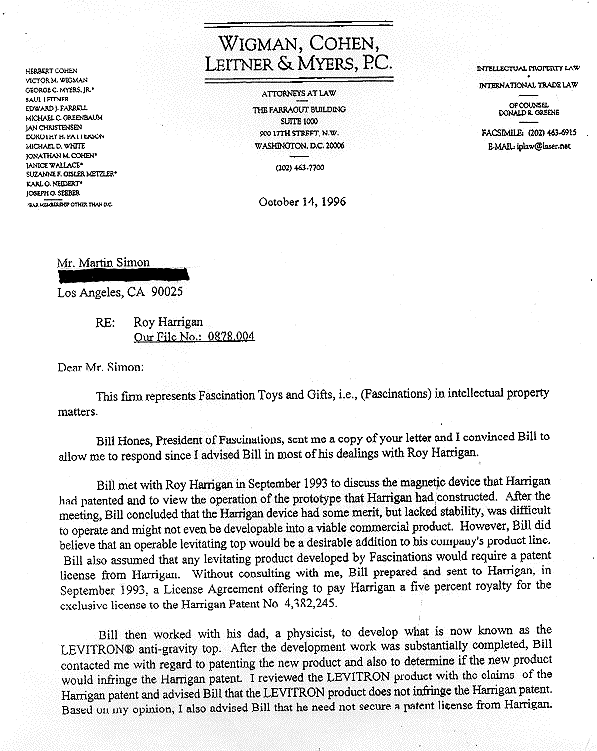
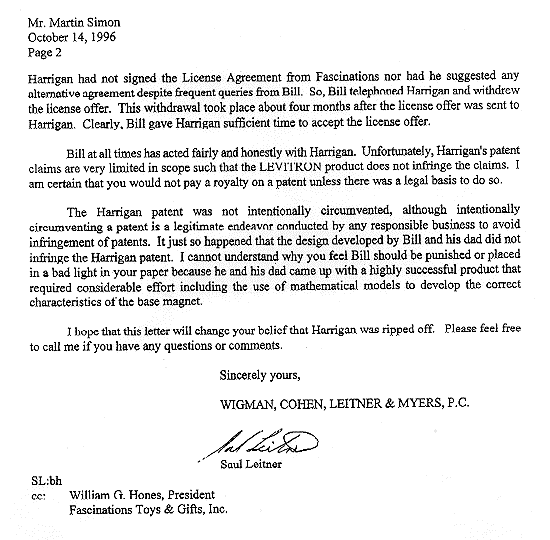
The Levitron invention itself has something of a contentious history (recounted here and here). Evidently, the physicist Ray Harrigan had patented a similar device a few years earlier and showed it to Bill Hones, who later got his own patent for a similar device and called it the "Levitron," but Hones was advised by his own lawyer that his own invention was sufficiently different from Harrigan's that he could market it without infringing Harrigan's patent or giving him credit or royalties. Apparently Harrigan was so disgusted and distrustful of his own lawyer that he never took the issue to court, so we'll never know what a judge would have thought. (The only issue which was ever litigated in court was over a former re-seller's use of the trademark "Levitron" — but that seems more straightforward, since the company that made up the word and trademarked it, owns it, completely separate from the merits of the invention that bears the name.) Some physicists have mixed feelings about the Levitron because of this, but it was apparently Harrigan's choice not to pursue the issue. (Besides, the new Levitron Revolution design uses nothing of Harrigan's idea, so some might feel that it's less "tainted".)
For cheaper levitation that takes no skill to operate, you can get the Diamagnetic Levitation Kit from Educational Innovations or search for pyrolitic graphite levitation on eBay — much less visually impressive though, with the graphite sheet levitating only 1 millimeter above the magnets.
Or for a more expensive conversation piece, the Levitron Lamp ($450 from InnovaToys or $400 from WorldToHome) levitates an entire lampshade above the base. I haven't tried that one out though.
- - - - - - - - - - - - - - - - - - - -
Levitating Picture Frames
Heart-shaped frame $25 from ZOpid; rectangular frame $70 from Hammacher Schlemmer.Computer-controlled levitation operating on a similar principle to the Levitron Revolution products. The $25 ZOpid picture frame is currently hanging out in Amazon limbo with a solitary 1-star review from a customer whose model broke after 4 months. But I think they look fine, and I'm giving two of them as gifts and crossing my fingers that I'm not that unlucky. With both the ZOpid and the Hammacher Schlemmer frames, unfortunately, there's apparently no way to switch off the LED lights (short of turning off the whole model).
Protip: You can prepare these as gifts by using photos downloaded from a friend's Facebook profile, but Facebook reduces the quality of uploaded photos, so that if you print them out, the pixellation will be noticeable up close. If you want the photos to look the best, you need to print them from high-res originals.
- - - - - - - - - - - - - - - - - - - -
Hanayama Japanese Pocket Puzzles
$13 from ThinkGeek and other vendors; some puzzles available for slightly less on eBay.Some disassembly puzzles are complete fails, either because there are so many separately moving pieces that you can't manipulate the puzzles in your hands at all (e.g. Yin and Yang"), or the moving parts are hidden from view so you can only "solve" them by pure guesswork (e.g. the "Bolted Closed" puzzle). The Hanayama pocket puzzles actually get it right — you can see all the pieces and move them comfortably in your hands, so solving them is just a matter of figuring out the right sequence of moves.
These are basically grown-up versions of the twisted nail puzzles you might have grown up with (and which you could also get, of course, as much cheaper stocking stuffers). But the Hanayama ones look good as shelf knick-knacks as well.
Hanayama pocket puzzles come with no solution included, but you can download a solution by going to this page and submitting your email address to request a download link.
- - - - - - - - - - - - - - - - - - - -
LED Jellyfish Mood Lamp
$35 from ThinkGeek and other vendors; no cheaper alternatives on eBayWorks more or less as shown in the video, with one caveat: In both the first model that I tried, and the free replacement ThinkGeek sent me when I reported the problem, the transitions between the different colors were much more abrupt and jarring than the smooth "color fade" shown in the video. (For some reason, some color LEDs would switch from completely on to completely off at the same time that other LEDs would switch on.) Unfortunately this small problem completely breaks the "reverie" effect of staring at the jellyfish floating around in the water, so I just set mine to a single color without using the transition effect.
Protip: You have to use real distilled water like the instructions tell you. I tried to make it work with regular tap water, and bubbles kept forming around the jellyfish and causing them to float to the surface. Fill it with distilled water and the jellyfish should sink beneath the surface without too much trouble.
Note, Fascinations has come out with a similar product, again sold on Innovatoys.com; I haven't tried that one, so it might be better (might actually get the color transition right), or it might not. Discovery Kids also makes a similar product which I haven't seen and which has been pulling pretty bad reviews on Amazon.
- - - - - - - - - - - - - - - - - - - -
Vino Vault and Cryptex Puzzle Pod
$30 and $22 from 4Thought Products LLCThe Puzzle Pod is a gift container that can only be opened by arranging the 5 rings to spell out a 5-letter password. It arrives pre-configured with the keyword "GRAPE"; once opened, you can re-configure the Pod with a new 5-letter secret word, seal a gift inside, and gift it to a recipient who has to find the secret word to open the puzzle and retrieve the gift. (It's re-usable, and you can set a different 5-letter "password" every time.) The Vino Vault is a larger version of the Puzzle Pod that can hold a bottle of wine.
I've only sampled the Puzzle Pod, so I can just vouch for the fact that it works exactly as described and doesn't get stuck or break easily. When you line up the letters of the secret word correctly, it actually slides smoothly open like it's supposed to.
- - - - - - - - - - - - - - - - - - - -
Ambiguous Vase
$33 from Grand Illusions Ltd (ships from the UK)This is a real-life version of the Rubin vase optical illusion. For years, Grand Illusions sold only a ceramic version for about $400 (plus another $200 to ship to the U.S.), but in November 2012 they released the $33 plastic version. It can also be used as a real vase (as long as you don't mind the barrier running down the center that divides the two halves).
- - - - - - - - - - - - - - - - - - - -
Steam Powered Top
$14 from Grand Illusions (ships from the UK)The world's simplest steam engine, made from a tube of copper pushed through a piece of cork, as shown in the demo video. Wikipedia explains the principle here — when the water in the copper tube is heated by the candle flame and boils, it expands and pushes out the ends of the tubes (driving the spinning motion). When the water contracts again, in sucks in water through the ends of the tubes — but the sucking motion pulls in water from all directions (while the expulsion of water pushes in only one direction), so the suction doesn't counteract the propulsion, and the top continues spinning.
Now, the original version is from Germany (and comes with detailed German instructions); the version that I got came with a sheet of English instructions that weren't as detailed. The instructions say to push the copper tube through the cork platform and "bend the tube at a 90-degree angle"; however if you just try bending the tube, it will probably crimp and create a hole, making it useless. To bend the tube so that it curves gradually, place your thumb on the cork next to where the tube protrudes, and use the fingers of your other hand to gently push the tube so that curves around your thumb. (This is spelled out in the original German instructions.)
Also, the instructions say to fill the copper tube by holding it under running tap water. This didn't work at all for me, since the tube is only about 2mm wide and the surface tension of water makes it hard to "push" it into a tube that small. Fortunately, a straw from a grocery-store juicebox fits perfectly over the other end of the copper tube, so if you submerge the other end in water, you can suck on the straw to fill the tube that way. (It's just copper after all, not lead.)
Finally, if you leave the cork floating in water too long, it eventually gets waterlogged and sinks, and as far as I can tell it's very hard to dry it out and bring it back to its original buoyancy. The workarounds for this are: (1) to increase the buoyancy, first put another tea light directly into your bowl of water so that it floats, and then lower the top into the water on top of that tea light, which will then help keep the top afloat; and (2) don't leave the top floating in water when not in use.
- - - - - - - - - - - - - - - - - - - -
"Flying F*CK" Remote-Control Helicopter
$20 from ThinkGeekAgain with the ThinkGeek swag; I swear I didn't know.
This is pretty self-explanatory, except I've tried two of them and the product doesn't seem to work too well as an actual remote-control helicopter; one of them couldn't hover in place (its two modes were "shooting up at the ceiling" or "falling"), and with the other, the R/C didn't seem to work through furniture. But that's probably OK since the whole point of this gift is in the giving and not the having.
In my case, I hid it behind a friend's chair at his birthday party, then at the appropriate time gave a speech ending with, "And so I thought, what do I give my friend to mark this occasion? What do I give? After much thought, I decided, this is what I give:..." There followed a dramatic pause where I pressed the "up" control on the remote, and nothing happened, whereupon I muttered, appropriately enough, "Fuck", then wandered over behind my friend's chair, repeated the setup line, pressed the remote button, at which point the copter shot up, banged into a chair and fell to the ground, whereupon for my third attempt I just picked it up and held it on the palm of my hand, pressed the remote, and the copter took flight and finally delivered the punch line, and all was good. If I'm there when he re-gifts it (since we both agreed that was the point of a gift like this), I hope it works better for him.
- - - - - - - - - - - - - - - - - - - -
Falling Sand Sculptures
$13 for the smaller 'Sandscape'; $80 for the larger 'Deep Sea Round'; both available from Educational InnovationsThese both make good decorations and shelf widgets. The sand in the Sandscape always falls in more or less the same pattern, since it's pre-determined by the gaps in the shelves holding the sand; the Deep Sea Round is more interesting since the pattern is determined by the placement of air bubbles and varies every time.
Pro tip: water evaporates from both of these, so eventually the water level will drop and the volume of air will increase, getting in the way of the sand flow. The 'Deep Sea Round' comes with a syringe that you can use to draw out air and inject more water into the aperture on the side. The cheaper 'Sandscape' doesn't come with a syringe, but it has a hole in the side where you can use a syringe to inject more water, if you buy the syringe separately.
- - - - - - - - - - - - - - - - - - - -
Galileo Thermometer
$17 for a wood-mounted model from Office Playground; cheaper ones available without wood mountingJust your basic elegant conversation piece demonstrating the principle that the density of a liquid changes with temperature. Pro tip: If you get the wood mounted one, before emailing the seller to complain that it's not working because all the spheres are bunched together at the wrong end, make sure it's not upside-down. (I realized, before I hit Send, that the felt-covered end goes on the bottom.)
- - - - - - - - - - - - - - - - - - - -
All of the remaining items on this list do exactly what they say they do, with no need for any special instructions not included by the manufacturer, so I'm just going to list them:
Glass Water Faucet — $50 from Uncommon Goods — a nice double optical illusion (faucet suspended in space, and glass-as-water).
Slicked Grandfather Clock — $30-$60 depending on who's selling it.
Tin Can Robot Kit — about $15 from various vendors — my stepdad and I assembled one using one of his beloved Hansen's soda cans.
Mini metal DIY sculptures — the Metal Works sculptures from Innovatoys ($7-$12) take some time to assemble but they come out looking pretty much like the pictures and make good shelf decorations. These Mikro sculptures ($10 and up, also available from Grand Illusions if you're filling your shopping cart there) are a bit easier to assemble since you just have to bend some shapes out from the metal sheet that they're carved from.
Ulexite "Television Stones" — $10 from Educational Innovations — a naturally occuring rock containing thousands of parallel fiber optic strands. Give it as a gift together with a square of patterned fabric so you can see the eerie effect when you place the rock against the fabric and the pattern "magically" appears on the opposite side of the rock.
And finally, if you need a last-minute gag gift for someone, browse through the gum and hand sanitizers from BlueQ.com — they're not geek-themed, but at $5.49 for the hand sanitizers and $1.39 for the gum, you can afford to stock up so you'll have a reserve of gag gifts suited for a variety of different people's tastes (except, of course, good taste).
And those are my favorites for gift-giving season 2012. You can send me suggestions for any items in this category that I've missed; I'll be back for Valentine's Day.
- - - - - - - - - - - - - - - -
Remember, if you have a feature idea, we'd love to hear it. -
Russia and China Withdraw Bid For Internet Control
judgecorp writes "Russia, China and other nations have withdrawn proposals to take control over the Internet within their borders. The proposals, handed to the World Conference on International Telecommunications (WCIT) on Friday, caused widespread dismay and protest. The WCIT event in Dubai, run by the UN agency ITU, is working on new International Telecommunications Regulations (ITRs) which are due for their first revision since the emergence of the mass Internet. The line-up of nations wanting to formalize their power to restrict the Internet included Russia, China, UAE, Saudi Arabia, Algeria, Sudan and Egypt. Their proposal has been withdrawn without explanation, an ITU spokesperson confirmed." -
Australian Police Warn That Apple Maps Could Get Someone Killed
First time accepted submitter jsherring writes "Police in Victoria, Australia warn that Apple's glitch-filled Maps app could get someone killed, after motorists looking for the Victorian city of Mildura were instead guided to a wilderness area. Relying on Apple Maps to navigate through rural Australia seems rather foolish but it has become common practice to rely on GPS navigation. Besides reverting to google maps, perhaps Apple should provide strong warnings to use other navigation sources if navigating to remote locations." -
Pirate Bay Founder Released From Solitary Confinement
TrueSatan writes "Pirate bay founder Gottfrid Svartholm is set to be released from solitary confinement but is still to serve the remainder of a one-year sentence relating to Pirate Bay activities. Five months remain of that sentence and they are to be served in a normal prison with far fewer restrictions on his confinement — assuming no new charges are brought against him. He had been accused of involvement in the hacking of Swedish IT firm Logica, but no charges have been substantiated in that case. He was later implicated in a second case but, once more, no charges have been substantiated against him." -
Ubuntu Community Manager: RMS's Post Seems a Bit Childish To Me
spacenet writes "As a response to RMS speaking out against Ubuntu about its privacy-violating integrated Amazon search results, which he considers to be spyware, Ubuntu Community Manager Jono Bacon has addressed RMS's statements. In his reply, Jono claims that Stallman's views on privacy do not align with Canonical's, that some of his statements are worded in order to 'generate fear, uncertainty, and doubt about Ubuntu' and that 'it just seems a bit childish to me.' The comments on the post itself are well worth a read." -
Ubuntu Community Manager: RMS's Post Seems a Bit Childish To Me
spacenet writes "As a response to RMS speaking out against Ubuntu about its privacy-violating integrated Amazon search results, which he considers to be spyware, Ubuntu Community Manager Jono Bacon has addressed RMS's statements. In his reply, Jono claims that Stallman's views on privacy do not align with Canonical's, that some of his statements are worded in order to 'generate fear, uncertainty, and doubt about Ubuntu' and that 'it just seems a bit childish to me.' The comments on the post itself are well worth a read." -
Money Python: Florida Contest Offers Rewards In 2013 Everglades Python Hunt
Press2ToContinue writes "Dubbed the Python Challenge, the month-long contest will award $1,000 for the longest python and $1,500 for the most pythons caught between Jan. 12 and Feb. 10 in any of four hunting areas north of Everglades National Park and at the Big Cypress National Preserve. Pythons have been spreading through the Everglades for years, posing a threat to the sensitive ecosystem by preying on native species. Some estimates put their number in the tens of thousands. Last year, 272 pythons were removed from the wild, state figures show." -
Ubuntu 13.04 Will Allow Instant Purchasing, Right From the Dash
sfcrazy writes "Ubuntu is becoming a shopping center. Instead of addressing the queries raised by Stallman and the EFF, Canonical is now pushing for making Ubuntu a shopping cart. With Ubuntu 13.04 Canonical is going one step forward, and soon you will be able to purchase software and music right from the Dash without opening the software center or web browser.This is intended to make the whole experience even more interactive and useful for the end user." -
Brain Pacemaker Helps Treat Alzheimer's Disease
First time accepted submitter Press2ToContinue writes "Deep brain stimulation (DBS) is the use of a pacemaker-like device implanted in the brain to treat the symptoms of diseases like Parkinson's, or other maladies such as depression. For the first time in the US, surgeons at Johns Hopkins in Baltimore, Maryland have used this technique to attempt to slow memory loss in a patient suffering from the early stages of Alzheimer's disease. The fornix, a vital part of the brain that brings data to the hippocampus, is being targeted with this device. Essentially, the fornix is the area of the brain that converts electrical activity into chemical activity. Holes are drilled into the skull, and wires are placed on both sides of the brain. Then, the stimulator device pumps in small and unnoticeable electrical impulses upwards of 130 times per second. Half of the patients will begin the electrical treatment two weeks post-surgery, but the other half won't have their pacemakers turned on until a full year after the surgery to provide comparison data for the study." -
NZBMatrix Closes Their Website
An anonymous reader writes "Hot on the heels of the closure of Newzbin2, this morning the usenet NZB indexing website NZBMatrix closed shop in the face of another DMCA notice. NZBMatrix allowed users to sift through messy usenet groups and quickly find data for download. NZBMatrix's API allowed automated polling from various clients, making it one of the more popular NZB sites. This is one of the last public NZB indexing sites, leaving mostly invite-only underground sites. A sad day for usenet users everywhere." -
A US Apple Factory May Be Robot City
dcblogs writes "Apple's planned investment of $100 million next year in a U.S. manufacturing facility is relatively small, but still important. A 2009 Apple video of its unibody manufacturing process has glimpses of highly automated robotic systems shaping the metal. In it, Jonathan Ive, Apple's senior vice president of design, described it. 'Machining enables a level of precision that is just completely unheard of in this industry,' he said. Apple has had three years to improve its manufacturing technology, and will likely rely heavily on automation to hold down labor costs, say analysts and manufacturers. Larry Sweet, the CTO of Symbotic, which makes autonomous mobile robots for use in warehouse distribution, described a possible scenario for Apple's U.S. factory. First, a robot loads the aluminum block into the robo-machine that has a range of tools for cutting and drilling shapes to produce the complex chassis as a single precision part. A robot then unloads the chassis and sends it down a production line where a series of small, high-precision, high-speed robots insert parts, secured either with snap fit, adhesive bonds, solder, and a few fasteners, such as screws. At the end, layers, such as the display and glass, are added on top and sealed in another automated operation. Finally, the product is packaged and packed into cases for shipping, again with robots. "One of the potentially significant things about the Apple announcement is it could send a message to American companies — you can do this — you can make this work here," said Robert Atkinson, president of The Information Technology & Innovation Foundation." -
Valve's 'Steam Box' Console Is Real, Says Gabe Newell
symbolset writes "The Verge is reporting that the Steam Console we discussed in November is a real thing. Gabe Newell said it will be a locked down platform for the living room. The source is a Kotaku interview with Newell at the Video Game Awards. Newell said, 'Well certainly our hardware will be a very controlled environment. If you want more flexibility, you can always buy a more general-purpose PC. For people who want a more turnkey solution, that's what some people are really gonna want for their living room. The nice thing about a PC is a lot of different people can try out different solutions, and customers can find the ones that work best for them.'" -
For League of Legends Creator Riot Games, Big Data Is Serious Business
Nerval's Lobster writes "Riot Games created the very successful League of Legends gaming franchise, which hosts millions of monthly users. Barry Livingston, director of engineering for the company's Big Data group, talks about how Riot Games scaled up to deal with that enormous data load. Consider all the millions of people playing the game in real time. Picture joining three massive tables — player data, game data, and session data — and you begin to see the full scope of Riot Games' issue. Gamer activity generates more than 500 GB of structured data and over four TB of operational logs every day. Riot Games has also posted 60 open-source Chef and Opscode recipes, among other code samples." -
How Corruption Is Strangling US Innovation
hype7 writes "The Harvard Business Review is running a very interesting piece on how money in politics is having a deleterious effect on U.S. innovation. From the article: 'Somehow, it seems that every time that [Mickey Mouse] is about to enter the public domain, Congress has passed a bill to extend the length of copyright. Congress has paid no heed to research or calls for reform; the only thing that matters to determining the appropriate length of copyright is how old Mickey is. Rather than create an incentive to innovate and develop new characters, the present system has created the perverse situation where it makes more sense for Big Content to make campaign contributions to extend protection for their old work.if you were in any doubt how deep inside the political system the system of contributions have allowed incumbents to insert their hands, take a look at what happened when the Republican Study Committee released a paper pointing out some of the problems with current copyright regime. The debate was stifled within 24 hours. And just for good measure, Rep Marsha Blackburn, whose district abuts Nashville and who received more money from the music industry than any other Republican congressional candidate, apparently had the author of the study, Derek Khanna, fired. Sure, debate around policy is important, but it's clearly not as important as raising campaign funds.'" -
Apple and Google Joining Forces On Kodak Patents Bid
TrueSatan writes "Bloomberg reports that Apple and Google have partnered to make a bid of more than $500 million for the Kodak patent portfolio. The bid relates to Kodak's 1,100 imaging patents. 'Kodak obtained commitments for $830 million exit financing last month, contingent on its sale of the digital imaging patents for at least $500 million.' This is likely to be an opening bid, with the final figure being far larger. By comparison, a group including Apple, Microsoft, and RIM bought Nortel's 6000+ patents for $4.5 billion last year. 'Google lost the auction for those patents after making an initial offer of $900 million.'" -
Ask Slashdot: Best Laptop With Decent Linux Graphics Support?
jcreus writes "After struggling for some years with Nvidia cards (the laptop from which I am writing this has two graphic cards, an Intel one and Nvidia one, and is a holy mess [I still haven't been able to use the Nvidia card]) and, encouraged by Torvalds' middle finger speech, I've decided to ditch Nvidia for something better. I am expecting to buy another laptop and, this time, I'd like to get it right from the start. It would be interesting if it had decent graphics support and, in general, were Linux friendly. While I know Dell has released a Ubuntu laptop, it's way off-budget. My plan is to install Ubuntu, Kubuntu (or even Debian), with dual boot unfortunately required." So: what's the state of the art for out-of-the-box support? -
Steve Jobs Patent On iPhone Declared Invalid
An anonymous reader writes "Apple's most famous multitouch software patents are increasingly coming under invalidation pressure. First the rubber-banding patent and now a patent that Apple's own lawyers planned to introduce to a Chicago jury as 'the Jobs patent.' U.S. Patent No. 7,479,949 covers a method for distinguishing vertical and horizontal gestures from diagonal movements based on an initial angle of movement. For example, everything up to a slant of 27 degrees would be considered vertical or horizontal, and everything else diagonal. The patent office now seems to think that Apple didn't invent the concept of 'heuristics' after all." -
RMS Speaks Out Against Ubuntu
An anonymous reader writes "In a post at the Free Software Foundation website, Richard Stallman has spoken out against Ubuntu because of Canonical's decision to integrate Amazon search results in the distribution's Dash search. He says, 'Ubuntu, a widely used and influential GNU/Linux distribution, has installed surveillance code. When the user searches her own local files for a string using the Ubuntu desktop, Ubuntu sends that string to one of Canonical's servers. (Canonical is the company that develops Ubuntu.) This is just like the first surveillance practice I learned about in Windows. ... What's at stake is whether our community can effectively use the argument based on proprietary spyware. If we can only say, "free software won't spy on you, unless it's Ubuntu," that's much less powerful than saying, "free software won't spy on you." It behooves us to give Canonical whatever rebuff is needed to make it stop this. ... If you ever recommend or redistribute GNU/Linux, please remove Ubuntu from the distros you recommend or redistribute.'" -
How Peer1 Survived Sandy
Nerval's Lobster writes "When hurricane Sandy knocked out the electricity in lower Manhattan, data-center operator Peer1 took extreme measures to keep its servers humming, assembling a bucket brigade that carried diesel fuel up several flights of stairs. Ted Smith, senior vice president of operations for Peer1, talks about the decisions made as the floodwaters rose and the main generators went offline, as well as the changes his company has made in the aftermath of the storm. He said, 'When the water got to a point that it had flooded the infrastructure and the basement, we were then operating under the reserves the building had on the roof, and our own storage tanks. Literally, at that point we had to do calculations as to how long we could run. And we believed we had enough diesel fuel—between what is in the building, and in our tanks, to about 9 AM the following day. ... You know the bucket brigade—it’s something I’ve never asked the team to do. If you think about what that was at that time, you’re talking about carrying fuel up 17 flights, in total darkness, throughout a whole evening. We had informed our data center manager that we were shutting down, but he kind of took on it himself to say, ‘Not on my watch.’ And he organized himself, got a temporary solution and then more customers jumped in. And at peak I think we had about 30 people helping.'" -
Maker of Hackable Hotel Locks Finally Agrees To Pay For Bug Fix
Sparrowvsrevolution writes "Slashdot readers are no doubt familiar by now with the case of Onity, the company whose locks are found on 4 million hotel room doors worldwide and, as came to light over the summer, can be opened in seconds with a $50 Arduino device. Since that hacking technique was unveiled by Mozilla developer Cody Brocious at Black Hat, Onity first downplayed its security flaws and then tried to force its hotel customers to pay the cost of the necessary circuit board replacements to fix the bug. But now, after at least one series of burglaries exploiting the bug hit a series of hotel rooms in Texas, Onity has finally agreed to shoulder the cost of replacing the hardware itself — at least for its locks in major chain hotels in the U.S. installed after 2005. Score one point for full disclosure." -
Republican Staffer Khanna Axed Over Copyright Memo
Bob9113 writes "Ars Technica reports that Derek Khanna is getting axed over his memo detailing the conflict between laissez-faire-oriented free market ideals and the regulatory monopoly that is copyright. 'The Republican Study Committee, a caucus of Republicans in the House of Representatives, has told staffer Derek Khanna that he will be out of a job when Congress re-convenes in January. The incoming chairman of the RSC, Steve Scalise (R-LA) was approached by several Republican members of Congress who were upset about a memo Khanna wrote advocating reform of copyright law. They asked that Khanna not be retained, and Scalise agreed to their request.'" -
Apple CEO Tim Cook On Apple's US Manufacturing Move
We mentioned a few days back the "Assembled in America" tag showing up on some models of Apple's iMac. Nerval's Lobster points out that in a new interview with Bloomberg Businessweek, Apple CEO Tim Cook offered some details on what that means: "'Next year we are going to bring some production to the U.S. on the Mac,' Cook told the magazine. 'We've been working on this for a long time, and we were getting closer to it. It will happen in 2013. We're really proud of it. We could have quickly maybe done just assembly, but it's broader because we wanted to do something more substantial.' He also had comments about Android and current litigation against Samsung and others." -
Apple CEO Tim Cook On Apple's US Manufacturing Move
We mentioned a few days back the "Assembled in America" tag showing up on some models of Apple's iMac. Nerval's Lobster points out that in a new interview with Bloomberg Businessweek, Apple CEO Tim Cook offered some details on what that means: "'Next year we are going to bring some production to the U.S. on the Mac,' Cook told the magazine. 'We've been working on this for a long time, and we were getting closer to it. It will happen in 2013. We're really proud of it. We could have quickly maybe done just assembly, but it's broader because we wanted to do something more substantial.' He also had comments about Android and current litigation against Samsung and others." -
Thorium Fuel Has Proliferation Risk
Capt.Albatross writes "Thorium has attracted interest as a potentially safer fuel for nuclear power generation. In part, this has been because of the absence of a route to nuclear weapons, but a group of British scientists have identified a path that leads to uranium-233 via protactinium-233 from irradiated thorium. The protactinium separation could possibly be done with standard lab equipment, which would allow it to be done covertly, and deliver the minimum of U233 required for a weapon in less than a year. The full article is in Nature, but paywalled." -
McAfee Arrested In Guatemala
Reports are coming in that John McAfee's on again off again relationship with various law enforcement agencies has finally come to an end. According to interior minister Mauricio Lopez Bonilla, he has been arrested in Guatemala after trying to enter the country illegally. -
McAfee Arrested In Guatemala
Reports are coming in that John McAfee's on again off again relationship with various law enforcement agencies has finally come to an end. According to interior minister Mauricio Lopez Bonilla, he has been arrested in Guatemala after trying to enter the country illegally.