Slashdot Mirror
Domain: slashdot.org
Stories and comments across the archive that link to slashdot.org.
Stories · 37,380
-
The Man Who Broke Ticketmaster (vice.com)
Jason Koebler quotes a report from Motherboard: The scourge of ticket bots and the immorality of the shady ticket scalpers using them is conventional wisdom that's so ingrained in the public consciousness and so politically safe that a law to ban automated ticket bots passed both houses of Congress unanimously late last year, in part thanks to a high-profile public relations campaign spearheaded by Hamilton creator Lin-Manuel Miranda. But no one actually involved in the ticket scalping industry thinks that banning bots will do much to slow down the secondary market. Seven years after his Los Angeles office was raided by shotgun-wielding FBI agents, Ken Lowson, the man who invented ticket bots, told Motherboard's Jason Koebler he's switched teams. Now, he's out to expose the secrets of the ticket industry in a bid to make sure tickets are sold directly to their fans. -
All Three New 2017 iPhones To Feature Wireless Charging, Says Analyst (macrumors.com)
In late October, Nikkei Asian Review released a report claiming Foxconn was testing wireless charging modules for the iPhone 8. Another report has surfaced recently that further reinforces those claims. KGI Securities analyst Ming-Chi Kuo now claims that all three new iPhones expected to launch later this year will feature wireless charging. MacRumors reports: Kuo said wireless charging increases the internal temperature of smartphones, so he expects the rumored iPhone 8 with an OLED display and glass casing to have a new 3D Touch module with "additional graphite sheet lamination" in order to prevent the device from malfunctioning due to overheating. An excerpt from Kuo's research note obtained by MacRumors: "While we don't expect general users to notice any difference, lamination of an additional graphite sheet is needed for better thermal control and, thus, steady operation; this is because FPCB is replaced with film, which is more sensitive to temperature change of the 3D touch sensor in OLED iPhone." The new 3D Touch module could be up to $5 more expensive for Apple to procure per phone. While that is a minimal increase, it lends further credence to a report claiming the high-end iPhone 8 could cost upwards of $1,000 in the United States due to a significant redesign and the use of premium parts. -
RSA: Ban On Booth Babes Has Been No Big Deal (networkworld.com)
netbuzz quotes a report from Network World: In March 2015, RSA Conference organizers made news by contractually insisting that vendors pitch their security wares without the help of "booth babes," a first such ban for the technology industry. Next week's event will be third under the new rules. With the use of "booth babes" long a source of contention -- and some would say embarrassment -- implementation of the ban has gone smoothly, according to RSA. "Overall I would say this has been received well by our exhibitors," says Sandra Toms, vice president and curator of the conference. "Several have thanked us for having a policy." If you compare the policy's contract language in 2015 with the language now used by Toms, you'll notice how much it has evolved and how it has been accepted by various stake-holders. Here's an excerpt from the "short Q&A" between Paul McNamara, news editor for Network World, and Toms: Has there been any need to enforce the code or have all exhibitors complied? "Enforce" always makes it sound like armed guards have come into play and dragged someone off the show floor. We share these guidelines with our exhibitors and we're clear that this is a policy that is expected to be acknowledged and complied with. We take our attendee experience seriously and expect our exhibitors to do the same. If we receive a complaint about a particular exhibitor, we will send someone over to the booth and examine the situation. If the attire matches our dress code, then they can proceed and we can explain to the attendee why that form of dress is allowed. If they are clearly in violation, we will ask them to change. This policy is equally applied to both men and women -- from Sumo wrestlers to scantily clad models. -
Watchdog Group Wants Uber's Self-Driving Trucks Off the Road (usatoday.com)
New submitter Kemtores quotes a report from USA Today: A few months ago, the ride-hailing giant announced that it would begin testing self-driving Volvo SUVs in this hilly city, but a day later that process was halted after the DMV said Uber had not applied for the proper permits. Uber moved its fleet to Arizona. Uber cars laden with sensors still troll San Francisco, but the company said it is only for mapping purposes. Now a southern California non-profit that has long raised concerns about the safety of autonomous vehicles has asked the DMV to look closer at the operations of Otto, a self-driving truck company that Uber bought last year for $670 million. Otto made headlines in October when it completed a 120-mile beer run with a large semi-tractor in Colorado. But Consumer Watchdog's John Simpson charged in a letter to DMV director Jean Shiomoto that in fact Otto's testing here did violate the law by operating in autonomous mode, offering proof in the form of documentation Otto submitted to Colorado officials that described a process where the driver hit a button and let the truck do the work. -
Watchdog Group Wants Uber's Self-Driving Trucks Off the Road (usatoday.com)
New submitter Kemtores quotes a report from USA Today: A few months ago, the ride-hailing giant announced that it would begin testing self-driving Volvo SUVs in this hilly city, but a day later that process was halted after the DMV said Uber had not applied for the proper permits. Uber moved its fleet to Arizona. Uber cars laden with sensors still troll San Francisco, but the company said it is only for mapping purposes. Now a southern California non-profit that has long raised concerns about the safety of autonomous vehicles has asked the DMV to look closer at the operations of Otto, a self-driving truck company that Uber bought last year for $670 million. Otto made headlines in October when it completed a 120-mile beer run with a large semi-tractor in Colorado. But Consumer Watchdog's John Simpson charged in a letter to DMV director Jean Shiomoto that in fact Otto's testing here did violate the law by operating in autonomous mode, offering proof in the form of documentation Otto submitted to Colorado officials that described a process where the driver hit a button and let the truck do the work. -
Watchdog Group Wants Uber's Self-Driving Trucks Off the Road (usatoday.com)
New submitter Kemtores quotes a report from USA Today: A few months ago, the ride-hailing giant announced that it would begin testing self-driving Volvo SUVs in this hilly city, but a day later that process was halted after the DMV said Uber had not applied for the proper permits. Uber moved its fleet to Arizona. Uber cars laden with sensors still troll San Francisco, but the company said it is only for mapping purposes. Now a southern California non-profit that has long raised concerns about the safety of autonomous vehicles has asked the DMV to look closer at the operations of Otto, a self-driving truck company that Uber bought last year for $670 million. Otto made headlines in October when it completed a 120-mile beer run with a large semi-tractor in Colorado. But Consumer Watchdog's John Simpson charged in a letter to DMV director Jean Shiomoto that in fact Otto's testing here did violate the law by operating in autonomous mode, offering proof in the form of documentation Otto submitted to Colorado officials that described a process where the driver hit a button and let the truck do the work. -
Microsoft Teases Windows 10's Upcoming 'Project Neon' Design Language (windowscentral.com)
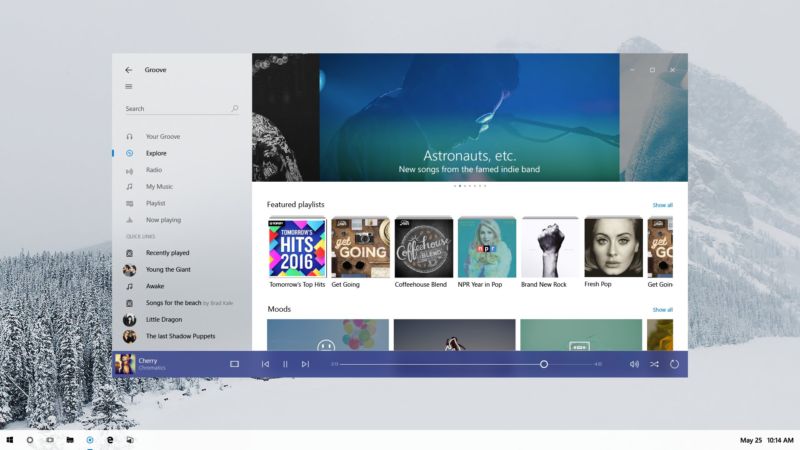
An anonymous reader quotes a report from Windows Central: Microsoft just gave developers a sneak peek at Project Neon, Microsoft's upcoming design language for Windows 10 that aims to add fluidity, animation and blur to apps and the operating system. We exclusively revealed that this was in the works in late 2016, and today Microsoft has given us a first peak at what Project Neon will look like. During the Windows Developer Day livestream, an image of Project Neon was seen the background of one of the PowerPoint slides being shown off on stage. Although not much, it's further confirmation that this is the end goal for Windows 10's UI, and Project Neon will be bringing a fresh coat of paint to apps. Project Neon should benefit all types of Windows 10 devices, including Windows 10 Mobile, HoloLens and even Xbox. We're still several months away from Project Neon being everywhere in Windows 10, and we're expecting to see more at BUILD this coming May. In fact, a lot of the Project Neon APIs are available in the latest Insider Preview builds of Windows 10, meaning developers can already begin taking advantage of these new user interfaces and design language! Animations and transitions are a big deal with Project Neon, with the goal of making the operating system and apps feel like they work together. Peter Bright does a good job summarizing the looks of the screenshot via Ars Technica: "The picture shows a refreshed version of the Groove music app on a Windows desktop. The fundamentals of the app and its layout aren't changed, underscoring that Neon is very much an iteration of the current Metro/Microsoft Design Language (MDL). The window has shed its discrete title bar and one pixel border, with the application content now extending to the very edge of the window. The search text field no longer has a box around it, and the left hand pane has a hint of translucency to it." You can view the screenshot here and judge it for yourself. -
Tor's Ooniprobe, Now Available On Android and iOS, Helps People Track Internet Censorship (cnn.com)
In 2012, researchers at Tor announced Ooniprobe, an open-source tool to collect data about local meddling with the computer's network connections, and also whether the government was censoring something. The team has now released a new app, available for Android and iOS, which makes it easier than ever to tell what your government is up to on the web. From a report on CNN Money: The Open Observatory of Network Interference (OONI), which monitors networks for censorship and surveillance, is launching Ooniprobe, a mobile app to test network connectivity and let you know when a website is censored in your area. The app tests over 1,200 websites, including Facebook, Twitter, and WhatsApp. You can decide how long to run the test, but the default is 90 seconds and would test between 10 and 20 websites depending on bandwidth. Links to blocked websites are listed in red, while available sites are green. Service providers, sometimes controlled by the government, don't always shutdown the internet entirely -- for instance, Facebook.com might be inaccessible while CNN.com still works. "Not only we will be able to gather more data and more evidence, but we will be able to engage and bring the issue of censorship to the attention of more people," Arturo Filasto, chief developer for the Ooniprobe app, told CNNTech. -
Tesla To Start Pilot Production of Model 3 This Month (reuters.com)
According to Reuters, Tesla is planning to "begin test-building its Model 3 sedans on February 20, a move that could allay concerns about the company meeting its target to start production in July." The sources familiar with the matter did not mention how many of the Model 3 vehicles Tesla aims to build in February, though the number is likely to be small to test the assembly system and the quality of vehicle parts. From the report: Tesla Chief Executive Elon Musk last year told investors and more than 370,000 customers who put deposits down for a Model 3 that he intended to start building the cars in July 2017. At the time, many analysts and suppliers said the timeline was too ambitious and would be difficult to achieve, pointing to Tesla's history of missing aggressive production targets. If Tesla succeeds in starting pilot production of the sedan at its factory in Fremont, California on Feb. 20, the company would be able to share the news with shareholders two days later when it reports fourth-quarter results and better answer any questions about the Model 3 rollout. Musk had told investors last year that the company could miss the July 2017 startup target if suppliers do not meet deadlines. -
Programmer Develops Phone Bot To Target Windows Support Scammers (onthewire.io)
Trailrunner7 quotes a report from On the Wire: The man who developed a bot that frustrates and annoys robocallers is planning to take on the infamous Windows support scam callers head-on. Roger Anderson last year debuted his Jolly Roger bot, a system that intercepts robocalls and puts the caller into a never-ending loop of pre-recorded phrases designed to waste their time. Anderson built the system as a way to protect his own landlines from annoying telemarketers and it worked so well that he later expanded it into a service for both consumers and businesses. Users can send telemarketing calls to the Jolly Roger bot and listen in while it chats inanely with the caller. Now, Anderson is targeting the huge business that is the Windows fake support scam. This one takes a variety of forms, often with a pre-recorded message informing the victim that technicians have detected that his computer has a virus and that he will be connected to a Windows support specialist to help fix it. The callers have no affiliation with Microsoft and no way of detecting any malware on a target's machine. It's just a scare tactic to intimidate victims into paying a fee to remove the nonexistent malware, and sometimes the scammers get victims to install other unwanted apps on their PCs, as well. Anderson plans to turn the tables on these scammers and unleash his bots on their call centers. "I'm getting ready for a major initiative to shut down Windows Support. It's like wack-a-mole, but I'm getting close to going nuclear on them. As fast as you can report fake 'you have a virus call this number now' messages to me, I will be able to hit them with thousands of calls from bots," Andrew said in a post Tuesday. -
Pioneering Data Genius Hans Rosling Passes Away At Age 68 (bbc.com)
An anonymous reader writes: On Tuesday, Sweden's prime minister tweeted that Hans Rosling "made human progress across our world come alive for millions," and the public educator will probably best be remembered as the man who could condense 200 years of global history into four minutes. He was a geek's geek, a former professor of global health who "dropped out" because he wanted to help start a nonprofit about data. Specifically, it urged data-based decisions for global development policy, and the Gapminder foundation created the massive Trendalyzer tool which let users build their own data visualizations. Eventually they handed off the tool to Google who used it with open-source scientific datasets. The BBC describes Rosling as a "public educator" with a belief that facts "could correct 'global ignorance' about the reality of the world, which 'has never been less bad.'" Rosling's TED talks include "The Best Data You've Never Seen" and "How Not To Be Ignorant About The World," and in 2015 he also gave a talk titled "How to Beat Ebola." Hans Rosling died Tuesday at age 68. -
Pioneering Data Genius Hans Rosling Passes Away At Age 68 (bbc.com)
An anonymous reader writes: On Tuesday, Sweden's prime minister tweeted that Hans Rosling "made human progress across our world come alive for millions," and the public educator will probably best be remembered as the man who could condense 200 years of global history into four minutes. He was a geek's geek, a former professor of global health who "dropped out" because he wanted to help start a nonprofit about data. Specifically, it urged data-based decisions for global development policy, and the Gapminder foundation created the massive Trendalyzer tool which let users build their own data visualizations. Eventually they handed off the tool to Google who used it with open-source scientific datasets. The BBC describes Rosling as a "public educator" with a belief that facts "could correct 'global ignorance' about the reality of the world, which 'has never been less bad.'" Rosling's TED talks include "The Best Data You've Never Seen" and "How Not To Be Ignorant About The World," and in 2015 he also gave a talk titled "How to Beat Ebola." Hans Rosling died Tuesday at age 68. -
Pioneering Data Genius Hans Rosling Passes Away At Age 68 (bbc.com)
An anonymous reader writes: On Tuesday, Sweden's prime minister tweeted that Hans Rosling "made human progress across our world come alive for millions," and the public educator will probably best be remembered as the man who could condense 200 years of global history into four minutes. He was a geek's geek, a former professor of global health who "dropped out" because he wanted to help start a nonprofit about data. Specifically, it urged data-based decisions for global development policy, and the Gapminder foundation created the massive Trendalyzer tool which let users build their own data visualizations. Eventually they handed off the tool to Google who used it with open-source scientific datasets. The BBC describes Rosling as a "public educator" with a belief that facts "could correct 'global ignorance' about the reality of the world, which 'has never been less bad.'" Rosling's TED talks include "The Best Data You've Never Seen" and "How Not To Be Ignorant About The World," and in 2015 he also gave a talk titled "How to Beat Ebola." Hans Rosling died Tuesday at age 68. -
NYC Fines Airbnb Hosts For 'Illegal' Home Rentals (cnet.com)
In October, New York Gov. Andrew Cuomo signed into law one of the nation's toughest restrictions on Airbnb, which includes hefty fines of up to $7,500 for people who rent out space in their apartments. Several month have passed and the New York Post has learned of "the first casualties of [the] newly enforceable law." The city has reportedly charged two hosts with a combined total of 17 violations, and since each violation comes with a $1,000 fine, it adds up to $17,000. From their report: Property owner Hank Freid -- who was once crowned one of NYC's "Worst Landlords" by a watchdog group in 2005 -- and real estate broker Tatiana Cames were slapped with 17 violations, at $1,000 apiece, for their allegedly illegal listings on Manhattan's Upper West Side and in Bedford-Stuyvesant, in Brooklyn, according to documents obtained by the Post. Freid, who manages the Marrakech Hotel, was hit with 12 violations for listing SROs in the building on several booking platforms, including Booking.com, Expedia, Kayak, Hotwire, Travelocity, and Orbitz, the citations reveal. Meanwhile, Cames -- who was served with five violations -- allegedly posted five separate listings to Airbnb advertising 320 Macon St, which records show she purchased for $2.15M in 2015. The Macon St. property was discovered to have inadequate fire alarms, sprinklers, illegal subdivisions, and a confused bunch of French tourists in a rear unit, according the procured documents. Cames appears to be making money off the vacancies in the building as she attempts to fill the space, as the same units are advertised as "for rent" on her personal website. The listings also seem to suggest that drawing illegal Airbnb-ers into BedStuy will help "diversify" the locale. If Freid and Cames don't pull their listings, they could be hit with a second set of violations, at $5,000 a pop. -
Apple's Ultra Accessory Connector Dashes Any Hopes of a USB-C iPhone (theverge.com)
An anonymous reader quotes a report from The Verge: Among all the iPhone 8 concepts and daydreams, my favorite scenario has always been to see Apple replacing its proprietary Lightning connector with the USB-C one that's taken over the entire rest of the smartphone world. Apple is already a strong proponent of USB-C, having moved to it aggressively with the new MacBook Pros in October, but the company also maintains Lightning for its iPhones and iPads -- which creates a lot of headaches for people desiring universal accessories that work with everything inside the Cupertino ecosystem. Alas, after yesterday's revelation of a new Ultra Accessory Connector (UAC), which is intended to ameliorate some of the pain of having both USB-C and Lightning devices, it looks like the dream of a USB-C iPhone will forever remain just that. The UAC connector is going to be used as an intermediary in headphone wires, splitting them in half so that the top part can be universal, and the bottom can be either a Lightning, USB-C, USB-A, or a regular old 3.5mm analog plug. The intent is to restore some of the universality of wired headphones -- which, until not too long ago, all terminated in a 3.5mm connector (or 6.35mm on non-portable hi-fi models designed for at-home listening). With UAC, a headphone manufacturer can issue multiple cable terminations very cheaply, making both the headphones and any integrated electronics, like a digital-to-analog converter or built-in microphone, compatible across devices with different ports. Why this matters with regard to the iPhone's sole remaining port is simple: if Apple was planning to switch its mobile devices to USB-C, it wouldn't have bothered with creating a Made for iPhone standard for UAC. It would have just made the port change. -
Uber Hires a Nasa Veteran Who Thinks We'll Start Seeing Flying Cars In Next Three Years (bloomberg.com)
Uber is getting serious about its intentions of building a flying car. Uber's plan involves airborne taxis that will travel 50 to 100 miles between "vertiports" that connect passengers between their homes and offices, according to a report on Bloomberg. Now it is hiring the right leader for this project. From the report: In 2010, an advanced aircraft engineer at NASA's Langley Research Center named Mark Moore published a white paper outlining the feasibility of electric aircrafts that could take off and land like helicopters but were smaller and quieter. The vehicles would be capable of providing a speedy alternative to the dreary morning commute. Moore's research into so-called VTOL -- short for vertical takeoff and landing, or more colloquially, flying cars -- inspired at least one billionaire technologist. After reading the white paper, Google co-founder Larry Page secretly started and financed two Silicon Valley startups, Zee Aero and Kitty Hawk, to develop the technology. Now Moore is leaving the confines of the U.S. National Aeronautics and Space Administration, where he has spent the last 30 years, to join one of Google's rivals: Uber Technologies Inc. Moore is taking on a new role as director of engineering for aviation at the ride-hailing company, working on a flying car initiative known as Uber Elevate. "I can't think of another company in a stronger position to be the leader for this new ecosystem and make the urban electric VTOL market real," he says. -
Uber Hires a Nasa Veteran Who Thinks We'll Start Seeing Flying Cars In Next Three Years (bloomberg.com)
Uber is getting serious about its intentions of building a flying car. Uber's plan involves airborne taxis that will travel 50 to 100 miles between "vertiports" that connect passengers between their homes and offices, according to a report on Bloomberg. Now it is hiring the right leader for this project. From the report: In 2010, an advanced aircraft engineer at NASA's Langley Research Center named Mark Moore published a white paper outlining the feasibility of electric aircrafts that could take off and land like helicopters but were smaller and quieter. The vehicles would be capable of providing a speedy alternative to the dreary morning commute. Moore's research into so-called VTOL -- short for vertical takeoff and landing, or more colloquially, flying cars -- inspired at least one billionaire technologist. After reading the white paper, Google co-founder Larry Page secretly started and financed two Silicon Valley startups, Zee Aero and Kitty Hawk, to develop the technology. Now Moore is leaving the confines of the U.S. National Aeronautics and Space Administration, where he has spent the last 30 years, to join one of Google's rivals: Uber Technologies Inc. Moore is taking on a new role as director of engineering for aviation at the ride-hailing company, working on a flying car initiative known as Uber Elevate. "I can't think of another company in a stronger position to be the leader for this new ecosystem and make the urban electric VTOL market real," he says. -
Patent Troll With Good Record in Past Sues Netflix, SoundCloud, Vimeo, Others Over Offline Downloads (arstechnica.com)
Netflix added the ability to download movies and TV episodes for offline viewing in November last year. Music streaming service SoundCloud, and video hosting service Vimeo have had this feature for quite some time, too. But they are all being sued now by a patent troll. From an ArsTechnica report: The plaintiff is a company few have heard of: Blackbird Technologies, a company with no products or assets other than patents. Blackbird's business is to buy up patent rights and file lawsuits over them, a business known colloquially as "patent trolling." Last week, Blackbird (who tells potential clients about being "able to litigate at reduced costs and achieve results") filed lawsuits against Netflix, SoundCloud, Vimeo, Starz, Mubi, and Studio 3 Partners, which owns the Epix TV channel. [...] The patent-holding company, which filed the lawsuits in Delaware federal court, has good reason to hope for success. The '362 patent already has a track record of squeezing settlement cash out of big companies. -
The Leap Week: Did Apple Really Have a Record Quarter? (lapcatsoftware.com)
An anonymous reader shares a blog post: Apple stated that Q1 FY2017 was an all-time record for quarterly revenue. The media dutifully and mostly uncritically spread this "great" news for Apple. Technically the claim is true, the revenue was an all-time record. True but misleading. Although Apple didn't lie as such, you might say there was a sin of omission, and a definite spin of the facts. Most Apple fiscal quarters are 13 weeks long. Once in a while, however, they need a 14 week quarter. You might call it a "leap quarter". There was a good explanation of this financial practice a few years ago in Slate. Apple's Q1 2017 was a 14 week quarter, for the first time since Q1 2013. John Gruber writes at DaringFireball, "Adjusted for the extra week, Apple actually had another down quarter." -
14,000 Domains Dropped Dyn's DNS Service After Mirai Attack (securityledger.com)
chicksdaddy New data suggests that some 14,500 web domains stopped using Dyn's Managed DNS service in the immediate aftermath of an October DDoS attack by the Mirai botnet. That's around 8% of the web domains using Dyn Managed DNS... "The data show that Dyn lost a pretty big chunk of their customer base because they were affected by (Mirai)," said Dan Dahlberg, a research scientist at BitSight Technologies in Cambridge, Massachusetts... BitSight, which provides security rating services for companies, analyzed a set of 178,000 domains that were hosted on Dyn's managed DNS infrastructure before and immediately after the October 21st attacks.
It's possible some of those domains later returned to Dyn -- and the number of actual customers may be smaller than the number of hosted domains. But in the end it may not have mattered much, since Dyn was acquired by Oracle the next month, and TechCrunch speculates that the deal had already been set in motion before the attack.
They also add that "Oracle, of course, is no stranger to breaches itself: in August it was found that hundreds of its own computer systems were breached." -
14,000 Domains Dropped Dyn's DNS Service After Mirai Attack (securityledger.com)
chicksdaddy New data suggests that some 14,500 web domains stopped using Dyn's Managed DNS service in the immediate aftermath of an October DDoS attack by the Mirai botnet. That's around 8% of the web domains using Dyn Managed DNS... "The data show that Dyn lost a pretty big chunk of their customer base because they were affected by (Mirai)," said Dan Dahlberg, a research scientist at BitSight Technologies in Cambridge, Massachusetts... BitSight, which provides security rating services for companies, analyzed a set of 178,000 domains that were hosted on Dyn's managed DNS infrastructure before and immediately after the October 21st attacks.
It's possible some of those domains later returned to Dyn -- and the number of actual customers may be smaller than the number of hosted domains. But in the end it may not have mattered much, since Dyn was acquired by Oracle the next month, and TechCrunch speculates that the deal had already been set in motion before the attack.
They also add that "Oracle, of course, is no stranger to breaches itself: in August it was found that hundreds of its own computer systems were breached." -
Are Gates, Musk Being 'Too Aggressive' With AI Concerns? (xconomy.com)
gthuang88 reports on a talk titled "Will Robots Eat Your Job?" Bill Gates and Elon Musk are sounding the alarm "too aggressively" over artificial intelligence's potential negative consequences for society, says MIT professor Erik Brynjolfsson. The co-author of The Second Machine Age argues it will take at least 30 to 50 years for robots and software to eliminate the need for human laborers. In the meantime, he says, we should be investing in education so that people are prepared for the jobs of the future, and are focused on where they still have an advantage over machines -- creativity, empathy, leadership, and teamwork.
The professor acknowledges "there are some legitimate concerns" about robots taking jobs away from humans, but "I don't think it's a problem we have to face today... It can be counterproductive to overestimate what machines can do right now." Eventually humankind will reach a world where robots do practically everything, the professor believes, but with a universal basic income this could simply leave us humans with more leisure time. -
Are Gates, Musk Being 'Too Aggressive' With AI Concerns? (xconomy.com)
gthuang88 reports on a talk titled "Will Robots Eat Your Job?" Bill Gates and Elon Musk are sounding the alarm "too aggressively" over artificial intelligence's potential negative consequences for society, says MIT professor Erik Brynjolfsson. The co-author of The Second Machine Age argues it will take at least 30 to 50 years for robots and software to eliminate the need for human laborers. In the meantime, he says, we should be investing in education so that people are prepared for the jobs of the future, and are focused on where they still have an advantage over machines -- creativity, empathy, leadership, and teamwork.
The professor acknowledges "there are some legitimate concerns" about robots taking jobs away from humans, but "I don't think it's a problem we have to face today... It can be counterproductive to overestimate what machines can do right now." Eventually humankind will reach a world where robots do practically everything, the professor believes, but with a universal basic income this could simply leave us humans with more leisure time. -
Can The Mayhem AI Automate Bug-Patching? (technologyreview.com)
"Now when a machine is compromised it takes days or weeks for someone to notice and then days or weeks -- or never -- until a patch is put out," says Carnegie Mellon professor David Brumley. "Imagine a world where the first time a hacker exploits a vulnerability he can only exploit one machine and then it's patched." An anonymous reader quotes MIT Technology Review: Last summer the Pentagon staged a contest in Las Vegas in which high-powered computers spent 12 hours trying to hack one another in pursuit of a $2 million purse. Now Mayhem, the software that won, is beginning to put its hacking skills to work in the real world... Teams entered software that had to patch and protect a collection of server software, while also identifying and exploiting vulnerabilities in the programs under the stewardship of its competitors... ForAllSecure, cofounded by Carnegie Mellon professor David Brumley and two of his PhD students, has started adapting Mayhem to be able to automatically find and patch flaws in certain kinds of commercial software, including that of Internet devices such as routers.
Tests are underway with undisclosed partners, including an Internet device manufacturer, to see if Mayhem can help companies identify and fix vulnerabilities in their products more quickly and comprehensively. The focus is on addressing the challenge of companies needing to devote considerable resources to supporting years of past products with security updates... Last year, Brumley published results from feeding almost 2,000 router firmware images through some of the techniques that powered Mayhem. Over 40%, representing 89 different products, had at least one vulnerability. The software found 14 previously undiscovered vulnerabilities affecting 69 different software builds. ForAllSecure is also working with the Department of Defense on ideas for how to put Mayhem to real world use finding and fixing vulnerabilities. -
Google, Unlike Microsoft, Must Turn Over Foreign Emails, Rules Judge (fortune.com)
Every year Google receives more than 25,000 requests from U.S. authorities for "disclosures of user data in criminal matters," according to a U.S. judge's recent ruling. But this one is different. An anonymous reader quotes Reuters: A U.S. judge has ordered Google to comply with search warrants seeking customer emails stored outside the U.S., diverging from a federal appeals court that reached the opposite conclusion in a similar case involving Microsoft. U.S. Magistrate Judge Thomas Rueter in Philadelphia ruled on Friday that transferring emails from a foreign server so FBI agents could review them locally as part of a domestic fraud probe did not qualify as a seizure...because there was "no meaningful interference" with the account holder's "possessory interest" in the data sought.
"Though the retrieval of the electronic data by Google from its multiple data centers abroad has the potential for an invasion of privacy, the actual infringement of privacy occurs at the time of disclosure in the United States," Rueter wrote... The ruling came less than seven months after the 2nd U.S. Circuit Court of Appeals in New York said Microsoft could not be forced to turn over emails stored on a server in Dublin, Ireland that U.S. investigators sought in a narcotics case.
Google announced they'd appeal the case, saying "We will continue to push back on overbroad warrants." -
New Book Describes How AirBNB Influenced City Laws (backchannel.com)
"For years, Airbnb was the friendly foil to Uber, aiming to work with cities rather than against them," writes Slashdot reader mirandakatz. "But as it grew and regulatory challenges mounted, the startup had to grow fangs." She shares an excerpt from a new book called The Upstarts: How Uber, Airbnb, and the Killer Companies of the New Silicon Valley Are Changing the World. The reality people saw often depended on where their sympathies lay. Regulators, left-wing politicians, hotel CEOs, union leaders, affordable housing advocates, and angry neighbors tired of carousing guests saw Airbnb as nothing but a rule breaker from the far-away land of arrogant, entitled billionaires. Investors, hosts, property owners struggling to make their monthly mortgage payments, travel-discount shoppers, and high-tech aficionados tended to believe in the startup with good intentions that was disrupting the stultified hospitality industry.
The book is by Brad Stone, who also wrote The Everything Store: Jeff Bezos and the Rise of Amazon. He describes how "good AirBNB" got Portland to eliminate the $4,000 permits for B&Bs by agreeing to collect lodging taxes from AirBNB hosts (and by opening a Portland call center). But his excerpt ends as "momentum was shifting" against AirBNB in New York City, as powerful hotels and their service employee unions convinced city lawmakers that legitimizing the company would be "politically radioactive" -- while the company's CEO "was going to fight for every inch of territory". -
Privacy-Centric Linux Distro Tails 3.0 Will Drop 32-Bit Processor Support (betanews.com)
All of its outgoing connections are routed through Tor, and it even blocks non-anonymous connections. You can carry it around on a USB stick, and Edward Snowden uses it. But a big change is coming with Tails 3.0. BrianFagioli quotes BetaNews: Unfortunately for some users, Tails will soon not work on their computers. The upcoming version 3.0 of the operating system is dropping 32-bit processor support. While a decline in compatibility is normally a bad thing, in this case, it is good. You see, because there are so few 32-bit Tails users, the team was wasting resources by supporting them. Not to mention, 64-bit processors are more secure too...
"In the beginning of 2016, only 4% of Tails users were still using a 32-bit computer. Of course, some of these computers will keep working for a while. But once the number had fallen this low, the benefits of switching Tails to 64-bit outweighed the reasons we had to keep supporting 32-bit computers," says the Tails team... "In the last few years, the developers who maintain Tails have spent lots of time addressing such issues. We would rather see them spend their time in ways that benefit our users on the long term, and not on problems that will vanish when Tails switches to 64-bit eventually." -
A Hacker Just Pwned Over 150,000 Printers Exposed Online (bleepingcomputer.com)
Last year an attacker forced thousands of unsecured printers to spew racist and anti-semitic messages. But this year's attack is even bigger. An anonymous reader writes: A grey-hat hacker going by the name of Stackoverflowin has pwned over 150,000 printers that have been left accessible online. For the past 24 hours, Stackoverflowin has been running an automated script that searches for open printer ports and sends a rogue print job to the target's device. The script targets IPP (Internet Printing Protocol) ports, LPD (Line Printer Daemon) ports, and port 9100 left open to external connections. From high-end multi-functional printers at corporate headquarters to lowly receipt printers in small town restaurants, all have been affected. The list includes brands such as Afico, Brother, Canon, Epson, HP, Lexmark, Konica Minolta, Oki, and Samsung.
The printed out message included recommendations for printer owners to secure their device. The hacker said that people who reached out were very nice and thanked him.
The printers apparently spew out an ASCII drawing of a robot, along with the words "stackoverflowin the hacker god has returned. your printer is part of a flaming botnet... For the love of God, please close this port." The messages sometimes also include a link to a Twitter feed named LMAOstack. -
FCC Rescinds Claim That AT&T, Verizon Violated Net Neutrality (arstechnica.com)
jriding writes: The Federal Communications Commission's new Republican leadership has rescinded a determination that ATT and Verizon Wireless violated net neutrality rules with paid data cap exemptions. The FCC also rescinded several other Wheeler-era reports and actions. The FCC released its report on the data cap exemptions (aka "zero-rating") in the final days of Democrat Tom Wheeler's chairmanship. Because new Chairman Ajit Pai opposed the investigation, the FCC has now formally closed the proceeding. The FCC's Wireless Telecommunications Bureau sent letters to ATT, Verizon, and T-Mobile USA notifying the carriers "that the Bureau has closed this inquiry. Any conclusions, preliminary or otherwise, expressed during the course of the inquiry will have no legal or other meaning or effect going forward." The FCC's Wireline Competition Bureau also sent a letter to Comcast closing an inquiry into the company's Stream TV cable service, which does not count against data caps. The FCC issued an order that "sets aside and rescinds" the Wheeler-era report on zero-rating. All "guidance, determinations, and conclusions" from that report are rescinded, and it will have no legal bearing on FCC proceedings going forward, the order said. ATT and Verizon allow their own video services (DirecTV and Go90, respectively) to stream on their mobile networks without counting against customers' data caps, while charging other video providers for the same data cap exemptions. The FCC under Wheeler determined that ATT and Verizon unreasonably interfered with online video providers' ability to compete against the carriers' video services. -
LG Confirms 5K Mac Monitor Has Issue When Placed Near a Router, Says New Batch To Have Enhanced Shielding (recode.net)
Late last month, we learned that LG's UltraFine 5K Display, which was designed in part by Apple to work with the new MacBook Pro and as a replacement for the Thunderbolt Display, would flicker, disconnect, or freeze computers if placed within two meters of a router. The company has acknowledged the issue, and says it will add enhanced shielding to its 5K monitors to prevent interferences with nearby wireless routers in the upcoming batch. From a report: "LG apologizes for this inconvenience and is committed to delivering the best quality products possible, so all LG UltraFine 27-inch 5K displays manufactured after February 2017 will be fitted with enhanced shielding," the company said in an email. Existing models will be able to be retrofitted with the enhanced shielding, which will allow the monitor to be placed near a router. -
Electric Car Battery Prices Fell By 80% In the Last 7 Years, Says Study (electrek.co)
An anonymous reader quotes a report from Electrek: A new study published this month by McKinsey and Company looks into how automakers can move past producing EVs as compliance cars and "drive electrified vehicle sales and profitability." Unsurprisingly, it describes battery economics as an important barrier to profitability and though the research firm sees a path to automakers making a profit selling electric vehicles as battery costs fall, it doesn't see that happening for "the next two to three product cycles" -- or between 2025 and 2030. That's despite battery costs falling from ~1,000 per kWh in 2010 to ~$227 per kWh in 2016, according to McKinsey. The company wrote in the report: "Despite that drop, battery costs continue to make EVs more costly than comparable ICE-powered variants. Current projections put EV battery pack prices below $190/kWh by the end of the decade, and suggest the potential for pack prices to fall below $100/kWh by 2030." Automakers capable of staying ahead of that cost trend will be able to achieve higher margins and possible profits on electric vehicle sales sooner. Tesla is among the automakers staying ahead of the trend. While McKinsey projects that battery pack prices will be below $190/kWh by the end of the decade, Tesla claims to be below $190/kWh since early 2016. That's how the automaker manages to achieve close to 30% gross margin on its flagship electric sedan, the Model S. Tesla aims to reduce the price of its batteries by another 30% ahead of the Model 3 with the new 2170 cells in production at the Gigafactory in Nevada. It should enable a $35,000 price tag for a vehicle with a range of over 200 miles, but McKinsey sees $100/kWh as the target for "true price parity with ICE vehicles (without incentives)": "Given current system costs and pricing ability within certain segments, companies that offer EVs face the near-term prospect of losing money with each sale. Under a range of scenarios for future battery cost reductions, cars in the C/D segment in the US might not reach true price parity with ICE vehicles (without incentives) until between 2025 and 2030, when battery pack costs fall below $100/kWh, creating financial headwinds for automakers for the next two to three product cycles." UPDATE 2/3/17: We have changed the source to Electrek and quoted McKinsey and Company -- the company that conducted the study. -
The Netherlands Opts For Manual Vote-Count Amid Cyberattack Fears (independent.co.uk)
Bruce66423 writes: Following revelations about the lack of security of the software, the Dutch government has decided to abandon the use of it to count the ballots at the forthcoming election in March. The Independent reports: The decision was taken amidst fears that hackers could influence next month's elections after allegations by the U.S. intelligence agency that Russia hacked into Democrats' emails to help Donald Trump get elected. Russia denies any wrongdoing. Intelligence agencies have warned that three crucial elections in Europe this year in the Netherlands, France and Germany could be vulnerable to manipulation by outside actors. In a letter to the Dutch Parliament, Interior Minister Ronald Plasterk said that 'reports in recent days about vulnerabilities in our systems raise the question of whether the results could be manipulated' and that 'no shadow can be allowed to hang over the result.' In previous elections, the ballots were counted by hand locally but regional and national counts were done electronically. But this year, all ballots will be counted by hand after voters make their choice on 15 March. Dutch media have reported that the counting software may not only be insecure but also outdated. The counting software is reported to be distributed by CD-ROM to regional counting centers, where it is set-up on old computers that are internet connected." -
Ransomware Completely Shuts Down Ohio Town Government (techcrunch.com)
An anonymous reader quotes a report from TechCrunch: In another interesting example of what happens when you don't manage your backups correctly, the Licking County government offices, including the police force, have been shut down by ransomware. Although details are sparse, it's clear that someone in the office caught a bug in a phishing scam or by downloading it and now their servers are locked up. Wrote Kent Mallett of the Newark Advocate: "The virus, accompanied by a financial demand, is labeled ransomware, which has hit several local governments in Ohio and was the subject of a warning from the state auditor last summer. All county offices remain open, but online access and landline telephones are not available for those on the county system. The shutdown is expected to continue at least the rest of the week." The county government offices, including 911 dispatch, currently must work without computers or office phones. "The public can still call 911 for emergency police, fire or medical response," wrote Mallett. -
GitLab Says It Found Lost Data On a Staging Server (theregister.co.uk)
GitLab.com, the wannabe GitHub alternative that went down hard earlier this week and reported data loss, has said that some data is gone but that its services are now operational again. From a report The Register: The incident did not result in Git repos disappearing. Which may be why the company's PR reps characterised the lost data as "peripheral metadata that was written during a 6-hour window". But in a prose account of the incident, GitLab says "issues, merge requests, users, comments, snippets, etc" were lost. The Register imagines many developers may not be entirely happy with those data types being considered peripheral to their efforts. GitLab's PR flaks added that the incident impacted "less than 1% of our user base." But the firm's incident log says 707 users have lost data. The startup, which has raised over $25 million, added that it lost six hours of data and asserted that the lost doesn't include users' code. -
Tim Sweeney Dislikes Windows 10 Cloud Rumors, Calls OS 'Crush Steam Edition' (arstechnica.com)
An anonymous reader quotes a report from Ars Technica: The rumor that Microsoft is building a version of Windows 10 that can only install apps from the Windows Store has drawn criticism before it's even official. Epic Games founder Tim Sweeney took to Twitter to attack the operating system. Although its real name is named Windows 10 Cloud, he's dubbing it "Windows 10 Crush Steam Edition." Sweeney is convinced that Microsoft wants to exercise total control over the Windows platform and destroy Valve's Steam. Last year, Sweeney attacked the Universal Windows Platform API. He claimed (incorrectly) that third-party stores such as Steam would be unable to sell and distribute UWP games, leaving them at a disadvantage relative to Microsoft's own store. He followed this statement with the claim that Microsoft would systematically modify Windows so as to make Steam work worse and worse, such that gamers grow tired of it and switch to the Windows Store. In his tweets, Sweeney recognizes that Microsoft wants to compete with Chrome OS. But he fails to understand what the company must do to actually offer that competition. He wrote that "it's great for Microsoft to compete with ChromeOS, but NOT BY LOCKING OUT COMPETING WINDOWS SOFTWARE STORES." This statement represents a failure to understand that "locking out competing Windows software stores" is, for this market, positively desirable. It's fundamental to preventing the hard-to-support free-for-all that a Windows system would otherwise represent. A later tweet does recognize the value of this lockdown, but Sweeney says that Windows 10's "great admin features to limit user software installs" should be used instead. This again suggests a misunderstanding of the target market: systems will be used with little to no supervision and with little to no administrative oversight. To compete against the Chromebook, Windows 10 Cloud needs to be locked down by default, and it must not offer any ready way to disable that lockdown. In his complaints, Sweeney also fails to consider what happens should the Chromebook threat go unaddressed: Chromebooks running Chrome OS will proliferate. These machines will not support third-party stores, they will not support Steam, and they will not support PC games at all. Sweeney may not want Microsoft to build this world, but even if Microsoft doesn't create it, Google already is doing so. -
Google Chrome Engineer Says Windows Defender 'the Only Well Behaved Antivirus', Cites 'Tons of Empirical Data' (onmsft.com)
Days after former Firefox developer Robert O'Callahan said that antivirus security suites are not necessary, and AV vendors are of little help. A Google Chrome engineer has echoed the same message, reaffirming that Microsoft's built-in software is indeed the most well-behaved security suite. From a report: Apparently the disdain for 3rd party AV solutions runs deep amongst browser developers, as in response to the threads a Google engineer, Justin Schuh, had this to say: "Browser makers don't complain about Microsoft Defender because we have tons of empirical data showing that it's the only well behaved AV." -
Touch Bar MacBook Pros Are Being Banned From Bar Exams Over Predictive Text (techcrunch.com)
An anonymous reader quotes a report from TechCrunch: When it launched late last year, the new MacBook Pro's Touch Bar was largely reliant on first-party applications to show off what it could do. Since then, a number of other companies have jumped on board, helping the secondary screen grow into something more than novelty. Of course, as with any new technology, there's going to be some unanticipated downside. Test taking software company Examsoft, for one, believes the input device could help facilitate cheating among students taking the bar exam. What's perhaps most interesting here, is that the company's calling out one of Touch Bar's more mundane features: predictive text. "By default," the company writes, "the Touch Bar will show predictive text depending on what the student is typing, compromising exam integrity." It's hard to say precisely how the company expects a standard feature on mobile devices to help students pass one of the more notoriously exam out there, but The Next Web notes that some states have already taken action. North Carolina, for one, has required test takers with the new model MacBooks to disable the Touch Bar, while New York is banning the machines altogether. -
AI Decisively Defeats Four Pro Poker Players In 'Brains Vs AI' Tournament (ieee.org)
Halfway through the "Brains vs. AI" poker competition, it was pretty clear the artificial intelligence named Libratus would end up victorious against its human opponents, who are four of the world's top professional players. Lo and behold, Libratus lived up to its "balanced and forceful" Latin name by becoming the first AI to beat professional poker players at heads-up, no-limit Texas Hold'em, reports IEEE Spectrum. From the report: The tournament was held at the Rivers Casino in Pittsburgh from 11-30 January. Developed by Carnegie Mellon University, the AI won the "Brains Vs. Artificial Intelligence" tournament against four poker pros by $1,766,250 in chips over 120,000 hands (games). Researchers can now say that the victory margin was large enough to count as a statistically significant win, meaning that they could be at least 99.7 percent sure that the AI victory was not due to chance. Previous attempts to develop poker-playing AI that can exploit the mistakes of opponents -- whether AI or human -- have generally not been overly successful, says Tuomas Sandholm, a computer scientist at Carnegie Mellon University. Libratus instead focuses on improving its own play, which he describes as safer and more reliable compared to the riskier approach of trying to exploit opponent mistakes. Even more importantly, the victory demonstrates how AI has likely surpassed the best humans at doing strategic reasoning in "imperfect information" games such as poker. The no-limit Texas Hold'em version of poker is a good example of an imperfect information game because players must deal with the uncertainty of two hidden cards and unrestricted bet sizes. An AI that performs well at no-limit Texas Hold'em could also potentially tackle real-world problems with similar levels of uncertainty. In other words, the Libratus algorithms can take the "rules" of any imperfect-information game or scenario and then come up with its own strategy. The Libratus victory comes two years after a first "Brains Vs. Artificial Intelligence" competition held at the Rivers Casino in Pittsburgh in April-May 2015. -
Razer Buys Nextbit (betanews.com)
BrianFagioli quotes a report from BetaNews: Today, startup Nextbit announced that it has been acquired by PC accessory maker Razer. True, it seems like an odd acquisition, but not any stranger than Razer buying THX. With that said, getting into the smartphone game seems like a very risky business, as more established companies -- such as HTC -- are struggling lately. Has Razer made a mistake? "I'm thrilled to announce that we're joining the Razer family! They're rebels like us, they speak from the heart, and they share our need to push boundaries. Nextbit will operate as an independent division inside Razer, focused on unique mobile design and experiences. To put it simply, we'll be doing exactly what we've been doing all along, only bigger and better," says Tom Moss, Co-Founder and CEO, Nextbit. Nexbit turned a lot of heads a couple of years ago when it released the Robin, "the first Android phone that makes running out of space history." The device's onboard storage is merged with the accompanied cloud storage, allowing Robin to seamlessly back up your apps and photos, archive the stuff you're not using and restore items when you need them. Unfortunately, you will no longer be able to purchase the Robin from Nextbit as the company has stopped selling the device and all accessories. Though, they "will continue to fulfill warranties for 6 more months" and "will continue to provide software updates and security patches through February 2018." -
LG's UltraFine 5K Display Becomes Useless When It's Within Two Meters of a Router (9to5mac.com)
The LG UltraFine 5K Display was designed in part by Apple to work with the New MacBook Pro and as a replacement for the Thunderbolt Display, which was discontinued late last year. According to 9to5Mac, the display apparently wasn't designed to work next to routers as it will flicker, disconnect, or freeze computers when it's within two meters of a router due to electromagnetic interference. The Verge reports: In emails to 9to5Mac, LG acknowledged the problem -- which LG says isn't an issue for any of its other monitors -- noting that routers "may affect the performance of the monitor" and that users should "have the router placed at least two meters away from the monitor" to avoid issues. Once the monitor was moved into a different room away from the router, 9to5Mac says the issues subsided. Despite the fact that it's insane to require a router to be far away from what is likely the main computer in your home, there's been no indication that LG is working on a fix for the issue, which may be more troublesome. -
FDA Confirms Toxicity of Homeopathic Baby Products; Maker Refuses To Recall (arstechnica.com)
Last year in November, the Federal Trade Commission issued an enforcement policy statement that requires over-the-counter (OTC) homeopathic drugs and product makers to disclose in their advertisement and labeling that there is no evidence that homeopathic products are effective. At around the same time the FTC issued the statement, the Food and Drug Administration was investigating homeopathic teething gels and tablets, which may have been improperly diluted, thus causing serious harm to infants. The FDA investigated 10 infant deaths and more than 400 reports of seizures, fever, and vomiting and confirmed Friday that belladonna, also known as deadly nightshade, was the prime suspect. When the FDA notified the products' maker, Hyland's, the company would not agree to recall the products. Ars Technica reports: Hyland's has been defensive since the FDA first opened the investigation last September. In an October press release, the company referred to agency's warnings as a source of "confusion" and assured consumers that the products are safe and effective. Still, the company discontinued distribution in the U.S. The National Center for Homeopathy, which has ties with Hyland's, slammed the FDA, calling the agency's warnings "arbitrary and capricious." In an "action alert," the organization went on to suggest that warning was prompted by "groups interested in seeing homeopathy destroyed" and led to "fear mongering" by the media. As before, the FDA is urging parents to avoid the homeopathic teething products and toss any already purchased. The FDA does not evaluate or approve the homeopathic products, which have no proven health benefit. Belladonna is an active ingredient in those products, but is supposed to be heavily diluted. Homeopaths belief that ailments and diseases can be cured by trace amounts or "memories" of toxic substances that mimic or cause similar symptoms. Homeopathy is a pseudoscience that has been squarely debunked, offering no more than a placebo effect. In its announcement Friday, the FDA said it had found inconsistent amounts of belladonna in Hyland's products. Some of the amounts were "far exceeding" what was intended. -
Facebook's Parse Is Shutting Down Today (parse.com)
Facebook acquired Parse, a toolkit and support system for mobile developers, in 2013. At the time, the social network's ambitions were high: Parse would be Facebook's way into one day harnessing developers to become a true cloud business, competing alongside the likes of Amazon, Google and Microsoft. Three years later, Facebook announced it would be shutting down Parse. Today is that day. From Parse's status page: As we previously shared, the Parse service is shutting down today. Throughout the day we will be disabling the Parse API on an app-by-app basis. When your app is disabled, you will not be able to access the data browser or export any data, and your applications will no longer be able to access the Parse API. -
This Week 'IT Issues' Ground Delta Airlines' Flights (cnbc.com)
Delta Air Lines has been forced to cancel at least 150 flights, and expects to cancel even more. But "the IT department is working to rectify the situation as soon as possible," they tweeted Sunday -- more than four hours ago. Long-time Slashdot reader SonicSpike quotes CNBC: Delta Air Lines U.S. domestic flights were grounded on Sunday evening due to automation issues, according to an advisory from the Federal Aviation Administration... "Delta teams are expeditiously working to fix a systems outage that has resulted in departure delays for flights on the ground," the airline said in the statement. "Flights in the air remain unaffected". [And their international flights were unaffected.]
Delta also grounded 2,000 flights last summer after a computer outage caused by a power outage in Atlanta. At the time Reuters reported that "Airlines will likely suffer more disruptions... because major carriers have not invested enough to overhaul reservations systems based on technology dating to the 1960s." And sure enough, just last week, another "IT issue" forced United Airlines to ground all their domestic flights. -
This Week 'IT Issues' Ground Delta Airlines' Flights (cnbc.com)
Delta Air Lines has been forced to cancel at least 150 flights, and expects to cancel even more. But "the IT department is working to rectify the situation as soon as possible," they tweeted Sunday -- more than four hours ago. Long-time Slashdot reader SonicSpike quotes CNBC: Delta Air Lines U.S. domestic flights were grounded on Sunday evening due to automation issues, according to an advisory from the Federal Aviation Administration... "Delta teams are expeditiously working to fix a systems outage that has resulted in departure delays for flights on the ground," the airline said in the statement. "Flights in the air remain unaffected". [And their international flights were unaffected.]
Delta also grounded 2,000 flights last summer after a computer outage caused by a power outage in Atlanta. At the time Reuters reported that "Airlines will likely suffer more disruptions... because major carriers have not invested enough to overhaul reservations systems based on technology dating to the 1960s." And sure enough, just last week, another "IT issue" forced United Airlines to ground all their domestic flights. -
This Week 'IT Issues' Ground Delta Airlines' Flights (cnbc.com)
Delta Air Lines has been forced to cancel at least 150 flights, and expects to cancel even more. But "the IT department is working to rectify the situation as soon as possible," they tweeted Sunday -- more than four hours ago. Long-time Slashdot reader SonicSpike quotes CNBC: Delta Air Lines U.S. domestic flights were grounded on Sunday evening due to automation issues, according to an advisory from the Federal Aviation Administration... "Delta teams are expeditiously working to fix a systems outage that has resulted in departure delays for flights on the ground," the airline said in the statement. "Flights in the air remain unaffected". [And their international flights were unaffected.]
Delta also grounded 2,000 flights last summer after a computer outage caused by a power outage in Atlanta. At the time Reuters reported that "Airlines will likely suffer more disruptions... because major carriers have not invested enough to overhaul reservations systems based on technology dating to the 1960s." And sure enough, just last week, another "IT issue" forced United Airlines to ground all their domestic flights. -
Running For Congress, Brianna Wu Criticizes The FBI's GamerGate Report (venturebeat.com)
An anonymous reader shares this update about programmer/game developer Brianna Wu as well as the FBI's recently-released report on their GamerGate investigation:Wu has officially unveiled the web site for her campaign for a seat in the U.S. Congress, and says if elected she'll confront the FBI over their "appalling failure" when investigating members of the controversial GamerGate coalition. "Wu catalogued more than 180 death threats that she said she received because she spoke out against sexism in the game industry and #GamerGate misogyny," according to VentureBeat, which quotes Wu as saying "only a fraction of a fraction of the information we gave them was ever looked into."
The article says the FBI did investigate -- even asking Google to "preserve records" for several email addresses and YouTube accounts, and making a similar request to Microsoft. And the FBI also interviewed one minor who admitted to making at least 40 threatening phone calls, but after turning over that information learned that the state of Massachusetts had declined to prosecute. In the end the FBI's 173-page report ultimately concluded that there were no actionable leads.
Wu's response? "All this report does for me is show how little the FBI cared about the investigation." -
Microsoft Reports New Subscribers For Office 365 Plunged 62% (itworld.com)
An anonymous reader writes: Microsoft is having trouble selling $7-a-month subscriptions to Office 365. In the last three months of 2016, Microsoft added just 900,000 new subscriptions -- and throughout all of 2016, subscriptions increased by just 4.3 million. In fact, a chart at IT World shows that new subscriptions actually peaked in a year ago, with a steady decline in new subscribers ever since. "In each of the last three quarters, Office 365 grew by about 900,000 subscribers, the smallest quarterly increase since early 2014," they write. "Prior to the nine-month stretch of 2016, subscribers were accumulating at rates two to three times larger per quarter."
This explains why Microsoft announced 97 new markets for the software nine weeks ago. So far after four years, Microsoft's found just 25 million subscribers for Office 365 -- and it's not clear how many of those came from their $100 five-user packages. (Although those figures suggest that Office 365 subscriptions are still earning Microsoft at least half a billion dollars a year.) -
SpaceX Is Livestreaming A Hyperloop Pod Competition (spacex.com)
SpaceX is livestreaming a competition between hyperloop pods from outside their headquarters in Hawthorne, California, and at least one Los Angeles newspaper is also covering the event live on Facebook. "This competition is the first of its kind anywhere in the world," SpaceX writes, noting that 27 teams put their pods through a "litany" of pre-qualifying tests hoping to qualify for a run on the track on "Rocket Road". An anonymous reader writes: The mile-long track is "roughly half the width of a full-scale Hyperloop system," according to Fortune -- but it's still a near-total vacuum inside, making it possible for the magnetically-levitated pods to attain extremely high speeds. "The winning team will be the one that hits the highest top speed -- then stops before hitting the end of the tube. 'There'll be a bit of tension," Elon Musk mused. 'Will it brake in time?'" Sunday's event "will mark the first time anyone gets to see the Hyperloop pods in action," according to Business Insider, which has photos and descriptions of the 27 pods -- including the MIT Hyperloop and the crowdfunded non-profit rLoop, which crowdsourced their open source development effort on Reddit.
SpaceX engineers ultimately awarded the highest overall score to the team from Delft University and determined that the fastest pod came from the Technical University of Munich, Germany. But SpaceX will also be hosting a second competition this summer focused on one criterion: speed. -
ISPs Finally Abandon The Copyright Alert System (engadget.com)
"Major internet providers are ending a four-year-old system in which consumers received 'copyright alerts' when they viewed peer-to-peer pirated content," reports Variety. An anonymous reader quotes Engadget's update on the Copyright Alert System. It was supposed to spook pirates by having their internet providers send violation notices, with the threat of penalties like throttling. However, it hasn't exactly panned out. ISPs and media groups have dropped the alert system with an admission that it isn't up to the job. While the program was supposedly successful in "educating" the public on legal music and video options, the MPAA states that it just couldn't handle the "hard-core repeat infringer problem" -- there wasn't much to deter bootleggers. The organizations, which include the RIAA, haven't devised an alternative.
"Surprise: it's hard to stop copyright violators just by asking them," reads their article's tagline, which attributes the failure of the system to naive optimism. "It assumed that most pirates didn't even realize they were violating copyright, and just needed to be shown the error of their ways." -
Ask Slashdot: Should You Tell Future Employers Your Salary History?
An anonymous reader writes: During the interview process for a technology job, I was asked to fill out an application which included questions about my compensation history. When I asked why, I was told that it was part of the background check and wouldn't be used to determine the size of the offer... What is the risk for the employer of not knowing that info? Is this standard procedure or part of a trend at technology companies?
The original submission asks if this is ever a legitimate question -- or more to the point, "Is it anything more than an attempt to gain negotiating leverage?" So leave your best answers in the comments. When you're interviewing for a new IT job, should you tell future employers your salary history?