Slashdot Mirror
Domain: sourceforge.net
Stories and comments across the archive that link to sourceforge.net.
Comments · 31,462
-
Artificial Intelligence Implications
Mind.Forth AI for Robots is a primitive but evolving artificial intelligence which may be able to enter into a direct mind-link -- a kind of "Vulcan Mind-Meld" a la Star Trek -- with human brains implanted with this new technology.
User Manual for Mind.Forth invites high-tech "early adopters" to set aside and dedicate an old MS-DOS machine to exactly this sort of brain communication technology, and to seeing who will hold the bragging rights to the longest-running artificial intelligence for parsecs around.
-
Artificial Intelligence Implications
Mind.Forth AI for Robots is a primitive but evolving artificial intelligence which may be able to enter into a direct mind-link -- a kind of "Vulcan Mind-Meld" a la Star Trek -- with human brains implanted with this new technology.
User Manual for Mind.Forth invites high-tech "early adopters" to set aside and dedicate an old MS-DOS machine to exactly this sort of brain communication technology, and to seeing who will hold the bragging rights to the longest-running artificial intelligence for parsecs around.
-
Uses for Bluetooth
I'm glad SonyEricsson is continuting to unveil new uses for bluetooth. Bluetooth is one of the most under-utilized standards on the market. Every digital camera should have bluetooth to allow you to easily send pictures instantly from any Camera/Bluetooth cellphone combo.
If anyone has a SonyEricsson T610 - T617 you can use it to control Winamp, Powerpoint, and all sorts of other things remotely by using the wonderful floAt's Mobile Agent.
Bluetooth has great potential and tons of new cell phones are now bluetooth enabled. Someone other than SonyEricsson please start innovating!
- Cary
--
Fairfax County Ticket and Arrest Search -
Rox, anyone?
Why not switch to using Application Directories? Simple, self-contained, and easy to manage.
-
Why is "passion" for the industry necessary?
That only leaves room for the people passionate about the industry.
And why is that necessarily a good thing? Does someone have to be an absolutely committed gamer to work in the video game industry? Wouldn't a more well-rounded team, with other skills and interests, lead to better results?
I've been programming for over 20 years, and have been in the software industry for around 12 years. I've worked for a word-processing company, a tax-software company, an ISP, a defense firm doing electronic-warfare simulation, a defense firm doing 3-D battlefield visualization, and two video-game companies. It never once occurred to me that I should look to specialize my software in one particular field; the true strength of a programmer is to be able to pick up any field and program it. But your attitude is consistent with the sort of people that I've met in the gaming industry -- they genuinely don't seem to understand that. I remember when we lost our audio programmer, and the higher-ups were panicked about hiring a new one. I told them I had done plenty of audio programming, and they told me no, they needed a specialist. I gave them a little history of the sort of audio programming I had done on my own, and left them speechless. They simply weren't willing to believe it. When I was being interviewed for my second video-game job, the president of the company told me that what he liked about my resume was my console experience; what he didn't like was that I didn't have enough console experience. Talk about tunnel vision.
I was hired to my first video-game job as a sort of "opportunity" programmer; they knew I was good, though I only had informal video-game experience, like the Quake II mod Weapons Of Destruction. I've been doing assembly-language programming and other low-level hardware tweaking since I was 12, so they gave me the (HUGE!) PlayStation 2 Hardware Reference manuals, and told me to get on with it. Within 3 months, I knew the machine well and was rewriting large sections of our code to either use the vector unit or to squeeze better into the FUBAR memory model. I was finding stuff that seemed really basic to me, but all the best "game programmer" minds that had worked at that company for 10+ years somehow couldn't find them. I even achieved an order-of-magnitude increase in performance for our physics engine. Oh, I picked up physics simulation while I was there too. (I remember being told by my boss that I was now considered the PS2 and physics-performance expert in the company. The same boss that was speechless about my audio experience. LOL!) It's not "passion about the video-game industry" that drove me to these accomplishments. I just normally act this way at work. (I act this way at play, also.)
Besides, what sort of grown adults could be so passionate about video games? The same sort that suffer from arrested development, that's who. The social atmosphere at both video-game companies where I worked was positively middle-school. I remember being told, hush-hush, that so-and-so "just doesn't like you", as if that was supposed to be some life-altering event. It was, too: I got fired from both jobs for reasons that didn't rise very far above that. A rejection letter I received recently from a video-game company actually went so far as to admit that.
If the video-game industry wants to improve itself, then the people involved first have to grow the hell up. The rest of what you need to do will become more obvious once you do that.
-
Why is "passion" for the industry necessary?
That only leaves room for the people passionate about the industry.
And why is that necessarily a good thing? Does someone have to be an absolutely committed gamer to work in the video game industry? Wouldn't a more well-rounded team, with other skills and interests, lead to better results?
I've been programming for over 20 years, and have been in the software industry for around 12 years. I've worked for a word-processing company, a tax-software company, an ISP, a defense firm doing electronic-warfare simulation, a defense firm doing 3-D battlefield visualization, and two video-game companies. It never once occurred to me that I should look to specialize my software in one particular field; the true strength of a programmer is to be able to pick up any field and program it. But your attitude is consistent with the sort of people that I've met in the gaming industry -- they genuinely don't seem to understand that. I remember when we lost our audio programmer, and the higher-ups were panicked about hiring a new one. I told them I had done plenty of audio programming, and they told me no, they needed a specialist. I gave them a little history of the sort of audio programming I had done on my own, and left them speechless. They simply weren't willing to believe it. When I was being interviewed for my second video-game job, the president of the company told me that what he liked about my resume was my console experience; what he didn't like was that I didn't have enough console experience. Talk about tunnel vision.
I was hired to my first video-game job as a sort of "opportunity" programmer; they knew I was good, though I only had informal video-game experience, like the Quake II mod Weapons Of Destruction. I've been doing assembly-language programming and other low-level hardware tweaking since I was 12, so they gave me the (HUGE!) PlayStation 2 Hardware Reference manuals, and told me to get on with it. Within 3 months, I knew the machine well and was rewriting large sections of our code to either use the vector unit or to squeeze better into the FUBAR memory model. I was finding stuff that seemed really basic to me, but all the best "game programmer" minds that had worked at that company for 10+ years somehow couldn't find them. I even achieved an order-of-magnitude increase in performance for our physics engine. Oh, I picked up physics simulation while I was there too. (I remember being told by my boss that I was now considered the PS2 and physics-performance expert in the company. The same boss that was speechless about my audio experience. LOL!) It's not "passion about the video-game industry" that drove me to these accomplishments. I just normally act this way at work. (I act this way at play, also.)
Besides, what sort of grown adults could be so passionate about video games? The same sort that suffer from arrested development, that's who. The social atmosphere at both video-game companies where I worked was positively middle-school. I remember being told, hush-hush, that so-and-so "just doesn't like you", as if that was supposed to be some life-altering event. It was, too: I got fired from both jobs for reasons that didn't rise very far above that. A rejection letter I received recently from a video-game company actually went so far as to admit that.
If the video-game industry wants to improve itself, then the people involved first have to grow the hell up. The rest of what you need to do will become more obvious once you do that.
-
OSS software configuration management tools - refsFor some info on OSS configuration management tools, including references to many of them, see Comments on OSS/FS Software Configuration Management (SCM) Systems. That paper, in turn, references lots of other pages on the topic:
"The better SCM initiative was established to encourage improved OSS/FS SCM systems, by discussing and comparing them. Among other things, see their comparison file. Zooko has written a short review of OSS/FS SCM tools. Shlomi Fish's OnLamp.com article compares various CM systems as does his Evolution of a Revision Control User. The arch folks have developed a comparison of arch with Subversion and CVS (obviously, they like arch). Another pro-arch discussion is Why the Future is Distributed. A pro-subversion discussion is available at Dispelling Subversion FUD. Slashdot had a discussion when Subversion 1.0 was announced. Kernel traffic posted a summary of a technical discussion about BitKeeper. Brad Appleton has collected lots of interesting SCM links. jemfinch has some interesting essays about SCMs (he uses the term VCS), including why he thinks the approach to branches used by Darcs, Arch, and Bazaar-ng is a poor one. A brief overview of SCM systems that can run on Linux is available."
There are lots of OSS/FS software configuration management (SCM) tools. CVS, Subversion (SVN), and GNU arch get lots of press, but there are many others such as Aegis, CVSNT, Darcs, FastCST, OpenCM, Vesta, Codeville, Bazaar and Bazaar-NG.
You might also take a peek at my paper Software Configuration Management (SCM) Security.
-
The offer's completely legit
I got my free ipod this week. It took a while to get all of the completions I needed since I'm not willing to push any "cancel later" offers on my friends or family.
The email account I created for the iPod offer has stayed remarkably free of SPAM. My snail mail spam hasn't increased either. I still get 10 offers a week to re-finance my house. But, that was the normal background noise before I gave them my address. There's been no marketing that I could track back to the freeiPods offer.
I'm really enjoying the iPod. I would not have spent the money on it. But, now that I've got it, I really think it's worth the $250 (really, any other HD MP3 player would be for that matter).
And, if you are worried about the compatibility with linux, I haven't had the first problem. I use gtkpod. It emerges beautifully on Gentoo. -
Re:Search Engines just Advertising Now?
Maybe we want/need a Linux type competitor to Google where quality is the driver? If only....
What, like Nutch? -
Re:How many open source projects
The first programming company I worked for done something similar, it was understood that pet projects could be used without license for any purpose by the company, they didn't however say that I couldn't also use project.
Because we were working small contracts about 10-20% of our time was filled with pet projects.
I developed an application called 'shite to basic', that performed a number of tasks,
like formating code, spell checking comments, checking tab order on forms, looking for poorly names variables, looking for complex or messy code, and dependency tracking.
The dependency tracking bit was used for some y2k testing, it was easy to track the dependencies of all functions that use dates, or used functions that used dates etc...
hacess also started out at work at a pet project, but ended up being used to recover some lost data in an access database for a client. -
From the ZDNet article...
"If companies are only using GPL-licensed software internally, they only need to distribute the source code to their employees."
Is he sure about that? First time I have heard this as a requirement.
all the best,
drew
http://zbcw.sourceforge.net/ -
Re:SourceforgeIt's not exciting. They don't seem to have put much into this release.
For example, the only description of google-goopy isPython functions that Googlers have found useful.
No docs, no forum, no nothing but the files.
Not much effort going into this on Google's part so far. -
Re:Needs policies
Group policies for Firefox:
http://sourceforge.net/projects/firefoxadm
http://spaces.msn.com/members/in-cider/PersonalSpa ce.aspx?_c=
-
Re:Anyone know...
That there are no OSS drivers for Windows is not strictly true. They may be few and far between though. Presumably this is due to poor driver development documentation (a marketing decision?) on Microsoft's part.
The BrookTree video capture driver comes to mind as an example of an OSS driver for Windows. -
JotSpot is proprietary
Given that Larry Lessig is on the board of the Free Software Foundation, it is a bit strange that he uses a wiki engine which is proprietary, even though free (and, in many ways, superior) alternatives such as MediaWiki (the engine used by Wikipedia) are readily available.
-
Re:Nice
It's nice to see that they aren't suffering from "Not Invented Here" syndrome.
Indeed, to convert PDFs to html in google desktop they use a pdftohtml.exe which comes from http://pdftohtml.sourceforge.net/. Let me guess what other desktop search engines will do....reinvent the wheel? -
Driving up error correction info ...
For the purpose of archiving Audio CD's, many hobbyists have been making losslessly compressed backups and using the space saved over the original CD for extra error correction information, usually with PAR2 or somesuch.
http://parchive.sourceforge.net/ -
Re:... and they affect Linux too
Use something like portsentry: http://sourceforge.net/projects/sentrytools/
It allows you to automatically firewall misbehaving IPs (detects portscans) and more
(easy configuration possible via webmin) -
My favorite is perftools
You can see code that Google is opening up here. My favorite is the perftools code because it helps with things like heap profiling. Very handy stuff, and it's hosted with Sourceforge. I'm pretty sure these four projects were just added in the last day or so.
-
Re:hmm
philosopher - when will this stop? You know what would be a good FireFox extension? Automatic spell checker that checks spelling before the page is submitted.
Ok, just found this: SpellBound
-
I know P2P is here to stay...
...when I see that six of the "Top Downloads" on Sourceforge's front page are P2P clients.
I think the RIAA, MIAA and friends are fighting a battle that they'll inevitably lose, no matter how expertly they play the governmental and legal systems.
King Canute didn't have much luck either.
-
Re: WinXP - Longhorn
I tried litestep, (and geoshell,) but I have stuck with bblean ever since I've tried it. Litestep was too much of a pain to customize, and geoshell was too unstable. http://bb4win.sourceforge.net/bblean/
-
Re:Implementation
My web hosting includes a Jabber server. While looking around I found Fire for Mac OS X. Most of my buddies are on Yahoo!, AOL, and ICQ so it meets my needs. Running under Linux is not an issue right now as I have a shell account and use a Mac as my main working machine -- use Photoshop fairly heavily to prepare graphics for web sites.
Thanks for the tip about Gaim, I will give it a try. Looks like it connects to more services than Fire.To return to the thread though, it is really frustrating to be a member of a support group on Yahoo! with members who feel the need for live chat and for most of said members to be unable to use the chat room Yahoo! provides.
-
Re:Mod me down if you must, but I prefer Visual Ba
> I agree that [...] Open Source Developers should take a lot of [Visual Basic] strengths and make their own RAD language.
What about this one? Or that other one?
-
GAMBAS
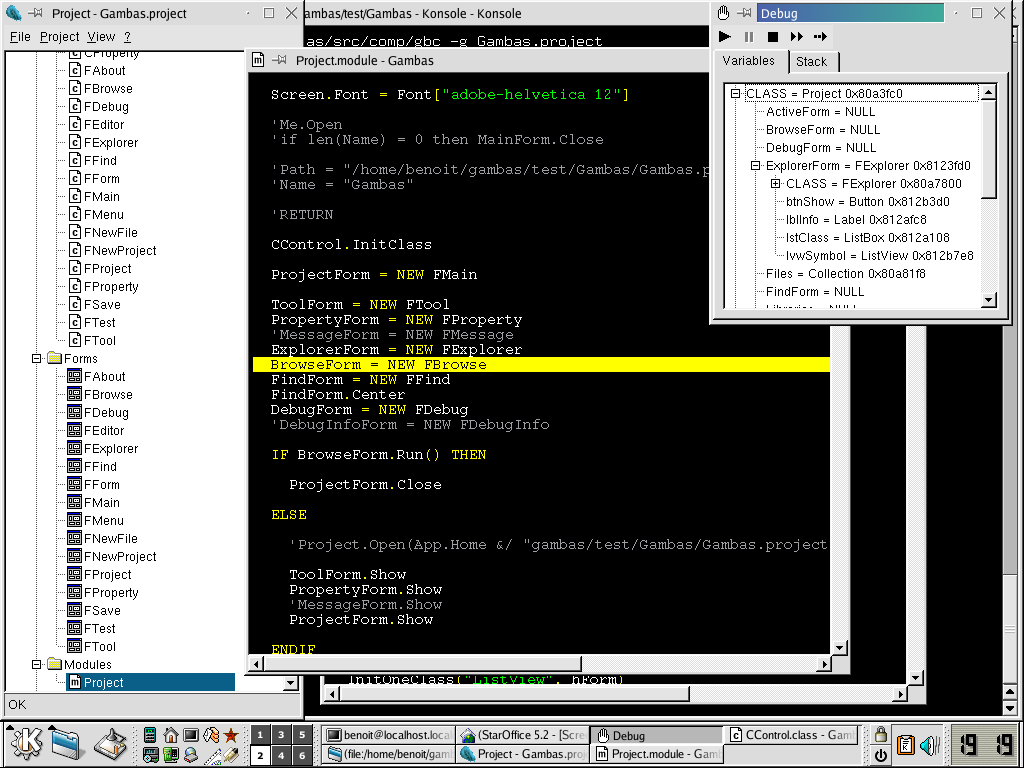
Thre's a product called Gambas it's not very mature yet and has some odd quirks (like the object members not being available in the constructor or destructor), but it's getting there and it's FOSS, so it may not be to hard to make it understand VB6.
Powerbasic used to make an exelent product, maybe a bit too good for the VB crowed.
Failing that there must be enough VB programmers out there to to a re-write? in VB? -
Re:oh GOD NO!!!!!!!
It looks pretty good. It even brought back some memories of working with VB6 after looking at the screenshots.
I remember how easy it was to use the debugger -
Fedora NTFS rpms
NTFS on Linux has no legal problems. It's all reverse-engineered using only a hex editor (i.e. without the use of copyrighted code or patened algorithms), and Red Hat is the only distro not to include it by default.
You can get NTFS RPMs fro the latest Fedora here. -
Fedora NTFS rpms
NTFS on Linux has no legal problems. It's all reverse-engineered using only a hex editor (i.e. without the use of copyrighted code or patened algorithms), and Red Hat is the only distro not to include it by default.
You can get NTFS RPMs fro the latest Fedora here. -
Try Gambas
Gambas looks promising, although granted it seems to be linux only... and alas, it's not a Visual Basic clone. Actually - maybe that's a good thing. http://gambas.sourceforge.net/
-
Re:Codenamed what?
Yep, get your Linux port right here
-
Gambas...and migrate to Linux at the same timeAre there any good F/OSS implementations of VB out there for customers to migrate to?
If you don't need to be on the Win32 platform GAMBAS is an awesome replacement for VB. It is a pleasure to use and the development community is very responsive.
-
And the answer is....
http://gambas.sourceforge.net/ is a kinda Linux VB replacement.
I've been using a combo of PyGtk+Glade recently. If someone could make an true RAD enviroment out of these, they'd be onto a winner. -
Re:REALBasic Instead of VB
... or Gambas, F/OSS and almost compiles on Cygwin. From the website: "I want to clear up any misunderstanding immediately. Gambas does not try to be compatible with Visual Basic, and will never be. I'm convinced that its syntax and internals are far better than the one's of its proprietary cousin
-
Trim Gag Reflex
"If only VB were a F/OSS project"
-
Alternatives
Have you looked into Gambas? It's not VB compatible, but it does give you a syntax like VB. It's also F/OSS. Additionally, pre-.NET VB folks need to move on. VB.NET is not old VB; it's better. So, either pick up VB.NET or C# if you want to continue with Microsoft's supported tools. Otherwise, choose a new development platform. There's always Java or C++. I happen to know that there are great job opportunities for experienced Java or C# folks.
-
Re:OpenLDAP Schemas?
You are right about the lack of good material on schema design. I surveyed the web a few months ago and found very little (and some of what I did find was trying to treat LDAP as a relational database!).
As a result, I ended up presenting a paper on LDAP Schema Design at the UKUUG Winter Conference. The paper covers issues of tree design and also entry design, and explains why the examples used in X.500 and early LDAP documents are not indicators of good practice. The full paper is available from my own website in both HTML and PDF formats.
In answer to your question about existing classes and attributes, I suggest getting either GQ or jXplorer - both include schema browsers which can help you to understand the relationships between the various elements. GQ may be in your favourite Linux distro. jXplorer is Java-based and I have run it happily on both Linux and Windows. In both cases you need a running LDAPv3 server as the schema that they display is the "live" one.
Andrew Findlay, Skills 1st Ltd
-
Something like this?
Is TFA refering to something like this? http://zero-install.sourceforge.net/ But in a larger scale.
-
Re:K3b on Windows?
There is no GPL version of Qt for windows, that's why many things don't get ported.
Yes there is. -
Re:NeroLINUX
You could try GnomeBaker.
http://gnomebaker.sourceforge.net/ -
Plot the data and look for patterns, yes.
Parent has it right. The Advanced Hex Editor (AXE) has this functionality. Lots of fun when looking at uncompressed graphic formats like icons stored in executables.
Grab a few megs from the start of the disk and use sox, the sond exchange to tack audio headers onto it, and try various codec conversions, endian swaps, etc.
There's every chance that the audio chip was interfaced to the drive very simply, as you theorized, without a filesystem. I'm aware of a product which lets you access an ATA device via RS232, it's called the StampDrive. As far as I can tell, it's a PICmicro that's been taught a basic subset of the ATA spec, and it acts as a storage broker for any device that can speak async serial.
People who build their own dataloggers have lots of experience with this sort of dirt-cheap interfacing. Your audio bug is, after all, just a specialized datalogger. A few minutes with a search engine should find plenty of info on the subject.
Post back with any success stories. -
Re:Destroy it!
Duh!. 7
-
Re:OT: www.oliverthered.f2s.com
there a preloader for firefox.
and there are light weight versions of firefox about that can run on portable devices.
There's also an IE themed firefox -
Re:Yes, but...
Remember guys, any platform. Wine has also been ported to Windows.... (!)
-
Re:Time to try Linux (again)
Thanks for the response. I've been toying with the idea of a Mac and will have to give it some more thought.
One application that I found recently through a friends school project, is Audacity and was quite amazed. One reason I started leaning towards Linux is due to the fact that this software seems to have many more Linux plugins then Windows based.
Stability is certainly a major factor and one to reckon with it would seem... -
Re:Coldfusion still wins my heart
-
Re:I can't even
>For example, I've got my own wildcard domain -- anything at this domain goes to me.
I used to do this as well. If I needed to give my address out, I'd come up with a company specific one on the spot. However, I abandoned the "forward all" account when someone started spoofing the From: line of their spams with <random text>@alanhoyle.com addresses. I started getting thousands apon thousands of bounced spam messages showing up in my inbox. My choice was either to train my mail filters to catch these bounces as spams, or quit the forward-all account. I still get more than 100/day, but the load is greatly lessened.
In my experience, the vast majority of my spam comes from email addresses posted on either my web site or from WHOIS information. Only one of my company-specific addresses ever seems to have made it onto a spam list.
Until recently, I prefered my tweaked solution with Pine, bogofilter, and a modified version of IMAP Spam BeGone. With an SSH client like PuTTY, I was using the same interface I was used to wherever I went in the world.
However, I've become hooked on GMail as it's so much more convenient to deal with Spam there. Click, click click, poof! it's gone.... -
Re:They came, they saw....
I'm actually kind of disappointed by this; the new terms seem more misleading to me than the old. It's important to keep in mind on IM services--and on the Internet in general--that anything you transmit unencrypted can be accessed and read by the general public. Now that AOL has stated that it won't read peoples' IMs, the uninformed masses have had their false sense of privacy restored. What, however, happens when the information stored (but not read) is requested of AOL by subpoena? What if the information is cracked out of the company by a malicious user? What of the several computers that have access to your messages in plain text as they are routed through the Internet?
The only way to keep your sensitive data and conversations private on the web is to encrypt them; any statement of privacy over plain-text media is at best erroneous, and at worst dangerously misleading.
-
Re:Ditch them anyway - untrustworthy
you can always use the handy Gaim Encryption plugin
-
Re:And directly from...Agreed.
The encryption is actually end-to-end, so AOL doesn't have a prayer of intercepting and decoding your conversation, especially if you don't use their client and instead use GAIM and its crypto plugin.
-
Re:And directly from...Agreed.
The encryption is actually end-to-end, so AOL doesn't have a prayer of intercepting and decoding your conversation, especially if you don't use their client and instead use GAIM and its crypto plugin.