Slashdot Mirror
Domain: space.com
Stories and comments across the archive that link to space.com.
Comments · 2,905
-
Important information omited from article
TFA leaves out one important change to NASA policy brought by Obama early in his administration. This is not a joke or a smear -- it really happened.
-
Blaming presidents don't make it better
You can blame Bush all you want, and I can point to the fact that it was Obama who wanted to turn NASA into a moslem appeasing agency
http://www.space.com/8725-nasa...
Both arguments wont get us anywhere
I don't care if it is Obama or Bush or Clinton or Reagan or
Whether or not NASA survive depends on one thing - the WILL for America to push forward its space program - whatever sitting president wants to dick around it shouldn't become a priority
-
Didn't think FTL all the way through.
Some kind of FTL travel
http://www.space.com/17628-war...It's a very nice thought; but I don't think so. Working through the relativistic geometry, just no--it isn't going to happen. (If you're considering a single observer and single destination; sure the physics seems to work, but when a third observer who is midway between the vehicle and the destination, everything falls apart.) And their math is just plain wrong since there is no complete theory merging general relativity an quantum mechanics which is required to actually design such an device.
-
Re:Smart man
Some kind of FTL travel
http://www.space.com/17628-war...Immortal crew
https://www.ted.com/talks/aubr...Prolonged stasis
http://www.themarysue.com/nasa...Generations of crew
This is least as much about will as it is about technology. I think the price of having children being born into captivity is too high though.This is just what's going on today. In 100 years, who knows? I personally believe we'll "solve" aging by then, and it will likely drive a discussion of whether or not we should and not whether or not we can.
-
Life = Improved Water Acquisition/Retention
Not so different from trace water on the Moon but on grander scale.
Enough mass for captive atmosphere
+ Great Oxygenation Event cyanobacterial critters emitting O2
+ UV light splitting the O2
+ free H from solar wind
= H2O forming in the upper atmosphere, no comets required -
Re:Heat source?
Is it possible that it is tidal heating from Pluto's satellites? Charon is pretty big, could it induce tidal heating in Pluto, and the inverse?
-
Re:And?
Because clearly someone who can't even manage to make an account is more of an expert than actual planetary scientists:
-
Re:True, Mars not in the priority list
Yes, he did say that.
And the White House denied that he was "charged" to do Muslim outreach.
My take is that Bolden was pandering to the Muslim audience, based on broader goals that he was given by Obama.
-
Re:It's fake
You have a "point", something does seem fishy. If you look at the two photos on space.com's article, the top "point" of the triangle is pointier in one versus the other.
-
Private Companies vs. NASA
Unlike NASA's mission to the moon, there are non-government entities that are now funding missions to Mars.
https://en.wikipedia.org/wiki/...
http://www.space.com/28215-elo...NASA could focus on actual Science, like sending unmanned missions into space and collecting data, as opposed to manned missions. This seems like a much more cost-benefit way to spend taxpayer money. Let the private companies fund the projects with questionable value.
-
Re:Martian soil is like toxic....
Perchlorates may lead to health problems but likely not deadly. According to some groups, perchlorate affects only the thyroid gland. Because it is neither stored nor metabolized, any effects of perchlorate on the thyroid gland are fully reversible. Some other studies suggest that perchlorate may have pulmonary toxic effects as well. In this article it is mentioned that exposure could be managed. As for using the soil for agriculture, there are several technologies can remove perchlorate, via treatments ex situ and in situ. Ex situ treatments include ion exchange using perchlorate-selective or nitrite-specific resins, bioremediation using packed-bed or fluidized-bed bioreactors, and membrane technologies via electrodialysis and reverse osmosis. In ex situ treatment via ion exchange, contaminants are attracted and adhere to the ion exchange resin because such resins and ions of contaminants have opposite charge. It may be beneficial to process it. Researchers have proposed a biochemical approach for the removal of perchlorate from Martian soil that would not only be energetically cheap and environmentally friendly, but could also be used to obtain oxygen both for human consumption and to fuel surface operations. In any event, precautions will have to be taken but the presence of perchlorates in the soil does not appear to be 'show stopper' at this point.
-
Re:Martian soil is like toxic....
Perchlorates may lead to health problems but likely not deadly. According to some groups, perchlorate affects only the thyroid gland. Because it is neither stored nor metabolized, any effects of perchlorate on the thyroid gland are fully reversible. Some other studies suggest that perchlorate may have pulmonary toxic effects as well. In this article it is mentioned that exposure could be managed. As for using the soil for agriculture, there are several technologies can remove perchlorate, via treatments ex situ and in situ. Ex situ treatments include ion exchange using perchlorate-selective or nitrite-specific resins, bioremediation using packed-bed or fluidized-bed bioreactors, and membrane technologies via electrodialysis and reverse osmosis. In ex situ treatment via ion exchange, contaminants are attracted and adhere to the ion exchange resin because such resins and ions of contaminants have opposite charge. It may be beneficial to process it. Researchers have proposed a biochemical approach for the removal of perchlorate from Martian soil that would not only be energetically cheap and environmentally friendly, but could also be used to obtain oxygen both for human consumption and to fuel surface operations. In any event, precautions will have to be taken but the presence of perchlorates in the soil does not appear to be 'show stopper' at this point.
-
Re:Martian soil is like toxic....
The issue with martian soil as presented in the movie isn't that it doesn't have enough nutrients, it's that it has a lot of poison (perchlorates).
This is a good read:
-
Re:Let's all hope...
At least it appears they've seen the errors of their ways... now that their own missions are in danger of being hit by it, of course.
-
Re:This is basic planetary physics..
First manned flight to Mars may very well be landing on one of the Martian moon, Phobos, first. A later manned flight will land on Mars itself.
http://www.space.com/29349-manned-mars-missions-phobos-moon.html
-
Re:The odds are very low...
NASA is already watching all known asteroids that might be a threat. So don't worry, it isn't going to happen.
-
Re:Can we get back
It's been well known for a while. The wikipedia article (https://en.wikipedia.org/wiki/Pluto) has some scholarly references and states, "With the new figures added in, the discrepancies, and with them the need for a Planet X, vanished.[55] Today, the majority of scientists agree that Planet X, as Lowell defined it, does not exist.[56] Lowell had made a prediction of Planet X's orbit and position in 1915 that was fairly close to Pluto's actual orbit and its position at that time; Ernest W. Brown concluded soon after Pluto's discovery that this was a coincidence,[57] a view still held today.[55]"
And another popular reference: http://www.space.com/29911-plu..., which states, "Studies eventually showed that Pluto doesn't have the mass necessary to interfere with the orbits of Uranus and Neptune. The errors in calculation that helped lead to its discovery were later attributed to an incorrect mass estimate for Neptune, a value that was refined by NASA's Voyager 2 mission." -
Re:balloon probe of venus
-
Mental problems are nothing compared to physical
From the article Earth Living Is Tough for Astronaut Used to Space:
"Speech is one issue, but other health effects are more pressing for long-term orbiting astronauts. Bone density lessens at a rate of 1 percent a month. Muscle mass shrinks. Eyeball pressure changes, with roughly one-fifth of astronauts reporting vision issues.
Until about June 3, Hadfield will do an intensive battery of testing and recovery at NASA's Johnson Space Center in Houston before pursuing an independent physical rehabilitation program for a few months."
Having spent roughly 5 months in zero gravity, this astronaut will have to spend months recovering from the experience.
Now tell me again how we are going to send humans to Mars...
How many months of space flight in microgravity will it take to get there?
How many months of recovery to be able to function in Mars' gravity (albeit 1/3 of Earth norm)?
How many more months of space flight in microgravity will it take to get back?
How many more months of recovery to be able to function in Earth's gravity?If you can't even deal with the physical effects of microgravity on human physiology, don't even start on any of the other technical problems.
Time to stop focusing on the science fiction that we see all the time and start focusing on science fact.
-
Hubble
Several of the Hubble repair missions at least got some preliminary work done on figuring this all out (to prototype stage IIRC). Getting the cost down was the issue.
-
science fiction
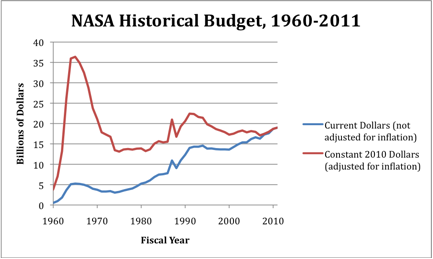
Until NASA's real, actual use-this-money budget comes in 20 year cycles it's just science fiction. Here is a chart of NASA's budget. I'm not going to say whether it's too much or too little in this comment, that's not the point. The big problem is NASA has no idea whether sequestration and budget games, the presidential fad this decade, or party politics is going to increase, eliminate, or do weird things with their budget. Maybe they'll have money for Orion or maybe the President will do away with it with the sweep of a pen. Maybe we can send up ten shuttles a month at a low cost per shuttle. Or maybe we'll have to cut that way, way back until the cost is hard to justify. From Mars to space stations to earth science the fad of the day dictates what NASA is building this year -- and worse, where it's building it.
There have been noises in the direction of stabilizing things and NASA is a fairly popular, if misunderstood, organization. But it's not enough. We need a NASA funding omnibus bill that sets NASA funds, be they generous or miserly, and NASA plans in stone. -
Re:The Moon programRight. It's the Congress critters owned by the United Launch Alliance that are holding up the funding. They would rather give nearly a billion dollars to prop up the Russian space program then let SpaceX get a lead on the current Boeing/Lockheed-Martin (ULA) monopoly.
NASA gave Boeing $4.2 billion for it's CTS-100 crew system, and $2.6 billion to SpaceX for the Dragon. Add in $900 million to the Russians to send US astronauts to the ISS and it's $3 billion extra to make sure that Boeing will remain the incumbent. And don't forget the the CTS-100 has never been launched, while the Dragon has been to the ISS multiple times.
So even though ULA sat on their ass for decades and used Russian motors for their Atlas V they are still the preferred vendor. So if you have enough clout in Congress and every manager in NASA and the Air Force knows they can spend their post-government career in a well paid civilian job at Boeing, you can sleep easy because the government will spend whatever it takes to keep you fat and happy.
No capitalism in sight. It's the insiders giving each other hands jobs. Business as usual.
-
L5 is now the NSS [Re:L5?]
To the AC above: If the majority of readers haven't heard about them either, then "who gives a fuck about L5?" Seriously, if this L5 society is worth at least even a little, they should be known as much as Space X, given that they've existed for so long.
The L5 society merged with the National Space Institute back in 1987 to form the National Space Society ("NSS") NSS is still around.
If you haven't heard of them, I'd say, well, so what? There are probably tens of millions of things you haven't heard of, some important, some not. That's a statement about you.
History of the L5 society here: http://www.nss.org/settlement/...
-
Re:Next moon landing?
Russia got out of the moon-race business once it lost. "Yay, we spent billions to come in second" would not have really worked for them. They've specialized in near-earth activities, and it's turned out really well.
China is still talking about it, and just might. They've landed a probe, have put people in orbit, and are working for real on a space station. They're not in a rush to get to the moon, since they'll need to do more than just plant a flag to make it seem like an achievement to rival America's, but the odds are good that the next feet on the moon will be Chinese.
-
Re:Goddard? Not so fast...
Eh, Goddard quickly learned that didn't work and went on to make this:
http://i.space.com/images/i/00...
Where Goddard failed apparently was in his paranoid insistence on secrecy.
-
What about the Toxic Soil on Mars?
Several Mars missions have reported a significant amount of Perchlorates in the Martian soil which is a problem as it is toxic to humans. This will prevent the use of the soil for agriculture and will be hard to avoid as colonists will track the dust into habitats. How do plans to colonize Mars deal with the presence of Perchlorates in the soil?.
-
Re:2 time the gravity thought
If 60% larger is "Earth-Sized," call me when they find something "Mars-Sized."
OK, Kepler-138b is about the size of Mars.
-
Re:More Republican corporate welfare
-
Re:There's no There there.
http://www.space.com/28189-moo...
There's definitely a reason to go back, because it's possible there's a lot of resources there which we could use here.
-
Re:we prefer Little Planet
Truth: Uranus is (sometimes) visible with the naked eye.
Source: http://www.space.com/22983-see-planet-uranus-night-sky.html
Yes, I've read that it's sometimes visible. However, few people will admit to staring at Uranus.
-
Re:we prefer Little Planet
Truth: Uranus is (sometimes) visible with the naked eye.
Source: http://www.space.com/22983-see-planet-uranus-night-sky.html
-
What about the toxic soil on Mars?
Perchlorates, a reactive chemical and toxic to human is present in the soil on Mars. This will prevent the use of the soil for agriculture and will be hard to avoid as colonists will bring the dust into habitats. How do plans to colonize Mars deal with the presence of Perchlorates in the soil?.
-
Re:Despite The Need
Just so you're aware, the real Intelligence Agencies? They stay so far out of the spotlight that most people have never heard of them. The US has 17. They are the: Office of the Director of National Intelligence (ODNI), Central Intelligence Agency (CIA), Office of Intelligence and Counterintelligence (OICI), Office of Intelligence and Analysis (I & A), Coast Guard Intelligence (CGI), Bureau of Intelligence and Research (INR), Office of Terrorism and Financial Intelligence (TFI), Defense Intelligence Agency (DIA), National Security Agency (NSA), National Geospatial-Intelligence Agency (NGA), National Reconnaissance Office (NRO), National Air and Space Intelligence Center (NASIC), National Ground Intelligence Center (NGIC), Marine Corps Intelligence Activity (MCIA), Office of Naval Intelligence (ONI), Federal Bureau of Investigation (FBI), and the Drug Enforcement Administration (DEA).
https://en.wikipedia.org/wiki/...
The reach of some of the lesser known agencies is astounding. The NRO, for example, recently donated two never-been-used better-than-Hubble space telescopes to NASA because they were obsolete for their purposes. See here: http://www.space.com/16145-nas...
If they can donate these, what does that say for the telescopes they have in orbit and pointed down at Earth? -
Re:From Unmannedspaceflight.com
Oh and for the record: Stern calls Pluto a planet, and makes some very good arguments.
And I'll add more that he doesn't make (though his are best!): it's ridiculous to call something a "dwarf X" and then say that that doesn't count as an "X". In any other field of science, if you had an "adjective-noun", it would also be classified as a "noun". If you have a dwarf shrew, it's also a shrew. If you have a dwarf fern, it's also a fern. Heck, even in the same field, astronomy, the same rule applies - a dwarf star is also a star.
Under the IAU definition, extrasolar planets aren't planets either. They don't even have a name - they're not anything at all. Not like we'd be able to classify them under the definition without dispatching a spacecraft all the way to each different star system even if they weren't excluded. The IAU definition also claims that they will create a system to establish more dwarf planets - something that clearly has not been done. There hasn't been a new dwarf planet accepted in nearly a decade, despite the fact that we know the sizes of many of them better than already-accepted candidates were known at the time. Quaoar is much bigger than Ceres, and we know it's size down to a mere 5 kilometers margin of error, yet it's not a dwarf planet. The IAU not only made up their ridiculous definition, but they're not even upholding it.
As with pretty much every categorization of object in pretty much every field of science, you need heirarchies and multiple groupings to describe the world. Among planets, we already know of significant diversity, and should only expect it to grow - hence we have terrestrial planets, gas giants, ice giants, hot jupiters, super earths, etc, and yes, dwarf planets - which should be just another category among the significant diversity already out there. Everyone knows a planet when they see it - you don't have to scan its orbit to see if it's "cleared" it, with some still-not-yet-agreed-upon definition of "cleared". If it's large enough to relax into a hydrostatic equilibrium, that's both meaningful, intuitive, and what people expect when they hear the word "planet". By any reasonable definition, our solar system has at least dozens, potentially hundreds of planets. And that should be seen as something to celebrate, not to be appalled about.
-
Re:From Unmannedspaceflight.com
Oh and for the record: Stern calls Pluto a planet, and makes some very good arguments.
And I'll add more that he doesn't make (though his are best!): it's ridiculous to call something a "dwarf X" and then say that that doesn't count as an "X". In any other field of science, if you had an "adjective-noun", it would also be classified as a "noun". If you have a dwarf shrew, it's also a shrew. If you have a dwarf fern, it's also a fern. Heck, even in the same field, astronomy, the same rule applies - a dwarf star is also a star.
Under the IAU definition, extrasolar planets aren't planets either. They don't even have a name - they're not anything at all. Not like we'd be able to classify them under the definition without dispatching a spacecraft all the way to each different star system even if they weren't excluded. The IAU definition also claims that they will create a system to establish more dwarf planets - something that clearly has not been done. There hasn't been a new dwarf planet accepted in nearly a decade, despite the fact that we know the sizes of many of them better than already-accepted candidates were known at the time. Quaoar is much bigger than Ceres, and we know it's size down to a mere 5 kilometers margin of error, yet it's not a dwarf planet. The IAU not only made up their ridiculous definition, but they're not even upholding it.
As with pretty much every categorization of object in pretty much every field of science, you need heirarchies and multiple groupings to describe the world. Among planets, we already know of significant diversity, and should only expect it to grow - hence we have terrestrial planets, gas giants, ice giants, hot jupiters, super earths, etc, and yes, dwarf planets - which should be just another category among the significant diversity already out there. Everyone knows a planet when they see it - you don't have to scan its orbit to see if it's "cleared" it, with some still-not-yet-agreed-upon definition of "cleared". If it's large enough to relax into a hydrostatic equilibrium, that's both meaningful, intuitive, and what people expect when they hear the word "planet". By any reasonable definition, our solar system has at least dozens, potentially hundreds of planets. And that should be seen as something to celebrate, not to be appalled about.
-
Re:This came so soon after the SpaceX launch.
There are several docking ports on the space station. This diagram may help clarify just what goes where, although this block diagram may be easier to follow.
Dragon normally docks with Harmony, where the Space Shuttle used to park, while Soyuz and Progress would dock with the Zvezda, Rassvet, Pirs and Poisk modules on the Russian end.
-
Don't rule out sabotage
The only alternatives to SpaceX are NASA's AtlasV and the Russian offerings. That's well known.
What's less known is that a major component — the RD-180 engine — of AtlasV is supplied by Russia as well. Russia is threatening to stop delivering it, but the US ought to stop buying it in the first place — and cut off billions of dollars for Putin.
If the SpaceX fails, the US may be forced to appease Russia — such as by forgiving the armed invasion and recognizing the annexation of Crimea.
A Russian agent, who'd successfully sabotage SpaceX, would certainly be richly rewarded back at home.
-
Re:Of course not.
-
Re:Of ALL places, I learned this on /. ... apk
-
Re:Pu-238 was available when it launced
NASA purchased Pu-238 from Russia as late as 2010. If the mission designers wanted an RTG, they could have got one. Full stop.
I conceded that Pu-238 is now in short supply (although NASA restarted production in 2013), but that isn't relevant to a spacecraft launched in 2004.
-
Glitch at Space Station changes it's orbit
"a Soyuz spacecraft docked at the station unexpectedly started" yep, that would do it.
http://www.space.com/29632-soy... -
Re:Largest known?
The light from the most distant objects we see has travelled about 13 billion light years to reach us. During the intervening 13 billion years, the expansion of the universe means that those objects would now be 46 billion light years away. So which number you use depends on how you want to define the size. I like the 13 billion number because it doesn't depend on any definition of simultaneity.
-
Everyone is going to the Moon...
Except for the United States. We're too busy planning to hump an asteroid in lunar orbit to explore future mining opportunities. Never mind that mining is illegal under existing space treaty.
-
Re:and yet, the GOP blocks private space.
Sabotage huh? Any proof of that or are you just echoing what Russia Today says? Launching things into space isn't without risks and it knows no geopolitical boundaries.
I think you'll also find that NASA's budget continually grows yet they're not flying shuttles, they still have the ISS (3+ Billion/yr) and they still
have their other programs.Also, if you look at the administrations request for NASA they were funded above their 2015 budget. If the Executive Branch asks for X dollars and Congress funds them above X, your argument about "funded NASA accordingly" is full of shit. If you exclude ISS, NASA has $15B to play with.
https://www.nasa.gov/sites/def...
https://en.wikipedia.org/wiki/...Oh and the privatization of space launches was pushed for by the current administration. http://www.space.com/7835-moon...
Get your facts straight next time please.
-
I was talking to a GE engineer...
-
So inflation is now a fact?
If cosmic inflation is now a fact, then what was the big deal about this?
-
Space elevator yet?
But is it strong enough to build a space elevator? That is the killer app for high-tensile-strength materials.
-
Re:Video?
-
Re:What's the cost ?
The study of many exoplanets will inform work here on climate. Planetary scientists have studied Mars, Venus and Jupiter's weather for many decades and you can be certain this has lead to many insights into Earth's climate.
For example if you write 3 computer programs to predict weather and one of them works also on Mars and Venus, then you know it has a better understanding of weather.
Just imagine when they find 100 Earthlike rocky planets orbiting at 1AU and discover what weather is like in such systems - that will massively inform earth climate http://www.space.com/2071-stor.... This makes Jupiter a test case of climate change prediction software. If the software can explain what happened on Jupiter it can inform what is happening here.
or http://astrogeo.oxfordjournals... (cosmic rays affect climate) -
Re:misquote
OK, here may be some related items
Space-X leases Cape Canaveral pad for landings
http://spacenews.com/spacex-le...Space-X breaks ground on Brownsville commercial launch facility
http://www.space.com/27234-spa...So, that would prevent overflight of the continental US and landing to the East for use of limited fuel
Is there any indication that this is the actual plan?The Space News article indicates that Space-x has plans to build a landing pad at Vandenberg as well. Any ideas what would be landing there?