Slashdot Mirror
Domain: spaceflightnow.com
Stories and comments across the archive that link to spaceflightnow.com.
Comments · 567
-
Re:great Maestro!A Maestro for Linux? Really? What, with no dependency problems? How about if I try it on Debian 2.2? No, make that SuSE 6.3. (I've got em both on this box) Do I have to compile the thing myself, or will it run right away like say, an Opera 6.03 tar.gz? (Well, after a #./install.sh) Will I actually get to see pictures from Mars with Maestro? If so, then this ranks as a "killer app" for Linux!
Imagine, pictures sent from a 400 lb spacecraft on Mars, viewable right on my own monitor! (Do you suppose I could do that anyway using MozillaFireBird on Mandrake 8, pointed to Spaceflight Now)Anyone have any details on all this?
-
Images
-
Images
-
Re:The Reality of XM vs Sirius
It is physically impossible for a satellite to be orbiting in a figure 8 pattern. These birds are in inclined polar orbits. They circle the entire planet.
A diagram can be seen here.
Newton and Keppler must be doing figure 8's in their graves.
-
Re:Am I interpreting this correctly?
Ion propulsion works very differently than any other type of normal rocket. The idea with ion engines is that they're able to take individual atoms of their "propellant" and accelerate them to high velocities, using electricity as the energy, rather than some sort of chemical reaction.
Rockets in space work by taking some mass and throwing it in the opposite direction you want to go. Imagine yourself floating in space holding a bowling ball. You wouldn't have to push the ball away from you very hard to get yourself moving, since it's very heavy. But what if you only had a ping-pong ball: to get yourself moving quickly, you'd have to "throw" the ping-pong ball away from you very very very fast, to make up for its very small mass.
Chemical rockets take some combination of chemicals that react strongly together, creating heat. The result is a hot gas at high pressure, which blows out in the direction of the rocket nozzle, providing thrust the other direction.
The xenon ion engine takes xenon gas at very very low pressure, ionizes the atoms so that they're electrically charged, and then uses electric force to fling them at VERY high speed out into space. The velocity is much higher than in any chemical rocket. But ion engines aren't very strong -- the process works with just a little tiny bit of xenon at a time, so the engine as a whole winds up giving just a very gentle push. But since not much xenon is used up, the xenon that you have will last a LONG time.
That's the "specific impluse": a measure of how much a rocket can push you "per pound" of fuel. This page says that the space shuttle's chemical engines have a specific impulse of 460. This latest ion engine has a specific impulse of 6000!
So with the same weight of fuel, the ion engine would get you going about 13 times faster by the time you used up the fuel.
- Peter -
Hubble still has four working gyros
The second one failed in April. If Hubble only had two working gyros, it would be shut down until repairs could be made (as was done in 1999). Three is the minimum required for pointing the telescope (one for each dimension).
-
Is there a map of sever locations on a real map?
I'd be interested in seeing a real global world map with the locations of servers pinpointed on the map to show the density of computer equipment around the global. Actually, it wouldn't even need the real map to exist, if all the points of light to represent a computer server were placed in their proper geographic locations, I bet you'd get a very good mapping of the world. In fact, it would probably look similar to the famous map of the world at night where the lights from industrialized countries creates a spectacular image of the developed world.
Does such a map exist? Is somebody working on one? -
Re:What are the odds?There was some blurb about experiments in the Atacama desert on spaceflightnow.com a few days ago.
Interesting article here is the full link
"In the driest part of the Atacama, we found that, if Viking had landed there instead of on Mars and done exactly the same experiments, we would also have been shut out,"
"...the team did discover a non-biological oxidative substance that appears to have reacted with the organics -- results that mimicked Viking's results."
-
seinfeld connection
Didn't this remind anyone of the Seinfeld episode with the famous Fisher Pen ?
-
Limited useThis system is line of sight, so the aircraft would either have to circle the laser station or get handed off to another one. Better hope there aren't any mountains or buildings nearby.
How powerful does this beam have to be to get a significant range? What happens to passing birds or say, aircraft, if they happen to be in its path?
I could see it possibly being used as a cheap communications platform, circling a service area. There are much more effective platforms that can handle bad weather that can serve the same purpose ( radio tower ).
Luckily, this is just a research project at this point, so either it dies off or inspires a more useful innovation later.
This seems more promising to me
-
Just wait for another 10 yearsWhen the MAXIM flys in about another decade, it will be able to resolve images (in Xray) up to a million times better than anything now available. It will allow imaging of blackholes, that is actual visualization of the Shwarzchild radius as well as observing other stars as well as we can our own sun today. To do this the telescopes must be in orbit since the high frequency radiation scatters too easily in the atmosphere. Even at the infrared wavelengths that the Keck used, adaptive optics were needed to make their observations from the ground.
I would like to see an array of cheap telescopes stationed at the LaGrangian points to do interferometry at any wavelength. Gravity wave detection could also be included in the mix. There would be no need for elaborate vibration damping and not being limited to the simple L shape that current ground based gravity detectors use, we would be able to triangulate gravity wave disturbances in 3 dimensions!
-
Re:Does the shuttle problem really limit the ISS?
NASA's orginal plan was for a fulltime 7 man crew, who could all use one, single escape vechicle called the X-38. I'm not real sure what the status of this vehicle is now though. There were some test flights.
-
Re:Why so nationalistic?To say that the ESA is the first to put ion propulsion in space is not at all true. Remember back when NASA launched the DS1 (Deep Space 1) probe? Some information on it's Ion Engine is available here here and many more here.
Actually, Ion engines have been used in space since early 90's but primarly as station keeping thrusters for satilites. You are correct that competition is good for NASA, but at this very moment, the Air Force is funding the Ion Space Propulsion Lab where I am currently doing my PhD research.
-
no.So, when can we throw out the Concord and whatnot and get transcontinental supersonic flight to boot?
You don't need to throw it out, it just needs a nose job. Witness:
Honk, honk!
You only want to throw the thing out when maintaining it costs more than developing and buying a new one. While it might be hard to modify the concord's swiveling nose this way, it's worth looking into.
The next modification needed is to the law, so that flights that don't make too much noise can fly over the contenetal US. If you can get from New York to California supersonically, people will want to do it and will pay for the above mentioned development and building.
-
Yes! Separate them FAR apart!
Separate cargo and crew are exactly what we need for space missions in the next few decades.
The cargo can fly on a Delta-2 rocket. The crew can take a Ford Expedition from Cape Canaveral to the NASA pavillion at Walt Disney World.
There, they can conduct all their orbital duties in complete safety, while being more accessible to the admiring public than ever before!
(Oops, maybe Disney isn't that safe after all...) -
Re:So what if the engineers HAD been heard?The shuttle had limited fuel so could only stay up there so long, and couldn't reach the ISS. No other shuttle was prepped for launch, and that takes a LONG time. Flying some re-entry pattern designed to minimize heat on the damaged side would have only have improved their changes slightly. They didn't have the material or capability to fix the shuttle themselves. So what would have been done??
NASA has already released information that states that they could have put Columbia into a low resource consumption mode that would have extended the mission duration to over a month, enough time to do a very quick preparation of another space shuttle to launch with a minimal crew. NASA admitted that it would be a very risky mission and the amount of time that it would have taken was on the ragged edge of Columbia's endurance margin, but it could have been done.
Also, a spacewalk could have been done - there were two EVA suits on the shuttle. Some sort of makeshift repair was possible. What we don't know (and hopefully will never HAVE to know) is how well such a repair would have worked.
There is a good article about this at Spaceflight Now. There are some very good quotes regarding a previous shuttle damage incident and about the merits of rescues and repairs.
-h- -
A good article about SIRTF
I posted this as a news story yesterday. It was rejected.
Anyway,
Here's a nice article about SIRTF that I found to be pretty cool. -
What Space Race?The space race is hardly heating up in the commercial arena. Boeing recently canceled their Delta IV program due to a lack of customers in the commercial satellite business. They wrote off almost a billion dollars. To wit:
However, over the last several years demand for commercial launches eroded while global launch capacity increased. In light of the continuing severe downturn in the commercial launch market, the company has determined that a meaningful recovery of demand and pricing is unlikely for the foreseeable future.
I'm hoping the Chinese have some serious success in their announced manned space program. Perhaps that will incentivize the U.S. to get off their butts and start doing some serious exploration. -
JWST to be launched on Ariane V
The full story is also at:
This caught my eye:
The 10-page report released Thursday outlined three options for NASA to choose from to achieve a transition from Hubble to the almost $1 billion James Webb Space Telescope, the planned successor to Hubble currently scheduled to launch in about 2011, aboard a European Ariane 5 booster.Why would NASA (or the US for that matter) allow such an expensive and high profile mission to fly on the worlds most unreliable rocket, when better domestic alternatives are available?
-
Come on get some better links to the story ...
A quick check on Spacetoday.com points to several good articles
SpaceFlightNow article
Florida Today article and it has three video's of the test
Orlando Sentinel article
Washington Post article
Houston Chronicle article -
Re:safe?
This has happened before. The Apollo 13 lunar module contained a plutonium power source for lunar surface experiments, which was intended to land on the moon and stay there. Instead, as we all know, the LM returned to Earth and burned up in the atmosphere after serving as a lifeboat for the astronauts. No major catastrophe.
-
Spaceflightnow.com coverage
Spaceflightnow.com has coverage, too. I like their coverage better than Space.com. They give more details, the page is easier to read, and have no pop-up ads.
-
Re:Everyone assumed too muchAnd WHAT happened to those interesting pics that that person in cal took, the "purple beam", that NASA sent a t-38 jet over to snag his camera and go "investigate". That story has poofed too near as I have seen. Maybe I missed it, but after a few days it evaporated, and I don't recall seeing them release the pics.
More information at this page.
Pictures of the Shuttle on-orbit can be found here.
Basically, the Starfire Optical Range can operate as a directed energy weapon using a high-power laser to ionize a conductive path through air, then pulsing a high-voltage, high-current jolt through it. It's actually pretty useful for atmospheric studies as well. -
Re:Everyone assumed too much
Ah, but that assumes a very limited view of our space program. There's a rocket launch somewhere around the world nearly every week. Check out Spaceflight Now to see what's on tap. Now, it's not trivial to launch any rocket, manned or unmanned. But they could certainly speed up processing of a Delta II or Atlas II and load it with the essentials. It would be extremely difficult to pull the whole thing off.
For example, a Delta II launched the GPS IIR-8 satellite on January 29. I imagine that if they knew Columbia was doomed, they could've prepared a rescue package of food, water, etc. Of course, you'd have to design or modify an appropriate capsule, program the avionics so it would get there, and figure out how to get in on board. Someone at the AF would be peeved at getting their launch bumped, but if it was feasible, they would step aside.
That's just one scenario. Launches from Russia, Vandenburg or South America may or may not be viable. In the meantime, they could get Atlantis prepped for launch in a quick, sensible fashion. BTW, Atlantis would not necessarily been as susceptible to the same problem, since it uses a new external tank design.
My point is, there is more than one solution to the problem. My guess is that in the future, they'll make any non-ISS mission have provisions for an extended orbital stay if necessary, and a procedure will be developed for quickly resupplying any stranded crew. It's a work in progress. -
Re:RiskIn general, I'm still rather angry about things like the spy agencies not giving satellite time.
The 'spy agencies' (or more specifically, the National Imagery and Mapping Agency) did offer their satellites, it was NASA management who refused to request pictures because they didn't think it would be useful. This is one of the NASA failures singled out by the accident inquiry preliminary report.
The question of whether a rescure should have been attempted is a thorny one. I personally think it should have been. There are a lot of very capable people at NASA who would have come up with a plan and made it work (c.f. Apollo 13). Either way, though, management should have at least thoroughly considered the possibility. The problem is complacency, the same problem that brought down Challenger.
-
an older prototype
This article is about an older prototype that was flown 2 years ago.
-
Re:CNN article prewritten> I got the impression when they said "upon landing", they were making reference to when the helicopter picked them up at the LZ, and took them to the medical facilities.
Yes, that makes perfect sense. Except for the fact that at the time the article was posted, the helicopter was still refueling at a base some distance away. They hadn't landed yet. See the timeline.
-
Re:Space programme costs
That's interesting. But it's not true. The NASA budget is $15 billion/ year. This includes things that have nothing to do with the space program per se, such as ground based telescopes, outreach, educational grants, etc. The budges for the manned space program is about $4 billion, IIRC. The unmanned NASA program is probably less than $1 billion, for things like Mars Rovers, SIRTF, etc.
However, the US space budget is much higher. The Air Force runs a very large space program, launcing a half-dozen satellites a year, many costing $1 billion +. A GPS satellite is a bargain at $50 million, double that for launch costs on a Delta II. NRO satellites are bigger, more expensive and generally launch on Titans (soon Atlas V and Delta IV). I bet the military space program has a bigger budget than NASA's space program, yet no one complains about those costs! The military program has obviously done better than NASA recently, but they've had their share of failures, too. Initially, all US satellites were going to launch on the shuttle, but that changed after Challenger.
(Addressing other posts) The marginal cost of a shuttle flight is nowhere near half a billion dollars. Those numbers always encompass total program costs, including development and engineering, which are a sunk cost. OTOH, each shuttle has a finite lifespan and definite maintenance costs, so the real cost is more than $40 million/ flight, but not $400 million.
Anyone else follow this story as it was breaking last night? I flipped on Google news, and the headlines were "Soyuz returns to earth," and then I went to Spaceflight Now! to read the details, and I saw that the Soyuz had not been located, and radio contact was not established after landing, Boy, did my heart sink! I turned on CNN, and a few minutes later they reported that Soyuz had been found.Phew!
As to the whole Shuttle vs. Soyuz thing, they have different purposes. Shuttle (post Challenger) is a very reliable vehicle, and its recent failure is unfortunate, but by no means invalidates the approach. A lack of imagination probably contributed to this; things which were not possible 20-30 years ago were not considered now even though they became available (e.g., high rez photography of space objects). Of course, ignoring the problem of the foam hitting the shuttle was not very smart; the Shuttle should probably have an outside agency come in every 5 years and do a top-to-bottom type review, and some of these problems would go away.
It's a shame that more shuttles aren't built due to lack of funds; the basic design is sound, most of the development is done, and the cost for one is probably comparable to a B2, and is more important to our national security. Maybe the Air Force will say as much, devote some of their funds to a Shuttle 2.0 (Columbia is 1.0, Challenger and Atlantis 1.1, and Endeavour is 1.2). Same basic design, improve the materials, electronics and apply lessons learned. But it probably won't happen; hopefully Delta IV and Atlas V heavy prove reliable enough to launch the Orbital Space Plane and reduce our reliance on the Shuttle and Soyuz. -
More interesting space stuffThis looks really good. There are a lot of intersting developments in space lately. My take on all of this (with redundant links):
Well, sounds like someone might actually build a spacecraft. Scaled Composites has designed a sub-orbital spacecraft launched from the belly of the plane. It is in testing now. They're trying to win the $10 million X-prize, by builing a re-usable spacecraft that can send three people to space (100km) and return them safely. Looks like a neat design, and these guys are for real. Passengers would have a 5-minute micro-gravity environment during the flight. Sounds really cool. Space.com has an excellent write-up.
In other news, the Columbia investigation continues, and Space Daily has a real good (but long) write-up.
But NASA soldiers on. They have 2 Mars missions scheduled for this summer, plus the launch of SIRTF (infra-red telescope), which was recently delayed. Check out Spaceflight Now for details, and the best space coverage, in general.
Oh hell, almost missed this one. Apparently, the founder of PayPal is trying to get into the "microsatellite" launch business, although 1000 pounds is a bit bigger than micro. The company, SpaceX, is based in El Segundo. But, I think these guys are biting off more than they can chew, essentially trying to compete with Boeing, Lockheed, and everyone else. I think Scaled Composites is for real, though; they might pull it off.
-
article credibility
The telegraph article is a pretty lousy article, and gives few details. A bettle article is available at Space Flight Now. Apparently, the study was partially funded by the American Petroleum Institute so I would be especially wary of bias.
There isn't enough evidence in the articles to understand what the study actually found. They published some of their findings in the Climate Research journal, which only gives an abstract without a subscription. However, they haven't even published their full findings which are supposed to be published in Energy and Environment which appears to be more of a policy journal than a scientific journal.
I think it is very hard to evaluate the credibility of these claims without seeing the actual journal article that explains them. Another thing is that according to Space Flight Now article, is that the study is actually "A review of more than 200 climate studies," and we need to look at the authenticity of these studies. However, maybe it will help us look at global warming from a new perspective.
-
article credibility
The telegraph article is a pretty lousy article, and gives few details. A bettle article is available at Space Flight Now. Apparently, the study was partially funded by the American Petroleum Institute so I would be especially wary of bias.
There isn't enough evidence in the articles to understand what the study actually found. They published some of their findings in the Climate Research journal, which only gives an abstract without a subscription. However, they haven't even published their full findings which are supposed to be published in Energy and Environment which appears to be more of a policy journal than a scientific journal.
I think it is very hard to evaluate the credibility of these claims without seeing the actual journal article that explains them. Another thing is that according to Space Flight Now article, is that the study is actually "A review of more than 200 climate studies," and we need to look at the authenticity of these studies. However, maybe it will help us look at global warming from a new perspective.
-
Re:The Shuttle is *extremely* difficult to land ..
Nobody has done it except for the first crew.
STS-112
"Making his first hands-on landing, first-time shuttle commander Jeffrey Ashby took over manual control of the shuttle five minutes before touchdown as the spaceplane passed through 50,000 feet above the Florida spaceport. "
STS-93
"Update for 11:17 p.m. EDT
Commander Eileen Collins is taking manual control of Columbia. Three minutes to touchdown. The shuttle has gone sub-sonic. Twin sonic booms now being heard in the local area around Kennedy Space Center."
STS-113
"Following a computer-controlled plunge to a point about 50,000 feet above the Kennedy Space Center, commander James Wetherbee, making a record fifth descent as a shuttle skipper, took over manual control and guided the spaceplane to a breezy landing, reports CBS News Space Consultant William Harwood."
If I remember correctly, the first Shuttle pilot (dunno his name, some ex-Navy pilot)
Pilot, Robert Crippen, USN
Mission commander, John Young, USN
I get most of my understanding of the Shuttle landing procedure from the X-Plane sim, which makes it very clear that it's extremely difficult for a human being to land the Shuttle...
I would suspect that they have a leetle bit more training than you do. -
Old news
This was posted way back on March 13 here. There are links that don't require the intrusive NY Times registration. They are Spaceflightnow and Nature
-
Re:In that case
According to this article [spaceflightnow.com], they could evacuate 6 in the emergency soyuz capsule.
Actually, I think the article says the Russian Enterprise module is capable of docking two Soyuz capsules, each of which can evacuate six crew members, for a total of six.
The ISS only bear three permanent crew members, between shuttle flights, now, because that is the total number that can be evacuated by the single Soyuz it has mounted now.
The Soyuz are replaced every six months. There was recent talk of building more Apollo capsules, if the Russians can't afford to build more Soyuz. A recent American law prevents them from paying for Russian Soyuz.
-
In that case
If a defect were discovered, they could park the shuttle at the ISS and do repairs there. Now, 3 to 6 crew on the ISS + 7 from the shuttle = 10 to 13 on the space station. According to this article, they could evacuate 6 in the emergency soyuz capsule. That would leave 1 extra crewman on the ISS, which I don't think would be a big deal (considering it was designed for a max crew of 6, according to the article)
-
Whoa, too many things to clarify
But doesn't it [Ceres] have a satellite? -- and -- What would we qualifty that as, because a satellite must orbit a planet.
It doesn't appear that Ceres has any satellites. But, there are 31 asteroids that do! That doesn't make them planets though...they're just small asteroids with really small moons.
Can anyone remind me what that sequence of numbers is called that vaguely predicts the distances of planets from the Sun?
Yep, its the Titius-Bode Law. Ceres does fit into this. But the reason we don't have a planet in between Mars and Jupiter is because "many astronomers think the asteroid belt is where a planet tried to form, but was pulled apart before it could solidify, caught between the strong opposing tugs of Jupiter and the sun's gravity." Quote taken from here.
Why does a planet _have_ to be a shpere...How perfect a sphere?
Well.... Ceres's shape is too distorted. Its shape is not spherical enough to be like regular planets. And, to get really technical, no planet is really a sphere. Due to rotation, all planets have a slightly distorted shape. -
Columbia video.
Google(TM) is your friend.
-
Three cheaper launch alternativesThe compelling problem that the space program should try to solve is that launching into space is just too damn expensive. Today it costs $5K to $10K to place one kilogram in orbit. At that price, space tourism and colonization are completely out of the question. Using its dying gasp of breath to dramatically lower the cost of launch would be the noblest, most valuable thing NASA could do. From that point on, space development would be picked up by Marriott and 3M, and political Brownian motion would be removed from the equation.
Tethers ( 1, 2, 3 ) attached to counterweights can be used to transfer spacecraft from one orbit to another. The first tether has an orbit that skims the atmosphere, where a craft catches and connects to the end of the tether. The craft is lifted into low earth orbit and subsequent tethers help it to reach escape velocity. Using the tethers takes energy out of the orbits of the counterweights, some of which can be put back by using the tethers for descent as well as launch.
J. Storrs-Hall (once moderator of sci.nanotech) envisioned a space dock, a linear motor suspended 100 km above the ground that accelerates spacecraft to an elliptical orbit. He computes an amortized cost of reaching low earth orbit of 42 cents per kilogram. From the elliptical orbit, it's a relatively small safe step to escape velocity.
A space elevator ( 1, 2 ) is an excellent long-term solution. A cable is hung from a weight in geosynchronous orbit, reaching down to the Earth's surface. The elevator climbs the cable, carrying a craft. When it reaches GEO, the craft detaches and spends only a little fuel getting to escape velocity.
Tethers and the space elevator require novel materials for strong cables, probably using carbon nanotubes. The frame to hold up the space dock is in compression, and something we could build with little or no advance in material science. Any of these alternatives would be vastly cheaper and vastly safer than putting human lives on the noses of fuel tanks subjected to unreasonable speeds and stresses.
-
whoa...
Air Force imagery confirms Columbia wing damaged...
but that photo looks like a giant penis. ! -
whoa...
Air Force imagery confirms Columbia wing damaged...
but that photo looks like a giant penis. ! -
Maybe Saved the Crew...One possibility (from the article) was doing a special re-entry that could have let the crew bail out at 40,000 feet.
If, in the midst of its 16-day flight, wing damage had been found to be dire, the only potential -- but still unlikely -- option would have been the formulation over several days by Mission Control of a profile that could have, perhaps, reduced heating on the damaged wing at the expense of the other wing for an unguided reentry, with scant hope the vehicle would remain controllable to about 40,000 ft., allowing for crew bailout over an ocean.
Looks like that option would've been extremely risky even if damage had been noticed.
Remember, it's still very possible that a meteoroid hit the wing during the spaceflight maybe even early in the re-entry.
-
composites don't shield lightnining well!
I haven't seen anyone try and connect the "purple streak" picture and the break-up, so i'll post my theory references again and hope it gets considered.
New image evidence shows damage to the composite section of the wing. An increasing reliance on composite materials in aircraft construction creates the potential for additional problems because the composites can allow a connection between lightning and airplane electrical circuitsThe tiles were damaged heavily at launch, scratched deeply as in previous incidents.
The roughtiles heated and shed, leaving a trail of debris plasma.
The plasma trailacted as a conduit for an electrical arc from charged particles in the high upper atmosphere,similar to the Ben Franklin kite legend.
A huge bolt travelled along the plasma trail to the left wing where it caused severe damage, enough to cause a cascading failure over subsequent minutes. Blue jets, elves and sprites are large atmospheric electrical phenomena which occur at the altitude the space shuttle was passing thru and were being studied by Ramon in the MEIDEX dust experiment.
My,My, Hey, Hey -
Electrostatic discharge down damage plasma trail
I haven't seen anyone try and connect the "purple streak" picture and the break-up, so i'll post my theory references again and hope it gets considered.
The tiles were damaged heavily at launch, scratched deeply as in previous incidents.
The roughtiles heated and shed, leaving a trail of debris plasma.
The plasma trailacted as a conduit for an electrical arc from charged particles in the high upper atmosphere,similar to the Ben Franklin kite legend.
A huge bolt travelled along the plasma trail to the left wing where it caused severe damage, enough to cause a cascading failure over subsequent minutes. Blue jets, elves and sprites are large atmospheric electrical phenomena which occur at the altitude the space shuttle was passing thru and were being studied by Ramon in the MEIDEX dust experiment.
New image evidence shows damage to the composite section of the wing. An increasing reliance on composite materials in aircraft construction creates the potential for additional problems because the composites can allow a connection between lightning and airplane electrical circuits -
parachutesMaybe it's time to go back to parachutes for reentry. In fact, there are some modern attempts. Those are the kinds of technologies we need for unmanned planetary probes anyway, and they are by far the most cost effective choice for sample return missions (where it may not be such a big deal if the parachutes fail).
It seems to me that the building of winged reentry vehicles is more driven by a desire for Buck Rogers-style space adventures, not good, cost-effective engineering.
-
STS-107 Mission Status Report
Spaceflight Now | STS-107 | Mission Status Report
THURSDAY, FEBRUARY 6, 2003
Amid congressional concern about NASA's objectivity in the wake of the Columbia disaster Saturday, the quasi-independent Accident Investigation Board, beefed up with non-NASA staff and board members, will assume the mantle of sole authority in determining what caused the crash that claimed the lives of seven astronauts. Read our full story.
1900 GMT (2:00 p.m. EST)
International space station planners are debating the possibility of launching a two- or three-man caretaker crew in late April or early May aboard a Russian Soyuz spacecraft to replace the lab's current crew and to keep the outpost occupied until space shuttle flights resume. Read our full story.
WEDNESDAY, FEBRUARY 5, 2003
Shuttle program manager Ronald Dittemore told reporters Wednesday they were, in effect, mistaken if they assumed from previous briefings the Columbia disaster investigation was focused primarily on the possibility foam debris from the ship's external tank triggered the orbiter's destruction during entry Saturday. Read our full story.
2222 GMT (5:22 p.m. EST)
Dittemore says the theory of the foam chunk that hit Columbia contained ice is highly unlikely. The ice inspection team that surveyed the shuttle in the hours before launch found no evidence of ice in that area of the tank. Also, January 16 wasn't a day with icing conditions, he said.
"It is something else. It is something else," Dittemore repeated, saying this foam isn't believed to be the cause of Columbia's disaster.
2206 GMT (5:06 p.m. EST)
Engineers remain confident in their understanding of the size and weight of the debris seen hitting Columbia's wing. Analysis determined the impact wouldn't significantly damage the shuttle or pose a safety issue.
"We believe there is something else," Dittemore said. "It just does not make sense to us that a piece of debris is the root cause for the loss of Columbia and crew."
He repeated the message from Monday that the "missing link" remains to be found.
2156 GMT (4:56 p.m. EST)
NASA has released new images showing before-and-after views of Columbia's wing from the foam impact during launch. Although the views are not high-resolution, there does not appear to be any "gross" change in the tile area, Dittemore said.
2155 GMT (4:55 p.m. EST)
In his technical news conference, shuttle program manager Ron Dittemore says the efforts to recover the 32 seconds of additional data from Columbia -- which was received on the ground but not displayed in Mission Control -- have been "relatively unsuccessful" thus far. Although hope remains that knowledge ultimately will be gained from the data, engineers are currently not satisfied with validity of the data examined.
In other developments, teams are taking the known data about the unusual increased heating on certain parts of Columbia before breakup and trying to determine where the heat source would have to be on the vehicle. Tests are also being performed to learn more about external tank foam impact and orbiter tile strength.
2045 GMT (3:45 p.m. EST)
The recovered remains of Columbia's crew were flown in flag-draped caskets from Barksdale Air Force Base in Louisiana to Dover Air Force Base in Delaware today aboard a C-141 Starlifter. Deputy NASA Administrator Frederick Gregory was expected to render honors to the crew.
NASA said the Charles C. Carson Center for Mortuary Affairs at Dover will prepare the remains for return to the families. Israeli payload specialist Ilan Ramon's remains will be flown to his home in Israel for burial. Final funeral arrangements for the crew are still to be announced.
1700 GMT (12:00 p.m. EST)
Mike Kostelnik, NASA's deputy associate administrator for the office of spaceflight, is giving his morning update from Headquarters. He reports there is still no confirmation from the teams sent to California and Arizona that the items found are indeed from Columbia. Amateur video from Saturday's reentry showed signs of pieces coming off the shuttle as it streaked overhead. Space agency officials said the reports of debris found out west were credible enough to deploy the teams to investigate.
In the main debris fields in Texas and Louisiana, workers are putting red tags on items that are deemed of great interest to investigators for quicker inspection.
Kostelnik also said the efforts to recover the 32 seconds of lost data from Columbia continues.
1600 GMT (11:00 a.m. EST)
A pair of NASA briefings are scheduled today -- 11:30 a.m. EST from NASA Headquarters and 4:30 p.m. EST from Johnson Space Center.
TUESDAY, FEBRUARY 4, 2003
2137 GMT (4:37 p.m. EST)
NASA's deputy associate administrator for the office of spaceflight, Mike Kostelnik, is telling reporters at a news conference underway right now at NASA Headquarters that the agency has dispatched experts to California and Arizona where reports of shuttle debris have been received. If the items turn out to be pieces of Columbia, that information could be a crucial to understanding what happened to the orbiter Saturday morning.
2115 GMT (4:15 p.m. EST)
NASA officials say more assistance has been added in the effort to collect and transport the Columbia debris.
"NASA, the Federal Emergency Management Agency and the Environmental Protection Agency are working expeditiously to recover Space Shuttle Columbia debris. The agencies are working as rapidly as possible to protect public safety, honor the needs of astronaut families, and support the mishap investigation.
"NASA is adding additional expertise and staff to support clean-up efforts in affected communities. NASA has provided guidance to EPA to enable clean-up teams to assess and recover debris when agency personnel are not available. Additional personnel trained in handling hazardous material have been added to these teams. The public is reminded not to attempt to handle Shuttle debris, but to inform local authorities when debris is found.
"All agencies participating in the Columbia mishap investigation deeply appreciate the caring, patience, efforts and dedication local communities have demonstrated during this difficult time," NASA said in a statement.
2030 GMT (3:30 p.m. EST)
President Bush capped an emotional tribute to the lost Columbia astronauts at Johnson Space Center today. "Their mission was almost complete and we lost them so close to home," Bush said. "All mankind is in their debt." Read the Bush's speech.
1755 GMT (12:55 p.m. EST)
Retired Admiral Harold W. Gehman, Jr., who chairs the independent Space Shuttle Accident Investigation Board, toured the recovery area in Texas today with other members of the panel.
"The purpose of our visit here today is to get out and look at some of the debris recovery area. This makes the accident more personal to us and prevents it from becoming an abstract event.
"We're not going to solve this today. We're here to see what the debris looks like and to get a sense of it personally.
"There are over 20 investigatory teams working on the various aspects of the Columbia accident. The board will take supervisory authority over all these activities.
"I'd like to compliment the many agencies involved in this effort. As you know, FEMA is in charge of the recovery effort, and our hats are off to the wonderful work they are doing.
"We have no timetable, but we have two main responsibilities here. One is to future astronauts, who need to know we've done everything possible to make it safe for them to fly. The other is to the three people currently in orbit on the International Space Station, who need to have the Shuttle program fly as soon as possible."
1730 GMT (12:30 p.m. EST)
President and Mrs. Bush have arrived near Houston for today's Columbia memorial service. The event begins at 1 p.m. EST at Johnson Space Center for the astronauts' families, NASA employees, contractor workers, government leaders and other invited guests.
1449 GMT (9:49 a.m. EST)
A fresh load of supplies has arrived at the International Space Station, enabling the three-man Expedition 6 crew to remain aboard the complex through late-June or early-July, if necessary. See our coverage of the docking here.
MONDAY, FEBRUARY 3, 2003
Engineers studying data from the shuttle Columbia before it broke apart Saturday say temperature readings in the ship's left-side landing gear wheel well may be indicating a catastrophic "burn through" in a different part of the wing, not the wheel well itself. Read our full story.
2330 GMT (6:30 p.m. EST)
NASA says the piece of foam insulation that fell off Columbia's external fuel tank about 80 seconds into launch, hitting the left wing of the shuttle, appears to measure about 20 inches by 16 inches by 6 inches and weighed about 2.67 pounds.
Dittemore said analysis conducted during Columbia's flight concluded that although the foam might have caused some structural damage to the wing area, it would not have been sufficient to cause a catastrophic event.
2310 GMT (6:10 p.m. EST)
The start time for Thursday's memorial service at the Washington National Cathedral has been moved up to 10 a.m. EST.
2229 GMT (5:29 p.m. EST)
NASA wants to know if there is any debris -- tiles or other pieces of the orbiter -- in Nevada, Arizona, New Mexico or northwest Texas, which would give investigators a key piece of information.
2212 GMT (5:12 p.m. EST)
In new information, Dittemore says that 8:52 a.m. EST was the first occurrence of temperature rise in the left wheel well area. That is earlier than NASA had previously said. The temperature increase was associated with the left main gear brake system.
Engineers have also determined that two yaw jet thrusters on Columbia were fired for 1.5-seconds to assist the aerosurfaces adjust the shuttle's attitude shortly before the breakup. Dittemore had previously said the aerosurfaces were moving to counteract what is believed to be increased aerodynamic drag, possibly due to missing or rough tiles.
2206 GMT (5:06 p.m. EST)
"Tomorrow, we are going to pause and reflect on the crew of Columbia," Dittemore says of the memorial service to be held at Johnson Space Center. He will not hold a technical press conference out of respect.
2202 GMT (5:02 p.m. EST)
"Our recovery efforts are really beginning to pick up steam," NASA shuttle program manager Ron Dittemore is telling reporters at news conference currently underway from Houston. The work to collect and transport the debris to staging areas will become more frequent of the next few days, he said.
Pieces of Columbia have been located in hundreds and hundreds of locations in Texas and Louisiana.
2050 GMT (3:50 p.m. EST)
Earlier today at the White House, Press Secretary Ari Fleischer fielded some questions concerning NASA's budget, a meeting between President Bush and NASA Administrator Sean O'Keefe, building a replacement shuttle and more. Read the full transcript.
2020 GMT (3:20 p.m. EST)
President Bush today spoke at the National Institutes of Health in Bethesda, Maryland. Before his speech about the Bioshield Initiative, his opening comments reflected on Columbia.
"Two days ago, America was yet reminded again of the sacrifices made in the name of scientific discovery. The seven brave men and women from the Columbia will be remembered for their achievements, their heroism and their sense of wonder. Our prayers are with their families and their loved ones.
"Their 16-day mission held the promise of answering scientific problems that allude us here on earth. Columbia carried in its payroll [sic] classroom experiments from some our students in America. I hope these children, our future scientists, will continue to ask questions, continue to explore, continue to discover.
"And while we grieve the loss of these astronauts, the cause of which they died will continue, America's journey into space will go on."
1750 GMT (12:50 p.m. EST)
A statement from the families of the Columbia astronauts has been released by NASA. Read the full statement.
1650 GMT (11:50 a.m. EST)
A NASA analysis of potential tile damage resulting from the impact of external tank foam insulation during the shuttle Columbia's launch concluded no significant damage would have resulted during re-entry even if multiple tiles were missing. Read our full story.
1600 GMT (11:00 a.m. EST)
Here's a look at some of the activities upcoming: NASA is planning two news conferences today -- 11:30 a.m. EST and 4:30 p.m. EST.
There are two memorial services being planned. The one at Johnson Space Center in Houston is scheduled for 1 p.m. EST Tuesday; and one at the Washington National Cathedral in Washington, DC, at 1 p.m. EST Thursday.
SUNDAY, FEBRUARY 2, 2003
NASA engineers are studying telemetry from the shuttle that indicates a sudden increase in temperature inside the left wing's main landing gear wheel well in the moments before the shuttle's destruction. What might have caused the temperature spikes, along with sensor malfunctions in the same area, is not yet known. But these could be indicators that whatever destroyed the shuttle started in this area. Read our full story.
2303 GMT (6:03 p.m. EST)
Dittemore confirms that the Columbia crew was informed during the mission of the tile hit that happened at launch. He said that the analysis performed a few days after launch indicated that the velocity and angle of the external tank foam insulation impacting the shuttle would not comprise Columbia's safety during reentry. Efforts to look at the shuttle from orbiting reconnaissance satellites or powerful observatories were not made. The astronauts had no way of viewing that area of the shuttle.
2230 GMT (5:30 p.m. EST)
In the NASA news briefing underway at this hour in Houston, space shuttle program manager Ron Dittemore says the review of telemetry from Columbia is revealing the unusual rise in temperatures on the left-side of the shuttle in the minutes leading to the breakup.
In addition, increased aerodynamic drag was noted on the left-side that could be caused by "rough tile" or missing tiles, Dittermore said.
But he stresses that investigators are not concentrating entirely on the tiles as the reason for Columbia's loss. Other potential root causes could be a structural failure or a flight control issue.
We'll have a full report on the NASA briefing a little later today.
2155 GMT (4:55 p.m. EST)
The President and Mrs. George W. Bush will join NASA Administrator Sean O'Keefe Tuesday afternoon in paying tribute to the brave heroes of the Space Shuttle Columbia crew during a special memorial service at the NASA Johnson Space Center in Houston. Read the full details.
2120 GMT (4:20 p.m. EST)
NASA sources say a sizeable section of what may be the shuttle Columbia's forward fuselage has been found near the Lufkin-Nocogdoches area southeast of Dallas near the Louisiana border. Recovery teams continue to search for remains of Columbia's astronauts and while sources say remains have, in fact, been found, no details about the astronauts have been released out of deference to family members. Read our full story.
2115 GMT (4:15 p.m. EST)
Officials are saying a memorial service, with President Bush in attendance, is being planned for Tuesday at Johnson Space Center.
1900 GMT (2:00 p.m. EST)
NASA has announced that it is planning two-per-day press briefings starting Monday. There will be a daily press briefing from NASA Headquarters in Washington at 11:30 a.m. EST and one from Houston's Johnson Space Center at 4:30 p.m. EST. Senior NASA officials will participate in the press briefings, the agency said.
1700 GMT (12:00 p.m. EST)
Today's NASA news conference from Johnson Space Center has been delayed until 4:30 p.m. EST.
1420 GMT (9:20 a.m. EST)
NASA Administrator Sean O'Keefe has announced the members of the Space Shuttle Mishap Interagency Investigation Board. Retired U.S. Navy Admiral Harold W. Gehman, Jr., will head the group. Read our full story.
1345 GMT (8:45 a.m. EST)
A day after the Columbia disaster, a freighter carrying cargo for the International Space Station was successfully launched from Central Asia aboard a Russian Soyuz rocket today, NASA has confirmed. Officials said the routine resupply mission would go forward as planned despite the shuttle accident. Read our full story.
0230 GMT (9:30 p.m. EST Sat.)
In the final minutes of shuttle Columbia's doomed reentry, flight controllers began to see indications of a major problem in the area of the shuttle's left wing, NASA officials said on Saturday in their first detailed news briefing since the tragedy. Read our full story.
0150 GMT (8:50 p.m. EST Sat.)
NASA is planning another news briefing on Sunday, prehaps around 1 p.m. EST. Watch this page for updates.
0130 GMT (8:30 p.m. EST Sat.)
The U.S. military is providing several assests in response of the Columbia accident.
* Air Force: A C-141 aircraft from McGuire Air Force Base, N.J., will be used to transport NASA's rapid response team from Kennedy Space Center, Fla.
* Air Force Reserve: Six F-16 Fighting Falcons from Naval Air Station Joint Reserve Base, Fort Worth, Texas, will be part of search operations and security.
* Coast Guard: 110-foot cutter from Naval Air Station New Orleans; buoy tender and station boat from District 7, based in St. Petersburg, Fla.; patrols in the Gulf of Mexico to check out reports of fallen debris.
* Army: Four UH-60 helicopters from Fort Hood, Texas, to assist in search operations.
* Navy: Dauphine helicopter from Naval Air Station New Orleans to assist in search operations.
* Texas Air National Guard: A C-130 Hercules from NASJRB, Fort Worth, to assist with search operations.
An Air Force Reserve Command HC-130 is on alert at Patrick Air Force Base, Fla., ready to respond if needed. The Coast Guard also has two UH-1 helicopters standing by in Corpus Christi, Texas, and a C-130 standing by in St. Petersburg, Fla.
The DOD Manned Space Flight Support Office at Patrick AFB is the single point of contact for coordinating initial DOD contingency support for the United States' manned space flight programs.
SATURDAY, FEBRUARY 1, 2003
2330 GMT (6:30 p.m. EST)
NASA is asking for the public's help:
NASA has established a telephone hotline and electronic mail address for the public to use for reporting information that may help investigators studying today's Space Shuttle mishap.
Anyone who discovers debris from the accident or who has film or video evidence that may be of value to the investigation team is urged to use these contacts. Please avoid contact with any debris, because it may be hazardous as a result of toxic propellants aboard the Shuttle.
Telephone reports should be directed to the following number: 281/483-3388
Text reports and images should be e-mailed to: nasamitimages@jsc.nasa.gov
The e-mail address is: columbiaimages@nasa.gov
All debris is U.S. Government property and is critical to the investigation of the mishap. All debris from the accident is to be left alone and reported to Government authorities. Unauthorized persons found in possession of accident debris will be prosecuted to the full extent of the law.
2150 GMT (4:50 p.m. EST)
Dittemore says foam was also lost from the same area of the external tank on STS-112 -- two flights ago in October -- as was noted January 16 during Columbia's launch. The last flight in November didn't appear to shed any chunks of foam. He said even prior to today, a review was being conducted to understand why two of the last three missions has suffered foam loss. That review would have determine what was causing the problem before clear the next shuttle for launch in March.
2141 GMT (4:41 p.m. EST)
Loss of communications between Columbia and ground controllers occurred at 8:59:22 a.m. EST at a mission elapsed time of 15 days, 22 hours, 20 minutes, 22 seconds. The shuttle was at an altitude of 207,000 feet and traveling at Mach 18.3.
2108 GMT (4:08 p.m. EST)
Dittemore confirms there is no way to do a spacewalk and repair tiles on the shuttle's belly in orbit. "We know we have no capability."
2103 GMT (4:03 p.m. EST)
Dittemore says of the external tank foam insulation striking Columbia's left wing during launch: "It was judged that event did not represent a safety concern."
The foam was seen breaking free from the bi-pod area of the tank where the orbiter nose attaches to the tank.
"As we now look at that in hindsight, that impact was with the left wing" and the signs of problems today are all on that wing. Dittemore says NASA "cannot discount there might be a connection" but there shouldn't be a "rush to judgement."
2050 GMT (3:50 p.m. EST)
Tomorrow's launch of a Russian Progress cargo freighter to the International Space Station will go forward as planned, Dittemore says. The station will have enough supplies for its resident crew through late-June without a shuttle mission to the outpost.
Dittemore says it certainly too soon to know when the next shuttle flight will occur.
2046 GMT (3:46 p.m. EST)
A central location has not been picked to house all the debris as it is recovered. Response teams are activating to be dispatched to the recovery areas, Dittemore said.
2039 GMT (3:39 p.m. EST)
Dittemore says the first sign of trouble occurred shortly before 9 a.m. EST with the loss of data from temperature sensors in the hydraulic systems on left wing aerosurfaces. That was followed by loss of tire pressure measurements from the left main landing gear and structural sensors.
2037 GMT (3:37 p.m. EST)
Shuttle program manager Ron Dittemore, speaking from Johnson Space Center right now, says a number of special teams have been established for the investigation. Data is being impounded to preserve all records -- pre-flight and in-flight information -- for the investigators.
2015 GMT (3:15 p.m. EST)
Click here to see an animated image from Columbia's launch that appears to show the incident with the shuttle's left wing. Engineers believe some foam insulation from the external tank broke off and impacted the wing about 80 seconds into flight.
2005 GMT (3:05 p.m. EST)
The NASA technical news conference from Johnson Space Center has been delayed a few minutes.
1940 GMT (2:40 p.m. EST)
You can read the full text of President Bush's speech here.
1930 GMT (2:30 p.m. EST)
As we grieve for the lost crew of Columbia, here are the biographies of the seven astronauts.
1910 GMT (2:10 p.m. EST)
"Our journey into space will go on," Bush says.
1905 GMT (2:05 p.m. EST)
In an address to the nation, President Bush says, "The Columbia is lost. There are no survivors."
1840 GMT (1:40 p.m. EST)
Another NASA news conference, this one from Johnson Space Center, is being planned for 3 p.m. EST.
1833 GMT (1:33 p.m. EST)
NASA's Associate Administrator for Spaceflight Bill Readdy says anyone with video or still pictures of the shuttle this morning are asked to contact the space agency. Officials want all possible information for the inquiry into this tragedy.
Readdy added, "It is too early to speculate" about the cause of the shuttle's break up.
1826 GMT (1:26 p.m. EST)
O'Keefe says internal and independent external groups will be set up to investigate today's accident.
1824 GMT (1:24 p.m. EST)
"This is indeed a tragic day," NASA Administrator Sean O'Keefe is telling reporters at Kennedy Space Center. He says that all data and information is being gathered and protected for the investigation.
President Bush and O'Keefe have spoken with the astronauts' families.
1800 GMT (1:00 p.m. EST)
Here are some stats about this mission. This was the 113th for the space shuttle program since flights began on April 12, 1981. It was the 88th mission since the 1986 explosion of Challenger. For Columbia, the oldest orbiter in NASA's fleet, this was its 28th flight.
1725 GMT (12:25 p.m. EST)
A weather radar shows the debris swath as the shuttle broke apart. Click here
1715 GMT (12:15 p.m. EST)
Debris is scattered across a wide area of Texas. NASA is asking that any persons finding debris should stay clear given the hazardous nature of the materials and alert local authorities.
1710 GMT (12:10 p.m. EST)
Here is the NASA statement:
A Space Shuttle contingency has been declared in Mission Control, Houston, as a result of the loss of communication with the Space Shuttle Columbia at approximately 9 a.m. EST Saturday as it descended toward a landing at the Kennedy Space Center, Fla. It was scheduled to touchdown at 9:16 a.m. EST.
Communication and tracking of the shuttle was lost at 9 a.m. EST at an altitude of about 203,000 feet in the area above north central Texas. At the time communications were lost. The shuttle was traveling approximately 12,500 miles per hour (Mach 18). No communication and tracking information were received in Mission Control after that time.
Search and rescue teams in the Dallas-Fort Worth and in portions of East Texas have been alerted. Any debris that is located in the area that may be related to the Space Shuttle contingency should be avoided and may be hazardous as a result of toxic propellants used aboard the shuttle. The location of any possible debris should immediately be reported to local authorities.
Flight controllers in Mission Control have secured all information, notes and data pertinent to today's entry and landing by Space Shuttle Columbia and continue to methodically proceed through contingency plans.
More information will be released as it becomes available.
1700 GMT (12:00 p.m. EST)
The NASA news conference by Administrator Sean O'Keefe is planned for 1 p.m. EST.
1645 GMT (11:45 a.m. EST)
Kennedy Space Center workers have been told that all work has been cancelled for this weekend. Only essential personnel should report for their duties.
1630 GMT (11:30 a.m. EST)
The NASA news conference has been delayed until later today. A new time has not been announced.
1620 GMT (11:20 a.m. EST)
We are getting reports from Central California from photographers are telling us that they saw a couple small objects flying free of the shuttle's streak across the sky.
1618 GMT (11:18 a.m. EST)
The space shuttle Columbia has broken up in the skies over Texas. Its crew of seven astronauts had no chance of survival. Mission control lost contact with the shuttle around 9 a.m. EST (1400 GMT), about 16 minutes before its planned touchdown in Florida. Read full story.
1535 GMT (10:35 a.m. EST)
A news conference from Kennedy Space Center in Florida is being scheduled for 11:30 a.m. EST, just under an hour from now.
1530 GMT (10:30 a.m. EST)
Spaceflight Now correspondent Stephen Clark was watching from Larue, Texas as the shuttle flew overhead this morning.
"We were outside and my Dad said "there it is!" in one piece. Then a tiny, tiny piece came off and I was somewhat perplexed. That wasn't supposed to happen. Then bigger pieces rained away from the main piece. It looked very similar to the video we saw of the Russian space station Mir reentering. Later, there was one loud boom and accompanied by smaller booms. Normally we hear two distinct sonic booms when shuttles pass over during entries."
1526 GMT (10:26 a.m. EST)
There are reports of debris in areas of Texas. However, it cannot be confirmed if the items are from Columbia.
1502 GMT (10:02 a.m. EST)
News reports say President Bush is being briefed. It is expected he could soon make a statement to the nation.
1500 GMT (10:00 a.m. EST)
There have been no further announcements from Mission Control.
1440 GMT (9:40 a.m. EST)
During a mission status news conference yesterday, Entry Flight Director Leroy Cain was asked about any possible damage to the shuttle's thermal tiles during launch. The tiles are what protect the shuttle during the fiery reentry into Earth's atmosphere.
Tracking video of launch shows what appears to be a piece of foam insulation from the shuttle's external tank falling away during ascent and hitting the shuttle's left wing near its leading edge.
But Cain said engineers "took a very thorough look at the situation with the tile on the left wing and we have no concerns whatsoever. We haven't changed anything with respect to our trajectory design. It will be a nominal, standard trajectory."
1436 GMT (9:36 a.m. EST)
NASA is asking that any persons finding debris should stay clear given the hazardous nature of the materials and alert local authorities.
1435 GMT (9:35 a.m. EST)
The last voice communications from the crew involved a tire pressure message. Communications were then garbled and static. Contact with the shuttle was lost at about 9 a.m. EST.
1429 GMT (9:29 a.m. EST)
Search and rescue forces are now being deployed, NASA says.
1427 GMT (9:27 a.m. EST)
NASA says the shuttle was about 200,000 feet up and traveling at 12,500 miles per hour when contact was lost.
From all the reports we're receiving, it is becoming clear that the shuttle broke apart over Texas.
1419 GMT (9:19 a.m. EST)
Contingency plans are in effect in Mission Control.
1416 GMT (9:16 a.m. EST)
This was the time of Columbia's landing. What we know is contact was lost with the shuttle at about 9 a.m. EST and a sighting by residents in Texas reported a debris cloud following the plasma trail as Columbia streaked overhead.
1415 GMT (9:15 a.m. EST)
The flight dynamics officer reports there is no tracking of the shuttle.
1414 GMT (9:14 a.m. EST)
Entry Flight Director Leroy Cain has instructed flight controllers to get out their contingency plan.
1410 GMT (9:10 a.m. EST)
NASA is still seeking tracking data. Communications with the shuttle were lost about 10 minutes ago.
1409 GMT (9:09 a.m. EST)
Still no contact with Columbia or crew.
1406 GMT (9:06 a.m. EST)
Mission Control is waiting for C-band tracking data and UHF communications with Columbia through MILA, located near Kennedy Space Center. Houston lost communications with the shuttle a few minutes ago over Texas. We have gotten reports of debris in the sky.
1405 GMT (9:05 a.m. EST)
THERE HAS BEEN NO COMMUNICATIONS WITH THE SHUTTLE. Mission Controllers waiting for tracking data from the Merritt Island station.
1404 GMT (9:04 a.m. EST)
We're getting reports from Texas of debris behind the shuttle's plasma trail during reentry.
1401 GMT (9:01 a.m. EST)
Columbia is out of communications with flight controllers in Houston. Now 15 minutes from landing time.
1359 GMT (8:59 a.m. EST)
At an altitude of 40 miles, shuttle Columbia has entered Texas.
1357 GMT (8:57 a.m. EST)
The shuttle is now 43 miles over New Mexico. Columbia is now reversing its bank to the left to further reduce speed.
1356 GMT (8:56 a.m. EST)
Columbia's speed is now about 15,000 miles per hour as it streaks over northern Arizona.
1355 GMT (8:55 a.m. EST)
The shuttle is now soaring over the southern portion of Nevada. Columbia set for touchdown at Kennedy Space Center in Florida in about 20 minutes.
1353 GMT (8:53 a.m. EST)
Columbia is now crossing the California coastline.
1351 GMT (8:51 a.m. EST)
Altitude 47 miles. Speed 16,400 miles per hour.
1349 GMT (8:49 a.m. EST)
Columbia is beginning the first in a series of banks to scrub off speed as it plunges into the atmosphere. These turns basically remove the energy Columbia built up during launch. This first bank is to the right.
1346 GMT (8:46 a.m. EST)
Thirty minutes to touchdown. Altitude 64 miles. Columbia will be making landfall over California shortly, flying north of San Francisco. The shuttle's course will take it over Nevada, Arizona, New Mexico, Texas and then along the Gulf Coast and into the Florida Panhandle.
1344 GMT (8:44 a.m. EST)
ENTRY INTERFACE. The protective tiles on the belly of Columbia are now feeling heat beginning to build as the orbiter enters the top fringes of the atmosphere -- a period known as Entry Interface.
The shuttle is flying with its nose elevated 40 degrees, wings level, at an altitude of 400,000 feet, passing over the southern Pacific Ocean, about 4,400 nautical miles from the landing site, at a velocity of Mach 25.
Touchdown is set for 9:16 a.m. EST at Kennedy Space Center in Florida.
1342 GMT (8:42 a.m. EST)
Columbia is currently above the Pacific Ocean at an altitude of 90 miles.
1336 GMT (8:36 a.m. EST)
Now 40 minutes to touchdown. Today's landing will be the 62nd to occur at Kennedy Space Center in the history of space shuttle program. Dating back to May 1996, this will mark the 40th of the last 45 shuttle missions to land in Florida. KSC is the most used landing site for the shuttle. Edwards Air Force Base in California has seen 49 landings and White Sands in New Mexico supported one.
1332 GMT (8:32 a.m. EST)
The remaining two Auxiliary Power Units are being activated to supply pressure to the shuttle's hydraulic systems, which in turn move Columbia's aerosurfaces and deploy the landing gear. One unit was started prior to the deorbit burn; the others just a few moments ago. The units are only activated during the launch and landing phases of the shuttle mission.
Also, a dump of excess propellant through the shuttle's Forward Reaction Control System has been completed.
1331 GMT (8:31 a.m. EST)
Columbia's current altitude is 146 miles. Time to touchdown: 45 minutes.
1323 GMT (8:23 a.m. EST)
Onboard guidance is maneuvering Columbia from its heads-down, tail-forward position needed for the deorbit burn to the reentry configuration of heads-up and nose-forward. The nose also will be pitched upward 40 degrees. In this new position, the black tiles on the shuttle's belly will shield the spacecraft during the fiery plunge through the Earth's atmosphere with temperatures reaching 3,000 degrees F. Columbia will begin interacting with the upper fringes of the atmosphere above the Pacific in about 20 minutes.
1318 GMT (8:18 a.m. EST)
DEORBIT BURN COMPLETE. Columbia has successfully completed the deorbit burn, committing the shuttle for its journey back to Earth. Landing is scheduled for 9:16 a.m. EST at Kennedy Space Center in Florida to cap Columbia's 16-day microgravity science flight.
1315 GMT (8:15 a.m. EST)
DEORBIT BURN IGNITION. Flying upside down and backwards about 176 miles above the Indian Ocean to the west of Australia, Columbia has begun the deorbit burn. The firing of the two Orbital Maneuvering System engines on the tail of the shuttle will last nearly three minutes, slowing the craft by over 250 feet per second to slip from orbit.
The retro-burn will send Columbia to a touchdown at 9:16 a.m. EST on a runway just a few miles from the Kennedy Space Center launch pad where the shuttle lifted off 16 days ago.
1311 GMT (8:11 a.m. EST)
Pilot Willie McCool is activating one of three Auxiliary Power Units in advance of the deorbit burn, now four minutes away. The other two APUs will be started later in the descent to provide pressure needed to power shuttle's hydraulic systems that move the wing flaps, rudder/speed brake, drop the landing gear and steer the nose wheel. NASA ensures that at least one APU is working before committing to the deorbit burn since the shuttle only needs a single unit to make a safe landing.
1309 GMT (8:09 a.m. EST)
GO FOR THE DEORBIT BURN! With the fog burning off and high-altitude winds deemed acceptable, entry flight director Leroy Cain has given space shuttle Columbia's astronauts the "go" to perform the deorbit burn at 8:15:30 a.m. EST for return to Earth.
The upcoming two-minute, 38-second retrograde burn using the twin orbital maneuvering system engines on the tail of Columbia will slow the shuttle's velocity just enough to slip the craft out of orbit and begin the plunge back into the atmosphere.
Columbia is headed for a landing at 9:16 a.m. EST at Kennedy Space Center in Florida.
1303 GMT (8:03 a.m. EST)
Columbia is now in the proper orientation for the deorbit burn. The shuttle is flying upside-down and backwards with its tail pointed in the direction of travel. The shuttle's vent doors have been closed and final configuring of the onboard computers has been completed.
1259 GMT (7:59 a.m. EST)
A weather briefing is being given to flight controllers. The fog is burning off. But the question is whether the situation is clearing fast enough to permit an on-time landing of Columbia today.
1255 GMT (7:55 a.m. EST)
A report on the conditions at the Shuttle Landing Facility indicates sky conditions scattered at 5,000 feet, scattered 29,000 feet and visibility of 4 miles.
1249 GMT (7:49 a.m. EST)
Mission Control has told the crew to maneuver the shuttle and press on with the final preparations for the deorbit burn. However, the weather is still being evaluated and a final "go" to perform the braking rocket firing to drop from orbit has not been made. The deorbit burn is scheduled for 8:15 a.m. EST to send the shuttle on the course for landing at Kennedy Space Center at 9:16 a.m. EST.
If this deorbit and landing opportunity is waved off, Columbia would make another orbit of Earth and target a deorbit burn at 9:49 a.m. and touchdown at 10:50 a.m. EST.
1245 GMT (7:45 a.m. EST)
The crew has deactivated the shuttle's kitchen area. And pilot Willie McCool has completed the Auxiliary Power Unit prestart, which positions switches in the cockpit in the ready-to-start configuration. One of the three APUs will be started prior to the deorbit burn.
Coming up on a "go/no go" decision for the deorbit burn in the next few minutes.
1232 GMT (7:32 a.m. EST)
The latest check on upper level winds shows conditions are trending more favorable, NASA says. It remains quite foggy, however, at the runway. But visibility is expected to improve as the morning continues.
1212 GMT (7:12 a.m. EST)
The crew has been given the approval to begin their "fluid loading" protocol to drink large amounts of liquids to help in readapting to Earth's gravity, a precursor to today's landing.
Although there is still optimism for favorable conditions at Kennedy Space Center for touchdown at 9:16 a.m. EST, visibility is currently restricted by fog at the runway. But it is expected that as the sun continues to rise the fog will burn off this morning. In addition, strong winds aloft are being monitored.
1200 GMT (7:00 a.m. EST)
The astronauts are finshing up the chore of checking the hundreds of switches in the crew module, verifying that they are in the right position for entry. In Mission Control, officials are continuing to monitor and discuss the winds aloft at Kennedy Space Center. Weather balloons have revealed that the winds are strong and shift directions are various altitudes. Based on the conditions, NASA will have to determine if Columbia can safely fly through the winds. And, if so, which end of the runway to use. -
Re:What about the Israeli guy?
OKAY Troll, I'll bite
Yes, I believe he was a scientist. Scientist and military are not mutually exclusive and if you bothered to read a little, besides this trash you *might* understand a little more. -
Re:Very sad...What I find sadest is that there's a real chance the failure might never be tracked down or traced back. I followed it all day, and the closest thing to fault indication was garbled radio, but since the vehicle is travelling in a bubble of plasma, that's not unusual.
Telemetry failed "out of range low", as if the instrumentation had just diedConcerning probabilies of survival, keep in mind that the vehicle was travelling 12,500 MPH
Here's something that really chokes me up
(Note: My
-
Re:weather radar image
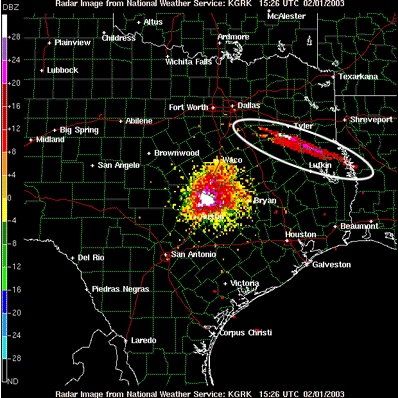
Not sure of it's been posted by anyone on the two threads, but here's a Radar Image of the debris rain being picked up by weather stations.
That image is labeled "15:26 UTC 02/01/2003". If I'm doing the math right (and Texas is on Central Standard Time, a.k.a. UTC -6:00), that's 9:26 local time, 10:26 Eastern
This Slashdot article from this morning points to this dramatic page, which shows a similar radar map, archived from about 13:00 to 17:00 UTC. The trail appears at 14:05 UTC, shortly after the breakup, and lingers for the remaining two hours of the loop. (The original poster said it "disappears so suddenly," but I think it's just the end of the loop.) I hacked the URL a little, and watched it last until almost 21:00 UTC, nearly seven hours after the incident.
So what is it? A line of dust-sized particles too light to fall? Some sort of condensation or thermal effect? (There are some other line-shaped artifacts in some frames, but nothing so dramatic.)
Nothing shows up in the live radar map.
P.S.: The ucar.edu page just stopped responding. Slashdot effect? -
weather radar image
Not sure of its been posted by anyone on the two threads, but here's a Radar Image of the debris rain being picked up by weather stations.
-
Tragedy for mankind
There are so many things to say, so many feelings. Firstly, I do believe that this is not just an American tragedy, it is one that affects mankind. NASA has been basically leading the way towards space exploration and if one is to believe the "Space, the final frontier" bit, I do feel that this is something that affects us all. Not to mention, there was an Indian American, an Isreali and an African American on board.
In fact, this is one of the many reasons why I feel that it was extra stupid of Saddam Hussein to call this catastrophe "God's punishment on America". If anything, he should have taken this opportunity to show some sympathy towards this event.
I also wonder if they will send a teacher up in space in the near future. They were just about to start interviewing over 4000 teachers but I really don't know if that is going to happen now.
Lastly, here are some links that I have found useful all day today that I haven't seen posted up yet - http://www.spacer.com, http://www.spaceref.com, http://www.spaceflightnow.com and of course http://www.space.com.