Slashdot Mirror
Domain: spaceflightnow.com
Stories and comments across the archive that link to spaceflightnow.com.
Comments · 567
-
Re:From the article ...
There's no good reason for NASA to launch the shuttle over the July Fourth holiday weekend
Sure there is, the launch window is 10 minutes a day from June 30 to July 19. The two previous sets of launch windows were March 4 to 19 and May 3 to 22. Nasa missed both of those so now they are trying this one. I am not sure why a launch on June 30 was not tried, but that still would have been part of the 4th of July weekend. Generally speaking you want to try launching early in the set of launch windows so if you have a delay you might be able to launch in the next day's window. More info on launch windows here, here, and here. -
SpaceFlightNow (as usual) has great coverage
STS-121 Mission Status Center - 'nuff said.
-
Noisy website
I prefer space news here. Space.com is a bit noisy.
-
I would love to see it happen
I LOVE astronomy. I think it is simply the most profound thing that we have been able to take the eye and stretch it to points beyond imagination. To look out into the cosmos is so humbling and awe-inspiring. Truly if one science has shown us simple magnificent beauty it is astronomy.
Now having said that I will say that only one thing makes astronomy better - seeing these object in motion! Galaxies and nebula seem so unreal in hubble's photos - it's hard to fully comprehend what exactly they are - what they are really like. But when you view those precious few object we have been able to capture in motion, to me it is exquisite! Somehow, to me, it makes them that much more real, more tangible. And that is truly the dream of the soul - to somehow touch, taste, smell that which is so beautiful
I hope these astronomers string together this phenomenal convergence into a movie!
Jupiter's storms in motion
Solar flares
Do you have any other cool astronomical movie links?
--
Music should be free -
Fuel leak identified, next start planned...
see http://www.spaceflightnow.com/falcon/f1/060325lea
k .html - appearently, a fuel leak has been identified in preliminary analysis of images. The articel quotes Elon Musk: "I cannot predict exactly when the next flight will take place [...] However, I would hope that the next launch occurs in less than six months." I think that this is, if confirmed, good news (both the fast and analysis, and the optimism that the program gets not indefinitely delayed). Also, the analysis seems to be consistent with what many people on -
Or Engine
Spaceflight Now observed:
A further look at the imagery seen from the onboard camera mounted to the Falcon 1 shows a noticeable change in the color and shape of the flame coming from the Merlin first stage main engine as the vehicle seemed to roll. It was at that point the webcast provided to reporters covering the launch immediately stopped. Repeated efforts to reconnect to the feed were unsuccessful.
Seems to be a problem with the engine, a leak, or pump failure. A turbopump that has seized could induce a sharp roll.
-
More info on the failure.
Looks like engine failure or some kind of catastrophic tank or plumbing failure.
Quoting Spaceflight Now (a real space news site!)
http://spaceflightnow.com/falcon/f1/status.html
326 GMT (6:26 p.m. EST)
Here is the official statement from Elon Musk, the founder of SpaceX:
"We had a successful liftoff and Falcon made it well clear of the launch pad, but unfortunately the vehicle was lost later in the first stage burn. More information will be posted once we have had time to analyze the problem."
2250 GMT (5:50 p.m. EST)
A further look at the imagery seen from the onboard camera mounted to the Falcon 1 shows a noticeable change in the color and shape of the flame coming from the Merlin first stage main engine as the vehicle seemed to roll. It was at that point the webcast provided to reporters covering the launch immediately stopped. Repeated efforts to reconnect to the feed were unsuccessful. -
Island evacuated before fueling
The launch is taking place on a 7 acre island near Kwajalein Atoll. The island is evacuated before the rocket is fueled. You can read about it here. I wish these guys luck. There're going to need it.
-
Real-time launch info; SpaceX Dragon
As the first link mentions, the launch is scheduled for Thursday, 1PM PST (4PM EST). According to RLV News, here's a few good sources for real-time commentary and info about the launch:
* Mission Status Center - Falcon Launch Report - Justin Ray
* Out of the Cradle
* NASASpaceflight.com - LIVE: SpaceX/Falcon 1 - 23rd March: launch coverage thread
Also, it was recently revealed that SpaceX has been secretly developing their SpaceX Dragon orbital capsule, which will be able to carry up to 7 people to and from orbit. A full-size prototype of the capsule has already been constructed, and the capsule is expected to enter service by 2009 (several years before NASA's CEV). -
Re:A modest suggestion
Oh, crap, one shouldn't feed the trolls. I sin. I'm no supporter of the shuttle orbiters, but this one has to be answered.
Mods- if you have any sense at all, make the parent +1 DUMBASS, then make this post +1 Troll pickler. Let folks read it and judge for themselvs. Yes, I'm going to unload on the fucker. And I'm going to say FUCK! Repeatedly! I might even misspeel. My nomex briefs are on...
I wonder what they mean by "bump"?
Lets start out with an article from a real space news site: http://spaceflightnow.com/news/n0603/08shuttle/
Go read that, or at least the first sentance. Then think about it for a bit. I quote:
The shuttle Discovery's robot arm is undergoing ultrasound inspections after a weekend mishap in which a moveable access bucket bumped into the arm during work to clean up broken glass.
As in the dipshits at KSC were working to clean up broken glass from a busted heat lamp, and rammed the fucker with a movable man holding bucket. I'll bet that would even put a nice sized ding in your beat to hell dumbass driver's Ford pinto http://en.wikipedia.org/wiki/Ford_Pinto/. Probably not a quarter million dollar ding, though. And they wouldn't likely need to spend a quarter mill worth of analysis to figure out what if anything to do to fix your pinto. Hell, I'd offer to fix your ride by gluing old bubble gum onto the side of your shitbucket with stale ass chaff- for free.
That arm is a piece of shit if you ask me. Like a lot of stuff designed at NASA (some is very good don't get me wrong) it's designed to work within insanely too small a tolerence.
Stick to something besides pretending to intelligently critique space hardware design.
See, an item like the arm doesn't just need to be precise (as you muttle on about), but also a few other things that go along with space flight hardware:
+ Strong (its a flying crane and can handle 65,000 pounds on orbit.)
+ Clean. As in contiminate free so that it doesn't fuck up things that fly inside the shuttle.
+ Lightweight. As in every pound that the arm packs up is an pound of cargo you can't fly (at ~$12k to $30K per pound).
+ TVAC compatible. As in it lives in space. Insane heat, vacum, cold... Nasty stuff. Also, cant outgass or warp in space.
+ Shirtsleeve compatible. As in lives inside the VAB and landing sites and everywhere the shuttle goes on earth.
+ Highly instrumented.
+ Accurate. (look that one up, it is different than precise)
+ Gentle. (can't damage the hardware while schlepping it around)
+ Reliable as all hell(as in who thefuck fixes it if it breaks on orbit)
+ Able to carry the OBSS: http://en.wikipedia.org/wiki/Orbital_Boom_Sensor_S ystem/
+ Documented to all bloody hell. As in the QA bastards can probably tell you what mine hauled up the metal in the wire that runs down the arm next to the bump, what miner brought it up, on what shift, using which truck, and so on and so on... For every component, again for every subassembly, again for every next level assembly. Oh, and the entire build, test, rework, and flight history of everything associated with the SRMS. Go look up heritage, in the space flight context.
The world is not a static place and the unexpected can happen, don't design a frigging billion dollar robotic arm that breaks if you touch it. I can't even count how many times those arms have broken.
Really? You must be mistaking the SRMS with that pinto that you drive!
Do you want to try and tell the world how many times the SRMS has broken on orbit?
disclaimers: Yes, homer, I do work in the aerospace business. No, I don't work for the fine cannucks that build the SRMS. Yes, I think that -
Watch play-by-play at SFN
SpaceFlightNow has the play-by-play - more exciting than watching grass grow
-
Boring story, here's a better one
So Elon Musk flaps his gums about what he's going to do, and its news? He should probably be concerned about the sorry state of Falcon. Then again he founded Paypal. Now there're some space credentials.
If you are looking for an interesting space story try this. I submitted the story but the slashdot priests rejected it. Maybe musk should use his billions and buy this thing.
-
Climate of budget tightening
This is a difficult situation because the mission has a lot of merit. But it was over budget and had technical problems. Something had to go in a climate of budget tightening. Most people on this forum will rail at this decision. They should blame the aimlessness of NASA's manned space program since Apollo, and credit NASA administrator Michael Griffin for doing something about it.
-
Re:Small changes
Read http://www.spaceflightnow.com/news/n0602/06nasabu
d get/ - it's billions in the future that's being raided. -
Re:Will it be business as usual?
On the other hand, the Russians just do their thing with little or no media attention.
The Russian space program has received a lot of attention recently.
-
Re:composite aging?
The tiles are frequently replaced, but the leading edge of the wing is not covered in tiles. The leading edges are covered in reinforced carbon-carbon (RCC) panels. I don't think they are on anything like the same replacement schedule as the tiles. I couldn't find anything for certain, but this SpaceFlightNow article suggests that they are not frequently replaced. I think it also offers some support for the OP's hypothesis about composite aging. http://www.spaceflightnow.com/shuttle/sts107/0304
1 7recommend/ -
"the first one"
If you are referring to Challenger, it became engulfed in flame 74 seconds into flight. The intact crew cabin smashed into the ocean 164 seconds later. I wouldn't call that immediately.
-
More Links to Click
I should start by saying that there's a wealth of information out online about Lockheed Martin's Atlas V.
The article gave a link to www.space.com but if you want the source of this information, you should go to Spaceflight Now for their informative diagrams. You can get an idea of how the vehicle actually breaks apart to deliver its payload. You can read about how they plan to retrieve the boosters from the ocean, the simulated views of onboard cameras, or previous Atlas launches. This site contains for more information than the one listed in the article.
If you're interested in payload sizes, check out Wikipedia's entries on this topic or the International Launch Service's documentation of preparation for Atlas V launches. -
More Links to Click
I should start by saying that there's a wealth of information out online about Lockheed Martin's Atlas V.
The article gave a link to www.space.com but if you want the source of this information, you should go to Spaceflight Now for their informative diagrams. You can get an idea of how the vehicle actually breaks apart to deliver its payload. You can read about how they plan to retrieve the boosters from the ocean, the simulated views of onboard cameras, or previous Atlas launches. This site contains for more information than the one listed in the article.
If you're interested in payload sizes, check out Wikipedia's entries on this topic or the International Launch Service's documentation of preparation for Atlas V launches. -
More Links to Click
I should start by saying that there's a wealth of information out online about Lockheed Martin's Atlas V.
The article gave a link to www.space.com but if you want the source of this information, you should go to Spaceflight Now for their informative diagrams. You can get an idea of how the vehicle actually breaks apart to deliver its payload. You can read about how they plan to retrieve the boosters from the ocean, the simulated views of onboard cameras, or previous Atlas launches. This site contains for more information than the one listed in the article.
If you're interested in payload sizes, check out Wikipedia's entries on this topic or the International Launch Service's documentation of preparation for Atlas V launches. -
More Links to Click
I should start by saying that there's a wealth of information out online about Lockheed Martin's Atlas V.
The article gave a link to www.space.com but if you want the source of this information, you should go to Spaceflight Now for their informative diagrams. You can get an idea of how the vehicle actually breaks apart to deliver its payload. You can read about how they plan to retrieve the boosters from the ocean, the simulated views of onboard cameras, or previous Atlas launches. This site contains for more information than the one listed in the article.
If you're interested in payload sizes, check out Wikipedia's entries on this topic or the International Launch Service's documentation of preparation for Atlas V launches. -
Re:... and the reason is:
AFAIK, the satellites aren't failing, its really kind of a myth:
http://www.spaceflightnow.com/delta/d308/
That's an article from last year, but still; satellites are failing at a rate of 1-2 a year, but thats how many we launch; there's no need to launch anymore.
The real advantage of having a second "GPS" (Galileo) system is dual band receivers. Twice as many satellites=better redundancy, and better accuracy.
Use both! You can bet your asses that U.S. military equipment will be designed to take advantage of both if at all possible; GPS primarily, but any and all secondary singles that may be avaliable.
I'm thrilled about Galileo; the more global positioning data/signals out there, the better. Glonass, Galileo, GPS; keep 'em coming! -
Scrubbed until December
The launch has been scrubbed until December to bring in more helium and liquid oxygen. See Spaceflight Now or Space.com
-
They just scrubbed againPer SpaceFlightNow The next opportunity comes at 1 p.m. EST (1800 GMT) Sunday.
There is a bit of irony/humor in "News for Nerds" reporting it as having "successfully launched"
-
Real information, as of 0018 GMT
Is linking to a page about a launch which hasn't happened yet, in a language that most slashdotters can't even read, some kind of sick prank? In any case, as of now (0018 GMT, 4:18 PM PST), the launch has been delayed a couple of times today. The first delay was due to overcast skies (they were afraid of possibly generating a lightning strike with the rocket plumes), and the current delays are due to problems with their liquid oxygen fuel boiling off during the first delay.
Here are some good sources of up-to-the-minute coverage:
* Spaceflight Now's Falcon 1 Mission Status Center
* Liveblogging by Out of the Cradle
* Liveblogging by space reporter Michael Belfiore
* SpaceX's official launch info (good info, but not updated as often as other sources)
They just got an extension on their launch window, and are still hoping to launch today (5pm PST at last report).
I've been eagerly awaiting this launch for the past couple of years. If it succeeds, it's going to change everything. Although their first rocket is relatively small, they're already working on much larger successors, all at a selling price which is a small fraction of their competitors'. Drastically cutting launch costs, increasing the launch rate, and enhancing space accessibility is crucial to SpaceX founder Elon Musk's long-term goal: helping humanity become a spacefaring civilization.
If it doesn't succeed, well, Musk has stated that he can afford up to three consecutive launch failures before calling it quits.
The following have some more background info on what Elon Musk is trying to achieve with SpaceX:
* Hopes of Start-Up Rocket Company Are Riding on First Launch (LA Times)
* SpaceX wikipedia article
* Big Plans for SpaceX (The Space Review, discusses plans for human spaceflight and building world's largest rocket engine)
* Shooting the Moon (Discover Magazine)
* -
Not launched yet!
The SpaceX Falcon 1 has not launched as of 4:08 p.m. EST. In fact, it's on hold for an hour. Somebody jumped the gun with the story. You can follow live coverage at SpaceFlight Now or Space.com
-
Launch cancelled
The launch has been cancelled:
http://www.spaceflightnow.com/ariane/v167/status.h tml -
Re:Its Actually a Good MoveThe maximum Soyuz crew is three. Soyuz 1 had only one test pilot aboard. Whereas the shuttle has a maximum crew of 7. Soyuz has killed 4 crew members, both accidents in the infancy of the vehicle. Whereas the shuttle has killed 14.
Which doesn't really support your original claim that Soyuz is 'much safer'. At best it shows it is might be slightly safer, but the sample size is small enough that is statistically pretty meaningless. Especially if you start to look at the other close calls Soyuz has had: Soyuz 5 the first attempt of Soyuz 18 the first attempt at Soyuz t-10 The first 2 of those were only non-fatal by a large amount of luck.
Nor is recent history flawless:
- Loss of cabin pressure on TMA-6 landing http://www.msnbc.msn.com/id/9888881/
- Thruster malfunction on TMA-5 http://www.russianspaceweb.com/iss_soyuztma5.html
- battery problems on TMA-5 http://www.nasawatch.com/archives/2005/04/soyuz_ba ttery_p.html
- Pyro accident and H2O2 tank problems in TMA-5 prelaunch processing. http://www.spaceflightnow.com/station/exp10/status .html
- Fuel pressurization problem on TMA-3 http://www.space.com/missionlaunches/exp8_soyuz_04 0428.html
- Flight computer failure/ballistic landing on TMA-1 http://www.russianspaceweb.com/iss_soyuztma1.htmlThe above obviously aren't in the same league as the early incidents, but do show a system that is encountering a significant loss of redundancy on nearly every flight. If you go back over the Mir era flights, you will find plenty more, although the Russians were even less inclined to talk about them.
I'm not trying to bash Soyuz... if you offered me a seat today, I'd jump on it. I'm just pointing out that the commonly held assumption that it is a whole lot safer than the shuttle doesn't really add up.
-
dead as a doornail
as i recall, the composite fuel tank had a variety of serious problems, so they planned to replace it with an aluminum one temporarily, and that threw all the the fight test cases back into areas that have already been significantly researched:
http://spaceflightnow.com/news/n0103/01x33/index2. html
Hence, funding was cut with a lot of construction already done (infrastructure for launch, vehicles nearing test, etc.)
So, yes, it has gone into the black hole. -
As seen in the previous Mars story...
...clearly, this is the work of the giant purple spiders.
-
Re:Simple: UK has no suitable launch sites
The answer to both of those questions is: The UK doesn't have any good launch sites.
So why not launch rockets from a site in the sea around the equator? After all, other countries do it. http://spaceflightnow.com/sealaunch/estreladosul1/ -
Re:Based on the site photos...Forget the giant purple spiders; what the heck is that over there on the right side of the page?
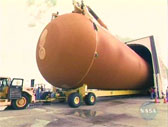
Breaking news: NASA builds giant space phallus. Scientists at NASA today unveiled what very well could be the largest phallus ever created. At a hastily convened press conference this morning NASA administrator Mike Griffin said "We believe we have successfully advanced the state of the art in phallus-building." The phallus was slowly rolled out of its gigantic protective sheath on a trailer custom-designed for the task, requiring a several tractors to pull it. An audible gasp rose from the crowd as its enormous bulk was slowly exposed. Other top NASA scientists were quoted as saying, "America now undoubtedly controls the biggest phallus around," and "So long, China! This next space race is over before it even began!"
-
Re:Unintended joke?
Aerogel seems to come close.
-
GPS Constellation status, with launch dates
From: ftp://tycho.usno.navy.mil/pub/gps/gpstd.txt
A. BLOCK II/IIA/IIR/IIR-M INDIVIDUAL SATELLITE STATUS
SVN PRN
15 15 Launched 01 OCT 1990; usable 15 OCT 1990; operating on Cs std
24 24 Launched 04 JUL 1991; usable 30 AUG 1991; operating on Cs std
25 25 Launched 23 FEB 1992; usable 24 MAR 1992; operating on Cs std
Scheduled unusable 20 Oct 0130 to 1330 UT for repositioning
maintenance (NANU 2005131/14 OCT)
26 26 Launched 07 JUL 1992; usable 23 JUL 1992; operating on Rb std
27 27 Launched 09 SEP 1992; usable 30 SEP 1992; operating on Rb std
29 29 Launched 18 DEC 1992; usable 05 JAN 1993; operating on Rb std
30 30 Launched 12 SEP 1996; usable 01 OCT 1996; operating on Rb std
31 31 Launched 30 MAR 1993; usable 13 APR 1993; operating on Rb std
Unusable 14 Apr 1634 UT and will remain unusable until
further notice (NANU 2005055)
32 01 Launched 22 NOV 1992; usable 11 DEC 1992; operating on Cs std
33 03 Launched 28 MAR 1996; usable 09 APR 1996; operating on Cs std
34 04 Launched 26 OCT 1993; usable 22 NOV 1993; operating on Rb std
35 05 Launched 30 AUG 1993; usable 28 SEP 1993; operating on Cs std
36 06 Launched 10 MAR 1994; usable 28 MAR 1994; operating on Rb std
37 07 Launched 13 MAY 1993; usable 12 JUN 1993; operating on Rb std
38 08 Launched 06 NOV 1997; usable 18 DEC 1997; operating on Cs std
39 09 Launched 26 JUN 1993; usable 20 JUL 1993; operating on Cs std
40 10 Launched 16 JUL 1996; usable 15 AUG 1996; operating on Cs std
41 14 Launched 10 NOV 2000; usable 10 DEC 2000; operating on Rb std
43 13 Launched 23 JUL 1997; usable 31 JAN 1998; operating on Rb std
44 28 Launched 16 JUL 2000; usable 17 AUG 2000; operating on Rb std
45 21 Launched 31 MAR 2003; usable 12 APR 2003; operating on Rb std
Unusable 13 Oct 0217 to 0905 UT due to repositioning
maintenance (NANUs 2005129, 2005130/13 OCT)
46 11 Launched 07 OCT 1999; usable 03 JAN 2000; operating on Rb std
47 22 Launched 21 DEC 2003; usable 12 JAN 2004; operating on Rb std
51 20 Launched 11 MAY 2000; usable 01 JUN 2000; operating on Rb std
53 17 Launched 26 SEP 2005
For more information about PRN17/SVN53, see:
http://www.spaceflightnow.com/delta/d313a/
54 18 Launched 30 JAN 2001; usable 15 FEB 2001; operating on Rb std
56 16 Launched 29 JAN 2003; usable 18 FEB 2003; operating on Rb std
59 19 Launched 20 MAR 2004; usable 05 APR 2004; operating on Rb std
60 23 Launched 23 JUN 2004; usable 09 JUL 2004; operating on Rb std
61 02 Launched 06 NOV 2004; usable 22 NOV 2004; operating on Rb std -
GPS Satellite Replacement
It sounds like they are already in the midst of replacing it - check out SpaceFlightNow. The new series is going up with the next generation in the works. Maybe it's just a matter of keeping at or above the crucial 24 limit...?
-
Failure: Second Stage Engine Cut-Off
According to SpaceFlightNow the failure was caused by missing command from on-board flight control system to shutdown second stage engine. No engine shutdown -> no stage separation ->> second stage, third stage and the cryosat end up fallig back on Earth in the designated second stage drop zone.
-
Re:Climate change?
mars has long periods of intense cold, interspersed with shorter periods of really intense cold. try this: http://www.spaceflightnow.com/news/n0312/17icymar
s / -
Re:It's all a matter of directionPRECISELY, VERY well put.
So how do you fix that? 360-degree reviews seems like they would either be too petty or too open to retribution.
I was holding out hope that there were some companies out there that could foster the right management culture, but after reading about the criticisms of NASA's management (whose responsibility in terms of life-and-death and budget are much greater than companies I've worked at, yet they still fail), I'm beggining to think there might not be any good companies to work at.
-
Re:What was that?
The puffs of gas were the exhaust plumes from the hydrazine powered auxiliary power unit. Any surface heat from reentry will have been dissipated during the regular cruise down to touchdown. Most of the heat during re-entry is formed by compression of the air at the boundary layer. It's mostly described here
Who knows what Jerry is on about. -
It has a REAL impact on some creatures
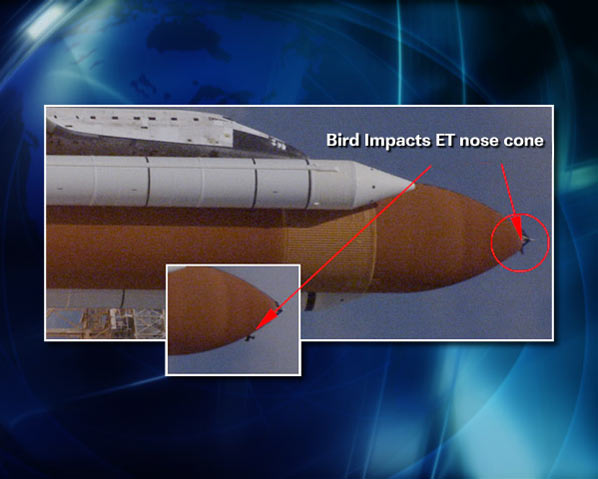
Like this poor bird.
-
Re:Put the saftey effort elsewhere
The shuttles still use freon for other cooling systems; in fact, Columbia had issues with its cooling system.
Oh, and NASA has an exemption from the Freon restrictions anyway.
While they might have initially switched to the freon-free foam for environmental reasons, there was nothing to prevent them from switching back once they found out it was less safe.
Trivia time: Which president issued the executive order to stop use of CFCs? -
Re:Waited too long...sfn:
Deliberately damaged blankets similar to the one aboard Discovery were tested overnight in a wind tunnel at NASA's Ames Research Center in California to help engineers and aerodynamicists calculate when during entry debris might rip away, what sort of trajectory it might follow and whether an impact could cause serious damage to the shuttle's rear wing elevons, rudder/speed brake or aft rocket pods.
But the wind tunnel tests, along with additional analyses, showed the blanket posed no significant threat to Discovery's return to Earth.
"We have new analysis that shows debris transport would be no issue and we came to the same conclusion with the Ames (wind) tunnel tests," Payette told the crew today. "So basically, no EVA 4 (fourth spacewalk)."
-
Far More Informative (Detailed) Links
Spaceflight Now | STS-114 Shuttle Report | Shuttle mission extended to give bonus day at station
Spaceflight Now | STS-114 Shuttle Report | NASA gives go-ahead to spacewalk repair work
(and the headline says "Emegency" -- someone fix that, please) -
Far More Informative (Detailed) Links
Spaceflight Now | STS-114 Shuttle Report | Shuttle mission extended to give bonus day at station
Spaceflight Now | STS-114 Shuttle Report | NASA gives go-ahead to spacewalk repair work
(and the headline says "Emegency" -- someone fix that, please) -
Y'know, now that you point that outThe shape of that missing chunk of the PAL ramp
http://www.spaceflightnow.com/shuttle/sts114/0507
2 7palrampimages/looks an awful lot like the unidentified chunk of debris that missed the starboard wing (scroll to bottom of link).
-
Y'know, now that you point that outThe shape of that missing chunk of the PAL ramp
http://www.spaceflightnow.com/shuttle/sts114/0507
2 7palrampimages/looks an awful lot like the unidentified chunk of debris that missed the starboard wing (scroll to bottom of link).
-
Re:Isn't debris unavoidable?
Take a look at the pics:
http://www.spaceflightnow.com/shuttle/sts114/05072 7palrampimages/
The right wing was barely missed by a large piece of insulation. I don't think they want to gamble anymore like they have in the past. -
Bird strike *was* a buzzard!
There are always vultures there. I went on a tour of the facilities a while back and there were vultures all over the place especially flying around the VAB. I asked some employees there about this and they say the vultures get great thermals there because of the huge building.
This just in, courtesy of Spaceflight Now. Note for the unitiated: buzzard == vulture
1810 GMT (2:10 p.m. EDT)
NASA believes the bird struck by Discovery's fuel tank was a buzzard. These large birds can have a wing span of more than six feet and the average weight of a full-grown bird is 6.5 lbs.
"It was in the wrong place at the wrong time," a Kennedy Space Center spokesperson said.
NASA has long assumed that the noisy launch pad environment at the time of main engine ignition would cause bird to fly away from the launching shuttle.
Workers had not located the carcass of the bird but not all areas of the launch complex had been searched.
Images of the strike are available here.
Subscribers of our Spaceflight Now Plus service can see a video clip of the bird strike here.
The incident is one of several NASA is studying from yesterday's launch, along with the chipped nose gear door tile and external tank debris-shedding event. -
Bird strike *was* a buzzard!
There are always vultures there. I went on a tour of the facilities a while back and there were vultures all over the place especially flying around the VAB. I asked some employees there about this and they say the vultures get great thermals there because of the huge building.
This just in, courtesy of Spaceflight Now. Note for the unitiated: buzzard == vulture
1810 GMT (2:10 p.m. EDT)
NASA believes the bird struck by Discovery's fuel tank was a buzzard. These large birds can have a wing span of more than six feet and the average weight of a full-grown bird is 6.5 lbs.
"It was in the wrong place at the wrong time," a Kennedy Space Center spokesperson said.
NASA has long assumed that the noisy launch pad environment at the time of main engine ignition would cause bird to fly away from the launching shuttle.
Workers had not located the carcass of the bird but not all areas of the launch complex had been searched.
Images of the strike are available here.
Subscribers of our Spaceflight Now Plus service can see a video clip of the bird strike here.
The incident is one of several NASA is studying from yesterday's launch, along with the chipped nose gear door tile and external tank debris-shedding event. -
Re:Nice misleading story, guys...
Well, there is photographic evidence of one tile fracturing and breaking off. So aybe debris did infact hit the shuttle.
Images here:
http://www.spaceflightnow.com/shuttle/sts114/05072 6images/