Slashdot Mirror
Domain: spaceweather.com
Stories and comments across the archive that link to spaceweather.com.
Comments · 201
-
Re:I was in Montreal in 1989
I was in Montreal in 1989. Probably caused by a geomagnetic storm.
How did the "geomagnetic storm" cause you to be in Montreal?
-
I was in Montreal in 1989
Probably caused by a geomagnetic storm. Not a coincidence we just entered an area with fast moving solar wind on the 28th.
-
Re:I was expecting a spectacular aurora but...
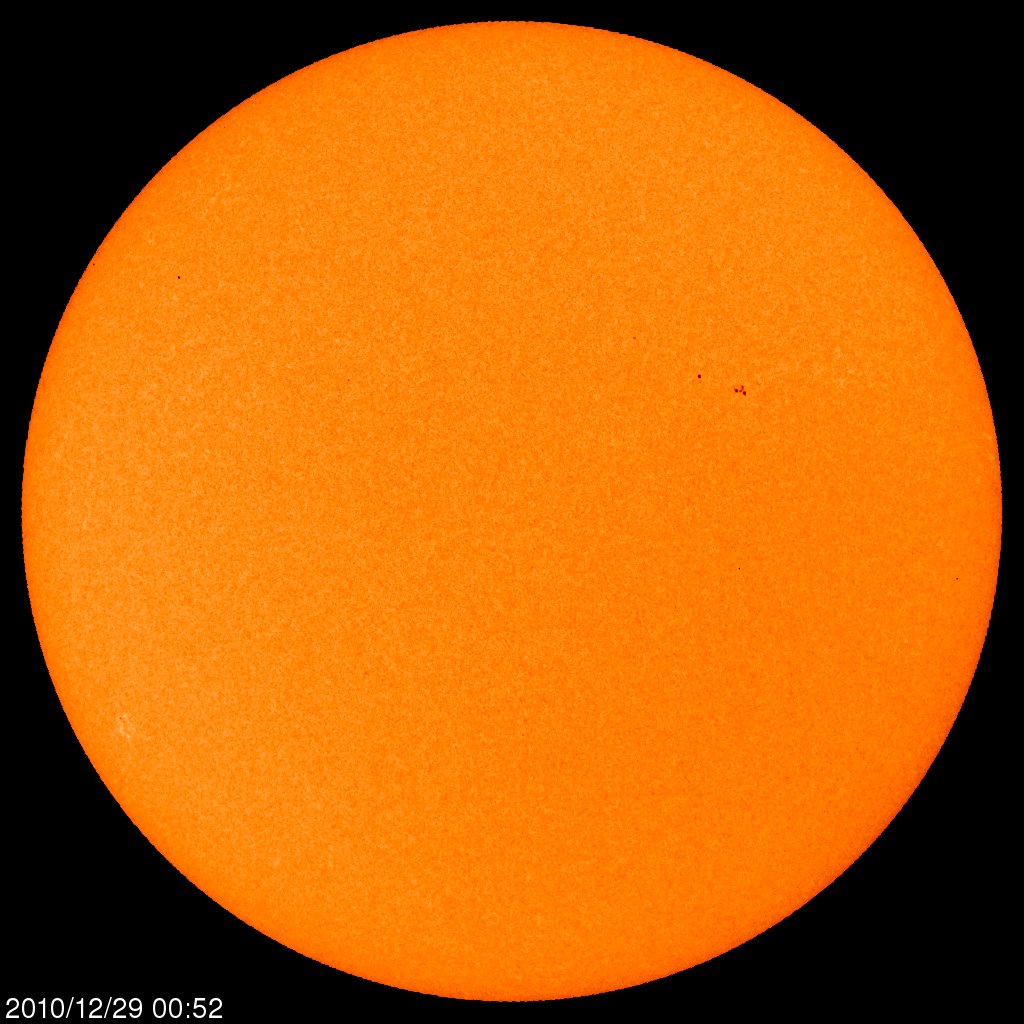
There will likely be aurorae tomorrow (or the day after that) but polewards from the arctic/antarctic circle. There is a coronal hole in the Sun (but no sunspots right now).
-
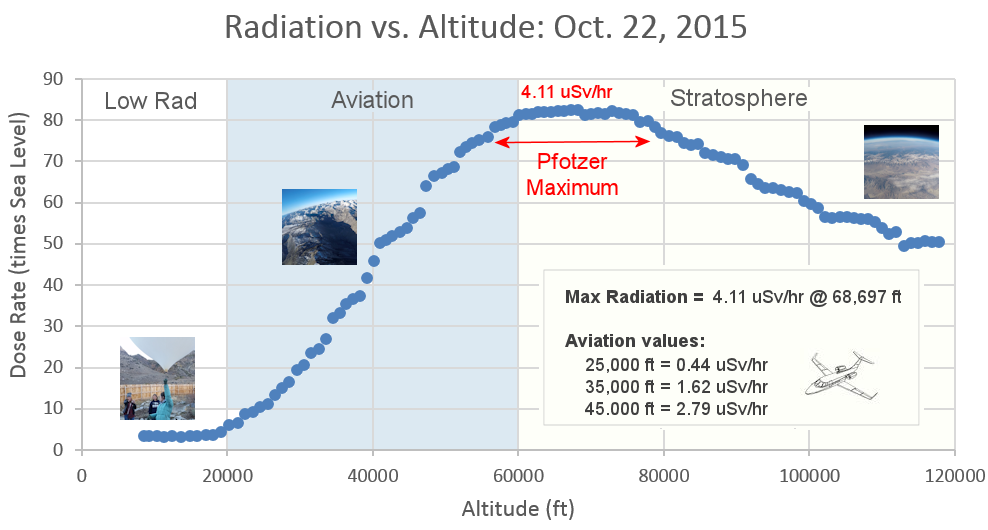
Remember a 4 hr flight is about like a Dental Xray
There's a great site where a college program puts radiation detectors on balloons and takes them on aircraft to map the rates.
http://spaceweather.com/cosmic...
But I remember the analysis was that up at cruising altitude (35k ft +) the dose you'd get going from the cosmic radiation penetrating the inside of the cabin in about 4 hours of flying was like getting a dental xray's dose of rads. Now there is a huge industry powerful industry that would be threatened by data like this becoming widely spread and talked about (like the Cigarette companies did for lung cancer or the fossil fuel industry did global warming & the GOP). So there will be astroturfing going on. -
Clever Marketing. Recent Solar CME
Any power outages caused by the recent CME eruption from our sun might scare people into purchasing 'protection'.
-
here's a picture
-
Re:Trajectory
Speaking of trajectory, wouldn't passing so close to earth have altered it?
Yes. http://www.spaceweather.com/ar... "...After it buzzed Earth, the space rock turned and headed for the Moon, executing a wider flyby of 179,000 miles on Sept. 8th. Researchers say 2016 RB1 is ~50 ft in diameter, about the size of a grey whale.
-
Surprise! Surprise!
it dumped fuel over the USA. link: http://www.spaceweather.com/
-
Why not spend $$$ on real science w/ NASA?
If you want to spend money on student research, why not invest in an actual NASA-sponsored project? Check out spaceweather.com (toward the bottom):
HEY, THANKS! The students wish to thank Sander Geophysics Ltd (SGL) for sponsoring this flight. Note their logo in the upper right corner of the payload. SGL's generous contribution of $500 paid for the helium and other supplies necessary to get this research off the ground. Readers, if you would like to sponsor an upcoming flight and see your logo at the edge of space, please contact Dr. Tony Phillips to make arrangements.
-
Re:spaceweather.com
I've never met a sysadmin that did have something to do most of the time. They'd probably just waste their free time doing something silly like playing tabletop games.
Or, PlanetSide 2.
As for the grandparent post, it appears to be holding up well. To everybody else, what an excellent time to check on the status of your routine system backups, disaster recovery plans and other such things that might come into play if/when this baby hits. Are you ready to lose power and/or telco?
-
Solar activity
I confirmed the effect of solar activity countrywide myself a few years ago...
I used to work in the NOC (Network operations center) for a major Telco. The job is pretty strait forward, there's an application that gets alerts from a vast and very diverse set of equipment all across the country and displays "alarms" when they are having problems. There are always alarms, but many are transient and a lot of the equipment will fix itself. Your job is to know what's bad, how bad it is and how to intervene if you need to. A remote in the backwoods of Georgia has a fire alarm... Call the fire department who will break down the door, hose down the equipment and put 10,000 people out of service for a week? Or notice that the same remote has a minor fan alarm thats not on your display because of the severity and know that what really is going on is the fan burned up and you can just send a field tech to replace it.Anyways, that jobs a lot like war. Long periods of boredom punctuated by brief periods of terror. 100k people without 911 service wares at you. But in the slow times it's really boring so I was surfing one day and found this:
http://spaceweather.com/
It's a NASA website that shows the activity in space around the sun/earth. You can even download spreadsheets of past data.
This got me thinking so I exported alarm activity on the millions of pieces of equipment I watched for the same time period.
At first it didn't match up, but then I remembered there are local causes to. So I found some data on electrical storms and subtracted that...
Tada! I had a perfect graph showing the rise and fall of solar activity that matched nicely with my alarm activity. There were a few anomalies, but I'm not scientist. I could see that the effect was more negligible on our fiber networks, but still there. I attributed this to power fluctuations.Excited I ran into my bosses office and told him to look at my charts. He said "That's fantastic! Good work! Really interesting! But useless I'm sad to say..."
I was baffled...
"Do you want me to block out the sun? This really is neat, but that's about it. We can't do anything about it."
I thought about it and finally agreed. It's is neat, but also unavoidable. At best we could use it to put more techs on staff on certain days, but that would be about it. And the fact is, there's ALWAYS someone on call... so, though being interesting, it's also irrelevant. About the most interesting part was that fiber made the issue go away... but we already knew fiber was better in just about all cases. This was just more proof. -
Re:That's odd
Hmm, I am surprised that they don't know. I think there are plenty of other people who do. RF effect from meteorite trails is a well-known phenomenon from radio (people were using it to bounce messages in the 30s)
Here are some people using it to track meteorites - very near the frequencies in question:
http://spaceweather.com/glossa...
The necessary condition for bouncing a particular frequency is that the path lengths of the plasma are the right length (say, half a wave length or maybe 2ish meters) which seems entirely plausible as a distance associated with the width of the plasma trail. It would not be at all surprising if a tiny amount bounced back and forth like a cavity resonator, OR, reflected ambient signals that the telescope wouldn't have otherwise detected.
So it doesn't seem that mysterious.
-
Re:Is this not the same as grass noise?
I've heard reports of people laying on the ground and "hearing" meteors. What baffled scientist about this was people were hearing them realtime and not delayed due to the speed of sound. They finally realized that it was radio waves emitted by the meteors causing the grass to vibrate and they were hearing the vibrations.
Maybe I dreamed it...
I have heard meteors making real time sounds as they streaked across the sky. It was during the 2001 Leonids meteor storm. It was in a city with not a blade of grass in sight. This particular meteor storm was widely reported as emitting crackling and hissing sounds:
http://www.spaceweather.com/me...There has been some speculation about what could cause such sounds. Some have suggested that “electrophonic meteors” can cause secondary lower frequency vibrations to be heard simultaneously, but it is just a suggestion since good quality data is missing.
The RTFA discovery is just a part of a new series of discoveries that shows we know a lot less about meteors and comets than we thought we did.
-
Why Bother?
SpaceWeather.com has a "Flybys " website; enter your zip code (USA) or Lat/Long (Anyplace) to see a list of overflights of the ISS and a couple dozen other satellites that are bright enough to see.
http://www.spaceweather.com/fl...
The web site is free; they have an Android and iOS app for five bucks, I think, that sounds an alarm.
More than good enough. Although I can see how designing your own device and programming it yourself is more impressive than buying an app or navigating to a web site.
-
Satellite Flybys app available for Android & i
http://spaceweather.com/flybys...
Which also tells you about loads of other object floating above your head, plus has audible alerts (if you want them) for any particular object.
As so many other bits of software previous mentioned also do.
Why acquire a piece of not-practically-portable hardware to do what you can set the mobe in your pocket to do?
Weird. -
Other than the date, why is this a big deal?
There are large asteroids passing near the Earth fairly often - this particular asterioid, 2000 EM26, will get only 8.8 Lunar Distances (LD) away. One that is more than three times its size, 2006 DP14, passed closer at 6.2 LD last week. Check out www.spaceweather.com for a list of recent and future NEAs, plus lots of other stuff.
If it were a large asteroid passing within the orbit of the moon (< 1.0 LD), now that would be worthy of a broadcast event like this. -
Radioactivity?
Um, no. "Radiation" was the word for which you were looking. "Radioactivity" refers to the particles which are emitted from nuclei as a result of nuclear instability.
There was a significant solar flare at 1832z (1:32 p.m. EST) on 7 January, that bathed the Earth with electromagnetic radiation (X-rays, UV, radio, etc.). This was an X1.2-class flare, meaning that its flux would have peaked at 1.2E(-4) watts/square meter at the Earth's surface, had our atmosphere not protected those of us on the ground from the worst of its effects. The effects of the flare itself (largely attenuation of HF radio signals over the Western Hemisphere during and shortly after the event) are over and done with.
Since this flare was caused by a particular sun spot group that remains active and unstable, Orbital Sciences was concerned about a repeat performance when the Antares' avionics were in the upper atmosphere, and therefore not protected from a second, possibly even more intense, flare that the sun spot may produce.
Concurrent with this flare was a coronal mass ejection (CME), which consists largely of protons blasted out of the sun's atmosphere (the corona). Since these particles are protons, not massless photons, they travel slower than the speed of light, and it takes them a while to get here; they are expected to arrive sometime early on 9 January UTC. However, predictions of CME particle velocity are difficult and prone to error; CMEs can arrive early.
Since the CME could be arriving while the Antares was in operation (the flight was scheduled for liftoff at 1832z on 8 January), and the performance of the rocket's avionics could not be guaranteed in that environment, when this risk was combined with the risk of another X-class flare I think they just decided that a scrub was the wiser choice.
-
Re:most observed comet ever
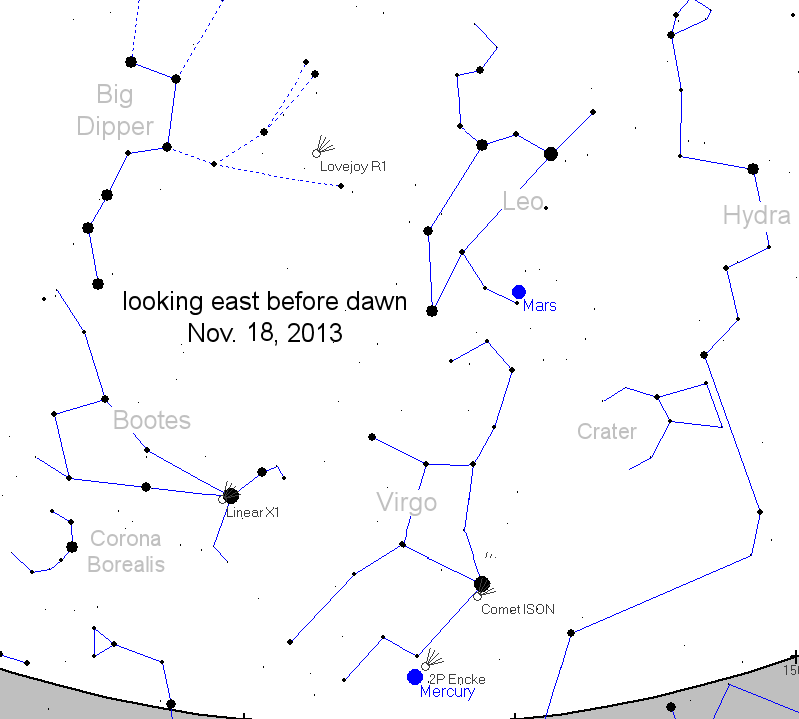
It's currently quite visible to the naked eye, if you can get away from any significant light pollution. You'll need to look due East just before dawn for the best views; ISON is currently passing by Spica in the constellation of Virgo. If you've got a reasonable camera that can do manual exposures and a tripod, then you'll get a much more impressive image by using a longer exposure and a mid-telephoto focal length; a 70-200mm range is currently ideal depending on how much of the tail you want to try and capture, or go for a longer length if you just want to capture the quite spectacular coma. Open the lens to the widest aperture, manually focus to infinity (I use a bright star for this), keep the exposure down to about 20s and adjust the ISO to suit.
-
Re:Chasing Unicorns
Persistent positive charge of the solar wind's magnetic field is preventing the storm to happen, even though conditions otherwise are favorable. Should the oncoming particles carry a negative charge things could change dramatically. The parameter is called Bz in this plot from the ACE satellite between Earth and Sun: http://www.swpc.noaa.gov/ace/MAG_24h.html The current value is also presented in the left sidebar of http://www.spaceweather.com/
-
Re:Two bucks says the video is doctored (2 secs?)
That was my first thought also. But, following a link in the talkbacks to this http://spaceweather.com/archive.php?view=1&day=11&month=09&year=2012 There is the comment that another astronomer, Dan Peterson (not the one who took the video), said the blast only lasted 1.5 to 2 seconds. This is very different from the famous comet smash of 1993 when the marks on the visible part of Jupiter lasted a long time while Jupiter rotated around.
-
Re:Electric Sun?
1) Astronomers do know about electric fields in space. I have written much on this topic. (Electric Universe: Whither the Electric Currents?).
2) The standard of science is the numerical results of the mathematical models must match the observations. If you claim the 'Birkeland' model works better than the standard model, then you must meet that standard.
Where are the numerical results from the model you advocate? Can you tell me the proton and electron density and energy or magnetic field at Earth's orbit predicted by your model and show how it is calculated? Where is the solar spectrum computed from first principles by the model you advocate? The lives of astronauts depend on you being able to demonstrate this!
If you can't meet that standard, then your model fails. Game over.
The ACTUAL track record of "Electric Sun" models making testable numerical predictions is dismal (Electric Cosmos: The Solar Resistor Model, Electric Cosmos: The Solar Capacitor Model. III)
3) I see a number of errors on your page. SDO first light images were not completely calibrated for intensity or scale information. Have you looked at more recent images on their site?
a) Doing science analysis on JPEG images or MPEG movies is just inviting embarrassment. You have to go back to the original data after the instrument has been calibrated.
b) Your sunspot data has obvious problems (Sunspot Number). Did you just make it up? And why only data to 1980? Are you trying to hide something about the more recent data?
And that's just what I could determine scanning your page before I realized some text was being clipped in my reader due to your lousy page formatting. I suspect I have hit just the beginning of your errors. -
Re:Summer Light
They are more common near the magnetic poles (both north and south). The closer you are to them, the greater your chance of seeing the Aurora. If the storm is strong enough, I know they've been seen as far south as 47 deg. Whenever I see news of solar activity, such as the CME, I usually look to spaceweather.com for updates.
-
Re:Units and news
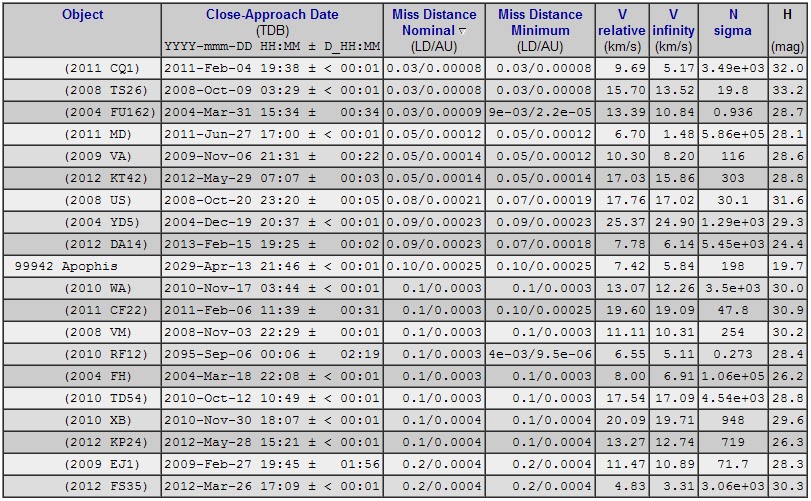
Many sites that report on PHAs (Potentially Hazardous Asteroids) use LD, meaning Lunar Distance. That's pretty descriptive to the general public - "Wow that thing flew right between Earth and the Moon!". According to their archive, KT42 missed Earth by 0.05 LD and was #6 on the all-time closest flyby list.
-
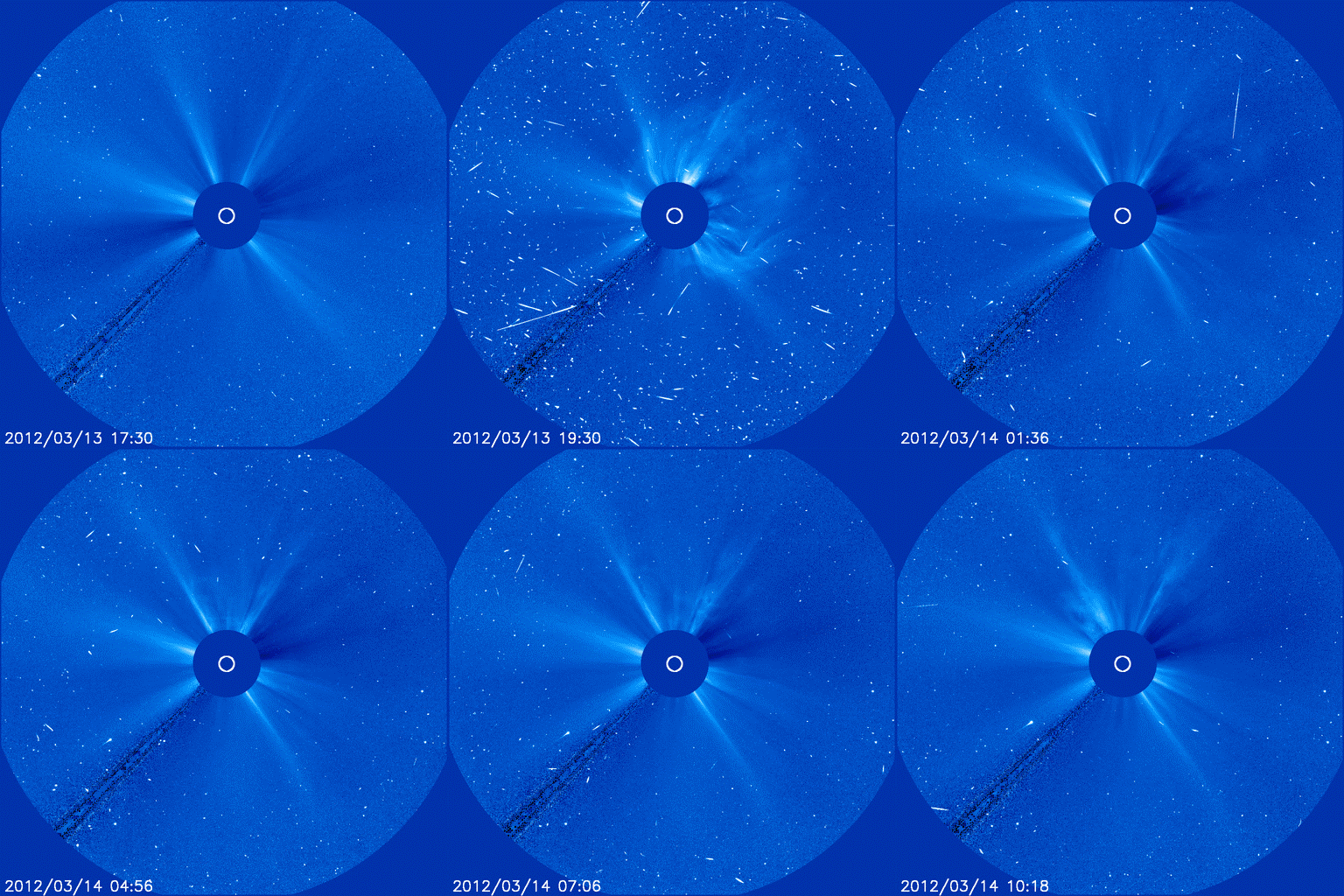
Comet on the same day?
Could it be related to this event: http://www.spaceweather.com/images2012/14mar12/deathplunge.gif ?
-
Re:where'd I put my tinfoil hat?
Actually, no, it isn't like hurricane or tornado scales. There are 5 letters that indicate the order of magnitude of the flare's x-ray (100-800 pm) flux (in W/m^2): A (<10^-7), B (10^-7 to 10^-6), C (10^-6 to 10^-5), M (10^-5 to 10^-4) and X (>10^-4). The number after the letter is a multiplier, so an M6 has an x-ray flux of 6x10^-5 W/m^2.
The scale is open ended, with the largest measured flare (2003-11-04) estimated at X45 (4.5x10^-3 W/m^2). We only have an estimate because the flare saturated the GOES detectors.
The Carrington Event is generally regarded as the largest flare in recorded history. It caused telegraph systems to catch fire and visible aurorae at least as far south as the Caribbean
-
It is common
The issue is we can only tell when one is about a day out. Many times we can only see them as they are leaving, not aproaching. It is actually a fairly common occorance. You can see them at http://www.spaceweather.com/. Since the begniing of the year there have been 5 that have come close enough to actually be of note.
-
Re:They rank these storms
'ranking system for CME/EMP effects'
Wow. Well, what you're talking about is the 'Flare Class' which only classifies the amount of x-ray energy given off by a flare. It's a log scale, so M is 10x as large as a C, and X is 10x as large as an M. Of course, there's no cap on it, and there have been X20 flares recorded. Of course, the sensors saturate, and as we're only really dealing with one significant figure and a magnitude, I don't know how much precision they have at those higher values.
To make things even more fun, there's also a flare 'importance' value, which is based on the energy and size of the flaring region in the optical (visible) spectrum.
But neither of these classifications have to do with CMEs, and particularly not their affects at earth. For that, you'd need to look at the solar wind folks, who are obsessed with things like 'Bz' (z-component of the magnetic field', ie, how is it oriented relative to the earth's magnetic field?) and radio bursts.
The closest thing that I can think of to what you describe would be a catalog of ICMEs (Interplanetary CMEs), but even those, if you look at the catalog, are just raw numbers, no sort of ranking to it. (the column with 'A' and 'B' in it are which of the two STEREO spacecraft saw the event, 'Ahead' or 'Behind')
Disclaimer : I'm not a solar physicist, but I work in a solar data archive, and have done work trying to normalize solar event catalogs.
-
Re:They rank these storms
'ranking system for CME/EMP effects'
Wow. Well, what you're talking about is the 'Flare Class' which only classifies the amount of x-ray energy given off by a flare. It's a log scale, so M is 10x as large as a C, and X is 10x as large as an M. Of course, there's no cap on it, and there have been X20 flares recorded. Of course, the sensors saturate, and as we're only really dealing with one significant figure and a magnitude, I don't know how much precision they have at those higher values.
To make things even more fun, there's also a flare 'importance' value, which is based on the energy and size of the flaring region in the optical (visible) spectrum.
But neither of these classifications have to do with CMEs, and particularly not their affects at earth. For that, you'd need to look at the solar wind folks, who are obsessed with things like 'Bz' (z-component of the magnetic field', ie, how is it oriented relative to the earth's magnetic field?) and radio bursts.
The closest thing that I can think of to what you describe would be a catalog of ICMEs (Interplanetary CMEs), but even those, if you look at the catalog, are just raw numbers, no sort of ranking to it. (the column with 'A' and 'B' in it are which of the two STEREO spacecraft saw the event, 'Ahead' or 'Behind')
Disclaimer : I'm not a solar physicist, but I work in a solar data archive, and have done work trying to normalize solar event catalogs.
-
Alert has been downgraded
Chance is now about 20% for 29 December. This ABC article is a bit alarmist and unnecessarily scaring the masses.
-
Northern Lights Further South! RIGHT NOW!
Northern Lights are visible in large parts of the United States that don't normally see them. Head outside and check it out.
-
Re:The meteors will still be there...
Or, much more simply, check out this page. They already have the special equipment, no purchase required. I use this site when there is a meteor shower but it is too cloudy or I am too lazy to drive out of the light pollution to see it. Also works well as a way of determining if there are enough meteors to be worth the price of gas to drive out of the light pollution. Posting AC simply because I am a lurker and have not made an account yet. Enjoy.
-
Even better. . .
might even produce an aurora visible as far south as Minnesota and Wisconsin
The submission is so old, we can say what really happened. Aurora were visible in the United States as far south as Utah, Colorado, and Nebraska. (Tip-'o-the-hat to SpaceWeather.com.)
-
Even better. . .
might even produce an aurora visible as far south as Minnesota and Wisconsin
The submission is so old, we can say what really happened. Aurora were visible in the United States as far south as Utah, Colorado, and Nebraska. (Tip-'o-the-hat to SpaceWeather.com.)
-
Even better. . .
might even produce an aurora visible as far south as Minnesota and Wisconsin
The submission is so old, we can say what really happened. Aurora were visible in the United States as far south as Utah, Colorado, and Nebraska. (Tip-'o-the-hat to SpaceWeather.com.)
-
Even better. . .
might even produce an aurora visible as far south as Minnesota and Wisconsin
The submission is so old, we can say what really happened. Aurora were visible in the United States as far south as Utah, Colorado, and Nebraska. (Tip-'o-the-hat to SpaceWeather.com.)
-
Email newsletters are convenient
Science news delivered periodically to your inbox. Some of them are customizable, so you can receive updates only on topics of interest to you.
Highly recommended:
American Scientist
Physorg
Also interesting:
Spaceweather
Nasa Science News
Nasa Earth Observatory
Discover Magazine
I imagine there are RSS feeds for most of these as well if you prefer that format. -
correlates w/ noctilucent clouds ?
interesting. noctilucent clouds have also been on the rise during the period of modern aircraft, and are also seen primarily towards polar latitudes.
-
never before in actual photos ?
Not true, here's a couple of other photos:
http://www.spaceweather.com/swpod2011/18may11/Maximilian-Teodorescu3_strip.jpg
-
Re:zeus canon misfires again, s. hillary evacuates
dude, don't do that to me.
I just checked http://spaceweather.com/ and http://www.syzygyjob.com/ and we're in the clear for now. -
Do your part to help stamp out pseudoscience
when you have massive ejections like yesterdays they can certainly contribute to instability in the Earth's magnetic field, which leads to tectonic shifting.
Er, no. The way the game of "science" is played, one must first show data establishing a valid statistical correlation between coronal mass ejections and earthquakes, then a plausible model establishing causation. Or, present the plausible model establishing causation, and then predict earthquakes to occur in the future, with a success rate that differs from random chance in a statistically significant manner.
The reason the relationship between CMEs and earthquakes is not "a more accepted concept than it is", is that no one has done either of the above. It shouldn't be hard: The occurrence of CMEs varies with the sunspot cycle and, therefore, one would expect a cyclic variation in earthquakes if this hypothesis were true. Note that near the solar maximum we expect two or three CMEs per day, so this has to be figured in, too.
Reviewing your links:
1. The Mukherjee and Mukherjee paper notes that there was increased solar activity, and then an earthquake occurred (the 2001 Gujarat earthquake). In fact, in the "entire world, a total of 65 earthquakes have been reported on the same day". However, there is no evidence presented that that was an unusually high (or low) number of earthquakes for a day, that other earthquakes occurred on similar days with high solar activity, or that they did not occur on days with low solar activity. In fact, some of that data presented -- in particular, the GOES X-Ray flux data -- is irrelevant to the argument, since X-Rays do not affect the Earth's magnetosphere (the protons arriving two days later, do that) and, in any event, they cannot pass through the Earth's atmosphere and so cannot affect the surface (let alone the rock below). Despite the heading of section 2 of the paper, no "correlation" between CMEs and earthquakes is presented -- just a single coincidence. I went to the dentist on 26 January 2001 -- did that also cause the Gujarat earthquake? The same amount of evidence is presented for both hypotheses.
2. The de Arcangelis, et al. paper does not even mention a causal relationship between CMEs and earthquakes. Rather, it notes that the statistical properties of the two phenomena are the same: Their distributions are both power-law. This is interesting, but so is the distribution of Internet links, and a million other phenomena. It's nice work, but does not support your hypothesis.
3. This guy just took a single month's worth of earthquakes and compared it with "solar activity" (without defining the term). Even the author didn't make any conclusions as a result, so why should the reader? Besides, 2010 was one of the quietest years of solar activity in human history -- just wait 'til 2013!
4. Do you have a link to the entire Jain paper, or are you citing the abstract as the reference? Without the paper it's hard to conclude anything, but even in the abstract the author states, "Our investigation preliminarily shows that each earthquake under study was preceded by a solar flare of GOES importance B to X class by 10-100 hrs. However, each flare was not found followed by earthquake of magnitude >4.0." This situation can occur with unrelated events, simply when one (a flare) is more common than another (an earthquake). Note that B-class flares are incredibly common, and in many years this level of energy represents the standard amount of X-ray flux arriving from the sun, without any flares.
All of the above does not prove, or even argue, that CMEs do not cause earthquakes. Rather, it says that no significant evidence of such a link has been established. Until it has, one might argue with equal validity that any other random physical phenomenon does, too.
-
ISS and Discovery Flybys
Be sure to check out Space Weather's Flybys page or Heavens Above to see if the ISS and Discovery are viewable overhead in your neighborhood. I tried a few zip codes and it looks like the NYC area will get to see a very bright ISS and Discovery pair on March 5th. This will be the day that Discovery undocks so you may get to see two bright dots moving across the sky from that area. I had the opportunity to see the ISS with Atlantis recently undocked on STS-129 and it was an impressive sight.
-
Follow this on spaceweather.com
I use spaceweather.com to follow solar flares. There is also an explanation of flare intensity at http://spaceweather.com/glossary/flareclasses.html. This is all I'll get, the rain has moved back to the pacific northwest, we will not even know if the sun is out.
-
Re:start worrying?
How is this informative if we do not know if we need to be worried or not?
Please let us know if we need to start worrying or not, just like in this post earlier on slashdot.
If a news outlet tells you that there is a massive thunderstorm coming do they have to spell out whether to take precautions or not? If an X-Class flare is sighted and they tell you that a massive CME is going to head our way, do you really have to have it spelled out? Besides, unless you are planning on building a Faraday cage what exactly can you do about it if we have a severe solar weather event? Backup data? You don't do that already?
By the way spaceweather.com is your friend if you give a shit about such matters. You know, like how you might hear a blurb on the news about possible bit thunderstorms so you go to a weather site for more info?
People are so lazy these days, wanting everything spoon fed to them.
-
Spaceweather
For anyone who doesn't already know about it, I'm sure there will be spectacular pictures of the auroras on SpaceWeather as the CME hits us over the next couple of days.
-
Re:Only a class C type flares expected.
Looks like you won't have to wait long:
EARTH-DIRECTED SOLAR FLARE: On Feb. 13th at 1738 UT, sunspot 1158 unleashed the strongest solar flare of the year so far, an M6.6-category blast.
-
Re:NASA link
Actually when I posted it NASA had nothing on the flare, but they do now. spaceweather.com
-
Free aurora alerts and other spacey links
I posted this earlier, figured this was an appropriate thread to post it again with some additions:
If you want a warning when auroras are likely to be occurring (so you can scurry outside and look), check out the NOAA's SWPC mailing lists. Go for the K-Index lists, and sign up for all those that apply for your location.
To figure out which minimum k-index results in visible aurora from your location, check out this helpful page; just enter in your latitude and longitude, and it'll give you your "magnetic latitude"; match that up with a k-index using the table, and you know which mailing lists to sign up for.
If your phone does email, you can get the alerts anywhere; if your phone doesn't but your provider has an email-to-sms gateway, you could just forward emails for the same effect.
Additional links:
- Spaceweather.com has a similar service that they charge money for (and likely gets the data from NOAA list anyways), but that does work if you need alerts on the phone and can't get them through email. They also have news posts and images whenever a large geomagnetic storm rolls around.
- NOAA's 3-day estimated Kp-index has the current Kp index and the last 3 days'
- CSSDP's real-time aurora oval is one of the most accurate current images of the aurora over Earth, showing roughly where it's visible and how strong (assuming perfect skies); green is weakest
- NOAA's Aurora Oval is similar
-
What solar activity???
The sun had shown a few sunspots last week... but it isn't doing anything this week.
-
Re:This is not news...or news-worthy
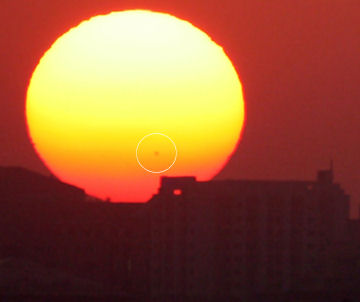
I actually found this far more interesting. Apparently the sunspot that created the intial flare is large enough it can be spotted with the naked eye. This sunspot is huge.
Image of the sunspot in question: http://spaceweather.com/swpod2010/02aug10/Oleg-Toumilovitch1_strip.jpg
SUNSPOT SUNRISE: Sunspot 1092, a key player in yesterday's Earth-directed eruptions, is big enough to see without the aid of a solar telescope. Oleg Toumilovitch "spotted" it on July 31st rising over Blairgowrie, South Africa:
Photo details: Canon EOS-350D, ISO-800, 1/1600s exposure
"During the first few minutes of sunrise only a fraction of the sunlight makes it's way to the observer - mostly from the red part of visible spectrum," notes Toumilovitch. "During this time large sunspots can be seen without a special solar filter." Be careful, though! Even when dimmed by clouds and haze, direct sunlight can hurt your eyes. "If you try to take a picture like this," advises Toumilovitch, "look only at the screen of your digital camera, not the optical viewfinder."
-
Re:This is not news...or news-worthy
I actually found this far more interesting. Apparently the sunspot that created the intial flare is large enough it can be spotted with the naked eye. This sunspot is huge.
Image of the sunspot in question: http://spaceweather.com/swpod2010/02aug10/Oleg-Toumilovitch1_strip.jpg
SUNSPOT SUNRISE: Sunspot 1092, a key player in yesterday's Earth-directed eruptions, is big enough to see without the aid of a solar telescope. Oleg Toumilovitch "spotted" it on July 31st rising over Blairgowrie, South Africa:
Photo details: Canon EOS-350D, ISO-800, 1/1600s exposure
"During the first few minutes of sunrise only a fraction of the sunlight makes it's way to the observer - mostly from the red part of visible spectrum," notes Toumilovitch. "During this time large sunspots can be seen without a special solar filter." Be careful, though! Even when dimmed by clouds and haze, direct sunlight can hurt your eyes. "If you try to take a picture like this," advises Toumilovitch, "look only at the screen of your digital camera, not the optical viewfinder."