Slashdot Mirror
Domain: stanford.edu
Stories and comments across the archive that link to stanford.edu.
Comments · 4,853
-
Re:A related story
There are some things that you cannot unsee.
-
Re:Don't like it?search engines are theoretically making it less likely that users will stay on the site past finding the page they wanted
But the gripping hand is that search engines (or other link aggregators) are the vastly predominant reason why users are on a site in the first place. It's been that way forever. Back in the stone age mid-90s, the single most important absolute number one web site (and home page of most, including me) was http://akebono.stanford.edu/ and although the URL has since changed, the principle remains true. Anyone who has worked on the web in the past decade should have known this fact already, and designed their site accordingly.
I often appreciate Neilsen's essays, but this one is just absurd whining. -
SRP is the right approach to passwords
MD5 is not the problem. The trouble with using a system like this is that if you can be fooled into trying to log in to the wrong server, then they can capture your password, because it has to be sent in a form the server understands and can verify against.
The right approach is something like SRP, which uses your password to negotiate a secure tunnel, in such a way that anyone who doesn't have the password, and doesn't guess it correctly during the negotiation phase, doesn't learn it and can't even take a new guess until next time there's a login attempt. This means that even relatively weak passwords gain a lot of security, because it's easy to limit the number of guesses the attacker is allowed.
If ssh used SRP, then you wouldn't have to worry about whether the remote host key is right, or whether it's changed - the fact that you manage to negotiate a proper session with them using your password means that they're a legit host. -
Been There, Done That...
There is an article Evolution of Mechanical Fingerspelling Hands for People who are Deaf-Blind that talks about the development of this technology since 1977.
There are a couple of challenges with this type of technology. Sign language does not depend only on finger movements but gestures and facial expressions to convey emotion and context. Finger-spelling hands, being mechanical, can only accept data so fast before they start "choking" and sezing up/breaking (we tried hooking one up to a teleprompter application, and its middle finger got stuck - go figure).
This technology can be exciting on a small scale, but is not meant (not able) to act as a replacement for sign language or even closed captioning.
-
Re:Legalities will be the downfall of America?
Well, to be honest, we should be using nuclear power anyway. It's very clean by relation to most currently available solutions. An interesting advocate of this, simply because, well, I like his computer science work, is Professor John McCarthy. Opponents of nuclear power would do well to read it.
-
Re:The Pure Profession
So presumably Category Theory doesn't exist?
-
Re:More cores are cool but are not the solution
GPUs can be used for all sorts of scientific processing.
Here Mike Houston talks about using a GPU for scientific calculations.
http://graphics.stanford.edu/~mhouston/public_talk s/R520-mhouston.pdf
also see
http://www.gpgpu.org/ -
Re:DRM is avoiding the underlying issue.
It is, in fact, VERY different from the old times.. You're right, you could copy your tapes and record off the radio... but... with the whole internet thing, the situation has been blown wide open.
I mean, how many people could/would you distribute your copied tapes to? You still have to go through all the trouble of copying the audio, buying the tapes.. I bet if you wanted to you would give your friends a tape and it would travel down the line (your friends give it to their friends and so on). That takes incredible long, meanwhile the tapes' audio quality are suffering greatly.
Here comes the internet, more specifically we can use Kazaa as an example. Thousands and thousands of people can get what you copied in a matter of hours. I hope you can tell the difference now. And you can also note that Napster is what really started alot of the major actions by the RIAA.
For further reading you can try this article on what has been coined the darknet. -
Stupid Coral cache submission.
a) not everyone can access port 8090 from behind a firewall.
b) It's Stanford. Do you really think they're lacking for bandwidth?
non-Coral link here -
Potental Funding for Twelve Steps in TrustABLE IT!See Twelve Step TrustABLE IT : VLSBs in VDNZs From TBA.
Stanford is also the home of the Meta-level Compilation (MC) project, a useful auditing tool for trusted build agents.
Now that Microsoft is getting into the signiture and behavour based antivirus industry, maybe Symantic could turn its patten matching technology to checking source code instead of binaries.
-
Re:orbit?
Because of some obscure effects of general relativity, and not because of gravity waves as some people think. I can write you differential equations of, but I'm not going to write them here in ASCII art.
These effects are extremely weak in our Solar System, but they can be observed in perihellion precession of planets ( http://en.wikipedia.org/wiki/Precession#Precession _of_planetary_orbits ). Right now Gravity Probe B ( http://einstein.stanford.edu/ ) is in the final stage of experiment which aims to check the gravitomagnetic effect which is another manifestation of GR (and is partially responsible for decay of black hole orbits). -
Re:Don't talk to me about Boost> > "would be nearly impossible to duplicate in C with the same kind of efficiency"
> BS. Unless you think theres some sort of magical assembly language that a C++ compiler can generate than a C compiled couldn't.
You could generate the same instructions in C, but you wouldn't. C++'s metaprogramming allows you to write code once yet specialize it for the best performance for each type. See this sorting comparison for an example. The C approach to genericizing code is to do extra work at run-time. The C++ approach is to do extra work at compile-time. In many cases (especially dealing with scientific stuff), that's much faster. So while theoretically, you can write specialized sorts for every data type in C, no one ever does. In C++, you don't even think about it.
-
My two $ 0.02
So, I live in Slovenia (I doubt any of you know where that is). But we have a nuclear plant. And it's been running for quite a while now. Because I've also studied physics I've found out, during some lectures, that the measurments taken around the nuclear plant show, that the grass around it recieves the exact same amount of the yearly dosage of radiation as something located far far away. Therefore, this energy is very clean, much cleaner than cole.
Right, so, then a disaster happens. Well, chances are very slim for a disaster. Today, we have a higher safety regulation for operating of nuclear power plants, and we are not competing on who gets to restart the turbines faster (check this) without using safety measures.
Besides disaster possibility, the problem is also waste dispossal as a poster pointed out before me. Where to put it. You simply cannot dissolve the waste, or this is to expensive. And I don't think the problem with space dumping is the image of Columbia blowing up. Waste baskets can be made that whitstand such blasts. It's more of the awarness that we can't already pollute the space, since we fuc*** up mother Earth. And it's becoming an increasing security concern too with all the terrorists roaming around. Imagine a break-in into the waste storage facility. It's easy to make a dirty bomb. Breaking into the plant itself is much harder, although it's still a possibility.
In conclusion, I think we have to accept the risks of possible danger (we fly with airlens, but those also crash don't they?) if in turn, we get back a possibility for a cleaner environment. And until we develop things than can use all the free enegry just lying around and as long as we use things that rely on our supply of power (computers among other things -
Yes, it is what Enron did.
Mark to market isn't what Enron did.
Yes, Mark-to-market is what Enron did:
"As McLean pointed out, her Fortune article, "Is Enron Overpriced?" appeared in March 2001. Yet in 1993 an article in Forbes sharply questioned Enron's troubling mark-to-market accounting for assets, which claimed profits for investments long before it was clear that they would in fact evolve. A few years later, an article in Fortune again signaled concern." -
Re:PatentHawk charges $125/hourI think there's a valid meta-debate issue that is implied, though.
In a public policy debate, the idea is supposed to be that the law in question is maybe actually good public policy in that it has indirect benefits for the public, as well as direct benefits for certain individuals.
For example, in the copyright debate, some people will argue that the copyright monopoly offers the population at large a benefit by giving an incentive for creators to create new works. Moreover, some people argue this even though they themselves do not have a significant financial stake in copyright; that is, they will only benefit through that indirect gain of more new works. The fact that some people will argue even this position even though they only gain indirectly gives some credence to the idea that it's a legitimate public policy argument.
On the other hand, you have the patent argument. A similar claim is advanced re: innovation. However, in my experience, everyone who defends (software) patents turns out to have a direct financial stake:
- patent holders (and patent-holders-to-be)
- patent lawyers
- the patent office
Obviously a government program that gives money to people of type A, B, and C is beneficial to people of type A, B, and C, and of course people of type A, B, and C are going to be in favor of such a program. But this is not evidence that such a program is good public policy, especially if it deprives other people of something (in this case, by granting a monopoly).
So when an individual in the patent debate turns out to have a direct stake in patents, I think it's perfectly reasonable to say "I'm not even going to bother reading that because I've seen this pattern far too many times over the last 15 years.
-
Re:PatentHawk charges $125/hour
I didn't know that. I had always read/heard that Jobs got a tour at PARC and went back and incorporated what he saw.
Do you have a source for that? I can't find anything that says Applic licenesed anything from Xerox.
on the contrary:
http://en.wikipedia.org/wiki/Apple_v._Microsoft
In an odd twist midway through the suit, Xerox filed a lawsuit against Apple, claiming Apple had infringed copyrights Xerox held on its GUIs. Xerox had invested in Apple and had invited the Macintosh design team to view their GUI computers at the PARC research lab; these visits had been very influential on the development of the Macintosh GUI. The Xerox case was dismissed on a technicality.
If Apple had licensed Xerox GUI ideas/designs/components, why did Xerox sue?
In fact:
http://news.com.com/5208-1016-0.html?forumID=1&thr eadID=6103&messageID=38010&start=-114
Apple licensed technology from Xerox and improved on it
Reader post by: Michael Louka
Posted on: April 15, 2005, 6:14 AM PDT
Story: An early peek at Longhorn
This is incorect, based on common myths about Apple and
Xerox, which are really unfair to the true innovators. Douglas
Englebart, Xerox, and Apple all contributed to the development
of the desktop GUI as we know it today, and each of them added
significant innovations
1) The concept of the mouse-controlled UI was NOT a Xerox
innvolation. It was conceived by Douglas Englebart much earlier
(see for example http://sloan.stanford.edu/MouseSite/
1968Demo.html)
2) Xerox produced the first (very expensive) commercial system
with a bitmap GUI display with pop-up menus that used a
windowing concept and some SmallTalk niceties (that the Mac
OS did not learn from), and a mouse to control it and do stuff
like selecting text (however the mac introduced direct
manipulation of such text).
3) Apple licensed the technology from Xerox. Yes, they actually
*paid* for it. Apple is commonly accused of stealing ideas from
Xerox (like many later accused Microsoft of stealing ideas from
Apple), but Apple licensed the technology from Xerox, and it
was knowingly demonstrated to Apple, so these repeated
accusations of stealling are very unfair, especially since those
that accuse apple of stealing the interface extend the interface
concept way beyond what Xerox had, to also encompass Apple's
own innvoations, which Apple should be credited for! See http:///
www.folklore.org/StoryView.py?
project=Macintosh&story=On_Xerox,_Apple_and_Progre ss.txt&t
opic=Origins&sortOrder=Sort%20by%20Date&detail=med ium
4) Apple developed the desktop metaphor (The Mac Finder with
drag and drop manipulation of files and folder, the trash can,
etc.) that most modern systems use. This was not a part of the
Xerox design and was a significant innovation by Apple that
greatly enhanced the usability of computer systems. The Star did
not even have overlapping window, which were also a Mac first.
if you are interesting in computing history and the development
of the desktop GUI as we know it today see:
http://www.folklore.org/StoryView.py?project=Macin tosh&story=Busy_Being_Born.txt&topic=User%20Interf ace&sortOrder=Sort%20by%20Date&detail=medium
I realize this is a post on a user forum and hardly authoritative, but it was the best I could find on short notice to respond to the 'nitwit' belittlement. -
Re:Global Warming Scare continues
The norms for areas where we have records for. This includes tree rings and ice core samples which go back several thousand years.
We only have detailed reords for about the past 150 years, but on the longer timescales the ice-cores and tree rings give a general idea what the climate was like. The norms I was referring to however, only deal with the past 150 years.
I'm not "making stuff up". You misinterpereted what I said (or maybe I wasn't specific enough).
And that's not even the point I was trying to make. The point is simple, the climate is changing. It's deviating from the averages that we have come to expect. That means we have to change with it.
Regardless of whether we are causing it or helping it we have to anticipate the changes and adapt to them.
The other choice is do nothing and watch, and hope we don't have the same climatic shifts that we've seen in the past. See http://www.stanford.edu/~meehan/donnellyr/summary. html
~X~ -
Moving Cheese
-
That's all good..References.
Here's a PDF on probabilistic robotics.
http://robots.stanford.edu/papers/thrun.probrob.pd f
http://robots.stanford.edu/papers.html
Has more references. -
That's all good..References.
Here's a PDF on probabilistic robotics.
http://robots.stanford.edu/papers/thrun.probrob.pd f
http://robots.stanford.edu/papers.html
Has more references. -
Re:Latency, latency, latency.
Yes, I agree 100%. Latency is the killer to most apps. I happen to be lucky to have a T1 at home. Running VOIP and gaming, I still have smooth speady web browsing (even though its ONLY 1.5MB up and 1.5MB down). I also thing of the great, must read article, It's the latency stupid: http://rescomp.stanford.edu/~cheshire/rants/Laten
c y.html -
Another site with manufacturing videos
Stanford University hosts another cool free site with manufacturing videos, entitled "How Everyday Things Are Made"
http://manufacturing.stanford.edu/
Here is the site's description:
"If you've ever wondered how things are made - products like candy, cars, airplanes, or bottles - or if you've been interested in manufacturing processes, like forging, casting, or injection molding, then you've come to the right place."
The videos play using Flash; some are longer than others. Since the videos are donated (they aren't made by Stanford) some of them spew a bit of propaganda, but overall they are excellent. -
ccrma?
This Medialinux thing is better than fedora/CCRMA how?
I don't object in the least to anyone making a new distribution of BSD or Linux, but realistically if you're going to do so... differentiate yourself somehow. At the very least, don't be a bad imitation of another setup.
I have to wonder if these people even bothered to research existing resources. -
A better piece on the topic
This is a far more eloquent and humorous piece on the topic.
-
Re:tis the seasonDonald Knuth is a Lutheran, or at least goes to the First Lutheran Church of Palo Alto now and then. See his news page for his occasionally scheduled appearances to have informal talks about Bible verses.
I suggest you look into two of his books, "3:16 Bible Texts Illuminated" and "Things a Computer Scientist Rarely Talks About".
He gave some lectures about how he wrote "3:16", his motivations for doing so, and various thoughts about God. These lectures were the basis for "Things a Computer Scientist Rarely Talks About"
-
Re:Becoming the new Xerox ParcThe corresponding urls:
http://www.sri.com/about/timeline/mouse.html
streaming video of the '68 demonstration
-
Re:You are on the right track ...Thank's for your detailed response. I've thought about these things for a while and I find other people's thought out views fascinating. We do have a small disagreement and I hope it doesn't escalate as parodied in the famous Emo Phillips joke.
This seems to be a topic that it easier to think about than talk about. As you suggest in the title of your original post, a lot of the problem can be mere semantics. Or to paraphrase the old adventure game, we seem to be facing a maze of twisty little metaphors all alike.
Another possible source of disagreement is the perspective of where we are coming from and where we want to go. I am trying to reconcile my "Physics" view of the world with my spiritual view. In particular I am interested in exploring the connections (if any) between the mathematical ideas exposed by Godel's Theorems and my experiences of self-awareness and consciousness. I see some very interesting parallels between the mathematical techniques used to "tame" Godel's Theorems and some of the common threads that run through many of the great spiritual paths.
Another source of difference is our personal experiences. I was extremely struck by my first instant of self-awareness. My realization of the hall of mirrors occurred many years later and was beautiful and dizzying but was not nearly so profound. What was almost as profound was my appreciation of the existence of the consciousness of others. The metaphor I find most useful for this experience is Indra's Net where each jewel in the net is a consciousness that reflects all of reality.
Perhaps your experience was vastly different from my own. Maybe you were given the hall of mirrors as mediation topic or a koan and it led you to a profound experience.
In your original post you had asked if there was any AI or evolutionary psychology definitions of self-awareness. The best (in fact, only) scientific definition I know of is the mathematical one discovered by Godel and explained in Smullyan's book.
I admit that it might seem foolhardy to try to make any link between the mathematics of Godel and human consciousness. This path is certainly filled with traps that have already caught many. For a while I despaired that anything more than weird coincidences and wild speculation would be impossible. But then I found E. T. Jaynes' book Probability Theory : The Logic of Science and my hopes increased. Jaynes mathematically defines an optimal "plausible reasoner" and makes several compelling arguments why our own personal models of reality should follow the same rules as the plausible reasoner.
It may never be possible to prove that results similar to Godel's apply to human consciousness. But it might be possible to apply Godel's ideas to Jaynes' plausible reasoner. Any non-trivial results would be extremely interesting and would help give us insights into human consciousness even though we can't prove mathematically that they apply to consciousness. AFAIK, very little (if any) of the non-trivial things that have been said about human consciousness can be proven mathematically.
I am not looking for proofs, for now I am content to examine the analogy and see how the concepts discovered by Godel relate to similar ideas in some of the major spiritual paths. I don't think I can change anyone's beliefs, but I hope to develop a very well defined vocabulary so that practitioners of various paths could say "yes this is what I am talking about" or "no that is not what I mean".
At best it would be a precise language with which to discuss consciousness and spiritual matters, at worst it would be all:
That is not what I meant at all.
That is not it, at all. -
Python was used in Google's first academic version
In L&S's "Anatomy of a search engine article" they wrote:
In order to scale to hundreds of millions of web pages, Google has a fast distributed crawling system. A single URLserver serves lists of URLs to a number of crawlers (we typically ran about 3). Both the URLserver and the crawlers are implemented in Python
http://www-db.stanford.edu/~backrub/google.html
A way of returning a favor, perhaps? -
Re:Wrong. Scientific Method cannot be applied to IThank FSM the ID proponents haven't taken up Feyerabend. Imagine if they started making compelling, rational arguments rejecting the actual power of scientific method within the 'scentific community,' and went from there to incommensurability as a basis for not comparing ID and evolution, up to the counter-induction principle as a basis for inclusion... The sad part is, as interesting as Feyerabend is, his actual position would have been for the inclusion of ID if it's what people wanted...
I hate that interesting and thoughtful critiques from science studies/ philosophy of science might eventually work for these christian fundie fascist wingnuts.
Before flaming back, NB the above description is a simplification (and, often conflation) of Feyerabend's work, such as I conjecture ID'ers might turn to. His actual work is quite interesting and far more nuanced.
-
Re:Serious talk about consciousness
Umm, no. There are plenty of disagreements over the nature of consciousness, but this is just sillyness that not even a hard core analytic functionalist should care to defend. A good intro to the subject can be found in the (excellent) Stanford Encyclopedia of Philosophy. Stanfod Encyclopedia of Philosophy
Hah, that's what you think ! -
Serious talk about consciousnessFrom TFA: "In humans, consciousness is basically a state in which the behavior of the self and another is understood," said Takeno.
Umm, no. There are plenty of disagreements over the nature of consciousness, but this is just sillyness that not even a hard core analytic functionalist should care to defend. A good intro to the subject can be found in the (excellent) Stanford Encyclopedia of Philosophy. Stanfod Encyclopedia of Philosophy
-
Re:No Numbers
Well, I can appreciate the space-saving design in theory, but I doubt anything good will come from a keyboard in which you need to use a Function key to type a number.
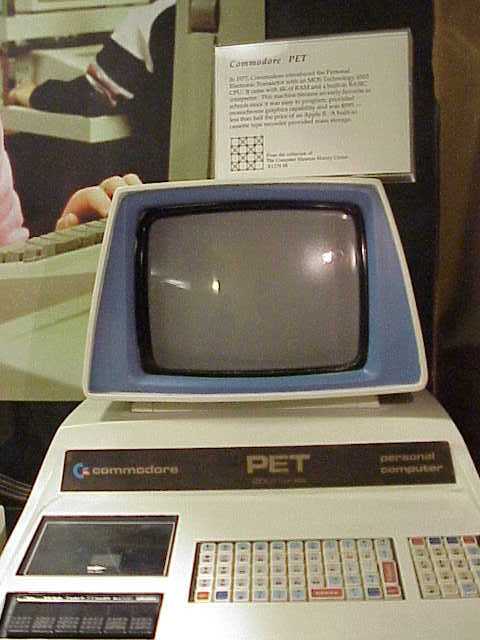
This reminds me of the PET computer space-saving technique I got to "enjoy" when I was in Junior High School. "Save space by lining the keys up vertically". That keyboard wasn't very amusing to try to deal with. Just adjusting the keys (much less combo-presses as mentioned in this article) like that was torture.
For those who didn't get to enjoy the PET space-saving keyboard "innovation", here's a picture -
Re:That day came some time ago...the day that IE7 comes out with it's phishing filter.
The Applied Cryto Group has had two anti phising extensions out for some time. One is for IE and Firefox, the other is for IE only.
From the site: " SpoofGuard is a browser plug in that is compatible with Microsoft Internet Explore. SpoofGuard places a traffic light in your browser toolbar that turns from green to yellow to red as you navigate to a spoof site. If you try to enter sensitive information into a form from a spoof site, SpoofGuard will save your data and warn you. SpoofGuard warnings occur when alarm indicators reach a level that depends on parameters that are set by the user"
I only use IE to download MS patches and updates so I've not installed SpoofGuard. I've used the Firefox extension for sometime now.
From the site: "PwdHash is an browser extension that transparently converts a user's password into a domain-specific password. The user can activate this hashing by choosing passwords that start with a special prefix (@@) or by pressing a special password key (F2). PwdHash automatically replaces the contents of these password fields with a one-way hash of the pair (password, domain-name). As a result, the site only sees a domain-specific hash of the password, as opposed to the password itself. A break-in at a low security site exposes password hashes rather than an actual password. We emphasize that the hash function we use is public and can be computed on any machine which enables users to login to their web accounts from any machine in the world. Hashing is done using a Pseudo Random Function (PRF)."
"Phishing protection. A major benefit of PwdHash is that it provides a defense against password phishing scams. In a phishing scam, users are directed to a spoof web site where they are asked to enter their username and password. SpoofGuard is a browser extension that alerts the user when a phishing page is encountered. PwdHash complements SpoofGuard in defending users from phishng scams: using PwdHash the phisher only sees a hash of the password specific to the domain hosting the spoof page. This hash is useless at the site that the phisher intended to spoof."
Personally I find prudence and a healthy dose of incredulity to be the best antiphising measures.
-
Re:That day came some time ago...the day that IE7 comes out with it's phishing filter.
The Applied Cryto Group has had two anti phising extensions out for some time. One is for IE and Firefox, the other is for IE only.
From the site: " SpoofGuard is a browser plug in that is compatible with Microsoft Internet Explore. SpoofGuard places a traffic light in your browser toolbar that turns from green to yellow to red as you navigate to a spoof site. If you try to enter sensitive information into a form from a spoof site, SpoofGuard will save your data and warn you. SpoofGuard warnings occur when alarm indicators reach a level that depends on parameters that are set by the user"
I only use IE to download MS patches and updates so I've not installed SpoofGuard. I've used the Firefox extension for sometime now.
From the site: "PwdHash is an browser extension that transparently converts a user's password into a domain-specific password. The user can activate this hashing by choosing passwords that start with a special prefix (@@) or by pressing a special password key (F2). PwdHash automatically replaces the contents of these password fields with a one-way hash of the pair (password, domain-name). As a result, the site only sees a domain-specific hash of the password, as opposed to the password itself. A break-in at a low security site exposes password hashes rather than an actual password. We emphasize that the hash function we use is public and can be computed on any machine which enables users to login to their web accounts from any machine in the world. Hashing is done using a Pseudo Random Function (PRF)."
"Phishing protection. A major benefit of PwdHash is that it provides a defense against password phishing scams. In a phishing scam, users are directed to a spoof web site where they are asked to enter their username and password. SpoofGuard is a browser extension that alerts the user when a phishing page is encountered. PwdHash complements SpoofGuard in defending users from phishng scams: using PwdHash the phisher only sees a hash of the password specific to the domain hosting the spoof page. This hash is useless at the site that the phisher intended to spoof."
Personally I find prudence and a healthy dose of incredulity to be the best antiphising measures.
-
Re:That day came some time ago...the day that IE7 comes out with it's phishing filter.
The Applied Cryto Group has had two anti phising extensions out for some time. One is for IE and Firefox, the other is for IE only.
From the site: " SpoofGuard is a browser plug in that is compatible with Microsoft Internet Explore. SpoofGuard places a traffic light in your browser toolbar that turns from green to yellow to red as you navigate to a spoof site. If you try to enter sensitive information into a form from a spoof site, SpoofGuard will save your data and warn you. SpoofGuard warnings occur when alarm indicators reach a level that depends on parameters that are set by the user"
I only use IE to download MS patches and updates so I've not installed SpoofGuard. I've used the Firefox extension for sometime now.
From the site: "PwdHash is an browser extension that transparently converts a user's password into a domain-specific password. The user can activate this hashing by choosing passwords that start with a special prefix (@@) or by pressing a special password key (F2). PwdHash automatically replaces the contents of these password fields with a one-way hash of the pair (password, domain-name). As a result, the site only sees a domain-specific hash of the password, as opposed to the password itself. A break-in at a low security site exposes password hashes rather than an actual password. We emphasize that the hash function we use is public and can be computed on any machine which enables users to login to their web accounts from any machine in the world. Hashing is done using a Pseudo Random Function (PRF)."
"Phishing protection. A major benefit of PwdHash is that it provides a defense against password phishing scams. In a phishing scam, users are directed to a spoof web site where they are asked to enter their username and password. SpoofGuard is a browser extension that alerts the user when a phishing page is encountered. PwdHash complements SpoofGuard in defending users from phishng scams: using PwdHash the phisher only sees a hash of the password specific to the domain hosting the spoof page. This hash is useless at the site that the phisher intended to spoof."
Personally I find prudence and a healthy dose of incredulity to be the best antiphising measures.
-
Re:I have enough trouble with keyboards already
Oh yeah, I know about Xmodmap. Used to be the first thing I'd install when I was setting up a Sun workstation. Alas, it doesn't work on the evil Sun Ray terminals Sun now forces all its non-developer employees to use. Notice I said "terminals". Officially it's a "thin client", but it doesn't do anything that fits in the client-server model. It's just a graphics terminal, with all the actual computing taking place on a central host. Yes, Time-Sharing is back!
-
Jeri Ellsworth's C64 Emulator hardware
Jeri Ellsworth is a self-taught VLSI designer (she also built racing cars for a few years.) She gave a great talk at Stanford on her experiences growing up as a hacker, putting up with prejudice against female high-school dropouts, hanging out at computer stores and starting one, learning VLSI and learning how to work with toy and electronics manufacturers to get things manufactured in China, and about the design itself. She did two C64 emulators. Commodore-One was the first, and the newer C64DTV is built into the base of a joystick. In addition to the commodoreworld site, it's available less expensively at Amazon.
-
Re:Moral VictoryAlright, define "authority." If you accept the challenge, you have set yourself up as an authority by claiming that "Nobody can possibly be an authority on anything at all", which means that your statement is incoherent and disregardable. If you decline the challenge, your statement is void of content. Either way, on simply logical grounds, your statement falls apart.
The point is that all of us reading this thread are fully aware of Kant's distinction between phenomenal and noumenal realms, and are fully aware that, beginning with the senses, it is impossible to achieve perfectly justified knowledge. Nevertheless, there are also clearly *some* people who have taken the time to investigate area X and come to conclusions, regardless of their "objectivity." Unless their conclusions are outrageous -- another "non-objective" term! -- we choose to call them "authorities on X", and tend to accept their judgment in matters regarding X, possibly even in preference to our own judgment in that area. It's not a matter of objective knowledge; it's a concession to our finite time and resources (No doubt amply demonstrated by my posting comments on Slashdot).
BTW, before you get too excited about knowledge being unattainable and humans being incapable of objectivity, you might want to consider the philosophical consequences of accepting relativism.
The article's long, but highly enlightening. It might rescue you from a silly epistemological fate.
-
If I'd use Flash to display text ...
... my site wouldn't get indexed properly by my favorite search engine, and NOBODY would read it anymore. So much for the need of readability. The homepage of mr. Knuth, who cares deeply about fonts, isn't flash-enabled either, as you may have noticed. It simply uses a large font size for readability. Seems a lot more effective to me than using flash.
-
Re:Dramatic Final Episode
In some senses, that's true, but England has is a far more plaintiff-friendly nation for libel (click)
Ali G (Sasha Cohen), for example may ACTUALLY be at risk for libel if Kazakhstan can obtain jurisdiction over him in England. -
Art of Programming by KnuthExcellent books
Don't forget the 4th here
CLG -
Site hash password generator
Here's one that's written in JavaScript so you can run it remotely wherever or as a Mozilla/Firefox extension:
http://crypto.stanford.edu/PwdHash/RemotePwdHash/
http://crypto.stanford.edu/PwdHash/
PwdHash takes your generic password and uses it to hash the address of the site you're accessing to generate a site-specific password. This way you only have to remember your single generic password but each site never sees it.
q -
Site hash password generator
Here's one that's written in JavaScript so you can run it remotely wherever or as a Mozilla/Firefox extension:
http://crypto.stanford.edu/PwdHash/RemotePwdHash/
http://crypto.stanford.edu/PwdHash/
PwdHash takes your generic password and uses it to hash the address of the site you're accessing to generate a site-specific password. This way you only have to remember your single generic password but each site never sees it.
q -
Stanford's Most Famous Alumnus is . . .
A friend of mine studying journalism at Google's alma mater . . .
Here's a list of people pissed off that Stanford is now Google's. For starters, if Google is big for its Internet historics, how about Vint Cerf? And didn't Yahoo do what Google did before there was a Google?
For the impatient, the Google guys are on Stanford's list. They're listed last in the "Business Leaders" category, the only ones out of alphabetic order. Guess which Slashdot anger magnet's CEO comes first alphabetically? -
Re:Overkill
Still, just the lyrics is not the entire song. You aren't including the notes, the tempo, the instruments, etc.
As noted elsethread, copyright law is quite specific in saying that the lyrics are covered.
The courts have established guidelines for the the questions to ask in determing whether something is fair use, and your argument doesn't seem to fit them very closely at all. That's not to say that there are no arguments possible -- certainly you could make a pretty good argument on the "transformative" criterion and probably as to the effect (or lack thereof) on the potential market as well. OTOH, I'm pretty sure almost any judge around would utterly reject your argument on the basis of the amount of the original that was taken -- and to qualify as fair use, you need to meet all the criteria they set.
So, you can certainly justify putting up a web page with "ok, I listened to this song on the radio, and here are the lyrics as I understood them" and calling it fair use.
You may be able to justify it to yourself. If you honestly think a judge is going to buy it, well, you're probably pretty safe -- because you're almost certainly too busy doing drugs to every really create such a web site at all.
--
The universe is a figment of its own imagination. -
Re:Overkill
But aren't lyrics not copyrighted or are the hundreds of sites out there that give song lyrics away for free underground criminal enterprises?
Yes lyrics are subject to copyright. This particular quote is from US law, but I'm reasonably certain all countries that follow the Berne Convention (and most at least claims to) have similar rules.
Of course, Fair Use is a possibility as well -- but almost certainly not in the case of quoting the lyrics to a complete song.
--
The universe is a figment of its own imagination. -
has anyone bothered to keep up with the times?So many comments talk about content, but content similarity was abandoned as the chief measure in searching years ago, when people started filling their pages with invisible, offtopic keywords to show up higher. Most contemporary ranking schemes are based on hyperlink analysis, i.e. the number and type of pages that LINK to your page, and vice versa.
If you want to figure out how to boost your ratings, why not get the advice from the horse's mouth?
Brin and Page's original paper about PageRank (Google) : the original Google paper
Another PageRank paper Inside PageRank
For those with a taste for Yahoo, search for Kleinberg's original 1998 paper on HITS. I seriously doubt that these authors have anything more to contribute than the two papers I listed, unless of course they worked for Google/Yahoo and are violating some SERIOUS NDAs.
-
Re:SolutionThat's why I Touring-test every single person I ever chat with on IM clients.
Well, I'd leave the room too - after all, running around visiting a bunch of places is a little extreme just to get to talk with you. I think a Turing test http://plato.stanford.edu/entries/turing-test/ may leave you feeling a bit less lonely.
-
Almost right.
The leakage path relevant to tunneling is through the gate oxide, from the gate to the channel below it. In this case, the width of the barrier is the gate oxide thickness, not the gate length. So the ways to decrease tunneling include having a thicker gate oxide, but of course it'll still be slower (less capacitive coupling of the gate to the charge in the channel). A representative paper reviewing gate tunneling and its effects on logic gate performance is this one (in pdf).
Also, the height of the barrier is determined by the material properties, not the gate voltage. With that said, I still don't understand how the authors can do what the press release says they say they do. How does RTA affect the material properies enough to affect tunneling significantly? MOS gate oxides are one of the most studied materials known to man, with uncounted man-millenia devoted to eliminating any defects therein. What did they miss?
A final thought--if this was such a fundamental breakthrough one would think it would be presented at the International Electron Devices Meeting itself, rather than at the small conference associated with it held later in the week. But maybe not. -
Re:then there was Jean Michel Jarre