Slashdot Mirror
Domain: techcrunch.com
Stories and comments across the archive that link to techcrunch.com.
Stories · 1,414
-
San Francisco's Housing Crisis Explained
An anonymous reader writes "We've heard a few brief accounts recently of the housing situation in San Francisco, and how it's leading to protests, gentrification, and bad blood between long-time residents and the newer tech crowd. It's a complicated issue, and none of the reports so far have really done it justice. Now, TechCrunch has posted a ludicrously long article explaining exactly what's going on, from regulations forbidding Google to move people into Mountain View instead, to the political battle to get more housing built, to the compromises that have already been made. It's a long read, but well-researched and interesting. It concludes: 'The crisis we're seeing is the result of decades of choices, and while the tech industry is a sexy, attention-grabbing target, it cannot shoulder blame for this alone. Unless a new direction emerges, this will keep getting worse until the next economic crash, and then it will re-surface again eight years later. Or it will keep spilling over into Oakland, which is a whole other Pandora's box of gentrification issues. The high housing costs aren't healthy for the city, nor are they healthy for the industry. Both thrive on a constant flow of ideas and people.'" -
Google Buys Drone Maker Titan Aerospace
garymortimer (1882326) writes "Google has acquired drone maker Titan Aerospace. Titan is a New Mexico-based company that makes high-flying solar powered drones. There's no word on the price Google paid, but Facebook had been in talks to acquire the company earlier this year for a reported $60 million. Presumably, Google paid more than that to keep it away from Facebook. 'Google had just recently demonstrated how its Loon prototype balloons could traverse the globe in a remarkably short period of time, but the use of drones could conceivably make a network of Internet-providing automotons even better at globe-trotting, with a higher degree of control and ability to react to changing conditions. Some kind of hybrid system might also be in the pipeline that marries both technologies.'" -
GM Names Names, Suspends Two Engineers Over Ignition-Switch Safety
cartechboy (2660665) writes "GM said it has placed two engineers on paid leave in connection with its massive recall probe of 2 million vehicles. Now, GM is asking NASA to advise on whether those cars are safe to drive even with the ignition key alone. Significantly, individual engineers now have their names in print and face a raft of inquiries what they did or didn't know, did or didn't do, and when. A vulnerability for GM: One engineer may have tried to re-engineer the faulty ignition switch without changing the part number—an unheard-of practice in the industry. Is it a good thing that people who engineer for a living can now get their names on national news for parts designed 10 years ago? The next time your mail goes down, should we know the name of the guy whose code flaw may have caused that?" -
Intel Releases $99 'MinnowBoard Max,' an Open-Source Single-Board Computer
A few months back, we posted a video interview with some of the folks behind the Linux-friendly, x86-based MinnowBoard. TechCrunch reports the release of a more powerful version of the same all-in-one computer, now with a 1.91GHz Atom E3845 processor. According to the linked article, "The board's schematics are also available for download and the Intel graphics chipset has open-source drivers so hackers can have their way with the board. While it doesn’t compete directly with the Raspberry Pi – the Pi is more an educational tool and already has a robust ecosystem – it is a way for DIYers to mess around in x86 architected systems as well as save a bit of cash. The system uses break-out boards called Lures to expand functionality." -
Illustrating the Socioeconomic Divide With iOS and Android
An anonymous reader writes: "Android has a huge market share advantage over iOS these days, but it hasn't had as much success at following the money. iOS continues to win over many app developers and businesses who want to maximize their earnings. Now, an article at Slate goes over some of the statistics demonstrating this trend. A map of geo-located Tweets show that in Manhattan, a generally affluent area, most of the Tweets come from iPhones. Meanwhile, in nearby Newark, which is a poorer area, most Tweets come from Android devices. In other tests, traffic data shows 87% of visits to e-commerce websites from tablets come from iPads, and the average value of an order from an iPad is $155, compared to $110 from Android tablets. (Android fairs a bit better on phones). Android shows a huge market share advantage in poorer countries, as well. Not all devs and business are just chasing the money, though. Twitter developer Cennydd Bowles said, 'I do hope, given tech's rhetoric about changing the world and disrupting outdated hierarchies, that we don't really think only those with revenue potential are worth our attention. A designer has a duty to be empathetic; to understand and embrace people not like him/herself. A group owning different devices to the design elite is not a valid reason to neglect their needs.'" -
Microsoft: Start Menu Returns, Windows Free For Small Device OEMs, Cortana Beta
At Microsoft's BUILD conference today, the company announced that the Start Menu will officially be returning to Windows 8.1. It will combine the Windows 7 Start Menu with a handful of Metro-style tiles. They're also making it so Windows 8 apps can run in windows using the normal desktop environment. In addition to the desktop announcements, Microsoft also talked about big changes for Windows on mobile devices and Internet-of-Things devices. The company will be giving Windows away for free to OEMs making phones and tablets (9" screens and smaller), and for IoT devices that can run it. Microsoft also finally unveiled Cortana, their digital assistant software that's similar to Siri. -
Amazon Launches Android-Powered 'Fire TV' For Streaming and Gaming
Today Amazon launched 'Fire TV,' a new video streaming box designed to compete with devices like the Roku and Apple TV. The Fire TV runs Android on a quad-core Qualcomm 1.7 GHz processor with 8GB of internal storage and 2GB of RAM. It supports 1080p video output at 60fps and measures 4.5" x 4.5" x 0.7". The Fire TV is also explicitly designed to support gaming, and Amazon has concurrently launched their own game controller. The Fire TV's remote control includes a microphone and a button that lets you search TV show and movies by voice. -
If Ridesharing Is Banned, What About Ride-Trading?
Bennett Haselton writes "The city of Seattle just imposed new limits on commercial app-based ride-sharing companies like Uber and Lyft, effectively protecting taxi companies from low-cost competition in the form of smartphone apps. If other cities follow suit, could a company help ridesharers circumvent the restrictions by creating a ride-trading app, allowing drivers to earn 'miles' by driving passengers, and redeem those miles later to get rides for themselves?" Continue reading below to see what Bennett has to say.The cab companies got Seattle to crack down on ridesharing companies by arguing that by letting drivers charge money for rides, they were essentially operating illegal unlicensed taxi services. So it's not hard to imagine other cities taking similar action on the same ambiguous legal grounds, as Los Angeles did in sending cease-and-desist notices to Uber, Lyft and Sidecar, ordering them to stop operating entirely.
I tried some of these services and actually never saw what the big deal was. Much of the time, they were almost as expensive as taxis, much too pricey to use on a regular basis, and I would never use them unless my own poor planning left me somewhere without my own car and desperate somewhere faster than public transit could take me. Perhaps cab companies were afraid of where the services were eventually headed -- especially towards a model where drivers could set their own prices. As far as I know, currently all ridesharing services set a minimum price per mile and don't let drivers set their rate any lower. But many drivers would probably be willing to drive at a price lower than what the app allows, and a set-your-own-price model probably really would put the cab companies out of business.
Perhaps some cities will take a more benign view of ridesharing in the long run, but as long as money is changing hands, (1) the city will certainly view it as within their rights to regulate the ridesharing industry, and (2) taxi companies will be able to argue, not unreasonably, that the companies are effectively running unlicensed taxi services. Of course the real solution would be for cities to stop limiting the supply of taxi medallions and artificially enriching cab companies at everyone else's expense (if the city's concern is with rider "safety", they could increase the number of taxi medallions while still requiring all drivers to take safety training). But that doesn't seem likely to happen any time soon. So instead, what if a company created an app that attempted to circumvent the legal restrictions, by allowing users to trade rides -- not for cash, but for returning the favor?
Here's how it could work: When you sign up as a new user, you have a "miles" balance of zero. (The very first users of the system would have to start out with a nonzero balance, so that there are some units in the system to trade, but everyone who joins after that starts at zero.) You have to earn miles by giving someone else a ride before you can redeem your miles by getting a ride yourself. So you log in as a driver, and some other user "hails" you through their smartphone app, much as riders hail drivers through Uber or Lyft. You pick up a passenger and give them a ride to their destination, and at the end of the journey, they transfer a number of "miles" to you indicating how far you drove them. You now have a positive miles balance, and you can "spend" it by hailing a ride yourself later on. Drivers and riders could leave ratings for each other just as they do on Uber and Lyft. What Couchsurfing is to Airbnb, this service would be to Uber.
Since no money is changing hands, the arrangements would presumably not be covered by existing taxi statutes. You could even make an argument that a city couldn't pass a law regulating these ride-trades even if they wanted to, because as voluntary arrangements between consenting parties, they're protected under our First Amendment right of freedom of association! Of course, libertarians believe all commercial transactions between consenting parties ought to be exempt from regulation as well, but most state and local governments take a dim view of that premise. However, take money out of the equation, and you're on much stronger ground that your ride-trading arrangements aren't covered by existing laws.
(It is of course silly and inconsistent that the law often forbids selling something for money, but allows trading it for something of "value", or permits it if the nature of the trade is not made explicitly clear. If a girl sleeps with you and you occasionally "lend" her money, she's a high-maintenance girlfriend, but if she ever does you the courtesy of spelling out the arrangement explicitly, she's a prostitute and can go to jail. But as long as the government makes those silly and arbitrary distinctions, we might as well use them when they count in our favor.)
Would ride-trading with strangers be safe? Well, when a rider pages a driver, the system could tell the rider the license plate of the car associated with that driver's profile, so unless the driver was in a stolen car, the system would always have a record of the license plate (and, hence, the owner) of any car that picked up a passenger. More generally, if I were a user in a system like this and someone told me it sounded unsafe, I would just say the same thing I always say about Couchsurfing (where I've hosted over 50 people with no bad experiences). Namely: "Look, have you or any of your friends ever gone home with someone you met at a bar? And that's fine, I'm not judging you, I'm just saying that was a hell of a lot more risky than meeting up with someone in a system where you can read other people's references." Besides, in many cities there's already thriving subculture of slugging -- picking up total strangers so you can use the carpool lane and they get a free ride.
I feel like I would be happy to have this ride-trading service available if I ever wanted a quick ride across town and didn't have my car. The only "cost" to me would be the cost of giving someone an equal-length ride at some other point in time when I wasn't in a hurry. (Or even giving someone a lift to a place that I was already going.) It's an efficient transaction because it lets me spend miles when my time is valuable, and then rack up the miles later on when I have some time to kill that's not as valuable. You can realize even more efficiencies by letting people pay "premium rates" for periods when demand is high (Friday and Saturday nights) or supply is low (early mornings when people need rides to the airport), so that the balance of miles that you pay for a ride may be greater than the actual number of miles traveled.
On the other hand, there's an inefficiency in that the system cannot serve the needs of people who want a ride, but whose time is too valuable to spend it driving in order to "earn" the miles to redeem for the ride. This is a limitation in any system that bans money as a means of trade and only lets you trade a service for a repayment-in-kind of the same service.
To environmentalists who would object that this promotes greater car usage: First of all, it might result in more impromptu car pooling over routes that were being inadequately served by buses, in which case the passengers were going to have to take cars anyway, so they might as well be piled into fewer of them. But in any case, I would actually take the bus more if a service like this existed. I live in Bellevue, about a 20-minute bus ride outside of Seattle, and I'd gladly take the bus in to Seattle if I was going to a specific destination close to the bus line, and knew I was coming right back afterwards. The problem is that once I'm in Seattle, if I want to get to some other arbitrary destination in Seattle, taking public transit is slow and annoying (and, you may have heard, often involves some waiting around in the rain). I drive my car in to Seattle not because I want to drive to the city, but in order to have a car while I'm there. If I could summon a ride in under two minutes to take me anywhere else in the city (with the only price being to return the favor to someone else later), I wouldn't need my car and could take the bus downtown.
So, even assuming a service like this would be useful, why would a company create it? We know how Airbnb and Uber make money, by skimming a cut off of each transaction. But how would a company make money just by connecting riders and drivers for complimentary rides through a free app? Well, Couchsurfing connects users for free stays in each other's houses, and they got venture capitalists to invest $22 million. The thinking seems to be that if even a free a service has enough users, it must be worth something.
The major obstacle to deploying the system, is that the system would require a critical mass of users in any given city, before it could become effective. If there aren't enough drivers active in the city, then hailing a ride would take so long that after factoring in the delay, you might as well have taken the bus. You'd need enough drivers active to be reasonably sure that in any given neighborhood, you can catch a ride quickly -- and for the drivers have to be out in force, they have to know that there's a critical mass of riders who are ready to offer some miles in their balance for rides. Services that require a critical mass of users in order to be successful, are notoriously hard to get off the ground. If the project had the feeling of a social movement behind it -- in the spirit of resource sharing, as well as environmental friendliness insofar as people like me would be more likely to start using the bus -- perhaps the founders could sign up a base of users over time, prior to actually launching the service. And then once the number of enrolled users was large enough, could launch the live service with a critical mass of users already in place. (Of course, if they tried that out here, this being Seattle, most of those enrolled users who said they would show up, would probably flake out.)
-
AT&T Exec Calls Netflix "Arrogant" For Expecting Net Neutrality
jayp00001 (267507) writes "'As we all know, there is no free lunch, and there’s also no cost-free delivery of streaming movies. Someone has to pay that cost. Mr. Hastings' arrogant proposition is that everyone else should pay but Netflix. That may be a nice deal if he can get it. But it's not how the Internet, or telecommunication for that matter, has ever worked,' writes AT&T Senior Executive Vice President of Legislative Affairs, James Cicconi. Mr. Cicconi took issue with a blog post from Netflix CEO Reed Hastings on the importance of net neutrality. -
Prominent GitHub Engineer Julie Ann Horvath Quits Citing Harrassment
First time accepted submitter PvtVoid writes in with the story of Julie Ann Horvath alleging a culture of sexism at GitHub. "The exit of engineer Julie Ann Horvath from programming network GitHub has sparked yet another conversation concerning women in technology and startups. Her claims that she faced a sexist internal culture at GitHub came as a surprise to some, given her former defense of the startup and her internal work at the company to promote women in technology." -
Eric Schmidt On Why College Is Still Worth It
An anonymous reader writes "The wisdom of getting a college degree and saddling yourself with a huge amount of debt has been called into question recently, but not by Eric Schmidt. The Google Chairman says it's still worth it, noting that: 'The economic return to higher education over a lifetime produces significant compound greater earnings.' From the article: 'When asked about the difficulty in paying for college, Schmidt was adamant: "I appreciate it's expensive and we need to fix that," he said, but "figure out a way to do it." One potential problem with Schmidt's statement is that it was an argument for the average student. It may be more advantageous for students at the bottom and top quartiles of the talent distribution to go straight into the workforce (or get vocational training). Case in point, Mark Zuckerberg dropped out of college, and I don't think anybody would say he made a mistake.'" -
Inside the Billion-Dollar Hacker Club
An anonymous reader writes "Here's an inside look at the personal successes of the elite hacking group "w00w00". From the article: 'For this group of old friends, assembled for an impromptu reunion, the venue would feel familiar: an online chat room running on a secure private server. Each were former members of the elite hacking group "w00w00" and they had reconvened that afternoon to celebrate and share in the success of one of their own. In some ways it was just like old times. But rather than success being the discovery of a new software exploit or penetration of a computer network, this was something more extraordinary. One of the group's former members had just sold their company for $19 billion dollars." -
The Tech Industry Is Getting Ridiculous
An anonymous reader writes "Columnist Jon Evans points out that the tech industry has been slowly getting stranger over the past several years. When you look at the headlines individually, they all seem to make sense, but putting them together and trying to imagine them popping up a decade ago really illustrates how odd it has become. Quoting: 'In Japan, some half-billion dollars' worth of cryptocurrency vanished from a site founded to trade Magic: The Gathering cards. In New Zealand, the world's greatest Call of Duty player has launched a political party to revenge himself on those who had him arrested and seized his sports cars. In Britain, the secret service is busy collecting and watching homegrown porn. Here in Silicon Valley, mighty Apple just revealed that a flagrant, basic programming error gutted the security of all its devices for years. Google, "more wood behind fewer arrows" Google, now has its own navy, to go with its air force and robot army.'" -
How Jan Koum Steered WhatsApp Into $16B Facebook Deal
First time accepted submitter paulbes writes "Jan Koum picked a meaningful spot to sign the $19 billion deal to sell his company WhatsApp to Facebook [Wednesday]. Koum, cofounder Brian Acton and venture capitalist Jim Goetz of Sequoia drove a few blocks from WhatsApp's discreet headquarters in Mountain View to a disused white building across the railroad tracks, the former North County Social Services office where Koum, 37, once stood in line to collect food stamps. That's where the three of them inked the agreement to sell their messaging phenom –which brought in a minuscule $20 million in revenue last year — to the world's largest social network." Forbes overstates the apparent selling price by a few billion dollars; big numbers, either way. [Update: 02/20 13:51 GMT by T : The $19 billion makes sense, if you include retention bonuses in the form of restricted stock units.] Another reader points out the interesting fact that "Acton — himself a former Apple engineer — applied for jobs at both Twitter and Facebook way before WhatsApp became a wildly popular mobile app. Both times he was rejected." -
Facebook To Buy WhatsApp
Facebook has announced an agreement to buy WhatsApp, the mobile messaging platform used by over 450 million people. The deal involves $4 billion in cash and an additional $12 billion in Facebook stock. They say WhatsApp will remain independent; its headquarters won't move, and it will continue to exist separately from Facebook's Messenger app. Mark Zuckerberg indicated they will focus on growth: 'Over the next few years, we're going to work hard to help WhatsApp grow and connect the whole world. We also expect that WhatsApp will add to our efforts for Internet.org, our partnership to make basic internet services affordable for everyone.' On WhatsApp's blog, they say, "Here’s what will change for you, our users: nothing. WhatsApp will remain autonomous and operate independently." -
Google Tells Glass Users Not To Be 'Creepy Or Rude'
An anonymous reader writes "One of the biggest worries about the rise of wearable computing is the ease with which random strangers will be able to record your actions without your knowing. Right now, it's pretty easy to tell if somebody's holding up their cellphone to take some video. But when everybody's wearing Google Glass, or something similar, it will become harder to tell. This has led to preemptive bans on Glass in certain places. Now, Google has published a list of Do's and Don'ts to tell Glass users how they should behave politely in public. Do: ask for permission before recording people. Don't: ignore the world around you, expect that people won't notice, or wear it during a cage fight. Most importantly, don't 'be creepy or rude.' Google says, 'Standing alone in the corner of a room staring at people while recording them through Glass is not going to win you any friends.'" -
AOL Reverses Course On 401K Match; CEO Apologizes
An anonymous reader writes "When we last checked in with Tim Armstrong, the AOL CEO was demonstrating 'Leadership with a Capital L' to employees of the company's Patch local news subsidiary by summarily firing an employee in the middle of a conference call for taking photos. Armstrong continued to serve up tasty material for tech bloggers this past week, blaming $7.1 million in extra expenses from Obamacare, and for $2 million in expenses for 'two AOLers that had distressed babies', for a decision to hold all matching funds for employee 401K programs until the end of each calendar year. After a small firestorm in the press, and a petition from AOL employees unhappy with both the policy change and the way it was presented, Armstrong reversed course, reinstating the per-period match and apologizing for mentioning the individual employee cases (TechCrunch is an AOL subsidiary). Incidentally, Armstrong was originally following in the footsteps of IBM, which made similar changes to its 401K program that went into effect last year." -
US Democrats Introduce Bill To Restore Net Neutrality
New submitter litehacksaur111 writes "Lawmakers are introducing the Open Internet Preservation Act (PDF) which aims to restore net neutrality rules enforced by the FCC before being struck down by the DC appeals court. Rep. Henry Waxman (D-CA) said, 'The Internet is an engine of economic growth because it has always been an open platform for competition and innovation. Our bill very simply ensures that consumers can continue to access the content and applications of their choosing online.' Unfortunately, it looks unlikely the bill will make it through Congress. 'Republicans are almost entirely united in opposition to the Internet rules, meaning the bill is unlikely to ever receive a vote in the GOP-controlled House.'" -
Google Buys UK AI Startup Deep Mind
TechCrunch reports that Google has acquired London-based artificial intelligence firm Deep Mind. TechCrunch notes that the purchase price, as reported by The Information, was somewhere north of $500 million, while a report at PC World puts the purchase price lower, at mere $400 million. Whatever the price, the acquisition means that Google has beaten out Facebook, which reportedly was also interested in Deep Mind. Exactly what the startup will bring to Google isn't clear, though it seems to fit well with the emphasis on AI that the company underscored with its hiring of futurist Ray Kurzweil: "DeepMind's site currently only has a landing page, which says that it is 'a cutting edge artificial intelligence company' to build general-purpose learning algorithms for simulations, e-commerce, and games. As of December, the startup had about 75 employees, reports The Information. In 2012, Carnegie Mellon professor Larry Wasserman wrote that the 'startup is trying to build a system that thinks. This was the original dream of AI. As Shane [Legg] explained to me, there has been huge progress in both neuroscience and ML and their goal is to bring these things together. I thought it sounded crazy until he told me the list of famous billionaires who have invested in the company.'" -
Gmail Bug Sends Thousands of Emails To One Man
An anonymous reader writes "TechCrunch is reporting on an interesting Gmail bug. Apparently, if you run a Google search for Gmail while logged in and click one of the top (and correct) results, it brings up a Compose window with an email address already filled in: the Hotmail account of a Fresno, CA man. He says he's been receiving hundreds every hour, most of which are blank, since yesterday. The article says the bug is related to the Gmail outage from earlier this afternoon." -
Apple Devices To Reach Parity With Windows PCs In 2014
Hugh Pickens DOT Com writes "Horace Dediu writes at Aymco that in 2013 there were 18.8 times more Windows PCs sold than Macs, a reduction in the Windows advantage from about 19.8x in 2012. But the bigger story is how Apple's mobile platform including iOS devices has nearly reached the sales volume of Windows. In 2013 there were only 1.18 more Windows PCs than Apple devices sold. Odds are that in 2014 Apple and Windows will be at parity. Dediu says that the Windows advantage itself came from the way computing was purchased in the period of its ascent in the 1980s and 1990s 'when computing platform decisions were made first by companies then by developers and later by individuals who took their cues from what standards were already established. As these decisions created network effects, the cycle repeated and the majority platform strengthened.' There was concentration in decision making in the 80s so a platform could win by convincing 500 individuals who had the authority (as CIOs) to impose through fiat a standard on the centers of gravity of purchasing power. Today, with mobile products there are billions of decision makers. and the decision making process for buying computers, which began with large companies IT departments making decisions with multi-year horizons, has changed to billions of individuals making decisions with no horizons. Companies have become the laggards and individuals the early adopters of technology. 'Ultimately, it was the removal of the intermediary between buyer and beneficiary which dissolved Microsoft's power over the purchase decision,' concludes Dediu. 'The computer has become personal not just in the sense of how it's used but in the sense of how it's owned.' Finally, all the above is almost moot, given the rise of Android, something that is beating both Cupertino and Redmond alike." -
Winamp Purchased By Radionomy
Major Blud writes "TechCrunch is reporting that Radionomy has purchased both Winamp and Shoutcast from AOL for $5-10 million and a 12% stake in the company. Radionomy CEO Alexandre Saboundjian said, 'We want to rebuild the story for Winamp. We think the future can be great because the strategy is not just desktop but mobile and cars and so much more.'" -
Snapchat Users' Phone Numbers Exposed To Hackers
beaverdownunder writes with an extract from The Guardian, based on a security diclosure from Gibson Security: "Snapchat users' phone numbers may be exposed to hackers due to an unresolved security vulnerability, according to a new report released by a group of Australian hackers. Snapchat is a social media program that allows users to send pictures to each other that disappear within 10 seconds. Users can create profiles with detailed personal information and add friends that can view the photos a user shares. But Gibson Security, a group of anonymous hackers from Australia, has published a new report with detailed coding that they say shows how a vulnerability can be exploited to reveal phone numbers of users, as well as their privacy settings." Snapchat downplays the significance of the hole. -
Apple Pushes Developers To iOS 7
Hugh Pickens DOT Com writes "Chuong Nguyen reports that Apple is forcing developers to adopt iOS 7's visual UI for their apps, and has advised iOS developers that all apps submitted after February 1, 2014 must be optimized for iOS 7 and built using Xcode 5 ... 'It's likely that Apple is more anxious than ever for developers to update their apps to fit in visually and mechanically with iOS 7, as it's the largest change in the history of Apple's mobile software,' says Matthew Panzarino. 'iOS 7 introduced a much more complex physical language while stripping out many of the visual cues that developers had relied on to instruct users. For better or worse, this has created a new aesthetic that many un-updated apps did not reflect.' Most app developers have been building apps optimized towards iOS 7 since Apple's World Wide Developer Conference in June 2013. Apple has been on a push over the past couple of years to encourage developers to support the latest editions of its OS faster than ever. To do this, it's made a habit of pointing out the adoption rates of new versions of iOS, which are extremely high. Nearly every event mentions iOS 7 adoption, which now tops 76% of all iOS users, and Apple publishes current statistics. In order to optimize apps for the new operating system, they must be built with the latest version of Xcode 5 which includes 64-bit support and access to new features like backgrounding APIs." -
Geeks For Monarchy: The Rise of the Neoreactionaries
Third Position writes "Many of us yearn for a return to one golden age or another. But there's a community of bloggers taking the idea to an extreme: they want to turn the dial way back to the days before the French Revolution. Neoreactionaries believe that while technology and capitalism have advanced humanity over the past couple centuries, democracy has actually done more harm than good. They propose a return to old-fashioned gender roles, social order and monarchy." -
Twitter Implements Forward Secrecy For Connections
Fnord666 writes with this excerpt from Tech Crunch "Twitter has enabled Perfect Forward Secrecy across its mobile site, website and API feeds in order to protect against future cracking of the service's encryption. The PFS method ensures that, if the encryption key Twitter uses is cracked in the future, all of the past data transported through the network does not become an open book right away. 'If an adversary is currently recording all Twitter users' encrypted traffic, and they later crack or steal Twitter's private keys, they should not be able to use those keys to decrypt the recorded traffic,' says Twitter's Jacob Hoffman-Andrews. 'As the Electronic Frontier Foundation points out, this type of protection is increasingly important on today's Internet.'" Of course, they are also using Elliptic Curve ciphers. -
Cute Cat Photos Are Data-Driven Science Behind Cunning New Language Learning App
An anonymous reader writes "Cats are cute, and cute is good for cognition. Which is why Memrise, a language learning startup, settled on using lolcat-style cat photos as mnemonic aids for a new series of apps aimed at people who normally wouldn't bother learning another language. The first CatAcademy app is 'Cat Spanish' From the article: 'What we found, however we sliced it, was that pictures of cats — cute pictures specifically, of which over 50% were cats — just kept on coming out as the most effective mnemonics... I have to admit we were slightly skeptical to begin with. We're a scientific group, and data driven — but the data did drive us towards cats.'" Now, just to add cat pictures to Mnemosyne. -
Microsoft Releases Browser-Based IDE, Visual Studio Online
rjmarvin writes "Microsoft today announced a web-based development environment for app creation to complement Visual Studio 2013, called Visual Studio Online. Microsoft Senior V.P. S. Somasegar says the new web-based IDE is designed for quick tasks related to building Windows Azure websites and services. Microsoft will be releasing the Visual Studio Online Application Insights service in a limited preview to show developers how to deploy and perform in conjunction with Visual Studio 2013's new features." -
Amazon Jumps Into Desktop Virtualization With "WorkSpaces"
mattydread23 writes "Amazon is getting into the desktop virtualization space. This is potentially huge news for providers like Citrix, but as writer Nancy Gohring points out, the company is starting small. Very small: 'The administrator console only allows managers to provision five WorkSpaces at a time. It's possible that will change when the service becomes generally available. For now, Amazon is accepting sign ups for a limited preview of the service. '" -
Robots Can Learn To Hold Knives — and Not Stab Humans
aurtherdent2000 writes "We humans enjoy not having knives inside of us. Robots don't know this (Three Laws be damned). Therefore, it's important for humans to explain this information to robots using careful training. Researchers at Cornell University are developing a co-active learning method, where humans can correct a robot's motions, showing it how to properly use objects such as knives. They use it for a robot performing grocery checkout tasks." -
Tech Titans Oracle, Red Hat and Google To Help Fix Healthcare.gov
wjcofkc writes "The United States Government has officially called in the calvary over the problems with Healthcare.gov. Tech titans Oracle, Red Hat and Google have been tapped to join the effort to fix the website that went live a month ago, only to quickly roll over and die. While a tech surge of engineers to fix such a complex problem is arguably not the greatest idea, if you're going to do so, you might as well bring in the big guns. The question is: can they make the end of November deadline?" -
Teachers Get 1 Week To Test Tech Giants' Hour of Code
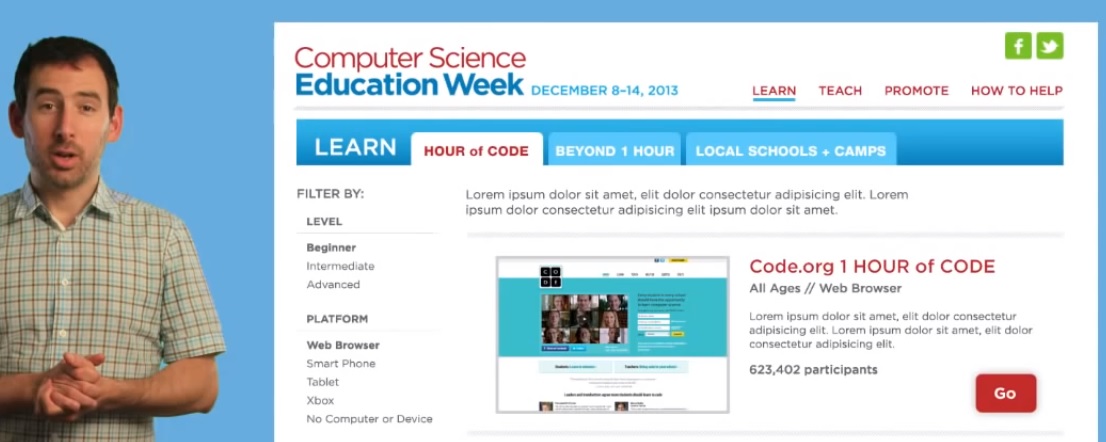
theodp writes "In a move straight out of Healthcare.gov's playbook, teachers won't get to preview the final lessons they're being asked to roll out to 10 million U.S. students until a week before the Dec. 9th launch of the Hour of Code nation-wide learn-to-code initiative, according to a video explaining the project, which is backed by the nation's tech giants, including Facebook, Microsoft, Apple, Google, and Amazon. The Hour of Code tutorial page showcased to the press sports Lorem Ipsum pseudo-Latin text instead of real content, promised tutorial software is still being developed by Microsoft and Google, and celebrity tutorials by Bill Gates and Mark Zuckerberg are still a work-in-progress. With their vast resources and deep pockets, the companies involved can still probably pull something off, but why risk disaster for such a high-stakes effort with a last-minute rush? One possible explanation is that CS Education Week, a heretofore little-recognized event, is coming up soon. Then again, tech immigration reform is back on the front burner, an initiative that's also near-and-dear to many of same players behind Hour of Code, including Microsoft Chief Counsel Brad Smith who, during the Hour of Code kickoff press conference, boasted that Microsoft's more-high-tech-visas-for-U.S.-kids-computer-science-education deal found its way into the Senate Immigration Bill, but minutes later joined his fellow FWD.us panelists to dismiss a questioner's suggestion that Hour of Code might somehow be part of a larger self-serving tech industry interest." -
Windows 8.1 Rolls Out Today
The newest iteration of Windows has begun rolling out, and is winning positive reviews. (Here's an in-depth review from Ars, and a more concise one from Wired — both give 8.1 a thumbs-up). Kelerei wrote with the above-linked TechDirt article on the release, noting that it is a staged rollout rather than global. Starting this morning, though, 8.1 is available to some customers. Kelerei writes: "The upgrade is optional (and free) for existing Windows 8 users, though if one looks at the changes, it's hard to imagine why those already on it wouldn't upgrade." Also at Slash BI. -
Facebook Buys Israeli Mobile Analytics Startup Onavo
rtoz writes "Israeli Mobile Data Management Startup "Onavo" has announced that it has been acquired by Social Media Giant Facebook. Facebook will get its first office at Israel by acquiring Onavo. Techcrunch has mentioned that Onavo will give facebook a much deeper tech bench to measure how its mobile services are working. 'Onavo will be an exciting addition to Facebook,' a Facebook spokesperson told AllThingsD. 'We expect Onavo's data compression technology to play a central role in our mission to connect more people to the internet, and their analytic tools will help us provide better, more efficient mobile products.'" -
Acer Officially Announces C720 Chromebook
adeelarshad82 writes "Acer officially announced its new Chromebook, C720. The C720 is 30% thinner (at 0.75 inches thick) and lighter (at 2.76 pounds) than Acer's previous Chromebook, C7. The C720 Chromebook has an 11.6-inch anti-glare widescreen, with a 1,366-by-768 resolution. Acer claims seven second boot times and up to 8.5 hours of battery life. The C720 comes with 4GB of DDR3L memory and uses an Intel Celeron 2955U processor based on Haswell technology. The system also has 16GB of local SSD storage along with 802.11 a/b/g/n Wi-Fi to get to Google's cloud-based storage. Like previous Chromebooks, the C720 Chromebook is constantly updated with the latest version of the Chrome OS and built around the Chrome browser." One thing this machine lacks is the most intriguing feature of the new ARM-based (and lower-power) Chromebook 11 from HP: charging via Micro-USB. -
Leaked Manual Reveals Details On Google's Nexus 5
Features of Google's next Nexus phone have finally been outed, along with confirmation that the phone will be built by LG, as a result of a leaked service manual draft; here are some of the details as described at TechCrunch: "The new Nexus will likely be available in 16 or 32GB variants, and will feature an LTE radio and an 8-megapixel rear camera with optical image stabilization (there’s no mention of that crazy Nikon tech, though). NFC, wireless charging, and that lovely little notification light are back, too, but don’t expect a huge boost in longevity — it’s going to pack a sealed 2,300mAh battery, up slightly from the 2100mAh cell that powered last year’s Nexus 4. That spec sheet should sound familiar to people who took notice of what happened with the Nexus 4. Just as that device was built from the foundation laid by the LG Optimus G, the Nexus 5 (or whatever it’s going to be called) seems like a mildly revamped version of LG’s G2." -
Facebook and Cisco Offer Check-In Service For Free Wifi
cagraham writes "According to TechCrunch, Facebook and Cisco are now expanding their joint "Facebook Wifi" program nationwide. The service directs customers who connect to a store's wifi to a landing page where they are encouraged to "check-in" to the business in order to be connected. While users can currently opt out of this and still be connected, the "skip this" button is noticeably difficult to find. The free software integrates with businesses existing routers and providers. Facebook provides reports to participating businesses as well, complete with anonymized aggregate data on the demographics of the customers who checked-in." -
Facebook Autofill Wants To Store Users' Credit Card Info
cagraham writes "Facebook has teamed up with payment processors PayPal, Braintree, and Stripe, in an attempt to simplify mobile payments. The system allows Facebook members (who have turned over their credit and billing info) to click a 'Autofill with Facebook' button when checking-out on a mobile app. Facebook will then verify the details, and securely transfer a user's info over to the payment processing company. The move is likely aimed at gathering more data on user behavior, which can be used to increase the prices Facebook charges for mobile ads. Whether or not the feature takes off however, will depend almost entirely on how willing users are to trust Facebook with their credit card data." -
Tumblr Follows Instagram - Reveals Plan For More Ads
cagraham writes "Following close on the heels of Instagram's advertising announcement last week, Tumblr has signed an agreement with analytics firm DataSift to provide info to advertisers on user behavior. According to Yahoo! CEO Marissa Mayer, who oversaw the recent $1.1 billion purchase of Tumblr, advertising on the site will become increasingly prevalent throughout 2014. DataSift will provide advertisers with info on the 5.5 billion interactions that occur on the site each day. This makes Tumblr the latest in a slew of recent tech companies to turn towards targeted ads in an attempt to generate revenue." Twitter is another customer of DataSift. -
Wireless Charging Start-Up Claims 30-Foot Radius
Lucas123 writes "At Disrupt this week, Ossia Inc. demonstrated for the first time its wireless charging technology that founder Hatem Zeine said has a 30-foot radius and, like WiFi, can charge through walls and 'around corners.' The technology, still in prototype phase, uses the same spectrum as other wireless standards, such as WiFi and Bluetooth. The Cota wireless charging system includes a charger and a receiver — either a dongle device or chip-tech integrated into a product, such as a smartphone or battery. While it has yet to be miniaturized, Zeine said the wireless technology will eventually be small enough to fit into a AAA battery or any portable electronic device. While the technology has wider industrial implications, as a consumer product, a charging unit will likely sell for around $100, he said." -
Dotless Domain Names Prohibited, ICANN Tells Google
New submitter gwstuff writes "Last year, Google filed applications for about 100 top level domains. These included .app, .cloud and .lol, but perhaps most prominently .search, which they had requested to operate as a 'dotless' domain. [Friday], ICANN gave their verdict on the idea that would make this URL valid : NO. Here is the formal announcement, and a related Slashdot story from last year. So that's that. But it may still be granted the rights for the remaining 100. Is prime dot-com real estate going to become a thing of the past?" -
Dispatch From the Future: Uber To Purchase 2,500 Driverless Cars From Google
First time accepted submitter Dave Jurgensen writes "Uber has said it will be purchasing 2,500 of Google's self driving GX3200 cars to be used around America. They are hoping to have their first set of driverless cars on the road by the end of the year. From the article: 'Uber has committed to invest up to $375 million for a fleet of Google’s GX3200 vehicles, which are the company’s third generation of autonomous driving cars, but the first to be approved for commercial use in the U.S. The deal marks the largest single capital investment that Uber has made to date, and is also the first enterprise deal that Google has struck for its new line of driverless vehicles.'" Update: Yes, this is a piece of speculative fiction. -
Dark Day In the AWS Cloud: Big Name Sites Go Down
An outage of one company's servers might only affect that company's customers — but when a major data center for Amazon hits kinks, sites that rely on the AWS cloud services all suffer from the downtime. That's what happened today, when several major sites or online services (like Instagram and AirBnB) were knocked temporarily offline, evidently because of problems at an Amazon data center in Northern Virginia. From TechCrunch's coverage of the outage: "The deluge of tweets that accompanied the services’ initial hiccups first started at around 4 p.m. Eastern time, and only increased in intensity as users found they couldn’t share pictures of their food or their meticulously crafted video snippets. Some further poking around on Twitter and beyond revealed that some other services known to rely on AWS — Netflix, IFTTT, Heroku and Airbnb to name a few — have been experiencing similar issues today." -
Single Developer Responsible For Over 47k Apps In BlackBerry World
hypnosec writes "If you are a BlackBerry owner, navigate to BlackBerry World (or just visit the website) and you will find that developer S4BB has developed over 47k apps for the BB platform. Unsurprisingly, most of them are just spammy apps that don't add any value. Apps like 'Restart Me Free,' 'Daily Quote,' 'Lock for SMS,' 'Search for Amazon,' 'Silent Foto Free' are just a few among the thousands of apps on BlackBerry World that actually have no utility whatsoever. BlackBerry announced back in May that developers were increasingly interested in making apps for the platform, and that BlackBerry World had more than 120,000 apps. This raises questions about the authenticity of the claims, and about the approval process that's been accepting these apps. S4BB may have a few useful apps for the platform, but that doesn't mean all of their apps are of 'A' quality. A statement from BlackBerry said, 'Developers in all app stores employ a number of different monetization tactics. BlackBerry World is an open market for developers and we let market forces dictate the success or failure of these tactics.'" -
As AOL Prepares To Downsize Patch, CEO Fires Employee During Meeting
An anonymous reader writes "AOL is closing or plans to sell nearly half of the 900 'hyperlocal' news websites operated by its money-losing Patch Media subsidiary (TechCrunch is also owned by AOL). Hundreds of staff layoffs are believed to be imminent. AOL acquired Patch in 2009, soon after ex-Googler Tim Armstrong took over as CEO; Armstrong was also a co-founder of Patch. During a tough conference call last Thursday Armstrong told Patch editors: 'Something at Patch has been missing for some time and that's leadership – leadership with a capital L'. Armstrong then demonstrated his grasp of Donald Trump's management style by firing an employee during the meeting for taking a picture. At 1:18 of the NY Post's sound clip from Jim Romensko: 'Leaking information Patch isn't going to bother me. I'm not changing direction'. At 2:00: 'Abel [Creative Director Lenz], put that camera down. Abel, you're fired. Out.' Armstrong later explained that 'The reason I fired Abel is I don't want anyone taking pictures of this meeting' and that, much like a sports team, AOL couldn't afford to have people 'giving the game plan away'." -
Obama on Surveillance: "We Can and Must Be More Transparent"
Today President Obama held a press conference to address the situation surrounding the NSA's surveillance activities. (Here is the full transcript.) He announced four actions the administration is undertaking to restore the public's confidence in the intelligence community. Obama plans to work with Congress to reform the Foreign Intelligence Surveillance Court to give greater weight to civil liberties, and to revisit section 215 of the PATRIOT Act, which is the section that allowed bulk collection of phone records. (Of course, "will work with Congress" is a vague term, and Congress isn't known for getting things done lately. Thus, it remains to be seen if anything substantive happens.) Obama is ordering the Dept. of Justice to make public their legal rationale for data collection, and there will be a new NSA official dedicated to transparency efforts. There will also be a new website for citizens to learn about transparency in intelligence agencies. Lastly, a group of outside experts will be convened to review the government's surveillance capabilities. Their job will include figuring out how to maintain the public's trust and prevent abuse, and to consider how the intelligence community's actions will affect foreign policy. In addition to these initiatives, President Obama made his position very clear about several different aspects of this controversy. While acknowledging that "we have significant capabilities," he said, "America is not interested in spying on ordinary people." He added that the people who have raised concerns about privacy and government overreach in a lawful manner are "patriots." This is in stark contrast to his view of leakers like Edward Snowden: "I don't think Mr. Snowden was a patriot." (For his part, Snowden says the recent shut down of encrypted email services is 'inspiring.') When asked about how his opinion of the surveillance programs have changed, he said his perception of them has not evolved since the story broke worldwide. "What you're not seeing is people actually abusing these programs." Obama also endorsed finding technological solutions that will protect privacy regardless of what government agencies want to do. -
How Did My Stratosphere Ever Get Shipped?
Bennett Haselton writes "How did a $400-billion company ship millions of units of a phone with a calendar app that displays the wrong date, a texting app that can't reply to group texts, a screen capture function that doesn't work, and a phone app that won't let me use the keypad unless the speakerphone is on? The answer, perhaps, suggests deeper questions about why market forces fix certain problems but not others, and what to do about it." Read on for the rest of Bennett's thoughts.I've been using either a Samsung Stratosphere or a Samsung Stratosphere 2 from September 2012 to the present. Where to begin?
-
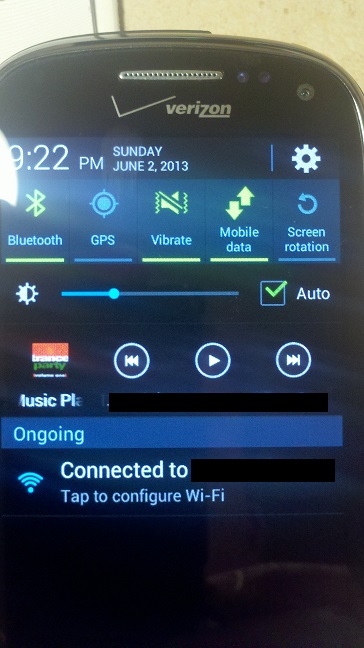
If you open the calendar application on the Stratosphere 2, it usually highlights tomorrow's date as "Today," and lists tomorrow's calendar entries as your list of things to do "Today." Here is a picture of my phone's screen taken on June 2, with the calendar app displaying "Today, Mon, Jun 3 2013" — despite the phone knowing the correct time is 9:22 PM on June 2.
Strangely, in the morning the calendar app would display the correct day as "Today," but would switch to the wrong day some time in the afternoon, and eventually I decided that the calendar app was probably using Coordinated Universal Time to decide what "Today" was, which is 9 hours ahead of Pacific Standard Time.
-
You'll notice that these images are not screen captures, but photos taken with another phone. This is because some time between the Stratosphere 1 and 2, the screen capture function broke — every support site says you're supposed to be able to take a screen cap on a Stratosphere by pressing the Home and Power buttons at the same time, and that works on the 1, but not on the 2.
-
If someone else sends a text to multiple recipients including you, the Stratosphere gives you no indication that it's a group text, and there's no way for you to see the other recipients or reply to the whole group. (I had a lot of awkward "What, you were asking everybody, not just me?" moments before I realized what was going on.) Other users have been complaining about this for months, and it apparently affects more Android phones than just the Stratosphere.
-
The built-in camera refuses to take a picture if the battery is low — it just says "Warning: low battery" and exits. Yes, I know they think they're doing it for my own good since the camera is a battery hog, but a few times I've wanted to take a picture where it was well worth using up a half a percent of my remaining battery life or however much it would have taken, but the phone wouldn't let me. That should be the user's decision, dammit.
-
When I was in Canada last week, if I tried sending a text message longer than 160 characters, the phone would tell me that the message sent, but it would actually fail silently and never get delivered. I'm not sure whether to blame Verizon, Android, or Samsung for this one (or just, you know), but in the end someone has to take responsibility for the product, and the phone telling you that a message was sent when it actually got lost, is a complete fail. If it doesn't work, fine, give me an error message, but never tell the user a message got sent successfully if it didn't.
-
During a phone call, the on-screen keypad doesn't work unless the phone is on speakerphone. If the speakerphone is off, the screen goes dark after about 1 second of inactivity, making it impossible to enter an account number or anything else. I can avoid this bug by turning on a speakerphone (which is how I know it's a software bug, not a problem with the touchscreen), but this is a pain if I'm in a public place and don't want to annoy everyone around me who would have to listen to all the voice prompts. (The phone's software seems to be following a rule like: "If the speakerphone is not on, then when the phone moves away from the user's face, assume the user is not actively using the phone and let the screen go dark" — where the bug is that it doesn't make an exception and keep the screen on if the user is actively pressing keys on the keypad.)
At first, these and many, many other bugs produce a state of mind that transcends annoyance to reach a kind of genuine curiosity, where you're asking "How did this happen?" not rhetorically, but because you actually want to know. But eventually the surprise wears off, and you're just left with bugs that are disproportionately aggravating because they obviously would have been caught during even the most basic UI testing. They're aggravating to me not because of how much they get in the way (you eventually get used to them), but because the existence of those bugs conveys a certain lazy attitude towards finding and fixing bugs at all.
I realize this is not a logical reaction. The aggravation you feel towards a bug should depend on how much the bug actually interferes with the user experience, not on how easily the manufacturer should have found it. Rationally speaking, the biggest problem with the phone right now (and the reason I'm having to mail to back to the manufacturer for a replacement) is that the charging port spontaneously broke, so that unless the micro USB charger is plugged in exactly right, the phone can't charge (even if you get it right and form a connection successfully, the connection breaks if you move the phone half an inch). Needless to say, that's exasperating — but it's hard for me to get mad at Samsung over that, because it's not an easy defect to catch at the manufacturing stage. On the other hand, if the calendar app displays the wrong day, I would say that someone should be fired over that except that probably nobody was assigned to do that testing in the first place.
I also posted questions about each of these problems on AndroidForums.com and AndroidCentral.com (those links show all questions recently posted from my username on each site), which have so far received hundreds of "views" but no replies. I mention this because some people think that if you do run into problems like these, all you have to do is post a question and The Community will help you out with a workaround. Nope.
Also, lest you think you can do away with these bugs by downloading third-party replacements for all of these apps, I spent part of an afternoon downloading different texting apps to see if any of them would fix even part of the problems I had with the built-in one. None of them worked much better, although several of them displayed pop-up ads over every third incoming text message, and most of them did not play nicely with each other, giving me no way to disable them so that their notifications would double and triple up on top of each other for every received text. So I gave up. Even if I thought I might eventually find a better app for texting, I didn't have time to test multiple replacements for every built-in default app that didn't work.
Farhad Manjoo has a column up at Slate arguing that the reason many Android phones suck is that they're laden down with adware attempting to extract more personal information and money from the user. I'm sure that's part of the problem, but I can't see how the manufacturer is making any money off of the bugs I ran into; they were just being lazy.
The problem, I think, is that phone manufacturers know that phone reviewers (and users, when they're choosing between models in the store) will focus on easily quanitifiable attributes, such as size, weight, battery life, and the number of megapixels in the camera. The number of aggravating bugs in the user interface is not something that is easy to compare across phones (and in any case would not be printed on the box). Thus market forces simply don't favor the development of a hassle-free interface, because in most cases the phone manufacturers wouldn't be rewarded for it.
And — I don't consider this too much of a stretch — this is where it connects with larger issues for me, because I've been arguing for years that the free market will usually fail to fix certain types of problems, often in the context of threats to free speech and civil liberties, especially if the user lacks information they need to compare multiple options. A major argument in favor of Net Neutrality is that the typical user wouldn't realize it if their ISP were throttling access to certain sites; they would just think that the remote site was responding slowly. Since that information would be hidden from the user, "the marketplace" won't solve the problem on its own. Similarly, every time I say that my Circumventor mailing list keeps getting blocked as "spam" by Yahoo, Hotmail, Gmail, or AOL (despite being 100% verified-opt-in, natch), someone tells me that if the free market is blocking my emails as unwanted, it must be because the users don't want them. That the free market might make a mistake (in this case, because users don't have full information about what is getting blocked as spam), doesn't occur to them. I think the belief in the infallibility of the free market, is one of the most widespread fallacies of our era — people who would never make the mistake of confusing correlation with causation, have no problem thinking that if a product or service gets blocked by a third-party intermediary, it must be because the end user didn't want it.
And so when I'm staring at my Stratosphere's calendar telling me that tomorrow is actually today, it brings out my aggravation not just towards Samsung, Google, and Verizon, but towards all the people I've heard over the years claiming that the marketplace will automatically reward good products and punish bad ones. If there weren't so many people who believed that, maybe we could have collectively put more effort into rating phones according to their usability, knowing that the "invisible hand" of the marketplace was not likely to solve those problems on its own, and maybe these bugs would have gotten fixed. Instead, the "marketplace" focuses disproportionately on attributes like dimensions, weight, and processor speed that are easily quantifiable.
So perhaps the solution — seriously — would be for some third-party review company to rate each new phone on the Stupid S#!% Index. They test the phone under normal usage, and each time they run into an idiotic bug like the calendar application not knowing what day it is, they file it under Stupid S#!%, and after some fixed period of phone usage they count up all the problems and rate the phone under the Stupid S#!% Index. For greater precision, you could compile multiple scores from different users for each phone and take the average. Now you have a quantifiable rating that can be used to compare one phone to another, and could incentivize manufacturers to do more testing on their phones in order to get a better Stupid S#!% Index score.
The message that Apple keeps pushing about the iPhone, after all, is essentially that it would get a good Stupid S#!% Index rating. In his keynote address at the 2011 Apple Worldwide Developers Conference, Steve Jobs repeated the words "It just works" like a mantra — unlike, presumably, everyone else's stuff. iPhones don't score well on price, openness, or compatibility with other companies' products (I always have to tell people that my car charger is not an iPhone charger, it's a literally-every-other-smartphone-in-the-entire-world charger) — but all of that scarcely matters to some people as long as It Just Works.
Well, I couldn't tell you. I can't test an iPhone under normal usage because I'm too addicted to the Stratosphere's slide-out keyboard, which enables me to type much faster than a touchscreen but which only comes on a few Android and Windows phones, and not on any version of the iPhone. Maybe I'll try one more time to make the switch to a touchscreen while my Stratosphere is in the shop.
Yes, these most First-World of First World Problems — especially the bugs specific to the Stratosphere — only apply to a small fraction of the population. But it should be a lesson for anyone who thinks the "free market" would prevent this sort of thing from happening.
Meanwhile, every time I hear an ad talking about how "thin" some new phone is going to be, I just want to say to the phone the same thing that I want to tell all the anorexic girls in nightclubs: You're already thin enough. So stop worrying about being thin, and just try to work on not being so f@#$ing stupid.
-
-
Forget Apple: Samsung Could Be Google's Next Big Rival
Nerval's Lobster writes "The idea of Samsung as a Google rival isn't unprecedented. For the past several quarters, Samsung has progressively molded Android to its own vision: layered with TouchWiz and sprinkled with all sorts of Samsung-centric apps, the software interface on Samsung devices is deviating rapidly away from the 'stock' Android that runs on other manufacturers' devices. During this year's unveiling of the Samsung Galaxy S4 at New York City's Radio City Music Hall, Samsung executives onstage barely mentioned the word 'Android,' and played up features designed specifically for the device. Establishing its own brand identity by moving away from 'stock' Android has done Samsung a lot of good: its smartphones and tablets not only stand out from the flood of Android devices on the market, but it's given the company an opportunity to position itself as the one true rival to iOS. While other Android manufacturers struggle, Samsung has profited. If Samsung continues to gain strength, it could become a huge issue for Google, which has its own eye on the hardware segment. Although Google purchased Motorola in 2011 for $12.5 billion, it hasn't yet remolded the brand in its own image, claiming that the subsidiary's existing pipeline of products first needs to be flushed into the ecosystem. But that reluctance could be coming to an end: reports suggest that Google will pump $500 million into marketing the Moto X, an upcoming 'hero' smartphone meant to reestablish Motorola's dominance of the Android space. If the Moto X succeeds, and Google decides to push aggressively into the branded hardware space, it could drive Samsung even further away from core Android. Never mind issuing TouchWiz updates until the original Android interface is virtually unrecognizable—with its industry heft, Samsung could potentially boot Google Play from the home-screen and substitute it with an apps-and-content hub of its own design. That would take a lot of work, of course: first, Samsung would need to build a substantial developer ecosystem, and then it would need to score great deals with movie studios and other content providers. But as Amazon and Apple have shown, such things aren't impossible. The only questions are whether (a) Samsung has the will to devote the necessary time and resources to such a project, and (b) if it's willing to transform its symbiotic relationship with Google into an antagonistic one." -
VOIP Provider Viber Attacked By Syrian Electronic Army
An anonymous reader writes "The hacking group known as the Syrian Electronic Army have hacked into Viber, defacing its support website, and posting what they claim is evidence of surveillance by the free phone-messaging app. The Syrian Electronic Army posted a message claiming the 'Israeli-based Viber is spying and tracking you' alongside what appeared to be a screenshot of an internal Viber database containing users' phone numbers, device UDIDs, IP address, operating system, and Viber version information." Viber is saying the attack was minor: "...the hack only allowed access to two minor systems, a customer support panel and a support administration system. According to the company's official response, 'no sensitive user data was exposed and Viber's databases were not "hacked."' Apparently, an employee simply fell victim to a phishing attack. -
Describe Any Location On Earth In 3 Words
First time accepted submitter jameshumphreys writes "London startup what3words has successfully launched a new website which has carved the world map into almost 57 trillion 3m x 3m squares, assigning each square a simple, unique 3 word address. For instance, the 'what3words' for the famous Peter Pan statue in London's Hyde Park is 'union.prop.enjoy'. This means you can easily describe even remote locations with great precision. CEO Chris Sheldrick says, 'We see our service being most useful where current methods of describing location (e.g. postcodes or ZIP codes) don't do the job well enough or don't do the job at all — but of course it has applications as a preferred alternative even where the existing solutions do a decent job, but perhaps less precise/customised than w3w.' An API is planned 'in the coming weeks.'" The heart of Disneyworld could be "Radioactive Humanoid Mice"; what would you call your neck of the woods?