Slashdot Mirror
Domain: theatlantic.com
Stories and comments across the archive that link to theatlantic.com.
Stories · 430
-
The CIA Does Las Vegas
Nicola Hahn (1482985) writes Despite the long line of covert operations that Ed Snowden's documents have exposed, public outcry hasn't come anywhere near the level of social unrest that characterized the 1960s. Journalists like Conor Friedersdorf have suggested that one explanation for this is that the public is "informed by a press that treats officials who get caught lying and misleading (e.g., James Clapper and Keith Alexander) as if they're credible."
Certainly there are a number of well-known popular venues which offer a stage for spies to broadcast their messages from while simultaneously claiming to "cultivate conversations among all members of the security community, both public and private." This year, for instance, Black Hat USA will host Dan Greer (the CISO of In-Q-Tel) as a keynote speaker.
But after all of the lies and subterfuge is it even constructive to give voice to the talking points of intelligence officials? Or are they just muddying the water? As one observer put it, "high-profile members of the intelligence community like Cofer Black, Shawn Henry, Keith Alexander, and Dan Greer are positioned front and center in keynote slots, as if they were glamorous Hollywood celebrities. While those who value their civil liberties might opine that they should more aptly be treated like pariahs." -
Russia Prepares For Internet War Over Malaysian Jet
An anonymous reader writes The investigation of a Malaysian passenger jet shot down over Ukrainian rebel held territory is heating up. U.S. and U.K. news organizations are studiously trying to spread the blame, Russian ITAR, which, just earlier today was celebrating the downing of a large aircraft by rebel missiles in Torez (Google cache) is reporting that the rebels do not have access to the missiles needed for such attacks. The rebel commander who earlier today reported the downing of the aircraft has also issued a correction to earlier reports that they had captured BUK air defense systems with Russian sources now stating that the rebels do not posses such air defenses. The Ukrainian president has been attempting to frame the incident as a "terrorist attack". President Obama made contact with Vladimir Putin and has been instead treating it as an accident, calling it a "terrible tragedy" and saying that the priority is investigating whether U.S. citizens were involved. With control of the black box and its own internet propaganda army Russia may be in a good position to win the propaganda war. -
Algorithm-Generated Articles Won't Kill the Journalism Star
theodp writes: The AP's announcement that software will write the majority of its earnings reports, argues The Atlantic's Joe Pinsker, doesn't foretell the end of journalism — such reports hardly require humans anyway. Pinsker writes, "While, yes, it's true that algorithms can cram stories about vastly different subjects into the same uncanny monotone — they can cover Little League like Major League Baseball, and World of Warcraft raids like firefights in Iraq — they're really just another handy attempt at sifting through an onslaught of data. Automated Insights' success goes hand-in-hand with the rise of Big Data, and it makes sense that the company's algorithms currently do best when dealing in number-based topics like sports and stocks." So, any chance that Madden-like (video) generated play-by-play technology could one day be applied to live sporting events? -
Mayors of Atlanta & New Orleans: Uber Will Knock-Out Taxi Industry
McGruber writes Atlanta Mayor Kasim Reed and New Orleans Mayor Mitch Landrieu agree: there will a 15 round fight between Uber and the taxicab industry that currently enjoys regulatory capture, but after a long fight, Uber will win. Landrieu says: "It actually is going to be a 15 round fight. And it's going to take time to work out, hopefully sooner rather than later. But that debate will be held.....But it is a forceful fight, and our city council is full of people on Uber's side, people on the cabs' side, and it's a battle." Mayor Reed of Atlanta also expressed how politically powerful the taxi cartels can be: "I tell you, Uber's worth more than Sony, but cab drivers can take you out. So you've got to [weigh that]. Get in a cab and they say, 'Well that mayor, he is sorry.' You come to visit Atlanta, they say, 'Well that Mayor Reed is as sorry as the day is long. Let me tell you how sorry he is while I drive you to your hotel. And I want you to know that crime is up.' This guy might knock you out. I want you to know it can get really real. It's not as easy as it looks." -
In 2012, Facebook Altered Content To Tweak Readers' Emotions
The Atlantic reports that two years ago, Facebook briefly conducted an experiment on a subset of its users, altering the mix of content shown to them to emphasize content sorted by tone, negative or positive, and observe the results. From the Atlantic article: For one week in January 2012, data scientists skewed what almost 700,000 Facebook users saw when they logged into its service. Some people were shown content with a preponderance of happy and positive words; some were shown content analyzed as sadder than average. And when the week was over, these manipulated users were more likely to post either especially positive or negative words themselves. This tinkering was just revealed as part of a new study, published in the prestigious Proceedings of the National Academy of Sciences. Many previous studies have used Facebook data to examine “emotional contagion,” as this one did. This study is different because, while other studies have observed Facebook user data, this one set out to manipulate it. At least they showed their work. -
Draper Labs Develops Low Cost Probe To Orbit, Land On Europa For NASA
MarkWhittington writes Ever since the House passed a NASA spending bill that allocated $100 million for a probe to Jupiter's moon Europa, the space agency has been attempting to find a way to do such a mission on the cheap. The trick is that the mission has to cost less than $1 billion, a tall order for anything headed to the Outer Planets. According to a Wednesday story in the Atlantic, some researchers at Draper Labs have come up with a cheap way to do a Europa orbiter and land instruments on its icy surface.
The first stage is to orbit a cubesat, a tiny, coffee can sized satellite that would contain two highly accurate accelerometers that would go into orbit around Europa and measure its gravity field. In this way the location of Europa's subsurface oceans would be mapped. Indeed it is possible that the probe might find an opening through the ice crust to the ocean, warmed it is thought by tidal forces.
The second stage is to deploy even smaller probes called chipsats, tiny devices that contain sensors, a microchip, and an antenna. Hundreds of these probes, the size of human fingernails, would float down on Europa's atmosphere to be scattered about its surface. While some might be lost, enough will land over a wide enough area to do an extensive chemical analysis of the surface of Europa, which would then be transmitted to the cubesat mothership and then beamed to Earth. -
Driverless Cars Could Cripple Law Enforcement Budgets
colinneagle writes "Google's driverless cars have now combined to drive more than 700,000 miles on public roads without receiving one citation, The Atlantic reported this week. While this raises a lot of questions about who is responsible to pay for a ticket issued to a speeding autonomous car – current California law would have the person in the driver's seat responsible, while Google has said the company that designed the car should pay the fine – it also hints at a future where local and state governments will have to operate without a substantial source of revenue.
Approximately 41 million people receive speeding tickets in the U.S. every year, paying out more than $6.2 billion per year, according to statistics from the U.S. Highway Patrol published at StatisticBrain.com. That translates to an estimated $300,000 in speeding ticket revenue per U.S. police officer every year. State and local governments often lean on this source of income when they hit financial trouble. A study released in 2009 examined data over a 13-year period in North Carolina, finding a 'statistically significant correlation between a drop in local government revenue one year, and more traffic tickets the next year,' Popular Science reported. So, just as drug cops in Colorado and Washington are cutting budgets after losing revenue from asset and property seizures from marijuana arrests, state and local governments will need to account for a drastic reduction in fines from traffic violations as autonomous cars stick to the speed limit." -
Your Old CD Collection Is Dying
Hugh Pickens DOT Com (2995471) writes "Adrienne LaFrance reports at the Atlantic that if you've tried listening to any of the old CDs lately from your carefully assembled collection from the 1980's or 1990's you may have noticed that many of them won't play. 'While most of the studio-manufactured albums I bought still play, there's really no telling how much longer they will. My once-treasured CD collection — so carefully assembled over the course of about a decade beginning in 1994 — isn't just aging; it's dying. And so is yours.'
Fenella France, chief of preservation research and testing at the Library of Congress is trying to figure out how CDs age so that we can better understand how to save them. But it's a tricky business, in large part because manufacturers have changed their processes over the years and even CDs made by the same company in the same year and wrapped in identical packaging might have totally different lifespans. 'We're trying to predict, in terms of collections, which of the types of CDs are the discs most at risk,' says France. 'The problem is, different manufacturers have different formulations so it's quite complex in trying to figure out what exactly is happening because they've changed the formulation along the way and it's proprietary information.' There are all kinds of forces that accelerate CD aging in real time. Eventually, many discs show signs of edge rot, which happens as oxygen seeps through a disc's layers. Some CDs begin a deterioration process called bronzing, which is corrosion that worsens with exposure to various pollutants. The lasers in devices used to burn or even play a CD can also affect its longevity. 'The ubiquity of a once dominant media is again receding. Like most of the technology we leave behind, CDs are are being forgotten slowly,' concludes LaFrance. 'We stop using old formats little by little. They stop working. We stop replacing them. And, before long, they're gone.'" You can donate CDs to be tested for aging characteristics by emailing the Center for the Library's Analytical Science Samples. I haven't had much trouble ripping discs that were pressed in the 80s (and acquired from used CD stores with who knows how many previous owners), but I'm starting to get nervous about not having flac rips of most of my discs. -
Malaysia Airlines Flight 370: Experts Unable To Replicate Inmarsat Analysis
McGruber (1417641) writes "The lynchpin of the investigation of the disappearance of Malaysia Airlines Flight 370 has been the pings from the plane to one of Inmarsat's satellites. The pings are the sole evidence of what happened to the plane after it slipped out of radar contact. Without them, investigators knew only that the plane had enough fuel to travel anywhere within 3,300 miles of the last radar contact—a seventh of the entire globe. Inmarsat concluded that the flight ended in the southern Indian Ocean, and its analysis has become the canonical text of the Flight 370 search. It's the bit of data from which all other judgments flow—from the conclusive announcement by Malaysia's prime minister that the plane has been lost with no survivors, to the black-box search area, to the high confidence in the acoustic signals, to the dismissal by Australian authorities of a survey company's new claim to have detected plane wreckage. But scientists and engineers outside of the investigation have been working to verify Inmarsat's analysis and many say that it just doesn't hold up." -
Students Remember Lectures Better Taking Notes Longhand Than Using Laptops
Hugh Pickens DOT Com (2995471) writes "Walk into any university lecture hall and you're likely to see row upon row of students sitting behind glowing laptop screens. Laptops in class have been controversial, due mostly to the many opportunities for distraction that they provide (online shopping, browsing Reddit, or playing solitaire, just to name a few). But few studies have examined how effective laptops are for the students who diligently take notes. Now Robinson Meyer writes at The Atlantic that a new study finds that people remember lectures better when they've taken handwritten notes, rather than typed ones. The research suggests that even when laptops are used solely to take notes, they may still be impairing learning because their use results in shallower processing. 'Our new findings suggest that even when laptops are used as intended — and not for buying things on Amazon during class — they may still be harming academic performance,' says psychological scientist Pam Mueller of Princeton University, lead author of the study. Laptop note takers' tendency to transcribe lectures verbatim rather than processing information and reframing it in their own words is detrimental to learning. If you can type quickly enough, word-for-word transcription is possible, whereas writing by hand usually rules out capturing every word. 'We don't write longhand as fast as we type these days, but people who were typing just tended to transcribe large parts of lecture content verbatim,' says Mueller. 'The people who were taking notes on the laptops don't have to be judicious in what they write down.'" -
Eyes Over Compton: How Police Spied On a Whole City
Advocatus Diaboli (1627651) writes with some concerning news from the Atlantic. From the article: "In a secret test of mass surveillance technology, the Los Angeles County Sheriff's Department sent a civilian aircraft over Compton, California, capturing high-resolution video of everything that happened inside that 10-square-mile municipality. Compton residents weren't told about the spying, which happened in 2012. 'We literally watched all of Compton during the times that we were flying, so we could zoom in anywhere within the city of Compton and follow cars and see people,' Ross McNutt of Persistence Surveillance Systems told the Center for Investigative Reporting, which unearthed and did the first reporting on this important story. The technology he's trying to sell to police departments all over America can stay aloft for up to six hours. Like Google Earth, it enables police to zoom in on certain areas. And like TiVo, it permits them to rewind, so that they can look back and see what happened anywhere they weren't watching in real time." -
Will Living On Mars Drive Us Crazy?
Hugh Pickens DOT Com (2995471) writes "When astronauts first began flying in space, NASA worried about 'space madness,' a mental malady they thought might arise from humans experiencing microgravity and claustrophobic isolation inside of a cramped spacecraft high above the Earth. Now Megan Garber writes in The Atlantic that NASA is hoping to find out what life on Mars does to the human emotional state by putting three men and three women in a 1,000-square-foot habitat shaped like a dome for four months. The volunteers in the second HI-SEAS mission — a purposely tiny group selected out of a group of 700 applicants — include, among others, a neuropsychologist, an aerospace engineer, and an Air Force veteran who is studying human factors in aviation. 'We're going to stress them,' says Kim Binsted, the project's principal investigator. 'That's the nature of the study.' That test involves isolating the crew in the same way they'd be isolated on Mars. The only communication they'll be allowed with the outside world—that is to say, with their family and friends—will be conducted through email. (And that will be given an artificial delay of 20 minutes to simulate the lag involved in Mars-to-Earth communications.)
If that doesn't seem too stressful, here's another source of stress: Each mission member will get only eight minutes of shower time ... per week. The stress will be compounded by the fact that the only time the crew will be able to leave their habitat-yurt is when they're wearing puffy, insulated uniforms that simulate space suits. In the Hawaiian heat. Throughout the mission, researchers will be testing the subjects' moods and the changes they exhibit in their relationships with each other. They'll also be examining the crew members' cognitive skills, seeing whether—and how—they change as the experiment wears on. Binsted says the mission has gotten the attention of the TV world but don't expect to see much inside-the-dome footage. 'You wouldn't believe the number of producers who called us,' says Binsted. 'Fortunately, we're not ethically allowed to subject our crew to that kind of thing.'" -
Don't Help Your Kids With Their Homework
Hugh Pickens DOT Com (2995471) writes "Dana Goldstein writes in The Atlantic that while one of the central tenets of raising kids in America is that parents should be actively involved in their children's education — meeting with teachers, volunteering at school, and helping with homework — few parents stop to ask whether they're worth the effort. Case in point: In the largest-ever study of how parental involvement affects academic achievement researchers combed through nearly three decades' worth of longitudinal surveys of American parents and tracked 63 different measures of parental participation in kids' academic lives, from helping them with homework, to talking with them about college plans, to volunteering at their schools. What they found surprised them. Most measurable forms of parental involvement seem to yield few academic dividends for kids, or even to backfire — regardless of a parent's race, class, or level of education. Once kids enter middle school, parental help with homework can actually bring test scores down, an effect Robinson says could be caused by the fact that many parents may have forgotten, or never truly understood, the material their children learn in school. 'As kids get older—we're talking about K-12 education — parents' abilities to help with homework are declining,' says Keith Robinson. 'Even though they may be active in helping, they may either not remember the material their kids are studying now, or in some cases never learned it themselves, but they're still offering advice. And that means poor quality homework.'" (More, below.) Hugh Pickens continues: "The study did find a handful of parental behaviors that made a difference in their children's education such as reading aloud to young kids (PDF) (fewer than half of whom are read to daily) and talking with teenagers about college plans. 'The most consistent, positive parental involvement activity is talking to your kids about their post-high school plans, and this one stood out because it was, pretty much for every racial, ethnic and socio-economic group, positively related to a number of academic outcomes—such as attendance and marks,' concludes Robinson. 'What this might be hinting at is the psychological component that comes from kids internalizing your message: school is important. '" -
Mathematician Gives Tips On How To Win $1 Billion On NCAA Basketball
Hugh Pickens DOT Com (2995471) writes "Jake Simpson reports at The Atlantic that Mathematician Tim Chartier, a Davidson College professor who specializes in ranking methods, teaches a math-heavy form of bracketology — the science of predicting the annual NCAA college basketball tournament at Davidson College in North Carolina. Chartier's academic research is in ranking methods where he looks at things like the page-ranking algorithms of Google. 'In 2009, my collaborator Amy Langville said: "You know what? ESPN has this huge online bracket tournament. Let's create brackets with our ranking methods, just to see if it's creating meaningful information."' Chartier's formula, an evolving code-based matrix that ranks each of the 68 tournament teams, has helped several Davidson students score in the 96th percentile (or higher) in ESPN's bracket challenge and this year, Chartier's goal is to help someone win the $1 billion prize offered by Warren Buffett to anyone who correctly predicts all 63 games of the men's tournament.
Chartier uses two methods. One is the Colley Method, named after astrophysicist Wesley Colley who developed a method used by the BCS for college football (PDF). His basketball method only counts wins and losses, not margin of victory. The other method is the Massey method created by sports statistician Kenneth Massey (PDF), which does integrate scores. Chartier has not been banned from any office pools — at least none that he knows of. But as a result of coming pretty darn close to filling out a perfect bracket just by crunching the numbers, brackets have become a labor of love. 'Now that the brackets are actually out, I've had students in and out of my office all week, sharing new ideas,' says Chartier. 'For me, that's more fun than filling out a bracket. They will all be filling out brackets, so it's like I'm doing parallel processing. I know what might work, but watching them figure out the odds, is a thrill.'" -
The Myth of the Science and Engineering Shortage
walterbyrd (182728) writes in with this story that calls into question the conventional wisdom that there is a shortage of science and engineering workforce in the U.S. "Such claims are now well established as conventional wisdom. There is almost no debate in the mainstream. They echo from corporate CEO to corporate CEO, from lobbyist to lobbyist, from editorial writer to editorial writer. But what if what everyone knows is wrong? What if this conventional wisdom is just the same claims ricocheting in an echo chamber? The truth is that there is little credible evidence of the claimed widespread shortages in the U.S. science and engineering workforce." -
Is the New "Common Core SAT" Bill Gates' Doing?
theodp writes "'I want to explain why Common Core is among the most important education ideas in years,' wrote Bill Gates in a USA Today op-ed last month that challenged the "dangerous misconceptions" of those who oppose the initiative (pretty confident for a guy who conceded there wasn't much to show for his earlier $5B education reform effort!). 'The Gates Foundation helped fund this process,' acknowledged Gates in quite an understatement of his influence. Receiving $6.5M in Gates Grants was Student Achievement Partners, whose founder David Coleman was dubbed the 'Architect of the Common Core.' So it's not too surprising that at last week's SXSWedu, Coleman — now President and CEO of The College Board (no stranger to Gates money itself) — announced a dramatic overhaul of the SAT that includes a new emphasis on evidence-based reading and writing and evidence analysis, which the AJC's Maureen Downey calls 'reflective of the approach of the Common Core State Standards.'" (Read more, below.) "And over at The Atlantic, Lindsey Tepe reports that the Common Core is driving the changes to the SAT. "Neither Coleman nor the national media," writes Tepe, "have really honed in on how the standards are driving the College Board-as well as the ACT-to change their product." In conjunction with the redesigned SAT, The College Board also announced it would exclusively team with Khan Academy (KA) to make comprehensive, best-in-class SAT prep materials open and free in an effort to level the playing field between those who can and can't afford test prep services. In a conversation with KA founder Sal Khan — aka Bill Gates' favorite teacher and a beneficiary of $10+ million in Gates Foundation grants (much earmarked for Common Core) — Coleman stressed that Khan Academy and CollegeBoard will be the only places in the world that students will be able to encounter free materials for the exam that are "focused on the core of the math and literacy that matters most." "There will be no other such partnerships", Coleman reiterated. Game, set, and match, Gates?" -
Teaching Calculus To 5-Year-Olds
Doofus writes "The Atlantic has an interesting story about opening up what we routinely consider 'advanced' areas of mathematics to younger learners. The goals here are to use complex but easy tasks as introductions to more advanced topics in math, rather than the standard, sequential process of counting, arithmetic, sets, geometry, then eventually algebra and finally calculus. Quoting: 'Examples of activities that fall into the "simple but hard" quadrant: Building a trench with a spoon (a military punishment that involves many small, repetitive tasks, akin to doing 100 two-digit addition problems on a typical worksheet, as Droujkova points out), or memorizing multiplication tables as individual facts rather than patterns. Far better, she says, to start by creating rich and social mathematical experiences that are complex (allowing them to be taken in many different directions) yet easy (making them conducive to immediate play). Activities that fall into this quadrant: building a house with LEGO blocks, doing origami or snowflake cut-outs, or using a pretend "function box" that transforms objects (and can also be used in combination with a second machine to compose functions, or backwards to invert a function, and so on).' I plan to get my children learning the 'advanced' topics as soon as possible. How about you?" -
The Science of Solitary Confinement
Hugh Pickens DOT Com writes "Joseph Stromberg writes in Smithsonian Magazine that while the practice of solitary confinement is being discontinued in most countries, it's become increasingly routine within the American prison system. It is estimated that between 80,000 and 81,000 prisoners are in some form of solitary confinement nationwide. Once employed largely as a short-term punishment, it's now regularly used as way of disciplining prisoners indefinitely, isolating them during ongoing investigations, coercing them into cooperating with interrogations and even separating them from perceived threats within the prison population at their request.
Most prisoners in solitary confinement spend at least 23 hours per day restricted to cells of 80 square feet, not much larger than a king-size bed, devoid of stimuli (some are allowed in a yard or indoor area for an hour or less daily), and are denied physical contact on visits from friends and family ... A majority of those surveyed experienced symptoms such as dizziness, heart palpitations, chronic depression, while 41 percent reported hallucinations, and 27 percent had suicidal thoughts...
But the real problem is that solitary confinement is ineffective as a rehabilitation technique and indelibly harmful to the mental health of those detained achieving the opposite of the supposed goal of rehabilitating them for re-entry into society. Rick Raemisch, the new director of the Colorado Department of Corrections, voluntarily spent twenty hours in solitary confinement in one of his prisons and wrote an op-ed about his experience in The New York Times. 'If we can't eliminate solitary confinement, at least we can strive to greatly reduce its use,' wrote Raemisch." -
Horseshoe Crabs Are Bled Alive To Create an Unparalleled Biomedical Technology
Lasrick writes "Alexis Madrigal at the Atlantic: 'The marvelous thing about horseshoe crab blood, though, isn't the color. It's a chemical found only in the amoebocytes of its blood cells that can detect mere traces of bacterial presence and trap them in inescapable clots.' Madrigal continues, 'To take advantage of this biological idiosyncrasy, pharmaceutical companies burst the cells that contain the chemical, called coagulogen. Then, they can use the coagulogen to detect contamination in any solution that might come into contact with blood. If there are dangerous bacterial endotoxins in the liquid—even at a concentration of one part per trillion—the horseshoe crab blood extract will go to work, turning the solution into what scientist Fred Bang, who co-discovered the substance, called a "gel." ... I don't know about you, but the idea that every single person in America who has ever had an injection has been protected because we harvest the blood of a forgettable sea creature with a hidden chemical superpower makes me feel a little bit crazy. This scenario is not even sci-fi, it's postmodern technology.'" -
Sochi Drones Are Shooting the Olympics, Not Terrorists
Hugh Pickens DOT Com writes "Rachel Feltman reports that drones are being used to film ski and snowboarding events at the Winter Olympics in Sochi and unlike military drones, which often look like a remote-controlled airplane, the creature floating around Sochi resembles a huge flying spider. The legs of the flying spider hold the rotors that spin around to keep it airborne. The drone then has a flight deck that holds the flight control system with GPS for navigation, sensors and receivers. The camera can be mounted in the middle or suspended below the flight deck. A drone with mounted camera can cost anywhere from a few thousand dollars to $37,000 for a top-of-the-line Ikarus from Britain's Heliguy, which is advising broadcast clients in Sochi on using drones. That compares with the cost of a few thousand dollars an hour to rent a helicopter with pilot, not including the camera crew and equipment. Cameraman Remo Masina says he can fly a drone at up to 40 mph while transmitting a high-definition, live image and says the chances of drone crashes are close to zero when a drone is handled by an experienced pilot, because the drones are programmed to return to base at the slightest problem — such as a low battery, rough winds or a malfunction. 'There have been mishaps, however. In one case last year, a drone filming an imitation version of Spain's running of the bulls in Virginia crashed and injured a few spectators.'" -
Facebook Analyzes the Impact of Love On Their Business
c0lo writes "Facebook might understand your romantic prospects better than you do. In a blog post, the company's team of data scientists announced with hard numbers that hints at budding relationships before the relationships start. The two people enter a period of courtship, during which timeline posts increase. After the couple makes it official, their posts on each others' walls decrease—presumably because the happy two are spending more time together (and less on FB?!) A subsequent blog entry offers an insight on break-ups: it is the last of a series of 6 blogposts that ran last week on the "love" theme." -
Super Bowl Ads: Worth the Price Or Waste of Time?
samzenpus writes "Every year companies are willing to dish out big bucks to reach tens of millions of consumers with their Super Bowl ads. With an average price tag of $4 million for a 30-second commercial, this year is no exception. We've seen: beer obsessed frogs, field goal kicking horses, celebrities drinking various beverages, explosions of all sizes, homages to 1984, and day trading babies in the past. Since talking about the commercials has become almost as popular as the game itself, here's a place to do just that. What have you liked and what do you think would have been better left on the cutting room floor." -
Tech's Gender and Race Gap Starts In High School
An anonymous reader writes "Diversifying the tech industry is a prominent topic these days, with much analysis being done on colleges and companies that employ software engineers. But exam data shows the gap is created much earlier — it's almost overwhelming even before kids get out of high school. From the article: 'Ericson's analysis of the data shows that in 2013, 18 percent of the students who took the exam were women. Eight percent were Hispanic, and four percent were African-American. In contrast, Latinos make up 22 percent of the school-age population in the U.S.; African-Americans make up 14 percent. (I don't need to tell you that women make up about half.) There are some states where not a single member of one of these groups took the test last year. No women in Mississippi or Montana took it. Seven states had no Hispanic students take the exam: Alaska, Idaho, Kansas, Mississippi, Montana, Nebraska, and North Dakota. And 10 states had no Black students take the exam: Alaska, Idaho, Kansas, Maine, Mississippi, Montana, Nebraska, New Mexico, North Dakota, and Utah. In some of these states, there simply aren't many students of any race or gender taking the test, which helps explain the dearth of young women and minorities. (Indeed, no women or minorities took the exam in Wyoming—but that's because no students at all took it.) But Idaho had nearly 50 students taking it, and Utah had more than 100.'" -
How Chris Christie Could Use the NSA Playbook
Hugh Pickens DOT Com writes "Conor Friedersdorf has written a tongue-in-cheek article in The Atlantic advising New Jersey Governor Chris Christie how he can use the NSA playbook to successfully defend himself of the charges that a senior member of his staff was involved in shutting down George Washington Bridge traffic, a stunt meant to punish the mayor of an affected town for opposing his reelection. Christie's NSA-inspired explanation would include the following points: There are almost 9 million people in New Jersey, and only one was targeted for retribution, an impressively tiny error rate lower than .001 percent; The bridge closure was vital to national security because [redacted]; Since the George Washington Bridge is a potential terrorist target, everything that may or may not have happened near it is a state secret; Going after a political rival is wrong but it's important to put this event in context; Fort Lee Mayor Mark Sokolich was the only target of non-compliant behavior. No other Fort Lee resident was ever targeted for retribution, and any delays that any Fort Lee resident experienced were totally inadvertent and incidental; Finally a panel will be formed to figure out how to restore the public's faith in Chris Christie. "To some readers, these talking points may seem absurd or deliberately misleading," concludes Friedersdorf, "but there isn't any denying that so far they're working okay for the NSA."" -
How the Dark Lord of the Internet Made His Fortunes
theodp writes "Over at The Atlantic, Taylor Clark's epic Jesse Willms, the Dark Lord of the Internet tells the tale of how one of the most notorious alleged hustlers in the history of e-commerce made a fortune on the Web. 'Accusing Willms of being a scammer,' Clark writes, 'does him a disservice; what he accomplished elicits something close to awe, even among his critics.' The classic themes Willms' company employed in 'sponsored' links for products that included colon cleansers, teeth whiteners, and acai supplements, Clark reports, included dubious scientific claims and fake articles ('farticles'); implied endorsements from celebrities and TV networks; incredible 'testimonials"; manipulative plays on insecurities ('You wouldn't have to worry about being the 'fat bridesmaid' at your sister's wedding!'); and 'iron-clad' guarantees that 'free trials' of the products were absolutely 'risk free.' But beneath his promises of a 'free trial,' the FTC alleged, Willms buried an assortment of charges in the fine print of his terms and conditions. After the 14-day trial period for each product, customers automatically became enrolled in monthly subscription plans, for up to $80 a month. 'The product was never the point,' explained an FTC attorney. 'The point was to get as many hits on each credit card as you could.' Despite a publicized $359 million settlement with the FTC, Jesse Willms is doing just fine financially-and he has a new yellow Lamborghini to prove it. After settling his tax debts, Willms surrendered his assets of just $991,000 to get the financial judgment suspended. Willms has left diet products behind and pivoted into information services. 'As of November,' Clark notes, 'if you searched vehicle history on Google, Yahoo, or Bing, ads for Willms's sites were among the first things you would see.'" -
The Archaeology of Beer
cold fjord writes with an excerpt from The Atlantic's profile of Dr. Pat McGovern, a biomolecular archaeologist at the University of Pennsylvania Museum of Archaeology and Anthropology, who has what sounds like a fascinating job: decoding ancient clues about what (and how) humans in the distant past were brewing and drinking. "'We always start with infrared spectrometry,' he says. 'That gives us an idea of what organic materials are preserved.' From there, it's on to tandem liquid chromatography–mass spectrometry, sometimes coupled with ion cyclotron resonance, and solid-phase micro-extraction gas chromatography–mass spectrometry. The end result? A beer recipe. Starting with a few porous clay shards or tiny bits of resin-like residue from a bronze cup, McGovern is able to determine what some ancient Norseman or Etruscan or Shang dynast was drinking." The article points out that McGovern has collaborated with the Dogfish Head brewery to reproduce in modern form six of these ancient recipes. -
Time For a Warrant Canary Metatag?
An anonymous reader writes "With the advent of national security letters and all the NSA issues of late perhaps the web needs to implement a warrant 'warrant canary' metatag. Something like this: <meta name="canary" content="2013-11-17" />. With this it would be possible to build into browsers or browser extensions a means of alerting users when a company has in fact received such a secret warrant. (Similar to the actions taken by Apple recently.) The advantage the metatag approach would have its that it would not require the user to search out a report by the company in question but would show the information upon loading of the page. Once the canary metatag was not found or when the date of the canary grows older than a given date a warning could be raised. Several others have proposed similar approaches including Conor Friedersdorf in The Atlantic and Cory Doctorow's Dead Man's Switch." What problems do you see with this approach? -
Could We "Wikify" Scholarly Canons?
An anonymous reader writes "'We can enormously extend the record; yet even in its present bulk we can hardly consult it' wrote Vannevar Bush in a 1945 Atlantic Monthly article. Nearly 70 years later, academics are still wrapping research in inaccessible journal articles. Might they be doing it wrong?" -
Critics Reassess Starship Troopers As a Misunderstood Masterpiece
Hugh Pickens DOT Com writes "Calum Marsh writes in The Atlantic that when Paul Verhoeven's Starship Troopers hit theaters 16 years ago today, American critics slammed it as a 'crazed, lurid spectacle' featuring 'raunchiness tailor-made for teen-age boys' and 'a nonstop splatterfest so devoid of taste and logic that it makes even the most brainless summer blockbuster look intelligent.' But now the reputation of the movie based on Robert Heinlein's Hugo award winning novel is beginning to improve as critics begin to recognize the film as a critique of the military-industrial complex, the jingoism of American foreign policy, and a culture that privileges reactionary violence over sensitivity and reason. 'Starship Troopers is satire, a ruthlessly funny and keenly self-aware sendup of right-wing militarism,' writes Marsh. 'The fact that it was and continues to be taken at face value speaks to the very vapidity the movie skewers.' The movie has rightfully come to be appreciated by some as an unsung masterpiece. Coming in at number 20 on Slant Magazine's list of the 100 best films of the 1990s last year, the site's Phil Coldiron described it as 'one of the greatest of all anti-imperialist films,' a parody of Hollywood form whose superficial 'badness' is central to its critique. 'That concept is stiob, which I'll crudely define as a form of parody requiring such a degree of over-identification with the subject being parodied that it becomes impossible to tell where the love for that subject ends and the parody begins,' writes Coldiron. 'If you're prepared for the rigor and intensity of Verhoeven's approach—you'll get the joke Starship Troopers is telling,' says Marsh. 'And you'll laugh.'" -
A Math Test That's Rotten To the Common Core
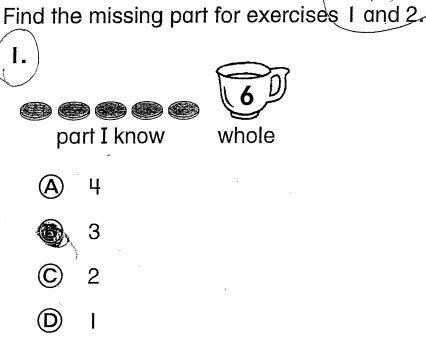
theodp writes " The Common Core State Standards Initiative," explains the project's website, ""is a state-led effort that established a single set of clear educational standards for kindergarten through 12th grade in English language arts and mathematics that states voluntarily adopt." Who could argue with such an effort? Not Bill Gates, who ponied up $150 million to help git-r-done. But the devil's in the details, notes Washington Post education reporter Valerie Strauss, who offers up a ridiculous Common Core math test for first graders as Exhibit A, which also helps to explain why the initiative is facing waning support. Explaining her frustration with the intended-for-5-and-6-year-olds test from Gates Foundation partner Pearson Education, Principal Carol Burris explains, "Take a look at question No. 1, which shows students five pennies, under which it says 'part I know,' and then a full coffee cup labeled with a '6' and, under it, the word, 'Whole.' Students are asked to find 'the missing part' from a list of four numbers. My assistant principal for mathematics was not sure what the question was asking. How could pennies be a part of a cup?" The 6-year-old first-grader who took the test didn't get it either, and took home a 45% math grade to her parents. And so the I'm-bad-at-math game begins!" -
A Plan To Fix Daylight Savings Time By Creating Two National Time Zones
Hugh Pickens DOT Com writes "Allison Schrager writes in the Atlantic that losing another hour of evening daylight isn't just annoying. It's an economically harmful policy with minimal energy savings. "The actual energy savings are minimal, if they exist at all. Frequent and uncoordinated time changes cause confusion, undermining economic efficiency. There's evidence that regularly changing sleep cycles, associated with daylight saving, lowers productivity and increases heart attacks." So here's Schrager's proposal. This year, Americans on Eastern Standard Time should set their clocks back one hour (like normal), Americans on Central and Rocky Mountain time do nothing, and Americans on Pacific time should set their clocks forward one hour. This will result in just two time zones for the continental United States and the east and west coasts will only be one hour apart. "America already functions on fewer than four time zones," says Schrager. "I spent the last three years commuting between New York and Austin, living on both Eastern and Central time. I found that in Austin, everyone did things at the same times they do them in New York, despite the difference in time zone. People got to work at 8 am instead of 9 am, restaurants were packed at 6 pm instead of 7 pm, and even the TV schedule was an hour earlier. " Research based on time use surveys found American's schedules are already determined more by television than daylight suggesting, in effect, that Americans already live on two time zones. Schrager says that this strategy has already been proven to work in other parts of the world. China has been on one time zone since 1949, despite naturally spanning five time zones and in 1983, Alaska, which naturally spans four time zones, moved most of the state to a single time zone. "It sounds radical, but it really isn't. The purpose of uniform time measures is coordination. How we measure time has always evolved with the needs of commerce.," concludes Schrager. "Time is already arbitrary, why not make it work in our favor?"" -
A Plan To Fix Daylight Savings Time By Creating Two National Time Zones
Hugh Pickens DOT Com writes "Allison Schrager writes in the Atlantic that losing another hour of evening daylight isn't just annoying. It's an economically harmful policy with minimal energy savings. "The actual energy savings are minimal, if they exist at all. Frequent and uncoordinated time changes cause confusion, undermining economic efficiency. There's evidence that regularly changing sleep cycles, associated with daylight saving, lowers productivity and increases heart attacks." So here's Schrager's proposal. This year, Americans on Eastern Standard Time should set their clocks back one hour (like normal), Americans on Central and Rocky Mountain time do nothing, and Americans on Pacific time should set their clocks forward one hour. This will result in just two time zones for the continental United States and the east and west coasts will only be one hour apart. "America already functions on fewer than four time zones," says Schrager. "I spent the last three years commuting between New York and Austin, living on both Eastern and Central time. I found that in Austin, everyone did things at the same times they do them in New York, despite the difference in time zone. People got to work at 8 am instead of 9 am, restaurants were packed at 6 pm instead of 7 pm, and even the TV schedule was an hour earlier. " Research based on time use surveys found American's schedules are already determined more by television than daylight suggesting, in effect, that Americans already live on two time zones. Schrager says that this strategy has already been proven to work in other parts of the world. China has been on one time zone since 1949, despite naturally spanning five time zones and in 1983, Alaska, which naturally spans four time zones, moved most of the state to a single time zone. "It sounds radical, but it really isn't. The purpose of uniform time measures is coordination. How we measure time has always evolved with the needs of commerce.," concludes Schrager. "Time is already arbitrary, why not make it work in our favor?"" -
Twitter Marks Clean Sites As Harmful, Breaks Links
starglider29a writes "Yesterday, a website I maintain that has a Twitter presence encountered an 'unsafe' warning when clicking on the tweets. 'This link has been flagged as potentially harmful.' After scanning the site and its database, then checking with Google and third-party site scanners, I found no evidence of harm. At noon, The Atlantic posted an article which describes the same issue with the Philadelphia City Paper. 'Perhaps most frustrating of all is that Twitter has not been particularly responsive to the paper's plight.' If the warnings are incorrect, how does Twitter justify this libel?" -
The Neuroscience of Happiness
Hugh Pickens DOT Com writes "Julie Beck has an interesting read in the Atlantic about how our brains are naturally wired to focus on the negative because evolution has optimized our brains for survival, but not necessarily happiness, which means that we feel stressed and unhappy even though there are a lot of positive things in our lives. 'The problem is that the brain is very good at building brain structure from negative experiences,' says neuropsychologist Dr. Rick Hanson. 'We learn immediately from pain—you know, "once burned, twice shy." As our ancestors evolved, they needed to pass on their genes. And day-to-day threats like predators or natural hazards had more urgency and impact for survival. On the other hand, positive experiences like food, shelter, or mating opportunities, those are good, but if you fail to have one of those good experiences today, as an animal, you would have a chance at one tomorrow. But the brain is relatively poor at turning positive experiences into emotional learning neural structure. 'Positive thinking by definition is conceptual and generally verbal and most conceptual or verbal material doesn't have a lot of impact on how we actually feel or function over the course of the day. A lot of people have this kind of positive, look on the bright side yappity yap, but deep down they're very frightened, angry, sad, disappointed, hurt, or lonely.' Dr. Hanson proposes several ideas for helping 're-wire' our brains for happiness. One of them is that we need to learn how to move positive experiences from short-term buffers to long-term storage. 'But to move from a short-term buffer to long-term storage, an experience needs to be held in that short-term buffer long enough for it to transfer to long-term storage,' says Hanson. 'When people are having positive thinking or even most positive experiences, the person is not taking the extra 10, 20 seconds to heighten the installation into neural structure. So it's not just positive thinking that's wasted on the brain; it's most positive experiences that are wasted on the brain.'" -
What the Surveillance State Does With Your Private Data
Lasrick writes "Conor Friedersdorf at the Atlantic writes up a new report (and infographic) from the Brennan Center for Justice at New York University Law School. 'What the Government Does With Americans' Data' is the best single attempt I've seen to explain all of the ways that surveillance professionals are collecting, storing, and disseminating private data on U.S. citizens. The report's text and helpful flow-chart illustrations run to roughly 50 pages. Unless you're already one of America's foremost experts on these subjects, it is virtually impossible to read this synthesis without coming away better informed.." -
The Post-Lecture Classroom
An anonymous reader writes "The Atlantic reports on a study into reversing the typical lecture/homework educational method. The study had students watch lecture videos at home, then use class time to work on activities. After three years of trials, the researchers found both a student preference for the new method and a 5% increase in exam scores. 'In 2012, that flipped model looked like this: At home, before class, students watched brief lecture modules, which introduced them to the day's content. They also read a textbook — the same, introductory-level book as in 2011 — before they arrived. When they got to class, Mumper would begin by asking them "audience response" questions. He'd put a multiple-choice question about the previous night's lectures on a PowerPoint slide and ask all the students to respond via small, cheap clickers. He'd then look at their response, live, as they answered, and address any inconsistencies or incorrect beliefs revealed. Maybe 50 percent of the class got the wrong answer to one of these questions: This gave him an opportunity to lecture just enough so that students could understand what they got wrong. Then, the class would split up into pairs, and Mumper would ask them a question which required them to apply the previous night's content... The pairs would discuss an answer, then share their findings with the class. At the end of that section, Mumper would go over any points relevant to the question which he felt the class failed to bring up.'" -
Study Shows Professors With Tenure Are Worse Teachers
Hugh Pickens DOT Com writes "We all know the stereotype about tenured college professors: great researchers, lazy teachers. Now Jordan Weissmann writes in the Atlantic that a new study confirms the conventional knowlege that faculty who aren't on the tenure-track appear to do a better job at teaching freshmen undergraduates in their introductory courses than their tenured/tenure-track peers. 'Our results provide evidence that the rise of full-time designated teachers at U.S. colleges and universities may be less of a cause for alarm than some people think, and indeed, may actually be educationally beneficial.' Using the transcripts of Northwestern freshmen from 2001 through 2008, the research team focused on two factors: inspiration and preparation. The team began by asking if taking a class from a tenure or tenure-track professor in their first term later made students more likely to pursue additional courses in that field. That's the inspiration part. Next the researchers wanted to know if students who took their first course in a field from a tenure or tenure-track professor got better grades when they pursued more advanced coursework. That's the preparation part. Controlling for certain student characteristics, freshmen were actually about 7 percentage points more likely to take a second course in a given field if their first class was taught by an adjunct or non-tenure professor and they also tended to get higher grades in those future courses. The pattern held 'for all subjects, regardless of grading standards or the qualifications of the students the subjects attracted' from English to Engineering. The defining trend among college faculties during the past 20 years or so (40, if you really want to stretch back) has been the rise of the adjuncts. 'That said, there is something appealingly intuitive in these results,' concludes Weissmann. 'Professionals who are paid entirely to teach, in fact, make for better teachers. Makes sense, right?'" -
Study Shows Professors With Tenure Are Worse Teachers
Hugh Pickens DOT Com writes "We all know the stereotype about tenured college professors: great researchers, lazy teachers. Now Jordan Weissmann writes in the Atlantic that a new study confirms the conventional knowlege that faculty who aren't on the tenure-track appear to do a better job at teaching freshmen undergraduates in their introductory courses than their tenured/tenure-track peers. 'Our results provide evidence that the rise of full-time designated teachers at U.S. colleges and universities may be less of a cause for alarm than some people think, and indeed, may actually be educationally beneficial.' Using the transcripts of Northwestern freshmen from 2001 through 2008, the research team focused on two factors: inspiration and preparation. The team began by asking if taking a class from a tenure or tenure-track professor in their first term later made students more likely to pursue additional courses in that field. That's the inspiration part. Next the researchers wanted to know if students who took their first course in a field from a tenure or tenure-track professor got better grades when they pursued more advanced coursework. That's the preparation part. Controlling for certain student characteristics, freshmen were actually about 7 percentage points more likely to take a second course in a given field if their first class was taught by an adjunct or non-tenure professor and they also tended to get higher grades in those future courses. The pattern held 'for all subjects, regardless of grading standards or the qualifications of the students the subjects attracted' from English to Engineering. The defining trend among college faculties during the past 20 years or so (40, if you really want to stretch back) has been the rise of the adjuncts. 'That said, there is something appealingly intuitive in these results,' concludes Weissmann. 'Professionals who are paid entirely to teach, in fact, make for better teachers. Makes sense, right?'" -
Social Media Is a New Vector For Mass Psychogenic Illness
Hugh Pickens DOT Com writes "There is an interesting read at the Atlantic where Laura Dimon writes that mass psychogenic illness, historically known as "mass hysteria"—is making a comeback and it appears that social media is a new vector for its spread. Mass hysteria such as the Salem Witch Trials of 1692-1693, the most widely recognized episode of mass hysteria in history, which ultimately saw the hanging deaths of 20 women, spreads through sight and sound, and historically, one person would have to be in the same room as somebody exhibiting symptoms to be at risk of 'catching' the illness. 'Not anymore,' says Robert Bartholomew, a sociologist who has studied over 600 cases of mass hysteria dating back to 1566, noting that social media — 'extensions of our eyes and ears' — speeds and extends the reach of mass hysteria. 'Epidemic hysterias that in earlier periods were self-limited in geography now have free and wide access to the globe in seconds,' says Bartholomew. 'It's a belief, that's the power here, and the technology just amplifies the belief, and helps it spread more readily.' In a recent case, nearly 20 students at a Western New York Junior-Senior High school began experiencing involuntary jerks and tics. Some believe that the Le Roy outbreak was a direct result of videos posted to YouTube by Lori Brownell, a girl with severe tics in Corinth, New York, 250 miles east of Le Roy. The story took off quickly, not just on the local and national news but on Facebook and autism blogs and sites devoted to mental health and environmental issues. Bartholomew warns that there is 'potential for a far greater or global episode, unless we quickly understand how social media is, for the first time, acting as the primary vector or agent of spread for conversion disorder.'" -
Could Technology Create Modern-Day 'Leper Colonies'?
theodp writes "Back in the day, leprosy patients were stigmatized and shunned, quarantined from society in Leper Colonies. Those days may be long gone, but are our mapping, GPS, and social media technologies in effect helping to create modern-day 'Leper Colonies'? The recently-shuttered GhettoTracker.com (born again as Good Part of Town) generated cries of racism by inviting users to rate neighborhoods based on 'which parts of town are safe and which ones are ghetto, or unsafe'. Calling enough already with the avoid-the-ghetto apps, The Atlantic Cities' Emily Badger writes, "this idea toes a touchy line between a utilitarian application of open data and a sly wink toward people who just want to steer clear of 'those kinds of neighborhoods.'" The USPTO has already awarded avoid-crime-ridden-neighborhoods-like-the-plague patents to tech giants Microsoft, IBM, and Google. So, when it comes to navigational apps, where's the line between utility and racism? 'As mobile devices get smarter and more ubiquitous,' writes Svati Kirsten Narula, 'it is tempting to let technology make more and more decisions for us. But doing so will require us to sacrifice one of our favorite assumptions: that these tools are inherently logical and neutral...the motivations driving the algorithms may not match the motivations of those algorithms' users.' Indeed, the Google patent for Storing and Providing Routes proposes to 'remove streets from recommended directions if uploaded route information indicates that travelers seem to avoid the street.' Even faster routes that 'traverse one or more high crime areas,' Google reasons, 'may be less appealing to most travelers'." -
For Education, Why TI-83 > iPad
theodp writes "Writing in The Atlantic, Phil Nichols makes a convincing case for why educational technologies should be more like graphing calculators and less like iPads. Just messing around with TI-BASIC on a TI-83 Plus, Nichols recalls, 'helped me cultivate many of the overt and discrete habits of mind necessary for autonomous, self-directed learning.' So, with all those fancy iPads at their schools, today's kids must really be programming up a storm, right? Wrong. Nichols, who's currently pursuing a PhD in education, laments, 'The iPad is among the recent panaceas being peddled to schools, but like those that came before, its ostensibly subversive shell houses a fairly conventional approach to learning. Where Texas Instruments graphing calculators include a programming framework accessible even to amateurs, writing code for an iPad is restricted to those who purchase an Apple developer account, create programs that align with Apple standards, and submit their finished products for Apple's approval prior to distribution.'" -
Internet.org's Slave and Helicopter-Powered Internet
theodp writes "As reported earlier on Slashdot, Mark Zuckerberg on Wednesday announced the launch of Internet.org, 'a global partnership with the goal of making internet access available to the next 5 billion people,' including 'those who cannot currently afford it.' So it's especially bizarre that just a few days ago, Internet.org carried a FAQ which joked that slaves were used to create an Internet for the Pharaohs. And until recently, Internet.org's home page sported a photo purporting to show that freighters are used to rush Internet porn to affluent residents of the 16th arrondissement of Paris, and an illustration showing how helicopters deliver Internet data to actor George Clooney's magnificent Lake Como Villa. So keep an eye on how your domain is used, kids, especially if you plan to use it soon to position yourself and your partners as saints who champion the right of the world's poor to Internet access." -
How the UN Might Have Inadvertently Started a Cholera Epidemic In Haiti
Hugh Pickens DOT Com writes "Celso Perez and Muneer Ahmad write in The Atlantic that despite evidence to the contrary, for nearly three years, the United Nations has categorically denied that it introduced cholera into Haiti after the country suffered a devastating earthquake in 2010. Since then, cholera has killed more than 8,000 people and infected more than 600,000, creating an ongoing epidemic. According to extensive documentation by scientists and journalists, peacekeeping troops belonging to the UN Stabilization Mission in Haiti (MINUSTAH) inadvertently but negligently brought cholera into the country several months after the January 2010 earthquake. That October, troops from Nepal carrying the disease were stationed at a military base near the town of Méyè. Because of inadequate water and sanitation facilities at the base, cholera-infected sewage contaminated the Artibonite River, the largest river in Haiti and one the country's main water sources. As locals consumed the contaminated water, cholera spread across the country. Absent from Haiti for over a century, cholera is now projected to plague the country for at least another decade. 'By refusing to acknowledge responsibility, the United Nations jeopardizes its standing and moral authority in Haiti and in other countries where its personnel are deployed,' writes the Washington Post Editorial Board adding that without 'speaking frankly about its own responsibility for introducing cholera to Haiti, the organization does a disservice to Haiti and Haitians, who deserve better.'" -
The Next Frontier of Consumer Exploitation By Corporations
First time accepted submitter alisonuw writes "So what if Google knows where I'm planning my next vacation and suggests hotels for me? Sure, it's creepy, but is there really any harm in companies tracking my info to target ads to me? Professor Ryan Calo (UW law) is out with a new paper that demonstrates the real harm behind these practices, making consumers vulnerable to making decisions that go against their self-interest (ie: predatory lending, price inflation, etc). The Atlantic has an article today that outlines the new research." -
Content Most Foul: the British Library's Nanny Filter Blocks 'Hamlet'
An anonymous reader writes "A man using the British Library's public wi-fi found that access to an on-line copy of 'Hamlet' was blocked for 'violent content'. Now, it is true that 'Hamlet' is pretty violent (8 murders, including one before the play starts, plus one suicide). But the heavy-handed irony of a guardian of British cultural heritage censoring the greatest work of British literature is just too blatant to be ignored. Library staff initially didn't seem too interested in fixing the problem, but in the end they adjusted the filters." -
Photocopying Michelle Obama's Diary, Just In Case
Hugh Pickens DOT Com writes "Conor Friedersdorf has a good (and humorous) read in the Atlantic about the analogy that President Obama has settled on to explain his theory of the NSA surveillance controversy to reporters. 'The question is how do we make the American people more comfortable?' Obama said. 'If I tell Michelle that I did the dishes ... and she's a little skeptical, well, I'd like her to trust me, but maybe I need to bring her back and show her the dishes and not just have her take my word for it.' The analogy has been widely panned, and for good reason. Friedersdorf writes that he has come up with a much better analogy. What if 'Barack snuck into Michelle's closet one day, dug through her belongings until he found her diary, and photocopied it. Then he replaced the original, locked the copy in his desk, and didn't think about it much until she found out months later and furiously confronted him.' Admittedly, it isn't a perfect analogy either says Friedersdorf, 'but it comes a lot closer than Obama did to capturing the actual stakes in this debate, and the reason so many Americans are angry at him.'" In related news, Snowden's father disagrees that his son isn't a patriot: "My son has spoken the truth, and he has sacrificed more than either the president of the United States or Peter King have ever in their political careers or their American lives. So how they choose to characterize him really doesn't carry that much weight with me." -
Schneier: The NSA Is Commandeering the Internet
Nerdfest writes "Bruce Schneier writes in The Atlantic: 'Bluntly: The government has commandeered the Internet. Most of the largest Internet companies provide information to the NSA, betraying their users. Some, as we've learned, fight and lose. Others cooperate, either out of patriotism or because they believe it's easier that way. I have one message to the executives of those companies: fight.'" -
The Latest Security Vulnerability: Your Toilet
NobleSavage writes "We all knew it was just a matter of time. With the rush to put more and more appliances on-line Japanese toilet-maker Satis, one of Japan's largest commode companies, has finally networked the toilet. Just as you would have predicted, the information security company Trustwave Holdings has published an advisory regarding Satis-brand toilets. According to Trustwave, every Satis toilet has the same hard-coded Bluetooth PIN, which means any person using the 'My Satis' [Android] application can control any Satis toilet." -
The Man Who Convinced Us We Needed Vitamin Supplements
An anonymous reader writes "The Atlantic has an interesting piece on the life and work of the scientist most responsible for moms around the world giving their kids Vitamin C tablets to fight off colds, Linus Pauling. From the article: 'On October 10, 2011, researchers from the University of Minnesota found that women who took supplemental multivitamins died at rates higher than those who didn't. Two days later, researchers from the Cleveland Clinic found that men who took vitamin E had an increased risk of prostate cancer. "It's been a tough week for vitamins," said Carrie Gann of ABC News. These findings weren't new. Seven previous studies had already shown that vitamins increased the risk of cancer and heart disease and shortened lives. Still, in 2012, more than half of all Americans took some form of vitamin supplements. What few people realize, however, is that their fascination with vitamins can be traced back to one man. A man who was so spectacularly right that he won two Nobel Prizes and so spectacularly wrong that he was arguably the world's greatest quack.'" -
How Silicon Valley's Tech Reign Will End
theodp writes "Silicon Valley's stranglehold on West Coast innovation is in danger. The main problem? It's no fun to live in Silicon Valley. Technology is people, explains The Atlantic's Derek Thompson, and more people are choosing to live in cities. And Silicon Valley isn't like a city, it's like a suburb. 'What's happening now,' says author Bruce Katz, 'is workers want to be in Oakland and San Francisco.' So, how might Silicon Valley save itself? 'Silicon Valley is going to have to urbanize,' Katz said. '[There is a] migration out of Silicon Valley to places where people really want to live.'"