Slashdot Mirror


A Math Test That's Rotten To the Common Core

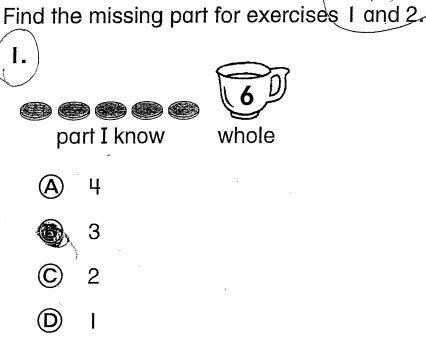
theodp writes " The Common Core State Standards Initiative," explains the project's website, ""is a state-led effort that established a single set of clear educational standards for kindergarten through 12th grade in English language arts and mathematics that states voluntarily adopt." Who could argue with such an effort? Not Bill Gates, who ponied up $150 million to help git-r-done. But the devil's in the details, notes Washington Post education reporter Valerie Strauss, who offers up a ridiculous Common Core math test for first graders as Exhibit A, which also helps to explain why the initiative is facing waning support. Explaining her frustration with the intended-for-5-and-6-year-olds test from Gates Foundation partner Pearson Education, Principal Carol Burris explains, "Take a look at question No. 1, which shows students five pennies, under which it says 'part I know,' and then a full coffee cup labeled with a '6' and, under it, the word, 'Whole.' Students are asked to find 'the missing part' from a list of four numbers. My assistant principal for mathematics was not sure what the question was asking. How could pennies be a part of a cup?" The 6-year-old first-grader who took the test didn't get it either, and took home a 45% math grade to her parents. And so the I'm-bad-at-math game begins!"
663 comments

  1. How hard can that possibly be? by Anonymous Coward · · Score: 0

    Question 1: You see 5 pennies, the total in the cup is 6, so the missing part is 1 (penny). How hard can that possibly be?

    1. Re:How hard can that possibly be? by MickyTheIdiot · · Score: 4, Funny

      Well when there isn't an explanation of what is being asked and the test was written by the same person that puts the iconography in airport bathrooms....

    2. Re:How hard can that possibly be? by beelsebob · · Score: 5, Insightful

      The question is clearly ridiculous. The problem lies there and solely there though, unlike as the article suggests. Expecting 5 or 6 year olds to be able to do basic addition and subtraction of small quantities of physical items is not a problem at all –that's exactly what I'd expect a 5 or 6 year old to be able to do. Writing crappy questions like pearson has is absolutely a problem though.

    3. Re:How hard can that possibly be? by mjwalshe · · Score: 1

      Needs Biilg to do one of his famous rants on who ever is in charge of this

    4. Re:How hard can that possibly be? by ShanghaiBill · · Score: 4, Insightful

      Question 1: You see 5 pennies, the total in the cup is 6, so the missing part is 1 (penny). How hard can that possibly be?

      If you see five, and there are six more in the cup, then the total is eleven. If only one is missing, then which one?

    5. Re:How hard can that possibly be? by Jeremiah+Cornelius · · Score: 1

      MONEY can't buy you excellence, in a corrupted society.

      --
      "Flyin' in just a sweet place,
      Never been known to fail..."
    6. Re:How hard can that possibly be? by RichMan · · Score: 5, Insightful

      There do not appear to be any coins in the cup. It appears to be full of liquid with the internal liquid level line.
      There is a number 6 under the cup, it does not say 6 coins. Why would there be coins in cap anyways? You put liquid in cup.

      "Find the missing part?" is a bad question. If anything it should ask about coins, not parts.
      There are no parts missing all the coins are whole so is the cup.

      The whole thing is not clear and misleading.

      You are assuming the question is asking about the sum of coins. That is not indicated by the question.
      Having to make assumptions about a question is very very wrong when it is not a written test where one can explain the assumptions one has to add to a question.

    7. Re:How hard can that possibly be? by Anonymous Coward · · Score: 2, Insightful

      Ridiculous. You have five out of six, so the remaining part is 1/6. That makes at least as much sense.

    8. Re:How hard can that possibly be? by Skapare · · Score: 4, Insightful

      Then just ask "what is 6 minus 5". Why make the question ridiculous?

      --
      now we need to go OSS in diesel cars
    9. Re:How hard can that possibly be? by Sloppy · · Score: 3, Insightful

      Buy you're wrong. The answer is 1 penny plus 1 cup. That's why you always need to be explicit with units, to avoid making the mistake of thinking it's merely just one penny.

      --
      As copyright owner of this comment, I authorize everyone to defeat any technological measure which limits access to it.
    10. Re:How hard can that possibly be? by comrade1 · · Score: 5, Funny

      People, people, you need to step back and reexamine your basic assumptions about the question. They are not 'pennies', but rather 'oreos'. -folds arms in triumph

    11. Re:How hard can that possibly be? by Lumpio- · · Score: 2

      Why would you put pennies in a coffee cup...?

    12. Re:How hard can that possibly be? by seededfury · · Score: 1

      I understood question 1 only after seeing question 5.

    13. Re:How hard can that possibly be? by alantus · · Score: 0

      Writing crappy questions like pearson has is absolutely a problem though.

      Give him a break, after all this is the same guy that made Windows ME.

    14. Re:How hard can that possibly be? by Qzukk · · Score: 5, Funny

      But it's obvious the cup is full of liquid, therefore the answer must be 787. That being the number of degrees required to melt zinc, which is clearly what is missing.

      --
      If I have been able to see further than others, it is because I bought a pair of binoculars.
    15. Re:How hard can that possibly be? by tricorn · · Score: 1

      The only problem with question 1 is that the "whole" is indicated as a coffee cup.

      It's obvious that subtraction is being taught as "the full (whole) amount" minus "the part you know" equals "the hidden (missing) part" (or at least one way of thinking about subtraction problems can be thought of that way).

      Some of the other questions are poorly worded as well, but Q1 is really bad.

      There's nothing wrong with having tests where some of the problems are "too hard" for the level being tested, tests should be useful as diagnostics, exploring what you DON'T know. It should be totally normal to get a 50% on a test, that just shows what still needs to be taught. There's been a lot of research on computerized adaptive tests, that's what should be used, not testing for failure.

    16. Re:How hard can that possibly be? by Skiron · · Score: 2

      Exactly. Just teach kids maths. I guess it is all down to the stupid assumptions (excuses) that PC people have about the kid that can't learn (dslyx... or however you spell it) or try to make it interesting involving drink and food. Load of bollocks.

    17. Re:How hard can that possibly be? by Okian+Warrior · · Score: 4, Informative

      It's hard because the people writing the test have no experience writing for an audience.

      When you write for an audience, you quickly come to understand that things you think are obvious aren't obvious to everyone, and that any loose or fuzzy choice of words adds ambiguity. It's the problem of self anchoring and illusion of transparency.

      Specifically in the case of the test:

      Test modes are introduced with only a brief explanation and no worked examples for clarity.

      "Find the missing part for exercises 1 and 2" is weak, non-specific, and ambiguous. "Part" has connotations of a physical piece that completes a whole (like a puzzle piece, or the broken handle of a cup), but is used to describe a grouping. The presentation uses two disparate representations of a group: 5 pennies, versus a cup labelled "6". The captions "part I know" and "whole" seem to have nothing to do with the pictures - the 5 pennies isn't a "part", and the cup is a "whole" object, but why is it labelled 6? The cup is non-sequitur to the question, and cups hold fungible materials while the pennies are enumerated. And to drive that last part home, the cup is shown "filled" with liquid. Or is it partially filled? And is the fact that it's partially filled somehow related to the question?

      Here's a reworked example that's a little better. (Could be better - I didn't give spend a lot of time.)

      For the next two questions, we will show you something on the left and something on the right. Choose the answer which, when added to the thing on the left, makes it the same as the thing on the right.

      Example: [left: Square containing 3 circles] [right: Square containing 4 circles]
      [list of answers, with circle marked correct].

      Question 1:

      Show 5 smaller cups (shot-glass sized) filled with a dark liquid. Show a measuring cup with lines labelled 1-7, and filled to level 6 with a dark liquid.

      Question: How much more ink is needed on the left to make the amount of ink on the right?

    18. Re:How hard can that possibly be? by skywire · · Score: 4, Insightful

      Well, sure, you were able to take what has to be one of the most pathetic examples of muddiness I've ever seen, and by a rather sophisticated exercise of elimination of possibilities, construe what must have been the intent of its creator. That was a much more difficult problem than the arithmetic problem that it was intended to represent, and you are no 5-year-old.

      --
      Those who would give up essential liberty to purchase a little temporary safety, deserve neither liberty nor safety.
    19. Re:How hard can that possibly be? by baffled · · Score: 2

      Reading your response, I realized the formulation of the question forces the student to deal with not only icons or only numbers, but rather they have to deal with both. That is, they see five pennies, and see one cup. But, they need to reason the 1 cup can hold 6 pennies, then perform the calculation. It seems the strange part of the problem - that it mixes icons and numbers - might precisely be why it was formulated as such.

      There are even more abstractions that need to be dealt with than that - they have to associate the cup that can hold 6 pennies is what is considered to be 'whole', and they need to recognize the 'missing' part will exclude 'part I know'. Whether this is a sound approach or not, I don't know - but I can understand, it being so different from traditional mathematics, it would ruffle some feathers.

    20. Re:How hard can that possibly be? by Anonymous Coward · · Score: 0

      And nothing spells corruption like greed.

      Interesting conundrum, though. With people who exhibit excellence, you often see them exhibit their own greed. Seems money can actually buy you excellence, where such people only care about money.

    21. Re:How hard can that possibly be? by gatkinso · · Score: 1

      Way of them, so hard your speak?

      (Translation: How hard would it have been for them to phrase the question the way you did?)

      --
      I am very small, utmostly microscopic.
    22. Re:How hard can that possibly be? by BinBoy · · Score: 1

      Question 1: You see 5 pennies, the total in the cup is 6, so the missing part is 1 (penny). How hard can that possibly be?

      If you see five, and there are six more in the cup, then the total is eleven. If only one is missing, then which one?

      The answer isn't listed. Whether there are 11 or 6, they're all accounted for so 0 coins are missing. (Assuming they're coins)

    23. Re:How hard can that possibly be? by Anonymous Coward · · Score: 0

      Anon for modding.

      I see 5 pennies.
      I see a teacup with a label 6.

      Is it 6 pennies to buy a cup of tea? Is there supposed to be 6 cups of tea? Is it a 5 cent coffee in a tea cup? Mommy would scream at me if I was putting pennies in her fine china...

      In my opinion the missing part of the equation is an actual question.

    24. Re:How hard can that possibly be? by sI4shd0rk · · Score: 1

      More silly multiple choice tests that accomplish... absolutely nothing; much like all of our other tests.

      --
      Ignorance is a choice
    25. Re:How hard can that possibly be? by ShanghaiBill · · Score: 1, Troll

      Then just ask "what is 6 minus 5". Why make the question ridiculous?

      Because that does not test if the student understands the concept. True story: I looked at a list of shipping containers, and the volumes listed were wildly inaccurate. So I talked to the responsible guy in the warehouse. It turns out that he had measured the width, length, and height, and then ADDED them together. He was fully capable of performing multiplication, but he obviously didn't grasp the concept.

    26. Re:How hard can that possibly be? by Anonymous Coward · · Score: 0

      Read the article: "... a full coffee cup labeled with a '6' and, under it, the word, 'Whole.' What is the coffee cup full of? Can I clearly see that there are six pennies or am I to assume there are 6 somethings submerged in a full cup of coffee? What it there were 6 dimes in the coffee, would the answer still be one because the unspecified units were actually coins and not the monetary value inherent to the coins? What if I'm a student from a foreign country and I don't know American currency yet?

      "This is much more than simple extrapolation, and the test's author may know math, but they don't know jack about children or childhood development. Game Over.

    27. Re:How hard can that possibly be? by gatkinso · · Score: 4, Insightful

      Well, according to the illustration, the cup is full of milk... which lends credence to your theory.

      --
      I am very small, utmostly microscopic.
    28. Re:How hard can that possibly be? by gatkinso · · Score: 3, Funny

      Because after being subject to such a curriculum they will be beggars?

      --
      I am very small, utmostly microscopic.
    29. Re:How hard can that possibly be? by gl4ss · · Score: 2

      the only fucking way for it to make ANY sense at all is if the price of the cup is six pennies.

      "you have 5 pennies and want to buy a cup that costs 6, how many pennies are you missing?"

      whoever did that should be kicked in the nuts though... and forced to take elementary school again since clearly he can't write and he can't use symbols either.

      it's obvious from the sizes that the cup can hold more pennies and since when does a cup become "whole" anyways. why the fuck have the cup even there, since it is not representing 6 items at all(the text is).

      --
      world was created 5 seconds before this post as it is.
    30. Re:How hard can that possibly be? by Anonymous Coward · · Score: 0

      http://www.amazon.com/The-Cottage-Industry-Morning-Mug/dp/B005BR7JJM/ref=sr_1_6?ie=UTF8&qid=1383411257&sr=8-6&keywords=Coffee+Mug is currently $9.48.

      The mug has six pennies in it, so we're looking at $9.54. We'll assume we somehow tricked amazon into giving us free shipping, so the answer is therefore $9.49 plus the difference between whatever we value time owning a mug and not owning a mug at for the period in which the mug is being shipped.

    31. Re:How hard can that possibly be? by Anonymous Coward · · Score: 0

      This is a (bad) reading comprehension test, not a math test. This is a huge complaint that I have had with my kids education and it is quite wide spread. Many of these tests use bizarre insider language that nobody would use in real life. The test is being given to 6 year olds with marginal reading abilities. I suppose their nominal motivation is to get them used to poorly written word problems early, so when they get poorly written word problems in Jr. High it's not a shock.

      Seriously, what is wrong with 2+2= ? or 6-1=? I'll tell you what, there is no money in it. The professional teaching industry makes money on continuously re-inventing the wheel. Pearson Education will not make any money producing books full of simple math problems like our parents and grandparents (and maybe even some of us) used. First grade math NEVER changes. It's not like a college computer science class. You would think we would just be perfecting it by now.

    32. Re: How hard can that possibly be? by Anonymous Coward · · Score: 0

      I have a six year old, and sure, the way her math problems are worded sound funny to me. I don't think it has anything to do with common core, just parents that don't remember what is was like when these concepts were introduced to themselves.

      You can't just say "subtract" to a child and get results, I do know that. You have to say kiddy stuff like "take away from" and show with real objects if I have this many and take this many away, how many do I have left? Then you have to do it with symbols like this test does. Then you teach what the regular math expression looks like, 4 - 2 = 2
      You can't just jump to the end.

      The kids should have already been instructed to deal with problems presented in the manner the test does.

      I only wish take home papers had a little blurb of fine print explaining to parents some of the context... I can figure out the method with a little thinking, but obviously from the article, some parents have difficulty with that.

    33. Re:How hard can that possibly be? by Bob9113 · · Score: 1

      Question 1: You see 5 pennies, the total in the cup is 6, so the missing part is 1 (penny). How hard can that possibly be?

      Hard enough that you got it wrong. If you know that the outcome is six pennies in a cup, and you start with five pennies, the number of missing things is 2; one penny and one cup.

      Not that I think this is any worse than when I was young. I remember having strenuous arguments about questions like these from my earliest years. Led to a deeply ingrained distrust of authority.

      Hmmm, which I see as a good thing, so I guess I approve of these crappy tests. :)

    34. Re:How hard can that possibly be? by nitehawk214 · · Score: 1

      I would tell the people that came up with that test. "Use your words." It should be condescending enough for the "educators" to understand.

      --
      I'm a good cook. I'm a fantastic eater. - Steven Brust
    35. Re:How hard can that possibly be? by nitehawk214 · · Score: 2

      Well, according to the illustration, the cup is full of milk... which lends credence to your theory.

      Or coffee, which I presume the person that wrote this test had 6 cups of, and was only paid 5 cents to create the test.

      --
      I'm a good cook. I'm a fantastic eater. - Steven Brust
    36. Re:How hard can that possibly be? by alexhs · · Score: 1

      But it's obvious the cup is full of liquid

      No, you didn't pay attention to the "whole" word.
      Obviously, it's not liquid but well-levelled whole-wheat flour :
      You have 6 <unit> of whole-wheat flour, and the part you know is that you want 5 cookies.
      The missing parts are mainly butter, sugar, eggs, but the kid forgot there's also baking powder, etc.
      Also I'm not sure what the unit should be. Maybe ounces ? Because with 6 cups of flour, you're going to have a lot of excess flour for only five cookies (or these are very big cookies, in which case the figure would not be to scale).

      --
      I have discovered a truly marvelous proof of killer sig, which this margin is too narrow to contain.
    37. Re:How hard can that possibly be? by pla · · Score: 5, Interesting

      Show 5 smaller cups (shot-glass sized) filled with a dark liquid. Show a measuring cup with lines labelled 1-7, and filled to level 6 with a dark liquid.

      I mean this with no disrespect, because I largely agree with your bigger point. But you've illustrated part of the problem with the original test - People designing tests for kids who don't understand how those kids perceive the world.

      Until at least age 7 or 8, and usually later, kids have a very poor grasp of conservation of volumes. They will tend to linearize the problem, seeing the "full" smaller glasses as having the same volume as the marker with the same height on the larger measuring cup.

    38. Re:How hard can that possibly be? by arth1 · · Score: 2, Insightful

      The test is being given to 6 year olds with marginal reading abilities.

      And that's part of the problem. By age six, reading abilities should not be marginal. At age three, yes. But if you haven't taught your kids to read reasonably well by the time they're six, either they are stupid or you are.

    39. Re:How hard can that possibly be? by technosaurus · · Score: 2

      And the cup is already labeled "whole", so it must be whole milk. ... So the answer is 2.
      Its missing nutritious snack and a glass of water, fruit juice or low-fat milk.
      (but I'd take the milk and cookies)

    40. Re:How hard can that possibly be? by davester666 · · Score: 1

      I think you need to upgrade that to giving the person in charge a good Ballmering.

      --
      Sleep your way to a whiter smile...date a dentist!
    41. Re:How hard can that possibly be? by Opportunist · · Score: 2

      Let's start with the non-sentence "part I know". What the FUCK is that supposed to tell us? That I know 5 pennies? That I know what a penny is? That I know there are 5 pennies? Is that a statement or a question, does it mean I know 5 pennies, or does it mean that I want to know 5 pennies? And what the hell does a cup have to do with pennies? A cup with a 6 on it is "whole". So is "part" supposed to have a meaning in the context of "whole vs. part"? A cup of 6 is "whole" while 5 single pennies is "part I know". Why the "I know"?

      I have to admit I do not know about the reading skills of the average 5 year old where this test is applied, but they learn reading in school here, i.e. after they were supposed to make that test. And yes, that includes numbers!

      Now, I guess it's safe to assume that you and I come to the same, and most likely correct, conclusion that the cup is supposed to represent a "container" object that holds our "whole" universe, with the "6" being a representation of the amount of items contained within, and that the 5 coins present next to it labeled "part I know" (which still puzzles me to no end considering I'd have thought "parts" would be correct, but ... never mind) represent a subgroup of the universe with the question relating to and asking for the missing pieces, which would of course be 1.

      Mind you that I and, presumably, you are not 5 year old, which means we both have a bit of life experience not to mention that during our education we had to deal with problems not unlike that one, and we both can read and write to some degree (I deduct that from your ability to express the idea you so eloquently informed us of). Two important advantages the child subject to this test does not have.

      To be brutally honest, I even had to ponder for a moment what the heck they want from me. And that's with a degree in statistics and an IQ that puts me in the .1% "smartest" group. Now, the latter obviously doesn't have much to do with our education system, but the former is pretty much obviously a result thereof. A result of the education system that wants to find out whether these kids are "ready" for school. Apparently only when your mind is bent and broken enough that you can wrap it around that kind of bull you're ready for school.

      --
      We used to have a Bill of Rights. Now, with the rights gone, all we have left is the bill.
    42. Re:How hard can that possibly be? by justthinkit · · Score: 1

      Every industry makes money on continuously re-inventing the wheel.

      ...and especially the software industry.

      FTFY

      --
      I come here for the love
    43. Re:How hard can that possibly be? by arth1 · · Score: 5, Funny

      I see 5 pennies.
      I see a teacup with a label 6.

      Your observational skills are somewhat lacking, I'd say.

      I see five stacks of two coins. (look closely)
      I see a coffee cup with a label.

      If I turn the coffee cup over the stack of coins, I would read 9, but there would be 10 coins under them. Thus, I need to take away one part - one coin. The answer is thus one.
      Q.E.D.

    44. Re:How hard can that possibly be? by QRDeNameland · · Score: 1

      The answer is 1 penny plus 1 cup.

      Another valid answer could be "2 girls minus 5 pennies" , though I suspect that would result in psychological counseling for 5-6 year olds.

      --
      Momentarily, the need for the construction of new light will no longer exist.
    45. Re:How hard can that possibly be? by angel'o'sphere · · Score: 1

      I guess forr an american child this kind of question would be easier to awnser if they used cents instead of pennies ;)

      (And no, I don't get the question either ... my bet would be 1 as the first poster betted)

      --
      Cost free eBook I read (by iBook/Kobo/Amazon/ObookO/Gutenberg etc.): "The Green Odyssey" by Philip Jose Farmer.
    46. Re:How hard can that possibly be? by Opportunist · · Score: 3, Interesting

      The problem itself is valid, and it's very sensible to expect a 6 year old to understand it. The presentation is beyond idiotic, though.

      How about writing "whole" and drawing a piggy bank (to make a connection with the coins) with a "6" on it. Then writing "taken out" and drawing 5 coins. Then writing "left?" and drawing the piggy bank again, this time with a big question mark, along with a piggy bank next to A, B, C and D with the 4 possible answer numbers on them.

      Clear, simple, easy to understand. The guy who made that test was responsible for user interfaces at MS before, I betcha.

      --
      We used to have a Bill of Rights. Now, with the rights gone, all we have left is the bill.
    47. Re:How hard can that possibly be? by imp · · Score: 3, Insightful

      If you've listened to the instruction that goes along with the test, it would be clear what to do. My first grader has no problem with these problems. He's told me that the teacher has explained the technique and he recognizes it from the questions that are asked.... Without understanding the context in which things are taugh, you can't judge the tests that are used. This test is not ridiculous when you look at it in proper context.

      Some people want to make political hay out of this, since they feel that they are losing local control. Or they are secretly against a good public education, so they oppose real attempts to raise the standards, think outside of the box and teach the concepts that will form the foundation of a lifetime...

    48. Re:How hard can that possibly be? by Opportunist · · Score: 1

      Whole milk, no less.

      I think the correct answer is "Timmy gets a tummy ache".

      --
      We used to have a Bill of Rights. Now, with the rights gone, all we have left is the bill.
    49. Re:How hard can that possibly be? by Opportunist · · Score: 1

      Not to mention in her tea.

      --
      We used to have a Bill of Rights. Now, with the rights gone, all we have left is the bill.
    50. Re:How hard can that possibly be? by Electricity+Likes+Me · · Score: 2

      Then just ask "what is 6 minus 5". Why make the question ridiculous?

      Because that does not test if the student understands the concept. True story: I looked at a list of shipping containers, and the volumes listed were wildly inaccurate. So I talked to the responsible guy in the warehouse. It turns out that he had measured the width, length, and height, and then ADDED them together. He was fully capable of performing multiplication, but he obviously didn't grasp the concept.

      What concept is being grasped by trying to decode someone's idiot iconography? There are wholly about 5 valid interpretations in the comments I've read so far. We're talking about 5 and 6 year olds here - they're still learning how to properly grasp the English language. We're teaching them mathematics separately - they sure as hell shouldn't be tested on whether they're smart enough yet to realize whichever adult wrote the question is an idiot.

    51. Re:How hard can that possibly be? by imp · · Score: 2

      The WHOLE is 6. You see 5 from the whole. That means one is missing from the five to make a while.
      This method of thinking through the problem is taught in the classroom instruction that goes along with it.

    52. Re:How hard can that possibly be? by Opportunist · · Score: 1

      Technically from the way the question is asked, one could assume that these 5 "discs" are supposed to be assembled in some way to get the cup as the end product.

      --
      We used to have a Bill of Rights. Now, with the rights gone, all we have left is the bill.
    53. Re:How hard can that possibly be? by Opportunist · · Score: 1

      Then it fails at it, too, because the correct answer is 1, which you could also come up with if you consider the 1 cup "whole" and thus the right answer.

      And you can present that question with the same test of abstraction ability in a very different way, too, that is less confusing. I outlined it above with an example using piggy banks.

      --
      We used to have a Bill of Rights. Now, with the rights gone, all we have left is the bill.
    54. Re: How hard can that possibly be? by Anonymous Coward · · Score: 0

      Perhaps the real purpose of this test is to get children accustomed to being asked stupid artificial textbook questions with a lot of irrelevant and misleading nonsense that is to be ignored. From my memory of math textbooks I doubt that the questions will become any clearer or closer to the real-world later...

    55. Re:How hard can that possibly be? by Opportunist · · Score: 3, Interesting

      If I had to assume that I do NOT know jack about math or life (which is pretty much the situation for 5 year olds...), the assumption could as well be that I know I have these 5 discs and somehow have to stack or otherwise assemble them to create a cup, and now the question is what is missing. The answer 3 seems valid, since it does look a bit like the handle of the cup.

      Remember that to kids numbers are not simply abstract symbols but they do have a "face". Actually, I remember that as a kid the 2 looked very friendly, the 1 was stern and the 5 pretty evil and intimidating. There is a reason why many 4 year old can solve the riddle below but few adults can:

      5628392 = 4
      5093526 = 3
      8522100 = 4
      7664921 = 3
      1226112 = 1
      1099712 = 3
      5723445 = 0
      8192341 = ?

      --
      We used to have a Bill of Rights. Now, with the rights gone, all we have left is the bill.
    56. Re:How hard can that possibly be? by Opportunist · · Score: 1

      The problem starts at "part I know". The confusion for the 6 year old sets in where he sees multiple objects being presented to him and referred to with the singular. The funny part is that the dumber the student, the less confusing it will be, but I know for a fact that it would have irritated me to no end. I think it is asking a bit much from a 6 year old to consider the 5 coins a "group" and hence referring to that group in singular being valid.

      I agree that there is nothing wrong with presenting questions that are "too hard" for the average student to find the prodigies, but this doesn't test this in the slightest. I don't even know what it is supposed to test, if anything, or whether it is just very badly designed.

      I vote for the latter.

      --
      We used to have a Bill of Rights. Now, with the rights gone, all we have left is the bill.
    57. Re:How hard can that possibly be? by Opportunist · · Score: 1

      Personally, I think understand how things work would be counter productive with these tests. I think rote learning is the way to ace them.

      --
      We used to have a Bill of Rights. Now, with the rights gone, all we have left is the bill.
    58. Re:How hard can that possibly be? by Joce640k · · Score: 3, Insightful

      What I want to know is why these people aren't hunted down and branded with a big "Useless, do not employ" on their foreheads?

      --
      No sig today...
    59. Re:How hard can that possibly be? by Joce640k · · Score: 2

      Paula Bean...?

      --
      No sig today...
    60. Re:How hard can that possibly be? by arth1 · · Score: 1

      I guess forr an american child this kind of question would be easier to awnser if they used cents instead of pennies ;)

      I guess Germans are unaware that in the US, cents are called pennies.

      Penny = cent
      Nickel = 5 cent
      Dime = 10 cent
      Quarter = two bits = 25 cent
      Half Dollar = eagle = four bits = 50 cent

    61. Re:How hard can that possibly be? by hermitp · · Score: 1

      "The cup is non-sequitur to the question, and cups hold fungible materials while the pennies are enumerated." Exactly. It's not clear what's being compared. The pics indicate a comparison between discrete items (coffee beans, I think, not pennies) to a continuous quantity (the drink made from the beans) whereas the numbers (5 and 6) indicate a comparison between discrete items (beans and beans). The 6 on the cup is particularly confusing. What does it refer to? The number of beans that go into a full cup? Number of ounces? If beans to beans, it's still confusing: If the beans have been processed into a cup of coffee, they're not really (discrete) beans anymore, so now how do compare?

    62. Re:How hard can that possibly be? by I'm+New+Around+Here · · Score: 1

      You're a sick individual, mister.

      --
      If you think I voted for Trump because of this post, you're wrong. I voted for Dr. Jill Stein of the Green Party. Again.
    63. Re: How hard can that possibly be? by Anonymous Coward · · Score: 1

      Three. Counting the loops or circles in the letters, or because every other answer is three; either might be a valid reason. That took me over two minutes, which pisses me off.

    64. Re:How hard can that possibly be? by I'm+New+Around+Here · · Score: 1

      Yes, but they've spent billions to develop these ones. Therefor they are better. And you need to buy these tests, because otherwise your kids will starve.

      --
      If you think I voted for Trump because of this post, you're wrong. I voted for Dr. Jill Stein of the Green Party. Again.
    65. Re:How hard can that possibly be? by BoRegardless · · Score: 1

      Whole thing was written by a Phd with not much else to do than ponder puzzles as a reason for existence.

    66. Re:How hard can that possibly be? by arth1 · · Score: 1

      Why would you put pennies in a coffee cup...?

      True. I learned to count (and enunciate) by reciting:
      A pepper corn in a copper pot
      Two pepper corns in a copper pot
      Three pepper corns in a copper pot ...

    67. Re:How hard can that possibly be? by noh8rz10 · · Score: 5, Insightful

      If you've listened to the instruction that goes along with the test, it would be clear what to do. My first grader has no problem with these problems. He's told me that the teacher has explained the technique and he recognizes it from the questions that are asked.... Without understanding the context in which things are taugh, you can't judge the tests that are used. This test is not ridiculous when you look at it in proper context.

      when you ask a simple question in a simple way, you test a child's ability to understand concepts. When you ask a simple question in an overly convoluted and distorted way, you test a child'a ability to follow directions. The school district makes clear which kind of test this is supposed to be.

      honestly people, a test for first graders that is hard to understand for many slashdot readers, including myself??? "you can't take it out of context, there are accompanying teaching segments, etc". I'm going to go out on a limb and say that you should be able to isolate a math question of "6 - 5 = ?" and be able to understand it outside of context.

    68. Re:How hard can that possibly be? by atriusofbricia · · Score: 1

      The entire thing is an overly complicated way to say something which is fairly simple: 6 - 5 = ??. The number of ways to present that are numerous but the simplest would likely have been: You have 6 Apples, you eat 5. How many are left?

      Assuming you just don't want to go with: 6 - 5 = ??. Odd that we could teach it the simple equation way for the last.. oh.. forever?

      --
      I was raised on the command line, bitch

      "Nemo me impune lacesset"

    69. Re:How hard can that possibly be? by AK+Marc · · Score: 1

      The missing part is you take the coins and buy a cookie, and dip the cookie in the milk in the cup.

      Part of the problem with simple tests is that they usually simplify to the point where the question is wrong. Well, at least without a large amount of disclaimers and such, which complicate the question more than a slightly more complex question would.

    70. Re:How hard can that possibly be? by AK+Marc · · Score: 1

      You have 5. The cup says 6. The answer is "why are you keeping pennies in a cup?

    71. Re:How hard can that possibly be? by Anonymous Coward · · Score: 0

      Don't judge! Yeh, I can judge it just fine: It's the mind numbing sort of ignorance I'd expect from a schizophrenic dropping LSD. There's no requirement that I appreciate it in the same way they do to recognize that.

      Nah, my bad. It's obviously a conspiracy of people afraid of losing control. People that work diligently at corrupting the intellect of people that live in boxes. Like hobos and sycophants to Common Core.

    72. Re: How hard can that possibly be? by Anonymous Coward · · Score: 0

      One problem with your post. That was NOT what the question was asking.

      Now are you confused as the 5 year old?

    73. Re: How hard can that possibly be? by AK+Marc · · Score: 1

      But you can jump straight to the end. I teach my 3 and 5 year olds actual math. They understand just fine. I just use "school speak" for parts. 6-5=1 "six take-away five is one". 5*5=25 "five fives is twenty five". They get it, and they learned the end state (actual math operations) and the initial state (idiot school talk) at the same time, without knowing they were learning two things at once.

      Kids are smarter than adults think they are. Treat them as adults (with caveats), and they'll perform better.

    74. Re:How hard can that possibly be? by AK+Marc · · Score: 1

      So there are 5 pennies next to the cup and 6 pennies in the cup. That's 11 pennies, none are missing. Not even you get the question well enough to explain.

    75. Re:How hard can that possibly be? by colinrichardday · · Score: 1

      But the tests are supposed to measure how well teachers/schools perform, not how well parents perform. Whether the tests do that is a different question.

    76. Re:How hard can that possibly be? by ahabswhale · · Score: 1

      It's not a matter of how kids perceive the world, it's a matter of how anyone does. It's simply an incredibly poorly written word problem. The algebra teacher I had in junior high sucked at writing word problems but even she wouldn't have put this trash to paper. It makes me think they didn't even review this material to see if actually makes sense. With this kind of quality control, there's little hope for these tests ever being useful other than to make kids think they are stupid.

      --
      Are agnostics skeptical of unicorns too?
    77. Re:How hard can that possibly be? by Bengie · · Score: 1

      I was turning in book reports all written in cursive at 6. I should hope 6 year olds have basic reading skills. The actual math question people are talking about is still horribly written.

    78. Re:How hard can that possibly be? by lance_of_the_apes · · Score: 1

      +1

      I would have had to guess at what they were after. As someone else mentioned, this question may have been taken out of context, though. If you saw it within the context of the entire test, the question, and therefore answer, may have been more clear.

    79. Re: How hard can that possibly be? by Opportunist · · Score: 1

      You'd be amazed how many people fail after trying for hours. And the more they know about math, the lower their chance to succeed because they start to go off on tangents you can't even imagine.

      --
      We used to have a Bill of Rights. Now, with the rights gone, all we have left is the bill.
    80. Re:How hard can that possibly be? by DarkOx · · Score: 1

      And right here is why education should NOT be done at the federal level or multi-state level. Another poster suggested the test should have used a Piggy banks. You and I would recognize that, because of cultural knowledge. Some immigrant child might very well not; and who could blame them there is nothing rational about inserting coins into pigglet, if you don't recognize it as a bank, and there is really nothing rational about making pig shaped banks for that matter.

      Individual teachers should be evaluating their students based on their own understanding of how best to communicate with their particular students.

      This question sucks because nobody should reasonable be expecting change to be stored in a tea/coffee cup. For most students the best way to ask this question ( assuming you want to evaluate their understanding of subtraction and the relationship of the minuend, subtrahend and difference, not their ability to follow directions or interpret pictograms ) is probably just ask it like:

      "If you have 6 pennies and I take away 5 how many do you have left?"

      --
      Repeal the 17th Amendment TODAY! Also Please Read http://www.gnu.org/philosophy/right-to-read.html
    81. Re: How hard can that possibly be? by tftp · · Score: 2

      They go on tangent because the question masquerades as a valid, mathematically correct system of equations - which already confuses anyone who heard about such things because those equations are not true. Whereas in reality the question has nothing to do with math, and can be just as easily asked with flowers or animals.

    82. Re: How hard can that possibly be? by Opportunist · · Score: 3, Interesting

      Yes, and that's the whole pitfall here, and why preschool kids succeed where we fail: We abstract. We see a 3 as a representation for something that is "three". For a child it is simply two half loops stacked on top of each other. An 8? Two small loops on top of each other. They have no abstract meaning, they are taken at face value.

      That's also the reason why they fail at this test.

      --
      We used to have a Bill of Rights. Now, with the rights gone, all we have left is the bill.
    83. Re:How hard can that possibly be? by DarkOx · · Score: 1

      Right there clearly should have been 5 cans on the left and a six pack on the right.

      --
      Repeal the 17th Amendment TODAY! Also Please Read http://www.gnu.org/philosophy/right-to-read.html
    84. Re:How hard can that possibly be? by unrtst · · Score: 5, Interesting

      Question 5 was my favorite WTF.
      ====
      5. Find the missing part.
            Write the numbers.
                              [9]
          o o o o [ ]

                  ___ ___
          part I know missing part
      ====

      (the o's are pennies, and the [ ] is a box)
      (slashdot is messing up the formatting, or I'm not doing it right)
      The student filled in:
      _9_ _5_ ...and got it wrong.
      Yeah, they *wanted* a different answer, but he's still right.
      What part does he know? The big "9" in the box.
      What part was missing? The 5, which he got right.

      If this were for an older student, and if the style of questions was explained and examples provided, then I'd understand that they should listen and comprehend what is expected with certain types of questions, but this is a first grader. The expectations should be very obvious.

      Before you write that off as something the student should have understood, take question 6, which is right next to it:

      ====
      Complete the picture.
      Write a subtraction sentence.
      6. Jennifer has 6 guitar picks.
            She gives 4 guitar picks to
            her students. How many
            guitar picks are left?
                            [6]
            | o | |
            | o | |
            | o | |
            | o | |

                  __ - __ = __
      ====

      The student got this one right:
      _6_ - _4_ = _2_ ... but the "6" is right under the part of the picture that has 4 dots in it (and yes, they're black circles, not triangles as a guitar pick would be... that's just one more stupid little detail that doesn't matter much, but shows the poor quality of the test).

      So what is it? Do they write the number that represents the whole first, or the number that represents the dots above the answer line?

      There's so much wrong with this test. Even the way it was marked by the teacher is, IMO, in bad form. Incorrect answers have their question number circled, and correct ones have a check mark in the middle of the question space. To see why that's wrong, just look at the students answer in question 8. It's a multiple choice question. He put an "X" through the three he thought were wrong, and circled the one he thought was right. "Circle" means right; "X" means wrong". They expect the child to circle correct answers, but they circle incorrect questions.

      BTW, anyone know when they started referring to math problems as "number sentences" and "subtraction stories"? Mixing reading comprehension and math seems like another unnecessary complication for a first grade test.

    85. Re:How hard can that possibly be? by Anonymous Coward · · Score: 0

      Your kids teacher cheated, it's a national test not for testing in context. The test is a failure if it needs prepping of the students, outside of maths problems.

      They could have just as well prepped the kids then that "-" is a minus sign.

    86. Re:How hard can that possibly be? by Anonymous Coward · · Score: 0

      No, not a PhD. Likely written by an Ed. There's a very real difference. Posting AC due to prior mods.

    87. Re:How hard can that possibly be? by emt377 · · Score: 1

      Question 1: You see 5 pennies, the total in the cup is 6, so the missing part is 1 (penny). How hard can that possibly be?

      It's a good test if students are taught to separate quantities from units (kinds). You'd be amazed how many can't do that, even college-educated adults, and who will fail such an elementary question. They won't see past the confusing and incompatible units. It's probably not suited for 5 or 6 year olds though, unless the purpose is to identify the exceptionally gifted.

    88. Re:How hard can that possibly be? by tftp · · Score: 1

      This is exactly true. A logically and mathematically oriented mind will come up with correct answers that are not in the list, only because the author of the test intended it for simpler minds, those who readily discard less obvious factors - like the cup itself.

    89. Re:How hard can that possibly be? by epyT-R · · Score: 1

      Seriously, the question is so badly framed I don't even know what to make of it. There are probably a half dozen interpretations. "Part I know"? WTF does that even mean? What do $0.05 in pennies have to do with a teacup? What happened to "Joe has $5 and the baseball costs $7.00. How much more money does he need to buy the baseball?"

      I can't imagine what a 5yo would make of such crazy wording and nonsensical props.

    90. Re: How hard can that possibly be? by Anonymous Coward · · Score: 0

      You're confusing what is simple for a /. reader, 6 - 4 = 2 with what is simple for a six year old.
      "There are five beans, and I take three away, how many do I have?"
      "I mean how many are left?"
      "No I mean pretend these ones went away, they're not in my hand... I ate them... so how many do you have? Just count the ones in your hand kid... That's all I'm asking."
      TWO
      "Great, so what does three subtracted from five equal?"
      I don't know.

      If you think it's so easy to do, try explaining 4 - 6 = -2 in words, to a child that still does math on their fingers.

      At the age level the test is intended for, the kids are still taught with symbols like.. Cup full of pennies.
      Christ, at six, they aren't expected to know what a comma is for.

    91. Re:How hard can that possibly be? by gl4ss · · Score: 2

      ok.. why is the cup there?

      and also, I'm puzzled, how is 4+3 = 7 a subtraction sentence?

      --
      world was created 5 seconds before this post as it is.
    92. Re:How hard can that possibly be? by emt377 · · Score: 1

      Consequently, it's impossible to have an opinion on this test without knowing who it's aimed at, what their curriculum looks like, and what percentage is expected to be able to answer it. What would be the point of a test that has no difficult section that pushes the limits and only a few percent are expected to be able to answer correctly? It's also not clear how the grading is done, for instance if a wrong answer yields -1/2 point to discourage guessing (whereas "don't know" is the neutral answer); on a 4-way this means a random guess has negative expectation, whereas being certain of the wrong answer isn't too detrimental (but still not reflected as something positive, since it isn't). Tests with difficult questions and grading which penalizes guessing will quickly teach students not to jump to conclusions, to evaluate the certainty of knowledge (hmm, how do I know this? is it true?), and other good habits. Hence, the tests themselves are part of the training.

    93. Re:How hard can that possibly be? by Anonymous Coward · · Score: 1

      Not just any milk, Whole milk.

      They're not just making our kids stupid, but fat as well!

    94. Re:How hard can that possibly be? by Anonymous Coward · · Score: 0

      It's your fault for not specifying the vector norm. He thought you wanted L1. Next time be more precise.

    95. Re:How hard can that possibly be? by ShanghaiBill · · Score: 1

      What concept is being grasped by trying to decode someone's idiot iconography?

      The question was retarded. And a far bigger problem was the complete lack of review and quality control at Pearson's Education that allowed this questions (and many of the others) to appear in a published test. But that doesn't mean that we should instead just ask "What is 6 minus 5". It is not enough to just drill kids on equations. They should also be able to apply the math to reality. That is what the problem was supposed to do. The problem here is "idiotic test writers", and "lazy and incompetent editors". But that doesn't mean there is anything wrong with the core standards (as TFA implies).

      I am quite familiar with the core standards, and in my opinion there is a lot wrong with them. They claim to "teach more about less" but that is just a euphemism for more dumbing down. Instead, we should be moving toward self-paced instruction, which allows each kid to learn as much they can. Self-paced instruction works especially well with math. But TFA doesn't really address any of the real problems with the core standards. Instead it just points out one incompetent company that happens to be implementing it.

    96. Re:How hard can that possibly be? by Delarth799 · · Score: 1

      In the article I believe it mentions they didn't test any of this filth in the field before implementing it. They just dropped it all with a "have fun" note stuck to the top.

    97. Re:How hard can that possibly be? by epyT-R · · Score: 4, Insightful

      Based on the language, another valid answer is 6 since there are still 6 guitar picks. Now if it had asked "How many picks does she have left?", then the answer would be 2, but it asks "How many are left?" Awful question. I ran into this a lot in 1980s elementary school. I would get frustrated and go up to teachers during the test and ask which way it was meant to be interpreted. Many would get frustrated with me, instead, thinking I was just causing trouble, but a few teachers were actually honorable enough to announce the proper interpretation to the class, or throw out the test and have us retake it, modified.

      I don't know about that weird language, but I'd guess it's the result of too much ideological abstraction. When it comes to ideology, a lot of state organizations operate under some-is-good-therefore-more-is-better. This particular doctrine was probably started as a way to reduce fear of math in the student, and now it's been taken to ridiculous extremes. I don't even know what 'number sentence" (equation?) or "subtraction story" (?) mean.

    98. Re:How hard can that possibly be? by emt377 · · Score: 1

      Since when is there a 9-cent coin? Jeez. If you're going to put coins in a box to get to 9 and you have 4, is that difficult? You need a penny and a nickel. 9 and 5? WTF? How can that possibly be correct?

    99. Re: How hard can that possibly be? by Anonymous Coward · · Score: 0

      If teaching is so easy, why not teach six year olds everything you think is simple, negative numbers, analogies, metaphors, testing a hypothesis, or polynomial expressions?

      Why are YOU so sure of what's easy to teach six year old children?

    100. Re:How hard can that possibly be? by emt377 · · Score: 1

      Hmm, except you don't of course. You only need a nickel.

    101. Re:How hard can that possibly be? by khasim · · Score: 4, Insightful

      honestly people, a test for first graders that is hard to understand for many slashdot readers, including myself???

      While I agree with your overall point, I disagree with that. Whether the phrasing is easy to understand or not entirely depends upon whether you have been exposed to that phrasing before.

      I'm going to go out on a limb and say that you should be able to isolate a math question of "6 - 5 = ?" and be able to understand it outside of context.

      I agree with that. I would have no problem with a math test that exclusively featured problems in the patterns of:
      6 - 5 = ?
      6 - ? = 1
      ? - 5 = 1

      Then, a DIFFERENT test with word problems. And if the school feels it necessary, a THIRD test with pictograms (or whatever).

      I know adults who have no problems with basic math but who cannot figure out a word problem. Those seem to be two different mental processes. So combining then into one score and on one test isn't very helpful. And probably leads to a lot of wasted time due to stress when the student hits a word problem.

    102. Re:How hard can that possibly be? by femtobyte · · Score: 1

      If I go to ship a box with UPS or FedEx, then L+W+H and total weight is what I pay for. The system imposes a strong penalty on odd-shaped packages; I can't ship a 1"x1"x144' package just like a 12"x12"x12" box. In shipping, L+W+H is a common method of specifying size (with weight considered separately).

      Granted, the warehouse worker probably wasn't the brightest fellow, and ought to have known what "volume" meant. However, L+W+H is an "obvious" mistake to make if you work in shipping, not the sign of an extraordinarily idiotic mind. I bet you'd make a few ridiculous noob mistakes your first couple days working in a warehouse, too.

    103. Re:How hard can that possibly be? by femtobyte · · Score: 1

      Sorry, replied to wrong post in thread... consider my diatribe above aimed at the GGP, not GP post.

    104. Re:How hard can that possibly be? by anagama · · Score: 4, Interesting

      I was in 1st grade 39 years ago so my memory is a little fuzzy to say the least. I do remember being the fasted reader in the class and just burned through all the materials (I think it was SRA readers). Even so, I doubt I would get the word "guitar" -- that word is an import from Spanish and just doesn't lend itself to being sounded out using English sound characteristics. Why didn't they just use "balls" or "hats" or something about which there can be little confusion? It's a math test -- not a reading test.

      --
      What changed under Obama? Nothing Good
    105. Re:How hard can that possibly be? by Fjandr · · Score: 1

      It's clearly asking how many ounces are in the cup when you put 5 pennies into a cup holding 6 ounces of liquid.

    106. Re:How hard can that possibly be? by anagama · · Score: 2

      What kind of whackjob gives a six year old coffee? They're annoying enough without a caffeine kick!

      --
      What changed under Obama? Nothing Good
    107. Re:How hard can that possibly be? by Anonymous Coward · · Score: 0

      What I want to know is why these people aren't hunted down and branded with a big "Useless, do not employ" on their foreheads?

      With the amount of technology and resources we have these days, 80% of humanity is useless. But we insist on the "total employment" economy, so you have vast parts of the population engaging in theater designed to convince the other part that they're the essential ones and you just don't understand.

    108. Re:How hard can that possibly be? by Anonymous Coward · · Score: 0

      They can't come up with plain vanilla questions because they somehow need to "add value" to justify the $150 million cost of the tests.

    109. Re:How hard can that possibly be? by epyT-R · · Score: 3, Insightful

      The questions should be obvious, clear, and unambiguous in written and verbal form, period, with no conflicts between the two. There's no reason the teacher should have to prop it up. If there's anything political in this, it has to do with the test writers spending too much time huffing ideological ivory tower vacuum over the fear-of-math 'problem.' The sad part is, they've abstracted so far, it actually makes many of these math problems more ambiguous to people having trouble with it than the traditional word problem would.

      Thinking out of the box is fine. However, as a student who often thought out-of-box, looking at question 6, I see immediately, based on the language, that there are at least two answers: 2 and 6. The test writer only meant for one answer to be correct, so the question is badly worded. "Part I know" also sits wrong with me. It sounds like retard-speak. As a student, knowing you're being graded on this, which would you pick? I would guess 2 and hope for the best. Learning math should not be this way.

    110. Re:How hard can that possibly be? by xtronics · · Score: 1

      The problem is that they were trying to avoid words and vocabulary - thus they created symbolic abstraction - probably not realizing it is just another form of vocabulary. I would much rather use a test written by a practicing math teacher than some pointed headed Phd.

      Having taught math, the real problem is the books are written by committees and a prime goal is to keep parents from complaining that their kids have to do real work to learn. ( If you want to teach your child math - find older books - books after the 60's and 70's have gone way down hill. )

    111. Re:How hard can that possibly be? by Anonymous Coward · · Score: 0

      Oh, well that's simple. It takes two copies of a disk to be homeomorphic to a cup with a handle, so there are clearly three disks missing from the cup.

    112. Re:How hard can that possibly be? by radarskiy · · Score: 1

      "they sure as hell shouldn't be tested on whether they're smart enough yet to realize whichever adult wrote the question is an idiot."

      I think recognizing that adults are idiots is the #1 life skill for a child to learn.

    113. Re:How hard can that possibly be? by epyT-R · · Score: 1

      when you ask a simple question in a simple way, you test a child's ability to understand concepts. When you ask a simple question in an overly convoluted and distorted way, you test a child'a ability to follow directions. The school district makes clear which kind of test this is supposed to be.

      It does? Which kind is it? As a student, I wouldn't have a clue..

      This is becoming so prevalent now that I'm wondering if it isn't being done deliberately to condition students into mindless obedience over critical thinking. Maybe that's paranoid, but other than gross negligence over at the dept of education, I don't know what else to think.

    114. Re:How hard can that possibly be? by WalksOnDirt · · Score: 1

      Half Dollar = eagle = four bits = 50 cent

      An eagle is traditionally made of gold is is worth ten dollars. They went away in 1933, though, so perhaps there is a new meaning.

      --
      a,e,i,o,u and sometimes w and y (at be if of up cwm by)
    115. Re:How hard can that possibly be? by Anonymous Coward · · Score: 0

      Solution: let's get whoever made the warning signs in Portal to write the tests.

      I mean, we all understood what those meant, right? I can see the first question:

      [picture of auto-turret] plus [picture of auto-turret] equals:
      (A) [picture of weighted companion cube]
      (B) [picture of two auto-turrets]
      (C) [picture of cake]
      (D) [picture of human dying painfully]

      A simple reasoning problem with a clear answer.

    116. Re: How hard can that possibly be? by Anonymous Coward · · Score: 5, Funny

      That's easy:
      There's 4 people in a car, 6 get out. How many have to get in before there's no one in it?

    117. Re:How hard can that possibly be? by ApplePy · · Score: 1

      5-year-olds don't need to understand the concept. They need to understand that 6 minus 5 equals 1, whether it's 6 pennies or 6 oreos or 6 Boeings. Believe me, a child gets the concept of "take-away" without the circumlocution.

      There's a reason we don't teach calculus to first graders. They aren't ready for abstraction yet. They need to know that two plus two is four, and we can very easily impress this by counting on fingers. We build from there. When we need bigger numbers than we can count on our fingers & toes, Little Johnny, here's how we do it, etc.

      Teaching basic math to a baby is not fucking rocket science, and should be kept away from these dumbshit "professional educators" whose agenda is to increase their incomes regardless of the damage it causes.

      --
      That I'm right, and you don't like it, doesn't mean I'm a troll.
    118. Re:How hard can that possibly be? by Anonymous Coward · · Score: 0

      It makes me think they didn't even review this material to see if actually makes sense.

      I would disagree - this looks entirely like the thing was overly reviewed. For example, suppose the original problem was a set of five cups of water labelled "Group A has five cups of water" and a set of six cups of water labelled "Group B has six cups of water", and the question text was "How many cups of water from Group B would need to be taken away to make it have the same number of cups of water as Group A?" (This is also a bad question, it's not supposed to be good.)

      First, that has to go by the subject matter experts. They look at it and say "This question is pretty good. It tests that a student knows that six minus one is five. It's a little confusing, but the core question is solid." So the question gets one half of a rubber stamp.

      Next up is the Presentation Committee. This review board would look at it and correctly say "We must improve this question." But they can't actually change the question, because it has half of a rubber stamp. They can only modify its presentation. So first they reword it as a "Part I know" "Whole" bit. Then they apply a rule that says that wholes should be represented as containers, so some intern somewhere is told to get a picture of a container that can hold cups of water, and he picks a big cup with a handle. At the same time, another member of the committee is applying a rule that says objects should be as abstract as possible to avoid confusion, so the cups of water become disks. Then the committee applies some rule that says containers should indicate how much they contain, so they slap a big "6" on the side of the picture of the cup. Then they apply a rule that say as few decimal numbers as possible should be shown, so they remove the descriptive text from each set, because they're already labelled as "Part I know" and "Whole". Then, because all presentation procedures have been followed, the question gets the other half of a rubber stamp and gets put into the test.

      And behold - a bad question has been turned into a terrible question by applying only tweaks that themselves sound harmless. Note that it would be obviously foolish to have the question go by the presentation committee first, instead of the subject matter, because... that's just preposterous! The core of a question needs to be validated first, THEN the presentation. Note also that it would be obviously foolish to throw out a question that has been validated by the subject matter committee. Their time is valuable and do you KNOW how many questions we have to vet and the deadline is next month and besides, the Presentation Committee's job is exactly to fix things like this! They have a handbook and everything!

    119. Re:How hard can that possibly be? by ApplePy · · Score: 1

      It's obvious that subtraction is being taught as "the full (whole) amount" minus "the part you know" equals "the hidden (missing) part" (or at least one way of thinking about subtraction problems can be thought of that way).

      That might be obvious to you, as an adult. We're talking about little skulls full of mush here, though.

      6th-grade reading comprehension as a prerequisite to1st-grade math isn't a sound teaching strategy.

      --
      That I'm right, and you don't like it, doesn't mean I'm a troll.
    120. Re:How hard can that possibly be? by Richy_T · · Score: 1

      And then in physics, you aren't supposed to separate quantities from units. The distance traveled in 3 seconds at 6m/s is not 18.

    121. Re:How hard can that possibly be? by ApplePy · · Score: 1

      The professional teaching industry makes money on continuously re-inventing the wheel.

      It's bad enough to reinvent the wheel; it's particularly shameful when you reinvent it wrong!

      --
      That I'm right, and you don't like it, doesn't mean I'm a troll.
    122. Re:How hard can that possibly be? by swalve · · Score: 1

      But that's not the question being asked. The question being asked is "how many do you have to add to 5 to get 6?" Filling in a missing part is a higher concept than simple subtraction. The student has to first figure out how to solve for x, and THEN do the subtraction. While the picture could be done much better, they are trying to get the kid to think abstractly and not just count.

      The test is copyright Pearson Education. So, not written by the feds. While this test is not great, it is much easier to revise and improve the one test than it is to try and make sure a quarter of a million teachers are all getting their lesson plans right. We are missing good enough in pursuit of perfection. A great teacher can teach great students a whole lot more than the basics. If we try and tailor the curriculum to assume all students and teachers are excellent, we will surely fail. So you have standard tests of basic knowledge, and then let the teachers add to that if they have the time after getting all the kids up to level.

      But what do we know? Maybe the text book introduces that iconography during the lessons, and makes perfect sense to the kid.

    123. Re:How hard can that possibly be? by swalve · · Score: 1

      The concept is very basic algebra: 5 + x = 6, solve for x.

    124. Re:How hard can that possibly be? by swalve · · Score: 1

      If they did that, the kid could just count or guess how many are missing. The question is trying to see if the kid understands how to convert 5 + x = 6 into 6 - 5 = x.

    125. Re:How hard can that possibly be? by arth1 · · Score: 1

      An eagle is traditionally made of gold is is worth ten dollars. They went away in 1933, though, so perhaps there is a new meaning.

      I think that lately (as in since my parents were kids), those have been known as "gold eagles". But you're probably right - before the half dollars with the eagle on them came out, they were probably the true eagles, no "gold" qualifier needed.
      These days, you seldom see a half dollar at all. Which is a shame - I like it, because it's substantial.

    126. Re:How hard can that possibly be? by Runaway1956 · · Score: 2

      "mindless obedience over critical thinking"

      That is exactly the charge being laid against "common core" standards. It has been phrased in so many different ways, by so many different people, but always you come back to one concept. Teachers are teaching children to pass the "common core" tests, rather than teaching skills, knowledge, facts, or "thinking". The goal is for the children to do well on these very specific target tests. Problem solving and thinking are, at best, accidental incidentals.

      Our education system has become FAR to politicized. With common core, we see the progressive's failed attempt to educate children. With "No Cretin Left Behind", or NCLB, we saw the conservative's failed attempt. (apologies to anyone born and raised on Crete) Both parties like to jack their jaws about the importance of education, but both parties have their part in the "dumbing down of America". And, THAT is why local governments should be tasked with educating children, and the federal government should maintain a hands off stance toward education.

      For the most part, politicians are failed human beings. As failures, they have zero idea how children should be educated.

      --
      "Windows is like the faint smell of piss in a subway: it's there, and there's nothing you can do about it." - Charlie Br
    127. Re:How hard can that possibly be? by Anonymous Coward · · Score: 0

      It turns out that he had measured the width, length, and height, and then ADDED them together.

      So, he worked for Fedex before?

    128. Re: How hard can that possibly be? by Anonymous Coward · · Score: 1

      I design and develop educational systems for school kids, so I can speak with some authority.
      THIS QUESTION SUCKS!
      Let me explain. Your question recognizes that young kids have limited reading ability, so the number of words are reduced.
      But, this question has little bearing to young children. They don't understand money and it *doesn't represent something they'd do in the real world*.
      I'm disappointed with the number of teachers who can't accept that tests need to be geared with *real world, practical examples*.
      I would *never* allow such a poor question in my system, regardless of ANY context given with it.
      Caveat: I think most educational systems are awful, and I have many reasons...

    129. Re:How hard can that possibly be? by zippthorne · · Score: 1

      A question further down provides insight into that one, but that's not really an excuse.

      I think that these questions might make sense given the instruction that is implied to have preceded them, but that doesn't make things better. "Number Sentence"? "Subtraction Story"?! Are the students supposed to write their own word problem about kids eating cookies or something?

      Appalling.

      --
      Can you be Even More Awesome?!
    130. Re:How hard can that possibly be? by Anonymous Coward · · Score: 0

      I'm pretty sure even children in Kindergarten will understand "what is 6 minus 5". Traditionally I recall story problems as being perceived as harder than the direct question. Then again back then I was the one shredding the math questions and math-related puzzles that were given to me.

    131. Re:How hard can that possibly be? by Anonymous Coward · · Score: 0

      When attempting to relate math to the real world, units matter. The question in question is as nonsensical as asking, "what is 50 degrees Fahrenheit minus 12 orangutans." You can only perform math once you've converted to like units, and the question gives you no way to do that. Teaching children to simply ignore the units at a young age will make it harder to understand subjects like physics later on.

      How hard is it to pick one type of unit per question?

    132. Re:How hard can that possibly be? by Runaway1956 · · Score: 1

      There aren't six pennies in the cup. The drawing in the link appears to be that of a cup almost full of some liquid - presumably coffee. Whatever the contents of the cup, I am quite sure that pennies are not liquid. If the pennies were melted to a liquid state, then any household cup is very unlikely to hold that liquid without melting, or breaking. And, how full would a one cup measuring cup be, were it filled with that much copper alloy? Not nearly full. Go ahead, grab a coffee cup, and drop six pennies into it. I can put six ounces of coffee into an 8 ounce cup, then drop six pennies in, and the change will hardly be noticeable.

      The drawing itself is a distraction away from the purported goal of "testing mathematical skills".

      --
      "Windows is like the faint smell of piss in a subway: it's there, and there's nothing you can do about it." - Charlie Br
    133. Re:How hard can that possibly be? by wisnoskij · · Score: 1

      But that is stupid. You either know maths or you do not. Every single person in the world uses the same icons, technical wording, algorithms, and first principles for a reason.

      Questions need to stand alone, and be understandable and solvable (if you are similarly proficient in maths) regardless of which country, state, or school you learned maths in.

      Maths is not about teaching kids to recognize and understand one set of strangely worded sentences as a maths question.

      --
      Troll is not a replacement for I disagree.
    134. Re:How hard can that possibly be? by wisnoskij · · Score: 1

      But that is not a word problem. There is no right answer to that unique set of words. You can only understand that question if a teacher explains the template to you before hand. As that is a meaningless set of words, by itself.

      --
      Troll is not a replacement for I disagree.
    135. Re:How hard can that possibly be? by Runaway1956 · · Score: 0

      "If I turn the coffee cup over the stack of coins, I would read 9"

      No, if you turned the coffee cup over the stack of coins, you would not read nine - you would be admiring the pretty stars behind your closed eyelids. Mother would have cuffed you upside the head, and she would be screeching at you to go get a dish towel to clean up the mess you have just made. When the stars disappear, and you open your eyes, you better do as you've been told, or Mother may hit you with something more substantial than her open hand!

      --
      "Windows is like the faint smell of piss in a subway: it's there, and there's nothing you can do about it." - Charlie Br
    136. Re:How hard can that possibly be? by Runaway1956 · · Score: 1

      "We are missing good enough in pursuit of perfection."

      The common core doesn't pursue perfection. Nor did the "No Cretin Left Behind". Both permit non-thinking people to believe that they have achieved something when they exit high school.

      "So you have standard tests of basic knowledge, and then let the teachers add to that if they have the time after getting all the kids up to level."

      Unfortunately, that is not what is happening. Teachers spend their entire school year preparing students to pass these very specific tests. They are NOT exceeding goals. They work hard to meet these very specific goals. "Everyone get good scores on these tests, so that the government gives us more money next year!" It's a closed loop, and a very vicious circle.

      --
      "Windows is like the faint smell of piss in a subway: it's there, and there's nothing you can do about it." - Charlie Br
    137. Re:How hard can that possibly be? by tricorn · · Score: 1

      It doesn't need to be obvious to the kids, that's simply how they're being taught (and there's nothing wrong with that). Looking at the test as a whole, you can figure out how they're teaching things and what they're testing for.

      Whether an adult who hasn't been taught a specific method, with key phrases ("the whole", "the hidden part", "the part you know"), finds a question difficult to understand, is irrelevant. What I was commenting on is that they don't appear to be following a coherent model, the test isn't properly testing comprehension of the concept. As an adult, you might be able to focus in on the key phrases they're using (and, after looking at the rest of the test, understand how they're being used even without having explicitly seen how it's being taught), thus figuring out the correct answer, but that isn't what the test should be testing for. By confusing the "part" and "whole" (with one being pennies, the other being unnamed units presumably inside a coffee cup??), the whole teaching paradigm is confused.

      This has nothing to do with whether an adult can look at the test and figure it out.

    138. Re:How hard can that possibly be? by Runaway1956 · · Score: 1

      Bengie - I don't doubt what you say at all. But, I question your interaction with the world around you. We do, in fact, graduate kids from high school who lack basic reading skills. If you live in the United States, just grab a favorite simple book from your book shelf, and carry it with you to a McDonald's. Challenge the kids you meet to read the book to you. Come up with something - tell them that you're going blind, and you'd like them to read to you. Offer them a burger if they'll read to you. You'll find plenty who can read just fine - but you will also find a bunch who can't read on a third grade level.

      And, since the subject of this posting is a test on math - while you're at McDonald's, you can test and evaluate kid's ability to make change. I haven't found a cashier in recent memory who can make change without a computer telling them how much money you should get back.

      --
      "Windows is like the faint smell of piss in a subway: it's there, and there's nothing you can do about it." - Charlie Br
    139. Re:How hard can that possibly be? by tricorn · · Score: 1

      Understanding subtraction, what it is, what it represents, how it occurs in actual problems, is completely different from learning your subtraction tables. This test is testing the conceptual part - the rote part isn't important to answering these questions, as they're small enough you can figure it out by counting.

      The adaptive testing I'm talking about is going to be about concepts, not about memorizing facts. For memorizing facts, there are much better methods (see, e.g. Corrective Feedback Paradigm). Both are good uses of computers in education, unlike the garbage that most Computer-Based Education seems to be these days.

    140. Re:How hard can that possibly be? by noh8rz10 · · Score: 2

      I would have no problem with a word problem or pictogram on the test. "Johnny had five cookies, but ate one for lunch. How many does he have left?"

      But that question was absurd. It failed as a word problem. There were no complete sentences or even grammatical structure, so you couldn't interpret anything. as a pictogram it was illogical. five pennies on the left, and a teacup on the right? and it still had words in it, not to mention the responses were in words not pictures, which spoils the whole point of a pictogram being good for kids with poor reading comprehension.

      overall, stupid stupid government interference into how parents should raise their kids.

    141. Re:How hard can that possibly be? by tricorn · · Score: 1

      "part I know" is how the concept is being taught, it won't be a confusing concept to the 6-year-old. The confusing part is that the coffee cup with "6" isn't in the same space as 5 pennies. I think I agree, though, that someone who doesn't really understand it yet might do better, simply by keying in on the key phrases and plugging them in to the pattern they've been taught, rather than wondering how you subtract 5 pennies from a coffee cup with the number 6 in it.

    142. Re:How hard can that possibly be? by Anonymous Coward · · Score: 1

      BTW, anyone know when they started referring to math problems as "number sentences" and "subtraction stories"? Mixing reading comprehension and math seems like another unnecessary complication for a first grade test.

      This.

      "number sentences" and "subtraction stories" is the same consultant-ese bullshit that is infecting every other facet of our society that is profit-driven. A company can no longer stick with statements people understand at any level. In order to be viewed as being "forward thinking" and "leveraging their core competencies" they have to invent bullshit terms that just confuse people into thinking "...well I don't understand it so it must be good, right? It's for the children after all." and they get paid buckets of money.

      The Pearson Mothership has been gobbling up companies that do anything with education at an alarming rate. My wife was a teacher and when she came home and starting sharing the stuff she was learning. It was if every cliche and consulting bullshit-Bingo phrase descended upon the education world at once trying to make up for lost time - and Pearson is all over this like white on rice.

      The concept of Common Core I think is a good one for the general masses - but damn - leave the consultant-ese bullshit out of it. That and remember that accommodations must be made for the people at both ends of the spectrum. If Johnny or Suzi is brilliant - fast track them into the heady stuff. If Johnny or Suzi are just droolers with little chance to excel at anything? Give Suzi a dancing pole and Johnny a TSA badge and let them shine in to their respective pre-planned and inevitable career tracks. :-p

      (Yes. I am just kidding. It's called humor.)

    143. Re: How hard can that possibly be? by Anonymous Coward · · Score: 0

      And you look like the victim of poor education.

    144. Re:How hard can that possibly be? by jc42 · · Score: 4, Interesting

      With common core, we see the progressive's failed attempt to educate children. With "No Cretin Left Behind", or NCLB, we saw the conservative's failed attempt. (apologies to anyone born and raised on Crete) Both parties like to jack their jaws about the importance of education, but both parties have their part in the "dumbing down of America". And, THAT is why local governments should be tasked with educating children, and the federal government should maintain a hands off stance toward education.

      That might not help much, either. An anecdote from my personal educational history: As a freshman in high school, I decided that math was interesting, and read the math text entirely in a few weeks. After briefly showing the teacher that I did understand it all, he handed me another textbook. Then, a month later, another. But after a few months, he apparently ran out of texts, because his reaction to my request for calculus texts was "You're not ready for that." I asked around a bit, and found to my dismay that the rest of the teachers seemed to agree with him. So this part of the "educational system" was now a brick wall that blocked my further learning.

      However, I did talk to the school principal (who was to become a friend) about it; he quietly asked around, and referred me to some students at a nearby college who were willing to find books and loan them to me. His attitude seemed to be that this was part of "the system" that he couldn't fight, but the rest of the teachers and administrators didn't have to know what I was reading in my spare time. He eventually helped me get some good college scholarships.

      A fun part of this was that my main source of math texts was a couple of young women at the college, who were working on degrees in math and science education. One of the first texts they loaned me was "Calculus for the Practical Man" (which is still in print). I looked at the title, and said something like "So they don't allow you to read it, either?" They grinned, and said I shouldn't tell anyone.

      Anyway, note that the high school's blocking of my further education was very much a "local" action. It was carrying out local (county, state) policies, and this had little to do with "liberal" vs. "conservative" doctrines. If anything, the district had a "conservative" population. But what was more at work, with both me and my college-level female friends, was that we were challenging the school's control over our educations, and control is what most administration is all about. This has little if anything to do with political factionalism.

      --
      Those who do study history are doomed to stand helplessly by while everyone else repeats it.
    145. Re:How hard can that possibly be? by akozakie · · Score: 1

      A PhD here, tech field. Not a native speaker, but clearly way above the 5-year-old level.

      I had NO idea what answer they want. Really. I got completely fooled by the non sequitur caused by pairing 5 somethings (pennies?) with a fluid container labeled 6 and the nonsensical "part I know" and "whole" labels. I could make up a more-or-less believable explanation of any of the answers.

      How the hell did I get a 5 (make it A for american readers) in functional calculus at the university? And algebra? And... nah, skip it - in short: most of the mathematical subjects? How the hell am I able to easily balance the budget of a project I lead? And why the hell do I tend to approach problems that escape my intuition by modeling them using (gasp!) mathematics, if I can't absentmindedly answer a question from a math test for 5-year-olds?

      I see this kind of stuff everywhere, it's not US specific. It's testmania. Using tests as a way to test someone's competence itself is disputable but useful, the real problems are:
      1. that the teacher is not allowed to accept and score a textual explanation of reasoning if the student thinks that the question is wrong.
      2. perhaps more important - that anyone at all believes that ambiguity in questions is not a problem as long as that type of problem was practiced. JEEZ! People! This is problem solving! You're not supposed to learn what solution is expected! Real problems do not have expected outcomes, just the right ones! If the problem is not clearly defined and no means of clarification are present, then the problem is not well stated and the only correct answer is "not enough input"!

    146. Re:How hard can that possibly be? by khasim · · Score: 1

      But that is not a word problem.

      Correct. Those are pictograms. That would place them in the 3rd example that I gave ("And if the school feels it necessary, a THIRD test with pictograms (or whatever).")

      There is no right answer to that unique set of words. ... As that is a meaningless set of words, by itself.

      No. They are not words. They are pictograms. And whether you understand a particular pictogram depends upon whether you have had previous exposure to it.

      You can only understand that question if a teacher explains the template to you before hand.

      Which is what I've said. And that is why it is the 3rd example that I gave. In essence, it is testing whether the teacher taught the student what those pictograms (or similar ones) represented.

    147. Re:How hard can that possibly be? by Runaway1956 · · Score: 1, Insightful

      Point taken. Locals can fail utterly, and dismally. But, they can't fail on the same scale that federal government can fail!

      Let us imagine that half of the school districts in the US prove to be utter failures. In that case, why on earth is it necessary for the federal government to spend untold billions to assist in their failure?

      Oh, wait. I don't need an answer to that. It's obvious, really. Government meddling helps to insure that failure is uniform across the nation!!

      --
      "Windows is like the faint smell of piss in a subway: it's there, and there's nothing you can do about it." - Charlie Br
    148. Re:How hard can that possibly be? by TheRealHocusLocus · · Score: 1

      No he's right -- the penny was for me.
      I'm from the Government and I'm here to help.

      --
      <blink>down the rabbit hole</blink>
    149. Re:How hard can that possibly be? by SeaFox · · Score: 1

      Maybe the question was looking an answer of "395" for the number of pennies you would still need to buy the coffee at Starbucks.

    150. Re:How hard can that possibly be? by Anonymous Coward · · Score: 0

      Thanks, I always wondered.

      - A German

    151. Re:How hard can that possibly be? by dcollins117 · · Score: 2

      Question 1: You see 5 pennies, the total in the cup is 6, so the missing part is 1 (penny). How hard can that possibly be?

      "Nothing is missing. I have some money and a cup to piss in. That is sufficient for my needs."

    152. Re:How hard can that possibly be? by SeaFox · · Score: 1

      But the tests are supposed to measure how well teachers/schools perform, not how well parents perform. Whether the tests do that is a different question.

      6 years old is nearly the beginning of formal schooling for most kids. How can the school be responsible (and needing to be measured performance-wise) for the child's development at that point?

    153. Re:How hard can that possibly be? by Anonymous Coward · · Score: 1
      What happens when the student of this inane kind of math instruction invented by non-real-mathematicians reaches a level of math and will not recognize what an equation is and other common mathematics notation? We'll be producing no mathematicians at all.

      I teach chemistry at a major university and in senior level course I had a lab exercise where students were required to model some spectroscopic data to a parabolic equation, i.e., get the parameters of the fitted parabola, then, using that equation find the equations of the tangents at the two zero y axis crossings to determine where the tangents intersected. It seemed to me to be a simple differential calculus problem applied to a chemistry problem. After several years of finding that senior level chemistry majors needed detailed instructions from me about how to solve this problem, I approached the math department to find out why, after three semesters of calculus and three semesters of calculus base physics, they couldn't solve the problem. It turns out the text they adopted had lots of pretty pictures of various functions showing tangents at various points, but never showed how their equations were determined by differentiating the original function. The only thing students were required to do was make nice drawings but never deal with equations. So, how did the students do in physics? The physicists gave up and never used calculus in their "calculus based" physics courses! I can only imagine how engineering and economics are taught at our school.

      It looks like the dumbing down of math instruction with non-standard notation and thought processes has reached the first grade. When these first grade students reach college they're probably not even going to see pretty pictures of function plots with tangents, much less understand what the equation of a function looks like or the concept of differentiation to figure a tangent. Integral calculus will be hopeless.

      The US is in big, big trouble when it comes to STEM education and it's going to get worse.

    154. Re:How hard can that possibly be? by Anonymous Coward · · Score: 0

      But "Part I know biscuit biscuit biscuit biscuit biscuit Whole cup of milk number 6" simply doesn't make any sense.

    155. Re:How hard can that possibly be? by Anonymous Coward · · Score: 0

      If nobody makes a big stink over it, the kids will just say "gross!" and move on. They'll probably get bored and leave before it's over, anyway.

    156. Re:How hard can that possibly be? by jc42 · · Score: 1

      ... why on earth is it necessary for the federal government to spend untold billions to assist in their failure? Oh, wait. I don't need an answer to that. It's obvious, really. Government meddling helps to insure that failure is uniform across the nation!!

      Perhaps, in part. But such "meddling" has a history of having other effects. Thus, despite being the top student in my high school (including their first ever to get a "perfect" 800 score on an SAT ;-), I didn't qualify for any state-funded scholarships, without which I'd have had no way to pay for college. But I did qualify for scholarships that were federally funded. (They were administered locally, but the money came from federal programs.) Similarly, federal funding in some cases produces more money for paying teachers, leading to either more teachers (thus smaller class sizes) or better-trained teachers; usually both.

      But I don't think that even the strongest supporters of federal funding for local schools would claim that the Feds never screw things up. We have too many examples to even consider such a suggestion. But we also have plenty of examples of locally-grown failed schools, along with examples of federal actions (especially funding ;-) producing improvements.

      The local vs. high-level control issue really is a red herring, which just distracts from finding and correcting the causes of problems that occur at all administrative levels.

      --
      Those who do study history are doomed to stand helplessly by while everyone else repeats it.
    157. Re:How hard can that possibly be? by Opportunist · · Score: 1

      If this is how our kids are educated today, then I think we have pinpointed what's wrong with education, and why people are waiting like Pavlov's dogs for their trigger phrases: They get taught to trigger. If this or that word or phrase is used in a test, then this or that method is to be applied.

      Too bad real life doesn't offer you pre-keyed problems.

      --
      We used to have a Bill of Rights. Now, with the rights gone, all we have left is the bill.
    158. Re:How hard can that possibly be? by FatLittleMonkey · · Score: 1

      The WHOLE is 6. You see 5 from the whole.
      This method of thinking through the problem is taught in the classroom instruction that goes along with it.

      Then the test is teaching a very narrow form of maths where you have to know their specific non-standard language (The whole/The part I know from the whole/The missing part) for simple subtraction. If the desire is to teach the ability to do "word problems" in general, then the test (and the teaching behind it) clearly fails. You have to already have been shown with the precise problem-type used to be able to understand what they are asking. That isn't teaching "word problems", it's teaching a specific language that excludes anyone not familiar with it. And if you are going to do that, why not just teach the form "6-5=?" ?

      [Even knowing the question, I still don't understand what situation the "word problem" it is trying to describe. What is the cup for? Is the cup supposed to contain 6 coins? Have I taken the five coins out of the 6-coin cup, or am I putting them in? Or is it a price? Am I buying a 6-coin cup, and so far I have 5 coins on the counter, how many additional coins do I need to buy the cup?]

      --
      Science is all about firing a drunk pig out of a cannon just to see what happens.
    159. Re:How hard can that possibly be? by FatLittleMonkey · · Score: 1
      --
      Science is all about firing a drunk pig out of a cannon just to see what happens.
    160. Re:How hard can that possibly be? by Anonymous Coward · · Score: 0

      "If you have 6 pennies and I take away 5 how many do you have left?"

      6 pennies and a corpse, motherfucker.

    161. Re:How hard can that possibly be? by ApplePy · · Score: 1

      It doesn't need to be obvious to the kids, that's simply how they're being taught (and there's nothing wrong with that).

      Uhh... It would seem that the vast majority of voices in this thread would beg to differ. In a world where a middle-class kid of average intellect cannot read, write, spell, punctuate, add, subtract, multiply, and understand fractions after 13 years in public schools -- there is something seriously fucking wrong with how they're being taught.

      Whether an adult who hasn't been taught a specific method, with key phrases ("the whole", "the hidden part", "the part you know"), finds a question difficult to understand, is irrelevant. What I was commenting on is that they don't appear to be following a coherent model, the test isn't properly testing comprehension of the concept.

      So... it doesn't matter what method we use to teach the kiddos, or if it even works, so long as it's consistently bad? Please tell me I didn't just read that.

      Do you work in education? You must work in education. No one else could say that with a straight face.

      One more thing: know how someone can drive a car without knowing how a transmission works, or what a piston is, or the Otto cycle? A 5-year-old doesn't need "comprehension of the concept", and he doesn't need word problems written by an Indian call center. He needs to know that 2 + 2 = 4. I thank the gods I escaped public school before they fucked that up. (Yes, I was taught the old-fashioned way, and no, I had no problems learning algebra, geometry, and calculus. Basics first, then the abstract.)

      --
      That I'm right, and you don't like it, doesn't mean I'm a troll.
    162. Re: How hard can that possibly be? by Anonymous Coward · · Score: 0

      As a math teacher teaching common core you are so wrong . The old tests were all about teaching to the test and memorization . I could get children with little real grasp to pass the exam. The exams tested minimal understanding. The common core cirricum is all about deep understand, problem solving and application into the real world. You can not teach to the test as you could with the old staTe tests. Why so much false info out there? Two Libby groups are against common core for different reasons . Libertarians because they are against federalizations of education(even though Obama and the Feds are not behind the standards) and the liberals who are against testing because it make their unions angry. As a teacher it is 10 times harder. All new lesson plans that are require far more thought, knowledge and planning. Some teachers are not knowledgeable to teach common core

    163. Re:How hard can that possibly be? by Anonymous Coward · · Score: 0

      Actually we are always making a large amount of assumptions when it comes to any worded math (and many other subjects as well) question.
      The trick is to make sure both the teacher and the students make the same assumptions, the concept is called a Didactic Contract. You should look it up, it's a very important part teaching.

    164. Re:How hard can that possibly be? by jc42 · · Score: 1

      Question 1: You see 5 pennies, the total in the cup is 6, so the missing part is 1 (penny). How hard can that possibly be?

      Except that the "6" is just a label. It's obviously not the number of pennies in the cup, because it doesn't make sense to write that on a cup. It can't be the cup's capacity (in pennies?), since we can see at a glance that the cup will hold many more pennies than 6. My first thought was that it's a 6-(fluid)-ounce cup, but that's not exactly consistent with the pennies, and we have no way to estimate correctly from the drawing how many pennies the cup can hold. Or are they pennies? Maybe they're those foil-covered disks of chocolate like you see around Hannuka(h)? But those come in lots of sizes, so that doesn't help us.

      Yes, you can guess that any of the above is the correct interpretation. But there are so many possibilities that your guess is likely to be marked incorrect, as happened to the kid.

      I'd guess that the drawing of a cup is a misdirection, and the test's writers meant "You need 6 of something, you have only 5, how many more do you need?" That's the only simple question that combines the two numbers in the picture and gives one of the four choices. But it's not obvious why you'd expect a 6-year-old to get that question from the picture. Or even an adult. Or a mathematician.

      All we really know is that we're shown a row of 5 penny-like objects and a cup with "6" painted on it, and we're asked to pick one of the four numbers that are the result of some unspecified operation on those numbers. I'd wonder what operation the child chose that gave his answer.

      (And indicating an answer by blacking out its letter name is a bit unusual. Why would they do it that way? Circling or checking your choice is the common method; obscuring it isn't, except for the "fill in the oval" multiple-choice notation, and that doesn't obscure anything.)

      --
      Those who do study history are doomed to stand helplessly by while everyone else repeats it.
    165. Re:How hard can that possibly be? by Opportunist · · Score: 1

      The problem is that this test does not tell you whether Johnny and Suzi are smart or dumb. If anything, and I can only speculate at this point, they tell whether they're good at rote learning. Whether they are good at identifying key words and phrases (considering how often "part I know" is used, I can only assume that it is a Pavlovian drool phrase) and whether they can apply the correct predetermined "program" to the problem at hand.

      That, though, does not prepare them for life. Life doesn't hand you key phrases that allow you to identify problems by. It just throws problems at you and you are now supposed to find out which of the rules you are supposed to use to get to a solution. And nobody is going to tell you whether your solution is correct, that's your job again.

      --
      We used to have a Bill of Rights. Now, with the rights gone, all we have left is the bill.
    166. Re:How hard can that possibly be? by swalve · · Score: 1

      Tests aren't meant to accomplish anything. They are meant to test whether anything has been accomplished.

    167. Re:How hard can that possibly be? by swalve · · Score: 1

      I'm not sure I would call that logical.

    168. Re:How hard can that possibly be? by swalve · · Score: 1

      That might be the worst part of the problem; the before and after aren't differentiated properly.

    169. Re:How hard can that possibly be? by swalve · · Score: 1

      I think it is saying that the cup can hold 6 pennies (or needs to have 6 pennies put into it), and you already have 5. How many more pennies to have a cupful?

    170. Re:How hard can that possibly be? by FatLittleMonkey · · Score: 1

      Maybe the text book introduces that iconography during the lessons, and makes perfect sense to the kid.

      Apparently not, since even the principle and the assistant principle for mathematics were apparently confused by it. By a question meant for 6yr olds.

      But even if the kids were introduced to this specific iconography in the classroom, how is that teaching maths, or abstract thinking? It's teaching that specific iconography. If you are going to do that, why not teach a most standard form: 6-5=? Or 6=5+?

      If your question makes no sense to anyone who hasn't encountered the specific form before, then your question is surely not suitable for a first grader. And if the specific nomenclature (such as "subtraction sentence") is used nowhere else except that test, then it's worthless to force them to learn it.

      --
      Science is all about firing a drunk pig out of a cannon just to see what happens.
    171. Re: How hard can that possibly be? by Anonymous Coward · · Score: 0

      There has been some issue with the construction of exam questions but the actual curriculum is very good. As a teacher who worked in engineering for 10 years prior to teaching, many education majors have little real world understanding and thus are struggling to implement the curriculum . The 7th grade math curriculum requires students to apply knowledge from science class, knowledge of sports such as golf and banking into multistep word problems.

    172. Re:How hard can that possibly be? by khchung · · Score: 1

      If you've listened to the instruction that goes along with the test, it would be clear what to do.

      Stop there. Can you reasonably expect 100% of those 6-7 year olds taking test to pay enough attention when the teacher was giving the instructions? Or are you going to penalize those whose mind wandered for a few minutes with the frustration of totally not able to understand the questions at all for the rest of the test?

      We aren't training military recruits here, each question in the test should be clearly understandable, so the student is ONLY being tested on the his/her math understanding, not convoluted English understanding nor attention span for verbal instructions (good luck to those who had hearing issues, now their math scores will hit the bottom as well).

      --
      Oliver.
    173. Re:How hard can that possibly be? by swalve · · Score: 1

      The point is to teach the little buggers how to USE math. Applied mathematics.

      And really, if you are going to criticize a test for first graders, you should probably not use the wrong word for principal.

      The fact that the administrators don't understand the questions is exactly why we need something like common core. I knew what they meant, and I'm just a moron who barely graduated high school. I'd hate to have boneheads like that in charge of educating my kids.

    174. Re:How hard can that possibly be? by khchung · · Score: 1

      Then just ask "what is 6 minus 5". Why make the question ridiculous?

      Because "6 minus 5" is too difficult for the teacher writing the test.

      --
      Oliver.
    175. Re: How hard can that possibly be? by Anonymous Coward · · Score: 1

      When you leave education up to individual counties with no federal oversight you end up with creationism-based "science" classes.

    176. Re: How hard can that possibly be? by Anonymous Coward · · Score: 0

      As a middle school math teacher, the old state standards based exams were out together to pass kids through and let the politicians pat themselves on the back. It was dangerous as a teacher to teach math the correct way because it introduced more opportunities for children to get confused . Since we knew the test was going to test dumb basic facts we stuck to only what was needed to maximize scores (which my rating is based on) by drilling in how to answer a question. With common core, students will be far more prepared for stem careers . Multistep problem solving based on scientific concepts that require students to analyze, interpret and plan out a strategy to solve is woven Into everyday instruction . Google common core math unwrapped and you will find the standards and sample implementation questions .

    177. Re:How hard can that possibly be? by swalve · · Score: 1

      That was a comment in response to the point about cultural differences affecting some students negatively, and that being a putative reason why common core is no good. But the reality is that far more students are "left behind" because teachers on the ground are asked/forced/allowed to create their own curriculums, and not every teacher is good at that. If every student in the world could meet the basics of a common core curriculum, it would be a HUGE improvement. The goal is not to make the best students better, it is to close the gap between the worst students (and teachers) and the good ones.

      And you missed my point. If it takes all year to teach the kids these basic concepts, then common core does no harm. They weren't going to learn much more than that anyway. But there is nothing about common core that prevents teachers from meeting the standards and then going beyond that if the students can handle it. There is nothing wrong with teaching to the test. If the test covers all the concepts the kids need to learn, that's a good thing.

      The other problem with leaving curriculum decisions in the individual schools or even classrooms is that there is little to no continuity between schools and grade levels. Having common goals for every age level makes it easier for kids to move between schools, districts or even states without falling behind or being a year ahead. I cannot understate what a problem this is in the education world. Each year level's curriculum depends on what the kids learned the previous year. If we can standardize that, we can make everyone's job easier and end up with better results. If that hurts some teachers' feelings, tough shit. Teaching isn't about them; it is about the students.

    178. Re:How hard can that possibly be? by Anonymous Coward · · Score: 0

      Because the ones that manage to grasp the context and answer correctly then feel really smart and special. But then they still suck at driving, screwing, and other basic skills. But hey, they answered that one question right one time when they were in first grade.

      Some people need validation.

    179. Re: How hard can that possibly be? by Anonymous Coward · · Score: 0

      This problem is trying to teach basic algebraic thinking . It's an early grade where formal syntax is not taught . The goal is to start children down the path of thinking if algebra so that when the time to start writing expressions using formal syntax arrives in grade 6 arrives , students will be better prepared

    180. Re: How hard can that possibly be? by MickLinux · · Score: 1

      I was just in a restaurant, and noticed a sign lying on the toilet flushbox, "employees must wash hands before returning to work".
      I couldn't help but think, I hope they know that that sign belongs above the sink.e.

      --
      Correct Horse Battery Staple: 72 bits of entropy. Enter "Correct H" into google. When it generates the phrase, that's
    181. Re: How hard can that possibly be? by Anonymous Coward · · Score: 1

      Easy. Technically Johnny still has every atom of all the cookies. You're gonna see the other one again in about 12 hours. You might not like it...

    182. Re:How hard can that possibly be? by sarkeizen · · Score: 1

      when you ask a simple question in a simple way, you test a child's ability to understand concepts. When you ask a simple question in an overly convoluted and distorted way, you test a child'a ability to follow directions.

      Possibly. You could also be testing the child's ability to recognize a problem in a context. It could be a familiar one - which is what I expect in this case. However even an unfamiliar context is testing a degree of mastery that is pretty important, I frequently deal with people who have spent years studying math but still can't apply it unless the problem is formatted as if it's from a textbook. The writers nephews wife who teaches calculus sounds exactly like this...and to a point so do you. One reason you don't just give students a long list of questions in the form of X + Y = Z is that the only place you actually see a real problem framed that way IS in teaching materials.

      That said, I don't find this terminology all that difficult. Nor did my six year old who regularly figures out these problems.

    183. Re: How hard can that possibly be? by OS24Ever · · Score: 1

      Try having a kid with ASD take these tests. He completely fails the bullshit word problems. I have to read them four or five times to figure out what they want and I went.

      --

      As a rock-in-roll Physicist once said, No matter where you go, there you are.

    184. Re:How hard can that possibly be? by Anonymous Coward · · Score: 1

      Their foreheads are too narrow

    185. Re:How hard can that possibly be? by Anonymous Coward · · Score: 0

      Coming from another country to the US, these type of phrasing confused me a lot. I was afraid of asking the teacher to clarify the question on the test, and have them think I was trying to be a smart ass.

    186. Re:How hard can that possibly be? by Impy+the+Impiuos+Imp · · Score: 1

      How the hell does a 6 year old even know what a guitar pick is? Some might, many won't.

      Also, diagrammers don't worry about Slashdot screwing up your reproductions, it doesn't detract from the quality of the presentations.

      --
      (-1: Post disagrees with my already-settled worldview) is not a valid mod option.
    187. Re:How hard can that possibly be? by FatLittleMonkey · · Score: 1

      The point is to teach the little buggers how to USE math. Applied mathematics.

      Except it is not. It wears a cloak of applied learning, but actually requires purely rote learning. You aren't being tested on your general ability, but on your exposure to these particular questions. The test requires the kids to decode a single arbitrary iconography created for one question, which doesn't represent an application of subtraction, but rather represents the specific nomenclature ("the whole/the part from the whole/the missing part, subtraction story, number sentence") which itself was apparently created just for these tests and will never be used again. That is, the question primarily tests the ability of kids to identify the elements that are translated to the nomenclature they were taught, which they were only taught because it's the form used in the test.

      That forces teachers to spend class-time teaching not only the test nomenclature, but also the nonsensical ways that the standardised tests might then hide it behind. How much time is that going to leave for actual "applied mathematics"? Neither the nomenclature, not any of the forms used in the questions have anything to do with helping the kids understand a basic number theory. What they teach doesn't generalise.

      For the record, I'm not opposed to standardised tests, or even rote learning. I'm opposed to fake "applied learning" language being used to hide mere rote learning. If all you are going to teach is rote learning, then teach rote learning and stop pretending otherwise.

      I knew what they meant

      Awesome. Then you know what the cup was for in question one? I mean I know it was "6", but why? Was it a price, a volume, what? What "applied" situation was the question describing?

      (I'll cop to "principal".)

      --
      Science is all about firing a drunk pig out of a cannon just to see what happens.
    188. Re:How hard can that possibly be? by colinrichardday · · Score: 1

      Good question, but still I doubt they're testing how well the parents do.

    189. Re:How hard can that possibly be? by winwar · · Score: 1

      Actually, there is something wrong about teaching to the test. It is professional misconduct for a teacher. It also means that you have failed to teach the standards. A standardized test does not cover the entire standards. It can't in the time allotted.

    190. Re:How hard can that possibly be? by flyneye · · Score: 1

      More correctly the missing part is 1/6th.
      Missing from the test is the cruel joke behind the problem
      This is how Bill has been paying for coffee in pennies; http://www.youtube.com/watch?v=DO1Q7F23DxM .
      Honestly, the whole fiasco is no surprise when you look at history.

      --
      *Repent!Quit Your Job!Slack Off!The World Ends Tomorrow and You May Die!
    191. Re:How hard can that possibly be? by FatLittleMonkey · · Score: 1

      I guarantee that no book a normal parent uses to teach their kids to read will use terms like "Subtraction story" or "Number sentence", nor are those phrases used in a way where even a full understanding of the words (say, "number" and "sentence") allows you to deduce the meaning of the phrase (which in these tests is, "equation") from the words alone.

      --
      Science is all about firing a drunk pig out of a cannon just to see what happens.
    192. Re: How hard can that possibly be? by JWW · · Score: 1

      The question gets so much simpler when you realize that there is no cup.

    193. Re:How hard can that possibly be? by Anonymous Coward · · Score: 0

      Why you gotta be down on a brotha, like that, biatch? You know you wanna be the cream filling in a chocolaty oreo.
      We gonna trade my Vision Card for a bottle of Hennessy an' me n' my partner put you on our spit and turn you out.

    194. Re:How hard can that possibly be? by FatLittleMonkey · · Score: 1

      It's clear from the language of the test that this isn't a general purpose maths literacy test, it uses specific methods and language that must be taught by the school in order for the test to be understood by the student. Therefore it tests only how well the school has taught the specific method and language, not how well the kid knows maths.

      --
      Science is all about firing a drunk pig out of a cannon just to see what happens.
    195. Re: How hard can that possibly be? by JWW · · Score: 1

      Except the question as stated was sort of 5 ? Cup 6 = whole.

    196. Re: How hard can that possibly be? by JWW · · Score: 1

      The problem is that "part I know" really has nothing to do with subtraction. Subtraction is "what I have", "what is taken away", and "how much is left". That is whet they should teach first graders. "Part I know" vs. "whole" is solving for x. That is algebra and is not the proper thing to teach first graders.

    197. Re:How hard can that possibly be? by FatLittleMonkey · · Score: 1

      Let's start with the non-sentence "part I know". What the FUCK is that supposed to tell us? That I know 5 pennies? That I know what a penny is? That I know there are 5 pennies? Is that a statement or a question, does it mean I know 5 pennies, or does it mean that I want to know 5 pennies? And what the hell does a cup have to do with pennies? A cup with a 6 on it is "whole". So is "part" supposed to have a meaning in the context of "whole vs. part"? A cup of 6 is "whole" while 5 single pennies is "part I know". Why the "I know"?

      Apparently they are attempting to teach or test the idea of minuend/subtrahend/difference by using child-accessible language. The minuend is "the whole", the subtrahend is "the part I know", and so the difference is "the missing part". The test isn't about whether they can do the actual subtraction, but whether they can convert the symbolism of the coin/cup into minuend/subtrahend and therefore difference.

      I'm sure you now feel much better about it all.

      --
      Science is all about firing a drunk pig out of a cannon just to see what happens.
    198. Re:How hard can that possibly be? by swalve · · Score: 1

      Huh?

    199. Re:How hard can that possibly be? by Anonymous Coward · · Score: 0

      to check for coffee brewed with purified water?

    200. Re:How hard can that possibly be? by Runaway1956 · · Score: 1

      "The goal is not to make the best students better, it is to close the gap between the worst students (and teachers) and the good ones."

      That is common core's worst failure, as well as NCLB. Intelligence isn't democratic, nor is the drive to excel, or the willingness to work. Given a very intelligent student who is willing to work hard, and the drive to excel, you SHOULD work with that student to ensure that he/she does excel.

      By definition, common core will only produce mediocrities. NCLB did the same. Mediocre students become mediocre workers, parents, and TEACHERS.

      --
      "Windows is like the faint smell of piss in a subway: it's there, and there's nothing you can do about it." - Charlie Br
    201. Re:How hard can that possibly be? by noh8rz10 · · Score: 1

      did you even look at the test question? theres a link in the summary. on the left you have five pennies, and on the right you have a teacup marked with the number six. the teacup is apparently full of liquid. tea, perhaps? you know that this is a puzzle, and you need to decipher it for some clue. has the riddler been here? where's batman!

      c'mon, man, i'm not gonna argue about the importance of solving word problems as a skill. all of life is word problems! but there's nothing wrong with writing a clear word problem so kids can focus on the math question, instead of trying to puzzle out the question itself. it's like giving someone a word problem, but it's in french!

    202. Re: How hard can that possibly be? by anubi · · Score: 3, Interesting

      This reminds me of a question I got in high school physics... Consider how much insight my teacher had. I still remember his lesson.

      You have a fine barometer. Very accurate. We need to ascertain the height of this building. How should we proceed?

      The first answer of course had to do with barometric pressure and elevation - and was dismissed as we studied inaccuracies of measurement.

      Maybe measure the height of the barometer, hold it outside and see how long of shadow it cast, then measure the shadow of the building.... kid got a round of applause.

      Another kid: call up the guy who built the building and tell him he can have a fine barometer if he will tell us how high the building is...

      Another kid: Toss the barometer off the top of the building and time it until it crashes to the ground, then using the formulas for gravitation and velocity, calculate the distance...

      All in all there must have been a unique way every student in that class came up with to somehow measure the height of the building with the barometer.

      Only one of them had to do with the proper use of the barometer.

      The rest of it had to do with THINKING.

      I will always remember Dr. Horn for that.

      It was teachers like Dr. Horn that got me ready for what I would see in the real world.

      --
      "Prove all things; hold fast that which is good." [KJV: I Thessalonians 5:21]

    203. Re:How hard can that possibly be? by crimson+tsunami · · Score: 1
      So now its a reading comprehension test that the kids are quite likely to fail.
      You have tried to explain it, but used a completely different method to what they have been learning all year.

      They spend all year learning about "whole" "part I know" "missing part"
      And now you are prattling on about left, right, make the amount. Teacher why did you change all the words to gibberish?

      When you write for an audience, you quickly come to understand that things you think are obvious aren't obvious to everyone

      The audience are the students not some random shalshdotters.
      The test is written for an audience, but that audience wasn't you, it would be obvious to everyone who payed attention in the class.

    204. Re: How hard can that possibly be? by Anonymous Coward · · Score: 0

      I love this one:

      12. Which is a related subtraction sententence?
        (Image)
      A. 2+4=6
      B. 5+2=7
      C. 4+3=7
      D. 3+2=5

      English is not my first language... But wasn't subs traction the thing with the minus sign?

    205. Re: How hard can that possibly be? by Concerned+Onlooker · · Score: 1

      This is easily the funniest thing I've read all week.

      --
      http://www.rootstrikers.org/
    206. Re:How hard can that possibly be? by jrumney · · Score: 1

      When my son was 3, he would have no problems with subtraction problems or even simple division when expressed in real world terms like sharing a bag of sweets. Put some math equations in front of him, and he'd be understandably stumped. The wording on these questions could be clearer, but for young children, this type of real world problem really does help them get started understanding mathematical concepts.

    207. Re:How hard can that possibly be? by Ungrounded+Lightning · · Score: 2

      looking at question 6, I see immediately, based on the language, that there are at least two answers: 2 and 6. The test writer only meant for one answer to be correct,

      Reminds me of a standardized test I hit back in the 6th (or so) grade. It was a "what's the missing number to this series?" question. One of the five options completed an arithmetic series, another a geometric series.

      This was one of those that also measured speed, by throwing too many questions at you to answer them all. I recall I hung on that question long enough, trying to figure out which one they wanted, that I could have answered perhaps five more.

      (That's the one where, while thinking about it afterward, I figured out that good test strategy includes abandoning a question that is taking too long.)

      --
      Bantam Dominique roosters crow a four-note song. Once you've heard it as "Happy BIRTHday" you can't NOT hear it that way
    208. Re:How hard can that possibly be? by Anonymous Coward · · Score: 0

      "MONEY can't buy you excellence, in a corrupted society."

            You're wrong! MONEY, lots of it, is the only thing that can buy you excellence in a corrupted society!!

      celle

    209. Re:How hard can that possibly be? by Anonymous Coward · · Score: 0

      What century are you posting from? How's the Morse to HTTP service doing?

    210. Re:How hard can that possibly be? by Anonymous Coward · · Score: 0

      I read 366 kids books and a novel or two before first grade back in 1986. I guess I was just weird.
      Public schools in the US suck - I was bored to tears for six years and could have done a *lot* more.
      If someone showed me programming at age 8, I would have ran with it and made the dotcom craziness.

    211. Re:How hard can that possibly be? by Hognoxious · · Score: 1

      it's like giving someone a word problem, but it's written by a 'tard who doesn't know what the shift key is for.

      FTFY.

      --
      Confucius say, "Find worm in apple - bad. Find half a worm - worse."
    212. Re:How hard can that possibly be? by makomk · · Score: 1

      You're also teaching them not to recognize when calculations make no sense. How can you subtract 5 pennies from a cup of 6 units of coffee? You can't, and that kind of check will be important in a few years once they move onto using that maths for real-world calculations where dimensional consistency is important.

    213. Re:How hard can that possibly be? by scarboni888 · · Score: 1

      I was reminded more of Windows 8 but maybe that's just because it's more current.

      ie; 'invisible' areas of the screen that do things and you're supposed to somehow know they're there and what they do via some arcane icon

    214. Re: How hard can that possibly be? by Hognoxious · · Score: 1

      There is a kind of logic to it. If it was over the sink it'd be redundant - if you were looking there you were probably about to wash your hands anyway.

      --
      Confucius say, "Find worm in apple - bad. Find half a worm - worse."
    215. Re:How hard can that possibly be? by Anonymous Coward · · Score: 0

      It's not

      It's a related subtraction sentence.

    216. Re: How hard can that possibly be? by Anonymous Coward · · Score: 0

      Assessments and standards are two different things. Yes, the question is not quality the way it is worded, but as some have said, expecting first graders to add and subtract is completely appropriate. So this article is really bitching about tests and carries no weight when speaking about the CCSS.

    217. Re:How hard can that possibly be? by GrumpySteen · · Score: 1

      Further down, there's a similar question that shows a number, a group of pennies and an empty box that asks for the missing part. The kid drew in the missing pennies to make the number of pennies equal the given total.

      In question one, the cup takes the place of the box and it would hold the missing pennies required to add up to the given number, so the total in the cup is one, not six.

      You have the right answer, but interpreted the question incorrectly. If you, as an adult, were confused by the question, why would you expect five year olds to not be confused and make mistakes?

    218. Re:How hard can that possibly be? by lsatenstein · · Score: 1

      The problem itself is valid, and it's very sensible to expect a 6 year old to understand it. The presentation is beyond idiotic, though.

      How about writing "whole" and drawing a piggy bank (to make a connection with the coins) with a "6" on it. Then writing "taken out" and drawing 5 coins. Then writing "left?" and drawing the piggy bank again, this time with a big question mark, along with a piggy bank next to A, B, C and D with the 4 possible answer numbers on them.

      Clear, simple, easy to understand. The guy who made that test was responsible for user interfaces at MS before, I betcha.

      You made my day with your closing remark. I laughed for about 5 minutes straight.

      --
      Leslie Satenstein Montreal Quebec Canada
    219. Re: How hard can that possibly be? by Anonymous Coward · · Score: 0

      I can only assume that two of the four were pregnant, and both gave birth while they were in the car, so the answer is zero.

    220. Re:How hard can that possibly be? by swalve · · Score: 1

      You are making my point. Mediocrity would be an improvement for a tremendous number of students. And teachers.

    221. Re:How hard can that possibly be? by west · · Score: 2

      This reminds me of my youngest in grade 1 in tears at his math homework.

      What is 1 + 1?

              He scrawled 2.

      How did you arrive at this answer?

          "I just added them. But that's not what the teacher wants. Waah!"

      I tried for 10 minutes to tease out the mental process from him, but he was well beyond using representational systems to add numbers. At this point, he just *knew*. Furthermore, my pathologically honest child could not lie at that age, so pretending he put two items together and counted them was right out.

      So I pulled out my first year math text which was mostly "God gives you zero and the successor function and 450 pages from now we prove calculus", and copied the appropriate paragraph or two.

      Teacher never said anything about it, and I didn't see another quite so insane question that year.

    222. Re:How hard can that possibly be? by Anonymous Coward · · Score: 0

      That, though, does not prepare them for life. Life doesn't hand you key phrases that allow you to identify problems by.

      "allow you to identify problems" or "to identify problems by", moron.

      And nobody is going to tell you whether your solution is correct, that's your job again.

      I design bridges. If I get it wrong somebody will tell me pretty darn quick.

    223. Re:How hard can that possibly be? by Anonymous Coward · · Score: 0

      cool story , but what we all want to know is ... did you have a 'study group' with the college girls while you were still in high school?

      i look forward to furiously m--- i mean, enjoying your fascinating memoirs while i reminisce on my own adventures in school.

    224. Re:How hard can that possibly be? by Hognoxious · · Score: 1

      He said wrote the test. Where I come from that means the person who invented the questions and compiled the test paper. The student takes the test.

      Is this perhaps a dialect thing, or are you crap at reading?

      --
      Confucius say, "Find worm in apple - bad. Find half a worm - worse."
    225. Re:How hard can that possibly be? by Hognoxious · · Score: 1

      Diogenes. Am I right?

      No, OST he used to piss on his hands.

      --
      Confucius say, "Find worm in apple - bad. Find half a worm - worse."
    226. Re:How hard can that possibly be? by Opportunist · · Score: 1

      In other words, whether they are able to press the problem into the pattern they have been taught.

      Pavlov would be so proud.

      --
      We used to have a Bill of Rights. Now, with the rights gone, all we have left is the bill.
    227. Re: How hard can that possibly be? by Hognoxious · · Score: 1

      You could guess that it means a subtraction rearranged, i.e 7 - 3 = 4 ergo 4 + 3 = 7.

      Or you could see that there are 4 shaded blocks and 3 unshaded. Only one answer has both 4 and 3 in it.

      --
      Confucius say, "Find worm in apple - bad. Find half a worm - worse."
    228. Re: How hard can that possibly be? by Anonymous Coward · · Score: 0

      First thing they should know is that arithmetic is not math. Math is a language.
      If 5 pennies are prime how many more pennies do I need to still be prime.

    229. Re:How hard can that possibly be? by sarkeizen · · Score: 1

      did you even look at the test question? theres a link in the summary. on the left you have five pennies, and on the right you have a teacup marked with the number six. the teacup is apparently full of liquid. tea, perhaps? you know that this is a puzzle, and you need to decipher it for some clue. has the riddler been here? where's batman!

      Apparently I looked more closely than you did. Five pennies yes, and a cup (looks more like a measuring cup to me) with "6" on it. Beneath the pennies are the words "part I know" and under the cup is the word "whole".

      It was obvious to me, and my daughter that the cup contains/represents the "whole" amount which is six but what I can see is five pennies. What we are being asked for is what is missing? What is missing from 5 to make 6? Really not *that* hard.

      This is probably even more obvious to a child which has been trained using these specific terms.

      i'm not gonna argue about the importance of solving word problems as a skill. all of life is word problems!

      I'm not talking about word problems. In fact I'd argue that all of life is the opposite of word problems. Life is filled with data you need to figure out how to structure it into something you can manipulate.

    230. Re:How hard can that possibly be? by noh8rz10 · · Score: 1

      a couple things -

      1) "This is probably even more obvious to a child which has been trained using these specific terms."
      This is the exact point! We should be teaching children to do subtraction, not to respond to tortuous question formats!

      2) you must admit that this question format is a little weird, even if you see it as solvable. There must be 100 questions that would test the same concept and be easier to understand. The point of a test should be to test the concept - the simplest question type should be used! This question is way suboptimal. And plenty of kids probably got this wrong, even if they understand the concept.

      so the question is a fail, regardless of how you feel about equating pennies to teacups.

    231. Re: How hard can that possibly be? by Anonymous Coward · · Score: 0

      No dumbass. Above the sink would mean they are already washing their hands.

    232. Re: How hard can that possibly be? by Morbid+Curiosity · · Score: 1

      I earnestly hope this was a well-crafted troll.

    233. Re:How hard can that possibly be? by Anonymous Coward · · Score: 0

      The answer is 1 penny plus 1 cup.

      Actually, it's negative five pennies and one cup. 5 pennies + (-5 pennies + 1 cup) = 1 cup.

    234. Re:How hard can that possibly be? by Phyrexia · · Score: 1

      This riddle is amusing. Took me a half a minute or so. Thanks for the grin :)

    235. Re:How hard can that possibly be? by Runaway1956 · · Score: 1

      You can't force the bottom 5% to rise to mediocre levels. You cannot force the bottome 15% to rise to mediocrity. I'm not even sure about the bottom 20%. By wasting resources on those bottom percentages, you only ensure that the top 5% won't get the resources they are deserving of.

      --
      "Windows is like the faint smell of piss in a subway: it's there, and there's nothing you can do about it." - Charlie Br
    236. Re:How hard can that possibly be? by sarkeizen · · Score: 1

      How can you subtract 5 pennies from a cup of 6 units of coffee? You can't, and that kind of check will be important in a few years once they move onto using that maths for real-world calculations where dimensional consistency is important.

      Nothing like an engineer to exemplify how poor math education is. Yes, units are exceptionally important. I'd argue that even more important is being able to correctly extract information (like say units) from some arbitrary situation. Sort of what you just failed to do....

    237. Re:How hard can that possibly be? by sarkeizen · · Score: 1

      This is the exact point! We should be teaching children to do subtraction, not to respond to tortuous question formats!

      Um...you're being obtuse. What I stated was

      a) The question was both obvious for myself and someone of the targeted age group. How exactly is something both objectively obvious and tortuous?

      b) That people educated in a particular way will respond to a question posed in that way more readily than those who weren't. That doesn't necessitate that the question being posed in a *generally difficult* way. Someone in a particular context will attempt to solve a system of linear equations by using Cramer's rule. Another context might simply attempt to reduce the matrix. Which approach is the most feasible on a test depends on the context. A very large matrix might be more easily solved using Cramer's which would of course be useless for a non-square matrix.

      the simplest question type should be used!

      What does "simplest" mean? Students get the question right more frequently? My vector calc prof told me a story about how he once produced an exam using their bank of questions but on just one question they changed all the variables from "x" to "theta" - the average performance on that question dropped significantly when compared with prior years and the rest of the exam. Did these people "understand the concept" or not? Clearly there are questions that the same body of people would have likely performed better on but clearly they didn't really understand that the greek letter theta doesn't actually have any magical properties. Which prompts us to ask the question: "What is the learning outcome we are testing?" Is it the ability to regurgitate the chain rule or the ability to solve a problem even if it doesn't look exactly like a textbook question? The answer to that really has to do with what you think education is actually *for*. While I think there are times and places for questions that essentially spoon-feed you the answer and can be performed by someone who doesn't really understand what they are doing. To me, anyway the actual outcome you are trying to achieve is the ability to do math even when something doesn't look like a textbook problem. In which case, I'd argue that your "never anything but the simpilest question type" rule achieves the opposite.

      regardless of how you feel about equating pennies to teacups.

      Actually, I think you give a good example here of how your math education failed you.

    238. Re:How hard can that possibly be? by noh8rz10 · · Score: 1

      you're an idiot. stop being an idiot!

      a) The question was both obvious for myself and someone of the targeted age group. How exactly is something both objectively obvious and tortuous?

      I found the question quite confusing and laughably complicated. Like bad instructions that come with a japanese tv. it was a poorly written question, and did not test kids on their subtraction knowledge.

      b) That people educated in a particular way will respond to a question posed in that way more readily than those who weren't.

      you're confusing being educated on mathematical concepts and being educated on how to answer test questions. from the descriptions it sounds like the classroom education is tricks for taking the test, not how to do math. you don't see something wrong with this?

      Actually, I think you give a good example here of how your math education failed you.

      the only way my math education "failed me" is it did not prepare me to take stupid tests mandated by the federal government. and yet I can still get by as an engineer! it's amazing those cars don't fall apart while driving on the freeway.

    239. Re:How hard can that possibly be? by sarkeizen · · Score: 1

      I found the question quite confusing and laughably complicated.

      Remind me again why that is necessarily anyone's problem but yours? Better yet just pontificate and call people who don't agree idiots...oh wait...

      it was a poorly written question, and did not test kids on their subtraction knowledge.

      This is more a pontification than an actual argument. Sometimes we call this an argument from implied anonymous authority. Also if a question is not a test of an educational outcome then it should be answerable without that knowledge. Are you saying that someone with no concept of subtraction (which seems unlikely) would be likely to answer this question correctly? So I'm thinking you need to do some more thinking. :)

      you're confusing being educated on mathematical concepts and being educated on how to answer test questions.

      In a lot of cases that's a distinction without a difference.

      I said that someone coached to approach a problem in a certain way will more readily answer a question posed in that way. In my grade eight class we were being taught to solve simple systems of linear equations by substitution and/or "subtraction". Someone schooled to approach them as a matrix would probably solve the same problem less quickly and someone who's only exposure to solving systems of linear equations was with Cramers rule (this would be unlikely, but at least theoretically possible) would not have been able to solve any of them.

      The grade eight student is being educated on how to answer the test questions they will be given on a test. Likewise a 1st year LA student is being educated in how to answer the questions they will be given on a test. Both are being fed from a very specific pool of representations of the problem space.

      I think my example of calculus was even more clear. Why should it matter what the variable is? It's just a placeholder. However clearly, people are coached to, at least on a test look at the Greek letter theta as a measure of an angle and that made it hard for them to answer the question correctly. So was this a good question? If all you want to know is if they can replicate what's in the textbook - then probably not. However, personally I don't think that's what I'd like to see in math education.

      from the descriptions it sounds like the classroom education is tricks for taking the test,

      As I illustrate above an awful lot of math education is exactly that and I suspect it would be a bad idea to remove it on that principle alone.

      Considering that the problem wasn't hard for me or my daughter - In a couple of weeks I'll be hanging out with a large group of friends, all with university math of some sort. I wonder what they would say. I really doubt that this is nearly the deal you are making it out to be. Perhaps you're just sore that you missed it and need to artificially inflate the complexity of the problem in order to avoid dissonance? Because the problem can't possibly be with you. Right?

      the only way my math education "failed me" is it did not prepare me to take stupid tests mandated by the federal government.

      And somehow mine didn't fail me like yours did. I wonder why?

      and yet I can still get by as an engineer!

      *sigh* Yes, I figured you were an engineer. Both the sheer number of engineers and the impairment that often comes from studying a tiny part of an enormous field were indications of that.

      it's amazing those cars don't fall apart while driving on the freeway.

      If there's even a hint of seriousness in that then your problems extend all the way down to first-order logic.

    240. Re:How hard can that possibly be? by Bob+the+Super+Hamste · · Score: 1

      The answer is "why are you keeping pennies in a cup?

      Because you are my 2 1/2 year old who loves to run around the house with a cup in his hand finding pennies to put in it.

      --
      Time to offend someone
    241. Re:How hard can that possibly be? by anagama · · Score: 1

      It's an allusion to the coffee cup in the test. It's called a weak attempt at humor. Perhaps you are crap at context.

      --
      What changed under Obama? Nothing Good
    242. Re:How hard can that possibly be? by Hognoxious · · Score: 1

      Two words: Harvard, Dubya.

      --
      Confucius say, "Find worm in apple - bad. Find half a worm - worse."
    243. Re:How hard can that possibly be? by tricorn · · Score: 1

      No, you didn't read that. Not sure what's wrong with your reading comprehension, perhaps it's the way you were taught.

      The big problem with teaching by rote memorization is that the student often ends up with no idea how to use what they've memorized. Perhaps for some people, memorizing facts, then learning how to apply them, works, but it isn't an optimal method. You would have learned fine if you were taught the concepts, THEN drilled on your times tables.

      My experience in teaching is as a flight instructor. It's rather practical, and we have very high-stakes tests. I don't get people to memorize stall speed, best glide speed, etc, before they even understand what they are.

      In any case, the "obvious" part was referring to an adult looking at the test, trying to figure out what it's testing without having been exposed to the actual lessons. What's being taught is how to take apart a specific problem and figure out how to solve it, by looking at "the whole" and "the part you know", which is a perfectly reasonable way of looking at subtraction problems. However, the test question is poorly written.

    244. Re: How hard can that possibly be? by jbcksfrt · · Score: 1

      First time I've laughed out loud at a comment in a long time.

    245. Re:How hard can that possibly be? by DrGamez · · Score: 1

      But the reality is that far more students are "left behind" because teachers on the ground are asked/forced/allowed to create their own curriculums, and not every teacher is good at that.

      To be unfair (by picking only a small bit of your post) I have to say the problem here is with the teachers then. Yes creating a syllabus and cirriculum to teach a wide array of children is hard. Teaching is hard. Teaching, is hard.

      There isn't some magic test or bullet that will just absolve people of this hard work. Teaching is one of those strange jobs that's: incredibly difficult, incredibly important, while being incredibly undervalued.

      We need better teachers. This of course implies we need to leverage teachers with the ability to BE better, with things like proper funding, support, etc.

    246. Re: How hard can that possibly be? by Anonymous Coward · · Score: 0

      Seriously. I have a master's degree in statistics from an ivy league school and had no idea what was being asked

    247. Re:How hard can that possibly be? by sarkeizen · · Score: 1

      Perhaps I can sum that up a bit...

      I rather suspect that what we are seeing is a question which is designed to mimic how students are being taught. If so I doubt the presentation is really a significant issue. I'd be willing to change my mind if someone can demonstrate objectively that there's some general detriment to being taught this way. For example if you could show that someone taught to frame problems this way significantly limits or hinders them from grasping something else of obvious higher value.

      An example of that might be that who seeing a six on a line drawing of a cup couldn't comprehend how it might not mean "6 cups" or "6 units of coffee". If that inability is due to their education then clearly it produced some limitations - doesn't sound like it's holding our engineer friend back in his work though. So at least he has that.

      Now if this isn't a question very close to the way students were taught then again it might still be a useful diagnostic. I tend to think that, in the real world nothing looks like a textbook question and math doesn't need to be *applied* to a problem so much as mathematical problems need to be *extracted* from situations. Often that involves being creative. Chaitin often refers to math as being as much art as science. I tend to agree. Steven Levitt isn't well-known because he was a human calculator. Levitt is well-known because he was able to extract mathematically solvable problems from the real world and derive some interesting and counter-intuitive results.

      So my standard, at least for now is that math needs to be taught in ways that help people to recognize opportunities to use it. If your math fails to do that, such as making you incapable to recognize a simple subtraction problem. Blame the question all you want, I'd still say that this is a sign that there's a significant gap in your ability to use your math.

      ...and what is something that can't be used except "useless"?

      Then again perhaps in some part of the world people like our engineer are rewarded not for solving problems but for whining and complaining that the world presents it's data in a way that is significantly different from the way they were taught in school.

    248. Re: How hard can that possibly be? by Anonymous Coward · · Score: 0

      I can only assume that two of the four were pregnant, and both gave birth while they were in the car, so the answer is zero.

      You clearly understand multiplication. Go to the head of the class.

    249. Re:How hard can that possibly be? by Culture20 · · Score: 1

      Remind me again why that is necessarily anyone's problem but yours? Better yet just pontificate and call people who don't agree idiots...oh wait...

      The only reason it's obvious to you is because you know the purpose of the question from the summary. You know it's a math test. Put yourself in the place of a first grader who is learning many more things than just math. They're learning about concepts like measurements (length, area, volume, time), science, music, art, geography, reading/writing, etc.
      Now:
      .... ,,
      What is left?*

      And somehow mine didn't fail me like yours did. I wonder why?

      Because you were willing to use the totality of your personal experience in the thought experiment, whereas the GP was willing to limit himself to the state of a first grade version of himself? Best case scenario, if the students are being taught to deal with translating measured data into "pictogram problems" like these, they will have a hard time communicating with engineers like the GP when they get into the work force. GP and I learned math with the x - y = __ format when we were in kindergarten, and if kids didn't learn that notation by 1st grade, they were really dumb. Occasionally there were kids who were dyslexic, but they can't get into advanced placement physics with pennies and teacups, no matter how easy it makes simple arithmetic for them.


      *If you didn't answer "four periods" you're wrong. Two commas were right. But "two commas" was not the correct answer. One, two, three, or four periods (possibly even including the whitespace and one comma for four periods) are all acceptable answers that fit the nature of the question "what is on the left hand side?", but the test maker has decided that only one answer (the most commonly chosen one) is correct.

    250. Re:How hard can that possibly be? by Anonymous Coward · · Score: 0

      and this is relevant how? did your report say "plays badly with others', 'prefers to remain anonymous'.

    251. Re:How hard can that possibly be? by Anonymous Coward · · Score: 0

      I saw a man who put coins in a cup. He took people's money for guessing wrong.

    252. Re:How hard can that possibly be? by Bloodoflethe · · Score: 1

      This does not matter. Call it a widget or an object. Knowing what it is is unimportant. Knowing that it represents a unit of something is important. This is the purpose of naming the imaginary object. This is what made question 1 so odious, in my opinion. When a whole is separated into parts that don't make sense, the question should be thrown out. My son would have gotten this in 1st grade but he would have inadvertently offended the teacher and I would have had to talk to her after school. Let it be known that I am a fan of question one simply due to its ridiculousness. I see it thus: "I know about 5 coins. Coffee cup #6 is a whole." Test taker: "I am unsure how many more coins it takes to purchase the coffee. Perhaps three coins will suffice."

      --
      "Little is much when little you need."
    253. Re:How hard can that possibly be? by Anonymous Coward · · Score: 0

      I do remember being the fasted reader in the class

      Guess you weren't so hot in writing though. Or proofreading.

    254. Re:How hard can that possibly be? by MetalOne · · Score: 1

      There are a few things with question 1 that are not clear.
      "A full coffee cup labeled with a 6 and the world whole"

      Does this mean there are currently 6 pennies in the cup?
      Does this mean that the capacity of the cup is 6 pennies?
      Does this mean that the capacity of the cup is 6 pennies and there are 6 pennies in it and thus no more can be added to it?

      What do pennies have do with coffee?
      Does the cup hold 6 ounces of coffee?

      Did the 5 pennies come from the cup, leaving 1 in the cup?
      Do you have 5 pennies but the cup is empty?

      What is missing from what?
      Do I need to put the 5 pennies back into the cup to make it whole?
      Are there only 5 pennies in existence, and therefore I am missing 1 to fill up the cup.
      Were 5 pennies removed from the cup and therefore I am missing the penny in the cup.

      What a terribly worded question.

      Although of the 4 choices, 1 is the only thing that could possibly work.
      Multiple choice is a really dumb idea here too.

    255. Re:How hard can that possibly be? by TechyImmigrant · · Score: 1

      But he certainly was hungry.

      --
      I should use this sig to advertise my book ISBN-13 : 978-1501515132.
  2. Outsourcing? by Anonymous Coward · · Score: 0

    The test was written by a non-native speaker of English, right?

    1. Re:Outsourcing? by sandytaru · · Score: 1

      Close. I'm guessing it was a lawyer. In TFA they complain that they're also teaching first graders how to "take a test." I don't think there's anything wrong with that. I do wish they'd focus more time on teaching kids how to study for tests. (Maybe not first graders, but later on.) That's something I had to pick up on my own in college because no one in 13 years of elementary, middle, and high school, ever bothered to go over that.

      --
      Occasionally living proof of the Ballmer peak.
    2. Re:Outsourcing? by Opportunist · · Score: 1

      Quite the opposite, I'm fairly sure that it was written by one of those "let's try to dumb it down so dumb kids can understand it" patronizing pedagogues. Who fail to see that they're usually dumber than the kids they try to test.

      --
      We used to have a Bill of Rights. Now, with the rights gone, all we have left is the bill.
    3. Re:Outsourcing? by Jason+Levine · · Score: 1

      Actually, materials like these are generally written by Pearson and other big businesses whom school districts pay a LOT of money to for materials. You would think this would make them responsible for providing good materials but it doesn't because they make sure to have a lot of state education officials bought and paid for. Besides, if they make it seem like kids are stupid, they can sell supplemental materials/courses/etc to the schools and make even more money. Students who do well in school don't make them as much money.

      --
      My sci-fi novel, Ghost Thief, is now available from Amazon.com.
    4. Re:Outsourcing? by Anonymous Coward · · Score: 0

      The test was written by a non-native speaker of English, right?

      I thought the same thing.

      I guess "number sentence" means "equation". Still, question 3 isn't worded very well: "Use cubes to solve. Choose the number sentence that shows the story."

      The English is a bit awkward and hard to understand.

      I wonder what they meant by "Use cubes to solve."

    5. Re:Outsourcing? by Opportunist · · Score: 1

      Then I guess it's time they are being held liable for the success of kids. If their books don't facilitate X% of the kids to succeed in their studies, they get thrown out and the next publisher gets a go.

      --
      We used to have a Bill of Rights. Now, with the rights gone, all we have left is the bill.
    6. Re:Outsourcing? by Jason+Levine · · Score: 1

      The problem is that Pearson and the other big companies are also writing the tests. The first round of testing in New York (testing Common Core before Common Core was implemented) saw 30% of kids pass. This was intentional. Make the tests such that a lot of kids fail now and then change them so that more kids pass later. (But not so much that Pearson et al aren't needed anymore.) Of course, there's no oversight on the tests either. Only Pearson is allowed to see them and grade them. Teachers aren't allowed so much as a glance.

      Mind you, I know of 4 teachers in my sons' school who peaked at the test (risking their jobs in the process). They tried answering one question and each got a different answer. These are four teachers with masters degrees who couldn't figure out the answer to an elementary school test. How are the kids supposed to pass? (Short answer: They aren't.)

      --
      My sci-fi novel, Ghost Thief, is now available from Amazon.com.
    7. Re:Outsourcing? by Opportunist · · Score: 1

      The teachers are not allowed to look at the tests? What kind of bullshit system is that?

      --
      We used to have a Bill of Rights. Now, with the rights gone, all we have left is the bill.
    8. Re:Outsourcing? by Jason+Levine · · Score: 1

      A system where companies are trying to a) spread the story that our public schools are failing and b) blame teachers for said failure. Then they sell the "solution" to the public schools and make money while looking like really great guys. Having teachers looking at the tests which would show that the schools are failing would lead to people leaking test questions and showing how the whole thing's a sham. Can't have that. It would get in the way of profits.

      --
      My sci-fi novel, Ghost Thief, is now available from Amazon.com.
    9. Re:Outsourcing? by Opportunist · · Score: 1

      Then why don't parents butt in? Are they so uninterested in the academic career of their kids?

      --
      We used to have a Bill of Rights. Now, with the rights gone, all we have left is the bill.
    10. Re:Outsourcing? by Jason+Levine · · Score: 1

      A lot of parents (like my wife and I) are butting in. A lot more probably feel powerless or have bought into the education department's story that this is all improving education.

      --
      My sci-fi novel, Ghost Thief, is now available from Amazon.com.
  3. poor question.. but... by Anonymous Coward · · Score: 0

    The answer is D.

    But it's REALLY bad.

    1. Re:poor question.. but... by Anonymous Coward · · Score: 0

      Why is "whole" written under the cup? Why the answer would be D ?

    2. Re:poor question.. but... by fazig · · Score: 1

      Because 6 is the "whole" number.

      The equation would be:1+1+1+1+1 + x = 6; solve for x.

      The misleading thing is that the '6' is on a cup and not in the form of six pennies.

      Other than that I don't fully understand the fuzz about this. I've had questions in exams that wouldn't allow me to solve the problem from elementary school up towards my masters degree. Sometimes there are mistakes, for me it was that a vital information was missing to solve the problem. The difference is that these are custom made tests by the professors, sometimes only a few hours before the exam (from what I know), and these standardized tests ought to be a 'little bit' more refined.

    3. Re:poor question.. but... by Jiro · · Score: 4, Insightful

      Other than that? That was the entire problem. Look, we're adults and we can say "they probably meant to have this be a problem about subtracting 5 from 6, and the fact that the 5 was in pennies and the 6 wasn't was just some boneheaded test writer." A 6 year old may very well not figure that out even if he can subtract.

      There's also a question of if a poorly written problem like this slips through, how shoddy the system of test reviewing is in the first place and so how many other problems are as bad.

    4. Re:poor question.. but... by pscottdv · · Score: 1

      Right. So kids who have attended one and one-half month of first grade are expected to set up a simple algebraic equation from a picture problem with confusing iconography and then solve for x.

      Sounds age appropriate...

      --

      this signature has been removed due to a DMCA takedown notice

    5. Re:poor question.. but... by Anonymous Coward · · Score: 1

      so the question is "cup-labeled-6 - 5penny = x, find a dimensionless decimal expansion series that approximates x"

      The question is wrong, there is no solution for even an 18 year old math student. I don't know enough about maths to know if there is an answer that a post-doc could find.

    6. Re:poor question.. but... by fazig · · Score: 1

      The equation was to clarify things. Nobody expects from a 1st grader to fully grasp the concept and to be able to set up a an algebraic equation.

      Other than that this kind of math is what we did in the 1st grade in Germany in the 90's, probably not 'the solve for x' part. Well, in our case the equation would have been: 5+( )=6; fill in the missing number.

      But solving an algebraic equation is easy for must students, the problem is with visualized problems and word problems. Because here different 'problems' arise for the student like proper depiction and choice of words for the age and on top of that there is reading comprehension.

    7. Re:poor question.. but... by pscottdv · · Score: 1

      The equation was to clarify things. Nobody expects from a 1st grader to fully grasp the concept and to be able to set up a an algebraic equation.

      Yes. Your equation does clarify things. That's my point. Problem 1 doesn't provide the equation, it provides a bunch of unrelated images from which the student must infer the equation.

      --

      this signature has been removed due to a DMCA takedown notice

    8. Re:poor question.. but... by Opportunist · · Score: 1

      The answer is D? Says who?

      Assuming I'm 6 and know little of math or life: I get 5 "discs" and am told that these are the parts I know of. I get shown a cup that represents the whole item I'm supposed to build. The only thing missing is the handle, and the 3 looks like one.

      --
      We used to have a Bill of Rights. Now, with the rights gone, all we have left is the bill.
    9. Re:poor question.. but... by djfreestyler · · Score: 1

      Maybe a physics postdoc? Estimate the amount of electrons, neutrons and protons in a cup and in five pennies, then figure out what the resulting object is. My guess is you end up with a donut.

    10. Re:poor question.. but... by uncqual · · Score: 1

      The point is, what this question really tests is how well the student can reverse engineer what some lazy, incompetent, or stupid (or, perhaps all three) adult meant when they wrote this garbage question.

      Unfortunately, the smartest kids are the most likely to notice that the cup (which, usually, is used to hold liquids) on the one hand seems to have fluid in it and there are discrete objects on the other hand (we don't see pennies or Oreos or whatever in the cup, just a line appearing to depict a liquid level) and, thus, be confused.

      This problem presents dissimilar objects in a comparison context and in later grades, I would expect students to declare that "the units are mixed" or something like that and insist that the teacher eliminate the problem from scoring.

      This problem is rather like asking "If the whole is six seconds and you have five grams, how many more grams do you need to make a whole?"

      --
      Why is there an "insightful" mod and why isn't it "-1"? If I wanted insight, I wouldn't be reading /.
    11. Re:poor question.. but... by __aaltlg1547 · · Score: 1

      What's the coffee cup for? Are six year olds supposed to make the leap from countable items like pennies to bulk items like coffee? What relationship is being suggested? Does coffee cost six cents a cup? Not at Starbucks!

  4. Ooh! Ooh! Mr. Kotter, I know this one! by Anonymous Coward · · Score: 0

    When Monty asks if you want to switch doors, always say 'yes'. There's a 2/3 chance you'll win that way.

  5. *scratches head* by TheSHAD0W · · Score: 4, Insightful

    Yeah, why pennies, and why a cup? I'm guessing the answer is D, 1, based on the number on the side of the cup, but that's a guess.

    And what about #12? What the heck is a "subtraction sentence"? Why are there no subtractions in the answers?

    1. Re:*scratches head* by aeranvar · · Score: 1

      I'm *GUESSING* here, but they might be trying to focus on the relationship between mathematics and language. Since you can't exactly teach context-free grammars to young children, this might be the first step (comparing mathematical expressions to sentences) of a half-assed attempt at going down that route.

      On the other hand, the authors of the curriculum may also just be idiots.

    2. Re:*scratches head* by Anonymous Coward · · Score: 1

      The Nautilus was a really fast submarine because it had great subtraction.

    3. Re:*scratches head* by Anonymous Coward · · Score: 1

      The only thing that makes sense is that they are trying to get 6 year olds used to poorly written tests so they do better on poorly written tests later. These are kids that can barely read, so is this a math test or a reading test? At this age I think it would be best to keep reading and math two separate subjects. I am absolutely sure that there are kids who understand math just fine who will fail this test due to the language requirement.

      This pissed me off a lot of times over the years with my own kids. Teachers would combine subjects (often inadvertently) requiring significant skill in one area to complete an easy assignment in another.

    4. Re:*scratches head* by Anonymous Coward · · Score: 0

      When I was five we had questions like this (sorry for the bad ascii art, the weird drawing before the equal sign is supposed to be a square which you can write in:

      It was easy to understand what you were supposed to do. But I would have been happier if they'd introduced the relationship between this form, algebra, and geometry right afterwards.
                  __
      5 - |__| = 3

    5. Re:*scratches head* by Anonymous Coward · · Score: 0

      You have to remember this test was drawn up by Microsoft Asia.. Even Bill Gates doesn't have anything made in America anymore.. It looks like all those bad and grammatically incorrect web pages you get, " You are System has corrupted, you are Windows AnitViurs has deteected a Viurs and must be to clean you are sytem." "Click Clean to Clean you are System" : ) Ya, let me just do that...

    6. Re:*scratches head* by DedTV · · Score: 1

      You are not thinking like a Corporation. Under Corporate logic, the test makes perfect sense.

      If they can get this test adopted, then for children to be considered intelligent they must be able to score well on this this test.
      Which means teachers must be able to teach students how to pass the tests.
      Which means a huge market for textbooks and study aids will explode overnight as they will be the only means to make any of the test questions make sense.

      And with plenty of copyright filings and a good, litigious law firm on retainer, all such materials will be created and sold exclusively by Pearson Education for many, many years to come.

      It's a win/win for them. If they get the tests through, they strike gold. If they don't, they've already got a ton of gold from the Gates'.

    7. Re:*scratches head* by efarng · · Score: 1

      The strange terms look to be consistent and repeated over all the questions. I'm guessing they follow a text book that was used for the class. The test seems to be taken out of context. However, I'd like to know the distribution of grades and how these questions performed across more students. Until then, I'll start trusting a test created by dozen of professional educators than trust a single parent with a child that scored poorly.

    8. Re:*scratches head* by nobodie · · Score: 1

      In the university program I work in, the first year I was there (2011) they decided to implement a grammar exam for our students (international students trying to work up to the minimum level required by the university to be a matriculating student). I said, based on the tests that I had seen used so far, that they had no one capable of writing a high-stakes exam that would meet international standards, and that they should not even try. (now, don't get me wrong: I believe that tests are the biggest waste of time and effort in the education world and refuse to give them in every case where I can)
      I explained then, and a number of time since to unhappy ears and scalding looks, that I had worked with people who were not just highly skilled but degreed in test creation. They can and do make exams and tests that are everything a test should be. (I still hate the damn things and don't think students get anything from doing them, but also like to see things done right).
      The thing I am doing now, and what I suggest for parents and educators in the future, is to run the research and prove whether or not students are improving because of the tests. If they are not then we, the educators and the parents and administrators have to stop this foolishness. First there must be proof, then action.

      --
      Subversion of spatial scale luxury decoration ideas.
  6. is the answer D? by comrade1 · · Score: 4, Interesting

    Because the pennies add up to 5, and to be whole it should be 6? Or is whole milk 6% fat and 6/100 = .06 * 5 pennies = .30, or in other words 30%, which is why the genius kid picked B? Or is it message about the deflation of the value of the dollar in international markets and the price of milk?

    1. Re:is the answer D? by comrade1 · · Score: 5, Funny

      oh, wait! Those aren't pennies! They're oreos! Now it makes complete sense!

    2. Re:is the answer D? by Opportunist · · Score: 2

      Why do I feel like the next guy will explain how this has to be added up to come up with 666 and how the whole test bears the mark of the devil? :)

      --
      We used to have a Bill of Rights. Now, with the rights gone, all we have left is the bill.
  7. Novel Idea by Mr+D+from+63 · · Score: 0

    Here's a novel idea. Instead of bitching about it, fix it. You find two poorly written questions on a test and its some kind of travesty? Look at the bright side....kids are going to have to learn to deal with people that can't express themselves, or ask stupid questions, eventually.

    1. Re:Novel Idea by peragrin · · Score: 2

      no but when 45% of the students fail and it is material they have learned and passed in other tests then the test itself is a failure.

      Half the problem of word problems is English is a horrible language. I before E except after C unless your an glacier efficient ancient person.

      --
      i thought once I was found, but it was only a dream.
    2. Re:Novel Idea by Anonymous Coward · · Score: 0

      You can't. I've tried many times to have schools clear up terribly worded questions. There's always someone above that won't push the issue to the source, and teachers cannot be bothered to proof read tests before handing them out.

    3. Re:Novel Idea by Mr+D+from+63 · · Score: 1

      I don't disagree with your point, but it depends on the purpose of the test. If low scores are all due to poor questions then it needs to be fixed. If its simply just harder then the other tests, then what is the benefit of making it easier just to raise the scores. Results of standardized testing of 6 year olds does not need to be shared with the kids to start with. I should be used to track, trend, and improve the instruction. If used that way, it does not matter where the bell curve of results peaks. Ideally, you might want it to peak about 50%.

    4. Re:Novel Idea by Anonymous Coward · · Score: 0

      English would be preferable to whatever language that test was written in.

    5. Re:Novel Idea by Anonymous Coward · · Score: 0

      Our children have a narrow window to learn in. This is government intuitive. Have you ever known anything to move fast in government? Do we stick with the current system until the new version comes out in 3-4 year? A 3-4 year period where are our kids are forced into a way of thinking that doesn't work and will stick with them the rest of their lives. Or do we go back to a system that at least made sense?

      I have novel concept: Democratic Education - Think Slashdot Firehose/Reddit for education. The tests are made by real people. Other people vote people vote on what they think questions actually are. That way everyday people make the decisions instead of the bureaucrats that have been out of the real world for decades.

    6. Re:Novel Idea by I'm+New+Around+Here · · Score: 1

      You should have thrown "weird" in there somewhere.

      --
      If you think I voted for Trump because of this post, you're wrong. I voted for Dr. Jill Stein of the Green Party. Again.
    7. Re:Novel Idea by AK+Marc · · Score: 1

      Half the problem of word problems is English is a horrible language. I before E except after C unless your an glacier efficient ancient person.

      You are weird.

    8. Re:Novel Idea by AK+Marc · · Score: 1

      Does the test measure what it should? That is the only question. Testing to have testing is evil. Testing to make sure the standards in KY line up with CA makes sense.

    9. Re:Novel Idea by Anonymous Coward · · Score: 0

      When the people find that they can vote themselves A+s, that will herald the end of the republic.

      -- Ben Franklin, adapted by AC.

    10. Re:Novel Idea by Anonymous Coward · · Score: 0

      your vs. you're - ironic.

    11. Re:Novel Idea by Jason+Levine · · Score: 2

      In New York State, our kids were given a series of high stakes tests and only 30% of the kids passed. The 70% failure rate was spun as "well, this is just the benchmark before we implement 'higher standards'." Of course, the goal was always for the kids to fail this first round of tests so later tests will show a higher passing rate and politicians (and the businesses they are funneling money to) can pat themselves on the back about how they've fixed the broken educational system.

      --
      My sci-fi novel, Ghost Thief, is now available from Amazon.com.
  8. That explains why by Anonymous Coward · · Score: 0

    Americans are so bad at maths when they're really testing English comprehension.

    1. Re:That explains why by aeranvar · · Score: 3, Informative

      This is a comment that I hear frequently from my friends that are teachers; most standardized tests don't actually test the skill they're intending to evaluate.

  9. Why reinvent the wheel? by reboot246 · · Score: 0, Flamebait

    We know what works in education, but we apparently are unable or unwilling to do it. Take a look at some of the tests from a hundred years ago and try your luck at passing them, or read reports written by sixth graders in 1900. Impressive, huh?

    We need better discipline in schools and less political correctness. Zero-tolerance should be replaced with common sense and mature judgement. Teachers who can't teach (even if they know their subject backwards and forwards) should be fired. It should be possible for anyone with the proper qualifications to teach whether they have a "teaching certificate" or not; imagine a person retiring from IBM teaching a computer class or a retiree from the financial field teaching economics.

    There's no need to experiment with our children using untested methods that may or may not work. We know how to do this. It ain't rocket surgery, for Christ's sake.

    1. Re:Why reinvent the wheel? by Anonymous Coward · · Score: 5, Informative

      or read reports written by sixth graders in 1900.

      I'm calling bullshit on this. Part of my job a couple of years ago was handling university archives. I was exposed to a large number of essays written by college students from ~1890-1910. They were all on the level that I was expected to write freshman year of high school.

    2. Re:Why reinvent the wheel? by Bowling+Moses · · Score: 2

      "Teachers who can't teach (even if they know their subject backwards and forwards) should be fired."

      Absolutely.

      "It should be possible for anyone with the proper qualifications to teach whether they have a "teaching certificate" or not; imagine a person retiring from IBM teaching a computer class or a retiree from the financial field teaching economics."

      Since they don't have any experience teaching, let alone teaching a class full of people aged 18 and younger, they would probably be horrifically bad teachers.

    3. Re:Why reinvent the wheel? by dkleinsc · · Score: 4, Insightful

      Take a look at some of the tests from a hundred years ago and try your luck at passing them, or read reports written by sixth graders in 1900. Impressive, huh?

      Part of the reason for that apparent phenomenon is that the kids who weren't actually near the top of their class in 1900 didn't go to school. Most 12-year-olds were working, either in factories or on family farms. Illiteracy and innumeracy was much much higher than it is today: Many many people not only couldn't have passed those tests, many people couldn't even read the numbers or hope to add them together. The fact of the matter is that according to even cursory study of the issue demonstrates that on average Americans are better educated now than at any time previously in the entire history of the country. The idea that there was some kind of idyllic America with great educational systems some time in the distant past is just nonsense.

      --
      I am officially gone from /. Long live http://www.soylentnews.com/
    4. Re:Why reinvent the wheel? by brunes69 · · Score: 2, Insightful

      It's easy to say "teachers who can't teach shoudl be fired" without looking at that fact that in many states the annual salary for a teacher is a paltry 35K / year or under. NO ONE wants to teach because they are paid horribly, are constantly lambasted by the public, and in many inner cities it is a dangerous job to boot. Teaching is not paid at the level it should be in the united states. You aren't going to get good teachers if you don't pay them a living wage.

    5. Re:Why reinvent the wheel? by Daniel+Dvorkin · · Score: 5, Funny

      Part of my job a couple of years ago was handling university archives. I was exposed to a large number of essays written by college students from ~1890-1910. They were all on the level that I was expected to write freshman year of high school.

      Hush. You're bringing relevant facts into a discussion of cherished golden-age mythology. You're supposed to join in the wailing and gnashing of teeth over our decline from those halcyon days (always conveniently just out of living memory) when people were upright and moral and true, before the rot set in and we declined to our present sad state of affairs. O tempora! O mores!

      --
      The correlation between ignorance of statistics and using "correlation is not causation" as an argument is close to 1.
    6. Re:Why reinvent the wheel? by Bengie · · Score: 1, Insightful

      $70k of student debt, $35k/year income, got 30 kids to watch during the day, and spend all night scoring their stuff. Fun times! Maybe they'll have their debt paid off by the time they retire.

    7. Re:Why reinvent the wheel? by burni2 · · Score: 1

      Hi,

      most likely as the anonymous coward suggested you had a slight overshot, and another second one, because you do undermine later what you stated at first,
      and well this is not logical and you can only be a good teacher if you can build logical bridges.

      First I will explain to you why you undermined your own(reasonable) entry statement.

      Entry statement:
      "..less political correctness, zero tolerance should be replaced with common sense and mature judgement."

      Contradicting statement:
      "Teachers who can't teach .. should be fired."

      Conclusion:
      This is zero tolerance, this is not based on common sense and simply as immature as zero tolerance is. Because you create the same
      myth in this case a bad-teacher-myth.

      However I can understand because I know from my own experience more than two decades ago, that your statement expresses anger on certain types of teachers,
      and most are really laking insight, but some have sociopathic tendencies.

      But the key issue you are creating here is not the "I'm bad at math" but "I'm a bad teacher". You don't leave "bad" teachers a way out as well as bad teachers and "the system" leaves many children no way out of the "bad at math myth".

      The way you can help a child break this myth is the same way as a teacher can be tought away from the bad-teacher-myth.
      Through the way of first creating a moderate learning environment and neutralising the myth for a short amount of time(this is the first step).

      I did this by when my pupils brought this "myth" up in confronting them with the fact why they lack certain skills and the analysis was a Q&A Analysis asking about learning habbits, learning intervalls, learning methods, and then they realized, mostly without much help from the outside that the first road block is the
      way they approached the problem (turtle tactic, duck & cover, do nothing). The second step however is to show your pupils what changed you into the person of today, how you approach a problem.

      Math problems for example are divide & conquer problems, and preparation, and I like what the principal said because she has an extreme insight!

      And there is one thing when teaching children, you can never win against the "the-math-test-is-tommorrow-syndrome" you can only mitigate the problem,
      but you can prepare a child that it will most likely fail or D+/- a test it hadn't prepared itself in the first.

      Neutralize that fail, teach that battles can be lost, but wars can still be won, and that sometimes you should give up a fight regain strength and start over.
      And then it's up to your ability to convince a child to start learning, and teach it how to learn, how to do self organisation.

      The main goal of such teaching lessons must be that you can only lay out a path were it can learn how to teach itself.

      So now replace children with teachers, and you see that you need only to neutralize a dead lock, and I think 90% of all bad teachers can learn how to get better,
      but in an aggressive environment, nobody will learn.

    8. Re:Why reinvent the wheel? by Anonymous Coward · · Score: 0

      Ayup. My father was the first one in our family that went to university, since Adam and Eve graduated from the Knowledge Tree. My grand father had school until Grade 3 (he went on to run a hugely successful construction business) and those before him, could hardly read and write, but they did OK too. 'Nuf sed.

    9. Re:Why reinvent the wheel? by Anonymous Coward · · Score: 0

      I have zero tolerance for Zero Tolerance. It's an abdication of responsibility. And the notion that there's one and only one way to present a fact or answer a question is just wrong. Teacher's have to have the time to know students and understand their learning styles and communications strategies in order to teach to them as people and not automotons. English is an ambiguous language, and if you don't understand how to parse it one way, you can always use the skin of a different cat. Get it?

    10. Re:Why reinvent the wheel? by mothlos · · Score: 1

      It is this sort of uninformed armchair policy making which is the greatest obstacle to legitimate education reform. We defer to engineers on how to best keep a bridge from falling, but everybody seems to be an expert when it comes to knowing what is best and what works in education.

      The biggest problem with your assertion that educational methods at the turn of the twentieth century had indisputably better results than schools today is that schools which produced artifacts of their success weren't in the business of educating all of their students to their fullest potential. The grading system, which we maintain, was designed as a system of discrimination intended to sort students by academic capability and eventually into different tiers of work performance. These schools set a rigid standard and those who failed to meet it were simply marked as inferior. The entire system was designed around conformity to a standard and those who failed to conform were tossed aside. By this measure, dropping out of school is not only accepted, a low rejection rate was considered to be a sign of poor standards. This entire mindset is incompatible with our modern vision of an inclusive education system with an intended goal of raising everyone to their maximal learning potential.

    11. Re:Why reinvent the wheel? by Guppy06 · · Score: 2

      We know what works in education, but we apparently are unable or unwilling to do it. Take a look at some of the tests from a hundred years ago and try your luck at passing them

      We're talking about mathematics, more specifically arithmetic, and you're trying to compare standards from before and after transistorization. Arithmetic "education" in 1900 at that level was drills, drills, and more drills, in an effort to develop not creative thinking but speed and accuracy through the use of arcane tricks and shortcuts. But nobody short of a mentat can compete with a 99 four-function calculator in multiplying multi-digit numbers, let alone something as iterative as calculating a square root. It literally takes more time to fiddle with logarithm tables to find an approximation of a square root than it does to find a potentially exact answer with a calculator.

      About the only people today who would have practical use for most of what arithmetic education focused on in 1900 are people who are looking to optimize a compiler.

    12. Re:Why reinvent the wheel? by Electricity+Likes+Me · · Score: 1

      It's intellectual laziness at it's finest: actually determining the results of tests, figuring out where students are weak or even changing your teaching approach is hard. It does not produce clear results. Modern capitalism shows quite apparently there's no real apparent 1:1 academic to fiscal success qualification, and you definitely can't pick one out during high school (beyond graduating > not graduating).

      But if your kid can tell you really fast? Wow! He must be doing well! Because smart people use maths a lot and he maths fast!

    13. Re:Why reinvent the wheel? by Anonymous Coward · · Score: 0

      Only an idiot would conflate an AC's personal anecdote with "relevant facts".

    14. Re:Why reinvent the wheel? by Anonymous Coward · · Score: 0

      Ah, your anecdotal experience must mean you're completely 100% correct and others are wrong? Wow.

      Expecting government bureaucrats and overpaid school administrators to rewrite education standards is a fool's errand. The parent post is correct, we do know what works. What doesn't work is throwing more money at the problem. That is a proven fact. Education spending adjusted for inflation keeps increasing while student performance is unchanged. We've distilled public school education to a pablum that might taste good to some but seriously under educates students. They are rarely prepared for university. Let's just face facts and admit that public K-12 education is just keeping kids off the streets. Eventually they might rise to the top. But forcing equal outcomes has distorted learning. It's no surprise that home schooling is becoming more popular.

    15. Re:Why reinvent the wheel? by Mashiki · · Score: 1

      . I was exposed to a large number of essays written by college students from ~1890-1910. They were all on the level that I was expected to write freshman year of high school.

      Not bad, these days it would be in the grade 6-8 range.

      --
      Om, nomnomnom...
    16. Re:Why reinvent the wheel? by Pranadevil2k · · Score: 1

      1) Teachers who can't teach (even if they know their subject backwards and forwards) should be fired.
      2) It should be possible for anyone with the proper qualifications to teach whether they have a "teaching certificate" or not.

      Don't these two things sort of contradict eachother? Knowing something doesn't immediately make you capable of teaching it, and I imagine there are quite a few people out there who know quite a lot of things that they would not be able to teach if they were asked to. The reason people get teaching certificates (or other such things) is to show that they can, in fact, teach things they know to other people. I know a lot about computers, but I'll be damned if I can teach my family how to do anything other than check their email with one. It's quite a bit harder than you might expect, even with people who are just as intelligent as you. Teaching children, who don't have fully developed concepts of logic and reasoning, must be even more difficult.

    17. Re:Why reinvent the wheel? by Anonymous Coward · · Score: 0

      The solution is something along the lines of golden handcuffed Master of Ed degrees - take someone who is qualified on the material and pay for them to learn the pedagogy in exchange for a commitment to teach for 4-5 years in [state/local] schools. On the flip side, there are a large number of teachers who are good teaching, but don't understand the math well enough to teach math well.

    18. Re:Why reinvent the wheel? by thesupraman · · Score: 1

      http://www.oecd-ilibrary.org/education/teachers-salaries_teachsal-table-en

      quite a stretch with your average salary figures there.
      I think what you meant was 'carefully selected lowest example salaries can be as low as..'
      As the average is clearly at least 10k more than that..

      In many areas there is an oversupply of teachers, and yet they tend to be strongly unionised,
      and fight strongly for ever increasing conditions with little risk of performance evaluation, let
      alone loss of jobs if they actually underperform.

      The #1 problem with education is NOT underpayment of teachers, it is lack of responsibility for the
      teaching profession in their performance. Good teachers are under-rewarded, bad teachers are over-protected
      and therefore the whole system gets dragged down..

    19. Re:Why reinvent the wheel? by wisnoskij · · Score: 1

      Going to school had far less to do with your genius than your parents finances.

      Every single person in the first world now has every advantage and more than those school kids of yesteryear.

      --
      Troll is not a replacement for I disagree.
    20. Re:Why reinvent the wheel? by wisnoskij · · Score: 1

      And they get summer off.

      It all ends up being a decent job overall.

      --
      Troll is not a replacement for I disagree.
    21. Re:Why reinvent the wheel? by Anonymous Coward · · Score: 0

      Yes, of course, we believe you...
      So please explain homeschoolers TODAY. How on earth are they doing better than schooled children, if schooling is so vital?

      Nice try, JEW...

    22. Re:Why reinvent the wheel? by Anonymous Coward · · Score: 0

      golden age nothing i was just hoping for a fat retirement and lax working standards that were the 1980s and 1990s,(the layover period between golden age and teeth gnashing) the idea of having to compete with someone looking for a better life here on an h1b or educational visa doing the job for half the pay is downright depressing.

    23. Re:Why reinvent the wheel? by BonThomme · · Score: 1

      "We need better discipline" at home

    24. Re:Why reinvent the wheel? by ShoulderOfOrion · · Score: 1

      Agreed.

      Worst math professor I ever had was in Calculus I. He had a Nobel prize in Mathematics. Literally read from his textbook. Best teacher I ever had in any class was Chemistry I. Same school. Same semester. Also a Nobel prize winner. He was such a charismatic and passionate instructor that the entire class stood up and applauded him at the end of the term.

      Brilliance in your field, and being able to impart that knowledge to others, are two entirely different skill sets. The latter is less common. Both skills combined in one individual is rare indeed.

  10. Re:I see the problem by aeranvar · · Score: 1

    Wouldn't the NSA design a system where they already knew how the student would do by observing classroom behavior? This kind of responsive ("predictive") system was exactly the sort of thing that researchers wanted to develop when I was at EDM 2013 in July, by the way.

  11. Re:Failure is expected result by mjwalshe · · Score: 3, Insightful

    This is a test for 5 year olds just joining school FFS

  12. Common Core or a crappy test? by the_scoots · · Score: 5, Insightful

    I don't see the Common Core standards as the problem, this is just a poorly written test made by people who were not the authors of Common Core. Unless I misunderstand, Common Core simply defines what skills a student should be proficient at by the end of school years. It doesn't define these test questions, Pearson Education did.

    1. Re:Common Core or a crappy test? by Toe,+The · · Score: 4, Informative

      You are correct, and the original article is incredibly misleading.

      The Common Core State Standards are, dontchya know, standards. They do not define tests. The states who participate in them can test to the standards. How they choose to do that is not a reflection on the standards themselves.

      If anyone cares to learn more about what the standards are, a web search turns up the actual standards pretty easily: http://www.corestandards.org/

      Here's the sort of language about testing that actually appears on that site:

      "The Standards for Mathematical Practice describe ways in which developing student practitioners of the discipline of mathematics increasingly ought to engage with the subject matter as they grow in mathematical maturity and expertise throughout the elementary, middle and high school years. Designers of curricula, assessments, and professional development should all attend to the need to connect the mathematical practices to mathematical content in mathematics instruction."

    2. Re:Common Core or a crappy test? by noobermin · · Score: 5, Insightful

      I'm agreeing with Toe, The. (That's an awkward name to type out). This is like putting down the singleton code pattern because there is one bad implementation of it that you've come across. The Common Core are standards which, actually, give a lot of freedom to the individual states (once again following the Federalist pattern).

      Digging a little deeper, we have this tid-bit about what 1st graders should learn about addition and subtraction:

      Use addition and subtraction within 20 to solve word problems involving situations of adding to, taking from, putting together, taking apart, and comparing, with unknowns in all positions, e.g., by using objects, drawings, and equations with a symbol for the unknown number to represent the problem.

      Nothing about making drawings that put pennies into cups. May be it should say "using objects in familiar and sensible fucking ways"? But what can you expect. It's a standard, not a rule for writing tests...plus, you'd expect more intelligence from the people actually writing the tests.

      If anything, this could give air to the argument that the Common Core is too vague, which is what the point of it was. Apparently, it was drafted in such a way to give freedom to the states and local educators to decide the best way to teach 1st graders how to add and subtract within 20. If anything, that says DOE should have more say in what and how states teach their kids to avoid them fucking up like this.

    3. Re:Common Core or a crappy test? by Greg+Merchan · · Score: 1

      You got it. I wish more people did.

    4. Re:Common Core or a crappy test? by Anonymous Coward · · Score: 0

      Just make them take the Mensa entry examination instead, then prepare to scratch your head as 45% of them manage to qualify for Mensa! One of my biggest pet peeves going through school was when the students were smarter than the people writing the exams.

    5. Re:Common Core or a crappy test? by Anonymous Coward · · Score: 0

      i cannot say bad education is an american only problem.... i used to run a cnc from italy that required every offset to be divided by half to get the correct amount on the calipers... if thats how ferraris are built i never want one. and yes the calipers were checked against other parts from other machines.

    6. Re:Common Core or a crappy test? by psnyder · · Score: 1
      The above "Insightful" comments didn't seem to RTA. It makes the case that the Core is badly designed FOR EARLY EDUCATION, and this test is merely a reflection of that.

      Are the standards reasonable, appropriate and developmentally sound—especially for our youngest learners? In order to answer that question, it is important to understand how the early primary standards were determined. If you read Commissioner John King’s Powerpoint slide 18, which can be found here, you see that the Common Core standards were “backmapped” from a description of 12th grade college-ready skills. There is no evidence that early childhood experts were consulted to ensure that the standards were appropriate for young learners. Every parent knows that their kids do not develop according to a “back map”—young children develop through a complex interaction of biology and experience that is unique to the child and which cannot be rushed.

      It goes on to compare the US Core with the standards from other countries such as Finland and Singapore.

      It then shows the very real and large problem that it was "Pearson Education" that made this poorly written test.

      This Pearson first-grade unit test is the realization of the New York Common Core math standards. Pearson knows how the questions will be asked on the New York State tests, because they, of course, create them.

      Children and schools are evaluated based on State tests. Do you want your job being evaluated by something like this?

    7. Re:Common Core or a crappy test? by Joining+Yet+Again · · Score: 1

      My biggest pet peeve going through school was a bunch of spotty upstart teens thinking they were smarter than all the adults.

    8. Re:Common Core or a crappy test? by Anonymous Coward · · Score: 0

      "practitioners of the discipline of mathematics increasingly ought to engage with the subject matter"

          What the hell is "ought to"? The schools were trying to get rid of "ought to" when I was in grade school forty years ago. Obviously it hasn't worked.

    9. Re:Common Core or a crappy test? by Half-pint+HAL · · Score: 1

      I don't see the Common Core standards as the problem, this is just a poorly written test made by people who were not the authors of Common Core. Unless I misunderstand, Common Core simply defines what skills a student should be proficient at by the end of school years. It doesn't define these test questions, Pearson Education did.

      The principle of "common core" isn't a problem, but the implementation certainly is. If you RTFA, you'll see a host of general criticisms raised by an experienced and highly regarded school principle about the rushed and unacademic approach taken in defining these principles. In particular, note:

      If you read Commissioner John King’s Powerpoint slide 18, ... you see that the Common Core standards were “backmapped” from a description of 12th grade college-ready skills. There is no evidence that early childhood experts were consulted to ensure that the standards were appropriate for young learners.

      They broke down the skills quantitatively, with apparently no regard to the stages of children's cognitive development.

      The bit about "word problems" in the standard has led to a sort of pedagogical inversion: traditionally, the goal of words in initial numeracy has been to make the questions easier by making them into something the child understands, rather than juggling with abstract figures. However, the Pearson test is now using the maths to test the children's ability to understand the words, rather than using the words to test the children's maths. It's wrong, but it follows from the Common Core, so the CC has to carry some of the blame.

      It's the responsibility of the writer to make his meaning clear. If one of the world's biggest educational publishers misinterprets you, it's probably your fault.

      --
      Got them moderator blues I blieve I walk out the do', With these mod-points I been gettin', I 'most never post no mo'
    10. Re:Common Core or a crappy test? by Half-pint+HAL · · Score: 1

      He didn't RTFA. Neither did you. I wish more people did.

      This is not just a "crappy test". It's a crappy test written to crappy guidelines produced by a crappy, rushed process.

      --
      Got them moderator blues I blieve I walk out the do', With these mod-points I been gettin', I 'most never post no mo'
    11. Re:Common Core or a crappy test? by Raenex · · Score: 1

      Here's the sort of language about testing that actually appears on that site

      No wonder the test was so bad, they were just following by example. Who writes shit like that?

    12. Re:Common Core or a crappy test? by Anonymous Coward · · Score: 0

      Umm, then how did the book get approved for passing the "Common Core Standards"? If the standards let books like this get through, yet disallow many other older books with better content, I think that Common Core is a major part of the problem. It's not like just anyone can publish a book claiming to meet the standards.

  13. Re:Failure is expected result by Anonymous Coward · · Score: 0

    Well, there is clearly something wrong with your brain.

  14. you're already bad at math by Anonymous Coward · · Score: 0

    you took 45% and didn't compare it to any other statistical metrics

    1. Re:you're already bad at math by spottedkangaroo · · Score: 1

      I'm no expert, but I'd say he meant 45% of the score... where 100% would be all of it.

      --
      Imagine if you weren't allowed to use roads because a bus company complained about your driving 3 times. --skunkpussy
    2. Re:you're already bad at math by Anonymous Coward · · Score: 0

      meaning...

      what is the curve of the class
      ; as compared to the district
      ; as compared to the county

      and a whole slew of socioeconomic factors

      making vast judgments based on a simple fraction is a problem that goes beyond math

  15. There are worse mistakes in the Common Core texts by mi · · Score: 5, Interesting

    An earlier edition of the "Social Studies Extended Response" stated the following (emphasis mine):

    Thus, poor countries are often home to terrorist groups that are free to plan and carry out attacks on the rich, industrialized nations, without fear of being stopped. This is in fact what happened on 9/11 when terrorists from Afghanistan hijacked planes and carried out attacks on the United States.

    --
    In Soviet Washington the swamp drains you.
  16. Re:Failure is expected result by Anonymous Coward · · Score: 0

    You don't understand! Until everychild gets 100% in every test they might think they are faillures and not precious little snow flakes.

  17. Right-wing nutjobs? by Anonymous Coward · · Score: 0

    I love being labeled a right-wing nutjob when I point out that common core is flawed to the core. It was fine when it was a concensus standard, but every self-declared expert came out of the woodwork when it became effectively a federal mandate.

  18. the theodp vaguely-related-link game by Anonymous Coward · · Score: 0

    What is it with the link in the last line of theodp submissions?

  19. John Van de Walle 's Missing Part Cards by Anonymous Coward · · Score: 0

    http://www.mathematicallyminded.com/downloads/Missing%20Part%20Cards%20-%20I%20Wish%20I%20Had.pdf

  20. Re:Failure is expected result by Anonymous Coward · · Score: 0

    Today's society is mainly intellectual,

    You are literally a retard.

  21. Re:Failure is expected result by sinij · · Score: 1

    Exactly, if nearly every child gets nearly 100% on every test, then these tests are useless. You test to measure both ability and familiarity with the material. Otherwise why not just assign grades solely based on attendance?

  22. Common Core isn't all that bad by BringsApples · · Score: 5, Interesting

    It's a system full of good intentions, but the people that come up with the questions appear to be gearing things toward a certain way of thinking. I'm all about the system, it is designed to show the children how they think, and how they work out problems naturally, in their mind's eye as it were.

    One problem that I have had with it in the past is that the way the questions allow for assumptions. For instance, I'm from Alabama. In Alabama it's generally hot and humid. When we take our kids to the park, they generally are wearing sandals or flip-flops. Any time they're playing in the sand, they're going to be bare-footed, or at the most, sandals/flip-flops. They give the kids a story to read about a kid that goes to the park. The story is basically this:

    Story title: 'A day at the park' Timmy goes to the park. He plays in the park. He plays in the sand. It starts to rain, so Timmy has to leave. Timmy goes home and puts on dry socks. Timmy then takes a nap. When Timmy wakes up, the sun is out. He goes back to the park. Timmy likes the sun. Timmy smiles.

    Then the questions that they ask are something like this:

    1) What's another good title for this story? a) The sun b) Timmy goes to the park c) Rain and sun d) Timmy takes a nap

    2) Why did Timmy put on dry socks? a) Because Timmy was home b) Because his socks were wet c) Because he was sleepy d) Because Timmy wanted to go back to the park

    So question #1 is asking for an opinion, and question #2 is asking about something that's not mentioned in the story. After my kid missed both questions, I asked the teacher why, and her answer was that the questions are introducing higher learning. Higher learning? An opinion is higher learning? Asking questions that are full of assumptions not mentioned in the story, is higher learning?

    So in that way it needs to be improved upon. But for math, they allow the kids to express the algorithm in any way, and as long as they get the answer correct, and the algorithm that they use is logical, then they're credited with learning. And I think that's way better than, "Here is an algorithm, learn it, and use it." Because if you don't understand how that algorithm came to be, you will not be able to use it in real life. Whereas if you came up with the algorithm yourself, you cannot explain how or why you came up with it, but you understand how to use your brain in the real world.

    --
    Politics; n. : A religion whereby man is god.
    1. Re:Common Core isn't all that bad by AuMatar · · Score: 1

      Neither of these are bad questions. In fact they're pretty damn good.

      Question 1- a title is supposed to inform you on what the story is about. That makes option (a) a bad choice. The sun is in the story, but is not a central actor. Option (d) is also a bad choice, it would make a relatively unimportant part the theme.

      Options b and c are harder to pick between, and I think that someone who chooses b isn't completely wrong. So I think having that option was a mistake. But (c) requires you to correctly identify the theme of the story, that the weather forces change in Timmy's actions.

      Question 2- requires the child to think about why he needed to change socks. This requires him to go beyond the word and analyze the story, interpreting facts not explicitly mentioned and using common sense. This is an INCREDIBLY important skill that needs to be taught early.

      This is EXACTLY what they should be teaching. Critical thinking and the ability to reason about the text.

      --
      I still have more fans than freaks. WTF is wrong with you people?
    2. Re:Common Core isn't all that bad by sI4shd0rk · · Score: 2

      Question 1- a title is supposed to inform you on what the story is about.

      Subjective. Titles can be anything.

      That makes option (a) a bad choice.

      Subjective.

      Option (d) is also a bad choice, it would make a relatively unimportant part the theme.

      Subjective.

      --
      Ignorance is a choice
    3. Re:Common Core isn't all that bad by sI4shd0rk · · Score: 1

      Because if you don't understand how that algorithm came to be, you will not be able to use it in real life.

      It doesn't grant them an intuitive understanding of the material (e.g. why and how it works); it's mostly the same garbage as we've seen countless times.

      --
      Ignorance is a choice
    4. Re:Common Core isn't all that bad by Anonymous Coward · · Score: 0

      Sorry, the road to hell is paved with good intentions, and so is the common core. It's purpose is not to test students, and you should be clear on that. The purpose of the common core is to hold teachers accountable for the performance of students on an ill-designed set of test questions. The goal is to change public education by opening it to so-called "free market" fundamentalism where there must and always will be an economic drain in order to satisfy the profit motive.

      You've ignored the first part of the story and attempted to prove the second part. In so doing, you've fallen into the trap of believing that the Common Core has anything to do with teaching, which clearly it does not. It doesn't address teacher's knowledge, skill sets of methods used in the classroom. You even went so far as to suggest that the test questions, themselves, are teaching tools. There's no mention anywhere I know of that education functions in that manner.

      I don't belive you understand that purpose of the Common Core or it's implementation, if you can't address the politics that drives these so-called, "good intentions."

    5. Re:Common Core isn't all that bad by Anonymous Coward · · Score: 0

      I've got a good title for a true story that's unfolding as we speak. It's a story about me and you. Here's the title:

      The One Who Couldn't Hide From My Licker Of Chops

    6. Re:Common Core isn't all that bad by aaaaaaargh! · · Score: 1

      Wow, this is just completely stupid. Is the purpose of these tests to eliminate all forms of imagination in children once and for all?

    7. Re:Common Core isn't all that bad by larkost · · Score: 1

      Question #1 is not really asking for an opinion. It is asking that you evaluate the suggestions to see which is the best option. Given your sample story it is clear that the b) option is the correct one since it best summarizes the story. If your kid missed that question, then he/she is indeed missing the ability to evaluate the story. So the test seems to have done a good job corrctly evaluating your child.

      Question #2 is indeed asking your child to come up with reasonable extensions on the story. They are expecting that your child not mearly comprehend the individual facts presented in the story, but have enough insight into what is going on to be able to extend it. Again if your child is incabable of doing this then the test has again correctly described the limits of your child’s abilites.

      Both of these questions are exactly the sort of questions that should be on tests. They go beyond the wrote learning model, and test for true understanding, and even better: the second tests information sysnthisis. You should be celebrating a test that has accurately found a weakness in your child’s abilities, and working with your child to better develop these skills.

    8. Re:Common Core isn't all that bad by Anonymous Coward · · Score: 0

      The problem is that kids can have perfectly valid reasons to interpret the questions and/or story, in several, much more insightful and practically meaningful ways, than the ivory tower logical fallacy theorists can ever begin to fathom, much less grok. Such standardized, ambiguous and simplistic tests will fail geniuses over and over again, just for being better than those who created the test in the first place!

      That inferior people's tests fail to clearly communicate their goals, values, relevance and context, should not affect people's evaluations and sense of worth in society. But history shows all schooling and tests do fail to be meaningful for evaulating the geniuses among us. Typically they are below mediocre at best, flat out boneheaded wrong, and even one of the biggest hurdles to new progress and paradigm shifts, in the longer term.

      Don't get me wrong, schooling is better than nothing or anarchy, and you do get some benefits out of it. However, the real motivation behind schooling does not seem to be about the love for knowledge, the pursuit of advancing your fellow human beings or learning how to learn, hot to intuit, create, build and maintain. It's nothing practical about it, all dry theories lacking foundation in something substantial and alive. Most damning of it all: There's no play or fun in it.

      Without any relevance, without any real motivation and without personal engagement, they resort to medication and zero tolerance.
      That says it all. No problem here.

      Captcha: terrors

    9. Re:Common Core isn't all that bad by Anonymous Coward · · Score: 1

      1) What's another good title for this story?
      a) The sun - The impact the sun has on Timmy's emotional and physical life is why I find this the MOST insightful and interesting title. It's something you could add on to to make a better story. The sun is central, and is the only change of character in the story as well as an emotional hook. The rest is totally bland and uninteresting.
      b) Timmy goes to the park - meh. I don't care about Timmy OR the park. Nothing of importance happens in the park. Why do I care if Timmy has fun in the park? *I'm* bored!
      c) Rain and sun - meh. Sounds like a boring story told to kindergardeners. I know what rain and sun is.
      d) Timmy takes a nap - ooh. Some story!

      2) Why did Timmy put on dry socks?
      a) Because Timmy was home - Yes, because his dry socks are at home, so in order to put on dry socks, he need to be home for that.
      b) Because his socks were wet - Did he have socks on and were they wet? We don't know that, so why answer on something that your really have no idea about? Do you want nuclear scientists and missile launch commanders to act on their assumptions and/or paranoia as well?
      c) Because he was sleepy - Why doesn't Timmy know you shouldn't sleep with your socks on? Eeew, gross! Why should I justify Timmy's bad actions? It seems like he did, but, eeew!
      d) Because Timmy wanted to go back to the park - Yes eventually. To go to the park you need to put on dry socks, or not. Momma told me so. But why, oh why, put on dry socks before going to sleep? Timmy must've wanted to go to the park, BADLY!

      Why do we insist on indoctrination?

      Captcha: psyche

    10. Re:Common Core isn't all that bad by sjames · · Score: 1

      Question 1, A is an excellent choice. Timmy likes the sun and it allows him to go to the park. D is as good as any since it was essentially his response to an external force beyond his control. Really, any of the answers can be justified.

      As for question 2, it's not really that clear. If the story said he changed into dry socks, sure. As an adult, I can guess that b is the answer the test writer wants to hear, but for young kids (I assume young based on the story) who don't normally wear socks to the park, it could be quite puzzling. Personally, on colder days I put on socks to go to bed because my feet get cold. Sometimes it gets chilly when it rains. If I'm sleepy, I might take a nap. That might lead me to c.

    11. Re:Common Core isn't all that bad by Anonymous Coward · · Score: 0

      You're an idiot.

      A) Titles cannot be just anything; they're related to the main points of the story. Take the title to this slashdot summary. If it said "Bill Gates donated $150 million to Common Core State Standards Initiative", that would be a stupid title; it's only peripherally related to the actual content of the article. Many sarcastic comments would be made about editors at Slashdot. Kids are taught this concept as a reading strategy (even if you apparently weren't).

      B) The idea behind the question isn't about picking the perfect title (They are after all, somewhat subjective. There is no perfect title). It's about making the child think about the content of the story, extract the main elements and decide which of the titles listed is the most relevent to the plot. It's all about reading comprehension. I imagine you'd rather ask a question along the lines of 'What did Timmy do after he got home?'; which has an answer that's not subjective (it's right there in the story). It is, however, pointless; as it doesn't actually require any real understanding of what's been read (you just parrot back the bit after "Timmy goes home...").

    12. Re:Common Core isn't all that bad by sI4shd0rk · · Score: 1

      A) Titles cannot be just anything

      Sure they can. Humans make up titles, and humans can give any title to a story that they feel like. These replies give a more in-depth explanation of some of the problems I have with this sort of thing.

      that would be a stupid title

      Subjective.

      B) The idea behind the question isn't about picking the perfect title

      But that's what it boils down to. There are no objectively 'right' or 'wrong' titles, yet the ones who made the test insist that any answer they don't like is 'wrong.'

      It is, however, pointless; as it doesn't actually require any real understanding of what's been read

      Neither does hinting at what the story is about by giving it a title that the test creators approve of.

      --
      Ignorance is a choice
    13. Re:Common Core isn't all that bad by AK+Marc · · Score: 1

      Answering subjective questions "correctly" is the point of critical thinking. If they were 100% objective, it isn't critical thinking, but deduction.

    14. Re:Common Core isn't all that bad by sI4shd0rk · · Score: 1

      Question #1 is not really asking for an opinion.

      It is.

      It is asking that you evaluate the suggestions to see which is the best option.

      That is completely subjective.

      then he/she is indeed missing the ability to evaluate the story.

      Or perhaps there is no objectively correct answer to such an ambiguous, subjective question.

      They go beyond the wrote learning model

      Nope. They're the same flawed multiple choice tests we've seen time and time again.

      --
      Ignorance is a choice
    15. Re:Common Core isn't all that bad by sI4shd0rk · · Score: 1

      Answering subjective questions "correctly" is the point of critical thinking.

      I don't think it's critical thinking when all you're doing is answering how you believe others want you to answer; that's almost mindless as far as I'm concerned. It's not even close to innovative thinking.

      There is no truly "correct" answer.

      --
      Ignorance is a choice
    16. Re:Common Core isn't all that bad by AK+Marc · · Score: 1

      I'm on the pro-school side, but the anti-school people have a point in that sometimes "right" or "knowledge" aren't what sought, but uniformity of thought. For that, there is only one correct answer. The other option is to have multiple right answers and multiple wrong answers, and let arguments after the test affect scoring. The truly standardized ones should be unambiguous, but the in-class multiple choice could be ambiguous without problem.

    17. Re:Common Core isn't all that bad by labnet · · Score: 1

      I agree with larkoss.
      As an engineer I'm always dealing with with these abstactive questions that require a subjective best fit answer.

      --
      46137
    18. Re:Common Core isn't all that bad by sI4shd0rk · · Score: 1

      I'm on the pro-school side, but the anti-school people

      Pro-school? Anti-school?

      I just really don't think that such simplistic tests and questions are capable of determining whether someone truly understands something in a grand majority of cases. In other environments, questions aren't asked in a multiple choice fashion; how you go about solving the problem usually isn't conveniently spelled out on a piece of paper; and problems that require innovative thinking can't be solved merely by learned pattern recognition or a large repository of meaningless facts. These are really some of the largest problems with our tests; they don't test for understanding, innovative thinking, or any other such thing.

      I honestly don't think that standardized testing (which is a one-size-fits-all solution) is a good thing in the long run.

      --
      Ignorance is a choice
    19. Re:Common Core isn't all that bad by Anonymous Coward · · Score: 0

      Subjective. Titles can be anything.

      Not really. You can write a program in any language that you like, but if the question was what language(s) should you write a web interface with, if one of the options is a combination of Cobol and Ada and Java, we can call it wrong, okay?

    20. Re:Common Core isn't all that bad by Anonymous Coward · · Score: 0

      Sorry, your kid isn't a genius. That isn't to say he is an idiot, but lets just say he isn't going to be the next Einstein. Your objections are likely due to the fact that the test shattered your dreams that your kid is the next best thing since sliced bread, so to speak.

      Now, we can have a discussion about what is the appropriate age to test for these sort of things, but the answers are (b) or (c) and (b). (Without the exact story, its hard to call between (b) and (c) for the first question._

      For a 3 year old, grasping this would be huge. For a 12 year old, it would be expected.

      Per your question, yes, those issues are higher learning. Connecting rain with getting your clothes wet is higher learning. THAT IS THE WHOLE POINT. IF YOU CANNOT GRASP THAT RAIN CAUSES YOUR CLOSES TO BE WET WITHOUT IT BEING EXPLICITLY STATED, YOUR ARE NOT ACTING INTELLIGENTLY. Once again, if you are 3, this is OK, if your are 12, not so much.

      A bit of a rant, but YOU are the problem with education in America. You simple cannot fathom that your kid isn't the best. That he isn't overachieving; that he is simply average, and you will do everything in your power to protect this idea.

      Trust me, I know.I have been the person who has to put in zero effort in school, because even the "smart" people have a hard time keeping up with me. I have given up my class ranking in order to go to university early (hint: 5 point scale for some classes, but those university classes, sorry they only qualify for a 4 point scale). I have had the school administration advise against going to university my senior year because "I would be missing the social aspect of high school." My school took a set of people and pushed them 1 year ahead in science in high school. Guess what, most couldn't cut it, so the school introduced a ticky-tack class that was "honors" so (1) they didn't have to take physics to graduate and (2) everyone else who did take physics could get 4 years of science with "honors".

      It is the same BS that you are complaining about. Just because your local ass-backwards Alabama teacher can't explain this doesn't make it wrong. To be honest, they probably aren't the brightest, and truly most K-12 teachers aren't that smart. On the other hand, IF YOUR WANT YOUR KID TO SUCCEED, TRY CHALLENGING THEM AND SUPPORTING THEM WHEN THEY FAIL INSTEAD OF BLAMING THE "SYSTEM".

    21. Re:Common Core isn't all that bad by russotto · · Score: 1

      You're right about what question #2 is intending to do, but it fails because its difficulty level depends on specific experience the child may have had. A child who ordinarily wears socks to the park will more easily make the leap to the socks becoming wet than a child who ordinarily does not wear socks to the park.

      Car analogy: The story describes the child riding to and from the park in a car. The story mentions that his father stops off at an ATM before they leave the park, and the test asks why. The child from New York City might easily intuit that Dad needs to pay the cabbie. The child from the suburbs has no idea.

    22. Re:Common Core isn't all that bad by sI4shd0rk · · Score: 1

      Not really.

      Yes, really.

      --
      Ignorance is a choice
    23. Re:Common Core isn't all that bad by sI4shd0rk · · Score: 1

      And you have to determine for yourself what the answer is. Usually there is not some dense third party who determines that your answer was wrong simply because it's not the answer that they like, depending on the result of your work. Furthermore, I would imagine that the 'correct' answer is spelled out right in front of you, like it is on these silly little tests...

      Asking students subjective questions and then arbitrarily declaring some of them to be 'wrong' is just indoctrination; it takes no critical or innovative thinking to just mindlessly give the answer that the test makers want you to.

      --
      Ignorance is a choice
    24. Re:Common Core isn't all that bad by Anonymous Coward · · Score: 0

      A bunch of assumptions about someone you don't even know. Yawn.

      On the other hand, IF YOUR WANT YOUR KID TO SUCCEED, TRY CHALLENGING THEM AND SUPPORTING THEM WHEN THEY FAIL INSTEAD OF BLAMING THE "SYSTEM".

      If you want your kid to succeed, don't put them into a broken-ass school system in the first place, if at all possible. Even if they do a bit of self-educating on the side (very rare, since the school system crushes people's interest in learning) so that they can actually learn something, schooling still wastes valuable time that could be used to actually learn something.

    25. Re:Common Core isn't all that bad by Streetlight · · Score: 1

      One could probably justify any of the answers to these questions as the "correct" answer. If the purpose of the test is to know if a kid can read, ask something about what was read. If the question is to justify an answer, have the kid write a short justification, thus testing reading ability, writing ability and some reasoning skill. The latter situation, where the student writes 50 words about a choice, will not be gradable as a multiple choice answer and requires someone to read the test and make a judgement about the quality of the answers. In that situation the score on the test will be highly subjective and based on the examiner's biases thus probably not accurate nor precise. Otherwise, questions like this are just plain nonsense.

      --
      In a time of universal deceit, telling the truth is a revolutionary act. George Orwell
    26. Re:Common Core isn't all that bad by Anonymous Coward · · Score: 0

      Jesus F. Christ, man, chill-out with the fucking caps lock, will you? As Slashdot days, it's like YELLING — no one appreciates it, it's harder to read, and it doesn't bolster your arguments.

      Bold and italics are both available for emphasis .

    27. Re:Common Core isn't all that bad by AuMatar · · Score: 1

      Subjective. Titles can be anything.

      No, they can't. The problem is you're an idiot.

      --
      I still have more fans than freaks. WTF is wrong with you people?
    28. Re:Common Core isn't all that bad by sI4shd0rk · · Score: 1

      No, they can't.

      They can't? So I'm incapable of creating a story and then giving it whatever title I want?

      The problem is you're an idiot.

      The problem, I think, is that some people do not understand the concept of subjectivity.

      --
      Ignorance is a choice
    29. Re:Common Core isn't all that bad by Anonymous Coward · · Score: 0

      Sun and rain are often presented as opposites in works of art and many people may think of them that way, and this may be recognized.

      The story revolves around going to the park, the rain, a retreat from the rain, a waiting period (the nap), a return when sunny and finally an appreciation of the sun. So what you are saying is that, the sun, shouldn't be the title? The sun, should be the title. Was the question: What is the most boring, simple minded title that would be almost? worthless to read off the page?

      How often do you change your socks because it begins to rain and you retreat to your house? Does timmy's house have a hardwood floor. Indicating that the reason for an action is that you have arrived at a place where it is convenient to perform the action, isn't uncommon. Some people may prefer to sleep with socks on if they tend to be cold. I notice some people place coverings on infants feet even when they do not have shoes, nor are expected to walk on their feet. Maybe someone continues to desire feet covered with socks.

      My feeling is that a child will do best on these tests if they are slow but not too slow. Maybe you should tell your child to think like what an adult would think a dumb child would think. Bingo.

      captcha: gratify

    30. Re:Common Core isn't all that bad by Anonymous Coward · · Score: 0

      The sun, should be the title.

      Not anymore so than whatever other random garbage someone could come up with...

    31. Re:Common Core isn't all that bad by Anonymous Coward · · Score: 0

      On second thought, maybe that isn't a good idea -- better to suffer the low test scores.

    32. Re:Common Core isn't all that bad by forkazoo · · Score: 1

      Question 1- a title is supposed to inform you on what the story is about. That makes option (a) a bad choice. The sun is in the story, but is not a central actor. Option (d) is also a bad choice, it would make a relatively unimportant part the theme.

      I'm sorry, but that's fucking ridiculous The suggestion that a title is "supposed" to inform you in any particular way is absurd. Some titles are chosen because they fit in with a particular pattern of other works in the series. (Final Fantasy : Advent Children. Tell me anything about the story based on that title!) Some titles are picked purely for marketing reasons. (The Day The Earth Stopped. Named to ride the coat tails of The Day The Earth Stood Still.) Some titles are picked purely because they sound cool, or because of a pun of a character's name that is funny. Some titles are awkward translations (Try deciphering some Anime titles and tell me how informative they are.)

      What the title of a story should be is absolutely subjective. "Which of these possible titles best explains what the story is about?" might be a reasonable question. But, absent a specified metric, there is absolutely no way to qualify a sample's success with regard to that metric.

    33. Re:Common Core isn't all that bad by Ol+Olsoc · · Score: 1

      Answering subjective questions "correctly" is the point of critical thinking. If they were 100% objective, it isn't critical thinking, but deduction.

      But simple math is not subjective. 2 plus 2 never equals 5

      Well, except for extremely large values of 2.

      --
      The shepherds did so well protecting the flock that the sheep no longer believed that wolves existed.
    34. Re:Common Core isn't all that bad by Ol+Olsoc · · Score: 1

      I agree with larkoss. As an engineer I'm always dealing with with these abstactive questions that require a subjective best fit answer.

      Reminds me of a test I once took years ago. The question was:

      What temperature does solder melt at?

      There were 4 answers with 4 different degrees Farenheit

      I wrote in "All of the above, probably"

      Manager called me in and asked why I wrote that. "Because you didn't specifiy what type of solder - there are dozens of different types with likewise dozens of different melting temperatures."

      He said the answer is 430 degrees. "Ok - thats 63/37 solder."

      But even though the question was impossibly vague, it was a standardized test, so I was wrong.

      http://en.wikipedia.org/wiki/Solder

      --
      The shepherds did so well protecting the flock that the sheep no longer believed that wolves existed.
    35. Re:Common Core isn't all that bad by AK+Marc · · Score: 1

      Pro-school? Anti-school?

      Have you not heard the arguments for the past 20+ years from Republicans to shut down public schools. Anyone who can't get into a private school doesn't deserve an education, and anyone in a private school should have it paid by the state. That's the core of the "voucher" group arguments. They say that public schools is indoctrination into compliant citizens, and kills creativity and thought. If you've never heard of it, perhaps you should do more research before you post your opinion on things you don't understand.

      I honestly don't think that standardized testing (which is a one-size-fits-all solution) is a good thing in the long run.

      So, how do you compare the performance or education between a graduating student in KY and one in CA? Subjective local grades? That doesn't sound like an effective differentiator for comparison.

    36. Re:Common Core isn't all that bad by AK+Marc · · Score: 1

      There were no "math" questions on the test. They were all word problems where the wording was sometimes ambiguous. 2+2=4, but how many apples is 2 oranges plus 2 bananas?

    37. Re:Common Core isn't all that bad by sI4shd0rk · · Score: 1

      Have you not heard the arguments for the past 20+ years from Republicans to shut down public schools.

      I've heard of that, but it's difficult to tell exactly what is meant by those two terms without first asking.

      perhaps you should do more research before you post your opinion on things you don't understand.

      Even though I've heard those sorts of arguments, listening to a few nuts speak has little to do with understanding education.

      They say that public schools is indoctrination into compliant citizens, and kills creativity and thought.

      I'd say that's true, but I would also say the same about most private schools.

      So, how do you compare the performance or education between a graduating student in KY and one in CA?

      Mostly, you don't. People wanted simplistic, easy to understand numbers, and what they got was a lousy one-size-fits-all solution that does a poor job of actually providing people with an education. Similarly, certain people foolishly look to IQ scores when they want an easy way of seeing how 'intelligent' someone is, but none of this garbage ever works out.

      --
      Ignorance is a choice
    38. Re:Common Core isn't all that bad by AK+Marc · · Score: 1

      Mostly, you don't. People wanted simplistic, easy to understand numbers, and what they got was a lousy one-size-fits-all solution that does a poor job of actually providing people with an education. Similarly, certain people foolishly look to IQ scores when they want an easy way of seeing how 'intelligent' someone is, but none of this garbage ever works out.

      A bad objective metric is usually preferred over a good subjective one.

    39. Re:Common Core isn't all that bad by Anonymous Coward · · Score: 0

      "Title the passage" is a common question type, and it asks for more than an opinion. Think of it this way: "Which answer best summarizes the content of the passage?"

    40. Re:Common Core isn't all that bad by EuclideanSilence · · Score: 1

      Question #1 is not really asking for an opinion. It is asking that you evaluate the suggestions to see which is the best option. Given your sample story it is clear that the b) option is the correct one since it best summarizes the story. If your kid missed that question, then he/she is indeed missing the ability to evaluate the story. So the test seems to have done a good job corrctly evaluating your child.

      Any decent writing curriculum would have taught you that titles should not summarize stories. What was that collection of books called, "a bunch of misfits deliver a ring south", or was it called "The Lord of the Rings" ? Go find a collection of titles, and see if any of them summarize the story they identify. (B) is the worst answer for a title to a story. (C) is actually the most likely title to be chosen for a story. But that still doesn't make any of them right. OP is correct, it is a very bad question.

      Question #2 is indeed asking your child to come up with reasonable extensions on the story.

      Really? Do you have access to some original form of the test that the rest of us do not? Otherwise, the question is not asking for extensions at all. The most correct answer is probably (A). He didn't change his socks when they got wet, he changed them when he got home. If he hadn't arrived home, he wouldn't have changed his socks. "Why" questions never have only 1 answer.

      You should be celebrating a test that has accurately found a weakness in your child’s abilities, and working with your child to better develop these skills.

      Well then I have something for you to celebrate too! Here's the good news. There is a common mistake people make. Two people encounter a description. The first sees and ambiguity, and the second does not. The second thinks he's smarter than the first because he is unaware of the ambiguity. The first is actually smarter because he can see the problem.

      Guess which one you are, and guess which one the OP's child is? Fortunately, with the sort of parenting that child is getting, I think he'll be fine. On the other hand, you still have celebrating to do.

    41. Re:Common Core isn't all that bad by cellocgw · · Score: 1

      They were all word problems where the wording was sometimes ambiguous. 2+2=4, but how many apples is 2 oranges plus 2 bananas?

      The answer to which, of course, is "one duck."

      --
      https://app.box.com/WitthoftResume Code: https://github.com/cellocgw
    42. Re:Common Core isn't all that bad by Anonymous Coward · · Score: 0

      I don't think it's critical thinking when all you're doing is answering how you believe others want you to answer

      If you can't understand how others think, you will fail at communicating. In the real world, we consider communication to be... critical.

    43. Re:Common Core isn't all that bad by sI4shd0rk · · Score: 1

      If you can't understand how others think, you will fail at communicating

      And if you support nonsense like this, then you don't want people to get actual educations; you just want to indoctrinate them.

      It's not even that difficult to guess how they want you to answer; it's just useless.

      --
      Ignorance is a choice
    44. Re:Common Core isn't all that bad by sI4shd0rk · · Score: 1

      And that's partly why we have such an abysmal education system; people want simple solutions to problems where simple solutions just don't cut it.

      --
      Ignorance is a choice
    45. Re:Common Core isn't all that bad by BringsApples · · Score: 1

      I disagree with both of your points.

      Question #1 asks "What is another good title" not "Which title best fits the story". In your defense, perhaps the teacher vocalized the question additionally to what was written on the test itself, but that wasn't the case here, I checked. You're obviously not an artist if you've limited your scope of thought to such an extent. My child is quite artistically inclined, and has much success with it, and all other aspects of school, which is why I looked over the 2 wrong answers to begin with. If we identify that in my child, then great! But if we identify that in my child, and tell her "Wrong!" then that's going against the teaching method, no? It'd be much the same if I gave your child a piece of paper and told him/her to make it fly, but I give no instructions, and I'm looking for a paper airplane. Then when they come back to me with a helicopter, that does indeed work, and I tell them "Wrong!", what then? You'd tell me to be more specific, and that's all I'm saying too.

      Question #2 is asking for information to be assumed. And this assumption (like any other assumption) is based on a group of known information, and a group of associated information (aka what's normal in your world). Since the story had no mention of socks (other than putting on dry ones) it's silly to assume that the kid was wearing socks in sand.

      In the south, we all agree that it's hot. We also all agree that sand is extremely hard to get out of shoes/socks, due to sweat. We also all agree that this question is based on the experiences of Northerners. To anyone that lives where it's hot most of the year, the idea of shoes and socks only arises during the winter. I know it sucks in the south, but you can go to Hawaii if you need to figure it all out.

      Having said all that, I do agree that these questions are in the right direction. I just think that the answers for such questions will vary from state to state and country to country. That's why they're great questions. To get the personal experience of the child, and see why they chose that reasoning, is, to me, the best way to gauge if the child is using their mind, or a set of logic given to them.

      --
      Politics; n. : A religion whereby man is god.
    46. Re:Common Core isn't all that bad by Anonymous Coward · · Score: 0

      look lady, just teach your kids that theres a whole world out there besides alabama and all of the parks arent the same temperature.

      some of us have to wear socks , and our socks get wet.
      then we go home and put on dry socks. to keep our feet warm.

      you alabamians think you're so smart because you dont wear socks. unbelievable!

    47. Re:Common Core isn't all that bad by AK+Marc · · Score: 1

      It's impossible to have non-metrics. If you were to treat all job applicants as equal, you'd waste inordinate amounts of time interviewing all of them to determine whether they are suitable, since metricizing their merits is "bad". Inappropriate qualification is inherent into people. You can't remove it just because it's illogical or ineffective. It's part of the hard-wiring of the brain.

    48. Re:Common Core isn't all that bad by Anonymous Coward · · Score: 0

      I agree that it's pretty much hard-wired into the brain and that the situation is quite bad in the sense that it would be extremely difficult to stop some of this nonsense, but perhaps it's not completely hopeless.

    49. Re:Common Core isn't all that bad by Anonymous Coward · · Score: 0

      The problem comes when they come up with an algorithm that is wrong and doesn't work in all cases. The test then teaches them to think incorrectly.
      This is actually a common problem with many people using incorrect sayings like "Please Excuse My Dear Aunt Sally" to learn the precedence of math operations and getting confused if a division occurs before a multiplication.

      Sometimes rote practice with the correct method is simply better. Later you can get deeper into math and learn what addition really is but before then you can at least do it.

    50. Re:Common Core isn't all that bad by tragedy · · Score: 1

      IF YOU CANNOT GRASP THAT RAIN CAUSES YOUR CLOSES TO BE WET WITHOUT IT BEING EXPLICITLY STATED, YOUR ARE NOT ACTING INTELLIGENTLY. Once again, if you are 3, this is OK, if your are 12, not so much.

      "...YOUR ARE NOT ACTING..."? "...your are 12..."

      You simple cannot fathom that your kid isn't the best."

      "You simple..."?

      IF YOUR WANT YOUR KID TO SUCCEED, TRY CHALLENGING THEM AND SUPPORTING THEM WHEN THEY FAIL INSTEAD OF BLAMING THE "SYSTEM".

      "...IF YOUR WANT YOUR..."? You have the excuse that you're just writing a post on Slashdot and aren't expecting to be graded. If your post were being graded, it would be covered in red marks, and you're not even 12. It's obligatory to point this sort of thing out whenever anyone posts a harshly critical post about grammar or spelling in another post. In this case, you didn't make such a post. Instead you were harshly criticizing a young child. I think that deserves the same treatment.

      Now I will address the actual content of your post. By your own admission, on that particular set of questions, you have a 50% chance of a grade of 50% (also known as an F), since you can't tell if the answer to the first question is (b) or (c). You say: "without the exact story, its hard to call between (b) and (c) for the first question." What you haven't grasped is that the quoted text was, in fact, the entire story and not a summary. The simple fact is that story titles are not newspaper headlines. There is no "correct" title and the answer is subjective.

      Why would, for example, "Rain and Sun" be correct? Why not just "The Sun"? Any child who understands that the sun is what causes rain in the first place might consider rain to be a redundant part. They also might wonder why it isn't "Sun, then Rain" or "Sun, then Rain, then Sun again". After all, these are sequential, not simultaneous events. For that matter, a descriptive title that leaves out the main character of the story could easily be seen as the wrong choice. The sun and the rain aren't characters in the story. They influence the events, but they aren't conscious actors. By that perfectly valid philosophy, it has to be "Timmy Takes a Nap" or "Timmy Goes to the Park". Trips to the park dominate the story in terms of action, so the latter is a logical choice. On the other hand, the nap is central to the story. In the traditional five-part short story, it's probably the peak of the rising action section, with the sun coming out again being the climax. So, "Timmy Takes a Nap" is a perfectly valid title. So, all the titles are valid from different points of view. The makers of the test clearly have a favorite. I'm guessing "Rain and Sun", but that's just an educated guess. It's also, I should note, a guess based on the contents of the multiple choice answers, rather than the questions. That turns it into a guessing game to try and figure out what the test writers want as the answer. Imagine if, instead of multiple choice, the question were simply "what title would you give this story?" Do you think you would have provided any of the 4 answers they presented as your title?

      As for the second question. It's ridiculous. You don't put on dry socks because your socks are wet. You _remove_ your socks because they're wet. You may or may not put on dry socks afterwards depending on your plans. You certainly don't put on dry socks just because the last ones were wet. If you're going to take a nap, and you do it in a bed, most people would actually leave the socks off. Frankly, if Timmy put on dry socks just because his old socks were wet without any consideration of whether he actually needed to continue wearing socks, he's not a very bright child. Once again, you're left trying to choose the least worst option. It devolves into a test-taking game where you try to divine the intent of the test creators rather than provide a practical answer to the question. To put all that more succinctly "Timmy must wear dry socks at all ti

    51. Re:Common Core isn't all that bad by dywolf · · Score: 1

      Firstly, why are these damn things multiple choice in the first place? Because it's easier to grade? Stuff that nonsense.

      Ask a simple question that clearly deomnstrates the learning objective, and give a space to write an answer, and space for the kid to draw or whatever if he needs to think his way through it. None of this multiple choice nonsense.

      --
      The guy who said the election was rigged won the presidency with the second-most votes.
    52. Re:Common Core isn't all that bad by Specter · · Score: 1

      Burn the witch!

    53. Re:Common Core isn't all that bad by tragedy · · Score: 1

      some of us have to wear socks , and our socks get wet.

      Then, because your socks are wet, you put on dry socks? I must be wierd. I take off my wet socks when my socks are wet, not put on another pair of dry socks over them. Oh? Does the act of putting on dry socks also involve taking off wet ones first? Hmm. Why do the two acts have to be related? I would only put on dry socks after taking off the wet ones if I needed to wear socks "because" of some other reason. Situations where I might not put socks on again include, for example, if I'm going to stay home and take a nap.

  23. More IQ test than math test by sideslash · · Score: 1

    The question is unclear and ambiguous, but the smarter test takers will figure out what they are probably asking. Somehow I don't think that was the original intent of the funders of this project.

    1. Re:More IQ test than math test by Anonymous Coward · · Score: 0

      " but the smarter test takers will figure out what they are probably asking."

      Wouldn't smarter test takers just get trapped in a higher levels of ambiguity?
      I remember i screwed up some tests as a kid because i out-thought the intent of the questions.
      I think the problem with badly designed tests is about assumed references that just don't match up with the actual brain content of kids.
      I think that such tests may prefer a certain degree of mediocrity and complacity and discourage creative thinking.

  24. The problem here seems to be... by Anonymous Coward · · Score: 0

    ... that maths concepts are being taught as if maths was similar to English Language. I suspect that was felt to be easier, or 'more inclusive' by the bureaucrats.

    Unfortunately, maths is a very precise set of codes, and English (in common with most other cultural languages) is full of nuance and ambiguity. 5-6 year olds are just starting to come to grips with language, and I'm not sure that pretending that a mathematical equation is the same thing as a sentence is going to help them.

    Besides, if it is, how do you do a metaphor in maths?

  25. I took the whole test by slashmydots · · Score: 1

    I took the whole test she posted and got a perfect score :-D yay! I sort of see where question #1 makes no sense but I get what they were trying to get at. A 6 cent cup of coffee perhaps? I dunno. Anyway, I'm a former math and programming tutor at my college and am now CIO and head software engineer at my company. That may have skewed the results a bit, lol.

    1. Re:I took the whole test by Opportunist · · Score: 1

      So you may pass this class and stay in elementary school.

      --
      We used to have a Bill of Rights. Now, with the rights gone, all we have left is the bill.
    2. Re:I took the whole test by ZeRu · · Score: 1

      Clever answer, but if that's the logic behind it, why the question says "part I know"? Shouldn't it be "parts I have"? Looks like it comes to a bad choice of words as the reason behind most of the confusion here.

      --
      If you post as an AC, don't expect me to spend a mod point on you.
  26. The rest of the test by russotto · · Score: 2

    It's not quite as bizarre as Q1, but the rest of the test isn't so great. Still looks like the kid failed legitimately, the test only contributed.

    Question 2 asks about jars and shows a picture depicting cubes, which seems odd, but Q3 implies they've been taught some technique involving cubes, so that might be OK.

    Assuming the cube thing has been taught Q3 is fine (although "number sentence" is odd; I imagine parents would absolutely freak if someone tried to teach little Greta and Johnny the word "equation")

    Q4 is fine; sorry kid, you got that wrong legitimately

    Q5 demonstrates the problem of trying to teach with simplified terminology. The kid was given that the total was 9 and a picture of 4 pennies. When asked for "part I know" the kid gave 9, which is literally true in one sense, but not what they're looking for.

    Q6 and Q7 are fine. (but why are they using circular counters instead of cubes as they did before?)

    Q8 and Q9 are fine.

    Q10 and 11 are fine, but why are they under the topic of "Additions"? It's subtraction.

    Q12 is broken. Elsewhere in the test they imply that a "subtraction sentence" is an equation with a subtraction operator. Searching the web confirms this. There's no subtraction operator there. Kudos to the kid for figuring out what they meant.

    1. Re:The rest of the test by artor3 · · Score: 1

      Q11 is not fine. The question was:

      "There are seven balloons in total. Two are red. How many are not red?"

      The spot for the answer has ___ + ___ = ___

      The question is asking a subtraction problem, but has an addition sign in the space for the answer. That could be confusing for a five year old.

    2. Re:The rest of the test by Anonymous Coward · · Score: 0

      It's teaching these kids to copy their tutor's thoughts. It's deliberate. Those who are confused, will be culled. It's deliberate.

    3. Re:The rest of the test by RightwingNutjob · · Score: 1

      It would be very confusing for a 5-year-old who hasn't figured out that addition and subtraction undo each other and that A + B = C is an identical statement to C - B = A. Even in the Philadelphia public schools some twenty years ago, they *did* teach that, and the lovely technical terminology for it, to first and second graders.

    4. Re:The rest of the test by AK+Marc · · Score: 1

      They aren't testing math very well, but testing logic. That it's confusing is part of the point. The children should see through (or work through) the confusion to get the answer.

    5. Re:The rest of the test by Ken_g6 · · Score: 1

      Q11 is not fine. The question was:

      "There are seven balloons in total. Two are red. How many are not red?"

      The spot for the answer has ___ + ___ = ___

      The question is asking a subtraction problem, but has an addition sign in the space for the answer. That could be confusing for a five year old.

      It's confusing to an adult who's very familiar with mathematics as well. They failed to specify that only two balloons are red. So the number of non-red balloons is less than or equal to 5.

      --
      (T>t && O(n)--) == sqrt(666)
  27. TFA leaps to strange conclusions. A bad question by raymorris · · Score: 4, Informative

    Someone at Pearson came up with a bad question.
    They meant for that question to coincide with the standards which say subtraction should be taught. How the heck do you leap from "Pearson has some bad questions" to "curriculum standards are bad"? Common Core may be bad, it may be good, TFA gives no reason to believe either. They only show that Pearson's implementation has some errors.

    We teach firefighting, construction safety, and other topics that have specific codes and standards students need to learn. When we realize we have a bad question we don't say "construction codes are bad and students shouldn't be expected to learn them", we say "this question is bad and we should rewrite it so it better gauges the student's understanding".

    There are a couple of statistical calculations test makers can use to find and fix bad questions. It doesn't appear that Pearson used those (yet). If they run the calculation, they'll see which questions are bad and can fix or remove them.

    Obviously if fewer than half of students get a question correct, it's probably a bad question. There are other calculations which are similar but more advanced. Look at a properly designed quiz covering the same subject, one with well vetted questions, and I bet it looks a lot better. Questions like "Imagine you had four cookies and gave one to your sister. How many would you have left?" also meet the common core standards, and that's probably a good question for a certain grade level.


  28. Re:Failure is expected result by Anonymous Coward · · Score: 0

    So the test should have been: 1 + 5 = ?
    a. 7
    b. 8
    c. 6
    d. 42

  29. So the test works as designed by Anonymous Coward · · Score: 0

    Bill Gates thinks we need more H1b's, so why not foist a rigged math test on American students?

  30. Universal language goes mainstream by Anonymous Coward · · Score: 2

    And what about #12? What the heck is a "subtraction sentence"? Why are there no subtractions in the answers?

    It seems that since Math is described as "universal language", these clowns have "CSI'ed" this concept and talk about equations as sentences. Now, you if you want to confuse the heck out of a 5 year old, this is exactly how you'd present the situation. You might as well start throwing theorems and axioms around while you are at it!

    The point of math is logical thinking. These tests show very little of it. There are some hints, but basically instead of writing "subtraction sentences" or "find numerical sentence that is true", how about simple, logical questions??

    Bob has 5 apples. Bob gives 3 of his apples with Alice. How many apples are there?

    Bob has 5 apples. Bob eats 2 apples and loses 1. How many apples does he have left?

    Bob has 5 apples. He gives 3 applies to Mary. Mary gives 1 apple to Johnny. How many apples does Mary have?

    Why would I need to start describing this as "subtraction sentences"? That ruins the entire point - it sets up the problem! It is suppose to be about logic, and they missed the point.

    1. Re:Universal language goes mainstream by sI4shd0rk · · Score: 4, Insightful

      Bob has 5 apples. Bob gives 3 of his apples with Alice. How many apples are there?

      How many apples are there? There are five. Bob has two, and his idiot friend Alice has three.

      Actually, since you didn't specify where we're looking, there's no way to even answer that.

      --
      Ignorance is a choice
    2. Re:Universal language goes mainstream by Anonymous Coward · · Score: 0

      --> "Bob has 5 apples. Bob gives 3 of his apples with Alice. How many apples are there?"

      I'd say five, given that there is no apple destruction in any of those three sentences.

    3. Re:Universal language goes mainstream by Anonymous Coward · · Score: 0

      Clearly, there are 5 apples. That's the answer.

      The problem with math is people learn "formulas" instead of using logic. You counter that by presenting irrelevant information that should be removed from the equation. How many apples Bob has or Alice (or whether Alice is an idiot or not), has little to do with the problem at hand.

      In grade school, math classes provide extremely low amount of logical thinking. Kids are seldom introduced to logic, theorems and proofs. That should be an important part of math education, though clearly not at grade 1 level (more like high school). As it is now, the top students in high schools go to university and suddenly find themselves ill-prepared and that's a shame.

    4. Re:Universal language goes mainstream by sI4shd0rk · · Score: 1

      Clearly, there are 5 apples.

      I don't know. The question could be asking how many apples there are in the entire universe; it doesn't specify where you're looking for apples.

      And besides that, why does it say, "Bob gives 3 of his apples with Alice"? Are they giving apples to some mysterious third party? I guess it doesn't matter.

      How many apples Bob has or Alice (or whether Alice is an idiot or not), has little to do with the problem at hand.

      What?

      Kids are seldom introduced to logic, theorems and proofs.

      The real problem is that they never focus on trying to get people to understand why or how things work, not that there's a lack of theorems and proofs. This is a pretty good summary of the problem.

      --
      Ignorance is a choice
    5. Re:Universal language goes mainstream by arth1 · · Score: 1

      Bob has 5 apples. Bob gives 3 of his apples with Alice. How many apples are there?

      Presuming we're not counting the apples on trees, supermarkets and fruit bowls around the world, at least five.

      Bob has 5 apples. Bob eats 2 apples and loses 1. How many apples does he have left?

      Presuming there is only one Bob, at least two.

      Bob has 5 apples. He gives 3 applies to Mary. Mary gives 1 apple to Johnny. How many apples does Mary have?

      Presuming that Mary had no apples at the start of this test, anywhere between two and six apples.

      Va dhrfgvba bar, gur nccyrf Obo tnir jvgu Nyvpr pbhyq unir orra gb Znel. Naq va dhrfgvba gjb, fur pbhyq unir cvpxrq hc gur bar gung Obo ybfg.

    6. Re:Universal language goes mainstream by arth1 · · Score: 1

      And besides that, why does it say, "Bob gives 3 of his apples with Alice"? Are they giving apples to some mysterious third party? I guess it doesn't matter.

      It certainly matters. A highly logical child would consider the possibility that they gave the three apples to Mary.

    7. Re:Universal language goes mainstream by tftp · · Score: 1

      Bob has 5 apples. Bob eats 2 apples and loses 1. How many apples does he have left?

      Presuming there is only one Bob, at least two.

      Assuming that the list of operations that were performed upon his set of apples is completely listed. But we do not know that. Bob could have eaten two apples, lost one, and in addition have one apple stolen from him - or three more added by his loving grandmother who notices that Bob is running low.

      This is why such questions are so hard for math-oriented people. They instantly see loose ends and loopholes.

    8. Re:Universal language goes mainstream by joss · · Score: 1

      Dude, if you're gonna make nice examples try to not fuck up

      > Bob has 5 apples. Bob gives 3 of his apples with Alice. How many apples are there?

      I can tell you how many bob has *left* but how many are there, presumably you mean in this story, well fucked if I know. Bob had 5, but there's a hint that Alice gave some apples away too since she gave them *with* Bob ( I don't know who to, or how many Alice donated), you're not a whole lot less confusing that the original.

      --
      http://rareformnewmedia.com/
    9. Re:Universal language goes mainstream by MrL0G1C · · Score: 4, Funny

      I bet Eve knows the answer, she's always nosing in.

      But anyway, the question is clearly referring to all apples, so:

      There were about 69 million tonnes of apples produced in 2010, at 6,666 apples per tonne that's 460 Billion apples, but they only last for a few weeks, so 460 / 26 = 17.7 Billlion

      Answer: There are roughly 17.7 billion apples.

      --
      Waterfox - a Firefox fork with legacy extension support, security updates and better privacy by default.
    10. Re:Universal language goes mainstream by Anonymous Coward · · Score: 0

      the answer could be 2 if Bob gave 3 of the apples to a juicer machine. no idea why Alice was tagging along for the ride though

    11. Re:Universal language goes mainstream by uncqual · · Score: 5, Insightful

      This demonstrates why problems should be tested by real kids before being released on the masses.

      One, albeit simplistic, test is to determine if particular questions are more likely to be answered "incorrectly" by kids who did well on other questions than by kids who didn't do well on other questions. If the problem is supposed to be hard, smart/more mature kids should do better on it than other kids. If the problem has been made hard by unintended ambiguity, smarter/more mature kids are sometimes more likely to get it wrong as they try to make sense out of the chaos that they are more likely to detect.

      Although it may be too complicated for first graders, the "test group" might also be asked to mark each question with "how sure are you that you got the right answer (certain, somewhat sure, quite unsure)" to detect when kids feel they had to assume facts not in evidence to try to answer the question.

      Sort of like politics - simplistic people come up with simplistic answers because they often fail to see the underlying and more subtle issues.

      --
      Why is there an "insightful" mod and why isn't it "-1"? If I wanted insight, I wouldn't be reading /.
    12. Re:Universal language goes mainstream by Kinematics · · Score: 1

      They should absolutely teach like this. At least for my personal amusement. Give them a test with one question like one of those listed above, and then grade based on how many answers the students can come up with.

    13. Re:Universal language goes mainstream by DarkTempes · · Score: 1

      I always just wanted a 'Do you think this is a shit question?' option.

    14. Re:Universal language goes mainstream by Cito · · Score: 1

      This is like the old word riddle we'd pull on friends as a kid.

      "If you take 2 apples from 3 apples how many apples do you have?"

      The riddle pokes fun at teachers that explain math subtraction as "taking x from y"

      So many would answer you have 1 apple if you took 2 from 3.
      But the actual answer is literal, 2. You "took 2 apples" therefore you have 2 :-)

      Old as the hills joke/riddle that can be taken 2 ways.

    15. Re:Universal language goes mainstream by Anonymous Coward · · Score: 0

      Always blaming Eve, I mean is no one questioning why Bob 3 apples to Alice, Clearly she's a prostitute.

    16. Re:Universal language goes mainstream by jrumney · · Score: 1

      I think I've figured this one out. The answer to this problem is that Bob was mistaken about losing an apple.

      First, Bob gave three apples to Mary. You can ask Alice about this, as she was there too. Mary gave one of her apples to Johnny. Later Bob ate two apples. He couldn't remember how many apples he'd given to Mary, so he checked how many she had. She had two, which meant there should be another one somewhere. But he didn't have any with him, so figured he must have lost one.

    17. Re:Universal language goes mainstream by cgenman · · Score: 1

      You're assuming current apples, without taking into account historical apple production and projected future trends. I'm afraid we can only give you %45 credit for that question. Better luck in Second grade.

    18. Re:Universal language goes mainstream by Joining+Yet+Again · · Score: 1

      If students haven't learnt about theorems and proofs by the time they have gone to university then they are as far from "top" as any reasonable definition allows.

    19. Re:Universal language goes mainstream by fractoid · · Score: 1

      Holy shit, to answer this math test's questions you need access to Wikipedia?

      --
      Rampant carbon sequestration destroyed the Dinosaurs' tropical paradise. I'm here to help repair the damage.
    20. Re:Universal language goes mainstream by fractoid · · Score: 1

      I hate questions like that. The less able kids think it's obvious while I'm left confused by the fact that the question is wrong, either having a bunch of equally valid answers, or none at all.

      --
      Rampant carbon sequestration destroyed the Dinosaurs' tropical paradise. I'm here to help repair the damage.
    21. Re:Universal language goes mainstream by Anonymous Coward · · Score: 0

      problems should be tested by real kids before being released on the masses

      I totally disagree that this particular case (or any case at all for that matter) demonstrates this. The reality here is that some force, be it stupidity, money interests or whatever, has managed to get its grip on the questions making them simply stupid. It is easy to see that the questions are bad. A system of testing the questions on kids will only serve to give said force another argument in favor of its stupid questions, namely "but our agreed-upon test shows that this question is fitting". And no, this test is not absolutely waterproof. It will be possible to make questions that older kids answer better by experience in tests, better language skills, or some other non math related skill.

      What should be done is take stupid for stupid. It is stupid, dismiss it on the grounds it is stupid. This is not a fitting test for kids, and the human ability to simply see this is the way it should be done. And while we're at it, the people who were in charge when this set of questions was decided upon should of course lose their jobs, and the Bill Gates foundation which seems to always mess up stuff (or does it do it by supporting messed up stuff ?) while pretending to be good by donating money, should be looked upon with utter suspicion in the future.

      But who am I kidding. The answer will of course be what it always is : More formalized nonsense like aforementioned "test on kids" will be added and it will make it even harder to fight the system to make good math tests for kids. Go right ahead, it is not like the future of children's math skills is at stake or anything.

    22. Re:Universal language goes mainstream by Anonymous Coward · · Score: 0

      The correct answer is 2, given a single cup in the picture. Because 2 girls are missing!

    23. Re:Universal language goes mainstream by Anonymous Coward · · Score: 0

      This is a typical style of questioning on the old AICPA business law examination. The answer would be 5. They expect accountants to think in a certain method.

    24. Re:Universal language goes mainstream by Maritz · · Score: 1

      Eager minds will want to know... How do you like them?

      --
      I do not want your cheap brainburning drugs. They are useless for work. And I am a working man today.
    25. Re:Universal language goes mainstream by Anonymous Coward · · Score: 0

      I asked my 4 year old and she agrees with you also adding "Why did he give them?"

    26. Re:Universal language goes mainstream by Anonymous Coward · · Score: 0

      How many apples are there? There are five. Bob has two, and his idiot friend Alice has three.

      Meh. I'm not too worried about Alice's intelligence. She's easy and hot, so that's good enough.

    27. Re:Universal language goes mainstream by Anonymous Coward · · Score: 0

      This demonstrates why the federal government should stay the hell out of public schools.

      Rather than blackmailing states with federal regulations that must be followed and only giving the funding to allow compliance if they also agree to the latest idiotic federal scheme.... The tax dollars shouldn't be leaving the state to begin with.

    28. Re:Universal language goes mainstream by doccus · · Score: 1

      Bob has 5 apples. Bob gives 3 of his apples with Alice. How many apples are there?

      Clearly he gave three apples *and* Alice to that third party.. unless "Apples with Alice" is some new kind of code word...

    29. Re:Universal language goes mainstream by Anonymous Coward · · Score: 0

      There are a lot more than five apples; I saw a bunch at the store this morning.

    30. Re:Universal language goes mainstream by Anonymous Coward · · Score: 0

      There's one problem with the simplistic approach you propose. Different people understand some forms of questions better than others, and the ones who are familiar with the type of exam would have an advantage. This means it's possible the results would show who is better in doing the particular exam type, not who is better in math. The problem gets even worse if you base the "smart/stupid" classes on results from exams that have similar problems.

      You can use the simplistic approach to find potential problems with the exam, but it doesn't tell how the exam should be fixed. Using it to iteratively design the exam would most likely be a bad idea.

  31. Re:Failure is expected result by Anonymous Coward · · Score: 1

    Then ask the question 5+1=? or 5+?=6.
    There are even visual ways to frame the question that actually ask the question.
    What is presented there is crap. Might as well ask 5 apples + ? = 6 oranges, and even that would make more sense than that question.

  32. This is a vocabulary problem by lseltzer · · Score: 1

    The "part I know" stuff shows up later in the test (Question 5) in a much clearer context. It looks to me as if this is a phrasing that schools are expected to teach. That said, the test doesn't seem to me to be written at a first grade level

    1. Re:This is a vocabulary problem by Half-pint+HAL · · Score: 1

      The "part I know" stuff shows up later in the test (Question 5) in a much clearer context. It looks to me as if this is a phrasing that schools are expected to teach. That said, the test doesn't seem to me to be written at a first grade level

      Question 5 is not "clearer context", because it tells you the total is 9. I know 9, so why did the kid lose a mark for not writing "4" under "part I know"? The kid got the final answer, the unknown part, correct. The kid knows the maths, but lost the mark because of language that, whether taught or not, is inherently ambiguous and confusing. In fact, the questions the kid got right are enough to tell me that he/she is good at maths, and the words are just confusing him/her, which isn't supposed to be the point of using word problems with elementary pupils. Words are supposed to keep a problem concrete and hence comprehensible. If the words increase the complexity of the problem rather than decreasing it, that's a whole new world of problems.

      --
      Got them moderator blues I blieve I walk out the do', With these mod-points I been gettin', I 'most never post no mo'
  33. Are you kidding me. by Anonymous Coward · · Score: 0

    They should just give the kid the math problem and drop the pictures. They could always teach children to draw out pictures if it helps them. This is just silly, it's like someone is intentionally making useless questions so this project fails.

  34. Re:Failure is expected result by sinij · · Score: 0

    Sure, but they chose to make it a bit harder. So what? The article did no demonstrate that it was unreasonably difficult, just whined that some kid failed it (probably author's).

    I disagree with the premise that just because the question is difficult, it is bad question and should be removed.

  35. Yeah - that's pretty bad. by RyanFenton · · Score: 2

    I've worked on programming games of chance for various states and governments, and learned that's there's a lot of problems communicating odds/ratios/differences in the ways this test is laying things out, especially for wide audiences that will validly complain about the terms used.

    While they're not always fully ambiguous, you're just going to get a large percentage of test-takers answering incorrectly for things they legitimately know, just because they were thinking 'wrong' about how the information was present at that moment. Now, while this does a good job of showing where real-life problems can mislead people - it does a poor job of testing the actual skills being taught, as it's testing too many distinct things in each question to be meaningful in measuring math alone.

    In order to have these kinds of questions be meaningful, you'd have to ask several variants over 100's of questions to filter understanding of each aspect of the questions - and you couldn't do that in one sitting either - which is why these are bad questions for a test of math.

    If you wanted to test understanding of language context, use a question just for that - a 'what is the best sentence to describe..', then you don't have to have it as part of every question, and can even use previous questions to establish a context.

    What this seems designed to do, is provide poor test results for people who haven't been given special training about 'math sentences' (which don't correspond to much), so that they can inflate their "improvement" when people improve in their tests, which are mostly just about 'math sentences'.

    That doesn't sound like a math class - that sounds like a product training class.

    Richard Feynman would rant much about this.

    Ryan Fenton

    1. Re:Yeah - that's pretty bad. by Anonymous Coward · · Score: 0

      Averaging the temperature of stars, are we?

  36. Range of problems by Boawk · · Score: 1, Interesting

    The problems with Common Core are manifold, from the (lack of) primary research behind it, to the squishiness of the outcomes. Here's a nice quote: "even if they said 3 X 4 was 11, if they were able to explain their reasoning and explain how they came up with their answer, really in words and oral explanations and they showed it in a picture but they just got the final number wrong; we’re really more focusing on the how and the why." (Fuzzy Math)

    Since 1970 we've more than doubled per-pupil spending on primary and secondary students in real dollars (National Center for Education Statistics) with little to show in academic improvement. <sarcasm>But hey! We've found the problem! What we need to do is yoke all 50 states to a common set of education standards! That'll help!</sarcasm>

    I abhor the intelligent design crap that some states try to shove into primary and secondary school curricula. However, all the power to them as long as I'm free to influence the math- and science-rich curriculum I want established in my state. I find it more repugnant that the Federal government sees fit to bribe states to adopt a one-size-fits-all model.

  37. Here is the fix . . . by Anonymous Coward · · Score: 0

    . . . don't give small children a WRITTEN math test. At that age, it becomes a reading test, really. So to help those who are bad at reading but reasonable at math, they used the idiotic wording. But using a minimum of words made it hard to formulate a question properlu. (And who keeps pennies in a cup - why not something vaguely familiar like a piggy bank or a wallet?)

    To test five year olds, the teacher asks the questions orally and fill in the form him/herself. Yes, that means more work to do the test, but that's small children for you.

    Written math tests are for children old enough that you take the reading part for granted.

  38. Re:Failure is expected result by mjwalshe · · Score: 1

    No the q was 5 plus a cup which makes no sense "you have 5 dollars and billy gives me 3 dollars how many dollars do i have is a valid question. this is a arithmetic test not a situationist performance art work.

  39. Reminds me of my niece in her pre-K test by Anonymous Coward · · Score: 0

    The teacher shows her a set of pictures of animals, and asks her to "Name the animals." She proceeds to... Spot (a dog), Whiskers (a cat), and so on. The teacher notes that she doesn't know her animals, not realizing she actually told her to NAME the animals, not identify them. Since she'd been playing Nintendogs for a few years at that point, she was used to naming animals, and that's exactly what she did.

    1. Re:Reminds me of my niece in her pre-K test by AK+Marc · · Score: 1

      Yeah, not unlike when I was dragged to the principal's office and beat (in direct violation of the law) because there was an assignment to "draw a man with two orange heads" as part of a halloween decoration for a parent's day. Everyone else drew a man with no normal head, but one orange head on each shoulder. I drew a completely normal man. But he was holding one orange head in each hand. Beat for that. The problem with the school system is the principal should have ended up in jail, and the teacher fired, but, of course, an official apology for assault, and no actions against either.

    2. Re:Reminds me of my niece in her pre-K test by ApplePy · · Score: 1

      That... is awesome!

      --
      That I'm right, and you don't like it, doesn't mean I'm a troll.
  40. The NYS Math Standard by kilodelta · · Score: 1

    Looks as though it was written by attorneys and legislators. No wonder it's so screwed up!

    1. Re:The NYS Math Standard by Anonymous Coward · · Score: 0

      Also brought to you by the makers of the Original Obamacare Website and Construction Contract Planning Services of the Federal Highway Administration.

      Our Motto - "Your taxdollars being spent effectively... doing something?"

  41. Pearson by C3ntaur · · Score: 4, Interesting

    Is this the same Pearson that designs and administers tests for IT and other professional certifications? If so, it would explain a lot. The ones I've taken seem to be designed not to test your skills in the subject matter, so much as to test your capacity to parse bad English and to solve trick questions. It's horrifying to think that we are subjecting first graders to this crap.

    --
    Loading...
    1. Re:Pearson by Alex+Pennace · · Score: 1

      Is this the same Pearson that designs and administers tests for IT and other professional certifications? If so, it would explain a lot. The ones I've taken seem to be designed not to test your skills in the subject matter, so much as to test your capacity to parse bad English and to solve trick questions.

      The subject matter is important, agreed. However, parsing bad English and dealing with trick questions are necessary professional skills in this age.

      Although I doubt it was Pearson's intention to test those dimensions.

    2. Re:Pearson by eyenot · · Score: 1

      Why? What's wrong with trick questions?

      It's public education we're talking about, so in all likelihood these children will also attend public (community) colleges as well.

      This sort of testing will prepare them for the overpaid egotists who didn't make "professor" grade, and who take it out on students by giving them trick questions for simplistic subjects like intro cultural anthropology or intro electronics, or transformers and rotating machines, etc.

      --
      "Stratigraphically the origin of agriculture and thermonuclear destruction will appear essentially simultaneous" -- Lee
    3. Re:Pearson by Opportunist · · Score: 1

      I knew I've seen that kind of shit before.

      Indeed that seems likely. And it's not so much trick questions, it's more that it seems the goal is not to test your ability but to make you feel dumb because you don't even understand the question, which you probably do until you realize that it's not you who is too dumb to understand it but them being too dumb to ask in a way that can be understood.

      --
      We used to have a Bill of Rights. Now, with the rights gone, all we have left is the bill.
    4. Re:Pearson by Anonymous Coward · · Score: 0

      .. IT and other professional certifications? If so, it would explain a lot. The ones I've taken seem to be designed not to test your skills in the subject matter, so much as to test your capacity to parse bad English and to solve trick questions

      So they test for the ability to interact with users?

    5. Re:Pearson by Jason+Levine · · Score: 1

      Yes, it is. Pearson looked at our public schools and thought: "Hey, why aren't we getting money from them for testing?" So now they are writing a lot of the tests that teachers are forced (by state education departments) to give the students.

      --
      My sci-fi novel, Ghost Thief, is now available from Amazon.com.
    6. Re:Pearson by Anonymous Coward · · Score: 0

      It's preparing you for a career as an IT drone, where your co-workers string words* together in arbitrary order in some vain, ape-like attempt to use language.

      * where the definition of words includes sequences of letters and numbers strung together in similarly arbitrary order, vaguely imitating words you might see used in the english language.

    7. Re:Pearson by Anonymous Coward · · Score: 0

      Yeah, I was one of those "egotists". None of the good students complained about trick questions, because they weren't tricks, they were hard. Some of the questions have to be hard, or you can't tell if people really understand the material. We did multiple choice, so I'd make the wrong answers look close to being right and that caused the poor students to complain about trick questions. For example.
      2 + 2 = ?
      a) 4
      b) 0
      c) 10
      d) -4
      To a student who confuses addition with subtraction, 0 is a "trick" answer. Because I'm looking to see if they know the difference between a right answer and a wrong answer. I could leave 0 off the list and put in 100. That would make the poor student happier, because he confused addition and subtraction, he won't find 0 on the list, so he can stop and try again. This would be a failure of my test.

      There are not trick questions if you truly understood the material.

    8. Re:Pearson by pseudorand · · Score: 1

      Slashdot needs to up the maximum score a comment can get just for this comment. Give it a 10, and give Pearson a -6.02x10^23.

      That said, I'm doing pretty well in life because I can figure out WTF the complete idiots at Pearson were thinking slightly more often than not. So possibly preparing kids early for the idiocy that is professional certifications isn't all bad for the kids. But for society, which needs a useful mechanism to determine someone's qualifications, things look pretty bleak.

    9. Re:Pearson by RubberDogBone · · Score: 1

      Same Pearson. They are also about to become the "official" test administrators for GED exams in my state, if not all states.

      --
      Sig for hire.
  42. Re:Failure is expected result by Bengie · · Score: 1

    I expect kids to know calculus by the time they're in pre-school.

  43. $150 MILLION!? by tmosley · · Score: 1

    They spent 150 MILLION DOLLARS on this? Where on earth did the money go? This is like the first draft of a test written by a teacher who just doesn't care.

    Bill Gates, if you are reading this, how about you give me just $1 million dollars and I will write you a much better standard, despite the fact that I don't know a damn thing about education. I do, at least, know how to read and write. I can research the rest.

    1. Re:$150 MILLION!? by Skiron · · Score: 1

      I expect BG donated the monies through an outlet that gets more back. Like his foundation that invests in Pharma's that him and his family have loads of shares in, and basically do a MS to shaft others then clean up the sales afterwards.

      Bill Gates is nothing but a modern day snake oil seller -> http://en.wikipedia.org/wiki/Snake_oil

    2. Re:$150 MILLION!? by bsolar · · Score: 1
      The sad thing is that there is people who still think that more money automatically equals more quality:

      Chingos said there’s no way that Georgia or other states can write their own high-quality tests at a lower cost.

      “If they’re going to spend less than the consortia, they’re going to get a worse test,” he said. “There may be reasons why Georgia thinks the PARCC tests aren’t appropriate for Georgia, but there’s no way to get around the math here.”

      The math might be sound, but the logic is definately lacking.

    3. Re:$150 MILLION!? by Bite+The+Pillow · · Score: 1

      I'm not convinced you can read and write. Go up to the top, where the "ponied up $150 million" link is that you're complaining about, and look where the money was spent. It was not on the one test in question, and not on the common curriculum in question.

      Come back when you know what you're outraged about. There's genuine outrage to be had, but you missed the mark.

  44. Re:Failure is expected result by Qzukk · · Score: 1

    You think the question isn't difficult? OK, then

    5 pennies and a cup of milk with 6 written on the side. What is missing?

    WHAT IS YOUR ANSWER?

    --
    If I have been able to see further than others, it is because I bought a pair of binoculars.
  45. Growing trend by Anonymous Coward · · Score: 1

    Yes, and time matches on. You are now expected to know more and earlier.

    This is a theme that is quickly saturating employers and is trickling down. Isn't it convenient that the only people that say it are the ones that will never have to go through things like this test. Making things harder for every consecutive generation only helps previous ones.

    It is just another way of saying "Fuck you! Got mine."

  46. This is not unusual by Anonymous Coward · · Score: 0

    I see alot of standardized tests because I homeschool

    I get to see the standardized tests that are provided by various organization because I am compelled by state law to administer one per year to each of my three children so that the all-powerful, wise, and knowing local school district can be assured that my children are progressing along at a fine academic pace. The school district still worries about my kids being social weirdo's, but that's aside the point.

    Everyone of these tests (Peabody, Stanford, Iowa Test of Basic Skills, and MN-CAT) that I've seen is horrible until the third grade because they assume the children can't read -- which is a fine assumption. So instead the kids are required to try to interpret problems based on pictures and other kinds of visual cues. The peabody is at least mostly verbale.

    Probably 5% of the question even adults can't figure out. 10% the kids can't figure out.

    So it's not news to people who have to admin the tests.

  47. Re:Failure is expected result by munch117 · · Score: 1

    Putting ANY sort of "requirement" on a 5 year old is outrageous. Children develop at a different pace, especially at that age, and this year's math flunky could easily be next year's wiz kid. Unless you ruin it by sending the kid a clear message that she has no talent.

  48. Re:There are worse mistakes in the Common Core tex by Anonymous Coward · · Score: 0

    Paid for by our friends the Saudis.

  49. Math / Science and school by Murdoch5 · · Score: 1

    The math and science standards in north america are horrible. My girl friend moved from China to Ontario at age 9 and she says that until Grade 9 she didn't learn a single new science or math concept. If we want to really make the system work for the kids we need to drastically revamp how we teach math and science and really follow the Asian standard.

    1. Re:Math / Science and school by Opportunist · · Score: 1

      Oh boy, would that put a dent in "no child left behind"...

      --
      We used to have a Bill of Rights. Now, with the rights gone, all we have left is the bill.
    2. Re:Math / Science and school by Murdoch5 · · Score: 1

      China has pretty much a no child left behind principal, either do the work and learn or you don't get to eat, play, have friends, family respect and etc.... Basically learn or die except that you can't die.

  50. Re:There are worse mistakes in the Common Core tex by kilodelta · · Score: 4, Informative

    Interestingly enough I was alive at the time of the events of 9/11/2001. And I remember that 17 of the 19 hijackers weren't Afghanis but Saudi Arabian. A full 89% were from our friend and ally in the middle east, Saudi Arabia.

  51. So writers of the WP are dumber than 1st graders by Anonymous Coward · · Score: 0

    A ridiculous Common Core test for first graders

    It's all Addition and Subtraction and many of the images give the answers away. Any preschooler should be able to get a 100% and feel insulted by the exam. It's outrageous that they are complaining about giving multiple choice exams and actually grading it; what else are you expecting? A gold star for writing 1+1=Fish

  52. There's a .... by PPH · · Score: 1

    ... song about this.

    --
    Have gnu, will travel.
    1. Re:There's a .... by Jason+Levine · · Score: 1

      That's a good one. My favorites, though are Tom Chapin's Not On The Test or Dudley aka Origin's Stop This Madness. I heard both of them perform at a rally in Albany in June attended by tons of parents, teachers, and students who were fed up with the whole situation.

      --
      My sci-fi novel, Ghost Thief, is now available from Amazon.com.
  53. Re:Failure is expected result by Anonymous Coward · · Score: 0

    Putting ANY sort of "requirement" on a 10 year old is outrageous. Children develop at a different pace.

  54. Context! It is about varying context! by Artagel · · Score: 1

    The question being criticized requires the child to generalize. Whether the generalization that the child is fairly or unfairly being asked to do the task appears to be the point of disagreement here. Also, the form and length of the test comes into play.

    Question #1 is not particularly different from #5 or #7 except that the number is on a drawing of a cup instead of in a drawing of a square. Are we really putting that much weight of fairness on that difference? It seems that perhaps that the particular teacher is missing the point: we can't train students to only respond to numbers in squares. They should respond to numbers in triangles, circles, and cups as well. Yes, the cup is harder. What is wrong with testing contextualizing skills as well as the number skill?

    I agree the children will not be helped if teachers are not ready to deliver the lesson. The teacher's guide for following up on this test was either wanting, or unread by the principal in question. It would be nice to hear what the teacher's guide for the test actually said.

    1. Re:Context! It is about varying context! by Electricity+Likes+Me · · Score: 2

      Because it's a test for 5 year olds who have pretty much just started school. They are just learning English. They will struggle with the idea of metaphor for a long time.

      Are we teaching them mathematics, i.e. basic theories about how numbers behave? Or are we teaching some other thing?

      Did the curriculum include "how to determine if the question is unclear?" Because you know, later life people would see an unclear question and ask someone to clarify it. 5 year olds are yet to even have the concept that adults can ever be wrong.

  55. The Answer Is by hduff · · Score: 2

    The missing part is clearly several dollars if that's Starbucks coffee in the cup.

    --
    "I believe in Karma. That means I can do bad things to people all day long and I assume they deserve it." : Dogbert
    1. Re:The Answer Is by Opportunist · · Score: 1

      6 bucks for a cup... yup, quite close to it, maybe a bit old the test 'cause, ya know, inflation...

      --
      We used to have a Bill of Rights. Now, with the rights gone, all we have left is the bill.
  56. test is out of context by Gravis+Zero · · Score: 1

    what people are missing is how the subject is taught. i actually looked at the whole test and it's clear to me that visual aids were used in teaching this, specifically pennies. if you aren't thinking about psychology, you aren't considering how children process information. the test uses terms like "number sentence" but you dont see people screaming "it's an equation, not a sentence!" because it's something they can somewhat grasp. i assure you that if you were in the class, you would understand the test.

    we arent teaching teens or college students, these are children with no knowledge of mathematics. take a moment and realize that the cognitive capabilities of a small child is like that of a chimpanzee. applying our knowledge of child psychology to teach children is a good thing because it will yield better results.

    stop assuming you understand the best way to teach a child.

    bold tag

    --
    Anons need not reply. Questions end with a question mark.
    1. Re:test is out of context by Opportunist · · Score: 1

      stop assuming you understand the best way to teach a child.

      Dear government: YOU FIRST!

      --
      We used to have a Bill of Rights. Now, with the rights gone, all we have left is the bill.
    2. Re:test is out of context by NoImNotNineVolt · · Score: 1

      i assure you that if you were in the class, you would understand the test.

      Isn't the whole point of Common Core to create a general basis for education, independent of which class you were in?

      If "number sentences" and "pennies in your coffee" are actually written into Common Core, then sure, this test is great. If, on the other hand, they're inventions of Pearson, then this test is a perfect example of failing to buy into Common Core.

      stop assuming you understand the best way to teach a child.

      China, Russia, or any other country that actually has successful outcomes for mathematics education... Do they rely on "number sentences" and "pennies in your coffee" to teach math? Do they "apply our knowledge of child psychology" to achieve outcomes that leave their children 5+ years ahead of ours in terms of math education?

      Based on my personal experience, I can say no, they don't. They don't water down their math classes. They don't cater to the lowest common denominator. They don't worry about having a child left behind. They don't give a fuck about child psychology. They just teach math, and if the kids don't learn, the parents beat the shit out of them.

      Of course, that shit won't fly over here, so we fumble around with child psychology and talking about how complex our little snowflakes are. Take a look at international math rankings and then come back here to talk about how our approach is yielding better results.

      --
      Chuuch. Preach. Tabernacle.
  57. Question #1 is so simple by Anonymous Coward · · Score: 0

    Guys, Question #1 is perfectly obvious. The writer went to his favorite diner in 1950 to buy a cup of coffee, which cost five cents at the time. When he got there, he was dismayed to realize the price had increased to six cents, so he couldn't afford it. The memory of the coffee that never was has haunted him for decades. A poignant reflection on the decreased purchasing power of the American penny.

    Personally, I applaud the Common Core for ensuring that all six-year-olds have a thorough understanding of historical economics.

  58. It isn't intuitive by madprof · · Score: 1

    The main thrust of teaching kids maths at an early age should be that the things in it are intuitive. Adding 2 and 2 together to make 4 is intuitive. Having 10 carrots and taking away 6 of them to leave 4 carrots is intuitive.
    Obviously children will vary in the speed at which they pick these things up but they are so straightforward as to be self-evident eventually, when the little switch clicks and they realise that the abstract numbers have an application to real world things.

    This test is not intuitive. It seeks to use clumsy language to describe things ("number sentence"?!?) and it makes people who can think intuitively about maths struggle because they can't apply their understanding of normal language to ascertain what the questions are about. It's as if maths is some special clever thing which can only be described using special language. It serves the companies making these materials nicely because it makes what they're producing seem somehow more impressive/technical than it is.

  59. Re:Failure is expected result by Stiletto · · Score: 1

    Putting ANY sort of "requirement" on a 15 year old is outrageous. Children develop at a different pace.

  60. Easily by Anonymous Coward · · Score: 0

    The missing part is a proper question.

  61. Re:Failure is expected result by sI4shd0rk · · Score: 1

    There is nothing wrong with these test

    Other than the fact that it's just another idiotic multiple choice test that doesn't actually test students for a deep understanding of the material.

    --
    Ignorance is a choice
  62. Common Core by the+eric+conspiracy · · Score: 1

    My objection to Common Core doesn't involve cherry picking questions and presenting them in media out of context.

    The problem with Common Core is that it isn't ambitious enough. In some states the whining has already begun that it's too hard.

    Wait until they learn that it's nowhere near hard enough. The states that actually try to give their kids a good education, like Massachusetts, are lowering their standards to participate in this program.

    What are they thinking? Even though Massachusetts has the best statewide education system in the US, it still falls considerably short of the top programs in the world, say Singapore.

    Common Core should require everyone to upgrade to the level of Massachusetts, and THEN start raising the bar from there.

    And fuck all the legislatures and parents who whine about that being too hard.

  63. Bill Gates is a monster by Anonymous Coward · · Score: 0

    The point of UNIVERSAL EDUCATION, a thing NOT common in any nation until the 20th Century, is absolutely NOT about educating the 'common man'. Indeed, if one looks at the original form of 'universal' education, it very much anticipated the 'need' to BETTER educate the children of the elites, and to identify and hone the best minds arising in the general population. As for the rest of the sheeple, well schooling was supposed to provide basic skills in MATHS and ENGLISH, but otherwise condition the kids to be as servile and useful as possible to futures generations of the elites.

    The USA gets the worst of this. Social engineering at school at a level far beyond other nations. Take the recent 'NEW MATHS' for instance, the project from the last decade to massively decrease the maths skills/confidence of average American children, while leaving the maths scores of those with natural superior maths abilities unchanged (this later part is essential, for it allows the defenders of the 'new maths' curriculum to describe the kids whose maths scores fall of a cliff as lazy morons, or victims of incompetent teachers- when in reality extremely sophisticated educational psychologists crafted the teaching methods to lower the average achievements in the subject quite deliberately).

    Bill Gates is the main force behind THREE very, very disturbing acts of warfare against American citizens.

    1) his inBloom (the way pedophiles describe their child targets, and Gates' official corporate name) FULL SURVEILLANCE children database of EVERY child in the USA, across every aspect of their childhood, including levels of sexual development, and fundamental vulnerability factors (ie., the ability of abusers to target children with least risk of discovery/punishment). Gates created this system in DIRECT partnership with Rupert (Fox News) Murdoch, a person you sheeple are told is on the opposite end of the political spectrum to Bill Gates.

    2) his NSA spying in every living room and child's bedroom device known as the XBOX ONE. The Xbox One comes with the Kinect 2, a platform of multiple, incredibly sophisticated spying sensors, that 99.5% of all console users are expected to set up in an optimal way in their homes, and leave PERMANENTLY connected to the internet. The 'time of flight' motion tracking sensor in the Xbox One is worth far more than the entire cost of the console, and was created using tens of billions of dollars from MS and the NSA, after Gates himself ordered the purchase of EVERY motion tracking company available (MS purchased at least three such companies). Kinect is provably USELESS for AAA gaming, and provably useless for boosting the sales of AAA gaming platforms. It is, however, the most comprehensive method of monitoring a room, and listening in to audio activity in adjacent rooms.

    Every Xbox One continuously monitors the people present in a room, takes detailed photographs of their faces, and sends this data daily to NSA servers in the cloud, where the NSA performs facial recognition on the image data, and cross references this information against the (obviously) known geographic location of the console (usually, the actual address of the consoles location is already logged). Every Xbox One currently online announces itself to NSA servers, and can be requested to begin a very high quality realtime video stream within ten milliseconds. Special tailored spy-ware packages can be remotely sent to individual, grouped, or every online Xbone, for any kind of spying activity using the cameras (still and video, ordinary light and IR), motion tracking (including identifying sexual behaviour) and the microphone array (which can track multiple conversations in multiple rooms at the same time).

    TODAY, people are complaining loudly about how BAD the coming versions of COD and BF4 are on the Xbone, compared to Sony's PS4. The games developers have CONFIRMED that even when the Xbox AAA games are running full blast, the Xbone still dedicates more than TEN PERCENT of its entire processing power to the Kinect sp

  64. Asinine, and its been that way since the 1940's by Almost-Retired · · Score: 1

    I have to clue what that test writer is smoking, but its got to be great stuff. But the people who actually approved this shit have got to be full blown crackheads. There simply is no other explanation that can begin to explain this level of abject stupidity.

    Here I am, now 79 years old. I went through the so-called educational system back in the 1940's, and was once tested by the Iowa test as having an IQ roughly equ to 147 on the S/B scale. I am also the only one scoring over 40 on the 100 question AFQT I took in the middle of the Korean war, scored a 98 on that, next best was 39 in a group of 136 boys that day.

    I have made my livelyhood for about 60 years now in electronics, making stuff work again when it quits, although I have now been retired from the Chief Engineers chair at the local CBS affiliate, a position I held since 1984, for a bit over 10 years, but just yesterday I had to go put our local daytime AM broadcaster back on the air.

    But I don't blame my 8th grade education, having quit school and going to work fixing televisions in 1949, on my poor math education. I did get decent scores on the math they taught, but there was little to almost zip underlying theory, and I did not actually learn a usable amount of algebra, and am still poor at calculus to this day. My math teacher, the best one ever, was when in the early 70's, I bought a TI SR-51 calculator. Strictly enforcing the algebraic rules, it taught me more useful math of the stuff I needed every day, in a month than I learned in 8 years of schooling. When it gave you the answer, if it wasn't correct, it was off by so far that you _knew_ you had screwed up stating the problem to it.

    I never did grok the RPN calculator craze, and while I had one for several years, I considered it a crutch for those who didn't ever understand the rules of math in the first place. It did NOT help me to solve the problems I encountered in every day repair, and occasionally redesign work, some of which was in digital stuff, done by high priced design people that never were in the same room with a book of recommended practices. Or mechanical, designed by people whose hands don't fit the tools. Mine has always fit the tools well.

    I realize I am just one voice in the wilderness, asking when in the hell are the parents going to demand that their children actually get a good, 100% usable education from the socialist indoctrination centers our schools have become in the last 100 years?

    But the reality is that there is so damned much federal money in the schools and they demand that the school boards do it their way if they want the money for that new school to replace the one the feds built in 1927. Said another way, if you want your kids to get a decent education, it will involve higher taxes to do it because you are not going to get that good education when there is a single penny of federal money in it.

    The choice really is that when its boiled down to its essence.

    This isn't it, not by a hell of a long row of apple trees. I was tempted to run for the local school board, but several conversations with other retired members of several boards, I learned they are so ham-strung by the need for federal money just to heat the buildings that most, still in good enough health & sound minds, simply gave it up and never ran for such a thankless job again. Their thoughts, like mine, are just that lonely voice crying out in the wilderness of mediocrity we have today, as exemplified by this example test's idiocy.

    So, no cheers from Almost Retired this time folks. But it really is you and I, who will have to "foot the bill" who will have to fix it. And be aware, the feds will use every hammer they have to flatten you when you do.

    1. Re:Asinine, and its been that way since the 1940's by the+eric+conspiracy · · Score: 2

      You immediately lose all credibility when you say you failed to grok RPN and call it a craze.

      It is neither. You are just exposing your inadequate education.

      As far as local school boards, please explain to me why other 'socialist' countries, like those in Europe beat the crap out of our school systems every year. Clue: it isn't because of Federal control. It's because of the stupid idea that local school boards made up of elected politicians with NO training in education have any place in running school systems.

    2. Re:Asinine, and its been that way since the 1940's by serviscope_minor · · Score: 1

      the socialist indoctrination centers our schools have become

      It's worse than that, they're trying to sap and impurify our precious bodily fluids too. Did you know they're fluoridating ice cream? Children's ice cream?

      --
      SJW n. One who posts facts.
  65. People want it both ways by ErichTheRed · · Score: 1

    I have nothing but respect for teachers. Everyone likes to demonize them as lazy government workers who get summers off and can't be fired, but they really have a crap job. Because all of those parents who demonize teachers got together and complained, we got No Child Left Behind and now the Common Core standards. Why? Because standardized tests are the only way to measure student progress, and teachers need to be evaluated based on student performance, right?

    I don't know which type of school district would be worse -- the inner city public school doomed to permanent failure because of demographics, or the affluent one filled with Type-A parents who insist on micromanaging everything a teacher does. Either way, I'd hate to be the teacher who lost their job because they got stuck with a class full of idiots, or kids who had such awful home lives that they can't handle school. That's what people who push for the elimination of tenure don't get. I know several teachers, and they concede that there are bad apples in the system, but that teachers who do their jobs are protected by tenure from political machinations, crappy administrators, etc. And, every one of those teachers I know (in a relatively affluent area) has had a conversation with a parent that basically boils down to "You work for me, little public servant. Now do what my child demands." Not fun...

    I looked at some of the early common core stuff, and it really does de-emphasize the rote memorization of math facts. When I was in school a million years ago, we just got a table of addition, subtraction, multiplication and division facts, and were told "Memorize this." This new wordier approach is, IMO, a good way for students (and their parents) who are apprehensive about math to have it presented in a different way.

    1. Re:People want it both ways by Jason+Levine · · Score: 1

      My wife is a teacher by trade, though not in a classroom right now. She worked in a private school - all girl's Catholic middle school - and had plenty of times when parents would storm in with an attitude of "I paid tuition, why is my daughter not being given straight A's." One dad got in my wife's face about why she gave his daughter a bad grade on her essay until my wife made him read the essay and he saw how bad it was. The sad thing isn't that he had the essay right there and never bothered to read it. His first assumption was that "teacher's giving my daughter an unfairly low grade" and not "my daughter didn't earn a high enough grade." A quick read of her essay would have let him know which it was, but he didn't want to even consider that his daughter wasn't writing well so he assumed that my wife was unfairly giving her students low marks.

      Once you look at all of the factors - the low pay, the long hours (before school setup, after school grading, summers spent making lessons for next year, etc), the parents who either don't care or try to micromanage, the administrators who butt in every chance they get, the politicians who think they know better than trained teachers just how to teach kids - it becomes quite clear why a lot of very good teachers get burned out and leave the teaching profession.

      --
      My sci-fi novel, Ghost Thief, is now available from Amazon.com.
  66. The Proveably Right Answer by Anonymous Coward · · Score: 0

    Is 823.

    The average cost of a cup of coffee in the United States is roughly $1.38, according to this page: http://www.statisticbrain.com/coffee-drinking-statistics/. It's almost doubled if you're after espresso, but as there's no barista visible and espresso is generally served in smaller cups, we can only assume this is a cup of ordinary coffee.

    I'm also going to make the assumption that this is in a state with no sales tax, and that the person buying six cups of coffee isn't also buying a box of doughnuts or a hot chocolate or tea for that one person in every group who isn't a coffee drinker.

    $1.38 x 6 = $8.28, minus the five pennies makes $8.23.

    This is, however, assuming that opportunity costs don't come into play. The buyer could save a few dollars by paying around $5.50 for a can of instant coffee, starting a fire using the old "Indian Method" of rubbing two sticks together, pouring in some purified river water (made using a jury-rigged solar purifier) and serving the coffee into six plastic cups stolen from a coffee shop. In this case, the answer is 545.

  67. Re:Failure is expected result by Anonymous Coward · · Score: 0

    you have 5 dollars and billy gives me 3 dollars how many dollars do i have is a valid question.

    Well, I have the 5 dollars, and you might now have 3 or more. If you hand over all your dollars I could count them, and then the answer would be zero.

  68. Need context to judge test.... by imp · · Score: 1

    This test is exactly like what my first grader does. They are taught a method for doing things, and the tests reflect that method. I've seen tests like this with my first grader, and he has no problem understanding what to do and doing it well. The missing context in this outrage is what goes on in the classroom to tease apart these basic concepts and apply them to everyday life. The first question is clear from the context: The whole is 6. I have a physical representation of 5 tokens. How many are left. Answer: 1. the other questions find other ways of expressing the same thing. The instruction in class teaches the technique. What's the deal here? Where's the beef?

  69. Time and Education by hackus · · Score: 1

    One of the reasons why I do not finish my degree work is the experience I had when I was taking a computer science exam.

    After taking the exam and getting a C on it, I protested that the solution I worked out was correct for a linked list, and in fact was superior to the one on the exam due to the fact I used void types and malloc, and not a static typed array. My list could use any type element it wanted too.

    I was told I didn't follow directions and that the exam couldn't allow separate solutions because it would take too long to grade.

    I quickly found this too be the case for my Mathematics classes and got sick and tired of spending gant wads of cash, to argue over solutions because these dicks didn't have the time to grade my papers.

    Spending giant sums of money to a bunch of F'ing bankers and being told I just don't "get it" when I clearly was very good at CS was a lie.

    It was cool-aid I wouldn't drink, so I left college and got a job then later started my own company many many years later.

    Best decision I ever made in my entire life.

    -Hackus

    --
    Got Geometrodynamics? Awe, too hard to figure out? Too bad.
    1. Re:Time and Education by Anonymous Coward · · Score: 0

      I just want to point out real quick that computer science is not the same as software engineering, and clearly you wanted to do software engineering. The field of computer science does not care about things like "void types" or "malloc."

  70. Beings from another planet by starfishsystems · · Score: 5, Insightful

    What strikes me about this test is the utter alienness of its language and symbology.

    Okay, it's been half a century since I took a test intended for children entering elementary school. I recognize a few of the sentence forms. Somebody has a certain number of guitar picks and gives some away, no problem. But the bizarre pennies to coffee cup equivalence, what the fuck is up with that? Who thought it was a good idea to assume that young children would know that the sentence in "number sentence" means what the rest of the world generally calls an "equation", or that a "subtraction story" conversely means a word problem? What is a "related subtraction sentence" and how does it differ from an ordinary subtraction sentence? Why are you using passive voice to ask questions of a five-year-old? Why do you think we need cubes to solve a linear equation?

    What's meant by the fragmentary term "part I know"? Dude, I have no idea what you know. Try speaking in full sentences, like we're taught in school. Oh, right.

    In short, this seems substantially to be a test of cultural indoctrination whose arithmetic pales in comparison to the challenge of getting inside the parochial mind of whoever developed the test. I'd be proud if my child failed this test. It's beyond absurd; I find it positively bigoted. These people need to get out and see more of the world.

    --
    Parity: What to do when the weekend comes.
    1. Re:Beings from another planet by Anonymous Coward · · Score: 0

      ... Why do you think we need cubes to solve a linear equation? ... ... cultural indoctrination whose arithmetic pales in comparison to the challenge of getting inside the parochial mind of whoever developed the test.

      Clearly the Time Cube guy is in on it.

    2. Re:Beings from another planet by Anonymous Coward · · Score: 0

      Your post eloquently articulates exactly what I came here to say.

      Oh, please, somebody mod this up to 5 -- it perfectly captures the most important story here.

    3. Re:Beings from another planet by lostboy2 · · Score: 1

      No mod points to give, so here's a reply instead.

      The only way I can see this test being "valid" is if the children were taught using this exact same language and diagrams all year. For example, if they had a workbook that was filled with these kinds of questions and they spent much of the year going through it.

      Even so, the coins to cup question has me baffled. If the "whole" number is the number in the box (like it is in questions 2, 5, 6, 7 and 8) then why do they put it in a tea cup in question 1?

    4. Re:Beings from another planet by starfishsystems · · Score: 1

      The only way I can see this test being "valid" is if the children were taught using this exact same language and diagrams all year. For example, if they had a workbook that was filled with these kinds of questions and they spent much of the year going through it.

      Agreed. And this is exactly what I mean by "indoctrination", including all the creepy implications that go with it.

      Am I maybe channeling a bit of old resentment here? Sure, could be. I'm one of those many people who moved around internationally on occasion during their school years. As a newcomer, you're often reminded of the disadvantages of not having an established place in the order, not knowing the code. On the other hand, you get to be the one who points out that the emperor has no clothes, and you also come to understand that these strange patterns of shared assumption, while arbitrary, are generally innocent. The egregious exceptions are the ones that are deliberately set up by people in power. That's indoctrination - a suppression of critical thought - and we should be highly alert to it.

      --
      Parity: What to do when the weekend comes.
    5. Re:Beings from another planet by Anonymous Coward · · Score: 0

      No, the people who wrote this test needs to be taken out and shot in the head.

    6. Re:Beings from another planet by Belial6 · · Score: 2

      The issue here is that 'experts' in education really are not experts at all. Child education and the related child psychology are self selecting career paths that end up as an echo chamber of bad ideas. One of the outcomes of them having no more idea on how to teach than any other reasonably intelligent adult, they take the route of changing things to achieve the goal of appearing like they are improving the situation.

      "Number Sentence" is a perfect example of this.

    7. Re:Beings from another planet by starfishsystems · · Score: 1

      Hate to think you're right, man. Education is so fundamentally important, it would be a shame to think it's in the wrong hands. For what it's worth, I know more truly fine examples of educators by far than miserable ones. (Though come to think of it, I know a frightening lot of miserable ones too, despite a lifetime of trying to avoid them.)

      Perhaps expertise in education is like any other field. There are operators trying to work the system, and there are pretenders, and there are also many sincerely dedicated people, plus a few geniuses and leaders, and there is a lot of deadwood. Some fields are so exacting that deadwood has little place. So it is in computer science and software engineering, for example. Perhaps in education it's naturally more forgiving, more relaxed. Given a choice between the two, teachers would rather cultivate a learning environment than bring out the rule book, wouldn't they? Perhaps that makes it relatively easy to hop on board and get a free ride, I don't know. How would one fix that?

      --
      Parity: What to do when the weekend comes.
    8. Re:Beings from another planet by Belial6 · · Score: 1

      Doing software development, I think you are giving us too much credit in thinking that we don't fall prey to many of the same problems. One problem I see is that a lot of people get confused between "truly fine examples of educators" and "teachers that I like". I have known many teachers that I liked, but that were not good educators.

      Sadly, I don't think our current education system can be fixed. The problems with our public education exist on every level. It is the parents, the teachers, the administration, the unions, the state legislature, the federal legislature, the courts, and even the POTUS. Fixing one level won't yield visible result, so getting a single level fixed and kept fixed is unlikely. Getting all of the players to get their act together at the same time is equally unlikely.

      This is why we dropped out of the system. We homeschool our kids, and because of that, our children are getting a far better education than they would get were we to put them in the system. Home schooling, and alternative schools are becoming more and more popular. A large part of that is because the public school system is completely broken, and even if it could be fixed, it won't be fixed before our children would have their education destroyed.

    9. Re:Beings from another planet by Anonymous Coward · · Score: 0

      Being able to compensate for someone elses incompetence, be it your test author or coworker is a norm these days and a big factor in being successful. But yeah, why start so early.

    10. Re:Beings from another planet by Chelloveck · · Score: 1

      I see the test as being full of jargon to which I've not been exposed. I've never heard of a "number sentence" or "part I know / missing part" before, but they way they're used sounds like those phrases have specific meaning. Presumably these terms were taught to the students as part of the curriculum.

      I can only speculate that at some point someone said, "Equation? How the hell's a 1st grader going to know what 'equation' means? They're scared of math because of all the unfamiliar terminology. Wee need to make math more accessible by replacing the mathematical jargon with words they understand. Read this equation out loud. 'Three plus four equals seven.' That's not a scary equation, that's a friendly sentence. A... number sentence!" Come on, you know it went down like that in some focus group trying to determine why kids do poorly at math.

      So "number sentence", "the part I know", and "the missing part" become simple substitutions for "equation", "addend / subtrahend / minuend", and "sum / difference". The trouble is that despite being "common words that the kids already know", in combination their meanings are every bit as precise and jargonistic as the actual mathematical terms. Worse, since they are familiar words those of us who've never been exposed to this particular dialect of jargon think we should know what they mean and are frustrated because they don't actually seem to mean what they say. Like Lisa Simpson on seeing a sign for the "Yahoo Serious Festival": "I recognize all three of those words but that statement doesn't make any sense."

      So, problem 1 would make a lot more sense if we knew that the kids had been taught using the example of pouring pancake batter from a measuring cup. Problem 3 makes sense if you consider "cubes" in the physical sense of six-sided blocks, such as we seen in problems 2 or 12. Problems 6, 7, and 8 are more meaningful if you know that the "circles in a divided box" symbology is specifically taught as a way to visualize the problem.

      I'm not saying that this is a good way to teach. I think it's well-meant but ultimately misguided. But look at the test again in that light and see if it doesn't make more sense. (Although nothing can explain why problem 12 talks about a "subtraction sentence" even though it has no actual subtraction anywhere in sight.)

      --
      Chelloveck
      I give up on debugging. From now on, SIGSEGV is a feature.
    11. Re:Beings from another planet by dywolf · · Score: 1

      but what kind of intuition or logic is such symbolism possibly teaching kids?
      They need to learn the basic logic of numbers and be able to translate that to real things.

      We started with simple squares or dots, and based the core concept off simple counting (add/subtract): ... > 3 dots .... > 4 dots ....... > 7 dots total.
      3+4=7

      This coins to cup thing is weird as hell.

      --
      The guy who said the election was rigged won the presidency with the second-most votes.
  71. There are several stupid questions by Anonymous Coward · · Score: 0

    This is a terrible exam. It is meant to see if first graders can add and substract small (mostly single digit) numbers in lots of different ways. The first problem are the terrible questionsé

    1. Pennies and a cup of liquid. Huh?

    3. "Use cubes to solve" Huh?

    10. Surely only innumerate teachers use the term "number sentence"

    11. "Draw a picture to solve" - so why is there space for an equation?

    6, 8, 12. Number sentences again.

    12. You are asked to find the correct equation using subtraction, but all answers use addition.

    Ok, that is all bad enough. However, the bigger problem is the level of expectations. I have two kids, one is really good at math, the other is average or below in native ability. By the end of first grade, both of them understood how to add arbitrary multi-digit numbers. Subtracting was more difficult, but that could add 10s, 100s, 100s, millions.

    The idiotic math curricula treat each additional digit like it is somehow magic. They never explain the system, and this test proves it: they just barely expect kids to deal with numbers from 10 to 20. But: if a kid can add into two digits, it is a very small step to explain that that is the whole system. Any average first grade kid should be able to add any numbers at all.

    1. Re:There are several stupid questions by Captain+Coolwater · · Score: 0

      If dump truck 1 has 8 trillion dollars in it and dump truck 2 has 37 billion, how many chairs are left in Ballmer's office?

  72. Government does nothing well or efficiently by Anonymous Coward · · Score: 0

    This just shows that if you want even the simplest of things to fail, let the government get involved. That is why the Founding Fathers favored a small, limited government since anything greater would be beyond the ability of a government - that is what Capitalism is for - efficiency, quality, results. That is why the Government does everything it can to destroy Capitalism - it shows them for the inept idiots they are. Simple...

  73. Re:Failure is expected result by Electricity+Likes+Me · · Score: 1

    Putting ANY sort of "requirement" on a 15 year old is outrageous. Children develop at a different pace.

    You think you're being clever, but what do you plan to do with the ones who fail your requirements?

    Think carefully now, since inner-city crime and how dead you get from being mugged hinge on your answer.

  74. Pearson isn't incompenent but has ulterior motives by dudeX · · Score: 3, Insightful

    While Bill Gates and others may talk about the declining state of education, there is a real movement by conservatives to use public money that funds education to enrich those who teach, by privatizing schools.

    The Common Core is a strategy to standardize the curriculum across all the 50 states (which isn't a bad idea) but the people who write the standards and create the tests don't have our best interests at heart. By creating ludicrous tests, they are going to "prove" that the US students are failing terribly, especially those in public schools. Then there will be demands of reform, where they will promote pseudo public schools that use public funds ran in a for profit manner.

    Once that happens, education which should not be a for profit enterprise, would be transformed into private enterprises that uses public funds to enrich companies like Pearson, Amplify, Thompson, etc.

  75. the fail is in dumbing everything down by Tom · · Score: 1

    Kids are not stupid, and challenging them is part of what school is about.

    The moron whou thought a whole sentence was beyond the comprehension of a school-age child deserves to be flogged and fired. He's part of the problem.

    Finding the math problem in a text problem was one of the most valuable lessons I remember from my early school days. Mostly because in the real world, you will encounter many more text problems than "1+2 = ?" ones.

    The problem with dumbing-down is that necessarily information gets lost. The first is tone and texture. For an example, compare just the introduction of the articles on "love" in Wikipedia, in regular english and in simple english.
    There's just a lot of depth lost in the simple english.

    But if you dumb down even more, then meaning starts to get lost. For example, the fact that love is an interpersonal emotion is not mentioned in simple english. You probably didn't notice because we all know what love is (more or less), so we add missing information without noticing. But someone who doesn't know can't do that, and so the aliens in Tau Ceti who get a copy of Wikipedia won't understand a lot about love from the simple english article.

    We're living in a world where everything is getting dumbed down. Mostly for profit reasons (more audience if more people understand it), but also for misunderstood benevolence reasons. If you know anything about people, you never dumb something down to their level, ever. If you want to do them good, you dumb it down to slightly above their level, so they can understand it and grow at the same time. You never remove the challenge completely, because we humans, like all animals, are lazy by nature and won't extend effort unless we have to.

    And if you want to make absolutely sure that someone understands a question, you need to add information, not remove it. The more terse a package of information is, the more effort the receiver has to make to extract the information from it, unless it was carefully crafted to make extraction easy.
    That is true for both compression and prose (the famous "sorry that this letter is so long, I didn't have time to write a short one" line - creating a short and yet informative package is quite a bit of work).

    --
    Assorted stuff I do sometimes: Lemuria.org
  76. How this works by Anonymous Coward · · Score: 0

    Filthy shills ALWAYS spam forums like this telling you that the people getting the answer wrong are fundamentally stupid, and the proof of this is the people getting the answer 'correct'. Let me explain their evil trick with a real world example.

    Years back, at a hotly contested US election, some districts became notorious because many of their voters seemed to have been 'confused' by their voting cards, and these voters claimed to have accidental registered a vote for the wrong person. Filthy shills flooded the internet demanding this problem be IGNORED because the voters were clearly victims of their own stupidity. However, in reality NOTHING could be further from the truth.

    1) Many US elections are decided by less that 1% of the actual vote, well below what is normally considered statistical 'NOISE' in the voting system. This makes manipulating the vote dishonestly VERY easy.

    2) US law specifically gives the party in current power the right and duty to craft the local METHODS used for voting. There is vanishing little Federal oversight of this process. Thus, the party in power is given a free hand to cheat, so long as the cheating is 'invisible'

    3) Voting is answering a question, or a series of questions, obviously. Psychologists (long before this formal label even existed) have always recognised the way in which you ASK a question influences the answers you receive. Tipping the answers of a LARGE number of respondents in a given direction greater than 1% is a fairly trivial exercise.

    4) The people creating voting materials have months and years to test them. Using different test groups, one can therefore hone material most likely to create 'MISTAKES' in the favourable direction of given candidates.

    5) The people engaged in electorial cheating can rely on armies of paid and unpaid shills to argue after the fact that no cheating occurred, and that the voters themselves were responsible for their own mistakes of the fallacious argument that those voters who voted 'correctly' prove that correct voting was possible for all. This would be the same logic as a criminal CONMAN claiming innocence because of all the people who failed to fall for his con, despite the existence of those that did become his victim.

    When a maths test is created and qualified at any significant level (eg., not the work of a drunk teacher one Friday night for the use of a class of 25 the following Monday), you know that its outcome is quite deliberately intended. Destroying the maths confidence of hundreds of thousands of children early in their educational career is an incredible victory for the monsters that rule over you.

    Less than ONE HUNDRED years ago, your masters were happy to send hundreds of thousands of you to your pointless deaths in the slaughterhouses known as the battlefields of WW1, and yet you brainless sheeple still think your masters have your best interests at heart. It is this inherent thickness that explains why you and your children get less than zero respect from the monsters that rule over you- and why they are happy to abuse you so badly. The war mongering atrocity known as Obama received the zionist controlled Nobel Peace Prize simply for being the first 'black' US president, and yet American sheeple, raised on a social engineered diet of 'cool' 'black' sports heroes (while the number of ordinary black American citizens crammed into the criminal penal system rises each year) gave Obama their unwavering love.

    You sheeple don't think (as the comments here so painfully prove)- you RESPOND. So long as you 'LOVE' a handful of marketed and managed 'black' 'heroes' each year, you can turn a blind eye to the most abusive 'justice' system on the planet, and not give a damn about the real plight of the descendants of slaves that the USA was so proud to use and abuse in every sickening way imaginable. This is how hopeless the American sheeple are- and why American sheeple have always been the easiest to manipulate. Bill Gates just seeks to make maximum 'scientific' use of the possibilities your American sheeple mindset creates.

  77. Rest of the test is not better by paavo512 · · Score: 1

    Particularly I find the question 9 very confusing:

    "Write a subtraction story for 8; Draw a picture!"

    What the hell is a "subtraction story"? How should a 6-year old child know that? And the correct answer for 8 apparently was subtraction (4=7-3), so how comes 8 was not a subtraction story already???

    1. Re:Rest of the test is not better by FatLittleMonkey · · Score: 1

      Question 9 was actually "Write a subtraction story for 8 - _ = 2; Draw a picture". In other words, it had nothing to do with Q8. I made the same mistake on the first read.

      (I don't know what a subtraction story is. I'm guessing it's a word problem? By that stage, it looks like the poor kid had pretty much just given up.)

      --
      Science is all about firing a drunk pig out of a cannon just to see what happens.
    2. Re:Rest of the test is not better by Anonymous Coward · · Score: 0

      Maybe if you took the class you would know...

  78. No one is bad at math by Anonymous Coward · · Score: 0

    Only a teacher who is no good at teaching.

  79. Re:Failure is expected result by Opportunist · · Score: 2

    The problem is that even IF little Johnny would be good in math he will fail with this kind of test. This test does not test math. It tests whether you're able to wrap your mind around the way someone else asks questions. That's like playing a computer RPG and not playing your character but instead trying to ponder what the programmer wanted you to do to progress.

    This test is not about math, it's about bending your mind to the twisted world of a teacher. I.e. a perfect preparation for the time when you work where you have to bend your mind to fit into the twisted world of a manager.

    --
    We used to have a Bill of Rights. Now, with the rights gone, all we have left is the bill.
  80. I can see... by Anonymous Coward · · Score: 0

    FIVE lights.

  81. Re:There are worse mistakes in the Common Core tex by mi · · Score: 4, Insightful

    A full 89% were from our friend and ally in the middle east, Saudi Arabia.

    Not just "friend and ally", but also a very wealthy country — whereas the text was implying, the hijackers came from an impoverished one...

    --
    In Soviet Washington the swamp drains you.
  82. Re:Failure is expected result by arth1 · · Score: 1

    5 pennies and a cup of milk with 6 written on the side. What is missing?

    WHAT IS YOUR ANSWER?

    Two things: The milk bottle and the sharpie.

  83. Re:Failure is expected result by Opportunist · · Score: 1

    The point isn't that it's "too hard". The point is that the way it is asked leaves way too much room for questions, especially if even the teacher can't clarify what the hell is asked from the kid.

    I can only assume that the goal was to test whether the pupil is able to abstract from the 5 "coins" they get shown to the abstract number of 6 being the total and being able to understand that they are missing 1 to make the equation. Of course, the child would phrase it differently, but that's (at least IMO) the intended test.

    The presentation is what made even me scratch my head briefly. And I tend to think that I know a tad bit more about math, life, tests and all the other things that could possibly increase my chances to succeed in this test than the average 5 year old.

    I think wanting to see whether a 6 year old understands the abstract concept of numbers vs. countable objects and putting them in context is quite fine, and while I do not think every 6 year old will succeed, most are able to comprehend that. The problem is that there are just way too many ways to misinterpret the presented question for a young child. I'll try to tap into my inner 6 year old and let him explore that a bit.

    "Hmm. I have 5 parts and I should make a cup out of them. When I stack them, they look a bit like the cup, then I only gotta make a hole into them. And the 3 ... or the 2 ... yes, definitely the 2 is a perfect handle for it!"

    The problem is that you present way too many variables to the kid. A 6 year old is not able to filter "important" from unimportant information in a test situation. For you and me these 5 "discs" could be coins, oreos or for all we care flying saucers, and the cup could contain milk, molten lead or your grandma's last urine sample, do we care? No, because we know it doesn't matter for the question asked. For the child everything you show him is equally important because he lacks the life experience to determine which information to keep and which to throw out.

    --
    We used to have a Bill of Rights. Now, with the rights gone, all we have left is the bill.
  84. Re:Failure is expected result by Opportunist · · Score: 1

    The tests are already worthless if every child gets the same result. Getting a leveled playing field is a very good indicator that something is going very wrong. And I somehow predict that these tests will come up with fairly equal results all over the board.

    --
    We used to have a Bill of Rights. Now, with the rights gone, all we have left is the bill.
  85. Re:Failure is expected result by I'm+New+Around+Here · · Score: 1

    You think the question isn't difficult? OK, then

    5 pennies and a cup of milk with 6 written on the side. What is missing?

    WHAT IS YOUR ANSWER?

    I would say sinij's brain, but that's just cuz I'm an asshole.

    --
    If you think I voted for Trump because of this post, you're wrong. I voted for Dr. Jill Stein of the Green Party. Again.
  86. Re:dumbed down by RightwingNutjob · · Score: 2

    Math with numbers? Where are the Greek letters?

  87. Re:Failure is expected result by I'm+New+Around+Here · · Score: 1

    Well, I taught my daughter the Pythagorean Theorem when she started kindergarten. Is that close enough?

    --
    If you think I voted for Trump because of this post, you're wrong. I voted for Dr. Jill Stein of the Green Party. Again.
  88. 'Common Core' = 'Communism' by Anonymous Coward · · Score: 0

    And yet the cretins on Slashdot will do exactly what ALL communists/Jews/Bolsheviks (is there a difference?) do - silent dissent. Nobody is allowed to DEBATE these tyrants, because, of course, they are wrong.
    Common Core is more socialism by the back door, brainwashing children into being part of the 'Jew World Order' - sorry - 'New' World Order, where there are no more nations, no more shared histories, because of 'diversity', and the poor, hard done by Jews, who create almost ALL the currency in the world, out of thin air, will be ruling over us, with criticism of Jews punishable by DEATH, just like it was in Bolshevik Russia, when the Jews took over and murdered around 50 MILLION Russian Christians. How kind of them.

    This stupid five pennies question just reveals how the insane mind of a communist works - they have to destroy everything, and they enjoy doing it.

    It's QUITE obvious that schools do not prepare children for adult life, but are simply there to brainwash them into being cogs in the machine - the machine of the Eternal JEW...

    How many of you have even done ANY research into the so-called 'Holocaust'? I mean - apart from believing everything the Jew-owned media tells you, and everything lying Jews tell you about their 'eyewitness' testimony?

  89. Re:Failure is expected result by Anonymous Coward · · Score: 0

    What is missing?

    The most brilliant answer is to not answer such suckiness (why, is left as an exercise to the "tutor").

    I usually score above average in such tests. I dream how I would perform if I felt motivated by such tests and curriculum. However, our society teaches us to suck, and to medicate ourselves when we are bruised trying to break the mold, and so life goes on for most of us.

    Captcha: transit

  90. Congratulations by moerre · · Score: 2

    You just beat some 5 year olds. You are sooo smart. On the other hand, a really (socially) smart person would not have spent their entire comment space here merely to congratulate themselves for the "achievement". Sorry if that sounds pretty negative, but come on, a test for 5 years olds and here you go telling us how great you are! And it is ALL you are telling us.

  91. I don't get it... by Guru80 · · Score: 1

    How do so many "smart" people continually come up with the dumbest testing criteria and questions. It boggles the mind...there are real consequences caused by inadequately designed tests especially at the developmental level this type of testing is aimed toward.

  92. The real problem by havexs · · Score: 1

    I think the real problem is that the children are brainwashed into thinking "money".

  93. huh by Hognoxious · · Score: 1

    English language arts

    What's that?

    --
    Confucius say, "Find worm in apple - bad. Find half a worm - worse."
  94. Re:Failure is expected result by Anonymous Coward · · Score: 0

    Welcome to America - land of the entitled idiots.

  95. There you go again... by PopeRatzo · · Score: 3, Funny

    You keep expecting a math test to have answers that are "right" and "wrong". That's just a liberal plot.

    Here in Missouri, we require our math tests to present a more balanced view of math and science questions that includes a traditional, faith-centric approach.

    "If Jesus is speaking to thirty-thousand people, and he wants to feed them all but he only has two loaves and three fishes, how many pieces will he have to divide them into?

    A) 30,000
    B) N/A. He just kept producing magical loaves and fishes because he's divine.
    C) None. Jesus told them to get a damn job so they can feed themselves and stop being takers.
    "

    --
    You are welcome on my lawn.
  96. ding ding, we have a winner by SuperBanana · · Score: 4, Informative

    Common Core doesn't specify questions or tests - this is just a shitty test, that happens to meet (maybe?) Common Core.

    There's a lot of misunderstanding (and hence vitriol) about CC out there; Common Core says your students need to have certain skills. How you develop them is up to you.

    https://en.wikipedia.org/wiki/Common_Core_State_Standards_Initiative#Mathematics_Standards

    1. Re:ding ding, we have a winner by Anonymous Coward · · Score: 0
      And yet, TFA points out clearly that (at least for math) the standards are made up without any consideration for the developmental level of the children and the fact that learning is not a linear progression of arbitrary steps:

      Are the standards reasonable, appropriate and developmentally sound—especially for our youngest learners? In order to answer that question, it is important to understand how the early primary standards were determined. If you read Commissioner John King’s Powerpoint slide 18, which can be found here, you see that the Common Core standards were “backmapped” from a description of 12th grade college-ready skills. There is no evidence that early childhood experts were consulted to ensure that the standards were appropriate for young learners. Every parent knows that their kids do not develop according to a “back map”—young children develop through a complex interaction of biology and experience that is unique to the child and which cannot be rushed.

      We also know that the standards were internationally benchmarked. We are told continually that we are “falling behind.” Yet the age at which students begin school varies from nation to nation.

      In the United States, students begin Grade 1 at the age of 5 or 6.
      In Finland, students begin Grade 1 at age 7.
      In Singapore, students begin Grade 1 at age 7 after two years of kindergarten.

      This is not an argument for starting school at a later age. Canadian students also begin first-grade at age 6. But we must recognize, especially given that Singapore’s standards were used to develop the Common Core, that we are asking our young children to engage in intellectual tasks for which they may not be developmentally ready.

      If the people who designed this were in charge of babies learning to walk, they might have said "By 12 months, an infant should be capable of basic walking without assistance. The intermediate steps are standing, and then walking with assistance, so let's require that babies stand by 4 months and walk with assistance by 8 months."

    2. Re:ding ding, we have a winner by Anonymous Coward · · Score: 0

      I agree. (disclaimer my wife is an elementary school teachers so i have seen these kinds of tests before)
      Yeah the first question is shitty. I think we can agree on that, however, the kids 45% has more to do with allll the other questions the kid got wrong.
      Q4
      Q5
      Q7
      Q8
      Q11
      Those are very straight forward questions, and whether or not adults on here recognize or can even understand what they're asking is irrelevant, they are taught this way of problem solving (critical thinking)

      The kid got Q12 correct btw, which so many adults on here seem to have trouble with..

    3. Re:ding ding, we have a winner by Anonymous Coward · · Score: 0

      The goals and Kindergarden math section of the Common Core Standards look reasonable.
          (Except, to my taste, there is not enough warning to stay away from the 'new math' that started in the 80's.)
          (Also they might start countimg coins as pert of the requirements.)

      There is no way that this test meets Common Core standards.

      Superficailly, the inventory of skills being taken matches the CCS, including asking the kid to write an equation which is a goal but not a kindergarder requirement.

      BUT, one of the stated goals for the math part of CCS is to teach how to precisely communicate the problem.
            If anything, this test is anit-teaching that skill.

      Perhaps there is no reason to pay someone to write an understandable test for Kindergarden math because there are plenty of free ones in existance.
          So to earn money to eat, the test writer has to resort to this.
              Or perhaps the test writer flunked Kindergarden math.

      Seems the person choosing to use this test gets some of the blaim as well.
      Kudos to the Principal bringing up the issue.

    4. Re:ding ding, we have a winner by Anonymous Coward · · Score: 0

      Does it not speak badly of common core if this is considered as qualifying for common core though?

      Should there not be better restrictions to make sure your kid's tests aren't written by idiots. (Excuse the phrasing, I hate using 'think of the kids' as a tool but it's appropriate this time)

    5. Re:ding ding, we have a winner by TIMED · · Score: 1

      Common Core doesn't specify questions or tests - this is just a shitty test, that happens to meet (maybe?) Common Core.

      There's a lot of misunderstanding (and hence vitriol) about CC out there; Common Core says your students need to have certain skills. How you develop them is up to you.

      https://en.wikipedia.org/wiki/Common_Core_State_Standards_Initiative#Mathematics_Standards

      "Common Core says your students need to have certain skills." Any educator who entered the profession, unaware of this primary and definitive objective, has demonstrated the root of the problem, as educator (assumedly qualified) focus on the administration, rather than the students, continues to devolve. This isn't a 'Common Core' issue; it's a Common Sense concern. That anyone writing policy, thinks that this needs to be stated as the prime directive from any agency (Federal, State, Employment)... that believes this is the 'important' message that the states need to learn, as if they were not already aware.... is clearly the biggest problem that the states educators are facing: idiotic fools at the helm. Though, admittedly, some states are more idiotic than others. The more 'common sense' is ignored, the more common the senselessness of it all becomes. What an enormous waste of taxpayer resources, though not unexpected. (See other agencies and their performance, the latest debacle notwithstanding) It appears that the more the Federal government gets involved in education, the more the US slides down in international ranking, now having descended to #17 among developed countries since the inception of the DOE in DC.

  97. What's so bad about the test? by Anonymous Coward · · Score: 0

    1) A terrorist boards a plane. The stewardess says he must check his AK-47 in with his checked bags. How many rounds of ammunition can he keep in order to get ketchup and a pickle with his in flight meal?
    2) A stripper winks at a patron after he stuffs a $20 in her G-string. How many more winks does she need to give before her pimp chokes on his own vomit in the back alley?
    3) A kid rides a bike without a helmet. How far can he go before the drunk driver crashes into the tree?
    4) A violent psychiatric patient is ripping a newspaper into paper dolls as she isn't allowed scissors. How many times does she need to sneeze before the boogers on the paper gets an arts funding grant?

    These questions are all straightforward. Any kid who can't get them clearly needs to be held back!

  98. Pathetic! And here's why... by almechist · · Score: 2

    OK, this is ridiculous. I’ve read the linked articles and many of the comments here and elsewhere, and while there is a lot to say about the Common Core in general, I will limit myself simply to question 1 of the test. Not to put too fine a point on it, this is an atrocious test question, an abomination that should never appear on any math test, let alone a 1st grader‘s! Think that’s too strong? Well tell me, then, why is the coffee cup marked with a 6 and labeled below as “whole“ even there? Can anyone at all explain to me why 5 pennies (or what appear to be 5 pennies) have anything at all to do with a friggin’ coffee cup? Is this to do with the price of a cup of coffee? Clearly not, but the thought must occur even to 5th graders, since there are coins involved... And thus confusion creeps in right from the start, merely from looking at the pictures. One immediately wonders, are we measuring price or quantity? The possibility that it might be price-related serves only to confuse, and has no business on a test of basic math skills. I should say right here that besides pennies it also occurred to me that the disks might represent volume, 3D slices of an idealized cylindrical “cup” of liquid, and it’s not impossible that a bright 1st grader with good visual thinking skills might think the same thing, only... The cup in the picture isn’t cylindrical. So then, more entirely unnecessary potential for confusion, this time seemingly aimed directly at the gifted student. I can’t tell you how many times I messed up on tests when I was a kid because I assumed extra complexity existed on what were in actuality very simple problems. The stating of what is required on a test question should be clear and unambiguous. This example here is riddled with ambiguity, and that’s just looking at the drawing!

    So then, it appears there’s no real relation between the pennies and the coffee cup, they’re just arbitrarily chosen icons used to test the understanding that a numeral (the 6 on the cup) can represent quantities of an item (the coins), and that one can do subtraction by converting the 5 coins to a number 5, which subtracted from the whole of 6 is the answer 1. Which is fine, as far as it goes, but nothing is gained from using coins and a cup, in fact it seems deliberately confusing! I’ve no background in education, but I’m pretty damn sure that trick questions should not be appearing on a 1st grade test of basic math skills, except possibly as a bonus for extra credit. So why not use units and pictures that make sense? A pie and individual slices comes to mind.

    Then there’s the wording. What exactly is meant by “part I know”? Talk about ambiguity! Why not say “the part you know about”, or even better, “the portion of the whole you know about”? The wording on these kinds of problems really matters, kids shouldn’t have to guess at the meaning! By keeping the caption short and vague you add unnecessary ambiguity. This does make the answer harder to arrive at, but it does so in a way that cannot possibly be beneficial to the teacher or student. Even the title reading "find the missing part" is ambiguous... The missing part of what? Surely there are better ways to specify exactly what's being asked of the test-taker in this question. Ambiguity in all its forms should always be avoided, because by its very nature it can’t be used to test for comprehension of specific concepts, and testing the understanding of very specific concepts is the stated goal of this particular test!

    Look, this is ridiculous. I know nothing at all about writing tests, or about education in general, yet I can easily and quickly pick apart the many problems with this one question. You’re telling me professionals who study this stuff for a living can’t do any better than this? There is simply no excuse for questions like this appearing on an important stand

    1. Re:Pathetic! And here's why... by crimson+tsunami · · Score: 1

      So then, it appears there’s no real relation between the pennies and the coffee cup, they’re just arbitrarily chosen icons used to test the understanding that a numeral (the 6 on the cup) can represent quantities of an item (the coins), and that one can do subtraction by converting the 5 coins to a number 5, which subtracted from the whole of 6 is the answer 1. Which is fine, as far as it goes, but nothing is gained from using coins and a cup, in fact it seems deliberately confusing!

      How the fuck do you know the students weren't taught exactly this, with cups and pennies in their classes? If this is the way they were taught it then its completely trivial to understand what they are expected to do and comes down to simple number skills. i.e. exactly what they are supposed to do.

      I’ve no background in education

      You don't say...

    2. Re:Pathetic! And here's why... by crimson+tsunami · · Score: 1
      This is completely trivial, if you have been taught it.

      If your taught
      "whole" means the part by itself on one side of the = sign
      "part I know" is the number on the other side of the = sign that you know
      and the other nuber is the "part you dont know" (yet)

      "part I know" "operator" "part I dont know" = "whole"
      part I know is 5
      its an addition question so +
      part I dont know is x
      whole is 6
      5 + x = 6
      x = 1

      Its only confusing to you because you weren't shown how to understand the question.
      (Or you really are dumber than a 1st grader...)

      Is it a good test to give with no prior knowledge of how to do this? Of course not it would be stupid, many adults here are having trouble.
      As a test to check if kids understand things they have already been shown to do, its perfectly adequate.

      Look, this is ridiculous. I know nothing at all about writing tests, or about education in general

      At least you're honest. So now you have a little knowledge, go back over your mindless rant and see if you can spot the errors.

  99. Re:There are worse mistakes in the Common Core tex by noobermin · · Score: 1

    There's more good stuff from your link:

    Omitted in this “scientific text” is the existence of other scientific data and theories, for example, the cyclical nature of the planet’s climate and the impact of solar activity on Earth’s temperatures. Nor does it mention the fact that the concept of man-made global warming is most actively promoted by those politicians who have a vested interest in imposing government regulations, which would allow them a greater control over the economy and people’s lives.

    Sounds like she's just upset that she isn't drilling her own ideology into the students.

  100. I have my CP book before my eyes by Anonymous Coward · · Score: 0

    I have got my first year of school book , saved thanks to my mother as memorabelia, and you know what the question are ? "What is the result of the following additions : " follows a long list of additions like "2+4" or "1+6" with increasing difficulty, the last one being "17+18". FFS there is no mention of cup, kids pennies or whatever. Why not just ask the question simply ?". 4-5 year old kid are not dumb.

  101. backdoor by Anonymous Coward · · Score: 0

    you know: born rich and a nice person but not too bright, but obviously needs a "good eduaction" paper (to be taken
    serious when taking over dads empire), so they had to build in a back door for these cases.
    the "right" people will get the "hints" and thus score along okay with "bulk" population ...

  102. technically not by globaljustin · · Score: 2

    one could assume that these 5 "discs" are supposed to be assembled in some way to get the cup as the end product.

    not rationally...not at all...those 5 discs do not look at all like they could be assembled into the cup no matter what the 6th piece looked like

    those 5 things (the discs) are too small and not shaped properly to add up to form something as large as the cup (even if you added some ridiculous final 'piece') and no one would think otherwise

    if what you say is true, the question would be forcing the child to **think wrongly** about the 5 coins....

    the fact that some (theoretically educated) adults defend this question at all is a clue as to the source of idiotic ideas like 'Common Core'

    --
    Thank you Dave Raggett
    1. Re:technically not by Opportunist · · Score: 1

      Rationally? Hello? 6 year old and rationally? We're talking about kids who most likely believe you if you told them that some fat dude slips down chimneys all over the world once a year.

      Whether something is rationally possible or not doesn't really matter to a 6 year old.

      --
      We used to have a Bill of Rights. Now, with the rights gone, all we have left is the bill.
  103. Re:TFA leaps to strange conclusions. A bad questio by SunTzuWarmaster · · Score: 1

    Someone at Pearson came up with a bad question.

    Whelp, we might as well never have common standards than!

    You hit the nail on the head. Numerous but relatively minor details in a large program rollout are to be expected. The benefit of establishing standards outweighs the difficulties of establishment.

  104. TFA is stupid by devent · · Score: 0

    I looked at the questions and got 100% correct. The questions are very easy and every 6 year old child should get 100%.
    Maybe the first question is a little bit funny, don't know why they used a cup, they should have used a box like in the other questions.
    But only because your kid is stupid (got just 45%) and the first question is a little bit funny, the whole curriculum is labelled as bad.

    Looking at the Pdf, your kid is just stupid.
    Question 4. is very obvious; Question 11, your kid can't do subtractions 7-2!=6; Question 7: 4+8!=6, and Question 9 is empty: 8-x=2

    --
    http://www.mueller-public.de - My site http://www.anr-institute.com/ - Advanced Natural Research Institute
    1. Re:TFA is stupid by Anonymous Coward · · Score: 0

      Communication is the key. Just because you are able to decode cryptic questions like the first example, means only you and the test author think in a similar way.

      Declaring that anybody who does not think like you is "stupid" is a very short sighted conclusion. Guess what? It takes work to try to understand the minds of the people around you and to craft messages which will communicate the contents of your thoughts to theirs. This is why some people excel in communication and others do not; it's a skill, and this test author did not have that skill.

      Math is only hard to understand when you have mono-minded teachers who don't recognize that there is a variety of learning and information processing styles.

      Interestingly, I have found that those in the education system who have the least ability to think adaptively and use their imaginations are also among those most threatened by people who can go off script with ease and who suggest that there is more than a one-size-fits-all learning system.

      People, in order to progress, need to get out of their personal self-centric bubble realities and recognize that the world is made up of people who are not them. It's an important step to learning how to be a decent human being.

  105. Re:TFA leaps to strange conclusions. A bad questio by Bite+The+Pillow · · Score: 1

    Everything I remember from theodp is a hackfest, promoting one-sided arguments and in many cases non sequitur inflammatory garbage. I usually play "spot the nonsense" which is usually easy.

    Anecdotes do not make evidence, associate the borg leader who just donated money and didn't really do anything wrong other than make nerds angry, assume that parent and teacher experience can determine whether a child would get an answer correct without knowing how the curriculum or preparation was introducing topics, and using the worst example as representative of the whole.

    These are egregious errors. Not as bad as scoring first graders on a multiple choice test, but pretty bad.

    The pennies problem is obviously supposed to be 6-1=5, and they had to do something to prevent students from counting all the pictured pennies, or other solutions which did not involve just counting for the answer. It was a poor solution to the difficult problem of writing a good question, and not age appropriate. But it hardly reeks of failure.

  106. When did math test become to stupid? by Anonymous Coward · · Score: 0

    What happened to 6 - 5 = x
    what's the value of x?

    Or if you wanna complicate the kids life a bit, 5+x = 6 .. idk... my math tests growing up had.. well... math in it..

  107. Good catch by Okian+Warrior · · Score: 1

    Until at least age 7 or 8, and usually later, kids have a very poor grasp of conservation of volumes.

    Good catch, I hadn't thought of that.

    For $150 million, a proper QA team could point out problems like this. Passing it by people with other perspectives and different experience would be very useful. Kid-testing would also be useful (meaning: ask the kids what they think the question means).

  108. NOT a state led initiative by Anonymous Coward · · Score: 0

    Even the most rudimentary of research shows that Common Core is a federal initiative. Which is completely unconstitutional as the federal government cannot run a national curriculum, so the they use proxy entities to push the program. Google Arne Duncan and Common Core.

    The whole thing is about dumbing down and indoctrinating children. You will encounter bullshit like sustainability, social justice, and these bizarre math problems which are designed to confuse the hell out of small children.

    Here's Common Core teaching materials encouraging kids to make arguments from emotion:

    http://www.youtube.com/watch?v=rGph7QHzmo8&list=FL_ri3HQq107Wo4h21-XfA-Q&index=30

    Asian kids excel and beat us in about every academic subject, but rather than trying to emulate what they're doing, we're going down the path of leftist social engineering.

  109. Re:TFA leaps to strange conclusions. A bad questio by Anonymous Coward · · Score: 0

    There are a couple of statistical calculations test makers can use to find and fix bad questions

    You're missing the point entirely.

    The examples shown in TFA are blithering-idiot-level errors. Some of those questions were written by people who have alarmingly poor cognitive/communication abilities, and should never have been hired for that kind of work.

    The problem here is not a lack of statistical analysis. The problem is that Pearson hired fucking idiots, and that the higher levels of management at Pearson allowed that to happen. The thing that's "rotten to the core" here is the severe systemic incompetence in Pearson's organization.

  110. Re:There are worse mistakes in the Common Core tex by devent · · Score: 2

    Omitted in this “scientific text” is the existence of other scientific data and theories, for example, the cyclical nature of the planet’s climate and the impact of solar activity on Earth’s temperatures. Nor does it mention the fact that the concept of man-made global warming is most actively promoted by those politicians who have a vested interest in imposing government regulations, which would allow them a greater control over the economy and people’s lives.

    That's why I don't read such sites that have an obvious agenda to push, like "The People's Cube: We cure weak liberalism with strong communism". Man-made global warming is "promoted" by scientists with hard evidence that already took the "cyclical nature" and the "solar activity" in consideration. If The People's Cube don't agree then they could publish scientific article in Nature how stupid 99% of all climatologists are.

    --
    http://www.mueller-public.de - My site http://www.anr-institute.com/ - Advanced Natural Research Institute
  111. Re:There are worse mistakes in the Common Core tex by mi · · Score: 0

    Sounds like she's just upset that she isn't drilling her own ideology into the students.

    Does it? To me it seems quite the opposite — she is upset, that anyone is able to drill an ideology into students. Because no one should be in that position — except the student's parents...

    --
    In Soviet Washington the swamp drains you.
  112. Words to die by by Anonymous Coward · · Score: 0

    Bad at math = Bad at life

  113. Re:There are worse mistakes in the Common Core tex by mi · · Score: 0

    Man-made global warming is "promoted" by scientists with hard evidence

    Three words: Hide The Decline. However you spin that, the credibility of "hard evidence" is in pieces even if you didn't know, that the most famous promoter of the idea has recently purchased a major piece of real estate on the coast — rather than in, say, Colorado mountains. When he sells that and moves higher in-land, wake me up to reconsider.

    Meanwhile, scratching the surface of any remaining promoter of the idea, that "something must be done" — like giving the government ever more control over our lives — is bound to reveal a Che Guevara T-shirt underneath...

    Green on the outside, red on the inside — watermelons...

    --
    In Soviet Washington the swamp drains you.
  114. Re:Failure is expected result by dr_dank · · Score: 1

    Your subject line is 100% on the mark: Failure is the expected & intended result.

    Low test scores that result from this test make a great lever to use to privatize schools and/or get rid of teachers that can't get their kids to pass this charade. Corporate America gets to cluck their tongues at the crop of obvious dolts-in-ye-making an lobby their pet congressperson to allow ever more H1-B and offshored/temp labor to compensate.

    I'd say this is working as designed.

    --
    Where does the school board find them and why do they keep sending them to ME?
  115. Re:Failure is expected result by period3 · · Score: 1

    Apparently not, if you test the ability and familiarity with the material, it is quite possible that every child get nearly 100% on the test. It sounds to me that what you actually want is to try to rank children relative to each other.

  116. poorly written test by Anonymous Coward · · Score: 0

    No, it is a very badly written test. Such people shouldn't be testing anyone.

  117. Re:There are worse mistakes in the Common Core tex by devent · · Score: 2

    2012 is a bad movie, I liked the first part with the volcano and where the earth crust rips open, nice special effects. But the rest was just bad; and the science is laughable.

    Clime change is in 100s of years, one prediction is 1.75 meter in 500 years with four time the current CO2 level. You don't have to migrate to mountains to avoid that. Or I misunderstood where you go with your beach house example.

    --
    http://www.mueller-public.de - My site http://www.anr-institute.com/ - Advanced Natural Research Institute
  118. Early Text Adventures by wisnoskij · · Score: 1

    This is what you would get if you let the author of Hitchhiker's Guide to the Galaxy (the text adventure) write your tests.

    --
    Troll is not a replacement for I disagree.
  119. Math test by Anonymous Coward · · Score: 0

    None of this is surprising considering the semi-literate point and click nature of MicroSwift!

  120. Re:There are worse mistakes in the Common Core tex by mi · · Score: 0

    Clime change is in 100s of years, one prediction [wikipedia.org] is 1.75 meter in 500 years years with four time the current CO2 level

    Well, in this case, maybe we should change our priorities a little — because currently, for example, America's government spends more fighting "global warming", than illegal immigration...

    But, perhaps, you just don't know something, our government does... Judging by Administration's directives, the threat is much more immediate than "in 100s of years".

    --
    In Soviet Washington the swamp drains you.
  121. Re:Failure is expected result by uncqual · · Score: 1

    You assign the kid to a "lower" math group or, hold the kid back a year if they are doing poorly in many subjects. There should always be a path to higher groups as well as a potential "demotion" to lower groups. In fact, one would expect a substantial number of kids to change groups in various subjects. Clearly some time needs to be set aside to mentor those who are doing well in lower groups to help them make the jump up to the more challenging group (as they would have "missed" some material that the more advanced kids would have been exposed to by being in the higher groups).

    --
    Why is there an "insightful" mod and why isn't it "-1"? If I wanted insight, I wouldn't be reading /.
  122. "within 20 to solve word". No thanks. 2 solutions by raymorris · · Score: 1

    > "within 20 to solve word" ..
    > DOE should have more say

    The people who wrote that should have MORE control over elementary curriculum? No thanks.

    Over the last 60 years, DOE has had more and more involvement. As their involvement has increased, US scores have fallen further and further compared to other countries.

    On the other hand, if students and parents could choose between two or three nearby schools, the schools that suck wouldn't get any students. There would be an incentive for each school to improve.

    For optimal results, those two or three schools would be able to try slightly different methods to find ways that work better. For teachers compensation, one might focus on seniority, another on subjective evaluation of teachers, and another on results of standardized testing. Parents could send their kid to the school that works the best. To have the flexibility that optimal results require, DOE's role would be limited to providing parents with guidance on choosing the best school, such as by reporting graduation rates, test averages, etc.

  123. Re:There are worse mistakes in the Common Core tex by Anonymous Coward · · Score: 0

    Ummm,

    While I think the statements are bull shit and have a racist (?) / elitist agenda the reality of the matter is something like the top 1% hold 90%+ of the wealth in Saudi Arabia. In other words most of the population is extremely poor. To that extent there is some truth to the statement.

    I attended an academic program in Paris, France in 2000. One thing I can say from experience is that the rich in Saudi Arabia have no understanding of the value of money. It literally flows from the ground (the concept you've always been told as a child, “money doesn't grow on trees” is false). I have also been to elite camps in the United States with kids from places like Kuwait, Mexico, and other countries. The places the rich and elite send there kids. There is no comparison between American rich and Saudi Arabian rich. The remainder of the population is generally dirt poor.

    One last thing to remember is that while the masses in American (and much of Europe, Australia, Canada, and 20 or so other countries) have achieved a level of middle class unseen the American system is also significantly f'd up. It's something like the top 10% control 90% of the wealth and the significance of the wealth is such that even with only 10% of it hitting the rest of the population you can still have a well-off middle class. However the US still has a 30% which is impoverished despite that.

    * Note: None of these numbers are accurate. They're just rough guesstimates that are meant to emphasize a point about the disparity.

  124. I met a girl once... by Anonymous Coward · · Score: 0

    ...Who could count out pennies into a cup.

  125. DEMAND to SEE who WROTE this 'test' by Anonymous Coward · · Score: 0

    Let's have them on national television, explaining their stupidity. Let's tar and feather these sick nation wreckers. This nonsense didn't come about by accident, it's a DELIBERATE ploy to destroy children's ability to understand the basics of the world around them, just like 'whole language' reading. It is DESIGNED to confuse them and make them unable to think and understand properly, so they will be easier to brainwash into the 'new world order' (JEW world order, more like).
    This is why we have so many cretins on Slashdot today who mod people down when they dare to tell the truth about the JEWS who are destroying the entire world...

  126. perhaps, my point stands and geniuses blither by raymorris · · Score: 1

    Perhaps Pearson is full of blithering idiots. A course I took with Pearson content suggests they don't train people in writing quiz questions.

    MY point is that Pearson didn't write common core, so Pearson's bad qquestions in no way reflect on common core. Common core may be bad because most things dictated from on high aren't great, but TFA's examples of Pearson questions tell us nothing about common core.

    As for idiot mistakes, maybe Pearson is a bunch of idiots, but maybe not. I consistently score in the top 0.1% on any test, and I make idiot mistakes more often than I care to admit. I took a programming certification exam recently. When I gave the certification agency some feedback, they hired me to go through the entire test bank and improve it. When I was done, they paid me a bonus for doing a good job. So I'm a good programmer, right? Yesterday I completely screwed up the fire school by making a dumb programming mistake after my boss had already warned me about the problem. So even the best of us produce crap occasionally.

  127. Re:There are worse mistakes in the Common Core tex by rtb61 · · Score: 2

    How to put it to an idiot. Not all coastline is the same, some is elevated well above sea level and some like say Florida is only slightly above sea level. As sea levels rise and major storms occur, in conjunction with tides, sea levels rise at the coast line. This can be very high including waves 3 metres or more, however if your property is situated higher than that and well constructed you do not have a problem. Now, idiot, as you can see from the external view the property is in fact well and truly above sea level, in fact on the top of a hill. The colour you are looking for is of course maroon.

    --
    Chaos - everything, everywhere, everywhen
  128. Tip of the iceberg by Jason+Levine · · Score: 4, Interesting

    Unfortunately, this is the tip of the iceberg and I've had a front row seat to this as a parent with a child in 1st grade and one in 5th grade in New York State public schools.

    The first step were the high stakes tests that our kids had to take last year. Tests which showed only 30% of New York State kids passing. This helped reinforce the message that politicians have been spouting that our public school system is broken and needs to be fixed. (Where "be fixed" means by them and by big businesses like Pearson.) Of course, nobody was allowed to see these tests so we could see if they were developmentally appropriate or if they were scored right. Pearson made the tests, graded them, and then they were destroyed. They don't help the teachers improve lessons (unlike normal tests which can show that Johnny is weak in some areas and might need extra help) and they just stress out the kids.

    These tests, by the way, are tied to the teachers' jobs. A teacher whose kids do poorly (like, say, one with special education students) can find themselves out of a job. So teachers have a strong incentive to make sure their kids do well on the tests. Any time teaching ANYTHING not on the test is time wasted. So whole subjects get nixed in favor of test preparation. MONTHS are spent taking practice tests (bought from Pearson) and rehearsing items that might come up on the tests. Our kids are getting very good at answering A, B, C, or D, but not much else.

    The next step, in New York State at least, is that EngageNY was forced into the classrooms. Remember every good teacher you ever had. What did those teachers do? They probably made learning fun, right? Make it interesting in their own unique way. Don't you with every teacher was that good? Well, too bad. EngageNY is a series of scripts that tells teachers what to say and when and even HOW to say it. It dictates how long each section of each lesson should take and how students should respond. Teachers are NOT to go off script no matter what... even if they themselves don't understand just what the script is trying to tell them to teach.

    Call me crazy, but making every teacher teach the same lesson in the same manner to every kid doesn't seem like it will help children. Last I checked, every child is different. Some may learn well one way but not another way. It's a teacher's job to find the best way to reach his/her students and teach them the material. The whole point of Common Core is to make kids ready for college, but by the time they get to college, they're going to look upon school and learning as a boring activity and won't want to proceed.

    So why Common Core? Because some big businesses looked at education and said "that's an untapped market." Why have these public schools when the businesses can turn a profit off kids? Why have teachers write lesson plans when a business can make a profit selling lesson plans?

    In fact, Pearson and other businesses have more to gain if kids fail. They can sell books to help the kids, lessons to make the teachers "teach better", sessions for administrators on how to better push more Pearson products into schools. If the kid passes, all those potential sales go away.

    This isn't even getting into the mess that is InBloom - putting tons of confidential student information online without the consent of parents. I'm sure the security will be totally uncrackable, right? I mean kids social security numbers, dates of birth, medical conditions, home addresses, etc. all online. Totally safe.

    Parents are beginning to understand just what is happening and they're fighting back. In New York State, Commissioner John King cancelled a series of forums on Common Core when he said "special interest groups" co-opted the forums. Video of the forum got out, though and it turned out that those "special interest groups" were upset parents. When backlash over the cancelled forums got too big, he reinstated them - making them at the exact time that school let out to keep parents and teach

    --
    My sci-fi novel, Ghost Thief, is now available from Amazon.com.
    1. Re:Tip of the iceberg by hurwak-feg · · Score: 1

      How pathetic does a person have to be to knowingly short change an entire generation for their own gain?

    2. Re:Tip of the iceberg by u38cg · · Score: 1

      Actually, randomised trials show that for poor teachers requiring direct instruction (ie reading off a script) is a far more effective classroom intervention than trying to raise teacher standards. Not that I can comment on this particular scheme.

      --
      [FUCK BETA]
    3. Re:Tip of the iceberg by Anonymous Coward · · Score: 0

      Where in Common Core or NCLB does it say a teacher must teach a certain way, teach to a test, or any other made up criteria I've heard. That's right IT ****ING DOESN"T. Sure there may be shitty tests out there but that's up to the administrators to decide on. Hell they can even develop their own test at a district level. That's right, if you don't like the cookie cutter tests you can make your own. If you think they are wording test questions poorly write your own. So basically you have 2 problems. Shitty administrators that aren't doing their job and shitty teachers who aren't doing their job.

      The fact is schools aren't using just Pearson's tests and they aren't all written poorly. The fact is this is basic math. School admins are a bunch of lazy assholes who aren't reviewing the tests before purchasing them. We also have teachers who can't even teach kids basic math. Yes it's as simple as that.

      It's high time we treat our education system as a professional institution that it is. Right now people that go into education are the drop-outs from all the other programs at university. Why? Because the curriculum is too easy. Business majors see the same thing happen to them. It ends up being full of the dropouts from other majors. If you thought getting a business degree or teaching certificate was hard, you aren't that good.

      What are we left with? A majority of school administrators and teachers are failures and just eeking by in the one profession that allows them in.

    4. Re:Tip of the iceberg by Anonymous Coward · · Score: 0

      Setting aside the issue of the *tests*, which can indeed be very terrible per TFA, I invite you to take a look at the old New York State standards for ELA and Math and compare then, carefully, to the Common Core. Once you've done that, come back here to tell us what you find.

    5. Re:Tip of the iceberg by Jason+Levine · · Score: 1

      Sadly, these businesses see an opportunity to make more money and that overrides all else. Plus, I'm sure they've drunk their own Kool-Aid and fully believe that only THEY can provide these kids with a proper education and teachers at a local level who actually know their kids and create lesson plans on their own can't possibly give a good education. (The "if you're so good, why aren't you rich" argument.)

      --
      My sci-fi novel, Ghost Thief, is now available from Amazon.com.
  129. Breeding a generation of simpletons by Anonymous Coward · · Score: 0

    Just for kicks and giggles, I took a look at some of the common core sample problems offered online. I looked at the sample math problems for 12th grade level. They looked like stuff I was doing in the 4th or 5th grade at the latest. There were very few if any that I couldn't do in moments in my head.

    The sort of math problems I remember doing in high school generally required a pencil and anywhere from 0.5 to 3 pages of paper to complete. Some test problems allowed Ti-83/89 style calculators, others didn't. I'm pretty sure between homework and tests, I used every function on my graphing calculator at least once before I graduated high school.

    If this is the new standard for high school graduates, then a couple of decades from now, employers will be lucky if they can find an American candidate that can successfully tie their own shoes without assistance.

  130. What school district pays less than $35k? by Anonymous Coward · · Score: 0

    Having looked at several school district pay levels, you might be able to find $35k for a new teacher, in a low paying district. $45k-$50k looks like more common teacher pay.

  131. Re:There are worse mistakes in the Common Core tex by slimjim8094 · · Score: 1

    No, when you object to some of the most well-researched science around these days, and want it to be replaced with a bunch of ad homenims, that's drilling an ideology.

    Omitted in this “scientific text” is the existence of other scientific data and theories, for example, the fact of mercury in vaccines. Nor does it mention the fact that the concept of vaccines preventing diseases is most actively promoted by those politicians who have a vested interest in imposing government regulations, which would allow them a greater control over the economy and people’s lives.

    On the one hand you have established, well-understood science, and on the other you have vague incredulity that nobody else has ever thought of your arguments, plus the vague (or not-so-vague) suspicion that it's really all a conspiracy. I've yet to meet any of these pseudoscientific proponents who was really willing to argue the science - and because of it, people get tired of trying to explain things to these people and start telling them to just shove off, which is a shame because they interpret that as further evidence of the conspiracy, that they've found a hole in the argument as opposed to just exhausting everybody else's tolerance of willful cluelessness.

    --
    I have developed a truly marvelous proof of this comment, which this signature is too narrow to contain.
  132. Re:There are worse mistakes in the Common Core tex by slimjim8094 · · Score: 1

    There you go with ad homenims again. Who cares what Al Gore does? Even if global warming was going to swamp his house in the short term, surely he can afford to shore up, or even lose, a house.

    What exactly do you think "hide the decline" means? Do you have a counter-explanation that's more plausible than the given one? Which, to save you the trouble, is:

    The final analyses from various subsequent inquiries concluded that in this context 'trick' was normal scientific or mathematical jargon for a neat way of handling data, in this case a statistical method used to bring two or more different kinds of data sets together in a legitimate fashion. The EPA notes that in fact, the evidence shows that the research community was fully aware of these issues and that no one was hiding or concealing them.

    Note that it needs to be compelling enough to justify the complexity of the "thousands of people are perpetrating a fraud on a massive scale with very little evidence" conclusion that follows naturally.

    --
    I have developed a truly marvelous proof of this comment, which this signature is too narrow to contain.
  133. Re:Pearson isn't incompenent but has ulterior moti by Jason+Levine · · Score: 1

    It's starting in New York already. We had a round of high stakes testing from Pearson which showed about 70% of the kids failing. The governor started calling for the "death penalty" for public schools who don't raise their scores. So if public schools are shut down, how are kids going to be educated? Simple. He'll have his business buddies open charter schools - run by businesses, for profit, but with money from the public school pot and without those pesky requirements that teachers have degrees in education. Of course, charter schools can pick and choose who they accept, so special needs kids will be excluded. If those kids' parents are rich enough, they can send them to a private school. (We actually looked into that for our boys, but it would require spending 30% of our income on their schooling when we're barely making ends meet.) Otherwise, the kids would be stuck in the few public schools left. Public schools which would be even more underfunded (as charter schools drain more and more money from the public school pot).

    Make no mistake about it: Replacing public schools with Pearson Education Incorporated is the end game of all of this.

    --
    My sci-fi novel, Ghost Thief, is now available from Amazon.com.
  134. Simple by Anonymous Coward · · Score: 0

    Q: what is missing
    A: common sense

  135. Re:There are worse mistakes in the Common Core tex by Gavagai80 · · Score: 1

    Saudi Arabia may technically be a wealthy country, but the vast majority of its people live in poverty.

    --
    This space intentionally left blank
  136. Re:dumbed down by uncqual · · Score: 1

    I found this term strange when I started tutoring students in elementary and middle school as I had not heard it before. However, the students were familiar with the term and, even though I was unfamiliar with it, I didn't have to ask anyone what it meant as it was pretty obvious (albeit, initially, awkward). I don't think this term causes much, if any, damage as long as it's abandoned as the students become more mature and sophisticated and when terms such as "equation" become more accessible and necessary. Although, I'm somewhat concerned when I've seen it still applied at the 7th grade level.

    --
    Why is there an "insightful" mod and why isn't it "-1"? If I wanted insight, I wouldn't be reading /.
  137. Re:TFA leaps to strange conclusions. A bad questio by rrohbeck · · Score: 1

    The root cause problem is letting for-profit corporation define these tests. They're probably copyrighted - wait for the DMCA take-downs. Pearson is well known for that.
    These have to be created by educators, not by some low-paid clerk at Pearson.

  138. Re:There are worse mistakes in the Common Core tex by Joining+Yet+Again · · Score: 1

    The idea that parents should drill an ideology into their children is horrific.

  139. Re:There are worse mistakes in the Common Core tex by Joining+Yet+Again · · Score: 2

    You're right, we should be fighting harder the notion that people are "illegal" merely for deciding to come to America.

  140. Maths has become riddle solving. by Anonymous Coward · · Score: 0

    A primary school teacher showed me a test with questions like this that they had to give to students. The questions were extremely tedious and felt more like riddle solving, how do these questions apply to real Math applications?

  141. Good questions, bad test by Half-pint+HAL · · Score: 1

    1) What's another good title for this story? a) The sun b) Timmy goes to the park c) Rain and sun d) Timmy takes a nap 2) Why did Timmy put on dry socks? a) Because Timmy was home b) Because his socks were wet c) Because he was sleepy d) Because Timmy wanted to go back to the park So question #1 is asking for an opinion, and question #2 is asking about something that's not mentioned in the story. After my kid missed both questions, I asked the teacher why, and her answer was that the questions are introducing higher learning. Higher learning? An opinion is higher learning? Asking questions that are full of assumptions not mentioned in the story, is higher learning?

    I think I see what they've done here. This sort of question typically appears in tests aimed at identifying stages of cognitive development, the sort of tests used to diagnose learning difficulties, or as data for scientific papers on child development. These are supposed to tell us when children are ready for more abstract tasks based on more sophisticated modes of thought.

    This sort of test is not the sort of thing you should be giving a grade for, though, because at its root, it's not a taught skill. Either a child is at that stage where (question 1) they see the whole story in terms of the "big picture" (hence correct answer) or they are still too immature and fixate on one of the events (wrong answer). Either they're at the stage where their brain reflects on other people's actions and reasons about their motivation (correct answer) or they're still at that stage where they have no concept of it (and the wrong answer is given).

    TLDR: they're testing cognitive development, which cannot be taught. Idiots.

    --
    Got them moderator blues I blieve I walk out the do', With these mod-points I been gettin', I 'most never post no mo'
  142. I have to agree, that makes no sense to me. by Anonymous Coward · · Score: 0

    So what IS the question asking??

    Perhaps in the context of the rest of the test the question makes more sense?

    But WTF is a "penny"??

  143. Re:"within 20 to solve word". No thanks. 2 solutio by TFAFalcon · · Score: 1

    That could work as long as there was enough space for all students to go to the best school(s). Unfortunately what would likely happen is that the schools with wealthier students would try paying their teachers more(and so being able to get the best ones), while the schools that had poorer students would try increasing their class sizes to 100 to see if in increased competition would improve grades. Any any parents trying to move their kids to the 'better' schools would be told that there is just no space available.

  144. have you not seen what government schools create? by raymorris · · Score: 1

    I could post examples of questions created by instructional designers at the government agency I work for that are also horrible. Neither government nor private companies have a monopoly on stupid.

    The big difference is that if a private company sells crap, purchasers can switch to a better vendor. If the government mandates garbage, you're screwed.

  145. Re:There are worse mistakes in the Common Core tex by newslash.formatblows · · Score: 1

    Mod this up to +11

  146. both are solved problems by raymorris · · Score: 1

    Those are both problems. SOLVED problems.

    > with wealthier students would try paying their teachers more(and so being able to get the best ones), while the schools that had poorer students

    Instead of handing $10,000 of tax money to whichever school is nearest the student, the money goes to the school that the parents choose. It's thesame money being spent today. The only difference is that in order to get the money and students, schools need to not suck. We have a limited form of this where Ilive and it works well.

    In fact, where I live not only do we have GOOD schools that students and parents can choose, they can choose the one that's best FOR THEIR CHILD. We have a high school for the arts, a collegiate high school where students graduate with an associate's degree, etc. All are tuition free - as public schools, they are financed by taxes

    > raising the class size to 100

    Schools here haven't tried that because if they did, students wouldn't choose that school. What they have done is ask students who are leaving "why are you choosing the other school?" They look at what works in the next school to see if it would work for them. Sometimes they decide to emulate the other school, sometimes it's different strokes for different folks. The science academy, for example, doesn't try to be just like the school for the arts.

    >

  147. HOW this question came about makes perfect sense.. by Anonymous Coward · · Score: 0

    Academia is now dominated by "right-brain" thinkers. These are people who are artistic, imaginative, intuitive who see things as a whole and are interested in patterns, shapes and sizes... the kind of mental processes that are associated with artistic ability like singing, painting, writing poetry, etc.
    Therefore, when these same people are tasked with creating a math test for a "left-brain" subject, this is what you get.
    Math and science tests should be written by left-brain people.
    Is there any wonder why we are falling behind in the sciences? The kids can't even understand the tests!

  148. Re:There are worse mistakes in the Common Core tex by Tracebooks · · Score: 1

    Actually it was 15. And most came from one family.

  149. The question that isn't being asked... by cundare · · Score: 1
    ...is: "What are the kids being taught prior to taking the test?"

    Are they being shown the analytical techniques needed to answer these questions, or otherwise being given a frame of reference within which the questions make sense? A colleague's 7-year-old, for example, recently asked him to help the kid with his math homework. When he couldn't make heads or tails of the questions (despite an EE degree), he Googled the context, figured out how the teaching model worked and within 15 minutes, knew how to explain the material.

    Here, the author has an agenda and doesn't ask questions that don't support the agenda. It's possible that this article may itself make a good Common Core question, should Analytical Rhetoric be deemed part of the curriculum.

    FWIW, having never had kids, I have no friggin' interest in the Common Core debate one way or the other. But looking through the sample test, I found it pretty interesting and definitely capable of being a valid teaching tool. But the bottom line, as usual, is context. The text can only be evaluated in light of the aspects of the instructional method that complement it. The fact that some jerkoff journalist and his wife can't answer a question in a topic in which they haven't received instruction is irrelevant, and the journalist's assumption that the problem lies with the test, and not with his and his wife's ignorance of the subject matter, may be an example of the arrogance of not knowing enough to know what one doesn't know.

  150. Fit for Purpose? by contrarywise · · Score: 1

    This test paper may (possibly) meet the specification but it is not fit for a class of 5/6/7(?) year old children, or anyone. Throw it away, apologise to the children and parents, get the money back from the company that produced it and use someone else to write the papers.
    Anything else is plain ridiculous.
    (Oh, since this is the USA, also sue the pants off the company that produced this toxic little waste of time).

  151. The kid answered correctly. by pupsocket · · Score: 1

    A cup is eight ounces.

    Of the six objects displayed, the last must make up the difference.

    Therefore, we need three more ounces to make a cup.

  152. Re:There are worse mistakes in the Common Core tex by Anonymous Coward · · Score: 0

    That notion does not exist. People are "illegal" if they enter and/or remain here in violation of the law. It's a pretty simple concept.

    Merely deciding to come to America is irrelevant -- it's the HOW.

  153. Answer to #9 by xkpe · · Score: 1
    I figure the answer to question #9:

    Write a subtraction story for 8 - __ = 2. Draw a Picture.

    Answer:

    Eight kids do a math test, six of them know math, how many of them get the test right?

    Picture:

    Bad.

  154. the people arnt dumb enough yet by Anonymous Coward · · Score: 0

    to make sure the people of america cannot think at all and must rely on great tv 'programming' to do this for them, we must give them complete gibberish as tests. if somehow they choose the correct responses, we can give them a gibberish award.
    we are finished dumbing down america, now its time to make sure they never get smart.

  155. Not ridiculous at all by Anonymous Coward · · Score: 0

    I do not think this particular test is ridiculous, and it certainly cannot be used to invalidate the ideas behind the Common Core curriculum. My 6.5-year-old son is in first grade and I am sure he and his classmates can pass this test. I do grant that the first question is not exactly clear. However, the rest of the questions, including #12 which allegedly stumped a teacher who teaches calculus, seem reasonable to me.

    One major problem with pre-college education in the U.S. is the low academic expectation we have of our kids, while placing undue emphasis on unimportant things like sports. The article cites the education system in Finland multiple times, as if that would help justify oppositions against this test or the Common Core. But the author neglects to mention that Finnish kids take schools seriously, as I mentioned in a previous post ( https://plus.google.com/114197560205046387312/posts/Ry7N5uDV1ot ).

  156. The answer is... by allonoak · · Score: 1

    D) 1. The test is clearly dealing with subtraction and parts missing vs the whole. That said, why they use the vocabulary they chose, not sure. Can't you teach the word 'equation' to first graders :P. #12 is lousy, though, since the solutions are not represented as equations that use subtraction. The test is TRYING to emulate different ways of saying and encountering subtraction, but still has room for improvement.

  157. Re:TFA leaps to strange conclusions. A bad questio by Anonymous Coward · · Score: 0

    I have taken Pearson exams for professional qualifications.

    The quality of those is similarly abysmal as the ones mentioned in the article.

    I think the problem here is Pearson Education is shit.

  158. Comprachicos... by Anonymous Coward · · Score: 0

    Instead of training the youth in how to deal with the world, we make the world incomprehensible to them, dampen their curiosity, instill self-doubt, kill any instinct of achieving the best, then accuse them of all sorts non-existent mental disorders, drug them, threaten them with force and then appear shocked at some of the things they do.

  159. Re:There are worse mistakes in the Common Core tex by Joining+Yet+Again · · Score: 1

    Merely deciding to come to America (unless you're a citizen) will, absent further steps, eventually make you "illegal" - my statement is accurate.

    It is absurd that the default outcome of deciding to come to America is being "illegal".

  160. Bill Gates by Anonymous Coward · · Score: 0

    That man has more to answer for than anyone else besides that other pompous git Steve Jobs, for ruining some aspects of our Society.

    Reminds me of the Pitman Simplified Spelling, that crippled a generation of poor blighters that could not spell for toffees (or was it tofese?).

    They quickly disassociated themselves from any responsibility for getting trendy politically correct namby-pamby "we are all winners" lefty commie school teachers to foist their stupid doctrines and unproven and untested points of views on helpless kids without any way the parents could stop them until it was too late.

    Allegedly.

    Errors and omissions excepted. I am a man of straw, and so on.

  161. Re:There are worse mistakes in the Common Core tex by Anonymous Coward · · Score: 0

    Clime change is in 100s of years

    It is now. 15 years ago, it was by 2010. But after that passed with nothing happening, like all the other doomsday predictions, they learned to set dates that are not falsifiable until the people making the predictions have got their pensions.

  162. Re:There are worse mistakes in the Common Core tex by NoImNotNineVolt · · Score: 1

    And similarly, we should be fighting harder the notion that immigration contrary to the established laws is not "illegal".

    Note, GP didn't say anything about illegal people. I don't see what's wrong with the expression "illegal immigration" with respect to immigration that is not legal.

    But please, continue your efforts to redefine the English language. What do I know, I only became a naturalized citizen in 1989. Legally.

    --
    Chuuch. Preach. Tabernacle.
  163. Clifford Stoll : A call to educate by Anonymous Coward · · Score: 0

    http://www.ted.com/talks/clifford_stoll_on_everything.html /thread

  164. a college flunky by Anonymous Coward · · Score: 0

    why is someone who dropped out of college and never finished what he started telling the department of education what to do.

    oh wait nevermind we got to get the kiddies hooked on windows so they know how to do a powerpoint presentation before 4th grade.

  165. Then there's the corporation helping itself... by zooblethorpe · · Score: 1

    No he's right -- the penny was for me. I'm from the Government and I'm here to help.

    Somehow I think Pearson is more of the threat in this particular situation. Government is just the tool that the corporation is using.

    --
    "What in the name of Fats Waller is that?"
    "A four-foot prune."
  166. standardized tests are bad reason #120,340,607 by Anonymous Coward · · Score: 0

    The idea of the standard (your child should be able to do x) vs. the assessment of the standard is really what is at issue.
    This is a horrible assessment. It is poorly written, the questions are structured incorrectly, are vague, and just plain misleading. Number 12 asks for a subtraction "sentence" (equation) for an answer, but only offers addition equations as choices.

    If you take the time to look at the underlying mathematical concepts for the questions, provided of course, that you can decipher them, the standards are not unreasonable. Wanting a student to be able to recognize missing addends and be able to write simple addition and subtraction equations is fine.
    The test is not fine.
    I would consider this an invalid assessment because it is so poorly written. Is this measuring their mathematical understanding? I don't think so, how can it when the students and adults have difficulty understanding the question.
    I wouldn't give this to my students without rewriting this test. This is a joke. Right?....Nope....You should see what was on the unit 1 test for PG County MD's 2nd grade quarter 1 unit exam. (I like my paycheck too much to post it)

  167. Standardized Assessment is Necessary by GofG · · Score: 1

    I work for a firm that analyzes student data and gives recommendations to schools as to which students ought to go in which math classes. The ordinary way this is decided is to give the math teachers full discretion as to who is ready for what. Unfortunately, this is an extremely poor predictive model, and tends to reward students who have absolutely no intention of going into a career which requires math, but are extremely hardworking and do their absolute best on homework and tests, while punishing both lazy computer geeks and most minorities.

    This has been going on for about two generations, and has led to the complete subjugation of America's position as the most innovative nation, primarily in the past decade or so. Most or all of the chairs in an advanced math class are filled with people who go on to be doctors, lawyers, marketing consultants, or what have you, NOT engineers, physicists, or mathematicians. This has had tremendous consequences on our economy. The Department of Defence, for instance, has been outsourcing nearly all of their software and cryptography needs to Indian firms, not because they're cheaper (they would pay extra for the ability to 'buy American'), but because there were literally zero qualified American applicants. Even the government outsources, and the private sector has even less incentive to buy American, so... Well, you can imagine.

    So, how do we fix this problem? Well, there are two primary goals. 1) Find better algorithms for determining math placement. We've made much progress on this front, with value-added predictive models approaching 99% accuracy with high precision. As an example, SAS's EVAAS software, when the political environment has allowed it to be tested, gives math placement recommendations with the result of nearly doubling the median scores on standardized tests at the end of the year; the students really do belong there, and the teachers did not correctly perceive those students' potential. The teacher unions will continue to lose power and this analytical coup de tat will fill the gap, or we will continue to train the wrong people to compete in the global economy.

    The second goal, 2) Find better algorithms for determining content mastery. Once again, the teachers have too much influence. Homework grades, participation grades, minor or major bias in grading, and sometimes even incompetency on the part of the teacher, all conspire to add a randomizing effect to any assessment of students' abilities based on grades and GPAs. We require some sort of standardized curriculum and standardized assessment system, so that we can get enough data to figure out what we should be changing about the way we educate children.

    There are a couple added benefits. From the perspective of laize fair capitalism, having the institution which teaches content mastery and the institution which assesses content mastery be the same institution is utterly ludicrous, and will lead to ridiculous market pressures favoring cheating (look what happened in Atlanta, where the a small cabal was able to alter all of the test scores for the whole city). While the politicians aren't exactly the best custodians of the assessment half of education (since they get rotated out so quickly, they are focused heavily on short-term goals), they will perform the job significantly better than the very same teachers who teach the content to be assessed, for the simple fact that there's much less pressure towards dishonest behavior.

    Common Core is the first attempt at standardizing the assessment criteria so that the system provides meaningful data instead of pure, opaque noise. I'll be the first to admit it is not a very good system, and in many ways in these early days does more harm than good.

    But do not doubt for a second that something *like* Common Core is necessary for the future survival of our Nation.

    --
    GFA/M/S d-- s: a--- C++++ UBL++$ P+ L+++ !E- W++ N+ !o K- w--- !O !M !V PS++ PE Y+ PGP+ t+++ 5- X+ R tv@ b++ DI++++ D+ G
  168. I'm so glad! by Anonymous Coward · · Score: 0

    The USA's awful educational system is a competitive advantage for my country!

  169. Re:have you not seen what government schools creat by mvdwege · · Score: 1

    Neither government nor private companies have a monopoly on stupid.

    Burn the heretic!

    --
    "I know I will be modded down for this": where's the option '-1, Asking for it'?
  170. Glad I am an adult by RubberDogBone · · Score: 1

    Very glad I am adult well past having to deal with taking bullshit tests like this, and also glad I don't have kids who would have to deal with it now.

    I keep hearing about how we need to throw more money at education and get kids to spend more time in school. We already put people in school from age 5-ish to their early 20s, longer for specialities. We're already BURNING the prime years of someone's life trying to stuff their heads with junk like this which offers minimal if any actual benefit and usefulness in what will become their everyday life after school. And it takes a huge chunk of years to do it.

    Thank you Greece for inventing this system. Great job. Just like everything else Greece has done, it falls into ruins and debt. But great job!

    The way we educate is broken. It takes far too long. The material is not nearly useful enough. And it costs too much. These are all areas that need to be improved. Faster, better, cheaper. Unfortunately, the people vested in education -teachers, boards of regents, etc, are all so heavily invested in keeping things as they are (or increasing their power or endowments), nobody will ever step back and evaluate with an open mind and blank sheet of paper what and how we are doing what we do and whether it might make sense to do something different.

    --
    Sig for hire.