Slashdot Mirror
Domain: theoildrum.com
Stories and comments across the archive that link to theoildrum.com.
Comments · 211
-
Re:Exponential rate
Some comments on your analysis:
(1) TD for the well is at 18369 ft MSL.
(2) Reservoir pressure should be more like 18369 * 0.433 = 7954 psia with a normal hydrostatic gradient. It's possible they tapped into an overpressured reservoir -- but not by a factor of nearly 2 (or 20)
(3) The "pipe" you refer to would be the innermost production casing string that BP ran, the 7" x 9-7/8" string (7" at TD, swedged up at around 13000 ft). Details of the casing program are available, among other locations, at http://www.theoildrum.com/node/6462. ID for the string is dependent on the weight of the casing they ran (which I don't know), but it certainly isn't 18".
(4) We also don't know whether the flow is internal to the casing string or up the annulus. There have been suggestions from the circumstances of the blowout that the latter may be the case. Clearly, the flowpath chosen would affect the results of your flow calculations.
(5) Lastly, we know nothing about flow restrictions at the exit from the wellbore which may be "choking" the flow. I doubt that the pipe is simply cut cleanly off immediately above the BOP stack; although that may be the case today, it certainly wasn't for most of the blowout. The wellbore diagrams show riser from the wellhead to 1500 ft above it and then a sharp bend and a return to the seabed. Was that factored into your calculations as well?
I'm interested in your methodology and assumptions; would you care to elaborate?
(BTW, I'm a working professional chemical/petroleum engineer specializing in fluid flow and hydrodynamics in wellbores.)
Cheers,
Rudi -
Re:You're seeing the problem
-
Re:You're seeing the problem
I went there, CTRL+F "shelburn" and found this article on the home page.
-
Re:SELL!I've never had economics in school, but I'll bite..
But it's worse than stocks, bonds, deeds, and a host of other things.
And why's that? It must be because you assume that your stocks, bonds, deeds etc. increase in value with time, whereas gold does not and costs money to store it safely. Am I right?
Gold is an inert metal that doesn't wear down with age (unlike the Dutch tulip bulb craze
The paradigm that in general stocks increase in value with time is *not* a fact. It is an assumption based on past behaviour, explained by a world-wide exponential growth in economy, as we got more people, the people extracted more raw materials (including non-renewable and non-recyclable materials such as oil) from our planet's crust, and those resources in turn fueled the economy and consumption rate.
Our planet is an open system in the sense that we get free sunlight from our sun and ultimately this is the power source for all economic growth (except nuclear fission and, as mentioned in another discussion, tidal
How can you believe to have permanent exponential growth of power resources / manufacturing / consumption in a closed system? IT DOESN'T MAKE SENSE.
Listen to this:- The greatest shortcoming of the human race is our inability to understand the exponential function Albert A. Bartlett, physicist
- Anyone who believes exponential growth can go on forever in a finite world is either a madman or an economist. w:Kenneth Boulding, economist
In a steady-state economic system, solar energy input == economic production. Your stocks and bonds are valuable but will not increase in value (I don't see how?). I haven't found any economics articles that I could understand about what such a world would look like, but the transition is probably painful (I'm not a doomer btw).
Just because Malthus (1798) and the Club of Rome (1972) were impopular doomers doesn't make them wrong. Our generation and the next few must *prove* them wrong.
For any serious (and really not always doomer-like -
Re:You won't mind if I poop in your yard, then?
Of course there really hasn't been enough time to establish negligence on the part of BP in this specific case.
But considering BPs track record, I wouldn't bet against it.
We can start with the plant explosions in Texas, go to the pipeline issues/leaks in Alaska. This company has a record of ignoring safety.
As for tree huggers being the reason behind stopping natural gas usage. Except that the tree huggers don't like natural gas either, because it isn't "carbon neutral".
I don't know where you got the idea that tree huggers were able to stop the usage of NG. It was the gasoline companies and their lobbyist which put the big stop to it.
http://www.theoildrum.com/node/5615
So continue on with your belief that there just isn't any other way.
But if you dig a little deeper you might find that some big name oil and coal companies are the actual tree huggers, not because it benefits the environment, but because it benefits their way of doing business and their pocket books. -
Re:Who exactly is fighting back?
I'm not sure that's what science tells us. CO2 ppm in the atmosphere is a somewhat hotly debated issue - today - but in reality we have both older direct measurements than what's normally reported, as well as a problem where we graft direct measurements onto proxies (i.e, the same problem as with tree ring proxies for temperature) without discussing what that means.
There are proper papers discussing diffusion of CO2 levels in ice cores available, but as a primer this writeup should do: http://www.john-daly.com/zjiceco2.htm
(disregard the site, the information is valid and sourced)
We also need to remember that for modelling reasons we claim CO2 to be well mixed in the atmosphere, even though we know from satellite measurements that it isn't (AIRS) - of special interest, of course, is that it's lower at the poles.
If we switch from the dubious ice core proxies for historical CO2 levels, things become much more interesting. It seems we're currently in a very CO2 starved atmosphere where most plant life (and animals) evolved when CO2 levels were much higher. On the order of ten magnitudes higher even: http://gcmd.nasa.gov/records/GCMD_NOAA_NCDC_PALEO_2002-051.html
As to the issue of volcanoes, you're correct, but thinking of single eruptions. If we instead talk about "volcanic activity" the issue becomes clearer. There are always eruptions happening at someplace on earth, but the level of activity waxes and wanes. Here are some telling quotes from a book on the effects just the volcanoes on Iceland have on the (european) climate: http://europe.theoildrum.com/node/6387
(again, disregard the site - it's not the source)
There's no such thing as a "scientific consensus" (Popper spins wildly in his grave) with regards to our climate. Usually those words are uttered by the same people who claimed acid rain would kill all plant life, that we would all die from exposure to UV radiation through the ozone hole (and no, we didn't "fix" it - it has a completely natural sun influenced cycle) or any one of the other scares from the "humans are a pest and the earth would do a lot better without us"-movement.
I'd rather do science.
-
Re:We'll run out of oil first
oh for gods sake. I'm not talking about just keeping existing fields pumping. the existance of tar sands or the econimcs of them becoming economic to extract oil from does not do anything to existing fields. I'm refering to massive quantities of lower quality sources of oil like tar sands. It costs more to extract the oil but there's a lot more oil there.
A lot of things which were economic to run while oil was cheaper become less and less economic to run and usage drops off.
A child could understand this.You should educate yourself better then, because tar sands will not be a viable option any time soon.
http://www.theoildrum.com/node/2915
They will never deliver more than about 3 million barrels a day, and certainly would not reach that capacity within the next 10-20 years. To refresh your memory, current world demand is about 80 million barrels a day, and climbing. In the meantime, production on existing fields is FALLING, which means that the total supply will fall even if new discoveries are made every day--which they are not.
Even if demand drops, that does mean prices will go up, but there is NOTHING out there that can take the place of the "easy" oil we're currently dependent upon. And I don't think you realize what "demand falling" means--it has to do with those "millions" of things in my previous post. It means most of the world will have to adjust to NOT HAVING OIL, while those who can afford it will find it harder and harder to come by. We can't do most of the things we're doing now if oil is not plentiful and cheap, that's the point.
If you're putting your faith in solutions like tar sands, you're in pretty deep denial.
-
The price will fluctuate up and down
Wanna make a $10,000 bet on the price?
I'm already making a much much bigger bet than that. On the order of several hundred k.
The oil price will go up till it kills the economy, puts millions out of work. Then it'll crash because nobody can afford it. Then as everthing recovers over the next couple of years it'll go back up again with demand. The specific price is going to depend on the level of inflation by the government.
There is a chart of whale oil prices which are a reasonable model of what's going to happen.
http://www.theoildrum.com/node/4672
Other commodities are recyclable. You can melt them down and reuse them. Oil, not. It's burned it's gone. Course we may switch to electric. Which means renewables, coal and primarily nuclear. But we have a huge oil infrastructure which would have to be replaced. Trillions of dollars. Which means lots of inflation and lots of recession.
-
Re:dessert snow
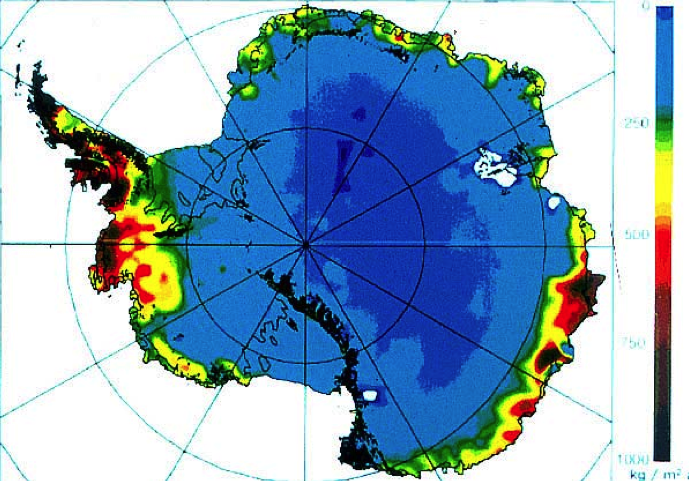
Ever looked at a precipitation map of Antarctica? Most of the continent is a desert.
Good point, it doesn't usually snow in a desert. Think it has something to do with moisture. In Tibet, where it gets really cold and there's moisture during the winter, it can snow a lot.
-
Re:Premature
Yeah, I've heard it. It is said by idiots who don't know anything about weather.
Read Changnon et al, 2006. 61-80% of major (over 6") snow events in the US occurred in warmer-than-average years, among other things. Warmer weather in temperate, subarctic, and arctic climates leads to more snow. It only leads to less snow in tropical climates and borderline-subtropical climates.
There is no temperature in which it's "impossible" to snow. But it does become decreasingly likely as temperatures fall. Ever looked at a precipitation map of Antarctica? Most of the continent is a desert. Only the coastal areas and peninsula get relevant snowfall; the air just can't hold enough moisture for it to snow much inland.
-
Re:Safely. noted this one on /. before:
significant drops in fuel efficiency that appear when you start moving up past 75 or so.
You're being too generous. Fuel mileage starts to drop off around 60 mph for most vehicles. See this link and the accompanying chart as well as this link from Wikipedia which shows a fuel mileage chart from various cars over the years. Note how all of them have reduced fuel mileage at 60 mph. For a more simplified version of the graph, see this link.
Even using the word 'significant' is a misnomer as you can lose 5 mpg going from 55 to 65 or nearly 10 mpg going from 60 to 70, depending on your vehicle. -
Re:Sodium Cooled Fast Breeder Reactors
Not sure how the link escaped my last post...
-
Re:little Economics+physics lesson
There is a good meta-analysis on Nuclear EROEI here: http://www.theoildrum.com/node/3877.
The problem is nuclear is super energy intensive in the fuel production stage. Coal has a better EROEI.
-
Re:Its a population crunch
Isn't all this predicated on whether man-made (anthro-something) Global Warming is real or not?
Not really..
if population growth is exponential, and we live in a closed system (spaceship earth) with only energy input (sunlight), then we are *GUARANTEED* to run into some kind of resource limit at one point because our bodies need food:
Whether it's the end of cheap energy from hydrocarbons, the end of cheap energy for cheap Nitrogen fertilizer via the energy-intensive Haber-Bosch process for NH4 (I quote"he Haber process is important because ammonia is difficult to produce on an industrial scale, and the fertilizer generated from the ammonia is responsible for sustaining one-third of the Earth's population."
, or the phosphate mines running out. Funnily enough, you never read about those things in the newspapers, instead you read about "economy" which doesn't, ultimately, exist. I say bring the discussion back to the real issues.
I don't think that anthropogenic global warming is really disputed anymore (will you please read chapter 2 of the AR4 synthesis report?). And I believe it has serious repercussions for food production (chapter 3), especially in Africa. (heat stress). Have you any idea how many Africans would emigrate if it becomes too hot for agriculture?
But really global warming is just an additional stress factor; if it didn't exist, some other stress factor would become more urgent for humanity's survival. Ultimately, an exponential process is -
Re:Why SF is dead.
People tend be conservative in their beliefs. Until now there was always oil, therefore there will always be oil. It is difficult to grasp an abstract concept (Peak Oil, for example) and translate it to your own real lifestyle in the real world, when everybody agrees it's going to happen but can't imagine it's actually going to happen to *THEM* if they live long enough.
The only recourse is really to teach people what EROEI means, and that open-pit-mining shale, crushing the rock and boiling the petroleum out of it may be very possible but not necessarily a useful idea.
I recommend The Oil Drum. -
Re:On the plus side!
The thing is, if you *really* believe we're sticking our collective heads in the sand, borrow a couple of billion dollars and buy oil on a long dated future. If the peak oil doom-mongers are right, in a few years we'll be paying a thousand dollars a barrel. The fact that the price of future-dated oil doesn't reflect this suggests that the smart money doesn't believe peak oil is as imminent as the heralds of doom suggest.
Read here for one example of an argument that a decrease in the supply of oil will coincide with a decrease in the price of oil.
I too first figured that oil scarcity would lead to an increase in oil prices due to a simple supply/demand relationship, but since learning more about peak oil theory and the complexity of relationships between oil supply, oil demand, money supply, debt, etc., I'm not at all sure anymore. It could be that the market too is pricing into oil prices the possibility of a deflationary spiral.
-
Peak oil.
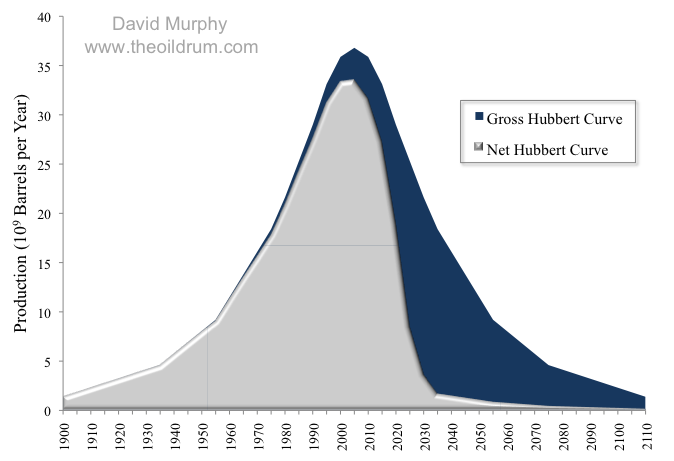
There's general agreement in the industry that we're near peak oil. The peak may have happened already, in 2006-2008. The most optimistic view is that the peak will be around 2020. That's not far away.
Prices aren't that good an indicator of availability. Because supply and demand are both relatively inelastic and change slowly. So small variations in supply or demand produce big changes in price. The worldwide recession has cut demand a bit, which brought the price way down. Supply did not increase.
All the easy places have already been drilled. US oil production peaked in 1970. Look at this list of countries where production has peaked.
Then there's France. Back in the 1970s, France decided to go nuclear. France has 59 nuclear power plants and exports electricity. It's good to plan ahead.
-
Yep, good old EROEI is the true take away
"If there really isn't much oil left, then oil will slowly become more and more expensive as the remaining oil becomes harder and harder to extract."
Once the Energy Return On Energy Invested becomes too small a ratio, that is when people truly start to feel the pain of bad things are happening or have already happened.
***
"The running average EROI for the finding and production of US domestic oil has dropped from greater than 100 kilojoule returned per kilojoule invested in the 1930s to about 30 to 1 in the 1970s to between 11 and 18 to 1 today. This is a consequence of decreasing energy returns as oil reservoirs are depleted and as energy costs increase as exploration and development are shifted deeper and offshore (Cleveland et al. 1984, Hall et al. 1986, Cleveland 2004)." quoted from http://netenergy.theoildrum.com/node/4678 -
it's not about the size, it's about net energy...The easy oil has been had, folks. It came out of the ground Beverly Hillbillies style. So, now we have to increasingly go deeper in the ocean or inject water into extant wells--and that gets expensive. Even the energy return on investment of oil has been declining (cite: http://netenergy.theoildrum.com/node/5600 ), and the energy return for alternatives is slowly improving, but is still 10 times less than that of light sweet crude--and because this is a liquid fuels/transportation problem, that means that economic growth can be curtailed unless we become more efficient AND use less.
(This is why I pay attention to the folks at The Oil Drum ( http://theoildrum.com/ ) and Energy Bulletin ( http://energybulletin.net/ ), they're well-intentioned academics/educators who are trying to get the world to live more smartly and sustainably...and the faster we do that, the better off we are going to be.)
-
it's not about the size, it's about net energy...The easy oil has been had, folks. It came out of the ground Beverly Hillbillies style. So, now we have to increasingly go deeper in the ocean or inject water into extant wells--and that gets expensive. Even the energy return on investment of oil has been declining (cite: http://netenergy.theoildrum.com/node/5600 ), and the energy return for alternatives is slowly improving, but is still 10 times less than that of light sweet crude--and because this is a liquid fuels/transportation problem, that means that economic growth can be curtailed unless we become more efficient AND use less.
(This is why I pay attention to the folks at The Oil Drum ( http://theoildrum.com/ ) and Energy Bulletin ( http://energybulletin.net/ ), they're well-intentioned academics/educators who are trying to get the world to live more smartly and sustainably...and the faster we do that, the better off we are going to be.)
-
Anglo Disease
Some commentators call this affliction, which seems to have harmed most English-speaking nations in the world, the "Anglo Disease". (Keep in mind that this particular eerily prophetic article was written before the Great Recession.)
-
Re:But the beauty is
...it probably takes almost a gallon of oil to get a gallon of oil out of the ground
Not even close. Currently it's in the neighborhood of 10-15:1. It will eventually approach 1:1, but when it does there'll be no point in pumping it out of the ground (for energy at least.) -
Re:One Last Time:OK - I see you're "new at this", so I'll change tone and put my "professor hat" on.
You wrote:
Yes, the EROEI on oil has declined. That's because we are using so bloody much of it that the profit to be made on it is worth the effort to find more.No, that is not true. EROEI on oil has declined because we have found all the easy oil. The only stuff left is underneath the ocean or in some frozen wasteland or is locked up in bitumen in weak sand formations. It takes enormous amounts of energy to build an ocean platform, or drill in the arctic, or wash and process tar sands. THAT is why the EROEI on oil is declining and declining rapidly. When it hit 1:1 we will simply stop mining it as a fuel, and only bother with it to make plastics and other materials.
I linked to that graph in point 3 because the article it is attached to talks about NET production of oil, and uses projected declines in EROEI as yet another attachment on production. I would recommend you read
It works like this: If you use 1 barrel of oil to drill out 4 barrels of oil, your NET oil return is 3 barrels. You could then extrapolate the EROEI (due to losses along the way) at somewhere very close to 1:1.
You wrote: Oil is not free energy either; it takes a lot of energy to make it.
And it is taking more and more. It used to be 100:1, now it is down to about 10:1. This is still, pound for pound, superior to ANY formulation of hydrogen, because of the simple physical fact that hydrogen takes more energy to produce than it gives in return.
This REMOVES hydrogen from the class of substances known as "FUEL". Fuel *brings* energy into a system. Oil is trapped solar energy from 100+ million years ago. Nuclear is trapped solar energy from a star that exploded billions of years ago, before our solar system was created. So, this "trapped" energy qualifies Thorium and Uranium as FUEL. This trapped energy value qualifies oil as FUEL. Hydrogen is not fuel. It is an energy carrier, and it is an extremely inferior carrier.
To use hydrogen as a fuel, you have to first mine a hydrogen rich resource (like oil or natgas) and then process it to remove the hydrogen from its chemical bonds. Due to the nature of hydrogen, it bonds rather well, especially with oxygen and carbon (typically as bicarbonate HCO3, or methane CH4, or water H2O or some variation on those three, or in the extended molecular chains of petroleum.) Water is not the tightest hydrogen compound, and it is one of the more common. However, it takes more energy to break the water bond and store the hydrogen than you get from the hydrogen, even if you burn the hydrogen and recover 100% of its energy (which is impossible due to the second law of thermo). Also, note: breaking up natgas or petroleum into hydrogen produces (you guessed it...) CO2.
Now, a battery can be charged DIRECTLY from any number of sources, and the loss in charging and discharging is VASTLY smaller than the loss used in burning hydrogen. Let's take 1w worth of hydrogen. It will take several watts of energy to make, store, and transport the hydrogen. And when you burn the hydrogen, you have to go through the whole ugly process again.
With a battery, it will take MANY watts of energy to make the battery that expends the 1w of power, however, charging the battery can come from any number of sources. The number of cycles of recharge vary - from a relative few (hundreds) for NickelMetalHydrite to "arbitrarily many" with an ultracapacitor. And these batteries/capacitors/devices can be charged from anything that will spin the generator - solar, geothermal, wind, hydro, whatever. The amount of energy invested in them is high at first, but as they are repeatedly charged over time, their EROEI goes UP. Hydrogen remains the SAME - negative.
Your final few lines betray your fundamental position:
But for vehicles, sooner
-
Re:One Last Time:OK. Facts:
1. EROEI on Oil has been declining steadily. In the 1920s it was up around 100:1. In 1990 it was down to about 20:1. It is now down around 10:1 or less (deep sea oil has an especially nasty return). for starters, Read the article on Wikipedia I linked to, the one you so blithely ignored without any supporting FACTS.
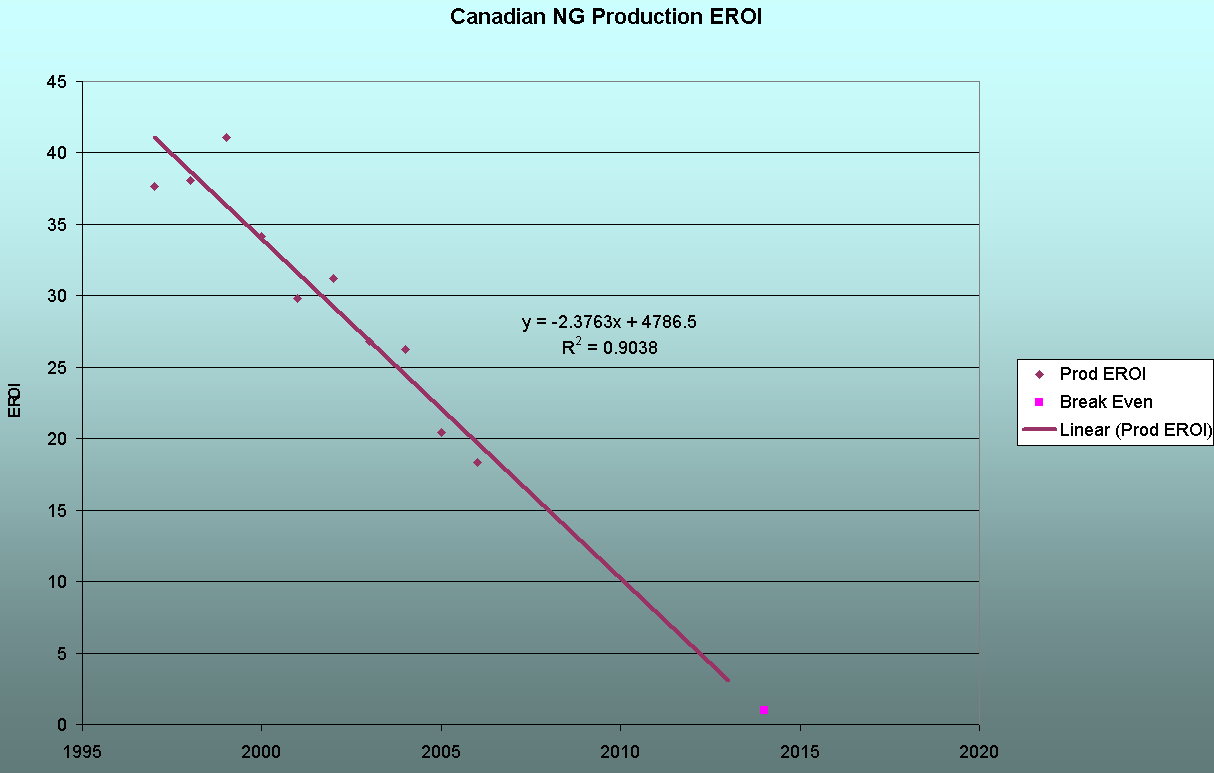
2. EROEI on gas is also declining. In Canada, it is expected to hit 1:1 around 2014 (according to an article based on data from Jean Leherrere, an internationally renowned expert in oil and gas exploration. He was in charge of Total Canadaâ(TM)s exploration from 1966 to 1971. )
3. You write: But we know that the EROEI for oil is going to go up, and possibly soon. and the fact is, no We Don't. In fact we know just the opposite is in effect. A recent chart based on recent data shows a dramatic collapse in EROEI of oil in the 2010 - 2020 range.
4. You wrote: . At the moment, that would have a really horrid energy return because of the current inefficiencies in solar panels. Wrong it would have a horrible energy return because it TAKES MORE ENERGY to make Hydrogen than you can get from burning Hydrogen. This is called Thermodynamics. It's like gravity, only far less forgiving.
5. Ultracapacitor technology from companies like eeStor are in the process of bringing a system that stores and expends electricity for a projected $40 per kW. The amount of energy that goes into building an ultracapacitor is high, but over a series of charges the EROEI goes into a high positive range. Even at 2:1 it would be vastly superior to hydrogen, which by definition can never be even 1:1.
So, Hydrogen has crappy EROEI, oil's EROEI is declining, and there are other superior technologies available. Then there are the manifest problems with Hydrogen itself, such as:
1. it hates being bottled. This is a well known problem - hydrogen atoms are the smallest and it is impossible to keep it bottled.
2. It hates bottles. This is also a well know fact - over time hydrogen embrittles the material that holds it.
3. It burns with an invisible flame, and it burns readily.
4. to keep it at a pressure where it has an energy density that is of value to humans, it has to be kept at an extremely low temperature, making it more dangerous, less amenable to maintained capture (bottled), and this intense refrigeration (a few degrees above zeroK) is extremely energy intensive, reducing its EROEI even farther.
I reiterate there will be no hydrogen economy. Hydrogen is a very poor and inferior choice for an energy carrier and a stupid choice for a fuel.
I have responded with more facts than your argument merits.
I do not do so to "make nice". The facts on hydrogen have been out for years, and as I noted, only "true believers" still buy into the mythology of the hydrogen economy.
Unfortunately, slashdot has a large number of such people (as evidenced by the score to my original post) and this is not to slashdot's advantage, much less civilisation itself.
If you want a primer on what is going on, go here and watch all the videos.
RS
-
Peak Oil necessitates energy conservation
So far all I've read in this thread are posters decrying this as a massive tax grab. That's a limited perspective, to say the least.
Yeah, mod me down as a paranoid troll, but we're already passed Peak Oil.
For those who don't understand what Peak Oil is:
http://en.wikipedia.org/wiki/Peak_oil
Basically, it's what is IMO a fact, that oil production/extraction will peak at a certain level (X number of barrels per day) and then begin an inexorable decline. Whether or not this output is replaced by alternative energy remains to be seen.
Nonetheless, most people don't understand how much energy we get from oil. Oil is the densest, easiest to transport, and most reliable energy source available. Once it's gone, alternatives will fall short of those standards:
http://www.theoildrum.com/node/3084
The total oil production volume amounted to a cubic mile (not a type) of oil per year. To equal this, it would take 104 coal fired plants running for 50 years, 52 nuclear plants running for 50 years, 32, 800 wind turbines running for 50 years.... you get the picture.
So when oil production starts winding down, we'll be hard-pressed to replace that output. The only way we can aspire to coming close to equaling that output is through energy consumption and more efficient use of energy. So far, the government's record on this is pathetic, and the private sector has had, at best, limited results.
-
200MW.It seems the world's electrical needs are a bit larger. And with the immanent collapse of net oil production, We're going to have to treble that capacity in the next 15 years. Per the first link, at 200MW per satellite, we'll need 82,995 satellites to MATCH present electrical production capacity. And treble that number to match future capacity and the downturn in watts per capita from the loss of oil, making it more like 248,985 of these things buzzing overhead to deal with future electrical needs.
So, let's say (obviously) we're not going to use energy sats for all of our electrical needs. Let's say only 10% of our needs. That's still about 8,300 200MW satellites. What part of "not going to happen" do these people not understand?
Even if the WORLD cut it's electrical needs in HALF, that's still 4,140 200 MW satellites.
Game Over. Thanks for playing.
It's not all "doom and gloom". It's not the "end of the world". It's just that for the first time, we really can see it from where we stand, and it's not that far away or that hard to get to. It's going to take a boat load of work and enormous sacrifice to get humanity through the 21st century. And 200 MW energy sats are NOT the solution.
We're going to have to make "other arrangements" for civilisation to continue. And they don't include Xbox, SUVs, McMansions, weekend vacations Tahiti, and WalMart.
RS
-
Re:Food crops as energy was never a good idea.
Algae might be a better biofuel compared to the alternatives in many ways on paper at least, but it's far from actually proven to work economically. E.g. the principal investigator of the $100 million NREL aquatic species research program has the following to say: http://www.theoildrum.com/node/2541
-
Re:What is so bad about "clean" coal?
For the amount of energy produced, coal created more radioactive waste then nuclear.
Funny you should mention that: linky
Step 1: Mine coal
Step 2: After burning the coal, take the thorium from tailings
Step 3: Use liquid fluoride thorium nuclear reactors to provide energy for a few thousand years
Step 4: Profit...for everyone... -
Research says - no.
Over on The Oil Drum this was hashed out
From Actual "research"
"surface, it has spread out considerably. The energy density is one-sixth that of the noon-day sun."So we've went from 2 times the 'normal' PV to now 1/6th the energy density of normal sunlight.
Once again the question to ask is - why go through the hassle of putting collectors in space if land based PV collecting regular old sunlight at 6x times the energy density?
Now you wanna play in space? Why not robotic mining/refining and send the results back down the gravity well? All ya need to do is solve AI and some material science issues. *wink*
-
Re:Familiarity Breeds Contempt
You might want to have a look at this article which suggests that uranium production way well have already peaked and will drop to zero by around 2050 or so, with ever increasing cost per kg produced. Since reprocessing is illegal in the USA, problems might arise sooner rather than later.
-
Re:Oil versus Electricity InfrastructureAmigori wrote:
Based on your logic, I should start investing in horses and drawn-carriages. Both are renewable and sustainable, minimal emissions during use and construction, and minimal nasty chemicals used during manufacturing, much of the world does not have current access to them, and they can travel places other transportation cannot. Think of the demand for veterinarians and blacksmiths, plus tack and riding gear, and carpenters and farmers too. Horses are natural, so we can have as many of them as we need without consequence, right?
It's actually worse than that, IMHO. Hint: the ONLY technology that has been PROVEN by countless cultures all over the world to be sustainable over countless millennia is NEOLITHIC.
As far as peak in oil goes, here is the data from the EIA and the IEA and CAPP. If those organisations are outside what you consider expert, we have nothing to discuss. Read THIS.
I am well aware of the economic clusterfuck that surrounds us. I am not certain that other currencies will *immediately* supplant the dollar. I do think that over the next decade we could see the formation of a "currency basket" where a variety of important currencies trade or value as a control group, say, the USD, EUR, RMB, JPY, and if the Russians can sit still long enough, maybe the RUB.
I've been researching this a great deal since 1998, and I urge you to do the following:
super-insulate your house.
get your heating off fossil fuel.
live close to work where you can walk to it, or ride a bike or take a bus or subway.
learn to grow high calorie value food in your backyard (i.e., beets, beans, carrots, peppers, potatoes, parsnips, etc. Yes. Wheat? No.)
Learn to deal with greater temp variation NOW, so it's not such a shock later.
Use electric assist solar hot water.
See if you can live with a small or no refrigerator. if you MUST have one, get a small SunFrost.
Learn to can food.
Compost your food scraps.I can guarantee you, the next 20 years will look nothing like the past 20 years. This is well explained here in this Crash Course.
good luck compadre...
RS
-
Re:Corporate culture
These guys make forecasts based on new projects coming on-line as well as past behavior and geopolitical concerns. According to them, oil production peaked in 2008. The former peak was 2005 but due to the energy crisis, oil producers manage to squeeze a little bit more production out. Based on the number of new projects coming on-line and their projected size, they won't balance out known rates of depletion of existing fields for the foreseeable future. We're in a lull right now in the energy market because the economy is ruined (which probably was helped by high oil prices), but energy prices will come back up.
Incidentally, what we're seeing now is very similar to what happened with the price of the last portable fuel we used before petroleum oil: whale oil (which is renewable if harvested in low enough quantities). There were massive oscillations in price that started just after the production of whale oil production peaked in 1845 when the whales started being hunted faster than they could reproduce. The great-grand-parent is totally wrong about the peak being in the future, it's here now and we all have to deal with that. The real question now is how long production can be sustained at this level and how soon will it decline?
By not trying to move onto new energy sources, Shell is resigning itself to becoming a two-bit company. You'd think they would have learned their lesson in 2004 when they had to downgrade their reserve estimates, but I guess not. I wouldn't buy stock in them. -
Nuclear, please.
This is silly. Putting solar panels in orbit? Please.
Use the money to build nuclear plants. Don't bore me with the waste issue. There is no such thing as waste, just more fuel.
-
Re:Good!
Educate yourself. Nuclear "waste" need not be wasted.
-
Re:Makes you wonderYes it is, since this increase is the *result* of government intervention. The guarantees a minimum feed-in tariff which makes building wind installations commercially viable (not just because of the subsidy but also because it makes the large up front investment predictable). What's more, the past has shown what happens when it's left to the free market. Since the law has to be renewed every two years political wrangling means it's sometimes in place and sometimes not. When it's not, investment immediately collapses (see the graph at the end of this article).
And since so far it hasn't been renewed installation this year will most likely be significantly lower.
Beyond that total installad capacity is only important when looked at relatively. Total population is almost four times as large in the US than it is in Germany, energy consumption per household it much higher in the US and even Germany only gets a relatively small percentage of it's electricity from wind (7% according to this). So overall: good start, but most of the work is still to do.
-
There already is an alternative
The liquid fluoride thorium reactor can burn existing nuclear waste just fine, and it's been available since the 50's.
-
Re:I wanted toFat lot of good that gas furnace is going to do for you when the Energy Return on Energy Invested of gas production in Canada goes below 1:1 in 2014 and production collapses.
rs
-
Green Motoring is an OxymoronThere is nothing green about the Happy Motoring Society, as it enables and supports the suburbs and exurbs, which are the
There is nothing Green or Sustainable about Industrial Society, or even civilisation itself, as all such efforts entail the inevitable draw down and destruction of irreplaceable natural resources.
So before you all go rushing off to buy your fuel cell cars to shlep you to your job enabling the mindless consumption of resources and goods, kindly apprise yourself of how utterly devastating your every choice is upon the planet.
A major failure of capitalist economics is its discounting of the future - it works to maximise immediate profits, but when applied to resource management, it necessarily entails ecocide.
So, sure: get in with the hydrogen economy, and push the species over the cliff. We're already well into overshoot, and fuel cells are just the first of what will prove to be many failed attempts at sustianing the unsustainable.
-
Re:I can only think of two words
-
Re:Wow, that's mature
If you were an oil trader and knew that if we started drilling today and that oil wouldn't get used for another 10 years, why in God's name would that affect your bidding on contracts for September delivery?
Oh, I don't know, because if you're trading on the futures market, you locked in your September 2008 contracts way back in Fall 2007. If you're going after energy contracts now for next month, that's practically spot market pricing, which can be even more volitile.
What they're trading now is setting up contracts for Summer 2009 onwards. It takes 1-2 years to build a land rig (ANWAR) and 3-4 years to complete a sea rig. Having Congress open up more leases for land drilling, and permitting off-shore drilling, will increase supply which can only reduce prices. Since it's a future development, it reduces the future price. Since my future price will be less, I will charge less now, since I won't need to have as much cash on hand next year to pay for the oil then.
-- Scott
-
Re:I have my doubts... but,
-
Re:I have my doubts... but,
-
Re:In other news
Of course what people tend to forget is that you can make gasoline from a lot of non petroleum sources including water and air. The only thing that prevents it is cost.
Exactly. It's not the unavailability of all of the fuel that is the issue, but how much it will cost, and more importantly how quickly that cost will increase. This rate of increase will determine whether we will be able to actually continue with this easy motoring way of life, or not. The higher the rate of increase, the less probability that we will be able to maintain the current way of doing things.
The cheapness of the fuel *is* the issue. Right now, diesel and gasoline still give the biggest bang for the buck.
See these (now quite well known) sites for more info: Kunstler and The Oil Drum
-
new peak
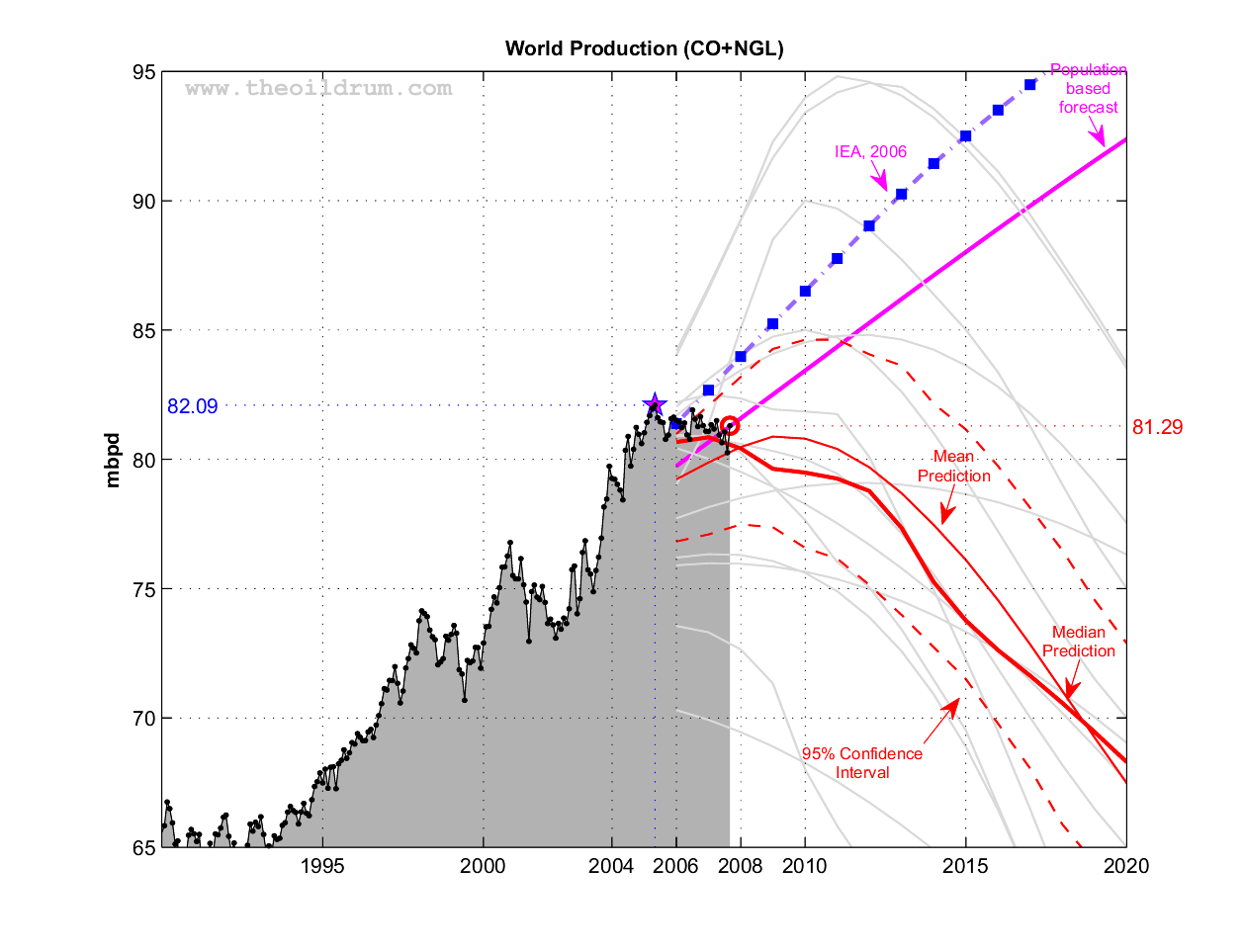
Actually, January 2008 is the new May 2005.
-
Re:extinction of zinc?
We haven't hit peak oil yet.
This statement is confused at best, a bald-faced lie at worst.
At any moment, there was another moment in the past at which oil production has peaked. That was peak oil. We won't know whether it was THE peak until we either exceed that past peak or until we've waited
Crude prices have exploded over the last couple years and yet the production peak of May 2005 has never been exceeded. If we can not increase production at $140 per barrel over that when it was $50 then I'm puzzled where anybody gets the sheer pigheaded ignorance to claim that we haven't hit peak oil yet (or mod such a claim "insightful").
There's always the chance that we haven't. There's always the possibility that something completely unforseen happens in the future -- that's why it's the future. But to look at the flat line in that graph and pretend that it is magically going to go up at some time in the future betrays a confidence born exactly out of putting one's head into the sand.
-
Re:Go watch BBC's Earth serries.
Apropo the immense global disaster of
so getting started early and possibly avoiding an immense global disaster seems only prudent.
Apparently (according to olduvai theory) energy production per capita can't keep up with energy consumption, and over the next few years we're going to see a percipitous drop in energy per capita on account of overreliance on non renuable resources. Due to our reliance on energy for things such as feeding the populations of our cities and sustaining our medical infrastructure this is predicted to result in the deaths of billions of people (in the absence of new renuable energy technologies, and I do actually mean "billions"). Here are the sources for those interested:
(10 pages) Olduvai revisited 2008
(1/2 page) http://en.wikipedia.org/wiki/Olduvai_theory#Details_of_theory>Wiki article on Olduvai theory
Footnote 2 of this article is interesting in its own right
(1/3rd of a page) wiki article applying the Malthusian catastrophe to energy consumption
Read the section titled "The Silent Lie" (p3-4) of this article Thoughts on Long-Term Energy Supplies: Scientists and the Silent LieI wonder if our society's attitude towards renewable energy isn't a lot like societies attitude in the US towards slavery in the first half of the 19th century. There's on camp with a vested economic interest in a morally unacceptable behavior, and another camp protesting the moral (people die) and practical (we die) consequences of this behavior. The only difference being that our problem is time critical.
-
Re:No it doesn't.
no, the eroi of ~15 includes paying employees.
there are many studies which give similar numbers. http://www.theoildrum.com/node/3810 gives an overview of the existing literature. as you can see, all of the post-2000 eroi on oil are in the ballpark of 10-18:1. the *economy* puts about 7% of the yields from the oil back into oil right now in order to sustain our current usage levels.
(sorry for all lower case, i exploded my left hand and shift key is hard). -
Re:Woodchips! Brilliant!
(The Amazon) is already being cleared for sugar cane plantations for the production of ethalol.
No it's not. Check the map. The areas most used for sugarcane production are the first ones the Europeans colonized in Brazil... about 450 years ago.
There are many reasons for why the Amazon is being cleared today. Ethanol is not one of them. -
It's not speculation
At least half of the current price for crude oil is driven by speculation and market manipulation
That's just false. You can indeed speculate on oil futures. But those always have a fixed date of delivery. On that date, you need to either physically take the oil, or sell it to someone else at the market price for that day - which is entirely dependent on classic supply and demand on that day, not on what others are willing to bid, speculatively, for oil for future delivery. So you can make money on oil futures only if the supply-demand situation, on the date of delivery, is in fact higher than the price you agreed to pay for it. Otherwise you eat your shirt. This is not at all like real estate or stocks, where you're not obligated to trade on any particular date.
In short, the price of oil futures can be subject to a speculative bubble. But the price of oil for current delivery - the basis of gasoline prices - is not subject to change because of action by speculators (beyond those who want to speculate by storing more of it physically in their tanks - but greater current inventories generally drive oil prices down, not up).
This has been covered time and again at The Oil Drum - a site with many petroleum analysts and traders who understand the market realities well. Believing it's speculators to blame is a convenient way of not facing the real crisis of diminished supply coupled to increased demand. -
Re:I hope so.It'll be just in time for the whole peak-oil extravaganza, and damn useful to power all our new electric cars.
There was a post at The Oil Drum on how it takes so long for new discoveries to ger deployed: http://www.theoildrum.com/node/4008#more
You can look at some of what has been going on in the subject for a while now here: http://www.lenr-canr.org/News.htm
It is definitely taking a long time.