Slashdot Mirror
Domain: thomasnet.com
Stories and comments across the archive that link to thomasnet.com.
Comments · 37
-
Re:Ehh, no.
http://www.thomasnet.com/artic...
I would consider carbon a metal based on the fact that graphene is an effective conductor. Carbon is also widely used as an electrode in batteries.
-
Re:Vehicles interfering with each other?
I assume at least they're looking for brightness rather than timing (distance travelled is very short and light is very fast) to determine the distance of an object.
They're not. It wouldn't work since the amplitude of reflections depends too much on the material, which the system doesn't know. As maeka mentioned, they use either direct time measurement or phase detection.
The timing really isn't a problem. Most off-the-shelf CPUs are easily capable of nanosecond-level time measurement and given that light travels about one foot in a nanosecond, they could give you roughly six-inch ranging accuracy. So it's not hard to create purpose-built timing circuits that can measure in the 10-100 picosecond range. For example this timer released in 2006 can measure time intervals up to 40sec in duration with a 10 psec resolution, which provides laser ranging accuracies of +-1 mm out to a distance of 1500m. I don't think there are yet any off-the-shelf femtosecond-precision timers, but I'm sure there will be within a few years, providing laser rangers with micrometer-level measurement.
We're accustomed to thinking of light as moving so fast that it's instantaneous across "human" distances. But that's only true at human timescales.
-
Re:Thanks Slashdot!
Wow, some stuff is getting manufactured, in the nation with the largest manufacturing economy!
China surpassed the US as the world's largest manufacturer in 2010, and has continued to widen the lead.
-
Individual Energy Use Is Insignificant
Here's the thing: individual energy use is fairly insignificant. Turning off the light leads to a miniscule reduction of total energy use because: residential energy use is only 14% of humanity's total energy use [ Source: http://news.thomasnet.com/IMT/... ], you are just 1 person out of 1 billion people living in the developed world (i.e. people with high-energy consumption), and turning off a light or two leads to a small reduction in your individual use. In other words: a fraction of a fraction of a fraction.
If people are concerned about global warming and humanity's energy use, you can do totally ineffective things like turning off a light or two more often, or you can push for more effective means of curbing global emissions: change the source of our energy (for residential energy, industrial/commercial energy, and transportation), push for more energy-efficient devices (e.g. a lot of Western European countries use about half as much energy per-capita as the US), and throw taxes on carbon-based energy sources to influence consumers via their pocketbook and influence the market towards forms of energy without all those carbon-emission externalities.
I can see that the conservatives are out in droves on this Slashdot story, flaunting their ignorance and conspiracy theories. You guys should really be ashamed of yourselves because you're only making yourselves look like cavemen. -
Re:This I didn't expect.
It makes perfect sense. After enough time of disparaging the factory life, Americans are finally realizing that it beats the alternative.
I can make sense of it at an intellectual level, it's just my gut reaction to go "WTF" -- it's a bit counter-intuitive.
The news is welcome, I just wish American companies would start making things in USA again. I know we can do it. I suppose in time, we will.
It's already turning around. Tesla builds its cars in Fremont, CA and they're planning to open a battery factory somewhere in the US. SpaceX makes rockets in Hawthorne, CA. SolarCity bought Silevo and is planning to build a solar panel factory in NY. Now we just need to convince someone besides Elon Musk (which is actually happening.)
-
Re:I wonder what their reasoning is...?
You need to ask your "honors: high school economics teacher for newer book. China is the world's largest manufacturer. Just google it: http://news.thomasnet.com/IMT/...
-
Re:I wonder what their reasoning is...?
" As of 2010, the country [the united states] remains the world's largest manufacturer, representing a fifth of the global manufacturing output."
The US was overtaken by China in 2010:
http://www.ft.com/cms/s/0/002f...
http://news.thomasnet.com/IMT/... -
Re:Single stream is part of the problem
Where I live in France we don't have rubbish collected from our house, instead we have 3 types of bins that are buried in the ground in a convenient place, usually within 50m or so of your house (isolated properties, businesses in commercial areas and people who are happy to pay are common exceptions). This means we cut down on the emissions of the refuse collection vehicles (for want of a better, internationally recognisable word) because they spend a lot less time idling, waiting for bins to be loaded at every other house.
The three bins are for:
1. All plastics and metals
2. Cardboard/paper
3. 'General' refuse
Everything in bin 1 is sorted at the recycling centre and recycled where appropriate*.
Everything in bin 2 is recycled in theory, although I wouldn't be surprised if some of it is incinerated.
Everything in bin 3 is mostly land-fill or incinerated if possible.
* As far as sorting goes I believe it works roughly like this:
a. Everything is shredded and then washed. During the washing process the plastic floats and is skimmed off.
b. The metal is sorted into ferrous/non-ferrous using magnets.
c. Plastics are ground down into smaller particles and then sorted, granule by granule, using x-ray or infra-red sensing. Plastics that fail testing and/or aren't a recyclable resin type are incinerated. -
Re:"Press F1 to continue..."
It isn't just the F1 key, but here you go: http://news.thomasnet.com/fullstory/Compact-Keyboard-has-12-function-keys-only-811828
-
Re:lack of unions and workers rights
Both. Scarcity will disappear for a larger portion of the population, but imo wealth is already just consuming higher-end versions of the same toys.
There will be a point where labor+logistics within the country will be a equation, but fuel costs and overseas instability will have to rise.
Such as
http://www.theatlantic.com/magazine/archive/2012/01/making-it-in-america/308844/
http://www.theatlantic.com/business/archive/2012/12/a-simple-graph-showing-the-american-manufacturing-worker-is-suddenly-an-incredible-bargain/266339/But survey results from executives seem to disagree
http://www.deloitte.com/view/en_US/us/Industries/Process-Industrial-Products/manufacturing-competitiveness/mfg-competitiveness-index/index.htm?id=us_furl_pip_gcmi_121412The biggest question I have is just how many shops will be able to re-awaken manufacturing at large-scale if/when. One of several common concerns:
http://news.thomasnet.com/IMT/2012/08/28/4-key-roadblocks-to-u-s-manufacturing-competitiveness/ -
BGA?
It is possible to remove and replace a BGA but it's not trivial. I'm sure an enterprising hobbyist will figure it out and figure out that there are BGA sockets and figure out how to heat sink them.
It's not the whiners who make money it's the makers.
http://news.thomasnet.com/fullstory/BGA-Socket-suits-1-00-mm-pitch-devices-484661
Oh darn, someone already done one.
-
Re:Women
May I introduce you to the placebo thermostat.
http://news.thomasnet.com/IMT/archives/2003/04/dummy_thermosta.html
-
This is a standard problem in CAM systems
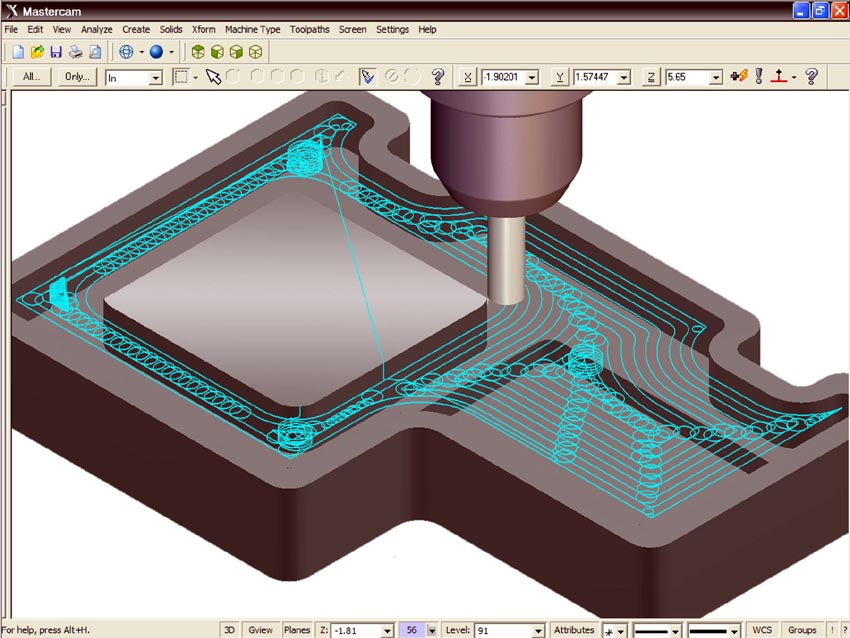
All modern computer-aided machining systems have solvers for this problem. When you tell a CAM system to machine an arbitrary area, it computes a tool path to do the job. Here's MasterCam doing it. Even low-end 2D CAM systems can solve the lawnmower problem. High-end systems can solve much tougher problems, automatically deciding what tool to use, clearing big areas with big tools and finishing up the tight spots with small ones. The most advanced CAM tools can do that in 3D on very complex objects.
-
It's the coupling to the heat sink that's new
The effect of the Sandia device is not to eliminate the boundary layer, as the article says, but to make it much thinner, as the PDF says. The thermal resistance of the boundary layer is approximately proportional to its thickness, so the heat transfer goes up by the same ratio. That moves the heat into the air between the impeller fins, which then proceeds to carry it overboard.
That's what is so impressive about this work. A spinning, finned heat sink isn't new. Combining it with a thermally efficient coupling to a stationary heat source is.
-
Re:Lot of space between $500 and $1k
So paper records are SOOOO much better for medical records, yah?
I'm sure bloody vomit does nothing to paper.Bluetooth will work just fine (approved since 2008!). Even an ECG. You're just an ignorant ass.
http://www.pdacortex.com/fda_approves_bluetooth_med_system.htm
http://news.thomasnet.com/fullstory/Bluetooth-Modules-target-integration-into-medical-equipment-553986
http://www.tradekey.com/product_view/id/1164463.htmAlso, you're the type of person that fanbois LOVE to wind up. Cause your response is so douchebaggy.
-
what changes?
Seems like I keep hearing of breakthroughs, but nothing ever seems to fucking change!
Prices have changed. According to Solarbuzz per watt costs have dropped from about 5.40 euros or a little over that in US dollars in December 2001 to about 4.20 euros or a little less US dollars for June 2010. Further it says "there are now 488 solar module prices below $4.00 per watt (3.24 euros per watt)". Efficiency has also increased. In 2001 conversion efficiency pushed 12%, in 2009 SunPower sold panels with conversion efficiencies of 19.3%, the highest in the industry.
Falcon
-
Looks like single voltage mobos are coming
http://news.thomasnet.com/fullstory/809646
Probably getting to be standard for small form factor mobos; space, power and noise are definitely on people's minds.
-
Diebold card skimming detection technology
'Diebold,
It would have been more technologically secure to not use magnetic strips in the first place and design a machine that only worked with authorized hardware. Something Diebold don't seem to be able to manage. It should have been foreseen that the crooks would attempt to hack the machines after all they are crooks -
USB OLED kit
He likely used something like this USB OLED kit. That would make more sense than using the external video port for sure.
-
Re:stop the xenophobia
-
Re:Conformal Coating
Any decent industrial electric motor shop should have a VPI tank. I think this one is big enough... http://news.thomasnet.com/fullstory/818736 (10'x10' VPI tank)
-
Re:It sounds so easy but
On a lightning strike, the circuit might let a 10V transient through which wouldn't harm the old analog tapes at all, but 10V spikes might be enough to glitch or erase modern SSD chips that operate at 3.3V or lower.
Good news: there's more to the electronics hardware than consumer-grade hardware. A little bit of googling turns up press release announcing 50V and 20V chips for industrial applications.
Seems like there's probably already high voltage hardware on the market, if required. -
Obvious recommendations.
Have sound tiles installed or use sound blankets http://www.thomasnet.com/products/curtains-sound-barrier-21260203-1.html
Have the rack of equipment in its own area for climate control and physical security reasons. The machine room should be separated from the office. Also, figure at least 3 feet or 1 meter around the racks to walk around. Far too many people put the racks right up against the wall until "oops, I have to run a wire in back."
Plan for expansion.
Climate control. Redundant systems.
Media storage. Lista cabinets. http://www.listaintl.com/
Large enough desk/bench area to take apart systems. See Lista above for decent benches.
As many electrical outlets as you can make them install. Make sure the electrical service is big enough to take the load and can be upgraded for expansion.
Get good locks for the machine room.
A refrigerator, pull out couch, and beer cooler.
--
BMO -
Re:Nice idea, but...
To put it into more perspective, there's the '10 most deadly jobs' list. Careers like fishing(142), professional pilots and flight engineers(88), logging(82), Iron and Steel workers(61), etc...
The US active duty force is about 1,426,700 active duty military members, with an additional 1,259,000 in the various reserve and guard units. There were 882 military deaths in Iraq in 2006. This would be a mix of active and reserve members though, and wouldn't count deaths otherwise. Afghanistan would add some, but outside of combat military members are about as likely to be killed at work as office workers.
Counting just the active duty members, that gives us 61.8 deaths per 100,000, or right around being a steel worker, plenty of whom make it to retirement. -
Re:These people are idiots
It is likely that the lower seer AC units you're looking at are window units, not fixed installation units as would be used in a forced air central heating / AC setup. I also am a bit sceptical at the 20 seer claim. 2 years ago when I was buying a whole house AC system, the normal AC systems were only able to reach about 14 seer, after that they had to go to exotic features like dual speed compressors or whatnot. These 20 seer units also have a 2 speed compressor, so probably are 10 seer on high speed and 24 seer on low speed, and the seer rating is measured over a long period of time (Seasonal Energy Efficiency Rating), so it's like having a 2 ton and an 8 ton AC unit at the same time. Let's see how reliable these things are in the long-run. It may be that a highly reliable 14 seer simple AC unit is more effecient over the life of the unit (say, 30 years) because iff the 20 seer unit breaks after 10 years, it will eat up whatever energy savings they made over their life-span with the replacement cost.
A little googling turns up a unit by lennox and another by bryant.
http://www.bryant.com/products/acheatpumps/ac/evolution.shtml
http://news.thomasnet.com/fullstory/462487
But, in any case, smaller units like those that go in your window just can't match the energy efficiency of a larger unit, so it isn't surprising that the best you see on a window banger is 7-8 seer. You're leaking more than that through the window you're putting it into anyhow... -
Re:It's in the BIOShttp://news.thomasnet.com/companystory/471725
VANCOUVER, Dec. 13
Absolute first announced BIOS support for its theft protection technology with IBM/Lenovo on February 1, 2005; followed by announcements with Gateway on August 9th and HP on October 4th. Today, Dell announced a set of customer solutions that leverages Dell's embedded BIOS support for Computrace allowing customers to address issues of regulatory compliance, data protection and PC theft recovery.
We don't use it here, but I believe once you enable it in the BIOS, it can't be disabled. Obviously, there's always a way to disable everything, but it's not a matter of formatting a drive or changing a BIOS setting. It comes down to hex-editing the BIOS data or replacing the BIOS chip or something.
-
Re:Similar to the Shadow 'Air Muscle'?According to This Article it's built like this:
The basic concept involves the wrapping of a watertight, flexible hose with non-elastic fibers arranged in a rhomboidal fashion.
Does sound similar to the Shadow Muscle:The Air Muscle consists of a rubber tube covered in tough plastic netting which shortens in length like a human muscle when inflated with compressed air at low pressure.
-
except for CEMS
Yea, the plants who don't have CEMS (continuous emissions monitoring systems) do. But almost all coal plants now have technology like this. Your numbers are way off or not current. Source, please...
The CEMS systems remove a LOT of the pollutants. It's a newer industry, but there are lots of companies doing this work. And it's not revolutionary. The processes are fairly sound, but somewhat inefficient (as expected). Here's one. Here's a nice list. of companies doing this sort of thing. They make a living helping power plants reduce pollutants.
I am not saying it's perfect because it's not. But methinks your number of 96K lbs/yr of mercury is probably old and outdated. These systems have been on the market only for a few years, but certainly enough to bring down the "highs" of the old days. -
Re:I betI know why!
Or maybe it is as simple as the key itself starts transmitting when it hears the noise.
My understanding is that key fobs are not programmed with a single number, but rather a number and an algorithm. The car is then programmed with the number and the same algorithm. The key fob sends the current number when a button is pushed and generates the next number with the algorithm. The car itself listens for either the current number or one of the next 256 numbers, if one of the numbers is transmitted it will respond to the request. HowStuffWorks explains it pretty well.
My Harley's security system will not allow the motorcycle to be started unless the key fob is within a about three feet of it or the security code has been entered. The Harley itself transmits a very weak signal. When the key is in range of the signal, it transmits back to the motorcycle the 'Ok' signal. The downside of this system is that placing the motorcycle keys within a few inches of a cell phone or running computer will result in the key draining its battery trying to "talk" to the motorcycle.
The article does not mention that the cell phones reprogram the keys, but rather changes the number in the keys. It could be possible that when placed next to cell phones the keys start transmitting the auth number continuously thus generating a number that is past the 256th number allowed by the car. -
Just tie some ropes around it
This is an ingenious and utterly simple concept that may actually work:
Scientists at Lehigh University have tested a next-generation "self-centering" system that uses gigantic steel bands to hold building columns and beams in place during an earthquake.
In allowing the beams and columns to separate, rock and twist independently of one another, the rope-like steel bands -- encased in plastic -- are meant to prevent a building frame from buckling during an earthquake. The system also uses friction plates that help dissipate the quake's energy. After the tremors subside, the steel bands pull the beams and columns back to their original positions. source -
It's a tuneable laser, but then what?
What those guys seem to make is a tuneable laser, one where the color can be changed dynamically. Last month, they announced it as a breakthrough for fibre optic data transmission. That's why they have "more colors" than old fashioned RGB systems. This will be useful in presenting pictures to species which have more than three-color vision. (Birds have at least four color vision, and see further into the UV than humans; some bird species have more than four color sensors.)
Other than that, having more than three display colors isn't that useful. It's useful for printers because of ink limitations, but that's a different problem.
It's unclear how this translates into a display, but I suspect it's something like a DLP display with field-sequential color.
One big pain with this idea is that it brings back scanning. We finally have displays that don't flicker at all, and they're so much more restful to watch. Going to a scanned technology is a step backwards.
-
It's Probably a Valid ConcernFrom an industry report I found sometime ago on Slashdot:
Among the small wonders produced by nanotechnology are carbon nanotubes, an advanced material as strong as diamond. These amazing carbon cylinders possess 100 times the tensile strength of steel and are 10,000 times finer than human hair. They are believed to conduct heat better than any other material, and they can also conduct electricity or function as semiconductors.
But this LiftPort PDF states:
"Nanotubes are astonishingly promising, and I'm a realist, not an optimist," says Rod Ruoff, a mechanical engineering professor at Northwestern University. "It's a question of making the technology cheap enough." In 2001, only 3 kilograms of the highest quality carbon nanotubes--the single-walled variety--were produced worldwide, each gram worth $300, or 30 times as expensive as gold.
Now, full-scale production of carbon nanotubes is underway at the world's first ever large-scale nanotube factory, built outside Tokyo by the Carbon Nanotech Research Institute, a subsidiary of Japan's Mitsui & Co. The new facility is expected to churn out 10 tons of carbon nanotubes--albeit the lesser quality multi-walled type--a month, and CNRI anticipates the price will be a much more reasonable $80 a kilogram.
These multi-walled carbon nanotubes may not possess all the impressive properties of their single-walled brethren, but mixed with plastics, they make ultrastrong composites or microscale precision parts. Such carbon nanotube-filled plastics are already being used by automakers in fuel lines because they are conductive and can thus be grounded to release static electricity, which can ignite flammable gasoline.One issue brought up is the possibility of discharging the ionosphere. Our calculations based on the size and conductivity of the ribbon and the electrical properties exhibited in our upper atmosphere illustrate that a small area (square meters) around the ribbon could become discharged in the worst conditions. The magnitude of this discharging makes us believe with high confidence that no adverse local or global phenomenon will occur. It also shows that it is unlikely, without considerable effort, that any kind of usable power may be generated by this same method.
I think your concern is valid though for conduction through the ionoshpere or even on the surface of the nano tube/wire -- what would this huge antenna/conducter do to our atmosphere (if anything)? -
Re:DRM
The additional chips cost more than you think. For example, a random MPEG2 decoder chip meant for use in a set top box: $11 in volume. link
-
Re:Wartime Bandaids
In ten years time, this technology is going to lay a good amount of major military doctrine about logistics to waste and redesign.
You couldn't be closer to the truth, except if you had read that :Indeed, the military is pushing for more machines in combat to minimize the loss of lives and to save money as well. By 2015, Congress wants one-third of all military vehicles to be unmanned.
One of the numerous sources here -
Re:What I'd like to see....
What you need to do is find the right search tool.
The Thomas Register might be more what you're looking for.
http://www.thomasnet.com/ -
Japan's Mitsui built first nanotube factory
After submitting the article a few days ago, it's come to my attention that this isn't going to be the first nanotube factory; I didn't explicitly say anything of the sort in the submission, but wanted to clear any possible assumptions. From an industry report:
Among the small wonders produced by nanotechnology are carbon nanotubes, an advanced material as strong as diamond. These amazing carbon cylinders possess 100 times the tensile strength of steel and are 10,000 times finer than human hair. They are believed to conduct heat better than any other material, and they can also conduct electricity or function as semiconductors.
"Nanotubes are astonishingly promising, and I'm a realist, not an optimist," says Rod Ruoff, a mechanical engineering professor at Northwestern University. "It's a question of making the technology cheap enough." In 2001, only 3 kilograms of the highest quality carbon nanotubes--the single-walled variety--were produced worldwide, each gram worth $300, or 30 times as expensive as gold.
Now, full-scale production of carbon nanotubes is underway at the world's first ever large-scale nanotube factory, built outside Tokyo by the Carbon Nanotech Research Institute, a subsidiary of Japan's Mitsui & Co. The new facility is expected to churn out 10 tons of carbon nanotubes--albeit the lesser quality multi-walled type--a month, and CNRI anticipates the price will be a much more reasonable $80 a kilogram.
These multi-walled carbon nanotubes may not possess all the impressive properties of their single-walled brethren, but mixed with plastics, they make ultrastrong composites or microscale precision parts. Such carbon nanotube-filled plastics are already being used by automakers in fuel lines because they are conductive and can thus be grounded to release static electricity, which can ignite flammable gasoline. -
Re:Noooooooo.... laptop hard drives...
Everyone has 1U SCSI servers, so that's no surprise.
They provide compute density (1/2 U for two processors), nothing more. A significant portion of people I know run blades diskless off of ramdisk or NFS where decent systems actually house the storage. In blades, the only mechanical component that is not hot-swappable is the drive, so there is a desire to not rely on it at all for a lot of people I know.
Hideously expensive to get both gigabit NICs connected? Technically speaking, those Ethernet switch modules are each 18 port gigabit switches, so taking that into account, they aren't so expensive.
A passive copper pass through module to use with external switches is described here, making both a non-blocking network configuration possible and getting the comparison between blades and 1U stand-alones closer to comparing apples and apples.
Of course, something on that blade backplane must be decent enough for ~2 Gb throughput, as they support myrinet daughter cards with an optical pass-through module, which provides a really good networking option for the blades if you have tons of cash.