Slashdot Mirror
Domain: tinyurl.com
Stories and comments across the archive that link to tinyurl.com.
Stories · 68
-
Ridley Scott Adapts Philip K. Dick's 'Man in the High Castle' For Amazon
An anonymous reader writes with word of an adaption of Philip K. Dick's The Man in the High Castle. Ridley Scott is the executive producer for the adaptation of a Philip K. Dick novel that's one of 13 new TV shows from Amazon Studios. There's also a video adaptation of The New Yorker magazine, and all 13 pilots are available free online. Votes of viewers will help decide which ones get picked up for a full season, and Amazon is promising customers that they've assembled "some of the greatest storytellers in the business with works of novelty and passion." -
Is "Scorpion" Really a Genius?
An anonymous reader writes CBS's upcoming hacker show Scorpion is pitched as based on the real life of Irish 'eccentric genius' Walter O'Brien a.k.a. "Scorpion". Some of the claims made for the real Scorpion are extraordinary. A child prodigy with an IQ of 197, hacking Nasa at age 13, [supplying] Ireland with more Personal Computers than DELL and Gateway together. Searching online I wasn't able to find anything which, for me, clearly backed up any of these (or other) claims. For example, rather than being the sixth fastest programmer in the world in 1993, his team ranked 90th out of 250 teams. Curiously, his degree grade was an ok, but hardly stellar B+ (II-I). Does anyone know anything to back up the genius claims being made about Scorpion? -
Intel Aims 'One Tablet Per Child' Program at Developing Countries
retroworks writes "Digitimes Reports that 'Intel is set to push a tablet PC product codenamed StudyBook to target emerging markets. ... The StudyBook tablet PC will feature a 10-inch panel with Intel's Medfield platform and adopt dual-operating systems and will target the emerging markets such as China and Brazil. .. The StudyBook tablet PC will be released in the second half of 2012. ... Intel also hopes to push the product into regular retail channels priced below US$299.' Will this be another 'OLPC' disappointment, or is it starting to look very tough for the traditional school book industry?" -
Programming Clojure
eldavojohn writes "Programming Clojure by Stuart Halloway was very near to the perfect book for me. It covers many things common to many Lisp languages while highlighting in moderate detail the things that make Clojure unique and worthy of some attention. The book spends a large amount of time dealing with the intricacies of interfacing fluidly with Java (down to a package rewrite inside a large project). This fits me perfectly as a Java programmer, and I now feel ready to experiment with peppering functional language capabilities into an object oriented language. The book also strives to show how to simplify multithreading through functional programming, which is good because I find multithreading in Java a serious headache that few are good at. Programming Clojure, released in May 2009, is currently the only book out there devoted to Clojure, and the introduction is written by the language's creator, Rich Hickey, who says, 'What is so thrilling about Stuart's book is the extent to which he "gets" Clojure.' The book earns its place on the Pragmatic Bookshelf by guiding the user through rewriting a part of Ant into a new build tool called Lancet — adding to the project what you just learned about Clojure at the end of each chapter." Keep reading for the rest of eldavojohn's review. Programming Clojure author Stuart Halloway pages 304 publisher The Pragmatic Bookshelf rating 8/10 reviewer eldavojohn ISBN 978-1-934356-33-3 summary A firm definition of Clojure via examples coupled with the beginnings of actually programming Clojure. First, a lot of you are probably wondering what Clojure is and asking me why you should care at all about it. Well, Clojure is a functional programming (FP) language that runs on top of the extremely pervasive Java Virtual Machine and in doing so seems to offer a simpler way of multithreaded programming. It belongs to the family of languages that are Lisps and as a result this book covers a lot of remedial material that is common to other Lisp languages. If you're a serious lisp programmer, you'll be able to skip some of this book (the intro will guide you). Clojure has rarely been mentioned on Slashdot with the resulting comments revealing largely confusion or considering it a buzzword. It's going to be hard to write this review about the book instead of the language being that 99% of what I know about Clojure comes from this book. If you work through this book linearly, you must also use the command line read-eval-print loop (REPL) that, similar to Ruby's IRB, allows you to get hands on with Clojure and Halloway's examples.
Both Hickey and Halloway are very active in Clojure development. In fact, Halloway has a video out on types and protocols, new developments in Clojure 1.2 since the book went to print. Halloway does a good job at providing examples, keeping the book pragmatic and showing you the "wrong" way before incrementally showing you how to correctly accomplish various goals in Clojure. But he loses two points on this review for two reasons. One is that he over evangelizes about Clojure. It would lend a lot more credibility to everything else he says if he would just relent and abstain a bit from painting Clojure as the best language for any task. This ties into my second point which is the fact that books on programming languages are supposed to give the reader two very valuable things: knowledge of when to use the language and knowledge of when not to use the language. Programming Clojure is lacking in the latter--this is not a unique problem as most books about a language really sell their language. All too often in my professional career I see a solution and think, "Wow, that really was not the right tool for the job." (I'm looking at you, Java) Clojure definitely has its strengths and weaknesses despite very little evidence of the latter in this book although I was directed to a QCon presentation where the author speaks more about where Clojure excels in real life.
That said, the book is a great fit for the object oriented Java developer who does not also code a lisp-like language regularly. I say that because Chapter Two deals with reviewing all of the facets of Clojure--most of which are found in other Lisp languages which might be seen as remedial to a proficient Lisp developer. However, before you skip it entirely, there are important notes that Halloway injects into these chapters ranging from how not to do things in Clojure to the minute differences and implications they hold. Chapter Five dives into the fundamentals and features of functional programming in Clojure. This chapter was especially useful to me as I'm not used to languages featuring things like lazy sequences, caching of results or tail-call optimization. Working through the examples in Chapter Five really opened my eyes to some of the more powerful aspects of FP. Like how an infinite sequence can easily be handled by Clojure and its laziness allows you to only pay for what you need from that sequence. While definitions of infinite sequences are also possible in Haskell or Python, Clojure brings this capability to the JVM (not that anything is preventing a more verbose Java library from handling such structures).
Chapter Three focuses a lot on Clojure's interaction with Java and does a great job of showing you how to rewrite part of your Java project into Clojure and run it on the JVM. This includes calling Java from Clojure, creating and compiling Clojure into java classes, handling Java exceptions in Clojure and ends with the beginning work in Lancet (the build tool the book strives to create using what we learn in each chapter). It also contains a bit on optimizing your performance when working with Java in Clojure. This theme continues through the book as Halloway knows that one of Clojure's main selling points is that it can be so much faster than Java if you're willing to put in the extra work and planning to utilize pure functional programming.
In Java, everything is an object. In Scheme, everything is a list. Well in Clojure, the main staple is sequences which brings us to Chapter Four: Unifying Data with Sequences. While this chapter succeeds in teaching how to load data into sequences, how to consume data from sequences and how to force evaluation of lazy sequences, it felt like one of the weakest chapters in the book. This is all necessary in learning Clojure but Halloway skimps on examples and could stand to add some more examples on what is and isn't seq-able, seq-ing on various things and performing functions on various things.
Multicore chips are all the rage these days. And right now it seems that developers are by and large content with coding single threaded applications. But that may change in the future when the user expects more than a few cores in usage. In the introduction, Halloway argues a few reasons why we all should use Clojure and one of those reasons happens to be the somewhat sound logic that we will all have cores coming out of our ears in the near future. That means that as a developer you have the option to spawn more threads which means coordination of threads which means you will be forced to do the dirty dance of concurrency. Chapter Six is entirely devoted to this and, honestly, I reread a lot of this chapter as there are several update mechanisms and models that you can use to manage concurrency in Clojure. Unsurprisingly there is no silver bullet for concurrency even in Clojure. This book has but a handful of figures and their formatting leaves much to be desired but the two in this chapter are necessary references for deciding if you should use refs and software transactional memory, atoms, agents, vars or classic Java locks. This is a potent chapter that ends with a snake game implementation in Clojure demonstrating some basic concurrency. While Clojure protects you from some classically complex issues and may make concurrency vastly more succinct, it still requires a lot of thought and planning. Halloway provides good direction but clearly hands on experience is a necessity in this realm.
Chapter Seven focuses entirely on macros and is somewhat disheartening in that it presents an extremely powerful feature of Clojure that is also very complex. Halloway gives two rules and an exception for Macro Club. The first rule is: "Don't Write Macros." The second rule is: "Write Macros if That Is the Only Way to Encapsulate a Pattern." The exception is you can also write macros if it makes calling your code easier. Halloway does a good job of explaining the basics of macros in Clojure and breaks them down via a taxonomy into categories and examples of macros in Clojure. Macros are a necessity when you're trying to augment Clojure by adding features to it or if you are creating a Domain-Specific Language (DSL). Macros in Clojure do seem easier than macros in most other Lisp languages. At the end of Chapter Seven, you create a basic DSL for Lancet which was helpful even though I was left feeling helpless in the face of macros. Despite the complexity of macros in Chapter Seven, Eight's multimethods are similar to Java polymorphism and was much easier to wrap my head around than macros. Multimethods are used very infrequently (seven times in the five thousand lines that compose the Clojure core).
Chapter Nine is unfortunately less than twenty pages and deals with "Clojure in the Wild." You would think that a book in the series of Pragmatic Programmer would have more pragmatism than the features of a language with Lancet but let's face it--Clojure is a relatively young language. Nine covers automated tests, data access and web development. The automated testing is a short section on Clojure's test-is packaging. The database stuff appears to be little more than wrappers around the already mature JDBC. The web development consists of an intro to Compojure which is similar to web.py and Sinatra. Compojure shows a lot of promise in reducing the amount of code one needs to write a basic web application. It lacks the feature set and support that Rails has with rapidly building CRUD applications but holds a lot of potential to be flushed out into something similarly powerful. Halloway says his introductions to these projects should "whet your appetite for the exciting world of Clojure development" but I think a more accurate description is that these brief brushes with functional projects leaves the reader ravenously blinded by hunger for more.
Some final thoughts on the book: I caught only two very minor typos in the book. It's all English and code. There were no pictures or illustrations in this book except for one on page 96 in which a tiny drawing appears named Joe who asks a question about vectors. Oddly enough, I didn't find Joe on any of the other three hundred pages. It was very easy to work through this book from cover to cover and the example code was very instrumental in my understanding of Clojure. As a Java monkey, rereading sections seemed a requirement although the book is concise enough for me to enjoy in my free time over one week. Halloway cites mostly websites and utilizes tinyurl to reference blogs like Steve Yegge's blog and frequently he references Wikipedia. Only three of his many citations are other printed books (although one of them is Gödel, Escher, Bach: An Eternal Golden Braid). Halloway's greatest strength is the engaging examples (like the Hofstadter Sequence) that he picks and provides to the user and I hope that future editions of the book build on this as well as expand on the growing base of Clojure projects out there. His github is rife with both instructive and pragmatic examples that could stand to be included in a future book.
Some final thoughts on the language: Clojure holds a lot of potential that is yet to be realized. I cannot say yet whether the succinct syntax offers a good balance between quick coding and readability. To the uninitiated, the code can look like a jumble of symbols. Yes, we escape the verbosity of Java and the kingdom of nouns but is what Clojure offers (a neighboring kingdom of verbs) better? While Clojure is concise, it requires a lot of keywords which required a lot of usage look up when starting. Clojure code is potent and powerful. A mere five thousand lines of Clojure code create your engine--the core of the language. I assume this brevity is due to ingenious reuse that Clojure can offer but I would hate to be the person to maintain that code if I was not the author. What's better is that this code is quickly conjured at the REPL if you wish to read it yourself or augment a feature. A sage coworker who has seen much more than I in this business of software development recommended Clojure to me. He was right that it is a very interesting and innovative language but in my opinion it has a long way to go before it becomes the next Ruby or Java. Clojure needs an equivalent to Ruby on Rails and it's fighting an uphill battle against all the developers like myself that left college with so much object oriented coding and so little functional programming (although Scheme is my alma mater's weed out course). If you find yourself stagnating and are thirsty for some continuing education in the form of a stimulating challenge, I recommend Clojure (and this book on Clojure). Hopefully Clojure's full potential is realized by the community and it finds its deserved place in many developer's tool sets as the right tool for some jobs.
You can find Programming Clojure in three DRM-free formats and hard copy from the publisher's site. For a sample of the author's writing and to get a feel for how he injects Clojure code into it, check out his blogs on his company's website.
You can purchase Programming Clojure from amazon.com. Slashdot welcomes readers' book reviews -- to see your own review here, read the book review guidelines, then visit the submission page. -
EU Conducts Test Flights To Assess Impact of Volcanic Ash On Aircraft
chrb writes "As we discussed on Friday, the eruption of Eyjafjallajökull in Iceland has led to flights being canceled across the EU. With travel chaos ensuing and the airlines losing an estimated $200 million per day, EU authorities are coming under increasing pressure to re-open the airways. Test flights conducted on Saturday were apparently successful, with no problems encountered during flight. Following the test flights, Peter Hartman, CEO of KLM, said, 'We hope to receive permission as soon as possible after that to start up our operation and to transport our passengers to their destinations.' Evidence possibly opposing this move comes from the Finnish Defense Forces, which released photos and a statement after F-18 Hornets flew through the ash cloud, saying, 'Based on the pictures, it was discovered that even short flights in ash dust may cause significant damage to an airplane's engine.' Is it safe to resume flights so soon, or should planes remain grounded until the ash cloud has dissipated?" -
Routine DNA Tests For Newborns Mean Looming Privacy Problems
pogopop77 writes "CNN has an interesting story about how newborn babies in the United States are routinely screened for a panel of genetic diseases. Since the testing is mandated by the government, it's often done without the parents' consent. However, many states store that DNA information indefinitely, and even make it available to researchers with little or no privacy safeguards. Sometimes even the names are attached! Here is information on state-by-state policies (PDF) of the handling of the DNA information." -
Hubble Releases First Post-Upgrade Images
Hynee writes "As tweeted, NASA has released 10 new images, all from the new WFC3 instrument and others, including the Cosmic Origins Spectrograph. Images include NGC 6302, Carina Nebula, Stephan's Quintet, Markarian 817, Abell 370, and a few others. Great looking stuff, the WFC3 has twice the resolution of the WF/PC2, on the CCD at least, if memory serves correctly. Eta Carina is a fascinating object, and there are at least two releases in this 'Early Release Observations' set." Here is a video about the new images at Hubblesite.org, and a full HubbleSite.org release page with 56 images. -
AP Says "Share Your Revenue, Or Face Lawsuits"
eldavojohn writes "The Associated Press is starting to feel the bite of the economic recession and said on Monday that they will 'work with portals and other partners who legally license our content and will seek legal and legislative remedies against those who don't.' They are talking about everything from search engines to aggregators that link to news articles and some sites that reproduce the whole news article. The article notes that in Europe legislative action has blocked Google from using news articles from some outlets similar to what was discussed here last week." -
CloudLeft Public License Closes User Data Loophole
FreedomFighter writes "In a Cloud Standards breakthrough, the FSF is teaming up with major cloud computing vendors to form the Free and Open Cloud Alliance (FOCA), a trade marketing association supporting Free(TM) and Open Cloud Computing (FOCC). The new CloudLeft Public License (CPL) is based on the ideas that data wants to be Free(TM) and all your Cloud(TM) are belong to us. It closes the 'user data loophole' by requiring the release of not only the source code for a CloudLeft platform but also the data passing through it. This renders most security issues void while appropriately setting the users' expectation of privacy. 'In the past, I've said that "cloud" is complete gibberish, but while discussing fashion during my weekly squash game with Stallman he convinced me that this was a great opportunity.' said Larry Ellison, CEO of Oracle. RMS, who previously said that 'cloud' is worse than stupidity was also pleased about the return of the advertising clause, requiring the use of the 'GNU/Cloud' name, as he is 'tired of haranguing the GNU/Linux community about this.' Full details will be available next Monday, including the first marketing and outreach program — 'FOCC: IT in 2009.'" -
CloudLeft Public License Closes User Data Loophole
FreedomFighter writes "In a Cloud Standards breakthrough, the FSF is teaming up with major cloud computing vendors to form the Free and Open Cloud Alliance (FOCA), a trade marketing association supporting Free(TM) and Open Cloud Computing (FOCC). The new CloudLeft Public License (CPL) is based on the ideas that data wants to be Free(TM) and all your Cloud(TM) are belong to us. It closes the 'user data loophole' by requiring the release of not only the source code for a CloudLeft platform but also the data passing through it. This renders most security issues void while appropriately setting the users' expectation of privacy. 'In the past, I've said that "cloud" is complete gibberish, but while discussing fashion during my weekly squash game with Stallman he convinced me that this was a great opportunity.' said Larry Ellison, CEO of Oracle. RMS, who previously said that 'cloud' is worse than stupidity was also pleased about the return of the advertising clause, requiring the use of the 'GNU/Cloud' name, as he is 'tired of haranguing the GNU/Linux community about this.' Full details will be available next Monday, including the first marketing and outreach program — 'FOCC: IT in 2009.'" -
Russia's Mars Mission Raising Concerns
eldavojohn writes "Space.com has a blog on Russia's Phobos-Grunt project designed to explore the planet further. He voices concerns about part of this exploration that is dubbed LIFE (Living Interplanetary Flight Experiment) and backed by The Planetary Society that involves sending several samples of Earth's hardiest microbes to see if they can survive the round trip voyage. Space.com's correspondent Leonard David did some legwork to ensure that The Outer Space Treaty of 1967 was being upheld as it prevents cross-contamination between planets and receives some interesting responses from experts on this mission. The Phobos-Grunt mission will also deploy a Chinese sub-satellite 'Firefly-1,' which will attempt to figure out how water on Mars disappeared. Unfortunately, The United States is not taking part in Phobos-Grunt." -
New York City Street Lights To Go LED
eldavojohn writes "Wired has a short piece on NYC's new street light project. I don't think we need to belabor the many benefits that LEDs hold over traditional light bulbs, but the finishing touches are being addressed, and they will hopefully be put into place sometime next year. This design won a competition back in 2004, and OVI has been whittling down the prototypes. At $1.175 million, this sounds like a pretty cheap deal considering the DOE forked over $21 million to 13 R&D projects along the same lines." -
Achieving Mathematical Proofs Via Computers
eldavojohn writes "A special issue of Notices of the American Mathematical Society (AMS) provides four beautiful articles illustrating formal proof by computation. PhysOrg has a simpler article on these assistant mathematical computer programs and states 'One long-term dream is to have formal proofs of all of the central theorems in mathematics. Thomas Hales, one of the authors writing in the Notices, says that such a collection of proofs would be akin to the sequencing of the mathematical genome.' You may recall a similar quest we discussed." -
BBC Brings DRM-Free Content To Linux Users
eldavojohn writes "The BBC is planning to release some of its programmes to users of GNU & Linux. You won't see Doctor Who or Dragons' Den on there anytime soon, but they have been working with Canonical & Collabora on getting this out there for Totem users. The developer blog mentions that the sheer number of options in the open source world actually makes this difficult to accomplish." -
Game Makers Accusing Innocent People of Piracy In the UK
eldavojohn writes "It's a topic that a lot of game makers like Atari don't want the public hearing: game makers wrongfully accusing clearly innocent people of piracy. From the article, 'According to Michael Coyle, an intellectual property solicitor with law firm Lawdit, more and more people are being wrongly identified as file-sharers. He is pursuing 70 cases of people who claim to be wrongly accused of piracy and has spoken to hundreds of others, he told the BBC.' If only a few are coming forward after receiving extortion letters ('Pay £500 OR ELSE!'), what's the actual number of those out there being wrongfully accused?" -
Shuttleworth Says Canonical Is Not Cash-Flow Positive
eldavojohn writes "Mark Shuttleworth, the millionaire bankroller who keeps Ubuntu going strong, has revealed 'Canonical is not cash-flow positive' just as version 8.10 (Intrepid Ibex) of the popular Linux distribution is released today. In a call, he said he 'had no objection' in funding Canonical for another three to five years. He did say, however, that if they concentrated on the server edition of Ubuntu that they could be profitable in two years." -
Rock Band Licenses The Beatles
eldavojohn writes "The Wall Street Journal is reporting that MTV's Rock Band has gained the licenses to an undetermined number of songs. Details are scant, but it would be nice to see a whole game based on just the evolution of The Beatles' music. According to Reuters, this has been in the works for months. Hopefully I can finally hide my strained vocals to so many beautiful songs within the privacy of my home instead of drunk off my ass at a bar." -
Odd Planet Confuses Scientists
eldavojohn writes "While there's been a lot of debate about what is a planet, there is a recent discovery that has scientists even more confused. COROT (COnvection ROtation and planetary Transits) spotted an object that appears to be the size of Jupiter yet is 21.6 times more massive ... and orbits its star in a mere four days and six hours. Now, the other piece of the puzzle is that the star it orbits is more massive and only slightly larger than our Sun. But they can't describe this thing orbiting it. So far they think it is more likely to be a 'failed star' but have settled with 'member of a new-found family of very massive planets that encircle stars more massive than the sun' to describe it accurately." -
In Response To Restraining Order, Real Networks Pulls RealDVD
eldavojohn writes "RealNetworks' product that allows one to copy a DVD containing a movie has been pulled. You may recall us discussing RealDVD and its legal implications." According to the linked BBC report, "RealNetworks — the firm behind the software — has responded to restraining order issued by a US court stopped selling the RealDVD software [sic]. Six major movie studios jointly sued the company on 30 September — the day the software was launched." -
Artists Strive To Wrest Rights From Music Industry
eldavojohn writes "The funny thing about the RIAA & BPI is that the artists are just as tired as the fans with how online music is being handled. So they're trying something new called the Featured Artists' Coalition. FAC's site states in their charter: 'We believe that all music artistes should control their destiny because ultimately it is their art and endeavors that create the pleasure and emotion enjoyed by so many.' As digital releases are increasing, the artists aren't seeing any more money. With the advent of online distribution, are the traditional music industry functions of promotion, samples, radio, and marketing now nothing but costly overhead for the artists? From Iron Maiden to Kate Nash to Radiohead, some big names are backing this new organization." -
Looming Royalty Decision Threatens iTunes Store, Apple Hints
eldavojohn writes "You may recall us discussing some legislation about online music. More decisions are being made that may affect how much money Apple must impart to labels and musicians. Right now, it's 9 cents a track — which adds up, when you sell 2.4 billion tracks each year. The Copyright Royalty Board is asking for 15 cents a track (66% increase) and Apple isn't going to agree." Reader scorp1us points out a similar article at CNN; both stories mention that Apple has intimated such a change might cause a complete shutdown of the iTunes Music Store. Update: 10/02 21:03 GMT by T : According to CNet, the rate has been officially frozen at 9.1 cents per track. -
Interplanetary Internet Tested In Space
Anonymous Coward writes "After Vint Cerf planned the Interplanetary Internet, there's a press release saying that the Interplanetary Internet is now being tested in space, using the Bundle Protocol developed by the Delay-Tolerant Networking Research Group. There's a conference paper with details on the testing too. These guys were previously the first to test IPv6 in space. Now they've found something with even fewer users than IPv6 to play with!" -
Research Finds Carbon Dating Flawed
eldavojohn writes "New research funded by the National Science Foundation at the University of Miami is showing that carbon dating (the 13C/12C ratio used to infer age) in the ocean can only be trusted up to 150 million years ago. From the primary researcher, 'This study is a major step in terms of rethinking how geologists interpret variations in the 13C/12C ratio throughout Earth's history. If the approach does not work over the past 10 million years, then why would it work during older time periods? As a consequence of our findings, changes in 13C/12C records need to be reevaluated, conclusions regarding changes in the reservoirs of carbon will have to be reassessed, and some of the widely-held ideas regarding the elevation of CO2 during specific periods of the Earth's geological history will have to be adjusted.' While this research doesn't necessarily throw carbon dating out the window, it should cause people to rethink so many theories about early life that revolved around ages of sediment in the oceans." -
Virginia Begins Open-Source Physics Textbook
eldavojohn writes "The Commonwealth of Virginia has issued a request for contributions to an open source physics textbook (or 'flexbook' they termed it). They are partnering with CK-12 to make this educational textbook under the Creative Commons by Attribution Share-Alike license." -
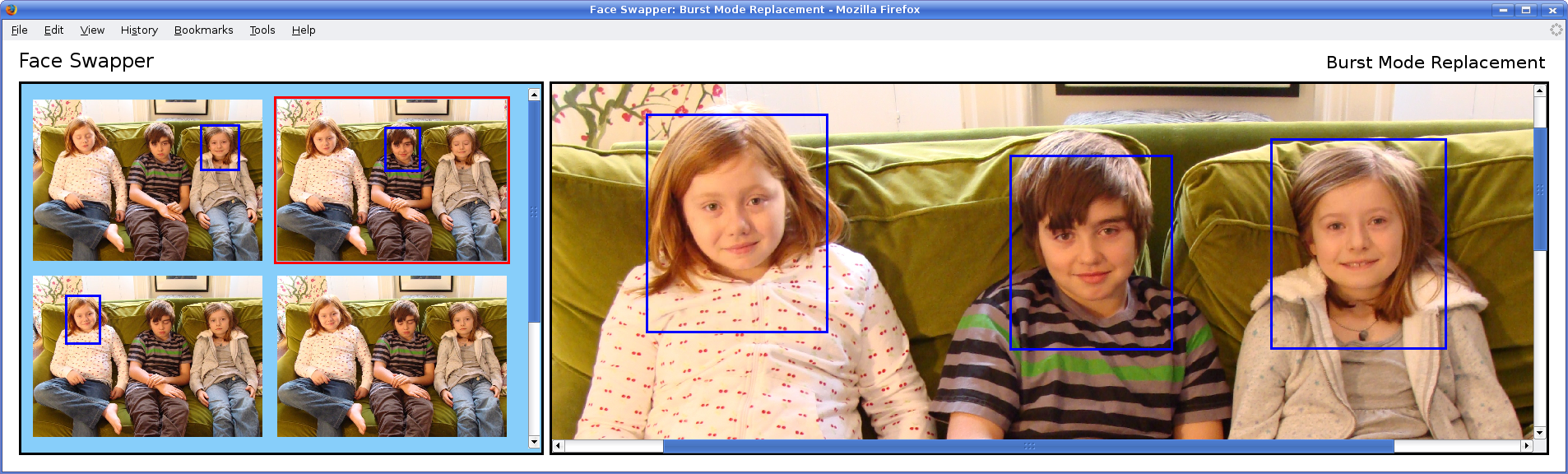
Face-Swapping Software To Protect Privacy
(0d0 writes "Some researchers at Columbia University's Computer Vision Labratory have developed software to automatically replace faces in batches of photos. Practical applications include protecting the identities of people in Google's Street View, coupling it with a digital camera's burst mode to create a perfect group photo, or protecting the identities of witnesses or law enforcement and military personnel. Other links to coverage include Boing Boing, American Public Media, and New Scientist." -
The Texas Petawatt Laser
Roland Piquepaille notes the hype surrounding what the University of Texas at Austin is calling the world's most powerful laser. During a tenth of a femtosecond this laser is 2,000 times more powerful than all the power plants in the US, and is brighter than sunlight on the surface of the Sun. On his own blog Roland points out that UT's is not the first petawatt laser; that distinction belongs to a system installed at Lawrence Livermore National Laboratory in 1996. -
Neuromarketers Pick the Brains of Consumers
Pickens points out a story at The Guardian about the development of neuromarketing, the method by which advertisers track signals inside the brain to roughly extrapolate how a consumer reacts to products and advertisements. We've discussed this technique in the past, but now consulting firms are appearing who have begun to use this research to increase the effectiveness of their marketing practices. The author also notes a paper which elaborates on the scientific details (PDF). "At McLean Hospital, a prestigious psychiatric institution run by Harvard University, an advertising agency recently sponsored an experiment in which the brains of half-a-dozen young whiskey drinkers were scanned. The goal, according to a report in Business Week, was 'to gauge the emotional power of various images, including college kids drinking cocktails on spring break, twentysomethings with flasks around a campfire, and older guys at a swanky bar'. The results were used to fine-tune an ad campaign for the maker of Jack Daniels." -
Novell Rises to Second Highest Linux Contributor
eldavojohn writes "Which companies contribute the most to the Linux kernel? Well, The Linux Foundation released their results and Novell's contributions have gone up 250% (from 3.6% of all contributions to 14.4% of all contributions) to put them at #2 behind Red Hat. This chart also illustrates just how widely Linux is modified by the community and not just a handful of developers/companies. You can find more coverage on blogs and the original report." -
Settlement Reached in Verizon GPL Violation Suit
eldavojohn writes "A settlement has been reached in the Verizon GPLv2 violation suit. The now famous BusyBox developers, Erick Andersen and Rob Landley, will receive an undisclosed sum from subcontractor Actiontec Electronics. 'Actiontec supplied Verizon with wireless routers for its FiOS broadband service that use an open source program called BusyBox. BusyBox developers Andersen and Landley in December sued Verizon -- claiming that the usage violated terms of version 2 of the GNU General Public License.'" -
Ads With Your Name On Them
eldavojohn writes "The NYTimes is running an interesting blog piece on the answers Microsoft, AOL, Yahoo, & Google gave to the question: Can they show you an ad with your name on it? The results: 'Microsoft says it could use only a person's first name [which it doesn't consider personal information]. AOL and Yahoo could use a full name but only on their sites, not the other sites on which they place ads. Google isn't sure; it probably could, but it doesn't know the names of most of its users.' Now whether or not they would use this information is a different story. AOL has no plans to, Yahoo is open to it, and Microsoft has implemented a technological barrier preventing it (despite behavioral and demographic data being served to the ad companies). Although Google might use name information at some point, they don't now do so; nor do they use behavioral or demographic data." -
Nanaimo, The Google Capital of the World
eldavojohn writes "Time.com has up a story on Nanaimo, a British Columbia coal mining town of about 78,000 that has had everything conceivable mapped into a Google database. Citizens can track fire trucks real time. The results also include Google Earth data for Nanaimo. 'The Google fire service allows people to avoid accident sites by tuning electronic devices to automatic updates from the city's RSS news feed, says fire captain Dean Ford. Eventually, Nanaimo plans to equip its grass-cutting machines with GPS devices, so residents piqued by the apparent shabbiness of a particular park or grass verge can use Google to find out when last it was groomed by the city's gardening staff. And the city's cemeteries will soon be mapped to allow Internet users to find out who is buried in each plot, says Kristensen. A new multi-million-dollar conference center, opening in June, will have 72 wireless access points to allow out-of-towners to use their laptops to navigate the Google Earth version of the city.'" -
Microsoft Wants To Read Your Brain
Simon Night writes "Microsoft has entered the realm of brain machine interfaces, attempting to patent a method of classifying brain states from EEG input. 'Human beings are often poor reporters of their own actions,' the patent application notes, so reading directly from your brain is a preferred option." -
Xeroxing Personal Data From Your Browsing History
grease_boy writes "Xerox has filed a patent covering a technique to recover demographic information like your age, sex and perhaps even your income by analysing the pattern of web pages you browse. They want to license the technique to online advertisers and shops. Read the full patent here." -
The Future Playground
eldavojohn writes "The BBC has an article on the London Science Museum's exhibit 'The Future Playground' which showcases some new technologies that may transform gaming. You may recognize some of these technologies as 'old news' but it's the way they're being utilized for gaming that makes this interesting. The most interesting one is the inflatable display which the article describes: 'The Puffer Sphere is an inflatable ball on which images can be projected, said Oliver Collier — one of its creators. Mr Collier said the idea of using the inflatable as a display grew out of an undergraduate project at the University of Edinburgh to use it as the basis for an interactive art installation.'" -
Google NASA Partnership Announced
eldavojohn writes "Google & NASA announced their partnership today with many benefits. The director of a NASA site said 'Just a few examples are new sensors and materials from collaborations on bio-info-nano convergence, improved analysis of engineering problems, as well as Earth, life and space science discoveries from supercomputing and data mining, and bringing entrepreneurs into the space program.'" Update 23:51 by SM As pointed out by so many readers the GoogleNASA site originally linked was completely bogus. -
Copyright Holders Sign China Piracy Agreement
eldavojohn writes "On Friday, a whole bunch of associations signed an agreement with China to combat internet piracy. From the article, "China's National Copyright Administration said the country would investigate and punish those suspected of online intellectual property abuses by the movie association as well as other groups such as the Association of American Publishers." From another article, I found that not only was it the MPA but also the Business Software Alliance (BSA), Association of American Publishers (AAP) and The Publishers Association (TPA) of the U.K." -
David X. Cohen Interviewed on New Futurama
eldavojohn writes "Toyfare has a short but exclusive interview with co-creator of Futurama David X. Cohen. There's a lot of information about how they plan to continue the series. He also reveals they're halfway through writing the new season and just starting animation. When asked about his favorite minor character of the show, Cohen responded 'Hypnotoad. By the way, we are looking into producing a full 22-minute episode of Everybody Loves Hypnotoad for the DVD release. I am serious.'" -
The Sierras of Titan
eldavojohn writes "Cassini has detected the tallest mountains on Titan, a large moon of Saturn. More importantly, clouds have also been detected in Titan's atmosphere. Why is this news important? Well, as scientists scan the skies for the easiest piece of mass to colonize, things that resemble Earth's geology & atmosphere are going to require the least effort & resources. These mountains mean that Titan may have tectonic plate movement similar in some ways to earth's. From the article, '"You can think of Titan as the Earth in deep freeze," said Dr Rosaly Lopes, Cassini radar team member at the US space agency's Jet Propulsion Laboratory. "It has a lot of the geological processes that Earth has. In fact, it is more Earth-like than anywhere else in the Solar System. But the surface is very cold; it's about minus 178C."'" -
Wikipedia Founder to Give Away Web Hosting
eldavojohn writes "Wikipedia founder Jimmy Wales is going to be giving away free web hosting from his company's site Wikia. The company announced this 'free culture' movement at the current Le Web 3 conference in Paris. They somehow received a $4 million dollar investment package from Bessemer Venture Partners, Omidyar Network and individual investors with no business model. Is this a dotcom bubble style mistake or just proof of Jimmy Wales' golden touch?" From the article: "Openserving will go further than Wikia's current services, by giving away hosting services and bandwidth, in addition to allowing site creators to keep the advertising revenue generated by the site. 'If we give away the bandwidth and the storage, and we get none of the advertising revenue, what's the business model? Well, I don't know yet,' Penchina said. The software acquired with ArmchairGM will let Openserving customers create collaborative publishing sites, combining elements of blogs and wikis." -
Unsuggester: Finding the Book You'll Never Want
Selanit writes "Lots of socially-oriented sites provide suggestions for things you might like based on user-provided data. But how many can claim to offer you things you'll probably hate? LibraryThing, the social book-cataloging site, has used its database of personal libraries to create UnSuggester, which does exactly that. You type in a book you like, "It analyzes the seven million books LibraryThing members have recorded as owned or read, and comes back with books least likely to share a library with the book you suggest." For example, apparently readers of Edward Said's "Orientalism" rarely purchase "Ella Enchanted" by Gail Carson Levine. Who'd have thought? Quirky though it may be, the tool seems an interesting way to broaden your horizons. If you're a hidebound, crufty old fogey, I un-recommend it!" -
The Mathematics of Neuroscience
eldavojohn writes "An academic paper on math [PDF] has been released by Paul Bressloff, resulting in much ado about the mathematical modeling of the brain's memory storage. The paper deals with specific receptors called AMPA and how memories are held while synapses still fire. Scientific American is running a more detailed report on the subject." From the article "At any given time, some AMPA receptors are moving inside the nerve cell where they are unable to receive signals. But to maintain memory, a number of AMPA receptors are anchored in place with what are known as scaffolding proteins, Bressloff said. The computer models examined how many AMPA receptors are anchored at the receiving area on the surface as opposed to those found elsewhere in the nerve cell. The more AMPA receptors that are anchored in place, the stronger the synapse." -
Galactic Traffic Patterns
eldavojohn writes "Using Hubble, researchers have noticed traffic patterns of stars within our own galaxy. From the article, 'Researchers analyzed 47 Tucanae, the second largest cluster in the Milky Way's galactic neighborhood, and determined the cluster sorts out stars according to their masses. Due to the associated gravitational pull, heavier stars slow down and sink to the cluster's core, while lighter stars pick up speed and zip out to the cluster's periphery.' There is speculation that these movements of stars — although tiny — can have significant implications and possibly result in mass segregation." -
Oracle Linux?
eldavojohn writes "There have been rumors floating around of Oracle working on their own distribution of Linux. If this is true, it is widely believed that this enterprise edition of Linux would be in direct competition with Red Hat Enterprise Linux. What is spurring the rumors? Well, Oracle chief executive Larry Ellison said, 'I'd like to have a complete stack. We're missing an operating system. You could argue that it makes a lot of sense for us to look at distributing and supporting Linux.' I know that Oracle has been doing a lot more than databases recently, will they go the extra mile and create their own stripped down Linux kernel? If they do, will companies switch to database solutions that are running Oracle only software for the benefits of support and (hopefully) stability?" -
Survey of Super Massive Black Holes Completed
eldavojohn writes "NASA has announced the completion of a survey of nearby supermassive black holes. Every galaxy that revolves around a supermassive black hole within 400 light-years of our own galaxy has been cataloged. From the article: 'Called active galactic nuclei, or AGN, these black holes have masses of up to billions of Suns compressed into a region about the size of our solar system. The all-sky census, performed using NASA's Swift satellite over a nine-month period, detected more than 200 nearby AGN.' I'm starting to feel very lucky to have grown up in the Milky Way Galaxy." -
Is Backyard Wind Power Worth It?
eldavojohn wonders: "In the October IEEE Spectrum magazine, I read an article on backyard windmills and their growing feasibility. With the lowest model's price tag, it's about $9,000 and lasts for around 100,000 kilowatt-hours (20 year life), which results in 9 cents per kilowatt-hour. Now, the article mentions that if the market takes off, that price will drop. However, I was wondering what price range the windmills would have to fall to (or the energy rates have to rise to) before I could consider this? Well, the price of the windmills in the article are out of my price range right now. I don't imagine many Americans have $8k-$11k laying around and the current month's rates for energy in my neighborhood are 2.2 cents/kWh for the first 800 kWh and 1.2 cents/kWh after. I was wondering what are your thoughts on being an early adopter of wind energy? Do you think that if enough people bought these windmills, the price per kWh could compete with the local power grid's? Will it ever?" -
PS3 Problems Cause Sony Stocks to Slide
eldavojohn writes "Gamespot has an article describing PS3s operating erratically at conference demonstrations.' In its defense, Sony said the PS3 failures were caused by unusually high temperatures created by having many of the next-gen consoles operating in close proximity to each other. 'It's not a problem with the PlayStation 3 unit itself,' Sony spokeswoman Nanako Kato told the AP. 'For a normal player at home, there shouldn't be any problem.' As a result, Sony's stock slid 2.75%. I guess they should have thought first before releasing five times the number of kiosks as they did with the PS2 — they're causing each other to overheat. There goes my PS3 beowulf cluster idea!" Update: 10/04 20:40 GMT by Z : anti-human 1 wrote in to mention a GamesIndustry.biz article, with a flat denial of overheating issues from Sony. "As could be seen on the TGS floor by the tens of thousands of media and public attendees, both the hardware and software worked flawlessly." -
Amazon's A9 Drops Retained Data Methods
eldavojohn writes "The recent update to Amazon's A9 service has removed its ability to record searches. A9 (which now uses Windows Live & Alexa) used to tout the ability to save every single search the user made, which required a login. Now, they no longer require you to log in and have dropped the recording of searches from their toolbar. What they added was aesthetic changes to the search site. What they dropped was the A9 Instant Reward, the A9 Toolbar, the A9 Yellow Pages, the A9 Maps (including Block View), the user diary, bookmarks, and history. Although they claim that A9 is merely 'shifting its priorities to areas where it can provide the greatest benefit for customers,' this smacks of a move to avoid the ethical controversies and pressures that come with retaining your user data. What does the rest of Slashdot think about retaining search data? Is it a liability or an asset?" -
Your 'Clickprint' Gives Away Your Identity Online
Krishna Dagli writes to mention an article at the Guardian site about an increasing interest in the possibility of identifying users by their 'clickprint', or online access habits. The article discusses a new paper on online identification written by two American professors. The piece posits that not only is nailing down individual users by their habits useful for advertisers looking to sell products, it may be possible to use this information to flag stolen identities. From the article: "'Our main finding is that even trivial features in an internet session can distinguish users,' Padmanabhan told the Wharton Review. 'People do seem to have individual browsing behaviors.' The duo found that anywhere from three to 16 sessions are needed to identify an individual's clickprint ... In one example, they found that from just seven aggregated sessions they could distinguish between two different surfers with a confidence of 86.7%. Given 51 sessions, the confidence level rose to 99.4%." -
Suing Google Over Pagerank
Yardboy wrote in to tell us about a story from Reuters describing a lawsuit by parental advice company Kinderstart.com against Google for 'charging it unfairly deprived the company of customers by downgrading its search-result ranking without reason or warning.' Kinderssart claims Google is responsible for 'a "cataclysmic" 70 percent fall in its audience -- and a resulting 80 percent decline in revenue.' I guess the courts will now decide: Can google taketh what they giveth? -
Aussie Techs Threaten Chaos
tintinaujapon writes "The Sydney Morning Herald is reporting that NCR staff with key responsibility (among other things) for fast food & supermarket chains, banking ATMs, schools and baggage handling at Sydney airport are preparing to walk off the job next week, in industrial action aimed at resolving a pay dispute. NCR's general manager thinks few people in the general community will care about the plight of the palest workforce, but the union claims potential disruption and financial losses could be huge. The strike could last up to a week and is the most significant action yet taken in Australia by the techie workforce."