Slashdot Mirror
Domain: tumblr.com
Stories and comments across the archive that link to tumblr.com.
Stories · 149
-
US Congressman Wants To Ban New Internet Laws
SchrodingerZ writes "Representative Darrell Issa, a Republican congressman from California, has drafted a bill for the internet. The bill, aptly named the Internet American Moratorium Act (IAMA), is, 'a two-year moratorium on any new laws, rules or regulations governing the Internet.' In short it hopes to deny any new government bills related to lawmaking on the internet for the next two years. The bill was first made public on the website Reddit, and is currently on the front page of Keepthewebopen.com, a website advocating internet rights. 'Together we can make Washington take a break from messing w/ the Internet,' Issa writes on his Reddit post. The initial response to the bill has been mixed. Users of Reddit are skeptical of the paper's motives and credibility. As of now, the bill is just a discussion draft, whether it will gain footing in the future is up in the air." -
One Musician's Demand From Pandora: Mandatory Analytics
jfruh writes "Most Slashdotters have been following the debate among the various players in the music industry about how much money artists (and their labels) get from traditional music outlets like radio and newer services like Pandora or Spotify. But Zoë Keating, a professional cellist who has a professional interest in the outcome of this argument, thinks there's one thing missing from all the proposals: more data on who her audience is. Even digital services can't tell her how many people heard her songs or where they're most popular. 'How can I grow my business on this information?' she asks. 'How do I reach them? Do they know I'm performing nearby next month? How can I tell them I have a new album coming out?'" She proposes mandatory reporting of information on listeners as part of royalties. -
New Dinosaur Named After the Eye of Sauron
SchrodingerZ writes "95 million years ago, the dinosaur Sauroniops pachytholus roamed northern Africa. Fossils, originally found in southern Morocco, only consisted of the upper skull, which included the eerie looking eye socket which resembles the Eye of Sauron from the Lord of the Rings movies. Using skull comparison, it is theorized the two-legged meat-eater would have been 40 feet tall, challenging the Tyrannosaurus Rex in height. More fossils are needed for a full analysis, but so far it is very clear this dinosaur towered over many." -
New York Data Centers Battle Floods, Utility Outages
miller60 writes "At least three data center buildings in lower Manhattan are struggling with power problems amid widespread flooding and utility outages caused by Hurricane Sandy. Flooded basements at two sites took out diesel fuel pumps, leaving them unable to refuel generators on higher levels. One of these was Datagram, which knocked out Buzzfeed and the Gawker network of sites. At 111 8th Avenue, some tenants lost power when Equinix briefly experienced generator problems." The NY Times has a running list of Sandy-related problems, including 5,700 more flight cancellations, 6 million people without power, rising water levels at a nuclear plant, official disaster declarations from President Obama, and a death toll of 38. On the upside, and despite the high water levels, the Nuclear Energy Institute was quick to point out that all 34 nuclear facilities in Sandy's path made it through without problems. -
NBC Erases SNL Sketch From Digital Archive For Fear of Copyright Lawsuit
M.Nunez writes with a tale of copyright woes. From the article: "The digital 'Saturday Night Live' archive does not feature a recent Bruno Mars sketch because it includes impersonations of pop singers and their chart-topping hits. Bruno Mars sings several songs that are not owned by NBC, so it can be presumed that the company refrained from uploading the sketch into its digital archive to avoid any legal issues. Convoluted music licensing laws have essentially erased the Bruno Mars sketch from the digital archives of SNL. In the short comedy sketch, Bruno Mars impersonates vocal performances by Billie Joe Armstrong (Green Day), Steven Tyler (Aerosmith), Katy Perry, Justin Bieber, Louis Armstrong, and Michael Jackson. The sketch cannot be found on NBC.com or Hulu, as a short clip or in either full editions of the episode." -
Mars Rover Solves Metallic Object Mystery, Unearths Another
SchrodingerZ writes "Last week the Mars Curiosity Rover spotted a shiny metallic-looking object in the martian soil. This week scientists have confirmed that it is plastic that has fallen off the 1-ton rover. However, the discovery of this trans-planetary littering has opened up another mystery for the science team. On October 12th the rover took a sample of soil from the ground, feeding it into its Chemistry and Mineralogy (CheMin) instruments for analysis, and a picture of the hole dug by the rover's claw revealed metallic particles in the dirt. The sample was subsequently dropped due to fears that particles from the rover had made it into the dirt. Further study now suggests that the metallic particles are actually native to Mars, as the photo reveals that they are embedded in the soil in clumps. In 2007 the older rover Spirit found evidence of silica for the first time, more testing will occur over the next few days to determine truly if this is again just Curiosity's littler, or something more profound." -
Boxee TV's Unlimited Cloud-based DVR Holds Users Hostage To Monthly Fees
An anonymous reader writes "Boxee has announced the game-changing Boxee TV, offering live streaming TV via two on-board tuners and an industry-first 'No Limit' DVR service that allows users to record as much TV content as they want, and access it from virtually anywhere. The problem is that the unit, which records directly to the cloud, does not allow recording to a local drive, meaning users are stuck with Boxee for as long as they want to access their stored content — potentially hundreds or thousands of hours – to the tune of $14.99 per month until Boxee ups the ante. CEPro.com suggests, 'I suspect Boxee is offering unlimited storage to make users especially beholden to them. The more content you have, the less likely you are to drop the service.'" -
Faculty To Grad Students: Go Work 80-Hour Weeks!
New submitter Ian Paul Freeley writes "Controversy has erupted after a departmental email from faculty to astrophysics graduate students was leaked. Key tips for success in grad school include: 'However, if you informally canvass the faculty (those people for whose jobs you came here to train), most will tell you that they worked 80-100 hours/week in graduate school. No one told us to work those hours, but we enjoyed what we were doing enough to want to do so...If you find yourself thinking about astronomy and wanting to work on your research most of your waking hours, then academic research may in fact be the best career choice for you.' Reactions from astronomy blogs has ranged from disappointment to concern for the mental health of the students. It also seems that such a culture, coupled with the poor job prospects for academics, is continuing to drive talent away from the field. This has been recognized as a problem for over 15 years in the astronomy community, but little seems to have changed. Any tips for those of us looking to instigate culture change and promote healthy work-life balance?" -
American Scientists Win Nobel Prize In Chemistry
SchrodingerZ writes "Two Americans have won the 2012 Nobel prize in Chemistry for their work in cell research. Their work involves the discovery and manipulation of the G-protein-coupled receptors, which detect signals outside the of cells they inhabit. 'The human body has about 1,000 kinds of such receptors, which enable it to respond to a wide variety of chemical signals, like adrenaline. Some receptors are in the nose, tongue and eyes, and let us sense smells, tastes and vision.' The winners are Robert J. Lefkowitz and Brian K. Kobilka. Lefkowitz works at the Howard Hughes Medical Institute and is a professor at Duke University Medical Center in Durham, North Carolina. Kobilka is a professor at Stanford University School of Medicine in California. Their research has helped create newer and more effective drugs with fewer side effects. More on G Protein-coupled Receptor research can be found in the Journal of Biological Chemistry." -
PETA Condemns Pokemon For Promoting Animal Abuse
SchrodingerZ writes "PETA, the same group that last November protested Mario for 'wearing fur,' has condemned the Pokémon media franchise and video game series. In light of the recent release of Pokemon Black and White Versions 2, the activist group is protesting that the Pokemon game series 'paints a rosy picture of what amounts to thinly veiled animal abuse.' As many of us know Pokemon is about young children who capture wild animals for the sole purpose of having them battle in non-fatal sparing matches. 'Much like animals in the real world, Pokémon are treated as unfeeling objects and used for such things as human entertainment and as subjects in experiments. The way that Pokémon are stuffed into pokéballs is similar to how circuses chain elephants inside railroad cars and let them out only to perform confusing and often painful tricks that were taught using sharp steel-tipped bullhooks and electric shock prods,' says a statement from the group. Ironically within Pokemon B/W 2 there an organization known as Team Plasma , which deals with taking Pokemon and retuning them to the wild. PETA is so up in arms that they have even created an anti-pokemon parody game in which you play as an escaped Pokemon battling your trainer. I recommend trying it, just for the laughs." -
Super Bacteria Create Gold
SchrodingerZ writes "With the price of gold skyrocketing in today's market, Michigan State University researchers have discovered a bacterium that can withstand high toxicity levels that are necessary to create natural gold. '"Microbial alchemy is what we're doing — transforming gold from something that has no value into a solid, precious metal that's valuable," said Kazem Kashefi, assistant professor of microbiology and molecular genetics.' The bacteria is Cupriavidus metallidurans, which is conditioned to be tolerant to heavy, toxic metals and to be 25 times stronger than most bacteria. When put into gold-chloride (a natural forming toxic liquid), the bacteria reproduces and converts the liquid into a gold nugget. The complete process takes about a week to perform. This experiment is currently on tour as an art exhibit called 'The Great Work of the Metal Lover.'" -
United States Navy Names Ship After Neil Armstrong
SchrodingerZ writes "In the wake of Neil Armstrong's death, the United States Navy has announced this week that a new research vessel will be named in his honor. This ship will be the first Armstrong-class Auxiliary General Oceanographic Research (AGOR) ship in the world. This ship got its name from secretary Ray Mabus, who wanted to honor the first man to set foot on the moon. 'Naming this class of ships and this vessel after Neil Armstrong honors the memory of an extraordinary individual, but more importantly, it reminds us all to embrace the challenges of exploration and to never stop discovering,' say Mabus. Armstrong, before his career at NASA, flew in combat missions during the Korean war. 'The Armstrong-class AGOR ship will be a modern oceanographic research platform equipped with acoustic equipment capable of mapping the deepest parts of the oceans, and modular on-board laboratories that will provide the flexibility to meet a wide variety of oceanographic research challenges.' It will be 238 feet long, beam length of 50 feet, and will be able to travel at 12 knots. The ship is currently under construction in Anacortes, Washington." -
Apple Reportedly Luring Ex-Google Mappers With Jobs
TechCrunch reports that Apple, facing a substantial backlash (and some snarky competitive advertising) over goofs in the mapping software included in iOS 6, is going after the problem with a hiring spree. Here's TechCrunch's lead: "Apple is going after people with experience working on Google Maps to develop its own product, according to a source with connections on both teams. Using recruiters, Apple is pursuing a strategy of luring away Google Maps employees who helped develop the search giant’s product on contract, and many of those individuals seem eager to accept due in part to the opportunity Apple represents to build new product, instead of just doing 'tedious updates' on a largely complete platform." Meanwhile, writes reader EGSonikku "Well known iOS hacker Ryan Perrich has gotten the iOS5 Google Maps application to run on iOS6 using 'a little trickery.' (YouTube demonstration.) He has not released it yet due to crashing issues but states 'it mostly works.'" -
Three Mile Island Shuts Down After Pump Failure
SchrodingerZ writes "The nuclear power station on Three Mile Island in Pennsylvania shut down abruptly this afternoon. Its shutdown was caused when one of four coolant pumps for a reactor failed to work. 'The Unit 1 reactor shut off automatically about 2:20 p.m., the plant's owner, Exelon Corporation, reported. There is no danger to the public, but the release of steam in the process created "a loud noise heard by nearby residents," the company said.' If radiation was released into the environment, it is so low that it thus far has not been detected. The plant is a 825-megawatt pressurized water reactor, supplying power to around 800,000 homes, thought there has been no loss of electrical service. Three Mile Island was the site of a partial nuclear meltdown in 1979. The Unit 2 reactor has not been reactivated since." -
Curiosity Rover Sees Solar Eclipse On Mars
SchrodingerZ writes "Though solar eclipses are fairly common on Earth (much more in the southern hemisphere), yesterday the Mars Curiosity Rover caught sight of a partial solar eclipse in Gale Crater on the Red planet. The martian moon Phobos took a small bite out of the sun on the 37th day (Sol 37) of the rover's martian mission. The Curiosity Rover was able to take a picture of the rare event through a 'neutral density filter that reduced the sunlight to a thousandth of its natural intensity.' This protects the camera from the intense light rays seen during an eclipse or looking directly at the sun. It is possible a short movie of the event could be compiled from the data in the near future. More solar transits of Mars's moon (including the second moon Deimos) are predicted to happen in the days to come." -
Florida Researchers Create Shortest Light Pulse Ever Recorded
SchrodingerZ writes "Researchers at the University of Central Florida have created the shortest laser pulse ever recorded, lasting only 67 attoseconds. An attosecond is a mere quintillionith of a single second (1/1,000,000,000,000,000,000). The record-breaking project was run by UCF Professor Zenghu Chang, using an extreme ultraviolet laser pulse. '"Dr. Chang's success in making ever-shorter light pulses helps open a new door to a previously hidden world, where we can watch electrons move in atoms and molecules, and follow chemical reactions as they take place," said Michael Johnson, the dean of the UCF College of Sciences and a physicist.' Its hoped that these short laser blasts will pave the way to better understand quantum mechanics in ways we have never before witnessed. In 2008 the previous record was set at 80 attoseconds, the pulse created at the Max Planck Institute in Garching, Germany." -
Quantum Teleportation Sends Information 143 Kilometers
SchrodingerZ writes "Scientists from around the world have collaborated to achieve quantum teleportation over 143 kilometers in free space. Quantum information was sent between the Canary Islands of La Palma and Tenerife. Quantum teleportation is not how it is made out in Star Trek, though. Instead of sending an object (in this case a photon) from one location to another; the information of its quantum state is sent, making a photon on the other end look identical to the original. 'Teleportation across 143 kilometres is a crucial milestone in this research, since that is roughly the minimum distance between the ground and orbiting satellites.' It is the hope of the research team that this experiment will lead to commercial use of quantum teleportation to interact with satellites and ground stations. This will increase the efficiency of satellite communication and help with the expansion of quantum internet usage. The full paper on the experiment can be found [note: abstract only, full article paywalled] in the journal Nature." -
Space Sugar Discovered In Binary System Star
SchrodingerZ writes "Sweet tooths rejoice! 400 light years from Earth in the constellation Ophiuchus, sugar molecules have been confirmed in a gas cloud surrounding a young star. The star, IRAS 16293-2422, though early in its life is relativity close to the size of our Sun. It is part of a Binary star system. '"In the disk of gas and dust surrounding this newly formed star, we found glycolaldehyde, which is a simple form of sugar, not much different to the sugar we put in coffee," study lead author Jes Jorgensen, of the Niels Bohr Institute in Denmark, said in a statement.' Glycolaldehyde has been found before in space, but never this close to a Sun-like planet. In fact 'the molecules are about the same distance away from the star as the planet Uranus is from our sun.' This discovery proves that the building blocks of life could have possibly existed in the earlier parts of our own solar system. This particular sugar reacts with propenal to form ribose, which is a major component for organic life on Earth." -
Disney Turns Plants Into Multi-Touch Sensors
SchrodingerZ writes "Designers of Disney Research in Pittsburgh Pa, have turned the average household plant into a musical device and remote control. Called the Botanicus Interacticus project, this new program can turn any household plant into touch-sensitive computer system. 'The system is built upon capacitive touch sensing — the principle used on touchscreens in smartphones and tablets — but instead of sensing electrical signals at a single frequency, it monitors capacitive signals across a broad range of frequencies. It's called Swept Frequency Capacitive Sensing.' This works by putting a pulsating electrode into the soil around a plant, which excites the plant, making any touch to the parts of the plant a replayable signal. This could mean soon swatting at your household plant could change the television channel or turn up the volume (PDF)." -
DARPA Creates Machine Which Extinguishes Fires With Sound
SchrodingerZ writes "The Defense Advanced Research Projects Agency (DARPA) is known for making odd scientific advances ranging from hypersonic unnamed rockets to bionic prosthetic limbs to insect-sized reconnaissance drones. But recently DARPA has made a interesting advancement in the field of fire suppression. Using two speakers arranged on either side of an open liquid fuel flame, an acoustic field was emitted and engulfed the fire. 'The sound increases air velocity, which then thins the area of the flame where combustion occurs, known as the flame boundary.' This make the flame weak and much easier to douse. Another wonderful thing about this: it's not even that loud! DARPA began its testing in 2008, stating that despite extensive research in this area, there have been no new methods for extinguishing and/or manipulating fire in almost 50 years. The agency plans to expand on this experiment and try to make it successful on a practical scale." -
IBM Touts Quantum Computing Breakthrough
Lucas123 writes "IBM today claimed to have been able to reduce error rates and retain the integrity of quantum mechanical properties in quantum bits or qubits long enough to perform a gate operation, opening the door to new microfabrication techniques that allow engineers to begin designing a quantum computer. While still a long ways off, the creation of a quantum computer would mean data processing power would be exponentially increased over what is possible with today's silicon-based computing." -
Delayed Outrage Over A Censored Site; What's a Better Way To Spread News?
Bennett Haselton is back with a thought provoking essay about not just an incident of Internet censorship on an American university campus, but a proposed method of propagating news, so that relevant stories aren't buried as easily by chance or time. Bennett writes: "The real scandal in the story of Arizona State University blocking students' access to the Change.org website, is not just that it happened, but that the block persisted for two months without being mentioned in the media. As a card-carrying member of the 'outrage grapevine,' I surely think we need a way to respond faster." Read on for the rest.This is a tale of censorship. From about December 7th until February 3rd, Arizona State University was blocking all users of its network from accessing the Change.org website, where users can create petitions and circulate them for other users to sign. (The lame excuse offered by the university was that a student had created a petition and was using the change.org site to "spam" other ASU accounts; of course, even if that had been the real reason, it would have easily been possible for ASU to block mail from the change.org servers, without blocking all students from accessing the website.) On February 3rd, after a furor of sudden media attention, the block was lifted.
But that's not the worst instance of censorship in this story. What's more disconcerting is that for the two months that the block was in place, the university's decision to block the website received no media coverage at all. This despite the fact that it was a political website being blocked, at a university with over 70,000 students — a publicly funded university, where a court would have almost certainly found that the blocking violated the First Amendment, had the case ever gone to trial.
I first heard about the original tumblr blog post describing the blocking situation, when someone posted the link on my Facebook wall. So as I went to my profile to read it, I was already predisposed to be pissed off, since almost every link that someone posts on my wall is either an outright scam, or a one-sided rant about an issue that is actually much more complicated than the author thinks it is. Well, it was a one-sided rant, all right, but it was about an issue where there was really only one side: ASU evidently got annoyed about a petition on change.org protesting tuition hikes, so they blocked the site. As I re-read the post, I kept thinking: How can this be true, if we haven't heard about it anywhere else? Perhaps an overzealous ASU network admin put the block in place, and it was reversed just a few hours later, but the tumblr post never got updated? I emailed the blog post's author, Eric Haywood, and the owners of change.org, asking how long the block had lasted before the site was un-blocked — I just assumed that the block couldn't possibly still be in place, two months later. But they confirmed that it was.
The link got blogged and re-blogged around tumblr a few times in December and January, and then, at about the same time as I was sending my emails, the issue suddenly "tipped" into public awareness as it was linked from a widely-read reddit post. Then the blocking received its first official "media" coverage in an article in the ASU student newspaper, the State Press. (Eric Haywood called the article "just ASU spreading it's own propaganda about this issue (they own, run and control the State Press)". I don't know about propaganda, but it did seem a little amateurish — the article says "The author of the original blog post is unknown", even though the guy's name, Eric Haywood, was listed in the post, along with his email address.) Then finally the story spilled over into the "real" media with an article in the Huffington Post, in which the author pointed out that the blocking likely violated the First Amendment. (A few hours after that article appeared, the university unblocked the site so that ASU students could access Change.org on their network again.)
None of the articles commented, however, on how the issue had remained buried for so long; the State Press article said only that the tumblr blog "began circulating the Internet Thursday." A reader could be forgiven for reading the articles and scratching their head and thinking: What is it that just happened? If the site has been blocked for two months, why is this only being written about now?
The answer, I think, is that most people don't realize how arbitrary the process is that determines what issues get news coverage and which ones don't. Before I got involved in a few issues that did receive media coverage (in my late teens, through Peacefire and in co-operative projects with others), I had just assumed that "the news" consisted of all stories that somebody in the media business considered to be "news-worthy." Some journalists just want to sell papers (or attract page-views), while other (better) journalists strive to tell the most important stories — but either way, surely their decision to cover something, or not, should depend on attributes of the story, right? Not on whatever else happened to be going on, or other random circumstances? But then, when I started to be involved in efforts to actually get media coverage for this or that issue, some issues ended up receiving far more coverage than even I thought they really deserved, and others received far less.
Sometimes reporters would frankly admit that they thought something was a good story, but they couldn't cover it because their plate was full that day, and even if they had time later, by that time the issue would be too "cold." Some years ago, I wrote in Slashdot about an experiment in which I sued some spammers in Small Claims court, and filed the court briefs with some of the pages stuck together with a sliver of paper. When the judges rejected the motions (as I expected, since Small Claims judges have been near-uniformly hostile to spam suits), I went to the courthouse to look at the files and found the pages still attached, indicating that the judges had rejected the motions without reading them. What I didn't mention in the original article, was that I had planned at first to give the exclusive story to a Seattle Times reporter, who came down to the courthouse to see the files and interviewed me afterwards. The paper must have thought there was a real story there, since they later sent a photographer to come down and take pictures of the files as well. But then something else landed on the reporter's desk and pushed the story back a few days, and days became weeks, and then the beat switched to a different reporter. When I eventually called to ask if they were still interested, they replied, essentially, that without a current "hook", they couldn't write the story, because now it would look like they weren't doing their jobs for the long intervening period when they didn't write about it, so it was better now to drop it entirely.
Traditional media seems hamstrung by two limitations here: (1) an inefficiency at finding the most important stories that most "deserve" to be written about; and (2) a convention that you can't cover something that's more than a few days old, because then the story looks "dated." The Internet doesn't seem to suffer from limitation #2, as demonstrated by the fact that the blocking of change.org at ASU on December 7th was still able to ignite a controversy on February 3rd. But it does still suffer from limitation #1, as illustrated by the Internet's near-total silence on the issue from December 7th through February 2nd.
Many other people have a pet issue that they think is being "suppressed" by the "liberal media" or the "corporate-owned media" (depending on which side they're on), but the evidence suggests that no conspiracy is necessary to keep an important story from being written about. Sometimes arbitrariness and chance is enough.
My naive earlier assumption — that stories received media coverage because of some combination of attributes of those stories — seems to be a specific instance of a cognitive fallacy, where if you observe that some group of things achieved some end result Z, and all of those things started out possessing some attribute X, then you think that attribute X caused the achievement of result Z. In this case, because we observe that most stories which receive news coverage are important and interesting (with obvious exceptions), we assume that most interesting and important news stories will receive news coverage. Thus, it's frustrating and counterintuitive when we find out about an issue that cries out to be written about, but was ignored by the media. The truth is more likely to be that for every important and interesting story that gets coverage, there are likely to be many other equally important and interesting stories that never make it into the news.
(By the way, I've been unable to find a precise name for the cognitive fallacy wherein if you observe that all things which achieve goal Z have attribute X, then you come to think that attribute X is a good predictor of achieving goal Z. It's not the same as the "post hoc fallacy" or the mistaken belief that "correlation equals causation," because both of those are about the illusion of causation. I'm talking about the correlation being an illusion in the first place — where people come to believe that attribute X is a good predictor of achieving result Z, ignoring the fact that there may be enormous numbers of cases where attribute X is true, but which never go on to achieve result Z. If you know the exact name of that fallacy, shoot me an email and submit a comment below.)
In an earlier article, I proposed a system that would eliminate the arbitrariness in determining which pieces of content are selected to be "the best" and broadcast to a larger audience. I suggested using the algorithm to determine which songs could be pushed out to listeners of a streaming music system, but it could be modified to select which news stories would be considered "important" enough to push out to readers of a news site. (The gist of the idea is that you have each piece of content rated by a random sample of users chosen from the system, and if their average rating is high enough, it gets pushed out to everyone else. If the random sample size is large enough, their average rating will be non-arbitrary, and will be determined by the attributes of the content itself.)
Maybe that algorithm is flawed or maybe someone could find a better one, but the more important thing to realize is that we don't live in that world now, where the attention given to an event is determined by attributes of that event. In the world we actually live in, it's safe to assume that many events take place every day that would have been covered by the news, if it hadn't been for a reporter's missed phone call or some other random happenstance. I have no doubt that the blocking of Change.org on ASU's network could have been a front-page story on CNN, under the right circumstances. I just think that in an ideal world, it should have ended up as a front-page story on CNN regardless of the "circumstances" — but real life, no favorable circumstances means no CNN story.
That might seem like a lot to read into a single case of media silence about a political website being censored at a state university. But while Change.org is no longer blocked at ASU, the inefficient and arbitrary means by which news "events" are discovered and distributed to a wide audience will be with us for a long time.
-
Delayed Outrage Over A Censored Site; What's a Better Way To Spread News?
Bennett Haselton is back with a thought provoking essay about not just an incident of Internet censorship on an American university campus, but a proposed method of propagating news, so that relevant stories aren't buried as easily by chance or time. Bennett writes: "The real scandal in the story of Arizona State University blocking students' access to the Change.org website, is not just that it happened, but that the block persisted for two months without being mentioned in the media. As a card-carrying member of the 'outrage grapevine,' I surely think we need a way to respond faster." Read on for the rest.This is a tale of censorship. From about December 7th until February 3rd, Arizona State University was blocking all users of its network from accessing the Change.org website, where users can create petitions and circulate them for other users to sign. (The lame excuse offered by the university was that a student had created a petition and was using the change.org site to "spam" other ASU accounts; of course, even if that had been the real reason, it would have easily been possible for ASU to block mail from the change.org servers, without blocking all students from accessing the website.) On February 3rd, after a furor of sudden media attention, the block was lifted.
But that's not the worst instance of censorship in this story. What's more disconcerting is that for the two months that the block was in place, the university's decision to block the website received no media coverage at all. This despite the fact that it was a political website being blocked, at a university with over 70,000 students — a publicly funded university, where a court would have almost certainly found that the blocking violated the First Amendment, had the case ever gone to trial.
I first heard about the original tumblr blog post describing the blocking situation, when someone posted the link on my Facebook wall. So as I went to my profile to read it, I was already predisposed to be pissed off, since almost every link that someone posts on my wall is either an outright scam, or a one-sided rant about an issue that is actually much more complicated than the author thinks it is. Well, it was a one-sided rant, all right, but it was about an issue where there was really only one side: ASU evidently got annoyed about a petition on change.org protesting tuition hikes, so they blocked the site. As I re-read the post, I kept thinking: How can this be true, if we haven't heard about it anywhere else? Perhaps an overzealous ASU network admin put the block in place, and it was reversed just a few hours later, but the tumblr post never got updated? I emailed the blog post's author, Eric Haywood, and the owners of change.org, asking how long the block had lasted before the site was un-blocked — I just assumed that the block couldn't possibly still be in place, two months later. But they confirmed that it was.
The link got blogged and re-blogged around tumblr a few times in December and January, and then, at about the same time as I was sending my emails, the issue suddenly "tipped" into public awareness as it was linked from a widely-read reddit post. Then the blocking received its first official "media" coverage in an article in the ASU student newspaper, the State Press. (Eric Haywood called the article "just ASU spreading it's own propaganda about this issue (they own, run and control the State Press)". I don't know about propaganda, but it did seem a little amateurish — the article says "The author of the original blog post is unknown", even though the guy's name, Eric Haywood, was listed in the post, along with his email address.) Then finally the story spilled over into the "real" media with an article in the Huffington Post, in which the author pointed out that the blocking likely violated the First Amendment. (A few hours after that article appeared, the university unblocked the site so that ASU students could access Change.org on their network again.)
None of the articles commented, however, on how the issue had remained buried for so long; the State Press article said only that the tumblr blog "began circulating the Internet Thursday." A reader could be forgiven for reading the articles and scratching their head and thinking: What is it that just happened? If the site has been blocked for two months, why is this only being written about now?
The answer, I think, is that most people don't realize how arbitrary the process is that determines what issues get news coverage and which ones don't. Before I got involved in a few issues that did receive media coverage (in my late teens, through Peacefire and in co-operative projects with others), I had just assumed that "the news" consisted of all stories that somebody in the media business considered to be "news-worthy." Some journalists just want to sell papers (or attract page-views), while other (better) journalists strive to tell the most important stories — but either way, surely their decision to cover something, or not, should depend on attributes of the story, right? Not on whatever else happened to be going on, or other random circumstances? But then, when I started to be involved in efforts to actually get media coverage for this or that issue, some issues ended up receiving far more coverage than even I thought they really deserved, and others received far less.
Sometimes reporters would frankly admit that they thought something was a good story, but they couldn't cover it because their plate was full that day, and even if they had time later, by that time the issue would be too "cold." Some years ago, I wrote in Slashdot about an experiment in which I sued some spammers in Small Claims court, and filed the court briefs with some of the pages stuck together with a sliver of paper. When the judges rejected the motions (as I expected, since Small Claims judges have been near-uniformly hostile to spam suits), I went to the courthouse to look at the files and found the pages still attached, indicating that the judges had rejected the motions without reading them. What I didn't mention in the original article, was that I had planned at first to give the exclusive story to a Seattle Times reporter, who came down to the courthouse to see the files and interviewed me afterwards. The paper must have thought there was a real story there, since they later sent a photographer to come down and take pictures of the files as well. But then something else landed on the reporter's desk and pushed the story back a few days, and days became weeks, and then the beat switched to a different reporter. When I eventually called to ask if they were still interested, they replied, essentially, that without a current "hook", they couldn't write the story, because now it would look like they weren't doing their jobs for the long intervening period when they didn't write about it, so it was better now to drop it entirely.
Traditional media seems hamstrung by two limitations here: (1) an inefficiency at finding the most important stories that most "deserve" to be written about; and (2) a convention that you can't cover something that's more than a few days old, because then the story looks "dated." The Internet doesn't seem to suffer from limitation #2, as demonstrated by the fact that the blocking of change.org at ASU on December 7th was still able to ignite a controversy on February 3rd. But it does still suffer from limitation #1, as illustrated by the Internet's near-total silence on the issue from December 7th through February 2nd.
Many other people have a pet issue that they think is being "suppressed" by the "liberal media" or the "corporate-owned media" (depending on which side they're on), but the evidence suggests that no conspiracy is necessary to keep an important story from being written about. Sometimes arbitrariness and chance is enough.
My naive earlier assumption — that stories received media coverage because of some combination of attributes of those stories — seems to be a specific instance of a cognitive fallacy, where if you observe that some group of things achieved some end result Z, and all of those things started out possessing some attribute X, then you think that attribute X caused the achievement of result Z. In this case, because we observe that most stories which receive news coverage are important and interesting (with obvious exceptions), we assume that most interesting and important news stories will receive news coverage. Thus, it's frustrating and counterintuitive when we find out about an issue that cries out to be written about, but was ignored by the media. The truth is more likely to be that for every important and interesting story that gets coverage, there are likely to be many other equally important and interesting stories that never make it into the news.
(By the way, I've been unable to find a precise name for the cognitive fallacy wherein if you observe that all things which achieve goal Z have attribute X, then you come to think that attribute X is a good predictor of achieving goal Z. It's not the same as the "post hoc fallacy" or the mistaken belief that "correlation equals causation," because both of those are about the illusion of causation. I'm talking about the correlation being an illusion in the first place — where people come to believe that attribute X is a good predictor of achieving result Z, ignoring the fact that there may be enormous numbers of cases where attribute X is true, but which never go on to achieve result Z. If you know the exact name of that fallacy, shoot me an email and submit a comment below.)
In an earlier article, I proposed a system that would eliminate the arbitrariness in determining which pieces of content are selected to be "the best" and broadcast to a larger audience. I suggested using the algorithm to determine which songs could be pushed out to listeners of a streaming music system, but it could be modified to select which news stories would be considered "important" enough to push out to readers of a news site. (The gist of the idea is that you have each piece of content rated by a random sample of users chosen from the system, and if their average rating is high enough, it gets pushed out to everyone else. If the random sample size is large enough, their average rating will be non-arbitrary, and will be determined by the attributes of the content itself.)
Maybe that algorithm is flawed or maybe someone could find a better one, but the more important thing to realize is that we don't live in that world now, where the attention given to an event is determined by attributes of that event. In the world we actually live in, it's safe to assume that many events take place every day that would have been covered by the news, if it hadn't been for a reporter's missed phone call or some other random happenstance. I have no doubt that the blocking of Change.org on ASU's network could have been a front-page story on CNN, under the right circumstances. I just think that in an ideal world, it should have ended up as a front-page story on CNN regardless of the "circumstances" — but real life, no favorable circumstances means no CNN story.
That might seem like a lot to read into a single case of media silence about a political website being censored at a state university. But while Change.org is no longer blocked at ASU, the inefficient and arbitrary means by which news "events" are discovered and distributed to a wide audience will be with us for a long time.
-
Delayed Outrage Over A Censored Site; What's a Better Way To Spread News?
Bennett Haselton is back with a thought provoking essay about not just an incident of Internet censorship on an American university campus, but a proposed method of propagating news, so that relevant stories aren't buried as easily by chance or time. Bennett writes: "The real scandal in the story of Arizona State University blocking students' access to the Change.org website, is not just that it happened, but that the block persisted for two months without being mentioned in the media. As a card-carrying member of the 'outrage grapevine,' I surely think we need a way to respond faster." Read on for the rest.This is a tale of censorship. From about December 7th until February 3rd, Arizona State University was blocking all users of its network from accessing the Change.org website, where users can create petitions and circulate them for other users to sign. (The lame excuse offered by the university was that a student had created a petition and was using the change.org site to "spam" other ASU accounts; of course, even if that had been the real reason, it would have easily been possible for ASU to block mail from the change.org servers, without blocking all students from accessing the website.) On February 3rd, after a furor of sudden media attention, the block was lifted.
But that's not the worst instance of censorship in this story. What's more disconcerting is that for the two months that the block was in place, the university's decision to block the website received no media coverage at all. This despite the fact that it was a political website being blocked, at a university with over 70,000 students — a publicly funded university, where a court would have almost certainly found that the blocking violated the First Amendment, had the case ever gone to trial.
I first heard about the original tumblr blog post describing the blocking situation, when someone posted the link on my Facebook wall. So as I went to my profile to read it, I was already predisposed to be pissed off, since almost every link that someone posts on my wall is either an outright scam, or a one-sided rant about an issue that is actually much more complicated than the author thinks it is. Well, it was a one-sided rant, all right, but it was about an issue where there was really only one side: ASU evidently got annoyed about a petition on change.org protesting tuition hikes, so they blocked the site. As I re-read the post, I kept thinking: How can this be true, if we haven't heard about it anywhere else? Perhaps an overzealous ASU network admin put the block in place, and it was reversed just a few hours later, but the tumblr post never got updated? I emailed the blog post's author, Eric Haywood, and the owners of change.org, asking how long the block had lasted before the site was un-blocked — I just assumed that the block couldn't possibly still be in place, two months later. But they confirmed that it was.
The link got blogged and re-blogged around tumblr a few times in December and January, and then, at about the same time as I was sending my emails, the issue suddenly "tipped" into public awareness as it was linked from a widely-read reddit post. Then the blocking received its first official "media" coverage in an article in the ASU student newspaper, the State Press. (Eric Haywood called the article "just ASU spreading it's own propaganda about this issue (they own, run and control the State Press)". I don't know about propaganda, but it did seem a little amateurish — the article says "The author of the original blog post is unknown", even though the guy's name, Eric Haywood, was listed in the post, along with his email address.) Then finally the story spilled over into the "real" media with an article in the Huffington Post, in which the author pointed out that the blocking likely violated the First Amendment. (A few hours after that article appeared, the university unblocked the site so that ASU students could access Change.org on their network again.)
None of the articles commented, however, on how the issue had remained buried for so long; the State Press article said only that the tumblr blog "began circulating the Internet Thursday." A reader could be forgiven for reading the articles and scratching their head and thinking: What is it that just happened? If the site has been blocked for two months, why is this only being written about now?
The answer, I think, is that most people don't realize how arbitrary the process is that determines what issues get news coverage and which ones don't. Before I got involved in a few issues that did receive media coverage (in my late teens, through Peacefire and in co-operative projects with others), I had just assumed that "the news" consisted of all stories that somebody in the media business considered to be "news-worthy." Some journalists just want to sell papers (or attract page-views), while other (better) journalists strive to tell the most important stories — but either way, surely their decision to cover something, or not, should depend on attributes of the story, right? Not on whatever else happened to be going on, or other random circumstances? But then, when I started to be involved in efforts to actually get media coverage for this or that issue, some issues ended up receiving far more coverage than even I thought they really deserved, and others received far less.
Sometimes reporters would frankly admit that they thought something was a good story, but they couldn't cover it because their plate was full that day, and even if they had time later, by that time the issue would be too "cold." Some years ago, I wrote in Slashdot about an experiment in which I sued some spammers in Small Claims court, and filed the court briefs with some of the pages stuck together with a sliver of paper. When the judges rejected the motions (as I expected, since Small Claims judges have been near-uniformly hostile to spam suits), I went to the courthouse to look at the files and found the pages still attached, indicating that the judges had rejected the motions without reading them. What I didn't mention in the original article, was that I had planned at first to give the exclusive story to a Seattle Times reporter, who came down to the courthouse to see the files and interviewed me afterwards. The paper must have thought there was a real story there, since they later sent a photographer to come down and take pictures of the files as well. But then something else landed on the reporter's desk and pushed the story back a few days, and days became weeks, and then the beat switched to a different reporter. When I eventually called to ask if they were still interested, they replied, essentially, that without a current "hook", they couldn't write the story, because now it would look like they weren't doing their jobs for the long intervening period when they didn't write about it, so it was better now to drop it entirely.
Traditional media seems hamstrung by two limitations here: (1) an inefficiency at finding the most important stories that most "deserve" to be written about; and (2) a convention that you can't cover something that's more than a few days old, because then the story looks "dated." The Internet doesn't seem to suffer from limitation #2, as demonstrated by the fact that the blocking of change.org at ASU on December 7th was still able to ignite a controversy on February 3rd. But it does still suffer from limitation #1, as illustrated by the Internet's near-total silence on the issue from December 7th through February 2nd.
Many other people have a pet issue that they think is being "suppressed" by the "liberal media" or the "corporate-owned media" (depending on which side they're on), but the evidence suggests that no conspiracy is necessary to keep an important story from being written about. Sometimes arbitrariness and chance is enough.
My naive earlier assumption — that stories received media coverage because of some combination of attributes of those stories — seems to be a specific instance of a cognitive fallacy, where if you observe that some group of things achieved some end result Z, and all of those things started out possessing some attribute X, then you think that attribute X caused the achievement of result Z. In this case, because we observe that most stories which receive news coverage are important and interesting (with obvious exceptions), we assume that most interesting and important news stories will receive news coverage. Thus, it's frustrating and counterintuitive when we find out about an issue that cries out to be written about, but was ignored by the media. The truth is more likely to be that for every important and interesting story that gets coverage, there are likely to be many other equally important and interesting stories that never make it into the news.
(By the way, I've been unable to find a precise name for the cognitive fallacy wherein if you observe that all things which achieve goal Z have attribute X, then you come to think that attribute X is a good predictor of achieving goal Z. It's not the same as the "post hoc fallacy" or the mistaken belief that "correlation equals causation," because both of those are about the illusion of causation. I'm talking about the correlation being an illusion in the first place — where people come to believe that attribute X is a good predictor of achieving result Z, ignoring the fact that there may be enormous numbers of cases where attribute X is true, but which never go on to achieve result Z. If you know the exact name of that fallacy, shoot me an email and submit a comment below.)
In an earlier article, I proposed a system that would eliminate the arbitrariness in determining which pieces of content are selected to be "the best" and broadcast to a larger audience. I suggested using the algorithm to determine which songs could be pushed out to listeners of a streaming music system, but it could be modified to select which news stories would be considered "important" enough to push out to readers of a news site. (The gist of the idea is that you have each piece of content rated by a random sample of users chosen from the system, and if their average rating is high enough, it gets pushed out to everyone else. If the random sample size is large enough, their average rating will be non-arbitrary, and will be determined by the attributes of the content itself.)
Maybe that algorithm is flawed or maybe someone could find a better one, but the more important thing to realize is that we don't live in that world now, where the attention given to an event is determined by attributes of that event. In the world we actually live in, it's safe to assume that many events take place every day that would have been covered by the news, if it hadn't been for a reporter's missed phone call or some other random happenstance. I have no doubt that the blocking of Change.org on ASU's network could have been a front-page story on CNN, under the right circumstances. I just think that in an ideal world, it should have ended up as a front-page story on CNN regardless of the "circumstances" — but real life, no favorable circumstances means no CNN story.
That might seem like a lot to read into a single case of media silence about a political website being censored at a state university. But while Change.org is no longer blocked at ASU, the inefficient and arbitrary means by which news "events" are discovered and distributed to a wide audience will be with us for a long time.
-
Carrier IQ Drama Continues
alphadogg writes "A Cornell University professor is calling the controversial Carrier IQ smartphone software revelations a privacy disaster. 'This is my worst nightmare,' says Stephen Wicker, a professor of electrical and computer engineering at Cornell. 'As a professor who studies electronic security, this is everything that I have been working against for the last 10 years. It is an utterly appalling invasion of privacy with immense potential for manipulation and privacy theft that requires immediate federal intervention.'" Read on for a grab-bag of other news about the ongoing story of Carrier IQ's spyware. Federal intervention is already on the menu; new submitter mitcheli writes "Following the video from Trevor Eckhart on Youtube after the filing of the Cease and Desist letter and subsequent reply by the EFF and apology letter (as reported on Slashdot), Senator Franken of the Subcommittee on Privacy Technology and the Law asks some rather pointed questions."
Franken has more reason, apparently, to look into this than might legislators in other countries; an anonymous reader submits news that Cambridge researchers have found the software to be confined to (or at least only confirmed in) American customers' phones. From their report: "We performed an analysis on our dataset of 5572 Android smartphones that volunteers from all over the world helped us create. From those 5572 devices, only 21 were found to be running the software, all of them in the US and Puerto Rico. The affected carriers we observed were AT&T, Boost Mobile and Sprint.
We found no evidence of the Carrier IQ software running on Android devices in any other country."
Another anonymous reader suggests that "Apart from anything else, the fundamental mistake that Carrier IQ made was attempting to silence a developer using a heavy-handed legal threat. Certainly this was the tipping point in terms of bring the whole incident to the public's attention."
Like apparently begets like; reader adeelarshad82 writes "Not surprisingly, the Carrier IQ controversy has resulted in some legal action. Class-action lawsuits have been filed in California and Missouri that accuse Carrier IQ, as well as Samsung and HTC, of violating federal wiretap laws. The California case was filed on behalf of four smartphone users with HTC and Samsung devices and accuses the companies of violating the Federal Wiretap Act, which prohibits the unauthorized interception or illegal use of electronic communications, and California's Unfair Business Practice Act."
Finally, GMGruman writes with the cautionary note that Carrier IQ and Facebook pose "the least of your privacy threats": "[S]o far these forms of monitoring anonymize the data, so an individual's actual privacy is not invaded. And while people fret over these potential invasions, a more pernicious privacy invasion is under way, one that monitors actual individuals and then uses that information to try to direct their behavior. For example, car insurers give monitoring boxes to customers to track their driving behavior and offer a discount if it is 'good.' Of course, the flip side is higher rates or no coverage if the black box decides you are "bad." And, as this blog post points out, this is just one of many such 'Big Brother corporation' efforts out there that give significant power to insurers and others who have a history of abusing personal information, such as for redlining and coverage denial." -
Ask Slashdot: How Do You View the Wall Street Protests?
__roo writes "The New York Times reports that the Occupy Wall Street movement has inspired hundreds of Facebook pages, Twitter posts, and Meetup events, and that 'blog posts and photographs from all over the country are popping up on the WeArethe99Percent blog on Tumblr from people who see themselves as victims of not just a sagging economy but also economic injustice.' What do Slashdotters think? Do you relate to the 99% stories? Do they make you angry — either at the system, or at the protesters? If it's at the protesters, is it rational or a just-world effect?" -
Stunning Time Lapse of the Earth From the ISS
The Bad Astronomer writes "Science educator James Drake took 600 still photos from the International Space Station as it orbited the Earth, and created a fantastic time-lapse animation out of them. It must be seen to be appreciated; storms and cities fly past below in amazing clarity." -
Whither Moore's Law; Introducing Koomey's Law
Joining the ranks of accepted submitters, Beorytis writes "MIT Technology review reports on a recent paper by Stanford professor Dr. Jon Koomey, which claims to show that the energy efficiency of computing doubles every 1.5 years. Note that efficiency is considered in terms of a fixed computing load, a point soon to be lost on the mainstream press. Also interesting is a graph in a related blog post that really highlights the meaning of the 'fixed computing load' assumption by plotting computations per kWh vs. time. An early hobbyist computer, the Altair 8800 sits right near the Cray-1 supercomputer of the same era." -
Notch Asks For Trial By Combat
Vrallis writes "As reported recently, Mojang AB, the creators of Minecraft, have been sued by Bethesda over the name of their latest project, Scrolls, citing a trademark infringement with their Elder Scrolls games. In his latest blog post, Notch, the founder of Mojang, has challenged Bethesda to a trial by combat. Specifically, a frag match in Quake 3." -
After Cell-Phone Switch-Off, Anonymous Promises BART Protest
According to the San Francisco Appeal, the cellphone service shut-down that the BART system imposed Thursday (by disabling transponders which allow cellphone communications in the underground portion of the system), besides drawing rebukes from various civil liberties groups, has generated plans for a protest Monday organized by Anonymous. -
Bethesda Tells Minecraft Creator: Cease and Desist
dotarray writes with news that Notch, creator of Minecraft, has received a letter from Zenimax, parent company of Bethesda, demanding that he rename his company's new game, which is called Scrolls. They claim it bears too strong a resemblance to The Elder Scrolls. Notch said: "First of all, I love Bethesda. I assume this nonsense is partly just their lawyers being lawyers, and a result of trademark law being the way it is. ... I agree that the word 'Scrolls' is part of that trademark, but as a gamer, I have never ever considered that series of (very good) role playing games to be about scrolls in any way, nor was that ever the focal point of neither their marketing nor the public image. The implication that you could own the right to all individual words within a trademark is also a bit scary. We looked things up and realized they didn’t have much of a case, but we still took it seriously. Nothing about Scrolls is meant to in any way derive from or allude to their games." -
Can Minecraft Change the Gaming Industry?
An anonymous reader writes "Is Minecraft really changing the gaming industry fundamentally? This author certainly thinks so, and even goes so far as to consider Minecraft's world manipulation a paradigm shift along the lines of 3D-gaming during the early '90s. 'Every block in the game is available to pick up and reallocate. We can tear down and build up. The neat thing is that future games does not need to be as liberal, but they will need to consider how they can make the environment a hell of a lot more manipulable. Now, this is quite a bit too simplified and the vast majority of games must not feature a shovel worthy of digging to the center of the earth, but giving the user power over everyday things (still in game worlds) will be a worthy challenge to consider.'" Minecraft may give us power over everyday things in the real world, too. -
Give The Onion a Pulitzer Campaign Gaining Steam
Long before Stewart or Colbert were on TV you could count on The Onion to bring you your daily dose of fake or funny news. After the recent publication of their 1000th issue, a small but growing movement has started pushing for the Pulitzer Prize to be awarded to the satirical site. The Americans for Fairness in Awarding Journalism Prizes website encourages readers to submit videos on why they think The Onion deserves the honor. The movement has grown so large that you can find videos from Tom Hanks and Arianna Huffington among the user submissions. -
SpaceX Sues Valador For Defamation
An anonymous reader writes "Looks like aerospace consulting firm Valador tried to bite off more than it can chew. After already having bagged lucrative 'safety review' contracts with SpaceX' competitors, it tried to sell its services to SpaceX as well. However, according to SpaceX' claims in a recent court filing, Valador tried to juice up their sales pitch by first spreading rumors at key NASA offices that SpaceX's Falcon 9 rocket is 'unsafe', and then generously offering its services to SpaceX to aid them with addressing any undeserved bias against them among NASA officials. In true California fashion (being the most litigious state of the nation), SpaceX is having none of that and is taking Valador to court for defamation, seeking damages identical to the value of the consulting contract Valador tried to sell to them." CT: It appears that the link in this story has disappeared. If you can find something better, post it. -
Notch Announces Minecraft 'Adventure Update'
jjp9999 writes "Notch announced that Minecraft 1.7 will include the long-awaited 'Adventure Update.' In an E3 roundup on his blog, Notch wrote, 'The idea with this update is to flesh out the game a bit, making it reward exploration and combat more.' Although he added, 'We're keeping the details secret so people can get surprises,' Notch wrote back on July 7, 2010 that Adventure Mode would be one of the three game modes in Minecraft (the other two being Survival and Creative), and would include a health bar and an inventory, but would remove the player's ability to place or destroy blocks. He said the value of this is that 'people can design "challenge maps" in creative or survival mode, then share them with people so that they can try to beat them in Adventure mode.' Interestingly, Notch also announced the release of the Minecraft source code to a small group of mod developers, in his latest blog post." -
Notch Announces Minecraft 'Adventure Update'
jjp9999 writes "Notch announced that Minecraft 1.7 will include the long-awaited 'Adventure Update.' In an E3 roundup on his blog, Notch wrote, 'The idea with this update is to flesh out the game a bit, making it reward exploration and combat more.' Although he added, 'We're keeping the details secret so people can get surprises,' Notch wrote back on July 7, 2010 that Adventure Mode would be one of the three game modes in Minecraft (the other two being Survival and Creative), and would include a health bar and an inventory, but would remove the player's ability to place or destroy blocks. He said the value of this is that 'people can design "challenge maps" in creative or survival mode, then share them with people so that they can try to beat them in Adventure mode.' Interestingly, Notch also announced the release of the Minecraft source code to a small group of mod developers, in his latest blog post." -
Minecraft To Officially Launch 11/11/11
tekgoblin writes "Minecraft has currently sold about 2 million copies and it's still only in beta. However, the developers have just announced that the game will officially launch on 11/11/11. The date 11/11/11 was actually chosen because it falls on the same date as other various game releases, the most notable being Skyrim." -
Minecraft Reaches Beta Status, Price Goes Up
Eric writes "After over a year of development, Minecraft has hit Beta status today. Minecraft was developed for about a week before its public release on May 17, 2009. With the new milestone, the price of the game has increased to €14.95; when Minecraft moves beyond beta status, it will sell for €20.00. The beta is more focused on polish and content. The aim is to add proper modding support via a stable API, some kind of non-intrusive narrative to help drive the game experience early on, and a late-game goal. Updates will be less frequent, so as to make sure stability is maintained thanks to more extended testing. Despite this, there have already been two beta releases: client and server Beta 1.0 followed quickly by client 1.0_01." -
4chan Declares War On Snow
With all the recent hacktivism in the news, Anonymous has decided to take on a new and powerful enemy: snow. On Sunday the group announced that it will "do everything in its power to shut snow down by attacking the Weather Channel and North Face websites, boycotting outerwear, and voting for the sun as Time’s 2010 Person Of The Year." I'm sure there are a lot of people in Minneapolis right now that would wish them luck. -
September Is Cyborg Month
Snowmit writes "In May 1960, Manfred E. Clynes and Nathan S. Kline presented a paper called 'Drugs, Space, and Cybernetics.' The proceedings of the symposium were published in 1961, but, before that, an excerpt of Clynes & Kline's paper appeared in the September issue of Astronautics magazine (issue 13), entitled Cyborgs and Space [PDF]. Aside from a mention in the New York Times, that's is the first time the word appears in print. This month is the 50th anniversary of that article. To commemorate, a group of writers and artists have gotten together to create 50 Post About Cyborgs. Over the course of the month, there will be essays, fiction, links to great older material, comics, and even a song. We're going to talk about Daleks, IEDs, Renaissance memory palaces, chess computers, prosthetic imagination, Videodrome, mutants, sports, and maybe the Bible. To kick things off, Kevin Kelly wrote this essay arguing that we've been cyborgs all along." -
PayPal Withholding Indie Game Dev's €600,000 Account
epee1221 writes "Markus Persson, a.k.a. Notch, the developer of Minecraft, posted on his development blog today that PayPal limited his account with unspecified cause on August 25th. Since then, payments for the alpha version of Minecraft have continued accumulating while Notch has been unable to withdraw them, and the account now contains over €600,000. PayPal recently told him it may take up to two more weeks for things to get sorted out and that if they conclude that there is funny business involved, they will keep the money." This unfortunate news followed an announcement a few days ago that he and a friend would be starting a studio of their own to continue development on Minecraft and start working on a new project. -
PayPal Withholding Indie Game Dev's €600,000 Account
epee1221 writes "Markus Persson, a.k.a. Notch, the developer of Minecraft, posted on his development blog today that PayPal limited his account with unspecified cause on August 25th. Since then, payments for the alpha version of Minecraft have continued accumulating while Notch has been unable to withdraw them, and the account now contains over €600,000. PayPal recently told him it may take up to two more weeks for things to get sorted out and that if they conclude that there is funny business involved, they will keep the money." This unfortunate news followed an announcement a few days ago that he and a friend would be starting a studio of their own to continue development on Minecraft and start working on a new project. -
Man Emails AT&T's CEO, Gets Threatened With C&D Order
An anonymous reader writes "After its recent bait and switch, AT&T went ahead and threatened someone emailing the company CEO about customer service concerns, namely with a query about tethering and eligibility rates. The email author also put up a voicemail recording of the company's response and how he managed to contact the CEO in the first place — through The Consumerist." As Engadget notes (as does the complaining customer's updated page), AT&T did at least offer an apology for the threat of legal action, which the company says was unauthorized. -
Man Emails AT&T's CEO, Gets Threatened With C&D Order
An anonymous reader writes "After its recent bait and switch, AT&T went ahead and threatened someone emailing the company CEO about customer service concerns, namely with a query about tethering and eligibility rates. The email author also put up a voicemail recording of the company's response and how he managed to contact the CEO in the first place — through The Consumerist." As Engadget notes (as does the complaining customer's updated page), AT&T did at least offer an apology for the threat of legal action, which the company says was unauthorized. -
Oracle Restricts Access To Sun Firmware Downloads
boer lee writes with the news that you can expect trouble in downloading firmware updates for your Sun server if you purchased it before March 16, 2010. "In a somewhat surprising move (and without any notification to customers), Oracle shut down public access to firmware downloads. I learned this the hard way when I contacted Oracle customer service almost two weeks ago. Yes, it took 13 days for me to get access to the firmware download for systems under the standard warranty (i.e. less than a year old)." -
Apple Not Disabling OS X Atom Support After All
bonch writes "Contrary to previous reports, Atom chip support is working fine in the latest 10C535 build of OS X 10.6.2. Apple's EULA still states that OS X is licensed to run only on Apple hardware, but it looks like OSX86 hackers can breathe easy ... for now." -
The Story of a Simple and Dangerous OS X Kernel Bug
RazvanM writes "At the beginning of this month the Mac OS X 10.5.8 closed a kernel vulnerability that lasted more than 4 years, covering all the 10.4 and (almost all) 10.5 Mac OS X releases. This article presents some twitter-size programs that trigger the bug. The mechanics are so simple that can be easily explained to anybody possessing some minimal knowledge about how operating systems works. Beside being a good educational example this is also a scary proof that very mature code can still be vulnerable in rather unsophisticated ways." -
The Hairy State of Linux Filesystems
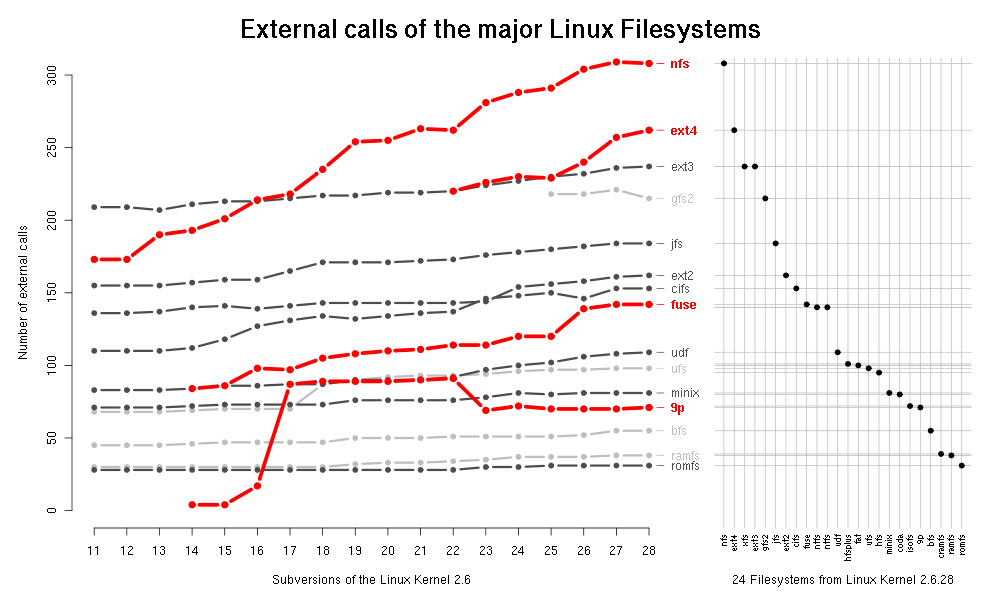
RazvanM writes "Do the OSes really shrink? Perhaps the user space (MySQL, CUPS) is getting slimmer, but how about the internals? Using as a metric the number of external calls between the filesystem modules and the rest of the Linux kernel I argue that this is not the case. The evidence is a graph that shows the evolution of 15 filesystems from 2.6.11 to 2.6.28 along with the current state (2.6.28) for 24 filesystems. Some filesystems that stand out are: nfs for leading in both number of calls and speed of growth; ext4 and fuse for their above-average speed of growth and 9p for its roller coaster path." -
BPI Defends Anti-File-Sharing Partnership With Virgin Media
MrSteveSD writes "The British Phonographic Industry (BPI) has responded to criticism by Bill Thomson over its collusion with Virgin Media in targeting UK file sharers. BPI chief executive Geoff Taylor personally wrote to the BBC to set things straight, and he asserts that 'it's Mr Thompson, rather than music companies, who is stuck in the past.' Of course, Virgin Media customers who download music and TV legally often find their connections being turned down to unusable speeds due to Virgin's aggressive throttling policy." Mike also points out a blog entry that describes one of the letters received by a Virgin Media customer. In the letter were suggestions regarding the customer's router settings and anti-virus software.