Slashdot Mirror
Domain: ucla.edu
Stories and comments across the archive that link to ucla.edu.
Comments · 1,051
-
Accordign to Google.....
They haven't blocked it:
http://www.asiamedia.ucla.edu/article.asp?parentid =57869 (posted at 2:18 PM EST)
http://www.toptechnews.com/news/China-Abandons-Wik ipedia-Censorship/story.xhtml?story_id=101009A5G2I Q (posted at 12:19 PM EST)
I don't know if I entirely believe it, but that's another story.... -
Re:Well That was IgnorantThen I guess you didn't make it to chapter two of my suggested readings:
People find it hard to wrap their head around the concept that ideas can be rewarded without a copyright or patent. Without a copyright, how will the author of a novel get paid? Consider the facts. Start with English authors selling books in the United States in the nineteenth century. "During the nineteenth century anyone was free in the United States to reprint a foreign publication" without making any payment to the author, besides purchasing a legally sold copy of the book. This was a fact that greatly upset Charles Dickens whose works, along with those of many other English authors, were widely distributed in the U.S., and yet American publishers found it profitable to make arrangements with English authors. Evidence before the 1876-8 Commission shows that English authors sometimes received more from the sale of their books by American publishers, where they had no copyright, than from their royalties in [England] where they did have copyright. In short without copyright, authors still get paid, sometime more than with it.
Please
-
Wasn't it known already that they interbred?
There was a Times article awhile back that involved the mating habits of Neanderthals and humans. It made that assumption from the analysis of the skeleton of a boy found in Portugal that had hybrid characteristics of the two groups.
From the article:"This skeleton demonstrates that early modern humans and Neanderthals are not all that different," said Dr. Erik Trinkaus, a paleoanthropologist at Washington University in St. Louis. "They intermixed, interbred and produced offspring."
-
Re:minor-attracted adult?How do you know they're 18 exactly? Because the artist puts makeup on them? I know for a fact one of the largest modeling agencies in Ottawa specializes in the 14-16 age group because they have the figure that middle-aged women covet.
Just because you believe those girls to be legal doesn't mean they are, and that's exactly my point. When's the last time you saw an age printed in the corner of the photo (except in a porno)?
"Kay, modeling our new line of masquera turned 15 this may and hopes to be a nurse some day"
A quick google brought me this site:Kimora Lee, better known as the wife of music mogul Russell Simmons and the designer of Baby Phat, started her career as a model at the age of 13. Kimora, who is half Korean and half black, was chosen by Karl Lagerfeld himself to grace the Chanel haute couture runway
-
Re:Bookie
Spelled "pact" wrong above.
Here's data backing up my claims in case you try and make another trolling, uninformed, jackassed comment.
http://taiwansecurity.org/News/IHT-The-Balance-of- Power-Remains-in-Taiwan's-Favor.htm
"On July 19, the Pentagon released its annual report to the U.S. Congress on "The Military Power of the People's Republic of China," which it was required to do according to the provisions of the National Defense Authorization Act of 2000...The report is clear that, until the end of the present decade, Beijing will not be able to defeat militarily even "a moderate-size adversary" and will not be able to project its sea power beyond coastal defense."
http://en.wikipedia.org/wiki/Political_status_of_T aiwan#Balance_of_power
"President Clinton, sent two aircraft carrier battle groups to the region, sailing them into the Taiwan Strait. The PRC, unable to track the ships' movements, and probably unwilling to escalate the conflict, quickly backed down..."
http://web.mit.edu/ssp/seminars/wed_archives_04spr ing/ross.htm
"...China today relies on missiles and fighter aircraft to threaten Taiwan. These weapons don't provide China a capability to bring Taiwan to its knees..."
http://www.international.ucla.edu/article.asp?pare ntid=6671
http://www.pinr.com/report.php?ac=view_report&repo rt_id=333&language_id=1 -
Re:Excellent!
-
Sheet Music Consortium
You might check out the Sheet Music Consortium. This is an effort by music libraries at UC Los Angeles, Indiana University, Johns Hopkins University, and Duke University to digitize much of their public domain sheet music. Also includes links to other on-line sheet music.
-
Re:YouTube Is Not Censoring Dumb @ss!
That's not what UCLA Political Scientists find.
Media Bias is Real -
Re:That does it
After about 2.5 months of use, I love my MacBook. It not only does everything that I want, but it does it in the way that I want it to work. I now can't live without Expose and Spotlight; going to a Windows box is now painful. Having access to the command line from a terminal icon on the Dock is very important to me, since I am a CS major and Unix user. I've had no problems finding compatible hardware nor installing hardware, and installing software is easy.
My only complaint about switching to OS X is the fact that finding very good, OS X native free software is difficult. NeoOffice is too slow for me and still not very Mac like (I guess I'm already getting that attitude), so I ended up shelling out $49 (I'm a student) for iWork, which has an excellent presentations program and a nice word processor (I pray that iWork 2007 comes with a spreadsheet; there are no free spreadsheets for OS X other than NeoOffice Calc. But I can put up with that, since I don't use spreadsheets for everything). I would have bought MS Office 2004 if it were a Universal Binary. However, all of the software that I've paid for (or plan on paying for; I'm thrilled with the OmniGraffle trial) is of very excellent quality. Going from free software (or an arsenal of old already paid for software; I've used Office 2000 on Windows for many years until I left Windows. I was also a FreeBSD user) to shelling out $$$ is a big change, but you get what you pay for. I think I'm getting used to the idea of paying for quality software.
I think I'm getting a bit more anti-Windows each day. Just bundle a spreadsheet in iWork, give me a free Mac version of Paint, and give me a Japanese word processor and dictionary of the quality of JWPce (I've been learning Japanese for nearly 7 years), and my dream of a perfect environment to work in is now complete.
-
Re:I don't get it
Thanks - but after reading your explanation I am even more confused, and feeling a little..away from home. What the hell does a $100 laptop have to do with single girls or women's career advancement activism, and what is this cryptic link between "security" and "sex"?
Does timothy sell condoms? I don't know.. I'm just terribly confused now. I haven't been so clueless in years. Timothy has like, totally ruined my day
PS: Restriction of sex to marriage is a goody thing, inherent in many cultures. Check this out. -
Re:Gosh...
maybe before you put in the few bucks in this Sudan thingy, you should know that this Sudan thingy did not show on the political map until Chevron got the boot out of many oil contracts with Sudan. Guess who won the contracts; You guessed it right; the enemies of the current Bush administration, that is Turkey, Iran, India, and China. The report of the human rights groups regarding the "Genocide in Darfur" is very wierd (p.s.Darfur means home of the Fur.). For the first time in the history of human rights groups, they point at the villages that need the intervention of the UN troops, (Led by the US forces of course) that the emptied villages matches the map of oil concessions in south Darfur.
Call me Paranoid,but I think there is a little more to it then just stopping a human rights abuse.
BTW, how come we did not see any dead bodies from this "genocide"? We are seeing all kinds of gore from Iraq on daily basis.
Darfur remained relatively quiet during the dreadful war (two million dead in the past 20 years) between the African ethnic groups of Southern Sudan, where most people are Christians or animists, and the Arabs of the North who dominated Sudans government, army and economy. It was the peace settlement between North and South in 2003 that triggered the revolt in Darfur. That peace deal gave the southern rebels a share in the central government, a half-share of the oil revenues now pouring in from wells that are mostly located in southern territory, and the right to a referendum on independence from Sudan in six years time. So some leaders of the Zaghawa and the Fur decided to emulate the southerners: launch a revolt in Darfur, and try to cut a similar deal with Khartoum in return for ending it.
Question to George Chultz of the 1st Bush Administration, who is behind most of this propaganda: Is this another "Slam dunk"????? -
Re:...but 78 billion light years is TOO far
The narrator on the video keeps going on about look 78 billion light years into the universe but that is wrong. The universe only formed 13.7 billion years ago so the furthest we can see is 13.7 billion light years due to relativity.
No, you're wrong. That ignores the nonlinear expansion of the universe. Actually, the observable universe can be any size, depending on how the universe expands; it can be far larger then 13.7 billion years. See this FAQ. -
Obligatory Wierd Al Reference
He's so White & Nerdy.
(Asians are White) -
FYI
A few years back there was a study on cavities and reading level. Huge headlines! Kids with higher reading levels have more cavities!
There was never any such real study. It's a hypothetical example used in statistics courses to illustrate a point.
Incidentally, for arguments concerning when one can infer causation from correlation, see Judea Pearl's work. -
Nature vs. Nurture
Before this turns into a large nature vs. nurture argument, I thought I'd pipe in here with a really great paper that really throws a wrench into the argument.
In one of the largest Nature vs. Nurture shakeups, it was shown that the maternal behavior of the mother can cause epigenetic variations in the child that ultimately cause the child to grow up to become a nurturing mother or a non-nurturing mother (http://www.neurobio.ucla.edu/~lmp/Meaney.pdf ). This is one of the biggest breakthroughs in Neurobiology connecting specific epigenetic alterations to behavioral response (yes, there were controls, switching mothers/children, read the paper for the full details).
However, the genetic alterations here are not on the sequence level, but rather on the Epigenetic level (the state of the DNA). Therefore sequencing the genome of two identical twins who had different mothers (one nurturing, one non-nurturing), can lead to entirely different epigenetic levels, yet the sequences would be identical. The take home message here is that while the underlying sequence is important and full sequences will certainly help in the understanding of biology, the underlying state is just as important. This epigenetic variation is also one of the causes of cellular differentiation (stem cells, etc.), and also certain cancer types. In an effort to make my post slightly controversial, I'd go as far to say that a high throughput epigenetic snapshot is probably more important for understanding success in individuals than the underlying DNA sequence (however, it is my hope that a high-throughput sequencing approach would be a first step towards a high-throughput epigenetic approach, as they are tightly coupled in a sense)-- as well as providing great breakthroughs in other areas of biology (tissue regeneration, cancer treatement, etc.). -
Re:a better operating system ..
According to this it relies on special processes to isolate user data. Something I would have thought was de rigur for any moderm Operating System. In the context of the quote I don't see why you need alternative OS. Couldn't something similar be added to the current OSs. Better than that is to embed such functionality directly into the hardware. It's a good idea but hardly a paradigm shift in OS design. Yet another abuse of the I word.
" Asbestos
In additional you could innoculate the system against exploits by uniquely scrambling the microcode table and randomly loading data into memory. -
On Being the Right SizeThis classic paper, On Being the Right Size written by JBS Haldane in 1928 covers the same ground in a very readable style.
Rich.
-
Re:Money!
Yes, that's true - ideas are nonrival goods. But they are not free goods, and they do roughly obey the law of supply and demand.
I'm not sure what you mean by this: ideas aren't goods, but they are 'free' as in anyone can trade time and neuron-cycles for one. The notion that intellectual monopoly should be called intellectual property is marketing speak by those that want to extort rents... ideas aren't 'goods' or 'property' as they can't be 'owned' in the physical property sense.The question becomes how to create incentives for the production of ideas, if the ideas cannot be valuable to the idea-generator.
Well, the real question is why everyone thinks that humans need incentive to create or be creative.
Humans create.
Our creativity is one of the main reasons we are the dominant species on this planet. That creativity bubbles within us (more in some than others to be sure!) and wants to get out.Creativity need no more a law to incent it than gravity does to attract bodies...
If you're really interested, read this. It's kinda long, it's PDF, but it's probably the best stuff I've ever read on the subject.
-
Re:Software piracy really is all that bad
Read this.
by Michele Boldrin and David K. Levine -
Re:All simplistic theories aside....This terrorism is EXACTLY a byproduct of the Islamic faith, entirely justified by the faith (whether or not some, or even most Muslims disagree with their religious interepretation). These hardliners do in fact profess a goal of bringing the entire world under "shariah" (Muslim rule).
Speak to any hardline Christian and they'll tell you that the world should worship the one God. Thats nothing unique to Islam. By your own admission it is only a minute proportion of the muslim population that engage in terrorism perhaps thousands from a population of over a billion. How do these tiny organisations achieve widespread popular suppport? What dissolusions the populace enough to side with organisations murdering innocent people? The fact that they have witnessed the same happen to friends and family members or been displaced in the hundreds of thousands or been subjected to economic sanctions by the west and live in utter poverty.
Not because the Quaran says so, incidently my understanding is that Islamic literature is very strongly worded to oppose attacking innocent civilians.
You might want to do more research on the origins and history of terrorism, my 'simplistic theory' is shared by many specialists in the field. Terrorism has been around for a long time and usually the aim is to inspire a revolution so that the people might govern themselves. Terroristic ideals change in generational waves. Currently Islam has been hiijacked, for want of a better term, to unite the masses. It is not the primer.
-
Re:malware
So, does this mean that the creators of malware/viruses/spyware are going to be classified as terrorists?
Why, yes! http://www.asiamedia.ucla.edu/article.asp?parentid =39237 -
Correct History by Daniel Barbalace
> However, 6 August 1991 is not the only date claimed as the 'birthday of the internet'.
This claim is very wrong. The Internet (notice the capitalization) was born on October 29, 1969 at 10:30 p.m. See http://www.lk.cs.ucla.edu/LK/Inet/1stmesg.html
As for the World Wide Web, here's a brief timeline.
1989 March
"Information Management: A Proposal" written by the great Tim Berners-Lee and circulated for comments at CERN.
http://www.w3.org/History/1989/proposal.html
1990 September
Tim Berners-Lee begins work on a global hypertext system.
1990 October
Tim Berners-Lee starts writing a hypertext browser/editor for the NeXTStep operating system. He calls it "WorldWideWeb".
http://www.w3.org/People/Berners-Lee/WorldWideWeb. html
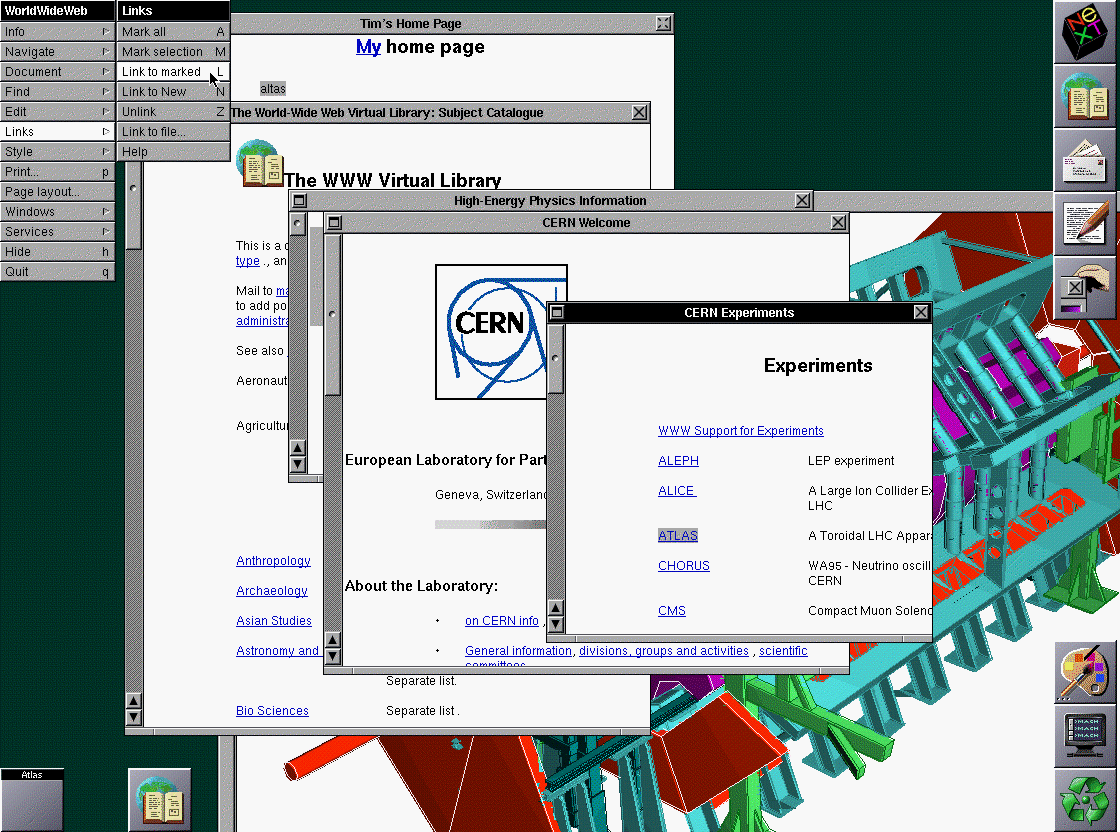
Here are some screenshots of his browser. Although simple by today's standards, the browser is rendering what clearly would be recognized as a web page today.
http://www.w3.org/History/1994/WWW/Journals/CACM/s creensnap2_24c.gif
http://www.w3.org/MarkUp/tims_editor
1991 March
Line mode browser (www) released to limited audience on "priam" vax, rs6000, sun4. This browser was a text-based browser, a major step backwards from "WorldWideWeb" that was meant to be so simple that any computer or terminal could run it.
1992 April-May
Other GUI web browsers are released for X-Windows.
1993 February
NCSA release first alpha version of Marc Andreessen's "Mosaic for X". Computing seminar at CERN. The University of Minnesota announced that they would begin to charge licensing fees for Gopher's use, which caused many volunteers and employees to stop using it and switch to WWW.
Well, there is no clear birthday for the WWW like there is for the Internet. However, the Web as we know it today would have been recognizable in April 1992. At that time there were about two dozen web servers world-wide. -
more detail
There are several posts that mention that the universe can expand faster than light. They are right but let me see if I can expand on it some.
If you have taken a fair bit of math skip this and and go here http://pancake.uchicago.edu/~carroll/notes/ to Chapter 8 in particular.
We want the universe on the largest of scales to look isotropic and be homogeneous spatially. The first means it looks the same in all directions about some point, and the second meaning that its physical properties are the same everywhere. If the universe is isotropic about one point and it is homogeous it follows that it is isotropic about every point. Straight away there is no priveleged center and it is meaningless to talk about the center of the Big Bang or some such. Insert standard dots on a balloon or raisn bread rising explanation here but neither is perfect.
We can look at galaxies and can see spectral lines and can measure their shifts and recognize that they must be moving with respect to us, and are typically moving away from us so the univsere is expanding. So the universe must look the same from every point in space but it is not static and can look different at different times. Because we want to maintain homogeneity and isotropy through time and because we believe there are no privleged directions or points in space we want this expansion to be solely a function of time. This function of time is what is called the scale factor and it is the fundamental quantity that determines what present distances in the universe are and how fast they are changing. There is no speed of light anywhere around the scale factor, and there isn't going to be.
With all this we can write down the model for the universe, and its called the Friedmann-Lemaitre-Robertson-Walker metric after the smart people who came up with it. Thats fancy talk for a single line that tells you how to compute the "distance" between two events each occuring at their own space and time coordinates. Its equation 8.7 in the article. If you believe we live in a flat universe which you should because theres lots of good experimental evidence for it from studying the cosmic microwave background, even that simplifies a fair bit to something that can look like ds^2 = dt^2-a^2(t)(dx^2+dy^2+dz^2).
The second section in brackets to the right of the scale factor is the way you'd compute the distance between two events in 3d space, just the sum of the squares of their differences in position, and the dt^2 is the bit that adds on time. In any local region of the universe a(t) is constant and can be taken to be one and then you have a return to happy special relativity where the speed of light is constant to all inertial observers. Take a(t) to zero and you see the singularity in the equations which we call the Big Bang. This is where the model and the equations break down and thats all we can truly say about it. The universe (hopefully) does not break down, only our model to describe it does.
This metric, which we can write happily as a diagonal matrix even can be plugged into Einsteins equations and give you yet more equations like the Friedmann equation and the acceleration equation (Carroll 8.35 and 8.36), and you can derive Hubbles law and discusses all the interesting forms of matter you can have in it including what happens in Einstein's equation has a cosmological constant term. You'll notice theres still no speed of light. Stuff in the universe cannot move faster than the speed of light according to some local observer. However, the universe is sort of the fabric on which all the stuff is and that fabric can stretch faster than the speed of light. We do see object moving faster than light. See near end for an example, more information and no serious equations http://www.astro.ucla.edu/~wright/doppler.htm
Thats become somewhat important following the studies of distant supernovae from '98 and we now know that the univer -
Re:Speed of Light
There is no center or edge of the universe. See this FAQ.
-
Re:Can it deal with the canonical problem?
Indeed, there is an anthropological school of thought that posits a "language singularity" that gave rise to human consciousness. The development of language was a "speciation event". The study of this imagined event is called Generative Anthropology. It's probably heavy sledding for most slashdotters, who I imagine would find it obtuse and boring, but it's really quite interesting stuff for those that like to really think about AI. If you've got some anthro background, or familiarity with post structuralism and lit crit, it might not be too bad, but this stuff is pretty dense. Those that want to delve beyond the wikipedia article should look here at theUCLA Anthropoetics site.
-
Re:I wish they would instead do something more use
My comment about mitochondrial DNA was refering to the fact that neanderthal mitochondrial DNA has variations that human mitochondrial DNA does not. Your mitochondrial DNA is very similar to your mothers mitochondrial DNA. Based on that, we can make statements about whether or not you are her descendent. Since neanderthal mitochondrial DNA has variations and mutations that are not found in humans, it means that there was very little interbreeding going on (perhaps there was a little bit, but it has been lost in the subseqent millenia). No humans have ever been found that have neanderthal-type mitochondrial DNA.
Comparing mtDNA of these Neanderthals to mtDNA of living people from various continents, researchers have found that the Neanderthals' mtDNA is not more closely related to that of people from any one continent over another. This was an unwelcome finding for anthropologists who believe that there was some interbreeding between Neanderthals and early modern humans living in Europe (which might have helped to explain why modern Europeans possess some Neanderthal-like features); these particular anthropologists instead would have expected the Neanderthals' mtDNA to be more similar to that of modern Europeans than to that of other peoples. Moreover, the researchers determined that the common ancestor to Neanderthals and modern Homo sapiens lived as long as 500,000 years ago, well before the most recent common mtDNA ancestor of modern humans. This suggests (though it does not prove) that Neanderthals went extinct without contributing to the gene pool of any modern humans. http://www.pbs.org/wgbh/nova/neanderthals/mtdna.ht ml
Some anthropologists have argued that people evolved at least partly from the Neanderthals. The opposing theory is that modern humans evolved in Africa, then spread outward, overwhelming earlier hominids including Neanderthals. The short, squat Neanderthals inhabited much of Europe from about 100,000 years ago until dying out about 28,000 years ago. "Neanderthal DNA is distinct from modern humans," Goodwin says, "and there are no examples of humans having Neanderthal-type DNA." http://cogweb.ucla.edu/Abstracts/Goodwin_00.html -
Vacuum energy
As others have noted, the idea of the energy of empty space being nonzero isn't an new idea. The quantum zero-point vacuum energy is nonzero. However, our predictions of its value are ridiculously large, which led some to speculate that either we should redefine the zero point of energy to equal the zero-point energy so that the energy of space exactly equals zero. It's also possible that our ways of doing the accounting are naive (e.g., ignoring quantum gravity), or that some kind of cancellation is going on (e.g. bosons cancelling out fermions in supersymmetry).
This is related to what may be the biggest open question in cosmology, the cosmological constant problem. The energy of space is intimately related to the "cosmological constant". We now know from the accelerating expansion of the universe that there appears to be a nonzero cosmological constant, implying a nonzero vacuum energy. Its experimentally measured value is many orders of magnitude smaller than a naive calculation of zero-point energy based on the Planck scale, however. Another possibility is that the cosmological constant is actually zero, and the accelerating expansion is actually due to the energy/pressure content of some kind of dynamical "dark energy" field (as opposed to the static cosmological-constant form of dark energy).
More on vacuum energy and the cosmological constant, plus a tutorial.
P.S. Contrary to some science fiction applications (cough-StargateAtlantis-cough) and crank physics (cough-Puthoff-cough), you can't extract free energy as work from the zero-point energy. The zero-point energy is by definition the lowest energy state that a system can have; to extract usable energy, you'd have to decrease the energy of the rest of the system below that minimum value, which is by definition impossible. -
Re:Bias? Balance, perhaps.
i'm sorry but this assertion just is not true. The media is generally very right leaning and those with conservative points of view hold a greater power and voice than those with a liberal point of view.. they get more exposure. The truth is that 70% of the US and an even greater percent of the world is "left leaning".. this means that the center is further "left" than you care to admit.
Wow, that's rich. Heh.
First, the editorial stances of almost every major newspaper, of ABC, NBC, CBS, NPR, CNN... all of those could scarecly be defined as conservative by any standard. More conservative, perhaps, than way-way-out crazy left, but being more conservative than, say, George Soros or Barbara Streisand doesn't mean you're some hard-core right winger. But never mind my take on it or yours: just read a little bit of actual academic research.
"larger picture" is a piece of jargon which in lobbyist speak means "my point of view rather than common sense"
Ok, so you think that's how lobbyists use that phrase. So what? That doesn't change the fact that most of the discussions surrounding this issue have tunnel vision that only sees "person trying to say something, evil institution preventing them," when there are actually many more factors in play (thus, a larger picture). -
Browsing C
Browsing and, incidentally, development. Use ctags (or compatible) and in vim press ^] over a symbol and vim will launch to the location that symbol is defined. Pop back by pressing ^T. See C++ development using vim and ctags for more options. Awesome.
-
Computer Game Studies Quiz
For all you gamers out there, I have a survey for you guys. I'm taking a gaming studies class and I need some stats. It's completely anonymous, I promise.
http://spello.sscnet.ucla.edu/phpESP/public/survey .php?name=gaming_survey_copy" target="_blank">
The more I get, the better my stats would be. Pass the survey on if you can. It would really help me out. Thanks! -
Censorship rights
Flamebait me if you want, but companies DO have rights to censorship. Heck, Slashdot censors. Otherwise, every article here might be M$ bashing or Linux raves. Or, endless dupes (oh wait, this happens already). Back to my point, companies can censor if they want. Users just don't have to go there. Why go to Baidupedia when you can go to Wikipedia? Yes, there is a Chinese language section of Wikipedia.
As far as I'm concerned, Chinese companies can censor all they want...so long as the government doesn't force them to use only Baidupedia and block Wikipedia.
By the way, Google owns 2% of Baidu. And as we all know, DO NO EVIL! (yes, full of sarcasm) -
Re:Spoofing has not been a problem for years
disallow non-expected source IP addresses from interfaces in the first place
This is much easier said than done. Cf.:
http://www.lasr.cs.ucla.edu/save/save_to_infocom.p df
http://www.lasr.cs.ucla.edu/classes/239_1.spring03 /papers/park.pdf -
Re:Spoofing has not been a problem for years
disallow non-expected source IP addresses from interfaces in the first place
This is much easier said than done. Cf.:
http://www.lasr.cs.ucla.edu/save/save_to_infocom.p df
http://www.lasr.cs.ucla.edu/classes/239_1.spring03 /papers/park.pdf -
Re:Hubble Ultra Deep Field
You ask a few good questions that merit a longer answer.
First of all, it is important to note that Einstein, in his theory of general relativity, showed that space can be curved. It is only because of this that one can even talk about something like the "diameter" of the universe. In simple GR, and using some fairly broad assumptions about the properties of the universe, there are three principal "shapes" for the universe: the universe can have a "positive curvature" and a finite volume, it can have an infinite volume and be "flat", or it can have a "negative curvature" and an infinite volume.
In three dimensions, these spaces are very difficult to imagine for us humans, but a 2d analogy might make things clearer: The analogy in 2d for a positively curved space is the surface of a sphere, for a flat space it is a plane, and for a negatively curved space a hyperboloid, and the "volume" would be the respective surface area. Note that locally, e.g., for small ants living on a huge sphere (or humans living on the Earth), it is very difficult to distinguish between these three possibilities. For example, it took 1000s of years for humans to realize that the Earth was not a flat disk, just because our Earth is so tremendously big that in our everyday life, its curvature just does not matter to us (unless you are an airline pilot that is...).
In the past 20-30 years, we were able to develop methods that allowed us to infer in what type of universe we live. Essentially, these methods boil down to measuring the amount of gravitating stuff in the universe, which is summarized in a parameter we astronomers call "Omega". If Omega<1, the universe is infinite and open (has an infinite volume), for Omega equals 1 it is flat and open, and for Omega>1 it has a finite volume.
Several measurements, using the Hubble Space Telescope, the Wilkinson Microwave Anisotropy Probe, X-ray data from galaxy clusters measured with ROSAT, XMM-Newton, and Chandra, data taken with balloon experiments etc. have allowed us to build what is called the so-called concordance model of cosmology, i.e. the baseline model that most of the astronomicical community agrees with. This model has an age of around 14 billion years and has Omega=1. This means that in this model the universe is flat and infinite in size. Therefore, giving the "diameter" of the universe for the concordance model, as quoted by the original poster, does not make sense in this model.
Now, astronomers often are sloppy people, and this is especially true for the people who write press releases for NASA, because they have the incredibly difficult job to summarize a piece of very complicated physics in a 1-2 minute sound bite. What is often meant when you read something like "the universe is 100billion light years across" is a statement about that part of the universe that is visible to us. So, consider a photon that was emitted shortly after the big bang. This photon happily moves through space for about 14 billion years, and is eventually detected by us. So, the distance traveled by the photon was 14 billion light years. However, while the photon traveled, the Universe expanded, i.e., it increased in volume. This means that the distance that the source of light has from us now is much larger. It is this distance which is often quoted as the "size of the universe". How far it is depends on the model assumptions one makes, i.e., the expansion history of the universe, but one can get values which are much larger than cT, where c is the speed of light and T the age of the universe.
So much for my very simplified answer of what proves to be far more complicated questions than one might think. I hope it clarified matters a little bit, if you want a little bit more detail, a good WWW page to check out is Ned Wright's cosmology tutorial (http://www.astro.ucla.edu/~wright/cosmo_03.htm).
-
Re:Killing copyrights is in their best interest
You are posting a link to DIGG??????
Why not link directly to the Fucking Article?
You idiot..... O wait a minute, you want to pimp your Digg submision on
You are even worse then I thought
Link -
Audio compression without Fourier transforms
The Swedish mathematician who proved a convergence theorem for Fourier series. without him there would be no IPOD.
Without Fourier transforms, we would have used time-domain methods for processing digital audio. Shorten, FLAC, Apple Lossless, and most other lossless audio codecs make use of an autoregressive analysis of a block of audio, followed by linear prediction with entropy coding of the residuals. The GSM Full Rate codec (implemented in Toast) and the Speex codec operate in much the same way, except they add pitch analysis (to filter out the periodicity of vowels and instrumental chords) and lossy quantization.
-
Re:MoonsWithout the moon, there would be no life on Earth.
When that huge impact happened, what was blown off was most of the lighter, surface material of the early Earth. All of those light silicates eventually clumped up to form the moon, leaving a body with a much thinner crust and a higher overall proportion of heavy metals. This made it much easier for convection currents to run inside the Earth's core, allowing the creation of a magnetic field. This deflected the solar wind, protecting the Earth from most of the hard radiation from the Sun. Venus doesn't have much in the way of protection:Theories of the dynamos operating in the liquid cores of the newly accreted terrestrial planets suggest that there was a magnetic moment of Venus of the same order as Earth's for about the first billion years of Venus' life. During that time, thermal convection from the heat left over from accretion drove the dynamo. However, after that energy source diminished, there was apparently no source to replace it. While solid core formation in Earth's interior maintains its dynamo to this day by virtue of the related 'stirring' of the molten core around it, Venus appears to either lack the necessary internal ingredients (chemical or physical) for solid core formation, or to have ceased such processes at an earlier time if they resulted in complete core solidification or arrested core solidification.
It's the moon pulling on the Earth that keeps this "stirring" going, by tugging on the surface and slowing it at a faster rate than the core.
The relatively thin crust made it much easier for the surface to crack and float around in pieces. If it were really thick, like on Venus, it would be too rigid for easy cracking, bumping, and grinding. Plate tectonics causes a lot of carbon on the surface to be sucked under the surface and recycled.
Tidal forces caused by the moon also pulled on the early Earth atmosphere, causing it to expand upward beyond the protection of the magnetic field. Once up there, the gases were swept away. -
Re: Biggest FallacyIt's tomorrow, and I suspect no one's reading this thread anymore, but I can't help but respond to this last post:
No. Pharmaceuticals are a good example here (although their patent protection has more in common with copyright than with other patents). Pharmaceuticals cost millions to develop. The biggest part of this cost is all the trials to verify safety. If anyone could just copy the drug after the trials, there would be no point. Companies would not bother to get drugs approved.
This is completely untrue. Drug companies exist in every nation, whether or not they have drug patents. Switzerland (IIRC) only had patents added to an otherwise thriving pharmaceutical industry in the 70's. It was then, and continues to be a world leader in pharmaceuticals. Patents changed nothing.
Secondly, trials would need to be repeated for a second company making drugs (how can the FCC be sure that the second-arriver got the same drug?) so these costs and this time spent is not a freebie to the 'leech' company. It's important to note that even breaking down a pill into it's basic elements doesn't tell you the process by which it was made, and therefore doesn't tell you how it was made. Work still needs to be done to re-create it.
Thirdly, while drugs do cost relatively lots to make, so does a factory, so what? It's a sunk cost for the company
Drug companies just make something that the bulk of us don't understand and can't really play with in our basements. It's shrouded in mystery, it looks complicated, and they state that they need high drug prices to cover future innovation.
Bullshit.
They make billions in profit. While I'm not opposed to profit, I am against laws that create artificial profits. If the drug companies didn't make a profit, then I could (perhaps) look at some laws and/or mechanisms like perhaps grants and subsidies (which by the way they get as well to ensure that research happens. So, now we have a situation where the drug companies are pocketing billions (i.e. not plowing that money back into research, but keeping it as profit) and then complaining that they need patent protection to pay for the future drugs...?!?? wtf!?
Read Chapter 8: Does Intellectual Monopoly Increase Innovation? (PDF warning) for more info on drug companies...This is the primary point of patents (and copyrights). They reward the original inventor for taking the effort to come up with the invention in the first place.
You've got it exactly backwards. Read up again. Patents are for advancing and promoting useful arts and sciences. No where does it state that it is for rewarding any individual. The reward is a means or a mechanism to accomplish this end; The promotion of advancement of useful arts and sciences is the end. There is nothing intrinsically 'right' about being given a monopoly over an idea for 20+ yrs...
A secondary effect is that patents require that the inventor expose the inner workings of the invention.
The interesting thing is that you are right on the last point: exposing the 'inner workings' doesn't promote innovation, and that is exactly why patents are unnecessary. Innovation happens without them, but they add considerable cost to consumers by way of monopoly pricing and legal activities (lawsuits) by the patent holder. -
Re:Wow
-
Resources I use
JWPce http://www.physics.ucla.edu/~grosenth/jwpce.html
Kanji Gold http://web.uvic.ca/kanji-gold/
Pera Pera Penguin http://www.yomiuri.co.jp/dy/columns/0002/
Kanji Trainer Penpen http://www.coolest.com/penpen/ -
Re:This is an oligopolywell, if you wanna get real picky (and I see you do) they in fact hold monopolies over specified 'ideas', and are in fact monopolists. Anyone who thinks otherwise hasn't thought it all the way through, and anyone who ignores what I say based on their own misconceptions...well, I can't help stupidity, and I'm not here to change the world.
So here goes anyways
Whereas the Oil Cartel (an admitted/explicit cartel) all sell oil that is indistinguishable one from another, Matisyahu's new studio album Youth is not an alternative to Coldplay's X&Y, and are very distinguishable from one another. Further, while any of the OPEC members can sell oil to any buyer, only EMI can (legitimately) sell you a new copy of X&Y. (meaning Sony can't sell it to you despite the fact that they sell Youth). It's important to note that one piece of creative work is not an alternative to another. They are not in direct competition any more than Braun is with Ford. Coffee makers and cars compete for the same dollar, true, but we don't decide to buy one and therefore not need the other. We may run out of money and only be able to buy one, but we don't buy one to replace the other.- So, in this case, they may be a cartel - this is unproven though under investigation. Stating that they are a cartel might cause people to dismiss your ideas, since this is unproven, regardless of how much you (and many others) believe it to be true.
- They do however form a general music oligopoly by the definition that there are a very limited number of sellers controlling the majority of the (more general) recorded music market.
- Most importantly however they do have individual monopolies on specified works, making them monopolists. They are in fact the only true kind of monopoly: one that is state-guaranteed (by law). Any monopoly that is not enshrined in law eventually finds itself in competition. Thanks to copyright, they have no legal competitors for their unique works.
Read this if you're still interested. (multiple PDF warning)
-
Re:Abolishing patents
Here's the citation, if you're so interested.
http://levine.sscnet.ucla.edu/papers/ip.ch.9.m1004 .pdf -
Re:A contrarian view, but probably right!
You say: " patents DO play an extremely important role in creating the incentives"
The fact is there is no real scientific evidence to this matter. A Patent is a granted monpoly. It is interesting that irrespective, a good idea will be built and sold. Companies do not stop competing once the patent expires. It seems to me that the patent does not function to ensure the production of beneficial ideas, it exists and is used to exploit the excessive profit potenital of a monpoly.
Most ideas, where good and viable, will be funded and built. To say otherwise is just a guess....or an idea. There is no offered proof to your assertion.
Read this:
http://levine.sscnet.ucla.edu/general/intellectual /against.htm -
Personetics
From Stanislaw Lem's "Non-Serviam" (1971):
(Personetics): A "world" for personoid "inhabitants" can be prepared in a couple of hours... A specific personoid activity serves as a triggering mechanism, setting in motion a production process that will gradually augment and define itself; in other words, the world surrounding these beings takes on an unequivocalness only in accordance with their own behavior... From four to seven personoids are optimal, at least for the development of speech and typical exploratory activity, and also for 'culturization'... It is possible to 'accommodate' up to one thousand personoids... Many different philosophies (ontologies and epistemologies) have arisen among them... I can enlarge their world or reduce it, speed up its time or slow it down, alter the mode and means of their perception; I can liquidate them, divide them, multiply them, transform the very ontological foundation of their existence...
On the lighter side of personetics... I'm developing an open source "Personetics" system called "SimFaux", which I've applied to parody Fox News, so it currently includes simulations of George W Bush, Dick Cheney, Bill O'Reilly, Ann Coulter, Frank Zappa, Arianna Huffington, Al Franken and Triumph the Insult Comic Dog.
I've published the SimFaux source code and content as Free Open Source, so you can make your own characters, experiment with the existing ones, transform the very ontological foundation of their existence, see how the keyword based simulation works, extend it with your own rules and content, learn how to build interactive interfaces and simulations with streaming video in OpenLaszlo, etc.
-Don
-
Re:Incredible!
In the romanization of Hindi and other languages of India, bh, dh, and gh are used for so-called "voiced aspirates". The difference between these and their unaspirated counterparts b, d, and g has nothing to do with tongue position. Rather, it is a matter of what phoneticians call phonation type. The ordinary b, d and g have modal voicing, in which the vocal folds vibrate in the usual way. The "voiced aspirates" have what is called breathy or murmured voicing, which results from the vocal folds being held together rather loosely. The glottal source spectrum of murmured sounds is much noisier than that of sounds with modal voicing. You can listen to a contrasting set of examples here.
-
Re:pre-9/11
Phil Agre's article entitled "How to Help Someone Use a Computer" http://polaris.gseis.ucla.edu/pagre/how-to-help.h
t ml explains very clearly why such 'dumb' users may make the mistakes that they do. I was fortunate enough to come across this before my job at the Helpdesk and it has helped me realize how many problems are the user and how many are the system they find themselves entangled in. -
Re:You heard it here first...
Well, there's Obler's Paradox for one.
Olber's Paradox is actually easily solved using just dust extinction. Curiously, the Wikipedia article doesn't allow for this as a solution, as they say "well, that'd produce uniform radiation in another band, and we don't see that" even though we do: the cosmic infrared background radiation.
You also could have an inflationary period (where space expands faster than the speed of light) which shoves all of the Universe outside of your cosmic horizon. That'd work, too.
The better answer for "why don't we believe the Universe is eternal?" is the CMB. It's really hard to imagine the CMB being formed by anything other than the Universe in a compact, highly dense form. -
Re:(Don't) Call Your Congressman!
Have a close read of these documents : http://levine.sscnet.ucla.edu/general/intellectua
l /against.htm
What we all fail to consider is that copyright allows intellectual monopolies. Are any monopolies anomolous in a free market world?
The reality is that people talk about theft
We all seem to just reflexively accept that copying is theft without really considering it very carefully.
We seem to ignore that most of the excellent manifestations of art existing today were done without copyright.
This is slashdot......where monopolies are bad?
The other reality is that copyright in effect does nothing to enrich an artist. See: http://www.salon.com/tech/feature/2000/06/14/love/
With the cost of disseminating music and books moving to zero, careful thought needs to be given by artists. Sadly they buy into the system because they hope they will be the next U2 and they see copyright as an essential tool to ensure that they become wealthy if they are popular. However the number of U2s is defined and limited by the record companies, not by the public or the talent of the band. The public has been trained to be told what they like.
As we have been trained to believe that some monopolies are good. Classic bait and switch - see the starving artist - send your cash to help him - zing cash goes to record company - artist is still starving. Public feels better cause they paid for music. Music business has you where it wants you. -
Re:Patents are violent
Pharmaceutical research would pretty much grind to a halt without IP laws. It can take up to a billion dollars to push a single drug from discovery, to lab testing, past regulation, and into production. No one is going to drop a billion dollars just to have their closest competitor copy what they just achieved at not cost to themselves. It simply would not happen.
Actually the facts show that just the opposite happens. http://levine.sscnet.ucla.edu/papers/ip.ch.9.m100
4 .pdf Both Germany and then later Italy, and now India have/had thriving pharmacutcial R&D industries right up till patent systems got put in place. What you say sounds nice in theory, but in practice it punishes people who collaberate on R&D between companies and researchers, but on the bright side it does benefit lawyers and marketing departments.This is the case in a lot of leading edge fields. In a lot of fields you need to create something that is amazing complex and capital intensive. You need to drop millions or billions of dollars on developing a product before it becomes viable. IP protection is the only thing that gives you any sort of assurance that if you find something, someone just can't steal it.
Once again, you don't know what you're talking about. There is a reason why the non proprietary x86 architecture took over the market place, and the better designed motorolla one didn't. There is a reason why we use ethernet networks today, and not token-ring, there is a reason why the IP protocool took off and the novell networks protocool didn't, there is a reason why the Mac's didn't seize the market place even though it was a better GUI and came before Microsoft. And today there is a reason why Microsoft is getting their butt kicked in the server space today by Linux. There is a reason why biotech stagnated for 10 years till they started to apply open-source ideas to DNA. How come the innovation in boitech has increased in the last 3 years while the number of patent submissions has gone down? It just amazes me the people who wouldn't recognize a free market - even when it rpis them a new one.
If you follow the money, and you follow the industry: It says the message loud and clear that patents and copyrights are shit, and it greatly rewards any industry and company that figures out new ways to bypass the proprietary crap of someone else.
It remids me of the people who said "well Marxisim is good, it was just implemented bad" - while blowing off the 100 million people who were murdered because of it over the last 50 years. Bullshit. Facts mean something, and when they don't back up theories than it is the theories are shit not the facts.
The fact here is that patents are violent, patents are evil, and there are millions of dead people in Africa to prove it, and hundreds and thousands of dead companies that "had" good implementations to prove it here.
-
more fuelpdf warning
In the next 30 years steam engines were modified and improved, and such crucial innovations as the steam train, the steamboat and the steam jenny all came into wide usage. The key innovation was the high-pressure steam engine -development of which had been blocked by Watt by strategically using his 1775 patent. Many new improvements to the steam engine, such as those of William Bull, Richard Trevithick, and Arthur Woolf, became available by 1804: although developed earlier these innovations were kept idle until the Boulton and Watt patent expired. None of these innovators wished to incur the same fate as Jonathan Hornblower.
Basically, the industrial-revolution hero Watt, patent holder for an improved steam engine spent the duration of his patent in court, fighting to keep improvements on 'his' invention from being produced.So there are a couple of interesting bits to this:
(1) Watt produced few steam engines while he held the patent. He spent his time in court, not in a factory/on-site making steam-engines. Nor did he improve upon it. Others did.
(2) Innovation happened despite his patent, but were simply held back until the patent expired. So, it can easily be argued that patents held back the industrial revolution by (roughly) the duration of the patent.
(3) After the patent expired, and despite newcomers to the field, and despite everyone having twenty years to prepare for this eventuality, Watt was able to make a living selling, installing and servicing steam engines. Despite other advances, and despite competitors also making steam engines, his expertise and his steam engines were still saleable commodities.From all this it can easily be argued that without patents we would be further (technologically) along than we are today. It can be further argued that patents were unnecessary for Watt to earn an income/return on his investment. Since these are the two basic arguments for patent protection it's easy to see that patent was in fact a negative effect on one of the most important events in the last few hundred years.