Slashdot Mirror
Domain: ucsc.edu
Stories and comments across the archive that link to ucsc.edu.
Comments · 594
-
Re:And, by the way...
"Why exactly do the NSA, FBI, CIA, MI6, GCHQ, DGSE, FSB, BND, etc... etc... have to trace everything we do or say online?"
This (mass surveillance) is just more part and parcel of state suppression of dissent against corporate interests. They're worried that the more people are going to wake up and corporate centers like the US and canada may be among those who also awaken. See this vid with Zbigniew Brzezinski, former United States National Security Advisor.
https://www.youtube.com/watch?...
Look at the following graphs:
http://www2.ucsc.edu/whorulesa...
http://www2.ucsc.edu/whorulesa...
http://www2.ucsc.edu/whorulesa...And then...
WIKILEAKS: U.S. Fought To Lower Minimum Wage In Haiti So Hanes And Levis Would Stay Cheap
http://www.businessinsider.com...
https://www.youtube.com/watch?...
Free markets?
https://www.youtube.com/watch?...
http://www.amazon.com/Empire-I...
"We now live in two Americas. One—now the minority—functions in a print-based, literate world that can cope with complexity and can separate illusion from truth. The other—the majority—is retreating from a reality-based world into one of false certainty and magic. To this majority—which crosses social class lines, though the poor are overwhelmingly affected—presidential debate and political rhetoric is pitched at a sixth-grade reading level. In this “other America,” serious film and theater, as well as newspapers and books, are being pushed to the margins of society.
In the tradition of Christopher Lasch’s The Culture of Narcissism and Neil Postman’s Amusing Ourselves to Death, Pulitzer Prize-winner Chris Hedges navigates this culture—attending WWF contests, the Adult Video News Awards in Las Vegas, and Ivy League graduation ceremonies—to expose an age of terrifying decline and heightened self-delusion."
-
Re:One's dreams may be superseded
Well, here, go look it up for yourself, ya lazy git.
https://genome.ucsc.edu/ -
In Praise of Idleness By Bertrand Russell...
... from 1932 echos part of your point: http://harpers.org/archive/193...
"First of all: what is work? Work is of two kinds: first, altering the position of matter at or near the earthâ(TM)s surface relatively to other such matter; second, telling other people to do so. The first kind is unpleasant and ill paid; the second is pleasant and highly paid. The second kind is capable of indefinite extension: there are not only those who give orders but those who give advice as to what orders should be given. Usually two opposite kinds of advice are given simultaneously by two different bodies of men; this is called politics. The skill required for this kind of work is not knowledge of the subjects as to which advice is given, but knowledge of the art of persuasive speaking and writing, i.e. of advertising. Throughout Europe, though not in America, there is a third class of men, more respected than either of the classes of workers. These are men who, through ownership of land, are able to make others pay for the privilege of being allowed to exist and to work. These landowners are idle, and I might, therefore, be expected to praise them. Unfortunately, their idleness is rendered possible only by the industry of others; indeed their desire for comfortable idleness is historically the source of the whole gospel of work. The last thing they have ever wished is that others should follow their example."The key part agreeing with you being: "The second kind is capable of indefinite extension: there are not only those who give orders but those who give advice as to what orders should be given."
You make another interesting point on equal distribution of material wealth in the USA essentially in terms of mass. To support your point, it's true that a lot of "money" controlled by the wealthiest 0.1% is now in the "casino economy" of the stock market and so on (FIRE sector) and so unavailable for use by most people to signal demand for material goods.
Still, I can doubt your point on equal distribution of goods and services is true overall, even if it is no doubt true for, say, beverages. I'd be curious to see more substantiation of that point.
It seems to me in the USA that wealthy people own a lot of land (and control corporations and politics, see: http://www2.ucsc.edu/whorulesa... ), they have in general better quality products and services (including education and food), as families they have more potential free time and self-determination, they have better access to medical care, and they face less financial precarity in their day-to-day lives. In general, they are not forced to take on risks that poorer people are (unsafe cars, unsafe neighborhoods, unsafe food, unsafe jobs, etc.). Those are enormous benefits towards a happier life. Still, as you point out, by strictly material standards, most people in the USA are better off than even the wealthy of 100 years ago. That is an important point. However, there is more to life that material goods. Things like face-to-face community, craftsmanship, general literacy, time spent by mothers with their young children, and time spent in nature and in sunshine seem to have declined per capita in the USA -- as have birth rates. A whole bunch of illnesses, including mental illness, seem to be on the rise.
There is a deeper issue here if we put aside the controversial issue that robots and AIs could do most jobs soon (and in a way, robots etc. just crank up a trend that has been going on for decades) . The fact is, most human labor is already not needed for use to live near to our current standard of living. Bertrand Russel pointed this out in that 1932 essay: "Modern technic has made it possible to diminish enormously the amount of labor necessary to produce the necessaries of life for every one. This was made obvious during the War. At that time all the men in the armed forces, all the men and women engaged in the produc
-
Sonic cannons? What an absurd term!Really, who made that name up? These are airguns that are simply blowing compressed air into the water.
These are the same airguns that have been used for many decades in ocean waters everywhere in the world. I have watched sea lions playing in the towed array of air guns behind a survey ship as they are operating. Sound levels of these guns are comparable to the noise made by a tanker and are actually lower than the low frequency sonar used by Navies all over the world. Whales and other marine mammals are quite capable of avoiding the noise, and normally do just that. The Navies of the world have been making much more noise without any environmental hysteria for decades.
-
Re:Crazy
Actually, blacks did not fare well.
A couple quotes:
THE GREAT Depression of the 1930s was catastrophic for all workers. But as usual, Blacks suffered worse, pushed out of unskilled jobs previously scorned by whites before the depression. Blacks faced unemployment of 50 percent or more, compared with about 30 percent for whites. Black wages were at least 30 percent below those of white workers, who themselves were barely at subsistence level.There was no relief from the liberal Roosevelt administration, whose National Recovery Act (NRA) of 1933 was soon referred to by Blacks as the Negro Removal Act. Although its stated goal was nondiscriminatory hiring and an equal minimum wage for whites and Blacks, NRA public works projects rarely employed Blacks and maintained racist wage differentials when they did.
---
In 1950 a black person's income was around $3,828 but a white
person's income was $7,057. By 1956 a black person's income was around
$4,768 and a white's income was $9,060. As you can see from these
figures, because of segregation and the various laws around black and
white people, white people led a much higher standard of living
compared to black people.
---Blacks have also consistently run about double the unemployment of whites as long as we've had data.
http://people.ucsc.edu/~rfairl...
And this was also true for the 1960's and 1970s. Double unemployment and much lower income.
Regarding 1930...
During most of the 1930's Blacks faced unemployment of 50 percent or more, compared with about 30 percent for whites. Black wages were at least 30 percent below those of white workers, who themselves were barely at subsistence level.
However, if you look at 1880 and 1910, during a period of general 3% unemployment- blacks had slightly lower unemployment.
----
I guess what I'm reacting to in your original post is the assumption that a lower or no minimum wage will automatically result in higher employment and that blacks benefited from lower minimum wages in the past. The data shows that from 1920 onwards, they had lower employment despite lower wages.
I don't want to bust your chops too much- I think the trend in robotics is going to replace humans generally with machines which can do the job 3 shifts a day for 1/6th the cost of a human per shift- never take vacations- never get sick (with a proper SLA). That's a good 15-30 years away before it becomes a dominant factor that can't be ignored tho.
-
Re:Third hand?
Yes you can. Artists ahead of their time, Stelarc's 1980 Third Hand: http://people.ucsc.edu/~joahan...
-
Re:this is a good thing
As a matter of fact it WAS in class at school, maybe your school sucks? Here, this will get you started.
https://www.google.com/webhp?c...
http://en.wikipedia.org/wiki/S...
http://www.fee.org/the_freeman...
-
Jane is Lonny Eachus is a pathological liar
You can argue if you like that a ~ 27.3% increase is large but I disagree, since climate sensitivity to CO2... [Jane Q. Public, 2014-07-07]
Ocean acidification is independent of climate sensitivity, and it's another reason to be concerned about the unprecedented rapidity of our CO2 emissions.
I would also like to point out again that even if acidification is happening, the RESULTS of that acidification are probably less than alarmists have claimed. Example (2010 article): http://www.rationaloptimist.co... [Jane Q. Public, 2014-06-10]
Lonny Eachus also linked to that misinformation from Matt Ridley, a journalist with a long history of distorting climate science.
In contrast, I quoted from Honisch et al. 2012 (PDF), Knoll et al. 2007 (PDF), and Ken Caldeira’s 2012 AGU lecture. That last link was from my videos section which also includes:
- Andrew Dickson gave a technical 2009 presentation called “Acidic Oceans: Why Should We Care?”
- A series of panels at the 2011 AGU discussed declining reef health and tipping points.
I'm not a chemist or a marine biologist/ecologist, so I read peer-reviewed papers and go to conferences like the AGU to watch lectures by scientists who do specialize and publish in those fields. For instance, consider that 2011 AGU panel on declining reef health. Nina Keul observed one species of foramanifera Glas et al. 2012 (PDF) growing faster as carbonate ion concentration decreases (which happens when CO2 increases). She provided context by noting that this is one species from one experiment, noting that this is like looking at one puzzle piece of a big puzzle.
Then Adina Paytan provides further context by noting that most species aren't like this. She shows Fig. 2 from Crook et al. 2012 (PDF) which shows that only ~3 out of 9 species of coral are present in locations with naturally low pH and notes that "Because these three species are rarely major contributors to Caribbean reef framework, these data may indicate that today’s more complex frame-building species may be replaced by smaller, possibly patchy, colonies of only a few species along the Mesoamerican Barrier Reef."
Finally, Robert Ridin
-
Re:Does it matter?
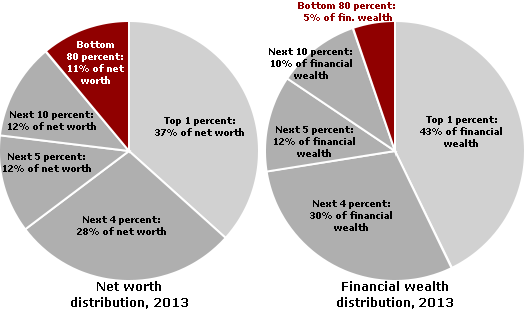
That may be true but over 80% of stocks and mutual funds are owned by only the top 10% of the population and over 35% are owned by the top 1%. Who Rules America?
-
Re:A lot of bits
-
Almost Nobody gets it even Snowden...
... this (mass surveillance) is just more part and parcel of state suppression of dissent against corporate interests. They're worried that the more people are going to wake up and corporate centers like the US and canada may be among those who also awaken. See this vid with Zbigniew Brzezinski, former United States National Security Advisor.
https://www.youtube.com/watch?...
Look at the following graphs:
http://www2.ucsc.edu/whorulesa...
http://www2.ucsc.edu/whorulesa...
http://www2.ucsc.edu/whorulesa...And then...
WIKILEAKS: U.S. Fought To Lower Minimum Wage In Haiti So Hanes And Levis Would Stay Cheap
http://www.businessinsider.com...
https://www.youtube.com/watch?...
Free markets?
https://www.youtube.com/watch?...
http://www.amazon.com/Empire-I...
"We now live in two Americas. One—now the minority—functions in a print-based, literate world that can cope with complexity and can separate illusion from truth. The other—the majority—is retreating from a reality-based world into one of false certainty and magic. To this majority—which crosses social class lines, though the poor are overwhelmingly affected—presidential debate and political rhetoric is pitched at a sixth-grade reading level. In this “other America,” serious film and theater, as well as newspapers and books, are being pushed to the margins of society.
In the tradition of Christopher Lasch’s The Culture of Narcissism and Neil Postman’s Amusing Ourselves to Death, Pulitzer Prize-winner Chris Hedges navigates this culture—attending WWF contests, the Adult Video News Awards in Las Vegas, and Ivy League graduation ceremonies—to expose an age of terrifying decline and heightened self-delusion."
-
Almost Nobody gets it even Snowden...
... this (mass surveillance) is just more part and parcel of state suppression of dissent against corporate interests. They're worried that the more people are going to wake up and corporate centers like the US and canada may be among those who also awaken. See this vid with Zbigniew Brzezinski, former United States National Security Advisor.
https://www.youtube.com/watch?...
Look at the following graphs:
http://www2.ucsc.edu/whorulesa...
http://www2.ucsc.edu/whorulesa...
http://www2.ucsc.edu/whorulesa...And then...
WIKILEAKS: U.S. Fought To Lower Minimum Wage In Haiti So Hanes And Levis Would Stay Cheap
http://www.businessinsider.com...
https://www.youtube.com/watch?...
Free markets?
https://www.youtube.com/watch?...
http://www.amazon.com/Empire-I...
"We now live in two Americas. One—now the minority—functions in a print-based, literate world that can cope with complexity and can separate illusion from truth. The other—the majority—is retreating from a reality-based world into one of false certainty and magic. To this majority—which crosses social class lines, though the poor are overwhelmingly affected—presidential debate and political rhetoric is pitched at a sixth-grade reading level. In this “other America,” serious film and theater, as well as newspapers and books, are being pushed to the margins of society.
In the tradition of Christopher Lasch’s The Culture of Narcissism and Neil Postman’s Amusing Ourselves to Death, Pulitzer Prize-winner Chris Hedges navigates this culture—attending WWF contests, the Adult Video News Awards in Las Vegas, and Ivy League graduation ceremonies—to expose an age of terrifying decline and heightened self-delusion."
-
Almost Nobody gets it even Snowden...
... this (mass surveillance) is just more part and parcel of state suppression of dissent against corporate interests. They're worried that the more people are going to wake up and corporate centers like the US and canada may be among those who also awaken. See this vid with Zbigniew Brzezinski, former United States National Security Advisor.
https://www.youtube.com/watch?...
Look at the following graphs:
http://www2.ucsc.edu/whorulesa...
http://www2.ucsc.edu/whorulesa...
http://www2.ucsc.edu/whorulesa...And then...
WIKILEAKS: U.S. Fought To Lower Minimum Wage In Haiti So Hanes And Levis Would Stay Cheap
http://www.businessinsider.com...
https://www.youtube.com/watch?...
Free markets?
https://www.youtube.com/watch?...
http://www.amazon.com/Empire-I...
"We now live in two Americas. One—now the minority—functions in a print-based, literate world that can cope with complexity and can separate illusion from truth. The other—the majority—is retreating from a reality-based world into one of false certainty and magic. To this majority—which crosses social class lines, though the poor are overwhelmingly affected—presidential debate and political rhetoric is pitched at a sixth-grade reading level. In this “other America,” serious film and theater, as well as newspapers and books, are being pushed to the margins of society.
In the tradition of Christopher Lasch’s The Culture of Narcissism and Neil Postman’s Amusing Ourselves to Death, Pulitzer Prize-winner Chris Hedges navigates this culture—attending WWF contests, the Adult Video News Awards in Las Vegas, and Ivy League graduation ceremonies—to expose an age of terrifying decline and heightened self-delusion."
-
Environment shapes evolution
Looking at cows, dolphins and horses genetic proximity shows unexpected results, as cows and horses are not the closer in the trio, despite their similar features.
That suggests environment drives evolution in a predictable way, while the genetic evolution is not. This is the really amazing point: evolution find similar solutions to similar problems, but it does so through different ways.
-
Re:So ... it covers these things?
We are not that clueless about Dark Matter - it is an invisible (transparent to light, and not generating light on its own) energy that is the source of gravitation. Visible matter moves towards it visibly, and clumps of matter-and-dark-matter result in matter colliding (visibly - it emits radiation and leaves behind scattered visible matter that gravitation points to) but Dark Matter not colliding (visibly) much or at all. We know upper limits on whether it could be various forms of matter from black holes of various sizes to very dim stars to small particles of dust, and the sum of these is at most only a few percent, because anything higher would produce a visible signal. We have a strong upper limit on the amount of it that's in the inner solar system and how dense it could be. All of that is based on observation coupled with experiment. There is enough of it to affect the evolution of galaxies, and consequently infer that it is almost always moving thermally (otherwise it would dramatically affect the shape of galaxies).
Where there are good theoretical ideas about what it could be (heavy neutrinos, various SUSY superpartners), direct experiment here on Earth has imposed limits which has precluded many of the well-motivated guesses that would accord with previous experiments and observations of the sky. Further sky observations have ruled out numerous other ideas that pass "regression testing" when they were proposed but which when the consequences of each such idea were pursued rigorously, conflicts with observation were discovered. So the body of "what Dark Matter is not (or mostly is not)" is growing too, and that provides clues by deduction.
However in a simulation at this scale a full microscopic theory of what Dark Matter is tends to be irrelevant, just like the exact behaviour of less abundant elements is irrelevant in studying the orbits of the objects in the solar system. At sufficient scale in any model, microscopic details are deliberately ignored if the consequences of doing so are negligible, but that negligibility is generally justified internally within the write-ups of the model and/or by reference to work that shows that it is "safe" to consider the consequences negligible. (Such underpinnings are ripe targets for experimenters and theoreticians alike.)
Finally, DM is not to "keep our other equations from breaking"; it is a name for an invisible source of acceleration of visible matter that was unexpected (and vigorously denied (as in "we expect that it's just observational artifacts" by many cosmologists and astronomers for almost fifty years until it became clear both that the accelerations *were* there and that the sources *were not visible*)). Although you could say it your way that these unexpected accelerations broke the equations, it does not follow that DM was just to "keep
http://physics.ucsc.edu/~joel/...
Ignorance is curable, and none of the scientists studying the unexpected accelerations are likely to want to preserve our ignorance about the dark sector. However, knowledge takes time to accumulate; it doesn't usually arrive all at once, but that does not make what we know at any given time fundamentally useless or utterly wrong.
-
Re:To all who say it's not two-dimensional
-
Re:getting real sick of this
Yes, it does. It means specifically that in this context. Please move beyond high school physics, kthxbye.
Let me know when you understand this:
http://physics.ucsc.edu/~peter...then we will talk.
-
Re:getting real sick of this
The headline is not fail, your understand is.
I suggest you read Collective Behavior of Interwell Excitation in Double Quantum Wells by Larionov and Tomofev.Also:
http://physics.ucsc.edu/~peter...YOU should also be aware the electrons are Zero(0) dimension objects.
-
Magic act
Look here, at our "less fishy" interface.
While we ensure you will never go to Bob'sTinyDomain.com ever again.
The 1% -
The reality is...
... one issue based bullshit is not going to stop this. We had SOPA and CISPA and they are preparing CISPA round 3.
The internet is something 'everyone can agree on' but unfortunately most people trying to 'protect the internet' are too historically and politically illiterate to really do so. None of you who are hardcore capitalists are "protectors" of the internet, in fact why SOPA and TPP are trying to lock it down is BECAUSE they fear the masses rising up against corporate (capitalist) powers. That's why we got governments and corporations going gangusters on surveillance worldwide.
If you doubt this check the spyfiles
https://wikileaks.org/the-spyf...
Corporate power is global, and resistance to it cannot be restricted by national boundaries. Corporations have no regard for nation-states. They assert their power to exploit the land and the people everywhere. They play worker off of worker and nation off of nation. They control the political elites in Ottawa as they do in London, Paris and Washington.
Consider the G20 Protests in Toronto
http://www.cbc.ca/news/canada/...
This is just more part and parcel of state suppression of dissent against corporate interests. They're worried that the more people are going to wake up and corporate centers like the US and canada may be among those who also awaken. See this vid with Zbigniew Brzezinski, former United States National Security Advisor.
https://www.youtube.com/watch?...
Look at the following graphs:
http://www2.ucsc.edu/whorulesa...
http://www2.ucsc.edu/whorulesa...
http://www2.ucsc.edu/whorulesa...And then...
WIKILEAKS: U.S. Fought To Lower Minimum Wage In Haiti So Hanes And Levis Would Stay Cheap
http://www.businessinsider.com...https://www.youtube.com/watch?...
Free markets?
https://www.youtube.com/watch?...
http://www.amazon.com/Empire-I...
"We now live in two Americas. One—now the minority—functions in a print-based, literate world that can cope with complexity and can separate illusion from truth. The other—the majority—is retreating from a reality-based world into one of false certainty and magic. To this majority—which crosses social class lines, though the poor are overwhelmingly affected—presidential debate and political rhetoric is pitched at a sixth-grade reading level. In this “other America,” serious film and theater, as well as newspapers and books, are being pushed to the margins of society.
In the tradition of Christopher Lasch’s The Culture of Narcissism and Neil Postman’s Amusing Ourselves to Death, Pulitzer Prize-winner Chris Hedges navigates this culture—attending WWF contests, the Adult Video News Awards in Las Vegas, and Ivy League graduation ceremonies—to expose an age of terrifying decline and heightened self-delusion."
-
The reality is...
... one issue based bullshit is not going to stop this. We had SOPA and CISPA and they are preparing CISPA round 3.
The internet is something 'everyone can agree on' but unfortunately most people trying to 'protect the internet' are too historically and politically illiterate to really do so. None of you who are hardcore capitalists are "protectors" of the internet, in fact why SOPA and TPP are trying to lock it down is BECAUSE they fear the masses rising up against corporate (capitalist) powers. That's why we got governments and corporations going gangusters on surveillance worldwide.
If you doubt this check the spyfiles
https://wikileaks.org/the-spyf...
Corporate power is global, and resistance to it cannot be restricted by national boundaries. Corporations have no regard for nation-states. They assert their power to exploit the land and the people everywhere. They play worker off of worker and nation off of nation. They control the political elites in Ottawa as they do in London, Paris and Washington.
Consider the G20 Protests in Toronto
http://www.cbc.ca/news/canada/...
This is just more part and parcel of state suppression of dissent against corporate interests. They're worried that the more people are going to wake up and corporate centers like the US and canada may be among those who also awaken. See this vid with Zbigniew Brzezinski, former United States National Security Advisor.
https://www.youtube.com/watch?...
Look at the following graphs:
http://www2.ucsc.edu/whorulesa...
http://www2.ucsc.edu/whorulesa...
http://www2.ucsc.edu/whorulesa...And then...
WIKILEAKS: U.S. Fought To Lower Minimum Wage In Haiti So Hanes And Levis Would Stay Cheap
http://www.businessinsider.com...https://www.youtube.com/watch?...
Free markets?
https://www.youtube.com/watch?...
http://www.amazon.com/Empire-I...
"We now live in two Americas. One—now the minority—functions in a print-based, literate world that can cope with complexity and can separate illusion from truth. The other—the majority—is retreating from a reality-based world into one of false certainty and magic. To this majority—which crosses social class lines, though the poor are overwhelmingly affected—presidential debate and political rhetoric is pitched at a sixth-grade reading level. In this “other America,” serious film and theater, as well as newspapers and books, are being pushed to the margins of society.
In the tradition of Christopher Lasch’s The Culture of Narcissism and Neil Postman’s Amusing Ourselves to Death, Pulitzer Prize-winner Chris Hedges navigates this culture—attending WWF contests, the Adult Video News Awards in Las Vegas, and Ivy League graduation ceremonies—to expose an age of terrifying decline and heightened self-delusion."
-
The reality is...
... one issue based bullshit is not going to stop this. We had SOPA and CISPA and they are preparing CISPA round 3.
The internet is something 'everyone can agree on' but unfortunately most people trying to 'protect the internet' are too historically and politically illiterate to really do so. None of you who are hardcore capitalists are "protectors" of the internet, in fact why SOPA and TPP are trying to lock it down is BECAUSE they fear the masses rising up against corporate (capitalist) powers. That's why we got governments and corporations going gangusters on surveillance worldwide.
If you doubt this check the spyfiles
https://wikileaks.org/the-spyf...
Corporate power is global, and resistance to it cannot be restricted by national boundaries. Corporations have no regard for nation-states. They assert their power to exploit the land and the people everywhere. They play worker off of worker and nation off of nation. They control the political elites in Ottawa as they do in London, Paris and Washington.
Consider the G20 Protests in Toronto
http://www.cbc.ca/news/canada/...
This is just more part and parcel of state suppression of dissent against corporate interests. They're worried that the more people are going to wake up and corporate centers like the US and canada may be among those who also awaken. See this vid with Zbigniew Brzezinski, former United States National Security Advisor.
https://www.youtube.com/watch?...
Look at the following graphs:
http://www2.ucsc.edu/whorulesa...
http://www2.ucsc.edu/whorulesa...
http://www2.ucsc.edu/whorulesa...And then...
WIKILEAKS: U.S. Fought To Lower Minimum Wage In Haiti So Hanes And Levis Would Stay Cheap
http://www.businessinsider.com...https://www.youtube.com/watch?...
Free markets?
https://www.youtube.com/watch?...
http://www.amazon.com/Empire-I...
"We now live in two Americas. One—now the minority—functions in a print-based, literate world that can cope with complexity and can separate illusion from truth. The other—the majority—is retreating from a reality-based world into one of false certainty and magic. To this majority—which crosses social class lines, though the poor are overwhelmingly affected—presidential debate and political rhetoric is pitched at a sixth-grade reading level. In this “other America,” serious film and theater, as well as newspapers and books, are being pushed to the margins of society.
In the tradition of Christopher Lasch’s The Culture of Narcissism and Neil Postman’s Amusing Ourselves to Death, Pulitzer Prize-winner Chris Hedges navigates this culture—attending WWF contests, the Adult Video News Awards in Las Vegas, and Ivy League graduation ceremonies—to expose an age of terrifying decline and heightened self-delusion."
-
Re:Thank you Kemeny and Kurtz.
How many kids have the chance to sit down in front of a computer and learn that the reason a ball goes across the screen comes down to something as simple as x=x+1? Schools won't teach them that until the end of primary.
Ugh. Wow. I hope primary schools never teach x=x+1.
In the computer industry, we've probably been set back by years or even decades by BASIC and imperative programming. Imperative programming makes intuitive sense because computers process things step by step, and that's what's exposed in imperative languages, but concurrency will be the downfall of imperative programming.
Personally, I think BASIC helped me in primary school maths, but it drove me away from being a programmer. It's challenging enough to do things in BASIC, but the step-by-step flow is clearly there. Then I looked at C and C++, and the pages of keywords and data types, and the need to buy a compiler to get anything to work, and it was no fun. And then I looked at event-based systems, like the Macintosh, and Where is the first step? How does defining a function just make things happen? Why is this nothing like the C/C++ books? It's so confusing and I quit. I only got back into programming because I took a music class from David Cope, and he taught LISP, and I was like, Woah, there's an entirely different way of programming, and it's more like math.
So, it's thoroughly discouraging to see Codeacademy, and the first thing they're doing is sequential, imperative programming, with output via console.log() and blocking function calls to alert() and prompt(), and I'm internally screaming. This is so wrong. This is not how we're going to train programmers for concurrent systems.
-
Well considering that..
... 80% of you in the US are competing over 5% of the money in the economy, you guys have no idea how unequal your society has become and you keep voting for more of getting screwed.
http://www2.ucsc.edu/whorulesa...
-
Well considering that..
... 80% of you in the US are competing over 5% of the money in the economy, you guys have no idea how unequal your society has become and you keep voting for more of getting screwed.
http://www2.ucsc.edu/whorulesa...
-
Well considering that..
... 80% of you in the US are competing over 5% of the money in the economy, you guys have no idea how unequal your society has become and you keep voting for more of getting screwed.
http://www2.ucsc.edu/whorulesa...
-
Post-Scarcity Princeton: Abundance vs. Elitism
From my essay discussing excellence vs. elitism & privilege: http://www.pdfernhout.net/post...
----
So, the question becomes, how do we go about getting the whole world both accepted into Princeton and also with full tenured Professorships (researchy ones without teaching duties except as desired?
http://www.ias.edu/about/missi...But you might object, who will run the kitchens, repair the roofs, plant Prospect Garden, and so forth? Essentially, who will be the Morlocks to support and maybe eat the Eloi on staff?
http://en.wikipedia.org/wiki/T...Well, that's where this analogy breaks down, although one could perhaps imagine robots as the Morlocks (maybe without the whole eating PU staff for fuel thing).
http://www.wired.com/gadgets/m...
"A prototype robot capable of hunting down over 100 slugs an hour and using their rotting bodies to generate electricity is being developed by engineers at the University of West England's Intelligent Autonomous Systems Laboratory."So, for the rest of this essay, I'll assume the "scarcity" world (at least in the USA) currently works more like, say, G. William Domhoff suggests:
http://sociology.ucsc.edu/whor...
http://sociology.ucsc.edu/whor...
"Q: So, who does rule America?
A: The owners and managers of large income-producing properties; i.e., corporations, banks, and agri-businesses. But they have plenty of help from the managers and experts they hire.
* "The rich" coalesce into a social upper class that has developed institutions by which the children of its members are socialized into an upper-class worldview, and newly wealthy people are assimilated.
* Members of this upper class control corporations, which have been the primary mechanisms for generating and holding wealth in the United States for upwards of 150 years now.
* There exists a network of nonprofit organizations through which members of the upper class and hired corporate leaders not yet in the upper class shape policy debates in the United States.
* Members of the upper class, with the help of their high-level employees in profit and nonprofit institutions, are able to dominate the federal government in Washington.
* The rich, and corporate leaders, nonetheless claim to be relatively powerless.
* Working people have less power than in many other -
Post-Scarcity Princeton: Abundance vs. Elitism
From my essay discussing excellence vs. elitism & privilege: http://www.pdfernhout.net/post...
----
So, the question becomes, how do we go about getting the whole world both accepted into Princeton and also with full tenured Professorships (researchy ones without teaching duties except as desired?
http://www.ias.edu/about/missi...But you might object, who will run the kitchens, repair the roofs, plant Prospect Garden, and so forth? Essentially, who will be the Morlocks to support and maybe eat the Eloi on staff?
http://en.wikipedia.org/wiki/T...Well, that's where this analogy breaks down, although one could perhaps imagine robots as the Morlocks (maybe without the whole eating PU staff for fuel thing).
http://www.wired.com/gadgets/m...
"A prototype robot capable of hunting down over 100 slugs an hour and using their rotting bodies to generate electricity is being developed by engineers at the University of West England's Intelligent Autonomous Systems Laboratory."So, for the rest of this essay, I'll assume the "scarcity" world (at least in the USA) currently works more like, say, G. William Domhoff suggests:
http://sociology.ucsc.edu/whor...
http://sociology.ucsc.edu/whor...
"Q: So, who does rule America?
A: The owners and managers of large income-producing properties; i.e., corporations, banks, and agri-businesses. But they have plenty of help from the managers and experts they hire.
* "The rich" coalesce into a social upper class that has developed institutions by which the children of its members are socialized into an upper-class worldview, and newly wealthy people are assimilated.
* Members of this upper class control corporations, which have been the primary mechanisms for generating and holding wealth in the United States for upwards of 150 years now.
* There exists a network of nonprofit organizations through which members of the upper class and hired corporate leaders not yet in the upper class shape policy debates in the United States.
* Members of the upper class, with the help of their high-level employees in profit and nonprofit institutions, are able to dominate the federal government in Washington.
* The rich, and corporate leaders, nonetheless claim to be relatively powerless.
* Working people have less power than in many other -
Re:Terrible summary of an interesting paper
When I was younger (over 30 years) I had a TA job in political science. If I recall right, even back then it was understood that you get different results depending on what questions you ask and what research tools you use. Most influential (US) books back then were probably:
Dahl, R. A. (1957). The concept of power. Behavioral Science, 2, 202-210. (decision making -> democracy)
Hunter, F. (1953). Community power structure: A study of decision makers. Chapel Hill: University of North Carolina Press. (reputation -> oligarchy)
Mills, C. Wright. The power elite. New York: Oxford University Press. (network/positions -> oligarchy)Maybe good extra reading, didn't really check:
Domhoff, G. William. 2007. "C. Wright Mills, Floyd Hunter, and 50 Years of Power Structure Research." Michigan Sociological Review 21:1-54.
Extended online version: http://www2.ucsc.edu/whorulesa... -
By what definition of "millionaire"?
If we're talking "has a net worth of over US$1M", that's not too crazy, especially given how inflation will affect salaries in the coming years. Heck, even though they called Thurston Howell III a "millionaire", he was probably a multi-millionaire, since $1M in 1964 would be just about $7.5M today*.
But if we're using millionaire figuratively, as in, "will be in the top 1%", well... not likely. You'd have to have a net income of around $1M to make it into the top 1%, and a net worth of about $16M. A net worth of $1M (and a net income of $250K) barely gets you into the top 20% ( http://www2.ucsc.edu/whorulesa... )
* Yes, "Gilligan's Island" is 50 years old come this September. Half a century. I have just made some of you feel incredibly old.
-
Re:Let it die
"such as the outrageously high unemployment rate"
You have no clue what you're talking about. The bottom 80% of Americans are competing over 5% of the money in the economy. Americans are bloody ignorant of just how unequal their society has become. Not only that it's a class project (despite americans distate for the idea of class war). The research bears this out in spades.
http://www2.ucsc.edu/whorulesa...
-
Re:Let it die
"such as the outrageously high unemployment rate"
You have no clue what you're talking about. The bottom 80% of Americans are competing over 5% of the money in the economy. Americans are bloody ignorant of just how unequal their society has become. Not only that it's a class project (despite americans distate for the idea of class war). The research bears this out in spades.
http://www2.ucsc.edu/whorulesa...
-
Re:Let it die
"such as the outrageously high unemployment rate"
You have no clue what you're talking about. The bottom 80% of Americans are competing over 5% of the money in the economy. Americans are bloody ignorant of just how unequal their society has become. Not only that it's a class project (despite americans distate for the idea of class war). The research bears this out in spades.
http://www2.ucsc.edu/whorulesa...
-
Re:Makers and takers
The top 1% of income earners actually pay a smaller percentage of their incomes to taxes than the 9% just below them.
The top 1% of income earners earned 17.2% of the income. Since they paid 37.4% of all federal income tax, that suggests that their tax rate is roughly double that of "the 99%". Your provided statistic would be much less misleading if it was phrased "17.2% of the income yielded 37.4% of all federal tax revenue", but that doesn't have the same outrageous tone to it.
That's just income statistics, though. Let's take a look at how wealth is distributed:
The top 1% of wealth owners actually own between 35.4% and 42.1% of the country's wealth.
The bottom 40% of wealth owners hold 0.3% of the country's wealth. If you take away their government cheese, they will not lay down and quietly die (nor should they).
Citation. -
Re:Laudable but futile...; Moving towards health
"Mass surveillance is inevitable to any industrialized country. Which is why all countries with any technological sophistication have it. To think that one can 'fight' it to any real degree is like thinking one can 'fight' indoor plumbing or mass electrification."
Sad, but true. Still, political plays a role in the outcome of all this in terms of what sort of world we want to build together.
Recent posts by me to slashdot on that referencing other items:
http://slashdot.org/comments.p...
http://slashdot.org/comments.p...
http://slashdot.org/comments.p...
http://slashdot.org/comments.p...
http://slashdot.org/comments.p...The bottom line -- read David Brin's "Transparent Society", read Theodore Sturgeon's 1952 "The Skills of Xanadu" about the meaning of privacy in a mobile networked world, read James P. Hogan's "Voyage from Yesteryear" and think about how we can transcend our society to some new healthier form. There are links to all those in my previous posts. It is so sad that with all this mindbogglingly powerful technology the main use we can think for it at first is to create artificial scarcity and kill each other with it. So sad. That is ultimately a moral issue requiring new ways of thinking, like Albert Einstein suggested after the development of atomic technology:
http://www.anwot.org/We need to accept we have powerful technologies relative to classical human needs and rethink fundamental issues of our society accordingly, such as moving beyond artificial scarcity and moving towards a basic level of abundance for all (which would include more time for voluntary civic participation instead of endless overwork at mostly pointless activities related to preserving a scarcity-based status quo).
http://www.whywork.org/rethink...
http://www.youtube.com/watch?v...
http://marshallbrain.com/manna...Some humor by me on is at the end of this post, a parody of the "bunker scene", where this time Hitler confronts post-scarcity ideas:
http://tech.slashdot.org/comme...Any movement that relies on secrecy to succeed is pretty much a non-starter, even in times of less technology like the 1950s Civil Rights movement. The push for encryption against the government by technologists is similar to the argument that handguns will somehow stop government corruption or fascism. It is not going to work. What will work is broad social change done through democratic processes.
"What Social Science Can Tell Us About Social Change"
http://www2.ucsc.edu/whorulesa...Or as I've said before: "As I see it, there is a race going on. The race is between two trends. On the one hand, the internet can be used to profile and round up dissenters to the scarcity-based economic status quo (thus legitimate worries about privacy and something like TIA). On the other hand, the internet can be used to change the status quo in various ways (better designs, better science, stronger social networks advocating for things like a basic income, all supported by better structured arguments like with the Genoa II approach) to the point where there is abundance for all and rounding up dissenters to mainstream economics is a non-issue because material abundance is everywhere. So, as Bucky Fuller said, whether is will be Utopia or Oblivion will be a touch-and-go r
-
5000 samples
http://artsites.ucsc.edu/faculty/cope/5000.html
There are 5,000 midi files on the above site, all mimicking Bach.
Not all of them are masterpieces, of course, but still, it's a do-able thing.
-
reminds me of a humorist Dave Barry on College:Dave Barry on College - "After you've been in college for a year or so, you're supposed to choose a major, which is the subject you intend to memorize and forget the most things about. Here is a very important piece of advice: be sure to choose a major that does not involve Known Facts and Right Answers. This means you must not major in mathematics, physics, biology, or chemistry, because these subjects involve actual facts.."
"So you should major in subjects like English, philosophy, psychology, and sociology -- subjects in which nobody really understands what anybody else is talking about, and which involve virtually no actual facts. I attended classes in all these subjects, so I'll give you a quick overview of each:"
"PHILOSOPHY: Basically, this involves sitting in a room and deciding there is no such thing as reality and then going to lunch. You should major in philosophy if you plan to take a lot of drugs...."
http://users.soe.ucsc.edu/~martine/light/barrycollege.html
Unfortunately, some aspects of physics are starting to sound like Dave Barry's take on Philosophy..
-
Social equity and automation
Wow, looking that up, on Applebees and Chili's: http://www.outsidethebeltway.com/the-beginning-of-the-end-of-waiters-and-waitresses/
http://www.usatoday.com/story/money/business/2013/12/02/applebees-tablets-table-top-devices-restaurant-technology/3698561/I think people overestimate the "human touch" need in service (like mentioned as a reason everything won't be automated in other posts). While it is true humans need other humans to be human, and physical human touch is important, interactions with "strangers" can be stressful for many, and they also expose people to a risk of disease. And example if banking, where many people now prefer using an ATM machine to talking to a bank teller. Same with many automated phone systems for routine transactions. It may depend in part on a person's personality of course. At some point thought, "more sanitary" and "more personalized and interactive" may become arguments for more automation. For example, who likes to wait around for the wait staff to bring you a bill when you are ready to go at the end of a dinner out?
One can hope though that as we see more abundance from more automation, people may have more time to cook at home and entertain at home. That may be the bigger long term change here. Why go to a restaurant at all, where you have little control over the ingredients, the people around you, and so on? Or, alternatively, when a robot can fetch your meal for you, as in this video of a PR2 robot going to Subway to fetch a sandwich:
http://www.youtube.com/watch?v=RIYRQC2iBpMarshall Brain's "Manna" explores two possible answers to your last question.
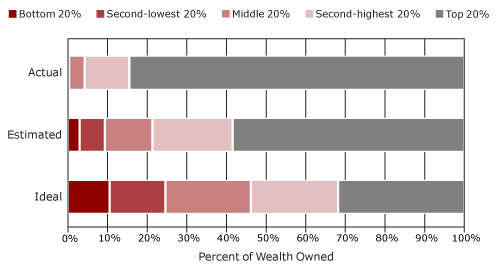
http://marshallbrain.com/manna1.htmRegarding "socialism", here is a great graph on US perceptions, preferences, and reality regarding wealth distribution:http://danariely.com/2010/09/30/wealth-inequality/
"As you can see from the figure, participants rather badly estimated the current state of wealth disparity! Furthermore, they offered an ideal wealth distribution (under a "veil of ignorance") that was even more different (and more equal) relative to the current state of affairs.
What this tells me is that Americans don't understand the extent of disparity in the US, and that they (we) desire a more equitable society. It is also interesting to note that the differences between people who make more money and less money, republicans and democrats, men and women -- were relatively small in magnitude, and that in general people who fall into these different categories seem to agree about the ideal wealth distribution under the veil of ignorance.
Maybe this suggests that when there are no labels, and we think about the core of our morality in abstract terms (and under the veil of ignorance), we are actually very similar?"Graph picture there seems broken; see it here:
http://ecologicalsociology.blogspot.com/2012/06/us-income-inequality-real-perceived.htmlStill, you are right about the "allergy", and that is why planning through the market in the USA along with a basic income may be the easiest way forward:
http://www2.ucsc.edu/whorulesamerica/change/science_market.html
http://www.basicincome.org/bien/
https://petitions.whitehouse.gov/petition/establish-basic-income-guarantee-all-americans-similar-what-being-proposed-switzerland/jF -
Re:Yes.
-
earlier paper links
The paper this press release is about doesn't seem to be online, but two papers from the past few months analyzing this GRAIL data (with some of the same authors) are available:
"Gravity Field of the Moon from the Gravity Recovery and Interior Laboratory (GRAIL) Mission", the initial report of the observations
"The Crust of the Moon as Seen by GRAIL", reconstructing the crust thickness and composition from the observations
-
Re:WATERBOARD HAYDEN
Thanks, Obama! Thanks for the CHANGE!
You're welcome!
Sincerely, your friends at the top -
Re:Fucking idiots
Unbelievable. I really can't understand this reasoning. You ADMIT that the government is incompetent in how they spend the public's money ('while not providing any healthcare") while wanting to take a well working health care system and dismantle it and give it to the government to control! This is just insane thinking.
It's very simple. The "incompetence" is not in the government spending money -- it's the government spending that money in the private sector rather than managing it itself.
The problem is that we don't have a true public healthcare system nor a true private one. We have a hybrid public-private healthcare system, with all the greed of a profit-seeking private insurance and healthcare sector welded to the low competition of a publicly-backed system and captive market, with all the inefficiencies of both multiplied. We have the worst of both worlds.
Going pure private sector won't help, because healthcare simply isn't a competitive free market and cannot be. Even if they had all the data, people simply do not seek care based on lowest cost, and the system cannot optimize itself to that end without that. Worse, the information asymmetry between providers and customers is horrible compared to something like auto dealerships Customers simply aren't qualified to know ahead of time whether they will get the best service for the lowest price.. (Do I really need that expensive CAT scan? How am I supposed to know?) Finally, customers are often not free to act with full rational capacity when the lives of themselves and their family are on the line. Time constraints, stress, etc. all compound the lack of available data with the inability to assess it properly. The end result is pretty much the opposite of what economists expect as the underpinnings of a free market.
Our system has one additional complications from its current worst of both worlds status of having people kept out of the decision-making process of their healthcare combined with the profit motive. Healthcare providers are unable (and unwilling in most cases) to provide a price sheet for their services up front, making competitive shopping impossible. That's for the insurers to handle, not the plebeians. Without customer input and without government regulation, this results in wild swings in costs for similar services as well as perverse incentives to charge the most to people without insurance instead of to the people who can most afford it. Fixing this would require regulation even without public use of funds.
So the only other real alternative is to swing the other way and eliminate the profit-seeking motive as a source of inefficiency. Also, a unified payer system would drastically cut down administrative costs. If the government was paying for all care, then the justification for most damages in malpractice lawsuits would drop sharply, reducing liability costs. Redundant services could be streamlined. Hospital costs could be brought in-line instead of varying wildly from facility to facility.
With public health as a greater priority than profits, programs to focus on wellness instead of recovery could be brought into focus. We would no longer have the terrible costs of people waiting until they end up in the emergency room because they gambled that they'd get better first. We wouldn't have the constant drag on the economy of the working poor working through their illnesses rather than getting treatment when it's cheapest and most effective because they're afraid of the costs.
And if you don't believe this, then just look at the numbers. Other countries spend far less of their GDP (with far less GDP per capita to begin with!) than we do, and they live longer. By having a national healthcare system, they spend sometimes half to a third of what we pay and often live 1-5 years longer. What exactly are we paying for, except a misguided principle that puts a mirage of economic liberty (which simply doesn't exist in healthcare) over human lives?
-
Re:Fucking idiots
The reasoning is
http://ucatlas.ucsc.edu/spend.php
If you look at the chart of spending vs outcome, you see the U.S. sucks and many other countries have better or at least equal outcomes with much lower cost.
It's not unreasonable to think if we toss out the current system of "for profit" medical insurance and care and simply emulated some of the other already successful countries that we could lower costs and improve outcomes.
As it is now, if you have a good job or are wealthy (and don't have a pre-condition), then you get insurance. Otherwise, forget it.
Why are we paying $4500 a year to get worse results than 20-30 other countries including many 1st world countries with otherwise similar costs of living?
The Medicare and Medicaid programs are actually comparable to other countries and younger doctors are accepting medicare and medicaid patients (they are profitable- just not AS profitable so long established doctors prefer to focus on the more profitable patients).
Being aware how extensive the anti-aca propaganda has been, I checked the numbers myself and I'll be saving about $2500 on my insurance costs. And the ACA has freed me to retire and start my own small business (more of a hobby really- healing people with chronic pain, migraines, and various overuse syndromes).
-
The 1% is maybe pretty diverse?
Good points, along the lines of books like "Brave New World" and "Amusing Ourselves to Death". Although it seems lots of systems link together to support power, so there is probably not just one, even if one may be stronger at one time.
The movie "Elysium" features security robots, for example. I envisioned something related here with robots enforcing the "rules":
"The Richest Man in the World: A parable about structural unemployment and a basic income"
http://www.youtube.com/watch?v=p14bAe6AzhAMarshall Brain talks about robots enforcing things in "Manna":
http://www.marshallbrain.com/manna1.htmBut right now, the laws the human police (and legal bureaucracies) enforce are created through political means:
http://www2.ucsc.edu/whorulesamerica
"Q: So, who does rule America?
A: The owners and managers of large income-producing properties; i.e., the owners of corporations, banks, other financial institutions, and agri-businesses. But they have plenty of help from the managers and experts they hire.
Q: Then how do they rule?
A: That's a complicated story, but the short answer is through lobbying, open and direct involvement in general policy planning on the big issues, participation (in large part through campaign donations) in political campaigns and elections, and through appointments to key decision-making positions in government."That said, perhaps the world will always be run by the "1%" who are paying attention in any community? Even those who showed up at "Occupy Wall Street" were, in a sense, part of a "1%"?
OWS's "We are the 99%" was actually a divisive slogan. A focus on increasing egalitarianism might have been better:
http://www.kurtz-fernhout.com/oscomak/Maybe the main issue is whether those who are paying attention have an egalitarian mindset to some degree, at least as far as distributing most of what nature and industry produces? If you look at Western Europe, there is a somewhat different sense of political and moral accountability among leadership. Granted, that is driven by a more active and aware populace building upon ideas from the USA's past:
http://www.salon.com/books/feature/2010/08/25/german_usa_working_life_ext2010
" How did Germany become such a great place to work in the first place?Thus:
"How Germany Builds Twice as Many Cars as the U.S. While Paying Its Workers Twice as Much"
http://www.forbes.com/sites/frederickallen/2011/12/21/germany-builds-twice-as-many-cars-as-the-u-s-while-paying-its-auto-workers-twice-as-much/
"In 2010, Germany produced more than 5.5 million automobiles; the U.S produced 2.7 million. At the same time, the average auto worker in Germany made $67.14 per hour in salary in benefits; the average one in the U.S. made $33.77 per hour. Yet Germanyâ(TM)s big three car companies --- BMW, Daimler (Mercedes-Benz), and Volkswagen -- are very profitable."That comes down somewhat to culture and mythology and the stories we (including the "1%") tell ourselves about who we are and who we want to be (and why).
-
Re: The urban poor subsidized the rich for a while
Also, per the second reference, the top 10% of the US pays more than 60% of the TOTAL tax income.
So? They control 77% of wealth in the US, and it's going up. Source: http://www2.ucsc.edu/whorulesamerica/power/wealth.html
Unless we want wealth (and ultimately, political power) to ultimately concentrate in the top few percent of people, we need to maintain a progressive tax rate to maintain any semblance of democratic society. -
Evolution for competition & cooperation
As much as I might like to disagree broadly with what you have written, I can't, because there is clearly a lot of truth to it from an evolutionary perspective. It's quite true that young people (teens, and twenties, especially, but also later as you point to) do try to show off in various ways to impress the opposite sex as part of human mating rituals. But, let me try to at least surround that truth would some additional options and nuances as a ramble.
First, as an example of a way to deal with this. In James P. Hogan's sci-fi novel "Voyage From Yesteryear" about a post-scarcity society, he addresses this by the notion that people compete to demonstrate excellence in their chosen skills. Showing excellence in helping the community become a form of "Wealth". Material goods are given away freely, including to those who make no contributions to society, in part because, if someone is "poor" (not contributing, so socially disrespected), why heap additional problems on them by not letting them have material goods? So, while you have outlined a truth, how society chooses to deal with that truth, how these urges are directed, is an aspect of culture and circumstance.
From another direction, life on this plane of existence seems to consist of both cooperation and competition, arrayed across a mix of both meshworks and hierarchies. As E. O. Wilson points out, organisms often cooperate within some defined social boundary (like an ant colony) and then compete outside of the boundary (like ant wars). Humans historically have cooperated within tribes, even as they fought other tribes to define essentially property line boundaries between tribes. Many people enjoy team sports where you cooperate in your team but compete against other teams. Even Genghis Khan's command organization must have had some sense of internal cooperation even as it may have attacked other communities. So, the healthy human brain is able to navigate this social landscape (at least withing historic boundaries and the "Dunbar's" number of 100 - 230 tribe members). So, again the issue becomes, how does society direct these impulses within the limits of human potential?
http://en.wikipedia.org/wiki/Dunbar's_numberFreud had some keen insights, but he also overgeneralized and was a bit nutty. (People might say that about me, too?
http://en.wikipedia.org/wiki/Sigmund_Freud
http://www.nytimes.com/books/97/08/10/reviews/970810.10boxert.html
"Freud may have been bad. But can he really have been bad in so many contradictory ways? A sampling of recent books suggests that after a century of Freud flogging, the critics still haven't finished with him."G. William Domhoff goes into detail about differences between the left and right:
http://www2.ucsc.edu/whorulesamerica/change/left_and_right.htmOne aspect not there is perhaps that the left tends to emphasize the cooperative aspect of society -- that we are all in this together, and if we all cooperate, we will all be better off, and that included caring for all children. While it may be rarely stated this extremely, the right tends to emphasize that people should succeed on their own merits, and part of success is being able to afford to raise children -- where if people can't afford children personally, they should not have them, and if they do have children, it is only right if the children suffer and die, because failure should not be propagated in order to maintain the health of the population.
There actually is quite a bit of sense to that sort of "Social Darwinism" from an individualist perspective -- except that it ignores both how much of success is collective, how sexual recombination crosses social rules about inherited wealth, and that the marketplace can be pretty f
-
Re:This is FUD
Woah, woah, what?
Except that my first take on this was what innovations.
Every single drug and test invented in the past twelve years has been absolutely dependent on understanding the sequence of the human genome and how its components play together. 15 new anti-cancer drugs were approved in 2012 alone, the most bountiful year for FDA approvals since 1995.
Yes, a lot of stuff is hyped up, but I've seen precious little utility for genomics in the trenches.
Then you've never heard of this? Or this? How much more trench-y do you need?
I think this study is total BS - especially since the methodology is hidden.
The third page links to the full report, noting that it includes the full methodology behind the study. The word "methodology" is right there in bright blue.
Sequencing the human genome is interesting, but the real key is sequencing other genomes and comparing them. That's happening with abandon now.
As far as human health is concerned, the primary questions are (a) how do we work? (b) how do the things that interact with us work? and (c) how does our environment affect us? While many model organisms provide excellent snapshots of simpler genomes that we can use to unravel complex mechanisms (like cell division in yeast), comparative genomics really only teaches us about evolution. It's not relevant to medicine, outside of predicting the evolution of pathogens. We're not benefiting human medicine by sequencing, say, red pandas or sea turtles, although these things are certainly important for other reasons. There are occasionally exceptional genomes, like the naked mole rat (immune to cancer), but these are rare.
And we're finally getting a handle on what controls the genome and how all the little pieces fit together.
The biggest recent contributor to that has been ENCODE, which, again, was a direct analysis of human data and did not involve any other species.
That should yield some better therapies but aside from a few edge cases in cancer treatment, there isn't much out there. And it's not like these cancer treatments have overwhelmingly improved survival - improvements of 20 - 50% are typical. Nothing to sneeze at, but not the Holy Grail.
We picked all the low-hanging fruit like phenylketonuria as soon as it became technologically feasible. Problems like cancer and severe autism are extremely complex, and the only hope we have to tackle them is through an extremely intimate understandinf of the human genome.
-
Re:Purpose of Math Courses in CS
The [Big Quote]First[Big Quote] Computer Scientist of history (Alan Turing) was mathematician by formation, and the article writed by him [1], which defines many things about computer science, however in a subliminal way (maybe he even didn't know that was doing this), is mathematical (it's purpose is to prove a stuff about a famous mathematical problem). [1] http://classes.soe.ucsc.edu/cmps210/Winter11/Papers/turing-1936.pdf
-
Be careful what you wish for
Bob Altemeyer says there are both left-wing and right-wing authoritarians. See also G. WIlliam Domhoff on similarities among left-right extremists:
http://www2.ucsc.edu/whorulesamerica/change/left_and_right.htm
"Although the [extreme] Right and Left have major differences that make it almost impossible for them to agree on anything, they also have certain -- if not immediately apparent -- similarities as well. In fact, they are remarkably similar for how different they are. Since these similarities are of a type that tends to make them blind to any other view, these similarities further reinforce the dichotomy between them: that is, the similarities I am about to discuss make for more differences.
First, they share the same high degree of moral outrage and anger. This strong moral outrage makes them into absolutists. They become True Believers in their cause, with no doubts whatsoever. They see everyone else as sell-outs and trimmers. This includes many people who share their sympathies, but not their fanaticism. This disdain for less fanatical friends who share their general beliefs also reveals to us what the tamer versions of Rightists and Leftists, that is, conservatives and liberals, have in common: they are more pragmatic, tentative, and experimental in their beliefs. As might be expected, then, and as everyday observation makes apparent, there is often tension between moderate conservatives and Rightists on the Right side of the divide and between liberals and Leftists on the other side.As Manuel De Landa says, we need both meshworks and hierarchies in our society. As others say, life exists at the interface of order and chaos, in the boundary area between fire and ice, or somewhere between altruism and selfishness.
http://www.t0.or.at/delanda/meshwork.htmYour past few posts on this issue seem to me to come across as tending extreme Left, given you seem to be implicitly calling for either essentially exterminating millions of people (or their potential offspring?) or at least chemically altering them because you claim they have some variant of some gene you don't like (with the variant expressed somehow in, say, suggesting that global climate change might be more a function of changes in solar output or soil erosion than burning fossil fuels, or perhaps, say, arguing we may be overall better off with a warmer global climate since plants will in general grow better,etc.). You are afraid such people with this gene variant will destroy humanity, and so you have expressed an implicit desire to either kill them first or perhaps just turn off that gene version somehow by forcing them to ingest medication? Hitler argued the same thing about the Jews -- that Jewish blood would weaken Aryans and destroy the world, and they needed to be destroyed or contained or sterilized. As Domhoff says, there seems to be an unexpected and not yet fully explained tendency of why extreme Leftists tend to resort to violence readily because they feel it is morally justified -- more so than extreme Rightists who tend to be somewhat more rule-driven and following a chain of command. Perhaps that tendency is "genetic" and people expressing such a Leftist inclination should be identified somehow and their genes suppressed?
All people have a mix of characteristics, inclinations, talents, and preferences that can be strengths or weaknesses depending on the situation. It's also true there are some real stinkers in the bunch. I hope you can find a way to make the most of yours to contribute to a healthy diverse society. Human intelligence (both the reasoning part and the emotional part) are so complex and so influenced by experience that it is unlikely everything about someone's world view will come down to having one variant of some gene instead of another. And in any case, natural
-
G. WIlliam Domhoff makes the same point
http://www2.ucsc.edu/whorulesamerica/change/left_and_right.html
"Although the [extreme] Right and [extreme] Left have major differences that make it almost impossible for them to agree on anything, they also have certain -- if not immediately apparent -- similarities as well. In fact, they are remarkably similar for how different they are. Since these similarities are of a type that tends to make them blind to any other view, these similarities further reinforce the dichotomy between them: that is, the similarities I am about to discuss make for more differences."Without the internet and the world wide web on top of it, it is unlikely I could have learned so much or passed it on to others, like I mentioned in this essay from 2004:
http://www.kurtz-fernhout.com/oscomak/AchievingAStarTrekSociety.html
"First, as a side note, I could not have written an essay like this before the World Wide Web -- I just would not have had the time to cover so many areas in a couple days writing from home, far from a university library, and relying on Google to make solid ideas that were just wisps of memory (from years of reading broadly on the web); nor would I before the wide adoption of the internet and email and the world wide web have been able to provide immediately accessible links for further exploration by readers, all at essentially no direct monetary cost. That is an example of the sort of exponential increase in technological capacity this essay is referring to. I certainly would not call this essay a scholarly work as it neither cites enough primary sources or connects all the dots, and I'm sure it has its share of flaws, but please consider it as a proof of concept that if even a little of what I write is true, there is enough to go around and make this Earth a more fantastic and more free place for every being on it. "