Slashdot Mirror
Domain: ucsd.edu
Stories and comments across the archive that link to ucsd.edu.
Comments · 1,055
-
Re:Moon-Bound at Least
doesn't make him wrong though
you space nutters foam at the mouth like a rabid bat at the mere mention of a rocket motor igniting somewhere
here go pound some facts into those thick skulls of yours
https://dothemath.ucsd.edu/201...
i know all you inwells (involuntarily gravity welled) are all sure you'll finally bloom into the adults you're supposed to be once you're in space and far away from all that awful air water and food
-
Re:Because it's there
We also need to get off this planet before we are wiped out by an asteroid or something.
It would be much cheaper and easier to fix and defend the planet we've got. We should be spending all of our current efforts to solve the climate change problem. Without serious progress on climate change we're going to wipe ourselves out in less than 200 years at the rate we're going. The odds of a large asteroid impact in that time frame are so small as to be almost non-existent by way of comparison.
Doing that in large numbers and creating a self sufficient colony
You need to read this article. Maybe then you will understand how foolish you sound.
-
Re:Power consumption is reducing in par with price
Individual panels seem lower but like in this article from 2011, what matters more is the system efficiency. Solar panels had improved even more by 2014 , with clear pathways for further improvement and that is even before looking at concentrators. Overall though, the real question is cost per watt which was $0.35/watt without subsidy in the US in 2017 and has an even clearer path to become cheaper and more productive.
-
Sign language?
A glove that recognizes signing letters and numbers, etc... something like this?
-
Re:Climate engineering
It won't help.
-
Re:Cargo cost per distance traveled
Power density won't improve much. It's not hard to check each combination of elements, caculate the energy stored per electron moved between them, and divide by the atomic or molecular weight of the substance. At best a small factor (2x? 3x?) improvement is possible over what we have now, like Li-Ion.
-
Re:Why not use solar panels
http://www.dry-it-out.com/cool...
A 10m x 10m room x 2m ceiling requires 12KW to cool it. I made the numbers easy to simulate an entire house and give 100sq meters of panel.
https://dothemath.ucsd.edu/201...
A standard solar panel produces about 250-300W per square meter in such regions. Therefore you'd need about half your roof space to cool just one room, and nothing else. Call it a two-storey house (upstairs and downstairs) and you can *just* about cool the house if you do nothing else with it.
https://news.energysage.com/12...
"As of January 2018, the average cost of solar in the U.S. is $3.14 per watt ($37,680 for a 12 kilowatt system). That means that the total cost for a 12kW solar system would be $26,376 after the 30% Federal ITC discount"
You would literally be spending something on the order of $35k just to cool your house. That's an annual wage. If you can't afford the air-con (notice that the article is just as much about "poorer countries can't afford air con, hotter countries cost even more to air con), $35k on top of the investment to power it is a huge amount.
https://www.ovoenergy.com/guid...
That would buy 437,500 KWh of electricity in India, for example, which would keep that same 12KW powered for.... 99 years.
What you're asking is "Why can't people just spend 100 years of their cooling electricity usage in one hit so that they don't have to pay for any more cooling? On top of the price of the cooling system, and not including maintenance, replacement, fitting, etc. of either."
-
Re:Indication that overpopulation is false
Source: Many long conversations with an uncle who be rather senior in a multi-state power co-op
I see your appeal to authority and raise you a conflict of interest.
though he is not a believer in man made 'climate change'
Which shows his understanding of aspects connected to his activity are pretty limited.
Keep that in mind: Quick & unexpected downturns in power consumption to save the earth, can actually result in a net positive expenditure of carbon emissions... and in this case, it may be more desirable to have people use the energy (either leaving their lights/heat on when not at home, mining for bitcoin, or looking for aliens with Seti@home) than have the thermal energy be dumped.
That's just an excuse to feel good about being lazy and keeping on wasting energy.
-
Re:Weird
Space array:
No reality, not feasible, 100% vaporware.Will never happen. Ever.
https://dothemath.ucsd.edu/201...
PS: Anything that claims to be 100% predictable is not engineering, is not based in reality, and is bullshit.
-
Re:Purchase price is one thing
Nothing against EVs, but there's a lot of hyperbole out there. For a realistic appraisal of EV capability, let me recommend this article by UCSD physics professor Tom Murphy. https://dothemath.ucsd.edu/201... This is based on his persanal EV.
Murphy's conclusion
"I am not yet personally convinced that we will see an EV revolution. Gasoline price fluctuations are a short-term killer of long-term planning. Batteries still do, and likely always will, disappoint. I am learning similar lessons on the nickel-iron battery front. We may have to face the fact that gasoline has been the ultimate transportation fuel, and the economists’ picture of universal substitutability may not apply."
That said. Batteries suck, but they are improving -- albeit rather slowly.. If you believe Murphy (and i do), EVs are sort of OK today in a warm climate (Murphy lives in San Diego). My guess is there are applications -- and trucking might be one of them -- where EVs are competetive with/superior to fossil fuel vehicles and others where they aren't. My guess is that there are a few applications, fire engine's, jet aircraft,
-
Re:Cost effective fusion is already here
It solves nothing. We are fucked no matter what.
-
Re: fucking krauts
If we include seawater extraction and thorium we can run our civilization for millions of years.
Have you seen the estimates for power usage in the distant future:
Thus in about 2500 years from now, we would be using a large galaxy's worth of energy
-
Re:Thanks Obama
a crippled Space Program, and a dependence on Russia to fly to the ISS.
More like the American People have other spending priorities right now besides repeating the same tired experiments ad-nauseum on manned space flights that reveal little or nothing new. The future of humanity is not in space right now and won't be for the foreseeable future. We have serious problems on this planet right here and right now, beginning with climate change and wholesale destruction of the natural environment. We're not going to fly to a new earth any time soon and certainly not before this one is beyond repair at the rate we're going. Manned space flight is a distraction for us. It's a luxury that we can no longer afford and we ought not, in my opinion, to be throwing good money after bad on the ISS or any other manned space flight project until we've stabilized the climate and cleaned up this planet and have an interstellar drive and somewhere interesting to go. I doubt that either of these goals will be met in our lifetimes and it's our responsibility now to ensure the long term survival of the species, not to waste more time in earth orbit or traveling to dead worlds in our own solar system. Space is a clear loser from a net energy perspective given our current level of technology and understanding: Do the Math - Why Not Space?. To suggest otherwise is fantasy.
-
Re: WHY?!?
-
Re:WHY?!?
Space is a dead end. What infuriates me is that anyone still thinks manned space has any meaning or use. "Space exploration" is done from the ground with telescopes, instruments, and computers.
The 1960s are well and truly dead. Let it go. A few type-A test pilots in a tin can are nothing more than nationalistic symbols.
www.distancetomars.com
-
Re:Gotta be water, not air
This just like setting up an inertial platform in the ocean. You tow the long tube out horizontally and then flood one end of it. The flooding end sinks while the not-flooded-yet end pops up.
If you divided the platform into two watertight segments, you could flood just one of the compartments and it would flip up to a vertical orientation with part of the non-flooded compartment below the waterline. You then position the tower where you want it, and flood the upper compartment just enough to settle it on the sea floor with enough force to keep it in place. It remains in part supported in its upright position by bouyancy. The flooded section is under compression; the part with air is under tension up to the displacement point of the above-water part.
-
Re:I'm pretty sure nuclear beats them all
?? That's not the sort of response I've come to expect from you. I understand that you are very passionate, that's why I assumed you might be willing to share your research. Rather than calling names, it would be better to try to educate. If you review my posting history, I'm fairly open minded, and very pro-environment. I did no shit talking, and I'll gladly return whatever prize it is that I have won.
I am not too lazy to perform a web search, and in fact I did one before posting. As you are no doubt aware, the problem with googling nuclear studies for anything is that it's quite challenging to tell the wheat from the chaff. There is so much spin by anti-nuclear groups, that it is really hard to tell how much of it is true. (I'm sure there's spin by pro-nuclear, but since it matches my bias, I am not as good at noticing it.) My nut-job buddy (and I call him that to his face) used to work with nuclear power, so the sources he cites tend to be very pro-nuclear.
There was an extensive study from UT last year that basically said "it depends." If you consider various aspects of costs, subsidies, availability, etc. you end up with different results. One of the biggest variables is location. Hell, in some counties, coal was still cheapest. There was an article published (UK paper, don't remember which one) just last year claiming that solar was more expensive, and probably would remain so until 2018. When Tom Murphy can't come up with a better answer than "Meh," you know it's a stickier problem than most.
I just want to re-state a point I made last time, unless we focus on reducing our energy usage, we are all fucked. The only way society makes it another 1000 years is if we seriously throttle back how much energy we use, no matter the means of production.
-
latency thermal wall
IMHO what is mostly needed is faster memory. Modern ML often involves working with multi-Gigabyte domain models, stored in DRAM, where the access latency hasn't changed particularly in the last 10 years.
You should write advertising copy.
What is needed is faster relief. We've improved the package perforation. Now rips open 2x faster!
Faster has many dimensions, yet you fixate on just one. It turns out, however, that slapping you down was a royal PITA: all of the vendors involved in HBM{1,2,3} pony up sweet-shit-all concerning latency (wanted: an edible, colour-coded haymark).
Finally I found this comment by one Tuna-Fish from 2010:
Memory latency of many devices using GDDR5 (like GPUs) is a lot higher than on the typical device that uses DDR3, but this has nothing to do with the RAM, and everything to do with the controller.
Basically, GPUs can expect to see a lot of accesses to addresses reasonably close to each other (like reading color values out of a texture) in a relatively short time, and the devices are typically good at finding other work to do while waiting on memory accesses. Because of this, and the fact that larger transfers are more efficient, GPUs tend to delay initiating transfers a bit to wait for opportunities to combine them.
It's entirely possible to have a memory controller that does this to GPU-like transfers and doesn't do it to CPU-like transfers.
I'm not the only frustrated person.
* AMD's upcoming Fiji GPU will feature new memory interface — Joel Hruska, 30 April 2015
Bandwidth, however, is just one characteristic of memory performance. Latency is equally important, but data on HBM latency compared with GDDR5 is much harder to come by. The implication, if I've read the various slide decks and data sheets correctly, is that HBM latency should be modestly better than GDDR5's — but possibly not by much. Certainly it won't improve by anything like the bandwidth jumps we're going to see.
The gist of the fragments I managed to find is that HBM latency is roughly on par with the concurrent GDR generation, and this is—in most controllers—actually worse than the concurrent DDR generation, hence the industry-wide light-lip syndrome.
Only that's not the whole story. Because HBM has more channels than GDR and allows more pages to be open concurrently. For a sufficiently parallel workload, HBM latency as a function of bandwidth can be excellent compared to the alternatives.
And certainly the thermal density is yards superior. Which is itself interesting, because you hardly ever see plots pitting latency against J/bit-ns. Awesome! A brand shiny new thermal wall. Physical distance, aka latency, actually functions as an implicit thermal spreader, and this goes away when the engineers get too pie-eyed over rail-gun-drone–accelerated rolling drive-thru nirvana (recommended: a Kevlar fish net on a titanium pole, and a Quick eye).
A Study of Application Performance with Non-Volatile Main Memory — Yiying Zhang (2015)
The fastest of the prospective non-volatile technologies (which are thermally desirable due to lack of refresh) is NRAM.
Fast NRAM to be released 2019-epsilon by Nantero/Fujitsu — August 2016
It actually has the endurance to be used as an on-chip SRAM replacement with eDRAM access times, but I don't know whether joint fabrication with CMOS is viable (in particular, at the high end). Note that ultimate durability is as yet unknown, because their 10^14-cycle test bench is taking a while to return 0/1.
[*] I wou
-
Re:But voter ID is raaaacist!!!!Please cite one case, by name and location, where a non-citizen has been convicted of voting in a US election. Please cite a specific election where so many non-citizens have been convicted of voting that it could have conceivable changed the outcome in that election. Let me cite you substantial analysis that requiring ID keeps many citizens from voting
Brennen Center, Washington Post, Atlantic, Mother Jones, UCSD, UW, Cornell, Cambridge. There is a mix a academic original research and easily accessible, but thoughtful articles in that list.
-
Links to actual facts
Since you have now cut-and-paste reposted this twice already in the same thread. I'm getting tired of reposting my reply, so this time I will just repost the links
graph of temperature and carbon dioxide over the last four glaciation cycles:
https://simpleclimate.files.wordpress.com/2012/04/edc.jpg
http://earthguide.ucsd.edu/virtualmuseum/images/VostokIceCore.htmlhttps://www.scientificamerican.com/article/what-thawed-the-last-ice-age/
http://earthguide.ucsd.edu/virtualmuseum/climatechange2/07_2.shtml -
Links to actual facts
Since you have now cut-and-paste reposted this twice already in the same thread. I'm getting tired of reposting my reply, so this time I will just repost the links
graph of temperature and carbon dioxide over the last four glaciation cycles:
https://simpleclimate.files.wordpress.com/2012/04/edc.jpg
http://earthguide.ucsd.edu/virtualmuseum/images/VostokIceCore.htmlhttps://www.scientificamerican.com/article/what-thawed-the-last-ice-age/
http://earthguide.ucsd.edu/virtualmuseum/climatechange2/07_2.shtml -
Cut-and-paste reposting of misunderstood facts
Since you are cut-and-paste reposting what you already posted, I will cut-and-post what I already replied:
The difficulty here is that you are mixing up stuff that's correct, and stuff that isn't.
For the longest time earth was flooded with CO2 18 times higher than we have today,
That part is true. The Earth has had more carbon dioxide in the past,
and it was colder.
This part is not true. In general, when there's more carbon dioxide it's warmer, and when there's less it's colder.
We had more CO2 in THE FUCKING ICE AGE.
First, to be pedantic, let me remind you that we are in an ice age right now: there are permanent ice caps on the planet that don't disappear in the summers. The detailed place we are in the cycle is that we are in an "interglacial" period, but overall, yes, we're still in an ice age.
It's quite well accepted that the glaciation cycle is driven by Milankovitch variations, the pattern of solar insolation (short for "incident solar radiation," by the way) across the northern and southern hemisphere. Carbon dioxide and water vapor, however-- the greenhouse gasses in the atmosphere-- are the amplifiers that turn the relatively small insolation changes into global temperature changes.
As the cycle of increase of glacial and interglacial periods go, the record is very clear: glacier advance correlate with reduced carbon dioxide, and glacier retreat trends with increased carbon dioxide. So, no, your statement is backwards-- if by "in the fucking ice age" you mean "during the ice covered periods of the current cycle", then, no, we had less CO2 in the atmosphere in the fucking ice age.
The graph you link, with a minimum increment on the time axis of 100 million years, doesn't show the ice age cycle (with time periods three orders of magnitude shorter than that). Here's a graph of temperature and carbon dioxide over the last four glaciation cycles:
http://earthguide.ucsd.edu/virtualmuseum/images/VostokIceCore.html">http://earthguide.ucsd.edu/virtualmuseum/images/VostokIceCore.htmlThe rest of your post seems to have equivalent random mixing up of facts. You write:
I don't know why you idiots just don't do your own research but keep repeating nonsense just because someone else said so.
But that seems to be exactly what you are doing-- posting a scrapbook of random unrelated stuff without, as far as I can tell, making any attempt to understand it. Here are some links:
https://www.scientificamerican.com/article/what-thawed-the-last-ice-age/
http://earthguide.ucsd.edu/virtualmuseum/climatechange2/07_2.shtml -
Cut-and-paste reposting of misunderstood facts
Since you are cut-and-paste reposting what you already posted, I will cut-and-post what I already replied:
The difficulty here is that you are mixing up stuff that's correct, and stuff that isn't.
For the longest time earth was flooded with CO2 18 times higher than we have today,
That part is true. The Earth has had more carbon dioxide in the past,
and it was colder.
This part is not true. In general, when there's more carbon dioxide it's warmer, and when there's less it's colder.
We had more CO2 in THE FUCKING ICE AGE.
First, to be pedantic, let me remind you that we are in an ice age right now: there are permanent ice caps on the planet that don't disappear in the summers. The detailed place we are in the cycle is that we are in an "interglacial" period, but overall, yes, we're still in an ice age.
It's quite well accepted that the glaciation cycle is driven by Milankovitch variations, the pattern of solar insolation (short for "incident solar radiation," by the way) across the northern and southern hemisphere. Carbon dioxide and water vapor, however-- the greenhouse gasses in the atmosphere-- are the amplifiers that turn the relatively small insolation changes into global temperature changes.
As the cycle of increase of glacial and interglacial periods go, the record is very clear: glacier advance correlate with reduced carbon dioxide, and glacier retreat trends with increased carbon dioxide. So, no, your statement is backwards-- if by "in the fucking ice age" you mean "during the ice covered periods of the current cycle", then, no, we had less CO2 in the atmosphere in the fucking ice age.
The graph you link, with a minimum increment on the time axis of 100 million years, doesn't show the ice age cycle (with time periods three orders of magnitude shorter than that). Here's a graph of temperature and carbon dioxide over the last four glaciation cycles:
http://earthguide.ucsd.edu/virtualmuseum/images/VostokIceCore.html">http://earthguide.ucsd.edu/virtualmuseum/images/VostokIceCore.htmlThe rest of your post seems to have equivalent random mixing up of facts. You write:
I don't know why you idiots just don't do your own research but keep repeating nonsense just because someone else said so.
But that seems to be exactly what you are doing-- posting a scrapbook of random unrelated stuff without, as far as I can tell, making any attempt to understand it. Here are some links:
https://www.scientificamerican.com/article/what-thawed-the-last-ice-age/
http://earthguide.ucsd.edu/virtualmuseum/climatechange2/07_2.shtml -
When the world had more CO2, it was warmer.
Since you are cut-and-paste reposting what you already posted, I will cut-and-post what I already replied:
The difficulty here is that you are mixing up stuff that's correct, and stuff that isn't.
For the longest time earth was flooded with CO2 18 times higher than we have today,
That part is true. The Earth has had more carbon dioxide in the past,
and it was colder.
This part is not true. In general, when there's more carbon dioxide it's warmer, and when there's less it's colder.
We had more CO2 in THE FUCKING ICE AGE.
First, to be pedantic, let me remind you that we are in an ice age right now: there are permanent ice caps on the planet that don't disappear in the summers. The detailed place we are in the cycle is that we are in an "interglacial" period, but overall, yes, we're still in an ice age.
It's quite well accepted that the glaciation cycle is driven by Milankovitch variations, the pattern of solar insolation (short for "incident solar radiation," by the way) across the northern and southern hemisphere. Carbon dioxide and water vapor, however-- the greenhouse gasses in the atmosphere-- are the amplifiers that turn the relatively small insolation changes into global temperature changes.
As the cycle of increase of glacial and interglacial periods go, the record is very clear: glacier advance correlate with reduced carbon dioxide, and glacier retreat trends with increased carbon dioxide. So, no, your statement is backwards-- if by "in the fucking ice age" you mean "during the ice covered periods of the current cycle", then, no, we had less CO2 in the atmosphere in the fucking ice age.
The graph you link, with a minimum increment on the time axis of 100 million years, doesn't show the ice age cycle (with time periods three orders of magnitude shorter than that). Here's a graph of temperature and carbon dioxide over the last four glaciation cycles:
http://earthguide.ucsd.edu/virtualmuseum/images/VostokIceCore.html">http://earthguide.ucsd.edu/virtualmuseum/images/VostokIceCore.htmlThe rest of your post seems to have equivalent random mixing up of facts. You write:
I don't know why you idiots just don't do your own research but keep repeating nonsense just because someone else said so.
But that seems to be exactly what you are doing-- posting a scrapbook of random unrelated stuff without, as far as I can tell, making any attempt to understand it. Here are some links:
https://www.scientificamerican.com/article/what-thawed-the-last-ice-age/
http://earthguide.ucsd.edu/virtualmuseum/climatechange2/07_2.shtml -
When the world had more CO2, it was warmer.
Since you are cut-and-paste reposting what you already posted, I will cut-and-post what I already replied:
The difficulty here is that you are mixing up stuff that's correct, and stuff that isn't.
For the longest time earth was flooded with CO2 18 times higher than we have today,
That part is true. The Earth has had more carbon dioxide in the past,
and it was colder.
This part is not true. In general, when there's more carbon dioxide it's warmer, and when there's less it's colder.
We had more CO2 in THE FUCKING ICE AGE.
First, to be pedantic, let me remind you that we are in an ice age right now: there are permanent ice caps on the planet that don't disappear in the summers. The detailed place we are in the cycle is that we are in an "interglacial" period, but overall, yes, we're still in an ice age.
It's quite well accepted that the glaciation cycle is driven by Milankovitch variations, the pattern of solar insolation (short for "incident solar radiation," by the way) across the northern and southern hemisphere. Carbon dioxide and water vapor, however-- the greenhouse gasses in the atmosphere-- are the amplifiers that turn the relatively small insolation changes into global temperature changes.
As the cycle of increase of glacial and interglacial periods go, the record is very clear: glacier advance correlate with reduced carbon dioxide, and glacier retreat trends with increased carbon dioxide. So, no, your statement is backwards-- if by "in the fucking ice age" you mean "during the ice covered periods of the current cycle", then, no, we had less CO2 in the atmosphere in the fucking ice age.
The graph you link, with a minimum increment on the time axis of 100 million years, doesn't show the ice age cycle (with time periods three orders of magnitude shorter than that). Here's a graph of temperature and carbon dioxide over the last four glaciation cycles:
http://earthguide.ucsd.edu/virtualmuseum/images/VostokIceCore.html">http://earthguide.ucsd.edu/virtualmuseum/images/VostokIceCore.htmlThe rest of your post seems to have equivalent random mixing up of facts. You write:
I don't know why you idiots just don't do your own research but keep repeating nonsense just because someone else said so.
But that seems to be exactly what you are doing-- posting a scrapbook of random unrelated stuff without, as far as I can tell, making any attempt to understand it. Here are some links:
https://www.scientificamerican.com/article/what-thawed-the-last-ice-age/
http://earthguide.ucsd.edu/virtualmuseum/climatechange2/07_2.shtml -
Re:FUCK OFF with the global warming alreadyThe difficulty here is that you are mixing up stuff that's correct, and stuff that isn't.
For the longest time earth was flooded with CO2 18 times higher than we have today,
That part is true. The Earth has had more carbon dioxide in the past,
and it was colder.
This part is not true. In general, when there's more carbon dioxide it's warmer, and when there's less it's colder.
We had more CO2 in THE FUCKING ICE AGE.
First, to be pedantic, let me remind you that we are in an ice age right now: there are permanent ice caps on the planet that don't disappear in the summers. The detailed place we are in the cycle is that we are in an "interglacial" period, but overall, yes, we're still in an ice age.
It's quite well accepted that the glaciation cycle is driven by Milankovitch variations, the pattern of solar insolation (short for "incident solar radiation," by the way) across the northern and southern hemisphere. Carbon dioxide and water vapor, however-- the greenhouse gasses in the atmosphere-- are the amplifiers that turn the relatively small insolation changes into global temperature changes.
As the cycle of increase of glacial and interglacial periods go, the record is very clear: glacier advance correlate with reduced carbon dioxide, and glacier retreat trends with increased carbon dioxide. So, no, your statement is backwards-- if by "in the fucking ice age" you mean "during the ice covered periods of the current cycle", then, no, we had less CO2 in the atmosphere in the fucking ice age.
The graph you link, with a minimum increment on the time axis of 100 million years, doesn't show the ice age cycle (with time periods three orders of magnitude shorter than that). Here's a graph of temperature and carbon dioxide over the last four glaciation cycles: http://earthguide.ucsd.edu/virtualmuseum/images/VostokIceCore.html
The rest of your post seems to have equivalent random mixing up of facts. You write:
I don't know why you idiots just don't do your own research but keep repeating nonsense just because someone else said so.
But that seems to be exactly what you are doing-- posting a scrapbook of random unrelated stuff without, as far as I can tell, making any attempt to understand it. Here are some links:
https://www.scientificamerican.com/article/what-thawed-the-last-ice-age/
http://earthguide.ucsd.edu/virtualmuseum/climatechange2/07_2.shtml -
Re:FUCK OFF with the global warming alreadyThe difficulty here is that you are mixing up stuff that's correct, and stuff that isn't.
For the longest time earth was flooded with CO2 18 times higher than we have today,
That part is true. The Earth has had more carbon dioxide in the past,
and it was colder.
This part is not true. In general, when there's more carbon dioxide it's warmer, and when there's less it's colder.
We had more CO2 in THE FUCKING ICE AGE.
First, to be pedantic, let me remind you that we are in an ice age right now: there are permanent ice caps on the planet that don't disappear in the summers. The detailed place we are in the cycle is that we are in an "interglacial" period, but overall, yes, we're still in an ice age.
It's quite well accepted that the glaciation cycle is driven by Milankovitch variations, the pattern of solar insolation (short for "incident solar radiation," by the way) across the northern and southern hemisphere. Carbon dioxide and water vapor, however-- the greenhouse gasses in the atmosphere-- are the amplifiers that turn the relatively small insolation changes into global temperature changes.
As the cycle of increase of glacial and interglacial periods go, the record is very clear: glacier advance correlate with reduced carbon dioxide, and glacier retreat trends with increased carbon dioxide. So, no, your statement is backwards-- if by "in the fucking ice age" you mean "during the ice covered periods of the current cycle", then, no, we had less CO2 in the atmosphere in the fucking ice age.
The graph you link, with a minimum increment on the time axis of 100 million years, doesn't show the ice age cycle (with time periods three orders of magnitude shorter than that). Here's a graph of temperature and carbon dioxide over the last four glaciation cycles: http://earthguide.ucsd.edu/virtualmuseum/images/VostokIceCore.html
The rest of your post seems to have equivalent random mixing up of facts. You write:
I don't know why you idiots just don't do your own research but keep repeating nonsense just because someone else said so.
But that seems to be exactly what you are doing-- posting a scrapbook of random unrelated stuff without, as far as I can tell, making any attempt to understand it. Here are some links:
https://www.scientificamerican.com/article/what-thawed-the-last-ice-age/
http://earthguide.ucsd.edu/virtualmuseum/climatechange2/07_2.shtml -
Re:Sounds Smart
LOL whatever you delusional loon. You've had the "game" on for half a century, and this is the result:
https://dothemath.ucsd.edu/201...
There won't be Mars colonies. There won't be a Moon base. There won't be asteroid mining. Not now, not in ten years, not ever.
So what "game" are you talking about? The endless supply of fantasies and quasi-religious drivel from you Space Nutters?
-
Re:Effects are LOGARITHMIC
Except the evidence says exactly the opposite. Last time the Earth had over 400 ppm CO2 was 4.5 million years ago - and temperatures then were 4-5 degrees C higher than today (10 degrees C higher at the poles). Considering that CO2 lingers in the atmosphere for many decades (some of it for centuries), and that we've only seen ~1 degree of warming so far, it's far more likely that 80% of the warming is yet to come (even if we stop excess emissions today).
-
Re:Says them
That does sound fascinating. Can you provide a link the study or any other info?
I can't seem to find the right combination of search terms.
There are tons of psychology and temperature experiments. Compensation/Overcompensation have their own meanings. There's a "placebo thermostat" experiment and plenty of "placebo button" experiments. We have the psychology of climate change, etc. etc.
I even found instructions about how to use the thermostats from the psych department at UC San Diego!
https://psychology.ucsd.edu/ab...
Arrgggghhhh!
-
Re:Done in the 90's?
I attended a presentations in the mid 90's sometime by Dr. Hecht-Neilson who had a company that evaluated people for their credit worthiness using neural networks.
There's these biomass machines with neural networks that do this a lot. It takes a bit of processing power (several billion neurons), and on the latest hardware, it still can take a few hours or days, but it has surprisingly good accuracy.
-
Re:Done in the 90's?
I attended a presentations in the mid 90's sometime by Dr. Hecht-Neilson who had a company that evaluated people for their credit worthiness using neural networks.
That's like saying that Amazon is making money by providing customers with an online shopping cart.
Algorithms are no longer a barrier to entry in analytics; you can get them for free from various Apache projects (Spark, Mahout, etc). The challenge is in acquiring the right data sets and finding features that deliver the kind of indicator you need by constantly evaluating samples and tuning your model. Everyone and their neighbor is using neural nets these days; most fail at achieving something meaningful with them.
-
Done in the 90's?
I attended a presentations in the mid 90's sometime by Dr. Hecht-Neilson who had a company that evaluated people for their credit worthiness using neural networks.
-
Re:I hate to say it...
"Directed space nuttery can result in new scientific and engineering knowledge "
Never happened. In all cases, normal progress and human innovation came *first*, then it was used in space.
", whether its a self-sustaining colony on Mars"
http://tinypic.com/view.php?pi...
" or abundant energy collected from satellites and microwaved to an Earth based collector,"
http://physics.ucsd.edu/do-the...
"or harvestable H3 on the Moon to power a fusion power plant,"
We don't even have fusion here on Earth where we can bring every resource to the problem, and we certainly don't have a clue what to do with He3 (not H3) for fusion either.
But I'm the moron, not you with your decades-obsolete sci-fi fantasy garbage and you can't even tell H3 from He3.
Got it.
-
Re:khaaaaaannnnnnnn
The most basic problem is, too many folks don't know that an ancient hypothesis called "vitalism" has been thoroughly disproved. The result of that disproof is simple: Every living thing, from a microbe to a whale, is basically just as much a machine as a fuel-powered car. Including the human body. Which means that we, as owners and drivers of human bodies, while we definitely want to fix "lemon" bodies, we also should be free to decide what we want in the way of improvements. Logically, we need to think about what opinions future generations will have, regarding any improvements we choose --but they will have the same dilemma with respect to the generations that follow their choices of improvements.
I know of some improvements that very few might disagree with: For example, the human species is descended from other species that are to manufacture their own Vitamin C, but humans lost that ability because of ancestors that lived in trees for many generations, where sources of Vitamin C made it unnecessary for bodies to make it. But then human ancestors descended from the trees, and Vitamin C was not so available as before.... By extension, it could be worth fixing up the human species to be able to internally manufacture all essential vitamins (and amino acids, too!).... -
Evidence
Models aren't evidence for or against a theory. The evidence for AGW is essentially that CO2 is a greenhouse gas, and that it exists in the upper atmosphere, and that we are increasing the concentration of it in the atmosphere. Very basic physical laws dictate that this will cause warming. You can prove the greenhouse gas part in your basement, to measure the upper atmosphere I'd imagine you'd need a sounding rocket. Your basement will also allow you to demonstrate a substantial positive feedback effect with water vapor. So, easily verified properties of atmospheric gases tell us that AGW must be occurring.
"But wait," you say, "who says that the real world has to match what happens in the laboratory? What if there's some bigger negative feedback loop that we don't know about?" This is a cogent objection. As it happens, that is exactly what we've been looking for (at least, since Keeling). We haven't found one, and we've ruled out all known atmospheric phenomena. Some misunderstood part of the water cycle was probably all that could have saved us; the H2O feedback effect is quite strong. As you can see, the amount of water that can be dissolved in air has a really nasty exponential curve to it, as anyone from the South can doubtless attest.
The science of AGW really is settled. What exactly will happen is where the models come in, and a large part of the modeled uncertainty is because they're giving projections which take into account human responses to climate change. I'm not suggesting that you take any particular action about this, but you may rely on the science being correct, so if your personal view is that that would be a situation requiring action, I would imagine that you would want to be thinking about what to do.
-
Re:Have they added DRM yet?
No there is no approximation. If your sound source is playing within 0-22Khz and a dynamic range at 0-96dB then a 16-bit 44Khz digitized medium such as a CD can reproduce any signals from that source with 100% accuracy. You might then argue that "but what if there is some signal between two samples, then those are missed!", well yes but if there are signals between two samples then those are from frequencies above 22Khz.
Another thing to take home that many of the "analogue is king" crowd tends to overlook is that the PCM data that you see in a sampling editor is not what will be sent to your speakers when played back. In the DAC the original sine waves (from the source to the ADC) will be recreated exactly by applying what is called the sine sinc to the samples.
Found a good explanation if you're interested here: http://control.ucsd.edu/mauric...
-
Re:Do the right thing - stand against Trump's bigo
-
Re:Whatever
From SolarCity's 2015 impact report it seems that 70MW of installed power produced 28,630 metric tons of CO2. It's 2017 (which should have yielded further emissions savings over 2015), plus installing bulk might yield yet further savings.
But I'm a firm believe in the energy trap, so I think that's 28,630 tons of CO2 well invested.
-
ARGO coverage is quite good!
The coverage is quite good and more than sufficient for evaluating global temperature trends (and much more besides!). In fact, the ARGO buoys are of sufficient resolution to be used in the study of mesoscale eddies!
-
Re:The future is now.
There simply is not enough lead or lithium in the Earth's crust to build the battery you require.
http://physics.ucsd.edu/do-the...
Look it up. I gave you a link. In short the batteries needed will require billions of tons of materials but known reserves are in the millions of tons. That is for lead acid batteries, lithium numbers are similar. Getting lithium from brine is insufficient for the supply required. Consider the economic and environmental impact of extracting these minerals. Then consider the building of the structures, concrete pads and steel roofs, to keep them from sinking in the mud and shorting out in the rain.
IT DOES NOT WORK!!
-
Re:Just a clue
Somebody even did the math. Even without the heat problem. we still have less than 2500 years to consume all the energy in the galaxy... requires present growth rates though, kinda doubtful that will be maintained...
-
Re:Models are inaccurate, but not wrong
America centric? Arrhenius and Tyndale? Do you think that the website is inventing the research papers being discussed? What about the scientific evidence, are the properties of H2O and CO2 also somehow "America centric"?
Arrhenius' paper was well-received, but it did contradict existing assumptions that the Earth was generally static or cyclical. Plate tectonics would not be widely accepted until the 1950s. The concept of ice ages had become mainstream only in the 1870s. In point of fact, Arrhenius was writing about CO2 in relation to his interest in the origin of ice ages. That it suggested anthropogenic warming was possible was incidental. Researchers in the early 20th Century had made measurements which suggested that additional CO2 would not have an effect on the Earth's climate. The theory was widely discredited on that basis, even though Arrhenius' equations and calculations seemed to be sound. Other lines of evidence spoke against the idea of a static Earth, and CO2's indisputably also key role in atmospheric warming spurred scientists to attempt to measure global concentrations of CO2 in the 1950s, culminating with the work of Keeling in 1960.
AGW was neither always controversial nor always accepted. Like most scientific ideas it had to gain acceptance, and as always, our theories about the universe improve with better data. The nice thing about the history of science is that it is objective: there are either published papers and observations or there are not. If AGW was as well established in the early 20th Century as you say, then you should have a plethora of evidence. So let's take a quick trip to Google scholar, and start searching for anything climate related that happens to turn up, and see what it says.
Civilization and Climate, 1922
"...there is a widespread idea that climatic uniformity is the normal condition..."
"As to the assumed uniformity of climate, meteorologists do indeed find that so far as records are yet available...there are no certain indications of progressive climatic changes."
An Introduction To Weather And Climate, 1943
"Water vapor is much the most important of the atmosphere's absorbing gases, although carbon dioxide and ozone are of minor importance."
"Very insignificant amounts of both solar energy and terrestrial energy are likewise absorbed by ozone, oxygen, and carbon dioxide."
Climate and evolution, 1915 seems to take the view that climatic changes are exclusively due to the shape and position of the continents, and that the shape and position of the continents is mostly due to erosion, not continental drift.
Ah, here's a good one. G. S. Callendar, 1949 "CAN CARBON DIOXIDE INFLUENCE CLIMATE?" You will also find Callendar's work highlighted in the AIP "Discovery of Global Warming" website I linked earlier, and I believe this article in particular is mentioned.
An interpretation of climatic change in terms of the variable carbon dioxide content of the atmosphere was first proposed some sixty years ago by the famous Swedish physicist, Sevante Arrhenius, who made some of the classic experiments on the absorption of heat radiation by gases. Since then the theory has had a chequered history; it was abandoned for many years when the preponderating influence of water vapour radiation in the lower
-
Re: No More Muslims
And through it all, the social justice movement was remarkably sympathetic to the Nazis. It wasn't until after America formally entered the war that their periodical, "Social Justice", was forced to cease publication, and their leader, Charles Coughlin, required to stop his antisemitic broadcasts (because he was basically campaigning for the enemy).
The movement's ties to Nazism were lampooned, actually, by no less a political cartoonist than Doctor Seuss
-
He's being optimistic
At present growth rates, it looks more like ~400 years before we boil off the oceans. The planet's surface area is fixed and can only dissipate so much heat. On the slightly bigger scale we have a little more than 2400 years before we consume all the energy generated by the entire galaxy
-
Too early to celebrate because data is not there
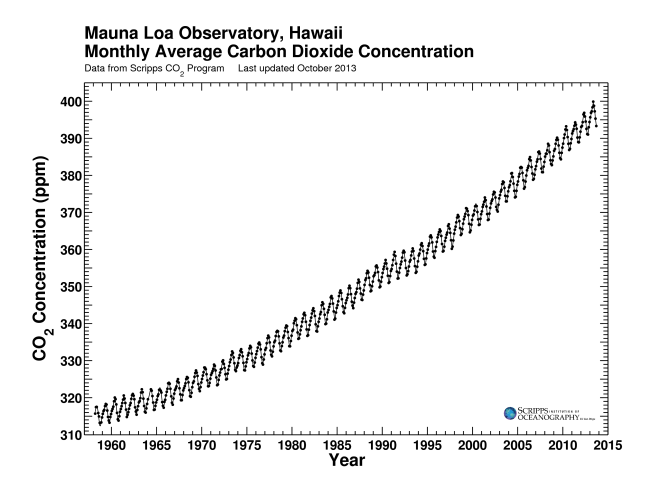
It's too early to celebrate because the data really doesn't show this purported downturn yet. Here's the measured carbon dioxide in the atmosphere for the last five years:
http://www.esrl.noaa.gov/gmd/c...
And the full record:
http://www.esrl.noaa.gov/gmd/c...If there's a recent downturn, I can't see it.
(A different link graphing the same data: https://scripps.ucsd.edu/progr... )
-
Re:And the hits keep on coming ...
I guess if you get all your science "knowledge" from crappy magazines you are going to believe in a lot of things that. Did you invest in housing real estate in 2005 since Time said it was going to be awesome (http://content.time.com/time/covers/0,16641,1101050613,00.html)?
Scientific papers were a tad different than your interpretation of them it would seem: http://aerosol.ucsd.edu/classe... there are some charts 9 pages in if you prefer pictures to words.
-
To "explore" space?
By going 120 kilometers up? How does that help to "explore" space?
www.distancetomars.com
http://physics.ucsd.edu/do-the...
Note the distances. No one is "exploring" anything better because they are in a tin can in the upper atmosphere...
-
Do the Energy Math and Space is a Distraction
For the human race, at our current level of technological development, space travel is a net loser activity from an energy standpoint. There is a finite amount of energy currently available to our species, both in an absolute sense and a per unit of time sense. We're currently in the process of squandering our fossil fuel inheritance and we're already looking for more sources of energy to satisfy our greed and thirst for growth. I like science fiction as much as the next nerd, but if you want an honest appraisal of our energy problems and growth prospects from a real physicist who pulls no punches then I suggest Tom Murphy's "Do the Math" blog on energy, growth and options to get a better understanding of why space is basically a distraction from our real energy problems right now.
-
Do the Energy Math and Space is a Distraction
For the human race, at our current level of technological development, space travel is a net loser activity from an energy standpoint. There is a finite amount of energy currently available to our species, both in an absolute sense and a per unit of time sense. We're currently in the process of squandering our fossil fuel inheritance and we're already looking for more sources of energy to satisfy our greed and thirst for growth. I like science fiction as much as the next nerd, but if you want an honest appraisal of our energy problems and growth prospects from a real physicist who pulls no punches then I suggest Tom Murphy's "Do the Math" blog on energy, growth and options to get a better understanding of why space is basically a distraction from our real energy problems right now.