Slashdot Mirror
Domain: udel.edu
Stories and comments across the archive that link to udel.edu.
Comments · 282
-
You must be smoking that sherm!
Or did you read the guy's geek guide to girls?
Or are you a transvestite? -
My favorite part ...
My favorite part of the A Guy's Guide to Geek Girls page:
7. Geek girls like Spock better than Kirk. Don't ask, it just IS.
Fascinating! -
Transistors? BAH!
I'm waiting for DNA Computers! Shove a hamburger into where the floppy drive used to be, run gMetabolize for Linux (GNUtrients?), in a few hours my machine isn't obsolete anymore.
Either that, or it mutates into an evil Steve Wozniak and strangles me in my sleep.
/* Steve */ -
Re:From the article...
It is real, have a look at:
This location.
Pretty interesting. -
Re:Who cares ...
Universities dont teach their students on sun boxes any more. Well not unless they are given away.
Hmmm . . . I beg to differ. At the University of Delaware our three central servers are all Suns: two Sun Fire 6800s (one with 8 750MHz. Ultra IIIs and 16GB RAM and one with 16 procs and 32GB) and an Ultra Enterprise 5000. Most of the rest of the machines (mail server, net gateways, storage) are also Sun Fires. When I took my Calc and Differential Equations courses, we used Sun workstations connected to the central servers. All programming courses at UD use X Terminals or Sun boxes that are connected to the main network as well.
I'm not saying that this is true of all Universities anymore, just that there's at least one place still teaching its students on non-donated Suns.
For more information on the University's hardware, see this page. -
Correction
What amazes me is that the Department of Homeland Security seems to be a much bigger beauracracy than any of the agencies that it is "swallowing", yet it's being built by an administration that sells itself as anti-big-government. {Emphasis added by me}
Correction... it is being built by an administration that sold itself as anti-big-government. See, there was this thing that happened called 9/11 and a lot of people shifted their positions on a lot of things. Its not like this is a big secret and its not like you are going to inspire outrage or shock by pointing out that DHS is big government.
-
disparity with other articles
how can you explain the disperity between the figures in this article and the figures in this article http://www.physics.udel.edu/wwwusers/watson/scen1
0 3/intel.html -
Re:OwnershipSince the website you are hosting the code on is owned by the school, they may have more rights than if you were posting the code elsewhere.
Certain rights and freedoms have been known to be limited when they are done from within an organization, school, or company. For instance, schools have the right to search students' lockers, and companies generally have the right to monitor and read e-mail sent by their employees.
The solution, in my opinion? Get a website elsewhere, not hosted on the schools webserver. Then, include a link which points to the other page saying something like,To view code I have written, you may visit my other website. Keep in mind that by clicking the above link you confirm that you will not use any code located on the other website for plagiarism, or for school assignments. NOTE: It is a violation of the University of Deleware's Academic dishonesy policy to use this code for completing your own assignments.
Once your code is no longer on the school's servers, they really have no case on you, as you could argue that if students really wanted, they could probably search Google and find examples of the code on other websites. By including the disclaimer below the link, you are essentially putting the onus on the student who visits your site. If they do use your code, they do so knowingly disobeying the Academic dishonesty policy. -
Question for slashdot
My advisor, DL Mills (the guy who invented NTP), said something a while back which this article somewhat reminds me of. He said that back in the day, people wrote operating systems in assembly. But the thing is, they just got way too f****** big and couldn't be maintained, even with the best of care. He said that today's operating systems are getting to that point as well, and maybe it's time for a new level of abstraction. Stuff like exception handling (amoung which automated buffer checking should be one), garbage collection, etc, should be built into the language, and leave the programmer to concentrate on more important things.
So my question is, does anyone have any idea what this "new level of abstraction" might be? -
Use theirs, get your own, or go elsewhere.Usually, an ISP will run NTP on their routers. Check the gateway they provide, and see if it runs NTP. As an alternative, they may run something like timed on one of their servers.
You could also purchase a GPS clock like one on this list.
The last option is to find another ISP who will offer time services, or one that will let you find them where you want.
-
Escape, or get thrown out?
Last time I really played a multiplayer game and got addicted was Action Quake 2. I've had episodes with Duke Nukem 3D, Ultima Online and Counter-Strike, but Action Quake 2 really ate up my time. I'd spend several hours every day, just after 6 until around 10 playing Action. I'd ignore my homework, family, tv, and just play for 2p a minute on Wireplay. I played like this four about two years, until my 56K modem decided to assign itself a new IRQ address. Nowonly being 14 I thought it had broken, so we sent it off for repairs, and I got knocked down to a 14.4K modem. I spent ages in chat rooms on this, but could never play AQ2, no matter how much I wanted to. When my 56K came back, and reinstalled itself correctly, I just didn't find AQ2 fun anymore. It was pointless, easy, repetative. I found after I'd collected my thoughts in the few weeks I'd not had my modem, I'd found that the game wasn't so brilliant, and it was just the same thing, over and over and over. I never played again ever since. I had a similar problem with Ultima Online, until one day I lost my Ostard on a server, got so pissed off I almost cried, and realised what I'd become. I deleted one of the main files so i could never play it, renamed the executable
-
Re:Slashdot.org
Does anything matter at Slashdot? BTW, here's a Google cache and a PDF version of the article.
-
Re:all sorts of theories
Regarding Benjamin Franklin and the smallpox vaccine:
My research shows Benjamin Franklin died in 1790 and Edward Jenner invented the smallpox vaccine in 1796.
Are you saying that Franklin predicted the invention of the smallpox vaccine, or that he wrote an essay years after he was dead? Either way, do you have a link to support this? -
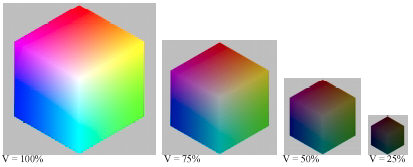
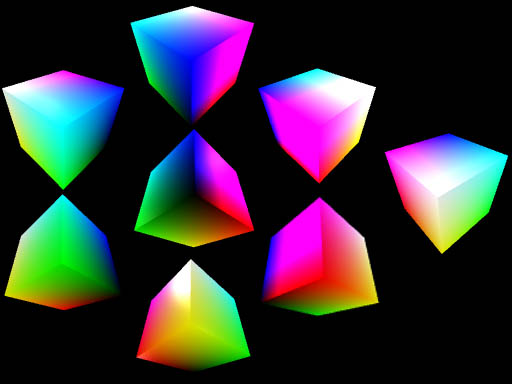
Re:Color dimensions
Then why is it alway represented by a two dimensional pallet?
Always? 2 3 4 5 6 7 8 9 10 11 12 13 14
It is often represented two dimensionally because it is difficult to display it three dimensionally. Two dimensional displays most often display Hue and Saturation and completely discard Value.
Color can be coded as RGB (Red/Rreen/Blue) or HSV (Hue/Saturation/Value) or HSL (Hue/SaturationLightness) or YCbCr aka YUV aka YIQ (used in TV) or CMY (Cyan/Magenta/Yellow) or L*a*b* or XYZ. It always requires exactly three components. Note CMYK uses 4, but K is redundant, it improves the quality of ink printing.
it isn't "exact" either, since many humans are missing at least one of the dimensions.
That is precisely why I included the word "normal" in "normal human vision".
- -
slashdotted already?
the article was just creeping when I viewed it. In case it get's completed
UD researchers develop revolutionary computer interface technology Sept. 27, 2002--University of Delaware researchers have developed a revolutionary computer interface technology that promises to put the bite on the traditional mouse and mechanical keyboard.
"We have developed a technology that goes well beyond the mouse and mechanical keyboard," John Elias, UD professor of electrical and computer engineering, said.
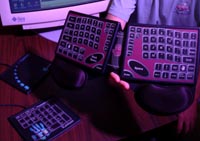
Elias and Wayne Westerman, UD visiting assistant professor of electrical and computer engineering, have been working on the new interface for about five years and are now marketing their iGesture product through a company called FingerWorks.
The project started as a doctoral thesis by Westerman, who was then a UD graduate student working with Elias.
The FingerWorks name fits because the technology uses a touch pad and a range of finger motions to communicate commands and keys to the computer. To open a file, you rotate your hand as if opening a jar; to zoom or de-zoom, you expand or contract your hand.
Elias said the communication power of their system is "thousands of times greater" than that of a mouse, which uses just a single moving point as the main input. Using this new technology, two human hands provide 10 points of contact, with a wide range of motion for each, thus providing thousands of different patterns, each of which can mean something different to the computer.
While much about the computer has changed over the last three decades-greater power, faster speeds, more memory-what has not changed is the user interface.
"For what it was invented for, the mouse does a good job," Elias said. "People accept the mouse and the mechanical keyboard because that's the way it is. But there are limitations in terms of information flow. There is so much power in the computer, and so much power in the human, but the present situation results in a communications bottleneck between the two."
Elias and Westerman have a better idea. "I believe we are on the verge of changing the way people interact with computers," Elias said. "Imagine trying to communicate with another human being using just a mouse and a keyboard. It works, but it is slow and tedious.
"This is not just a little step in improving the mouse, this is the first step in a new way of communicating with the computer through gestures and the movements of your hands. This is, after all, one of the ways humans interact."
Elias said he could envision in the next 10 years "a very complex gestural language between man and machine."
The system is a multi-touch, zero force technology, Elias said, meaning the gestures and movements use all the fingers in a light and subtle manner.
Because of that, the system has a second major advantage over the mouse and mechanical keyboard because it can greatly reduce stress injuries such as tendonitis and carpal tunnel syndrome attributed to traditional computer work.
The company markets both stand-alone touch pads and touch pads built into nonmechanical keyboards. In the keyboards, the keys overlap the touch pad so the operator does not have to move his hands when switching between typing and using the mouse. Rather, everything can be done in a smoother flow of hand motions.
Elias explained the touch pad acts like a video camera, recording the objects touching its surface. An embedded microprocessor then applies an algorithmic process to convert those touches into commands understood by the computer.
"To observers watching somebody use multi-touch, it looks a little like magic," Elias said, illustrating his point on a computer in Evans Hall. "People see lots of things happening on the computer screen but very little hand motion is observed."
He said the system has been designed so the gestures used make sense for the operation being performed. For instance, you cut text with a pinch and paste it with a flick.
Eventually, he said, the computer password could be a gesture known only to the user.
Elias said people often think that speech recognition systems will become the ultimate user interface. "Voice commands are good for many things but terrible for other things," Elias said, adding he believes there are inherent problems with a speech-only interface.
"If you want to test this claim, you can do so with a perfect speech recognition system-another human being," Elias said. "Put somebody in front of your computer and try to do your work by issuing voice commands to him. You'll quickly find that many common tasks are difficult to do using speech, even though your 'computer interface' understands you perfectly."
Using hand and finger motion to input commands is, for many tasks, much more effective than trying to explain what you want to do in words, he said.
The system is being used at several work stations in Evans Hall and the reaction is largely favorable. It is something of a challenge for some workers, Elias said, because it is like learning a new language.
Susan Foster, UD vice president of information technologies, said she is impressed with the interface and plans to adopt it for use at several computer sites around campus.
"The device is the result of new thinking about the 'bandwidth' that constrains the physical interaction between operator and computer," Foster said. "It capitalizes on human gestures, which are easy to understand and execute. Once learned, like other motor skills, they are readily retained. The assistive qualities of the device also make it quite useful for those with limitations on upper extremity use."
The plug-and-play device, which requires no special software, should be of particular interest to programmers, graphic designers and editors, Foster said, and she is recommending they consider making use of a new technology that was "born and bred at UD and under continuing development here."
The University of Delaware is an equity partner in FingerWorks. -
Multifinger gestures are cooler.
At UD (where I am attending), I have been able to try out a device that can do multi-finger gestures on the same surface that does typing and mousing. It has does gestures for back, forward and scroll all the requisite browser movements for reading Slashdot, plus most other conceivable hotkey combos! Here is an article about it in our school newspaper: http://www.mis4.udel.edu/udaily/index.html
-
Re:WOW!!!
-
"The Myth of Superman" (& Star Trek too)
Umberto Eco points this out in his article The Myth of Superman (I'm afraid a quick google only turned up this synopsis, not the whole text). Here are some key quotes from that link, and, I assume, the article (come on, it's been nearly six years since I've read it!
Traditional mythic heroes were governed by a law, therefore these heroes were predictable and held no suprises for the audience.
... and
Authors preferences are not considered when writing a novel. They are forced to write along the guidelines of a cultural model. In this case, "authors. .
Basically the deal was that if you started at A and went to B, you might pass through C or D or E but your story must end up at A again or you'll have spoiled the myth.
There's only so much a mythical figure can do (or mythos o' figures). Here are some of the more horrendous deviations from the "A leads to B leads to A again" that I can think of off-hand (a little Spidey-centric, I'm afraid):
* The brilliant folk at Marvel kill off Aunt May. (She's back now)
* The brilliant folk at Marvel decide Spider-Man is really a clone. (The clones have all disappeared now)
* The brilliant folk at DC kill off Superman and then have several return. (I think we're back to one, but I don't read Superman)
* Patrick Duffy leaves Dallas.
* Felix Lieter (sp) has his leg eaten by a shark in Licensed To Kill. (Haven't fixed that yet, but they did ditch Dalton, even if it isn't his fault that movie stunk to high heaven)
This is why, I believe, these fictional stories rarely do things that are irreversable, like have Peter Parker age [much] or main characters get married (last I looked, Marvel was still struggling with that one, even having MJ disappear). It's also why shows tend to die after the leading man & woman get romanticly involved -- see Moonlighting. Or why they die when they switch tone -- see all those Carol Burnett[-esque] episodes later on in Magnum, P.I.
So, in one sense, the reason Star Trek is always the same is the same reason everyone was on pins and needles when Diane left Cheers. -
Karma whoring
-
Re:No More Free (legacy) Unix?
AFAIK everything that was available under the old "enthusiast license" deal that began with SCO before the buyout was reissued under a BSD-like license more recently, so I don't think they could take it back even if they wanted to. Here is the license itself in PDF format.
-
Did you check the NTP FAQ?
Here's a good link that has information on syncing your private NTP server to GPS.
--Turkey
-
Use the standard Unix NTP d�mon: nptd ...Use the standard NTP dæmon in RedHat, Debian and other called ntpd
Ntpd supports many GPS reference clocks directly, so you don't need any special software to "pull out the time, and then feed it to an NTP server".
-
Use the standard Unix NTP d�mon: nptd ...Use the standard NTP dæmon in RedHat, Debian and other called ntpd
Ntpd supports many GPS reference clocks directly, so you don't need any special software to "pull out the time, and then feed it to an NTP server".
-
Re:Olin College Came to my high school
I don't know how most places do it, but at my university you do in fact get credit for the classes you AP or test out of (language classes, which most high school require, are the exception). This sounds prefectly reasonable - why should you have to take harder math classes if you worked hard and placed out of the easier ones. [This does nothing but lower your GPA, as well] Now, I can say having taken my fair share of AP tests (12) that how much you take away from a class depends strongly on the teacher. My high school calc teacher was WONDERFUL, and well over half her kids were getting 5's (and she taught 150 kids a year), while some teachers were bums and I had to teach myself.
Now, for my personal sitation (And just for the record): I didn't want to lose the 51 credits I came in with (I had worked quite hard to earn those), so that I why I didn't apply to Olin. And, it turns out, I was able to get really lucky during the schedule, and jump straight into the sophmore engineering track. I was incredibly fortunate to have a great circuits class in high school. (Sadly, most places don't offer that). Once again, broad generalizations like that don't apply to everyone.
Sure, there are kids who come in with a ton of APs and bomb during their first semester, but for the most part, I think that you have to reward the kids who worked hard in high school. Make the tests harder, but don't eliminate the reward. -
Re:Most cablemodem/DSL head-end routers have the t
Pretty cool. I've updated my
-
Microsecond accuracy for free
-
Microsecond accuracy for free
-
Re:Don't Do That
Sounds right to me...
After typing up the earlier answer though, I found this excellent link...
LINK!
=D -
Let xntpd do it's magicFor Unix, don't fuss with ntpdate, cron, rdist, or anything use. Use xntp . Trust me on this one. You will gain a newfound appreciation of the complexities of network time synchronization after spending a good hour trying to figure out how to get this daemon to do the simplest of tasks, e.g. automatically keep your clock in sync. It's obvious from the docs and code that someone has spent way, way more time thinking about all this than you'll ever want to. XWindows, Linux, Sendmail, Apache, and xntp always come to mind when I think of free software projects that just freak me out because of how well done they are.
For Windows you can get ntp daemons but I find that, if something new appears in their system tray, users will fiddle with and break it every time. I use Samba and MS Windows networking built-in time sync, put in a startup script so it syncs on every boot. Clock drift on any modern computer is going to be negligible even if you're only syncing once every day or two.
-
NTP all the way
My firewall runs ntpd to sync its time with one of the public time servers in Canada. All of my Unix-ish machines run ntpd to synchronize with that; Windows machines run Tardis on startup to sync.
A trick to find nearby time servers (other than looking at a list): run ntptrace on a nearby, well-administered Unix machine. Find the last machine that's inside the organization--that will be the one they sync with the outside world. Run ntpq on that machine and type peers. You'll see a list of the NTP servers that it queries. Put some of those in your
-
NTP all the way
My firewall runs ntpd to sync its time with one of the public time servers in Canada. All of my Unix-ish machines run ntpd to synchronize with that; Windows machines run Tardis on startup to sync.
A trick to find nearby time servers (other than looking at a list): run ntptrace on a nearby, well-administered Unix machine. Find the last machine that's inside the organization--that will be the one they sync with the outside world. Run ntpq on that machine and type peers. You'll see a list of the NTP servers that it queries. Put some of those in your
-
Re:ntpdate [server] in crontab...
check out
this
for a list of time servers to use with ntp. -
ntpdate
nexus:~# ntpdate time.nist.gov
4 Jul 15:17:34 ntpdate[26989]: adjust time server 192.43.244.18 offset 0.000626 sec
nexus:~# date
Thu Jul 4 15:17:22 MST 2002
It's 3:17 PM right now. So yes, I know what time it is. Debian users can apt-get install ntp or ntpdate... it should be part of the base system in freebsd, and the NTP homepage is http://www.eecis.udel.edu/~ntp/
Sh -
Aint that just the way...
I setup my first ntp server about three days ago... and am using Automachron to sync my PC's clock (which is needed, cos it loses a few minutes every day or so). People shouldn't automatically use time.nist.gov though...the poor thing will get slashdotted. There are a ton of stratum-2 servers here.
-
NTP, ntpdate
I run ntpdate every odd hour to synchronize my system clock to five NTP servers in the Bay Area. Looking at the logs, it appears that my system clock usually gains 0.13 seconds between to updates.
Besides, once every month, I save the system clock to the hardware clock. Of course, this is because I don't reboot often. I would do it more often, even at every shutdown, if I was to reboot often.
And of course, I use my system time to update everything else, like my wristwatch, my alarmclock, etc. You can find a list of time servers in your area on this page. For more information about the Network Time Protocol, look there. -
NTP, ntpdate
I run ntpdate every odd hour to synchronize my system clock to five NTP servers in the Bay Area. Looking at the logs, it appears that my system clock usually gains 0.13 seconds between to updates.
Besides, once every month, I save the system clock to the hardware clock. Of course, this is because I don't reboot often. I would do it more often, even at every shutdown, if I was to reboot often.
And of course, I use my system time to update everything else, like my wristwatch, my alarmclock, etc. You can find a list of time servers in your area on this page. For more information about the Network Time Protocol, look there. -
around the clock
So how do you get the time?
using one of these ? -
Microsecond accuracy for $25
-
Re:P2P DNS, can it be done?
This first saw this idea kicked around on slashdot a few months ago. I actually had sit down with one of my professors (who actually helped invent the internet, and I don't mean that in the Al Gore way) He said, IIRC, that for such a setup, effeciently updating dns entries would become a nightmare very quickly. Remember - there are only 12 root dns servers. I'd imagine that if you did the math, the sum total of all DNS entries would be on the order gigabytes (or maybe even tens of gigabytes) of data. Broadband simply is not at the point where it can cope with such a load.
-
Re:This is probably why they're introducing it
I strongly disagree with that statement. The professor for whom I am currently doing research did in part invent the internet, or at least a few important cornerstones. He is in no way corrupted - he is a realist and sees the internet as it is. I would think most of the founders of the internet are like him - they tend to shy away from the polical issues, prefering instead to focus their energy into the engineering side of it. When that happens, you create a power vacuum, and it pulls in just the kind of people John Gilmore is railing against.
-
Circuit City's past
Aren't these the same clowns who were in on DIVX, which failed?
I'm a former Best Buy employee, so maybe I'm biased. Personally, I just don't like shopping anywhere with salespeople who work on commission. -
Downloads
-
Downloads
-
Re:No need to be left out
Some Amish use cellphones.
I suppose there are WAP-enabled webmail services available. -
Re:Not setAlso, XP does rather more than just provide sync software. It's preconfigured to point to a Microsoft time server. Of course Apple does that too, and they deserve points for being the first system vendor to provide a server. On the other hand, Apple seems to be less anxious to have people actually use the server.
Preconfiguration is not a small issue. It can be complicated, and if you're a good Netizen, you should be careful about what time servers you access. Then again, these rules seem to be widely ignored.
Linux distros have always included NTP software. Except that NTP configuring it is a bitch. This protocol is much more elaborate than most users need -- it supports a "multi-stratum" network of servers designed to minimize the load on individual servers and maximize accuracy (within a few milliseconds if client and server are on the same network, tens of milliseconds otherwise). That's rather more accuracy than I need -- I just want to keep my file times reasonably correct. After wasting a bit of time trying to make the NTP daemon work properly, I finally just had cron run ntpdate every four hours.
-
Perhaps it's Asperger Syndrome?
IANAD; but, could sk8's odd behavior possibly be explained by Asperger Syndrome?
People with Asperger are often extremely bright, have a single, strong interest (which they talk about obsessively), take many things too literally, don't understand non-verbal social cues, spend lots of time in fantasy worlds, &c.
I wonder whether this has anything to do with his strange reactions. Interestingly, Asperger seems to have an unusually high incidence in children whose parents are in the high-tech industry.
Or, maybe he's just bipolar, and is delusional while in a manic state. I don't know much; but, I agree that the guy probably suffers from some sort of illness. =-( -
Tardis 2000 and NTPOn Windows machines use Tardis 2000, and on Linux/Unix machines use NTP. These two programs combine server and client functions and are interoperable over the same network. Both accept GPS input from an RS232 source and can sync an entire network from it. I have used Tardis with my Garmin eTrex on COM1:, for example.
Having said that, there is one caveat: Simple GPS input will give you only about one-second accuracy. For better accuracy, you need a GPS with an auxilliary PPS (pulse-per-second) output. NTP can accept PPS inputs if the Linux kernel is compiled with that option. (My out-of-the-box Red Hat 7.1 was not.) If not you may still be able to get better accuracy by temporarily hooking up your GPS simultaneously (using NTP) with several internet time servers. Using ntpq (a utility included with NTP), you can observe the offset from internet time your GPS is giving you. It will be less than one second. NTP gives you the option of programming an offset for each time source you choose, and you can use your observed GPS offset to correct your GPS time source.
I'm not sure whether Tardis can handle PPS or not.
-
2 of many options...
2 years ago I wrote a small C program to synchronize a Windows PC to a Trimble GPS: easy. A RS232 library, a quick look at the Trimble communication protocol and it was done in under 4 hours.
Last week I've been synching my SGIs using ntp (Network Time Protocol) and I saw in the documentation that it can also synch to a GPS. Didn't look at the details though, but probably through the serial port. And ntp is free.
-
Use ntp. Period.
Windows net time
Real synching of clocks can be done with NTP, the network time protocol. And yes, it can sync one computer's time to GPS...
Read the FAQ for more information... and the newsgroup comp.protocols.time.ntp is read by many helpful people! .
-
"Irreducibly complex"?