Slashdot Mirror
Domain: ufl.edu
Stories and comments across the archive that link to ufl.edu.
Comments · 436
-
Do something about it
More than having an intellectual wanker-fest on slashdot, how about we let some people know tasering the kid was wrong?
president@ufl.edu (university president)
updinfo@admin.ufl.edu (university police dept)
http://www.police.ufl.edu/media/Citizen%20Complaint.JPG (police complaint form)
ag.mccollum@myfloridalegal.com (florida attorney general)
support@johnkerry.com (john kerry's contact email)
http://www.trustees.ufl.edu/about/ (trustees of the university of florida) -
Do something about it
More than having an intellectual wanker-fest on slashdot, how about we let some people know tasering the kid was wrong?
president@ufl.edu (university president)
updinfo@admin.ufl.edu (university police dept)
http://www.police.ufl.edu/media/Citizen%20Complaint.JPG (police complaint form)
ag.mccollum@myfloridalegal.com (florida attorney general)
support@johnkerry.com (john kerry's contact email)
http://www.trustees.ufl.edu/about/ (trustees of the university of florida) -
University's statement
http://insideuf.ufl.edu/2007/09/18/prez-statement/
"Two officers involved in the incident have been placed on paid administrative leave pending the outcome of the investigation." -
Re:religion
"Creationists denying that this occurred are as credible as the color-blind denying that the sky is blue. Frankly, they don't know what they're talking about."
I don't want to seem overly critical, but I would just point out that the sky isn't blue. The sky doesn't have a colour. Indeed in the broadest sense nothing at all has a colour, because colour is merely rooted in our perception based on marginally different forms of light caused by the different properties of the materials which it either bounces off or travels through. The point might be better made if I were colour blind (but I'm not). But I suppose it does allow me to question whether or not you and I perceive colour in the same way anyway - in a meaningful sense what you call "blue sky" might indeed be what I would call "green", due to the endless possibilities of our brains interpreting the data in different ways.
I bet if we both looked at the "duck-rabbit" we might see different things, and I'm inclined to see this as no different.
see... http://web.nwe.ufl.edu/~gulmer/longman/2/duckrabbit.html -
True and permanent data destruction
Use an IBM Deskstar hard drive:
http://www.astro.ufl.edu/~ken/crash/index.html
Seriously, though, if you use a _power_ sander to sand a platter, it will die. Just like wood, just like metal. Once you get rid of the shine, nothing will be recovered -- assuming you got rid of it mechanically/chemically and not just by covering it.
-DrkShadow -
Re:Good application for iRobot Create
Actually, iRobot produced a robot called the iRobot-LE which later became a commercial product called the CoWorker that was designed specifically for telepresence applications. They couldn't find a market for it and eventually discontinued production. (You can see images of both here: http://iml.jou.ufl.edu/projects/Spring05/Rodrigue
z /coworker2.htmhere ) -
Re:The problem there...
The problem there is that you're essentially proposing the equivalent of making a car instantly go from 50 km/h to 200 km/h, without it ever having a speed of 100 km/h in between (or any other between 50 and 200.) Only in this case you're proposing something like going from 0.5c to 2c without ever being at the other speeds in between.
What we need is an electromagnetic equivalent to the de Laval nozzle. The speed-of-light barrier comes from an equation, and could be an over simplification. When you break the sound barrier, the sonic boom is a result of a shock wave--which corresponds to a singularity in the Prandtl-Glauert equation, i.e., a Mach number of 1.0. So maybe there's an optical boom instead of a sonic boom when you break the light barrier, but I'm not going to say it's impossible.
Well... how?
Even if there wasn't the pesky issue of having c in between, that violates even Newtonian mechanics. Savagely. Since you're proposing that speed "jump" to essentially happen in exactly zero time (or you'd go through all the values in between), even by old Newtonian mechanics you're talking about an infinite force. -
Re:No way to combat filesharing
Well, they could simply copy what the University of Florida has done with DHNet's system called ICARUS .
Basically, a student is required to register the MAC Address of his devices with the system and tie it to your student ID. If something is not in their database then it isn't allowed on the network.
Then, port scanners run constantly checking for open ports on people's machines and any outbound traffic that does not appear to be a few specific protocols is noted.
If "unauthorized" traffic is found, it automatically involves a strike, cutting off all internet access outside of the UF website. If this happens three times, students are cut off entirely. This system works. The risks are to great for 99% of students to attempt to break the system so its flaws are extremely hard to find.
Anyway, that's just my experience with how a school network actually can block all P2P traffic effectively. -
Other references already exist though...
like this one:
http://wilstar.com/caffeine.htm
and this:
http://www.napa.ufl.edu/2003news/caffeinecontent.h tm
Starbucks regular drip coffees contain an average of 200 milligrams of caffeine per 8-ounce serving; their decaffeinated drip coffees contain an average of 5 milligrams to 11 milligrams of caffeine per 8-ounce serving, according to the statement.
The study's second phase used 16-ounce cups of Starbucks' Breakfast Blend, a mix of Latin American coffees, purchased on six consecutive days from a single Gainesville store and analyzed by the same method. Results for the six days were, in order: 564 milligrams, 498 milligrams, 259 milligrams, 303 milligrams, 300 milligrams and 307 milligrams. -
Variations
The idealized likelihood of any one particular person is one in 64 trillion different genetic combinations of mother and father chromosomes. And with 100 billion neurons being stimulated throughout childhood, how are we to say that birth order influences one particular variable that we measure with various psychology tests? There is an immense amount of complexity that we cannot yet isolate (ask the neuroscientists), even in estimating the likelihood of specific combinations of genes because of diffusion gradients, energy interaction dynamics of DNA, and all sorts of other phenomena that keep us guessing only in 'Idealized' cases-- birth order is nowhere near such an idealization, however.
* Wikipedia linked me to this re: birth order and intelligence.
* Judith Harris on birth order and related psychology. -
Some do it more or less naturally
Lake Jackson in North Florida, for example, does it every few years as ground water levels fluctuate. I'm sure that human intervention has something to do with these water levels, but isn't likely the only determining factor.
It's kind of funny that, before you go bass fishing, you have to actually make sure there's water in the lake. Sometimes, it drains very quickly. -
Re:Air quality?
Ughh... I get swamped when trying to google it with all the global warming stuff.
Still, here's a study of greenhouse heating requirements. Please note that this is old, and for florida. It also only expects R11, but at least it's a start.
3000 square feet(.069 acres), expected building cost of $5/square foot, would take on average 28 million BTUs to maintain 75 degrees. With Propane this would cost ~$540/year. Straight electric would be $821/year, Natural Gas $210. A good heat pump system should be able to drop the electric cost down to $273. Effectivly zero if you were going to cool the area you're getting the heat from anyways. Still, we have to worry about other energy costs, such as any required artificial lighting.
Using the NG example, shipping one acre's product would have to cost more than 3k to exceed heating costs. Per this poster, shipping costs for an entire acre would only be about $1800. Please note that ocean cargo shipping is extremely cheap, often cheaper than the 'last miles' to get products inland.
1 acre is 43,560 square feet, so 1 acre of greenhouse would end up costing $218k. In another post I figured out that it'd have to cost less than $100k per acre to be financially feasable. -
Re:too bad
I have an expectation of privacy when using a cordless phone, even though especially the old ones were trivial to listen in on.
No you don't. From here (among other places):[I]n United States v. Smith, while conceding that nearly half of all American households use cordless telephones, the Fifth Circuit held that "pure radio communications" are not afforded the same Fourth Amendment protection as communications carried by land-based telephone lines because "broadcasting communications into the air by radio waves is more analogous to carrying on an oral communication in a loud [p138] voice or with a megaphone than it is to the privacy afforded by a wire."
-
Linux Download Managers
They're working on a new version of the manager that runs Linux: http://developer.emusic.com/ and I know that there's also a Python eMusic, Dromanova, that's getting rave reviews and can be downloaded here: http://boykin.acis.ufl.edu/?p=97
-
Re:Really?
Sure, you may see a lot of stuff when you look at what's included, but there's really no tractable way to see what's not included. I bet there's a lot that's not a part of the Debian repo that you or I have never even heard about
True, but that's really not important...That depends on your perspective. From my point of view, there is a huge gap in complexity between apt-get install foo (which rarely fails and is wonderful) and wget http://foo.invalid/foo.tgz && tar zxvf foo.tgz && cd foo &&
I don't expect esoteric research projects to show up in a distribution (though to give credit, I was pleasantly surprised to see UMFPACK in the repo). However, failing that, in Windows, most of these research projects that are worthwhile end up with MSI installers, or as precompiled zip files. In Linuxland, there isn't a good standard distribution method better than the configure/make/make-install process. It wouldn't be difficult to make tarballs that follow the Linux Standard Base, and then place those into
Regarding Java for research... I hate Java as a language, personally. Some things like JAMA have been ported over to C++, but oftentimes a research project needs to stand on the legs of other packages for complex algorithms like FFT, SVD/Eigenstructure, or PCA. Still, the only place where I've personally seen Java rule the research world is software development tools, such as Molhado Ref and the multitude of Eclipse plugins; and then only really because Java is miles easier to parse and statically analyze than C++.
Someone else already mentioned apt-pinning, which is actually exactly what I'd be interested in for the mix-n-match stability issue. My point isn't that apt is bad, it's that there isn't a very good popular standardized spot in between apt and source tarballs.
-
Re:Microwaves
It's interesting you mention this. A multidisciplinary project at the University of Florida College of Engineering integrated this idea into a "smart house" project for the elderly:
http://www.napa.ufl.edu/2003news/smarthouse.htm
IMHO the project was ambitious but mostly ridiculous. They jam-packed the house full of interesting ideas, but the student engineers really didn't seem to have a grasp on how little the elderly would actually care for all of the technological "improvements." Anyway, I always thought the microwave idea was kind of cool, though, but I think they were using RFID in the packaging (???!?!) which is just downright wasteful if not plain stupid. -
Re:How does this actually happen?
A mechanical failure doesn't grind the platters into sand.
-
Re:Swing that razor one more time.
The organism he was speaking of is most likely the Varroa mite, Varroa jacobsoni.
-
Re:So...Like
How DO you grow your own spaghetti?
You plant some of these: http://edis.ifas.ufl.edu/BODY_MV141 -
Re:maxtor?
-
Re:alt fuels and systems
I confess to being baffled as to why people continue to indulge themselves with the delusion that such a proposition as yours will ever be possible. Considering these two graphs how could the prospect of "weaning ourselves off of high energy consumption" ever be seen as anything but irrational hope? No, the exponential growth of energy consumption by human civilization and the inextricably associated increases in life expectancy and living standards are undeniable. The energy consumption of the world will continue to increase exponentially and unabated for the forseeable future. The trick then, is to find a source of energy which can simultaneously provide the staggeringly huge needs of the future while also being environmentally benign. Controlled nuclear fusion, among a few other potential energy sources, fits this need nicely.
-
Re:It is your PCbusinesses need to be able to share documents with their business partners and clients, thusly, they must support the same file formats as their business partners and clients.
Shouldn't the businesses be more worried about THEIR intellectuual property rather than microsoft's. The words typed and spreadsheets, presentations the employees create is owned by the business. Seems like the tool, microsoft office gets more protection than the work results created.
All documents should be in open file formats.
http://openoffice.org/
It is your PC
Your thoughts expressed in documents, spreadsheets, drawing, etc should be primary. The proprietary document computer file formats should not be used to lock you out of YOUR intellectuual property. Microsoft proprietary document Word/Office (.doc) and Excel (.xls) force you to pay an upgrade ransom to keep using or sharing YOUR intellectual property.
http://lists.ufl.edu/cgi-bin/wa?A2=ind0510&L=ccc&P =10169
Subject: Introduction to OpenDocument
Date: Thu, 20 Oct 2005
From: Ken Sallot
Get virus resistant computer preloaded with OpenOffice
http://www.curtissystemssoftware.com/preloads.htm -
No matter what you do...Note that even the original University of Florida press release begins
PLEASE NOTE: To guard against the risk of fire, people who wish to sterilize their sponges at home must ensure the sponge is completely wet. Two minutes of microwaving is sufficient for most sterilization. Sponges should also have no metallic content. Last, people should be careful when removing the sponge from the microwave as it will be hot.
*sigh* -
Re:Hmm? Something is missing
After reading your site,I thought your readers would be interested in looking at these energy technologies and EPS's theoretic base for ball lighting.
Aneutronic Fusion: Here I am not talking about the big science ITER project taking thirty years, but the several small alternative plasma fusion efforts.
There are three companies pursuing hydrogen-boron plasma toroid fusion, Paul Koloc, Prometheus II, Eric Lerner, Focus Fusion and Clint Seward of Electron Power Systems
Vincent Page (a technology officer at GE!!) gave a presentation at the 05 6th symposium on current trends in international fusion research , which high lights the need to fully fund three different approaches to P-B11 fusion
He quotes costs and time to development of P-B11 Fusion as tens of million $, and years verses the many decades and ten Billion plus $ projected for ITER and other "Big" science efforts
Here are the links:
http://www.electronpowersystems.com/
A resent DOD review of EPS technology reads as follows:
"MIT considers these plasmas a revolutionary breakthrough, with Delphi's
chief scientist and senior manager for advanced technology both agreeing
that EST/SPT physics are repeatable and theoretically explainable. MIT and
EPS have jointly authored numerous professional papers describing their
work. (Delphi is a $33B company, the spun off Delco Division of General
Motors)."
and
"Cost: no cost data available. The complexity of reliable mini-toroid
formation and acceleration with compact, relatively low-cost equipment
remains to be determined. Yet the fact that the EPS/MIT STTR work this
technology has attracted interest from Delphi is very significant, as the
automotive electronics industry is considered to be extremely demanding of
functionality per dollar and pound (e.g., mil-spec performance at
Wal-Mart-class 'commodity' prices)."
EPS, Electron Power Systems seems the strongest and most advanced, and I love the scalability, They propose applications as varied as home power generation@
It also provides a theoretic base for ball lighting : Ball Lightning Explained as a Stable Plasma Toroid http://www.electronpowersystems.com/Images/Ball%20 Lightning%20Explained.pdf
The theoretics are all there in peer reviewed papers. It does sound to good to be true however with names like MIT, Delphi, STTR grants, NIST grants , etc., popping up all over, I have to keep investigating.
Recent support has also come from one of the top lightning researcher in the world, Joe Dwyer at FIT, when he got his Y-ray and X-ray research published in the May issue of Scientific American,
http://www.sciam.com/article.cfm?chanID=sa006&colI D=1&articleID=00032CE5-13B7-1264-8F9683414B7FFE9F
Dwyer's paper:
http://www.lightning.ece.ufl.edu/PDF/Gammarays.pdf
and according to Clint Seward it supports his lightning models and fusion work at Electron Power Systems
lightning produces thermonuclear reaction
This new work By Dr.Kuzhevsky on neutrons in lightning: Russian Science News http://www.informnauka.ru/eng/2005/2005-09-13-5_65 _e.htm is also supportive of Electron Power Systems fusion efforts
Vincent Page (a technology officer at GE!!) gave a presentation at the 05 6th symposium on current trends in international fusion research , which high lights the need to fully fund three different approaches to P-B11 fusion (Below Is an -
Re:Here's proof of continuous use by Cisco
Support is not use, in trademark terms. Existence of a support website (that says InfoGear was recently acquired by Cisco) does not support a claim of use of a trademark. It might support a claim of use of a service mark.
University of Florida refers to an IPhone service (note the capitalization), not an iPhone product. In fact, most of the time Florida refers to its VoIP service as I-Phone (note the capitalization and dash):
I-Phone is a new solutions-offering presented by OIT-Telecom that takes advantage of the convergence of voice and data networks.
The I-Phone service is part of the "services-to-wallplate" model that is offered by OIT-Network Services and is designed to ultimately provide an enterprise communications solution for the University of Florida.
University of Pennsylvania refers to a web-based service called My iPhone (alternatively referred to as Penn iPhone):
My iPhone is a web service that allows you to manage certain telephone features and voice mail options from a web browser.
Neither University is using a product called iPhone (except legacy units purchased 5+ years ago). They are both using a service they refer to as, in the case of Florida, I-Phone (VoIP) and, in the case of Pennsylvania, My iPhone (web manager).
Cisco's disuse of the mark in trade for a period of five plus years hurts their case considerably. A support web page that has not changed in five plus years offering service with respect to the mark may help a bit, but not much. -
Here's proof of continuous use by Cisco
This is just some bloggers, not a legal opinion, even if it's from a lawyer.
Here's a demonstration that Cisco was continuously using the trademark: the support web site for the iPhone, as archived at archive.org. "With InfoGear recently being acquired by Cisco Systems, there is currently no change to your iPhone coverage. We hope you continue to enjoy using your iPhone, and we thank you for your business. So, even if Cisco wasn't selling new units, they were still supporting the old ones. That page has been archived every year since 2000, so that's a form of continuous use.
There's an active user base. The University of Florida went iPhone. There's a description of their configuration here. They have a VoIP infrastructure with three Cisco CallManagers, two Cisco 6608 VoIP gateways, a Cisco Unity voice mail system, and many Cisco IP telephones, some of which are iPhone units, on desktops. The University of Pennsylvania also went iPhone. There are probably corporate installations too, but they tend not to publish their phone instructions on the public web. Those installations have to be supported, which is something Cisco does, and gets paid for. Cisco is in the network infrastructure business, after all.
As long as there's support, and support-related revenue, the trademark is clearly in use.
-
Here's proof of continuous use by Cisco
This is just some bloggers, not a legal opinion, even if it's from a lawyer.
Here's a demonstration that Cisco was continuously using the trademark: the support web site for the iPhone, as archived at archive.org. "With InfoGear recently being acquired by Cisco Systems, there is currently no change to your iPhone coverage. We hope you continue to enjoy using your iPhone, and we thank you for your business. So, even if Cisco wasn't selling new units, they were still supporting the old ones. That page has been archived every year since 2000, so that's a form of continuous use.
There's an active user base. The University of Florida went iPhone. There's a description of their configuration here. They have a VoIP infrastructure with three Cisco CallManagers, two Cisco 6608 VoIP gateways, a Cisco Unity voice mail system, and many Cisco IP telephones, some of which are iPhone units, on desktops. The University of Pennsylvania also went iPhone. There are probably corporate installations too, but they tend not to publish their phone instructions on the public web. Those installations have to be supported, which is something Cisco does, and gets paid for. Cisco is in the network infrastructure business, after all.
As long as there's support, and support-related revenue, the trademark is clearly in use.
-
Re:Whiskey Tango Hotel
If you'd stopped your rant earlier I might have been with you but honestly what an unscientific CRAP site!
According to it, it'd take me about 610 cans of coke to kill me according to that site. Assuming 375ml cans that's almost 228L. Now granted I'm a big guy, but even if I half my weight, that's 114L. Never mind that they don't mention a time frame in which you're drinking this. You can't work out what fraction of a lethal dose is in a drink, divide the amount in a single can of drink and claim that's deadly. I'm pretty sure I've had 610 cans of coke through my life time and I'm not dead. I'm also pretty sure if I drank that much in a day I'd be dead. Then again I'm pretty sure I'd pass out before I could drink that much.
Well it turns out if you drink 114L of anything including WATER will kill you.
http://chemistry.about.com/cs/5/f/blwaterintox.htm
http://www.hhp.ufl.edu/faculty/pbird/keepingfit/AR TICLE/toomuchwater.htm
http://en.wikipedia.org/wiki/Water_intoxication
"A person with two healthy kidneys can excrete about 1.5 litres of water per hour at maximum filtration (other studies find the limit to be as little as 0.9L/h [1]). Consuming as little as 1.8 litres of water in a single sitting may prove fatal for a person adhering to a low-sodium diet, or 3 litres for a person on a normal diet. However, this must be modulated by potential water losses via other routes. For example, a person who is perspiring heavily may lose 1 L/h of water through perspiration alone, thereby raising the threshold for water intoxication."
No one's suggesting we ban water.
So what have you proven? That too much of anything disrupts the body and will kill you.
Fucking pseudoscience being moderated up on
But then looking at this more carefully you've made a good point - what counts isn't the deadly dose, but the speed at which it's absorbed (how it's administered). 2x4's might be good for making furniture, but if incorrectly administered at too high a dosage (over the back of the head repeatedly every 3 seconds) they also lead to death too. Look at nuclear waste that way and the problem which is rightly pointed out is that if we're not careful we'll have no control over nuclear waste products in the long term - the equivalent of belting ourselves over the head with 2x4's with increasing frequency. -
Re:It's racism against Americans
You can pick a hell of a lot more oranges than 3 an hour. Most orange harvest crews pick between nine and eleven field boxes per hour per person. A field box is a 90 lb box. Nearly half (49%) of the oranges harvested by the sampled crews were harvested at a piece rate of $.70 per 90 pound field box. During the first week of January 1998, orange harvesters earned an average of $60 per day.
Increasing the amount these workers make would not significantly effect prices. Doubling the rate of the 90 pound field box to $1.40 would increase the average worker's pay from $60 to $120 per day. Tripling the rate of the 90 pound field box to $2.10 would increase the average worker's pay from $60 to $180 per day. Neither increase would significantly increase the cost of individual oranges in the supermarket. Further, either increase would mean more Americans taking those jobs. -
Re:Overblown story...I just read this morning about a group of researchers at the University of Florida who have used a similar substance (extracts from the acai berry) to kill cultured leukemia cells. The berry extracts work remarkably well at killing the cancer cells, but to quote the linked article,
[Professor Stephen Talcott] cautioned that the study, funded by UF sources, was not intended to show whether compounds found in acai berries could prevent leukemia in people.
"This was only a cell-culture model and we don't want to give anyone false hope," Talcott said. -
Control it at the sourceE. Coli is an essential part of our (and animals') digestive process. Most strains of E. Coli are harmless to humans, but some, like O157:H7 are extremely virulent in humans but harmless to the animals that carry them.
It makes sense to spend our efforts trying to eradicate these strains in the domestic and wild animal populations. Otherwise, we run the risk of every farmer's field and every outdoor trail becoming a serious health hazard.
So while the epidemiologic effort to trace the source of the human outbreak is impressive, I think research into controlling it in animals is even more important.
-
A lot of this is available now
4. The first time that a single query will bring a gallery of
results equivalent to running multiple queries about the
meaningful variations of the same topic.
5. The first time a search engine will let users evaluate answers
on the spot by displaying uninterrupted and coherent text
snippets, often letting searchers forgo having to click through
to links and saving time.
Both of these have been available for a couple of years: e.g. searching on the single query "semantic web" using CQ web, reveals clusters such as these:
fuzzy sets
fuzzy systems
neural networks
set theory
soft computing
aritifical intelligence
control systems
expert systems
And each one of which is linked to a specific page of results using sentences instead of snippets, e.g. for artificial intelligence:
1. This paper will present the foundations of fuzzy systems...noteworthy objections to its use with examples drawn from current research in the field of artificial intelligence.
Fuzzy Systems - A Tutorial
2. The most obvious implementation for the fuzzy logic is the field of artificial intelligence.
Fuzzy Logic
3. Ultimately it will be demonstrated...fuzzy systems makes a viable addition to the field of artificial intelligence and perhaps more generally to formal mathematics.
Fuzzy Systems - A Tutorial
4. The paper gives examples of the fuzzy logic applications with emphasis on the field of artificial intelligence.
Fuzzy Logic
5. A collection of articles and other technical resources for artificial intelligence.
PC AI - Fuzzy Logic -
A lot of this is available now
4. The first time that a single query will bring a gallery of
results equivalent to running multiple queries about the
meaningful variations of the same topic.
5. The first time a search engine will let users evaluate answers
on the spot by displaying uninterrupted and coherent text
snippets, often letting searchers forgo having to click through
to links and saving time.
Both of these have been available for a couple of years: e.g. searching on the single query "semantic web" using CQ web, reveals clusters such as these:
fuzzy sets
fuzzy systems
neural networks
set theory
soft computing
aritifical intelligence
control systems
expert systems
And each one of which is linked to a specific page of results using sentences instead of snippets, e.g. for artificial intelligence:
1. This paper will present the foundations of fuzzy systems...noteworthy objections to its use with examples drawn from current research in the field of artificial intelligence.
Fuzzy Systems - A Tutorial
2. The most obvious implementation for the fuzzy logic is the field of artificial intelligence.
Fuzzy Logic
3. Ultimately it will be demonstrated...fuzzy systems makes a viable addition to the field of artificial intelligence and perhaps more generally to formal mathematics.
Fuzzy Systems - A Tutorial
4. The paper gives examples of the fuzzy logic applications with emphasis on the field of artificial intelligence.
Fuzzy Logic
5. A collection of articles and other technical resources for artificial intelligence.
PC AI - Fuzzy Logic -
Re:TUCOWSI thought we were talking about tucows, not spamhaus.
Tucows has customers in Illinois. A court can have jurisdiction even if the company doesn't have a physical presence in the state.
See http://nersp.nerdc.ufl.edu/~malavet/civpro/notes/
p art10.htm for some legal background, esp. the part about GRAY v. AMERICAN RADIATOR & STANDARD SANITARY CORP. -
Re:"Moon is a Harsh Mistress" anybody??
Peak for shuttle launch is 3Gs, and for Apollo reentry, exceeded 7Gs (source paper with cited sources). For a launch abort on the Apollo design, stress would have exceeded 16Gs, and this was deemed uncomfortable, but survivable (albeit with an assumed inability to operate controls during the process). (source LBJ Space Center.)
So limiting it to 2Gs of total stress is very arbitrary and unnecessary.
-
Re:White light?
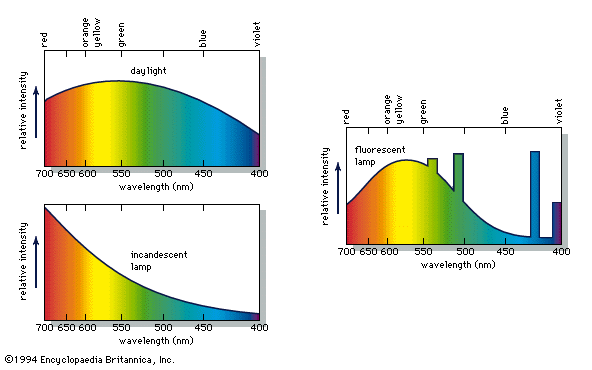
The yellow tinge is due to incandescent lights, not the "color" of the sun - while the sun's peak is in the yellow range (and therefore technically a "yellow" star), it's a lot less visibly yellow than typical incandescent light bulbs. Check out http://www.phys.ufl.edu/~avery/course/3400/light/
b lackbody_color.gif (note the fluorescent one shown is, as far as i can tell, a normal one, not a "true white" one. But still, which one is closer to sunlight? Even with the odd "spikes" -
Re:Weird Al is not the best example to mention
Moreover, while Weird Al (and his fans) always calls his stuff parody, it's arguably satire, and not protected.
http://grove.ufl.edu/~techlaw/vol9/issue1/collado. html
The difference is that parody has to specifically make fun of the original, whereas satire uses portions of the original to make fun of something else. "Smells Like Nirvana" is plainly parody. Most of the rest of his stuff's borderline. I'd argue that "Jurassic Park" primarily makes fun of the titular movie, rather than "Macarthur Park."
It's for more than courtesy that he gets permission, I think. -
Re:So will I be sued for my Hulk stuff?
Double posting. Here's a good reference that criticizes the difference.
-
Unlike Nintendo's Wii
Hangs head in shame.
Contest Report, 2006 SubjuGator Team Members, full fledged Windows XP Professional on a Pentium M. -
Re:Picture
Interesting. The full article from the University of Florida only mentions a $175,000 grant from the DOE. It seems the Army picked up a huge chunk of the tab with the $750,000 grant.
-
Picture
Here is a link to a picture of the device and a professor who I assume worked on it (or at least took credit for it).
-
Re:Hmmm
There's an even simpler reason
The code was stored on an IBM deathstar drive. -
Re:Lightning?
Fulgerites are generally not particularly pretty, since they're covered in the sand that was used to create them. It's possible there are beautiful ones but the ones I've seen looked like someone's kid brother's pottery project gone badly awry.
-
The point of AOL
Now I'm not entirely sure on this, because I never lived in a city that had a local access number for any of the "big guns". But back in the pre-internet days there were these things called "BBSes". They were computers with an (often) dedicated phone line and a modem. You could call them with your computer and leave messages, play games, and download/upload files. At first, most systems could only support one caller at a time. Most were run by hobbiests out of their homes.
Eventually, some of the systems grew to support multiple simultaneous callers, and they networked with other computers so that message forums could span the country, or even globe. One of the big guns at this time was "Compuserve". Another was "Prodigy". I believe, but am not sure, that AOL was also coming around at that time. At this stage of the game, these big players were essentially still BBS systems, they just happened to be massively multi-line, had access numbers in many major cities, and were crudely networked with other systems.
The downfall of these big fish was that they did not own the pipelines they were using to network to other systems. They only owned the modem farms.
As soon as it became relatively easy for anyone to hook up a modem to "The Internet", Compuserve, AOL, and the like lost their lock on being the only way into the online world. At that point, they had to try and "re-invent" themselves as more than a mere ISP, but, rather, as some kind of "value adder" to the online experience. They only continued to exist as long as they did because they marketed extensively and profited off of ignorant users who didn't know that once you got on the Internet you could get any content you wanted with or without the help of an AOL.
Here's a neat history of AOL etc. that Google turned up:
http://iml.jou.ufl.edu/projects/Fall2000/McAtee/
Steve -
Lightning effects on distribution lines
"It is common knowledge that an underground power grid is less susceptible to the effect of a large thunderstorm."
There are three aspects of thunderstorms that can affect transmission lines and distribution lines: a) wind, b) water and flooding, 3) lightning strikes. Moving transmission lines below ground is generally considered impractical for the distances usually seen in North America.
Moving distribution lines underground protects against wind damage, but heightens the risk from water and, counterintuitively, lightning.
A typical lightning strike on above ground distribution lines will usually leave the line to find a shorter path to ground, and only a small fraction of the current will continue on the line, damaging consumer electronics and tripping protective breakers, but not usually damaging the distribution infrastructure.
With a lightning strike near below ground distribution lines, the strike often finds the lines and will travel hundreds of feet along the line, damaging the insulation as it dissipates.
The University of Florida Lightning Research group has done significant research in the area:
http://www.lightning.ece.ufl.edu/ -
Re:You're more likely to drown in the bathtub.
Yes, but you're still more likely to die from a lightning strike than a terrorist attack. See http://www.flmnh.ufl.edu/fish/sharks/attacks/rela
r isklightning.htm.
It also appears that you are also more likely to be eaten by a shark than killed by a terrorist. -
Re:Radiation, most likelyThere's a reason why NASA is trying their best to get their fingers on ancient CPUs.
Yes, space applications necessitate the need for radiation hardened processors. Due to the nature of the hardening process (special design rules, triple modular redundancy, etc.), these chips dissipate much more heat and operate at lower clock frequencies than the original processor they were based on. But these chips are still made at state-of-the-art facilities; they may not use the smallest processes out there, but technology like SOI (silicon-on-insulator) dramatically improves the radiation-tolerance of the process.
But, NASA is interested in using newer commercial-of-the-shelf processors (IBM PPC based) in order to increase the amount of processing power available on satellites. As an example, take a look at this project that I previously worked on. (Hopefully it will fly sometime in 2009)
-
Re:Pedantry alert
For a purely habitual addiction - whether it be sex, gaming, work or anything else without a direct chemical impact - you can only provide the counselling.
You think you can't become addicted to neurotransmitters? You do realise that people who become addicted to exercise are addicted to the endorphin high, right?
Just because you're not explicitly shovelling drugs into your system doesn't mean they're not in there. -
Re:I expected more from the article . . .
They say it must not be hot because we put a piece of paper over it and it didnt catch fire!
There's another problem with that as well. In order to set the paper on fire the plasma would have had to be both hot and dense. The plasma in florescent bulbs, for instance, is at a temperature of a few thousand Kelvin. It is extremely sparse, however, so it doesn't conduct much heat to its surroundings (i.e. the glass tube containing the gas).
Ranging from Red to Yellow to Blue eh? So they are not . . black? If you range from any of the 3 primary colors to the other 3, don't you about cover everything that isn't a shade of grey and outside of our vision?
Yes and no. Black really isn't a color, something that is black is something which absorbs all radiation incident upon it. Of course your eyes only see a very small portion of the electromagnetic spectrum so things which are not technically black can appear to be black to your vision. -
Re:An idea
Have some huge contraption made ready such that a huge explosion at some specific point can be used to set up potential energy reservoirs which then can be tapped slowly and efficiently. Now, explode anything, and now we do have a means to obtain energy from the same.
Here's a few links showing the explosions we've used. Some even involved fusion reactions.
image1
image2
image3
image4
image5