Slashdot Mirror
Domain: uiowa.edu
Stories and comments across the archive that link to uiowa.edu.
Comments · 277
-
Re:Free will
And no unpredictable doesn't mean random.
If an event isn't random, then it must be under the control of a preceding event.
Which isn't true, at least in the sense in which we currently understand computers, otherwise we'd be able to build an AI easily
Programming a catalogue of complex behaviors isn't the hard part of AI research. The main difficulty is getting the computer to respond properly to discriminative stimuli.
There's still nothing stopping you from from eating cashews anyway, date someone with a ratio of 0.8 or holding you hand over a flame even when its too hot.
Why would I do those things if they went against my best interests? Is capricious and irrational behavior essential to your definition of free will?
If the options are equal in all other ways, then my preference does effectively stop me from acting in a contrary way. I'm compelled to repeat certain experiences. There is evidence to suggests that those experiences induce the release of dopamine in the nucleus accumbens. The experiences that I'm referring to are known as rewards or reinforcers. I'm also compelled to avoid certain forms of stimulation. As you probably guessed, those stimuli are known as punishments.
Nice dig at Christianity...
The genesis myth that I was referring to predates Christianity by several centuries. -
Relevant links
Commerical and military: http://www.syntheticvision.com/ General Aviation: http://avsp.larc.nasa.gov/pdfs/SVS_GA_FAA-WS/SVS-
G A_Overview.pdf University Research: http://opl.ecn.uiowa.edu/ -
Re:What is a Moon?Not exactly related to parent, but to the article in general, you can listen to Cassini encountering the electo-magnetic bow shock as it approached Saturn here. There are also a bunch of other cool space sounds at this site.
-
Re:coincidence?
Even more amazing?
His office at The University of Iowa is in Van Allen Hall.
-
Re:coincidence?
Even more amazing?
His office at The University of Iowa is in Van Allen Hall.
-
Go Messenger!
While most other planets have been well studied, Mercury has not even had half its surface mapped! Messenger has non-visual light detectors including a laser altimiter which will let it map the whole planet, counteracting its slow rate of rotation. I hope the launch goes well and look forward to the data return. Kudos to NASA for doing some good science on what is considered a less sexy target than some others which seem to hog all the research money.
-
Says who?
"47% of all statistics are made up on the spot."
So who said this fifty fifty thing about a major operation being done under the Bush administration? A senior Clinton advisor? Hey, any chance we're approaching an election in which the two candidates are neck and neck? Also, what's one of the most vulnerable "hot button" issues to the Bush administration? Oh, the environment?I'm not defending Bush. All I am saying is, Reader Beware. You see a Slashdot blurb or a headline somewhere saying "Nuclear this and that! We'll probably cause a meltdown, 50/50! We're lighting our own WMDs!" What many of us may not realize is essential to consider is who came up with these numbers, upon what data is this guy basing his numbers which magically add up to an even 50 50? What political agenda might that guy have, considering that he was Clinton's go-to guy on the environment? Oh, he now is a top guy of some official-sounding "Institute for Policy Studies" in Washington DC? Did he get there because he's a green genius or maybe some strings were pulled for him by people who want some favors returned? Any word from him of the risks of not doing this clean-up?
You get the idea. Yeah, most of us saw Fahrenheit and know Bush is an evil liar; but please people, keep your Bullshit Detector on stand-by when getting politicked by either parties.
-
metacortechs.com and The Matrix
I just wanted to chip in about a similar "mystery". Starting October 1st, metacortechs.com (Metacortex was the company Neo worked for in the first movie) unveiled a series of ever-increasing fan-made (this was confirmed at a later point) plots which other fans discovered by using the clues scattered around the sites or even making use of good, old-fashioned brute force hacking.
Check out this guide; there's a pretty massive amount of information regarding this and it was great fun to see its development. -
Re:A map without a key...
Are you counting the votes of overseas military/civvies?
I dunno. Does the USA have 16 million overseas voters? Lol.
Also, the dems brought out the 'hanging chad' and 'voters are too fucking stupid to read candidates' names' ploys. I found it totally freaking hilarious that it was only Al Gore supporters who claimed to have been 'confused' by the voting slips.
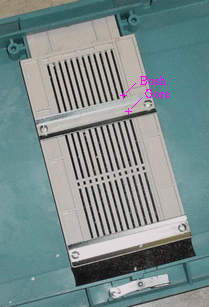
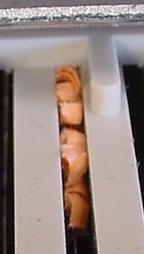
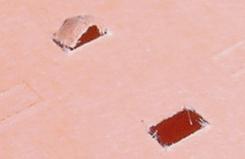
Are you familiar with what detailed examination of the voting machines revealed? Dr Jones disassembled one each of the two different machines in question. Here is a picture showing the structural bar that caused the problem. Here is a picture showing how the chads can be jammed behind the bar. Here is a picture of Pregnant chad resulting from punching into a firmly packed chad jam.
The ballot design put the location to punch for Gore right over top of the structural bar. Duh!
Down in the USA you follow the foolish practice of letting every county design its own ballots. Amateurs design them. Partisan amateurs, one from each Party. Here in Canada there is a standard, simple, ballot design.
If you were paying attention during the followup to the election you might have noticed that the Republicans were not defending the ballot design. Instead they merely pointed out that the Democrats signed off on it too.
Ballot designs that resulted in disproportionate numbers of chads for one candidate had been observed in previous Florida elections. It appears to me that the Republicans ballot designers were better informed than the Democrat ballot designers, and outsmarted them.
-
Re:A map without a key...
Are you counting the votes of overseas military/civvies?
I dunno. Does the USA have 16 million overseas voters? Lol.
Also, the dems brought out the 'hanging chad' and 'voters are too fucking stupid to read candidates' names' ploys. I found it totally freaking hilarious that it was only Al Gore supporters who claimed to have been 'confused' by the voting slips.
Are you familiar with what detailed examination of the voting machines revealed? Dr Jones disassembled one each of the two different machines in question. Here is a picture showing the structural bar that caused the problem. Here is a picture showing how the chads can be jammed behind the bar. Here is a picture of Pregnant chad resulting from punching into a firmly packed chad jam.
The ballot design put the location to punch for Gore right over top of the structural bar. Duh!
Down in the USA you follow the foolish practice of letting every county design its own ballots. Amateurs design them. Partisan amateurs, one from each Party. Here in Canada there is a standard, simple, ballot design.
If you were paying attention during the followup to the election you might have noticed that the Republicans were not defending the ballot design. Instead they merely pointed out that the Democrats signed off on it too.
Ballot designs that resulted in disproportionate numbers of chads for one candidate had been observed in previous Florida elections. It appears to me that the Republicans ballot designers were better informed than the Democrat ballot designers, and outsmarted them.
-
Re:A map without a key...
Are you counting the votes of overseas military/civvies?
I dunno. Does the USA have 16 million overseas voters? Lol.
Also, the dems brought out the 'hanging chad' and 'voters are too fucking stupid to read candidates' names' ploys. I found it totally freaking hilarious that it was only Al Gore supporters who claimed to have been 'confused' by the voting slips.
Are you familiar with what detailed examination of the voting machines revealed? Dr Jones disassembled one each of the two different machines in question. Here is a picture showing the structural bar that caused the problem. Here is a picture showing how the chads can be jammed behind the bar. Here is a picture of Pregnant chad resulting from punching into a firmly packed chad jam.
The ballot design put the location to punch for Gore right over top of the structural bar. Duh!
Down in the USA you follow the foolish practice of letting every county design its own ballots. Amateurs design them. Partisan amateurs, one from each Party. Here in Canada there is a standard, simple, ballot design.
If you were paying attention during the followup to the election you might have noticed that the Republicans were not defending the ballot design. Instead they merely pointed out that the Democrats signed off on it too.
Ballot designs that resulted in disproportionate numbers of chads for one candidate had been observed in previous Florida elections. It appears to me that the Republicans ballot designers were better informed than the Democrat ballot designers, and outsmarted them.
-
Re:Why would anyone want to listen to this anyway?For fans of experimental music, this kind of "field recording" isn't that far removed from other practitioners in the field who utilize recordings of atmospheric phenomena as the basis of audio pieces, sometimes processed, sometimes just left in the raw unfiltered recordings. As someone who counts himself a fan of the work of labels like Mego and Antiopic , this recording isn't too far from the kind of stuff I would gladly add to my over-burdened record collection.
For some samples of people working with this kind of source material, check out these two artists:
Joyce Hinterding -- Australian cross media artist working in part with ecordings of magnetic fields and weather satellites.
Steven Mcgreevy -- VLF (Very Low Frequency) recordins of atmospheric phenomena -- very beautiful, with audio samples available from the site.
-
interesting...
Sounds sort of like Saturn's radio emissions...
Does everything around Saturn sound the same? Perhaps it's all eminating from a single source? I dunno, maybe some sort of black rectangular monolith? -
Re:Question
James Van Allen did this back in 1953. Not carrying humans, but his "rockoons" got instruments relatively high up in the atmosphere for not much money.
By the way, contrary to popular assumption Dr. Van Allen is still alive and still working at the University of Iowa as a professor emeritus. His autobiography is here -
Re:license
It must involve at least two parties, party A and party B.
You're the one oversimplifing, because you said "at least two", but then only used exactly two in your example.
It's better to say that A = original developer (one of him), B = derivative developer (5 of them), C = end user (999999 of them). The GPL gives more freedom to A & C at the expense of B, which is usually more freedom overall.
(Of course, that makes assumptions about the relative populations of ABC, as well as about the quantified values of the freedom each has lost or gained. Your decision about which license produces the greater net freedom must depend on the weight you assign to each of those factors)
it doesn't appear to me that I have taken away anything from X by including a BSD component in my project - X will be in exactly the same state they were in before I chose to do so.
Sure. Exactly the same. Instead of increasing... By declining to increase $SOMETHING when you had the option to do so, the total amount of $SOMETHING is less overall. I think that's obvious.
Suppose I'm a founder of the USA, and I'm recruiting states to join. Should I allow citizens of these new members to own slaves? Or would taking away that freedom increase the level of freedom for everybody?
(That illustrates that a local decrease in freedom between two entities may create an overwhelmingly higher amount in the relationship between others)
It must involve the concept of party A doing something that affects party B in such a way that party B has less of something than he would have if party A would not have done that in the first place.
Nope. You create a false duality: increase or decrease. But in reality there is a third way: do nothing. Neither help nor harm.
And that 3rd option is what the GPL guards against, by encouraging other authors to GPL their own code by offering them a positive incentive to do so.
By examining history, we can see places where either the GPL or BSD license could've done more to increase overall freedom. Linux, for example, is much better as GPL than BSD, as has been proven by the multiple greedy corporations that use Linux in products but Free their changes in exchange. BSD, however, was superior for the Vorbis code.
There's no right answer for all cases, and to claim that such exists is the ultimate oversimplification.
I think this is what my Borg analogy is really driving at
Dump that analogy in the trash alongside the "viral GPL" one. The Borg suck you away with tractor beams and drill through your skull; a virus pierces your cytoplasmic membranes and injects invasive DNA. They're both aggressive, and act without the victim's consent.
The GPL, on the other hand, does nothing unless you willingly decide to modify code supplied under the GPL. If you like Star Trek analogies, then GPL is more like the UFP: if you want access to their technologies, your planet has to join up to the Federation. (They certainly don't go giving away technical secrets willy-nilly! The Prime Directive forbids it) -
Re:What about a spreadsheetSo if I write Macro in Excel will that be taxed too?
If you write a macro in Excel, you should be ashamed of yourself. You should wash your hands, too.
Seriously, there are good reasons not to use Excel.
-
Re:What about a spreadsheetSo if I write Macro in Excel will that be taxed too?
If you write a macro in Excel, you should be ashamed of yourself. You should wash your hands, too.
Seriously, there are good reasons not to use Excel.
-
From a current CS/Math majorI am pursuing a double BSc in Math and Computer Science. My school makes this extremely easy. To obtain a math degree in addition to a CS BSc, you have to take two additional classes. The typical person in this sort of track takes the following "math" classes (some classes are on the cusp of CS and Math):
Calculus I, II and III
Discrete Structures (graphs, trees, etc.)
Linear Algebra
Numerical Analysis
Algorithms
Abstract Algebra I
Also you have to take one or two math electives.. I opted for a course on Game Theory.
This is just a snapshot of my school career... YMMV, however one can see that CS and Math degrees are still heavily linked. -
Re:Which problems do you want?
Actually, failures in punch cards aren't going to happen fully randomly. The whole problem with the Florida ballots was that there's a flaw in the machine and certain positions were likely to be blocked by an accumulation of chad, which therefore make it impossible for the voter to properly punch the hole. This is somewhat mitigated by how they randomly shuffled the positions at different precincts.
The nice thing, however, is that once you create a standard for what rationally constitutes an intent by the voter to vote one way, you can always re-run the vote to check.
The part that was sticky in Florida was that there's no legal standard for what constituted the "intent" of the voter. Some ballots will always end up being poorly punched, just because people are stupid; there's nothing that can be done about that. However, if none of the holes are punched except for one dented hole on the card, it's pretty damn likely that they intended to properly punch that hole. If one hole is hanging and one hole is punched, it's pretty damn likely that the one where the hole is punched was intended.
I personally prefer the mark-sense systems because they can be electronically scanned just like punched cards, except they require even cheaper voting stations (i.e. a table with a privacy screen) and make the intent of the voter clearer. -
Re:two words,
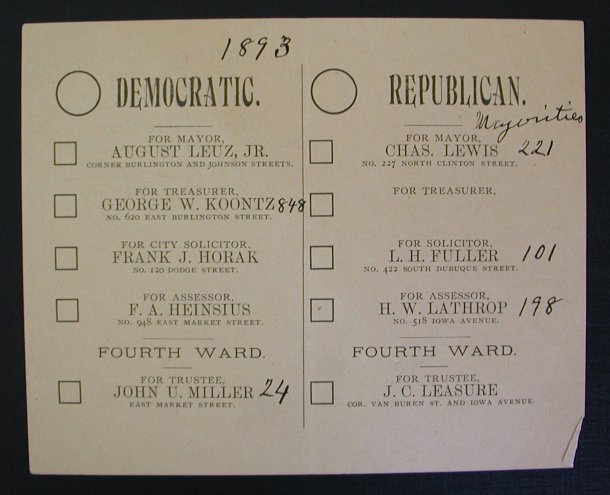
Oh yeah, and I don't mean punch cards like the Florida crap, I mean like this one,
http://www.cs.uiowa.edu/~jones/voting/pictures/bal lot1893b.jpg
check this site for more info,
http://www.cs.uiowa.edu/~jones/voting/pictures/ -
Re:two words,
Oh yeah, and I don't mean punch cards like the Florida crap, I mean like this one,
http://www.cs.uiowa.edu/~jones/voting/pictures/bal lot1893b.jpg
check this site for more info,
http://www.cs.uiowa.edu/~jones/voting/pictures/ -
Re:Why? What is the point?
-
Re:Does it matter?
An opposing view from something in a
-
The Original Clockwork OrangeAnthony Burgess, author of the book "A Clockwork Orange" was the artist in residence while I was in the undergraduate program at the Iowa City Writer's Workshop back in 1974. I think he based his book on the work of Jose M.R. Delgado, M.D. published under the book with the damn spooky title: "Physical Control of the Mind: Toward a Psychocivilized Society".
I managed to get a copy of the book finally, and discovered wonderful passages such as the following on page 115:
ESB [electrical stimulation of the brain -- JAB] may evoke more elaborate responses. For example, in one of our patients, electrical stimulation of the rostral part of the internal capsule produced head turning and slow displacement of the body to either side with a well-oriented and apparently normal sequence, as if the patient were looking for something. This stimulation was repeated six times on two different days with comparable results. The interesting fact was that the patient considered the evoked activity spontaneous and always offered a reasonable explanation for it. When asked, "What are you doing?" the answers were, "I am looking for my slippers," "I heard a noise," "I am restless," and "I was looking under the bed." In this case it was difficult to ascertain whether the stimulation had evoked a movement which the patient tried to justify, or if an hallucination had been elicited which subsequently induced the patient to move and to explore the surroundings.
This passage is eerily reminiscent of a passage from Richard Dawkins' "The Extended Phenotype" chapter titled "Host Phenotypes of Parasite Genes":
"Many fascinating examples of parasites manipulating the behavior of their hosts can be given. For nematomorph larvae, who need to break out of their insect hosts and get into water where they live as adults, '...a major difficulty in the parasite's life is the return to water. It is, therefore, of particular interest that the parasite appears to affect the behavior of its host, and "encourages" it to return to water. The mechanism by which this is achieved is obscure, but there are sufficient isolated reports to certify that the parasite does influence its host, and often suicidally for the host... One of the more dramatic reports describes an infected bee flying over a pool and, when about six feet over it, diving straight into the water. Immediately on impact the gordian worm burst out and swam into the water, the maimed bee being left to die' (Croll 1966)."
-
MADD is mad (we need YRC: "your rights in a car")If MADD had their way, they'd have a detector that if you touched a bottle of alcohol in the last two hours, you'd get a ticket for attempting to start your car. You think I'm kidding, but with an ignition interlock and the ever-falling BAC levels, it may just happen. (Do everyone a favor and read why MADD is mad.).
BTW, unlike MADD or a rambling lunatic, I'm going to back up every claim with a link.
MADD (and NHTSA) grossly overexaggerate their claims of "drunk driving accidents," which are really alcohol-related accidents (a misleading statistic used by NHTSA). Did you know that if you, while 100% sober, hit a drunk pedestrian, it counts as an alcohol-related accident? Or did you know that if you get in an accident and EVERYONE is sober (driver, pedestrian, passengers), you can still be counted as alcohol-related due to the statistical correction that NHTSA uses, since only 63% of drivers are tested for their BAC level!
MADD claims that 0.08 BAC reduction saves lives, yet a study by NHTSA found no proof of such reduction after North Carolina enacted the lower BAC limit: "There appears to have been little clear effect of the lower BAC limit in North Carolina. Survey data indicate that the general public believes the new law was well-publicized. Although awareness of the new lower limit was not particularly high nearly 18 months after the law took effect, frequent drinkers did evidence a substantial degree of awareness that the law had changed and about what the new BAC limit was. As is typical in North Carolina, enforcement of the lower limit was vigorous and strict."
MADD wants to lower the BAC limit lower and lower, to 0.05. It claims victory over the 0.08 law over the previous 0.10 standard. However, it has been found that "the relative risk [of being in a traffic accident while using a cell-phone] is similar to the hazard associated with driving with a blood alcohol level at the legal limit." The legal limit in that paper was 0.10 BAC. Another interesting note is that "These data also call into question driving regulations that prohibit handheld cell-phones and permit hands-free cell-phones, because no significant differences in the impairments caused by these two cellular devices were found.", but that's another topic of conversation.
Point is, why do they want to keep lowering the BAC when it has been shown that the vast majority of drunk driving accidents occurs with drivers with over 0.10 BAC, and that below that, it's as risky as using a cell phone? Why is MADD targeting low-BAC-level drivers, such as 0.08 (and as they hope 0.05), with huge fines, property confiscation, loss of driver license, and obscene insurance surcharges? MADD wants to bully states into the 0.08 BAC law by passing legislation that threatens their funding.
Furthermore, when NHTSA's accident data was loaded in a database and independent statistics were ran on it, the massive exaggerations were exposed. Quote from the previous link: "Through the use of this tool we were able to discover that across the entire country NHTSA nearly doubles the number of instances of drunk drivers. And this is prior to them implementing their "Multiple Imputation" methodology w
-
Re:Linux in cache?
If you had a larger cache than program code and memory requirements (and I guess I/O buffers) then you _could_ get everthing into a CPU level cache. That said caches are typically much smaller than the actuall RAM size so to fit the memory contents into cache a hashing algorithm is used. (eg use some of the bits from the memory address to index into the cache.)
Because of the hashing you might still get collisions, it depends, but when you get a collision then the "old" contents already in the cache have to be written back to memory or disk (if they are different then the original copy aka "dirty") or they could just be written over. This is why using a cache can possibly give you really bad performance if things in your code happen to occupy the same cache line in say an often repeated loop. (They keep bumping each other out of cache.)
Your idea leads to another interesting idea; what if the OS got it's own chunk of fast memory that the CPU could access quickly, possibly on a second bus. This relates to the LinuxBIOS project and something called a Harvard architecture (first link I found). -
Re:Good list of papers about electronic voting
Sorry, here is the link
http://www.cs.uiowa.edu/~jones/voting/ -
PDP-11/03 with teletype and FOCAL on paper tape
My pop brought this home from work one weekend. Its clockrate was less than 1 MHz, and had 32 kilowords of RAM (16-bit words.) This was in 1976.
The neatest thing about it was, when you powered it on, it presented a "machine language monitor" to whatever console device was hooked (e.g. teletype.) With it, you could store octal words to memory locations, list the octal value of memory, and execute programs (like FOCAL)
In fact, that was how you booted the damn thing. To boot a disk drive (we eventually got two 8" floppy drives), you'd type in the start address of teh boot loader EPROM, followed by 'G', and off it'd go. We ran RT-11, and eventually RSX-11S. Both were command-line O/Sen. Here I learned how to write code, mostly in the PDP-11 instruction set, which even back then was a better design than the 80x86 set.
It's a real antique now, in boxes in the folk's garage. We eventually got a "video terminal kit," which to make operational, we had to hand-solder each and every resister and capacitor onto a circuit board. Fortunately it worked first time out, unlike many of our other hand-built projects!
Overall, this was as good an introduction to computers as I could expect, as it taught me the innards of computers -fundamentals like bits, bytes, registers, etc. -
Perl is *NOT* Sweet Sixteen
Sweet Sixteen is an older computer language designed by Steve Wozniak (see http://oldcomputers.net/byteappleII.html and http://www.fadden.com/dl-apple2/sweet16.txt) for the apple ][ and is a little less bloated than Perl.
-
big honkin spreadsheet dictionaries
My Japanese textbook, Nakama 1, has a companion site provided by the publisher and authors, with some small additions made by Japanese lecturers at American universities. One of the resources that I initially thought would be useless was the spreadsheet-based dictionaries (first year, second year). These have proven quite valuable, especially since you can use Excel with the Office Japanese IME (offered for free from MS) to search the text in English or Japanese.
-
Without real money, this dosn't make sense.
The whole idea of using a market based system to get a poll sample is based on the idea that people will have more realistic responses if they have their money on the line, even if they don't necessarily agree with that particular outcome. The old "put your money where your mouth is" idea. Without actually putting down some green, it's all just hot air. There is a reason that the IEM was constructed by professors in Economics as well as Poli Sci and others. Because without the Economics part, it's just wanking.
Also, The concept of an Idea market is also a bit of a miss. When you take something like an election, and simply ask "Who do you think will win" and "By what margin", your questions are without bias towards a particular outcome. With an idea, there is no clear, predictable, final event. Will stock X go up? Yes. How much? In what time period? What if No one is right? What if the market takes a powerdive no one expected? Or a terrorist event causes the market to be closed for a day? How do I buy THAT stock? And that's even an idea that's easy to track, and has a two dimensional plane of movement. In the end it's silly because we don't NEED a meta-market for the actual stock market. We already HAVE the stock market, which does that job nicely. How would you track more nebulous ideas, that have no prediction market, but more unpredictable outcomes? Not with a market of this type.
The current stock market works because it takes all the factors of the world, and asks a simple question. Will all these things help or hinder this company from making money, and therefore, make this stock valuable or worthless. In this case, our old friend Gordon Gecko was right. Greed is good. It causes this system to work, and without it, there simply IS no stock market, for ideas, companies, politicians or anything else under the sun. -
Iowa Electronic Markets
The Iowa Electronic Markets at the University of Iowa has had this for a long time. And it does use real money, and is fully legal.
-
Re:In related news...
This is indeed an ARG (Alternate Reality Game) very similar to the A.I. ARG "The Beast"
-
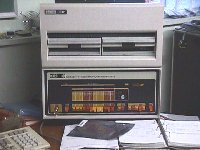
The PDP-8 from DECis actually, IMHO, the first personal computer and was introduced in March of 1965, predating the MCM by about 8 years.Here is one on a desktop (with dual floppies! woohoo!).
This was the first computer I got to use hands on (the language being FOCAL and one had to toggle in the bootstrapping code). It sure beat handing in cards for the 360!
A good starting point to read more is here
-
Re:Microsoft can't win by cutting prices
Almost.
At least, at my Uni, there is one way to keep your license (note, still ain't yours)--you graduate. Anything else, and all money you've given up is gone and you get nothing.
You drop out for a year? Gone.
You flunk out? Gone.
School decides it's not worth it anymore? Gone. (and they're extra susceptible to audits!)
Microsoft stops the agreement for any reason? Gone.
(check that one; I believe it's accurate).
Microsoft determines that your Uni is somehow in breech of contract? Gone.
What's more, they've just opened up a pandora's box of possiblities w.r.t. auditing the school and inspection, the EULA of the software aside. Microsoft now has access to student IP via inspecting their computers, as well as to the researchers' computers. Yay!
In addition, over the course of your schooling, you've already paid through the nose ($50-$70 or so per semester) for software you likely wouldn't have bought anyway! How many of us are still using Win98 for their desktop and Office 97 for their productivity software?!
Personally, I think it's insane. We've already seen Microsoft's attitude towards schools--audit 'em even when they're in financial trouble, and use it to force 'em into new licensing agreements. The schools have made a deal with the Devil, truly. -
Carl Sagan: "The Burden of Skepticism"
I know the popular thing to do is bash psuedo-sciences, and cold fusion because of its shaky introduction into popular thought quickly falls into this quagmire. But, let the human race dream before summarily dismissing the entire concept.
Carl Sagan addressed this issue in his essay, "The Burden of Skepticism." (See also lecture version).
Sagan explained:
It seems to me what is called for is an exquisite balance between two conflicting needs: the most skeptical scrutiny of all hypotheses that are served up to us and at the same time a great openness to new ideas. Obviously those two modes of thought are in some tension. But if you are able to exercise only one of these modes, whichever one it is, you're in deep trouble.
If you are only skeptical, then no new ideas make it through to you. You never learn anything new. You become a crotchety old person convinced that nonsense is ruling the world. (There is, of course, much data to support you.) But every now and then, maybe once in a hundred cases, a new idea turns out to be on the mark, valid and wonderful. If you are too much in the habit of being skeptical about everything, you are going to miss or resent it, and either way you will be standing in the way of understanding and progress.
On the other hand, if you are open to the point of gullibility and have not an ounce of skeptical sense in you, then you cannot distinguish the useful as from the worthless ones. If all ideas have equal validity then you are lost, because then, it seems to me, no ideas have any validity at all.
-
Re:Sounds of the plasma wind
I don't....think they used harmonically related channels...? They did have to downsample the original antenna recording to make it audible to us humans but it's still just a direct full spectrum recording from the plasma wave antenna...I think anyway, correct me if I'm wrong of course. I'm pretty sure the reason it sounds eerie is just due to the natural "noises" (actually EM radiation) given off by electrons spiraling around the magnetic field lines of Ganymede, which is thought to be produced by a salty ocean under it's surface. In a sense you're listening to the ocean on Ganymede.
-
Re:Sounds of the plasma wind
I don't....think they used harmonically related channels...? They did have to downsample the original antenna recording to make it audible to us humans but it's still just a direct full spectrum recording from the plasma wave antenna...I think anyway, correct me if I'm wrong of course. I'm pretty sure the reason it sounds eerie is just due to the natural "noises" (actually EM radiation) given off by electrons spiraling around the magnetic field lines of Ganymede, which is thought to be produced by a salty ocean under it's surface. In a sense you're listening to the ocean on Ganymede.
-
Re:I remember when..
I know for a fact that the Windows copies are for upgrades (although they may or may not be full copies on the CD, it says so in the license and at the info page (here and here)).
The MS Office stuff looks like it's for the full version (hmm).
A new important point is that, if the Uni decides not to renew the Campus agreement, you're treated the same as if you had not graduated (i.e., your license is revoked). The more I read about the program, the more ominous it seems, especially when you factor in the university's liabilities as Microsoft may see it (and they're the ones who can force an audit of every computer involved with the campus!)
Good points on the fact that the students never see the fees. Doubly so, because they're on their parents nickel, and the fees are hidden.
Finally, while MS Studio may cost $2k for most people, it's only $100 for the full Visual Studio system, so it would take exactly two semesters at $50 each to pay for it as a student (and as a university, I believe). The student rates for the other software is comparable (ca. $100 each). The students and university in general is getting ripped off, especially when you factor in the various anal clauses and things in there, and the Auditing bit. -
Re:I remember when..
I know for a fact that the Windows copies are for upgrades (although they may or may not be full copies on the CD, it says so in the license and at the info page (here and here)).
The MS Office stuff looks like it's for the full version (hmm).
A new important point is that, if the Uni decides not to renew the Campus agreement, you're treated the same as if you had not graduated (i.e., your license is revoked). The more I read about the program, the more ominous it seems, especially when you factor in the university's liabilities as Microsoft may see it (and they're the ones who can force an audit of every computer involved with the campus!)
Good points on the fact that the students never see the fees. Doubly so, because they're on their parents nickel, and the fees are hidden.
Finally, while MS Studio may cost $2k for most people, it's only $100 for the full Visual Studio system, so it would take exactly two semesters at $50 each to pay for it as a student (and as a university, I believe). The student rates for the other software is comparable (ca. $100 each). The students and university in general is getting ripped off, especially when you factor in the various anal clauses and things in there, and the Auditing bit. -
Even if you had to...
...load it from paper tape before you could start using it.
-
Re:Public Disgrace!!
I have said this before, and I am dead serious so do not mod this as funny, the only way to deal with this is if spammers fear for their safety. That could occur in two ways:
1 - Electronic Market
Similar to the Iowa Poltical Market people would buy futures in when a particular spammer would die, and when enough people stood to gain from a particular spammers death then market forces would apply themselves naturally.
2 - Vigilantism
Maybe it would start out as making their lives unpleasant, and would escalate as the need arose. -
"terrorist market" actually a good ideaThe so-called "terrorist market" was an information market, which is modelled after a futures market, not the stock market. The Iowa Electronic Markets, which are run by the University of Iowa, have proved themselves useful both in pooling information about possible future events (e.g., who will elected president) and in attracting ideas about possible outcomes. Information markets clearly are a good idea - though it makes sense for something like this to be run by a university rather than the Pentagon.
Regards
-
Market For Spammers
How about we set up a market for spammers, modeled after the Iowa Electronic Markets. Except instead of buying futures in political candidates, you buy futures in a spammer dying. If people stand to make millions from a certain spammer biting the dust then the market forces will apply themselves naturally.
-
Re:Science behind itThe "efficient markets hypothesis" would better be called the "efficient markets assumption." Remember that solid economic theory claims that bubbles cannot occur in markets because rational investors would recognize that the bubble was bound to burst and choose not to invest in the first place.
Yeah, right.
Having said that, there have been some interesting experiments predicting political events at the Iowa Electronic Market. They are much more likely to gather dispersed information --- in an election everyone has at least one piece of private information --- who they are planning to vote for. In a 'terrorism market' the vast vast majority of people have no private information, they're going to relying on the media and the market itself for information, not unlike the dot com boom where most investors had no idea of the real state of the businesses they were investing in.
Even if insiders decide to bet they are unlikely to be large enough to move the market by themselves.
-
This is just an information tool...
I'm considerably more Libertarian than the next guy, but you need to take the tin foil hat off for this one.
A futures market like this is just an efficient, effective tool for measuring the likelihood of something happening. It's essentially a datamining technique where you have a large number of intelligent actors processing information for you and coming together to find a market-clearing price. From this price, you can back out the likelihood of the event occuring.
This is nothing more than an application of sports betting or like the Iowa Electronic Markets, which I understand are good predictors of election results.
Alas, I'm afraid some of the more fanciful suggestions here will not come to pass. Do you really think a terrorist would be foolish enough to trade large on a DoD futures market right before committing some act? It would seem silly to do that with your DoD account when you could just sell airline and insurance stocks instead.
A market like this is not going to be sufficiently liquid for someone to either hedge the risk of an event or profit much on one.
That is, if you came to the market and tried to buy $3 billion worth of "Chippewa Falls destroyed by fire and brimstone SEP '03" futures, you'd probably spook the market and wouldn't find any profitable edge.
If I were the King of Jordan and I found out people were willing to pay $97 for a "King overthrown by December" I'd be pretty damned greatful for the head's up. It's like a free opinion poll.
And...except that it might be government sanctioned (though it would be easy enough to have an outside firm run the market), this is not different than betting sites making markets on whether Saddam will still be in power.
TIA sucks. But I think this is a not-so-novel, but pretty ingenious thing that really doesn't trample anyone's liberties. -
Like it or not, this stuff works.Look at the Iowa Electronic Markets, where people bet real money on the outcome of presidential elections and so forth. It has generally been more accurate than any poll. (Last presidential election was a rather unusual case)
The book Blind Man's Bluff also gives a detailed account of how the lost submarine USS Scorpion was located. All the experts could only narrow it down to a 20 mile radius. With no other options, they resorted to taking real money bets from other submarine commanders on the probabilities of different scenarios. Result? The submarine was found within a couple hundred yards from where they guessed.
Can you imagine some Navy officer going to his superiors at the Navy and explaining that we're going to try and find a submarine by having a betting pool on it? It sounds completely insane, and personally I can't believe anyone had the balls to suggest it. But it works. When people have a skin in the game, they tend to give their best, most honest appraisal. If it was up to me, I would require intelligence analyst types to participate in this kind of thing.
-
Precedents
The Iowa Electronic Markets operated by the University of Iowa Tippie College of Business has been n operaton since 1988. It has offered real-money futures contracts for U.S. and other political markets including"Control of Congress" as well as the Democratic & Republican Presidential nominee and the popular vote share, Senate seats, Russian and French Presidential contests, etc.
Speculation can be strictly distinguished from gambling.
The speculator makes a bet on the outcome of a risky event which would exist in the absence of speculators, such as bad weather and natural disasters.
The gambler, finding nothing satisfactory for betting, sets up a slotted wheel, makes six-sided dice, designs cards which are identical from the back but different from the front, and then bets on what happens when these devices are randomized.
Speculation shifts existing risk. Gambling adds to the universal total of risk.
The Pentagon site is speculative. -
Precedents
The Iowa Electronic Markets operated by the University of Iowa Tippie College of Business has been n operaton since 1988. It has offered real-money futures contracts for U.S. and other political markets including"Control of Congress" as well as the Democratic & Republican Presidential nominee and the popular vote share, Senate seats, Russian and French Presidential contests, etc.
Speculation can be strictly distinguished from gambling.
The speculator makes a bet on the outcome of a risky event which would exist in the absence of speculators, such as bad weather and natural disasters.
The gambler, finding nothing satisfactory for betting, sets up a slotted wheel, makes six-sided dice, designs cards which are identical from the back but different from the front, and then bets on what happens when these devices are randomized.
Speculation shifts existing risk. Gambling adds to the universal total of risk.
The Pentagon site is speculative. -
Re:Just clearing up a bit / Re:Word importing
If you read the old icelandic sagas, you'll find that all documented attemts to colonize Vinland - which most likely was the area around Newfoundland - failed. The longest semi-permanent settlement I can recall, was no more than two years before they had to withdraw; partly because of external treats (ie; the native americans), partly because of internal quarrels.
As far as the Kensintongton rune stone goes, it is widely accepted as a hoax (allthought I did find and include a link claiming the opposite). To sum up; The inscription doesnt follow the formula commonly used on runestones in scandinavia, use of a word not used in the scandinavian languages at the time, date (1362) out of whack with reality (by 1362, the old vikings had long since settled down and stopped exploring - and the tradition of putting up runestones had died out as well), the runic alphabet used to write the stone is younger than the date placed on the stone (in particulary the J-rune, which wasn't in use until around the mid 1500's).
Before anyone goes apeshit on me here; yes, runes was in common usage among norwegians and other scandinavians at the time the stone is supposed to date from; we have plenty of evidence of that from archeological digs in our old cities. But this sort of text, and so long texts, are not found in scandinavia. The vikings and their decendants were not a people of the book, allthought quite a lot of ordinary people could read and write in a fashion.
I have no explonations why you got a group of "fair-skinned" and "fair-haired" indians up in Michigan thought - but it's probaly just a coincidence of genetics. Blue eyes and blond hair are both recessive genes; meaning that if norse and native american mixed blood, those traits should be gone in a few generations anyway.