Slashdot Mirror
Domain: usgcrp.gov
Stories and comments across the archive that link to usgcrp.gov.
Comments · 45
-
Re:Should not be a surprise
Yes, I believe we've had this discussion before. If not with you, I've had with someone else. Now, who is National Science Foundation? Or to be more accurate, who makes up the National Science Board? The list can be found HERE. Surely these guys are not biased. Surely their daytime jobs would not be affected by AGW research, right? Let's look at a member, shall we?
Dan E. Arvizu became the eighth Director of the U.S. Department of Energy's National Renewable Energy Laboratory (NREL) on January 15, 2005. NREL, located in Golden, Colorado, is the Department of Energy's primary laboratory for energy efficiency and renewable energy research and development. NREL is operated for DOE by Alliance for Sustainable Energy, LLC (Alliance). He is President of Alliance and also is an Executive Vice President with the Midwest Research Institute, headquartered in Kansas City, Missouri.
Hmmm... Director of the US Dept of Energy's Renewable Energy Laboratory. Gee, I wonder what would happen to his funding if we found out that AGW is not really a problem. I wonder what his views are concerning giving grants to those that seek to disprove the current "consensus" of AGW.
How about this guy?
G. Wayne Clough has been a member of the faculty at Duke University, Stanford University, Virginia Tech, and the University of Washington. At Virginia Tech, he served as Head of the Department of Civil Engineering and as Dean of the College of Engineering. In 1993, he was appointed Provost and Vice President of Academic Affairs at the University of Washington, and in 1994 he became Georgia Tech's tenth president. In 2008 he was appointed the 12th Secretary of the Smithsonian Institution.
Hmmmm. The Smithsonian Institute? What do they have to do with Global Warming? Surely, they can be a non-biased source, right? Let's see.
Within the Smithsonian Institution, global change research is conducted at the Smithsonian Astrophysical Observatory, the National Air and Space Museum, the Smithsonian Environmental Research Center, the National Museum of Natural History, the Smithsonian Tropical Research Institute, and the National Zoological Park. Research is organized around themes of atmospheric processes, ecosystem dynamics, observing natural and anthropogenic environmental change on daily to decadal time scales, and defining longer term climate proxies present in the historical artifacts and records of the museums as well as in the geologic record at field sites. The Smithsonian Institution program strives to improve knowledge of the natural processes involved in global climate change, to provide a long-term repository of climate-relevant research materials for present and future studies, and to bring this knowledge to various audiences, ranging from scholarly to the lay public. The unique contribution of the Smithsonian Institution is a long-term perspective; for example, undertaking investigations that may require extended study before producing useful results and conducting observations on sufficiently long (e.g., decadal) time scales to resolve human-caused modification of natural variability.
Well, crap. How about a meteorologist. Surely one can be non-biased. How about this guy. Surely, he has no vested interest in government money going to AGW research:
He also directs the Sasaki Institute, which is a non-profit organization at the University of Oklahoma that fosters the development and application of knowledge, policy, and advanced technology for the mutual benefit of the government, academic and private sectors.
Well, there you have it. I'm not saying that all the members are biased, but here are three that deal with AGW. Many of the others are professors of health, philosophy, communications and other none climate disciplines.
So, yeah, it appears that the NSB, the part of the NSF that directs funding, is quite biased toward research that supports AGW and have jobs that are threatened by research that may disprove AGW.
-
Re:Cost? energy 1/10th gas cost
In case you didn't know, most of the hydro-electric power along the Columbia has large draws and large reservoirs - so this statement is still true even in summer. As a matter of fact, it's late summer and early fall where the draws are lowest, as glaciers stop melting as much.
True.. However we have had several years where the water was less than normal. At that time the AC use and irrigation diversion and pumping is above normal. I can remember being asked to not use Christmas lights in years past.
http://www.usgcrp.gov/usgcrp/Library/nationalassessment/overviewpnw.htm
Look at the streamflow graph..
"Relative to present flows (dashed), the wetter winters and drier summers simulated by climate models are very likely to shift peak streamflow earlier in the year, increasing the risk of late-summer shortages. Though the Columbia system is only moderately sensitive to climate change, allocation conflicts and a cumbersome network of interlocking authorities restrict its ability to adapt, producing substantial vulnerability to these shortages."
The streamflow doesn't vary all that much overall. But the local population has changed.. Demand on the system is causing problems. Here is mention of the Seattle area, known for it's wet weather.
"Seattle Public Utilities (SPU) experienced summer droughts and potential shortages in 1987, 1992, and 1998. Their responses to the three events illustrate institutional flexibility and learning. Summer 1987 began with full reservoirs, but a hot dry summer and a late return of autumn rains created a serious shortage in which water quality declined, inadequate flows were maintained for fish, and the main reservoir fell so low that an emergency pumping station had to be installed."
When the pond is low and the fall rains are late, the big pond is useless when it is empty.
The capacity of the ponds on the Columbia has grown little since the 1960's. In the meantime the population has more than doubled.
"The region has seen several decades of population and economic growth nearly twice the national rate, with population nearly doubling since 1970. "
The population has doubled, but hydro capacity has not. The Pacific NW's 80% of the power from hydro will continue to shrink as demand continues to outgrow the fixed capacity of the hydro system. -
Re:Manmade being key here...
Actually, the temperature increase started around the same time as the anthropogenic CO2 increase. You seem to believe that humans weren't contributing to CO2 before 1940, but the Industrial Revolution began before 1940, and indeed before 1880. Try referring to a combination of the hockey stick and a CO2 reconstruction, like here. The temperature really started ramping up a little after 1900, during which CO2 emissions were already on their way up.
-
Warming issues in NH not all positive
Given that the Northern Hemisphere at least is getting warmer, this is not entirely a bad thing as the food growing season is longer, and the increased productivity is an economic boon. From this government report on climate change: http://www.usgcrp.gov/usgcrp/Library/nationalasse
s sment/overviewmidwest.htm [usgcrp.gov] "With an increase in the length of the growing season, double cropping, the practice of planting a second crop after the first is harvested, is likely to become more prevalent. The CO2 fertilization effect is likely to enhance plant growth and contribute to generally higher yields. The largest increases are projected to occur in the northern areas of the region, where crop yields are currently temperature limited."
Up in British Columbia, Canada, vast amounts of pine forests are being destroyed due to the mountain pine beetle - an insect that was formerly kept in check during extended freezes in winter. The pine forests here are just devastated - it's really shocking to see places that were green a year or two ago that are now all brown and black. We just haven't had the temperatures to control it and it's not looking like we'll get them any time soon.
While there may be positives to a global warming trend, they would most likely be balanced out by negatives - new pests and diseases will be able to make inroads that they weren't able to before. -
Re:Mod parent flamebait
I wouldn't say that calling global warming 'highly doubtful' is inflammatory. While I have no doubt that continued destruction and pollution of our environment will have profound if not irreversable negative impact on our planet, attributing the sinking of an island to global warming is irresponsible journalism at best.
While ocean levels are rising around the world, Arctic levels are falling http://news.bbc.co.uk/2/hi/science/nature/5076322
. stm and the model predicting the globabl warming trend cannot explain why.Another unexplained action is while consensus is that the planet is getting warmer and glaciers are melting, the Antarctic ice sheet - by far the biggest in the word is actually growing larger: http://www.iceagenow.com/Growing_Antarctic_Ice_Sh
e et.htm. Glaciers in California are also growing: http://dwb.sacbee.com/content/news/story/14317368p -15234887c.htmlGiven that the Northern Hemisphere at least is getting warmer, this is not entirely a bad thing as the food growing season is longer, and the increased productivity is an economic boon. From this government report on climate change: http://www.usgcrp.gov/usgcrp/Library/nationalasse
s sment/overviewmidwest.htm "With an increase in the length of the growing season, double cropping, the practice of planting a second crop after the first is harvested, is likely to become more prevalent. The CO2 fertilization effect is likely to enhance plant growth and contribute to generally higher yields. The largest increases are projected to occur in the northern areas of the region, where crop yields are currently temperature limited."But with the increase in global temperature, the worlds deserts would increase in size causing more environmental destruction you say? Not so - the Sahara desert, the largest desert in the world, is actually shrinking, again contrary to the global warming model. http://www.newscientist.com/article/mg17523610.30
0 -africans-go-back-to-the-land-as-plants-reclaim-th e-desert.htmlSo given all of these environmental observations (not minor discrepancies but huge anomalies) that are contrary to the global warming prediction, I think its perfectly acceptableto have doubts as to the actual cause of sinking islands.
-
Whoa, ain't he the pot calling the kettle black!
'You can see "political science" at work when it comes to "global warming". Despite near unanimity in the science community there's now a movement - driven by ideology and short-term economics - to ignore the evidence and discredit the reality of climate change.' -BloomBerg
"Global Warming". "Unanimity". "Evidence". . .
These are buzzwords used by politicians to politicize climate cycles. LOL -- nice going, Mayor.
Yes, climate change is real. -
Re:HV/AC and the Ozone Daily News
from Anthropogenic Ozone Depletion: Status
-Monitoring data show that the growth in concentrations of ozone-depleting chemicals in the atmosphere is slowing, consistent with the declining production required by international agreements.
-The maximum ozone depletion (and increase in UV-B radiation) is likely to occur within the next 10 years; thereafter, the ozone layer is expected to slowly recover over the next several decades. -
pick one: wacko? alarmist? abused child?
as 'global warming' evidence mounts
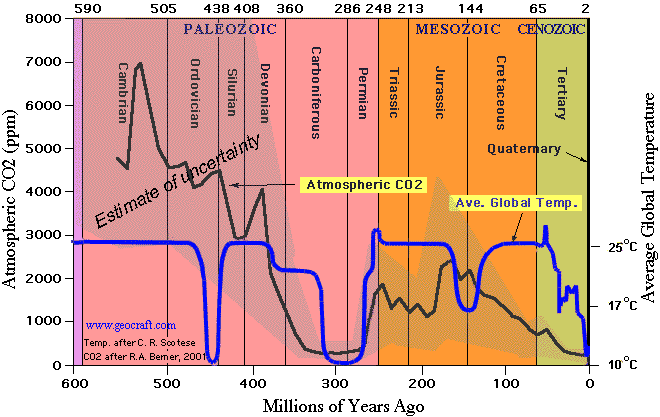
If you don't know what a climate cycle is by now, you are nuts. In fact, I don't think you really know anything -- clearly you are just angry political reasons, just like all the others. The data just doesn't back you alarmist wackos up. -
f*ck off, fruitbag
you can drive any car you like,
but try to tell me what I can drive, and I'll spit on you
buy all the buzz you want from your neighbor's little windfarm, see if it makes a difference
Why can't you 'global warming' hoes just relax and enjoy yourselves? -
Re:Also shrinking. . . .
The president doesn't write our budget. Congress does. And nobody gives a shit about climate change and 'global warming' because the climate changes and that's just the way it goes. Deal with it. The sun rises, the sun sets. Climates change. Get over it.
-
Re:Ways to combat "global warming"
11. wait
-
what a fucking idiot
unfortunately the little ice this wacko struggles to sustain with all his motorboats may actually inhibit the natural absorption of CO2 into the ocean.
-
Re:act now
Global cooling and warming were happening long before prognosticating worrywarts like you got here.
-
You people are so clueless!
100-yr trends are for herdsmen. here's a 440,000-yr trend.
try finding 1985 on this one. -
Re:How long till the skeptics post?
-
Re:Meet the new boss...same as the old boss
It might be a good idea to sell that beachfront property and start shopping for property further north
I heard an interesting story on NPR this afternoon about a village in Alaska that is being threatened by storms. Historically the village was safe because by this time of year the ocean near the shore had frozen. In recent years (past decade?) the oecan is not freezing before the severe storms hit. As a result, the erosion is removing the sand that the village is settled on. The general trend appears to be supported by a report from the US Global Change Research Corportaion. which states in partAll components of the cryosphere (the frozen portions of the Earth) in the Arctic are experiencing change, including snow cover, mountain and continental glaciers, permafrost, sea ice, and lake and river ice. For example, glaciers in Alaska, as throughout the Arctic, have retreated through most of the 20th century. Estimated losses in Alaskan glaciers are of the order of 30 feet in thickness over the past 40 years, even while some have gained thickness in their upper regions.
And don't cherry pick that "gained thickness in their upper regions" part. My guess (I'm not a glacial hydrologist) is that there is a small gain at the top due to increased precipitation -- possibly also caused by warming. Bottom line is the the ice mass is decreasing. On the matter of erosion the USGRP report saysIn fact, there are already numerous ecosystem changes observed due to permafrost thawing. They include:
Of course, being authored by an agency of the US goverment the report finds the silver liningIn the longer term, longer ice-free seasons are likely to bring substantial benefits to marine transport and offshore operations in the petroleum industry
Me. I think we've set in motion a huge experiment. We should do our best to minimize our impact, but being humans, we won't. The mass would rather swill another budwiser and flick the remote. -
Re:Potential disruption of methane pockets?
1.) Rather than hydrates being chemically altered by CO2, the implication
is that the process of trying to bury this CO2 could potentially disrupt
any already loose hydrates in that first 300 metres you mention. As you're
aware, the hydrates can then dissolve further in the water, the methane
turning to gas and rising as bubbles.
2.) Even the website for Mallik mentions that gas hydrates are also known
to cause seafloor instabilities. That fact alone should provoke a lot
of research in the feasibility of CO2 storage under the ocean floor.
3.) I don't dispute that hydrates are a possible alternative energy source. And
I certainly agree that the rate of consumption of fossil fuels is absurd. But Mallik
seems at a cursory glance a research project to determine production methods and
feasibility by drilling some permafrost cores. My primary concern would be how
invasive production techniques would be in order to mine the susbstance from
permafrost regions. As it is, the rate of loss of permafrost across the world.
Mt. Kilimanjaro seems to have "already lost some 82% of its permafrost
since 1912 - and 33% of this in the past two decades." Alaska could
potentially lose "as much as the top 30 to 35 feet (10 meters) of discontinuous
permafrost thawing by 2100." Granted, it's hard to play fortune teller, but the
rate of loss of permafrost globally has increased quite a bit over the last two
decades. Depending on the depth of the hydrates in the permafrost regions,
it would seem logical that these hydrates could thaw and further escape into the
atmosphere. If this is true, above-ground hydrate mining doesn't seem so feasible.
You may know much more about this than I do so your thoughts are appreciated.
-Shawn -
What for?
The amount of carbon dioxide in our atmosphere has not met any of the maximum levels reached over four distinct CO2-rich periods during the past 420,000 years. So what exactly would the purpose of this ridiculous exercise be?
-
Re:Scarce
In real life, we have to take into account the costs
Thankfully we have oilmen to do all that tricky math for us.
the sum of all of the above
$2.63/gal
global warming
-
Re:Global Warming Is Not Bad
I worry about a runaway greenhouse effect, where global temperatures rise above 100C from when you perturb a chaotic system
Ha, LOL. If the Earth's climate were actually choatic and actually being perturbed, maybe your two paragraphs of alarmist drivel would have actually meant something to somebody somewhere. -
Ha ha; Um, which record?
systematic temperature records
short-term temperature trends are for herdsmen and politicians. I prefer ice-core derived records. -
Re:1933 number is deceiving
Parent is correct. The number of hurricanes globally is not increasing. However, there is evidence that Hurricanes are becoming more intense because of global climate change.
Linkie.. (Lots of papers.) -
No Return?
-
about 150 years ago
The industrial revolution began 150 years ago. The question is, when did the current warming trend begin?
-
Yes
-
"Perma"frost?
If it melts as the planet warms, and then (gasp!) refreezes again as temps go back down, then can it be called permanent?
-
Re:Nothing to see here
big SUVs
Hmmm... who should I trust? These Antarctic scientists or a little canadian fruitbag who just called me a bad word? Tough one, but I'll go with A. -
Re:Nothing to see here
global warming would have been much less noticeable then it is now
-
Re:Yes, but...
-
Re:Is that so?
GW Critic: There doesn't appear to be any evidence that global warming is caused by human beings.
GW Wacko 1: "Troll!"
GW Wacko 2: "Dip Wad!"
GW Wacko 3: "You Shut up! That's Flamebait!"
GW Critic: OK? So you're telling me the warming of the earth is because of humans? Long term climate cycles really are just... just.. Wait... so what are they? -
Re:Maybe, but maybe not?
Here you are: 420,000 years of evidence
-
Re:Ahh.
For one thing, I guess the earth's normal climate cycles could, eh... 'interfere'...
-
Re:Um..?
They're just saying that climate change leads to mass extinction, be it normal cyclic (like the last 100,000 years) or cataclysmic (think dinosaurs - they didn't die because asteroid shards hit every single one of them, they died because the debris in the atmosphere blocked out the sun, causing the major producers of the time to die out). Right now the climate is changing, we're approaching a peak, anthropogenically aided or not. Will that lead to another mass extinction? That's the question they're raising. Nice jump to reactionary politicism, though.
-
Re:So what does that mean for us?
Pretty, but why don't take your graph and lay it on top of the Vostok 420,000 yr graph (from the parent) then come back here and chat about what you've discovered.
-
Re:So what does that mean for us?
-
Re:for the self-loathing fags of /.
http://www.junkscience.com/
At least they are honest with the domain name, offering a www site with comercially produced junk science.Of course I'd rather base my decisions on real science, as summarized in the IPCC reports and validated by the US National Assesment on Climate Change.
-
Re:More on sinks
"Correlations have been shown, and some effects have been linked to the temperature increases, but while many people, including some Slashdotters, have said that other ideas have all been debunked, I've still seen no evidence of it."
New Scientist
The New Scientist is the UK's preeminent scientific publication produced weekly.
Relevant Climate alteration page
The major point is that the Bush Administration backed away from other nation's reports. Another poster in the thread mentioned other nation's motives, but this is a misnomer because this isn't a national issue, but a global one. Given Governmental speed in dealing with such things, it would have been an idea to entertain the notion in 2002 rather than roll out think-tank advisors, which is actually what happened.
"That bothers me, because it just seems that the people arguing against them don't want to deal with them as they might upset their worldview."
Likewise some of us trying to get people to avoid dismissing the whole idea of Global Warming on the basis that it's not proven find that worldviews or personal paradigms are the hardest thing to change. I'm personally willing for the whole thing to be bunk; I've frequently argued against the 1970s idea that the population of the world would increase to the point where it cannot support itself. Starvation and disease are a feedback loop in themselves, the latter looking more interesting in the light of recent avian flu's crossing species lines with startling ease.
Likewise there are problems with the green movement in terms of a lack of real knowledge, but to dismiss everything based on the label 'tree hugger' is to throw the baby out with the bathwater.
-
Re:Excellent news
Well, you could do worse than the documents linked to from the first site. These look like particularly relevant ones (adjust as needed for
http://www.grida.no/climate/ipcc_tar/wg1/pdf/WG1 _T AR-FRONT.PDF
http://www.grida.no/climate/ipcc_tar/wg1/pdf/TAR -0 7.PDF
http://www.grida.no/climate/ipcc_tar/wg1/pdf/WG1 _T AR-FRONT.PDF
If a site calling itself environmentaldefense.org seems a bit leftish to be trusted, you might want to consider the current official study by the US government. When even the Bush White House acknowledges what's going on
Oh, here's the URL for the full report:
http://www.usgcrp.gov/usgcrp/Library/ocp2004-5/o cp 2004-5.pdf -
Re:Whoa.
Yes, and even before the Earth Simulator was built the US was falling behind on environment and climate research, to be behind even some smaller European nations.
Even so, the US preaches to the rest of the world how they should do and think. I think you have reached the state of "being so dumb you don't even KNOW that you are dumb". -
Re:I see a lot of talk about CO
Firstly, it is a troll, and it's one of the best that I've read. If I was wearing a hat, I'd take it off for the author.
As for the line "The world is heating up, it's largely Mankinds fault, and this is a bad thing that we must put a stop to", I think that first two points can be defending scientifically, the third is harder for me to answer as I haven't studied it.
The heating of the world has been well and truely observed. The ground, sea surface and deep sea all have been observed heating up at a significant rate. The upper atmosphere has shown a slight cooling, however this is line with loss of ozone and the addition of more particles to the atmosphere. A very diverse range of scientific bodies have agreed on this. Also boreholes, and other paloclimatic data supports this hypothesis.
That CO2 is significant cause of this is also well known. The greenhouse effect (of which CO2 is a very significant part) is a well accepted scientific principle, and it can be fairly well shown (by studing radioisotopes) that the rising CO2 levels are from human sources.
As for the third part, I can't say that much about it, but this link may interest you. It's a IPCC report on to the regional effects of climate change. I should note that I haven't read it myself (but I do intend to). -
Re:Two graphs to consider~
Well frankly I think none of us (those of us who aren't in the field) are qualified to say "this study's right, that model's wrong"; thus we can only make a judgement about the credibility of the people advanccing the various cases. And the the IPCC [www.ipcc.ch] have the most credible findings - if anything, they err on the conservative side so as not to freak out certain wobbly 'Western' nations with shakey commitment to doing anything. (The IPCC was set up to establish the global consensus amongst eveyone working in the field.)
Er, look at the name "Intergovernmental Panel on Climate Change's 2001" Does "Intergovernmental Panel" suggest anything to you? In fact, there are *NO* scientists on the IPCC, it's entirely composed of political appointees! Here's their organization information, not a single scientist listed. In fact, if you look at IPCC's forecasts for the near future dating back to their initial conception, time has proved every one of them wrong. -
Re:Cute, but false.
"In terms of real forested area, over 65% of NY state is forested, more than there was 150 years ago."
Ah yes the fine art of lying, you practice it very well my friend. Yes what you say is the truth but it's not the whole truth or nothing but the thruth. as This report shows there is less forest in NY then there was in 1600 and 1700. Not only that but the rate of reforestation has leveled off and is possibly dropping again. Again that's just in the north.
As the report I mentioned also makes clear the forests elsewhere are being cut down to make up for the offset.
That's just America though. Of course we stripped the northwest first and then replanted some of it as we started logging the west.
Worldwide the picture is a whole lot different. Right now for example it's cheaper to buy logs from canada then to log them here. We will probably stabilize and the canadians will cut more. In other places they are going to run out trees withing a hundred years. -
Katz: Belief trivializes the matter.This is real and serious. Not only has the UN and the vast majority of climate scientists agreed that Global warming and climate change is upon us, but even the Bush Administration has been forced to face these facts. Please read the US National Assessment of the potential consequences of human generated climate change. This is the report the Bush administration commissioned to assess the validity of the UN report on climate change which concluded ten years ago that it is happening and that it represents a serious threat to not only the survival of our civilization, but earth's very biodiversity is under threat by mass extinction.
The business community would like us to put our heads in the sand and forget about all these pesky problems steamrolling our way. But the consequences of inaction could be devastating for life across the planet, and our species survival. To continue to trivialize the debate by turning the issue into one of belief instead of verifiable facts simply accepts the common US big media propaganda and spin. This is not a debate of the number of angels on the head of a pin, it's a scientific debate whereby the vast majority of academic scientists the world over have accepted a common view that global climate change is real and could be devastating to life on earth. Please also see: Organization for Economic Co-Operation and Development documents on the issue as well.
--Maynard
-
Re:Too much theories??OK , OK , I am a gimp, I admit it... I posted the wrong link. Seriously, it's good reading & reasonably short.
--
If the good lord had meant me to live in Los Angeles -
Re:Too much theories??You're referring to the thermo-haline circulation in the north Atlantic, aka the Gulf Stream. Warm water heads north east from the Gulf of Mexico, gradually cooling as it does so. It dumps a load more heat into the western European climate which accounts for our unnaturally warm climate. (check the temperatures of other areas on the same latitude: Siberia, northern Canada... etc.) As the water cools, it becomes denser and saltier (due to evaporation). This culminates in some areas off Greenland ("gyres") where the cold dense water sinks and heads back south to restart the cycle. The whole cycle takes several centuries.
However several rather frightening changes have been seen in the temperature and saltiness (haline) of various important currents off the northern coast of Scandanavia . One apocalyptic scenario is indeed for the Gulf Stream to shutdown, which would ****up western Europe nicely.
However this is a *local* effect in the context of the global climate. The whole system is *extremely* complex (chaotic, even) and hard to model or predict. Broad, long-period predictions are easier to make than short term ones - we can model nice equilibrium states, but it's highly likely that in the short term (a few hundred years) that the entire planet will see wild fluctuations in precipitation, temperature, sea levels, yadda yadda.
Ob links:
- UN IPCC Third Assessment Report: Summary (PDF) This is especially sobering reading; contributed to by ~1000 leading world authorities on the science)
- Intergovernmental Panel on Climate Change main site
- GEO-2000 report
- Worldwatch
- EPA Global warming site
- New Scientist special report
Note to the inevitable sceptics: if you accept (say) evolution, Relativity, Quantum mechanics (random eexamples) as being very very very likely to be true, then at least read the damn docs, look at the scientists who are putting their reps on the line on this, and consider whether it's more likely that we *are* affecting the global climate in unpredictable ways, or that vested interests are funding astroturf movements to try to convince American voters that it's all a commie plot...
--
If the good lord had meant me to live in Los Angeles