Slashdot Mirror
Domain: wearcam.org
Stories and comments across the archive that link to wearcam.org.
Comments · 181
-
Re:Confirming the Brady-Curran model
On April 1, 1995, scientists discovered darkons! http://wearcam.org/theory_of_d...
-
Re:just leave
Surveillance is what governments do. You're not "the anti-surveillance crowd", you're the "anti-photography crowd". And photography in public places is perfectly OK in our society, and that includes restaurants.
First, video is not the same as photography.
Second, surveillance is not limited to government action but means only "the act of carefully watching someone or something especially in order to prevent or detect a crime". Photography or video need not be done by the state to be surveillance.
Third, restaurants are not public places. In fact the blog to which you link acknowledges to authority of business managers to ban photography on the premises.
My life is a creative work: my choice of dress, my manner of movement, my speech, everything I do is a . Photographs or videos of me in any but the most incidental manner (i.e., I happen to be walking down the street and you capture me in a street scene) are derivatives of that work. I do not grant Google any license to make or distribute such derivative works.
As Steve Mann put it, surveillance is theft.
But all in all, I suspect law won't be willing to address this, and we apparently can't rely on people doing the right thing on their own. We need ubiquitous jammers. Just cheap laser pointers could be an effective means to deal with "glassholes".
-
Re:Sometimes we should fear change.
It already happened.
http://wearcam.org/mcdonalds/eyetap_blogspot_mcdonalds.pdf
Anyone who thinks they won't be violently assaulted if they wear one of these things is already shown to be wrong.
-
Re:He's not just a researcher...
I've had the privilege of meeting Steve Mann (he lectures at the University I attended, so I sat in one some of his lectures and talked to him after class a bit). He quite literally wrote the book on wearable computers (http://wearcam.org/cyborg.htm), and a good portion of the book covers the hostile reactions people have to someone wearing conspicuous recording devices.
Come to think of it, I've previously commented on
That said, I am in no way trying to justify the actions of the thugs who assaulted Dr. Mann. I hope they get punished appropriately.
-
Take no prisoners
Sounds like you need smart underwear. Of course, this security technology is vulnerable to social engineering.
-
Re:The grey line of theft
But when I imagined this scenario in my mind, I was imagining walking into someplace like a Best Buy or a Wal-Mart and fucking them over
How is this "fucking them over"? It seems no more so than seeing an item in a brick-and-mortar store, than going home and searching on-line for a better deal. Or indeed, seeing an item in a brick-and-mortar store and then buying it at another brick-and-mortar store that you know has better prices. You are not ethically or legally obligated to purchase something at Store X just because you first see it at Store X.
And hell, you could easily stand in front of their table with your thumb up and have your friend shoot the picture and walk away. (You'd even own the copyright on that photo!)
You'd have violated the ethical subjectright of the author, and possibly (depending on jurisdiction) their legal right of publicity or right of privacy. Not really comparable.
-
no.. no and no.
This isn't a problem just because you "think" it's a problem.
The brain can train itself to deal with changes in perception almost instantly.
Even when you do something stupid like turn everything upside down http://wearcam.org/tetherless/node4.html the brain just makes it work right again.
People won't detrain their normal viewing of the world with 3d TVs, they'll train themselves in seeing 3d from screens as an extra on top of their training in 3d in real life.
-
Re:For all the /. whining about camera's
For all the
Acutally I've been complaining about those for years, thanks. Steve Mann's been talking about them for at least 15 years.
Criminals are by definition cowards given courage by anonymity, remove that and they revert to their craven state.
No, actually criminals are by definition those who violate laws. Depending on the law in question, violating it may be a cowardly act, or an act of bravery, or neither.
-
Re:Booooo!!
I mean what are you going to do, force stores to stop using cameras?
Yes. Sure. Absolutely. Or at least heavily regulate their use.
My life is an ongoing work of art. Video surveillance of my person is the creation of a derivative work -- a violation of my subjectright.
Perhaps you are too young to remember this, but there was a time -- within the living memory of the older cadre of
But my point is: it's not going away and it's really not that bad.
It is that bad, and we can make it go away by passing laws that say, "If you do this bad thing, you are out of business."
-
Re:It's not privacy, it's obscurity
In this case, it's one party simply compiling what another person has made public (even if doing so unknowingly). The problem is the people, and what they're making public, not the company - or individual - who is compiling it.
No, the problem is very much the people compiling and selling this information.
I am the author of my life; the information these leeches are compiling about me is a derivative work. Commercial use of such data (outside of fair use considerations) is a violation of my Subjectright.
The fact that part of the performance of the artistic work that is my life takes place in public is irrelevant -- if I perform a song or poem in public, I do not thereby place it in the public domain.
Is it any different if a company takes a picture of the front of your house, than if someone stalking you does it? Or even just a random tourist walking by?
The appearance of the front of my house is a personal artistic expression. It should be understood to be covered by copyright. A random tourist taking a photo is fair use; someone taking a photo to use for commercial purposes, is not.
-
Re:Getting old
He's right, society doesn't understand and until people learn to look past minor indiscretions society never will. Until that time, the only way to have a fresh start is to give people a name that doesn't have all the past associated with it.
Or we can try to have a sane society, and pass laws requiring businesses to delete any information associated with a person at that person's request.
Subjectright: you don't get to make money off data about me, without my consent. I am the author of my life, and the data you collect is a derivative work.
-
It already exists
A little pricey, but you can already buy such a thing: http://wearcam.org/domewear/
-
Adaptability of the brain.
Because the woman has been effectively blind since birth, the results suggest that the brain is able to adapt to new visual stimuli remarkably quickly.
We knew that already. People have been equipped with a camera and an actuator that "projects" an image through the tactile nerves on a patch of skin.... Those people similarly report being able to "see" using that hardware.This leads me to believe that our brains are not hardwired to interpret visual information only on just the optical nerve. During the first few years, we learn what nerves are connected where. And our brains are flexible, and will be able to adapt to changes in what-connects-where.
In an experiment, a long time ago(*), a person was equipped with glasses that flipped the image in his eyes upside-down. In about two weeks he didn't notice the difference anymore. Also, learned skills, like skiing, were instantly possible with the re-wired visual hardware. Adapting to the original situation (no flipping glasses) was quicker than adapting to the flipping glasses.
(*) http://wearcam.org/tetherless/node4.html I intended "a long time ago" to mean something like "in the 19-seventies", turns out the original experiment dates back to 1896!
-
Re:privacy?
If privacy is so important why parade around nude or in outlandish costumes then?
Because parading around nude, or in outlandish costumes, at a private event with a cohort that shares many of your values, is different than parading around nude, or in outlandish costumes, out in the mundane world.
Many people face the possibility of losing their jobs - or even their kids -- if their participation in events outside the cultural mainstream is found out. If someone can get their kid taken away for being at the SubGenius's "X Day", it could certainly happen to Burning Man attendees.
Doesn't mean I necessarily agree with this solution -- at events like Starwood and the Free Spirit Gathering, the rule is basically "You may not take a photo of anyone without their permission". If you want to add a DMCA-takedown enabling clause to that, it seems to me (though IANAL) that adding "If you do take any photographs during your attendance at this event without the permission of all identifiable subjects, you surrender all copyright interest and they immediately become the property of $EVENT_ORGANIZERS".
That way, legitimate photos are yours, and this kicks in only when you've violated someone's subjectright.
-
Kopin, as used by Mann
http://www.kopin.com/about-cyberdisplay/ (Tiny LCDs.)
http://wearcam.org/ (More complex than regular 'partially transparent' displays, but _far_ more capable - look up Mediated Reality / Augmented Reality.) -
Re:What is eye-fi and why would I care?
Back on topic, This card is a solution to a non-problem.
If you're trying to document misbehavior by police or other security personal, the kind of folks who will beat you and smash your camera, having some auto-upload capability is a very good idea.
Sousveillance makes corrupt officials nervous. Anything that enables it is a worthwhile technology. Hide a netbook nearby, have it relay images from eye-fi equipped camera to a server far away, and see bad cops caught in the act.
-
Re:The crossed the line this time
imagine how you would feel if a similar group performed the same action on Barack Obama (or a political leader in your own country)
If a similiar group engaged in sousveillance ("watchful vigilance from underneath") demonstrated that a government officials I admired (hah!) was engaging in illegal activities, such as using personal communication accounts to conduct official business to avoid the mandated official records, I'd be happy that they brought out the truth. I'd rather be corrected about someone I wrongfully admired, then persist in my error.
Government officials have no privacy rights when conducting their business. Palin was using this account to conduct official business, and that's the real issue here. When she started doing that, this account became rightfully open to the public. The sooner everyone understands she's crooked, the sooner McCain can dump her and get a better running mate - or the sooner McCain will be exposed as someone who doesn't care whether his running mate is crooked or not.
It's a win for the people either way. Fsck her and the moose she rode in on.
-
Septambic keyer DIY
Hey guys these devices have been around for a while. See Steve Mann's DIY septambic keyer project. More info on keyers.
Do any of you remember the Nintendo powerglove? Now that was the pinnacle of interface design IMHO!!! -
Re:Not so novel
I believe that Steve Mann of wearable computing fame was the first to create an algorithm for photo stitching.
-
Re:See also: The Bat Ultrasonic Location System
Interesting. The UW RFID project reminded me of Steve Mann's work with cameras, particularly his concept of sousveillance. I think there is a quite a bit of good use to be had with RFID tags, especially for a plastic tag you could put on luggage, or other shipping issues. I'm glad they conducted this study, there is some scholarship on what the effect of privacy might be in a "web of things" but scientific-ish research is always nice to pull out to bolster your argument when these issues are being legislated on.
-
Re:It seems rather cut and dried against the cop
common sense - whether or not there should be an expectation of privacy.
The best way to align the use of recording devices with the "expectation of privacy" is to allow recording devices only when carried on a human being.
Steve Mann notes that privacy has two aspects: being apart from the company of other people, and being apart from observation. He suggests that we ought to combine them, and only allow recording systems to be attached to people. I think it's an excellent idea.
-
Steve Mann has been doing this kind of thing...
Steve Mann has been doing this kind of thing since the '90s. Well, since 1981, but it didn't really get wearable until the '90s.
http://en.wikipedia.org/wiki/Steve_Mann
http://wearcam.org/steve.html
When I met him at Usenix he looked more like a guy wearing dark glasses and an unusually thick sweater for the season... his wearable computer was built into a vest and the display was hidden in the glasses frame. The new model Eyetap is no more obtrusive than the borg-style bluetooth headsets you see people wearing.
He's done stuff like having his reality completely mediated, with advertising around him bluescreened out by an image recogniser back in his office. The possibilities are endless. -
Welcome to the Transparent Society
Sheesh, The Transparent Society came out nearly 10 years ago, Earth was published in 1990, and some of the same themes show up in Stand on Zanzibar (1968) and The Shockwave Rider (1975). Professor Steve Mann took this further and developed a series of Wearcams through the '90s.
Anyone who hasn't been anticipating this for at least the past decade, if not longer, has some remedial reading ahead of them. -
Re:Not all that ominous IMO
I'd rather have more police than more surveilance cameras, especially if those police are subject to sousveillance.
But I'd rather have fewer police, much better trained and paid and held to much higher standards, and dedicated to stopping actual crime (that is, threats to other people's rights) rather than locking up drug users and prostitutes.
-
Re:Not all that ominous IMO
Ubiquitous remote cams on the other hand are.
I agree with you and with Steve Mann - cameras on people, ok; cameras making your city a Panopticon prison, bad.
-
Well...
-
Steve Mann
Steve Mann wrote a textbook worth reading by anyone truly interested in the subject.
-
Re:Here is the reason...
The distinction you're drawing is as silly and absurd as that old saw about the tree that falls with nobody around. When you are "in a public place," other people have a right to "look at what you're doing."
Well, first, there's nothing silly or absurd about the question of the nature of "objective" reality versus the nature of observable reality, it's a problem that vexes Zen masters and quantum physicists alike.
But that's beside the point. When you are in a place, public or private, other people who are there have a right to look at what you're doing. It is an exchange, an equality: you seem them and they see you.
That does not in any way inform the question of whether people who are not there should have any right to look at what you're doing. That is not an exchange, it is a taking; it is not an equal relationship, it is lord and serf, jailor and prisoner.
Law enforcement cameras are entitled to be anywhere an officer of the law is entitled to be.
If we want a society that respects and promotes liberty, law enforcement cameras are entitled to be only where officers of the law are present - wearables and copcar-cams are fine, provided that civilians can also wear or dashboard-mount cameras. That would be an equal relationship. (See Steve Mann's thoughts on wearable webcams, interesting precursor to contempory camera phones.)
But your approach to surveillance cameras in every space that's not privately owned turns every public place into a panopticon jail, sacrificing liberty for little if any reduction in crime. (Besides depriving people of their liberty, prisons are actually not very safe places, tending to harden both inmates and guards.)
-
Re:Same as always
The thing you keep missing is that no one has an expectation of privacy in a public place.
Of course you have an expectation of privacy in a public place, if no one is around. Expectation of privacy is based on the presence or absense of other human beings, not vague distinctions been a "public" or a "private" space. I expect that I can kiss my lover with extra passion in the park if no one is around, in a way that I might not do in my own home if my housemate is there.
What about video cameras on the dashboards of police cars? Are they not the same as the camera mounted on poles if both cameras point to the same location?
Not at all. The dashboard-cam is there only if the cop is there. I have no problem with cameras (sans telephoto lenses, et cetera) in or at least next to the actual physical hands of cops. Steve Mann pointed out the difference between wearable cameras and surveillance cameras more than a decade ago:
So who is afraid of a camera connected to a radio transmitter? True it does reduce our privacy slightly. It's one more camera in a world already full of cameras. Given a choice between hidden cameras in my workplace, and cameras mounted on people in my workplace I'd choose the latter. Both are intrusions into my privacy, but the latter is far less intrusive, and far more symmetrical. With the latter, you use the simple rule: when somebody's looking, you're on camera, when nobody's looking you're not on camera. You can still pick your nose when nobody's looking. In the toilet stall or department store changeroom, nobody else is present so you're not on camera. Privacy equals seclusion. Observation needs company.
If we envision a society in which fixed-cameras of all kinds are prohibited, and only wearable cameras are allowed, and assume, further, that wearable cameras are cheap enough that everyone could afford one, such a society may well be more private than the one in which we are currently living. In fact, if we were all wearing cameras we could certainly reduce crime. Crimes would be solved by cooperation among individuals. In a sense we would be witnesses with augmented visual memory, and augmented visual communications skills. These augmentations would eliminate the need for surveillance cameras, and it would not be necessary to have fixed cameras (hidden or not).
-
A possible read
You might be interested in http://wearcam.org/anonequity.htm
which isn't technically specific like you are interested in, but it explores the ideas you bring up.
As for the UCLA student, that bastard had it coming. -
Just do you part to fight back... SousveillanceFor fun times, bring a video camera into an airport or wal-mart and start filming the ceilings and asking the officials what the dark hemispheres are. If they are allowed to film you without explicit permission, why aren't you allowed to film them for your own personal protection?
I want to make a T-shirt to sell to black hat attendees that reads something like: "By looking in my direction you implicitly agree to have your likeness stored in my feeble brain and/or my camcorder flash memory cartridges."
But I'm too dumb/lazy to make it into a snappier statement.
Here are some links on Sousveillance so I can earn my +1 informative point:- Sousveillance
- A generic link for those who aren't fans of Steve Mann.
-
Re:oversight
Just mentioned this in another post, but, again:
http://en.wikipedia.org/wiki/Sousveillance
http://wearcam.org/sousveillance.htm -
Re:This is absurd on so many levels
You might find the concept of sousveillance interesting.
http://en.wikipedia.org/wiki/Sousveillance
http://wearcam.org/sousveillance.htm -
sousveillance & shootback
(sousveillance) '... watchful vigilance from underneath
Steve Mann [1] has a lot of intelligent things to say on surveillance [2], sousveillance [3] and the intersection of technology & privacy. The earliest I can find is in a 1995 paper [4]. In an article predating the Austrians, Mann advocates shooting back (with your own camera) [5].
More links can be found here. [6]
Reference
[0] Steve Mann, 'definition from Sousveillance as an alternative balance':
http://wearcam.org/sousveillance.htm
[Accessed Tuesday, 3 January 2006]
[1] Steve Mann, 'Cyberman':
http://wearcam.org/steve.html
[Accessed Tuesday, 3 January 2006]
[2] Steve Mann, 'Identity Trail - Stream 3 - technologies that identify, anonymize and authenticate':
http://idtrail.org/content/view/47/43/
[Accessed Tuesday, 3 January 2006]
[3] Steve Mann, 'Sousveillance: A Gathering of the Tribes':
http://sousveillance.org/tribesissue/
[Accessed Tuesday, 3 January 2006]
[4] Steve Mann, 'PRIVACY ISSUES OF WEARABLE CAMERAS VERSUS SURVEILLANCE CAMERAS, Feb. 24, 1995':
http://wearcam.org/netcam_privacy_issues.html
[Accessed Tuesday, 3 January 2006]
[5] Steve Mann, 'Shooting back article & pictures':
http://wearcam.org/shootingback.html
[Accessed Tuesday, 3 January 2006]
[6] Delicious 'my delicious links on steve.mann':
http://del.icio.us/goon/steve.mann
[Accessed Tuesday, 3 January 2006] -
sousveillance & shootback
(sousveillance) '... watchful vigilance from underneath
Steve Mann [1] has a lot of intelligent things to say on surveillance [2], sousveillance [3] and the intersection of technology & privacy. The earliest I can find is in a 1995 paper [4]. In an article predating the Austrians, Mann advocates shooting back (with your own camera) [5].
More links can be found here. [6]
Reference
[0] Steve Mann, 'definition from Sousveillance as an alternative balance':
http://wearcam.org/sousveillance.htm
[Accessed Tuesday, 3 January 2006]
[1] Steve Mann, 'Cyberman':
http://wearcam.org/steve.html
[Accessed Tuesday, 3 January 2006]
[2] Steve Mann, 'Identity Trail - Stream 3 - technologies that identify, anonymize and authenticate':
http://idtrail.org/content/view/47/43/
[Accessed Tuesday, 3 January 2006]
[3] Steve Mann, 'Sousveillance: A Gathering of the Tribes':
http://sousveillance.org/tribesissue/
[Accessed Tuesday, 3 January 2006]
[4] Steve Mann, 'PRIVACY ISSUES OF WEARABLE CAMERAS VERSUS SURVEILLANCE CAMERAS, Feb. 24, 1995':
http://wearcam.org/netcam_privacy_issues.html
[Accessed Tuesday, 3 January 2006]
[5] Steve Mann, 'Shooting back article & pictures':
http://wearcam.org/shootingback.html
[Accessed Tuesday, 3 January 2006]
[6] Delicious 'my delicious links on steve.mann':
http://del.icio.us/goon/steve.mann
[Accessed Tuesday, 3 January 2006] -
sousveillance & shootback
(sousveillance) '... watchful vigilance from underneath
Steve Mann [1] has a lot of intelligent things to say on surveillance [2], sousveillance [3] and the intersection of technology & privacy. The earliest I can find is in a 1995 paper [4]. In an article predating the Austrians, Mann advocates shooting back (with your own camera) [5].
More links can be found here. [6]
Reference
[0] Steve Mann, 'definition from Sousveillance as an alternative balance':
http://wearcam.org/sousveillance.htm
[Accessed Tuesday, 3 January 2006]
[1] Steve Mann, 'Cyberman':
http://wearcam.org/steve.html
[Accessed Tuesday, 3 January 2006]
[2] Steve Mann, 'Identity Trail - Stream 3 - technologies that identify, anonymize and authenticate':
http://idtrail.org/content/view/47/43/
[Accessed Tuesday, 3 January 2006]
[3] Steve Mann, 'Sousveillance: A Gathering of the Tribes':
http://sousveillance.org/tribesissue/
[Accessed Tuesday, 3 January 2006]
[4] Steve Mann, 'PRIVACY ISSUES OF WEARABLE CAMERAS VERSUS SURVEILLANCE CAMERAS, Feb. 24, 1995':
http://wearcam.org/netcam_privacy_issues.html
[Accessed Tuesday, 3 January 2006]
[5] Steve Mann, 'Shooting back article & pictures':
http://wearcam.org/shootingback.html
[Accessed Tuesday, 3 January 2006]
[6] Delicious 'my delicious links on steve.mann':
http://del.icio.us/goon/steve.mann
[Accessed Tuesday, 3 January 2006] -
sousveillance & shootback
(sousveillance) '... watchful vigilance from underneath
Steve Mann [1] has a lot of intelligent things to say on surveillance [2], sousveillance [3] and the intersection of technology & privacy. The earliest I can find is in a 1995 paper [4]. In an article predating the Austrians, Mann advocates shooting back (with your own camera) [5].
More links can be found here. [6]
Reference
[0] Steve Mann, 'definition from Sousveillance as an alternative balance':
http://wearcam.org/sousveillance.htm
[Accessed Tuesday, 3 January 2006]
[1] Steve Mann, 'Cyberman':
http://wearcam.org/steve.html
[Accessed Tuesday, 3 January 2006]
[2] Steve Mann, 'Identity Trail - Stream 3 - technologies that identify, anonymize and authenticate':
http://idtrail.org/content/view/47/43/
[Accessed Tuesday, 3 January 2006]
[3] Steve Mann, 'Sousveillance: A Gathering of the Tribes':
http://sousveillance.org/tribesissue/
[Accessed Tuesday, 3 January 2006]
[4] Steve Mann, 'PRIVACY ISSUES OF WEARABLE CAMERAS VERSUS SURVEILLANCE CAMERAS, Feb. 24, 1995':
http://wearcam.org/netcam_privacy_issues.html
[Accessed Tuesday, 3 January 2006]
[5] Steve Mann, 'Shooting back article & pictures':
http://wearcam.org/shootingback.html
[Accessed Tuesday, 3 January 2006]
[6] Delicious 'my delicious links on steve.mann':
http://del.icio.us/goon/steve.mann
[Accessed Tuesday, 3 January 2006] -
sousveillance & shootback
(sousveillance) '... watchful vigilance from underneath
Steve Mann [1] has a lot of intelligent things to say on surveillance [2], sousveillance [3] and the intersection of technology & privacy. The earliest I can find is in a 1995 paper [4]. In an article predating the Austrians, Mann advocates shooting back (with your own camera) [5].
More links can be found here. [6]
Reference
[0] Steve Mann, 'definition from Sousveillance as an alternative balance':
http://wearcam.org/sousveillance.htm
[Accessed Tuesday, 3 January 2006]
[1] Steve Mann, 'Cyberman':
http://wearcam.org/steve.html
[Accessed Tuesday, 3 January 2006]
[2] Steve Mann, 'Identity Trail - Stream 3 - technologies that identify, anonymize and authenticate':
http://idtrail.org/content/view/47/43/
[Accessed Tuesday, 3 January 2006]
[3] Steve Mann, 'Sousveillance: A Gathering of the Tribes':
http://sousveillance.org/tribesissue/
[Accessed Tuesday, 3 January 2006]
[4] Steve Mann, 'PRIVACY ISSUES OF WEARABLE CAMERAS VERSUS SURVEILLANCE CAMERAS, Feb. 24, 1995':
http://wearcam.org/netcam_privacy_issues.html
[Accessed Tuesday, 3 January 2006]
[5] Steve Mann, 'Shooting back article & pictures':
http://wearcam.org/shootingback.html
[Accessed Tuesday, 3 January 2006]
[6] Delicious 'my delicious links on steve.mann':
http://del.icio.us/goon/steve.mann
[Accessed Tuesday, 3 January 2006] -
sousveillance & shootback
(sousveillance) '... watchful vigilance from underneath
Steve Mann [1] has a lot of intelligent things to say on surveillance [2], sousveillance [3] and the intersection of technology & privacy. The earliest I can find is in a 1995 paper [4]. In an article predating the Austrians, Mann advocates shooting back (with your own camera) [5].
More links can be found here. [6]
Reference
[0] Steve Mann, 'definition from Sousveillance as an alternative balance':
http://wearcam.org/sousveillance.htm
[Accessed Tuesday, 3 January 2006]
[1] Steve Mann, 'Cyberman':
http://wearcam.org/steve.html
[Accessed Tuesday, 3 January 2006]
[2] Steve Mann, 'Identity Trail - Stream 3 - technologies that identify, anonymize and authenticate':
http://idtrail.org/content/view/47/43/
[Accessed Tuesday, 3 January 2006]
[3] Steve Mann, 'Sousveillance: A Gathering of the Tribes':
http://sousveillance.org/tribesissue/
[Accessed Tuesday, 3 January 2006]
[4] Steve Mann, 'PRIVACY ISSUES OF WEARABLE CAMERAS VERSUS SURVEILLANCE CAMERAS, Feb. 24, 1995':
http://wearcam.org/netcam_privacy_issues.html
[Accessed Tuesday, 3 January 2006]
[5] Steve Mann, 'Shooting back article & pictures':
http://wearcam.org/shootingback.html
[Accessed Tuesday, 3 January 2006]
[6] Delicious 'my delicious links on steve.mann':
http://del.icio.us/goon/steve.mann
[Accessed Tuesday, 3 January 2006] -
sousveillance & shootback
(sousveillance) '... watchful vigilance from underneath
Steve Mann [1] has a lot of intelligent things to say on surveillance [2], sousveillance [3] and the intersection of technology & privacy. The earliest I can find is in a 1995 paper [4]. In an article predating the Austrians, Mann advocates shooting back (with your own camera) [5].
More links can be found here. [6]
Reference
[0] Steve Mann, 'definition from Sousveillance as an alternative balance':
http://wearcam.org/sousveillance.htm
[Accessed Tuesday, 3 January 2006]
[1] Steve Mann, 'Cyberman':
http://wearcam.org/steve.html
[Accessed Tuesday, 3 January 2006]
[2] Steve Mann, 'Identity Trail - Stream 3 - technologies that identify, anonymize and authenticate':
http://idtrail.org/content/view/47/43/
[Accessed Tuesday, 3 January 2006]
[3] Steve Mann, 'Sousveillance: A Gathering of the Tribes':
http://sousveillance.org/tribesissue/
[Accessed Tuesday, 3 January 2006]
[4] Steve Mann, 'PRIVACY ISSUES OF WEARABLE CAMERAS VERSUS SURVEILLANCE CAMERAS, Feb. 24, 1995':
http://wearcam.org/netcam_privacy_issues.html
[Accessed Tuesday, 3 January 2006]
[5] Steve Mann, 'Shooting back article & pictures':
http://wearcam.org/shootingback.html
[Accessed Tuesday, 3 January 2006]
[6] Delicious 'my delicious links on steve.mann':
http://del.icio.us/goon/steve.mann
[Accessed Tuesday, 3 January 2006] -
Re:Ha!
Check out the SeatSale EULA for the preferred solution to the "telling people what happens" part.
-
ACM CFP conference keynote: presentation material
The presentation materials from the Opening Keynote Plenary Panel (Steve Mann, David Brin, and others) on equiveillance is now at http://wearcam.org/cfp2005/ along with pictures of the equiveillance tour (that was funded by Bell, by the way), and the making of the camera bags (some with live wireless transmission) so that all attendees could participate. Each conference attendee received a "maybecamera" bag but didn't know whether or not theirs had a real camera and transmitter in it.
-
readers, make your own mind up
-
Not again ...
As an engineering student at the University of Toronto ("Toike Oike! Toike Oike! Ollum te chollum te chay!" etc.) I shudder everytime I read anything along the lines of "Mann, a University of Toronto professor...". To my knowledge he hasn't taught a class in two years, and hasn't taught anything besides a postgrad seminar based on his own book - moreover his published work is repetitive and focused on his personal goal of becoming a cyborg. His lab is very small in proportion to his media profile and commercially (rather than research) -oriented.
In general this makes me feel badly for some of the truly excellent professors UofT has doing pioneering research in a wide range of fields. They tend to labour in anonymity because their work (in many cases with wider implications than Mann's) is less understandable to the general public and keeps them sufficiently busy to preclude field trips to Seattle malls. I sincerely hope this stunt wasn't in any way funded by his UofT salary. -
Not again ...
As an engineering student at the University of Toronto ("Toike Oike! Toike Oike! Ollum te chollum te chay!" etc.) I shudder everytime I read anything along the lines of "Mann, a University of Toronto professor...". To my knowledge he hasn't taught a class in two years, and hasn't taught anything besides a postgrad seminar based on his own book - moreover his published work is repetitive and focused on his personal goal of becoming a cyborg. His lab is very small in proportion to his media profile and commercially (rather than research) -oriented.
In general this makes me feel badly for some of the truly excellent professors UofT has doing pioneering research in a wide range of fields. They tend to labour in anonymity because their work (in many cases with wider implications than Mann's) is less understandable to the general public and keeps them sufficiently busy to preclude field trips to Seattle malls. I sincerely hope this stunt wasn't in any way funded by his UofT salary. -
CeBit footage
Charbax' Rube Goldbergesque headcam cyber setup was pretty interesting - Terry Gilliam would surely approve of all the visible wiring - reminds me of early designs from Steve Mann. Now Charbax only needs to find a way to broadcast live! Thanks for sharing these.
-
Re:No 'Killer App'
If you're not trolling and really interested in a "killer app" with regards to wearable computing, I suggest you read this paper by Steve Mann which explains exactly how augmented reality can improve your awareness in everyday situations.
The man is truly a genius and well ahead of our time. -
Re:Too bulky
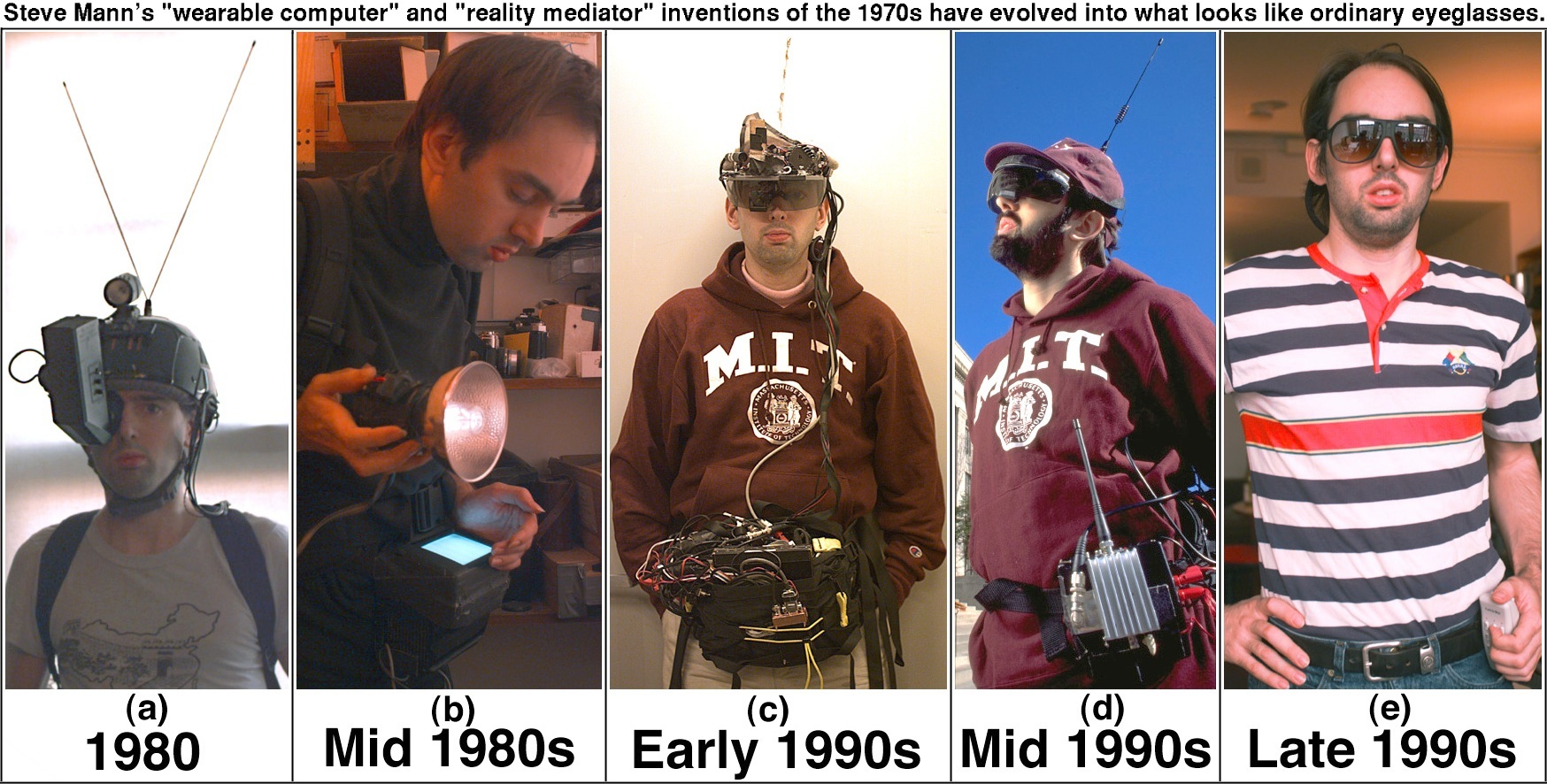
I think somebody should upload this picture to Wikipedia for the "nerd" article. Especially the helmet on the left; that picture is priceless.
-
Re:I welcome..
If it can prevent crimes/terrorism, or at give the authorities a clue on who did sent what, i dont have a problem about getting my picture take.. Its already on dozens of other surveillance videos, and I havent seen people complaining about that..
Is that sarcasm that I'm missing, a troll, or simple ignorance?
No, cameras don't significantly prevent crimes. Giving the state the ability to track citizen's communications is a bad idea, sure to be abused. And if you haven't seen people complaining about the growing surveillance culture, you need to open your eyes.
-
UCSC, not MIT
The roulette shoe computer is here.. UCSC, MIT