Slashdot Mirror
Domain: wikimedia.org
Stories and comments across the archive that link to wikimedia.org.
Comments · 6,832
-
Re:You see? They *are* changing their business mod
Easier than searching newsgroups or torrents right after the show and downloading without commercials at all?
Easier for someone to quickly get access to a nice, clean version of the broadcast in a convenient format, strip the commercials and stick it on a file-sharing website. This still counts as "making it easier for the pirates" - but either way, the regional aspect of commercials still applies - very few companies will be in a position to push the same commercials in more than a couple of countries.
The TV networks are operating under a logical fallacy, although sadly I'm not sure of the name. It's where you compare options against the way the world 'should be' in your head, and not the actual way the world is.
Wikipedia suggests the Nirvana or Perfect Solution fallacy, or at least, that seems similar. And yes, much of the anti-pirate lobby seem to argue along these lines; forgetting that they are doing better financially now than they ever have. A common mistake is to look at the "number of downloads" rather than the "number of sales that didn't occur due to piracy - the number that occurred because of piracy". The first number is meaningless, but sounds scary and justifies the anti-pirates' salaries.
That is over. Copyright law cannot function in a society with digital copies. This isn't a moral judgment, I'm not asserting that 'information wants to be free', it's not any sort of 'stance'...it's a fact. It's like trying to operate automobiles in a world without friction.
I disagree - I think that copyright law can function perfectly well in our society - it is merely enforcing it that is problematic. The same can be said for speeding (and there are many parallels between the two) - many people speed, and very few are ever caught and punished as it is difficult to identify infringers without invasive surveillance. But the mere existence of the law (and the few who are punished) combined with the logical arguments for the law are enough to keep many people driving - if not legally - at least sensibly and safely.
Luckily, their business model is selling ads,
Speaking as an avid watcher of BBC programs, I must dispute this; most TV networks are in the business of selling advertising space (aside from subscription services), but I would argue that the TV production companies are in the business of selling/distributing content, so if they can find alternate ways of distributing material for a fee, they no longer need the networks.
Not literally at that moment, obviously, but someone would say 'I will pay 50 cents each to stick commercials in an 1000 episodes of BtVS' and someone
The Google Ads-style idea does sound interesting, but once again we run into the problem of taking power (and potentially revenue) away from the networks. While the networks remain the gatekeepers for TV, it will be very hard to wrestle any control from them (same with record labels and music, and film production companies and film).
I think a saner way to do that is to require a mandatory level of sales to renew copyright. You get it for seven years. At the end of seven years, you must demonstrate that X people have purchased a copy, and/or Y people have viewed a copy, to keep your copyright.
This sounds a little to... obligatory or mandatory for my tastes. Mandatory licensing or "public domaining" is a very dodgy place to go to, as it transfers powers not to the public (as copyright expiration should) but to the relevant authority. The better way (imho) of achieving the same effect is to allow renewals of copyright after n years, but charge a fixed fee (or possibly increasing for e
-
Re:So what?
Which, ironically, has been called the "World-Wide Fund for Nature" for quite some time now: https://secure.wikimedia.org/wikipedia/en/wiki/World_Wide_Fund_for_Nature
-
Re:heat generated would dissipate into the ocean
Using the city as a heatsink has been tried in many European countries, especially the Eastern parts.
Benefits are clear, but you have to have a rather large network of rather large pipes around the city, transporting hot water or in some places steam.
For examples, see
http://commons.wikimedia.org/wiki/Category:District_heating_pipelines_in_WuppertalLovely, eh?
Disadvantages are
- maintenance costs for an additional network of public utilities. High maintenance if steam is distributed instead of water
- waste heat and water often leaking somewhere, if cities save on the above maintenance. Worse with steam pipes.
- cannot be transported far, so it's impossible to built into a somewhat redundant grid (unlike electricity or gas) - if the power plant feeding the local hot water distribution fails, all homes are cold.
- cannot be transported far, reaching outlying suburbs is impossible, homes need to be quite close to the power plant, rendering this option very undesirable for nuclear power plants. (Pipes transporting a physical medium from the nuclear reactor to the living room? Of course they have several levels of "impenetrable" heat exchangers as barriers between different circuits, but do you trust anyone else's Geiger counter?)and the main reason:
The entire thing works only in winter. Waste heat must be dissipated through other means in summer, adding another set of equipment - cooling towers - that require capital expenditure and constant maintenance. Above a certain increased standard of living, electricity usage always has its absolute peak in summer, not coincidentally at the same time when demand for central heating is at its lowest.
So it's a fine technology that works best in scenarios that have a) long, cold, dark winters, b) a low to medium standard of living, c) a high population density and d) low labor costs. For maximum efficiency, add e), the political power to centralize people around power plants or other large industrial heat source (forges, smelters etc.).
In other words, perfect for the past Soviet Union, probably OK for dense northern cities in current Russia or China, less suitable for less-dens, less northern cities. Roughly half of Russia's land mass lies north of Canada's northern border, so it clearly can make more sense for them.
-
Re:Regarding IE
-
Re:Regarding IE
-
Re:The Innovator's Dilemma
And I'm not sure if saying "near 20 years of full end-user software compatibility" is justified if I can't run win16 binaries on win64 (and that's a hard limitation of x86-64)
This is a myth. The inability to run win16 binaries on x64 is a software limitation. Microsoft chose not to support it. It is not a hardware limitation (I assume this is what you mean by "hard" limitation).
The very first paragraph of Wikipedia's article on long mode says:
In the x86-64 computer architecture, long mode is the mode where a 64-bit application (or operating system) can access the 64-bit instructions and registers. 32-bit programs and 16-bit protected mode programs are executed in a compatibility sub-mode; real mode or virtual 8086 mode programs cannot run in this mode. (emphasis added)
As the above quote indicates, x86-64 cuts off compatibility at real mode. So you are right in that one cannot (for example) run old DOS applications natively in x86-64, and this is a hardware limitation. But Windows 3.1 and above do not run in real mode (and in fact cannot run in real mode). So any "win16" binary written for Windows 3.1 or above (the vast majority of them) is a protected mode application, and in principle the hardware does support running such an application in long mode.
In the end, the fact that we're even able to discuss this topic is a huge testament to the emphasis that the Wintel platform places on backwards compatibility. For any other platform the discussion would end with the single word "no."
-
Re:The Innovator's Dilemma
And I'm not sure if saying "near 20 years of full end-user software compatibility" is justified if I can't run win16 binaries on win64 (and that's a hard limitation of x86-64)
This is a myth. The inability to run win16 binaries on x64 is a software limitation. Microsoft chose not to support it. It is not a hardware limitation (I assume this is what you mean by "hard" limitation).
The very first paragraph of Wikipedia's article on long mode says:
In the x86-64 computer architecture, long mode is the mode where a 64-bit application (or operating system) can access the 64-bit instructions and registers. 32-bit programs and 16-bit protected mode programs are executed in a compatibility sub-mode; real mode or virtual 8086 mode programs cannot run in this mode. (emphasis added)
As the above quote indicates, x86-64 cuts off compatibility at real mode. So you are right in that one cannot (for example) run old DOS applications natively in x86-64, and this is a hardware limitation. But Windows 3.1 and above do not run in real mode (and in fact cannot run in real mode). So any "win16" binary written for Windows 3.1 or above (the vast majority of them) is a protected mode application, and in principle the hardware does support running such an application in long mode.
In the end, the fact that we're even able to discuss this topic is a huge testament to the emphasis that the Wintel platform places on backwards compatibility. For any other platform the discussion would end with the single word "no."
-
Re:MWe
Megawatt Electrical to distinguish from the thermal output.
-
Re:Debunked
I just tried, and it worked. (Granted, it wasn't a very good test: I embedded your post, zipped, inside today's featured picture, with OutGuess, a JPEG steganography tool.)
Unfortunately, due to that compression/resizing Facebook performs, the data did not survive (even with OutGuess' ECC option enabled and using Facebook's "download in high resolution" link). -
Re:I'll be first to say WTF
The discrete logarithm problem can be implemented via factorization and vice versa. If you can easily solve one, you can easily solve the other
That may be true, but where in your link is this stated? Closest I can see is that some discrete log solvers were inspired by algorithms for factorization, which doesn't quite mean the same thing to me.
-
Re:Probably Wrong but Clearly Falsifiable
This is not a P=NP paper. The paper solves a problem of a related data structure in polynomial time (quartic time), then shows that it can be used to solve some cases of 3SAT. The 3 outputs the algorithm can give are "the formula is not satisfiable", "the formula is satisfiable" (and the solution is given), and "failure of classification" -- it couldn't solve the problem. The important question we wait for on the experts on this paper isn't "is it correct" (it probably is) but "how effective is it".
In fact it does suffice to show that the algorithm determines satisfiability of a 3-SAT instance in polynomial time. Create a derived 3-SAT instance that adds a clause restricting one variable to value '1'. Then see whether it is still satisfiable. It is not? Ok, constrain the variable to '0', and add a constraint for the next variable. Is it now satisfiable? And on and on. You understand the pattern? For n variables it only takes O(n) time to turn the 3-SAT satisfiability testing algorithm into a 3-SAT solver. Or in CS terms: the 3-SAT decision problem is polynomial time reducable to the 3-SAT solving problem.
-
Re:I'll be first to say WTFThere are so many errors in your comment that I almost don't know where to start:
- Integer factorization is not NP-hard (which would imply it is outside NP), it is in NP
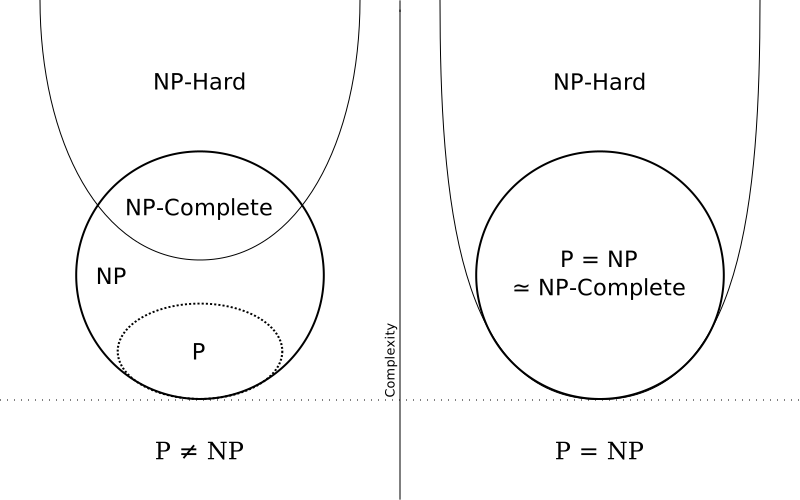
- Being in NP, but not NP-complete means, that it is probaly "easier" then 3-SAT (look at this diagram describing relations between complexity classes)
- The discrete logarithm problem can be implemented via factorization and vice versa. If you can easily solve one, you can easily solve the other
-
Re:I'll be first to say WTFThere are so many errors in your comment that I almost don't know where to start:
- Integer factorization is not NP-hard (which would imply it is outside NP), it is in NP
- Being in NP, but not NP-complete means, that it is probaly "easier" then 3-SAT (look at this diagram describing relations between complexity classes)
- The discrete logarithm problem can be implemented via factorization and vice versa. If you can easily solve one, you can easily solve the other
-
Re:I'll be first to say WTFThere are so many errors in your comment that I almost don't know where to start:
- Integer factorization is not NP-hard (which would imply it is outside NP), it is in NP
- Being in NP, but not NP-complete means, that it is probaly "easier" then 3-SAT (look at this diagram describing relations between complexity classes)
- The discrete logarithm problem can be implemented via factorization and vice versa. If you can easily solve one, you can easily solve the other
-
Your Post Is Fundamentally Incorrect
Every asymmetrical encryption algorithm in the field relies on the factoring problem, which is NP hard. If P==NP, then suddenly we know the factoring problem is NP easy.
-
Re:First handheld to be fully region locked
This is the FIRST Nintendo system to be fully region locked.
What? Dude, Nintendo friggin' invented region locking for video games. Even the NES was region locked. You couldn't even play German games on your British NES.
-
Re:First handheld to be fully region locked
This is the FIRST Nintendo system to be fully region locked.
What? Dude, Nintendo friggin' invented region locking for video games. Even the NES was region locked. You couldn't even play German games on your British NES.
-
Re:No, it is the same
Well spoken! About time for a right to Internet access... It's a required step for net neutrality. It's not too late to be the 6th country to declare this a basic human right!
Strangely even France is on the list who if countries who have legal precedent for this right, especially given the recent three strikes and you're off the net move... -
Re:Any need for this?
Sorry, Occam's Razor says absolutely nothing about what's most likely, in this case or any other.
The original formulation of Occam's Razor may not, but the modern probability-theoretic formulation does. See Minimum Message Length.
-
Re:Hope and...
Minimum wage laws have a history of working. Find me something from a mainstream economist showing they don't.
Where do you get your data? Even a bare minimum of fact checking (aka Wikipedia) speaks to the contrary: https://secure.wikimedia.org/wikipedia/en/wiki/Minimum_wage
An analysis of supply and demand of the type shown in introductory mainstream economics textbooks implies that by mandating a price floor above the equilibrium wage, minimum wage laws should cause unemployment
Economists disagree as to the measurable impact of minimum wages in the 'real world'. This disagreement usually takes the form of competing empirical tests of the elasticities of demand and supply in labor markets and the degree to which markets differ from the efficiency that models of perfect competition predict.
Some leading economists such as Kevin M. Murphy and Nobel laureate Gary Becker do not accept the Card/Krueger results,[60] while some others, like Nobel laureates Paul Krugman[61] and Joseph Stiglitz do accept them as correct
Nobel laureate James M. Buchanan responded to the Card and Krueger study in the Wall Street Journal, arguing:[65]
In a 2008 book, David Neumark and William L. Wascher described their analysis of over 300 studies on the minimum wage.[3] The studies were from several countries covering a period of over 50 years, primarily from the 1990s onward. According to the Neumark and Wascher, a large majority of the studies show negative effects for the minimum wage; those showing positive effects are few, questionable, and disproportionately discussed.
Until the 1990s, economists generally agreed that raising the minimum wage reduced employment. This consensus was weakened when some well-publicized empirical studies showed the opposite, although others confirmed the original view. Today's consensus, if one exists, is that increasing the minimum wage has, at worst, minor negative effects.[72]
According to a 1978 article in the American Economic Review, 90 percent of the economists surveyed agreed that the minimum wage increases unemployment among low-skilled workers
Ultimately, opinions are all over the board on the issue, which is exactly why I put it under the category of "simplistic solutions to complex problems". If it were truly that simple, we would just set everyone's minimum salary at 1 million. Problem solved.
The Dems never claimed the cost savings came from mandatory coverage
Yet they claimed the bill overall would save money...even the CBO says this. If the "added risk without compensation" cost was not taken into consideration when determining how much money this bill is going to "save" us, I would say that adequately fits the category of "do not think through the implications of their policies". It is my impression that they were more concerned with "getting everyone healthcare" and "keeping people from being denied" than they were with cost-savings. And the fact they claimed (and continue to claim) we're ultimately going to save money from this is tentative at best (and an outright lie at worst).
Social Security and medicare are the most successful social programs in American history. I challenge you to prove they have failed.
They've almost single-handedly driven our debt to the level it is right now and they'll still on the verge of insolvency. People still do not have adequate retirement money and people still can't afford healthcare. By what standards do you define "successful"? I challenge you to prove they succeeded.
I don't personally know about the others, but I do not trust any of your ex
-
Re:The answer to this privacy invasion is data wip
So why doesn't the US government use this fact to mop up all suspected terrorists/undesirables/commies and chuck them all in jail, then re-arrest them as soon as they come out, rinse and repeat?
Possibly because it's utter bollocks?
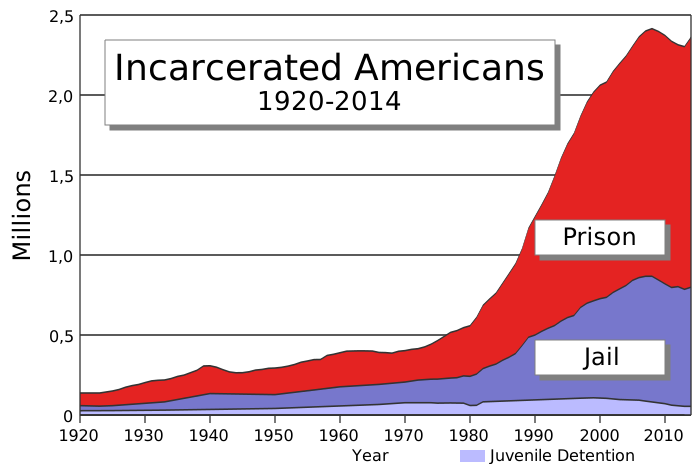
They eventually filled the jails, build lots more and over filled them too and the trend hasn't stopped, even though we have the largest percentage of people in jail. So what's utter bollocks?
-
Licensed engineers != Engineers
An engineer is a professional practitioner of engineering, concerned with applying scientific knowledge, mathematics, economics and ingenuity to develop solutions to meet economic and societal needs. Engineers design structures, machines and systems while considering the limitations imposed by practicality, safety and cost. The word engineer is derived from the Latin root ingenium, meaning "cleverness" -Wikipedia
Nowhere does this mention licensing of any kind. Licenses and liability to lawsuits are a recent invention and are little more than unnecessary government intervention in the free market for the purpose of restricting the supply of engineers. This sort of guild mentality has always been detrimental to the economy by forcing people to pay for something they don't necessarily want. It would have been much better if all this licensing nonsense disappeared and we could rely on the traditional reputation system that the free market uses to maintain quality.
-
Everyone was Expecting the Spanish Inquisition!
-
Re:Hit them back
https://secure.wikimedia.org/wikipedia/en/wiki/File:US_Federal_Debt_as_Percent_of_GDP_by_President.jpg As you can see, it was lower a decade ago. But I agree with you point, both parties have contributed equally to the debt situation.
-
Re:You have it backwards
Your comment betrays ignorance I am afraid. More precisely, it is a great example why "research by Wikipedia" does not work when it is not backed by an actual intimate understanding of the subject matter.
Specifically your ill informed comparison with "Romania", that backward, not "actually civilized" banana republic that you use as a boogie man only reveals your ignorance. Yes, Romania is a relatively poor country, the GDP per capita is about $12k/year (compare to $46k/year in the US) as per wikipedia.
However, the level of health services available is not immediately obviously worse than in the US, once adjusted for the purchasing power of the median citizen, and especially the less affluent. People there can have high quality cancer treatments and heart surgery that would cost hundreds of thousands of dollars or more in the USand possibly bankrupt them and their families - all paid for by the public health plans. Expensive drugs are often covered. Extended hospital stays - of the orders of weeks or even months - are also very often covered. I have had friends from Europe who had surgery in the US and were shocked to be kicked out of the hospital hours after the doctor sowed the last stitch. That would be unheard of even in a backward place like Romania.
You are guilty of oversimplification. I wish not to make the same error, only with a different sign. I will be the first to remark that, not price adjusted, the quality of Romanian health care is often not great especially for non life threatening diseases. The bureaucracy is often suffocating. Petty bribes are common. I wish not advocate for a "single payer" health care system.
However, people who live in glass houses most definitely should wield their stones carefully.
-
Re:Wow this is a bit onesided.
https://secure.wikimedia.org/wikipedia/en/wiki/Disruptive_technology
what is the chance that those heavyweights will create something that undermines their position? exactly zero.
what is the chance that someone will set up a disruptive service using free tools in their garage or dorm room? almost guaranteed.
Almost, because those heavyweights are trying their hardest to use every law in the books to make sure the disruptive do not happen.
the internet, and its child the world wide web, are the most disruptive force in technology so far.
There is a story that when the gray beards at AT&T got packet switching explained to them they reacted to it like the pope reacts to free sex. It was heresy, pure and simple, as it violated old knowledge about how circuit switching should operate. Similarly, youtube have basically preached heresy when it comes to broadcasting. Where before one needed a expensive license and millions in hardware and personel, now a single person can upload a video shot using a cheap handheld (or even phone) and reach the world.
The giants in the field can take a hike, the mice will be the kings now and forever.
-
Re:Dark matter vs black holes
Say what?
First off, the GPP has a decent question. The largest supermassive black holes are on the order of 10^9 solar masses, about the same mass as what was calculated for this satellite galaxy. So, I suppose it's at least plausible that it's a single black hole, if unlikely.
But remember and repeat after me: a black hole has no more gravity than any other object of the same mass. As long as you stay away from the event horizon, that is. You need to rethink your first paragraph with that in mind.
So, how would we tell the difference? Well, an X-ray source from the same location would be a good clue that it's a black hole, which says that it's feeding off of something. You should also be able to tell from the gravitational lensing -- dark matter is incredibly diffuse compared to a black hole. It would still bend light, but not quite in the same way, especially considering the distances involved.
But what about a black circle in the sky? Well, the even horizon for such a black hole has the same diameter as the orbit of Pluto, if I remember right. Detectable, maybe, under the right conditions (but not by Hubble -- you'd need something with about 20x better resolution
-
Re:They should already know!
Keep in mind that Mark Shuttleworth's goals are not the same as the community at large. He wants to see a return on his $20 million. It's why he hired Windows apologist Matt Asay instead of someone deeply involved in the linux community.
You are right on about Mark Shuttleworth's goals, of course its his money and he can play the cards as he sees fit, of course we do not have to sit at his table do we.
As for Fedora, watch out, they are have announced that they are going to Wayland eventually as well. Wayland ~ Mono ~
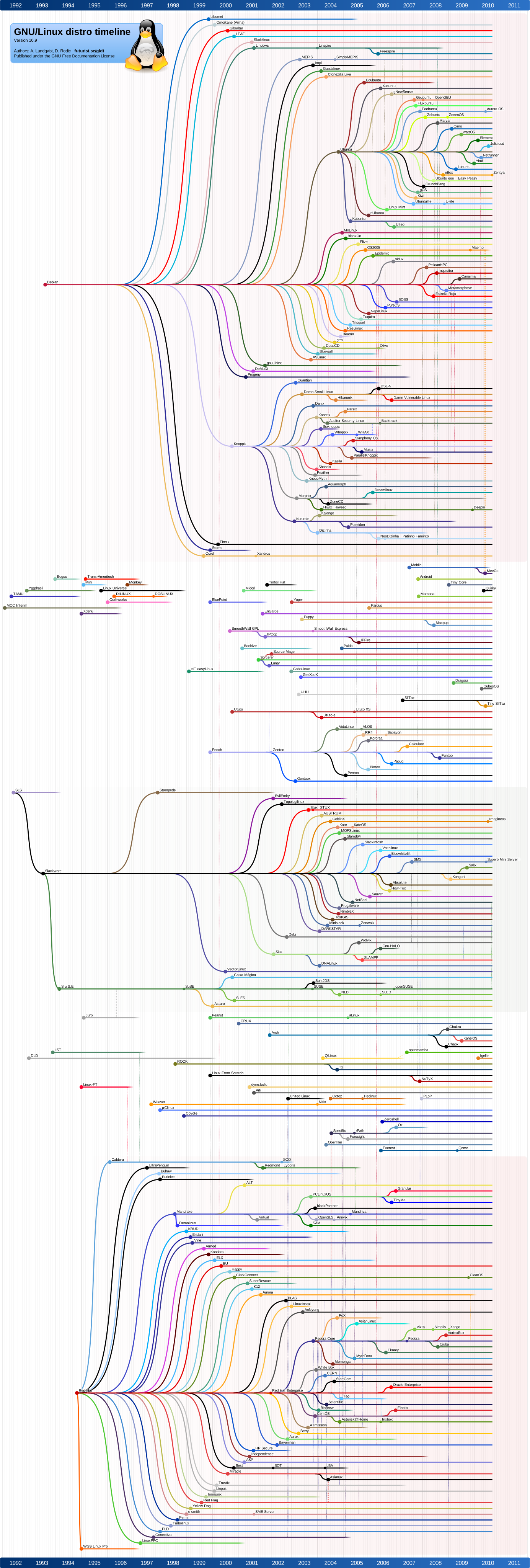
Here is a great Graphics view of different Distros and which are derived from which base distros. Obviously to avoid Wayland you want to avoid any distro that gets its base from either Ubuntu or Fedora.
-
Compare it to facebook, google, etc.
This slide pretty much sums it up.
The Wikimedia Foundation is extremely efficient in its server operation.
-
Re:Useful not not authoriative
-
Re:As always, it comes down to content providers
On one hand you know that if you go with H.264, all IE and Safari users (read 90%+ of computer users) will be able to view your content without downloading a plugin. You will miss out Chrome users (assuming nobody comes out with an H.264 plugin for Chrome). On the other hand, you can choose WebM and presumably avoid the spectre of maybe, possibly, one day (but not very likely) having to pay royalities on H.264. You end up with some portion of the 90% of the market who are willing to download a plugin. Which do you choose? Or more realistically, which one does your employer hoist on you?
90%? Please look up any remotely recent browser market share measurements. The total of IE and Safari users is nowhere even close to that total. For example, if you look at the median measurements of multiple sources on Wikipedia, you will find that IE and Safari users, when added together are only 50% of the browser market.
-
Re:Enough with the "Evil" hyperbole
I'm not interested in your perversion of the english language which is clearly defined in things we call dictionary. Now please do us all a favour and fuck off. Defined here for you and your poor grasp of how language works.
-
Re:Great Legal Team!
Sure hope not, especially if they are doing it in California. They'll get their nuts cut off and fed to them.
https://secure.wikimedia.org/wikipedia/en/wiki/Strategic_lawsuit_against_public_participation
-
Founder Hoax
Let's try the hoax in the summary that Jimmy did it all. The correct answer is:
The earliest known proposal for an online encyclopedia was made by Rick Gates in 1993,[1] but the concept of an open source web-based online encyclopedia was proposed a little later by Richard Stallman around 1999. Wikipedia was formally launched on 15 January 2001 by Jimmy Wales and Larry Sanger using the concept and technology of a wiki pioneered by Ward Cunningham.
https://secure.wikimedia.org/wikipedia/en/wiki/History_of_wikipedia
-
Re:Actually it does to some extent
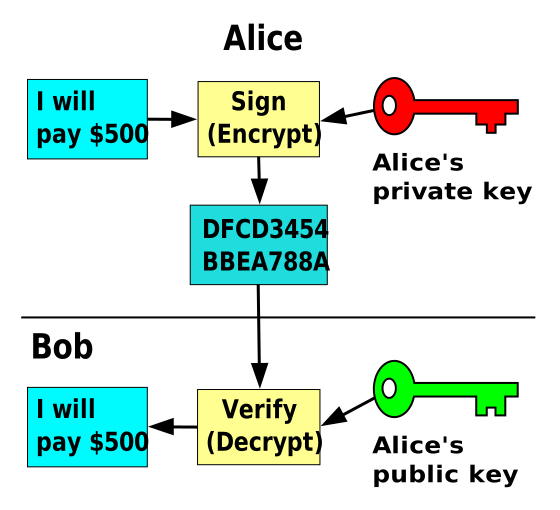
Thank you. I always made an assumption about signing that didn't quite make sense to me. It was that when you sign a message, that the whole message was just encrypted with the private key and then easily decrypted at the other end. This would serve the purpose of proving authorship, but then no-one could read the document unless they had your private key which makes it somewhat inconvenient.
Instead, a hash of the message is taken, and then encrypted using your private key. This encrypted hash is then attached to the original message. The recipient then takes that hash and decrypts it, meanwhile, it performs the hash function on the data and if those hashes match, then the author is valid.
The latter being far better as you don't need to have the authors public key to read the message, only to verify it. The hash is encrypted, not the message. Much more convenient
I think it's images like this that tend to confuse as it leads you to believe that the whole message is encrypted by Alice.
This all just makes the original posters statement even more confusing though as the public key is never even decoding a message, just a hash to verify a signature.
I love slashdot, you end up learning things you may otherwise never get round to looking up. -
Re:Evil commenting on evil
Unlikely
having a unique CD key for each CD means that you can't mass produce them, which would massively increase the costs
https://secure.wikimedia.org/wikipedia/en/wiki/Compact_Disc_manufacturing -
Re:20-character
This US keyboard only appears to have 94 characters, but I actually wasn't looking at keyboards before. If you have 96 characters then a 20-character password has about 131.7 bits of entropy.
-
Re:Utter utter rubbish
Frankly you'd have to be a special kind of stupid to claim that global temperature averages aren't on the increase.
It is about scale and perspective. Statements like yours indicate a lack of such. See here.
-
Re:As powerful?
Looks like you could at least buy one:
The Game Boy also contains optional input and/or output connectors. On the left side of the system is an external power supply jack that allows users to use an external rechargeable battery pack or AC adapter (sold separately) instead of four AA batteries.
-
Re:Here's why they are doing this
Sir —
This kind of thing happens day in and day out in the U.S. We make more people rot in confinement than the worst despotic regimes in history. And there are many effective ways to get around the protections offered by your 'rights', making them nearly meaningless in practice.
Quite right. This map says quite a lot, I believe.
I believe either half or a quarter of all prisoners in the world (I cannot recall offhand which) are in the United States. It is the land of the free, for those lucky enough to avoid a criminal conviction machine that incarcerates at a rate considered preposterous – and contrary or without regard to its stated purpose – elsewhere.
Alas, many Americans seem to be in denial about uncontroverted facts such as these, and as a result unable and unwilling to question the reason such a reality has come about.
-
Re:Need a bigger knife
Yep. Make sure the handouts are food, not money which can go on cigarettes and beer.
It's not as simple as that. If someone has any income at all, they can use the food stamps to buy food, and then use the money (that they would otherwise have spent on buying food) on cigarettes and beer, or even drugs. In this way food stamps can increase alcohol/tobacco/drug use even if 100% of the handout is spent on food. It's called the substitution effect in economics.
I like the concept of food stamps overall but I don't think there is any way to solve the problem of using food stamp money (indirectly) to buy drugs.
Of course, the Anonymous Coward who called for eliminating food stamps has absolutely no clue what he's talking about. (Surprise surprise -- rabid anti-government tea partier has no knowledge of actual facts.) Food stamps are a federal program, and eliminating food stamps wouldn't save California a dime or affect California in the slightest.
-
Re:No Thanks
Or finally read all those books you've been waiting to read but never could because of all the people bothering you every day.
-
Re:YRO?
That's probably why the Government wouldn't allow Chrysler or GM to go bankrupt.
Actually but the government allowed both Chrysler and GM to go bankrupt. Sorry to throw a wrench in your "unions just won't die" fantasy.
Entire wikipedia page on GM bankruptcy: https://secure.wikimedia.org/wikipedia/en/wiki/General_Motors_Chapter_11_reorganization
Article detailing Chrysler bankruptcy: https://www.nytimes.com/2009/05/01/business/01auto.html?_r=1&hp
-
Mojave Experiment says otherwise
Who knows what is in the mind of marketing?
...
Windows Vista
Windows 7Actually, it's pretty obvious why Microsoft marketing went back to version numbers, especially considering the Mojave Experiment. While it's certainly possible they might have just named it 7 because they felt it was the seventh generation of Windows, the obvious, likely reason is that 7 sounds as little like Vista as possible.
-
Re:Sad news for the web
Might help with your silverlight-on-linux problem
https://secure.wikimedia.org/wikipedia/en/wiki/Moonlight_(runtime)
Isn't perfect (far from it), but certain things work.
-
Re:Noooooooooo!!!!!!1111!11!
Yeah, but even then there are different conclusions possible. If you assume autism or death was caused by a vaccine based on this fallacy why jump to the conclusion the vaccine is bad. It could just as well have been any other problem like contamination. This can of course be accidental but I would not even expect mayor manufacturers to destroy entire batches when a few are known to be polluted (after all they even shipped AIDS infected products knowingly so I don't really have their general code of ethics in high regard). So if and when jumping to conclusions based on incomplete evidence and a logical fallacy I would claim a polluted vaccine probably caused it instead of boycotting all vaccines...
-
And Windows is not a generic term ?
'Microsoft v. Lindows.com, Inc. was a court case brought by Microsoft against Lindows, Inc in December 2001 [1], claiming that the name "Lindows" was a violation of its trademark "Windows." link
-
Re:Take a look at the nude cover of Electric Ladyl
Nice thumbnail. Here's a better one.[NSFW]
Personally, I think 60s and 70s porn is inferior to modern and older material.[NSFW] -
Better watch out, better not cry, better not pout
Unfortunately in the US there is no mens rea requirement for child porn charges, you're equally guilty if you solicit such images as if somebody emails them to you or you randomly encounter one that you can't tell the age of the people in the photos.
Warning to Americans: Here are a couple of so-hot-they-must-be-pron babes who if they "act their age" are both way south of 18!
-
Better watch out, better not cry, better not pout
Unfortunately in the US there is no mens rea requirement for child porn charges, you're equally guilty if you solicit such images as if somebody emails them to you or you randomly encounter one that you can't tell the age of the people in the photos.
Warning to Americans: Here are a couple of so-hot-they-must-be-pron babes who if they "act their age" are both way south of 18!