Slashdot Mirror
Domain: wikipedia.org
Stories and comments across the archive that link to wikipedia.org.
Stories · 7,048
-
Game Theory Calls Cooperation Into Question
An anonymous reader sends this excerpt from Quanta Magazine: The physicist Freeman Dyson and the computer scientist William Press, both highly accomplished in their fields, have found a new solution to a famous, decades-old game theory scenario called the prisoner's dilemma, in which players must decide whether to cheat or cooperate with a partner. The prisoner's dilemma has long been used to help explain how cooperation might endure in nature. After all, natural selection is ruled by the survival of the fittest, so one might expect that selfish strategies benefiting the individual would be most likely to persist. But careful study of the prisoner's dilemma revealed that organisms could act entirely in their own self-interest and still create a cooperative community.
Press and Dyson's new solution to the problem, however, threw that rosy perspective into question (abstract). It suggested the best strategies were selfish ones that led to extortion, not cooperation.
[Theoretical biologist Joshua] Plotkin found the duo's math remarkable in its elegance. But the outcome troubled him. Nature includes numerous examples of cooperative behavior. For example, vampire bats donate some of their blood meal to community members that fail to find prey. Some species of birds and social insects routinely help raise another's brood. Even bacteria can cooperate, sticking to each other so that some may survive poison. If extortion reigns, what drives these and other acts of selflessness?" -
West Point and Marines Launch Open Cyber Conflict Journal
rumint writes: The Army Cyber Institute at West Point and the Marine Corps Cyberspace Command just launched an open journal studying cyber conflict — Cyber Defense Review. It focuses on strategy, operations, tactics, history, ethics, law and policy in the cyber domain. The Cyber Defense Review is positioning itself as the leading online and print journal for issues related to cyber conflict for military, industry, professional and academic scholars, practitioners and operators interested providing timely and important research to advance the body of knowledge in an inherently multi-disciplinary field. -
Five Glorious Years of Sun Images In a Four-Minute Video
An anonymous reader writes: In early 2010, NASA launched the Solar Dynamics Observatory. It carried a number of sensors dedicated to watching and measuring various aspects of the Sun. The SDO's team just celebrated its fifth anniversary by going through a half-decade worth of images, pulling out the most amazing ones, and stitching them into an amazing video (YouTube). It includes enormous flares, sunspots, the transit of Venus, and more. -
Scientists In China Predict Pentagonal Graphene
TechkNighT_1337 writes: Chinese scientists made calculations and predict that a new 2D allotrope of carbon based in a pentagonal form resembling a common pavement in the streets of Cairo can be synthesized. They call this new form penta-graphene. From the announcement in the Chemistry World, they say: "The team found that not only should a pentagon-containing version of graphene be fairly stable, it should also be stronger than conventional graphene and be able to withstand higher temperatures, up to 730C. It would also be a natural semiconductor, unlike conventional graphene, which is a highly efficient conductor and has to be chemically modified to turn it into a semiconductor." -
Starting This Week, Wireless Carriers Must Unlock Your Phone
HughPickens.com writes Andrew Moore-Crispin reports that beginning today, as result of an agreement major wireless carriers made with FCC Chairman Tom Wheeler in late 2013, wireless carriers in the US must unlock your phone as soon as a contract term is fulfilled if asked to do so unless a phone is connected in some way to an account that owes the carrier money. Carriers must also post unlocking policies on their websites (here are links for AT&T, Verizon, Sprint, and T-Mobile), provide notice to customers when their devices are eligible for unlocking, respond to unlock requests within two business days, and unlock devices for deployed military personnel. So why unlock your phone? Unlocking a phone allows it to be used on any compatible network, regardless of carrier which could result in significant savings. Or you could go with an MVNO, stay on the same network, and pay much less for the same cellular service. -
Live Patching Now Available For Linux
New submitter cyranix writes "You may never have to reboot your Linux machine ever again, even for kernel patching," and excerpts from the long (and nicely human-readable) description of newly merged kernel code that does what Ksplice has for quite a while (namely, offer live updating for Linux systems, no downtime required), but without Oracle's control. It provides a basic infrastructure for function "live patching" (i.e. code redirection), including API for kernel modules containing the actual patches, and API/ABI for userspace to be able to operate on the patches (look up what patches are applied, enable/disable them, etc). It's relatively simple and minimalistic, as it's making use of existing kernel infrastructure (namely ftrace) as much as possible. It's also self-contained, in a sense that it doesn't hook itself in any other kernel subsystem (it doesn't even touch any other code). It's now implemented for x86 only as a reference architecture, but support for powerpc, s390 and arm is already in the works (adding arch-specific support basically boils down to teaching ftrace about regs-saving). -
Empirical Study On How C Devs Use Goto In Practice Says "Not Harmful"
Edsger Dijkstra famously opined in 1968 on the danger of Goto statements. New submitter Mei Nagappan writes with a mellower view, nearly 50 years later: By qualitatively and quantitatively analyzing a statistically valid random sample from almost 2 million C files and 11K+ projects, we find that developers limit themselves to using goto appropriately in most cases, and not in an unrestricted manner like Dijkstra feared, thus suggesting that goto does not appear to be harmful in practice. (Here's the preprint linked from above abstract.) -
Drone, Drone, Everywhere a Drone -- at CES (Video)
One thing Timothy noticed at CES was that there were drone vendors all over the place. Drones are obviously one of the hot-hot toy/gadget trends of the moment. The Drone that won 'Best Robot or Drone in Show' was the camera-carrying, "follows you like a dog on a (Bluetooth 3) leash" AirDog. They already had a crazy-sucessful KickStarter campaign that led to a large stack of pre-orders, so don't count on getting your very own AirDog right away, even if you have $1300 to spend on one. -
The Uncanny Valley of Voice Recognition
An anonymous reader writes: We've often seen the term "uncanny valley" applied to the field of robotics — it's easy to get unsettled when robots act close to being human, yet fail completely in a few key ways. GitHub Engineer Zach Holman writes that we've now reached uncanny valley territory in speech recognition as well, though the results are more frustrating than they are disturbing. He says, "Part of this frustration is the user interface itself is less standardized than the desktop or mobile device UI you're used to. Even the basic terminology can feel pretty inconsistent if you're jumping back and forth between platforms.
Siri aims to be completely conversational: Do you think the freshman Congressman from California's Twelfth deserved to sit on HUAC, and how did that impact his future relationship with J. Edgar? Xbox One is basically an oral command line interface, of the form: Xbox (direct object). ...it's these inconsistencies that are frustrating as you jump back and forth between devices. And we're only going to scale this up." -
Rich Olson Embodies the Spirit of the Maker Movement (Video)
What kind of person builds a cloud chamber at home in his spare time -- and wants to make it easy for other people to make them, too? How about someone who uses a 3-D printer to make shifters for his bicycle? And then there's the spherical speaker enclosures and the alarm clock that shreds money if you don't wake up. The clock isn't original. Seattle resident Rich Olson (whose URL is nothinglabs.com) says someone else originally made it and he liked the idea. No 3-D printing or laser cutting required; just buy and hook up some inexpensive, easy-to-find components and off you go. Despite its lack of originality (which Rich freely admits), this little project got Rich mentioned everywhere from financial publications to the New York Daily News to Huffington Post's UK edition, which is somewhat amusing when you realize that Rich is not famous (outside of a small circle of maker-type people) and doesn't have anyone doing PR for him.
By day, Rich is a humble mobile app developer. But when he's done working he becomes Mr. 3-D and laser cut cool designer guy who does fun things in his workshop with CAD software, a 3-D printer, a laser cutter, and (of course) traditional cutting, drilling, and shaping tools. Since he's an open source devotee, Rich posts almost all of his designs online so you can make them yourself. Or modify them. Or use them to spur an entirely new idea that you can then make, and hopefully pass on to others. While it's interesting to see that Martha Stewart is now selling 3-D printer designs, Rich and his hobby are what the maker movement is really about. If you're so inclined, you can follow Rich on YouTube, where he posts a video now and then that shows what he's made recently or follow his low-volume blog to see what he's up to. -
SpaceX Launch of "GoreSat" Planned For Today, Along With Another Landing Attempt
The New York Times reports that SpaceX will again attempt to recover a Falcon 9 launch vehicle, after the recent unsuccessful try; the company believes the lessons from the earlier launch have been learned, and today's launch will be loaded with more hydraulic fluid. This evening, the rocket is to loft the satellite nicknamed "GoreSat," after Al Gore, who envisioned it as a sort of permanent eye in space beaing back pictures of Earth from afar. The purpose of the satellite has evolved, though: Writes the Times: The observatory, abbreviated as Dscovr and pronounced “discover,” is to serve as a sentinel for solar storms: bursts of high-energy particles originating from the sun. The particles from a gargantuan solar storm could induce electrical currents that might overwhelm the world’s power grids, possibly causing continent-wide blackouts. Even a 15-minute warning could let power companies take actions to limit damage. -
Earth's Libration Visualized For the First Time Above the Moon's Far Side
StartsWithABang writes Thanks to the fact that the Moon is tidally locked, we can only see 50% of its surface on any given night. Over time, the fact that the Moon's orbit is elliptical, and that it moves faster at perigee and slower at apogee means that up to another 9% is visible over the course of many years. The observed "rocking" and growing/shrinking of the Moon over time is known as lunar libration, an incredibly interesting phenomenon. But now, for the first time, we've been able to visualize how the Earth appears to move as seen from above the far side of the Moon. -
Female-Run Companies Often do Better Than Male-Run Ones (Video)
Today's interviewee, Viktoria Tsukanov, is one of the executives at predictive marketing company Mintigo who did a study in January, 2015 that seemed to show that large companies with female CEOs "achieve up to 18% higher revenue per employee than male CEOs." The study, titled "She’s the CEO and She’s Sensational," used financial data Mintigo collected on 20 million companies, and determined CEOs' genders by analyzing first names, so it was not subject to survey vagaries but was a straight data analysis job. Could this be a case of correlation and causation being unrelated? It's possible. It's also possible that the revenue per employee figures are affected by the fact that female CEOs are more common in healthcare and non-profit organizations, while men dominate manufacturing and construction -- and, as Viktoria pointed out in a blog post headlined "Women Just Raised the Bar. Big Time." there may be other factors at work as well.
The "18% higher revenue" figure specifically applies to companies with more than 1000 workers, while companies with fewer workers may average more revenue per employee if they have male CEOs. Besides discussing the study itself, in our interview Viktoria talks about how male employees might want to alter (or not alter) their behavior if they find themselves working for a female boss for the first time. She also discusses challenges a woman might face if she is suddenly put in charge of a heavily male IT or programming staff. Other thoughts she shares have to do with finding mentors and dealing with negative people, both of which apply to people of all genders. Interesting food for thought all around. -
TP-82: The Gun Cosmonauts Carried On Space Missions
HughPickens.com writes James Simpson has an interesting story about the TP-82 survival pistol that Russian cosmonauts carried into space with them on missions between 1982 and 2006. But calling it a pistol is slightly misleading—the TP-82 was essentially a sawed-off, double-barreled shotgun with a short-barreled rifle added onto it. Having a gun inside a thin-walled spacecraft filled with oxygen sounds crazy, but the Soviets had their reasons. Much of Russia is desolate wilderness. A single mishap during descent could strand cosmonauts in the middle of nowhere. In March 1965, cosmonaut Alexey Leonov landed a mechanically-faulty Voskhod space capsule in the snowy forests of the western Urals 600 miles from his planned landing site. For protection, Leonov had a nine-millimeter pistol. He feared the bears and wolves that prowled the forest—though he never encountered any. But the fear stayed with him. Later in his career, Leonov made sure the Soviet military provided all its cosmonauts with a survival weapon. For the Soviets, the weapon was a case of "better safe than sorry," and from 1986, it was a permanent fixture in the portable survival kits of every Soyuz mission. "Astronauts of all nationalities—including Americans—have trained with the TP-82," writes Simpson. "And still today, before they ride the Soyuz to space, they must complete a Russian survival training course in the Black Sea and the Siberian forest." -
TP-82: The Gun Cosmonauts Carried On Space Missions
HughPickens.com writes James Simpson has an interesting story about the TP-82 survival pistol that Russian cosmonauts carried into space with them on missions between 1982 and 2006. But calling it a pistol is slightly misleading—the TP-82 was essentially a sawed-off, double-barreled shotgun with a short-barreled rifle added onto it. Having a gun inside a thin-walled spacecraft filled with oxygen sounds crazy, but the Soviets had their reasons. Much of Russia is desolate wilderness. A single mishap during descent could strand cosmonauts in the middle of nowhere. In March 1965, cosmonaut Alexey Leonov landed a mechanically-faulty Voskhod space capsule in the snowy forests of the western Urals 600 miles from his planned landing site. For protection, Leonov had a nine-millimeter pistol. He feared the bears and wolves that prowled the forest—though he never encountered any. But the fear stayed with him. Later in his career, Leonov made sure the Soviet military provided all its cosmonauts with a survival weapon. For the Soviets, the weapon was a case of "better safe than sorry," and from 1986, it was a permanent fixture in the portable survival kits of every Soyuz mission. "Astronauts of all nationalities—including Americans—have trained with the TP-82," writes Simpson. "And still today, before they ride the Soyuz to space, they must complete a Russian survival training course in the Black Sea and the Siberian forest." -
British MPs Approve 3-Parent Babies
An anonymous reader writes: A vote of 382-128 in the UK's House of Commons gave approval for a procedure that allows the creation of babies using DNA from three parents. If the measure passes the House of Lords and gets licensed by the fertility regulator, the UK would be the first country to allow such genetic engineering. The medical procedure was designed to help conception when genetic diseases could be passed through mitochondrial DNA. A child inherits mitochondria only from its mother, and these mitochondria have their own DNA, which doesn't affect things like the child's appearance.
The purpose of the procedure is to replace the mother's mitochondria, and that can happen in two different ways. In one method, doctors take eggs from the mother and from a donor, removing the nucleus of both. The mother's nucleus is then implanted in the donor's egg, which can then be fertilized by the father's sperm. The other method is similar, but both eggs are fertilized before the nucleus swap takes place.
There has been lively debate about this issue, with critics raising ethical concerns and questioning the procedure's success rate. They also bring up the slippery slope argument that this will lead to further genetic modification of children. Proponents point out that less than 0.1% of the child's DNA will come from the donor, and it won't affect anything other than the child's health. -
Alan Turing's Notes Found After Being Used As Insulation At Bletchley Park
An anonymous reader writes: In 2013, a restoration project for Hut 6 of Bletchley Park uncovered a collection of papers being used as roof insulation. The papers were frozen to preserve them while they were inspected and repaired. Now they're on display at an exhibition showing items found during the restoration process. "The documents also included the only known examples of Banbury sheets, a technique devised by [Turing] to accelerate the process of decrypting Nazi messages. No other examples have ever been found. All the findings are unique as all documentary evidence from the codebreaking process was supposed to be destroyed under wartime security rules." -
Gamma-ray Bursts May Explain Fermi's Paradox
An anonymous reader writes: A new study confirms the potential hazard of nearby gamma-ray bursts. It quantifies the probability of an event near Earth, and more generally in the Milky Way and other galaxies over time: "[Evolved] life as it exists on Earth could not take place in almost any galaxy that formed earlier than about five billion years after the Big Bang." This could explain the Fermi's paradox, or why we don't see billion-year-old civilizations all around us. -
Gamma-ray Bursts May Explain Fermi's Paradox
An anonymous reader writes: A new study confirms the potential hazard of nearby gamma-ray bursts. It quantifies the probability of an event near Earth, and more generally in the Milky Way and other galaxies over time: "[Evolved] life as it exists on Earth could not take place in almost any galaxy that formed earlier than about five billion years after the Big Bang." This could explain the Fermi's paradox, or why we don't see billion-year-old civilizations all around us. -
Valve's Economist Yanis Varoufakis Appointed Greece's Finance Minister
eldavojohn writes A turnover in the Greek government resulted from recent snap elections placing SYRIZA (Coalition of the Radical Left) in power — just shy of an outright majority by two seats. Atheist, and youngest Prime Minister in Greek history since 1865, Alexis Tsipras has been appointed the new prime minister and begun taking immediate drastic steps against the recent austerity laws put in place by prior administrations. One such step has been to appoint Valve's economist Yanis Varoufakis to position of Finance Minister of Greece. For the past three years Varoufakis has been working at Steam to analyze and improve the Steam Market but now has the opportunity to improve one of the most troubled economies in the world. -
Davos 2015: Less Innovation, More Regulation, More Unrest. Run Away!
Freshly Exhumed writes: Growing income inequality was one of the top four issues at the 2015 World Economic Forum meeting in Davos, Switzerland, ranking alongside European adoption of quantitative easing and geopolitical concerns. Felix Salmon, senior editor at Fusion, said there was a consensus that global inequality is getting worse, fueling overriding pessimism at the gathering. The result, he said, could be that the next big revolution will be in regulation rather than innovation. With growing inequality and the civil unrest from Ferguson and the Occupy protests fresh in people's mind, the world's super rich are already preparing for the consequences. At a packed session, former hedge fund director Robert Johnson revealed that worried hedge fund managers were already planning their escapes. "I know hedge fund managers all over the world who are buying airstrips and farms in places like New Zealand because they think they need a getaway," he said. Looking at studies like NASA's HANDY and by KPMG, the UK Government Office of Science, and others, Dr Nafeez Ahmed, executive director of the Institute for Policy Research & Development, warns that the convergence of food, water and energy crises could create a "perfect storm" within about fifteen years. -
Verizon, Cable Lobby Oppose Spec-Bump For Broadband Definition
WheezyJoe writes Responding to the FCC's proposal to raise the definition of broadband from 4Mbps downstream and 1Mbps upstream to 25Mbps down and 3Mbps up, the lobby group known as the National Cable & Telecommunications Association (NCTA) wrote in an FCC filing Thursday that 25Mbps/3Mbps isn't necessary for ordinary people. The lobby alleges that hypothetical use cases offered for showing the need for 25Mbps/3Mbps "dramatically exaggerate the amount of bandwidth needed by the typical broadband user", referring to parties in favor of the increase like Netflix and Public Knowledge. Verizon, for its part, is also lobbying against a faster broadband definition. Much of its territory is still stuck on DSL which is far less capable of 25Mbps/3Mbps speeds than cable technology.
The FCC presently defines broadband as 4Mbps down and 1Mbps up, a definition that hasn't changed since 2010. By comparison, people in Sweden can pay about $40 a month for 100/100 mbps, choosing between more than a dozen competing providers. The FCC is under mandate to determine whether broadband is being deployed to Americans in a reasonable and timely way, and the commission must take action to accelerate deployment if the answer is negative. Raising the definition's speeds provides more impetus to take actions that promote competition and remove barriers to investment, such as a potential move to preempt state laws that restrict municipal broadband projects. -
Ask Slashdot: Is Pascal Underrated?
An anonymous reader writes In the recent Slashdot discussion on the D programming language, I was surprised to see criticisms of Pascal that were based on old information and outdated implementations. While I'm sure that, for example, Brian Kernighan's criticisms of Pascal were valid in 1981, things have moved on since then. Current Object Pascal largely addresses Kernighan's critique and also includes language features such as anonymous methods, reflection and attributes, class helpers, generics and more (see also Marco Cantu's recent Object Pascal presentation). Cross-platform development is fairly straightforward with Pascal. Delphi targets Windows, OS X, iOS and Android. Free Pascal targets many operating systems and architectures and Lazarus provides a Delphi-like IDE for Free Pascal. So what do you think? Is Pascal underrated? -
Fark's Drew Curtis Running For Governor of Kentucky
New submitter AlCapwn writes [Fark founder] Drew Curtis announced on Friday that he will be running for governor of Kentucky. "We have a theory that we're about to see a huge change in how elections and politics work. Across the country, we have seen regular citizens stepping up and challenging the status quo built by political parties and career politicians. They have been getting closer and closer to victory and, here in Kentucky, we believe we have a chance to win and break the political party stronghold for good." -
Americans Support Mandatory Labeling of Food That Contains DNA
HughPickens.com writes Jennifer Abel writes at the LA Times that according to a recent survey (PDF), over 80% of Americans says they support "mandatory labels on foods containing DNA," roughly the same number that support the mandatory labeling of GMO foods "produced with genetic engineering." Ilya Somin, writing about the survey at the Washington Post, suggested that a mandatory label for foods containing DNA might sound like this: "WARNING: This product contains deoxyribonucleic acid (DNA). The Surgeon General has determined that DNA is linked to a variety of diseases in both animals and humans. In some configurations, it is a risk factor for cancer and heart disease. Pregnant women are at very high risk of passing on DNA to their children."
The report echoes a well-known joke/prank wherein people discuss the dangers of the chemical "dihydrogen monoxide" also known as hydrogen oxide and hydrogen hydroxide. Search online for information about dihydrogen monoxide, and you'll find a long list of scary-sounding and absolutely true warnings about it: the nuclear power industry uses enormous quantities of it every year. Dihydrogen monoxide is used in the production of many highly toxic pesticides, and chemical weapons banned by the Geneva Conventions. Dihydrogen monoxide is found in all tumors removed from cancer patients, and is guaranteed fatal to humans in large quantities and even small quantities can kill you, if it enters your respiratory system. In 2006, in Louisville, Kentucky, David Karem, executive director of the Waterfront Development Corporation, a public body that operates Waterfront Park, wished to deter bathers from using a large public fountain. "Counting on a lack of understanding about water's chemical makeup," he arranged for signs reading: "DANGER! – WATER CONTAINS HIGH LEVELS OF HYDROGEN – KEEP OUT" to be posted on the fountain at public expense. -
Doomsday Clock Moved Two Minutes Forward, To 23:57
An anonymous reader writes As reported by CNN and Time, the Bulletin of the Atomic Scientists has moved their famed Doomsday Clock two minutes closer to midnight. Now at 23:57, this clock attempts to personify humanity's closeness to a global catastrophe (as caused by either climate change or nuclear war). According to the Bulletin of the Atomic Scientists, this change is due to a lack of action regarding climate issues, the continued existence of nuclear weapon stockpiles, and the increased animosity that now exists between the United States and Russia. -
Doomsday Clock Moved Two Minutes Forward, To 23:57
An anonymous reader writes As reported by CNN and Time, the Bulletin of the Atomic Scientists has moved their famed Doomsday Clock two minutes closer to midnight. Now at 23:57, this clock attempts to personify humanity's closeness to a global catastrophe (as caused by either climate change or nuclear war). According to the Bulletin of the Atomic Scientists, this change is due to a lack of action regarding climate issues, the continued existence of nuclear weapon stockpiles, and the increased animosity that now exists between the United States and Russia. -
'Never Miss Another Delivery' - if You Have a TrackPIN (Video)
The company is called TrackPIN, as is the product. Its creator, Mark Hall, showed it off at CES. Timothy pointed his camcorder at Mark as he explained how his product would let you get package deliveries safely when you aren't home by giving the UPS or FedEx (or other) delivery person access to your garage, as well as letting in selected people like your maid, your plumber, and possibly an aquarium cleaner. Each one can have a private, one-time PIN number that will actuate your garage door opener through the (~$250) TrackPIN keypad and tell your smartphone or other net-connected device that your garage was just opened, and by whom. You might even call this, "One small step for package delivery; a giant leap forward for the Internet of Things." Except those of us who don't have garages (not to mention electric garage door openers) may want to skip today's video; the TrackPIN isn't meant for the likes of us. (Alternate Video Link) -
Blackberry CEO: Net Neutrality Means Mandating Cross-Platform Apps
DW100 writes In a bizarre public blog post the CEO of BlackBerry, John Chen, has claimed that net neutrality laws should include forcing app developers to make their services available on all operating systems. Chen even goes as far as citing Apple's iMessage tool as a service that should be made available for BlackBerry, because at present the lack of an iMessage BlackBerry app is holding the firm back. Some excerpts from Chen's plea: Netflix, which has forcefully advocated carrier neutrality, has discriminated against BlackBerry customers by refusing to make its streaming movie service available to them. Many other applications providers similarly offer service only to iPhone and Android users. ... Neutrality must be mandated at the application and content layer if we truly want a free, open and non-discriminatory internet. All wireless broadband customers must have the ability to access any lawful applications and content they choose, and applications/content providers must be prohibited from discriminating based on the customer’s mobile operating system. Since "content providers" are writing code they think makes sense for one reason or another (expected returns financial or psychic), a mandate to write more code seems like a good way to re-learn why contract law frowns on specific performance. -
User Plea Means EISA Support Not Removed From Linux
jones_supa writes A patch was proposed to the Linux Kernel Mailing List to drop support for the old EISA bus. However a user chimed in: "Well, I'd like to keep my x86 box up and alive, to support EISA FDDI equipment I maintain if nothing else — which in particular means the current head version of Linux, not some ancient branch." Linus Torvalds was friendly about the case: "So if we actually have a user, and it works, then no, we're not removing EISA support. It's not like it hurts us or is in some way fundamentally broken, like the old i386 code was (i386 kernel page fault semantics really were broken, and the lack of some instructions made it more painful to maintain than needed — not like EISA at all, which is just a pure add-on on the side)." In addition to Intel 80386, recent years have also seen MCA bus support being removed from the kernel. Linux generally strives to keep support even for crusty hardware if there provably is still user(s) of the particular gear. -
Is D an Underrated Programming Language?
Nerval's Lobster writes: While some programming languages achieved early success only to fall by the wayside (e.g., Delphi), one language that has quietly gained popularity is D, which now ranks 35 in the most recent Tiobe Index. Inspired by C++, D is a general-purpose systems and applications language that's similar to C and C++ in its syntax; it supports procedural, object-oriented, metaprogramming, concurrent and functional programming. D's syntax is simpler and more readable than C++, mainly because D creator Walter Bright developed several C and C++ compilers and is familiar with the subtleties of both languages. D's advocates argue that the language is well thought-out, avoiding many of the complexities encountered with modern C++ programming. So shouldn't it be more popular? The languages with the biggest gains this time around include JavaScript, PL/SQL, Perl, VB, and COBOL. (Yes, COBOL.) The biggest drops belonged to the six most popular languages: Objective-C, C, Java, C++, PHP, and C#. -
President Obama Will Kibbitz With YouTube Stars
theodp (442580) writes "For better or worse, YouTube stars are a big deal these days. Last December, Microsoft and Code.org turned to YouTube Stars iJustine and The Fine Brothers to help recruit the nation's K-12 schookids for the Hour of Code. And next week, in what the White House is touting as the State of the YOUnion , President Obama will turn to a trio of YouTube Stars for advice on the issues of day following his State of the Union Address. "We're inviting a handful of YouTube creators to the White House to talk with the President in person," explains the White House Blog, "and you can watch it all live on Thursday, January 22. YouTube creators Bethany Mota, GloZell, and Hank Green will interview President Obama about the issues care they most about and what they're hearing from their audiences." Commenting on the choice of the YouTube interviewers, CNN's David Acosta asked (confused) WH Press Secretary Josh Earnest, "I'm just curious, was 'Charlie Bit My Finger' or 'David After Dentist' not available?" So, how long until the U.S. is redistricted into YouTube Channels?" -
New Collaborative Project Wants to Systematize Complex Problem Solving Online
New submitter albert555 writes A new collaborative project emerged lately and its goal is pretty ambitious: solving complex problems. Anyone will look to Google or Quora for the response of a usual question that requires one single answer, but nothing exists online to solve complex problems with multiple solutions. The website uses brainstorming techniques coupled with the Problem Tree Methodology to them. In simple words: decomposing the main issue into subsequent small-ones and providing solutions to the sub-issues, the result taking form of a node tree. Users are free to provide meaningful content to the nodes (and therefore may help understand the causes of the issues) or to provide solutions to the ultimate sub-issues. Contributions are placed under the CC BY-SA 4.0 license. While Wikipedia proved that collective intelligence could provide quality contents able to compete with the major encyclopedias. Eris Solver intends to channel the wisdom of the crowd to find the best solutions to the most complex problems available. The idea is interesting, though so far the project does not have contributions pouring in like Wikipedia does. You can add your own questions or answers; "user contributions to Solver questions and general questions [are] licensed under the CC BY-SA 4.0." -
Ridley Scott Adapts Philip K. Dick's 'Man in the High Castle' For Amazon
An anonymous reader writes with word of an adaption of Philip K. Dick's The Man in the High Castle. Ridley Scott is the executive producer for the adaptation of a Philip K. Dick novel that's one of 13 new TV shows from Amazon Studios. There's also a video adaptation of The New Yorker magazine, and all 13 pilots are available free online. Votes of viewers will help decide which ones get picked up for a full season, and Amazon is promising customers that they've assembled "some of the greatest storytellers in the business with works of novelty and passion." -
Silicon Valley Security Experts Give 'Blackhat' a Thumbs-Up; Do You?
HughPickens.com writes Cade Metz writes that last week Parisa Tabriz, head of Google's Chrome security team, helped arrange an early screening of Michael Mann's Blackhat in San Francisco for 200-odd security specialists from Google, Facebook, Apple, Tesla, Twitter, Square, Cisco, and other parts of Silicon Valley's close-knit security community, and their response to the film was shockingly positive. "Judging from the screening Q&A—and the pointed ways this audience reacted during the screening—you could certainly argue Blackhat is the best hacking movie ever made," writes Metz. "Many info-sec specialists will tell you how much they like Sneakers—the 1992 film with Robert Redford, Sidney Poitier, Dan Ackroyd, Ben Kingsley, and River Phoenix—but few films have so closely hewed to info-sec reality as Mann's new movie, fashioned in his characteristic pseudo-documentary style." "Unlike others, this is a film about a real person, not a stereotype—a real guy with real problems thrust into a real situation," says Mark Abene. "The technology—and the disasters—in the film were real, or at least plausible.
Director Michael Mann worked closely with Kevin Poulsen in researching, writing, and shooting the film. Like Hemsworth's character, Poulsen spent time in prison for his hacking exploits, and Mann says his input was invaluable. "It's the first crime-thriller to hinge so heavily on hacking without becoming silly." says Poulson. "We put a lot of work into finding plausible ways that malware and hosting arrangements and all these other things could be used to advance the plot and all of that I think turned out pretty nice." I'm a fan of Michael Mann, and the previews I've seen of Blackhat make it look at least like a passable thriller. For anyone who's seen the film already, what did you think? -
Lost Beagle2 Probe Found 'Intact' On Mars
New submitter Stolga sends this report from the BBC: The missing Mars robot Beagle2 has been found on the surface of the Red Planet, apparently intact. High-resolution images taken from orbit have identified its landing location, and it looks to be in one piece. The UK-led probe tried to make a soft touchdown on the dusty world on Christmas Day, 2003, using parachutes and airbags — but no radio contact was ever made with the probe. Many scientists assumed it had been destroyed in a high-velocity impact.
The new pictures, acquired by NASA's Mars Reconnaissance Orbiter, give the lie to that notion, and hint at what really happened to the European mission. Beagle's design incorporated a series of deployable "petals," on which were mounted its solar panels. From the images, it seems that this system did not unfurl fully. "Without full deployment, there is no way we could have communicated with it as the radio frequency antenna was under the solar panels," explained Prof Mark Sims, Beagle's mission manager from Leicester University. -
OpenBSD's Kernel Gets W^X Treatment On Amd64
New submitter brynet tips this news from Theo de Raadt: Over the last two months Mike Larkin (mlarkin@) modified the amd64 kernel to follow the W^X principles. It started as a humble exercise to fix the .rodata segment, and kind of went crazy. As a result, no part of the kernel address space is writeable and executable simultaneously. At least that is the idea, modulo mistakes. Final attention to detail (which some of you experienced in buggy drafts in snapshots) was to make the MP and ACPI trampolines follow W^X, furthermore they are unmapped when not required. Final picture is many architectures were improved, but amd64 and sparc64 look the best due to MMU features available to service the W^X model. The entire safety model is also improved by a limited form of kernel ASLR (the code segment does not move around yet, but data and page table ASLR is fairly good." -
Talk to the World Through Ubi -- and Use Gestures, Too (Video)
'The Ubi is an always-on voice-activated computer ready to help. Just plug it in, talk to it and it'll help you connect with your world.' That Kickstarter project description back in 2012 helped UBI raise $229,594 even though they only hoped for $36,000. So now they sell Ubis for $299, as you can see for yourself by clicking the "BUY NOW" button in the upper right corner of www.TheUbi.com, their site's main page. A cynic might say that a decent Android phone can perform most Ubi functions, including a growing number of home automation control tasks, and that Android voice recognition gets better with each new release. But Ubi is cute, and round, and "you can talk through it to the ones you love."
That's great, but Android phones can do that, too. What a smartphone can't do is compete with Ubi Interactive, which may finally give us gesture-based computer input that is not only exciting in a Star Trek way, but is also practical for home and business use. This, along with Kinect, looks like a product that has a solid future ahead of it. (Alternate Video Link) -
UK Prime Minister Says Gov't Should Be Capable of Reading Any Communications
Dr_Barnowl writes: The BBC reports that UK Prime Minister David Cameron has vowed to introduce a "comprehensive piece of legislation" aimed at there being no "means of communication ... we cannot read," in the aftermath of the Charlie Hebdo attacks in Paris. While he didn't mention encryption specifically, the only logical means by which this could occur would be by the introduction of compulsory key escrow, and the banning of forms of encryption which do not use it. While the UK already essentially has a legal means to demand your encryption keys (and imprison you indefinitely if you don't comply), this would fall short if you have a credible reason for not having the key any more (such as using an OTR plugin for your chosen chat program).
The U.S. tried a similar tack with Clipper in the 90s. As we all know, terrorists with any technical chops are unlikely to be affected, given the vast amount of freely available, military-grade crypto now available, and the use of boring old cold war tradecraft. Ironically, France used to ban the use of strong cryptography but has largely liberalized its regime since 2011. -
UK Prime Minister Says Gov't Should Be Capable of Reading Any Communications
Dr_Barnowl writes: The BBC reports that UK Prime Minister David Cameron has vowed to introduce a "comprehensive piece of legislation" aimed at there being no "means of communication ... we cannot read," in the aftermath of the Charlie Hebdo attacks in Paris. While he didn't mention encryption specifically, the only logical means by which this could occur would be by the introduction of compulsory key escrow, and the banning of forms of encryption which do not use it. While the UK already essentially has a legal means to demand your encryption keys (and imprison you indefinitely if you don't comply), this would fall short if you have a credible reason for not having the key any more (such as using an OTR plugin for your chosen chat program).
The U.S. tried a similar tack with Clipper in the 90s. As we all know, terrorists with any technical chops are unlikely to be affected, given the vast amount of freely available, military-grade crypto now available, and the use of boring old cold war tradecraft. Ironically, France used to ban the use of strong cryptography but has largely liberalized its regime since 2011. -
UK Prime Minister Says Gov't Should Be Capable of Reading Any Communications
Dr_Barnowl writes: The BBC reports that UK Prime Minister David Cameron has vowed to introduce a "comprehensive piece of legislation" aimed at there being no "means of communication ... we cannot read," in the aftermath of the Charlie Hebdo attacks in Paris. While he didn't mention encryption specifically, the only logical means by which this could occur would be by the introduction of compulsory key escrow, and the banning of forms of encryption which do not use it. While the UK already essentially has a legal means to demand your encryption keys (and imprison you indefinitely if you don't comply), this would fall short if you have a credible reason for not having the key any more (such as using an OTR plugin for your chosen chat program).
The U.S. tried a similar tack with Clipper in the 90s. As we all know, terrorists with any technical chops are unlikely to be affected, given the vast amount of freely available, military-grade crypto now available, and the use of boring old cold war tradecraft. Ironically, France used to ban the use of strong cryptography but has largely liberalized its regime since 2011. -
EnOcean Wireless Sensors Don't Need Batteries (Video)
'The EnOcean technology is an energy harvesting wireless technology used primarily in building automation systems; but is also applied to other applications in industry, transportation, logistics and smart homes,' says Wikipedia. There's also a Siemans spinoff company called EnOcean, and today's video is an interview with its president, Jim O'Callaghan. But EnOcean technology is the real star here. The idea is that energy-efficient sensors can be powered by energy harvesting, i.e. drawing energy from their surroundings, including such low-level sources as light, temperature changes, and pressure, which can be the pressure of your finger on a switch or even changes in barometric pressure. The EnOcean Alliance has a professionally-produced video that describes their technology and notes that self-powered wireless sensors not only save energy but save miles of wire between sensor nodes and controllers, which means it's possible to install more sensors sensing more parameters than in the past. (Alternate Video Link) -
EnOcean Wireless Sensors Don't Need Batteries (Video)
'The EnOcean technology is an energy harvesting wireless technology used primarily in building automation systems; but is also applied to other applications in industry, transportation, logistics and smart homes,' says Wikipedia. There's also a Siemans spinoff company called EnOcean, and today's video is an interview with its president, Jim O'Callaghan. But EnOcean technology is the real star here. The idea is that energy-efficient sensors can be powered by energy harvesting, i.e. drawing energy from their surroundings, including such low-level sources as light, temperature changes, and pressure, which can be the pressure of your finger on a switch or even changes in barometric pressure. The EnOcean Alliance has a professionally-produced video that describes their technology and notes that self-powered wireless sensors not only save energy but save miles of wire between sensor nodes and controllers, which means it's possible to install more sensors sensing more parameters than in the past. (Alternate Video Link) -
'Silk Road Reloaded' Launches On a Network More Secret Than Tor
rossgneumann writes A new anonymous online drug market has emerged, but instead of using the now infamous Tor network, it uses the lesser known "I2P" alternative. "Silk Road Reloaded" launched yesterday, and is only accessible by downloading the special I2P software, or by configuring your computer in a certain way to connect to I2P web pages, called 'eepsites', and which end in the suffix .i2p. The I2P project site is informative, as is the Wikipedia entry. -
Rare Recalled NES Game Stadium Events On Ebay For $99,000
An anonymous reader writes Via Eurogamer comes news of possibly the rarest of all NES games selling on the auction site Ebay for a staggering 99,000 Dollars at this time, with 4 days left to go. The game in question the 1987 NES game Stadium Events was released then pulled only 2 days later. Stadium Events was released by Bandai as a test title for its Family Fun Fitness Control Mat — an early version of the technology now found in Dance Dance Revolution floor pads. But Nintendo acquired the technology for itself, just as the game was being released. The company ordered an immediate return of all copies so the game could be rebranded with Nintendo's version of the controller mat, now named as the NES Power Pad . -
Four Facepalm Bugs In USPS Label-Printing Site
"The United States Postal Service "Click-N-Ship" site suffered no outages or slowdowns during Christmas rush," writes Bennett Haselton. "It just has bugs that make the process more annoying than just standing in line at the post office, which defeats the purpose. The most frustrating part is that most of these bugs could have been fixed, just by having some testers run through the ordering process and make a note of anything that seems confusing or wrong. (Although I've included notes on how to work around all the bugs, so you really can print your own labels and skip the line.)" Read on for the rest; what other gripes do you have about the current package delivery regime, and how would you resolve them? This suggestion on the LifeProTips subreddit reminded me that I'd been meaning to try printing my own USPS mailing labels to skip the lines at the post office. I'd been putting it off because I knew that I'd be determined to find the most efficient way of doing everything through the site, and if the site didn't steer me towards exactly the best options, I'd end up forcing myself to reverse-engineer their whole algorithm in order to find the most efficient way myself. That's why I always appreciate it when a website just tells me the best option instead of making me second-guess them.Right away, the USPS website failed that test because it does not allow you to print first-class mail labels, instead steering you towards the more expensive Priority Mail and Priority Mail Express options. Online users have complained about the lack of first-class-mail options on USPS.com for years, and users on several forums suggested using the PayPal Ship Now site instead, which does let you print first class mailing labels online, along with Priority Mail labels other options.
In my case it was a moot point because I had to use the Priority Mail labels in order for my packages to arrive by Christmas, but the deception was still hugely aggravating. Not just because of the thought of millions of people wasting money (and the finite resources of the postal system) due to the USPS site tricking them into a more expensive upgrade that they didn't need. But because it now meant I'd have to second-guess every recommendation they made, wondering if they were steering me toward something that was worse for me and better for them. The reason sites like Amazon are so stress-free to use is because, for the most part, they do display the options that are best for you, even at the expense of their own short-term profit. Some third-party merchant is selling a book for less than Amazon's list price? They'll let the seller list the book right on their site and undercut Amazon's own sales. The benefit to the user is not just the cost savings, but knowing that you don't have to feel like a chump for not wasting time on search engines trying to find a cheaper deal.
Once I realized the USPS site was concealing the cheaper options, in my determination to avoid getting ripped off by the USPS I almost ended up getting ripped off much worse by one of their "partners". I remembered an ad on a Google search mentioning Stamps.com, so I signed up for an account there and downloaded their software, which does in fact let you print first-class postage. It was only after reading a warning in the original subreddit that I realized I had unwittingly "agreed" to a $15.99/month charge. It turns out that the Stamps.com registration page says above the credit card form that your card info is "required to purchase postage", but this is misleading -- the fine print in the sidebar says you will be charged $15.99 per month if you don't cancel. (And neither the software nor the website gives you a link to cancel -- you have to call their customer service number.) Fortunately, I did call and cancel after realizing I'd been duped, but I was not surprised to learn on Wikipedia that the company had been the subject of over 1,000 Better Business Bureau complaints from users regarding the unauthorized monthly charges. (The part on Wikipedia about "long hold times" is out of date, though -- the automated prompts recognized my account by my phone number and let me cancel without any waiting.)
What does that have to do with USPS.com? Because it never would have happened if the USPS website had been on my side in the first place, giving me all the mailing options that I actually needed. It's bad enough when a private company does this, but the USPS works for us, don't they?
So that's not a "bug" in the traditional sense, but I'm counting it: #1: Not giving users all the mailing options they want to know about.
Most of the other bugs are not self-serving tricks; rather, they're just unclear directions where you have to pause and puzzle out what you're really supposed to do, which is different from what the site tells you to do. For example:
#2: Listing boxes as shipping options that don't fit the dimensions that you've already entered
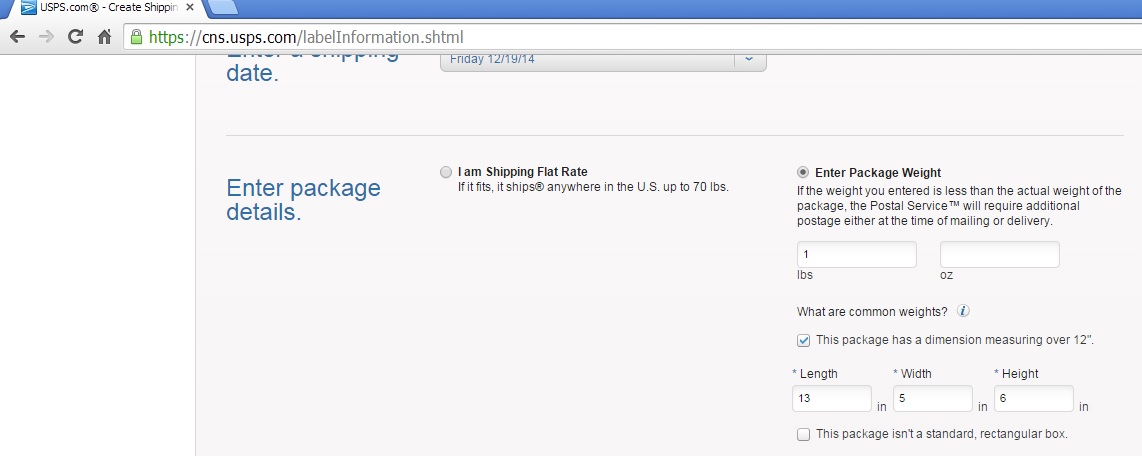
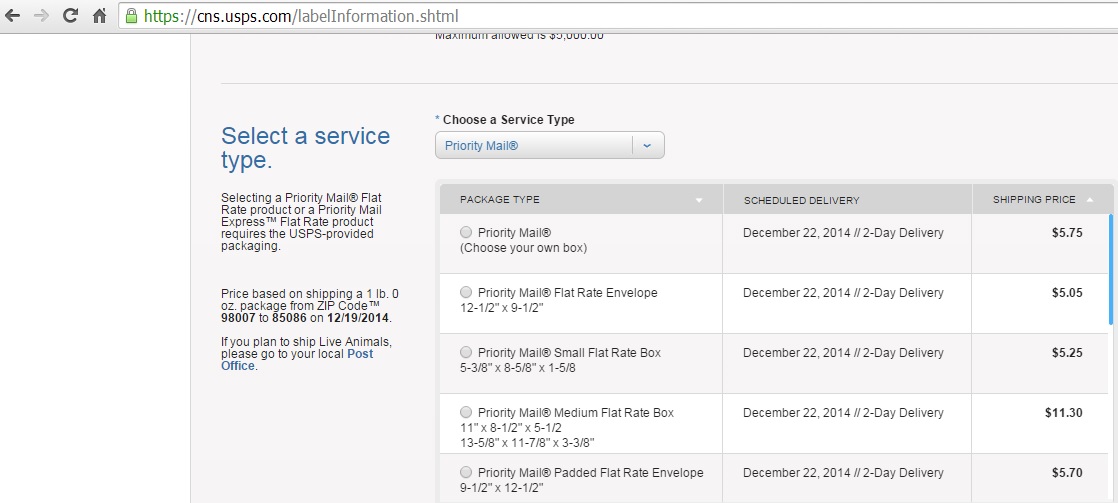
On the label printing page (requires a USPS.com login if you don't have one) is the option to enter package dimensions. If you specify package details of 1 lbs and 13x5x6 inches, and click to calculate "available Services and Prices" based on the details you've entered, you're presented with a list of options that include 'Priority Mail Flat Rate Envelope 12-1/2" x 9-1/2"', 'Priority Mail Small Flat Rate Box 5-3/8" x 8-5/8" x 1-5/8"', 'Priority Mail Medium Flat Rate Box 11" x 8-1/2" x 5-1/2"', 'Priority Mail Medium Flat Rate Box 13-5/8" x 11-7/8" x 3-3/8"', and 'Priority Mail Padded Flat Rate Envelope 9-1/2" x 12-1/2"' -- all of which, of course, are too small to hold the package whose dimensions you just specified.
You could argue that it's the user's responsibility to make sure their package fits into the box they select, but a user could reasonably assume that the whole point of entering the length, width and height is so that the USPS can recommend only those boxes that will hold the item. Remember, the user usually doesn't have these boxes in front of them at the time they're printing the label. They could end up selecting a box option, printing the label, taking it all the way to the post office along with their package, only to find out that the package doesn't fit into the box that they printed the label for, and that they have to wait in line anwyay to pay for an alternate method.
It's a middle-school-level programming exercise to take the length, width, and height of a package as an input, take as a second input a list of boxes of varying lengths, widths, heights, and costs, and find the lowest-cost box that will hold the package (keeping in mind that the package can be rotated to different orientations so that the "height" becomes the "width", etc.). It's reasonable to expect the postal service to be able to do this too.
#3: Everything wrong with the "print your labels" page
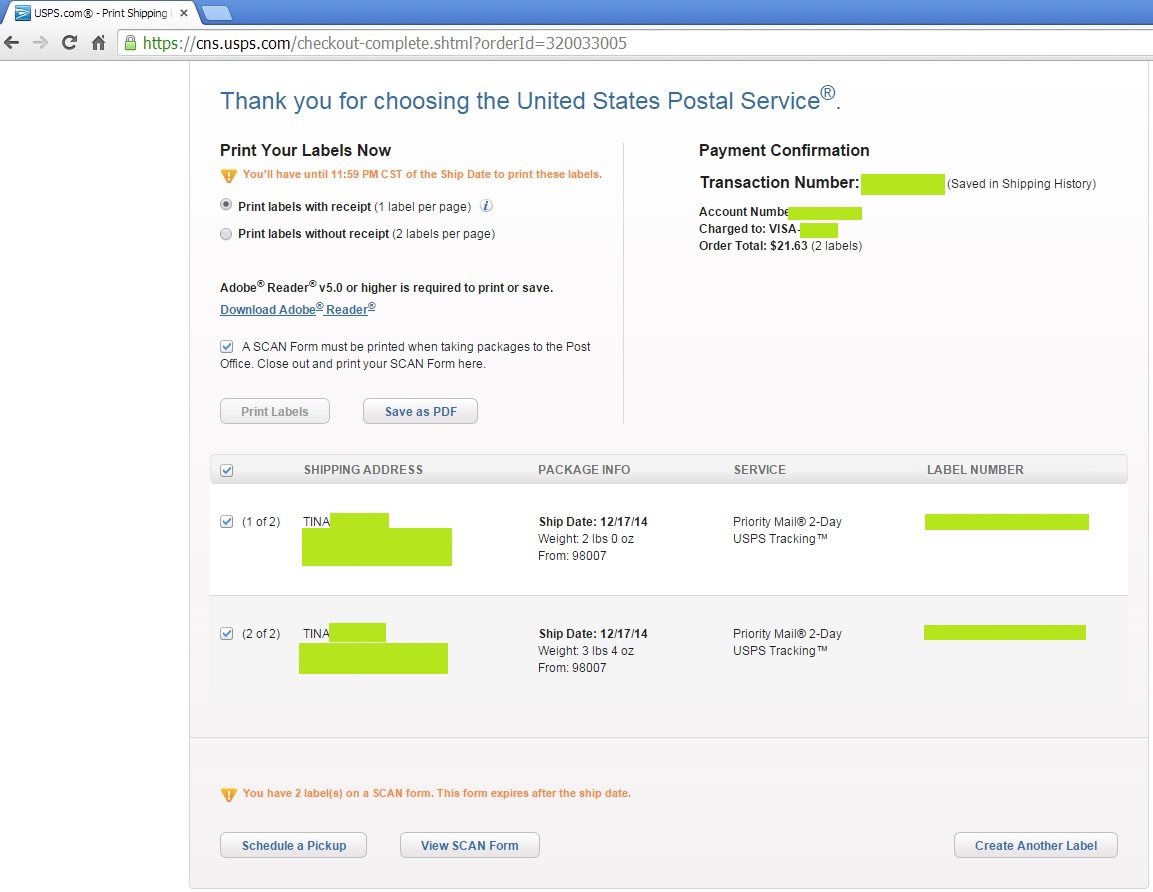
Here's a screen grab of the "print your labels" page that appears after you've paid, which you can use to play the Highlights "What's Wrong?" game:
-
The text at the top says "You'll have until 11:59 PM CST of the Ship Date to print these labels." OK, but if I print them at 11:59 PM, what good does it do if the post office closed at 6? Are the labels only valid on the ship date, or will they still work if I take them to the post office the next day? This should be more clear.
-
Text says "A SCAN Form must be printed when taking packages to the Post Office." Fine, but there's a checkbox next to that sentence. If that sentence describes a postal regulation, what does it mean if I un-check the box? That the regulation no longer applies to me? Can someone tell me if the drug laws work that way as well?
-
The next sentence says: "Close out and print your SCAN Form here." I have no idea what that sentence means. Close out of the browser? And where is "here"? When it's not hyperlinked, "here" means here.
-
WHY IS THE "PRINT LABELS" BUTTON DISABLED?? I have the checkboxes checked for both labels. I want to print them. What else do you want me to DO? (My PC has a printer, which the Chrome browser is aware of -- it lets me print from other webpages with no problem.) I got it to work by saving the PDF and printing that, but I never figured out why the Print button was just sitting there, mocking me from behind its veil of grey.
-
The "Schedule a Pickup" button at the bottom -- same problem as the "print until 11:59 PM" message at the top. Since I printed these labels with the ship date specified as today, it should be more clear if the labels will still be considered valid tomorrow, which is the soonest time that a pickup could be scheduled.
#4: Over an hour on hold and never got through.
As an adherent to the touchingly quaint notion that a reporter should talk to the subjects of their story before running it, and also because I just wanted clarification on some of these questions, I called the USPS help line and waited on hold for 30 minutes before their help line disconnected me. I called back and waited for another 40 minutes before I hung up this time. OK, strictly speaking that's not a "bug". They just suck.
In the end, after reverse-engineering their pricing options as I had vowed to do, I determined what appeared to be their rules, (applies only to domestic Priority Mail), which you may find handy:
- If you're shipping in a Flat Rate box, the weight of the package doesn't matter (up to the 70 lb limit), only the dimensions, to the extent that they determine which Flat Rate box you can fit it into, with the bigger ones being more expensive.
- On the other hand, if you pick the Priority Mail "Use your own box" option, then the dimensions don't matter (unless you exceed the allowed limits), only the weight -- a 5 lb, 3"x3"x3" package and a 5 lb, 21"x21"x21" package both ship for $15.22, but if you change the weight, that's when the price changes. (If you try to ship a 22"x22"x22" package, you get an error that you've exceeded the dimensions for a Click-N-Ship.)
Using this, I was able to strategically break my one shipment, which would have cost about $30, into two separate shipments which cost $12 and $8. All told, with the effort to reverse-engineer their pricing options and to document all of the bugs for posterity, it took me about an hour to figure out that $10 savings and to print labels that I could take to the post office and skip the line -- which, it turned out, looked only about 3 minutes long -- in order to experience what one redditor described as "feeling the hate from the people standing in line as I casually stroll up and drop my packages off at the front desk". But the important thing is, I did it efficiently.
-
-
Heinlein's 'All You Zombies' Now a Sci-Fi Movie Head Trip
HughPickens.com writes: Sara Stewart reports at the NY Post that the new sci-fi movie Predestination, opening January 9, is "loopier than Spielberg's [Minority Report]; its plot twists and turns 'like a snake eating its tail,' one character remarks, until you're not sure whether its developments are even plausible in a fictional universe." It's based on Robert A. Heinlein's science fiction classic All You Zombies, first published in 1959. The story involves a number of paradoxes caused by time travel, further developing themes explored by Heinlein in a previous work, By His Bootstraps, published some 18 years earlier. Predestination's plot concerns the intersection of a time-traveling assassin and an androgynous young writer -
Report: DHS Failing On Cybersecurity
chicksdaddy writes: It's always interesting to listen to what politicians say on their way out of office — after the pressure to get re-elected and say "on message" has been lifted. Eisenhower's historic farewell address in 1961 warned Americans about the influence of the Military-Industrial Complex. Twenty years later, Jimmy Carter warned of the distorting influence of "single-issue groups and special interest organizations" on the political process. And, this week, outgoing Sen. Tom Coburn (R-OK) used his final days in office to issue a blistering report on the Department of Homeland Security. Coburn argued that DHS was failing on each of its five, critical missions, among them: cyber security.
The report, "A Review of the Department of Homeland Security's Missions and Performance (PDF)," was released on Saturday. In it, the outgoing Senator said that DHS's strategy and programs "are unlikely to protect us from the adversaries that pose the greatest cybersecurity threat."
Despite spending $700 million annually on a range of cybersecurity programs, Coburn said it is hard to know whether the Department's efforts to assist the private sector in identifying, mitigating or remediating cyber incidents provide "significant value" or are worth the expense. DHS programs are still heavily weighted towards software vulnerability mitigation, Coburn says, an activity that "will not protect the nation from the most sophisticated attacks and cybersecurity threats." -
Little-Known Programming Languages That Actually Pay
Nerval's Lobster writes There is no shortage of programming languages, from the well-known ones (Java and C++) to the outright esoteric (intended just for research or even humor). While the vast majority of people learn to program the most-popular ones, the lesser-known programming languages can also secure you a good gig in a specific industry. Which languages? Client-server programming with Opa, Salesforce's APEX language, Mathematica and MATLAB, ASN.1, and even MIT's App Inventor 2 all belong on that list, according to developer Jeff Cogswell. On the other hand, none of these languages really have broad adoption; ASN.1 and SMI, for example, are primarily used in telecommunications and network management. So is it really worth taking the time to learn a new, little-used language for anything other than the thrills? -
Sony Thinks You'll Pay $1200 For a Digital Walkman
An anonymous reader writes: The Walkman is one of the most recognizable pieces of technology from the 1980s. Unfortunately for Sony, it didn't survive the switch to digital, and they discontinued it in 2010. Last year, they quietly reintroduced the Walkman brand as a "high-resolution audio player," supporting lossless codecs and better audio-related hardware. At $300, it seemed a bit pricey. But now, at the Consumer Electronics Show, Sony has loudly introduced its high-end digital Walkman, and somehow decided to price it at an astronomical $1,200.
What will all that money get you? 128GB of onboard storage and a microSD slot to go with it. There's a large touchscreen, and the device runs Android — but it uses version 4.2 Jelly Bean, which came out in 2012. It also supports Bluetooth and NFC. Sony claims the device has 33 hours of battery life when playing FLAC files, and 60 hours when playing MP3s. They appear to be targeting audiophiles — their press release includes phrasing about how pedestrian MP3 encoding will "compromise the purity of the original signal."