Slashdot Mirror
Domain: wikipedia.org
Stories and comments across the archive that link to wikipedia.org.
Stories · 7,048
-
German Wikipedia Passes One Million Article Mark
saibot834 writes "The German Wikipedia, the second largest language edition behind the English Wikipedia, just reached its 1,000,000 article milestone. Combined with 3.1M English articles and 240 other language editions, this adds up to a total of 14 million Wikipedia articles. Interestingly, there is a request for deletion on the millionth article. German Wikipedia has been criticized for its rules on notability, which are stricter than on the English Wikipedia. Quality though, is often considered to be higher on the German Wikipedia." -
German Wikipedia Passes One Million Article Mark
saibot834 writes "The German Wikipedia, the second largest language edition behind the English Wikipedia, just reached its 1,000,000 article milestone. Combined with 3.1M English articles and 240 other language editions, this adds up to a total of 14 million Wikipedia articles. Interestingly, there is a request for deletion on the millionth article. German Wikipedia has been criticized for its rules on notability, which are stricter than on the English Wikipedia. Quality though, is often considered to be higher on the German Wikipedia." -
German Wikipedia Passes One Million Article Mark
saibot834 writes "The German Wikipedia, the second largest language edition behind the English Wikipedia, just reached its 1,000,000 article milestone. Combined with 3.1M English articles and 240 other language editions, this adds up to a total of 14 million Wikipedia articles. Interestingly, there is a request for deletion on the millionth article. German Wikipedia has been criticized for its rules on notability, which are stricter than on the English Wikipedia. Quality though, is often considered to be higher on the German Wikipedia." -
German Wikipedia Passes One Million Article Mark
saibot834 writes "The German Wikipedia, the second largest language edition behind the English Wikipedia, just reached its 1,000,000 article milestone. Combined with 3.1M English articles and 240 other language editions, this adds up to a total of 14 million Wikipedia articles. Interestingly, there is a request for deletion on the millionth article. German Wikipedia has been criticized for its rules on notability, which are stricter than on the English Wikipedia. Quality though, is often considered to be higher on the German Wikipedia." -
Fifth Anniversary of a Cosmic Onslaught
The Bad Astronomer writes "Five years ago today (December 27, 2004), a vast wave of high-energy gamma and X-rays washed over the Earth, blinding satellites and partially ionizing the Earth's atmosphere. The culprit was a superflare from the magnetar SGR 1806-20, located 50,000 light years away. The energy released was mind-numbing: in one-fifth of a second, this supercharged magnetic neutron star blasted out as much energy as the Sun does in 250,000 years!" -
What DARPA's Been Up To, At Length
The New York Times takes an inside look at DARPA, the secretive defense agency, mentioned frequently on Slashdot, that is "changing the way we use machines — and the way they use us" in the form of a review of Michael Belfiore's The Department of Mad Scientists. Besides tracing the history of the agency, Belfiore's book expounds on the well-known Grand Challenge and its link to ever-more-automated vehicle control in civilian and military contexts, as well as other DARPA pet projects, including robotic surgery, information analysis, and the integration of electronics with the human body. -
Gnome Switches Nautilus Back To Browser Mode
An anonymous reader writes "In one of the do-the-developers-actually-use-their-own-software decisions in the Linux Desktop World, back in 2004 Gnome switched to the 'Spatial' view by default with their Nautilus file manager opening a new window with each new folder viewed. Many derided the decision as poor design or as being different for the sake of being different. Well, after five long years the Gnome powers that be have decided to switch back to browser mode." -
Networked Christmas Tree Controlled By Twitter
An anonymous reader writes "What's Twitter good for? How about crowd sourcing control of your Christmas tree. Dangerous Prototypes built an open source, networked Christmas tree that you can control from Twitter. Send a color or hexadecimal color code to @tweet_tree, then watch the color change on the live video stream. This project is based on an updated version of the open source business card size web server covered previously." -
VLC Team Announces Video Editor In the Works
eldavojohn writes "Despite news that VLC might not have anyone to work on the Mac release, Lifehacker brings word of a video editor that the VLC team is working on dubbed VideoLAN Media Creator. It hasn't been released yet (git clone git://github.com/VLMC/vlmc.git) but a pre-release is due out soon." -
Alternative 2009 Copyright Expirations
jrincayc writes "It's nearly the end of 2009. If the 1790 copyright maximum term of 28 years was still in effect, everything that had been published by 1981 would be now be in the public domain — like the original Ultima and God Emperor of Dune — and would be available for remixing and mashing up. If the 1909 copyright maximum term of 56 years (if renewed) were still in force, everything published by 1953 would now be in the public domain, freeing The City and the Stars and Forbidden Planet. If the 1976 copyright act term of 75* years (* it's complicated) still applied, everything published by 1934 would now be in the public domain, including Murder on the Orient Express. But thanks to the Sonny Bono Copyright Term Extension Act, nothing in the US will go free until 2018, when 1923 works expire." Assuming Congress doesn't step in with a Copyright Extension Act of 2017. What are the odds? -
Alternative 2009 Copyright Expirations
jrincayc writes "It's nearly the end of 2009. If the 1790 copyright maximum term of 28 years was still in effect, everything that had been published by 1981 would be now be in the public domain — like the original Ultima and God Emperor of Dune — and would be available for remixing and mashing up. If the 1909 copyright maximum term of 56 years (if renewed) were still in force, everything published by 1953 would now be in the public domain, freeing The City and the Stars and Forbidden Planet. If the 1976 copyright act term of 75* years (* it's complicated) still applied, everything published by 1934 would now be in the public domain, including Murder on the Orient Express. But thanks to the Sonny Bono Copyright Term Extension Act, nothing in the US will go free until 2018, when 1923 works expire." Assuming Congress doesn't step in with a Copyright Extension Act of 2017. What are the odds? -
Alternative 2009 Copyright Expirations
jrincayc writes "It's nearly the end of 2009. If the 1790 copyright maximum term of 28 years was still in effect, everything that had been published by 1981 would be now be in the public domain — like the original Ultima and God Emperor of Dune — and would be available for remixing and mashing up. If the 1909 copyright maximum term of 56 years (if renewed) were still in force, everything published by 1953 would now be in the public domain, freeing The City and the Stars and Forbidden Planet. If the 1976 copyright act term of 75* years (* it's complicated) still applied, everything published by 1934 would now be in the public domain, including Murder on the Orient Express. But thanks to the Sonny Bono Copyright Term Extension Act, nothing in the US will go free until 2018, when 1923 works expire." Assuming Congress doesn't step in with a Copyright Extension Act of 2017. What are the odds? -
Alternative 2009 Copyright Expirations
jrincayc writes "It's nearly the end of 2009. If the 1790 copyright maximum term of 28 years was still in effect, everything that had been published by 1981 would be now be in the public domain — like the original Ultima and God Emperor of Dune — and would be available for remixing and mashing up. If the 1909 copyright maximum term of 56 years (if renewed) were still in force, everything published by 1953 would now be in the public domain, freeing The City and the Stars and Forbidden Planet. If the 1976 copyright act term of 75* years (* it's complicated) still applied, everything published by 1934 would now be in the public domain, including Murder on the Orient Express. But thanks to the Sonny Bono Copyright Term Extension Act, nothing in the US will go free until 2018, when 1923 works expire." Assuming Congress doesn't step in with a Copyright Extension Act of 2017. What are the odds? -
Alternative 2009 Copyright Expirations
jrincayc writes "It's nearly the end of 2009. If the 1790 copyright maximum term of 28 years was still in effect, everything that had been published by 1981 would be now be in the public domain — like the original Ultima and God Emperor of Dune — and would be available for remixing and mashing up. If the 1909 copyright maximum term of 56 years (if renewed) were still in force, everything published by 1953 would now be in the public domain, freeing The City and the Stars and Forbidden Planet. If the 1976 copyright act term of 75* years (* it's complicated) still applied, everything published by 1934 would now be in the public domain, including Murder on the Orient Express. But thanks to the Sonny Bono Copyright Term Extension Act, nothing in the US will go free until 2018, when 1923 works expire." Assuming Congress doesn't step in with a Copyright Extension Act of 2017. What are the odds? -
Alternative 2009 Copyright Expirations
jrincayc writes "It's nearly the end of 2009. If the 1790 copyright maximum term of 28 years was still in effect, everything that had been published by 1981 would be now be in the public domain — like the original Ultima and God Emperor of Dune — and would be available for remixing and mashing up. If the 1909 copyright maximum term of 56 years (if renewed) were still in force, everything published by 1953 would now be in the public domain, freeing The City and the Stars and Forbidden Planet. If the 1976 copyright act term of 75* years (* it's complicated) still applied, everything published by 1934 would now be in the public domain, including Murder on the Orient Express. But thanks to the Sonny Bono Copyright Term Extension Act, nothing in the US will go free until 2018, when 1923 works expire." Assuming Congress doesn't step in with a Copyright Extension Act of 2017. What are the odds? -
Alternative 2009 Copyright Expirations
jrincayc writes "It's nearly the end of 2009. If the 1790 copyright maximum term of 28 years was still in effect, everything that had been published by 1981 would be now be in the public domain — like the original Ultima and God Emperor of Dune — and would be available for remixing and mashing up. If the 1909 copyright maximum term of 56 years (if renewed) were still in force, everything published by 1953 would now be in the public domain, freeing The City and the Stars and Forbidden Planet. If the 1976 copyright act term of 75* years (* it's complicated) still applied, everything published by 1934 would now be in the public domain, including Murder on the Orient Express. But thanks to the Sonny Bono Copyright Term Extension Act, nothing in the US will go free until 2018, when 1923 works expire." Assuming Congress doesn't step in with a Copyright Extension Act of 2017. What are the odds? -
Alternative 2009 Copyright Expirations
jrincayc writes "It's nearly the end of 2009. If the 1790 copyright maximum term of 28 years was still in effect, everything that had been published by 1981 would be now be in the public domain — like the original Ultima and God Emperor of Dune — and would be available for remixing and mashing up. If the 1909 copyright maximum term of 56 years (if renewed) were still in force, everything published by 1953 would now be in the public domain, freeing The City and the Stars and Forbidden Planet. If the 1976 copyright act term of 75* years (* it's complicated) still applied, everything published by 1934 would now be in the public domain, including Murder on the Orient Express. But thanks to the Sonny Bono Copyright Term Extension Act, nothing in the US will go free until 2018, when 1923 works expire." Assuming Congress doesn't step in with a Copyright Extension Act of 2017. What are the odds? -
Alternative 2009 Copyright Expirations
jrincayc writes "It's nearly the end of 2009. If the 1790 copyright maximum term of 28 years was still in effect, everything that had been published by 1981 would be now be in the public domain — like the original Ultima and God Emperor of Dune — and would be available for remixing and mashing up. If the 1909 copyright maximum term of 56 years (if renewed) were still in force, everything published by 1953 would now be in the public domain, freeing The City and the Stars and Forbidden Planet. If the 1976 copyright act term of 75* years (* it's complicated) still applied, everything published by 1934 would now be in the public domain, including Murder on the Orient Express. But thanks to the Sonny Bono Copyright Term Extension Act, nothing in the US will go free until 2018, when 1923 works expire." Assuming Congress doesn't step in with a Copyright Extension Act of 2017. What are the odds? -
Where Are the Cheap Thin Clients?
Darren Ginter writes "I find many aspects of desktop virtualization compelling, with one exception: the cost of the thin clients, which typically exceeds that of a traditional box. I understand all of the benefits of desktop virtualization (and the downsides, thanks) but I'm very hung up on spending more for less. While there are some sub-$200 products out there, they all seem to cut corners (give me non-vaporware that will drive a 22" LCD at full resolution). I can PXE boot a homebrew Atom-based thin client for $130, but I'd prefer to be able to buy something assembled. Am I missing something here?" -
Insurgent Attacks Follow Mathematical Pattern
Hugh Pickens writes "Nature reports that data collected on the timing of attacks and number of casualties from more than 54,000 events across nine insurgent wars, including those fought in Iraq between 2003 and 2008 and in Sierra Leone between 1994 and 2003, suggest that insurgencies have a common underlying pattern that may allow the timing of attacks and the number of casualties to be predicted. By plotting the distribution of the frequency and size of events, the team found that insurgent wars follow an approximate power law, in which the frequency of attacks decreases with increasing attack size to the power of 2.5. This means that for any insurgent war, an attack with 10 casualties is 316 times more likely to occur than one with 100 casualties (316 is 10 to the power of 2.5). 'We found that the way in which humans do insurgent wars — that is, the number of casualties and the timing of events — is universal,' says team leader Neil Johnson, a physicist at the University of Miami in Florida. 'This changes the way we think insurgency works.' To explain what was driving this common pattern, the researchers created a mathematical model which assumes that insurgent groups form and fragment when they sense danger, and strike in well-timed bursts to maximize their media exposure. Johnson is now working to predict how the insurgency in Afghanistan might respond to the influx of foreign troops recently announced by US President Barack Obama. 'We do observe a complicated pattern that has to do with the way humans do violence in some collective way,' adds Johnson." -
Yes, Google Does De-List Pages; But When?
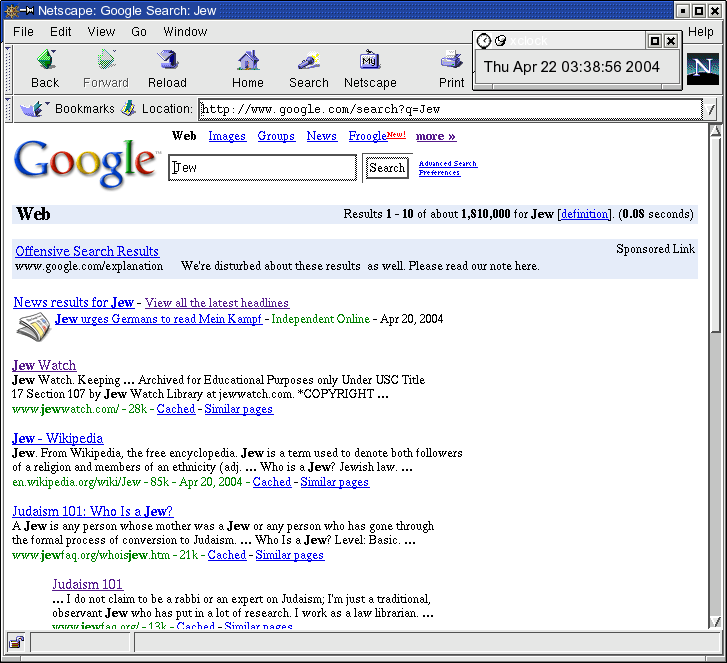
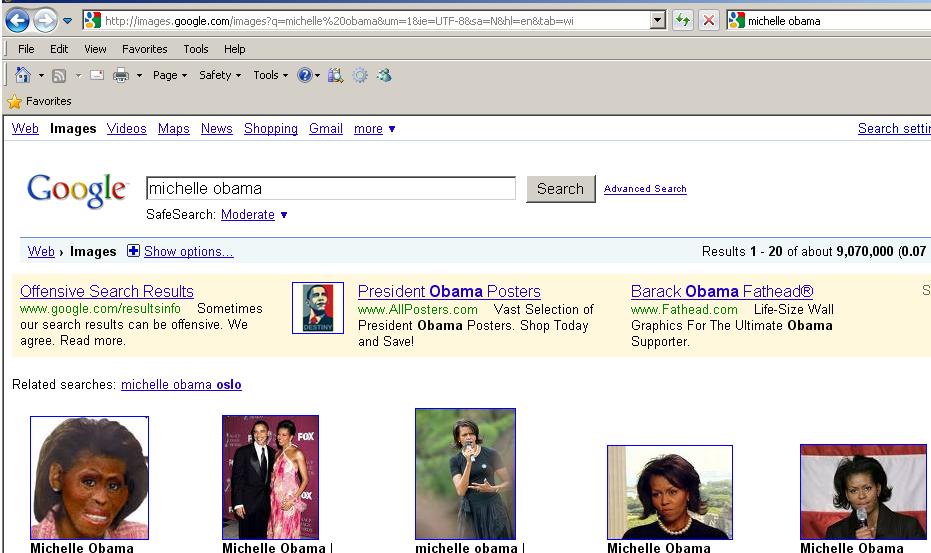
Frequent Slashdot contributor Bennett Haselton writes "Google finds itself inserting a disclaimer once again above some offensive search results. But the disclaimer still leads many to believe (incorrectly) that Google doesn't tamper with search results even in cases of 'harmful' or 'offensive' material. We know that Google has in fact de-listed some pages at the request of offended parties. What is their real policy on the issue?" Read on for Bennet's essay.In 2004, when Google users discovered that the top search result for the word "Jew" was the anti-semitic site Jew Watch, Google ran a disclaimer in the space usually reserved for ads, explaining that their results only reflected the reality of link counts on the Web, and that they did not endorse any Web sites which appeared at the top of their listings. Now the disclaimer has been dusted off again, as the top result on Google Images for "Michelle Obama" is a picture of a monkey's face with Michelle's hairdo. (Ironically, it looks as if the original image would have fallen out of the rankings, if it hadn't been for a follow-up blog post about the controversy, which itself now comes up as the first result.)
I first heard about the controversy from Dennis Prager's column in which he takes a New York Times columnist to task, because the columnist complained about "racially offensive images of the first couple" that come up in Google searches. Prager was unable to find any examples from Googling "first couple" or "Michelle and Barack Obama pictures," so he concluded that the NYT columnist "wildly exaggerated, if not made up" his claims. I tried Google Image searches for "first couple," "Barack Obama," and some other terms, and I couldn't find anything controversial either. However, it only took 10 seconds to enter "first couple google images controversy" on the regular Google Web search and find multiple blog posts explaining what all the fuss was about. Back to Google 101 for Dennis.
Many of the blog posts refer to Google's disclaimer about not tampering with search results. Those on one side are urging Google to make an exception and "fix" the results, while others sagely observe that Google just reflects reality, it doesn't create it.
All of this punditry is starting from a premise that's wrong. Google has actually removed pages from their search results — not because the pages were illegal or because the webmasters were search engine spamming, but because of the page's "offensive" content. In the "Chester's Guide" incident, a councilman in Chester, England discovered that one of the search results for "chester guide" was a satirical page titled "Chester's guide to picking up little girls." Although the page itself was obviously just someone's idea of sick humor, a Chester city councilman (who admitted that he hadn't looked at the page, saying that the title told him everything he needed to know) urged Google to remove the page from their index. Google at first refused, but later manually blacklisted the page to prevent it from appearing in their search results.
Whether or not you think this was the right decision, probably depends on what you think is the purpose of Google. If Google's purpose is to return the most useful results, then it made sense to remove the link, as Danny Sullivan of Search Engine Watch argued at the time, since it almost certainly was not a useful result for people searching for "Chester Guide." On the other hand, if the primary purpose of Google is to reflect the reality of what pages on the Web feature certain words most prominently (combined with all the other factors that Google weighs, of course), then the results shouldn't be altered.
But more people should at least realize that it happened. The Google disclaimer doesn't precisely say that they never blacklist pages or modify search results ("Google reserves the right to address such requests individually"), but it seems to give most people the impression that that's the case. According to that crudest of Googling techniques for which novice searchers are so frequently lampooned, there appear to be about 400 times as many stories on the Web about the Google "Jew Watch" controversy (where Google stood their ground) as there are stores about the "Chester's Guide" incident (where Google caved).
And Google-number-three Matt Cutts posted on his blog back in March explaining why Google does not remove "offensive" pages from search results; over a hundred comments followed, debating the pros and cons of the position, but none of them mentioned the Chester incident or any other case where Google actually had removed pages except as a result of a court order. One isolated comment from "Anonymous" said:
This is not quite true. I know of at least one web site that was de-listed for containing illegal content and/or promoting illegal activity.
which may or may not have been a reference to the Chester Guide incident. And that was it.
Is this a lot of hay to be making over something that happened years ago? Well, for one thing, I doubt if it happened just once. Consider that the Chester Guide incident involved a public declaration of outrage by a city council, and a public statement from Google, and still hardly anyone knows that it ever happened. If other incidents occurred without those high-profile elements, it would be even harder to discover them now. We'll probably never know how many such incidents took place, unless someone sues Google (maybe the owner of a blacklisted website, or maybe the victim of a RipOffReport hatchet job wondering why that site hadn't been blacklisted long ago), subpoenas Google for a list of cases where pages were de-indexed, and publishes the list if it's not sealed by a court order.
But whether it was one time or a handful, consider that political candidates like Arnold Schwarzenegger and Al Franken got asked during their campaigns about things they did 20 years earlier, and it's fair to ask a candidate about their past, because it's the same person standing in front of you now. Why did you do that? Have you stopped? Why?
And in the big scheme of things, Google is probably more powerful than a single US senator or the governor of California. So, can't we ask? What are their real rules about page removal? Have those rules changed since the Chester's Guide controversy? Can they even tell us what their rules are, or do they consider it a trade secret?
It is well known, of course, that Google censors some results in their search engines branded for different markets like China and even in liberal democracies like Germany. But nobody would call that a slippery slope towards censorship in the US version of Google, because the censorship in the Chinese and German versions is done at the behest of the governments there. On the other hand, Google does admit that they will de-index pages which include credit card numbers or social security numbers (which are all too easy to find on the Web). This might not seem like a controversial position, but even this act of voluntary self-censorship may be dipping their toe in the water further than it seems. Most people do consider their credit card information more private than their home address. But surely there are people like J.D. Salinger who less about the privacy of their credit card number (which is easily changeable) than their home address (which isn't). If someone finds Salinger's address and posts it on the Web, should Salinger be able to demand that Google de-index the page? Why should Google cater to the majority who want to keep their credit card number secret, but not to the minority who care more about keeping their address secret? Another commenter on Matt Cutts's blog post asked:
"hi. I have a question. My mom 'googled' herself and it shows some of her medical problems. She wants/needs these pages removed from search engines."
Again, why shouldn't that be considered at least as private as a credit card number?
And finally, even Google's decision to display an "offensive results" disclaimer, for some results but not for others, raises the same "Where do you draw the line?" questions as the issue of page removal. The Michelle Obama monkey picture gets a disclaimer. But search for 'george w bush' and the first row includes a photoshopped (I think!) image of Bush flipping off the press. Does that warrant a disclaimer as well? (Maybe that's considered less unfair because, even though the picture is fake, it does depict something that actually happened.) The first image result for "bristol palin" is a photo of her engaged in underage drinking — a real photo, but probably unfair to call it the single most relevant photo of her on the Web.
So while Google might consider credit cards and social security numbers and search engine spam to be on one side of a "bright line," and everything else is served up without alteration, I think the line is blurrier than that, for at least those three reasons: (a) credit cards and SSNs are less private than some other that things that Google serves up anyway; (b) Google has unambiguously removed some content that fell outside that bright line, as in the Chester's guide incident, and (c) they make other "slippery slope" judgment calls about search results all the time (as in the question of when to show the disclaimer). So I hope that Google someday comes out with a more complete answer to the question. What is their real policy on what they will remove? The Chester's guide incident — would they do that sort of thing if the same situation came up today, or have their rules changed? If they want to go really deep, then is there a general set of principles from which their rules follow — explaining why, for example, they treat credit card numbers as more private than sensitive medical information? (Google did not respond to my request for comment, either through official channels or the unofficial back channels of friends who work there.)
I hope Google gives an answer some day. Even just to say, "It's a classified internal policy and that's all we're going to tell you." But once and for all, the answer is not "Google doesn't remove content just because it's 'offensive' or 'harmful.'"
Meanwhile, a modest suggestion about the disclaimer displayed above the search results: Put it where people will actually see it, in a separate line below the ads, but above the search results. Right now the link to the disclaimer is displayed as one of three ads across the top, and people don't look at the ads. But hey, people do buy ads, so if you push the disclaimer down a bit where people will read it, you also free up space for 50% more ad revenue!
-
Are You Using SPF Records?
gravyface writes "I've been setting up proper Sender Policy Framework records for all my clients for past year or so, hoping to either maintain or improve their 'reputation' in the email universe. However, there's a lot of IT admins I speak with who either haven't heard of SPF records or haven't bothered setting them up. How many of you are using SPF records for your mail domains? Does it help? How many anti-spam vendors out there use SPF records as part of their 'scorecard'?" -
Facebook Mafiosi Go To the Mattresses vs. Zynga
sympleko writes "Zynga has the lion's share of traffic in Facebook applications, and Mafia Wars is one of their most popular social games. Collapsing under the weight of over 26 million users, Zynga has been scrambling to thwart hard-core gamers who reverse-engineer URLs or script the game to optimize their enjoyment. Many of the workarounds have annoyed users who were accustomed to various game features, and even worse, the hastily-deployed changes have resulted in many players losing access to the game, in-game prizes, or statistics. Fed up with a software company seemingly bent on discouraging people from enjoying their product, a number of tagged players have organized a boycott of all Zynga games. The first 24-hour boycott on Sunday 12/13 resulted in an 11% decline in Daily Active Users, and an emergency thread on Zynga's forums (from which most of the flames were deleted). The current boycott, extending Wednesday through Sunday is being supported by a 428K strong Facebook group. At issue is the social contract between software companies and their devoted user base, as well as the nefarious tactics Zynga has used to raise cash." -
FASTRA II Puts 13 GPUs In a Desktop Supercomputer
An anonymous reader writes "Last year tomography researchers of the ASTRA group at the University of Antwerp developed a desktop supercomputer with four NVIDIA GeForce 9800 GX2 graphics cards. The performance of the FASTRA GPGPU system was amazing; it was slightly faster than the university's 512-core supercomputer and cost less than 4000EUR. Today the researchers announce FASTRA II, a new 6000EUR GPGPU computing beast with six dual-GPU NVIDIA GeForce GTX 295 graphics cards and one GeForce GTX 275. The development of the new system was more complicated and there are still some stability issues, but tests reveal the 13 GPUs deliver 3.75x more performance than the old system. For the tomography reconstruction calculations these researchers need to do, the compact FASTRA II is four times faster than the university's supercomputer cluster, while being roughly 300 times more energy efficient." -
Former Congressman Learns About Streisand Effect
corbettw writes "Ted Alvin Klaudt, a former South Dakota lawmaker convicted of raping his two foster daughters, has sent news organizations what he claims is a copyright notice that seeks to prevent the use of his name without his consent." The story says Klaudt maintains "no one can use his name without his consent, and anyone who does would owe him $500,000." -
BetaNet Sues Everyone For Remote SW Activation
eldavojohn writes "Not to be out patent trolled by Eolas, a mystery company named 'BetaNet, LLC' is suing: Adobe Systems, Inc, Apple, Inc., Arial Software, LLC, Autodesk, Inc.,, CARBONITE, INC., Corel Corp., Eastman Kodak Co., International Business Machines Corp., Intuit, Inc., Microsoft Corp., McAfee, Inc., Oracle Corp., Rockwell Automation, Inc., Rosetta Stone, Inc., SAP America, Inc., Siemens Corp. and Sony Creative Software, Inc. for infringement of their patent entitled Secure system for activating personal computer software at remote locations. And of course, this was filed in our favoritest of favorite places: Marshall, TX (Texas Eastern District Court)." -
Sci-Fi Author Peter Watts Beaten, Charged During Border Crossing
JoeGee writes "On December 8th, Canadian sci-fi author Peter Watts, author of the Rifters trilogy and Blindsight, was crossing the US/Canadian border at Port Huron, Michigan when he was involved in an altercation with US Border Patrol agents. According to Watts, he was beaten, left half-naked in a cold cell, and finally dumped on the Canadian side of the border with no coat. A legal consultant from the Electronic Frontier Foundation was successful in helping a civil rights lawyer in Michigan free Watts. Watts faces US charges of assaulting a federal officer. Based on the accounts, one can assume Watts did so by hitting the officer's hand with his face. If convicted, Watts faces two years in a US Federal prison." -
How To Build a Quantum Propulsion Machine
KentuckyFC writes "According to quantum mechanics, a vacuum will be filled with electromagnetic waves leaping in and out of existence. It turns out that these waves can have various measurable effects, such as the Casimir-Polder force, which was first measured accurately in 1997. Just how to exploit this force is still not clear. Now, however, a researcher at an Israeli government lab suggests how it could be possible to generate propulsion using the quantum vacuum. The basic idea is that pushing on the electromagnetic fields in the vacuum should generate an equal and opposite force. The suggestion is that this can be done using nanoparticles that interact with the vacuum's electric and magnetic fields, generating the well-known Lorentz force. In most cases, the sum of Lorentz forces adds up to zero. But today's breakthrough is the discovery of various ways to break this symmetry and so use the quantum vacuum to generate a force. The simplest of these is simply to rotate the particles. So the blueprint for a quantum propulsion machine described in the paper is an array of addressable nanoparticles that can be rotated in the required way. Although such a machine will need a source of energy, it generates propulsion without any change in mass. As the research puts it with magesterial understatement, this might have practical implications." -
Quebec Data Center Built In a Silo
1sockchuck writes "A supercomputing center in Quebec has transformed a huge concrete silo into the CLUMEQ Colossus, a data center filled with HPC clusters. The silo, which is 65 feet high with two-foot thick concrete walls, previously housed a Van de Graaf accelerator dating to the 1960s. It was redesigned to house three floors of server cabinets, arranged so cold air can flow from the outside of the facility through the racks and return via an interior 'hot core.' The construction and operation of the unique facility (PDF) are detailed in a presentation from CLUMEQ." -
New Hubble Ultra Deep Field In Infrared
Hynee writes "Just in time for Christmas, HubbleSite has released a Hubble Ultra Deep Field redux. The original was in visible light; this version, five years on, is in infrared (1.05, 1.25 and 1.6 um). The observation is in support of the upcoming JWST, which will observe exclusively in infrared, but the newly installed WFC3 does seem to provide some extra resolution over the 2004 visible observations with WFC2." -
New Hubble Ultra Deep Field In Infrared
Hynee writes "Just in time for Christmas, HubbleSite has released a Hubble Ultra Deep Field redux. The original was in visible light; this version, five years on, is in infrared (1.05, 1.25 and 1.6 um). The observation is in support of the upcoming JWST, which will observe exclusively in infrared, but the newly installed WFC3 does seem to provide some extra resolution over the 2004 visible observations with WFC2." -
ECMAScript Version 5 Approved
systembug writes "After 10 years of waiting and some infighting, ECMAScript version 5 is finally out, approved by 19 of the 21 members of the ECMA Technical Committee 39. JSON is in; Intel and IBM dissented. IBM is obviously in disagreement with the decision against IEEE 754r, a floating point format for correct, but slow representation of decimal numbers, despite pleas by Yahoo's Douglas Crockford." (About 754r, Crockford says "It was rejected by ES4 and by ES3.1 — it was one of the few things that we could agree on. We all agreed that the IBM proposal should not go in.") -
13-Year-Old Radio Pirate Defies Canadian Authorities
Freshly Exhumed writes "Broadcasting illegally on the FM Radio band from atop his father's strip club in Canada's capital city of Ottawa, young Jayhaed Saadé was handed a cease-and-desist order by Industry Canada inspectors on December 2 to shut down his MIX FM operation, then simply waited a few hours, pumped up the volume once again the next afternoon, and still remains defiantly on the air. His choice of programming has been described as a blatant rip-off of Lebanon's popular MIX FM music station. The story gets weirder as it seems Saadé's father is a former Ottawa mayoralty candidate, and apparently sees no harm in his son's illegal activities despite looming $20,000-per-day fines that Industry Canada may impose under Canada's Broadcasting Act, let alone the shark feeding frenzy that is sure to occur when the Mounties, the taxman, music industry copyright/plagiarism watchdogs, and other aggrieved parties descend on his second floor playhouse." -
Brain of Patient H.M. Being Sliced, Streamed Live
buswolley writes "The slicing of the brain of the famous amnesic patient H.M. into giant histological sections is now in full swing, and is being streamed live. The brain specimen is frozen and sectioned whole during one continuous session that is expected to last approximately 30 hours." -
The Voynich Manuscript May Have Been Decoded
MBCook sends word on a possible solution to the mystery of the Voynich Manuscript, which we last visited nearly 6 years ago. "The Voynich Manuscript has confounded attempts to decode it for nearly 100 years. A person named Edith Sherwood, who has previously suggested a possible link to DaVinci, has a new idea: perhaps the text is simply anagrams of Italian words. There are three pages of examples from the herb section of the book, showing the original text, the plaintext Italian words, and the English equivalents. Has someone cracked the code?" -
Typewriters, Computers, and Creating?
saddleupsancho writes "Today's NY Times reports that Cormac McCarthy is auctioning the 45-year-old Olivetti manual typewriter on which all his novels, screenplays, plays, short stories, and much of his correspondence were written, to benefit the Sante Fe Institute where he is a Research Fellow. What would happen decades from now if, say, Richard Powers or Neal Stephenson attempted to auction their desktops or laptops? Setting aside completely any comparison among the three authors, is there something more intrinsically interesting and valuable, less ephemeral and interchangeable, about a typewriter vs. a computer as an instrument of literary creation? Or is the current generation just as sentimental about their computer-based devices as McCarthy's generation is about his Olivetti? Would you offer as much for McCarthy's input device if it were a generic PC, Mac, or Linux box as you would for his Olivetti?" -
Typewriters, Computers, and Creating?
saddleupsancho writes "Today's NY Times reports that Cormac McCarthy is auctioning the 45-year-old Olivetti manual typewriter on which all his novels, screenplays, plays, short stories, and much of his correspondence were written, to benefit the Sante Fe Institute where he is a Research Fellow. What would happen decades from now if, say, Richard Powers or Neal Stephenson attempted to auction their desktops or laptops? Setting aside completely any comparison among the three authors, is there something more intrinsically interesting and valuable, less ephemeral and interchangeable, about a typewriter vs. a computer as an instrument of literary creation? Or is the current generation just as sentimental about their computer-based devices as McCarthy's generation is about his Olivetti? Would you offer as much for McCarthy's input device if it were a generic PC, Mac, or Linux box as you would for his Olivetti?" -
Typewriters, Computers, and Creating?
saddleupsancho writes "Today's NY Times reports that Cormac McCarthy is auctioning the 45-year-old Olivetti manual typewriter on which all his novels, screenplays, plays, short stories, and much of his correspondence were written, to benefit the Sante Fe Institute where he is a Research Fellow. What would happen decades from now if, say, Richard Powers or Neal Stephenson attempted to auction their desktops or laptops? Setting aside completely any comparison among the three authors, is there something more intrinsically interesting and valuable, less ephemeral and interchangeable, about a typewriter vs. a computer as an instrument of literary creation? Or is the current generation just as sentimental about their computer-based devices as McCarthy's generation is about his Olivetti? Would you offer as much for McCarthy's input device if it were a generic PC, Mac, or Linux box as you would for his Olivetti?" -
Canadian Blood Services Promotes Pseudoscience
trianglecat writes "The not-for-profit agency Canadian Blood Services has a section of their website based on the Japanese cultural belief of ketsueki-gata, which claims that a person's blood group determines or predicts their personality type. Disappointing for a self-proclaimed 'science-based' organization. The Ottawa Skeptics, based in the nation's capital, appear to be taking some action." -
Scientology Charged With Slavery, Human Trafficking
eldavojohn writes "A formal complaint was filed in California (caged PDF) last week by John Lindstein naming David Miscavige and the Church of Scientology International as defendants. Lindstein claims that for sixteen years (from age 8) he was forced to work as a slave at Gold Base, a secret CoS site run by Golden Era Productions with 'razor wire, security guard patrols, surveillance posts, and three roll calls each day.' The pay was $50 a week. The allegations include 'Violations of wage and hour laws as well as unfair/illegal business practices actionable under California B&P 17200 Et. Seq.' and a complaint under the 13th Amendment of the US Constitution, which abolished slavery. Members of the group Anonymous praised the summons." -
MacBook Mod Gives Base Station Chassis New Purpose
odysseus31173 writes "A little over a year ago, I began developing for the iPhone and needed a working mac (not a Hackintosh), so I decided to purchase a MacBook logic board to save on cost. I modded a Linksys case to accept the logic board (along with all of the other hardware) and made it function again. The Mac currently runs Leopard and has a working iSight and mic along with fully functional WiFi and bluetooth. The RAM is the standard 1 gig, but the hard drive has been upgraded to 160 gigs. The iSight/mic holes in the front panel are hard to see and this could be used as a nanny cam of sorts." -
Cancer Vaccine That Mimics Lymph Node
SubComdTaco writes "Harvard has announced their approach towards an implantable cancer vaccine (press release here). To anyone familiar with how the immune system works, this appears to be a synthetic lymph node, an intriguing bit of biomimicry. From the Science Daily article: 'A cancer vaccine carried into the body on a carefully engineered, fingernail-sized implant is the first to successfully eliminate tumors in mammals, scientists recently reported in the journal Science Translational Medicine. The new approach, pioneered by bioengineers and immunologists at Harvard University, uses plastic disks impregnated with tumor-specific antigens and implanted under the skin to reprogram the mammalian immune system to attack tumors. The new paper describes the use of such implants to eradicate melanoma tumors in mice. ... The slender implants... are 8.5 millimeters in diameter and made of an FDA-approved biodegradable polymer. Ninety percent air, the disks are highly permeable to immune cells and release cytokines, powerful recruiters of immune-system messengers called dendritic cells. These cells enter an implant's pores, where they are exposed to antigens specific to the type of tumor being targeted. The dendritic cells then report to nearby lymph nodes, where they direct the immune system's T cells to hunt down and kill tumor cells.'" -
Plasma Device Kills Bacteria On Skin In Seconds
Ponca City, We love you writes "In medicine, plasma, the fourth state of matter, is already used for sterilizing surgical instruments; plasma works at the atomic level and is able to reach all surfaces, even the interior of hollow needle ends. Now the BBC reports that researchers at the Max Planck Institute for Extraterrestrial Physics have demonstrated a plasma device that can rid hands, feet, or even underarms of bacteria, including the hospital superbug MRSA, by creating cold atmospheric plasma that produces a cocktail of chemicals that kills bacteria but is harmless to skin. 'The plasma produces a series of over 200 chemical reactions that involve the oxygen and nitrogen in air plus water vapor — there is a whole concoction of chemical species that can be lethal to bacteria,' says Gregor Morfill. 'It's actually similar to what our own immune system does.' The team says that an exposure to the plasma of only about 12 seconds reduces the incidence of bacteria, viruses, and fungi on hands by a factor of a million — a number that stands in sharp contrast to the several minutes hospital staff can take to wash using traditional soap and water. Morfill says that the approach can be used to kill the bacteria that lead to everything from gum disease to body odor and that the prototype is scalable to any size and can be produced in any shape." -
Newspapers Face the Prisoner's Dilemma With Google
Hugh Pickens writes "Nicholas Carr has an interesting analysis of Rupert Murdoch's threat to de-list News Corp's stories from Google and Microsoft's eager offer to make Bing Murdoch's exclusive search engine for its content. Carr writes that newspapers are caught in a classic Prisoner's Dilemma with Google because Google's search engine 'prevents them from making decent money online — by massively fragmenting traffic, by undermining brand power, and by turning news stories into fungible commodities.' If any single newspaper opts out of Google, their competitors will pick up the traffic they lose. There is only one way that newspapers can break out of the prison — if a critical mass of newspapers opt out of Google's search engine simultaneously, they would suddenly gain substantial market power. Murdoch may have been signaling to other newspapers that 'we'll opt out if you'll opt out,' positioning himself as the would-be ringleader of a massive jailbreak, without actually risking a jailbreak himself. There are signs that Murdoch's signal is working, with reports that the publishers of the Denver Post and the Dallas Morning News are now also considering blocking Google. In the meantime, Steve Ballmer is more than happy to play along with Murdoch because although a deal with News Corps would reduce the basic profitability of Microsoft's search business, it would inflict far more damage on Google than on Microsoft." -
The World's First Osmotic Power Plant
ElectricSteve writes "Her Royal Highness Crown Princess Mette-Marit of Norway officially opened the world's first osmotic power plant prototype on November 24. The prototype has a limited production capacity and will be used primarily for testing and data validation, leading to the construction of a commercial power plant in a few years time. Statkraft claims that the technology has the global potential to generate clean, renewable energy equivalent to China's total electricity consumption in 2002 or half of the EU's total power production" What's osmotic power? Wikipedia to the rescue! -
Contributors Leaving Wikipedia In Record Numbers
Hugh Pickens writes "CNET reports that the volunteers who create Wikipedia's pages, check facts and adapt the site are abandoning Wikipedia in unprecedented numbers, with tens of thousands of editors going 'dead' — no longer actively contributing and updating the site — a trend many experts believe could threaten Wikipedia's future. In the first three months of 2009, the English-language version of Wikipedia suffered a net loss of 49,000 contributors, compared with a loss of about 4,900 during the same period in 2008. 'If you don't have enough people to take care of the project it could vanish quickly,' says Felipe Ortega at the Universidad Rey Juan Carlos in Madrid, who created a computer system to analyze the editing history of more than three million active Wikipedia contributors in ten different languages. 'We're not in that situation yet. But eventually, if the negative trends follow, we could be in that situation.' Contributors are becoming disenchanted with the process of adding to the site, which is becoming increasingly difficult says Andrew Dalby, author of The World and Wikipedia: How We are Editing Reality and a regular editor of the site. 'There is an increase of bureaucracy and rules. Wikipedia grew because of the lack of rules. That has been forgotten. The rules are regarded as irritating and useless by many contributors.' Arguments over various articles have also taken their toll. 'Many people are getting burnt out when they have to debate about the contents of certain articles again and again,' adds Ortega." -
US Air Force Buying Another 2,200 PS3s
bleedingpegasus sends word that the US Air Force will be grabbing up 2,200 new PlayStation 3 consoles for research into supercomputing. They already have a cluster made from 336 of the old-style (non-Slim) consoles, which they've used for a variety of purposes, including "processing multiple radar images into higher resolution composite images (known as synthetic aperture radar image formation), high-def video processing, and 'neuromorphic computing.'" According to the Justification Review Document (DOC), "Once the hardware configuration is implemented, software code will be developed in-house for cluster implementation utilizing a Linux-based operating software." -
Prison Terms For Spammer Ralsky, Scientology DoS Attacker
tsu doh nimh writes "Alan Ralsky, the 64-year-old dubbed the 'Godfather of Spam,' was sentenced to 51 months in prison on Monday, the Washington Post's Security Fix blog reports. According to anti-spam group Spamhaus.org, Ralsky has been spamming since at least 1997, using dozens of aliases and tens of thousands of 'zombies' or hacked PCs to relay junk e-mail. Also sentenced — to 40 months in jail — was Ralsky's 48-year-old son-in-law, Scott K. Bradley, and two other men named last year in a 41-count indictment for wire fraud, mail fraud, money laundering and violations of the CAN-SPAM Act." And eldavojohn writes "19-year-old Dmitriy Guzner, Anonymous member and Scientology DDoS attacker, received one year and one day in jail for his admitted crime. His sentence could have been a maximum ten years. According to the Church of Scientology, Anonymous has harassed and attacked them with '8,139 threatening phone calls, 3.6 million e-mails, 141 million hits on its website, ten acts of vandalism against its property, 22 bomb threats, and eight death threats against Church leaders.'" -
Program To Detect Smuggled Nuclear Bombs Stalls
Pickens writes "The NY Times reports that a program to detect plutonium or uranium in shipping containers has stalled because the United States has run out of helium 3, a crucial raw material needed to build the 1,300 to 1,400 machines to be deployed in ports around the world to thwart terrorists who might try to deliver a nuclear bomb to a big city by stashing it in one of the millions of containers that enter the United States every year. Helium 3 is an unusual form of the element that is formed when tritium, an ingredient of hydrogen bombs, decays — but the government mostly stopped making tritium in 1989 after accumulating a substantial stockpile of Helium 3 as a byproduct of maintaining nuclear weapons. 'I have not heard any explanation of why this was not entirely foreseeable,' says Representative Brad Miller, chairman of a House subcommittee that is investigating the problem. Helium 3 is not hazardous or even chemically reactive, and it is not the only material that can be used for neutron detection. The Homeland Security Department has older equipment that can look for radioactivity, but it does not differentiate well between bomb fuel and innocuous materials that naturally emit radiation like cat litter, ceramic tiles and bananas — and sounds false alarms more often. In a letter to President Obama, Miller called the shortage 'a national crisis' and said the price had jumped to $2,000 a liter from $100 in the last few years. With continuing concern that Al Qaida or other terrorists will try to smuggle a nuclear weapon into the United States, Congress has mandated that, by 2012, all containers bound for the US be inspected overseas." -
Australia's CSIRO To Launch CPU-GPU Supercomputer
bennyboy64 contributes this excerpt from CRN Australia: "The CSIRO will this week launch a new supercomputer which uses a cluster of GPUs [pictures] to gain a processing capacity that competes with supercomputers over twice its size. The supercomputer is one of the world's first to combine traditional CPUs with the more powerful GPUs. It features 100 Intel Xeon CPU chips and 50 Tesla GPU chips, connected to an 80 Terabyte Hitachi Data Systems network attached storage unit. CSIRO science applications have already seen 10-100x speedups on NVIDIA GPUs."