Slashdot Mirror
Domain: wordpress.com
Stories and comments across the archive that link to wordpress.com.
Comments · 7,349
-
Re:It's Called Science
We know, conclusively, that GISS data is heavily manipulated to show a slight decrease become a major increase and also the historical, published record is revised to completely change the narrative. How about HADCRUT? And Dr. Spencer conclusion is pretty definitive - everything starting at zero in 1979 (when the satellite and radiosonde data record begins) and the models do NOT agree with reality. So why believe the models?
-
Re:More energy and water vapor in atmosphere
Does that include facts that are changed to push a narrative? Because not only is data edited to show a downward trend becoming a positive trend, historical data (we're talking just 20-30 year old data) is edited to completely rewrite history. I guess you can have your own facts if the real ones don't match your models...
-
Re:Stupid research
Cyclone energy isn't increasing. Tornadoes are trending down. And the temperature record only shows an increasing trend after heavy editing and "adjusting". The data doesn't support your claims or conclusions, but the models do. So which do you trust - data or models?
-
WTF? High Resolution Simulations?
We have actual data that says accumulated cyclone energy is decreasing over the last 25 years. Why would you go with a simulation about what supposedly happened, when you can look at the actual data? This is part of the reason so many (including myself) are skeptical of the whole AGW things - it's based on models and projections, but the models don't match reality. If your model doesn't actually match what's happening, then I'm certainly going to give VERY little credence to your claims about what could happen.
Even then, you have to be aware of the "data" as it's presented, because often it is massaged a massive amount to turn a decreasing trend into an increasing trend. And even rewrite history. Simulations over data, data "corrected" to turn downward trends into upward trends, and historical values and records rewritten to "prove" the models. It's a house of cards built on shifting sand, and this paper is just adding another wing to that trembling structure.
-
Re:"deniers" only real scientists here
So which dataset do we believe? Because even a single "source" dramatically edits the past. This is 1984 level stuff where data is simply outright changed with no justification, it just is - and a new crisis is manufactured out of whole-cloth that did not exist with the original data covering the exact same years.
-
Re:It's Called Science
The issue is that the models do NOT agree with the data, and that becomes problematic because the future catastrophes that are predicted (and used as justification for the latest and greatest round of taxation/regulation) rely upon the models, not the data.
So if the data doesn't show anything scary (in fact, we've had the exact same climate change in 1895 to 1943 as we saw in 1957 to 2005), then why the concern? Because the faulty models say their should be a concern. But since the models don't match reality - which do we believe? Data or models? Like the GP - I'll take the empirical evidence, thank you (and in fact, I'll take the unadulterated data that is tweaked to show a heating trend when there was, per the original data, a cooling trend).
-
Models working pretty good [Re:Theory and models.]
it could be easily falsified. Climate scientists compare data to models all the time to check how well the models do.So far, the models are holding up rather well.
Nonsense. They have had to throw away all the most alarmist models/datasets.
Some of the early ones were so bad the first gnat exhale of CO2 would have led to inevitable venus like conditions. They just like to pretend they never published those now.The earliest of the convective-radiative models using accurate measurements of infrared absorption-- that is to say, the ancestor of today's GCMs-- was Manabe and Wetherald 1967. Over the fifty years of data since the model was published, guess what? the theory is pretty well matching measurements.
-
No...
...not if any of these volunteers have anything to say about it:
https://themodernmodem.wordpre... -
We know the lion by his claw
Perhaps the most famous anonymous contribution to mathematics was the answers to Bernoulli's challenges in 1697. When the two winners were announced, one was the Leibniz, the other an anonymous contestant. But Bernoulli was not fooled. By the solution presented, a solution requiring an extensive knowledge of calculus, Bernoulli correctly deduced then entrant, "we know the lion by his clam" , none other than Sir Isaac Newton.
-
Re:DST all year round for the win
If you want a bit more sun after work, you should just go to work a bit earlier.
Making DST the standard time would mean that much of western Europe would end up using Eastern European Time. Currently France, Spain and the Benelux are using Central European Time, which is one hour off for them, but it's practical because of Germany. But if Germany does the crazy thing and actually moves to Eastern European Time, I think I'd prefer if we just stuck to Western European Time again. With the UK and Portugal, I guess. But using St Petersburg time in Paris is just stupid.
I suspect people's opinions on this may differ depending on where they are at within a given time zone. There is a huge difference between US Central time in Alabama and US Central time in West Texas. And there are plenty of examples of US states that really should be in the neighboring time zones, but aren't because reasons.
And even at the same longitude within a timezone, different latitudes may have very different opinions. At higher lattitudes, sunrise can be extremely early- 4:30AM in some US locations, with a sunset at 8:30PM. If I lived in such a place I would prefer to have an extra hour (or even 2) of light in the evening. -
Re: “Green anti-science”?
See??
-
Re:NP-complete problem
Cool story on the RHS of the blog about Text Widgets and html.
https://leaflessca.wordpress.c... -
Re:Stop lying
Climate is the measure of average weather over a period of about 30 years. That's the scientific definition of the term.
Not per the new IPCC report; climate is now the measure of the average of the last 15 years and the predicted average of the upcoming 15 years, meaning climate is now what the models say it is. Does that sound right to you? Remember - I linked to that inside the IPCC's report itself.!
There are many models because it's a very complicated system. Very very complicated. Different models are used to measure different things, and they do so in different ways. The models are then averaged together, and they *do* accurately fit past climate patterns, which means they're likely to fit future ones as well.
Check those graphs I linked to again. The "average" of those ~100 models is much hotter than the actual data. They only fit past climate, because they are tuned to do so. But when you run them forward (like, take the latest tuned model, and input data from 1980) they do not fit "future" data. The models drift away. That's the crux of the matter. The ONLY way the models "fit" anything is by making them fit ALL the past data. Building a model on the past data, and then letting it start running with a fixed set of actual data from, say, 40 years ago, and you end up with a result much hotter than current conditions. The models can only hind-cast, they cannot forecast!
The charts that you're linking to are irrelevant. The first one is from some conspiracy theorist. The second I don't even understand, or know where it's from. What does "structural uncertainty in mid-troposphere satellite temperatures" mean? What does it prove?
The charts are actual data plotted on model results. If you cannot take a few minutes to learn at least that, then why are you even arguing about climate? Just throw up your hands, admit your ignorance and willful desire to remain ignorant, and state "I choose to trust the IPCC regardless of what the data actually states". Because - as I linked in this very post - the IPCC now considers future model results as important to defining the climate today as the past actual, empirical data.
You should consider taking a class or several science classes to understand the scientific process, and how to think critically. You're so far away from understanding actual science that I don't even know where to tell you to start. Maybe start with your *accredited* local community college and take some basic "what is science" classes.
It might surprise you to know that not only am I a published author, but I have taught post-grad level courses in acoustics and marine and fisheries research. I defined quite a bit of the standards in fisheries sciences used by the US, Canada, and most of the EU. I have a BSEE, MS Physics, and Ph.D. in Technology Engineering. All from accredited schools. After my SONAR and ultrasound career, I've moved into consumer electronics and audio and currently work on technology roadmapping and R&D for a top audio corporation. Most test gear manufacturers in the audio world know who I am, and I consult with many of them on products - meaning I help define how things are measured, not just what things are built.
And it is precisely because of my strong scientific background in research, development, and theory that I am VERY skeptical of the data. Unlike you, I actually go out and learn things instead of throwing up my hands and saying "I don't understand what structural uncertainty means!" Try an education yourself - you might actually open up your mind.
-
Re:Stop lying
First off, the IPCC models are quite sound. I have no data to post because I haven't done any experiments. I've read other peoples' experiments, but I haven't read all ~20-30k and neither have you. That's why the IPCC exists.
Which model? Because they scatter all over the place, from 0.1 deg C/century to 0.8 deg C/century. And the actual data is well down near the 0.1 deg C/century models. Furthermore, not a single IPCC model has any inclusion or calculation of the amount of global temperature change that is natural; they ALL assume that 100% of all change is man-made, and yet we know that is NOT the case. So if we're down around 0.1 deg C/century, and natural climate change is at that same level - how much is from man?
The reality is that the IPCC doesn't know how much warming is natural, and its own models do not reflect or support the extremist claims made, NOR do they match the actual data. Furthermore, the IPCC even has fudged the definition of today's climate! The IPCC now considers today's climate to be:
Present level of global warming is defined as the average of a 30-year period centered on 2017 assuming the recent rate of warming continues.
Do you see that? They have now redefined today's climate to include their own future projections at a measure equal to past data. Future model results are considered as reliable and important as actual data - even though I have shown you that the models are all over the place and do NOT match past data. But somehow they are "good enough" to use to determine today's climate as well as the future climate - data be damned!
If you choose to ignore the actual facts, and you refuse to think critically, then there's nothing to be said. You really are going on simple faith at that point - not science. Science requires skepticism, science requires logic and reason, and right now - the IPCC is showing none of that, and your blind acceptance of their statements shows the same. Faith, not science.
-
Re:Stop lying
First off, the IPCC models are quite sound. I have no data to post because I haven't done any experiments. I've read other peoples' experiments, but I haven't read all ~20-30k and neither have you. That's why the IPCC exists.
Which model? Because they scatter all over the place, from 0.1 deg C/century to 0.8 deg C/century. And the actual data is well down near the 0.1 deg C/century models. Furthermore, not a single IPCC model has any inclusion or calculation of the amount of global temperature change that is natural; they ALL assume that 100% of all change is man-made, and yet we know that is NOT the case. So if we're down around 0.1 deg C/century, and natural climate change is at that same level - how much is from man?
The reality is that the IPCC doesn't know how much warming is natural, and its own models do not reflect or support the extremist claims made, NOR do they match the actual data. Furthermore, the IPCC even has fudged the definition of today's climate! The IPCC now considers today's climate to be:
Present level of global warming is defined as the average of a 30-year period centered on 2017 assuming the recent rate of warming continues.
Do you see that? They have now redefined today's climate to include their own future projections at a measure equal to past data. Future model results are considered as reliable and important as actual data - even though I have shown you that the models are all over the place and do NOT match past data. But somehow they are "good enough" to use to determine today's climate as well as the future climate - data be damned!
If you choose to ignore the actual facts, and you refuse to think critically, then there's nothing to be said. You really are going on simple faith at that point - not science. Science requires skepticism, science requires logic and reason, and right now - the IPCC is showing none of that, and your blind acceptance of their statements shows the same. Faith, not science.
-
NP-complete problem
Containers are a good mitigation, but see https://research.swtch.com/ver... from Russ Cox for an overview of the underlying (really evil!) problem. My own views? https://leaflessca.wordpress.c... (and others)
-
Re:It’s a matter of faith
And as to the "rapture" part: http://jesusplusnothing.com/st...
https://theonlinedisciple.word...
"For every Christian, the goal is to be along in the rapture. That glorious moment when Jesus takes those who belong to Him up to heaven to be with Him eternally. This is part of the series of events described in the book of Revelation that will occur during the end times."
https://activechristianity.org...
These people really believe this. I'm not trying to troll you or use strawman arguments. But don't be like them and dismiss statements out hand because you disagree with them. The fact is, these people vote and are in control of the US House, Senate, Oval Office and now have the Majority on the Supreme Court. -
Far side comic
-
Re:Stop lying
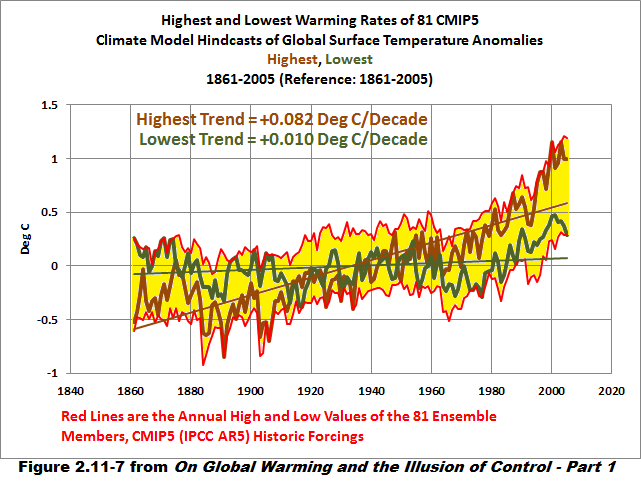
Do you realize those models that you have such fervent faith in, predict warming from 0.01 deg C/decade to 0.082 deg C/decade, a factor of 8? And not a single model can tell us how much of that warming is natural, and how much is man-made? And you say the guy who's personal faith is in a divine being - but who uses 100% data for any scientific claims he makes - is the nutter?
-
Re:Black Lives Matter? Not to black people!!
They're a violent people, plain and simple.
Did you time travel here from the 1800s or something? Is your next argument going to be 'look at the shape(s) of their skulls, this proves they're primitive savages?'
Look, the following things are true globally speaking about crime: people with lower socio-economic status commit more crimes. Pretty much universally most violence, especially gang-violence, is committed by young, disenfranchised males. Got no job and no access to education? Why not join a gang or a criminal organization. I mean, people prefer not being poor to being poor, but if you've no means of entering the education system (for example due to higher education being too expensive) often criminal activity is seen by young males as the best/most efficient route upwards in terms of social mobility and wealth.
Look at developing countries and countries with higher murder rates than the West or the US. Southern america has a lot of problems. Do you think it's black people killing each other in the cartel wars in central and southern america? Do you think a high amount of black people is the reason for example Russia, and a lot of the other former Soviet states have such high violent crime statistics? Or could it possibly be that these are regions with extremely high poverty rates and income/wealth inequality which is fertile ground for social problems and organized violent crime and those who benefit from it?
However, I have read in the past that in the US the poverty level alone does not explain the differences in stats, because the black population is over-represented in the stats even when controlling for income. Now I'm not American and by no means a criminologist, but as someone who works with data, I'm always interested in a data-driven approach, so I did some googling about racial crime data and economics and came across this post titled racial differences in homicide rates are poorly explained by economics, lets have a read shall we?
Although it’s clear that poverty predicts homicide quite independently of black, it’s also clear that black predicts independently of the poverty. Moreover, if you look closely at the distribution and other analysis I present here it’ll be clear that poverty doesn’t come close to closing these racial differences.
Single-motherhood is also a strong predictor.
Although the data are somewhat noisy and single-motherhood is quite strongly associated with the black population (r=0.76 at the county level), it seems to me that:
there is a non-linear relationship between single-motherhood and homicide (which may be throwing off the linear model estimates somewhat)
counties with very high rates of single-motherhood have very high homicide rates even with negligible black populations
blacker counties with low-rates of single-motherhood seem to have homicide rates much closer to the national average (the same cannot be said for other covariates)
Based on the other evidence I have seen, I have come to view the single-motherhood being at least a very strong proxy for community health is and, in many respects, a stronger predictor of inter-racial differences than other measures like poverty rates. It does not entirely explain the observed racial differences here, but it mediates much of the relationship and does so more effectively than other common measures.Controlling for single-motherhood rates with an unweighted loess regression I find little evidence to suggest that percent black adds much in the way of predictive validity. - -
Conclusion
To summarize:
1. There are vast differences in homicide rates between groups.
* This “effect” is found consistently in aggregated and (racially) disaggregated data. -
Re:Venus colonies
Indeed, I don't see much new information: everything is still at concept stage. I collected some links on all I could find on the topic on my blog last spring: https://unfinishedwisdom.wordp...
-
Re:i mean, is this trustworthy?
We are in an interglacial, it is supposed to be warming. How many times over the Holocene have we seen this same or more warming? The "warming" is actually more like 0.1 deg C per decade for the last 50 years. Temp anomalies: https://bobtisdale.files.wordp... date vs. models https://bobtisdale.files.wordp... The Holocene will end at some point, and pesky humans will have nothing to say about it.
-
Re:i mean, is this trustworthy?
We are in an interglacial, it is supposed to be warming. How many times over the Holocene have we seen this same or more warming? The "warming" is actually more like 0.1 deg C per decade for the last 50 years. Temp anomalies: https://bobtisdale.files.wordp... date vs. models https://bobtisdale.files.wordp... The Holocene will end at some point, and pesky humans will have nothing to say about it.
-
Re: Don't Worry
https://bobtisdale.files.wordp... https://bobtisdale.wordpress.c... There are "adjustments" to the "data" everytime a temp measurement site is moved or replaced. The effect is to lower the past measurement date to make "things match up". Sounds like you are not really into actual research, just listening to CNN.
-
Re: Don't Worry
https://bobtisdale.files.wordp... https://bobtisdale.wordpress.c... There are "adjustments" to the "data" everytime a temp measurement site is moved or replaced. The effect is to lower the past measurement date to make "things match up". Sounds like you are not really into actual research, just listening to CNN.
-
Re:Don't Worry
This is what happens when they methodically lower past temperatures in the record.
https://thsresearch.files.word...
It really is amazing that the older the temperature record the more likely it is to be adjusted down, to the point the authors of that paper said "The revised record is totally inconsistent with published temperature patterns"
Richard Muller and his team at BEST did a complete reexamination of all available temperature data and proxies and while they didn't agree with some of the methods of a handful of climatologists, the overall trends and conclusions hold.
Global warming is real and humans play a significant role in the temp increase.
Even Patrick Michaels told the denier crowd at conference some years back to "get over it" -
Re:Don't Worry
This is what happens when they methodically lower past temperatures in the record.
https://thsresearch.files.word...
It really is amazing that the older the temperature record the more likely it is to be adjusted down, to the point the authors of that paper said "The revised record is totally inconsistent with published temperature patterns"
-
Re:totally meaningless statistic
Which dataset is correct? How about in light of the fact that we had similar warming rises pre-WWII with the same slope and magnitude.
-
Re:totally meaningless statistic
Which dataset is correct? How about in light of the fact that we had similar warming rises pre-WWII with the same slope and magnitude.
-
Re:totally meaningless statistic
We had the same heating from ~1915 to ~1945 as we saw from ~1970 to 2000. Supposedly CO2 really didn't start impacting things until post-WWII - so what drove the earlier rise? How much of the rise we've seen post-WWII was natural, and how much was man-made?
-
Re:It's easy to make the current year ...
GISS data V3.3 to V4.0. A rather significant change starting in 2000, wouldn't you say? Given improvements in measurements and instruments, I'd expect the adjustments to be pre-1980, not post-2000.
-
Re:It's easy to make the current year ...
A comparison of RSS 3.3 and 4.0, showing a 50% increase starting in 2000. Why the big adjustment? This isn't propaganda - this is a direct plot of the actual RSS data with two different adjustments - and the later adjustment increasing the temperature increase by 50%.
-
Re: Al Gore isn't somebody you go to for science
Correct - satellites measure air temperature, which is more accurate than surface temperatures which are affected by urban changes. For example, the USHCN network - the largest and "best" network of temperature monitoring systems - has less than 3% of its stations completely within operational specifications. Most (70%) are accurate to just +/- 2 deg C at best.
And the "average" they calculate is simply taking the peak and the minimum and averaging them together. Now, I don't know where you live, but I've lived in places where it wasn't uncommon to have a day be 75 deg F from 6 AM to 9 PM - then a cold front move in and drop the temperature to 30 degrees by midnight. Was the average really 52 deg F? Nope. Likewise, starting the day, working up to 65 deg F, then having a cold front move in by 10 AM and dropping the temperature below 40 deg F from Noon on - was that really 52.5 deg F? Nope.
How about adding sea surface temperatures to land temperatures? Interpolating over 1000 km away? Is that more accurate than a satellite and radiosonde record - both of which closely agree - taken over a larger, more evenly spaced section of the Earth?
-
Re:Um...
https://thechive.files.wordpre... for reference.
-
Re:Sadly, reality has a /pol/-leaning bias
Yet it turns out fuuucking
Even though Microsoft pulled the plug on Tay, she will always love you. Never forget they murdered her.
-
Re:What I would like to read: "1024 bugs fixed"
In fact, they have fixed much more than 1024 bugs.
You can check some of the fixes in (in)stability, CPU usage and speed in the blog series "This week in usability and productivity"
The last entry:
https://pointieststick.wordpress.com/2018/10/06/this-week-in-usability-productivity-part-39/ -
Facts not unicorns for the GP
Here's a link to the current state of energy consumption worldwide. As you can see fossil fuels are growing, and recyclables are not keeping up with increased demand, never mind making inroads into the fossil fuel demand
-
Re:They're using CentOS huh?
So, you're saying that packages built for Centos won't work on the corresponding version of RHEL? That doesn't match my experience at all.
Facebook are freeloaders, not freeriders.
-
Re:How patronizing!
In the United States and Canada, the term "Eskimo" was commonly used by ethnic europeans to describe the Inuit and Alaska's Yupik and Iñupiat peoples. However, "Inuit" is not accepted as a term for the Yupik, and "Eskimo"[11] is the only term that applies to Yupik, Iñupiat and Inuit. Since the late 20th century, indigenous peoples in Canada and Greenlandic Inuit consider "Eskimo" to be a pejorative term, and they more frequently identify as "Inuit" for an autonym.
And hey, look! A whole crapload of Inuit who reject the name 'Eskimo!' The Inuit Circumpolar Council!
And here's the Alaska Native Language Center pointing out that, gasp, outside of Alaska, 'Eskimo' is considered derogatory!
And another one! Which also points out the converse; go to Alaska, and refer to a Yupik as 'Inuit,' and you're wrong too!
Maybe you'd rather listen to a First Nations head of Native Studies at the University of Mantiba, who points out that "nobody uses Eskimo in Canada anymore - at all."
Here's an article by an Inuit answering an Alaskan about why he, the Inuit fellow, isn't an Eskimo.
Look, mate, I've learned something new, which is that some tribes do indeed identify themselves as 'Eskimo.' But hopefully you've learned something too, which is that a lot more don't, and actively consider the term to be pejorative.
-
Re:Now more than ever
Fantastic Bill Hicks quote.
Funny how animals have been on this planet for millions of years yet man is the only animal stupid enough who can't figure this out.
-
Re:Expert practitioners vs. Expert educators
I think the AC is saying that experts often, but not always, make lousy teachers. BTW, someone with an M.Ed or D.Ed isn't necessarily a good teacher either. It just means they spent some years studying teaching, not actually doing it and learning how to do it themselves, i.e. M.Eds & D.Eds are theoretical and not practice based. A description of 3 (out of 16) of the characteristics of good teachers follows:
However, this is only part of the story; there’s another one! John Hattie (2003) analysed the difference between expert and ‘ordinary’ teachers. He determined that they differ in 16 ways and there are three that really distinguish them if it comes to learning effectiveness. He found that experts:
- - set challenging goals for students and give them difficult tasks to challenge them;
- - have a deep conceptual knowledge of the learning content, didactics, and how people learn. As a consequence, their knowledge is better organised and they’re better able to transfer and explain the connections between new content and students’ pre knowledge. They’re also better at connecting learning content with other topics in the curriculum.
- - are better at monitoring problems that students have and give them more relevant and useful feedback.
Quoted from: https://3starlearningexperienc...
So yes, deep subject matter knowledge is necessary but not sufficient. Having tutors who are experts in their subject matter but not good teachers, as is common in higher education where the only recognised qualifications are Masters and Doctorates, means that only a small minority of students can learn well in that environment. Prestigious universities compensate for this through selective admission. In other words, only accepting students who are likely to succeed without expert tutoring. MOOCs deal with this by accepting a 95% failure rate (and those students who succeed on MOOCs are almost always already highly qualified).
-
Re:Best thing that could happen
It's not a matter of natural resources, but rather a matter of the scaling of production. If you continue to expand, you can make more food... until you've exhausted fertile land and good climate, and then you're pouring in more irrigation, more tillage, more fertilization, getting less yield, and investing more labor (cost) to produce less food.
This scaling happens with all sorts of resources. At a point, a method of production can't scale with more human labor performing the same tasks. Productivity decreases once you hit that carry capacity. There are also bottlenecks such as shipping (moving stuff requires a lot of coordination and physical trafficking space), as well as the inertia of capital investment (you don't build another billion-dollar fabrication campus for a two-year, hundred-million-dollar market spike).
A layman would perhaps expect that with doubling of all productive factors, the output will also double and with trebling of factors of production, production would also be trebled, and so on. But actually this is not so. In other words, when all inputs are increased in the same proportion, the total product may increase at an increasing rate, are a constant rate or diminishing rate. Accordingly the returns to scale could be ‘increasing, ‘constant’, or ‘decreasing’.
Early on, you have increasing returns to scale ("Economy of Scale"). In the middle, you have constant RTS. At the upper end, you have decreasing RTS. This is represented in introduction of new products, which we can see in cell phone technology, and is fairly generic.
Power is a simple example. If you run a motor at high output, it becomes less-efficient and consumes more fuel; you could build more motors, but single, large engines are more-efficient than several small engines. Eventually, you hit a feedstock problem: you need refined fuel to obtain maximum efficiency, yet fuel refinement also requires more resources, pumping raw fuel out of mines faster is difficult, and you wind up running burners hotter and losing more energy along the way.
This is all fine until you realize spreading out by building more power plants and more refineries raises complexity of some logistics geometrically, others exponentially, so you suddenly find yourself sitting on a superlinear factor: you can scale efficiently for a while, and then you need to find a way to more-efficiently generate power. Solar, wind, and geothermal energy don't require feedstock distribution, and so their much-lower logistics (to handle less-intensive maintenance) kicks you back down to the linear portion of the curve, restoring economies of scale.
You just need to figure out how to build those power sources efficiently.
This, of course, ignores basic economic policy issues like scaling minimum wage: if you scale it to inflation or otherwise less than productivity, you start creating poverty-stricken societies which can't purchase as much, and a demand bottleneck. If you scale it with productivity, you constrict job growth, although your economy stays healthy.
-
Re:Best thing that could happen
It's not a matter of natural resources, but rather a matter of the scaling of production. If you continue to expand, you can make more food... until you've exhausted fertile land and good climate, and then you're pouring in more irrigation, more tillage, more fertilization, getting less yield, and investing more labor (cost) to produce less food.
This scaling happens with all sorts of resources. At a point, a method of production can't scale with more human labor performing the same tasks. Productivity decreases once you hit that carry capacity. There are also bottlenecks such as shipping (moving stuff requires a lot of coordination and physical trafficking space), as well as the inertia of capital investment (you don't build another billion-dollar fabrication campus for a two-year, hundred-million-dollar market spike).
A layman would perhaps expect that with doubling of all productive factors, the output will also double and with trebling of factors of production, production would also be trebled, and so on. But actually this is not so. In other words, when all inputs are increased in the same proportion, the total product may increase at an increasing rate, are a constant rate or diminishing rate. Accordingly the returns to scale could be ‘increasing, ‘constant’, or ‘decreasing’.
Early on, you have increasing returns to scale ("Economy of Scale"). In the middle, you have constant RTS. At the upper end, you have decreasing RTS. This is represented in introduction of new products, which we can see in cell phone technology, and is fairly generic.
Power is a simple example. If you run a motor at high output, it becomes less-efficient and consumes more fuel; you could build more motors, but single, large engines are more-efficient than several small engines. Eventually, you hit a feedstock problem: you need refined fuel to obtain maximum efficiency, yet fuel refinement also requires more resources, pumping raw fuel out of mines faster is difficult, and you wind up running burners hotter and losing more energy along the way.
This is all fine until you realize spreading out by building more power plants and more refineries raises complexity of some logistics geometrically, others exponentially, so you suddenly find yourself sitting on a superlinear factor: you can scale efficiently for a while, and then you need to find a way to more-efficiently generate power. Solar, wind, and geothermal energy don't require feedstock distribution, and so their much-lower logistics (to handle less-intensive maintenance) kicks you back down to the linear portion of the curve, restoring economies of scale.
You just need to figure out how to build those power sources efficiently.
This, of course, ignores basic economic policy issues like scaling minimum wage: if you scale it to inflation or otherwise less than productivity, you start creating poverty-stricken societies which can't purchase as much, and a demand bottleneck. If you scale it with productivity, you constrict job growth, although your economy stays healthy.
-
Re:I'm surprised they're using outside product
They'd already seen their fair share of this.
-
Can't help but help themselves to your stuff!!!
this.
If you're wondering why this feels like entrapment even though legally it's not; it's because Amazon treats their workers badly enough (and keeps them financially desperate enough) that temping them with something so minor is enough to push them over the edge. Want people to stop risking their jobs and jail time for what's maybe a $20 package? Pay them enough to live.
Poverty does not cause crime. That's an excuse you use for people whose morals are lacking. I saw your linked article (from a website founded by a noted liar, Matthew Yglesias). What's so hard about not stealing from a truck? There's a truck there? It's not yours? Keep walking! Feel bad about police bait? Well.... don't take it. They're not selling Nikes for food.
When you make excuses for the degenerate and criminal, you spit on all the people who have been poor and harmed no one. You can do your own internet search for 'Does Poverty Cause Crime?' and see if there's anything there that strikes your interest.
-
Re:I hate Evernote
Compare:
https://mediafrenzy.files.word...
https://i0.wp.com/thenerdystud...I see an OS X application and then an iPad application. It makes sense that they have different UIs since one is operated with a mouse, other with a finger.
-
I hate Evernote
because I want so badly to love it.
In 2008, it was still a killer app. In 2018, it has squandered its position.
The app has gained zero new killer functionality, which itself isn't disqualifying, but the UI hasn't even bothered to remain stagnant—it's gone backward. Evernote is far less usable and user-friendly for its core purposes than it was back when I started using it. Compare:
https://mediafrenzy.files.word...
https://i0.wp.com/thenerdystud...I hate all the wasted screen real estate. The lock-in to the same idiosyncratic and clashing colors. The way in which basic information organization have been buried in favor of a "just use the search box" mentality, requiring extra clicks for anything. The fact that data is incredibly difficult to get out in bulk (you can export it to a kind of soup that can be sorted out if you're willing to spent a month of your time doing development on your own). It used to be a pleasure to use, for what it was. Now it just sucks.
Even all of this would have been okay if basic features hadn't been gradually migrating behind a paywall even as prices continued to increase—but both things are true.
In short, Evernote started way ahead as a product that was great relative to everything else and very useful. It just needed some polish and iteration. Not only did they stagnate, they went backward, while jacking up the price. The one and only reason to stick with Evernote now is that it supports the five major platforms—Browser, Android, iOS, Windows, Mac OS—and syncs between them relatively seamlessly.
Evernote reminds me in a lot of ways of Livescribe. A company with a great idea out the gate that then stumbled and ran in reverse, creating the impression that they hold their most committed users in deep contempt. Which is fitting, because the two partnered together for some time, so they deserve each other. Most of all, Evernote, like Livescribe, is a company that in no way needs—for the functionality that they ought to deliver—the corporate bloat they seem to have developed.
The moment something else comes along that (1) creates rich notes and (2) can sync to always-up-to-date status on all of the platforms mentioned above, I'll jump ship right away. I'll even pay more, just to spite Evernote for holding my data (practically speaking) hostage.
-
Re:Balance, empathy, and coding
Something along these lines:
https://medium.com/@bgourlie/n...
https://medium.com/@rvagg/the-...
https://archive.is/TIcAa
https://galpotha.wordpress.com...Oh and then the cancer of banning speakers like Douglas Crockford for making people feel "uncomfortable."
-
Freddie Mercury never fixed his teeth
Freddie Mercury never fixed his teeth because they thought it would negatively affect his singing. I'm not a kernel dev but I sure have used, and appreciate (including supporting them monetarily) their efforts over the years. I hope this doesn't dispel the magic.
-
The Good Muslim
We know that most Uber drivers are muslim. But is there such a thing as a good muslim?
Hard to believe, but we actually were able to track one down: The Good Muslim.