Slashdot Mirror
Domain: wsj.com
Stories and comments across the archive that link to wsj.com.
Stories · 1,821
-
AT&T Quietly Adds Charges To All Contract Cell Plans
guttentag writes "The Wall Street Journal is reporting that AT&T Mobility, the second-largest wireless carrier in the U.S., has added a new monthly administrative fee of 61 cents to the bills of all of its contract wireless lines as of May 1, a move that could bring in more than a half-billion dollars in annual revenue to the telecom giant. An AT&T spokeswoman said the fee covers 'certain expenses, such as interconnection and cell-site rents and maintenance.' The increased cost to consumers comes even though AT&T's growth in wireless revenue last year outpaced the costs to operate and support its wireless business. The company has talked of continuing to improve wireless profitability. Citigroup analyst Michael Rollins noted that the new administrative fee is a key component for accelerating revenue growth for the rest of the year. He said the fee should add 0.30 of a percentage point to AT&T's 2013 revenue growth; he predicts total top-line growth of about 1.5%. Normally, consumers could vote with their wallets by taking their business elsewhere. AT&T would be required to let customers out of their contracts without an early termination fee if it raised prices, but it is avoiding this by simply calling the increase a 'surcharge,' effectively forcing millions of people to either pay more money per month or pay the ETF." -
Ad Exec: Learn To Code Or You're Dead To Me
theodp writes "In a widely-read WSJ Op-Ed, English major Kirk McDonald, president of online ad optimization service PubMatic, informed college grads that he considers them unemployable unless they can claim familiarity with at least two programming languages. 'Teach yourself just enough of the grammar and the logic of computer languages to be able to see the big picture,' McDonald advises. 'Get acquainted with APIs. Dabble in a bit of Python. For most employers, that would be more than enough.' Over at Typical Programmer, Greg Jorgensen is not impressed. 'I have some complaints about this "everyone must code" movement,' Jorgensen writes, 'and Mr. McDonald's article gives me a starting point because he touched on so many of them.'" -
IRS Admits Targeting Conservative Groups During 2012 Election
An anonymous reader writes "A recurring theme in comments on Slashdot since the 9/11 attacks has been concern about the use of government power to monitor or suppress political activity unassociated with terrorism but rather based on ideology. It has just been revealed that the IRS has in fact done that. From the story: "The Internal Revenue Service inappropriately flagged conservative political groups for additional reviews during the 2012 election . . . Organizations were singled out because they included the words 'tea party' or 'patriot' in their applications for tax-exempt status, said Lois Lerner, who heads the IRS division that oversees tax-exempt groups. In some cases, groups were asked for their list of donors, which violates IRS policy in most cases, she said. 'That was wrong. That was absolutely incorrect, it was insensitive and it was inappropriate. That's not how we go about selecting cases for further review,' Lerner said . . . 'The IRS would like to apologize for that,' she added. . . . Lerner said the practice was initiated by low-level workers in Cincinnati and was not motivated by political bias. . . . she told The AP that no high level IRS officials knew about the practice. Tea Party groups were livid on Friday. ... In all, about 300 groups were singled out for additional review. . . Tea Party groups weren't buying the idea that the decision to target them was solely the responsibility of low-level IRS workers. ... During the conference call it was stated that no disciplinary action had been taken by those who engaged in this activity. President Obama has previously joked about using the IRS to target people." So it's not how they choose cases for review (except when it is), and was not motivated by political bias (except that it was). Also at National Review, with more bite. -
Ender's Game Trailer Released
The first trailer has been released for the movie adaptation of Orson Scott Card's sci-fi classic Ender's Game. It gives us a good look at Harrison Ford as Colonel Graff, Ben Kingsley as Mazer Rackham, and Hugo's Asa Butterfield as Ender. It also demonstrates just how much money they put into the special effects for this movie. -
US Senate Passes Internet Tax Bill 69 To 27
schwit1 quotes The Washington Post: "The Senate aimed to help traditional retailers and financially strapped state and local governments Monday by passing a bill that would widely subject online shopping — for many a largely tax-free frontier — to state sales taxes. The Senate passed the bill by a vote of 69 to 27, getting support from Republicans and Democrats alike." schwit1 adds "Unfortunately online businesses could be in for a rude awakening when it comes to the law's interpretation." Passage in the House is not certain, and companies like eBay are lobbying to raise the minimum sales required to collect state sales tax to $10 million instead of $1 million per year. -
President Obama To Nominate Cable and Wireless Lobbyist To Head FCC
symbolset writes "The Wall Street Journal and others are reporting that longtime telecomm lobbyist Tom Wheeler will be nominated to head the Federal Communications Commission. According to the LA Times: 'Wheeler is a former president of the National Cable Television Assn. and the Cellular Telecommunications and Internet Assn. Despite his close ties to industries he will soon regulate, some media watchdogs are willing to give him the benefit of the doubt. "As someone who has known Tom for years, I believe that he will be an independent, proactive chairman," said Gigi B. Sohn, president and chief executive of Public Knowledge, adding that she has "no doubt that Tom will have an open door and an open mind, and that ultimately his decisions will be based on what he genuinely believes is best for the public interest, not any particular industry."'" -
vTel Deploying Gigabit Internet In Vermont At $35/Month
symbolset writes "Up to 17,500 rural Vermont subscribers of vTel, a legacy copper telephone company, stand to get gigabit fiber to the home. Funded by a $95 million U.S. grant and $55 million in coinvestment from a utility for smart meters, the 1,200 mile fiber network will cost $8,500 per home — if every subscriber takes the gigabit Internet. Currently the company is doing its best to convince people this is a product they need, but have seen only 600 takers so far. The federal grant is part of $7.2 billion in broadband stimulus funds that seem to have accomplished very little." -
Maryland Team Hopes To Nab $250k Prize For Leg-Powered Copter
daltec writes "The $250,000 American Helicopter Society Igor I. Sikorsky Human Powered Helicopter Competition prize, unclaimed since 1980, is now closer than ever to being won. With flights up to ten feet in altitude and lasting over 65 seconds, the prize's strict requirements (thought by many to be impossible to satisfy) have all been met — but not on the same flight. Two teams — AeroVelo in Canada and Gamera II at the University of Maryland — are tantalizingly close to claiming the prize. The Gamera team will be making its latest attempt this weekend." -
Terrible Advice From a Great Scientist
Shipud writes "E.O. Wilson is the renowned father of sociobiology, a professor (emeritus) at Harvard, two time pulitzer prize winner, and a popularizer of science. In a recent article in the Wall Street Journal, Wilson provides controversial advice to aspiring young scientists. Wilson claims that math literacy is not essential, and that scientific models in biology, intuitively generated, can later be formalized by a specialized statistician. One blogger calls out Wilson on his article, arguing that knowing mathematics is essential to generating models, and that lacking what Darwin called the "extra sense" is essentially limiting to any scientist." -
Microsoft Working With Suppliers on Designs for Watch-Like Device
An anonymous reader writes with news that Microsoft may be working on a smartwatch. "The modern smartwatch market hardly even exists, and yet it's already starting to feel very crowded. Hot on the heels of plans (official and otherwise) from Apple and Samsung, the Wall Street Journal reports that Microsoft has also been shopping around for parts to build a 'watch-style device.' While details are scarce as to what that would entail, unnamed supplier executives tell the newspaper that Microsoft has been asking for 1.5-inch touchscreens. We wouldn't count on seeing an ultra-small Surface anytime soon, however -- these executives say they've visited Microsoft's campus, but they don't know whether the Windows developer is fully committed to its wrist-worn endeavor or just experimenting. If the project exists at all, of course. Still, there's finally a glimmer of hope for anyone who's still mourning the loss of their beloved SPOT watches." -
RapLeaf Is Back and Bad As Ever
itwbennett writes "Privacy blogger Dan Tynan opted out of data aggregator RapLeaf back in 2010 — and wrote about it. At the time, opting out seemed to work well enough. But fast forward a couple of years and ... they're baaaack. While testing a privacy service called Safe Shepherd, Tynan discovered that 'not only [is he] not opted out of RapLeaf's database, they've also gathered far more information about [him] than they had before.' And it's a pretty good bet some of the data came from Facebook apps, which is a practice that the company was slapped for in 2010 and claimed to no longer do." -
No Such Thing As a Tax-Free Lunch At Google?
theodp writes "In search of the best corporate cafeteria in the world, Gourmet Live's Tanya Steel visited the Googleplex, where she found Petaluma chicken cacciatore, porcini-encrusted grass-fed beef, whole-wheat spaghetti pomodoro, and Parmesan-creamed onions on the menu in one of the search giant's 25 cafes. So, must all good things come to an end? The WSJ's Mark Maremont reports that it's debatable whether Silicon Valley's daily fringe-benefit meals are taxable, and the issue is now on the IRS's radar. 'What would a food tax on Google's meals look like for the average employee?' Maremont asks. 'Assuming a fair-market value of between $8 and $10 per meal, a Googler chowing down two squares a day could get dinged for taxes on an extra $4,000 to $5,000 a year.' That'd be just fine with UF tax-law Prof. Martin J. McMahon. 'I buy my lunch with after-tax dollars,' said McMahon. 'And I have to pay taxes to support free meals for those Google employees.'" -
Margaret Thatcher Dies At 87
syngularyx writes "Margaret Thatcher, the former British prime minister who became one of the most influential global leaders of the postwar period, died on Monday, three decades after her championing of free-market economics and individual choice transformed Britain's economy and her vigorous foreign policy played a key role in the end of the Cold War." -
Bitcoin To Be Regulated Under US Money Laundering Laws
Newsubmitter davek writes with news that the U.S. will be applying money-laundering laws to Bitcoin and other 'virtual currencies.' "The move means that firms that issue or exchange the increasingly popular online cash will now be regulated in a similar manner as traditional money-order providers such as Western Union Co. WU +0.17% They would have new bookkeeping requirements and mandatory reporting for transactions of more than $10,000. Moreover, firms that receive legal tender in exchange for online currencies or anyone conducting a transaction on someone else's behalf would be subject to new scrutiny, said proponents of Internet currencies. 'I think it's inevitable that just like you have U.S. dollars used by thieves and criminals, it's sadly inevitable you will have criminals use a virtual currency. We want to work with authorities,' said Jeff Garzik, a Bitcoin developer. Still, law enforcement, regulators and financial institution have expressed worries about the hard-to-trace attributes of virtual currencies, helping trigger this week's move from the Treasury's Financial Crimes Enforcement Network, or FinCen." -
Microsoft, Partners Probed Over Bribery Claims
c0lo writes "U.S. federal authorities are examining Microsoft's involvement with companies and individuals that allegedly paid bribes to overseas government officials in exchange for business. The United States Department of Justice and the Securities and Exchange Commission have both opened preliminary investigations into the bribery allegations involving Microsoft in China, Italy and Romania. The China allegations were first shared with United States officials last year by an unnamed whistle-blower who had worked with Microsoft in the country, according to the person briefed on the inquiry. The whistle-blower said that a Microsoft official in China directed the whistle-blower to pay bribes to government officials to win business deals. U.S. government investigators are also reviewing whether Microsoft had a role in allegations that resellers offered bribes to secure software deals with Romania's Ministry of Communications. In Italy, Microsoft's dealings with consultants that specialize in customer-loyalty programs are under scrutiny, with allegations that Microsoft's Italian unit used such consultants as vehicles for lavishing gifts and trips on Italian procurement officials in exchange for government business. In a blog post Tuesday afternoon, John Frank, a vice president and deputy general counsel at Microsoft, said the company could not comment about continuing investigations. Mr. Frank said it was not uncommon for such government reviews to find that the claims were without merit. Somehow, given the way OOXML became a standard, it wouldn't surprise me if it were an actual fire that caused this smoke." -
Amazon's Quest For Web Names Draws Foes
quantr writes in with a story about backlash to Amazon's request for ownership of new top-level domain names. "Large and small companies are vying for control of an array of new Internet domain names, but Amazon.com Inc.'s plans are coming under particular scrutiny. Two publishing industry groups, the Authors Guild and the Association of American Publishers, are objecting to the online retailer's request for ownership of new top-level domain names that are part of a long-awaited expansion of the Web's addressing scheme. They argue that giving Amazon control over such addresses—which include '.book,' '.author' and '.read'—would be a threat to competition and shouldn't be allowed. 'Placing such generic domains in private hands is plainly anti-competitive,' wrote Scott Turow, Authors Guild president, to the Internet Corporation for Assigned Names and Numbers, or ICANN, the nonprofit that oversees the world's Internet domain names. 'The potential for abuse seems limitless.'" -
Singaporean University Snubs Lauded (But Anti-Censorship) Professor
New submitter nifty-c writes "Singapore has invested heavily in higher education partnerships with the U.S. and launched an ambitious program of high-tech research with Western countries, but recent events have opened these links to controversy. Prof. Cherian George at Nanyang Technological University (NTU), Singapore, is a communication and information school professor and an outspoken critic of his government's censorship of the Internet. NTU recently fired him, sparking an outcry from critics who claim political interference. This week a group of faculty and affiliates at Harvard's Berkman Center for Internet & Society has 'strongly caution[ed]...colleagues working in the area of Internet and society in any dealings with Singaporean universities.'" -
Did Google Tip Off EU About Microsoft Browser Ballot?
Dupple writes with a story about the latest in the Google-Microsoft feud. "The tired spat between Google and Microsoft just got a lot more interesting after reports that the search giant tipped off European authorities to antitrust concerns, a tip that will now cost the Windows-maker nearly a billion dollars. When news of the fine levied by the European Union's competition watchdog broke on Wednesday, nobody was too surprised that the European Commission was punishing Microsoft for bullying consumers. But with a recent headline-stealing dispute between the Redmond, Washington company and Google, it's competitor down in Mountain View, California, bloggers got curious. Early Wednesday evening, The Wall Street Journal's Tom Gara wondered, 'Did Google Snitch?' According to a Financial Times report published a few minutes later, the answer is yes." -
New Research Sheds Light On the Evolution of Dogs
Hugh Pickens writes writes "The first dogs descended from wolves about 14,000 years ago but according to Brian Hare and Vanessa Woods humans didn't domesticate dogs — dogs sought out humans and domesticated us. Humans have a long history of eradicating wolves, rather than trying to adopt them which raises the question: How was the wolf tolerated by humans long enough to evolve into the domestic dog? 'The short version is that we often think of evolution as being the survival of the fittest, where the strong and the dominant survive and the soft and weak perish. But essentially, far from the survival of the leanest and meanest, the success of dogs comes down to survival of the friendliest.' Most likely, it was wolves that approached us, not the other way around, probably while they were scavenging around garbage dumps on the edge of human settlements. The wolves that were bold but aggressive would have been killed by humans, and so only the ones that were bold and friendly would have been tolerated. In a few generations, these friendly wolves became distinctive from their more aggressive relatives with splotchy coats, floppy ears, wagging tails. But the changes did not just affect their looks but their psychology. Protodogs evolved the ability to read human gestures. 'As dog owners, we take for granted that we can point to a ball or toy and our dog will bound off to get it,' write Hare and Woods. 'But the ability of dogs to read human gestures is remarkable. Even our closest relatives — chimpanzees and bonobos — can't read our gestures as readily as dogs can. 'With this new ability, these protodogs were worth knowing. People who had dogs during a hunt would likely have had an advantage over those who didn't. Finally when times were tough, dogs could have served as an emergency food supply and once humans realized the usefulness of keeping dogs as emergency food, it was not a huge jump to realize plants could be used in a similar way.' This is the secret to the genius of dogs: It's when dogs join forces with us that they become special," conclude Hare and Woods. 'Dogs may even have been the catalyst for our civilization.'" -
Ask Slashdot: Should We Have the Option of Treating Google Like a Utility?
eegad writes "I've been thinking a lot about how much information I give to technology companies like Google and Facebook and how I'm not super comfortable with what I even dimly know about how they're handling and selling it. Is it time for major companies like this, who offer arguably utility-like services for free in exchange for info, to start giving customers a choice about how to 'pay' for their service? I'd much rather pony up a monthly fee to access all the Google services I use, for example, and be assured that no tracking or selling of my information is going on. I'm not aware of how much money these companies might make from selling data about a particular individual, but could it possibly be more than the $20 or $30 a month I'd fork over to know that my privacy is a little more secure? Is this a pipe dream, or are there other people who would happily pay for their private use of these services? What kinds of costs or problems could be involved with companies implementing this type of dual business model?" -
Buying Your Way Onto the NY Times Bestsellers List
Freshly Exhumed writes "An endorsement from Oprah Winfrey; a film deal from Steven Spielberg; a debut at the top of The New York Times bestsellers list. These are the things every author craves most. While the first two require the favor of a benevolent deity, the third can be had by anyone with the ability to write a check — a pretty big one, to ResultSource, a San Diego-based marketing consultancy — in what Forbes says is essentially a laundering operation aimed at deceiving the book-buying public into believing a title is more in-demand than it is. Soren Kaplan, a business consultant and speaker, hired ResultSource to promote his book Leapfrogging. Responding to the WSJ article on his website, Kaplan breaks out the economics of making the list. 'It's no wonder few people in the industry want to talk about bestseller campaigns,' he writes. 'Put bluntly, they allow people with enough money, contacts, and know-how to buy their way onto bestseller lists.'" -
Utilities Racing To Secure Electric Grid
FreeMichael61 writes "In the latest episode of Spy vs. Spy, China rejects accusations it's hacking U.S. companies to steal IP or bring down the grid. But there's no doubt the grid can be hacked, CIO Journal's Steve Rosenbush and Rachael King report. Industrial control networks are supposed to be protected from the Internet by an air gap that, it turns out, is largely theoretical. Internal security is often lax, laptops and other devices are frequently moved between corporate networks and control networks, and some SCADA systems are still directly connected to the internet. What security standards actually exist are out of date and don't cover enough, and corporations often use questionable supply chains because they are cheaper." -
Utilities Racing To Secure Electric Grid
FreeMichael61 writes "In the latest episode of Spy vs. Spy, China rejects accusations it's hacking U.S. companies to steal IP or bring down the grid. But there's no doubt the grid can be hacked, CIO Journal's Steve Rosenbush and Rachael King report. Industrial control networks are supposed to be protected from the Internet by an air gap that, it turns out, is largely theoretical. Internal security is often lax, laptops and other devices are frequently moved between corporate networks and control networks, and some SCADA systems are still directly connected to the internet. What security standards actually exist are out of date and don't cover enough, and corporations often use questionable supply chains because they are cheaper." -
Estonian Schools To Teach Computer-Based Math
First time accepted submitter Ben Rooney writes "Children in the Baltic state of Estonia will learn statistics based less on computation and doing math by hand and more on framing and interpreting problems, and thinking about validation and strategy. From the article: 'Jon McLoone is Content Director for computerbasedmath.org, a project to redefine school math education assuming the use of computers. The company announced a deal Monday with the Estonian Education ministry to trial a self-contained statistics program replacing the more traditional curriculum. “We are re-thinking computer education with the assumption that computers are the tools for computation,” said Mr. McLoone. “Schools are still focused on teaching hand calculating. Computation used to be the bottleneck. The hard part was solving the equations, so that was the skill you had to teach. These days that is the bit that computers can do. What computers can’t do is set up the problem, interpret the problem, think about validation and strategy. That is what we should be teaching and spending less time teaching children to be poor computers rather than good mathematicians.”'" -
Apple Said To Be Working On a 'Watch-Like Device'
The WSJ reports that Apple is "experimenting with designs for a watch-like device that would perform some functions of a smartphone, according to people briefed on the effort." An excerpt: The company has discussed such a device with its major manufacturing partner Hon Hai Precision Industry Co., one of these people said, as part of explorations of potentially large product categories beyond the smartphone and tablet. Apple's efforts come as companies have introduced various kinds of wearable gadgets, mainly designed to measure physical activity. More sophisticated devices face big technical challenges, but also are attracting investments from large technology companies. Foxconn, as Hon Hai is also known, has been working on a spate of technologies that could be used in wearable devices, one of these people said. In particular, the Taiwan-based company has been working to address the challenges of making displays more power-efficient and working with chip manufacturers to strip down their products." -
Should the Start of Chinese New Year Be a Federal Holiday?
First time accepted submitter CarlosF writes "Does Lunar New Year belong alongside those other red-letter days? Efforts to recognize Lunar New Year at the state and local level have been afoot for years. In 1994, San Francisco decided to close public schools on Lunar New Year, but this was largely a response to demographic reality rather than political pressure." -
Ubuntu Smartphone Shipping In October
An anonymous reader writes "Smartphones running the open source Ubuntu operating system will be available to customers beginning in October 2013, Canonical CEO Mark Shuttleworth told CIO Journal. Ubuntu will be available on a full range of devices, including desktop and tablet computers, potentially providing corporate IT executives a way to reduce the number of devices they purchase and manage, and would allow users to access all manner of corporate data through a single, pocket-sized device. 'You can share Windows apps to the phone desktop,' said Mr. Shuttleworth during a meeting in New York Tuesday." Jon Brodkin adds, "Canonical is taking community input on what the core applications (e-mail, calendar, clock/alarm, weather, file manager, document viewer, YouTube, Facebook, and Twitter) should look like. The best aspects of community proposals will hopefully make it into Ubuntu phones when they finally hit the market sometime toward the end of 2013 or beginning of 2014. Take a look at the best designs Canonical has received so far." -
OUYA Android Game Console Available In June
An anonymous reader writes "The WSJ reports that OUYA, the $100 Android-based gaming console, will reach retail availability in June. The makers have partnered with Amazon, Best Buy, GameStop, and Target for distributing the devices. The console will come with a controller (which has the traditional thumbsticks, D-pad, buttons, and triggers as well as a built-in touchpad), and additional controllers will be sold for $50. OUYA CEO Julie Uhrman said, 'For the last year or two years all we've been hearing is that the consoles are dead. The reason is there isn't new, innovative intellectual property. It's expensive to develop on it. You're seeing a major shift of games being developed on the television. Our viewpoint has always been that console gaming isn't dead, the way we think about it hasn't changed. We're bringing the best screen and the best device to interact with that by creating a platform that is open.' There was a recent 'Game Jam' to create game prototypes for the console; you can browse the 166 entries." -
Internet-Deprived Kids Turning To 'McLibraries'
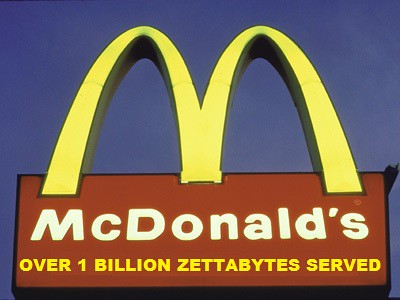
theodp writes "After the school computer lab and public library close for the night in many communities, the local McDonald's is often the only place to turn for students without internet access at home. 'Cheap smartphones and tablets have put Web-ready technology into more hands than ever,' reports the WSJ's Anton Troianovski. 'But the price of Internet connectivity hasn't come down nearly as quickly. And in many rural areas, high-speed Internet through traditional phone lines simply isn't available at any price. The result is a divide between families that have broadband constantly available on their home computers and phones, and those that have to plan their days around visits to free sources of Internet access.' The FCC says it can make broadband available to all Americans by spending $45 billion over 10 years, but until then the U.S. will have to rely on Mickey D's, Starbucks, and others to help address its digital divide. Time to update that iconic McDonald's sign?" -
Washington Post: We Were Also Hacked By the Chinese
tsu doh nimh writes "A sophisticated cyberattack targeted The Washington Post in an operation that resembled intrusions against other major American news organizations and that company officials suspect was the work of Chinese hackers, the publication acknowledged on Friday. The disclosure came just hours after a former Post employee shared information about the break-in with ex-Postie reporter Brian Krebs, and caps a week marked by similar stories from The New York Times and The Wall Street Journal. Krebs cites a former Post tech worker saying that the publication gave one of its hacked servers to the National Security Agency for analysis, a claim that the Post's leadership denies. The story also notes that the Post relied on software from Symantec, the same security software that failed to detect intrusions at The New York Times for many months." -
Wall Street Journal Hit By Chinese Hackers, Too
wiredmikey writes "The Wall Street Journal said Thursday its computers were hit by Chinese hackers, the latest U.S. media organization citing an effort to spy on its journalists covering China. The Journal made the announcement a day after The New York Times said hackers, possibly connected to China's military, had infiltrated its computers in response to its expose of the vast wealth amassed by a top leader's family. The Journal said in a news article that the attacks were 'for the apparent purpose of monitoring the newspaper's China coverage' and suggest that Chinese spying on U.S. media 'has become a widespread phenomenon.'" -
Tech Firms Keep Piles of 'Foreign Cash' In US
theodp writes "There's a funny thing about the estimated $1.7 trillion that American companies say they have indefinitely invested overseas,' reports the WSJ's Kate Linebaugh (reg. or the old Google trick). 'A lot of it is actually sitting right here at home.' And if tech companies like Google and Microsoft want to keep more than three-quarters of the cash owned by their foreign subsidiaries at U.S. banks, held in U.S. dollars or parked in U.S. government and corporate securities, Linebaugh explains, this money is still overseas in the eyes of the IRS and isn't taxed as long as it doesn't flow back to the U.S. parent company. Helping corporations avoid the need to tap their foreign-held cash are low interest rates at home, which have allowed U.S. companies to borrow cheaply. Oracle, for instance, raised $5 billion last year, paying an interest rate roughly two-thirds of a percentage point above the low post-crash Treasury yield, about 2.5% at the time (by contrast, grad students and parents pay 6.8%-7.9% for Federal student loans). Were the funds it manages to keep in the hands of its foreign subsidiaries brought home and subjected to U.S. income tax, Oracle estimated it could owe Uncle Sam about $6.3 billion." -
Researchers Explain Why Flu Comes In the Winter
First time accepted submitter ggrocca writes "Using human mucus as a testbed for how well influenza virus thrives in different humidity conditions, researchers at Virginia Tech found that the virus survived best if humidity is below 50%, a typical indoor situation during the winter in temperate climates due to artificial heating. The virus begins to find itself at home again only when humidity reaches almost 100%. Unsurprisingly, the latter finding explains flu spikes during rainy season in tropical climates. Full paper on PLOS ONE." -
You Can Donate Your Genome For Medical Research, But Not Anonymously
An anonymous reader writes "Dozens of volunteers who anonymously donated their genomic data to a public database for medical research have been identified by a team led by Yaniv Erlich, a former computer security researcher turned geneticist. Erlich's team matched Y chromosomal markers in genomes compiled by the 1000 Genomes Project with non-anonymous genomic databases, for example some assembled from contributions by family tree enthusiasts (abstract). After finding a match on a presumed relative of the study participant, the researchers pieced together the relative's family tree through search engines and the like, until they were able to identify the participant based on gender, age, place of birth, and other supposedly 'non-identifying' information associated with the genome. The names of the identified participants have not been released." -
The Strange Math of Apple's Alleged Massive iPhone 5 Order Cuts
zacharye writes "The Sunday evening Wall Street Journal article claiming that Apple had cut its iPhone 5 display orders drastically for the March quarter made quite a splash. The way WSJ wrote its piece seemed to support the original Nikkei claim about Apple cutting its iPhone 5 display orders in half from the originally planned order of 65 million units. This would be a massive adjustment. But Apple uses the same new display type for both iPhone 5 and the latest iPod touch. Neither WSJ nor Nikkei addressed this, however — both seemed to be referring to just iPhone 5 displays. The math just doesn't add up." -
Intel's Attempt At A-La-Carte Television Hits Delays
bill_mcgonigle writes "Updating the previous story, Forbes and Gigaom are now reporting that Intel is running an internal startup aimed at offering an internet-connected set top box with a-la-carte 'cable' channel subscriptions. They also apparently plan to record everything and offer all content on-demand. While some are skeptical that content providers will give up their cable cash cow and they've run into licensing problems already, perhaps the economic effects of cord-cutters will finally make this business model viable." -
2012 Set Record For Most Expensive Gas In US
An anonymous reader writes "According to data from the American Automobile Association, the average price for a gallon of gas in the U.S. was higher in 2012 than in any year before it. Nationwide, gas averaged $3.60/gallon, up from $3.51/gallon in 2011. 'The states with the most expensive annual averages for 2012 included Hawaii ($4.31), Alaska ($4.09), California ($4.03), New York ($3.90) and Connecticut ($3.90). The states with the least-expensive annual averages included South Carolina ($3.35), Missouri ($3.38), Mississippi ($3.39), Tennessee ($3.40) and Oklahoma ($3.41). The highest daily statewide average of the year was $4.67 in Calif. on Oct. 9, while the lowest daily statewide average was $2.91 a gallon in South Carolina on July 3.' Bloomberg reports that fuel consumption is down 3.6% compared to last year, while U.S. oil production reached almost 7 million barrels a day recently, a level that hasn't been reached since 1993. AAA predicts gas prices will be cheaper in 2013." -
Empty Times Square Building Generates $23 Million a Year From Digital Ads
dryriver writes "Advertising things at the right place is proving to be a cash cow, as electronic ads earn about $23mn each year for an empty building at One Times Square – the iconic tourist destination in the New York City. A 25-story Manhattan office building that has long been empty keeps on bringing in millions to its owner as a billboard. Michael Phillips, CEO of Atlanta-based Jamestown Properties, bought One Times Square through a fund in 1997 for $117 million, as the Wall Street Journal reports. More than 100mn pedestrians pass through the square each year, which is 90% more than 16 years ago, says the Times Square Alliance, a non-profit business improvement organization. And this is what makes a price tag for having a company's name placed on the building the highest in the world, even above such crowded tourist destinations as Piccadilly Circus in London. Dunkin' Brands Group Inc. pays $3.6mn a year for a Dunkin' Donuts digital sign on the One Times Square building, with Anheuser-Busch InBev paying another $3.4mn a year for its advertisement. Sony and News America pay $4mn a year for a shared sign." -
Acer Rethinks the "Tablet Bubble," Launching $99 Tablet
retroworks writes "In August 2011, Acer Chairman JT Wang declared that the consumer affection for tablets had already begun to cool, basically labeling it a fad. What a difference a year (and a half) makes. Acer now plans to introduce a 'category killer' $99 tablet. 'In the past few months, we've made project roadmap changes in response to big changes in the tablet market,' according to a source at the Wall Street Journal. 'The launch of the Nexus 10 has changed the outlook for what makes competitive pricing.' Acer is aiming the new tablet at emerging markets, competing with Chinese 'white box' tablets (already available in Shenzhen at $45 each)." -
Google Skunkworks Working on 'X Phone,' Reports WSJ
The Wall Street Journal says that Google is not quite content to be just a name printed on certain Android phones, and has set some of the cellphone engineers from Google-owned Motorola Mobility to work on a high-end project known internally as the 'X phone.' The rumored phone, says the article, "is due out sometime next year," and is meant as a technology flagship for Android phones, incorporating more innovative features than typical phones, such as advanced gesture recognition. Some of those features, like a flexible screen, have reportedly already been dropped from the design, though. If the X Phone materializes, a tablet is expected to follow. -
NCTC Gets Vast Powers To Spy On U.S. Citizens
interval1066 writes "In a breathtaking new move by (another) little-known national security agency, the personal information of all U.S. citizens will be available for casual perusal. The 'National Counterterrorism Center' (I've never heard of this org) may now 'examine the government files of U.S. citizens for possible criminal behavior, even if there is no reason to suspect them.' This is different from past bureaucratic practice (never mind due process) in that a government agency not in the list of agencies approved to to certain things without due process may completely bypass due process and store (for up to 5 years) these records, the organization doesn't need a warrant, or have any kind of oversight of any kind. They will be sifting through these records looking for 'counter-insurgency activity,' supposedly with an eye to prevention. If this doesn't wake you up and chill you to your very bone, not too sure there is anything that will anyway." -
Google's Schmidt: Patent Wars Harm Startups
Nerval's Lobster writes "Former Google CEO Eric Schmidt opened up to The Wall Street Journal in a Dec. 4 interview. Among the topics covered: the status of his company's ongoing patent war with Apple, as well as its attempts to make the Android mobile operating system more of a revenue giant. In Schmidt's mind, startups have the most to lose in the current patent wars: 'There's a young [Android co-founder] Andy Rubin trying to form a new version of Danger [the smartphone company Mr. Rubin co-founded before Android]. How is he or she going to be able to get the patent coverage necessary to offer version one of their product? That's the real consequence of this.'" -
In the World of Big Stuff, the US Still Rules
westlake writes "From Peoria, the WSJ a look at the giant trucks manufactured by Komatsu and Caterpillar. 'In certain areas — notably aircraft, industrial engines, excavators and railway and mining equipment — the U.S. exports far more than it imports. These industries produce relatively small numbers of very expensive goods, requiring specialized technology and labor. Their competitive advantage rests partly on expertise built by U.S. companies in making durable, high-tech weaponry and other equipment for the military — frequently applicable to other products.' It may surprise you to learn that Komatsu doesn't employee a single industrial robot. The quality of workmanship simply isn't there where it is needed." -
Who Owns Your Health Data?
porsche911 writes "The Wall Street Journal has an interesting article about how the data from Implanted health devices is managed and the limitations patients run into when they want to see the data. Companies like Medtronic plan to sell the data but won't provide it to the person who generated it. From the article: 'The U.S. has strict privacy laws guaranteeing people access to traditional health files. But implants and other new technologies—including smartphone apps and over-the-counter monitors—are testing the very definition of medical records.'" -
Samsung Sets New Guidelines For Alcoholic Beverages
jones_supa writes "To tame the vigorous drinking habits of the Koreans, the parent company, Samsung Group, implemented a strict code of conduct for staff dinners at Samsung. Deeply ingrained in South Korean business culture, hoesik is a hierarchical bonding experience which usually involves free-flowing alcohol, often forced upon lower-ranked staff who are expected to serve and entertain their superiors. The new rules banned rituals like beolju, or forcing drinks on others, and sabalju — the mixing of several different beverages to make a potent punch. An employee of nine years, said the company had implemented a rule known as '1-1-9', which restricts hoesik to one sitting, one type of alcohol and a cut-off point of 9pm in order to prevent excessive drinking. Samsung's move comes as South Korea has more broadly made some steps towards tackling excessive alcohol consumption and drink-induced violence. South Koreans are by far the heaviest drinkers in Asia and the biggest consumers of spirits in the world, according to the World Health Organization." -
One Cool Day Job: Building Algorithms For Elevators
McGruber writes "The Wall Street Journal has an article about Theresa Christy, a mathematician who develops algorithms for Otis Elevator Company, the world's largest manufacturer and maintainer of people-moving products including elevators, escalators and moving walkways. As an Otis research fellow, Ms. Christy writes strings of code that allow elevators to do essentially the greatest good for the most people — including the building's owner, who has to allocate considerable space for the concrete shafts that house the cars. Her work often involves watching computer simulation programs that replay elevator decision-making. 'I feel like I get paid to play videogames. I watch the simulation, and I see what happens, and I try to improve the score I am getting,' she says." -
South Korean Man Given Suspended Sentence For Retweeting NK Propaganda
tukang writes "Park Jung-geun, 24, of South Korea has been given a 10 month suspended prison sentence for violating the country's National Security Law, which prohibits 'praising, encouraging or propagandizing' North Korea, by retweeting over 100 North Korean propaganda posts." -
How Free Speech Died On Campus
theodp writes "The WSJ catches up with FIRE's Greg Lukianoff and his crusade to expose how universities have become the most authoritarian institutions in America. In Unlearning Liberty, Lukianoff notes that baby-boom Americans who remember the student protests of the 1960s tend to assume that U.S. colleges are still some of the freest places on earth. But that idealized university no longer exists. Today, university bureaucrats suppress debate with anti-harassment policies that function as de facto speech codes. FIRE maintains a database of such policies on its website. What they share, lifelong Democrat Lukianoff says, is a view of 'harassment' so broad and so removed from its legal definition that 'literally every student on campus is already guilty.'" -
Google Wants To Be a Wireless Carrier
zacharye writes "Google has already conquered the software side of smartphones and now the technology giant is reportedly in talks to take over the air waves. A report on Thursday claims that Google has held talks with satellite television provider Dish Network regarding the possibility of a venture that would see Google launch its own cellular network and compete directly with the likes of Verizon and AT&T." -
Airlines Face Acute Pilot Shortage
Hugh Pickens writes "The WSJ reports that U.S. airlines are facing their most serious pilot shortage since the 1960s. Federal mandates are taking effect that will require all newly hired pilots to have at least 1,500 hours of prior flight experience — six times the current minimum. This raises the cost and time to train new fliers in an era when pay cuts and more-demanding schedules already have made the profession less attractive. Meanwhile, thousands of senior pilots at major airlines soon will start hitting the mandatory retirement age of 65. 'We are about four years from a solution, but we are only about six months away from a problem,' says Bob Reding, recently retired executive vice president of operations at AMR Corp. A study by the University of North Dakota's aviation department indicates major airlines will need to hire 60,000 pilots by 2025 to replace departures and cover expansion over the next eight years. Meanwhile, only 36,000 pilots have passed the Air Transport Pilot exam in the past eight years, which all pilots would have to pass under the Congressionally imposed rules, and there are limits to the ability of airlines, especially the regional carriers, to attract more pilots by raising wages. While the industry's health has improved in recent years, many carriers still operate on thin profit margins, with the airlines sandwiched between rising costs for fuel and unsteady demand from price-sensitive consumers. 'It certainly will result in challenges to maintain quality,' says John Marshall, an independent aviation-safety consultant who spent 26 years in the Air Force before overseeing Delta's safety. 'Regional carriers will be creative and have to take shortcuts' to fill their cockpits."