Slashdot Mirror
Domain: yahoo.com
Stories and comments across the archive that link to yahoo.com.
Stories · 5,662
-
Study Finds That "Extreme Gamers" Play 48 Hours a Week
An anonymous reader writes "Think you're a big gamer? According to a new study from market research firm NPD Group, to be considered among the real hardcore you'll need to play an average of 48.5 hours a week — nearly seven hours a day. This group of gamers is, on average, '29 years old, and — perhaps surprisingly — one-third of them are female. They're more likely to play on consoles than on the PC, and on average they've purchased 24 titles in the past three months — a bill that could easily run over a thousand dollars. But dedicated though they may be, the Extreme Gamers are just a small minority: a mere 4% of the US's 174-million-strong gaming public. '" -
Airship Inflated To Create Monster "Stratellite"
yoderman94 writes "A huge inflatable vehicle as long as a 23-floor skyscraper is tall has become the world's largest airship in its bid to serve as a stratospheric satellite, or 'stratellite,' according to its developers." -
Company Offers "Rockstar" Funerals
The Nirvana Memorial Garden columbarium is done with boring old traditional Buddhist funeral ceremonies. They offer a funeral with recorded voices and chants, machine-generated smoke, a $2 million sound and light system, a Buddha statue with pulsating LED lights, and a ray of bright white light that shines on the urn of the deceased symbolizing the ascent to heaven. "This is just 60 percent of what we can offer," said Jessie Ong, who works for Nirvana Memorial, the company that runs the columbarium. "We are still fine-tuning the laser lights." -
Waitress Fired For Complaining About Tip On Facebook
22-year-old Ashley Johnson lost her job after she complained about a poor tip on Facebook. She felt the $5 tip from a couple who had sat in her section for 3 hours was a joke, and wrote about it on the social networking site. From the article: "Brixx officials told Johnson a couple of days later that she was being fired because she violated a company policy banning workers from speaking disparagingly about customers and casting the restaurant in a bad light on a social network." Silly Ashley, as everyone who has worked in a restaurant can tell you, complaining on Facebook isn't the answer. If you want to get back at bad customers you overcharge them, or put something in their food. -
ACLU Sues To Protect Your Right To Swear
The ACLU is suing the police in Pennsylvania for issuing tickets to people who swear. They argue that it is every American's constitutional right to drop an F-bomb. From the article: "'Unfortunately, many police departments in the commonwealth do not seem to be getting the message that swearing is not a crime,' said Marieke Tuthill of the ACLU of Pennsylvania. 'The courts have repeatedly found that profanity, unlike obscenity, is protected speech.'" This is a big f*cking deal. -
Too Many College Graduates?
The AP reports on a growing sense among policy wonks that too many Americans are going to four-year colleges, to the detriment of society as a whole: "The more money states spend on higher education, the less the economy grows." "The notion that a four-year degree is essential for real success is being challenged by a growing number of economists, policy analysts, and academics. They say more Americans should consider other options, such as technical training or two-year schools, which have been embraced in Europe for decades. As evidence, experts cite rising student debt, stagnant graduation rates, and a struggling job market flooded with overqualified degree-holders. ... The average student debt load in 2008 was $23,200 — a nearly $5,000 increase over five years. Two-thirds of students graduating from four-year schools owe money on student loans. ... [A university economist said,] 'If people want to go out and get a master's degree in history and then cut down trees for a living, that's fine. But I don't think the public should be subsidizing it.'" -
FCC Allows Blocking of Set-Top Box Outputs
bth writes with this excerpt of an AP story as carried by Yahoo: "Federal regulators are endorsing Hollywood's efforts to let cable and satellite TV companies turn off output connections on the back of set-top boxes to prevent illegal copying of movies. ... In its decision Friday, the agency stressed that its waiver includes several important conditions, including limits on how long studios can use the blocking technology. The FCC said the technology cannot be used on a particular movie once it is out on DVD or Blu-ray, or after 90 days from the time it is first used on that movie, whichever comes first." -
Avatar Blu-Ray DRM Issues
geekd writes "Once again, DRM only hurts legit content purchasers: 'An unusual glitch has angered some Avatar Blu-ray owners. For these unlucky people, since the disc won't play on their Blu-ray players, their new Avatar DVD serves no real purpose other than to sit idly on the coffee table. ... It appears the main culprit concerning playback issues with Avatar is, ironically, the disc's DRM (digital rights management). ... Even with updated firmware, a lot of Blu-ray players weren't prepared for these security measures. Despite the security problems, bootleggers are having a field day. Pirated copies of Avatar, according to Los Angeles Times, were available as early as January.'" Reader Murpster adds that this problem isn't specific to the Blu-ray version: "Got a regular Avatar DVD and it won't play on either of my DVD players. It will play on one computer DVD drive, if I want to watch it on a 12-inch screen." -
Was Flight Ban Over Ash an Overreaction?
HaymarketRiot writes "Richard Branson has claimed that the flight ban, due to the eruption of the volcano Eyjafjallajokull, was an overreaction on the part of the authorities. Britain's government has even called for the airlines to be compensated. This does look like a perfect excuse for already greedy airlines to try and get more money ... any experts care to comment on the effect of volcanic ash on planes?" -
Indonesian Police Barred From Penis Enlargement
If you have had your penis enlarged, don't try to join the Papua police force. Papua police chief Bekto says an applicant "will be asked whether or not his vital organ has been enlarged. If he has, he will be considered unfit to join the police or the military." A police spokesperson says that an enlarged organ causes a "hindrance during training." The best part of this story is the method Indonesians have been using to enhance themselves. From the article: "Papuans use a local technique to achieve the enlargement, according to a sexologist quoted by local newspaper Jakarta Globe, wrapping the penis with leaves from the 'gatal-gatal' (itchy) tree so that it swells up 'like it has been stung by a bee,' the expert said." Apparently the force has all the dicks it can handle already. -
George Washington Racks Up 220 Years of Late Fees At Library
Everyone knows that George Washington couldn't tell a lie. What you probably didn't know is that he couldn't return a library book on time. From the article: "New York City's oldest library says one of its ledgers shows that the president has racked up 220 years' worth of late fees on two books he borrowed, but never returned. One of the books was the 'Law of Nations,' which deals with international relations. The other was a volume of debates from Britain's House of Commons. Both books were due on Nov. 2, 1789." -
China's Research Ambitions Hurt By Faked Results
Hugh Pickens writes "AP reports that plagiarizing or faking results is so rampant in Chinese academia that some experts worry it could hinder China's efforts to become a leader in science. China's state-run media recently rejoiced over reports that China publishes more papers in international journals than any other country except the US; but not all the research stands up to scrutiny. In December, a British journal retracted 70 papers from a Chinese university, all by the same two lead scientists, saying the work had been fabricated, and expressing amazement that a fake crystal structure would be submitted for publication. 'Academic fraud, misconduct and ethical violations are very common in China,' said professor Rao Yi, dean of the life sciences school at Peking University. 'It is a big problem.' Last month the Education Ministry released guidelines for forming a 35-member watchdog committee and has asked universities to get tough but Rao remains skeptical. Government ministries are happy to fund research but not to police it, Rao says. 'The authorities don't want to be the bad guy.'" -
Another WW-I Chemical Site In Washington, DC
WrongSizeGlass writes "The AP is reporting that the US Army Corps of Engineers has uncovered what appears to be the fourth major disposal area for World War I-era munitions and chemical weapons in the nation's capital. Digging was suspended at a construction site after 'workers pulled smoking glassware from the pit — preliminary tests show the glassware was contaminated with the toxic chemical arsenic trichloride. ... Workers also discovered a jar about three-quarters full of a dark liquid that turned out to be the chemical agent mustard.' Someone needs to remind our government of the meaning of NIMBY." -
Innocent Until Predicted Guilty
theodp writes "Gizmodo has an angry piece on IBM helping Florida to predict how delinquent your child's going to be. The Florida Department of Juvenile Justice has decided to start using IBM predictive analytics software to help them determine which of the 85,000 kids who enter their system each year poses the biggest future threat. From IBM's sales pitch: 'Predictive analytics gives government organizations worldwide a highly-sophisticated and intelligent source to create safer communities by identifying, predicting, responding to and preventing criminal activities. It gives the criminal justice system the ability to draw upon the wealth of data available to detect patterns, make reliable projections and then take the appropriate action in real time to combat crime and protect citizens.'" -
WePad Tablet Will Use Linux To Rival the iPad
cypherdtraitor writes with news of an iPad rival being prepped in Germany for a June launch. "A German company, Neofonie GmbH, has set out to provide an alternative to the iPad, according to Neofonie's founder, Helmut Hoffer von Ankershoffen. The WePad will boast a Linux-based OS, USB ports, webcam, and Wi-Fi, as well as other features. The 16GB edition will cost €449 ($610), and the 32GB €569 ($773). A more expensive model will include a 3G modem. This PDF compares WePad specs with the iPad. There are also hints of cheap, available software. For example, OpenOffice.org will be the primary office suite, and you may use 'any application that pleases you' to play music and video, a clear edge over Apple's limitation to iTunes." The WePad will also run Flash. -
Activision Countersues Modern Warfare 2 Execs
WrongSizeGlass writes "AP is reporting that Activision has countersued former Infinity Ward executives Jason West and Vince Zampella. Activision claims West and Zampella 'morphed from valued, responsible executives into insubordinate and self-serving schemers who attempted to hijack Activision's assets for their own personal gain and whose actions threatened both the future of the Call of Duty franchise and the future of Activision's (Infinity Ward) studio.'" This follows Activision's firing of the execs earlier this year. Legal documents indicate that this legal dispute has caused delays in the production of Modern Warfare 3. Lawyers for the two fired execs say Activision's claims are ridiculous, citing Modern Warfare 2's overwhelming financial success. Meanwhile, it's rumored that EA is seeing the whole fiasco as an opportunity. -
Wake Forest Researchers Swap Skin Grafts For Cell Spraying
TigerWolf2 writes with this excerpt from a Reuters story carried by Yahoo: "Inspired by a standard office inkjet printer, US researchers have rigged up a device that can spray skin cells directly onto burn victims, quickly protecting and healing their wounds as an alternative to skin grafts. ... Tests on mice showed the spray system, called bioprinting, could heal wounds quickly and safely, the researchers reported at the Translational Regenerative Medicine Forum." -
Russia Doubles Price For Launching US Astronauts
Third Position writes "NASA on Tuesday signed a contract to pay $55.8 million per astronaut for six Americans to fly into space on Russian Soyuz capsules in 2013 and 2014. NASA needs to get rides on Russian rockets to the International Space Station because it plans to retire the space shuttle fleet later this year. NASA now pays half as much, about $26.3 million per astronaut, when it uses Russian ships." -
Japanese Astronaut Gets Designer "Space Suit"
Naoko Yamazaki knows you have to look good at work even if your work is in outer space. Japanese fashion designer Tae Ashida has created a designer suit for the female astronaut to wear during her stay on the International Space Station. "As a female designer, I chose a design and colour with a sense of grace ... so that she can feel at ease as she carries out a tough mission in a male-dominated, bleak atmosphere. It's like a dream come true to see my clothes worn in space," said Ashida. "I'm looking forward to seeing her wear my design." -
Fossil of Ant-Eating Dinosaur Discovered In China
thomst writes "Charles Q. Choi of LiveScience reports that a farmer in southern Henan Province in China has dug up the first known ant-eating dinosaur, a half-meter-long theropod (the dinosaur family to which T. Rex belongs), whose fossilized remains were described as 'fairly intact'. The 83- to 89-million-year-old pygmy dinosaur has been named named Xixianykus zhangi by Xig Xu, De-you Wang, Corwin Sullivan, David Hone, Feng-lu Han, Rong-hao Yan, and Fu-ming Du, whose paper on the critter, A basal parvicursorine (Theropoda: Alvarezsauridae) from the Upper Cretaceous of China, was published in the March 29 issue of Zootaxa (the abstract is available in PDF format for free, the full article is paywall-protected.)" -
Innovators Shine At CTIA Wireless Conference
CWmike writes "The CTIA Wireless conference this week brought in larger crowds and more vendors than last year's event, but that probably isn't saying much, considering the recession had begun to hit hard in early 2009, Matt Hamblen reports from Vegas. The uptick pleased vendors exhibiting at the event, especially some of the smaller, lesser-known companies that sometimes offer the most interesting products, even if they never go gangbusters with the public. Matt highlights top innovative firms and products from the show, including W PhoneWatch (yes, a GSM phone watch for $199; see video), AT&T's Zero Charger (ends 'vampire draw'), Connectify (turns your laptop into a hotspot), and Line2, a Wi-Fi calling app for iPhones and iPod Touches (look out cellular voice service revenues)." Android made quite a strong showing at the conference as well. -
College To Save Money By Switching Email Font
The University of Wisconsin-Green Bay has come up with an unusual way of saving money: changing their email font. The school expects to use 30% less ink by switching from Arial to Century Gothic. From the article: "Diane Blohowiak is the school's director of computing. She says the new font uses about 30 percent less ink than the previous one. That could add up to real savings, since the cost of printer ink works out to about $10,000 per gallon. Blohowiak says the decision is part of the school's five-year plan to go green. She tells Wisconsin Public Radio it's great that a change that's eco-friendly also saves money." -
Company Sued, Loses For Not Using Patented Tech
bdcrazy writes "A man was recently awarded $1.5M in a jury trial after his hand was injured by a Ryobi table saw. The saw did not include the patented 'Saw Stop' technology that the plaintiff argued would have prevented all the problems." 60 similar cases have now been filed nationwide. TechDirt makes the argument that this jury decision is completely crazy: "If the government is going to require companies to use a patented technology, it seems that the only reasonable solution is to remove the patent on it and allow competition in the market place." If the decision stands, not only will the price of table saws go way up, but other hungry patent-holders will probably get a gleam in their eye. -
Town Planning Luddite Anniversary
The townsfolk of the northern English town of Huddersfield are planning to celebrate the bicentenary of the Luddite movement. Instead of smashing computers, wearing tinfoil hats, or writing manifestos, they plan on remembering the 19th century weavers by building a center or museum to commemorate the Luddites and the social change they brought about. Huddersfield member of parliament Barry Sheerman says, "We want to recognize the part the Luddites made in our struggle for democracy...and recognition of organized labor." -
Complex Life Found Under 600 Feet of Antarctic Ice
Chroniton writes "NASA ice scientists have found a shrimp-like creature and a possible jellyfish 'frolicking' beneath 600 feet of solid Antarctic ice, where only microbes were expected to live. The odds of finding two complex lifeforms after drilling only an 8-inch-wide hole suggests there may be much more. And if such life is possible beneath Earth's oceans, why not elsewhere, like Europa?" -
Study Finds That Video Games Hinder Learning In Young Boys
dcollins writes "Researchers at Denison University in Ohio have shown that giving PlayStations to young boys leads to slower progress in reading and writing skills. Quoting: 'The study is the first controlled trial to look at the effects of playing video games on learning in young boys. That is to say, the findings aren't based on survey data of kids' game habits, but instead on a specific group of children that were randomly assigned to receive a PlayStation or not ... Those with PlayStations also spent less time engaged in educational activities after school and showed less advancement in their reading and writing skills over time than the control group, according to tests taken by the kids. While the game-system owners didn't show significant behavioral problems, their teachers did report delays in learning academic skills, including writing and spelling.'" -
CCTV In School Toilets
An anonymous reader writes "Students at Grace Academy in Chelmsley Wood, UK, have returned from half-term break to find staff had installed cameras in bathrooms without notifying them or their parents. Some parents are furious at what they say is a 'total invasion of privacy' and claim some pupils are so anxious about being watched they are refusing to use the facilities." -
Japanese Baby Robot Teaches Parenting Skills
What giggles when you shake a rattle, cries when you tickle it too much, and stares directly into your soul with a pair of luminous blue eyes? It's Yotaro, a Japanese robot programmed to be just as cranky as a real baby. Yotaro's creators hope the robot will teach young people the joys of parenthood and that the gigantic head made of soft translucent silicon and backlit by a projector won't be too terrifying to look at late at night. "Yotaro is a robot with which you can experience physical contact just like with a real baby and reproduce the same feelings," said Hiroki Kunimura of Tsukuba University's robotics and behavioral sciences lab north of Tokyo. -
Toyota Black Box Data Is More Closed Than Others'
wjr writes "Many cars these days contain black boxes that record information (speed, accelerator position, etc) and can preserve information in the case of an accident. Ford and Chrysler say that they use 'open systems' so anyone can read out the data; General Motors has licensed Bosch to produce a device capable of reading its cars' black boxes. On the other hand, Toyota has only a single laptop in the US capable of reading its cars' black boxes, and generally won't allow the data to be read without a court order. Honda seems to have a similar policy. This is emerging as an issue in the investigation into unintended acceleration." -
Facebook Patents the News Feed
daedae writes "It seems Facebook has been granted a patent for the news feed, as a method of monitoring activities, storing them in a database, and displaying an appropriate set of activities to an appropriate set of users. 'That sounds pretty broad, and the social-networking world was all atwitter at the possible ramifications. Writing for ReadWriteWeb, Marshall Kirkpatrick proclaimed, "This could be very big. ... MySpace, Flickr, Yahoo, Twitter (?), the sharing part of Google Reader, and even Google Buzz — do all of these sites have technology at the center of their social experiences that falls under this new patent of Facebook's?" The patent may not be that broad. Nick O'Neill at the All Facebook blog wrote that the patent doesn't appear to cover status updates as used by Twitter. "It appears that this patent surrounds implicit actions. This means status updates, which is what Twitter is based on, are not part of this patent. ... Instead, this is about stories about the actions of a user's friends. While still significant, the implications for competing social networks may be less substantial," O'Neill wrote.'" -
Court Rules "Zombies" Have Free Speech Rights
An appeals court in Minneapolis, Minnesota has overturned a lower court ruling, finding that a group of seven "zombies" had been wrongfully detained during a 2006 shopping mall protest. The decision allows the zombies to continue with their lawsuit against police who arrested them for disorderly conduct. "An objectively reasonable person would not think probable cause exists under the Minnesota disorderly conduct statue to arrest a group of peaceful people for engaging in an artistic protest by playing music, broadcasting statements (and) dressing as zombies," the appeals court ruled. -
IBM Claims Breakthrough Energy-Efficient Algorithm
jitendraharlalka sends news of a claimed algorithmic breakthrough by IBM, though from the scant technical detail provided it's hard to tell exactly how important the development might be. IBM apparently presented its results yesterday at the Society for Industrial and Applied Mathematics conference in Seattle. The breathless press release begins: "IBM Research today unveiled a breakthrough method based on a mathematical algorithm that reduces the computational complexity, costs, and energy usage for analyzing the quality of massive amounts of data by two orders of magnitude. This new method will greatly help enterprises extract and use the data more quickly and efficiently to develop more accurate and predictive models. In a record-breaking experiment, IBM researchers used the fourth most powerful supercomputer in the world... to validate nine terabytes of data... in less than 20 minutes, without compromising accuracy. Ordinarily, using the same system, this would take more than a day. Additionally, the process used just one percent of the energy that would typically be required." -
Xerox Sues Google, Yahoo Over Search Patents
gnosygnus writes "Xerox Corp has sued Google, Inc. and Yahoo, Inc., accusing them of infringing the document management company's patents related to Internet search. In a lawsuit filed last Friday in the US District Court in Delaware, Xerox said Google's Web-based services, such as Google Maps, YouTube and AdSense advertising software, as well as Web tools including Yahoo Shopping, infringe patents granted as far back as 2001. Xerox seeks compensation for past infringement and asked the court to halt the companies from further using the technology." -
How Packing a Gun Protects Valuables From Airline Theft
mobileworker writes "If you don't like your bags being out of your sight and it makes you uncomfortable to think that airline workers are rifling through your stuff, you should read this article by Jason Fitzpatrick of Lifehacker who explains how you can take advantage of the TSA's own security rules by — eek — packing a gun. You can alternatively decide to have your luggage shipped to your destination by FedEx, UPS or US Postal Service ground shipping. It's cheaper than having them checked with the airline, and you can be sure that you'll have them delivered, and on time!" -
Man Commutes 1,000 Miles To Work
At the end of every week Michael Hanley leaves his job in Kansas and starts his 530 mile trip back to his home in Wisconsin. After the local GM plant closed down, his family couldn't afford to go without his $28 an hour job or his health insurance. Now Hanley drives over 1,000 miles round-trip weekly with his brother and two brothers-in-law who find themselves in the same situation. "I like to say I gave up an eight-minute commute for an eight-hour commute," he says. -
Turns Out You Actually Can Be Bored To Death
A study conducted by researchers at University College London shows that boredom can kill you. The researchers found that people who reported feeling a great deal of boredom were 37 per cent more likely to have died by the end of the study. Martin Shipley, who co-wrote the report said, "The findings on heart disease show there was sufficient evidence to say there is a link with boredom." -
YouTube To Allow Video Rentals
poopdeville writes "Starting Friday, Google and YouTube will allow movie rentals. The first five films available to rent through YouTube will cost $3.99 for a 48-hour viewing period. Movie studios will be able to set their own prices, with rental viewing windows ranging from one to 90 days. YouTube will get an unspecified commission from each rental. Barclays Capital analyst Douglas Anmuch expects YouTube to generate about $700 million in revenue this year, an estimated 55 percent increase from 2009. If YouTube hits that target, it likely will turn profitable, helping to justify the $1.76 billion in stock that Google paid for the site more than three years ago." -
Disaster Recovery For Haiti's Cell Phone Networks
spun writes "A disaster recovery team from Trilogy International Partners, LLC was among the first responders to arrive after the quake in Haiti. After seeing to the safety of their staff, they worked quickly to bring up emergency generators and restore service to the devastated country. Winners of a State Department medal for their previous work in Haiti, the company appears to be a model not only for proper disaster recovery response, but also for ethical corporate behavior. Their quick action has no doubt saved thousands of lives, but Haiti still needs our help." Keith Calder, who used to work on Slashdot ad stuff before we had big corporate owners, is now a film producer of last summer's Battle for Terra. They are giving away signed copies of the DVD to the first 100 people who make $25+ red cross donations. It would be cool to see generous Slashdot Sci-Fi fans make a difference. If you are curious or voyeuristic about the devastation, Google Maps has satellite photos. -
Bell Labs Says Networks Can Be 1000 Times More Energy Efficient
judgecorp writes "Bell Labs believes that data networks can be more efficient and has launched a consortium which aims to develop technology that uses only a thousandth of current network energy requirements by 2015. The Green Touch initiative is going to focus in particular on wireless, seeking to reduce wasted energy in signal broadcasts. Cynics might say Alcatel-Lucent is using its research division to distract attention from its troubles — the Financial Times described it as 'a poster child for much that is wrong in the telecoms equipment industry' — but Bell Labs still commands respect and support, and the goal it has set is an interesting one." -
Cellphone Radiation May Protect Brain From Alzheimers
We've discussed cellphones and cancer many times. Here's a new angle: reader olddotter sends in a Reuters article suggesting that cellphone radiation may protect the brain from Alzheimer's disease. "At the end of that time, they found cellphone exposure erased a build-up of beta amyloid, a protein that serves as a hallmark of Alzheimer's disease. The Alzheimer's mice showed improvement and had reversal of their brain pathology..." -
How Norway Fought Staph Infections
eldavojohn writes "Studies are showing that Norway's dirtiest hospitals are actually cleaner than most other countries', and the reason for this is that Norwegians stopped taking antibiotics. A number of factors like paid sick leave and now restrictions on advertising for drugs make Norway an anomaly when it comes to diseases like Methicillin-resistant Staphylococcus aureus (MRSA). A Norwegian doctor explains, 'We don't throw antibiotics at every person with a fever. We tell them to hang on, wait and see, and we give them a Tylenol to feel better.' Norway is the most MRSA free country in the world. In a country like Japan, where 17,000 die from MRSA every year, 'doctors overprescribe antibiotics because they are given financial incentives to push drugs on patients.'" -
Times Square Shredder Offers Good Riddance to 2009
Scores of New Yorkers celebrated the third annual Good Riddance Day in Times Square by throwing bad memories into an industrial shredder. Most people put in bills, love letters, newspapers or photographs. A dumpster and sledgehammer were available for items that couldn't be shredded. The winner of this year's $250 prize for most creative shredding was 12-year-old Alissa Yankelevits of Los Angeles. She shredded the memory of a counselor on a school trip who was featured on the America's Most Wanted. "I just spent a week with him," Alissa said. "It was really terrifying because I just found that out." -
German Wikipedia Passes One Million Article Mark
saibot834 writes "The German Wikipedia, the second largest language edition behind the English Wikipedia, just reached its 1,000,000 article milestone. Combined with 3.1M English articles and 240 other language editions, this adds up to a total of 14 million Wikipedia articles. Interestingly, there is a request for deletion on the millionth article. German Wikipedia has been criticized for its rules on notability, which are stricter than on the English Wikipedia. Quality though, is often considered to be higher on the German Wikipedia." -
TSA Wants You To Keep Your Seat, and Your Hands In Sight
An anonymous reader excerpts from an AP story as carried by Yahoo News about changes stemming from yesterday's foiled bombing attempt of a Northwest Airlines flight: "Some airlines were telling passengers on Saturday that new government security regulations prohibit them from leaving their seats beginning an hour before landing. The regulations are a response to a suspected terrorism incident on Christmas Day. Air Canada said in a statement that new rules imposed by the Transportation Security Administration limit on-board activities by passengers and crew in US airspace. ... Flight attendants on some domestic flights are informing passengers of similar rules. Passengers on a flight from New York to Tampa Saturday morning were also told they must remain in their seats and couldn't have items in their laps, including laptops and pillows." The TSA's list of prohibited items doesn't seem to have changed in the last day, though. -
Yes, Google Does De-List Pages; But When?
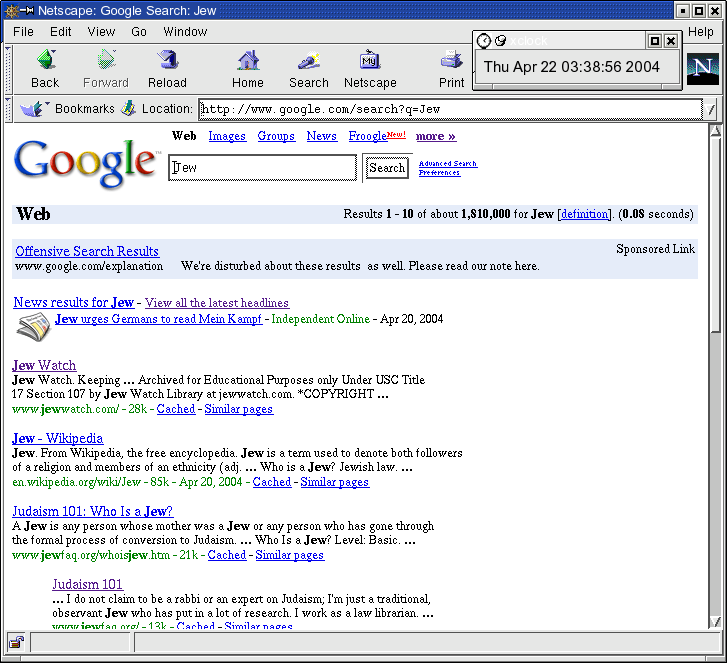
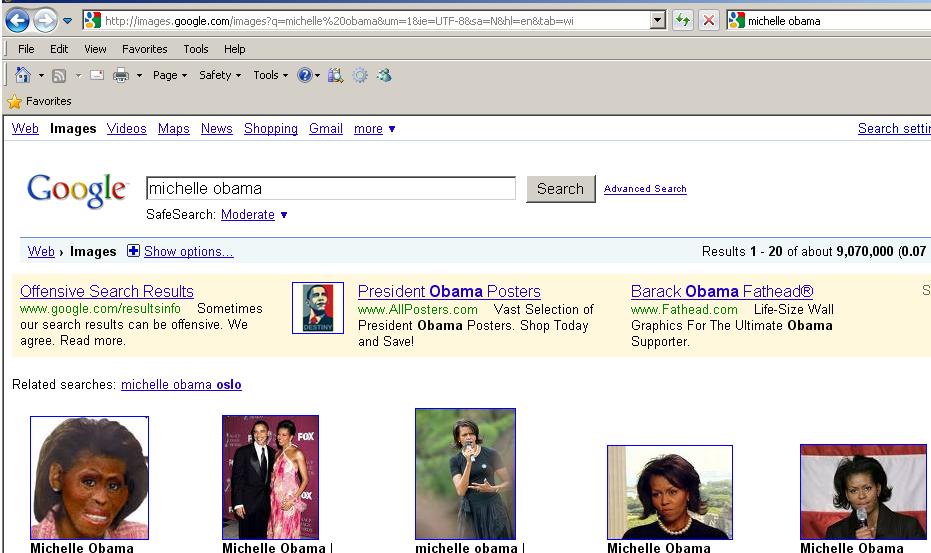
Frequent Slashdot contributor Bennett Haselton writes "Google finds itself inserting a disclaimer once again above some offensive search results. But the disclaimer still leads many to believe (incorrectly) that Google doesn't tamper with search results even in cases of 'harmful' or 'offensive' material. We know that Google has in fact de-listed some pages at the request of offended parties. What is their real policy on the issue?" Read on for Bennet's essay.In 2004, when Google users discovered that the top search result for the word "Jew" was the anti-semitic site Jew Watch, Google ran a disclaimer in the space usually reserved for ads, explaining that their results only reflected the reality of link counts on the Web, and that they did not endorse any Web sites which appeared at the top of their listings. Now the disclaimer has been dusted off again, as the top result on Google Images for "Michelle Obama" is a picture of a monkey's face with Michelle's hairdo. (Ironically, it looks as if the original image would have fallen out of the rankings, if it hadn't been for a follow-up blog post about the controversy, which itself now comes up as the first result.)
I first heard about the controversy from Dennis Prager's column in which he takes a New York Times columnist to task, because the columnist complained about "racially offensive images of the first couple" that come up in Google searches. Prager was unable to find any examples from Googling "first couple" or "Michelle and Barack Obama pictures," so he concluded that the NYT columnist "wildly exaggerated, if not made up" his claims. I tried Google Image searches for "first couple," "Barack Obama," and some other terms, and I couldn't find anything controversial either. However, it only took 10 seconds to enter "first couple google images controversy" on the regular Google Web search and find multiple blog posts explaining what all the fuss was about. Back to Google 101 for Dennis.
Many of the blog posts refer to Google's disclaimer about not tampering with search results. Those on one side are urging Google to make an exception and "fix" the results, while others sagely observe that Google just reflects reality, it doesn't create it.
All of this punditry is starting from a premise that's wrong. Google has actually removed pages from their search results — not because the pages were illegal or because the webmasters were search engine spamming, but because of the page's "offensive" content. In the "Chester's Guide" incident, a councilman in Chester, England discovered that one of the search results for "chester guide" was a satirical page titled "Chester's guide to picking up little girls." Although the page itself was obviously just someone's idea of sick humor, a Chester city councilman (who admitted that he hadn't looked at the page, saying that the title told him everything he needed to know) urged Google to remove the page from their index. Google at first refused, but later manually blacklisted the page to prevent it from appearing in their search results.
Whether or not you think this was the right decision, probably depends on what you think is the purpose of Google. If Google's purpose is to return the most useful results, then it made sense to remove the link, as Danny Sullivan of Search Engine Watch argued at the time, since it almost certainly was not a useful result for people searching for "Chester Guide." On the other hand, if the primary purpose of Google is to reflect the reality of what pages on the Web feature certain words most prominently (combined with all the other factors that Google weighs, of course), then the results shouldn't be altered.
But more people should at least realize that it happened. The Google disclaimer doesn't precisely say that they never blacklist pages or modify search results ("Google reserves the right to address such requests individually"), but it seems to give most people the impression that that's the case. According to that crudest of Googling techniques for which novice searchers are so frequently lampooned, there appear to be about 400 times as many stories on the Web about the Google "Jew Watch" controversy (where Google stood their ground) as there are stores about the "Chester's Guide" incident (where Google caved).
And Google-number-three Matt Cutts posted on his blog back in March explaining why Google does not remove "offensive" pages from search results; over a hundred comments followed, debating the pros and cons of the position, but none of them mentioned the Chester incident or any other case where Google actually had removed pages except as a result of a court order. One isolated comment from "Anonymous" said:
This is not quite true. I know of at least one web site that was de-listed for containing illegal content and/or promoting illegal activity.
which may or may not have been a reference to the Chester Guide incident. And that was it.
Is this a lot of hay to be making over something that happened years ago? Well, for one thing, I doubt if it happened just once. Consider that the Chester Guide incident involved a public declaration of outrage by a city council, and a public statement from Google, and still hardly anyone knows that it ever happened. If other incidents occurred without those high-profile elements, it would be even harder to discover them now. We'll probably never know how many such incidents took place, unless someone sues Google (maybe the owner of a blacklisted website, or maybe the victim of a RipOffReport hatchet job wondering why that site hadn't been blacklisted long ago), subpoenas Google for a list of cases where pages were de-indexed, and publishes the list if it's not sealed by a court order.
But whether it was one time or a handful, consider that political candidates like Arnold Schwarzenegger and Al Franken got asked during their campaigns about things they did 20 years earlier, and it's fair to ask a candidate about their past, because it's the same person standing in front of you now. Why did you do that? Have you stopped? Why?
And in the big scheme of things, Google is probably more powerful than a single US senator or the governor of California. So, can't we ask? What are their real rules about page removal? Have those rules changed since the Chester's Guide controversy? Can they even tell us what their rules are, or do they consider it a trade secret?
It is well known, of course, that Google censors some results in their search engines branded for different markets like China and even in liberal democracies like Germany. But nobody would call that a slippery slope towards censorship in the US version of Google, because the censorship in the Chinese and German versions is done at the behest of the governments there. On the other hand, Google does admit that they will de-index pages which include credit card numbers or social security numbers (which are all too easy to find on the Web). This might not seem like a controversial position, but even this act of voluntary self-censorship may be dipping their toe in the water further than it seems. Most people do consider their credit card information more private than their home address. But surely there are people like J.D. Salinger who less about the privacy of their credit card number (which is easily changeable) than their home address (which isn't). If someone finds Salinger's address and posts it on the Web, should Salinger be able to demand that Google de-index the page? Why should Google cater to the majority who want to keep their credit card number secret, but not to the minority who care more about keeping their address secret? Another commenter on Matt Cutts's blog post asked:
"hi. I have a question. My mom 'googled' herself and it shows some of her medical problems. She wants/needs these pages removed from search engines."
Again, why shouldn't that be considered at least as private as a credit card number?
And finally, even Google's decision to display an "offensive results" disclaimer, for some results but not for others, raises the same "Where do you draw the line?" questions as the issue of page removal. The Michelle Obama monkey picture gets a disclaimer. But search for 'george w bush' and the first row includes a photoshopped (I think!) image of Bush flipping off the press. Does that warrant a disclaimer as well? (Maybe that's considered less unfair because, even though the picture is fake, it does depict something that actually happened.) The first image result for "bristol palin" is a photo of her engaged in underage drinking — a real photo, but probably unfair to call it the single most relevant photo of her on the Web.
So while Google might consider credit cards and social security numbers and search engine spam to be on one side of a "bright line," and everything else is served up without alteration, I think the line is blurrier than that, for at least those three reasons: (a) credit cards and SSNs are less private than some other that things that Google serves up anyway; (b) Google has unambiguously removed some content that fell outside that bright line, as in the Chester's guide incident, and (c) they make other "slippery slope" judgment calls about search results all the time (as in the question of when to show the disclaimer). So I hope that Google someday comes out with a more complete answer to the question. What is their real policy on what they will remove? The Chester's guide incident — would they do that sort of thing if the same situation came up today, or have their rules changed? If they want to go really deep, then is there a general set of principles from which their rules follow — explaining why, for example, they treat credit card numbers as more private than sensitive medical information? (Google did not respond to my request for comment, either through official channels or the unofficial back channels of friends who work there.)
I hope Google gives an answer some day. Even just to say, "It's a classified internal policy and that's all we're going to tell you." But once and for all, the answer is not "Google doesn't remove content just because it's 'offensive' or 'harmful.'"
Meanwhile, a modest suggestion about the disclaimer displayed above the search results: Put it where people will actually see it, in a separate line below the ads, but above the search results. Right now the link to the disclaimer is displayed as one of three ads across the top, and people don't look at the ads. But hey, people do buy ads, so if you push the disclaimer down a bit where people will read it, you also free up space for 50% more ad revenue!
-
Ohio Eatery Offers Discount For Sandwich Tattoos
An Ohio restaurant, Melt Bar & Grilled, is offering anyone who gets a grilled cheese sandwich tattoo a 25% discount. The establishment specializes in putting a new spin on the old lunchtime favorite. The discount, like the shame of getting a grilled cheese tattoo, lasts a lifetime. -
Driver Gets Stuck On Cruise Control
Benaiah writes "In something seemingly out of a Keanu Reeves movie, an Australian driver was unable to make his freeway exit when his car failed to slow down as he applied the brake. For those of you too lazy to RTFA he tried everything to stop the car including turning off the ignition but to no avail, the computer was in control. Police at one point escorted him down the wrong side of the road at 80km/h(50mp/h) until he eventually was able to stop it by repeatedly stepping on the brake pedal. Ford Australia spokeswoman Sinead McAlary said there has been a recall on that make of car but for a different reason." -
Weightlifter Unexpectedly Gives Birth While Training
Elizabeth Poblete, a Chilean Olympic weightlifter, got a big surprise when she gave birth to a boy while she was training in a Brazilian gym. Poblete didn't know she was 6 months pregnant and had even consulted a doctor a week previous. Head weight trainer in the gym, Horacio Reis, said: "It was a surprise for me. A week ago I acted as a judge in a competition in Chile and this girl was competing. All went well and she won the competition. I could see she was a big girl, round and strong. That's all I noticed." Both mother and child were brought to the hospital after the surprise delivery. The boy remains in intensive care and it is reported that he can already clean and jerk a full 10oz bottle. -
22 Million Missing Bush White House Emails Found
ctmurray writes "Computer technicians have found 22 million missing White House e-mails from the administration of President George W. Bush, and the Obama administration is searching for dozens more days' worth of potentially lost e-mail from the Bush years, according to two groups that had filed a lawsuit — which has now been dropped — over the failure by the Bush White House to install an electronic record-keeping system. Earlier we discussed the Obama White House's opposition to the lawsuit that led to this discovery." The related links reflect our discussions about the missing emails over two years. -
"Loud Commercial" Legislation Proposed In US Congress
Hackajar writes "Have you ever caught yourself running for the volume control when a TV commercial comes on? Congresswoman Anna Eshoo (D-CA) has, and is submitting legislation that would require TV commercials in the US to stay at volume levels similar to the programming they are associated with. From the article: 'Right now, the government doesn't have much say in the volume of TV ads. It's been getting complaints ever since televisions began proliferating in the 1950s. But the FCC concluded in 1984 there was no fair way to write regulations controlling the "apparent loudness" of commercials.'"