Slashdot Mirror
Search
Search the archive with full-text matching across story titles, bodies,
and comments. Phrases are quoted; or, -word,
and parentheses behave as in a web search. Queries must be at least
3 characters.
Stories · 3,636
-
Pirates and Ninjas — Emacs Or Vi?
Sherri Davidoff writes "In the great debates of Pirates vs. Ninjas and Emacs vs. Vi, there is one overarching question: Do Pirates and Ninjas use Emacs or Vi? Philosecurity has conducted countless hours of research, interviewed real ninjas and pirates in their natural environs, and launched intensive laboratory studies involving monkeys in order to bring you, our readers, the scientifically proven answers you demand. After thousands of hours and monkey brains, our scientists have reached the following conclusions: Pirates use Emacs and Ninjas Use Vi. Laboratory results showed that 92% of ninjas preferred vi, while fully 96% of pirates used emacs. In the wild, these numbers were even higher (94% and 97.5%, respectively)."
-
Dealing With a Copyright Takedown Request?
George Maschke writes "I recently received a takedown notice from a corporate lawyer demanding that I remove a post on my Web site's message board. It purportedly lists the first 75 of 567 questions on the MMPI-2 paper-and-pencil psychological test. It seems to me that such posting of a limited amount copyrighted material for discussion purposes on a public-interest, non-profit Web site falls within the scope of the fair use exemption of US copyright law. I have thus declined to remove the post. I believe that the corporation in question is seeking to chill public discussion of its test, which applicants for employment with many governmental agencies are required to complete. I would be interested in this community's thoughts on the matter."
-
No Business Case For IPv6, Survey Finds
alphadogg writes "Business incentives are completely lacking today for upgrading to IPv6, the next generation Internet protocol, according to a survey of network operators conducted by the Internet Society (ISOC). In a new report, ISOC says that ISPs, enterprises and network equipment vendors report that there are 'no concrete business drivers for IPv6.' However, survey respondents said customer demand for IPv6 is on the rise and that they are planning or deploying IPv6 because they feel it is the next major development in the evolution of the Internet."
-
Programming Language Specialization Dilemma
aremstar writes "I'm a final-year Computer Science student from the UK. During my studies, we covered 3 programming languages: C, C++ and Java. The issue is that we didn't cover any of these languages in sufficient depth for me to claim that I have commercial-ready experience. It's one thing being able to write simple programs for class assignments, but those are quite different from writing something as complex as the Linux kernel or a multi-threaded banking app. I'm thinking of spending a few weeks/months studying in order to specialize in one of those languages. Fortran also entered my consideration, as it is great for numerical computing and used by many financial institutions, banks, etc. In terms of skill requirements in job ads, my (brief) experience suggests that most programming jobs require C++, with Java a close second. C — unfortunately — doesn't appear as much. My question is: if you were in my shoes, which language would win your time investment? My heart suggests C, with a little bit of Fortran to complement it, but I'm a bit worried that there might not be enough demand in the job market."
-
Blizzard Asserts Rights Over Independent Add-Ons
bugnuts writes "Blizzard has announced a policy change regarding add-ons for the popular game World of Warcraft which asserts requirements on UI programmers, such as disallowing charging for the program, obfuscation, or soliciting donations. Add-ons are voluntarily-installed UI programs that add functionality to the game, programmed in Lua, which can do various tasks that hook into the WoW engine. The new policy has some obvious requirements, such as not loading the servers or spamming users, and it looks like an attempt to make things more accessible and free for the end user. But unlike FOSS, it adds other requirements that assert control over these independently coded programs, such as distribution and fees. Blizzard can already control the ultimate functionality of add-ons by changing the hooks into the WoW engine. They have exercised this ability in the past, e.g. to disable add-ons that automate movement and facilitate 'one-button' combat. Should they be able to make demands on independent programmers' copyrighted works, such as forbidding download fees or advertising, when those programmers are not under contract to code for Blizzard? Is this like Microsoft asserting control over what programmers may code for Windows?"
-
eBay Describes the Scale of Its Counterfeit Goods Problem
Ian Lamont writes "As the Tiffany vs. eBay lawsuit winds its way through a federal appeals court, eBay has trotted out some numbers that show how many sellers attempt to sell fake goods on the auction site. Millions of auctions were delisted last year, and tens of thousands of accounts were suspended after reports were made to eBay's Verified Rights Owner program, which lets trademark owners notify eBay of fake goods being sold on the site. eBay says 100% of reported listings were removed from the site last year, most within 12 hours, and the company uses sellers' background information to make sure that they don't create new accounts to sell delisted items. Tiffany brought the suit against eBay in 2004, alleging that eBay was turning a blind eye to counterfeit luxury goods and demanding that eBay police its listings for bogus goods. Tiffany lost the case last July and will shortly present its arguments to the US Court of Appeals for the Second Circuit in New York. A similar case in France cost eBay $61 million."
-
Computer Science Major Is Cool Again
netbuzz sends along a piece from Network World reporting that the number of computer science majors enrolled at US universities increased for the first time in six years, according to new survey data out this morning. The Taulbee Study found that the number of undergraduates signed up as computer science majors rose 8% last year. The survey was conducted last fall, just as the economic downturn started to bite. The article notes the daunting competition for positions at top universities: Carnegie Mellon University received 2,600 applications for 130 undergrad spots, and 1,400 for 26 PhD slots. "...the popularity of computer science majors among college freshmen and sophomores is because IT has better job prospects than other specialties, especially in light of the global economic downturn. ... The latest unemployment numbers for 2008 for computer software engineers is 1.6%... That's beyond full employment. ... The demand for tech jobs may rise further thanks to the Obama Administration's stimulus package, which could create nearly 1 million new tech jobs."
-
Women Skip Math/Science Careers To Have Families
hessian notes a Cornell survey, published in the Psychological Bulletin, of 35 years of sociological studies that concludes that women tend to choose non-math-intensive fields for their careers not because they lack mathematical ability, but because they want flexibility to raise children or prefer less math-intensive fields of science. "'A major reason explaining why women are underrepresented not only in math-intensive fields but also in senior leadership positions in most fields is that many women choose to have children, and the timing of child rearing coincides with the most demanding periods of their career, such as trying to get tenure or working exorbitant hours to get promoted,' said lead author Stephen J. Ceci... The authors concluded that hormonal, brain, and other biological sex differences were not primary factors in explaining why women were underrepresented in science careers, and that studies on social and cultural effects were inconsistent and inconclusive. They also reported that although 'institutional barriers and discrimination exist, these influences still cannot explain why women are not entering or staying in STEM careers,' said Ceci."
-
Court Demands Private Facebook Data
Defeat Globalism writes in with a Canadian court decision that has ordered a man suing over injuries from a car accident to answer questions about content on his private "friends only" Facebook page. "Lawyers for Janice Roman, the defendant in the lawsuit, believe information posted on John Leduc's private Facebook site — normally accessible only to his approved 'friends' — may be relevant to his claim an accident in Lindsay in 2004 lessened his enjoyment of life. As a result of the ruling by Justice David Brown of Ontario's Superior Court of Justice, Leduc must now submit to cross-examination by Roman's lawyers about what his Facebook page contains. Brown's Feb. 20 ruling also makes clear that lawyers must now explain to their clients 'in appropriate cases' that postings on Facebook or other networking sites — such as MySpace, LinkedIn and even blogs — may be relevant to allegations in a lawsuit, said Tariq Remtulla, a Toronto lawyer who has been following the issue."
-
Feds Demand Prison For Guns N' Roses Uploader
Defeat Globalism writes with this excerpt from Wired: "Federal prosecutors in Los Angeles are pursuing a 6-month prison term for a Los Angeles man who pleaded guilty in December to one misdemeanor count of uploading pre-release Guns N' Roses tracks, according to court documents. Kevin Cogill was arrested last summer at gunpoint and charged with uploading nine tracks of the Chinese Democracy album to his music site — antiquiet.com. The album, which cost millions and took 17 years to complete, was released November 23 and reached No. 3 in the charts. The sentence being sought — including the calculation of damages based on the illegal activity of as many as 1,310 websites that disseminated the music after Cogill released it — underscores how serious the government is about punishing those for uploading pre-release material."
-
Review: Halo Wars
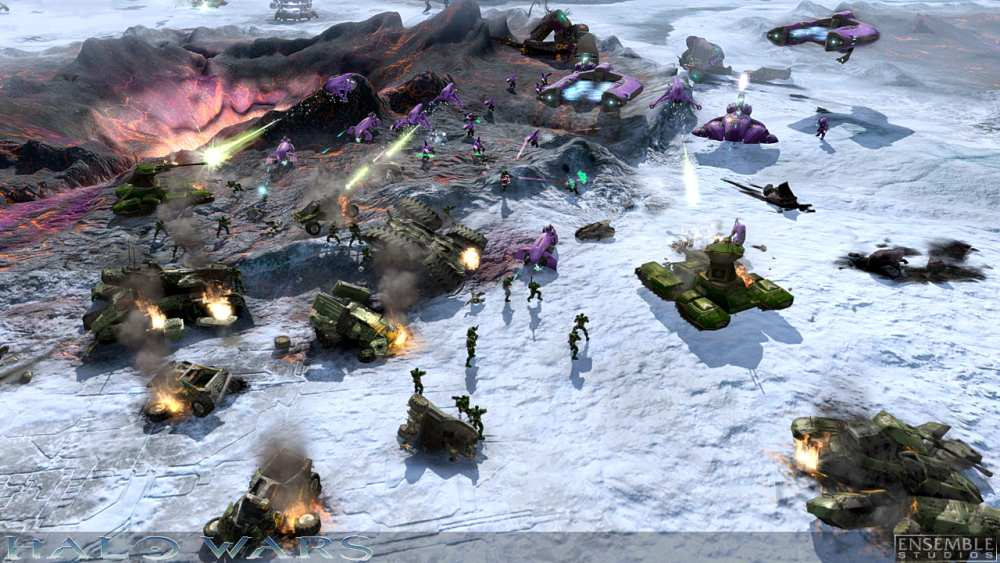
The success of the Halo franchise is unquestionable. Bungie's trilogy of first-person shooters established a standard against which most similar games have been judged for the past eight years. Thus, when Ensemble Studios picked up the task of bringing the Halo universe to real-time strategy, they faced two separate mountains to climb: maintaining the high quality demanded by fans of the series and developing for a genre that traditionally translates poorly to console play. Fortunately, they had a head start on the latter, bringing in a wealth of experience from the Age of Empires series. Creating an intuitive and dependable control scheme was a top priority, and their success in doing so makes Halo Wars a worthy addition to the series. Read on for the rest of my thoughts.
- Title: Halo Wars
- Developer: Ensemble Studios
- Publisher: Microsoft Game Studios
- System: Xbox 360
- Reviewer: Soulskill
- Score: 7/10
A solid camera system is the foundation of a good control scheme, and here Ensemble gets off to a running start. The left stick pans around the map at a variable speed determined by how far you push the stick. You can scroll slowly or quickly, and you can also change the maximum speed in the options menu. It's very responsive and easy to get from one place to another. You can hold the left trigger for even more speed, going all the way across the map in about a second. The right stick controls the zoom function, which is largely irrelevant — you'll probably want to keep it zoomed out as far as it will go most of the time — and pushing the stick to the sides rotates your view. You won't need to use this very often, but it's convenient and useful if you want to see things from a different angle.
The other way you can move around the map is with the directional pad. Hitting left will cycle through your base positions, and pressing down will cycle through your unit positions. Occasionally you'll get an alert — for example, a few of your units will be under attack somewhere on the map — and pressing right will take you immediately to the position of your latest alert. Getting around the map is definitely not a problem in this game. It's about as close as you can get to the ease of use that comes with a mouse and keyboard.
The next big hurdle was unit selection, and again, Ensemble did a fine job, giving you all the options and speed you're used to in these types of games. The A-Button selects units individually, but if you hold it down, you get a good-sized circular area which you can then sweep over multiple units to select them at the same time. This takes the place of the typical click-and-drag rectangles on the PC. It's slightly slower, but not by much, and you get the added benefit of being able to grab everyone in a circle around a unit you want to stay put. On top of that, double tapping the A-button on a unit will select all of that type of unit nearby. The right shoulder will select everything on screen, and the left shoulder will grab all units period. The only notable missing function is the inability to save certain groups and switch back to them, and even then, if your groups are spread out, it's not an issue.
If you have multiple unit types selected, the trigger buttons will cycle through the different types, making it very easy to send all your marines in one direction and all your vehicles in another. Once you've had a few missions to get used to the myriad selection options, you won't even need to actively think about what buttons to press. It's a good system because it doesn't get in the way of the actual gameplay. Finally, the means of controlling your units and buildings are simple and intuitive as well. The X-button is your standard "go here," "attack this," "grab this" button, and the Y-button activates any special attacks your selected units have. One nice feature is that you can hold down the X-button for a few seconds and a unit will finish walking to where they were already headed before they go to the new location. This lets you set up paths to take the long way around if the short way isn't safe. Buildings have a radial context menu through which you activate upgrades or pump out new units. You can queue up multiples at a time, and you can cancel an order before it finishes. Essentially, all is as it should be, and you're left to focus on what's important.
Halo Wars starts you off about 20 years before the events of the first Halo game. They send you to Harvest, the first planet to be taken by the Covenant, to establish peaceful and cooperative relations with their leaders and diplomats after five long years of combat. Just kidding — they want you to kill stuff. You get to see cinematics after every mission, which are largely responsible for driving the plot of the game. Visually, they're quite impressive, though the first few are a bit slow. As the game goes on, the cinematics become progressively cooler and more exciting. The writing and the dialogue is less than stellar, but it's serviceable, and it provides some good context to the Halo universe. There are also minor plot points shown during the mission, rendered by the game engine. Those are usually what determine your specific objectives.
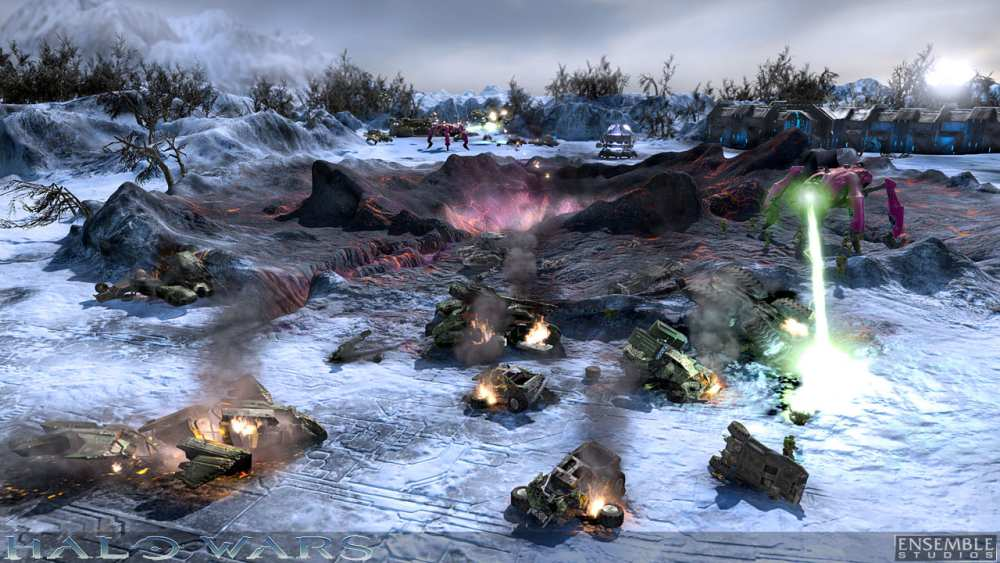
There are not many missions in the campaign — just 15 — but they're very diverse. No two are alike, and Ensemble does a decent job of creating interesting objectives and differing levels of resistance. In one, you have to defend civilians as they head for their evacuation shuttles, and you need to take care of the shuttles themselves. The mission is timed, waiting on a countdown to launch. Another mission has you faced with a large energy shield that needs to be taken down. Certain positions on the map are good attack points for a type of long-range tank, so you have to take each position one at a time and hold them all long enough to knock down the barrier. Later you fight a Covenant super-weapon (a Scarab), dodging its main attack while taking out its power supply. And, of course, you get a mission to just build a massive army and annihilate everything else on the map.
They give you a good mixture of offense and defense, though in some cases the amount of resistance you're likely to encounter is unclear. Decisions made early in the game in terms of build order and unit production can effectively eliminate your chances of winning if you guess wrong. This is important because of the way Halo Wars deals with building bases. The bases themselves can only be placed in particular spots. Once a base is built, a number of empty construction bays spring up around it, and you're only allowed to build additional structures where there are construction bays. This means that you're only allowed a maximum of seven structures per base. On top of that, resources aren't something you go out and farm; you build supply pads, which slowly get deliveries from your ship in orbit. So, you're given a tough decision early on whether you want to develop your army or your economy. If you throw down five supply pads, you'll get resources like crazy, but you won't have enough space left to build all of the other things you need to win.
On the easier difficulty levels, this works out decently well; a ton of early resources means that you can pump out enough basic marines to handle most threats until you get fully established and perhaps take a second base. On the harder modes, you're attacked earlier and with stronger forces. Another decision they give you is what type of enemies you want to defend against. Several units are particularly strong against one type of enemy — infantry, vehicle, or aircraft — and not as useful against others. When in doubt, diversify, but if you're playing at an appropriate difficulty level, you can expect to fail a few because you just don't know what to prepare for. The timed missions, in particular, force you into early decisions that simply may not work. Since there's only the UNSC campaign, it's worth going through and doing the side missions, and also trying for some of the difficulty-related achievements.
The AI in Halo Wars is solid; pretty standard for this type of game. Your forces are reasonably smart about picking a target to focus, but not too smart; they won't switch off a full-health tank to drop one that's already almost dead. The pathing is pretty good; you won't have to spend much time micromanaging where you want them to go, but the option is there if you need it. One complaint is that when defending, your troops like to chase attackers too far, spreading out your forces and making it easy for a smart enemy to score some easy kills. There are four difficulty levels — easy, normal, heroic, and legendary. If you're just looking for a quick play-through of the game, go with normal. If you'd like to work for it, go with heroic. If you're pretty good at other real-time strategy games and/or enjoy being punched in the face, legendary will fit the bill.
The selection of units is interesting. You often get a leader and a group of three Spartan soldiers. In addition to being quite powerful, these units are essentially unkillable in the single-player campaign. When they take lethal damage, they drop to the ground and slowly regenerate health. Once they've healed enough, you can revive them by bringing another unit close by. It can lead to some surprising shifts in power. Most of the units are upgradeable to a high degree, becoming significantly more powerful late in the game. For example, the standard UNSC marines begin as a squad of four men with machine guns and grenades. Successive upgrades will: add one man, trade the grenades for long-range rocket launchers, add a medic that will heal the squad after a battle, and finally upgrade all of the marines to Shock Troopers. Each side even has "uber units;" Scarabs shoot giant lasers that fry UNSC forces in seconds, and Vultures are airborne behemoths that can eradicate Covenant buildings almost as quickly.
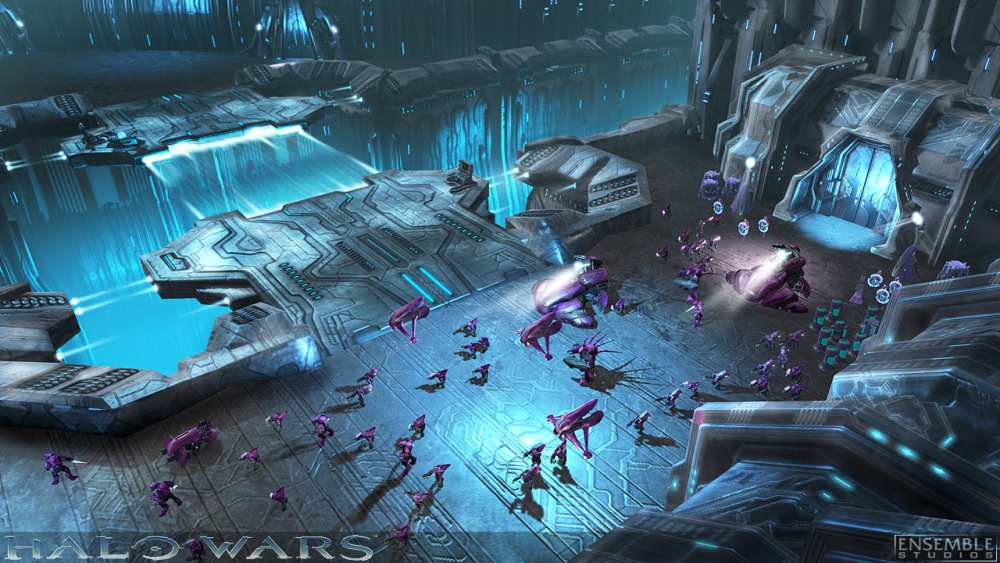
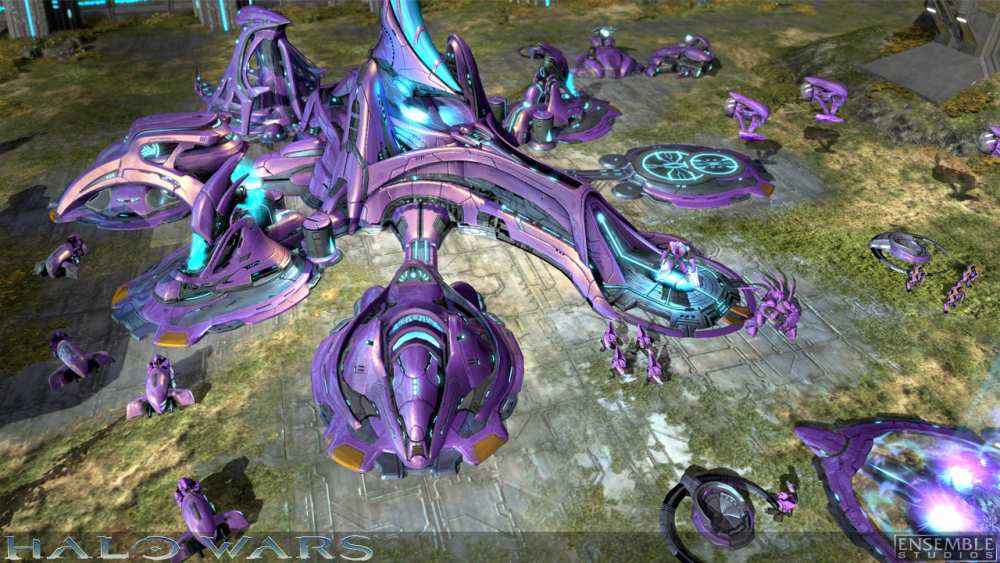
It would have been great to get a campaign of Covenant missions, but you can still use them in multiplayer. Their buildings are similar to the UNSC selection, but with minor variations. They get shield generators of questionable utility, and their infantry are the ones specialized to fight against particular units, rather than the vehicles. The two factions are similar enough that they'll be well balanced. You can play multiplayer maps against the AI or online with other humans, and you can also play cooperatively with your friends. You select the faction you want to play and then the leader you want, each of whom brings a different unit, ability, or potential upgrade to the table. You can expect to see players using strategies that work in other RTS games. Rushes work well, but they can be dealt with. Selecting your opening strategy tends to be more important than out-managing your opponent in battles. You don't have to have a ridiculous number of actions per minute to do well.
Ensemble succeeded quite well at establishing a control system that is powerful yet doesn't fight for intellectual real estate with the actual playing of the game. It's not a ground-breaking new entry into the real-time strategy genre, but, in a manner similar to the first Halo shooter, it demonstrates how well this genre can work on consoles. And it does well by the Halo franchise in the process. It's too bad Ensemble themselves got split up after completing this game — DLC involving some Covenant missions or making the Flood a third playable race would make this game even better. Fortunately, a team of Ensemble members now going by the name Robot Entertainment will be providing "support." If they're proactive about tuning and balancing the game, Halo Wars multiplayer could become quite popular indeed, in part because there isn't much competition. While it's not likely to be suitable for the hardcore, competitive RTS players, Halo Wars is definitely the fun and easy-to-operate console RTS many players have been waiting for.
-
Robot Love Goes Bad
hundredrabh writes "Ever had a super needy girlfriend that demanded all your love and attention and would freak whenever you would leave her alone? Irritating, right? Now imagine the same situation, only with an asexual third-generation humanoid robot with 100kg arms. Such was the torture subjected upon Japanese researchers recently when their most advanced robot, capable of simulating human emotions, ditched its puppy love programming and switched over into stalker mode. Eventually the researchers had to decommission the robot, with a hope of bringing it back to life again."
-
New Zealand's Recording Industry CEO Tries to Defend New Draconian Law
An anonymous reader writes "Campbell Smith, CEO of the RIAA equivalent in New Zealand, has written an opinion piece for one of New Zealand's largest daily papers, in which he tries to justify the new 'presumed guilty' copyright law. This law allows recording industry members to watch file-sharing activity and notify ISPs of users who are downloading material. The copyright holder can then demand that an ISP disconnect that user — without the user ever having a chance to demonstrate their evidence."
-
ESA Pushes Broadband Adoption
A story at CongressDaily points out that the Entertainment Software Alliance (ESA) is busily lobbying for policies to spur broadband adoption across the country. "Opportunities to play games online and download games and game-related content from a range of legitimate download services help drive demand for broadband, the Entertainment Software Association said in a briefing paper sent to President Obama's transition team. 'We're the only form of entertainment online that's interactive — movies and music are linear.' Gallagher told CongressDaily. 'We're very pleased with the president's strong embracing of broadband deployment as a high value goal for our country.' The $6 billion-plus in broadband funds in Obama's economic stimulus package was a good start, he added. Gallagher's group also supports efforts to free up wireless spectrum as gaming moves from PCs and plasma screens to handheld devices."
-
George Riddick — the One-Man RIAA of Clip Art
An anonymous reader writes "Pages at ireport.com and extortionletterinfo.com have been documenting and researching the activities of George P. Riddick III, previously known for his lawsuits against IMSI and Xoom at the turn of the century. In 2007 he issued a largely-ignored press release claiming the majority of clip art online infringes a copyright and has ranted about how Microsoft and Google are stealing from him. In recent months, he's apparently made a business model of going after web site operators who were using clip art they believed to be legally licensed or public domain, telling them they're infringing clip art collections he hasn't offered commercially in years and making outrageous settlement demands. He seems to have tested the waters on this some years back, but emboldened by the passage of the PRO-IP act, he's gone aggro with it. A few dodgy anonyblogs had popped up to 'out' him as a copyright abuser, but these recent ireport.com and extortionletterinfo.com reports go much deeper in documenting and researching Riddick's recent one-man campaign to be the RIAA of clip art."
-
Psion Accuses Intel of Cybersquatting
Save the Netbooks writes "We discussed Psion sending C&Ds late last year over international trademarks held on the term 'netbook' and Dell accusing Psion of fraud last week. Since then Intel has joined in by suing Psion in federal court. On Friday Psion counter-sued Intel (court filing, PDF). SaveTheNetbooks.com has an analysis here. Psion has demanded a jury trial, profits, treble damages, destruction of material bearing the mark 'netbook' and the netbook.com domain (among other things), claiming that they are still actively selling netbooks despite also revealing sales figures showing a minuscule market share. It seems that declaring victory may have been a little premature as it will be months before the dispute plays out in court."
-
Solar Panels Reach $1 a Watt
ZosX writes "An article over at Popular Mechanics announces that, for the first time, solar cells have been manufactured for the much sought-after figure of $1/Watt. They also talk about a new study of the cost of the particular raw materials used in different manufacturing processes. The conclusion is that the company that just achieved the $1/W milestone, using cadmium telluride technology, may not prove to be the long-term winner capable of meeting demand when it rises into the terawatt range."
-
The CDA Is Dead, But States Are Trying To Revive It
oliphaunt writes "This week at The Legality, Tracy Frazier has an article discussing the damage that can be done by anonymous online comments. While regulars here are familiar with infamous bits of Net censorship like the Fishman Affidavit fiasco, and everyone has been an anonymous coward at least once or twice, some of you may not know about the conflict between Heide Iravani and AutoAdmit.com. Heide eventually filed a lawsuit because the first result for a Google search on her name brought up anonymous comments on AutoAdmit that accused her of carrying an STD and sleeping her way to the top of her class. The Communications Decency Act was supposed to prevent this kind of thing, but an injunction prevented it from ever being enforced and eventually the Supreme Court killed it. Should the law be changed?" The article links to a proposal from last summer in the New Jersey legislature that would institute a DMCA-like takedown regime for allegedly defamatory content posted on a Web site, and would allow aggrieved parties to demand the identity of anonymous posters without a subpoena. No indication of how that proposal fared. Also linked is a recent North Carolina proposal that would criminalize the act of defaming someone using an electronic medium. This proposal shields Web sites from liability and explicitly does not apply to anonymous speech.
-
Book Publishers Making the Same Mistakes as Record Labels?
Techdirt points out an interesting query in Slate asking why book publishers appear to be making the same mistake that record labels did with the iTunes service with DRM, and single-vendor lock-in. "Back in 2005, we noted that Apple's dominance over the online music space, which upset the record labels tremendously, was actually the record labels' own fault for demanding DRM. That single demand created massive lock-in and network effects that allowed Apple to completely dominate the market. If the record labels had, instead, pushed for an open solution, then anyone else could have built stores/players to work as well, and it could have minimized Apple's ability to control the market. Yes, everyone is now opening up (including Apple), but it took a long time, and Apple had already established its dominant position. So why are book publishers doing the same thing?"
-
Music Industry Conflicted On Guitar Hero, Rock Band
Wired is running a story about the friction between the music industry and music-based games, such as Guitar Hero and Rock Band. Despite the fact that these games are very successful and are drawing a great deal of attention to the music represented in the games, the industry is not pleased with the licensing arrangements that allow the games to use their songs. Quoting: "Putting the brakes on music gaming would hurt everyone in the ailing music industry. Instead of demanding greater profit participation, Warner should be angling for creative participation. Thirty years ago, Hollywood took a similar threat — the VCR — and turned it into a new source of revenue, building customer loyalty in the process. The music industry could use new games the same way — but its track record suggests that it won't."