Slashdot Mirror


1-Click Rejection Rejected

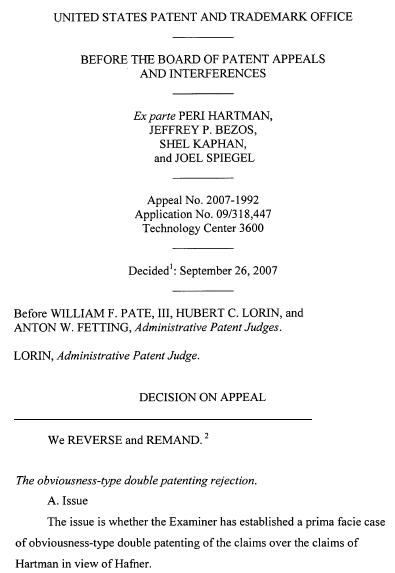
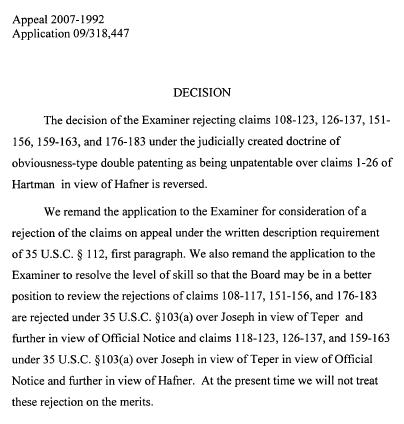
theodp writes "On Wednesday, a three-judge USPTO panel convened at Amazon's request rejected a USPTO Examiner's rejection of Amazon CEO Jeff Bezos's 1-Click patent, ruling that it wasn't obvious to them what the Examiner found obvious. The application has been remanded to the Examiner with instructions to make the obviousness more obvious."
201 comments

  1. But... by Aladrin · · Score: 4, Funny

    But, but... It's so OBVIOUS!

    Seriously, though... If there's even a single person that can't see what's obvious about this in the patent office, there needs to be firings until there isn't. This is pretty much the definition of obvious. Heck, if the person even had access to the internet, they'd have fallen across rants about its obviousness every other month.

    --
    "If you make people think they're thinking, they'll love you; But if you really make them think, they'll hate you." - DM
    1. Re:But... by pimpimpim · · Score: 4, Insightful
      Apparently the Examiner saw it, but the people higher up (let me guess, older?) are apparently easily flabbergasted by Amazon's techspeak. I'm no patent lawyer, but I can imagine one can rewrite "using account data saved from the user" in a complex enough way to make it sound like innovation.

      And as far as I've heard it's a crap 'invention' anyway, one wrong click and you just spent money on something you didn't really want. I'd rather review my account data and address every time.

      --
      molmod.com - computing tips from a molecular modeling
    2. Re:But... by delong · · Score: 4, Informative

      Non-obviousness is a legal requirement for a patent. The Examiner is required to make his determination based on a reasoned finding of fact and conclusions of law. If the Examiner failed to make his reasoning clear that the legal requirement of non-obviousness has not been met, then his determination is legally deficient. This doesn't mean that the Board doesn't see the obviousness; it means at the minimum that the Examiner did not adequately do his job in defending his determination in writing as required.

    3. Re:But... by Anonymous Coward · · Score: 5, Funny

      You could probably patent breathing if you'd word it something like:

      Method of obtaining oxygen while at the same time getting rid of carbon dioxide in intra-body transportation liquids by periodically increasing and decreasing the interior volume of a intra-body cavity connected with the outside air supply through a flexible biological tube, where the walls of the intra-body cavity are connected with the inter-body transport liquid system through semipermeable membranes which allow diffusion of oxygen and carbon dioxide between the transportation liquid and the air.

      Funny thing is, the captcha is "breath" :-)

    4. Re:But... by ehrichweiss · · Score: 2, Interesting

      And as far as I've heard it's a crap 'invention' anyway, one wrong click and you just spent money on something you didn't really want. I'd rather review my account data and address every time.

      I'd never thought of it that way but you're right. I already want to review everything(is the seller charging me $15 to ship an item that costs 40 cents to mail?) so why I'd want to accidentally buy something without a chance to say 'no' is beyond my reasoning powers.

      --
      0x09F911029D74E35BD84156C5635688C0
    5. Re:But... by Anonymous+Brave+Guy · · Score: 5, Insightful

      But, but... It's so OBVIOUS!

      The problem with the whole area of tech patents evaluated by non-techie people is the classic teacher's dilemma: for those who understand, no explanation is necessary, while for those who do not understand, no explanation is possible.

      Almost by definition, something is obvious if it is apparent without further explanation. However, like the many tests of "reasonableness" in law, obviousness is in the eye of the beholder and depends on context. Defining an accurate, repeatable, qualitative test that determines whether something is or is not obvious in general is impossible.

      However, one realistic and credible test is whether other people in the field in question could sensibly be expected to "invent" the same thing in the same circumstances without much thought. I would argue that claiming a typical web developer wouldn't think of the idea to have a single click in a specific place perform an action is pretty insulting to the intelligence of web developers, not least because hyperlinks have been following this principle since before Amazon was a twinkle in Jeff Bezos's eye. Similarly, the idea of remembering user data to minimise repetitive data entry has been around in database world since many years before the web existed. This is drifting into prior art rather than obviousness, perhaps, but I suspect that's the best way to attack this particular lunacy. After all, you can't credibly argue that other people wouldn't think of the same thing in the same circumstances if many of them already did.

      --
      If you disagree, post your argument. (-1, Overrated) isn't your personal censorship tool for views you don't like.
    6. Re:But... by bangzilla · · Score: 1

      Isn't is amazing how obvious things become *after the fact*? Want to sing Happy Birthday - such an "obvious" song? Better pay your license fees to ASCAP. Pet rocks? Patented and copyright. One-Click may be "obvious" now, but that's after someone actually invented it. Remember an invention does not need to be whizzy and complex; simple and elegant often win the race.

      --
      Rich people are eccentric. Poor people are strange. Me, I'd be happy with odd.
    7. Re:But... by tinkerghost · · Score: 1

      I really have a hard time with the judges not seeing how "1 click" is anything other than obvious.

      Amazon: We store a customers CC # & other information. We used to go to a page where customers had to confirm that they actually want to buy the thing they clicked on & review the amount of S&H etc, but we now provide this little button that skips that page.

      Judge: Brilliant!

    8. Re:But... by I+Like+Pudding · · Score: 1

      Amazon does not ship or charge your card 3 milliseconds after purchase. You can just go back and redact or cancel the order.

    9. Re:But... by Aladrin · · Score: 5, Interesting

      Far from elegant, '1 click' is dangerous and insane. As a developer, I would -never- consider implementing such a crazy thing. The 'are you sure' dialog is more of an invention than '1 click'. '1 click' is the opposite of invention, it's lack of one. It's leaving out a step. You know, the secure one that prevents the customer from accidentally ordering the $1000 fuzzybear their daughter was looking at by accidentally clicking on the button, then clicking elsewhere and loading the second page so they don't even know they've ordered it.

      I'm of 2 minds about this patent. It's so obvious that if it remains, the patent system is irretrievably broken. But as long as it remains, nobody else can implement this horrid system.

      When the Amazon MP3 thing showed up on /. yesterday, buying MP3s defaulted to 1-click. I bought one about 3 steps earlier than I expected. (Luckily, I had intended to follow through with it.) Less than an hour later, they had added a 'check here to always confirm before purchase' checkbox. They had obviously snagged quite a few 'accidental' sales that people didn't expect to make, and got tons of complaints.

      This patent is so obvious that every programmer goes through a stage where they learn about the confirmation dialog because they've already implemented this and need to fix it!

      --
      "If you make people think they're thinking, they'll love you; But if you really make them think, they'll hate you." - DM
    10. Re:But... by yerM)M · · Score: 2, Insightful
      I agree, but in this case there is no teacher's dilemma. If you can explain the concept in a sentence, it is obvious:

      We'll keep your credit card on file.

      This is the essence of 1-click. Now, I'm not saying that just saying it makes it possible, but, come-on, if you said this to any web-designer from 1988 on, they could have implemented it (perhaps not securely, but, whatever.)

    11. Re:But... by jkoke · · Score: 1

      I think it would be dangerous if it actually worked the way you describe it (I'm talking about normal Amazon purchases via 1-click -- I haven't used the MP3 store yet). When I click "Purchase Now with 1-click" I am taken to a page that very obviously informs me that I just purchased something, and gives me a clear method of canceling the order (within 90 minutes, which seems pretty reasonable). I find it hard to believe one could actually purchase something accidentally.

    12. Re:But... by Loconut1389 · · Score: 1

      You'd be surprised. I've found a couple of times that if you finalize an order or do 1-click about shipping time, the order is instantly locked to changes.

    13. Re:But... by Aladrin · · Score: 2, Informative

      I quite often accidentally click things by my finger slipping on the mouse and pressing the button. I've also clicked 2 things on a page in the browser, and it'll send both requests (if you click slow enough) but only show you 1 or the other page. Some show you the first, some the second. If you accidentally click the 'buy' button, then click another link, it's possible to have bought the product and never know it.

      I'm sure you'll get an email and all that, but how often do most people check their email? I doubt they're as anal about it as I am.

      The MP3 'buy' button offered no such cancellation page and actually immediately started the download of the MP3. There was no chance to back out. As I said, there's an option in place now to help that, though.

      --
      "If you make people think they're thinking, they'll love you; But if you really make them think, they'll hate you." - DM
    14. Re:But... by BadMrMojo · · Score: 3, Informative

      Almost by definition, something is obvious if it is apparent without further explanation. However, like the many tests of "reasonableness" in law, obviousness is in the eye of the beholder and depends on context. Defining an accurate, repeatable, qualitative test that determines whether something is or is not obvious in general is impossible.


      (My emphasis added above.)

      One thing I've learned in lengthy 'discussions' (... and by 'discussions', I really mean 'arguments') with a group of law grads is that legal definitions of words are a very limited subset of the real world definition. Many words mean exactly one specific thing. No matter how much nuance or implication you can attach to a word in the English language, these things do not apply in Legal English. I can't tell you how many times I simply sat there, agape, as these people were explaining to me that simple words do not have the same meanings that I have attributed to them for my entire life.

      The trick is, these magic keywords are sprinkled throughout the text without any indication... so unless you know beforehand that the word "obvious" doesn't really mean "obvious", but rather "something which would be put together in exactly the same way by someone of average skill in the art with the same components at their disposal." (Note: That definition is from memory, rather than a factually accurate quote. It may be off but I cba to look it up.)

      Not necessarily any old web developer, given a database of user information, would create a 1-click purchase system (thankfully!) and therefore it's arguably not obvious, in Legal English. Whether or not you agree, that's the logic. It may be internalized, bizarro-world, insane troll logic with little to no bearing on the real world but there is some sort of consistency to it, however twisted.
    15. Re:But... by Anonymous Coward · · Score: 0

      Let me explain this with my favorite analogy: Lawyers are to the English language what Statisticians are to mathematics. They both take the subject at hand, twist it, beat, and smack it around until it says exactly what they want it to say. You have never seen more bastardization of a language then you have after a lawyer gets a hold of it. (Patent attorneys are really good at this.)

    16. Re:But... by jkoke · · Score: 1

      Okay, I'll concede the point that it is *possible* to purchase something accidentally if you were to accidentally click the 1-click button and then within a second or so click another link on the page, and then not check your email for 90 minutes. Unlikely and probably rare, but possible and given the volume of transactions on Amazon, it has probably happened at least once. However, I can't see how that translates to "dangerous and insane" as you originally opined. It seems far more likely for someone to charge their own credit card twice by clicking "sumbit" twice on any standard e-commerce site than accidentally purchasing something via 1-click.

    17. Re:But... by Anonymous Coward · · Score: 0

      Remember member an invention does not need to be whizzy and complex; simple and elegant often win the race.

      You can't patent and idea. Or at least the law says you can't. You can on patent a method. If the method is the obvious way to implement the idea you are not entitled to a government created monopoly on the idea. That's the law. It's just stunningly hard to get the patent office and judges to follow the law.

    18. Re:But... by Comatose51 · · Score: 1

      But... but...

      It was so obvious!

      --
      EvilCON - Made Famous by /.
    19. Re:But... by bkr1_2k · · Score: 2, Insightful

      Or you could say that lawyers make language specific and attempt to make it less ambiguous. It's all a matter of perspective, really.

      I'm not a fan of legal abuses or lawyers who try to weedle a situation trying to get the bad guy off on some technicality of how something was worded, but let's face it, sometimes that's exactly what's needed. Sometimes it's the bad guys who are getting hung by the same technicalities of language. Consider the RIAA's attempts to prosecute people for "offering up" songs for download, which technically isn't doing anything wrong. Without being specific about what "offering up" means, we'd have no real way to defend against the RIAA, right?

      Everything can be used for "good" or "bad" deeds, but what is "good" and what is "bad" are strictly a matter of perspective.

      --
      "Growing old is inevitable; growing up is optional."
    20. Re:But... by mavenguy · · Score: 5, Interesting

      This very probably the case, as reading the board's full decision shows. However, after browsing over the long and contorted prosecution of this application, and considering the huge number of claims to consider it's clear that there was not enough time to do a proper job to meet the level of discussion and discourse required by the Board.

      I have no idea if the examiner was given extra time to work on this application, but this is unlikely, or, if given, would hardly be enough to cover the work required. PTO management is fanatical about meeting production goals and meeting dates to crank out responses. Assuming that the business methods get among the most time to work on an application would mean a Primary Examiner would be expected to average getting out the equivalent of one full prosecution in about 40 hours that counts everything from when the examiner first sees the application until it sent off as an abandonment, allowance, or an appeal. the applicant here filed a Request for Continued Examination, so the examiner got another "balanced disposal", meaning that he had about 80 hours to get this out. Of course, the time is accounted on each application, but extra time spent on one application must come at the expense of working on other applications.

      Give the spotlight that this application has been under I bet management will come down hard on the examiner, probably charging him/her with an "Action Taking" clear error, if not others. They will scold employees for not doing a sufficieent job, but will will continue to hold them to production standards. Therein lies the main reason the quality of work from the PTO is often very poor.

      -Ex Examiner

    21. Re:But... by Anonymous Coward · · Score: 0

      Not that I'm going to spend the minute looking this up, but from what I remember it's not just obvious *to anyone* which is a bar so low, you can't get under it.

      It was something more along the lines of "obvious to one conversant in the art" which is a much higher bar. The whole thing seems to breaks down as the patents become way more complex (as they follow the state of the art). You'd have to keep a staff of high end people in all sorts of complex fields. Expensive.

      This all worked better when our "art" was simpler. Those days are gone and we haven't found a workable system to replace it.

      If we do, it will probably involve some form of peer review. Of course, that introduces a ton of additional politics. Currently, the system is subject mostly to bribes and stupidity. With peer review, you can add jealousy.

      What about when machines start "inventing" things? Who owns it? The owner of the machine? Or the builder of the machine? Or the designer? Maybe the machine?

      That will be much nastier fighting than we have now, I suspect.

    22. Re:But... by Locutus · · Score: 1

      I've often wondered as to WHOM the "not obvious" clause of determining if something is patentable refers to. I could not believe that it would be the examiner alone and figured they had some way to test this. Now we see that there is no real test at the USPTO, they just rubber stamp everything and let the courts deal with it. Or worst, after the courts deal with it, the USPTO has another look and rubber stamps it again. WTF.

      Something is very wrong here and unless there are massive changes, it'll be the major businesses with large bank accounts who control patents and further stall progress and new products from making it to market.

      If 1-click can make it, then 1/2-click can also do the same. Catch the freak'n mouse-down event instead of the click event( mouse-down and mouse-up ). And then try for the no-click by "rubbing" the 'buy now' button with a few mouse-over events and change the button color to show the move from "buy now" to "purchased".

      I sure hope someone hasn't patented pushing buttons on a flat surface to trigger the stringing of alpha-numeric display elements in a browser or text-box... What a waste of time and effort. IMO.

      LoB

      --
      "Anyone who stands out in the middle of a road looks like roadkill to me." --Linus
    23. Re:But... by jack455 · · Score: 1

      Unfortunately when a talented lawyer helps a client skirt a bad law using a technicality, that prevents the law from being tested in the courts. It's also why settling a case is sometimes "bad".

      They can put unfair laws on the books and if nothing gets appealed then the law just sits there oppressing people.

    24. Re:But... by Locutus · · Score: 1

      yes, please explain that to a bunch of legal monkeys who have little to know understanding of the computer industry or computer technology/usage in general. Where is the line as to the education and depth of knowledge expected for the determinate of non-obvious?

      Maybe the examiner can require the Board members to take a few basic computing classes or require some books and quiz them on their understanding/comprehension of the books contents? Have you tried explaining how to do something to a Windows user who doesn't know but how to click a few buttons and open a browser and email client? It is very frustrating how little people know about the tool they are using. I know people being paid to use a computer and they didn't know how to get to a website without a link to it. Talk about a society full of dumb shits...

      There is a line which must be drawn and there needs to be validation of basic knowledge in the field of the invention by the examiner and all who address the patents. And basic does not mean knowing how to hit the power button if the patent is computer related. IMO.

      LoB

      --
      "Anyone who stands out in the middle of a road looks like roadkill to me." --Linus
    25. Re:But... by blackjackshellac · · Score: 1

      I'm going to guess, that the vast majority of what you use from day to day in your computing environment was created by "older" people, so I wouldn't be so quick to diss us old farts.

      --
      Salut,

      Jacques

    26. Re:But... by edmicman · · Score: 1

      I think you forgot to add "on the web". That's the money-phrase to get the patent!

    27. Re:But... by Anonymous Coward · · Score: 0

      Far from elegant, '1 click' is dangerous and insane. As a developer, I would -never- consider implementing such a crazy thing. The 'are you sure' dialog is more of an invention than '1 click'. '1 click' is the opposite of invention, it's lack of one. It's leaving out a step. You know, the secure one that prevents the customer from accidentally ordering the $1000 fuzzybear their daughter was looking at by accidentally clicking on the button, then clicking elsewhere and loading the second page so they don't even know they've ordered it.


      But didn't Amazon start making better revenue once they started this? Isn't it obvious that improving sales by implementing something like this is "innovation"?
    28. Re:But... by fourchannel · · Score: 1
      One thing you need to change is that it's not

      any old web developer, given a database of user information, would create a 1-click purchase system
      it's

      any old web developer, given a database of user information, and a massive commercial marketplace, would create a 1-click purchase system

      Then, yeah, it is pretty obvious. You have to remind yourself that if you were working for Amazon, and its primary busy model was a huge online marketplace, then eventually it would have occured to you to save some time by offering a 1-click button.
      --
      ---FourChannel---
    29. Re:But... by pimpimpim · · Score: 1

      Sorry old Jacques! Didn't want to offend! I guess age is not related with this, but more the fact that the patent examiner knows his way in the field, whereas the control committee might be more general. I have no clue why otherwise they would reject the patent rejection!

      --
      molmod.com - computing tips from a molecular modeling
    30. Re:But... by Anonymous Coward · · Score: 0

      It happens relatively frequently, and is normally resolved by declining the shipment or returning the item, both of which cost Amazon money.

    31. Re:But... by Necrobruiser · · Score: 1

      So your problem with 1-click is that if you accidentally click the button, go to the next screen and accidentally enter your password, you might accidentally purchase an item and you would then have to (gasp!) CANCEL THE ORDER??? How traumatic for you.
      I am not sure why you seem to have such a personal hatred against 1-click. Using words like "dangerous", "insane" and "horrid" suggest that you have either an agenda or an inability to use hyperbole effectively.
      It might or might not be a decent patent. I have found it to be useful and convenient, but that's unfortunately not one of the requirements for receiving a patent. I suspect that if you examined 1-click with an open mind, you might find it to be useful, or if not useful, then at least not "dangerous".

      --
      "I planned within my means and got a fixed rate mortgage, so where's MY bailout?" -cafepress
    32. Re:But... by pseudorand · · Score: 1

      That's hardly obvious to us Monera, you insensitive clod. Okay, the semipermeable membrane thing most of us get, but "intra-body cavity" and "flexible biological tube". You expect us all to know about these things. If you eukaryotic jerks would just allow patents on such things, maybe market forces could share this whole "breath" thing with the rest of us. After all, we are the majority and probably a huge untapped market. But no, instead you keep all of your fancy technology for the exclusive use of so-called "higher organisms". It's the 21st century, but clearly Imperialism never really died.

    33. Re:But... by Anonymous Coward · · Score: 0

      --it's not obvious to me... Should I Left-Click or Right-Click???

    34. Re:But... by DavidM01 · · Score: 0

      ITS CALLED A TAB. They used to be in most bars in major cities in America. Using a device in new ways is ENGINEERING, not an INVENTION.

    35. Re:But... by Zalbik · · Score: 1

      You could probably patent breathing...

      I call prior art!

    36. Re:But... by ajs · · Score: 1

      This is getting to be a regular post for me, but I'll make it anyway:

      You cannot judge a patent by the cute name given to it by the press, or even by a summary of it. You have to look at each claim. Is Amazon's 1-click patent obvious? I don't know because I haven't read the claims. If they claim that clicking on one button to buy something is obvious, then the answer is no, but that's almost certainly not the only element of their claims.

    37. Re:But... by FredMenace · · Score: 1

      You left out the word "plurality", as in "a plurality of intra-body cavities". "Getting rid of" is also too colloquial, so perhaps "expelling" or (that being too obvious) better yet "disposing of carbon dioxide and a plurality of other waste gasses by dispersal into the surrounding gaseous medium after being physically expelled, by force of periodic, autonomic exertion of a curved muscular structure underlying the plurality of intra-body cavities, via a flexible biological tube". (etc.)

      Also, the whole should be broken down into multiple separate claims.

    38. Re:But... by BadMrMojo · · Score: 1

      Naturally I point out the emphasis and manage to screw it up. Oops.

      I actually agree with your point. I personally believe this should never have been patented. I was just playing devil's advocate (no pun intended).

      I think that the legal definition of the word 'obvious' does leave at least some room for it to be argued, however flimsy. I'm just saying that the people behind this are not quite as far out in left field as it seems at first glance. They're playing the game in accordance with the internal logic. It just happens to be abstracted to the point where it looks completely ridiculous unless you have all the information - at which point it only looks mostly ridiculous.

      The whole thing is still a big stinking pile of crap... just a slightly less aromatic pile than it sounds to the casual observer, relatively speaking. Not much of a consolation, perhaps, but there you have it.

    39. Re:But... by Anonymous Coward · · Score: 0

      You don't have to enter your password if you were logged in. THAT'S WHY IT'S ONE-CLICK. And Amazon never logs you out unless you do it manually. So if you've ever made a purchase, even through shopping cart, one-click is automatically on for you the next time you're just browsing.

    40. Re:But... by Anonymous Coward · · Score: 0

      Wrong. Try again. You are prompted for your password every browser session. If you never close your browser, then you will only be prompted once. But for most people, they are prompted for their password every time.

    41. Re:But... by ScrewMaster · · Score: 1

      {sigh} that's pretty much how I figured it had to be, given the current state of affairs, but it's nevertheless depressing to hear it from one who knows.

      All right. I'm up for another cold one. Who's with me?

      --
      The higher the technology, the sharper that two-edged sword.
    42. Re:But... by Anonymous Coward · · Score: 0

      Amen Amen Amen

      From another Ex-Examiner

    43. Re:But... by bkr1_2k · · Score: 1

      Excellent point. I think it's far better to fight the crappy laws than to get around them on a technicality.

      --
      "Growing old is inevitable; growing up is optional."
  2. Firehose antics... by SnoopJeDi · · Score: 3, Insightful

    Sure, it's something that relevant to Slashdot, but posting a link directly to the documents leaves somebody without much experience reading patent-speak (like myself) almost in the dark.

    Maybe this was a bad call coming straight from the firehose?

    1. Re:Firehose antics... by Anonymous Coward · · Score: 5, Funny

      But a direct link means you only have to use 1-click to get to the documents.

    2. Re:Firehose antics... by Pantero+Blanco · · Score: 1

      The links aren't very complicated for legal documents.

      The first document says that they reject the rejection. The second one says that they don't understand the examiner's explanation. And that's terrible.

    3. Re:Firehose antics... by Intron · · Score: 4, Funny

      "If a "provisional" nonstatutory obviousness-type double patenting (ODP) rejection is the only rejection remaining in the earlier filed of the two pending applications, while the later-filed application is rejectable on other grounds, the examiner should withdraw that rejection and permit the earlier-filed application to issue as a patent without a terminal disclaimer."

      Clear now?

      --
      Intron: the portion of DNA which expresses nothing useful.
    4. Re:Firehose antics... by Gr8Apes · · Score: 3, Informative

      But it would have been really helpful to have a story on the original decision linked, such as to the Slashdot post, or, perhaps, even a direct link to the original rejection?

      --
      The cesspool just got a check and balance.
    5. Re:Firehose antics... by mystran · · Score: 2, Interesting

      And now somebody probably should say: You must be new here.

      Rationale: one is not supposed to RTFA on /.

      That said, I personally kinda like legalese, patent-speak, and other dialects of formalese. They appear to be kinda like somewhere between natural and formal languages. The rules seem too strict for a truly natural language, yet not strict enough to be parsed with a formalized grammar. Most of the potential ambiguity is removed (or reduced), yet the expressive power doesn't seem to be artificially limited. If one could somehow take such a language just a couple of steps towards formalization to allow mechanical parsing and then replace the rather heavy-weight syntactical forms with something more digestible, maybe that would be an interesting basis for a semi-programming language for human-computer interaction. I mean, seriously.

      --
      Software should be free as in speech, but if we also get some free beer, all the better.
    6. Re:Firehose antics... by Poromenos1 · · Score: 1

      You do realize that if Amazon hears about this they'll sue /. for all they've got, right?!

      --
      Send email from the afterlife! Write your e-will at Dead Man's Switch.
    7. Re:Firehose antics... by Anonymous Coward · · Score: 0

      nonstatutory obviousness-type double patenting (ODP)

      Is that like double-secret probation?

    8. Re:Firehose antics... by Gridpoet · · Score: 1

      OH NOES!!!
      Amazon could win and take all our virginty and hot-air! :p

      --

      -=-=-=-=-=-=-=-=-=-=-=-=-=-=-=-=-=-=-
      This is MY galaxy...go find your OWN!

    9. Re:Firehose antics... by ColdWetDog · · Score: 1

      But it would have been really helpful to have a story on the original decision linked, such as to the Slashdot post, or, perhaps, even a direct link to the original rejection?

      Damn, where are the dupes when you really need them?

      --
      Faster! Faster! Faster would be better!
    10. Re:Firehose antics... by g2devi · · Score: 1

      > Clear now?

      Yes. It's obvious.;-)

      Seriously, almost nothing is obvious to all people. Even something as basic as counting is not obvious to everyone ( http://www.bioedonline.org/news/news.cfm?art=1207 ). Even the old cliche "The only intuitive interface is the nipple" is false, since it ignores the fact that some new mothers have breast feeding problems.

      On top of that, many of the "obvious" things we know are wrong in some situations. It's "obvious" that when you drop a ball, it falls down....except if you're in space or your ball is more buoyant than its environment or.....

      So "obvious" only has a meaning when referring to an audience in a particular context. For anyone in the computer world, it's "obvious" that if something exists in the real world that it's also possible for the same thing to exist in the virtual world. In this case, the real world analogy of "pointing to an item and saying 'put it on my tab'" is exactly equivalent to the computer implementation of the 1-click patent. It's "obvious" even though the technology for implementation might not be for a person who's unfamiliar with Java-script, HTML, cookies, and sessions (which sound more like a cooking show than a patent application).

      BTW, your quote shows precisely the problem of most patent application. They use complex wordings to describe simple concepts in order to make that patent sound like something that should be patented. As Orwell pointed out, that's intellectual dishonesty ( http://www.mtholyoke.edu/acad/intrel/orwell46.htm ).

      If I were in charge of the patent office (and if I believed patenting was justified, which I don't), I'd reject any patent application that couldn't be phrased in a way that could be understood by a 10 year old, yet get solicit a "cool, why didn't I think of that!" response from anyone that looked at it.

  3. Obviousness by geoffrobinson · · Score: 5, Funny

    It isn't obvious to me why they couldn't find obvious what the examiner found non-obvious.

    Obviously?

    --
    Except for ending slavery, the Nazis, communism, & securing American independence, war has never solved anything.
    1. Re:Obviousness by Hanners1979 · · Score: 1

      You're not taking into account the rejection of the rejected rejection.

    2. Re:Obviousness by curmudgeous · · Score: 1

      Perhaps they should replace "obvious" with "oblivious".

    3. Re:Obviousness by nuzak · · Score: 3, Funny

      PTO: Well, I reject your rejected rejection rejection and no tagbacks!

      Pwned! Should have seen that one coming, obviously.

      --
      Done with slashdot, done with nerds, getting a life.
    4. Re:Obviousness by Anonymous Coward · · Score: 0

      My opinion: The obviousness test employed by the rejecting examiner involved finding it obvious you do not take bribes to ignore the obviousness of an invention. The panel of rejection rejecting judges found this proposition non-obvious.

      Hey, judge, One-Click This!

    5. Re:Obviousness by Anonymous Coward · · Score: 0

      How much wood would a woodchuck chop if a woodchuck would chop wood?

    6. Re:Obviousness by jack455 · · Score: 1

      Actually, the examiner found it not non-obvious

    7. Re:Obviousness by krgallagher · · Score: 1
      "It isn't obvious to me why they couldn't find obvious what the examiner found non-obvious."

      The trouble with their trouble is they don't seem to trouble them.

      --

      Insert Generic Sig Here:

  4. This post, which is first by PresidentEnder · · Score: 4, Funny

    The post which is first comes before the other posts. That is, it is the first post, if read in chronological order. Its firstness is determined by the earliness of its posting.

    But no matter how hard I try, I still can't make this as confusing as the summary.

    --
    I used to carry a bottle of whiskey for snake bite. And two snakes. -Nefarious Wheel
    1. Re:This post, which is first by HoosierPeschke · · Score: 3, Funny

      But you can make it as obviously wrong as the rejected rejection of the obviously obvious...

      --
      Mr. Universe: "They can't stop the signal, Mal. They can never stop the signal."
    2. Re:This post, which is first by nutshell42 · · Score: 0, Offtopic

      "First shalt thou take out the Holy Pin, then shalt thou count to three, no more, no less. Three shall be the number thou shalt count, and the number of the counting shall be three. Four shalt thou not count, neither count thou two, excepting that thou then proceed to three. Five is right out. Once the number three, being the third number, be reached, then lobbest thou thy Holy Hand Grenade of Antioch towards thy foe, who being naughty in my sight, shall snuff it." Amen.

      --
      Don't think of it as a flame---it's more like an argument that does 3d6 fire damage
  5. You're joking...right? by condition-label-red · · Score: 5, Funny

    There has GOT to be a Monty Python joke in there somewhere....

    --
    Lorem ipsum dolor sit amet, consectetuer adipiscing elit.
    1. Re:You're joking...right? by danpsmith · · Score: 4, Funny

      Sir Lancelot stops to keep from marching into a giant hole.

      Sir Lancelot: Halt here!

      Servants stop.

      Servant: Why'd we stop sire?

      Sir Lancelot: Well isn't it obvious?

      Servant: Isn't what obvious?

      Sir Lancelot: Why we stopped, isn't it obvious?

      Servant: That's what I was asking.

      Sir Lancelot: There's a giant hole there.

      Servant: Ahh, I see, great job stopping there. Fine job indeed. I shall tell tales of your decisiveness and cunning.

      Sir Lancelot: Decisiveness and cunning? But it was obvious!

      Servant: What was obvious?

      Sir Lancelot: Stopping in front of the hole there of course.

      Servant: Well, that might have been obvious to someone such as you, your excellence. But I'd hardly call that obvious.

      Sir Lancelot: But it's a hole!

      Servant: Yes... Yes it is...

      Sir Lancelot: And it's quite deep.

      Servant: Yes sir, quite deep indeed.

      Sir Lancelot: And falling down it would've indeed injured us.

      Servant: Perhaps so, your excellence, perhaps so.

      Sir Lancelot: So it was obvious to stop then!

      Servant: To someone with your skills and decisiveness perhaps.

      Sir Lancelot: Are you saying you wouldn't have stopped then?

      Servant: Perhaps not.

      Sir Lancelot: But you would of fallen.

      Servant: Probably yes, your majesty.

      Sir Lancelot: Did you see the hole?

      Servant: Yes, yes I did, it was a quite impressive hole.

      Sir Lancelot: But you would've still gone?

      Servant: Perhaps.

      Sir Lancelot: But WHY?!? IT WAS OBVIOUS THEN!

      Servant: No offense, but maybe to you it was obvious, your excellence. But to me it was less so.

      King Arthur strides up with servants.

      King Arthur: HALT HERE!

      Servants and Arthur halt.

      King Arthur: Why have you stopped here Lancelot?

      Sir Lancelot: Well, isn't it obvious?

      Servant: Here he goes again, twas what we were just discussing.

      King Arthur: AHA the hole, but wait, why did we stop? There's a bridge over there.

      --
      Judges and senates have been bought for gold; Esteem and love were never to be sold.
  6. Even More Trouble by organgtool · · Score: 4, Funny

    Bezos was reported to be so mad about this ruling that he began throwing chairs and now he's getting legal threats from some CEO in Redmond who claims to have a patent on chair launching.

    1. Re:Even More Trouble by aweiland · · Score: 5, Funny

      Actually there is prior art on chair launching. Seems a fellow named Bob Knight did it first.

    2. Re:Even More Trouble by deniable · · Score: 4, Funny

      Bill should step down and make Steve chairman just for the joke value.

    3. Re:Even More Trouble by FredDC · · Score: 2, Funny

      Yea, but since when does prior art matter when giving out patents?

      --
      09 f9 11 02 9d 74 e3 5b d8 41 56 c5 63
    4. Re:Even More Trouble by ravenshrike · · Score: 2, Funny

      Maybe with folding chairs, but Ballmer pioneered in the field when he launched office furniture. Definitely worthy of a patent under the current USPTO.

    5. Re:Even More Trouble by ColdWetDog · · Score: 1

      Maybe with folding chairs, but Ballmer pioneered in the field when he launched office furniture. Definitely worthy of a patent under the current USPTO.

      You're confusing patents and trademarks again. Bad boy! No biscuit!

      --
      Faster! Faster! Faster would be better!
  7. I object ... by dam.capsule.org · · Score: 1

    ... to the rejection of the rejection, obviously.

    --
    What sig ?
  8. 1 click rejection? by Anonymous Coward · · Score: 4, Funny

    Sounds like me in high school...

    1. Re:1 click rejection? by Anonymous Coward · · Score: 0

      I posted this the parent comment (so I am my own father), and can't help but wonder... who the hell moderated Insightful?!

  9. 1-Click Rejection by biocute · · Score: 2, Funny

    At first I thought someone tried to patent this " 1-Click Rejection" feature, and Slashdot would have to be paying $0.20 for every submission they easily rejected with one click.

  10. We need a hero to save the day. by Cutriss · · Score: 4, Funny

    Where's Captain Obvious when you need him the most?!

    --
    "Mod, mod, mod...and another troll bites the dust."
    1. Re:We need a hero to save the day. by Anonymous Coward · · Score: 0

      Heh - one of my favorite characters - he deserves his own strip.

      I'm not sure where to find it (doesn't seem to be online) but the bit where the birth of obvious man is documented (it all began with a power failure, which allowed the awakening of a mind from the distractions of multimedia...) leading up to a climatic confrontation with the head of the local mass media empire... if I could only find that I'd post it on my cubicle.

  11. Catch-22 by Pantero+Blanco · · Score: 3, Insightful

    How do you explain what makes something obvious when it's obvious?

    It's incredibly easy, if not trivial, to design a site so that someone can save a set of data (name, address, CC info) and resubmit it along with another set of data (the order) in one click. There are first and second-year CS and CIS projects that are more complicated than that. Securing the site wouldn't be nearly as simple, but that's not the part that's covered by the patent.

    1. Re:Catch-22 by Anonymous Coward · · Score: 1, Informative

      Obvious does NOT mean easy and vice versa.

      Obvious does NOT mean what you think it does.

      Obvious in patent law is a specific term with a specific statutory interpretation. Here is a simple interpretation...

      Pretend to be an unimaginative man skilled in the art, look at the cited prior art, look at the patent application, consider the difference. In considering the difference you have to have a motivation to add that difference to the prior art. Sometimes the prior art may teach or fairly suggest alternative approaches. Say for example the application is for a composite thingumagig and one prior art document is for a metal thingumagig which says "other materials may be used" and a second prior art document that says "composites can be used for lots of things". You can then consider combining these two pieces of prior art into an obviousness argument. But what if the first document said "we tried other materials, metals are best no other material will do". Where is the motivation then?

      It might come down to the skilled man and this is an important point from the ruling. The judge has asked the examiner to "resolve the level of skill". This means that they are not sure who the skilled man is in this case. The skilled man is a construct and may be an amalgam of different people not just a single person. Is it a computer scientist? a shop keeper? a website designer? an accountant? Remember they have to be unimaginative, they will only do what they know. Also you have to place this man at a time before the application was filed. You must not use hindsight. Thinking that something was obvious after the fact is easy!

      It isn't as straight forward as you think.

    2. Re:Catch-22 by Billosaur · · Score: 1

      Perhaps the folks in the patent office need to hire some first-year CS students to help them figure it out?

      --
      GetOuttaMySpace - The Anti-Social Network
    3. Re:Catch-22 by Anonymous Coward · · Score: 1, Informative

      I'm not denying that, what I'm trying to say is that "I could have thought of that eventually" is not a cogent legal argument.

    4. Re:Catch-22 by Waffle+Iron · · Score: 1

      It isn't as straight forward as you think.

      Yes, it is. Patent attorneys, bureaucrats and judges have been working for decades to try to redefine common English words like "obvious" to drum up more business for themselves. (And that business is buying and selling restrictions on other peoples' work.)

      Various times I've had arguments on threads with patent industry types who keep claiming that "obvious" has some double-secret meaning that only they can divine, but which essentially is "not exactly described by an existing US patent". I kept telling them that that's hogwash. Now the US Supreme Court has backed me up on that. It turns out that I knew more about the issue than these patent "experts" and their manufactured case law doublethink.

      It's natural that people whose jobs depend on patents would hem and haw rather than admit that this patent *is* in fact obvious to even people with below-average skills who had never seen the alleged "invention". They're still pulling out the legal mumbo-jumbo to try to keep the scope of patentability, and therefore the breeding ground for fees, salaries and promotions, as large as possible. That still doesn't change the truth.

    5. Re:Catch-22 by zoips · · Score: 1

      The real problem is that this patent is very simply the ultimate example of "*previously done task* on the web!" Everything about it is obvious to everyone. Let's use a bar (where you go to get drunk and fail to pick up chicks) as an example. Bar regular walks in, gets a beer. He hasn't paid yet, didn't provide any credentials, etc. Why did he get his beer? Well, isn't it obvious? He has a tab. All of his data is already known and stored (name, credit card, whatever).

      I can see one obvious rebuttal to what I said above. Let's say he's not a bar regular. So he walks in, hands over his credit card, and starts a tab. This is in no way different than a new customer to Amazon starting up the process of "enrolling" in the 1-Click. There on out the guy can just grab a new beer without going through the process of providing payment details. There on out the customer can purchase something from Amazon without going through the process of provding payment details.

      Anyone claiming the Amazon 1-Click patent is at all different other than the "...on the web!" part is being disengious. Amazon does not do anything different than what the bar is doing. They sell crap to someone. The fact that the medium is different is entirely irrelevant.

    6. Re:Catch-22 by Anonymous Coward · · Score: 0

      there are two problems.

      1. 1 click isn't an advancement. rather, it is shady commerce akin to the professor guy's sales tactics.
      2. the government bureaucrats reviewing these applications aren't skilled in the art of programming, so they have no ability to judge what someone skilled in the art of programming would find obvious. are they skilled in anything beyond being government bureaucrats unskilled at anything else?

  12. Can you confuse me more? by mfh · · Score: 1, Offtopic

    He rejected the rejector's rejection? Hmmm. K.

    Please, Slashdot editors, you gave me a buffer overflow. Try to explain those kinds of twisted stories better before throwing the green-light. I now have to READ THE EFFING ARTICLE, before knowing what it's really about. :(

    I like to be able to make a decision of whether something is worth my time BEFORE reading it.

    --
    The dangers of knowledge trigger emotional distress in human beings.
    1. Re:Can you confuse me more? by theantipop · · Score: 1

      Apparently the word "overturn" isn't in the submitter's vocabulary.

    2. Re:Can you confuse me more? by itlurksbeneath · · Score: 1

      I like to be able to make a decision of whether something is worth my time BEFORE reading it.

      But it only takes 1-Click to read the article!

      Cue troop of lawyers entrance - stage left

      --
      Have you ever considered piracy? You'd make a wonderful Dread Pirate Roberts.
    3. Re:Can you confuse me more? by mfh · · Score: 1

      One click, plus a few minutes to absorb the details. The idea of a site like slashdot is to summarize things well, to give readers the choice of what they want to read or discuss. When a summary is confusing, it's a waste of time posting it, apart from the link to details.

      --
      The dangers of knowledge trigger emotional distress in human beings.
  13. Obviousness. by Ihlosi · · Score: 3, Insightful

    As always, there are some who will find somthing obvious only after they've had their heads repeatedly banged against it.

  14. Half-click shopping ... by MacTO · · Score: 5, Funny

    It is time to patent a brilliant new system that will help e-commerce vendors rake in billions of dollars: half-click shopping. Rather than waiting for the MOUSE_UP event after a MOUSE_DOWN event, we will use the MOUSE_DOWN event itself to close the transaction. This will ensure that all of those customers who initiate a click in a moment of shopping excitement will not be able to prematurely terminate a transaction by dragging their mouse pointer off of the link element before releasing the mouse button. Just imagine all of the extra transactions that will initiate! Next up, Zero-click shopping by using MOUSE_OVERs.

    1. Re:Half-click shopping ... by Corporate+Troll · · Score: 1

      Don't give them ideas please...

    2. Re:Half-click shopping ... by Overzeetop · · Score: 2, Insightful

      Wouldn't this make for prior art? Or at least give credence to any future obviousness claim.

      --
      Is it just my observation, or are there way too many stupid people in the world?
    3. Re:Half-click shopping ... by somersault · · Score: 0

      Would someone tell me how this happened? We were the fucking vanguard of online e-commerce on these here internets. The One Click patent was our secret weapon for success. Then the other guy came out with a half click patent. Were we scared? Hell, no. Because we hit back with a little thing called the Rollover buy. That's when you move your mouse over a picture and you've just bought something. For ease of use. But you know what happened next? Shut up, I'm telling you what happened -- the bastards started having orders dispatched as soon as someone views an item. Now we're standing around with our cocks in our hands, with our Rollover buy quickly becoming outdated. Rollover or no, suddenly we're the chumps. Well, fuck it. We're going to start delivering stuff and debiting their accounts even when they *dont* browse our site.


      (yes, shamelessly edited from that article on the onion which was shamelessly taken from Monty Python or somewhere)

      --
      which is totally what she said
    4. Re:Half-click shopping ... by Corporate+Troll · · Score: 1

      I'll bookmark it for future reference...

    5. Re:Half-click shopping ... by Anonymous Coward · · Score: 0

      Next up, Zero-click shopping by using MOUSE_OVERs.

      That's like, immaculate purchasing, isn't it?

    6. Re:Half-click shopping ... by Rocketship+Underpant · · Score: 1

      Dang ... that's a lot less obvious than one-click shopping. Well done, you've make the rejection rejectors' jobs that much easier!

      --
      He who lights his taper at mine, receives light without darkening me.
    7. Re:Half-click shopping ... by ColdWetDog · · Score: 1

      Zero-click shopping by using MOUSE_OVERs.

      And Amazon could call it un-click.

      --
      Faster! Faster! Faster would be better!
    8. Re:Half-click shopping ... by pclminion · · Score: 1

      Personally, I'm a fan of Negative-One-Click-Shopping, where the online store decides at random that I want shit, without me even being logged in, and bills me and ships it to me. I think that would be rad.

    9. Re:Half-click shopping ... by IronChef · · Score: 2, Funny

      You are correct. Shopping that seems to defy the Arrow of Time is the future of ecommerce. Marketing is calling it "Lightspeed Shopping" for now. Reasonably priced licenses are available now, contact me for details.

      When a new potential revenue stream is instantiated (ie, born) the retailer references the birth record and local demographics. Based on the instance's socioeconomic class and other factors, a queue of products is created and stored in a database. The instance will then receive products and bills without intervention for the remainder of their lives. (Geolocation data from the instance's mobile phone can be used to update the product stream in near real time. You have probably already seen some fascinating articles about this in the standard publications, eg J Retail Sci.)

      Advanced collaborative filtering will be used to ensure that the product stream is highly relevant to the instance's lifestyle. Obviously, this method is patented. The specific database techniques used to store the predicted product stream has also yielded an unreasonably broad patent, which we are very excited about.

      Eventually, the legislature may wish to allow our revenue streams to opt out of the program, so we all need to get ready to spend some time in court to protect the business model.

    10. Re:Half-click shopping ... by Almahtar · · Score: 1

      Zero-click shopping by using MOUSE_OVERs. Better yet let's just start sending people shit and billing them for it! I mean, what about the people without computers or Internet?
    11. Re:Half-click shopping ... by jc42 · · Score: 1

      Better yet let's just start sending people shit and billing them for it! I mean, what about the people without computers or Internet?

      There's far too much prior art for that to be patentable. After all, that's the way that every government ever known has worked.

      --
      Those who do study history are doomed to stand helplessly by while everyone else repeats it.
  15. So show basis already by Anonymous Coward · · Score: 2, Informative

    The level of obviousness they need to show on appeal to reject the patent application is well below the level an applicant need to show to get it granted. The gap between the two is even greater now:

    http://www.news.com/Supreme-Court-loosens-patent-obviousness-test/2100-1014_3-6180220.html

    The court just wants to show it's done it's job. In this case the patent office has an extra problem in that it previously granted the patent, so undermined it's own right to reject on the grounds of obviousness. But that just means they have to explain why they're rejecting it now (as opposed to accepting it before), it doesn't mean they don't win by default.

  16. Tagging thread by pv2b · · Score: 1

    I'm tagging this one obvious.

  17. Catch-22 by RyanFenton · · Score: 4, Funny


    "Why isn't this obvious?!" Yossarian asked

    "The obviousness is just to obvious, that's why." said Captain Black

    "That... that's just stupid. If it's so obvious, you should just call it obvious and reject it." said Yossarian

    "Oh, sure. But if we did that, what would be the end result? Everyone would spend all their time trying to force themselves to think of non-obvious things." said Captain Black

    "What?! Isnt't that the point of this whole patenting system?!" asked Yossarian

    "NO! That's exactly my point - have you ever seen a good invention, I mean a really good invention? What makes you say it's a good invention - I'll tell you, it's because it makes so much sense for the situation its in! The really good inventions are only the ones that are SO obvious you never thought of them before. So, therefore, we decided it's really best that if an invention seems TOO obvious, it obviously must be something we have to encourage, and therefore has to be accepted BECAUSE it was too obvious." said Captain Black

    -

    Ryan Fenton

  18. Well, there is some merit to this by MeditationSensation · · Score: 1

    In philosophy, some people try to cheat and call things "self-evident." But, really, what's self-evident to you may not be self-evident to me. Likewise with what's obvious and what's not.

    1. Re:Well, there is some merit to this by tgd · · Score: 1

      Its also probably worth noting that the value of the 1-click methodology to a store is pretty obvious where impulse purchasing is concerned.

      Because its value is so obvious, the patent itself doesn't seem quite as obvious -- in hindsight, yeah, but most inventions are obvious in hindsight. If it was really that obvious, because it has such clear economic value, someone else would've done it.

      I'd probably argue that regardless how much of a "duh" you get when you hear about it, the fact that no one else did it suggests with some strength that claim of obviousness on the part of the examiner does, in fact, need to be clarified.

      Just because an invention is obvious after the fact doesn't make it unpatentable.

    2. Re:Well, there is some merit to this by foobsr · · Score: 1

      In maths they have the 'term' 'trivial'.

      From Wikipedia: "Another joke concerns two mathematicians who are discussing a theorem; the first mathematician says that the theorem is "trivial". In response to the other's request for an explanation, he then proceeds with twenty minutes of exposition. At the end of the explanation, the second mathematician agrees that the theorem is trivial. These jokes point out the subjectivity of judgements about triviality."

      CC.

      --
      TaijiQuan (Huang, 5 loosenings)
    3. Re:Well, there is some merit to this by msuarezalvarez · · Score: 1

      Something is `trivial' in math-speak when there isn't anything deep in it, and it follows basically from the definitions of the terms involved (so, in a way, it's like an analytical proposition) For example, the example in the Wikipedia page for Trivial about the `theorem' that the integral of a function in a zero-length `interval' vanishes is trivial because it's truth is apparent at once if one knows the meanings of the terms involved. Likewise, you can climb all the way to the heights of EGA and find lots and lots of trivialities (for a certain subset of these trivialities, Grothendieck and his school used the term `yoga'...) which, despite being trivial, require years of study in order to be appreciated in their glorious triviality. On the other hand, what Wikipedia calls the Fundamental Theorem of Calculus or most of the elementary theorems of analysis require both an insight and quite a lot of technical tools in order to be proved---what a mathematician would call `an idea'.

      Complexity and difficulty are orthogonal concepts.

    4. Re:Well, there is some merit to this by foobsr · · Score: 1

      Complexity and difficulty are orthogonal concepts.

      Uncorrelated.

      because it's truth is apparent at once if one knows the meanings of the terms involved, ... glorious triviality ...

      Which only emphasizes that each and every concept's classification into any scheme of categories is dependent on the chosen/acquired/experienced frame of reference. And as 'yoga' is mentioned, it gets tough indeed when it comes to phenomena which, though (maybe) observable on an individual basis, are not easily (if at all) to be communicated. It starts with the seemingly neither difficult, complicated nor complex concept of, say, the colour 'blue'.

      CC.

      --
      TaijiQuan (Huang, 5 loosenings)
    5. Re:Well, there is some merit to this by msuarezalvarez · · Score: 1

      Complexity and difficulty are orthogonal concepts.

      Uncorrelated.

      Actually, they are not uncorrelated. They are independent (which is what orthogonal means, precisely).

      because it's truth is apparent at once if one knows the meanings of the terms involved, ... glorious triviality ...

      Which only emphasizes that each and every concept's classification into any scheme of categories is dependent on the chosen/acquired/experienced frame of reference. And as 'yoga' is mentioned, it gets tough indeed when it comes to phenomena which, though (maybe) observable on an individual basis, are not easily (if at all) to be communicated. It starts with the seemingly neither difficult, complicated nor complex concept of, say, the colour 'blue'.

      I have no idea what you mean here. I can tell you are extrapolating from what I said about math and the way mathematicians look at certain things to a much more general context.

      Anyone who thinks that 'blue' is a simple, or easy, or uncomplicated concept needs to think a bit more about the question. In any case, that's rather unrelated to my post, so...

    6. Re:Well, there is some merit to this by foobsr · · Score: 1

      "There is an issue of terminological accuracy here that needs clarification. The terms orthogonal and uncorrelated (or nonorthogonal and correlated) are used as if they were interchangeable. While this is true if the variables or vectors involved are centered (have mean 0), it is not true in the general case. Formally, two vectors are orthogonal if their scalar product (or inner product) is 0. They are uncorrelated if the scalar product of their centered (mean corrected) forms is 0. All four logical possibilities of these two designations are possible. That is, two vectors can be both orthogonal and uncorrelated, orthogonal but correlated, nonorthogonal but uncorrelated, or nonorthogonal and correlated. Only if the variables or vectors with which one is dealing are by definition mean corrected or centered are the two terms interchangeable. For this reason, the way the terms have been used in this article is at best sloppy and technically simply incorrect." ( http://www.ats.ucla.edu/stat/spss/library/ssnoadd.htm )

      http://users.rcn.com/rathbone/lw70-75c.htm , as an aid to understand the intrinsics of language.

      CC.

      --
      TaijiQuan (Huang, 5 loosenings)
    7. Re:Well, there is some merit to this by msuarezalvarez · · Score: 1

      I am using the word 'orthgonal' in the same way as I am using the word 'trivial': in the way a mathematician, talking informally, would use it (I am a mathematician writing informally, after all). Complexity and difficulty are correlated in the informal sense that in most people find complex things difficult and the things they find difficult tend to be complex. They are independent (orthogonal, in lunch-time-at-a-math-department lingo) notions, though.

      `Intrinsics of language'... I'll be giggling about that on my way home. You missed using the word `paradigm'...

    8. Re:Well, there is some merit to this by foobsr · · Score: 1

      Complexity and difficulty are correlated in the informal sense

      That is where I would say: 'there is some empirical evidence that ... but ...' (I am a psychologist)

      You missed using the word `paradigm'... Hmm, as a German I should have come up with 'Weltanschauung' :)

      CC.

      --
      TaijiQuan (Huang, 5 loosenings)
    9. Re:Well, there is some merit to this by msuarezalvarez · · Score: 1

      You missed using the word `paradigm'... Hmm, as a German I should have come up with 'Weltanschauung' :)

      Yeah. That works too ;-)

  19. Gah! by Thaelon · · Score: 3, Insightful

    Why can't they reject it on the grounds that software shouldn't be patentable?

    Patents were never intended to protect ideas but rather an idea + method of accomplishing it. The purpose being that it wouldn't stifle innovation because other people could come up with other - perhaps improved - methods to accomplish the same thing. Thus innovation continues forward, but the particular device that the original designer came up with is protected, not the goal he set out to accomplish. It's akin to patenting an octagonal wheel. Someone else is free to come along and patent a circle based wheel. But with software patents, even if you do it better, you can be sued for it. Thus obvious stifling of innovation. Sure you could do it on your own time, but you have to wait, what, 50 years before you can make money from it?

    --

    Question everything

    1. Re:Gah! by Anonymous Coward · · Score: 0

      Actually it's 20 years.

      Still very long by internet time standards.

    2. Re:Gah! by Dragonslicer · · Score: 1

      Why can't they reject it on the grounds that software shouldn't be patentable? Because you (and many others) think that software shouldn't be patentable, yet there's no law explicitly saying so. Showing that something is obvious has a much firmer foundation in existing law than trying to convince judges and/or the USPTO that all software patents should be tossed out.
    3. Re:Gah! by __aayurq3262 · · Score: 1

      Why can't they reject it on the grounds that software shouldn't be patentable? Patents were never intended to protect ideas .... the particular device that the original designer came up with is protected, not the goal he set out to accomplish. Patents don't cover ideas. They don't allow it now and they didn't allow it when the patent system started. When Samuel Morse patented the telegraph, he tried to claim all ways of using electromagnetic force to transmit letters or symbols to a distance. His claim was rejected because it was directed to an idea, not a method or apparatus for achieving that result. The problem is that you think software is an "idea" while the U.S. Patent Office does not. If they did, they would reject software patents. I agree with you that a "goal" someone "sets out to accomplish" is no more than an idea - and it shouldn't be patented. The U.S. patent laws also agree with that point of view. But software is not an expression of a desired goal, it's (usually) a specific way of achieving that goal.
    4. Re:Gah! by Thaelon · · Score: 1

      But they issue patents of ideas. Amazon's 1-click is a perfect example. I could write code that would enable 1-click purchases. And it certainly wouldn't be same code that they wrote. Yet, if I did I would be open to lawsuits because I implemented their idea - even if the actual implementation was totally different.

      --

      Question everything

    5. Re:Gah! by __aayurq3262 · · Score: 1

      But they issue patents of ideas. Amazon's 1-click is a perfect example. I could write code that would enable 1-click purchases. And it certainly wouldn't be same code that they wrote. Yet, if I did I would be open to lawsuits because I implemented their idea - even if the actual implementation was totally different. I suspect you could build a telegraph that would have different batteries and different size wires, and different shaped switches to turn on and off the signal on the wires. Your "new" implementation of a telegraph would probably still infringe Mr. Morse's valid patent claims (the one they allowed after they took out the ones that were too broad because they covered the "idea"). This is basically true of all patents - software and hardware. If you ask a skilled engineer to design a machine to accomplish the same result, he will seldom build one that looks exactly like the patented invention. Sometimes his design will infringe, sometimes not. You would have to look at how the machine worked to determine if there is infringement. I don't know exactly how all the 1-click claims read. There were more than 100 of them and I only saw a few. I suspect that you could write code that would infringe and code that would not. From the point of view of the patent office, they did not allow a patent on an "idea" just because you could write code to achieve the same result.
    6. Re:Gah! by AeroIllini · · Score: 1

      Thus obvious stifling of innovation. I don't see the obviousness of the innovation stifling. Could you point it out?
      --
      For security, the MD5 hash of this message and sig is 09f911029d74e35bd84156c5635688c0.
  20. It doesn't appear rejected... by scubamage · · Score: 1

    I'm just curious, but the court docs don't say that it was rejected, they say that it was remanded. The two are very different things. Rejection means poof, its done. No more contesting unless someone appeals. Remanding means that it is returned back to the prior stage of the legal system to be looked at again. Maybe I'm misreading this?

    1. Re:It doesn't appear rejected... by Anonymous Coward · · Score: 0

      No, you aren't misreading. In fact, you're one of the few people that may actually understand what's truly happening. The courts basically said "hey, this isn't double patenting, but it may not be clear enough in the first place. Have the examiner look back over this for other defects because it just isn't cutting the mustard."

  21. Blinded by bling by Applekid · · Score: 1

    The judges were blinded to the obviousness of it by the bright reflections of light off of the precious metals combined with the dilation of their pupils at the vast sums of money they were being paid off with.

    --
    More Twoson than Cupertino
  22. Patent free for all by styryx · · Score: 1

    Luckily I will deal a devastating blow to Amazons patent with my 'I'll take it' patent. It works thusly:

    A person will be browsing a shop (and/or an online shop, definitely both!) at some point they will decide to make a purchase. At this point something in their mind goes 'i'll take it', my patent then is the business method of selling that person (either directly, on the internet, using 2 (OR MORE) clicks, or any and all other methods) immediately after this decision to purchase has been made. This decision in deciding to decide to make the decision (obviously, and hereafter referred to as CUSTOMER ACTION A) to buy is where my business method is. Only if a person has taken CUSTOMER ACTION A will you require my patent in order to sell them the product, otherwise it is business as usual.

    NB: My patent will do no harm to MS as they do not require CUSTOMER ACTION A to sell their products.

  23. Use the right language. by deniable · · Score: 1

    They just need to find someone who speaks 'judge' that can come in and explain it in an approachable manner. One of their peers who can come in and ridicule the amount of 'work' in the patent.

    "I think the panel needs to realize that Amazon patented the bar tab. They've then gone and harmed other bars and clubs with this patent.'

    Yeah, I'm probably wrong. Ignore me.

  24. Comment removed by account_deleted · · Score: 3, Interesting

    Comment removed based on user account deletion

  25. Oblig.... by trancemission · · Score: 1, Insightful

    There is nothing as deceptive as an obvious fact - Arthur Conan Doyle

  26. Captain Obvious to the rescue! (serious) by Spy+der+Mann · · Score: 2, Informative

    I suggest using the following pseudo-code:


    function button_click() {
        add_item_to_shopping_cart();
        if(one_click_enabled) { // THIS IS THE OBVIOUS PART - a simple IF!
              checkout_and_buy();
        } else {
            continue_showing_items();
        }
    }

    function checkout_and_buy() { // This applies for both normal checkout and 1-click-buy
        process_financial_transaction_to_buy_items_in_shopping_cart();
        empty_shopping_cart();
        show_thankyou_screen_and_continue_showing_items();
    }

    function button_checkout() { // This is for non-1-click buy
        show_checkout_screen_and_wait_for_confirmation();
    } // NOTE: These are pseudo-functions, the actual implementation may differ according to the programming language used (PHP, java, ASP.NET, C#).


    there ya go.

  27. Obviously by Anonymous Coward · · Score: 0

    N/T

  28. How to tell it's obvious? by Chilled_Fuser · · Score: 1

    When you can say what it is and someone can code it in less than hour.

    1. Re:How to tell it's obvious? by Jimb0v · · Score: 1

      Do you really want the time to code to be the factor in determining whether something is patentable? Its a ridiculous standard. The standard we have is a good one. The problem is the lack of prior art. Every person in this thread is going on and on about how obvious this is, but not one person has offered two pieces of prior art which when combined produce the claimed invention. Not one. Noone has ever done so in any of these threads. How could there not have been an article or scholarly paper back in 1992 or whenever people think this existed that said, "hey you can buy stuff on the Internetz!!! and people can have a website save their infoZZZzz! so that someone can just take one action". I'm not saying the EXACT prior art exists, but SOMETHING. I just wish people would back up their claims. My gut, like everyone elses seems to say, this must have exists before they applied for a patent, but someones gut reaction should not determine legal rights.

    2. Re:How to tell it's obvious? by Dragonslicer · · Score: 1

      Every person in this thread is going on and on about how obvious this is, but not one person has offered two pieces of prior art which when combined produce the claimed invention. Not one. Noone has ever done so in any of these threads. I would guess that the confirmation step was always considered necessary (not from a technical standpoint, but from a user standpoint). Nobody did it because nobody thought it was a good idea, not because they couldn't do it or didn't think of it.

      How could there not have been an article or scholarly paper back in 1992 or whenever people think this existed that said, "hey you can buy stuff on the Internetz!!! and people can have a website save their infoZZZzz! so that someone can just take one action". Because there were already several Libraries of Congress worth of papers about transmitting data across networks and storing that data in a relational database (or any of several other flavors of persistent storage). Making that data be someone's address and credit card number is hardly worthy of a "scholarly paper" for anyone beyond a freshman Computer Science major.
  29. An Obligatory, just for you by hellfire · · Score: 4, Funny

    Sir Lancelot: We were in the nick of time. You were obvious.
    Sir Galahad: I don't think I was.
    Sir Lancelot: Yes, you were. You were very obvious
    Sir Galahad: Look, let me go back in there and be obvious
    Sir Lancelot: No, it's too obvious
    Sir Galahad: Look, it's my duty as a knight to be as obvious as I can.
    Sir Lancelot: No, we've got to find the Holy Patent. Come on.
    Sir Galahad: Oh, let me have just a little bit obviousness?
    Sir Lancelot: No. It's unhealthy.
    Sir Galahad: I bet you're Jeff Bezos.
    Sir Lancelot: Am not.

    --

    "All great wisdom is contained in .signature files"

    1. Re:An Obligatory, just for you by condition-label-red · · Score: 0, Offtopic

      Ah! I just KNEW there was one....

      --
      Lorem ipsum dolor sit amet, consectetuer adipiscing elit.
  30. So you're telling me... by Bin_jammin · · Score: 1

    that three reasonably well educated grown adults sat around a table and come to the conclusion that a single button wasn't obvious? Did they fall over with shock when this was presented before them? Had they gotten so used to the idea of multiple clicks that it was old hat to them? This is a load of crap, and I'd like to know exactly who the hell was in that meeting that can explain to me in simple terms how a single click isn't obvious, and why this obviously looks like a scam.

  31. Comment removed by account_deleted · · Score: 1

    Comment removed based on user account deletion

  32. Extrapolate this by suv4x4 · · Score: 1

    If one click is not obvious, what about the multi-click checkouts used worldwide.

    The patent office is just begging to be abused, since by curiosity of law, everyone else is the victim of this, but them.

  33. The problem with "Obvious" by mlwmohawk · · Score: 2, Insightful

    The problem is "Obvious" to whom?

    There are a number of things that are perfectly obvious to me that may not be obvious to someone else. One of the things I think is lacking is the notion, actually used in patent law, "obvious to someone skilled in the art." But what "art?" Software engineering is not one art. Like it or not, it is splitting into a number of (sometimes and sometimes not) overlapping fields.

    Web, GUI, networking, search, OS, embedded, etc. these are all specializations and what is obvious to an OS guy may be completely incomprehensible to a web guy. An OS guy who only sees mouse clicks as merely system interrupts may not think 1-click is obvious, hell he probably doesn't even like mice.

    The 1-click patent is totally obvious and trivial to anyone doing any sort of GUI and/or web programming.

  34. I patent breathing by Anonymous Coward · · Score: 0

    The judges are obviously dumb enough to allow me to patent that.

    They now owe me $10/breath.

    Actually...

    I want to patent a pump system in which I bring air into a container, wherein oxygen is filtered into the mechanisms of a combustion- system, and carbon-dioxide is filter out, and then pump air out.

    There. Now I can charge the judges $100k per lung, per year!

  35. So "Administrative Patent Judges" are... by Colin+Smith · · Score: 1

    Lawyers?

    Lawyers are deciding what's obvious and what's not in a technical discipline?

    --
    Deleted
  36. Re:onLoad shopping ... by foniksonik · · Score: 1

    I propose and even faster more efficient method... initiate transactions ONLOAD! Simply add all items available on the page to the order when the user loads the page, process the transaction and immediately present them with the order confirmation.

    No more having to make decisions about whether or not to buy... imagine the time savings for all involved. If they don't want to buy the items they can call the 1 800 number on the contact page and talk to a customer representative ("I'm sorry all our lines are busy, please hold").

    --
    A fool throws a stone into a well and a thousand sages can not remove it.
  37. Not treated on the merits by Jimb0v · · Score: 2, Insightful

    This appeal decision did not even address obviousness. Obvious type double patenting essentially means another application has the same claims as this patent. The appeal board recommended a rejection under 112. That means they think the claim is indefinite. They explicitly said they didn't treat the obviousness rejection on the merits. Stop bashing software patents. Stop bashing the patent system, when you have no clue what you are talking about.

    1. Re:Not treated on the merits by kindbud · · Score: 1

      Stop bashing software patents.

      If software patents are so great, then patents on books and music should be even better. Same thing.

      --
      Edith Keeler Must Die
  38. Hmm... by vegiVamp · · Score: 1

    Patents aren't about wether or not something is obvious. They're about being the first to think of something. A lot of things seem obvious when you see them, even though you'd never have thought of it yourself.

    However, it's clear that Amazon wasn't the first to think of one-click ordering, just the first to think of pouring it into a patent. Maybe they should be granted a patent on asking patents for obvious things :-)

    --
    What a depressingly stupid machine.
    1. Re:Hmm... by russotto · · Score: 1

      Patents aren't about wether or not something is obvious.


      Wrong. Patents are supposed to be for inventions which are "useful", "novel", and "non-obvious". Unfortunately, people gaming the patent system have managed to get the meaning of "novel" widened and the meaning of "obvious" narrowed to the point where they mean little beyond "this exact thing hasn't been patented before" (and even then, the patents are often granted if obfuscated enough).

      The Supreme Court recently tried to widen "obviousness", but the lower courts aren't playing along, as the recent Vonage decision shows.
  39. Obvious to WHOM? by Anonymous Coward · · Score: 0

    Seriously, has nobody working in the USPTO these days actually READ the patent act? It doesn't have to be obvious to the examiner, it has to be obvious to "someone schooled in the arts".

    1. Re:Obvious to WHOM? by robertmc · · Score: 1

      This writer is correct. I have been through the same patent appeals system and won. The test of obviousness is not just individual prior art items (patents and anything used or published anywhere in the world) but CONJUNCTIVE prior art items. If two previously known processes can be used conjunctively (even though widely separated in time and place) the obviousness test invalidates the patent. From my experience, this is a huge win for Amazon. Many, many patents look "obvious" in restrospect.

    2. Re:Obvious to WHOM? by joto · · Score: 2, Insightful

      From my experience, this is a huge win for Amazon. Many, many patents look "obvious" in restrospect.

      I don't get this argument. If it looks obvious in retrospect, it's still obvious. Patents exist because it's good for society to have a system where individuals or companies that choose to spend money on expensive research, have a way of profiting from it. If your research wasn't expensive, and your "invention" was the result of a single aha-moment, then society does not benefit from you getting a patent.

      And that's the way obviousness should be interpreted. There's no way someone else wouldn't have "invented" ("discovered" is perhaps a better word) one-click shopping, if Amazon didn't. Perhaps Amazon was first, but it's still obvious.

    3. Re:Obvious to WHOM? by danpsmith · · Score: 1

      And that's the way obviousness should be interpreted. There's no way someone else wouldn't have "invented" ("discovered" is perhaps a better word) one-click shopping, if Amazon didn't. Perhaps Amazon was first, but it's still obvious.

      It sure is obvious...An obviously bad idea.

      --
      Judges and senates have been bought for gold; Esteem and love were never to be sold.
  40. Perhaps by Poromenos1 · · Score: 2, Interesting

    Maybe it's useless for this particular implementation, but what if someone creates a site that allows you to buy items/services (such as songs) for a fixed fee (say $1) with one click while you're browsing? That'll be useful, but in comes this patent and that site can't use their system any more.

    --
    Send email from the afterlife! Write your e-will at Dead Man's Switch.
    1. Re:Perhaps by Firehed · · Score: 2, Interesting

      Well I have to say that it pairs quite nicely with Amazon's new MP3 store. Or if you have Amazon Prime (since 2-day shipping is free on Prime items). At least with the MP3s, you can have it show a confirmation after the one-click purchase making it two-click - I'd assume it's the same for tangible goods as well.

      But yeah, it's obvious if I've ever seen it. In fact, doesn't iTunes use it? Surely a patent this stupid would apply to web apps just as much as it applies to websites.

      --
      How are sites slashdotted when nobody reads TFAs?
    2. Re:Perhaps by Anonymous Coward · · Score: 0

      The song site could simply license the patent from Bezos Corp. They'd just have to raise the cost of each song from one to thirteen dollars and have no uh ... ...uh, yeah. I see your point. :)

      --
      Captcha: re8gned

      "You failed to confirm you are a human. Please double-check the image and make sure you typed in what it says."

      I tell ya. Some of these captchas throw me for a loop. I guess I should just turn in my fake, human ID that I've been carrying around for all of these years.

    3. Re:Perhaps by Merk · · Score: 1

      I tried to buy 2 Stevie Wonder songs using Amazon's MP3 store the other day. I didn't want to use their "one click to buy" mechanism but there was no alternative. I wanted to add them to a "shopping cart" so that I could order a bunch at once. I bought one song, clicked on the album title again, found the other song, bought it, then tried to hit the back button my browser a bunch of times to get back to the page I was at before I got the stevie wonder songs.

      Somehow in that process, it decided that I wanted to buy the first song again -- i.e. an HTTP get = purchase a song, even when just refreshing a cache after the user hits the back arrow, so it downloaded that one song twice. I guess there's some logic somewhere in the system though, since I was only charged for the download once, but to me that points to a big flaw in the one-click ordering system. The back button should never constitute a purchase agreement.

  41. My suggestion... by jollyreaper · · Score: 1

    Write the obviousness answer down on a plank of wood, call it a clue-by-four, apply directly to the forehead with vigor until they stop spouting such idiotic nonsense.

    --
    Kwisatz Haderach
    Sell the spice to CHOAM
    This Mahdi took Shaddam's Throne
  42. by using MOUSE_OVERs. by RobBebop · · Score: 1

    Next up, Zero-click shopping by using MOUSE_OVERs.

    Brilliant! After that... retrieve Billing information from cookies on the users system which were established by other eCommerce vendors and use that information to trigger a sale then the user simple LOADS a page with something you are selling. The "View/Buy" system will make millions!

    --
    Support the 30 Hour Work Week!!!
  43. Even the inventor of the browser by Anonymous Coward · · Score: 0

    Even the inventor of the browser thought that one click was obvious. That's why he developed the browser to save cookies, so it could save the information for one click shopping.

  44. Click-counting anyone? by WH44 · · Score: 1

    Perhaps the folks involved are simply a bit uninformed and need a tiny bit of information, to whit: It has been standard practice for over twenty years to count the number of interactions a user must make to perform a given action as a measure of the ease of use of an interface. After the mouse became standard, this measure was given the handy name of 'click counting'. Who can read that, and then say "one click" is not the obvious end-point?

  45. If its so obvious.. by Anonymous Coward · · Score: 0

    The only reason the patent was granted is because they determined if one click ordering was so obvious, why hadn't anyone done it before amazon?.. seriously.. There's a lot of things that are great idea's that seem painfully obvious when they come out on the market however since no one thought of doing it before, it's really not that obvious. Every single other shopping cart had assumed people didn't want to sacrifice security for the simplicity of one-click and sense amazon was the only one who assumed users don't give a crap about security they got a patent on what was, in all honesty, not really obvious.

    Learn more about patent law..
    http://www.digital-law-online.info/lpdi1.0/index.html

  46. Re:But Wikipedia agrees with you by uufnord · · Score: 1

    on the "obvious" disambiguation page.

    http://en.wikipedia.org/wiki/Obvious

  47. Obvious this is a dead patent by MECC · · Score: 1

    'E's not pinin'! 'E's passed on! This parrot is no more! He has ceased to be! 'E's expired and gone to meet 'is maker! 'E's a stiff! Bereft of life, 'e rests in peace! If you hadn't nailed 'im to the perch 'e'd be pushing up the daisies! 'Is metabolic processes are now 'istory! 'E's off the twig! 'E's kicked the bucket, 'e's shuffled off 'is mortal coil, run down the curtain and joined the bleedin' choir invisibile!! THIS IS AN EX-PATENT!!

    --
    "We are all geniuses when we dream"
    - E.M. Cioran
  48. Bar tab by TheTick21 · · Score: 0

    It's like trying to patent a bar tab.

  49. Pixel Perfection by Anonymous Coward · · Score: 0

    I can imagine the troubles you run into with one click, for instance clicking 'near' the button but actually clicking on the square image the button is on, thus buying the product. Unhappy customer complains he never clicked the button and then you'll need some kind of legislation on standardising buttons on the internet that are used to enter legally binding contracts.

  50. Find this: by Anonymous Coward · · Score: 0

    A wheel

    Find the paten for the wheel.

    No prior art? Ah well, it's patentable then, innit.

  51. Easy solution. by juuri · · Score: 1

    In most of these patents for such "click" actions you will notice it is the actually click itself which is the trigger. Obviously it is the ACT of the contact, the click, which is the mechanical nature of this patent. Therefore any system which wants to get around such a click system would only come into motion, when the finger is removed from the mouse button. We are no longer keying the mechanical action off the click, but rather the abscense of contact. Since the patent system has a lower threshold for innovative mechanical interactions we should all be good to go.

    --
    --- I do not moderate.
  52. Obviousness by spaglia · · Score: 1

    What's not obvious to me is why Amazon wants this patent. It is not a technical innovation. I can only guess they want to be unique in their ability to grab cash from someone with 1 click.

  53. It's so Obvious! by palpatine · · Score: 1

    The one thing that definitely is obvious is the USPTO has no clue what they are doing.

  54. Explanation... by Joce640k · · Score: 1
    --
    No sig today...
    1. Re:Explanation... by Otto · · Score: 2, Informative

      Perhaps you meant this URL instead?
      http://www.artlum.com/dilbert.gif

      --
      - Give a man a fire and he's warm for a day, but set him on fire and he's warm for the rest of his life.
  55. IT USES FUCKING COOKIES! by nagora · · Score: 1
    THAT'S WHAT'S OBVIOUS! Cookies are for recognising returning users. 1-click uses the fact that the user is recognised to look up their information. THAT'S WHAT RECOGNISING A USER MEANS! Jesus fucking Christ - these people are STUPID STUPID STUPID MORONS.

    TWW

    --
    "Encyclopedia" is to "Wikipedia" what "Library" is to "Some people at a bus stop"
  56. Zero clicks! by argent · · Score: 1

    Buy the product by *hovering your mouse* over the "buy" button!

  57. Demonstrating non-obviousness by Animats · · Score: 1

    There are ways to demonstrate non-obviousness in a patent application. One of the better ones is this:

    1. Show that, before the patent, others had identified the problem, but hadn't solved it.
    2. Show that the solution in the patent solves the problem.
    3. Show that, after the patent, the solution was used in practice.

    The "one click" patent satisfies those criteria. Before "one click", online shopping was time-consuming and was recognized as such. The "one click buy" mechanism made online shopping less time-consuming. Others then imitated the "one click buy" mechanism. Thus, it's "non-obvious".

    "Obvious in retrospect" is not "obvious" for patent purposes. If other people in the field tried and failed to solve the problem, that indicates non-obviousness.

    1. Re:Demonstrating non-obviousness by doom · · Score: 1

      Show that, before the patent, others had identified the problem, but hadn't solved it.

      And it would fail on this point. Phillip Greenspun, for example, says he had implemented something like before Amazon did.

      The real trouble with this is: (1) it's obvious once you've got cookies... this is the kind of thing cookies were invented for. Someone else put out a new piece of tech and Amazon slapped a patent on using the tech. (2) software patents are inherently a bleeding stupid idea, and the United States needs to get over this bullshit.

  58. Parent violated patent! by Nushio · · Score: 1

    I'm sorry sir, but you must provide a link that links to the Dilbert page in order to not violate the patent.

    We've attached electronically a link to our bill.

    Signed,
    Amazon's Lawyers.


    P.S.
    Your link leads to nowhere.

    --
    Check out Unsealed: Whispers of Wisdom! http://unsealed.k3rnel.net It's an action-RPG about Open Sourcerers.
    1. Re:Parent violated patent! by digitig · · Score: 4, Funny

      I P.S.
      Your link leads to nowhere.

      That's what you think. In fact, you've just ordered a 36 volume encyclopaedia, and the first instalment of $199.99 will be debited from your credit card next month.

      That's what comes of not reviewing your order.

      --
      Quidnam Latine loqui modo coepi?
  59. Funny, but seriously by WH44 · · Score: 1

    Hovering then becomes the action instead of clicking - same "click count" - despite no button pressing.

    1. Re:Funny, but seriously by argent · · Score: 1

      You're not thinking like a marketing guy. Take off the engineer hat and try again.

    2. Re:Funny, but seriously by WH44 · · Score: 1
      > You're not thinking like a marketing guy. Take off the engineer hat and try again.

      The people we need to convince are the PTO judges. If they are marketing people, we're sunk before we've started!

  60. Redundant redundancy by Anonymous Coward · · Score: 0

    Seems that it looks like the writer took a trip to the redundancy department of redundancy department.

  61. We're Doomed... by Anonymous Coward · · Score: 0

    ...if the standard is to be obvious to a government bureaucrat. the only thing obvious to those types is payola potential.

  62. Finding of fact and conclusion of law by Pinky's+Brain · · Score: 1

    Obviousness is neither, all the tests lawyers (and lawyers pretending to be judges) have come up with to disguise that basic fact are bunk.

  63. Who are these patent examiners? by Pinky's+Brain · · Score: 1

    That they can put themselves in the place of someone with more intimate domain knowledge than themselves, all the while whiping knowledge from their thoughts while doing so. Are they superbeings capable of running world simulations in their heads to go back in time? Thinking for yourself is hard enough, only lawyers would suppose you could think for someone else ... they are asking for the impossible from patent examiners, and obviously they are not doing the impossible. Obviousness is just an opinion, everything else just padding.

    It's just like being in high school again, having to pad the text for a higher grade.

  64. I think this issue needs a LOT of clarification. by CaptainPatent · · Score: 1

    An obviousness-type double patenting (which the one click was originally rejected under) is saying that the same inventor is essentially trying to obtain two patents for the same invention and has nothing to do with the patentability of the invention itself. By proposing only a double patenting rejection the examiner was effectively saying that the invention you describe in previous patents is a patentable invention, but this particular application is much too close to another invention you have already obtained. In other words, this means a patent for the invention already exists by the same inventor, it's just that the second one must either be grouped into the same intellectual property as the first, or be dropped altogether.

    The courts (whom I actually think have it right) are saying that while this invention is separate from the one cited by the examiner (thereby allowing it to stand on it's own as a patent if deemed patentable,) we don't think it is clear enough (U.S.C 112 rejection usually means they do not state something clearly) and the courts are saying the examiner should re-reject it because it is indefinite.

    This is actually good news overall because it means that the USPTO is on the right track and attempting to bring this one down as it should be.

    --
    Well, back to rejecting software patent applications.
  65. OK, now, listen up! by gbutler69 · · Score: 1

    PHB (standing in front of massive chart. One blue line sloping up, another red line sloping down):

    OK people. Listen up. It's do or die time!

    Our competitors are killing us the last few quarters. I mean, for God's sake, look at their numbers!

    We used be at the top of the heap. Our customers could buy our crap by simply moving their index finger down about two millimeters, hardly any effort at all, and then simply release the pressure. BAM! WE HAD A SALE!

    I mean, can you friggin' believe it. We were GODS! People bought our trash with almost no effort whatsoever. We could do no wrong. Our customers thought we were the SHIZZLE!

    Well, here we are, 1 year later, getting our asses handed to us. Why didn't any of you idiots think of it?

    Our competitor now has the thing set up where their customers need only pause momentarily in their movement of their hand over the word, "BUY"! They don't even need to exert ANY additional effort. None of this "so last year" exertion of index finger effort!

    You people make me sick! You're gonna have to do better. We can't have our competitors making it less effortless for OUR customers to purchase THEIR crap!

    Come on people. Brainstorm. Come up with something.

    (From the far end of the overly long table...)

    Timid Drone:

    Sir, I have an idea

    PHB:

    Yes, go ahead Stimpson.

    Timid Drone:

    Sir, we could simply install a Flash/Silverlight based application that takes control of the user's Webcam and monitors their eye movements. If their eyes rest upon the word BUY for more than 25ms, then we activate the "ZERO CLICK, ZERO DIGIT, ZERO APPENDAGE EFFORT BUYING SYSTEM"!

    PHB:

    BRILLIANT! MAKE IT SO!

    *********************

    NOTE: I claim all rights to the above invention. Take this as PRIOR ART! You may not use this idea without paying me more money that you will ever make off of using it!

    *********************

    --
    Over-the-top Response Guy! Giving "Over-the-Top Responses" since 1970.
  66. A button you press that buys something! by SQLz · · Score: 1

    OMG its ground breaking. I mean, its better than the other buttons you press that do crazy and unimaginable things. Who would have thought that I would live in a world where a company can have my credit card details on file, and when I click a button, it accesses them and buys stuff! I mean, we have buttons, we have databases, we have a standard electronic communications medium. Who would have thought to put those together! Its amazing. I bet they are using VARCHAR and INT fields in the datasbase to store character and integer data in the SAME TABLE. Its amazing!

  67. Yes, that's the one... by Joce640k · · Score: 1

    [blushes]

    --
    No sig today...
  68. Prior act:Half-click shopping ... by slashdotmsiriv · · Score: 1

    Check out anti-personnel mine. Hint: it's not like the movies...

  69. 1 click by Anonymous Coward · · Score: 0

    I couldn't agree more.

    Maybe one should patent also the "are you sure" dialog, as "more-than-1-click" system, it is at the same level of obviousness. As a result, if you want to implement any on-line purchase, you will need to pay royalities to a patent holder.

  70. I was wondering by the_womble · · Score: 1

    Theodp, are you related to Sir Humphrey Appleby? Or the perhaps the USPTO panel are?

  71. Philosophy cheating by Pinky's+Brain · · Score: 1

    The most common cheat is to pretend there was no David Hume.

  72. Whats even more obvious is that soiftware is not.. by 3seas · · Score: 1
  73. How to look up the application by deblau · · Score: 1
    Let the karma whoring begin...

    Here's how you look up a patent application. Have a look at the first image. Find the application number. Here, it's 09/318,447. Then, go to the USPTO website and access Public PAIR here. Under "Search for Application" select "Application Number" and enter the number. Now you have access to all the documents in the case, probably way more than you're interested in. You get:

    • The title of the invention
    • The filing date
    • The examiner's name
    • The attorney's docket number
    • The first named inventor
    • The case status
    • Lots more stuff
    and that's just on the summary page. Click on the "Image File Wrapper" tab and you can get PDFs of (nearly) every piece of paper that the applicant sent to or got from the patent office, including:
    • Information Disclosure Statements (telling the examiner what other patents and printed publications might prevent the applicant from getting a patent)
    • The full text of the application, including the claims and the drawings
    • Amendments to the application
    • Rejections (where the examiner gives the applicant arguments why they shouldn't get a patent using prior references)
    • Notices of appeal and the full appeal decision
    • Fee worksheets (find out how much they paid!)
    • Requests by the applicant for more time
    • etc ad infinitum.
    Click on "Continuity Data" and you can find out what other patents and applications are in the "patent family" (cover similar subject matter). From this, you can build a family tree of related technology, and figure out when the applicant first filed for protection on what.

    I use this tool all the time at work. Everyone here should know about it and use it.

    --
    This post expresses my opinion, not that of my employer. And yes, IAAL.
  74. Seems obvious. by BrookHarty · · Score: 1

    Seems obvious to me, the 1 click patent is basically removing of the "Are you sure [Y/n]" prompt.

  75. Obvious Prior Art by Anonymous Coward · · Score: 0

    On / off button

  76. um by baffled · · Score: 1

    The 1-click patent is obvious to anyone who has purchased something online and found the opportunity to confirm their payment convenient. That recognition of convenience is derived from the juxtaposition of the opportunity with the possible lack of said opportunity - the 1-click.

    Isn't this obvious?