Slashdot Mirror
Domain: allthingsd.com
Stories and comments across the archive that link to allthingsd.com.
Stories · 127
-
Comcast Will Let Netflix Onto Its X1 Platform
Kara Swisher, reporting for Recode:Cable giant Comcast will allow popular web video streaming service Netflix onto its X1 platform. (Editor's note: both the companies confirmed the move to the publication.) Sources said the deal to be on the cable giant's set-top box would be akin to the arrangement that Netflix has cut with smaller cable operators in the United States and bigger ones across the globe. Netflix also has deals with Apple, Roku and Google's Chromecast; its app is offered on these Internet TV services. It also is embedded in smart televisions.It's an enormous step, given the long and sometimes contentious history between the two companies against a backdrop of increased consumer usage of internet-delivered video. From the report:Back in 2012, for example, Peter Kafka reported that Netflix CEO Reed Hastings was "once again accusing Comcast of violating 'net neutrality' principles by favoring its own web video service over those from Netflix, HBO and Hulu, when it comes to data usage." -
Was Eich a Threat To Mozilla's $1B Google "Trust Fund"?
theodp (442580) writes "Over the years, Mozilla's reliance on Google has continued to grow. Indeed, in its report on Brendan Eich's promotion to CEO of Mozilla, the WSJ noted that "Google accounted for nearly 90% of Mozilla's $311 million in revenue." So, with its Sugar Daddy having also gone on record as being virulently opposed to Proposition 8, to think that that Google's support didn't enter into discussions of whether Prop 8 backer Eich should stay or go seems, well, pretty much unthinkable. "It is the chilling and discriminatory effect of the proposition on many of our employees that brings Google to publicly oppose Proposition 8," explained Google co-founder Sergey Brin in 2008. "We should not eliminate anyone's fundamental rights, whatever their sexuality, to marry the person they love." Interestingly, breaking the news of Eich's resignation was journalist Kara Swisher, whose right to marry a top Google exec in 2008 was nearly eliminated by Prop 8. "In an interview this morning," wrote Swisher, "Mozilla Executive Chairwoman Mitchell Baker said that Eich's ability to lead the company that makes the Firefox Web browser had been badly damaged by the continued scrutiny over the hot-button issue, which had actually been known since 2012 inside the Mozilla community." Swisher, whose article was cited by the NY Times in The Campaign Against Mozilla's Brendan Eich, added that "it was not hard to get the sense that Eich really wanted to stick strongly by his views about gay marriage, which run counter to much of the tech industry and, increasingly, the general population in the U.S. For example, he repeatedly declined to answer when asked if he would donate to a similar initiative today." So, was keeping Eich aboard viewed by Mozilla — perhaps even by Eich himself — as a possible threat to the reported $1 billion minimum revenue guarantee the organization enjoys for delivering search queries for Google?" -
Was Eich a Threat To Mozilla's $1B Google "Trust Fund"?
theodp (442580) writes "Over the years, Mozilla's reliance on Google has continued to grow. Indeed, in its report on Brendan Eich's promotion to CEO of Mozilla, the WSJ noted that "Google accounted for nearly 90% of Mozilla's $311 million in revenue." So, with its Sugar Daddy having also gone on record as being virulently opposed to Proposition 8, to think that that Google's support didn't enter into discussions of whether Prop 8 backer Eich should stay or go seems, well, pretty much unthinkable. "It is the chilling and discriminatory effect of the proposition on many of our employees that brings Google to publicly oppose Proposition 8," explained Google co-founder Sergey Brin in 2008. "We should not eliminate anyone's fundamental rights, whatever their sexuality, to marry the person they love." Interestingly, breaking the news of Eich's resignation was journalist Kara Swisher, whose right to marry a top Google exec in 2008 was nearly eliminated by Prop 8. "In an interview this morning," wrote Swisher, "Mozilla Executive Chairwoman Mitchell Baker said that Eich's ability to lead the company that makes the Firefox Web browser had been badly damaged by the continued scrutiny over the hot-button issue, which had actually been known since 2012 inside the Mozilla community." Swisher, whose article was cited by the NY Times in The Campaign Against Mozilla's Brendan Eich, added that "it was not hard to get the sense that Eich really wanted to stick strongly by his views about gay marriage, which run counter to much of the tech industry and, increasingly, the general population in the U.S. For example, he repeatedly declined to answer when asked if he would donate to a similar initiative today." So, was keeping Eich aboard viewed by Mozilla — perhaps even by Eich himself — as a possible threat to the reported $1 billion minimum revenue guarantee the organization enjoys for delivering search queries for Google?" -
Five Easy Pieces: Short Product Presentations from CES 2014 (Video)
At CES and other big trade shows, small companies and start-ups are often overshadowed by industry giants whose huge promotional budgets let them dominate a show's exhibit area. In this video, Tim Lord asked the spokespeople for five small companies exhibiting at CES whose products interested him to give one-minute presentations about their products. So take a quick look at the ZeroHour USB "tactical grade" battery backup flashlight; MadeSolid, a 3-D printing material company; TangoPC, "the world’s most powerful Pocketable, Officeable, Entertainmentable, Gameable, Windowsable, Linuxable PC; Google Glass competitor GlassUp; and DoorBot, "the doorbell for smartphones," which was featured on the ABC TV show Shark Tank in November, 2013. DoorBot got no investment from the "sharks," but managed to raise $1 million from "traditional technology investors." DoorBot's fundraising success aside, today's video is about companies that are unlikely to get much coverage from "mainstream" news channels that cover CES. If you don't see the video (probably because you're enjoying the thrill of Slashdot Beta), you can view it here. -
Apple Denies Helping NSA Subvert iPhone
New submitter aissixtir sends word that Apple has responded to allegations that the NSA has backdoor access to iPhones. Apple said, "Apple has never worked with the NSA to create a backdoor in any of our products, including iPhone. Additionally, we have been unaware of this alleged NSA program targeting our products. ... Whenever we hear about attempts to undermine Apple’s industry-leading security, we thoroughly investigate and take appropriate steps to protect our customers. We will continue to use our resources to stay ahead of malicious hackers and defend our customers from security attacks, regardless of who’s behind them." -
Code.org Stats: 507MM LOC, 6.8MM Kids, 2K YouTube Views
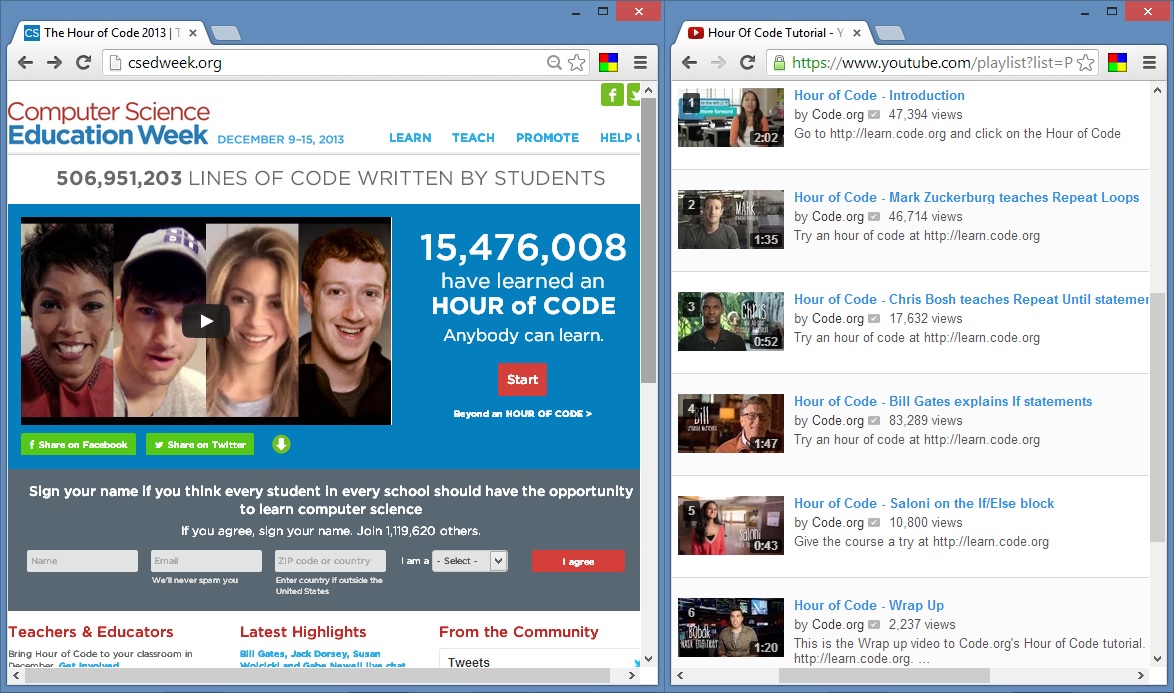
theodp writes "On the final day of Computer Science Education Week, the Hour of Code bravado continues. Around 12:30 a.m. Sunday (ET), Code.org was boasting that in just 6 days, students of its tutorials have "written" more than 10x the number of lines of code in Microsoft Windows. "Students of the Code.org tutorials have written 507,152,775 lines of code. Is this a lot? By comparison, the Microsoft Windows operating system has roughly 50 million lines of code." Code.org adds, "In total, 15,481,846 students have participated in the Hour of Code. Of this group, 6,872,757 of them used the tutorials by Code.org, and within the Code.org tutorial, they've written 507,152,775 lines of code." On YouTube, however, a playlist of the Code.org tutorial videos has distinctly lower numbers, with only 2,246 views of the Code.org Wrap Up video reported as of this writing. So, any thoughts on why the big disconnect, and how close the stats might reflect reality? Code.org does explain that an 'Hour of Code' is not necessarily an 'hour of code' ("Not everybody finishes an Hour of Code tutorial. Some students spend one hour. Some spend 10 minutes. Some spend days. Instead of counting how many students 'finish one hour'; or how much time they spent, this [LOC] is our simplest measure of progress"). So, with millions being spent on efforts to get Code.org into the nation's schools — New York and Chicago have already committed their 1.5 million K-12 students — is it important to get a better understanding of what the Hour of Code usage stats actually represent — and what their limitations might be — and not just accept as gospel reports like AllThingsD's 15 Million Students Learned to Program This Week, Thanks to Hour of Code ("every other school family in the U.S. has a child that has done the Hour of Code")?" -
Nokia Still Experimenting With Android Smartphone
Nerval's Lobster writes "According to unnamed sources, Nokia is working on an Android-based smartphone. The test versions of the device, which is codenamed 'Normandy,' run a heavily modified version of Android. In late November, @evleaks posted an alleged image of the phone, which (if accurate) includes many of the Nokia design hallmarks, such as a brightly colored shell and prominent rear camera. Exactly how the software differs from the 'standard' version of Android is an open question, although other companies that have forked the operating system (most notably Amazon, with its Kindle tablets) haven't been shy about modifying the user interface in radical ways. According to AllThingsD, Nokia's 'low-end mobile phone unit' is overseeing the project. 'Normandy aims to repurpose the open-source version of Android into a better entry-level smartphone than Nokia has had with its current Asha line,' the publication explained, 'which is based on the aging Series 40 operating system.' But here's the rub: Nokia's phone unit is well on its way to becoming a Microsoft subsidiary. Microsoft competes against Google in many arenas, including mobile and search. The idea of a Microsoft ancillary producing an Android-based phone to compete in lower-end markets — where cheap Android phones dominate — is liable to provoke a burst of surprised laughter from anyone in tech: surely such a project would never hit store-shelves, given Microsoft's very public backing of Windows Phone as its sole mobile OS. And yet, there's also reason to think Microsoft might actually take a chance on an alternative OS. Over the past few years, the company's legal team has cornered the majority of Android manufacturers worldwide into a stark deal: agree to pay a set fee for every Android device produced, or face a costly patent-infringement lawsuit. As a result of that arm-twisting, Microsoft already makes quite a bit of money off Android (more, perhaps, than it earns selling Windows Phone), which could acclimate it to the idea of taking the leap and actually selling Android devices." -
Only 25% of Yahoo Staff "Eat Their Own Dog Food"
nk497 writes "Only 25% of Yahoo staff have obeyed the company's request to 'eat their own dog food' and switch to Yahoo Mail, a colorful internal memo has revealed. The leaked email, acquired by All Things Digital, implores staff to move over to the corporate version of Yahoo's webmail system, gently lambasting staff who refuse to part with Microsoft Outlook. The message goes on to take a swipe at what appears to be Yahoo employees' preferred mail client, Microsoft Outlook, describing it as 'anachronism of the now defunct 90s PC era, a pre-web program written at a time when NT Server terrorized the data center landscape with the confidence of a T-Rex born to yuppie dinosaur parents who fully bought into the illusion of their son's utter uniqueness because the big-mouthed, tiny-armed monster infant could mimic the gestures of The Itsy-Bitsy Pterodactyl.'" -
Reports: Apple To Buy Israeli 3D Sensing Company PrimeSense
Several sources, including this report at Forbes, and this one at All Things Digital, say that Apple has bought (or is in the process of buying) Tel-Aviv based PrimeSense, the company behind the 3-D sensing technology in Microsoft's Kinect, for $345 million. The Forbes piece also gives a compact but interesting summary of the possibilities of ubiquitous 3-D hardware, and the sudden, recent drop in price of the components necessary for that to happen. Devices like the Lynx 3-D scanner that I saw at last year's SXSW (targeting the cheap and portable end of the 3-D scanning market) may have a lot of competition in the near future. -
Don't Call It Stack Rank: Yahoo's QPR System For Culling Non-Performers
An anonymous reader writes "Employees don't like to be graded on the bell curve (or any other curve except for Lake Wobegon's) — we know that from the Microsoft experience. But Yahoo is struggling with what some say is vastly bloated headcount, and CEO Marissa Mayer has implemented a 'quarterly performance review' system that requires, or strongly recommends, that managers place a certain quota of their charges in the less-than-stellar categories. That sounds a lot like the infamous GE-Microsoft stack rank system. But according to AllThingsD's Kara Swisher, who (as usual) broke the latest story about life inside Mayer's Yahoo, Mayer's curve may more similar to the elaborate evaluation system used by her old employer, Google." -
Don't Call It Stack Rank: Yahoo's QPR System For Culling Non-Performers
An anonymous reader writes "Employees don't like to be graded on the bell curve (or any other curve except for Lake Wobegon's) — we know that from the Microsoft experience. But Yahoo is struggling with what some say is vastly bloated headcount, and CEO Marissa Mayer has implemented a 'quarterly performance review' system that requires, or strongly recommends, that managers place a certain quota of their charges in the less-than-stellar categories. That sounds a lot like the infamous GE-Microsoft stack rank system. But according to AllThingsD's Kara Swisher, who (as usual) broke the latest story about life inside Mayer's Yahoo, Mayer's curve may more similar to the elaborate evaluation system used by her old employer, Google." -
Dell Ad Says Windows 8.1 Apps Will Run On Xbox One
cold fjord writes "An article at DailyTech begins, 'While many people scoffed at or failed to recognized the significance of Microsoft Corp.'s talk of a "unified" development path for Windows, Xbox, and Windows Phone, the real world ramifications of that approach are now becoming clear — and they're significant. A pre-order page from Dell for the Xbox One "accidentally" (and, it appears, officially) revealed that Windows 8.1 apps will run on the Xbox.'" A Microsoft spokesperson told AllThingsD, 'The suggestion that all Windows 8 apps run on Xbox One is not accurate," but they didn't deny that there would be some cross-compatibility. PCWorld's article has words of caution: "It would certainly be interesting if the full-blown Windows Store landed on Xbox One. But don't hold your breath for it to be there at the console's launch, no matter what Dell's words vaguely imply." -
Square Debuts New Email Payment System
cagraham writes "Mobile payment company Square — best known for their smartphone credit-card swipers — has launched a new payment service called Square Cash. The service doesn't require users to sign up or make an account. Instead, they just email the person they'd like to transfer money to (with the amount as the subject), and CC 'cash@square.com.' Square asks the sender for their debit card info, and then sends a link to the recipient, who can transfer the money into any account they want within 1-2 business days." -
Facebook Buys Israeli Mobile Analytics Startup Onavo
rtoz writes "Israeli Mobile Data Management Startup "Onavo" has announced that it has been acquired by Social Media Giant Facebook. Facebook will get its first office at Israel by acquiring Onavo. Techcrunch has mentioned that Onavo will give facebook a much deeper tech bench to measure how its mobile services are working. 'Onavo will be an exciting addition to Facebook,' a Facebook spokesperson told AllThingsD. 'We expect Onavo's data compression technology to play a central role in our mission to connect more people to the internet, and their analytic tools will help us provide better, more efficient mobile products.'" -
HP CEO Meg Whitman To Employees: No More Telecommuting For You
McGruber writes "AllThingsD has the news that Hewlett-Packard has enacted a policy requiring most employees to work from the office and not from home. According to an undated question-and-answer document distributed to HP employees, the new policy is aimed at instigating a cultural shift that 'will help create a more connected workforce and drive greater collaboration and innovation.' The memo also said, 'During this critical turnaround period, HP needs all hands on deck. We recognize that in the past, we may have asked certain employees to work from home for various reasons. We now need to build a stronger culture of engagement and collaboration and the more employees we get into the office the better company we will be.' One major complication is that numerous HP offices don't have sufficient space to accommodate all of their employees. According to sources familiar with the company's operations, as many as 80,000 employees, and possibly more, were working from home in part because the company didn't have desks for them all within its own buildings." -
US Intelligence Chief Defends Attempts To Break Tor
Hugh Pickens DOT Com writes "Arik Hesseldahl writes that James Clapper, Director of National Intelligence, says that the NSA tried to penetrate and compromise Tor, but it was only because terrorists and criminals use it, too and our "interest in online anonymity services and other online communication and networking tools is based on the undeniable fact that these are the tools our adversaries use to communicate and coordinate attacks against the United States and our allies." It was all legal and appropriate, Clapper argues, because, "Within our lawful mission to collect foreign intelligence to protect the United States, we use every intelligence tool available to understand the intent of our foreign adversaries so that we can disrupt their plans and prevent them from bringing harm to innocent Americans. Our adversaries have the ability to hide their messages and discussions among those of innocent people around the world. They use the very same social networking sites, encryption tools and other security features that protect our daily online activities." Clapper concludes that "the reality is that the men and women at the National Security Agency and across the Intelligence Community are abiding by the law, respecting the rights of citizens and doing everything they can to help keep our nation safe."" -
Austrian Professor Creates Kindle E-Book Copier With Lego Mindstorms
An anonymous reader writes "Using a Lego Mindstorms set, a Mac, and optical character recognition, Austrian professor Peter Purgathofer created a makeshift ebook copier. From the article: 'It's sort of a combination of high tech meets low. The scanning is done by way of the Mac's iSight camera. The Mindstorms set does two things: Hits the page-advance button on the Kindle (it appears to be an older model, like the one in the picture above), then mashes the space bar on the Mac, causing it to take a picture.' Purgathofer calls the creation a 'reflection on the loss of long established rights.' Check out the Vimeo video for a demonstration." -
Uber Tip-Skimming Allegations Could Spark National Class Action
curtwoodward writes "Uber has just raised a monster investment round that valued the company at some $3.5 billion. And it looks like some of that cash will have to be earmarked for more legal expenses. The startup, which offers an easy-to-use mobile app for hailing "black car" sedans and other rides, is being sued in federal court over allegations that it's illegally skimming the tips paid to drivers. The lawsuit also claims that Uber is misclassifying its drivers as contractors, rather than employees. The upshot: If the federal judge certifies this as a national class action, Uber could be facing millions of dollars in potential damages. Oh, and the lawyer behind it? She's made a career out of suing companies for exactly these kind of violations." -
Asus CEO On Windows RT: "We're Out."
symbolset writes "AllThingsD's intrepid reporter Ina Fried has an interview up where Asus chairman and CEO Jonney Shih says they will not make any more Windows RT devices until Microsoft proves demand for the product. This leaves Dell as the only OEM who has not sworn off Windows RT. Dell is seeking to take itself private, relying on a $2 billion loan from Microsoft." Turns out people want things that are the size of a laptop to work as well as a laptop. -
Why Bob Mansfield Was Cut From Apple's Executive Team
colinneagle writes "AllThingsD reported that Bob Mansfield, Apple's Senior Vice President of Technologies, has disappeared from the executive management team at Apple. But it was only last October when Mansfield was widely reported to have been convinced to return from retirement by Apple CEO Tim Cook for a two-year stint. His return to the company may have been cut short on account of Apple's continued reliance on Samsung for its mobile SOC processors, for which Apple paid an estimated $10 billion to Samsung last year. Mansfield's group was to have played a major role in this, and apparently it has not been able effect this change." -
Tech Firms Planning Highly Irate Letter To Government Requesting Transparency
Nerval's Lobster writes "a 'broad alliance' of 63 technology companies and civil liberties organizations plan on demanding more transparency about U.S. government surveillance programs, according to a new report in AllThingsD. Those companies and organizations will reportedly ask the government to allow them to report more accurate information about user-data requests. At the moment, federal agencies forbid Google, Microsoft, and other tech vendors from reporting more than a broad numerical range; for example, Google might announce as part of its Transparency Report that it received between 0-999 National Security Letters (issued by agencies as part of national security investigations) in 2009. 'We seek permission for the same information to be made available regarding the government's national security–related authorities," reads a portion of a letter that will be reportedly published July 19 and signed by all those tech companies. "This information about how and how often the government is using these legal authorities is important to the American people, who are entitled to have an informed public debate about the appropriateness of those authorities and their use.' This is all continuing fallout from Edward Snowden's leaks of top-secret documents alleging that the NSA maintains a program called PRISM that allegedly siphons personal information from the databases of the world's largest tech companies. Ever since, those companies (which have all denied participation in PRISM) have been anxious to show the world that they only give the government as little user data as possible. This new push for more 'transparency' plays to that strategy, and the stakes couldn't be higher—if consumers and businesses lose faith in their IT providers' ability to preserve privacy, the latter's very existence could be at risk." -
Microsoft Says Goodbye To WebTV/MSN TV
An anonymous reader writes "Microsoft has just notified both subscribers of MSN TV that the service would be ending at the end of September (FAQ for subscribers here). The service, which delivered Internet access to a TV screen via a set top box, was the evolution of WebTV Networks launched by Steve Perlman and others during the initial Web boom in the mid '90s. Microsoft bought the company for $503 million in 1997, when Bill Gates was still CEO." -
Software-Defined Data Centers: Seeing Through the Hype
Nerval's Lobster writes "In case you didn't catch it yesterday, AllThingsD ran a piece endorsing the idea of the software-defined data center. That's a venue where hordes of non-technical mid- and upper-level managers will see it and (because of the credibility of AllThingsD) will believe software-defined data centers are not only possible, but that they exist and that your company is somehow falling behind because you personally have not sketched up a topology on a napkin or brought a package of it to install. If mid-level managers in your datacenter or extended IT department have not been pinged at least once today by business-unit managers offering to tip them off to the benefits of software-defined data centers—or demand that they buy one—then someone should go check the internal phone system because not all the calls are coming through. Why was AllThingD's piece problematic? First, because it's a good enough publication to explain all the relevant technology terms in ways that even a non-technical audience can understand. Second, it's also a credible source, owned by Dow Jones & Co. and spun off by The Wall Street Journal. Third, software-defined data centers are genuinely happening—but it's in the very early stages. The true benefits of the platform won't arrive for quite some time—and there's too much to do in the meantime to talk about potential endpoints. Fortunately, there are a number of resources online to help tell hype from reality." -
Atheer Offers a Wearable Display That's Glasses, Not Glass
An anonymous reader writes "A new competitor to Google Glass was unveiled Thursday at the AllThingsD conference. Unlike Glass, it shows augmented reality content in 3D and is driven by hand gestures and voice input." Here's a video demo. If you think complaints that Google Glass is creepy have merit, take heart: these aren't for walking around with. -
Motorola Developing Pill and Tattoo Authentication Methods
redletterdave writes "In trying to solve the 'mechanical mismatch' between humans and electronics — particularly wearables — special projects chief Regina Dugan unveiled two new projects currently in development at Google's Motorola Mobility centered on rethinking authentication methodology, including electronic tattoos and ingestible pills. Of the pill, which Dugan called her 'first superpower,' she described it as an 'inside-out potato battery' that when swallowed, the acids in one's stomach serve as the electrolyte to power an 18-bit ECG-like signal that essentially turns one's body into an authentication token. 'It means my arms are like wires and my hands are like alligator clips [so] when I touch my phone, my computer, my door, I'm authenticated,' Dugan said. 'This is not science fiction.'" -
Motorola Building "Self-Aware" Smartphone
Nerval's Lobster writes "Back in the ancient days of 2009, Motorola Mobility earned considerable buzz with its Droid smartphone. Marketed as an iPhone alternative, the device featured a sliding QWERTY keyboard and a chunky black body that seemed positively Schwarzenegger-esque in comparison to its svelte Apple rival. But Motorola failed to translate that buzz into sustained momentum in the smartphone space. Instead, Samsung became the dominant Android smartphone manufacturer, battling toe-to-toe with Apple for market-share and profits. Even Google acquiring Motorola for the princely sum of $12.1 billion didn't really seem to alter the equation very much. Motorola CEO Dennis Woodside wants to change all that. In a May 29 talk at AllThingsD's D11 conference, he told the audience that Motorola has a 'hero phone' in the works, dubbed the Moto X—and that it's self-aware. 'It anticipates my needs,' he said, according to AllThingD's live blog of the event. But what does that actually mean? Thanks to embedded sensors, the phone knows when the user removes it from his or her pocket; in theory, that capability could serve broader applications, such as the phone recognizing where the user is located within a city and serving up content and applications accordingly. In fact, it sounds a bit like Google Now on steroids—or like the smartphone precursor to SkyNet, the supercomputer from the Terminator movies that's so intelligent, it decides that the world would be better off if it ruled over humanity." -
Sheryl Sandberg: Facebook's Home App Needs Some Work
Nerval's Lobster writes "Facebook COO Sheryl Sandberg told an audience at AllThingsDigital's D11 conference that the social network's 'Home' app for Android has a viable future despite needing some work. 'I think it will be a long road,' she told the audience. 'We believe that the phone will get reorganized around people—Home is the first iteration of that.' But Home could require a good deal of tweaking, at least if user feedback is any sort of indication. After installing the Home app, the Android user's screen displays a modified version of the Facebook news feed, with an emphasis on images; other features include 'Chat Heads,' a messaging interface that sprinkles the screen with little icons of friends' heads. While that's a great way to get Facebook front-and-center on someone's phone, the software's one-star reviews on the Google Play storefront greatly outnumber the four- and five-star reviews." -
Entrepreneur On Yahoo/Tumblr: It's the Content Readers, Stupid
An anonymous reader writes "Weighing in on Yahoo's recent acquisition of Tumblr for $1.1 billion, social networking entrepreneur Adam Rifkin argues that Tumblr is extremely valuable business property because it has successfully organized itself around the 'Interest Graph' (people interested in the same hobbies or things), rather than the 'Social Graph' (family, friends, and coworkers/colleagues, as is typical for Facebook). He opines that, for a social networking site, readers are far more important than writers; writers, after all, 'have time but no money. Certain groups are going to be overrepresented: Students, stay-at-home moms, the underemployed, retirees.' While readers are just the opposite: they 'have money but no time.... They want to see a picture of a watch they like, and buy it now.' In other words, it's the readers of the content that businesses are trying to reach. And interest graphs can be specifically targeted by businesses, much more so than social graphs." -
LivingSocial Hacked: 50 Million Users Exposed
wiredmikey writes "Daily deals site and Groupon competitor LivingSocial said on Friday it had fallen victim to a cyber attack that put its roughly 50 million users at risk. 'LivingSocial recently experienced a cyber-attack on our computer systems that resulted in unauthorized access to some customer data from our servers,' the company said in a brief note on its site while prompting users to reset their passwords. Attackers reportedly obtained information including names, email addresses, date of birth for some users, and passwords, which fortunately were hashed and salted. Additionally, the database holding credit card information was not accessed by the attacker, the company said. 'While it is good that the passwords stolen from LivingSocial are hashed and salted as this likely slow down the cracking process, it won't stop it,' Rapid7's Ross Barrett said. 'Once they had cracked the first round with the tools at their disposal, they posted the hashes in a Russian hacker forum where other motivated individuals with the necessary skills and more advanced cracking tools were able to help decode the remaining passwords,' Barrett continued. 'While salting the passwords will slow this process down further, eventually the attackers or their network will get the information they're after.' LivingSocial said they are actively working with law enforcement to investigate the incident but have not provided any additional details." -
Why AppGratis Was Pulled From the App Store
RougeFemme writes "By now, you may know that AppGratis, a popular app discovery app, was recently pulled from the App store. Apple listed violations of the following guidelines: '2.25 Apps that display Apps other than your own for purchase or promotion in a manner similar to or confusing with the App Store will be rejected. ... 5.6 Apps cannot use Push Notifications to send advertising, promotions, or direct marketing of any kind.' Now, the company's CEO, Simon Dawlat, has made a blog post with 'the rest of the story.'" As it turns out, AppGratis had been cleared by Apple for guideline 2.25 as recently as October, and its iPad version was approved less than a week ago. The brand new Apple review team member who contacted the company isn't able to explain what went into the decision to ban it now. Dalwat says the complaint about guideline 5.6 was 'another surprise for us since we only send one "system notification" a day to our users, coming in the form of a generic, opt-in only "Today’s deal is here!" message, which is precisely how Apple recommends developers to use its push notification service.'" However, the AllThingsD article cites sources claiming Apple was "more than a little troubled that AppGratis was pushing a business model that appeared to favor developers with the financial means to pay for exposure." Dalwat does not address this in his post. -
Do Big-Money Acquisitions Mean We're In a Tech Bubble?
Nerval's Lobster writes "When a major IT company pays a reported $30 million—roughly 90 percent of it in cash—for an iOS app with no monetization strategy and a million downloads since launch, is that a sign that the tech industry as a whole is riding a massive, overinflated bubble? Yahoo isn't alone, by a long shot: over the past couple years, a few apps have been snatched up for enormous sums—think Facebook's $1 billion acquisition of Instagram in 2012, or Google buying Sparrow for a reported $25 million. Nor has the money train stopped there: in a pattern that recalls the late-90s market frothiness for anyone over the age of 28, a handful of tech companies have either launched much-hyped IPOs or witnessed their share price skyrocket into the stratosphere. But does all this IPO activity and app-acquiring actually mean 'bubble'?" -
The Data That Drove Yahoo's Telecommuting Ban
Stiletto writes "Business Insider and All Things D are reporting that Yahoo CEO Marissa Mayer's decision to ban telecommuting was data-driven, as you'd expect out of the former Google exec. After spending months frustrated at how empty Yahoo parking lots were, Mayer consulted Yahoo's VPN logs to see if remote employees were checking in enough. Despite all the outrage and flak she's getting from those outside the company for the move, some ex-employees are praising the decision, citing abuse, slacking off, and general 'unavailability' of folks working from home." -
Groupon Still Losing Money, CEO Is Fired And Leaks Final Email
New submitter Inzkeeper writes with news that the CEO of Groupon met the axe today: "Groupon CEO Andrew Mason made public an email he sent to Groupon employees. He takes responsibility for the company's downturn, expresses his appreciation for his staff, and wishes them well. 'For those who are concerned about me, please don't be — I love Groupon, and I'm terribly proud of what we've created. I'm OK with having failed at this part of the journey. If Groupon was Battletoads, it would be like I made it all the way to the Terra Tubes without dying on my first ever play through.'" Despite increased revenues, they are still losing about $81 million each quarter, and Wall Street needs blood. -
NASCAR Tries To Squelch Video of Spectators Injured By Crash
An anonymous reader writes "Dozens of fans attending a NASCAR race at Daytona Speedway were injured when a crash during the last lap triggered a chain reaction, culminating in the front section of Kyle Larson's car ricocheting into the fence in front of the stands (Larson escaped injury). While the footage accompanying the article is dramatic enough, an even more riveting clip showing the chaotic scene in the stands from up close was posted on YouTube, but was taken down after NASCAR claimed it violated their copyright . YouTube has since restored the fan's video. A NASCAR spokesman has issued a clarification, saying that the takedown request was done out of respect for those injured. The race was an opening act for the main event, the Daytona 500, which officials say will proceed as scheduled. 'With the fence being prepared tonight to our safety protocols, we expect to go racing tomorrow with no changes,' Speedway President Joie Chitwood told CNN." -
Mayer Terminates Yahoo's Remote Employee Policy
An anonymous reader writes "AllThingsD's Kara Swisher reported and tweeted that Marissa Mayer (CEO since July 2012) has just sent an all-hands email ending Yahoo's policy of allowing remote employees. Hundreds of workers have been given the choice: start showing up for work at HQ (which would require relocation in many cases), or resign. (They can forget about Yahoo advice pieces like this). Mayer has also been putting her stamp on Yahoo's new home page, which was rolled out Wednesday." -
Eric Schmidt To Sell Up To 42% of Stake In Google
derGoldstein writes "AllThingsD reports that Eric Schmidt 'plans to sell up to 3.2 million shares of his class A common stock in the company,' according to an SEC filing. 'The amount is equal to approximately 42.1 percent of his overall stake in Google.'" -
Facebook To App Developers: Good Idea, Now Stop Using Our API
An anonymous reader writes "In what seems to be a recurring theme with Facebook as the social networking giant adds features, competing apps that use Facebook integration risk being cut off due to the terms of service surrounding the API. For example, 'Voxer CEO Tom Katis told AllThingsD that the company got an email on Thursday saying that Facebook wanted to hold a phone call to discuss possible violations of a section of the company’s terms of service. The section in question centers around the use of Facebook’s social graph by competing social networks.' Similarly, 'Within hours of Twitter launching its Vine video-sharing application on Thursday, Facebook has cut off access to Vine’s "find people" feature, which used to let Vine users find their Facebook friends using the Vine application.' You have to ask yourself: is it really worth developing an app that integrates with, or worse runs completely on Facebook's platform?" -
Facebook To App Developers: Good Idea, Now Stop Using Our API
An anonymous reader writes "In what seems to be a recurring theme with Facebook as the social networking giant adds features, competing apps that use Facebook integration risk being cut off due to the terms of service surrounding the API. For example, 'Voxer CEO Tom Katis told AllThingsD that the company got an email on Thursday saying that Facebook wanted to hold a phone call to discuss possible violations of a section of the company’s terms of service. The section in question centers around the use of Facebook’s social graph by competing social networks.' Similarly, 'Within hours of Twitter launching its Vine video-sharing application on Thursday, Facebook has cut off access to Vine’s "find people" feature, which used to let Vine users find their Facebook friends using the Vine application.' You have to ask yourself: is it really worth developing an app that integrates with, or worse runs completely on Facebook's platform?" -
Intel's Attempt At A-La-Carte Television Hits Delays
bill_mcgonigle writes "Updating the previous story, Forbes and Gigaom are now reporting that Intel is running an internal startup aimed at offering an internet-connected set top box with a-la-carte 'cable' channel subscriptions. They also apparently plan to record everything and offer all content on-demand. While some are skeptical that content providers will give up their cable cash cow and they've run into licensing problems already, perhaps the economic effects of cord-cutters will finally make this business model viable." -
Microsoft To Apple: Don't Take Your Normal 30% Cut of Office For iOS
An anonymous reader writes "Sources tell All Things D that Apple and Microsoft are at loggerheads over the cut Apple is expected to take of Office 365 subscriptions sold through Microsoft Office for iOS, which is expected to launch sometime next year. An update to Microsoft's SkyDrive app has been rejected after the company was 'pushing Apple to adjust the 70/30 revenue split in its developer license agreement. Predictably, Apple has refused to comply. It’s not yet clear what sort of concession Microsoft is seeking, but whatever it is, Apple’s evidently not willing to consider it.'" -
News Corp's The Daily iPad App Shutting Down On December 15
An anonymous reader writes with news that, as predicted, the iPad only newspaper The Daily failed. From the article: "The goal of The Daily was to provide a modern spin on the news cycle by delivering world news draped in a multimedia experience. In other words, The Daily devoted a lot of resources towards adding photos, video, and touch controls to news stories that would otherwise be static. ... It was announced today that The Daily will be closing up shop on December 15 after failing to rake in the dough." -
Windows Chief Steven Sinofsky Leaves Microsoft
CWmike writes with this excerpt from Computerworld: "Steven Sinofsky, the executive in charge of Microsoft's Windows 8 operating system and the driving force behind the new OS, is leaving the company effective immediately, Microsoft announced late Monday. Sinofsky was also the public face for Windows 8 and its new Metro interface, posting constant updates in a Windows 8 blog that charted its development. His last post, fittingly, was entitled 'Updating Windows 8 for General Availability.' The OS was officially launched at the end of last month. According to the All Things D blog, there was growing tension between Sinofsky and other members of the Microsoft executive team, who didn't see him as enough of a team player. But Microsoft's official position is that the decision was a mutual one. Sinofsky had only good things to say about his former employer." Also at SlashCloud. -
AMD Reportedly Preparing Massive Layoff
An anonymous reader writes "AMD is preparing to lay off 20 to 30 percent of its workforce after warning of a 10 percent decline in Q3 revenues driven by the weak global economy and PC sales, according to AllThingsD's Arik Hesseldehl. The layoffs will reportedly focus on engineering and sales, and are in addition to a 10 percent headcount reduction 11 months ago. Teams of consultants from McKinsey and Boston Consulting Group are reportedly swarming headquarters to advise the CEO Rory Read, who took over from Dirk Meyer a little over a year ago; several senior executives, including the CFO, have recently departed." -
AMD Reportedly Preparing Massive Layoff
An anonymous reader writes "AMD is preparing to lay off 20 to 30 percent of its workforce after warning of a 10 percent decline in Q3 revenues driven by the weak global economy and PC sales, according to AllThingsD's Arik Hesseldehl. The layoffs will reportedly focus on engineering and sales, and are in addition to a 10 percent headcount reduction 11 months ago. Teams of consultants from McKinsey and Boston Consulting Group are reportedly swarming headquarters to advise the CEO Rory Read, who took over from Dirk Meyer a little over a year ago; several senior executives, including the CFO, have recently departed." -
Apple iPad Mini Could Complicate Things For Windows 8 Tablets
Nerval's Lobster writes "Current rumor suggests that Apple is gearing up to unveil its iPad Mini Oct. 17, with invitations to media arriving Oct. 10. That's according to Fortune, which obtained the information from an unnamed Apple investor who, in turn, heard those dates from other unnamed sources. While that attribution might prove a bit too vaporous for some people, it does align with earlier reports from AllThingsD that Apple is planning to reveal a smaller iPad sometime in October. If those rumors prove accurate, the unveiling of an iPad Mini in that timeframe could prove very bad news for the upcoming Windows 8 tablets. (Gizmodo offers a pretty complete rumor rundown on the iPad Mini's possible features here.) Unlike the traditional PC market, Microsoft doesn't dominate the market for mobile-device operating systems. Windows 7 tablets never gained much of a toehold among tablet users, who prefer iPads and Android-based devices by wide margins. When it comes to Windows 8 (and Windows RT, the version of next-generation Windows for ARM architecture), Microsoft is starting out as the underdog." -
Why Apple Replaced iOS Maps
tlhIngan writes "So why did Apple decide to ditch the (working) iOS maps app with one based on their own data (despite having one more year to the contract)? It turns out to be turn-by-turn voice navigation. It wasn't a feature in the original Apple-Google licensing agreement, so Apple went back to Google to renegotiate what has become a top-tier feature on Android. Apple wanted it. In return, Google wanted increased branding in the maps app (Apple refused) or to integrate Latitude (Google's FourSquare competitor), to which Apple refused as well. As a result Apple was forced to seek other sources in order to obtain this feature." Eventually, iOS users who don't want to wait for Apple-Google parity will be able to download a native version of Google's maps (rather than a hacked version), but that could be a ways off. -
The Passing of the Personal Computer Era
An anonymous reader writes "AllThingsD columnist Arik Hesseldahl noticed another milestone marking the passing of the personal computer era: for the first time since the early '80s, the share of worldwide sales of DRAM chips consumed by PCs (desktop and laptop computers, but not tablets) has dropped below fifty percent. Perhaps a more important milestone was reached last year, when more smartphones were shipped (not sold) worldwide than the combined total of PCs and tablets (also noticed by Microsoft watcher Joe Wilcox). While this is certainly of tremendous marketing and business importance to the likes of Apple, Microsoft, Google, Adobe, and PC OEMs, others may reflect on the impending closing of the history books on the era that started in Silicon Valley a little over 35 years ago." -
Alibaba Says Google Threatened Acer With Banishment From Android
Spy Handler writes "In a Microsoft-esque move, Google threatened Acer with banishment from Android if it went ahead with its new cellphone project with Alibaba (China's version of Amazon), using an OS called Aliyun. Acer has remained silent on the issue, but Alibaba reports that they received notification from Google, stating 'if the new product launch with Aliyun went ahead, Google would terminate Android product cooperation and related technical authorization with Acer.' A possible reason for Google's upset is that the Aliyun OS, which is not Android, can run Android apps as well as its own." -
New iOS App Sends Users' Web Traffic Through Its Proxy Servers
New submitter spac writes "AllthingsD has an interesting story about how a startup called Wajam requires users of their service to download a script that sets up a proxy to handle all network requests for the purpose of providing 'Social Recommendations' within built-in apps. The privacy implications of using this profile script isn't clearly presented to users. Are we really to entrust our data to a company founded by a man who comes from the world of browser toolbars? And for social search?!" The company rushes to counter privacy concerns by pointing out that their service has "received security certifications from TRUSTe, McAfee and Norton." -
Amazon, Apple Expected to Strut Their Small-Tablet Stuff Soon
After a few years of rumors and hints, All Things Digital says that a smaller iPad will debut in October. And Amazon may be trying to steal their thunder with a revamped Kindle tablet: Nerval's Lobster writes with a report at SlashCloud that "Amazon could be readying a new set of Kindle tablets for unveiling in early September. That's the widespread speculation following the online retailer's invitations to media for a Sept. 6 event in Santa Monica, Calif. Even by the coy standards of most tech companies' event invitations, Amazon's is notably bereft of detail. It will take place at 10:30 AM PST at Barker Hangar, a noted (and quite large) event space. But the timing of the event is auspicious: with Apple rumored to be unveiling a smaller iPad in the near future, and the holiday shopping season a few months away, early September could prove the ideal time for Amazon to whip back the curtain from a new tablet and dominate the media conversation, at least for a few days."