Slashdot Mirror
Domain: ams.org
Stories and comments across the archive that link to ams.org.
Comments · 141
-
Re:Well, is it a bad thing? After all it's success
I disagree. One can insist on quality while being civil. It's fair to call out Linus for his lack of civility and how that management style influences the project. Civility is a good thing and is something we very much need more of in this world.
The problem is going from a lack of civility to being hostile toward women. I haven't seen any evidence that Linus was disproportionate in his lack of civility. That seems like a stretch to me, and something that absolutely needs to be challenged.
I see a complaint about how women aren't prolific contributors and it reminds me of another post I recently read. Read the whole thing through before getting angry at the first part. It's still unreasonable, suggesting that departments should stop hiring white men until women and minorities are equally represented. There simply aren't that many women with doctorates who are interested in faculty positions in math departments. A doctorate is generally the baseline qualification for a faculty position. Where does the author propose we get all these women from? Shall we magically create them from thin air?
Origincally, #metoo was about allowing women to come forward about seriously abusive behavior from men. There were some truly disturbing allegations and the men involved deserved their fates. More recently, #metoo has been used to request that men divulge their salaries so women can identify unequal pay. That's a far cry from the original intent.
There have been allegations of abuse by prominent #metoo supporters, that these women were abusive toward men. There have been multiple accusers in some cases and the behaviors mirror those that men have been forced to resign over. If the goal is to eliminate workplace harassment, shouldn't the women face the same outrage and be forced out? That hasn't been the case.
I'm all for civility and eliminating workplace harassment. I believe a lot of people genuinely support these goals. But it seems like there some women who just want to target men and drive them from power. It seems like some are using #metoo as a vehicle to put women in high-ranking positions where they otherwise wouldn't have been hired. I suspect this because of the call for men to divulge their salaries and why there isn't the same outrage over harassment from women.
Four takeaways:
1) There just aren't enough women in some fields who are objectively qualified (e.g., having a doctorate).
2) More civility is a good thing.
3) Power differential leads to harassment, not necessarily gender.
4) Is #metoo really just about eliminating workplace harassment, or are some using it as an opportunity to push men out of high-ranking positions and replace them with women? -
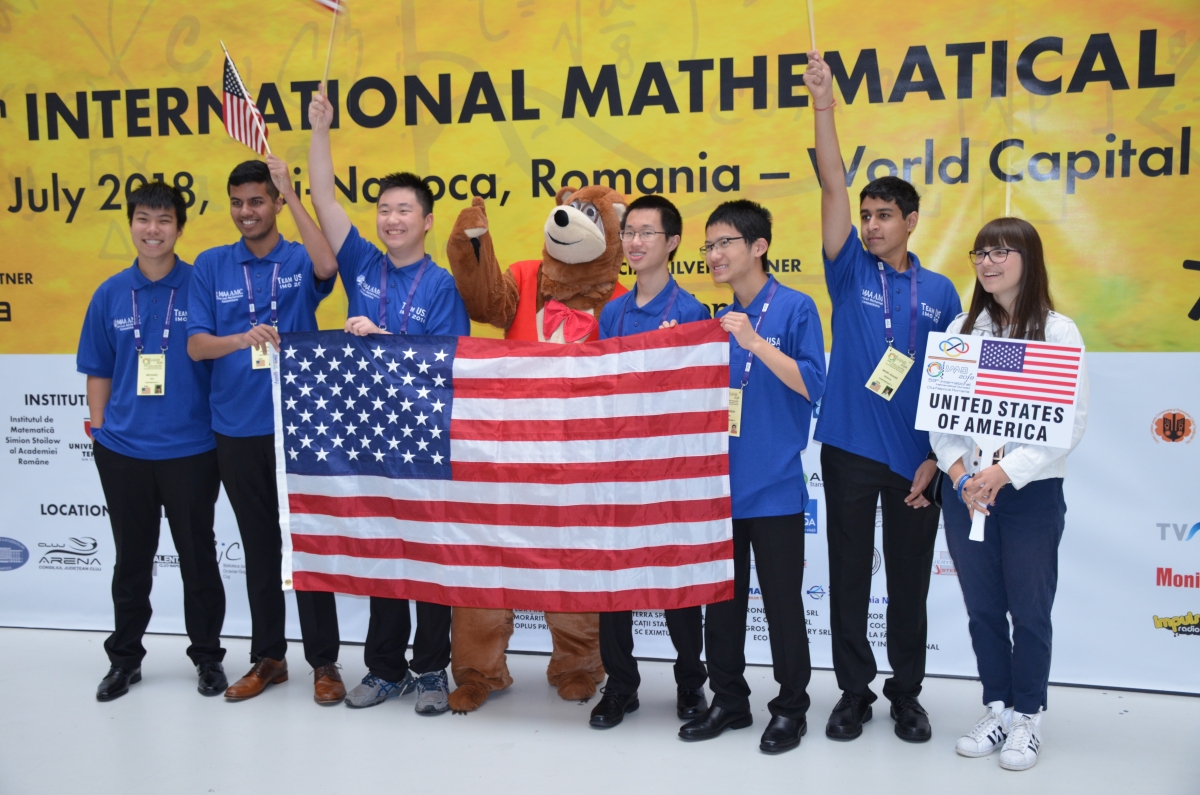
Re:US team wins First Place in Math Olympics
America's top "mathletes" have won the first place once again this year in the international Math Olympiad.
The team's group picture, however, is as racist as it gets...
The winning team picture has been archived @ https://web.archive.org/web/20...
There were altogether 7 members on the stage - consist of 5 yellow (4 male and 1 female) plus 2 brown males
Taking a cue from Slashdot's anti-Chinese sentiment - that the Chinese are all thieves and cheaters - the 5 Chinese thieves and cheaters must have stolen everything from their 2 brown skinned friends.
Next time we should just send those 2 brown skinned guys. It would save us some money. -
US team wins First Place in Math Olympics
America's top "mathletes" have won the first place once again this year in the international Math Olympiad.
The team's group picture, however, is as racist as it gets...
-
Re: Maxwell's equations and quaternions
It's also interesting that the equations could be changed that way.
Interesting doesn't begin to cover it.
Missed Opportunities by Freeman Dyson (1972)
See numbered page 644 (document page 10).
I do not know how many pure mathematicians heard or read Gibbs' lecture. If they had studied it carefully, they would soon have noticed that Gibbs had not really succeeded in unifying the notions of quaternion and vector. On the contrary, by putting the two notions side by side he had made explicit the lack of any real compatibility between them
His lecture ought to have suggested to any attentive mathematician the question, "How can it happen that the properties of three-dimensional space are represented equally well by two quite different and incompatible algebraic structures?"
If this question had once been clearly asked, the answer would almost certainly have been forthcoming. And the answer would have led inevitably to a complete theory of the single-valued and double-valued representations of the three-dimensional rotation group. The vectors are the simplest nontrivial single-valued representation, and the quaternions are the simplest double-valued representation.
Also, the quaternions are the prototype of what later were called spinor representations. The development of the theory of spinor representations, which was actually begun by Elie Cartan in 1913 and completed during the 1930's with substantial help from the physicists Pauli and Dirac, might have been accelerated by approximately 40 years.
It is impossible to say what effects such an accelerated development would have had on other branches of pure mathematics, but the effects could hardly have failed to be substantial.
I commented on Slashdot for a long time, because there's a certain utility in mastering Defense Against the Dim Bulbs.
And here's this long, geeky Slashdot thread with everyone stumbling around looked for the entry point into the higher plane of comprehension, and turns out it was completely covered on Reddit back in 1972.
* Freeman Dyson "I kept quiet for thirty years, maybe it's time to speak." — 15 June 2018
It happens that I corresponded with two heretics on the subject of evolution. Motoo Kimura who was a Japanese biologist and Ursula Goodenough, an American biologist. Both of them had heretical ideas about evolution which I think were probably correct.
I'm preparing a talk which discusses the idea that Darwin was correct up to a point but he didn't tell us the whole story.
Because the biologists are very defensive about Darwin. If you say anything critical about Darwin you're regarded as an enemy. It's a very dangerous subject to tread on. I kept quiet for thirty years so maybe it's time to speak.
* The Key to Everything — 10 May 2018
The explanation lies in the peculiar behavior of gravity in the physical world. On the balance sheet of energy accounting, gravitational energy is a deficit. When you are close to a massive object, your gravitational energy is minus the amount of energy it would take to get away from the mass all the way to infinity. When you walk up a hill on the earth, your gravitational energy is becoming less negative, but never gets up to zero.
Any object whose motions are dominated by gravity will have energy decreasing as temperature increases and energy increasing as temperature decreases. As a consequence of the second law of thermodynamics, when energy f
-
Re:Blacklist these groups?
The right is trying to invent terms like "feminist math" to describe actual math that comes to conclusions and proofs that hurt their feelings
Oh child. You've only proven yourself to be an idiot. Sorry, but the left, feminists, "black rights" groups already have you beat. It's almost like you can't realize that you're part of the same group of people trying to destroy western civilization.
-
Plenty for nerds here
For example, check out the work of Moon Duchin and the Matrix Geometry and Gerrymandering Group at Tufts: http://sites.tufts.edu/gerryma... Chronicle of Higher Ed profile: https://www.chronicle.com/arti... And other mathematicians also: http://www.ams.org/publication...
-
Re:True but irrelevant
And copy editing isn't paid for by the publisher. For example, look at the journal Mathematics Of Computation.
http://www.ams.org/publications/journals/journalsframework/mcom
If an author wants his article to be copy edited, the author is instructed to pay a third-party editor (in this case, Charlesworth Author Services).
-
Re:Maths Safe, Science Problematic
Sorry Math isn't safe, and the regressive left are trying to fuck that up too. No this article is not Poe's law in action. Liberals need to get their shit together because you've got a whole fucking pile of actual crazy on your side right now. You're where the right was in the 1990's "there's no problem."
Your comments tell me you either didn't fully read or didn't understand the blog post you linked to.
-
Re:Maths Safe, Science Problematic
-
Re:Maths Safe, Science Problematic
Sorry Math isn't safe, and the regressive left are trying to fuck that up too. No this article is not Poe's law in action. Liberals need to get their shit together because you've got a whole fucking pile of actual crazy on your side right now. You're where the right was in the 1990's "there's no problem."
-
The reality is rather different
Dr Piper Harron, writing on the AMS "Inclusion/Exclusion" blog, informs us:
"If you are a white cis man you almost certainly should resign from your position of power."
A reply from an anonymous University mathematician serves equally well as a reply to Dr Heather Metcalf.
"We are all painfully aware of the inequalities in faculty composition and trying hard to fix it. *Every* math department I know of is trying really hard to hire every qualified minority and female applicant out there (and by qualified I mean: a *very* generous ballpark within the hiring range of each department). The real problem is that there are not enough such candidates, and most departments end up making offers to the same few that are available in the market each year. By the way, our departments are aware of the problem, and so are our Deans and higher administration. In my experience, they are all very supportive of us hiring under-represented minorities, even offering additional positions when such opportunities occur, *as long as we conform with the laws*, and as long as the hire is within the 'generous ballpark'."
In other words, departments are willing to lower the standards for minority and female candidates, by a "*very* generous ballpark", with the consent of the University administration; but they are still unable to find sufficient candidates.
It is no wonder that there is "pushback" from white men; or that women and minorities are treated with suspicion as having benefitted from "affirmative action".
-
The reality is rather different
Dr Piper Harron, writing on the AMS "Inclusion/Exclusion" blog, informs us:
"If you are a white cis man you almost certainly should resign from your position of power."
A reply from an anonymous University mathematician serves equally well as a reply to Dr Heather Metcalf.
"We are all painfully aware of the inequalities in faculty composition and trying hard to fix it. *Every* math department I know of is trying really hard to hire every qualified minority and female applicant out there (and by qualified I mean: a *very* generous ballpark within the hiring range of each department). The real problem is that there are not enough such candidates, and most departments end up making offers to the same few that are available in the market each year. By the way, our departments are aware of the problem, and so are our Deans and higher administration. In my experience, they are all very supportive of us hiring under-represented minorities, even offering additional positions when such opportunities occur, *as long as we conform with the laws*, and as long as the hire is within the 'generous ballpark'."
In other words, departments are willing to lower the standards for minority and female candidates, by a "*very* generous ballpark", with the consent of the University administration; but they are still unable to find sufficient candidates.
It is no wonder that there is "pushback" from white men; or that women and minorities are treated with suspicion as having benefitted from "affirmative action".
-
Re:Some people just read fast
I think that says more about the quality of reading material than anything else. Density definitely has an effect. Classics take much longer to read because they pack more substance into the same number of words. Some of the philosophical ramblings require you to stop reading and actually think about what they're saying. It happens all the time with research papers too. Try reading this in 10 minutes or less (hint: you can't).
-
Re:All right!
It takes a special kind of person to see celebrating greater diversity as celebrating the decline of another group.
I don't understand it myself. What's wrong with increasing diversity? Is it that you feel threatened because you think you can't compete in the job market? Are you afraid of interacting women and minorities?
A person who disagrees with the diversity rhetoric is not necessarily doing so because they feel threatened. In my case, for example, I see two main reasons to oppose it:
(1) Many of the claims made by the supporters of diversity are irrational claims. See, for example, http://www.ams.org/notices/201409/rnoti-p1024.pdf. An individual who values logic and rational thought should be expected to oppose such claims.
(2) The benefits of diversity are not really apparent to me, but I am increasingly pressured to help to increase diversity. In that sense, discussion of diversity is an annoyance that takes time away from other endeavors. In particular, many individuals read Slashdot as a form of entertainment. The discussion of diversity diminishes that entertainment.
You strongly imply that white males are being attacked or otherwise oppressed and that some unnamed other takes pleasure in causing that harm.
Do you remember that "pac-man" pie chart of religious affiliation in the US? The one where the largest piece is saying "help, we're being oppressed!"? Your comment reminds me of that.
It's really easy to be a Christian in the US. You're in the majority...
You seem to be jumping to unwarranted conclusions here. (See point 1, above.) The people who are opposed to the diversity rhetoric are not necessarily white male Christians.
Though, as many atheists know, there are also social consequences for those on the outside. The larger group benefits from something called "privilege".
I couched that in religious terms for your benefit. It's easy to see that Christians in the US are not, in fact, being oppressed and that they enjoy numerous social benefits. It's also easy to see why atheists often need to hide their beliefs to avoid discrimination or other harmful conflict.
I, in fact, happen to be atheist. I have always been very open about my beliefs, even though I spent most of my life living in a conservative religious community. Although I did receive some harassment for my beliefs, you greatly exaggerate it. For example, I never needed to "hide [my] beliefs to avoid discrimination or other harmful conflict" while I was growing up.
-
Re:conflict of interest ignored here
ps. The author Goode has been at CSU-Fullerton since at least 1986 according to his profile at mathscinet. His most recent research publication was 1995. The author Annin has been there since 2005 and perhaps he became a co-author in one of the updated versions. It is not uncommon for a senior faculty member to get a junior one to help update an older text, and publishers like it when there are new editions as it kills the used book market for a while.
-
Re:Mathematics, Pen, and Paper
You mean like in this document ? If so, then no it isn't. Compare to that document. In particular typesetting quality, consistency, features, and ease of creating macros.
-
Let's give this article some context
Another paper (published by a member of the same university, in fact) dubunks the claim that "diversity trumps ability."
http://ams.org/notices/201409/rnoti-p1024.pdf
It turns out that "diversity" is a popular buzzword at universities in California right now. Many universities require applicants for faculty positions to write diversity essays to document their contributions to diversity.
-
Dr. Wertheimer was just cited on SlashdotWertheimer is the Directer of Research a the NSA. He was quoted on Slashdot two days ago apologizing in the Notes of the American Mathematical Society. The issue was a possible trap door in a set of encryption standard parameters submitted by the NSA. This was noticed by some researchers at Microsoft, and when it was brought up in the standards committee NSA just ignored the criticism.
This made some member of the AMS very unhappy. Here is what angry mathematicians sound like:
“AMS Should Sever Ties with the NSA” (Letter to the Editor), by Alexander Beilinson (December 2013); “Dear NSA: Long-Term Security Depends on Freedom”, by Stefan Forcey (January 2014); “The NSA Backdoor to NIST”, by Thomas C. Hales (February 2014); “The NSA: A Betrayal of Trust”, by Keith Devlin (June/July 2014); “The Mathematical Community and the National Security Agency”, by Andrew Odlyzko (June/July 2014); “NSA and the Snowden Issues”, by Richard George (August 2014); “The Danger of Success”, by William Binney (Sep tember 2014);
If you read his statement, it is content free. As a admission of wrongdoing, it's completely worthless.
"With hindsight, NSA should have ceased supporting the dual EC_DRBG algorithm immediately after security researchers discovered the potential for a trapdoor. In truth, I can think of no better way to describe our failure to drop support for the Dual_EC_DRBG algorithm as anything other than regrettable"
This is more of an apology for getting caught then anything else.
So when Dr. Wertheimer pontificates about filtering email and national security, you should not be very impressed. His agenda assumes the end of constitutional protections for privacy. He is not an honest man doing an honest job for an honest employer.
-
Re:It depends on the field
Professors in technical areas make large amounts of money, and are guaranteed their salary for life once they've been promoted once (to associate professor).
In my department, at the lowest level - assistant professor (tenure track, but not yet tenured) - they are making well north of 10K dollars a month.
False. I am an assistant professor in mathematics at one of the top universities in the world. Many associate professors here do not have tenure and have no hope of ever receiving tenure. They certainly have not been "guaranteed their salary for life". They can be fired at any moment.
And they don't make "well north of 10K dollars a month". In fact, if you look at the statistics online
http://ams.org/notices/201406/rnoti-p611.pdf
you'll see that the tenure-track assistant professors at large public universities make around 83K per year on average. The assistant professors who aren't tenure-track make even less, of course.
He's talking about engineering.
Math and science are one step below. Arts and humanities are one further step below.
-
Re:It depends on the field
Professors in technical areas make large amounts of money, and are guaranteed their salary for life once they've been promoted once (to associate professor).
In my department, at the lowest level - assistant professor (tenure track, but not yet tenured) - they are making well north of 10K dollars a month.
False. I am an assistant professor in mathematics at one of the top universities in the world. Many associate professors here do not have tenure and have no hope of ever receiving tenure. They certainly have not been "guaranteed their salary for life". They can be fired at any moment.
And they don't make "well north of 10K dollars a month". In fact, if you look at the statistics online
http://ams.org/notices/201406/rnoti-p611.pdf
you'll see that the tenure-track assistant professors at large public universities make around 83K per year on average. The assistant professors who aren't tenure-track make even less, of course.
-
uhh
Think women can't do math?
Hardly anyone thinks this because there is ample evidence to the contrary. Moreover, the average woman is probably about as good at math as the average man. But when you're hiring in a "mathematical profession" you're not looking at the entire population; you're looking at the set of men and women with relatively high mathematical ability. Within that set, at least in the United States, men outnumber women. This could very well be the result of socialization; I'm not necessarily arguing from physiology. But it's hard to argue with numbers. The ratio of men to women among the set of SAT takers with a perfect math score, after adjusting for the fact that more women than men take the SAT, is 2.5 to 1. So, all else being equal we should expect about 28% of engineers and mathematicians to be women. Interestingly, if you look at the percentage of Math Ph.D.s granted to U.S. citizens (in 2010) women earned exactly 28%. With respect to engineering and computer science, approximately 20% of bachelors degrees (in 2008) were granted to women, so there may be work to be done there. My guess is that this is due to the stereotypical reputations of CS/Engineering (bearded hackers with poor hygiene and huge egos) being less appealing to women than to men.
-
Re:Couldn't you just make up any old equation...
Arguably the fact that it's an open question is what makes it special. But while Beal more or less came up with the question in a vacuum, it's related to other questions posed over the years. Some more details can be found here: http://www.ams.org/notices/199711/beal.pdf
-
Re:What's in it for him?
He apparently does mathematics in his spare time and has spent a good amount of time working on this question (that's why it's named after him). The prize has been offered for several years actually, the news is that it has increased to $1M. The origin of the prize, along with some more details, here: http://www.ams.org/notices/199711/beal.pdf
-
Re:depends on what you're going into
Almost all of Linear Algebra can be learned in a day, if you're willing to apply yourself.
WTF? Matrix multiplication can be learned in a day. How about geometric transforms, diagonalization, basis vectors, eigen values, etc... Sure I can refresh my memory on ALL of those and more in an hour or two, but to learn it the first time is not a one day task.
Read the AMS article on PageRank and tell me how someone could grok that after studying linear algebra for one day. -
KB has no Erdos number, but 4 is his Erdos+Bacon #
Hmmm... For Bacon to have an Erdos number, Kevin Bacon would first have had to have a paper published with co-authors who could then be linked to Erd``os. But I do not believe that Kevin Bacon has published a paper. So we're right out on an Erd``os number for KB.
.
But if we consider the concept of a joint Erdos-Bacon number which is the sum of an individual's Bacon number and their Erdos number, then we might be able to go somewhere. Those individuals with joint Bacon-Erdos numbers have a vertex on the Bacon graph and a vertex on the Erdos graph, thus allowing travel between the Bacon graph and the Erdos graph. The individual with the smallest Bacon-Erdos number would then be able to provide the shortest path from Kevin Bacon on the Bacon graph to Erdos on the Paul Erdos graph.
.
A quick look at the Erdos-Bacon number article on wikipedia shows that the minimal Erdos-Bacon number (in their given examples) is held by Steven Strogatz, a professor at Cornell who has Bacon number 1 and Erdos number 3 with a combined Bacon-Erdos number of 4.
.
Thus you can get from (0), Kevin Bacon, who was in a film (Connected: The Power of Six Degrees) with
(1) - Steven Strogatz, who published a paper with
(2) - Nadim Ali , who published a paper with
(3) - Peter Salamon, who published a paper with
(4) - Paul Erd''os . Thus a path is drawn. -
KB has no Erdos number, but 4 is his Erdos+Bacon #
Hmmm... For Bacon to have an Erdos number, Kevin Bacon would first have had to have a paper published with co-authors who could then be linked to Erd``os. But I do not believe that Kevin Bacon has published a paper. So we're right out on an Erd``os number for KB.
.
But if we consider the concept of a joint Erdos-Bacon number which is the sum of an individual's Bacon number and their Erdos number, then we might be able to go somewhere. Those individuals with joint Bacon-Erdos numbers have a vertex on the Bacon graph and a vertex on the Erdos graph, thus allowing travel between the Bacon graph and the Erdos graph. The individual with the smallest Bacon-Erdos number would then be able to provide the shortest path from Kevin Bacon on the Bacon graph to Erdos on the Paul Erdos graph.
.
A quick look at the Erdos-Bacon number article on wikipedia shows that the minimal Erdos-Bacon number (in their given examples) is held by Steven Strogatz, a professor at Cornell who has Bacon number 1 and Erdos number 3 with a combined Bacon-Erdos number of 4.
.
Thus you can get from (0), Kevin Bacon, who was in a film (Connected: The Power of Six Degrees) with
(1) - Steven Strogatz, who published a paper with
(2) - Nadim Ali , who published a paper with
(3) - Peter Salamon, who published a paper with
(4) - Paul Erd''os . Thus a path is drawn. -
KB has no Erdos number, but 4 is his Erdos+Bacon #
Hmmm... For Bacon to have an Erdos number, Kevin Bacon would first have had to have a paper published with co-authors who could then be linked to Erd``os. But I do not believe that Kevin Bacon has published a paper. So we're right out on an Erd``os number for KB.
.
But if we consider the concept of a joint Erdos-Bacon number which is the sum of an individual's Bacon number and their Erdos number, then we might be able to go somewhere. Those individuals with joint Bacon-Erdos numbers have a vertex on the Bacon graph and a vertex on the Erdos graph, thus allowing travel between the Bacon graph and the Erdos graph. The individual with the smallest Bacon-Erdos number would then be able to provide the shortest path from Kevin Bacon on the Bacon graph to Erdos on the Paul Erdos graph.
.
A quick look at the Erdos-Bacon number article on wikipedia shows that the minimal Erdos-Bacon number (in their given examples) is held by Steven Strogatz, a professor at Cornell who has Bacon number 1 and Erdos number 3 with a combined Bacon-Erdos number of 4.
.
Thus you can get from (0), Kevin Bacon, who was in a film (Connected: The Power of Six Degrees) with
(1) - Steven Strogatz, who published a paper with
(2) - Nadim Ali , who published a paper with
(3) - Peter Salamon, who published a paper with
(4) - Paul Erd''os . Thus a path is drawn. -
Gardner had it wrong
Just yesterday I read this 2007 review of Hofstadter's Strange Loop by Gardner, and it starts
Our brain is a small lump of organic molecules.
It contains some hundred billion neurons, each
more complex than a galaxy.When I read this I thought, as much as I admire Martin Gardner, what a stupid thing to say. How can a galaxy, i.e. something that contains solar systems that contain at least one biosphere that contains billions of human brains, be less complex than a human brain. This assertion could only be true if you use some measure of complexity that discounts smaller dimensions, that regards complexity only on the outer layers of something. Now I see he might be wrong even on the galactic level.
-
Re:...Why?
Maxwell's equations force E=0 inside perfect conductors, which means that vacuum fluctuations with a half-wavelength longer than the separation between the plates can't exist between the plates.
By the way: If you are going to refer to Maxwell's equations, you should use caution. Because often what are referred to as "Maxwell's Equations" are actually just Maxwell's simplifications of Heaviside's and Hamilton's quaternion equations, with introductions of arbitrary "constants" to cancel out inconveniences, much like Einstein's "cosmological constant". There is a good deal of modern evidence that Maxwell's attempt to simplify things may have been wishful thinking, and that Heaviside and Hamilton had it right all along. We rely much on Maxwell, but his conclusions are assumptions. Not only are they not proven, there is significant counter-evidence. [Jane Q. Public]
Good grief. Electric fields are zero in perfect conductors. I explain this fact to freshman physics students by asking: what would happen if we tried to place an electric field across a conductor? Electrons would move opposite the field, and positive electron holes would move with the electric field, exactly enough to cancel out the original field inside the conductor. Better conductors cancel out faster, so electric fields are zero in perfect conductors.
Mentioning that this fact can be derived from Maxwell's equations is meant to be helpful, because all physics students should be familiar with the first theory that emerged in a Lorentz-invariant form. In other words, Maxwell's equations were consistent with special relativity before relativity even existed. They're the basis of all radio equipment, and the correspondence principle checks that quantum electrodynamics (one of the most accurate theories in history) is identical to Maxwell's equations for large systems. If your reaction to hearing "Maxwell's equations" is to spray chaff about quaternions, you'll be disappointed to find that core classes based on junior-level Griffiths and graduate-level Jackson are almost exclusively about Maxwell's equations.
Quaternion notation is useful when desribing 3D rotations, but it's not used in electrodynamics because vector notation is more intuitive. That doesn't stop crackpots from insisting that Maxwell's equations are wishful thinking.
Physicists use Maxwell's vector equations despite the fact that we're well aware of quaternion notation. John Baez even wrote a paper on octonians. As Baez quips, if the noncommutative quaternions are like a shunned eccentric cousin, then the nonassociative octonians are like the crazy old uncle nobody lets out of the attic.
In fact, look at p542 of Griffiths 3rd edition: "Equation 12.136 combines our previous results into a single 4-vector equation-- it represents the most elegant (and the simplest) formulation of Maxwell's equations."
Page 555 of
-
Re:Helping to Keep it Secret...
I assume you are alluding to the greater male variability hypothesis, which has been extensively debunked by research in many countries.
Here is an excellent paper which fairly treats that and other gender-differences hypothesis (full text PDF).
-
Lots of things
See here: http://www.ams.org/profession/career-info/early-careers/early-careers
For example, stockbroker, research scientist, urban designer, public utilities analyst, animator, foreign exchange trader, population ecologist, estimator, epidemiologist, statistician, technical writer, market research analyst, cryptoanalyst, quantitative analyst, commodities trader, air traffic controller, climate analyst, financial aid director, pollster, forensic analyst appraiser, banker underwriter actuary, computer programmer, production manager, professor, claims adjuster, benefits administrator. -
Re:Exhaustive search...
Notice that no computers where involved in the proof — this is classical mathematical proof involving logical deductions rather than exhaustive search.
Computers were involved to some extent. From Tao's blog:
The first refinement, which is only available in the five primes case, is to take advantage of the numerical verification of the even Goldbach conjecture up to some large {N_0} (we take {N_0=4\times 10^{14}}, using a verification of Richstein [...])
. See the paper by Richstein: http://www.ams.org/journals/mcom/2001-70-236/S0025-5718-00-01290-4/S0025-5718-00-01290-4.pdf
-
There WERE computers involved, indirectly.
From the abstract of Tao's paper: Our argument relies on some previous numerical work, namely the verification of Richstein of the even Goldbach conjecture up to $4 \times 10^{14}$, and the verification of van de Lune and (independently) of Wedeniwski of the Riemann hypothesis up to height $3.29 \times 10^9$.
Richstein's work (available at http://www.ams.org/journals/mcom/2001-70-236/S0025-5718-00-01290-4/S0025-5718-00-01290-4.pdf ) definitely involves a computer, and I assume the Riemann hypothesis verification does as well.
-
Re:Math
Yes, that does seem paltry. And it does put a dent in my theory. It turns out that the age limit is merely traditional.
.. though there is no formal age limit for recipients, the medals have traditionally been presented to mathematicians not older than forty years of age, as an encouragement for future achievement.
-
Re:A Perfect Slashdot Article
I can tell it's truly News for Nerds because I can barely understand what it's saying and it drops causal references to advanced mathematics
I recommend you start visiting arXiv then.
Are you suggesting the OP, a self-described interested lay person, learns or even mere follow mathematic research by reading arXiv? If so, WTF!?
arXiv is a pre-print archive of original research articles, not exactly a welcoming place for a non-mathematician (or non-subject specialist, e.g. physics, and computer science also use it). Even with an undergrad degree in mathematics, I find it a difficult (and/or useless) place to try to follow progress in the field, without the editorial assistants to filter the wheat from the chaff. And I've been reading original (first source) research papers since the mid-1990s in multiple research disciplines.
You might as well ask him to read Euclid's Elements in its original Greek. Heck, after the translation, it would be more accessible, as it is intended to be a textbook for learning.
I would rather suggest, try reading some of the mathematics journals that are intended to be more accessible, such as from MAA and AMS societies. Some are aimed at students of two-year and four-year "colleges" (aka polytechs / technical colleges and universities), while others are just interesting yet often accessible, such as Journal of Recreational Mathematics and Mathematics Magazine and online columns such as Kevin Devlin's Devlin's Angle.
In the more general sense, I would recommend popular math writers such as Ian Stewart, Simon Singh, Paul J. Nahin, the recently deceased Martin Gardner (slashdot), and many more authors that I cannot recall.
Unfortunately I can't think of any pop-math books or articles on linear algebra, in the vein of "e: The Story of a Number" (Maor), "An Imaginary Tale" (Nahin), "Flatland" (Abbott), "Flatterland" (Stwart), "A Mathematician's Apology" (Hardy), "Fermat's Last Theorm" / "Fermat's Engima" (US) (Singh), "Does God Play Dice?" (Stewart), "Chaos" (Gleick), and many others.
To wit, mathematics is I believe the only discipline where fourth year undergrad students take third or fourth year courses with "introduction" or "elementary" in their course titles. But I digress. My point is that one "problem" is that given mathematics long history, and that is has fascinated people across cultures throughout history, the subject has accumulated such a vast body of knowledge, so it is difficult to get a firm understanding on every field within mathematics. So feeling overwhelmed with all the facts and fields to learn is normal.
-
Re:Some suggestions
SIAM (Society for Industrial and Applied Mathematics) has several special interest groups related to computing/programming problems. The other major math and stat groups have excellent articles on computing problems from time to time as well like the AMS, MAA, or AMSTAT, but SIAM probably provides the most of these groups and a lot of coverage that compliments IEEE and ACM. Also depending on if you're working in a specific industry or if you're furthering your studies in a graduate program there may be other professional societies that deal with informatics or computational issues related to that focus.
-
It is the "most irrational possible" number
The golden ratio phi is "the most irrational number", in some sense. If you try to take better and better rational approximations to phi, obviously you need to go to bigger and bigger denominators in the fraction. In the limit as the error tolerance goes to zero, the necessary size of the denominator grows at a certain asymptotic rate. One can show that for phi this rate is the largest possible, so the golden ratio is the hardest number to rationally approximate.
-
Re:related pet peeve
The system described above does tend to reflect the will of the people better. As an analogy, consider the GPA of a student. The current system is like only counting the As, i.e. you get credit for a class only if you get an A in that class. This is great for the students that always get As, but pretty much sucks for everyone else, and doesn't accurately reflect one's ability. The Borda system is more similar to the way that grades are actually averaged. You can be ranked on a scale from 0 to 4 (or 0 to 12 if you include pluses and minuses), which better reflects a student's ability.
To compare the two systems, consider the two following hypothetical students: student X took five classes last semester, got an A in one, and failed the other four; student Y also took five classes last semester, but got Bs in all of them. Under the first system, student X, who failed most of his classes, would still be ranked above student Y, because student X managed to get at least one A, whereas student Y did not. On the other hand, in the system we use, student Y would be ranked more highly.
A similarly brief overview of this idea (complete with this analogy) was published a while back by the AMS as part of their Mathematical Moments series. The relevant documents are near the bottom of the linked page, under the heading "Making Votes Count."
-
Re:LaTex Who?
Mathematics generally requires TeX. For example, the AMS. (They prefer various forms of TeX, but will also accept submissions on paper, so you could use MS-Word. But it's a world of pain for all involved.)
I couldn't dream of using anything else, even outside of math, if only to get proper kerning and small-caps.
-
Re:We can hope
That's not to say that there's no promise in there. I'm not really in favor of the idea of quantum consciousness, but it is interesting to think about.
Not that long ago John H. Conway and Simon Kochen proved a theorem they call the "Strong Free Will Theorem" (which improves on past results; hence the "strong") that shows that if the quantum world satisfies a few axioms then the measured response of a particle is not a function of the past state of the universe. I.e. if we have free will then so do elementary particles, in a certain technical sense.
Of course, with the right axioms you can prove anything. But these particular axioms are testable, and so far the evidence seems to support them; in addition to the fact that they are already commonly believed by quantum physicists.
Here's a link to one exposition.
-
anything written by Ian Steward
Ian Stewart has written numerous popular mathematics books that are lucid, educational, and entertaining. _Letters to a Young Mathematics_ (review) is likely a good bet.
_Chaos: Making a New Science_ by James Gleick was a book I read in high school that was a classic about chaos (dynamic non-linear systems) and one of books I can point to as and fractals that inspired me to maintain a heavy mathematical bend in additional to the trendy (profitable, and for me at least, easy) Computer Science courses in university.
The classic autobiographical _A Mathematician's Apology_ by G. H. Hardy might be worth considering.
Others have already mentioned _Flatland_ by Edwin A. Abbott, but the writing style might be off-putting for some readers who find its dated style strange. _Flatterland_ (review) by Ian Stewart might by an alternative.
Others have already mentioned Simon Singh's books, which I can endorse as well. In general anything about deciphering the Enigma crypto-machines during World War II, and Alan Turing are potential books to consider as well. Anything about Paul Erdos (_The Man Who Loved Only Numbers_), and the classic book turned into a movie about John Nash, _A Beautiful Mind_, by Sylvia Nasar.
As long as the book shows that mathematics is about critical thinking and problem solving, not about pushing around numbers in equations, any popular mathematics is likely worth considering.
For hands-on math education / experience, that's a different question, that's a problem to be left to the interested student...
-
anything written by Ian Steward
Ian Stewart has written numerous popular mathematics books that are lucid, educational, and entertaining. _Letters to a Young Mathematics_ (review) is likely a good bet.
_Chaos: Making a New Science_ by James Gleick was a book I read in high school that was a classic about chaos (dynamic non-linear systems) and one of books I can point to as and fractals that inspired me to maintain a heavy mathematical bend in additional to the trendy (profitable, and for me at least, easy) Computer Science courses in university.
The classic autobiographical _A Mathematician's Apology_ by G. H. Hardy might be worth considering.
Others have already mentioned _Flatland_ by Edwin A. Abbott, but the writing style might be off-putting for some readers who find its dated style strange. _Flatterland_ (review) by Ian Stewart might by an alternative.
Others have already mentioned Simon Singh's books, which I can endorse as well. In general anything about deciphering the Enigma crypto-machines during World War II, and Alan Turing are potential books to consider as well. Anything about Paul Erdos (_The Man Who Loved Only Numbers_), and the classic book turned into a movie about John Nash, _A Beautiful Mind_, by Sylvia Nasar.
As long as the book shows that mathematics is about critical thinking and problem solving, not about pushing around numbers in equations, any popular mathematics is likely worth considering.
For hands-on math education / experience, that's a different question, that's a problem to be left to the interested student...
-
Re:Also #1 for mathematicians!Allyn Jacskon (editor of Notices of the AMS) has published an interesting article about the impact of preprint servers on mathematics: http://www.ams.org/notices/200201/fea-preprints.pdf
In it he writes:As an experiment, Greg Kuperberg looked at the publication status of the first 100 papers in theoretical high energy physics posted to the arXiv in December 1998. He found that 81 had appeared in journals, 11 were conference proceedings or invited lectures, and 2 were Ph.D. theses. "Thus at least 94 of the 100 have been blessed by some form of peer review," he concludes.
-
Re:Why latex at all ?
I've used only three guides to LaTeX to get along with it so far. The first two are free to download, and the third is a book by the father of LaTeX:
1)The Not So Short Introduction to LaTeX2?
2)User's Guide for the amsmath Package (Version 2.0)
3)LaTeX: A Document Preparation System -
Re:Why "fortunately"?
Li did respectable work once and has made a large faux pas in his handling of this affair, but it is now over. Let's focus on something far more interesting if we're talking about the Riemann Hypothesis - a wonderful (translation of a) transcript of an interview with Atle Selberg, which makes fascinating reading.
-
Re:Destructive mindset
Public key is based on simple one-way math functions. It's easy to prove it's secure (with certain assumptions about not being able to solve hard problems, like discreet logs or factoring large numbers). If the maths is solid, you've got a good encryption algorithm. If the single hard maths problem isn't cracked, you're safe. Job done.
Awesome...so if I assume that factoring a 512-bit number is hard, I can build an uncrackable asymmetric cipher based on factoring 512-bit numbers. Oh...wait...shit...factoring large numbers isn't really as hard as we thought it was...oops.
With symmetric algorithms, we crack them by developing techniques like differential cryptanalysis, and with asymmetric algorithms, we crack them by developing techniques like faster factoring algorithms. When make asymmetric algorithms stronger by increasing the size of the prime numbers, and we make symmetric algorithms stronger by cascading them like we did with 3DES. The reason DES was so short-lived compared to RSA is that the government shortened the key and block sizes to make it weaker. The original version of the algorithm was submitted by IBM and was (one of several algorithms) they named Lucifer. It had a block size equal to the current AES and a key size of 128 bits (one of the three key sizes used by the official AES). -
Starting salary should be $195kThe only starting salary chart I could quickly find on Google is for Math PhDs. For full-year teaching/research, the starting salary in 1965 was $10,400 and in 2000 was $51,000. To adjust for inflation, I use official CPI values until 1988, and shadowstats.com after that, which computes the CPI according to pre-Greenspan forumlas. Eyeballing the inflation rate for each year from the chart at shadowstats.com and plugging those numbers into Excel, I get that inflation from 1988 to 2008 was 502% (i.e. 5x). Using the official BLS calculator, inflation from 1965 to 1988 was 390% (i.e. 3.9x). Taking these together, we get that the 2008 starting salary for a Math PhD should be $195k, adjusting for inflation from 1965. Not for someone experienced. Starting salary.
No wonder Gen Y is cynical about salaries.
-
Re:Not any more (and, really, never).New sig better?
--
What's purple and commutes? An Abelian grape.I thought the old sig was pretty good. Say, you might be the person who could answer this for me (it's a question that's been bugging me for about 30 long seconds since I came across it here )
What do you get when you cross a mosquito with a mountain climber?
Oh, never mind. I just found the answer: You can't cross a vector with a scalar.
-
SAGE is an interesting project
I am not personally involved with SAGE, but I know a little about it. Rather than being a totally new system in all respects (although there is certainly new code created for it) SAGE attempts to make use of the plethora of existing open source systems available already and provide a unified interaction environment for them. As it says above, SAGE takes aim at the functionality offered by commercial systems.
This is undeniably a practical approach that will benefit many research teams, and I am rooting for its success. My main concern with it is that by using a wide array of libraries/programs to cover broad functionality, it will become difficult to integrate results from one system into the computations of another. Different systems may make different default assumptions (sometimes very subtle ones) that other systems will not be aware of. Efforts like OPENMATH (http://www.openmath.org) that have attempted to define a protocol for exchange of mathematical information between systems have run into this before.
Unfortunately, any proper solution to that problem is likely to be even more work than re-implementing algorithms inside a single environment. A framework for a CAS that could handle such broad scope is a problem (Axiom probably comes the closest right now) so for problems that don't hit the more difficult situations SAGE will be very useful indeed, but it is something to bear in mind.
In the very long term, we need to integrate formal proof software concepts (ISABELLE, ACL2, COQ, etc.) with computer algebra systems in order to be able to trace any calculation back to its axiomatic roots at need - or, put another way, have the system be able to provide upon request correctness proofs of a result. There is a fair bit of literature on that and related topics, but it cannot be denied that the problem is an awesome one. In the meantime, SAGE is a very promising short term (practical) solution to real world problems.
SAGE's developers are also supporters of the idea of open source software in general, which is probably the most important aspect of the whole discussion: http://www.ams.org/notices/200710/tx071001279p.pdf
It may be argued that computers are not really an appropriate tool when truly "correct" mathematics must be relied upon. My response to that is that as problems of interest become ever more complex, limitations both of the human mind and the human life span will ultimately limit the problems we can solve unaided. The task for us now is to create a system we CAN trust to solve problems correctly, because someday we will have to trust it to solve problems we cannot handle. Some researchers would probably have a philosophical objection to that and define any problem human beings cannot solve and verify themselves as a problem where we will always be uncertain if it is really solved. The philosophical questions involved are fascinating for people who like that sort of thing. My take on it is such a system would be useful and is worth looking into.
SAGE is more pragmatic in its orientation, but that means for many (most?) people it is a project to watch and probably a product to use. Here's hoping they can build increased momentum! -
Re:From the flip side...
Disclaimer: I wrote the AMS opinion piece being discussed.
>
> is accepting proprietary software used in proofs?
Yes, the AMS does sometimes publish papers that contain tables, conclusions, data, etc., that were computed using only proprietary software. These tables may then be used by other mathematicians in their work... As an example, here is a paper that I personally co-authored that uses proprietary software (Magma http://magma.maths.usyd.edu.au/magma/) for the calculations:
http://www.ams.org/mcom/2001-70-236/S0025-5718-01-01320-5/home.html
This sort of thing is now extremely common in computational number theory, at least.