Slashdot Mirror
Domain: anandtech.com
Stories and comments across the archive that link to anandtech.com.
Comments · 3,318
-
Re:I felt a great disturbance in the Force...
sorry it'a anadtech not toms hardware...
http://www.anandtech.com/show/4771/microsoft-build-windows-8-pre-beta-preview/1 -
Re:Other possible uses ?
Does it work with the iPhone4 ?
Yawn. Actually Holding the [iPhone 4] with no case actually improves WiFi signal strength by a measurable 5 to 10 dB.
-
Re:short answer: you don't, go for slow, silent fa
http://www.anandtech.com/show/4023/the-brazos-performance-preview-amd-e350-benchmarked/5
"definitely superior" my ass
-
Re:short answer: you don't, go for slow, silent fa
OTOH, a low-power CPU (i3 2100T with the included 600 RPM fan, a PSU with a quiet FAN and an 80+ gold rating, and probably no graphics card, will make no audible noise, less than the hard disk. silentpcreview.com has lists and reviews of components.
Dolphin is a Wii emulator, so it may need a real graphics card, especially if he's considering 1080p (wii doesn't do 1080p but the emulator does).
I'd recommend the $40 fanless Radeon HD 5450. As you can see from this review the 5450 provided double the framerates compared to a i3 2100 without a video card, in many cases going from unplayable 20-something fps to very playable 50+ fps.
Of course in that same review they threw in a $70 Radeon HD 5570 which many times offered 2-3x the framerates of the fanless 5450, but the 5570 has a fan and noise is the primary concern to the poster, not price or framerates. -
Re:Two questions:
One could conceivably argue the the content of the drive being worth $5 million is art in that it's an artistic statement.
Well yeah, that's the point.
But if you want to make a more interesting artistic statement, why not go whole hog and make it performance art?
-
Re:Sandy Bridge-E
http://www.anandtech.com/bench/Product/203?vs=363
Let's see here, according to this:
--All Sysmark tests
--Photoshop CS4
--DivX encoding
--x264's first pass
--Media Encoder 9
--3dsmax r9
--Cinebench single and multi-threaded
--Blender
--Ever single game testedNot what one would call a trivial list. Oh and it uses less power while doing it.
-
Re:Sandy Bridge-E
The i5 isn't overclockable at all
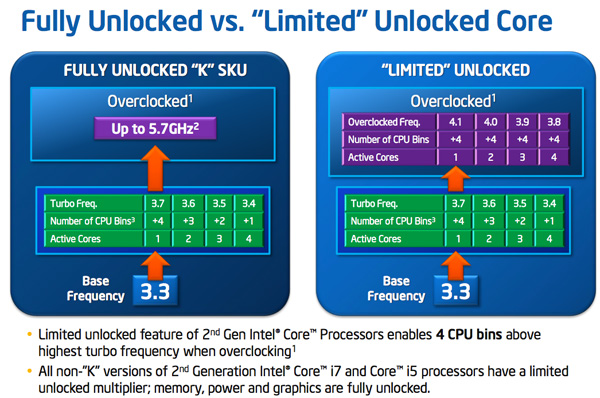
Non-K CPUs can be overclocked... only with a limited multiplier... up to 41-42x for an extra +400mhz... plus more (200+mhz?) for risky BCLK overclocks.
but its barely more expensive bigger brother the 2500k has *way* more overclocking headroom than the Phenom.
I know that, I wasn't contesting the performance of the 2600 or 2500k/2600k
They've got happily to 4Ghz on the stock cooler, and 4.5Ghz on better air coolers.
I've read some reports of 4.5 OC's with the stock cooler... but those were probably with good TIM and airflow.
-
Re:Sandy Bridge-E
Um...nearly ALL of them?
Benchmarks -
Re:Mix this:
Depends heavily on which two drives you are comparing. unTRIM'd usually kills performance pretty badly.
For instance, check this 2009 article, back before TRIM was in standard use. Note how the OCZ Summit drive drops from 12MB/s in their test to about 2.5MB/s-- about 1/4 the speed.
Considering that SATA drives with NCQ can push over 150MB/s, and most SSDs arent quite up to 600MB/s yet, there certainly are places where lack of TRIM will cause the mechanical drive to be better-- especially since, if the drive doesnt support TRIM or any garbage collection, its speed will eventually drop permanently below the speed of the mechanical.
-
Re:Sandy Bridge-E
And in the vast majority of tasks the X6 is slower, including some very multithreaded ones:
-
Re:Sandy Bridge-E
Even at 6 threads, the i5 gives the X6 a very very tough time http://www.anandtech.com/bench/Product/203?vs=363. More very-multithreaded benchmarks go the i5's way than the X6's, and they're all extremely close.
Conclusion... for 6 threads and more they're equally fast, for less than 6 threads the i5 beats it silly. That's the i5 being a faster CPU in my book.
-
Re:Sandy Bridge-E
Here's a much more complete set of benchmarks that don't rely purely on synthetics –oh look, the i5 wins everywhere except for h264 encoding, which the i5 has a hardware unit for.
-
Re:Sandy Bridge-E
With Intel, you're still paying more for the equivalent and next year you'll need to get another motherboard to upgrade that processor because of constant socket changes.
Ivy Bridge is the codename for the yet-to-be released 22 nm die shrink of Sandy Bridge. Ivy Bridge processors will be backwards-compatible with the Sandy Bridge platform.[6] According to a leaked Intel roadmap, Ivy Bridge processors will be released in March-April 2012.[7]
While Ivy Bridge will be compatible with the Cougar Point chipset motherboards associated with Sandy bridge, Intel will also release a new 7-series Panther Point chipset with Ivy bridge.http://www.overclock.net/hardware-news/988606-tpu-ivy-bridge-1155-compatible-panther.html
http://www.anandtech.com/show/4318/intel-roadmap-ivy-bridge-panther-point-ssds -
Perhaps more relevant to home/SOHO users is . . .
. . . a Storage Review experiment from over a year ago:
http://www.storagereview.com/western_digital_velociraptors_raid_ssd_alternative
They put WD Raptors in RAID 0 to form a high performance (yet still affordable) platter drive setup, and then faced them off against Western Digital's new (at the time, first) SSD. Makes sense, right? Except that WD's first SSD was a complete joke, an underperforming, laughably expensive POS that I forgot about a couple days after Anand's review. When I first read about it I couldn't help but think that WD was deliberately setting it up to fail. It was at the bottom of every benchmark yet priced higher than any other (MLC) SSD. They even put a jmicron controller in it for fuck's sake (not the infamous original one, but still . .
Even so, this supposedly screaming platter drive setup could only occasionally hang with the bottom of the barrell of SSDs, and mostly lagged behind it. And as I said, this was over a year ago. It goes without saying that they didn't worry much about heat, noise, reliability (of RAID 0), or power consumption.
Anand doesn't even list platter drives in his benchmark results anymore because they'd skew the charts so badly.
As a previous poster said, a winning strategy is to get a SSD boot drive just big enough for your OS and programs, and use platter drives for everything else. And since the SSD takes care of your performance needs, you can get the cheapest, slowest, coolest, quietest platter drives. There are some cases where both high performance and high capacity are needed at once (like video editing) but they're not the norm.
-
Re:Ya right
Yeah but hang on a second, because a lowly i3 with one sixth the L2 cache handily beats it in low-thread situations:
http://www.anandtech.com/bench/Product/146?vs=289
I'm not saying "OMG Intel r better!!!11!oneone", but for most people, a Core iX is usually a better choice. It also eats a lot less power- almost half.
Here in the UK, the i3 2100 is also £40 cheaper than the Phenom 1090. Spending an extra £12 and getting an i5 2400 gets you a significantly faster and cooler-running chip in almost everything, bar things like SPEC and 3DSMax.
I don't know much about AMD chipsets these days (my last AMD system was a Barton) but I'd hazard a guess you have to grab a video card as well, which means more money, no? -
It's not always the controller's fault
It's not always the fault of the controllers, it can also be the way they're connected to the system.
These onboard controllers are connected to the system using PCI Express x1 - it's literally just like plugging them into a x1 slot only they're directly on the motherboard. The problem is there are two versions of PCI Express - the older PCI Express 1.0 provides 250 MB/s in each direction, while PCI Express 2.0 provides 500 MB/s in each direction.
AMD motherboards only had PCI Express 2.0 lanes but Intel had a mix of 2.0 lanes and 1.0 lanes - the most common was 32 x 2.0 lanes (for 2 x x16 lanes for graphics cards) and about 6 x 1.0 lanes coming from the southbridge. So motherboards manufacturers had to either use 1 lane from southbridge and get only 250 MB/s in each direction or resort to using some multiplexing chips that take 2 or more lanes and create a x4 path for the controller. More recently, motherboards detect if there is a card on the second pci express x16 and if there's nothing there, they "borrow" a few of those unused lanes to improve the performance of the various controllers integrated on the motherboard.
See this Anandtech article, it explains better than I can explain: http://www.anandtech.com/show/2973/6gbps-sata-performance-amd-890gx-vs-intel-x58-p55/2
But the point is even if the pci express 2.0 is used, there's only 500 MB/s in each direction, SATA 6 gbps means that a maximum of 750 MB/s should be reachable - very few motherboards connect the controllers to more than one 1x lane so even if the controller could reach 750 MB/s, you won't get it.
This is nothing new - remember the gigabit network cards on PCI? The whole PCI system on your computer can do 133 MB/s and a gigabit link can do about 110 MB/s - would you sue anyone if you plug 4 pci cards in your system and can't reach a throughput higher than 133 MB/s ?
-
The cheaper technology usually wins
I remember spending close to $150 of a 16GB SLC thumb drive.
Up until about a year ago, the market was flooded with MLC drives that could not offer comparable write speed or reliability but did cost 1/10th of that price.
Now I see some USB 3.0 thumb drives posting impressive speeds. I wonder what NAND technology they use.
-
Re:The OS was never the issue.
There is a counterpoint to your link: http://www.anandtech.com/show/4658/its-not-qualcomms-fault-dispelling-touchpad-myths/2
If Android does get ported to the TouchPad then the performance being a hardware vs. software issue may finally be answered.
-
Re:Stock coolers are a waste anyway
I don't have time to write a proper response, but for encoding in particular, look at the x264 graphs in the article below. OCed system is 38% faster. That's a MASSIVE difference in encoding time!
http://www.anandtech.com/show/4503/sandy-bridge-memory-scaling-choosing-the-best-ddr3/7 -
Re:Come again?
-MMC/SD/eMMC doesn't come close to the throughput of SATA
Not that your other points don't have merit, but the OCZ Vertex 3 bumps up against the throughput limits of 6 Gbps SATA. Next time you might not want to make a point that's countered in the summary, unless the summary is just wrong.
Start with
-
Anandtech is testing ONBOARD video performance
The story in anandtech that you're quoting finds that higher bandwidth memory pushes up gaming performance when you're using the onboard video. That's certainly true, but the performance user willing to pay for performance memory is using a stand-alone video card. With a stand-alone card, the tomshardware results that I linked to are the relevant benchmark -- not the anandtech one you posted.
Don't get me wrong, AMD's on-die graphics are head-and-shoulders above even Intel's Sandy Bridge HD3000 graphics -- but they don't hold a candle to even basic video cards, like the Radeon 6670:
These APUs make for an ideal solution to replace entry-level PCs with crappy integrated graphics. And, they certainly could introduce a lot of graphics muscle to a segment historically light in that regard. If Llano catches a foothold there, the APU could impact peoples’ expectation of what a PC can do. Developers might start targeting a higher lowest common denominator in their games, and that’d of course be great news for PC gaming.
But once you reach outside of the budget basement and consider folks willing to use discrete graphics, the A-series’ utility is hamstrung. It’s easy to put an $80 Radeon HD 6670 in a cheap OEM box and walk away with something that easily trumps AMD’s product in both processing and graphics benchmarks.
-
Re:How about lower wattage CPUs?
Is this a joke? I do read up on this continually, and have a 6970 at home and an E350 netbook. Not commenting on my work. It's not a "6xxx" GPU, it's equivalent to the lowest end of the 6 series gpu. The highest end version is 1/10th that of the flagship graphics card and has only better performance than the lowest end of the flagship design from the last iteration. Also, that hasn't changed *since* at least the last two iterations (we're talking 4x series). I don't know what planet you're on but FLOPS do matter substantially for server compute environments (clusters). Parallelism is far more important than "we have less than a tflop extra per *chip* - not "per core".
Having the latest graphics card on a PCIE is easily 10x faster this year. Intel's strides have been an improvement but are still generally shit. AMD has done a whole lot more. AMD will never allow themselves to cannibalize other markets via making integrated graphics anywhere even remotely near the current performance of discreet cards, for a lot of reasons. Dont' let yourself be mislead with consumer performance vs enterprise/research utility. They aren't even close to the same. Consumer performance also "looks good", but the reality is that the graphics core on the AMD is still easily 2-3x as fast as intel.This stuff has always improved in performance, but that doesnt' mean it's caught up with the times. The purpose is low power, not performance.
-
Re:PS3 wins because it is silent
I have heard that a lot of the noise from the 360 is actually DVD drive noise not fan noise. If you are not already doing so consider installing games to the hard drive to avoid this.
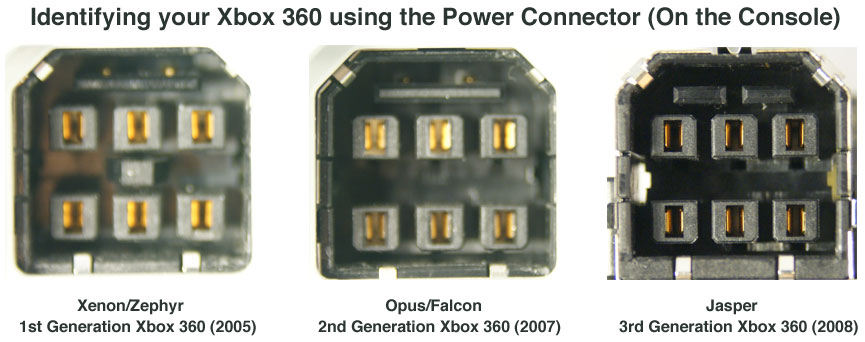
Also which generation of xbox 360 do you have? (If it's a fat model you can tell by looking at the input power connector. I belive there is only one hardware revision of slim model.) Afaict both the 360 and the PS3 reduced significantly in power consumption and noise over their life cycles.
-
Re:However, something important to keep in mind
At this point, all SSDs are basically "fast enough" for desktop usage. You notice a major difference between an SSD and a HDD. You don't notice much, if any, difference between a lower and higher end SSD on the desktop.
A large part of the reason SSDs are faster than HDDs is their low latency (has a big impact on small file read/writes). However there's another big reason you don't notice much difference between lower and higher end SSDs: We're using the wrong metric.
SSDs and HDDs benchmarks are almost universally given in MB/s. The problem is, people don't perceive speed in MB. They perceive it in seconds. The computing tasks you need to get done are almost never "I can wait 1 second. How much data can my computer crunch?" They're of the type "I need to crunch 1 GB of data. How many seconds will that take?" So the correct metric we should be using is s/MB.
But it's the same number! Why should this make a difference? Because when you invert a metric, the big numbers become small numbers, and the small numbers become big numbers. e.g. Say you have a HDD which can read 100 MB/s, a cheap SSD which can read 200 MB/s, and an expensive SSD which can read 500 MB/s. So in 1 second, the HDD reads 100 MB, the cSSD 200 MB, and eSSD 500 MB. Expressed in MB/s you gain 100 MB/s switching from HDD->cSSD, and a whopping 300 MB/s switching from cSSD->eSSD. Switching from cSSD->eSSD gives you 3x the benefit of switching from HDD->cSSD! So the extra money for the expensive SSD is definitely worth it! Right?
Hold on. Invert to s/MB and say you need to read 1 GB. The HDD takes 10 sec, the cSSD 4 sec, and the eSSD 2 sec. Switching from HDD->cSSD saves you 6 seconds. Switching from cSSD->eSSD only saves you 2 sec. So in terms of time you spend waiting, the HDD->cSSD switch saves you 3x as much time as the cSSD->eSSD switch. The vast majority of your time saved can actually be obtained from the switch to the cheaper SSD. The next step switching to the expensive SSD only gives you a marginal improvement. (Even if you insist on using relative measures of time, the cheap SSD still wins. 10 sec to 4 sec is a 60% reduction in time. 4 sec to 2 sec is only a 50% reduction in time.)
Anandtech basically stated as much in a recent SSD review. They admitted that in real world use (i.e. benchmarks measured in seconds), there really isn't much difference between the different SSDs. But reviews with benchmarks showing all products having nearly the same result doesn't get people coming back to read more reviews. So to hype people up, reviewers invert the scale and measure in MB/s to exaggerate small differences. Differences which for the vast majority of people are so small as to be nearly meaningless in their real-world computer use.
The same thing crops up with fuel mileage in cars. Fuel consumption is actually gallons per mile. But because the U.S. measures it in miles per gallon, it exaggerates the benefit of high mileage vehicles. If you ask a dozen people which saves more gas, switching from a 14 MPG SUV to a 25 MPG sedan, or switching from a 25 MPG sedan to a 50 MPG hybrid, I will bet nearly all of them will say switching to the hybrid saves more gas. After all, 50-25 = 25 MPG improvement, while 25-14 = only a 11 MPG improvement. But if you drive 100 miles:
14 MPG SUV = 7.1 gallons used
25 MPG sedan = 4 gallons used
50 MPG hybrid = 2 gallons used
Surprise. The 11 MPG improvement switching from the SUV to sedan saves you 3.1 gallons per 100 miles driven, while the 25 MPG improvement switching from sedan to hybrid only saves you 2 gallons. The metric we should be using is GPM, not MPG. The rest of the world measures fuel consumption in liters per 100 km for this reason. (A consequence of this is that if we as a nation wish to lower our fuel consumpt -
I'll stick with Intel
I bought one of Intel's 3rd generation 80GB SSDs back in January and have had zero problems with it. No, it's not as fast as OCZ's drives, but it's reliable. Intel's failure rate is 0.6% while OCZ's is 3% (not sure if that's a per-year figure or something). Why an average user would buy primary storage with a 3% failure rate is beyond me.
(failure rate figure comes from http://www.anandtech.com/show/4202/the-intel-ssd-510-review/3 ) -
Re:Learn Mandarin and buy Bitcoins
Okami: pressed in Taiwanese DVD-fab factory. Wii: full of Foxconn components (China slave labor), likely Korean laser diode in the DVD drive. Sony TV: Taiwanese or Korean LCD, could be either. Toyota minivan: mostly made in the US (probably Knoxville TN).
What was your point again?
Taiwan's what we really should wonder about. China's very good at stealing tech from other countries, but crap-all at doing anything else except for destroying the environment and committing acts of barbarism against farmers and monks.
You must not be from the USA, because only the executives count around here. That's why when we say we buy American cars, we mean the ones built in Mexico for American companies instead of the ones built here for Japanese companies.
-
Re:Learn Mandarin and buy Bitcoins
Okami: pressed in Taiwanese DVD-fab factory.
Wii: full of Foxconn components (China slave labor), likely Korean laser diode in the DVD drive.
Sony TV: Taiwanese or Korean LCD, could be either.
Toyota minivan: mostly made in the US (probably Knoxville TN).What was your point again?
Taiwan's what we really should wonder about. China's very good at stealing tech from other countries, but crap-all at doing anything else except for destroying the environment and committing acts of barbarism against farmers and monks.
-
Re:Gone in 10 years.
On the battery side of things, you're wrong.
Check out the charts here: http://www.anandtech.com/show/4471/htc-sensation-4g-review-a-sensational-smartphone/10
The best Blackberry, the Bold 9780, is roughly equal to the iPhone 4 in all tests, trading off for the top spot in the web browsing tests. In the 3G talk time test both the iPhone and the Blackberry are firmly beaten by a number of Android devices.
I'll also point out that the Blackberry has a small 2.4" screen compared to the 3.5-4.3" screens of the majority of the competition and has a slow 624 MHz processor, compared to ~750 MHz in the iPhone and 800-1200MHz on the Androids. On paper it should have no problem beating the others simply from having less display to illuminate and a less demanding processor.
Standby time was not tested so it may win there, but honestly is it really that much of a problem to plug a phone in when you go to bed? I have a HTC Evo, one of the most power-hungry phones on the market, and that's all I have to do. Same as I've done out of habit with every phone I've owned in the past, smart or not.
Keyboard you're probably right, though personally I have never found a smartphone keyboard I liked. Likewise having not used Blackberry e-mail in years I'll refrain from judgement, though I can't say I have any complaints about either iOS or Android in that regard.
-
Re:Not the only ones.
-
Re:Who would be the target customers?
With those specs, you don't have a Llano system (the new A-series with the K10+ cores), you have a Brazos system (an E-350 with Bobcat cores, the lower-end chips that came out in January).
Llano is much more capable from a gaming perspective (particularly for integrated graphics):
see thi Anandtech review for example. -
Re:huh?
You're mostly right, but SSD's have been outstripping platter HDD's in sequential performance for at least a couple of years now; my comparatively ancient and pedestrian OCZ agility could do sequential reads and writes faster than the 150GB raptor it replaced (across the whole "surface"), and random access patterns were already a couple of orders of magnitudes faster. There are still very few SATA discs that can saturate a single 150MB/s connection on a sequential read, whilst SSD's were bandwidth limited to ~270MB/s until 6Gbps SATA arrived earlier this year in the form of new AMD and Intel chipsets (I don't count the 6Gbps marvell SATA controllers cos they're crap).
I picked up a 256GB crucial C300 last year that's currently used as scratch space for video editing - reads at 350MB/s, writes at 270MB/s, to get anywhere near that with platter based hard drives you're already talking spending comparable amounts on just a decent RAID card. Newer drives out this year are already pushing 500MB/s, to say nothing of the PCIe based SSD's.
If you need the space, use platters and a RAID card. If you need the speed, use an SSD. If you need both...
Back OT, this OCZ thing is nothing terribly new, and I suspect its thunder is going to be stolen in the consumer space by Intel's "SRT" (essentially software/driver based use of an SSD as either a read-through or a write-through cache) with a plan jane HDD (doesn't have to be a comparatively weedy 2.5" either) on the backend. Sadly it's windows-only and (stupidly) restricted to only the Z68 chipset at present. Enterprises are already using things like ZFS-with-an-SSD-cache (or some other SAN/NAS with built in flash cache) or, like ourselves, Fusion-IO in between the SAN and our blades.
Anand did a fairly thorough comparison of intel's caching technology here http://www.anandtech.com/print/4337 and I suspect the OCZ card won't be any better performance wise (and don't get me started on OCZ's QA...!). Well worth a read if you're thinking about building a computer in the next six months.
-
Re:Garbage Brand
GP's vitriol was a bit over the top, but his facts were basically right.
After a dose of public retribution OCZ agreed to allow end users to swap 25nm Vertex 2s for 34nm drives, they would simply have to pay the difference in cost. OCZ realized that was yet another mistake and eventually allowed the swap for free (thankfully no one was ever charged), which is what should have been done from the start. OCZ went one step further and stopped using 64Gbit NAND in the 60GB Vertex 2, although drives still exist in the channel since no recall was issued.
-
Re:Garbage Brand
Citation Required.
http://www.anandtech.com/show/4256/the-ocz-vertex-3-review-120gb/2
Not sure this incident should brand OCZ as a "garbage brand" though. If anything it highlights the necessity for the consumer to do their homework and not rely on just the summary specs of a drive before making a purchase. (That's not meant to defend OCZ's mistakes - just pointing out there's more to selecting an SSD than just the summary specs you see printed on the box or in the results of a Newegg search)
-
Re:Garbage Brand
I don't know if they're a garbage brand, but OP is certainly right. You can read OCZ's own announcement, or read Anandtech's analysis in their Vertex 3 review. Storagereview did a comparison of the 32nm and 24nm Vertex 2's which is also worth a read. .
-
Re:Not quite true... All PowerPC based
I've seen the articles or their equivalents. I've been around long enough to remember it all. I disagree with your assessment that MS received little benefit from Cell project. I understand MS didn't utilize all or maybe even most of the technology developed in the joint venture. However it's quite clear that what did go in was substantial.
You've also got some of your facts/assumptions messed up. The Cell and PPE are based of off a combination of POWERn/PowerPC arch. The terms seem mostly interchangeable for recent CPU's.
http://domino.research.ibm.com/comm/research.nsf/pages/r.arch.innovation.html
And the PPE is a derivative of Cell, not an ancestor.
http://www.anandtech.com/show/1647/3
And Cell was spearheaded by Sony, especially financially. I'm sure IBM could have done it on their own if they wanted, but why do it that way when Sony will foot much of the developmental funding and IBM and sell to them and MS.
but not to the extent that they would use the whole Cell architecture and give it to SCEA's direct gaming competitors (and I would have thought there would be an explicit exemption to that in the Sony-IBM contract). The wikipedia article (see below for links) is quite informative.
Yes, and the links that article is based on contains a lot more detail info including information that contradicts your exemption thought.
-
Re:It's because hardware has stalled
The PS3 has 7 cores and game developers are making good use of them. The 360 has 3 and the game developers are making even better use of them. I have a quad core and even Portal 2 makes use of all of my cores. What you say was true back in 2007 when the first quad-core came out and the Cell was just starting to get used but multi-threaded applications are the norm now, at least in the computation and gaming markets.
Also, hz is not all that matters when it comes to CPU's. Heck, it's barely relevant unless comparing within the exact same production run of CPU's but this is all pretty obvious by looking at game benchmarks for PC. Check out this one for Farcry 2 which was released what, 3 years ago?.
I don't know where you're getting these performance percentages but as far as I know there hasn't been any slowdown in performance improvements when measured against time. -
Re:Wait for Bulldozer
I would take that page with a pinch of salt - on Anandtech's page the 6-core AMD is using about the same as an i5 of similar price and speed: http://www.anandtech.com/bench/Product/288?vs=203 My system with a 4core Phenom also uses only 84 watts at idle... Perhaps that article didn't have energy-saving turned on for the chip - that's an extra 25w right there (tested myself with a power monitor).
-
Re:its 2D
they are not 3D, they are just thinner and deeper than the standard, we still dont see transistors on top of each other. the latice is still pretty much 2D. i ussually dont complain too much, but slash dot summaries are batting way below the mendoza line.
No the structure is totally different. Look at how the source, drain, and the gate are arranged. Different geometry here.
The article from AnanTech has the best explanation of the technique I have come across so far today:
http://www.anandtech.com/show/4313/intel-announces-first-22nm-3d-trigate-transistors-shipping-in-2h-2011Well... the geometry is still pretty similar. What they've done is raised the source/drain up and wrapped the gate around it, which means they have increased gate area, and can pretty much further increase it as much as they want, without changing the surface area required by the transistor.
However, it seems to me that this is going to increase the gate oxide leakage, which is a significant part of the power burned non-usefully by FETs, and also increase the gate capacitance, which means the gate drive current is going to increase. Gate drive current is already a huge part of the power required by (and burned by, and heat having to be removed from) a fet, and rises as the clock switching speed rises.
Am I wrong about this? Does this design evade these two problems somehow? Making a transistor smaller while increasing the power it uses and the heat it dissipates seems like going in almost exactly the wrong direction. Obviously they're making it work, so I'm wondering what I'm missing.
You are correct in your assumption that the gate drive current will go up, but the real issue is that as the gate width decreases, the on current increases, but the standby current increases much faster. And at 22nm the gate is too small to accurately control the inversion layer, meaning there is not enough difference between the ON and OFF voltages to differentiate between a logic 1 and 0. So the solution is to increase the gate width while still being able to scale down the channel width. One way to achieve this is by raising the channel up so that there are essentially 3 contact points for the gate(s). This roughly doubles the gate width which, in turn, allows for more control over the transistor at lower voltages and smaller architectures. Another side-effect of the wider gate is that it allows for a greater flow of current which will cater to the performance crowd. Now back to your question; yes, it might raise the drive current some, but the power savings will really come from the lower voltage standby state.
-
"... holds up pretty well"?
Ummm, against what, my obsolete Phenom (I) X4 9850? Funny how true fanbois can read the same review as an objective person and walk away with entirely different conclusions, eh?
The AnandTech review was even less forgiving of AMD's underdog status, and basically recommended passing and either waiting for the allegedly awesome new Bulldog line or jumping ship for Intel. Hell, when Sandy Bridge both outperforms AND underconsumes (power), you oughtta be seriously questioning that underdog affection. I certainly am.
-
Re:Wait for Bulldozer
>>I'll be waiting for the dust to clear with Bulldozer before I make a commitment for my next build.
I agree. The Phenom II line is just grossly underpowered compared to Sandy Bridge:
http://www.anandtech.com/bench/Product/288?vs=362The i5 2500K is in the same price range, but is substantially faster. Bulldozer ought to even out the field a bit, but then Intel will strike back with their shark-fin Boba FETs or whatever (I didn't pay much attention to the earlier article on 3D transistors.)
And then on the high-ish end, AMD has nothing to compete against the i7 2600K. And it's not really that much more expensive (+$100) for the 15% extra gain in performance. It's not like their traditional $1000 high end offerings.
-
Re:Pffft
Many things are made by Foxconn. Also from what I've read, their suicide rate is quite a bit lower than the average suicide rates in Chinese/Taiwanese manufacturing plants. We only hear/care about this one because they make i-devices. I mean come on, the very title of this summary should be a glaring indicator why anyone cares. Foxconn is not a "chinese iPad factory," its a massive global technology company manufacturing pipeline.
-
Re:its 2D
they are not 3D, they are just thinner and deeper than the standard, we still dont see transistors on top of each other. the latice is still pretty much 2D. i ussually dont complain too much, but slash dot summaries are batting way below the mendoza line.
No the structure is totally different. Look at how the source, drain, and the gate are arranged. Different geometry here.
The article from AnanTech has the best explanation of the technique I have come across so far today:
http://www.anandtech.com/show/4313/intel-announces-first-22nm-3d-trigate-transistors-shipping-in-2h-2011Well... the geometry is still pretty similar. What they've done is raised the source/drain up and wrapped the gate around it, which means they have increased gate area, and can pretty much further increase it as much as they want, without changing the surface area required by the transistor.
However, it seems to me that this is going to increase the gate oxide leakage, which is a significant part of the power burned non-usefully by FETs, and also increase the gate capacitance, which means the gate drive current is going to increase. Gate drive current is already a huge part of the power required by (and burned by, and heat having to be removed from) a fet, and rises as the clock switching speed rises.
Am I wrong about this? Does this design evade these two problems somehow? Making a transistor smaller while increasing the power it uses and the heat it dissipates seems like going in almost exactly the wrong direction. Obviously they're making it work, so I'm wondering what I'm missing.
-
Re:37% faster!
If you have a 2500K, you're gonna overclock. Otherwise you should have saved $25 and gotten the i5-2500, which is identical except for the unlocked multiplier. Same with the 1100T. Should have gotten a 1090T if you're not going to overclock. I'm still wondering how you say it's just barely in Intel's favor though, because the ONLY benchmark that the 1100T comes close to it on are POV Ray and some video encoding benches where it wins by a very small margin, and that's very seldom the only or even primary thing people do with their computers. All other benchmarks the 1100T gets trounced: http://www.anandtech.com/bench/Product/288?vs=203
-
Re:its 2D
they are not 3D, they are just thinner and deeper than the standard, we still dont see transistors on top of each other. the latice is still pretty much 2D. i ussually dont complain too much, but slash dot summaries are batting way below the mendoza line.
No the structure is totally different. Look at how the source, drain, and the gate are arranged. Different geometry here.
The article from AnanTech has the best explanation of the technique I have come across so far today:
http://www.anandtech.com/show/4313/intel-announces-first-22nm-3d-trigate-transistors-shipping-in-2h-2011 -
Re:RAMYeah, but pretty sure Win7 Aero (and OSX quartz extreme, and maybe compiz too) are different. This was the first thing I found along those lines with a simple search:
http://www.anandtech.com/show/2760/5So what can you do with WDDM 1.1? For starters, you can significantly curtail memory usage for the Desktop Window Manager when it’s enabled for Aero. With the DWM enabled, every window is an uncompressed texture in order for it to be processed by the video card. The problem with this is that when it comes to windows drawn with Microsoft’s older GDI/GDI+ technology, the DWM needs two copies of the data – one on the video card for rendering purposes, and another copy in main memory for the DWM to work on. Because these textures are uncompressed, the amount of memory a single window takes is the product of its size, specifically: Width X Height x 4 bytes of color information.
Furthermore while a single window may not be too bad, additional windows compound this problem. In this case Microsoft lists the memory consumption of 15 1600x1200 windows at 109MB. This isn’t a problem for the video card, which has plenty of memory dedicated for the task, but for system memory it’s another issue since it’s eating into memory that could be used for something else. With WDDM 1.1, Microsoft has been able remove the copy of the texture from system memory and operate solely on the contents in video memory. As a result the memory consumption of Windows is immediately reduced, potentially by hundreds of megabytes. -
Re:There is a more reasonably price Honeycomb tabl
And I suspect it will be stillborn, because Asus' PR dept does know how to do its job. $400 and good reviews? I think the Eee Pad will be the benchmark for Honeycomb.
-
Re:level
Asus Eee Pad Transformer. $399 for full model, $150 for optional add-in keyboard and second battery transforming the tablet into a Honeycomb netbook with 15 hours of run time.
http://www.anandtech.com/show/4277/asus-eee-pad-transformer-review
And that's just one example. They could get the XO-3 when/if it comes out for a rumored $75 (they're in education, not cutting edge technology, they can afford to wait a year or two if it costs them 6x less).
This product isn't selling yet, it's only been announced. My comment stands.
-
Re:level
Asus Eee Pad Transformer. $399 for full model, $150 for optional add-in keyboard and second battery transforming the tablet into a Honeycomb netbook with 15 hours of run time.
http://www.anandtech.com/show/4277/asus-eee-pad-transformer-review
And that's just one example. They could get the XO-3 when/if it comes out for a rumored $75 (they're in education, not cutting edge technology, they can afford to wait a year or two if it costs them 6x less).
-
Stability?
Other reviews mention random reboots. Is Android Central at a point where they don't see that as a problem?
-
Re:Better Review
If you like their review, please give them some revenue by linking to the main review page http://www.anandtech.com/show/4277/asus-eee-pad-transformer-review. It contains some advertising but the ratio of content to ads is quite good.
BTW I'm not affiliated with them in any way and also like most of their reviews.