Slashdot Mirror
Domain: anandtech.com
Stories and comments across the archive that link to anandtech.com.
Comments · 3,318
-
Devil's Advocate
To play devil's advocate: I don't know of a single chip that doesn't have errata published by the manufacturer. The first "real" lesson I learned in my EE career is "you can't take the manufacturer's documentation at face value."
The important thing is how problems are handled, and I don't know of any chip maker who handles bugs like this well.
When their GeForce 8600M had issues with overheating and dying, NVIDIA first blamed notebook manufacturers, and later the foundry. It was later found to be a problem with NVIDIA's silicon layout. Apple had to replace millions of MacBooks whose NVIDIA card died after less than a year (Ever wonder why Apple uses AMD graphics these days?)
Even AMD has issues when it goes into CYA mode: Back in the day, AMD had major TLB issues with their Phenom processor. At the time AMD claimed the "... TLB erratum is a highly random event that would not occur during normal desktop usage and we've never encountered it during our testing of Phenom." "Normal desktop usage" was defined to exclude a Xen hypervisor running Windows XP, or running the SPEC 2006 benchmark -- not exactly common, but they're clearly doing the PR spin.
Then there's Intel... Some serve as an example of others to follow. Others serve as a warning to others.
In the past two months alone, from serious bugs in the Intel Management Engine to Meltdown, they've done a great job serving as a warning.
-
Spectre vs Meltdown, you are picking nits:
mysidia said "Non-Intel platforms are affected by the same form of problems" (emphasis mine). This doesn't seem like a lie: Understanding Meltdown & Spectre: What To Know About New Exploits That Affect Virtually All CPUs
I'm not a CPU architect, and perhaps you are, which would explain why you seem to take the differentiation of these bugs and exploits so seriously. Or perhaps you are paid by AMD or an ARM vendor.
Or maybe it's that your statement: "the world revolves around me" suggests that there might be other issues behind your comments
-
Re:Deja Vu
-
Made for Apple?
It's pretty noticeable Apple have been using Intel CPUs and either Intel or AMD Radeon GPUs.
So an Intel CPU with an AMD Radeon GPU on the same package seems to be aimed squarely at Apple.
Of course a lot of people thought that was the case with Atom - it was aimed at the upcoming Macbook Air. Of course Apple decided to pass on it.
So it'll be interesting to see if Apple go for this part. It's not clear if it will fit in a standard socket
https://www.anandtech.com/show...
I would add that the Core i7-8809G is listed in a table with other desktop processors. There are no mobile processors in this table, which one might extrapolate that this processor is aiming for a desktop/socketed motherboard. It would be very easy for Intel to enable this in current Coffee Lake-capable motherboard solutions, as long as the size of the combined package was suitable (and the power management of the Coffee Lake motherboards could cope with the Vega graphics as well as the CPU). Judging by the renders provided by Intel, it doesn't look the case, so it could possibly be that we're looking at a new motherboard/socket combination, or perhaps this will only be sold as an onboard CPU, similar to Intel's Atom processors. Assuming it is made available for home builds at all, that is.
I.e. it's an interesting technical achievement but like many interesting technical achievements by Intel you have to wonder who - if anyone - will actually buy it.
And the power consumption advantage of EMIB seems to be somewhat moot given the TDP is 100W. This is not a low power part. Then again a Core-i7 and an Vega was never likely to be.
-
Re: Plugged in
I'm sorry, but you are just making excuses...and incorrect ones at that.
The iPhone battery capacity is around 1900mAh (src) at 1.2V.
At 10W the battery will discharge entirely in 10 minutes.
I can't imagine any system designer ever allowing a mobile device to run to peak power consumption that would do this, especially since there is no guarantee that the system will come out of its peak state. Sure, you can do it, but it's a stupid design choice.
So what power does the iPhone run at?
Doing a little bit of research, iPhone (and most other computer phones) uses around 1 to 1.5W (src).
I'm sick of reading Apple themed threads on Slashdot because of the sheer number of mindless apologists that just ruin the discussion with their allegiance/belief in the mighty Apple corporation. It's crazy! Can't we all just stick to the facts? The fact being, in this case, Apple is a slimy corporation that has implemented policies that go against the interests of their customers, and employ an elite PR department who are working hard (but very effectively) to put some spin on it.
-
Re:They've done the impossible
Pretty safe bet, now that Intel CPU + AMD GPU on a chip has been announced.
-
Re:GPU market now fully in the hand of fraudsters?
So, nVidia sells you GPUs with part of the memory silently being "low-bandwidth" connected
No, the specs nVidia gave reviewers were plain wrong:
The error, as NVIDIA explains it, is that in creating the GTX 970 reviewer's guide, the technical marketing team was unaware of Maxwell's aforementioned and new "partial disable" capabilities when they filled out the GTX 970 specification table. They were aware that the GTX 970 would have the full 256-bit memory bus, and unaware of the ability to independently disable ROPs they assumed that all 64 ROPs and the full 2MB of L2 cache was similarly available and wrote the specification table accordingly. This error then made it into the final copy of the guide, not getting caught even after being shared around various groups at NVIDIA, with that information finally diffused by press such as ourselves.
Basically, they presented it to reviewers as if it had the full 4GB available at full speed because that's what technical marketing believed themselves, both before release and quite some time after. It's only after shit really hit the fan they talked to the engineers again realized that it didn't. So this seems to me like an honest mistake and not underhanded marketing unless you think all this is a cover story and nVidia intentionally gave out false information to commit fraud, which seems rather extreme. How they handled it, like how long it took to discover it, how they addressed it, how they dealt with customers who had based their purchasing decision on it etc. can probably be the topic of a long debate though.
I find this story a much worse case of blatant of blatant and underhanded marketing. They didn't accidentally downgrade these specs. They didn't accidentally introduce two different cards with the same model number. This is pretty clearly someone's conscious decision to sell lower spec cards using a name you'll find for example in reviewer's chart giving a certain performance and now won't, even if the stores are updated. It's bait and switch at its worst, it's worse than the simple rebranding they do to make old cards look like part of a new series. It's the kind of shit that makes me wish marketing would die in a fire.
-
Re:Not that New
Mobile SOCs have been stacked package on package for ages.
https://en.wikipedia.org/wiki/...
The Apple A8 is a package on package (PoP) 64-bit system-on-a-chip (SoC) designed by Apple and manufactured by TSMC.
Package on Package, as the name suggests, is stacking packaged chips. There's a good diagram here
https://en.wikipedia.org/wiki/...
Something like a MicroSDXC chip is bare dies stacked together. Good photo of the die stack.
https://www.anandtech.com/show...
While SanDisk didn't release any details of the internals, it's pretty safe to assume that the 512GB Extreme PRO consists of 32 x 128Gbit (16GB) dies. The photo above is from SanDisk's 2014 Investor Day presentation where the company claimed that it has the technology for a 32-die SDXC card and with the Extreme PRO the technology has made it into the retail. Since SanDisk/Toshiba doesn't have a 256Gbit NAND die (nobody has one in mass production yet), the only way to achieve 512GB is through a 32-die stack. SanDisk hasn't specified whether the NAND is MLC or TLC, but given that it is a high-end product I'm guessing it is MLC based.
NAND flash chips do it too
https://www.pcper.com/reviews/...
This prototype Toshiba flash part has 16 (!) layers of 32 Gbit 34nm flash, adding up to a whopping 64GB in a single package.
-
Re:Hobbit
Your information is out-of-date. You are talking about old school VR from the 90's.
In contradistinction, VR today renders each frame for each eye. And that was THREE years ago.
http://www.anandtech.com/show/...
"Lastly, NVIDIAâ(TM)s fourth and final latency optimization for VR Direct is VR SLI. And this feature is simple enough: rather than using alternate frame rendering (AFR) to render both eyes at once on one GPU, split up the workload such that each GPU is working on each eye simultaneously. AFR, though highly compatible with traditional monoscopic rendering, introduces additional latency that would be undesirable for VR. By rendering each eye separately on each GPU, NVIDIA is able to apply the performance benefits of SLI to VR without creating additional latency. Given the very high performance and low latencies required for VR, itâ(TM)s currently expected that most high-end games supporting VR headsets will need SLI to achieve their necessary performance, so being able to use SLI without a latency penalty will be an important part of making VR gaming commercially viable."
-
Mobile offerings?
Looks great for desktop and server use. Does AMD have a good mobile offering at the moment?
Yes, the recently released Raven Ridge aka Ryzen Mobile.
My personal hope is for AMD to release some low-power APU's that fit between mobile & 'classical' desktop applications. Say, AM4 socket parts with around ~30W TDP to go on affordable mini-ITX boards for SFF PC's, home theatre, all-in-ones and such. Not that I would mind even lower-power mobile parts, but those tend to be thin on the ground in terms of availability for diy builds (eg. separate APU + motherboard purchase). And there's quite some space these days between laptops & the bulky PC's of yesterday.
-
Re:Fuck these Intel chips. Buy from AMD.
A few from the front page of goog about the AMD Secure Processor. It does, apparently, run its own OS and have its own flash/memory.
https://hothardware.com/news/amd-confirms-it-will-not-be-opensourcing-epycs-platform-security-processor-codehttps://www.phoronix.com/scan.php?page=news_item&px=Linux-4.14-Crypto-AMD-SP
-
Re:I wonder what their energy use is like...
Anandtech has a good write up of the technical details: https://www.anandtech.com/show...
The power management is considerably improved from desktop Ryzen. They are using linear LDO regulators to manage power for each component independently. -
Most devices aren't vulnerable to hijacking
There's a pretty good write-up at Anantech: https://www.anandtech.com/show...
Basically, they say the vulnerability is worse for some configurations more than others. If you use Android, or WPA-TKIP, or 802.11ad the attacker can do more damage. Normally it's only evesdropping of one side of the communication. -
Re:Few people cares
Dang link got broken. Here’s a fixed link to the graph.
-
Re:Is there really any competition on CDMA yet?
It really is too bad that Intel has killed Atom line.
They've killed off the name 'Atom' for netbooks and I'm not sure they're launching any more phone SKUs, but the Atom microarchitecture lives on
https://en.wikipedia.org/wiki/...
https://www.anandtech.com/show...
For the moment at least, Intel is out of the SoC side of the smartphone market. This will allow ARM architecture based SoCs to absorb the remaining market share they didn't have already.
What's less clear at the moment is whether this will also impact the low-cost/non-premium tablet market, as embodied by products such as the Surface 3. In their updated statement, Intel has told us that Broxton is cancelled for both "phones and tablets." Our current understanding is that Broxton is the SoC at the heart of the Willow Trail platform - the successor to the widely used Cherry Trail-T - but at this time Intel has not explicitly confirmed whether this is in fact Willow Trail, or if Broxton's tablet variation represented another platform altogether. Though regardless of what happens with traditional tablets, we'll continue see Intel in more premium tablet-like devices such as 2-in-1s (e.g. Surface Pro) via Apollo Lake and the Core processor lineup, as Intel has previously identified convertable devices as a growth market for the company.
Update 5/02: In a newer statement, Intel has confirmed that Apollo Lake will be offered to tablet manufacturers. At this point it's not clear what the tradeoffs are for that versus Willow Trail, and whether Apollo Lake is suitable for all types of devices that the current-generation Cherry Trail has been used in. But this does mean we will see tablets using the Goldmont CPU core, while Intel Intel will flesh out the rest of their tablet SoCs with Core-based parts. Intel will also "continue to support" their tablet customers with Bay Trail, Cherry Trail, and SoFIA parts.
Also not discussed in greater detail is Intel's future plans for their overall Atom lineup. With Apollo Lake announced just earlier this month, it's clear that Intel's Atom efforts have not been cancelled entirely. We will still see the new 14nm Goldmont cores appear in low-cost PCs under Apollo Lake, most likely in several 11-to-13 inch high volume devices. However for the moment there is not an Atom core on Intel's roadmap beyond Goldmont.
Is it cancelled? Yeah, kinda. On the other hand I bet if Apple said "Hey Intel, we'd like to launch a phone with an Apollo Lake successor in it" I'm sure they could uncancel it.
The problem was that the Asus business wasn't really a business because Intel didn't make any money out of it. So in the absence of a real customer I think they'll keep launching Atom microarchitectures but only produce SKUs for the markets that make money.
E.g. I bet they sell embedded/low end netbook/low power server Atom SoCs.
The odd thing is is Microsoft hadn't fucked up mobile/desktop convergence you could have had a device like the Nokia Communicator running a version of Windows based on the desktop kernel. So you'd able to unfold the clamshell and run desktop apps. Or keep it closed and press buttons on the cover to phone people.
E.g. imagine a device like this that could run desktop apps
https://en.wikipedia.org/wiki/...
And was based on a Goldmont core.
I'd have bought one.
Sadly of course Windows Mobile couldn't run desktop applications. In fact it couldn't even run Win32 applications cross compiled for Arm (i.e. WIndows Mobile ones) but only Metro Apps. Which no one wrote.
So we all ended up running Android. Of course now the value of desktop Windows applications has pretty much ceased for most people - they can do most things on other OSs.
-
Re:I miss my audio port!
My car has aux in. They talk about how 3.5mm Jack's are crap and wear out. Well now I'm going to wear out my charging port and turn my phone into a paper weight. I think about it every time I plug my phone in to it.
USB Type-C is rated for 10,000 connect/disconnect cycles, So that's 4.5 years worth at 6 cycles/day.
4.5 years is about how long I kept using my previous phone, before ever-growing software and lack of updates caused me to finally buy my Nexus 6p. But with Oreo on it now, my battery lasts under two hours. So I'm having to keep my phone tethered to power all day. If I'm going places, I'm looking at more like 10 connect/disconnect cycles a day, because THEY WON'T LET ME CHANGE THE BATTERY.
By all means, manufacturers, keep using up the supply of rare earth metals by making phones permanently die faster with each generation.
-
Re:I miss my audio port!
My car has aux in. They talk about how 3.5mm Jack's are crap and wear out. Well now I'm going to wear out my charging port and turn my phone into a paper weight. I think about it every time I plug my phone in to it.
USB Type-C is rated for 10,000 connect/disconnect cycles, So that's 4.5 years worth at 6 cycles/day.
-
Re:And this is news?
Nobody outside of Apple really knows what the fusion drive mechanism does because Apple does not open-source the technology. What you wrote is basically straight from Apple's marketing department. We know that they are very good, this does not mean the technology is that great. Early reports were saying that the tech was basically on par with SSHD (a HDD + some amount of Flash as cache) or a bit better, but not a game changer.
The closest open-source equivalent would be the ZFS filesystem, which offers several levels of caching with its ZIL and L2ARC features. These do offer very good performance improvements.
-
Article has it backwards
The A11 has 2 High performance cores and 4 Low Performance/High Efficiency cores.
-
Article has it backwards
The A11 has 2 High performance cores and 4 Low Performance/High Efficiency cores.
-
Re:Does it boot Windows 7?
You can run Windows 7 on these new machines, but you have to patch some files or something if I am remembering correctly.
http://www.anandtech.com/show/...
Well there is a whole article on it, but I just skimmed over it so who knows how well it works.
-
Daisy Daisy....
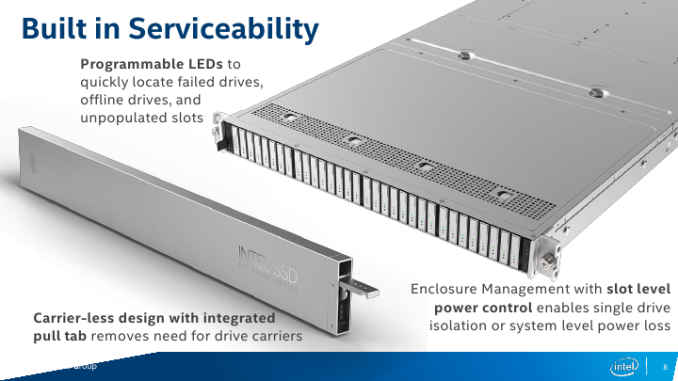
This image of the new drives loaded in a rack makes me think of this scene from 2001.
-
Re:Only on Linux
https://forums.anandtech.com/t...
Have fun reading.
-
Re:Do they support virtualization?
Intel's normal desktop chips also support virtualization in most cases (I have an old core2duo laptop that happened to be one of the few that did NOT support VT-x, but even most of those did).
The Ryzen chips do support virtualization. I couldn't find a spec sheet off hand that lists it, but there's plenty of reference to it out there.
One of the big differences between Intel and AMD consumer chips is that Intel frequently disables ECC support, but AMD leaves it enabled and up to the motherboard manufacturer to expose or not. Here's some detailed info on ECC support on Ryzen: http://www.hardwarecanucks.com...
I also ran into anandtech's review here: http://www.anandtech.com/show/...
IMO, it has some very useful comparisons right on the first page of that review. Someone else in this thread had mentioned upgrading to the low end Ryzen 5 for an extra $40 to make the upgrade more meaningful from his current platform... but that doesn't seem to add all that much IMHO. Wish I could just paste in the table from that review...Ryzen 5 1400 and 1500x are both 4 core, 8 thread, but, otherwise, they nearly mirror the specs of Ryzen 3 1200 and 1300x (which have 4 cores / 4 threads). Personally, I'd want to jump up to the 6 core / 12 threads versions, or just stick with the 1300x.
That review also has a nice comparison with Intel's comparatively priced cpus. The Ryzen's have twice the L2 cache (256kb intel, 512kb ryzen), more than twice the L3 cache (3mb intel, 8mb ryzen). and twice the cores (2 core 4 thread intel, 4 core ryzen), all with a similar TDP (51-54w intel, 65w ryzen). They seem like a pretty good option, at least on paper.
-
Re:Seems the scam has run its courseYou misunderstood. The original code will be written by humans. It will be improved over time by AI. And you're wrong about chip design. It HAS changed over the last 20 years. No team of humans can manually lay out a chip with 7 billion transistors. Not in their lifetime. That's why it's no longer done manually by humans, except for certain portions, which will become fewer as time goes on. This was true even in 2010. From an intel engineer
All of the analog circuitry, arrays, and performance-sensitive parts are definitely hand-drawn (schematics) and hand laid out. We're one of the few places that actually still do this (apparently Apple does too). You can tell which parts were laid out by hand if you look at die photos.
It's only a matter of time before they have to go full automation, as others have done.
-
Re:Nice and everything but...
There's been $1000 chips at least since the Pentium 4 Extreme Edition came out. You obviously haven't been paying attention. http://www.anandtech.com/show/...
-
Re:Video Transcoding is one possibility...
Completely irrelevant. None of these CPUs are designed "for the masses." These are "High-End Desktop Processors" (HEDT). In fact, Anandtech is calling them "Super High End" or "SHED" processors. Your post is less than useless and contributes nothing to the discussion. This is like going onto a Ferrari forum and telling us all why your mom doesn't need one.
-
Re:Too bad its 9 years behind Intel with IPC
How about you use a source that actually knows what they're talking about, and knows how to do reliable, repeatable testing?
Ryzen 5 1600X vs Core i5 6600K
Cost difference is negligible - a minor discount on either side will swing it. Nominal TDP is only 4W apart. And it's the high-end "ordinary consumer" part - the default recommendation for PC gaming. This is as close to an even comparison as you can get.
Across multiple graphics cards, across multiple games at different resolutions, AMD is competitive. Major wins on some games (Civilization 6), major losses on others (Rocket League), plenty of dead ties (GTA V), and a general trend of AMD doing better as resolution increases. No real oddities with uneven framerates - the 99th percentile framerate tracks the mean. AMD gets a small but consistent lead on synthetic benchmarks, and naturally scores overwhelming wins on multithreaded rendering.
-
Re: Good for Russia
They aare largely hypothetical and I've taken a look at the methods - they appear sound, assuming the hypotheses' are correct. (Which is, I admit, a large assumption.)
There is one hypothesis that is very unlikely to be correct, namely that they have accounted for all positive and negative feedback loops. If they have missed just one significant negative feedback loop, none of their predictions are correct. A second problem with the talk of tipping points is that it depends on time scales. We just might be able to emit enough carbon to take us back to the Pliocene, that is, no polar ice caps, within a few thousand years. That new state might last a few million years before the ice caps reappear and we return to the current climate. Is that a "tipping point"? (To be sure, I consider that unlikely. Also, I suspect that a Pliocene climate would be preferable to our current climate.)
I don't have access to big iron anymore.
You can buy a 10 TFLOP desktop machine for less than a thousand dollars. That's the speed of a top-end supercomputer of 10 years ago, when a lot of that climate modeling was done.
-
Re:Imagine a Beowulf cluster...
Now we just get fanbois droning on endlessly about how awesome it is that AMD's next generation will be slower but cheaper than Intel's latest offering.
Actually, AMDs newest chip is pretty good. Earlier today, Anandtechan article comparing Intel and AMDs latest offerings, and puts the 8176 up against AMDs best CPU. The overall takeaway is that the AMD system is faster in a lot of workloads (databases being the one big notable area where it loses badly) than the Intel system and at a much lower cost. It isn't a complete ass-whooping to the degree it was in the Opteron days, but now AMD actually has a product that won't be relegated to the bargain bin.
-
Re:Hopefully not too late
AMD actually beats intel in AES both in performance-per-watt, in performance-per-dollar and with most CPUs also in raw performance. See for example http://www.anandtech.com/show/... and http://techreport.com/review/3.... Note also that the only Intel offering in these beating the Ryzen 1800x in performance-per-CPU is the i7-6950x, which is more than three times the cost and almost 50% increase in TDP. That said, most of the benchmarks don't have the Intel server offerings included, so perhaps you can prove me wrong?
-
Kryotech
Once upon a time (late 1990s), a company called Kryotech essentially put a refrigerator inside a computer rather than do it the other way around. At the bottom of a very tall and heavy case, they had the workings of a refrigerator (compressor, condenser, coils, etc.) that pumped coolant to the CPU. AnandTech and Tom's Hardware still have their coverage on their sites, complete with diagrams.
-
Re:Translation:
Funny how AMD is getting credit around here since they actually sued multiple mobile graphics companies for patent infringement this year: http://www.anandtech.com/show/...
Incidentally, those companies are in absolutely no way trying to make "Radeon knockoff" parts that copy AMD's actual products. Hell, they aren't even competing in the same markets where AMD sells products since AMD ain't selling smartphone chips.
But AMD sued anyway and not a peep from the "OMG patent troll!" crowd.
The difference is that Intel is trying to prevent direct knockoffs of its own products here. Intel isn't running around suing anybody who makes an ARM chip for use with standard ARM software, it's (legitimately) trying to stop direct knockoffs that are basically reimplementing x86 architecture. If you want to whine about how that's "unfair" try making an ARM knockoff chip without paying up and see how far you get.
-
Re: WHAT?!
Don't use latest version of CutePDF!!
It has some sort of adware baked into the installer nowadays that is utterly crap.
https://en.wikipedia.org/wiki/CutePDF
https://forums.anandtech.com/threads/cutepdf-warning.2328025/
-
Re:It has Turbo Boost Max Technology 3.0!?!?!
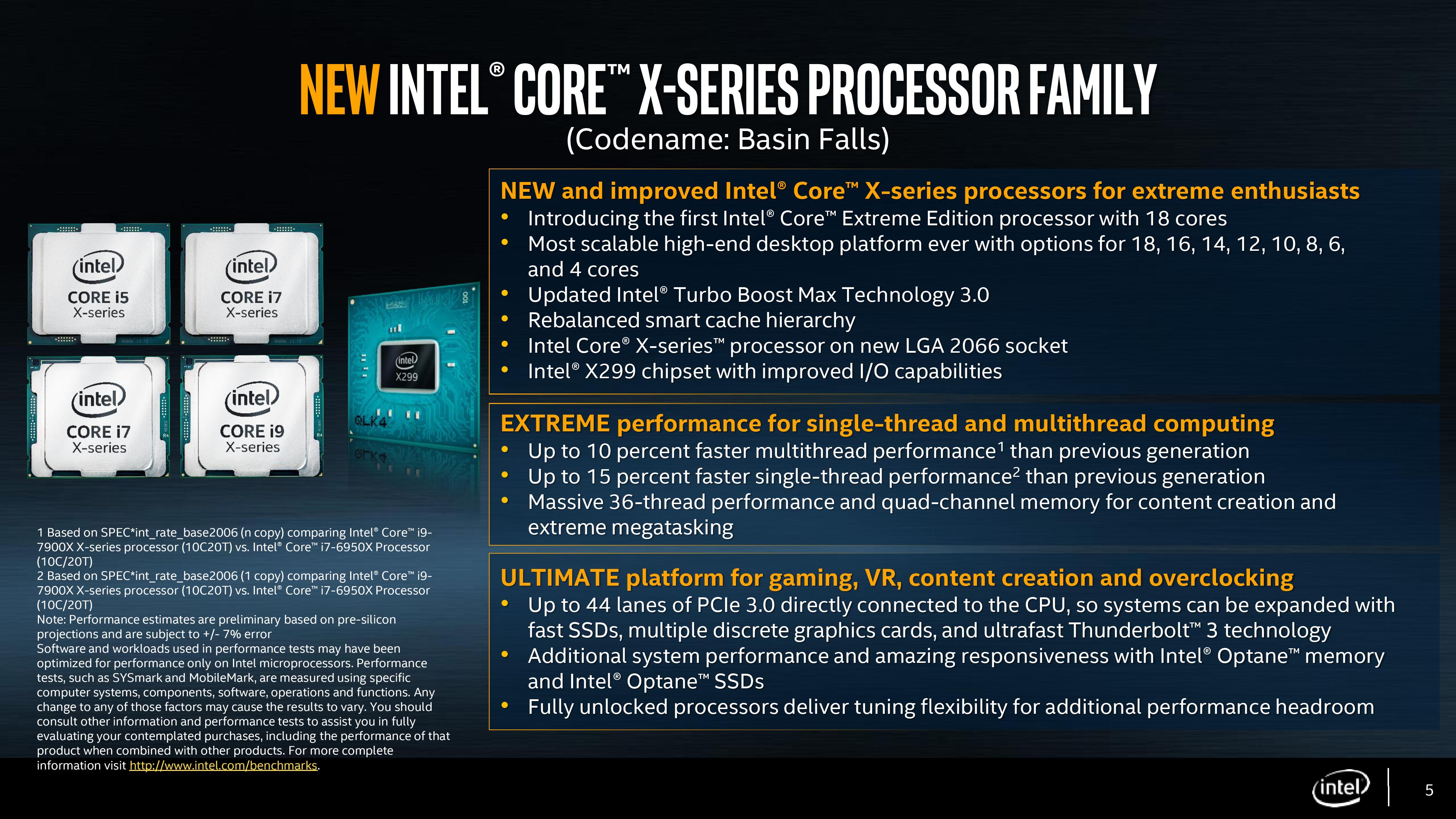
Intel's marketroids calls it "Extreme Megatasking". I kid you not:
-
No they aren't
No, ARM's new processors are not "designed" to power AI. They added an INT8 instruction, something useful for AI deploying neural nets (not training them though). And that's it. Otherwise it's a standard evolution of both designs taped out on "10nm" rather 14nm. They just know AI is HOT HOT HOT and so hope to grab some of that PR magic quick.
For those really interested Anandtech has the actual computer engineering of the whole thing: http://www.anandtech.com/show/... -
Re:120 fps .. someone FINALLY groks UI !
The difference in the UFO test is like night and day to me -- 120 fps is "sharp" and in focus. The lower the frame rate the more "blurry" and "stuttery" it looks.
This isn't rocket science -- just simple physics.
* At 120 Hz refresh rate the UFO moves 1 pixels per quantum.
* At 60 Hz the UFO has to move 2 pixels per quantum.
* At 30 Hz the UFO has to move 4 pixels in the same quantum.Now 4 px/quantum it looks jerky and stuttery-as-hell compared to 1 px/quantum. Not everyone is as blind as you.
When I'm gaming I can _instantly_ tell when the frame rate drops from 60 Hz to 30 Hz. 120 Hz is harder to tell, but it is still noticeable.
First, maybe if you actually _listened_ to professional gamers they would tell you the _exact_ same thing -- micro-stuttering IS important -- maintaining a SOLID, consistent framerate is THE most important thing in UI. Setting the bar low means people don't step up to the plate -- instead they will half-ass it with shitty 30 fps.
Here is a demo of why 30 Hz is crap -- holy lag batman!
* https://www.youtube.com/watch?...
Second, as alluded above with the video, 120 Hz is important to minimize lag input. If you actually knew anything about rendering you would understand LATENCY. Not only rendering latency but INPUT latency.
http://www.anandtech.com/show/...
If Apple's marketing material is accurate, it mentions a change from the 120 Hz sampling rate of the capacitive touch screen in normal use to 240 Hz when the stylus is detected.
Having a sampling rate of 120 Hz when the display is only 30 or 60 Hz is laggy as hell. You want to keep BOTH at high rates, preferably in sync.
If you would listen to artists using tablets they say the same thing. Minimizing input lag along with a high frame rate is extremely important for artists to have a "natural" feel. THAT is the one of the strengths of traditional art forms -- they have 0 ms lag in pencil, brush, etc.
* http://www.cultofmac.com/38847...
Again, go read the Anand review of the iPad Pro Page 9
After a few trials I measured an approximate latency for the iPad Pro of roughly 49ms or 3 frames of delay, while the Wacom Cintiq in this configuration had roughly 116ms or ~7 frames of delay. Itâ(TM)s worth mentioning here that the camera I used was recording at 240 FPS, so these figures could be off by around 4ms even before accounting for human error. Although the Cintiq 22 HD does have higher latency, I wouldnâ(TM)t put too much into this as itâ(TM)s likely that a more powerful computer driving the display would narrow, if not eliminate the gap entirely.
For reference, I estimated the Surface Pro 3 to have about 87 ms or 5-6 frames of delay, and the Surface Book to have about 69 ms or around 4 frames of delay. However, in the case of the Surface devices I was using Fresh Paint, which is a drawing application that isn't exactly comparable to Photoshop but is sufficient for comparison purposes. To give an idea for how much the application has an effect on latency, the Apple Notes app has roughly 38 ms or around 2 frames of latency from when the stylus tip passes over one point to when the inking reaches the same point.
Third, GEE, why are the VR guys targeting 90+ Hz? Because it makes for less nausea.
* http://www.roadtovr.com/sony-c...
Fourth, you are not an Graphics / UI / UX expert. You don't have a fucking clue about the importance of why _every_ millisecond matters in jank free animation -- so stop pretending that you do a
-
Re:120 fps .. someone FINALLY groks UI !
The difference in the UFO test is like night and day to me -- 120 fps is "sharp" and in focus. The lower the frame rate the more "blurry" and "stuttery" it looks.
This isn't rocket science -- just simple physics.
* At 120 Hz refresh rate the UFO moves 1 pixels per quantum.
* At 60 Hz the UFO has to move 2 pixels per quantum.
* At 30 Hz the UFO has to move 4 pixels in the same quantum.Now 4 px/quantum it looks jerky and stuttery-as-hell compared to 1 px/quantum. Not everyone is as blind as you.
When I'm gaming I can _instantly_ tell when the frame rate drops from 60 Hz to 30 Hz. 120 Hz is harder to tell, but it is still noticeable.
First, maybe if you actually _listened_ to professional gamers they would tell you the _exact_ same thing -- micro-stuttering IS important -- maintaining a SOLID, consistent framerate is THE most important thing in UI. Setting the bar low means people don't step up to the plate -- instead they will half-ass it with shitty 30 fps.
Here is a demo of why 30 Hz is crap -- holy lag batman!
* https://www.youtube.com/watch?...
Second, as alluded above with the video, 120 Hz is important to minimize lag input. If you actually knew anything about rendering you would understand LATENCY. Not only rendering latency but INPUT latency.
http://www.anandtech.com/show/...
If Apple's marketing material is accurate, it mentions a change from the 120 Hz sampling rate of the capacitive touch screen in normal use to 240 Hz when the stylus is detected.
Having a sampling rate of 120 Hz when the display is only 30 or 60 Hz is laggy as hell. You want to keep BOTH at high rates, preferably in sync.
If you would listen to artists using tablets they say the same thing. Minimizing input lag along with a high frame rate is extremely important for artists to have a "natural" feel. THAT is the one of the strengths of traditional art forms -- they have 0 ms lag in pencil, brush, etc.
* http://www.cultofmac.com/38847...
Again, go read the Anand review of the iPad Pro Page 9
After a few trials I measured an approximate latency for the iPad Pro of roughly 49ms or 3 frames of delay, while the Wacom Cintiq in this configuration had roughly 116ms or ~7 frames of delay. Itâ(TM)s worth mentioning here that the camera I used was recording at 240 FPS, so these figures could be off by around 4ms even before accounting for human error. Although the Cintiq 22 HD does have higher latency, I wouldnâ(TM)t put too much into this as itâ(TM)s likely that a more powerful computer driving the display would narrow, if not eliminate the gap entirely.
For reference, I estimated the Surface Pro 3 to have about 87 ms or 5-6 frames of delay, and the Surface Book to have about 69 ms or around 4 frames of delay. However, in the case of the Surface devices I was using Fresh Paint, which is a drawing application that isn't exactly comparable to Photoshop but is sufficient for comparison purposes. To give an idea for how much the application has an effect on latency, the Apple Notes app has roughly 38 ms or around 2 frames of latency from when the stylus tip passes over one point to when the inking reaches the same point.
Third, GEE, why are the VR guys targeting 90+ Hz? Because it makes for less nausea.
* http://www.roadtovr.com/sony-c...
Fourth, you are not an Graphics / UI / UX expert. You don't have a fucking clue about the importance of why _every_ millisecond matters in jank free animation -- so stop pretending that you do a
-
Just Because Intel Says It Doesnt Make it True
Have people forgotten that Intel promised us 10 GHZ chips by 2005? http://www.anandtech.com/show/680/6 . I think that Intel can get down to maybe 7nm but after that I believe we will have reached the end of what silicon can do. Intel and the rest of the industry dont want to switch away from silicon because they dont want to reinvest in machining, money, or more research for a new material (cant blame them) but they cant bury their heads in the sand too much longer.
I believe that towards the beginning of the 2020's we will need a new material if we want to reduce power or increase performance anymore. But eventually there will be a limit on how small we can make something regardless of the material. The 2030's will be a very interesting time.
-
Re:Flash killed flash.
True, however, any hardware built after 2009 (perhaps earlier) has had mpeg4/h.264 hardware decoder built-in, and more recently, VP8/VP9 and h.265, even in on-board graphics hardware. Although saying that, Flash also began utilising (h.264) hardware decoding capability of graphics cards since late 2009 with version 10.1.
But this doesn't mean that Flash wasn't a resource hog on modern computers, not to mention, a monolithic block placed on a web page. While HTML5 solved many of the issues, including accessibility and seo compatibility... although to be fair, HTML5 and Javascript has its own set of issues, i.e. they're also becoming a massive memory and cpu hog.
I still use Flash where possible for video, as it's a lot smoother and less CPU intensive on my circa-2005 cpu, especially on WinXP which only has basic support for earlier video types.
-
Re:TDP?
Forgot link https://forums.anandtech.com/t... . I have Atom c2750 .
-
Re:Ryzen problems with Windows 7
Hmm, what do all of these have in common? Oh right, they were all written a month before release based on
How about *after* release?
-
Crippled Ryzen 7
Unfortunately, it seem as if these 6-core and 4-core Ryzen 5 CPUs are only going to be eight-core Ryzen 7 CPUs with cores disabled in both compute-complexes.
The R5 1600X and 1600 are going to have one core disabled per compute-complex (CCX): 3+3. This was expected.
However, surprisingly, AMD has told Anandtech and Ars Technica that the R5 1500X and likely also the R5 1400 are going to have two cores disabled per CCX: giving it a 2+2 config.When clock and IPC have been taken into account, Ryzen's biggest performance bottleneck compared to Intel has been shown to be when threads on different CCX'es are accessing the same memory. Each CCX has its own L3 cache and there is an interconnect between the CCX'es L3 caches which while being slower than a single shared L3 cache is somewhat faster than going to main memory
This means that the 1500X and 1400 are going to be slower on many workloads than on a hypothetical Zen CPU with one single four-core CCX.
It is believed that this bottleneck is the reason behind relatively low Ryzen 1800X/1700X/1700 scores in many games - compared to Intel (even when clock speed and IPC have been taken into account).
(Curious enough, this is also a known issue among programmers for the XBox One and PS4 - both having AMD CPUs with a similar setup, but apparently it didn't really occur to game programmers that AMD would have a go at retaking the desktop?) -
Re:Nope...
The latest phone Atom chips were perfectly competitive with midrange ARM stuff, but I don't think they saw any economic sense continuing this.
And ARM servers were supposed to be huge every year since iPhone made it big, I recon this will happen during the year of the Linux desktop.
-
fabric shrink in the washboard abs
There are moments when I understand what other people are griping about.
AMD Prepares 32-Core Naples CPUs for 1P and 2P Servers: Coming in Q2
Launching an enterprise product that gains even a few points of market share from the very large blue incumbent can implement billions of dollars to the bottom line, as well as provided some innovation as there are now two big players '''on the field.
Sad, Ian, sad.
While not specifically mentioned in the announcement today, we do know that Naples is not a single monolithic die on the order of 500 mm2 or up. Naples uses four of AMD's Zeppelin dies (the Ryzen dies) in a single package.
But first I had to wade through that other sentence. (I want a Purple Heart!)
—
Once upon a time you would have a pair of quad-CPU servers, with two cores per CPU and two threads per core.
Now you have a pair of quad-die CPUs, with two cores per die, and two threads per core.
- Box to box latency is replaced by CPU to CPU latency.
- CPU to CPU latency is replaced by die to die latency within a single CPU package.
I wonder if AMD is bonding the four die modules using some form of TSV (through-silicon via).
—
The last time I had die modules was a dual Pentium Pro 166 MHz (with 512 KB of L2 cache per CPU as a second die module). Fast processors, but the DRAM was dog slow. Eventually replaced it with a dual-cartridge Pentium III 750 (L2 cache as separate chips on the cartridge). I liked the dualies back then. It made for a creamier GUI with the system under load.
I had a great Opteron system at work (a 24/7 affair) and barely used my home system at all for about four years. Intended to replace it with an AMD system, but then the Opteron product line went insane, and Intel came out with the CoreDuo, and that was all she wrote for my AMD loyalty card.
It's so nice to see AMD finally back in the game, but presently I can't flop to AMD until they properly validate FreeBSD and get themselves off the FreeBSD shit list.
Please, AMD, do us a solid and make it rock.
-
Why Are There No Huge Leaps Forward In CPU power?
NVIDIA's 2016 Pascal architecture was significantly faster than their previous Maxwell architecture.
"Relative to GTX 980 then, we're looking at an average performance gain of 66% at 1440p, and 71% at 4K. This is a very significant step up for GTX 980 owners,"
http://www.anandtech.com/show/10325/the-nvidia-geforce-gtx-1080-and-1070-founders-edition-review/32 -
ZEN
-
Re: Simple Answer
No they don't. They take an existing design supplied by ARM and make some modifications to it, they do not design their own.
Well that's not factually true. An Apple Ax processor is not an existing design by ARM; they are wholy designed Apple chips.
NVIDIA and Samsung, up to this point, have gone the processor license route. They take ARM designed cores (e.g. Cortex A9, Cortex A15, Cortex A7) and integrate them into custom SoCs. .
You're just dead wrong.
-
Re:Translation...
Because it has a HUGE Risk for very little Reward. Silicon is literally dirt cheap.
99% of people don't know or care that Silicon CPU's do everything they need. They will never be able to justify the cost of a CPU that is 10x or 100x then what they currently pay. The current tech is "good enough" for 99% of people -- that's where the bread and butter is.
This creates a chicken-and-egg scenario. None wants to risk investing billions into alt. tech when the status quo is much more profitable. i.e. Who is going to change first? Intel? AMD? The _other_ guy won't so why take that risk? With Intel abandoning Tick-Tock for for Process-Architecture-Optimization there is even less motivation.
I don't see any "disruptive technology" happening anytime soon -- due to the HUGE $$$ barriers of entry. i.e. AMD has been fabless for years. Intel isn't interested in Knight's Landing, er, Xeon Phi in shipping to consumers. ARM is in't going to invest into Hybrid-Silicon or non-Silicon CPUs. Who's left? nVidia? There has been rumors of them making their own CPU's and Mobo's for years but that hasn't happened.
Instead of going deep, everyone is going wide but it is significantly cheaper to scale.
The industry is stagnating.
-
Re:GD+T matters
When you specify that a batteries maximum envelope is X, and the supplier provides a battery which has a maximum envelope greater than X then, yes, it's a supplier problem.
Except that this isn't what happened, according to the much-more-detailed Anandtech article. Samsung specified the maximum exterior dimensions of the pouch, but those dimensions weren't big enough to accommodate the battery material itself. The second battery was slightly thicker, but suffered the same failure because of the thickness of welds on the very same parts that caused the first battery failure.
When you look at these failures together, it seems reasonable to suggest that Samsung's specifications were pushing the limits of battery technology to the breaking point, and that these unreasonable specifications were the common root cause of both battery failures. In other words, yes, there are limits to how thin you can make a battery and still have it be safe.