Slashdot Mirror
Domain: arstechnica.com
Stories and comments across the archive that link to arstechnica.com.
Comments · 9,494
-
Re:Interesting
As for me, I want a Chromebook Pixel, but wiped and running a full distro of Linux...the hardware is gorgeous.
Could always just replace it with a full blown Linux distro. Problem solved.
The pixel is one of the few Chromebooks you can install another OS with because it has a BIOS emulator. The other Chromebooks don't, so you can't install another Linux at all. ChromeOS uses coreboot I believe and as such, it's nice and secure.
The problem with the Pixel is rebooting Linux is a pain as you have to be in developer mode, then hit Ctrl-L every time in order to load the BIOS, otherwise it'll try to boot ChromeOS in developer mode (which you probably wiped).
Once installed, you'll find poor support for high-dpi displays (though it's changing, slowly - high-dpi support is coming to GNOME), and the touch screen works off the bat, but the touchpad probably won't...
For hardware, it's gorgeous. But the damned thing really doesn't want to run anything other than ChromeOS - besides being inconvenient to use (rebooting or turning it on, you must hit Ctrl-L within 30 seconds or it'll stall out and you'll have to power cycle it to restart it).
It's bad enough that there exists side-by-side chroot installs of Linux - which require entering developer mode and waiting 30 seconds until the bootloader times out and boots in developer mode.
Very nice locked down machines, yes. Running an alternate OS though, isn't very fun at all.
Of course, there's also the NSA factor - you're putting your data on Google's servers, after all...
http://arstechnica.com/information-technology/2013/09/why-the-nsa-loves-googles-chromebook/
-
They are probably still offended
That he didn't take the job offer they gave him. They wanted him to work for them and he opted to stay where he was at with the job he was happy with and not uproot his family. At the end of the day FB is a business and they are going to do whatever they want or need to to keep the revenue stream growing. http://arstechnica.com/business/2013/08/meet-matt-kruse-the-man-making-facebook-better/
-
Market segment of those who share a use case
[Multi-window multitasking is] not really a market segment it is a use case.
Every use case, such as multi-window multitasking, has a corresponding market segment of people who regularly use it. Page 4 of an Ars Technica article about OS features useful to the market segment of creative professionals (discussion) mentions multi-window multitasking features, and page 5 decries Microsoft's focus on retooling its OS for "consumption" (passive viewing of works created by others) of one thing at a time.
-
Joke laws
You are part of the cattle (and get years or decades of jail for things that are crimes, affects noone or make your rights prevail), or you are above the law, getting more money and support if you violate constitution amendments, get promoted if found that you intentionally lied to the congress, or get a small fine if is found that you you knowingly launder money for terrorist and drug cartels.
There are countries where law and justice seem to be antonyms.
-
Re:That's no fix
> better to keep your communications inside your own country.
This is not enough. Just look at Germany.
Transit providers were involved with providing copies of traffic to the NSA or GCHQ (basically a port-mirror) in Germany, there is a compound about 30 kilometers away from the DE-CIX Internet Exchange in Germany.
Here is an introductory article:
-
Re:Very little utility here
I'm not confident that the NSA hasn't already solved the discrete logarithm problem at the heart of that method.
I think its about NSA submarining vulnerable elliptic curve keys into the standard
-
Re:Very little utility here
I'm not confident that the NSA hasn't already solved the discrete logarithm problem at the heart of that method.
Even if the security is perfect, I have a hard time understanding why people would need it. If you were discussing something that were merely private that you didn't want anyone to ever know you'd have to convince the other person to install the app as well. Hey Dave, I have a secret I would like to share with you, but only if you install this app... You have to be really paranoid, or have a really valuable secret to divulge. I just don't see that many legitimate uses.
If you integrated it into android, where every text between two android users did the same thing, that would be valuable. So things would be secure and private by default.
-
Re:Meh
Also, the Android OS version apparently doesn't really matter anymore... they moved all of the critical API stuff to "Google Play Services" which auto-updates every week or so, and pretty much supports everything back to Android 2.2
Actually, it's more insidious than that. By moving code to Google Services they've moved previously open source functionality that (say) Amazon could use on their devices, into functionality tied to Google devices. Develop using Google Services and you can't then put that app on Amazon App Store without some porting.
-
Re:Great. How long until it's in shipping devices?
-
Re:Meh
That's fine and all, but I really don't care about the OS name. There's multiple articles out there and people going crazy _just for the name_. I want to know what's new in the OS for developers, not what their next marketing strategy is.
Also, the Android OS version apparently doesn't really matter anymore... they moved all of the critical API stuff to "Google Play Services" which auto-updates every week or so, and pretty much supports everything back to Android 2.2
-
Re:uhuh sure
I don't think you can dismiss out of hand the possibility that this was a planned outcome.
That sounds very weaselly, in the sense that if one person anywhere had such a thought but never spoke it, your statement would be true. And it sounds like the kind of baseless nutball regurgitation we have come to expect from internet conspiracy crazies.
You should meet AC, he's informative but shy. This is probably why it was marked troll initially, since it has been going around for a while, and calling out the NSA is standard fare for a frosty piss.
Skype was moved to centralized servers so they could survive the new era of communications: mobile devices. It was impossible to do Skype on mobile devices without centralized servers because the P2P communications would eat your battery AND your data bill. I'm sure this helps with interception as well, but it wasn't he main intention. This is discussed in detail by a former Skype engineer here:
Your post should have consisted solely of This link followed by this link which it took me all of 3 minutes to find, so I would know whether to make fun of you or support you.
How Brazil-ian that the line between "chicken little" ignorant asshattery and fact has completely disappeared.
-
Re:What patent?
What is the patent involved here? Establishing a connection between two entities on an IP network? NAT traversal techniques? Usage of Interactive Connectivity Establishment protocols?
Following links in the article will eventually get you to an article listing the patents.
-
ApplicationsFrom arstechnica:
Most people have ended up viewing stem cells as a promising way of repairing damaged tissues. But, for many scientists, they're now providing a way of studying mutations and processes that are too difficult to examine any other way. Techniques like organoid formation provide additional tools to make these studies as relevant to human biology as they possibly can be.
-
Re:Numbering ..
I'm actually surprised that the OP didn't include the other news, that Nintendo is dropping the price of the Wii U by $50.
Maybe because there are no worthwhile Wii U games compared to the 3DS?
-
Re:Numbering ..
I'm actually surprised that the OP didn't include the other news, that Nintendo is dropping the price of the Wii U by $50.
-
Re:Predicitng the future is hard
So apparently this was a legitimate article from Ars Technica in 2005. Let's see how we're doing so far, just 8 years later.
1. The people of the future are a scantily clad people. They delight in showing off their naked, tattooed flesh.
Check.
2. In the future, an airport security checkpoint will work exactly the same as it does now, except that the scanning technology will be different. For instance, at the GE-manufactured checkpoint that I saw, the machine supposedly sniffs you for bomb residue.
Check.
3. The elderly Japanese people of the future will be so desperately lonely for companionship that they'll purchase creepy android replicas.
Not quite yet, but still seems headed in that direction.
4. The senior citizens of the future won't roll around in wheelchairs - not even cool robotic wheelchairs like those invented by Dean Kamen. Instead, they'll have robotic exoskeletons that will make them much stronger and faster than the non-elderly. So in addition to being the largest voting block in future elections, they'll also have superhuman strength and speed.
Not yet, and not looking too likely at this point. Robotic exoskeletons exist, but they're not even used much in heavy industry yet.
5. In the future, most robots will look pretty much like robots have looked since the 1970's.
Robots pretty much look like Frisbees. (I.e. the Roomba is the only successful robot so far.)
6. Apple's market share doesn't change much in the future.
Considering the iPhone and iPad, I'd say their market share has definitely increased.
7. On the weekends, the people of the future will take to the water in dolphin-shaped craft that don't look nearly as much fun to drive as a Seadoo of today.
No signs of that happening any time soon.
8. Dolphin watercraft aren't the only form of future transportation that's a bit cramped. The electrically powered cars of the future will be quite small.
We now have the Smart, the Fiat 500, the Mini, and several others. American drivers have a lot more choices in very small cars than they did in 2005.
9. Future entertainment will follow the trends that were established with the rise of disco. First, they replaced the live band with a DJ. Next, they'll replace the DJ with a large, floor-mounted robotic arm.
Not sure about the DJs. That seems to not have changed much since 2005, and I think the mix of live music to DJs to Musak is likely to remain where it's been for the past few decades. Maybe more iTunes mixes though, especially at parties. The prediction about vinyl records was spot on though.
10. In a future 9/11-style scenario, where the top of a high-rise building is on fire, a Moller Aircar...
The Moller is still 50 years away, as always. Moller says it's 5 years away, as always.
-
TheTrueHOOHA on spooky types ..
"It really concerns me how little this sort of corporate behavior bothers those outside of technology circles. Society really seems to have developed an unquestioning obedience towards spooky types." TheTrueHOOHA, Feb 2010
"I can authoritatively state that those specific question types absolutely cannot be asked without specific cause [i.e. reporting]. If you got asked this, there's a specific reason, creepster." TheTrueHOOHA, Nov 2008 -
TheTrueHOOHA on spooky types ..
"It really concerns me how little this sort of corporate behavior bothers those outside of technology circles. Society really seems to have developed an unquestioning obedience towards spooky types." TheTrueHOOHA, Feb 2010
"I can authoritatively state that those specific question types absolutely cannot be asked without specific cause [i.e. reporting]. If you got asked this, there's a specific reason, creepster." TheTrueHOOHA, Nov 2008 -
Re:Misleading Headline
It's completely unrelated to oft-reported experience. It's as simple as that.
It's no different than this click-bait article from 2007 or, from your definition, spinning around real fast for a bit.
There is nothing that goes out of the body during an OBE.
That's not an assumption anyone is making here. Just you
Just for fun: You have no evidence to support your assertion. Your claim is based solely on an unfounded set of metaphysical assumptions. You're the skeptical equivalent of a creationist. (Skepticism needs to apply to everything, after all, not just what you already assume is nonsense. What good would it be otherwise?)
-
They bolted a desktop UI onto a tablet UI
It seems pretty obvious (to me, anyway; I'm a home user rather than an IT worker) that in Windows 8, Microsoft wanted to try to appeal to both tablet users with Metro, and to desktop users with the traditional desktop, all in one release. So they bolted a tablet interface to a desktop interface. It's sort of an odd combination, especially if you're new to Metro. Since the OS boots into Metro, it also seems pretty obvious that Microsoft's design choices wouldn't please business users or home users with large, non-touchscreen monitors who aren't interested in their computers looking like a tablet.
As part of its marketing campaign for IE 11, Microsoft's made Windows 8.1 Pro Preview virtual machine images available, so it's easy to try it out for yourself. The Start button takes you back to the Metro start screen, unless you right-click on it, in which case it brings up a context menu allowing you access to some of the more technical aspects of the OS (i.e. control panel; power shell; etc.).
I haven't played with it enough yet to find the setting that allows you to boot straight into the desktop rather than Metro, but even so, it's just one click to go to the desktop. But what they really to make desktop users happy is a Start menu button application launcher, and if you want that, AFAIK, you still have to install a 3rd-party utility.
-
Re:One word
Yes indeed. Now they're trying to stomp on NOAA, a comparatively small and weak governmental entity (they can't even find enough money to replace lost weather buoys).
Nothing like the economic power of a determined billionaire and the bottomless pit of graft and avarice that is the Congress to keep bad ideas afloat.
-
Re:The NSA would like to thank you very much
There are now resources devoted to detecting steganography on public networks like Facebook. It's been known for many years (think late twentieth century) that Al Quaeda was using steganography to hide documents. There were more convenient routes for communicating and probably better ones, but they went with stego, using porn as the cover. When you see stories like this one:
Exclusive: Pornography found in bin Laden hideout: officials
remember that extensive archives of digital porn, arriving on hand-couriered usb drives, doesn't mean porn-addiction but video-based steganography.
The Russians do it too. See this story from 2010:
How even the dumbest Russian spies can outwit the NSA
Don't think for a second that known stego routines aren't now checked for in collected data from sources like Facebook (PRISM).
-
Re:Was that really necessary?
Sarcasm aside, this ridiculous claims has actually been made by not only copyright agencies, but the US government, to justify more money for copyright-enforcement efforts.
news.cnet.com/Terrorist-link-to-copyright-piracy-alleged/2100-1028_3-5722835.html
http://arstechnica.com/tech-policy/2008/03/us-attorney-general-piracy-funds-terror/ -
Re:Not just Win8
Here is just one and sometimes even Linux desktop users are targetting too because they refuse to run AV software and feel invulnerable.
Slashdot will never post an anti linux article. There are plenty out there in places like itworld, neowin.net, and other sites.
Linux machines are frequently targetted because many run SQL databases and good old fashioned SQL inserts and other exploits are easy targets. Windows kernel actually has more security features like ASLR that Linux does not have.
I had someone at a Linux Users group whose SuSE Enterprise servers were all rooted and bank phising site was hosted on it. Rootkit installed to make it undectable and everything. It was found by the CISCO guys noticing strange traffic and it took 3 weeks before IT could track it.
Where do you think the term "Root"kit came from? They would be called adminkits otherwise.
-
Re:Not just Win8
Here is just one and sometimes even Linux desktop users are targetting too because they refuse to run AV software and feel invulnerable.
Slashdot will never post an anti linux article. There are plenty out there in places like itworld, neowin.net, and other sites.
Linux machines are frequently targetted because many run SQL databases and good old fashioned SQL inserts and other exploits are easy targets. Windows kernel actually has more security features like ASLR that Linux does not have.
I had someone at a Linux Users group whose SuSE Enterprise servers were all rooted and bank phising site was hosted on it. Rootkit installed to make it undectable and everything. It was found by the CISCO guys noticing strange traffic and it took 3 weeks before IT could track it.
Where do you think the term "Root"kit came from? They would be called adminkits otherwise.
-
Re:Not just Win8
"I have programming friends that applaud Visual Studio, so I'm not sure if other professionals share your hatred."
Yes. True and competent professionals share the hatred. Even those who begrudgingly use Microsoft software share it. Show me a guy running around saying "I like Windows; it's great!" and I will show you someone who is by definition incompetent.
"The only reason that I can think that an open source OS would be more secure than Windows is because of obscurity."
That is the best reason I have seen in quite some time to stop thinking about the issue with your current level of knowledge, which is exceedingly inadequate, and to start actually learning about what you are talking about.
"That's to say it's not safer because it intrinsically better programmed, but because it's not popular enough to warrant as many people trying to find exploits in it"
It is safer if not poorly administered for many, many reasons. An improperly configured system is unsafe, no matter what OS you use. That being said, a properly administered Linux system is more secure than a Windows system, and it has absolutely nothing to do with the number of people trying to find exploits. People focus on Windows because it is the low hanging fruit. The much more desirable target is Linux, which runs in all the major corporations including Google and Microsoft. The market share for the desktop is greater with Windows, but the important data is on Linux servers, meaning the real professionals would much rather find Linux exploits.
Furthermore, the homogeneous nature of Windows makes it less safe. Because Linux comes in many, many flavours and the kernel in use can and will be different even with the same version release (due to varying config options) it is literally impossible to create an attack that works on all, or even most, Linux systems. Any exploit you can come up with will only work on a very small subset of systems in the wild. Ergo, only targeted attacks make sense on Linux. Trying to come up with a virus that will affect all Linux systems the way one can come up with one that will affect all Windows 7 systems, for example, is a fools errand.
Seriously?
You mean no security like this and servers running linux are never targeted.
Mac users at work keep going ballastic when their accounts get disabled because they do not run AV software and think they are invulnerable because the highschool kid at the Apple Store said so. Same is true with Linux users who refuse to patch their damn Apache boxes. Incompotence is in every platform and I would say profession.
Windows users use Windows because they need to get stuff done. Software is written for it. That does not make then incompetent. If you are an accountant and you use some project at SourceForge then how the hell can one of the big 4 accounting firms audit your work? They wont and will tell you to put it in excel or quickbooks/great plains and get back to them.
Windows 2008R2 and Windows 7 and later are fairly secure and have more security options in the kernel like browser sandboxing, UAC, ACL, ASLR, DEP (linux uses dep for some services now), and other things. It is not Windows 98 anymore where everything runs in ring 0 and shares ole activeX components unsigned, full admin, to the os and other apps anymore.
Yes Windows 98 was fucking crap. XP meh ok kernel for the 1990s with crap thrown on top of it from windows 9.x, and a horrible browser framework.
I have AMD/ATI hardware and Linux updates are known to break except for Centos or Fedora distros on both my computers due to the lack of a stable ABI. So would I be competent to run Linux then with all these issues or anyone else who doesn't want to play with these things and just needs to get to work?
-
Re:Not just Win8
"I have programming friends that applaud Visual Studio, so I'm not sure if other professionals share your hatred."
Yes. True and competent professionals share the hatred. Even those who begrudgingly use Microsoft software share it. Show me a guy running around saying "I like Windows; it's great!" and I will show you someone who is by definition incompetent.
"The only reason that I can think that an open source OS would be more secure than Windows is because of obscurity."
That is the best reason I have seen in quite some time to stop thinking about the issue with your current level of knowledge, which is exceedingly inadequate, and to start actually learning about what you are talking about.
"That's to say it's not safer because it intrinsically better programmed, but because it's not popular enough to warrant as many people trying to find exploits in it"
It is safer if not poorly administered for many, many reasons. An improperly configured system is unsafe, no matter what OS you use. That being said, a properly administered Linux system is more secure than a Windows system, and it has absolutely nothing to do with the number of people trying to find exploits. People focus on Windows because it is the low hanging fruit. The much more desirable target is Linux, which runs in all the major corporations including Google and Microsoft. The market share for the desktop is greater with Windows, but the important data is on Linux servers, meaning the real professionals would much rather find Linux exploits.
Furthermore, the homogeneous nature of Windows makes it less safe. Because Linux comes in many, many flavours and the kernel in use can and will be different even with the same version release (due to varying config options) it is literally impossible to create an attack that works on all, or even most, Linux systems. Any exploit you can come up with will only work on a very small subset of systems in the wild. Ergo, only targeted attacks make sense on Linux. Trying to come up with a virus that will affect all Linux systems the way one can come up with one that will affect all Windows 7 systems, for example, is a fools errand.
Seriously?
You mean no security like this and servers running linux are never targeted.
Mac users at work keep going ballastic when their accounts get disabled because they do not run AV software and think they are invulnerable because the highschool kid at the Apple Store said so. Same is true with Linux users who refuse to patch their damn Apache boxes. Incompotence is in every platform and I would say profession.
Windows users use Windows because they need to get stuff done. Software is written for it. That does not make then incompetent. If you are an accountant and you use some project at SourceForge then how the hell can one of the big 4 accounting firms audit your work? They wont and will tell you to put it in excel or quickbooks/great plains and get back to them.
Windows 2008R2 and Windows 7 and later are fairly secure and have more security options in the kernel like browser sandboxing, UAC, ACL, ASLR, DEP (linux uses dep for some services now), and other things. It is not Windows 98 anymore where everything runs in ring 0 and shares ole activeX components unsigned, full admin, to the os and other apps anymore.
Yes Windows 98 was fucking crap. XP meh ok kernel for the 1990s with crap thrown on top of it from windows 9.x, and a horrible browser framework.
I have AMD/ATI hardware and Linux updates are known to break except for Centos or Fedora distros on both my computers due to the lack of a stable ABI. So would I be competent to run Linux then with all these issues or anyone else who doesn't want to play with these things and just needs to get to work?
-
Re:fair use
Okay, now I've read TFA; the document in question is a court filing and definitely not subject to copyright.
Incorrect. Federal judicial decisions are not subject to copyright. 17 USC 105. But the briefs and other materials prepared by private litigants are subject to copyright.
Using that material "for purposes such as criticism, comment, news reporting, teaching (including multiple copies for classroom use), scholarship, or research, is not an infringement of copyright." 17 USC 107. But don't think that the fact that material appears within a public record immunizes someone who obtained a copy from the public record from copyright claims. You'll often find copies of copyrighted material submitted as evidence, e.g., an allegedly infringed photograph, book, film, etc. Including it in reporting or criticism of a judicial case, almost conclusively fair use. Reproducing it for commercial sale, probably not going to be a fair use.
Ars Technica reported that Comcast had put the brakes on the service provider that was apparently conducting the search and takedown notice activity. That's probably because the Comcast attorneys realize that this is terrible PR in addition to almost certainly being a fair use situation. I've yet to see a third party service provider who actually has an IP attorney in the loop (or anyone putting much of an effort into reviewing content), which means that they tend to fire first and wonder why there was such an explosive backlash afterward.
-
Re:Doesn't work that way
Well to be fair, 99.7% of Bittorrent Traffic is illegal. I don't remember Linux distributions using bittorrent for years, and who gives a care about a homemade cartoon? Even if it is theoretically possible to use bittorrent for non-illegal purposes, in common speech it's safe to conflate bittorrent with piracy.
-
Re:Apple review process = a few seconds?
Well, in 2012 you could already publish things like this and even get to the chart tops.
-
Re:I call bullshit on "unaware" claims
Every single one of those, requires permission from the user to do - posting tweets an app cannot do directly, it brings up a sheet. Same thing for email/SMS. Taking photos requires an OK from the user to access the camera. You cannot "attack other apps" because of the sandbox.
Good point. I guess that this never happened because of the tight limits put on app capabilities.
Extraordinary claims, like a complete breaking of the sandbox, require more proof than they have presented. I would bet they are saying they THEORETICALLY could break out of the sandbox but have absolutely no actual working exploits that go outside of existing user permissions and the sandbox...
Ah, the old "That vulnerability is completely theoretical" defense. It worked so well for Microsoft in 1992, and it's still working for Apple today.
-
Re:Sure it's a loopy idea
If you think this is bad, check out the recent story about this on Arstechnica. Like 2/3s of the comments are trying to prove that the hyperloop won't work because of... terrorists! Sure, you can screen anyone at the entrance like in the airport, but what if the terrorist drives to the middle of the route and blows it up with an RPG? How do you counter that, Musk?
-
Re:Jesus H. Christ Luvs Microsoft
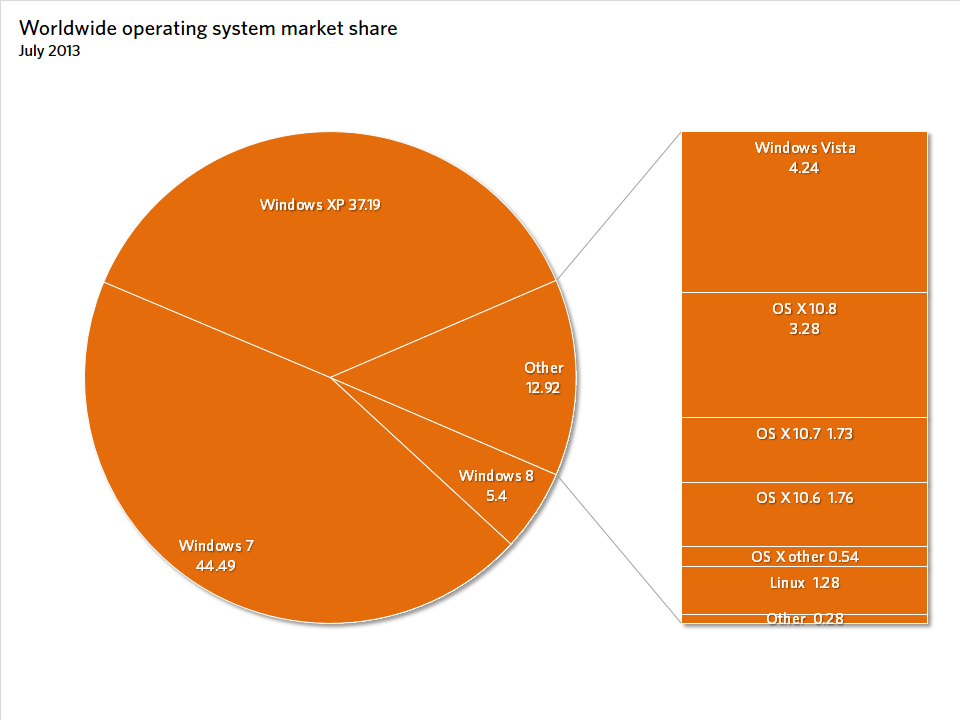
OK, simple enough: http://cdn.arstechnica.net/wp-content/uploads/2013/08/os-2013-07.png. If you want the article that this came from it is here: http://arstechnica.com/information-technology/2013/08/windows-8-passes-vista-at-last-as-ie10-growth-slows/. These numbers were reported August 2nd, 2013 - and show Linux desktop share at 1.28%.
-
Re:Boo
>probably like 3/4 of the people are different now than they were back then.
That's irrelevant. The "people" you refer to are nothing more than hired guns, they're not the company. The company is the executives and the shareholders and the board. The shareholders come and go for the most part, except the big shareholders, who are also the board members and executives. So really, the way I see it, the "company" is the people who run the company at the top, and those people haven't changed in decades. Bill and Steve have been running the place as long as I can remember. So as long as Steve is running the place and Bill is hanging around and helping patent trolls, I'm going to hold a grudge. MS isn't like a normal company where the executives come and go over the years and the ownership completely changes hands over time.
-
Re:Why proprietary chargers?
You are talking about the iPhone 5, in which case, this is certainly a new trend. Otherwise, upto now, it had only been the 30-pin adaptor.
Translation: You are too dumb to use Google - http://arstechnica.com/apple/2011/11/hands-on-with-the-iphone-micro-usb-plug-and-third-party-chargers/
-
Re:good news for NSA
We have no reason to believe that, despite the resources of the NSA, that they are significantly ahead of the public face of encryption technologies. In fact, it has been noted numerous times that cryptographers working for the NSA aren't paid nearly as well as the private sector positions;
It's reasonable, then, to assume, that the NSA doesn't have any magic secrets other than gag orders alleged by affected parties.
-
Re:They don't need 3 Surfaces, they need an xTab
Microsoft's planned "entry point" was Windows 8. I don't know this for a fact, since I don't have spies inside MS, but it's the only explanation that makes sense.
Microsoft hoped that by cramming a tablet interface onto Windows 8, that actual tablets would ride the coattails. "I already know how to use this, I should just buy the Windows 8 tablet."
This was a total fantasy and never worked, of course.
The new Nexus 7 is the "new standard" according to ArsTechnica. Microsoft could make a $200 Surface 7" model and it still won't compete. If Microsoft could get a Surface 7" model ready in time for back-to-school, and sell it for $150 (taking a loss, mind you!), that would sell and might help establish a toehold in the tablet market. Of course, to hit the back-to-school market they would need to release it right now, so it's already too late. (We should have heard rumours by now if any such thing were happening.)
-
Re:Betteridge's law of headlines
Maybe. But theists are stupid compared to atheists. Yes, I have a reference: http://arstechnica.com/science/2013/08/new-meta-analysis-checks-the-correlation-between-intelligence-and-faith/
-
Re:New Plan
No, it works. Uncle Sam can't read it. You just print your document, then scan it on a Xerox printer/scanner like the Workcenter 7335. http://arstechnica.com/information-technology/2013/08/confused-photocopiers-randomly-rewriting-scanned-documents/. If your document is carefully crafted, your message will be obfuscated by the scanner. Print and send that. The receiving party must then send it through another Xerox to get your actual message back.
-
Re:Not sure I understand the question.
The German BND does not forward domestic communication to the NSA. Doing so is prohibited by law (the G-10 law, specifically) and breaking the law in Germany is actually a bad idea, even for the government. So I'd say your email would be quite secure there.
Well I you might want to peek at this Ars article where multiple security experts are taking the German telecoms to task for their claims of increased security by merely turning on ssl for their web interface.
http://arstechnica.com/business/2013/08/crypto-experts-blast-german-e-mail-providers-secure-data-storage-claim/ -
Re: Yeah, it's those politicians who are corrupt
> When you purchase music, you actually purchase a license. Your rights are whatever
> the seller gives to you through the license. There is no ambiguity.My rights are whatever the seller gives me? So if the license I get says I cannot complain about the quality of the music in any public forum, this abrogates my first amendment rights? Somehow, I don't think so.
> There is no ambiguity.
Somehow, I get the impression you aren't a lawyer.
Oh, and by the way, unless you were talking solely about digital downloads, you should read the following Wikipedia article: First sale doctrine. And even the status of digital downloads is not totally determined, we're still waiting for the ReDigi litigation to play out.
-
Re:Do you work for Xerox?
Do you work, or have you worked, directly for Xerox on these sorts of products?
No, but I do possess a skill most people in this modern world seem not to possess: I can read stuff.
If you have not, how did you come upon this information? Is it based on actual specifications or design documents? Or is it based on speculation?
-
Sunspots [Re:Irrelevant data]
so the piece doesn't explicitly state that there is a relationship, but it suggests there is one.
Correct. The data given as a putative "response" is irrelevant to the question on so many levels it hurts. It doesn't state what the connection between sunspots and solar activity is; it shows the normal 11-year sunspot cycle, not anything different or unusual, and it shows only about one and a half cycles, not enough of a long term time series to even judge whether sunspot number (much less solar output) is going up or down.
So, with respect to the request, "Could you give a citation for that 'lowered solar output?' "-- fail.
But-- as you go on to demonstrate-- it does serve excellently to completely change the subject, and thus does its job of distracting people from noticing that there is no evidence whatsoever for the original assertion by changing the topic to a discussion of the relationship between sunspots and climate.
On that subject, the best data at the moment seems to show that the onset of the "little ice age" cooling was correlated with volcanic eruptions, and hid little or nothing to do with sunspots.
http://arstechnica.com/science/2012/02/eruptions-not-quiet-sun-may-have-triggered-little-ice-age/
http://www.scientificamerican.com/article.cfm?id=volcanoes-may-have-sparked -
Re:$600,000
You can create shell companies with other people as board members and put any wealth not already spoken for by the court in there. It becomes untouchable.
And the best part is, you don't even have to tell those people that they're on the board, and can even use made up names. And nothing bad will ever happen to you as a result.
It's foolproof!
-
Re:$600,000
You can create shell companies with other people as board members and put any wealth not already spoken for by the court in there. It becomes untouchable.
And the best part is, you don't even have to tell those people that they're on the board, and can even use made up names. And nothing bad will ever happen to you as a result.
It's foolproof!
-
Re:$600,000
You can create shell companies with other people as board members and put any wealth not already spoken for by the court in there. It becomes untouchable.
And the best part is, you don't even have to tell those people that they're on the board, and can even use made up names. And nothing bad will ever happen to you as a result.
It's foolproof!
-
Re:Sorta
Mitochondria are thought to be a (relatively late) Major Event - the genetic and biosynthetic pathways were already fairly advanced.
The major idea behind a LUCA is that you can 'work the clock back' with DNA sequencing to something around 4 billion years ago AND that all life-as-we-know-it relies on a fairly specific set of chemical reactions. It's pretty clear that modern organisms are a mismash of A+C+B+x - nature hates to throw genetic material away. It's also perfectly reasonable to assume that life started / stopped multiple times and that bits of earlier life were indeed incorporated into later critters. When you start talking about that, you get into some terribly annoying semantic arguments (perfect for Slashdot).
The Holy Grail would evidence of organisms using wildly different chemistry (like incorporating arsenic into the DNA backbone instead of Phosphorus) or some molecule that transferred genetic information without DNA or RNA entirely.
This is one strong reason why we should get our respective asses towards Mars. It offers the closest laboratory for finding off-world life. What that looks like (if it exists) is going to be one of the biggest scientific discoveries ever.
So, for life on earth, it's pretty clear that there is one LUCA - something started us along the pathway to RNA and DNA based life (I'm personally a proponent of RNA World). And TFA implies that that this enzyme was present fairly early on. But something further back had to set the stage for the ability of an organism to fold amino acids into proteins, etc. TFA doesn't even begin to discuss what the chemistry would have been - that''s another story - but by the time Thioredox was on the scene, something was making RNA and there was something that looked like a ribosome - pretty advanced functions. How they got there is pretty much hand waving.
-
Re:xp still works
While what you say has some truth, the part you leave out is that the attacks against Android were not against the linux kernel used by Android, but the Android specific parts. So, while while your numbers may be accurate as they quote Trendmicro, they misrepresent the reality. Just as a vulnerability in Firefox is not a linux vulnerability, even though Firefox ships with most linux distributions, likewise, a vulnerability found in the Google specific Android pieces does not make it a linux kernel vulnerability. If those pieces were tied directly into the kernel by the kernel developers, that would be different. But just like if I raise my Jeep and it becomes unstable when cornering, that doesn't mean it is a problem with all Jeeps, Google, modifying specific pieces of "linux" does not mean that the vulnerability is a problem with linux.
You mean like this one?
While I never said linux was immune from an attack, I'll worry about that when my bank gets online banking to work with linux. But, yeah, I'm sure people all over the world who click on an email attachment can get all sorts of stuff installed on their computer. Of course, the article was a bit thin on how that would actually happen, unless you are running as root. First warning would be that pesky enter root password dialog. But then there are all of those people who send their banking information to the wife of the Nigerian prince to get their share in a lottery winning, so who knows, maybe they would click on such a thing.
But regardless, while threats may exists, they are far fewer on linux and bsd based systems than Windows. Fewer, that is, unless the OS manufacturer has done something to open up vulnerabilities.
-
Re:The death-knell of US cloud providers...
Clearly the operator of Lavabit received a national security letter or warrant which he objected to.
I would imagine (though don't know) that a warrant wasn't the issue. I don't know too many people who have an issue with respecting a warrant since that is, after all, due process. Law enforcement must go to a judge and convince the judge to issue the warrant based on the facts. The issue that most people have is the lack of a warrant in the vast majority of situations right now. I imagine that some gentlemen came knocking on Lavabit's doors, asked him to hand over the info, he asked to see their warrant and they said something to the effect of "we don't need a warrant!"
Warrant-backed searches are entirely acceptable and part of the process of law enforcement. Warrantless searches are a problem in just about every conceivable way.
(I assume I don't need to say that I have absolutely no clue of the specifics of this case and thus everything I'm posting is guesswork but, based on what's known, that guesswork is about as valid as anyone else's post...)
It is not the warrant per say.
The fact is this guy's customers are security minded and they know the NSA has a backdoor master key. So why should they do business with him anymore? He is not the only one who is losing business as a result?
Regardless of whether you feel it is right or wrong it is having a negative effect on his company's pocketbook. What really would be the point of using his service if it is going to be snopped on anyway?
-
Re:The death-knell of US cloud providers...
I think you right about American cloud providers getting screwed.
Man, I wish slashdot would have ran that story I submitted. In Europe the article quotes over 50% are either cancelling their cloud contracts or reviewing them with US companies thanks to Prism!