Slashdot Mirror
Domain: arstechnica.com
Stories and comments across the archive that link to arstechnica.com.
Stories · 4,420
-
Net Neutrality Will Be Repealed Monday Unless Congress Takes Action (arstechnica.com)
With net neutrality rules scheduled to be repealed on Monday, Senate Democrats are calling on House Speaker Paul Ryan to schedule a vote that could preserve the broadband regulations. From a report: The US Senate voted on May 16 to reverse the Federal Communications Commission's repeal of net neutrality rules, but a House vote -- and President Trump's signature -- is still needed. Today, the entire Senate Democratic Caucus wrote a letter to Ryan urging him to allow a vote on the House floor. "The rules that this resolution would restore were enacted by the FCC in 2015 to prevent broadband providers from blocking, slowing down, prioritizing, or otherwise unfairly discriminating against Internet traffic that flows across their networks," the letter said. "Without these protections, broadband providers can decide what content gets through to consumers at what speeds and could use this power to discriminate against their competitors or other content." The letter was spearheaded by Senate Democratic Leader Chuck Schumer (D-N.Y.), Sen. Bill Nelson (D-Fla.), and Sen. Brian Schatz (D-Hawaii). -
Flight-Sim Maker Threatens Legal Action Over Reddit Posts Discussing DRM (arstechnica.com)
An anonymous reader quotes a report from Ars Technica: Today's controversy begins with a Reddit thread that noted FlightSimLabs' A320 add-on installing "cmdhost.exe" files in the "system32" and "SysWOW64" folders inside the Windows directory. The strange filename and location -- which seems designed to closely match those of actual Windows system files -- made some Reddit users suspicious, especially given FlightSimLabs history of undisclosed installations. FlightSimLabs responded on Facebook last Thursday by saying that the files came from third-party e-commerce service eSellerate and were designed to "reduce the number of product activation issues people were having." This system has been acknowledged in the FlightSimLabs forums in the past, and it apparently passes all major antivirus checks.
The "controversy" over these files might well have died down after that response. But then FlightSimLabs' Simon Kelsey sent a message to the moderators of the flightsim subreddit, gently reminding them of "Reddit's obligation as a publisher... to ensure that any libelous content is taken down as soon as you become aware of it." While ostensibly welcoming "robust fair comment and opinion," the message also warns that "ANY suggestion that our current or future products pose any threat to users is absolutely false and libelous." That warning extends to the company's previous password-extractor controversy, with Kelsey writing, "ANY suggestion that any user's data was compromised during the events of February is entirely false and therefore libelous." "I would hate for lawyers to have to get involved in this, and I trust that you will take appropriate steps to ensure that no such libel is posted," Kelsey concludes. A follow-up message from Kelsey reiterated the same points and noted that FlightSimLabs has reported specific comments and demanded they be removed as libelous. -
California's Efforts To Restrict Elon Musk's Flamethrowers Go Down In Flames (arstechnica.com)
An anonymous reader quotes a report from Ars Technica: A California state bill that would have more heavily regulated the use of flamethrowers has now effectively fizzled out in a legislative committee. In light of this development, there's nothing to stop Boring Company customers in California from receiving the company's sold-out flamethrowers. On May 26, the day after the bill died in committee, CEO Elon Musk tweeted: "About to ship. @BoringCompany holding flamethrower pickup parties in a week or so, then deliveries begin. Check https://www.boringcompany.com/... for details." After Musk said he would be selling a flamethrower dubbed "Not a Flamethrower" to get around customs, Assemblyman Miguel Santiago (D-Los Angeles) authored a bill that would have imposed more restrictions on their acquisition and use.
"I honestly thought it was a joke when I saw the news about this," the assemblyman said in a statement at the time. "This product, in the wake of California's deadliest wildfire year in state history, is incredibly insensitive, dangerous, and most definitely not funny." He added: "There are many times in which technology and inventions benefit society but are not made available to the public. We don't allow people to walk in off the street and purchase military grade tanks or armor-piercing ammunition... I cannot even begin to imagine the problems a flamethrower would cause firefighters and police officers alike." -
AT&T Wants To Settle With FTC To Avoid Unlimited Data Throttling Lawsuit (arstechnica.com)
AT&T has given up its years-long quest to cripple the Federal Trade Commission's authority to regulate broadband providers. "Just weeks ago, AT&T said it intended to appeal its loss in the case to the U.S. Supreme Court before a deadline of May 29," reports Ars Technica. "But today, AT&T informed (PDF) court officials that it has decided not to file a petition to the Supreme Court and did not ask for a deadline extension." From the report: AT&T had been trying to limit the FTC's authority since October 2014, when the FTC sued AT&T for promising unlimited data to wireless customers and then throttling their speeds by as much as 90 percent. With AT&T having ruled out a Supreme Court appeal, the FTC can finally pursue its case against AT&T and try to secure refunds for affected customers. AT&T's decision also means that traditional phone companies will have to face some net neutrality oversight from the FTC after the Federal Communications Commission finalizes its net neutrality repeal. AT&T said it will try to settle the case with the FTC instead of going to trial. AT&T's decision might indicate that it is already having settlement talks with the agency.
"We have decided not to seek review by the Supreme Court, to focus instead on negotiating a fair resolution of the case with the Federal Trade Commission," AT&T said in a statement to Ars. The FTC is barred from regulating common carriers, and AT&T has long been a common carrier for its mobile voice and landline phone services. AT&T previously argued that the FTC can't regulate any product offered by AT&T, whether it is or isn't a common carrier service. Though ultimately unsuccessful, AT&T's attempt to deny the FTC's authority to regulate any aspect of its business has delayed the throttling case for years. -
Telegram CEO Claims Apple Has 'Prevented' App Updates Globally Since April
New submitter devoid42 writes:Multiple news outlets -- ArsTechnica and The Verge -- report that Apple is restricting updates to Telegram app across the globe. The outage comes at a time when the Russian government has instructed Apple to ban the secure message app. No response from Apple as to the reason, though preventing security updates globally in response to one countrie's request seems quite a miss judgement, one can argue. -
Hacker Gets Super NES Games Running On Unmodified NES (arstechnica.com)
The latest project from Tom "Tom7" Murphy is an unmodified NES running Super NES games. "Murphy breaks down this wizardry in a pair of detailed videos laying out his tinkering process," reports Ars Technica. "Though the NES hardware itself is untouched, the cartridge running this reverse emulation is a heavily customized circuit board (ordered from China for about $10), with a compact, multi-core Raspberry Pi 3 attached to handle the actual Super NES emulation." From the report: The Pi essentially replaces the PPU portion of the cartridge, connecting to the NES via a custom-coded EEPROM chip that tells the system how to process and display what would normally be an overwhelming stream of graphical data coming from the miniature computer. Only the CIC "copyright" chip from the original cartridge remains unmodified to get around the hardware's lockout chip. Murphy -- you may remember him from previous efforts to teach an AI how to play NES games -- says that the Raspberry Pi actually has too much latency to effectively "stream" tile-by-tile graphical instructions to the NES' cartridge CPU. By the time the Pi manages to "discharge" a set of instruction bits (only 180ns after they were generated), the NES itself has already moved on to the next part of its read-write cycle.
Murphy used a one-cycle delay to compensate for this latency, essentially guessing where the fairly predictable PPU would be writing to next and just sending data to that location ahead of time. That process works pretty well but results in the persistent flickering and graphical noise you see throughout his video demonstrations. -
Qualcomm Launches a New Chip Specifically For Standalone AR, VR Devices (arstechnica.com)
Yesterday at the Augmented World Expo in Santa Clara, California, Qualcomm announced a new chip specifically designed for standalone augmented reality and virtual reality devices: the Snapdragon XR1. Ars Technica reports: The company is staying tight-lipped on technical details about the new SoC for the time being. Qualcomm says the SoC will use a Kryo CPU and Adreno GPU, as Qualcomm chips typically do, but exactly how those and the rest of the XR1's building blocks will be configured isn't yet clear. That said, Qualcomm is slotting the XR1 below its existing Snapdragon 845 -- the chip powering most of the year's highest-end smartphones -- in terms of memory bandwidth and GPU power. It is primarily aiming XR1 devices at "lean back" experiences like 360-degree video viewing, at least to start.
Even still, the company says the XR1 can output video up to 4K resolution at 60 frames per second, that it'll keep motion-to-photon latency "well below" 20 milliseconds (so as to prevent nausea and motion sickness), and that it can handle both 3DoF and 6DoF tracking for headsets and accompanying controllers if needed. (Devices with the latter allow users to replicate a fuller range of movement in a virtual space.) Qualcomm is talking up the chip's power management and 3D-audio abilities and its support for always-on voice assistance as well. -
Sonic and Ultrasonic Attacks Damage Hard Drives and Crash OSes (arstechnica.com)
Dan Goodin reports via Ars Technica: Attackers can cause potentially harmful hard drive and operating system crashes by playing sounds over low-cost speakers embedded in computers or sold in stores, a team of researchers demonstrated last week. The attacks use sonic and ultrasonic sounds to disrupt magnetic HDDs as they read or write data. The researchers showed how the technique could stop some video-surveillance systems from recording live streams. Just 12 seconds of specially designed acoustic interference was all it took to cause video loss in a 720p system made by Ezviz. Sounds that lasted for 105 seconds or more caused the stock Western Digital 3.5 HDD in the device to stop recording altogether until it was rebooted. The device uses flash storage to house its firmware, but by default it uses a magnetic HDD to store the large quantities of video it records. The attack used a speaker hanging from a ceiling that rested about four inches above the surveillance system's HDD. The researchers didn't remove the casing or otherwise tamper with the surveillance system. The technique was also able to disrupt HDDs in desktop and laptop computers running both Windows and Linux. In some cases, it even required a reboot before the PCs worked properly. The paper titled "Blue Note: How Intentional Acoustic Interference Damages Availability and Integrity in Hard Disk Drives and Operating Systems" can be found here (PDF). -
Google Zooms By Amazon In Smart Speaker Shipments, Report Says (arstechnica.com)
A new report released this week says that Google has surpassed Amazon in global smart speaker shipments in the first quarter of 2018. "[Research firm Canalys] says Google shipped 3.2 million Google Home and Home Mini speakers over the course of the quarter," reports Ars Technica. "Amazon, meanwhile, is said to have shipped 2.5 million Echo speakers." From the report: According to the report, Google jumped from taking 19.3 percent of smart speaker shipments in Q1 2017 to 36.2 percent this past quarter. Amazon accounted for a whopping 79.6 percent of shipments in the year-ago quarter but fell to 27.7 percent in Q1 2018, the report says. Now, it appears the Home has reached a point of parity with the Echo; this report would mark the first time Google has overtaken Amazon in total shipments. Canalys credits Google's rise in part to retailers and channel operators "prioritizing" the Home over the Echo, given that Amazon is one of its biggest competitors in retail at large. A couple of caveats: neither Amazon nor Google breaks out quarterly sales figures for each device family, so Canalys' figures likely aren't 100-percent exact. It's also worth noting that "shipments" are not the same as "sales," so it's possible that deals and discounts on the devices have affected the figures to an extent. -
FBI Tells Router Users To Reboot Now To Kill Malware Infecting 500,000 Devices (arstechnica.com)
The FBI is advising users of consumer-grade routers and network-attached storage devices to reboot them as soon as possible to counter Russian-engineered malware that has infected hundreds of thousands devices. Ars Technica reports: Researchers from Cisco's Talos security team first disclosed the existence of the malware on Wednesday. The detailed report said the malware infected more than 500,000 devices made by Linksys, Mikrotik, Netgear, QNAP, and TP-Link. Known as VPNFilter, the malware allowed attackers to collect communications, launch attacks on others, and permanently destroy the devices with a single command. The report said the malware was developed by hackers working for an advanced nation, possibly Russia, and advised users of affected router models to perform a factory reset, or at a minimum to reboot. Later in the day, The Daily Beast reported that VPNFilter was indeed developed by a Russian hacking group, one known by a variety of names, including Sofacy, Fancy Bear, APT 28, and Pawn Storm. The Daily Beast also said the FBI had seized an Internet domain VPNFilter used as a backup means to deliver later stages of the malware to devices that were already infected with the initial stage 1. The seizure meant that the primary and secondary means to deliver stages 2 and 3 had been dismantled, leaving only a third fallback, which relied on attackers sending special packets to each infected device.
The redundant mechanisms for delivering the later stages address a fundamental shortcoming in VPNFilter -- stages 2 and 3 can't survive a reboot, meaning they are wiped clean as soon as a device is restarted. Instead, only stage 1 remains. Presumably, once an infected device reboots, stage 1 will cause it to reach out to the recently seized ToKnowAll.com address. The FBI's advice to reboot small office and home office routers and NAS devices capitalizes on this limitation. In a statement published Friday, FBI officials suggested that users of all consumer-grade routers, not just those known to be vulnerable to VPNFilter, protect themselves. The Justice Department and U.S. Department of Homeland Security have also issued statements advising users to reboot their routers as soon as possible. -
Newest NOAA Weather Satellite Suffers Critical Malfunction (arstechnica.com)
An anonymous reader quotes a report from Ars Technica: The U.S. National Oceanic and Atmospheric Administration released some bad news yesterday: the GOES-17 weather satellite that launched almost two months ago has a cooling problem that could endanger the majority of the satellite's value. GOES-17 is the second of a new generation of weather satellite to join NOAA's orbital fleet. Its predecessor is covering the U.S. East Coast, with GOES-17 meant to become "GOES-West." While providing higher-resolution images of atmospheric conditions, it also tracks fires, lightning strikes, and solar behavior. It's important that NOAA stays ahead of the loss of dying satellites by launching new satellites that ensure no gap in global coverage ever occurs.
Several weeks ago, it became clear that the most important instrument -- the Advanced Baseline Imager -- had a cooling problem. This instrument images the Earth at a number of different wavelengths, including the visible portion of the spectrum as well as infrared wavelengths that help detect clouds and water vapor content. The infrared wavelengths are currently offline. The satellite has to be actively cooled for these precision instruments to function, and the infrared wavelengths only work if the sensor stays below 60K -- that's about a cool -350F. The cooling system is only reaching that temperature 12 hours a day. The satellite can still produce visible spectrum images, as well as the solar and lightning monitoring, but it's not a glorious next-gen weather satellite without that infrared data. -
Ariane Chief Seems Frustrated With SpaceX For Driving Down Launch Costs (arstechnica.com)
schwit1 shares a report from Ars Technica: Like United Launch Alliance, the [France-based] Ariane Group faces pricing pressure from SpaceX, which offers launch prices as low as $62 million for its Falcon 9 rocket. It has specifically developed the Ariane 6 rocket to compete with the Falcon 9 booster. But there are a couple of problems with this. Despite efforts to cut costs, the two variants of the Ariane 6 will still cost at least 25 percent more than SpaceX's present-day prices. Moreover, the Ariane 6 will not fly until 2020 at the earliest, by which time Falcon 9 could offer significantly cheaper prices on used Falcon 9 boosters if it needed to. (The Ariane 6 rocket is entirely expendable). With this background in mind, the chief executive of Ariane Group, Alain Charmeau, gave an interview to the German publication Der Spiegel. The interview was published in German, but a credible translation can be found here. During the interview, Charmeau expressed frustration with SpaceX and attributed its success to subsidized launches for the U.S. government.
When pressed on the price pressure that SpaceX has introduced into the launch market, Charmeau's central argument is that this has only been possible because, "SpaceX is charging the U.S. government 100 million dollar per launch, but launches for European customers are much cheaper." Essentially, he says, launches for the U.S. military and NASA are subsidizing SpaceX's commercial launch business. However, the pay-for-service prices that SpaceX offers to the U.S. Department of Defense for spy satellites and cargo and crew launches for NASA are below those of what other launch companies charge. And while $100 million or more for a military launch is significantly higher than a $62 million commercial launch, government contracts come with extra restrictions, reviews, and requirements that drive up this price. -
Comcast Confirms Plan To Buy 21st Century Fox and Control of Hulu (arstechnica.com)
Comcast is reportedly preparing an offer to buy major portions of 21st Century Fox, which would give it majority control of Hulu and other media properties. Ars Technica reports: Walt Disney Company already has a $52.4 billion all-stock deal to buy the 21st Century Fox properties. But Comcast was rumored to be lining up $60 billion in financing in order to make a hostile bid for the Fox assets, and Comcast's announcement today confirms it. Comcast "is considering, and is in advanced stages of preparing, an offer for the businesses that Fox has agreed to sell to Disney," Comcast's announcement said. Comcast is working on the offer in preparation for shareholder meetings in which the Disney/Fox deal will be considered.
The Fox properties for sale do not include assets such as the Fox News Channel, Fox Business Network, and Fox Broadcasting Company. Those properties would be spun off into a company being referred to as "New Fox," and Comcast would acquire 21st Century Fox after the spinoff. The Fox sale to either Disney or Comcast would include 21st Century Fox's film and television studios; cable entertainment networks; the Fox Sports Regional Networks; and international properties including Star in India and Fox's 39-percent ownership of Sky across Europe. The sale would also include Fox's 30-percent stake in Hulu, the popular online video streaming service. Comcast already owns 30 percent of Hulu, so a deal with Fox would give the nation's largest cable company majority control over the online video provider. -
Razer Slims Down Blade, Debuts MacOS-Compatible eGPU Enclosure (arstechnica.com)
An anonymous reader quotes a report from Ars Technica: Today, Razer debuted big updates to its Razer Blade laptop, focusing on design and performance to usher the gaming notebook into 2018. While the new Blade still looks unmistakably "Razer," its design has changed dramatically for the better. Razer upped the screen size from 14 inches to 15.6 inches, reducing the surrounding bezels to just 4.9mm so that the device fits in with the other nearly bezel-less ultrabooks popular today. Razer is offering 1080p 60Hz or 144Hz panels, along with a 4K touchscreen option as well. The larger display panel makes the laptop slightly heavier than its predecessor, and it's a bit wider overall, too (4.7 pounds and 9.3 inches, respectively). However, the slimmer bezels, sharper edges, and aluminum unibody make the new Razer Blade look like a clear upgrade from the previous model.
Another new addition to the Razer lineup is the Core X, a Thunderbolt 3 external graphics enclosure with space for large, three-slot wide graphics cards. The Core X joins the Core V2 graphics enclosure as one of Razer's solutions for gamers who want to add desktop-like graphics power to their laptops -- and it's more affordable than the V2 as well. While it's a bit stockier than Razer's existing enclosure, the Core X has an aluminum body with open vents to properly handle heat, regardless of the task at hand. The Core X connects to a compatible notebook through one Thunderbolt 3 port, providing eGPU access and 100W of power thanks to its 650 ATX power supply. It's both cheaper and seemingly easier to use than the V2, but that comes with some compromises: the Core X doesn't have Chroma lighting, and it lacks USB and Ethernet ports. Some other specs of the new Blade include a Intel Core i7-8750H processor, Nvidia GTX 1060 or 1070 with Max-Q graphics, up to 32GB of RAM, up to 2TB of PCIe-based SSD, and 80Whr battery. There are three USB-A 3.1 ports, one proprietary charging port, one Thunderbolt 3 port, a Mini DisplayPort, and an HDMI port. -
German Test Reveals That Magnetic Fields Are Pushing the EM Drive (arstechnica.com)
"Researchers in Germany have performed an independent, controlled test of the infamous EM Drive with an unprecedented level of precision," writes PvtVoid. "The result? The thrust is coming from interactions with the Earth's magnetic field." From the report: Instead of getting ahold of someone else's EM drive, or Mach-effect device, the researchers created their own, along with the driving electronics. The researchers used precision machining and polishing to obtain a microwave cavity that was much better than those previously published. If anything was going to work, this would be the one. The researchers built up a very nice driving circuit that was capable of supplying 50W of power to the cavity. However, the amplifier mountings still needed to be worked on. So, to keep thermal management problems under control, they limited themselves to a couple of Watts in the current tests. The researchers also inserted an enormous attenuator. This meant that they could, without physically changing the setup, switch on all the electronics and have the amplifiers working at full noise, and all the power would either go to the EM drive or be absorbed in the attenuator. That gives them much more freedom to determine if the thrust was coming from the drive or not.
Even with a power of just a couple of Watts, the EM-drive generates thrust in the expected direction (e.g., the torsion bar twists in the right direction). If you reverse the direction of the thruster, the balance swings back the other way: the thrust is reversed. Unfortunately, the EM drive also generates the thrust when the thruster is directed so that it cannot produce a torque on the balance (e.g., the null test also produces thrust). And likewise, that "thrust" reverses when you reverse the direction of the thruster. The best part is that the results are the same when the attenuator is put into the circuit. In this case, there is basically no radiation in the microwave cavity, yet the WTF-thruster thrusts on. So, where does the force come from? The Earth's magnetic field, most likely. The cables that carry the current to the microwave amplifier run along the arm of the torsion bar. Although the cable is shielded, it is not perfect (because the researchers did not have enough mu metal). The current in the cable experiences a force due to the Earth's magnetic field that is precisely perpendicular to the torsion bar. And, depending on the orientation of the thruster, the direction of the current will reverse and the force will reverse. The researchers' conclude by saying: "At least, SpaceDrive [the name of the test setup] is an excellent educational project by developing highly demanding test setups, evaluating theoretical models and possible experimental errors. It's a great learning experience with the possibility to find something that can drive space exploration into its next generation." -
FCC is Hurting Consumers To Help Corporations, Mignon Clyburn Says On Exit (arstechnica.com)
Former Commissioner Mignon Clyburn, who left the agency this month, has taken aim at it in an interview, saying the agency has abandoned its mission to safeguard consumers and protect their privacy and speech. From her interview with ArsTechnica: "I'm an old Trekkie," Clyburn told Ars in a phone interview, while comparing the FCC's responsibility to the Star Trek fictional universe's Prime Directive. "I go back to my core, my prime directive of putting consumers first." If the FCC doesn't do all it can to bring affordable communications services to everyone in the US, "our mission will not be realized," she said. The FCC's top priority, as set out by the Communications Act, is to make sure all Americans have "affordable, efficient, and effective" access to communications services, Clyburn said. But too often, the FCC's Republican majority led by Chairman Ajit Pai is prioritizing the desires of corporations over consumers, Clyburn said. "I don't believe it's accidental that we are called regulators," she said. "Some people at the federal level try to shy away from that title. I embrace it."
Clyburn said that deregulation isn't bad in markets with robust competition, because competition itself can protect consumers. But "that is just not the case" in broadband, she said. "Let's just face it, [Internet service providers] are last-mile monopolies," she told Ars. "In an ideal world, we wouldn't need regulation. We don't live in an ideal world, all markets are not competitive, and when that is the case, that is why agencies like the FCC were constructed. We are here as a substitute for competition." Broadband regulators should strike a balance that protects consumers and promotes investment from large and small companies, she said. "If you don't regulate appropriately, things go too far one way or the other, and we either have prices that are too high or an insufficient amount of resources or applications or services to meet the needs of Americans," Clyburn said. -
Should T-Mobile Stop Claiming It Has 'Best Unlimited Network'? (arstechnica.com)
An anonymous reader writes: Speed isn't everything, or is it? According to a report from Ars Technica, the National Advertising Division (NAD) says T-Mobile should stop claiming that is has "America's Best Unlimited Network" because it needs to prove it also has the widest geographic coverage and best reliability. T-Mobile is saying that speed outweighs all other factors.
"T-Mobile's claim is based on data from Ookla and OpenSignal, which offer speed-testing apps that let consumers test their wireless data speeds," reports Ars Technica. "Both Ookla and OpenSignal have issued reports saying that T-Mobile's speeds were higher than Verizon's, AT&T's, and Sprint's. The OpenSignal tests also gave T-Mobile an edge over rivals in latency and 4G signal availability." T-Mobile "did not provide evidence that its network is superior in providing talk and text mobile services or in providing high-speed data more reliably or to a greater coverage area," the industry group's announcement said. -
No Fossil Fuel-Based Generation Was Added To US Grid Last Month (arstechnica.com)
An anonymous reader quotes a report from Ars Technica: In the U.S., two types of electricity generation are on the rise: natural gas and renewables. If one of those is set to make a bigger mark than the other this year, it's natural gas: in 2018, natural gas-burning capacity is expected to outpace renewable capacity for the first time in five years, according to data from the Energy Information Agency. Although natural gas additions are expected to overtake renewable energy additions in 2018, forecasts for renewable energy additions to the grid roughly match what we saw in 2017. Natural gas is overtaking renewables not because renewable energy adoption is slowing, but more because natural gas facilities are seeing a considerable boom.
In fact, barring any changes in the EIA numbers, natural gas, wind, and solar generation are the only electricity generation sources that will be added to the U.S. grid in any consequential manner in 2018. Battery, hydroelectric, and biomass facilities make up the small percentage of "other" sources that are expected to come online this year. Renewable energy also started off the year strong. According to the EIA, "in February 2018, for the first time in decades, all of the new generating capacity coming online within a month were non-fossil-fueled. Of the 475 MW of capacity that came online in February, 81 percent was wind, 16 percent was solar photovoltaic, and the remaining 3 percent was hydro and biomass." -
Utilities, Tesla Appeal Federal Rollback of Auto Emissions Standards (arstechnica.com)
A coalition of utilities and electric vehicle makers, including Tesla, are petitioning the EPA to reconsider its recent plan to roll back auto emissions standards. In April, the EPA said that it would relax greenhouse gas emissions standards that had been put in place for model year 2022-2025 vehicles. Ars Technica reports: The National Coalition for Advanced Transportation (NCAT) represents 12 utilities as well as Tesla, electric truck maker Workhorse, and EV charging network EVgo. NCAT earlier this month asked the Second Circuit Court of Appeals in Washington, DC to review the EPA's latest efforts to relax the Obama-era fuel economy standards.
The coalition challenge to the EPA follows a similar challenge made by 17 states, including California. The utilities' efforts show that they're interested in protecting one of the major projected avenues for growth in electricity demand. Electricity consumption has stagnated in the U.S. as efficiency measures take effect and, in some states, solar panels make it easier for residents to buy less electricity from the local utility. -
With Steam Link App, Your Smartphone Can Be An Imperfect Gaming Monitor (arstechnica.com)
Ars Technica's Kyle Orland shares his experience with Valve's recently announced Steam Link app, which lets users play games running on a PC via a tablet, mobile phone, or Apple TV on the same network. The app launches today for Android 5.0+ devices; iOS support is "pending further review from Apple." From the report: Valve isn't kidding when it says a Wi-Fi router in the 5Ghz band is required for wireless streaming. I first tested iPad streaming on the low-end 2.4Ghz router provided with my Verizon FiOS subscription (an Actiontec MI424WR), with a wired Ethernet connection to my Windows gaming rig on the other end. The Steam Link network test warned me that "your network may not work well with Steam Link," thanks to 1- to 2-percent frame loss and about 15ms of "network variance," depending on when I tested. Even graphically simple games like The Binding of Isaac ran at an unplayably slowed-down rate on this connection, with frequent dropped inputs to boot.
Switching over to a 5GHz tri-band router (The Netgear Nighthawk X6, to be precise), the same network test reported a "fantastic" connection that "look[s] like it will work well with Steam." On this router, remotely played games ran incredibly smoothly at the iPad's full 1080p resolution, with total round-trip display latency ranging anywhere from 50 to 150ms, according to Steam Link's reports (and one-way "input lag" of less than 1ms). At that level of delay, playing felt practically indistinguishable from playing directly on the computer, with no noticeable gameplay impact even on quick-response titles like Cuphead. -
Cops Will Soon ID You Via Your Roof Rack (arstechnica.com)
An anonymous reader quotes a report from Ars Technica: On Tuesday, one of the largest license plate reader (LPR) manufacturers, ELSAG, announced a major upgrade to "allow investigators to search by color, seven body types, 34 makes, and nine visual descriptors in addition to the standard plate number, location, and time." Such a vast expansion of the tech now means that evading such scans will be even more difficult.
"Using advanced computer vision software, ELSAG ALPR data can now be processed to include the vehicle's make, type -- sedan, SUV, hatchback, pickup, minivan, van, box truck -- and general color -- red, blue, green, white and yellow," ELSAG continued. "The solution actively recognizes the 34 most-common vehicle brands on US roads." Plus, the company says, the software is now able to visually identity things like a "roof rack, spare tire, bumper sticker, or a ride-sharing company decal." -
Senate Votes To Save Net Neutrality (gizmodo.com)
In a monumental decision that will resonate through election season, the U.S. Senate on Wednesday voted to reinstate the net neutrality protections the Federal Communications Commission decided to repeal late last year. From a report: For months, procedural red tape has delayed the full implementation of the FCC's decision to drop Title II protections that prevent internet service providers from blocking or throttling online content. Last week, FCC Chairman Ajit Pai confirmed that the repeal of the 2015 Open Internet Order would go into effect on June 11. But Democrats put forth a resolution to use its power under the Congressional Review Act (CRA) to review new regulations by federal agencies through an expedited legislative process. All 49 Democrats in the Senate supported the effort to undo the FCC's vote. Republicans, Sen. Susan Collins of Maine, John Kennedy of Louisiana and Lisa Murkowski of Alaska crossed party lines to support the measure. Further reading: ArsTechnica. -
Comcast Charges $90 Install Fee At Homes That Already Have Comcast Installed (arstechnica.com)
An anonymous reader quotes a report from Ars Technica: Based on our tests, signing up for standalone Internet or TV service on Comcast.com often requires payment of a $59.99 or $89.99 installation fee, depending on where you live. (The fee was $60 in two Massachusetts suburbs and $90 at homes in Houston, Texas, and Seattle, Washington.) In cases where the $60 or $90 fee is charged, the fee is required whether you purchase your own modem or rent one from Comcast for another $11 a month.
The installation fee might be charged even if the home you're buying service at has existing Comcast service, and even if you order Internet speeds lower than those purchased by the current occupant. That means the fee is charged even when Comcast doesn't have to make any upgrades at the house or apartment you're moving into. Internet speed makes no difference, as the fee may be charged whether you purchase 15Mbps downloads or gigabit service. You can avoid the installation fee by purchasing certain bundles that include both TV and Internet, but the fee is often mandatory if you buy only TV service or broadband individually. The $60 or $90 fee is also charged when you buy phone service only or a "double-play" package of phone service and broadband. -
Surface Hub 2 Coming in 2019, Looks Amazing (arstechnica.com)
Microsoft gave an early look at its next-generation Surface Hub 2 today. It will go on sale next year, with certain selected customers testing it this year. From a report: Microsoft's Surface Hub, its conference room computer, was something of a surprise hit. The system has been in short supply since its launch about three years ago, especially in its 84-inch version: its combination of video conferencing and whiteboarding makes it a collaborative tool with few direct competitors. The central feature of the new system is that it's a 50.5-inch 4K display with a rotating mount. Instead of the traditional 16:9 aspect ratio, the Surface Hub 2 has the same 3:2 ratio of Microsoft's other Surface systems. -
Lenovo Teases a True All-Screen Smartphone With No Notch (cnet.com)
An anonymous reader quotes a report from CNET: Notches, it seems, are the new black. Originally seen -- and often criticized -- on the Essential PH-1 and iPhone X in 2017, the trend of adding notches to Android phones has only accelerated this year as phone makers look to maximize the screen size. But the Lenovo Z5 is going the other way: It's truly all-screen, and notch-free. At least, that's according to a sketch shared last Friday by Lenovo VP Chang Cheng on Weibo, a Twitter-like platform in China. Cheng's teaser post says (according to Google Translate) that the Lenovo Z5 is the company's new flagship phone. Besides that, the post leaves it pretty vague.
All-screen phones look cool, but they challenge the manufacturer to find a place to put front cameras, sensors and other hardware. That's why we see bezels on some phones and notches on others. It's not clear what Lenovo plans to do with the front camera on the Lenovo Z5. Cheng's post claims that "four technological breakthroughs" and "18 patented technologies" were made for the phone, but doesn't go into details. One of the first smartphones to launch with an edge-to-edge display was the Xiaomi Mi Mix. It launched with next to no bezel or notch, leaving many to wonder where the earpiece would be. What Xiaomi managed to do was use what it calls "cantilever piezoelectric ceramic acoustic technology." Basically, it's a component that converts electrical energy into mechanical energy to transfer to the phone's internal metal frame, which then vibrates to create sound. It's possible the Z5 relies on a similar technology, or bone conduction technology found in many headphones and some smartphones.
Aside from the front-facing camera and ambient light sensors, the other components that are typically found on the front of smartphones are relatively easy to drag-and-drop to different locations. For example, the speakers in the Z5 are likely bottom facing and the navigation controls are almost certainly software based. The question is whether or not it's worth having a true all-screen smartphone if it means there's no front-facing camera, ambient light sensors, or stereo speakers. -
Slashdot Asks: Which Is Your Favorite Email Client?
With Google recently rolling out a big revamp of Gmail to mixed reviews, we would like to know which email client you prefer. Are you a firm believe in the "inbox zero" idea -- that is, the approach to email management aimed at keeping the inbox empty, or almost empty, at all times? If you're looking for inspiration, Ars Technica recently published an article highlighting several different email clients used by the editors of the site: Are you the sort of person who needs to read and file every email they get? Or do you delight in seeing an email client icon proudly warning of hundreds or even thousands of unread items? For some, keeping one's email inbox with no unread items is more than just a good idea: it's a way of life, indicating control over the 21st century and its notion of productivity. For others, it's a manifestation of an obsessively compulsive mind. The two camps, and the mindsets behind them, have been a frequent topic of conversation here in the Ars Orbiting HQ. And rather than just argue with each other on Slack, we decided to collate our thoughts about the whole "inbox zero" idea and how, for those who adhere to it, that happens. Some of the clients floated by the editors include: Webmail, Airmail 3, Readdle's Spark, Edison Mail, Sparrow, Inbox by Gmail, and MailSpring. -
Jails Are Replacing Visits With Video Calls (arstechnica.com)
An anonymous reader shares a report: In recent years, more and more jails have introduced video-calling services. Theoretically, these products could make it easier for inmates to maintain their relationships with family and friends outside. But many jails have moved in the opposite direction, using the advent of these "video visitation" services as an excuse to restrict or eliminate traditional in-person visits.
There are a number of reasons jail administrators have gone this route. But critics say that money plays a big role. In-person visitation requires more staff supervision -- both to escort inmates to and from visitation rooms and to make sure no contraband changes hands during a visit. So switching to video visitation can save cash-strapped jails money.
But jails also profit more directly from limiting in-person visits. While on-site video visits are usually free, the companies providing the system generally offer a paid off-site video-calling service, too. And jails get a hefty percentage of that money. -
AI Trained To Navigate Develops Brain-Like Location Tracking (arstechnica.com)
An anonymous reader quotes a report from Ars Technica: Now that DeepMind has solved Go, the company is applying DeepMind to navigation. Navigation relies on knowing where you are in space relative to your surroundings and continually updating that knowledge as you move. DeepMind scientists trained neural networks to navigate like this in a square arena, mimicking the paths that foraging rats took as they explored the space. The networks got information about the rat's speed, head direction, distance from the walls, and other details. To researchers' surprise, the networks that learned to successfully navigate this space had developed a layer akin to grid cells. This was surprising because it is the exact same system that mammalian brains use to navigate. More DeepMind experiments showed that only the neural networks that developed layers that "resembled grid cells, exhibiting significant hexagonal periodicity (gridness)," could navigate more complicated environments than the initial square arena, like setups with multiple rooms. And only these networks could adjust their routes based on changes in the environment, recognizing and using shortcuts to get to preassigned goals after previously closed doors were opened to them. The study has been reported in the journal Science. -
Malicious Chrome Extensions Infect Over 100,000 Users Again (arstechnica.com)
An anonymous reader quotes Ars Technica: Criminals infected more than 100,000 computers with browser extensions that stole login credentials, surreptitiously mined cryptocurrencies, and engaged in click fraud. The malicious extensions were hosted in Google's official Chrome Web Store. The scam was active since at least March with seven malicious extensions known so far, researchers with security firm Radware reported Thursday. Google's security team removed five of the extensions on its own and removed two more after Radware reported them. In all, the malicious add-ons infected more than 100,000 users, at least one inside a "well-protected network" of an unnamed global manufacturing firm, Radware said...
The extensions were being pushed in links sent over Facebook that led people to a fake YouTube page that asked for an extension to be installed. Once installed, the extensions executed JavaScript that made the computers part of a botnet. The botnet stole Facebook and Instagram credentials and collected details from a victim's Facebook account. The botnet then used that pilfered information to send links to friends of the infected person. Those links pushed the same malicious extensions. If any of those friends followed the link, the whole infection process started all over again. The botnet also installed cryptocurrency miners that mined the monero, bytecoin, and electroneum digital coins. -
Supercomputers Are Driving a Revolution In Hurricane Forecasting (arstechnica.com)
Ars Technica's Eric Berger reports of how dramatic increases in computer power have helped improve the accuracy of hurricane forecasts: Based upon new data from the National Hurricane Center for hurricanes based in the Atlantic basin, the average track error for a five-day forecast fell to 155 nautical miles in 2017. That is, the location predicted by the hurricane center for a given storm was just 155 nautical miles away from the actual position of the storm five days later. What is incredible about this is that, back in 1998, this was the average error for a two-day track forecast. In fact, the annual "verification" report released Wednesday shows that for the hyperactive 2017 Atlantic hurricane season -- which included the devastating hurricanes Harvey, Irma, and Maria -- the National Hurricane Center set records for track forecasts at all time periods: 12-hour, 24-hour, and two-, three-, four- and five-day forecasts. -
In Blocking Autoplay Videos, Chrome Is Breaking Many Web-Based Games (arstechnica.com)
An anonymous reader quotes a report from Ars Technica: An update Google rolled out for its popular Chrome browser this weekend helps prevent those annoying auto-playing video ads on many websites from disturbing your day with unwanted sound as well. But that update is causing consternation for many Web-based game developers who are finding that the change completely breaks the audio in their online work. The technical details behind the problem involve the way Chrome handles WebAudio objects, which are now automatically paused when a webpage starts up, stymying auto-playing ads. To get around this, Web-based games now have to actively restart that pre-loaded audio object when the player makes an action to start the game, even if that audio wasn't autoplaying beforehand. "The standard doesn't require you to do this, so no one would have thought to do this before today," developer Andi McClure told Ars Technica. "With Chrome's new autoplay policies, developers shouldn't assume that audio can be played before a user gesture," Google told The Daily Dot in a statement. "With gaming in Chrome, this may affect Web Audio. We have shared details on what developers can do to address this, and the design for the policy was published last year." -
Google Details New Android P Features, Including iPhone X-Like Gesture Controls (arstechnica.com)
An anonymous reader quotes a report from Ars Technica: A public beta for Android P, as it's still known, is out today for those who want to try the software for themselves. The usual caveats with installing unfinished software still apply. Notably, however, Google has made the beta available on devices beyond the company's own Pixel smartphones. Google says those who own the Essential Phone, Nokia 7 Plus, Sony Xperia XZ2, Xiaomi Mi Mix 2S, Vivo X21, Oppo R15 Pro, and the OnePlus 6 (when it comes out) can access the early build alongside those with a Pixel or Pixel 2 phone. Google is crediting its Project Treble updating initiative for making this expansion possible.
As for the update itself, the biggest news in Preview 1 was a new design style that was applied to the notification panel, main settings screen, and some system UI bits. Android VP of Engineering Dave Burke recapped a couple of features that had already been announced in that earlier preview, including a simplified volume control widget and the option to change the screen orientation even when you've locked the device in portrait mode. Perhaps the most immediately noticeable new feature, however, is a new set of gesture controls that trade Android's traditional home and recent apps buttons for a setup similar to what Apple does with its iPhone X. Swiping up from a flatter button at the bottom of the screen will now display a horizontal (not vertical!) list of your recent apps, with icons for five "predicted apps" placed underneath them. Swiping up a second time from there will display the all apps screen, effectively allowing you to access it from anywhere on the phone. You can also slide the home button sideways to start scrolling through recent apps. The icons for those recent apps appear to be larger than before, and Google showed off the ability to highlight text within them. The back button is still there, but not as a global key; it instead appears to only show up in certain contexts, such as the new recent apps screen. Also available in Android P is an "adaptive battery" feature that improves battery life, an "adaptive brightness" feature that uses AI to ensure the phone screen's brightness is more appropriately set for your surroundings, and an "app actions" feature that will surface shortcuts for frequently used apps within the app drawer and Search. Google is also including a "digital wellbeing" Dashboard app that will detail how much time you've spent in particular apps, how often you've unlocked your phone, and how many notifications you've received. There will even be an "app timer" to help you limit your time on a particular app, and a "shush" gesture that will make is so the phone automatically goes into Do Not Disturb mode. Finally, there's a "wind down" mode that will turn on Do Not Disturb until the morning and set your phone screen in a grayscale mode, which will intentionally make content on your phone appear less stimulating to ultimately help you put it down. -
Are Two Spaces After a Period Better Than One? (arstechnica.com)
Researchers at Skidmore College conducted an eye-tracking experiment with 60 Skidmore students and found that two spaces at the end of a period slightly improved the processing of text during reading. Ars Technica reports the findings: Previous cognitive science research has been divided on the issue. Some research has suggested closer spacing of the beginning of a new sentence may allow a reader to capture more characters in their parafoveal vision -- the area of the retina just outside the area of focus, or fovea -- and thus start processing the information sooner (though experimental evidence of that was not very strong). Other prior research has inferred that an extra space prevents lateral interference in processing text, making it easier for the reader to identify the word in focus. But no prior research found by [study authors] Johnson, Bui, and Schmitt actually measured reader performance with each typographic scheme.
First, they divided their group of 60 research subjects by way of a keyboard task -- the subjects typed text dictated to them into a computer and were sorted into "one-spacers" (39 regularly put a single space between sentences) and "two-spacers" (21 hit that space bar twice consistently after a period). Every student subject used but a single space after each comma. Having identified subjects' proclivities, the researchers then gave them 21 paragraphs to read (including one practice paragraph) on a computer screen and tracked their eye movement as they read using an Eyelink 1000 video-based eye tracking system. [...] The "one-spacers" were, as a group, slower readers across the board (by about 10 words per minute), and they showed statistically insignificant variation across all four spacing practices. And "two-spacers" saw a three-percent increase in reading speed for paragraphs in their own favored spacing scheme. The controversial part of the study has to do with the 14 point Courier New font that the researchers presented to the students. "Courier New is a fixed-width font that resembles typewritten text -- used by hardly anyone for documents," reports Ars. "Even the APA suggests using 12 point Times Roman, a proportional-width font. Fixed-width fonts make a double-space more pronounced." -
Google Will Ban Bail-Bond Ads (arstechnica.com)
First Google banned ads from payday lenders in 2016, now it will no longer allow ads from bail-bond companies. Ars Technica reports: In a blog post, the company suggested that such ads constitute a "deceptive or harmful product," citing a 2016 study concluding that minority and low-income communities are typically most affected by such services. "For-profit bail-bond providers make most of their revenue from communities of color and low-income neighborhoods when they are at their most vulnerable, including through opaque financing offers that can keep people in debt for months or years," Google wrote. Also in 2016, another study found that "there are 646,000 people locked up in more than 3,000 local jails throughout the U.S.," simply for their inability to pay a bond, which is what drives many people to the services of a bondsman. The change will take effect in July 2018. -
Ask Slashdot: Do Citizen Science Platforms Exist? (arstechnica.com)
Loren Chorley writes: After reading about a new surge in the trend for citizen science (also known as community science, civic science or networked science), I was intrigued by the idea and wondered if there are websites that do this in a crowd sourced and open sourced manner. I know sites like YouTube allow people to show off their scientific experiments, but they don't facilitate uploading all their data or linking studies together to draw more advanced conclusions, or making methodologies like you'd see in academia straight forward and available through a simple interface. What about rating of experiments for peer review, revisions and refinement, requirement lists, step-by-step instructions for repeatability, ease of access, and simple language for people who don't find academia accessible? Does something like this exist already? Do you, Slashdot, think this is something useful, or that people are interested in? Or would the potential for fraud and misinformation be too great? -
UK Police Say 92 Percent False Positive Facial Recognition Is No Big Deal (arstechnica.com)
An anonymous reader quotes a report from Ars Technica: A British police agency is defending its use of facial recognition technology at the June 2017 Champions League soccer final in Cardiff, Wales -- among several other instances -- saying that despite the system having a 92-percent false positive rate, "no one" has ever been arrested due to such an error. New data about the South Wales Police's use of the technology obtained by Wired UK and The Guardian through a public records request shows that of the 2,470 alerts from the facial recognition system, 2,297 were false positives. In other words, nine out of 10 times, the system erroneously flagged someone as being suspicious or worthy of arrest.
In a public statement, the SWP said that it has arrested "over 450" people as a result of its facial recognition efforts over the last nine months. "Of course, no facial recognition system is 100 percent accurate under all conditions. Technical issues are normal to all face recognition systems, which means false positives will continue to be a common problem for the foreseeable future," the police wrote. "However, since we introduced the facial recognition technology, no individual has been arrested where a false positive alert has led to an intervention and no members of the public have complained." The agency added that it is "very cognizant of concerns about privacy, and we have built in checks and balances into our methodology to make sure our approach is justified and balanced." -
Alan Turing's Chemistry Hypothesis Turned Into a Desalination Filter (arstechnica.com)
An anonymous reader quotes a report from Ars Technica: Alan Turing is rightly famed for his contributions to computer science. But one of his key concepts -- an autonomous system that can generate complex behavior from a few simple rules -- also has applications in unexpected places, like animal behavior. One area where Turing himself applied the concept is in chemistry, and he published a paper describing how a single chemical reaction could create complex patterns like stripes if certain conditions are met. It took us decades to figure out how to actually implement Turing's ideas about chemistry, but we've managed to create a number of reactions that display the behaviors he described. And now, a team of Chinese researchers has figured out how to use them to make something practical: a highly efficient desalination membrane.
To make this a true Turing-style system, the researchers dissolved a large molecule in water. This had the effect of making the water more viscous, which slowed the diffusion of the activator. In addition, the molecule was chosen so that the activator would stick to it, slowing things down even further. The end result was a system similar to the ones defined over a half-century ago. Imaging of the features show that rather than simply thickening the membrane, the membrane retained the same width in these areas; instead, it bulged out to form the structures. That's critical, as the amount of surface area exposed to a salt solution should influence how much water gets through the membrane. In fact, the researchers confirmed that more water was purified when the new membranes were used (the version with the stripes outperformed the dotted one). Unfortunately, the researchers don't compare this system to commercially available membranes. The report has been published in the journal Science. -
Google News To Be Revamped, Incorporate YouTube Videos and Magazines (arstechnica.com)
Google News is reportedly being updated with a "new design" that will "incorporate elements of the [Google Play] Newsstand app and YouTube." It will be powered by Google's AMP technology and is expected to launch at Google I/O 2018. AdAge was first to report the changes. From a report: A Google News redesign is surprising considering that the current design is less than a year old. It's unclear if the current design is just being tweaked to incorporate YouTube and Play Newsstand or if the whole thing is being scrapped and rebuilt. The report also mentions that Google News will get a new app. Google Play Newsstand is currently an odd hybrid of magazine store and RSS reader. The report says that Google Play Newsstand is going to close as part of the Google News redesign. This is the second time we've heard of a "Google Play" brand getting the axe: Google Play Music is also expected to close when it merges with YouTube. We should learn more about the changes at Google I/O, which starts next week on Tuesday, May 8. -
Chinese Government Is Behind a Decade of Hacks On Software Companies, Says Report (arstechnica.com)
An anonymous reader quotes a report from Ars Technica: Researchers said Chinese intelligence officers are behind almost a decade's worth of network intrusions that use advanced malware to penetrate software and gaming companies in the US, Europe, Russia, and elsewhere. The hackers have struck as recently as March in a campaign that used phishing emails in an attempt to access corporate-sensitive Office 365 and Gmail accounts. In the process, they made serious operational security errors that revealed key information about their targets and possible location. Researchers from various security organizations have used a variety of names to assign responsibility for the hacks, including LEAD, BARIUM, Wicked Panda, GREF, PassCV, Axiom, and Winnti. In many cases, the researchers assumed the groups were distinct and unaffiliated. According to a 49-page report published Thursday, all of the attacks are the work of Chinese government's intelligence apparatus, which the report's authors dub the Winnti Umbrella. Researchers from 401TRG, the threat research and analysis team at security company ProtectWise, based the attribution on common network infrastructure, tactics, techniques, and procedures used in the attacks as well as operational security mistakes that revealed the possible location of individual members. -
Sorry Elon Musk, There's No Clear Evidence Autopilot Saves Lives (arstechnica.com)
Timothy B. Lee writes for Ars Technica: A few days after the Mountain View crash, Tesla published a blog post acknowledging that Autopilot was active at the time of the crash. But the company argued that the technology improved safety overall, pointing to a 2017 report by the National Highway Traffic Safety Administration (NHTSA). "Over a year ago, our first iteration of Autopilot was found by the U.S. government to reduce crash rates by as much as 40 percent," the company wrote. It was the second time Tesla had cited that study in the context of the Mountain View crash -- another blog post three days earlier had made the same point. Unfortunately, there are some big problems with that finding. Indeed, the flaws are so significant that NHTSA put out a remarkable statement this week distancing itself from its own finding.
"NHTSA's safety defect investigation of MY2014-2016 Tesla Model S and Model X did not assess the effectiveness of this technology," the agency said in an email to Ars on Wednesday afternoon. "NHTSA performed this cursory comparison of the rates before and after installation of the feature to determine whether models equipped with Autosteer were associated with higher crash rates, which could have indicated that further investigation was necessary." Tesla has also claimed that its cars have a crash rate 3.7 times lower than average, but as we'll see there's little reason to think that has anything to do with Autopilot. This week, we've talked to several automotive safety experts, and none has been able to point us to clear evidence that Autopilot's semi-autonomous features improve safety. And that's why news sites like ours haven't written stories "about how autonomous cars are really safe." Maybe that will prove true in the future, but right now the data just isn't there. Musk has promised to publish regular safety reports in the future -- perhaps those will give us the data needed to establish whether Autopilot actually improves safety.
UPDATE (2/16/19): The study's underlying data reveals serious flaws in the methodology that undermine its credibility, according to new analysis from a research and consulting firm. -
Google Releases Open Source Framework For Building 'Enclaved' Apps For Cloud (arstechnica.com)
An anonymous reader quotes a report from Ars Technica: Today, Google is releasing an open source framework for the development of "confidential computing" cloud applications -- a software development kit that will allow developers to build secure applications that run across multiple cloud architectures even in shared (and not necessarily trusted) environments. The framework, called Asylo, is currently experimental but could eventually make it possible for developers to address some of the most basic concerns about running applications in any multi-tenant environment. Container systems like Docker and Kubernetes are designed largely to allow untrusted applications to run without exposing the underlying operating system to badness. Asylo (Greek for "safe place") aims to solve the opposite problem -- allowing absolutely trusted applications to run "Trusted Execution Environments" (TEEs), which are specialized execution environments that act as enclaves and protect applications from attacks on the underlying platform they run on. -
Mobile Gaming Cements Its Dominance, Takes Majority of Worldwide Sales (arstechnica.com)
An anonymous reader quotes a report from Ars Technica: Newzoo's 2018 Global Games Market Forecast now predicts that mobile games will make up a slim majority (51 percent) of all worldwide gaming revenue this year (including smartphones and tablets, but not dedicated gaming handhelds). That's up from 34 percent in 2015 and just 18 percent in 2012. Console and PC games will split the remainder of the pie relatively evenly in 2018, at 25 percent and 24 percent of worldwide spending, respectively. The growth of the mobile market doesn't show any signs of stopping, either: by 2021, Newzoo estimates that 59 percent of all gaming spending will go to mobile platforms, with console and PC games dividing up the scraps. The report finds that China is responsible for 28 percent of all gaming spending in the world, up from 24 percent in 2015. "Mobile gaming is overrepresented in the world's biggest gaming market, responsible for 61 percent of all Chinese gaming revenue and poised to grow to 70 percent by 2021," reports Ars. Japan's overall spending on mobile games is nearly on par with the United States, despite the country having one-third as many gamers overall. -
Researchers Want To Turn Your Entire House Into a Co-Processor Using the Local Wi-Fi Signal (arstechnica.com)
An anonymous reader shares an excerpt from a report via Ars Technica: Researchers are proposing an idea to make your computer bigger. They are suggesting an extreme and awesome form of co-processing. They want to turn your entire house into a co-processor using the local Wi-Fi signal. Why, you may be asking, do we even want to do this in the first place? The real answer is to see if we can. But the answer given to funding agencies is thermal management. In a modern processor, if all the transistors were working all the time, it would be impossible to keep the chip cool. Instead, portions of the chip are put to sleep, even if that might mean slowing up a computation. But if, like we do with video cards, we farm out a large portion of certain calculations to a separate device, we might be able to make better use of the available silicon.
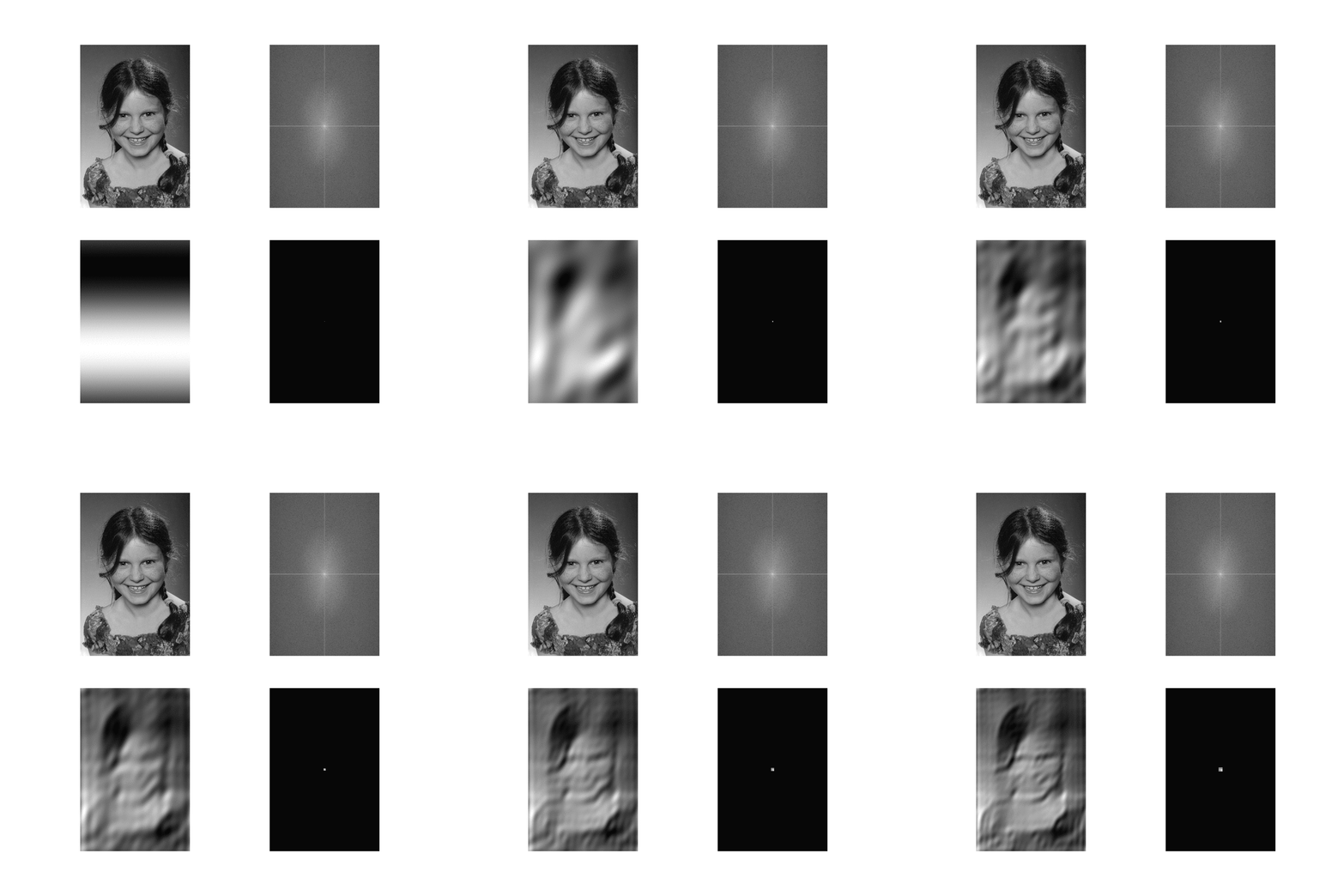
So, how do you compute with Wi-Fi in your bedroom? The basic premise is that waves already perform computations as they mix with each other, it's just that those computations are random unless we make some effort to control them. When two waves overlap, we measure the combination of the two: the amplitude of one wave is added to the amplitude of the other. Depending on the history of the two waves, one may have a negative amplitude, while the other may have a positive amplitude, allowing for simple computation. The idea here is to control the path that each wave takes so that, when they're added together, they perform the exact computation that we want them to. The classic example is the Fourier transform. A Fourier transform takes an object and breaks it down into a set of waves. If these waves are added together, the object is rebuilt. You can see an example of this in the animation here. -
Facebook's Phone-Free, Wireless 'Oculus Go' VR Headset Is Released Today
UnknownSoldier writes: The Oculus Go is finally available for purchase. Amazon is selling the 32GB model for $199, while the 64GB model is selling for $249. As a standalone virtual reality unit, it doesn't require a computer or phone to use. Ironically, you must use a phone for the initial setup. Reviews are out on The Verge and Ars Technica. The TL;DR -- Pros: Inexpensive; Cons: LCD, fixed 72 Hz rate, limited motion tracking. Will 2018 finally will be the year of cheap VR? -
Comcast Won't Give New Speed Boost To Internet Users Who Don't Buy TV Service (arstechnica.com)
An anonymous reader quotes a report from Ars Technica: Last week, Comcast announced speed increases for customers in Houston and the Oregon/SW Washington areas. The announcement headlines were "Comcast increases Internet speeds for some video customers." Customers with 60Mbps Internet download speeds are being upped to 150Mbps; 150Mbps subscribers are going to 250Mbps; and 250Mbps subscribers are getting a raise to 400Mbps or 1Gbps. Comcast says speed increases will kick in automatically without raising the customers' monthly bills -- but only if they subscribe to certain bundles that include both Internet and TV service.
"Cord cutters are not invited to the [speed increase] party," the Houston Chronicle wrote. "Only those who bundle Internet with cable television and other services... will see their speeds go up at no extra charge." Presumably, Internet-only customers can get the new speeds by paying more or by bundling their Internet subscriptions with video. -
Man Sues Nation For Allegedly Seizing France.com, a Domain He Has Owned For Over 20 Years (arstechnica.com)
A French-born American has now sued his home country because, he claims, the Ministry of Foreign Affairs has illegally seized a domain that he's owned since 1994: France.com. From a report: In the mid-1990s, Jean-Noel Frydman bought France.com from Web.com and set up a website to serve as a "digital kiosk" for Francophiles and Francophones in the United States. For over 20 years, Frydman built up a business (also known as France.com), often collaborating with numerous official French agencies, including the Consulate General in Los Angeles and the Ministry of Foreign Affairs. However, sometime around 2015, that very same ministry initiated a lawsuit in France in an attempt to wrest control of the France.com domain away from Frydman.
Web.com locked the domain, and Frydman even roped in the Berkman Klein Center at Harvard Law School to intervene on his behalf. By September 2017, the Paris Court of Appeals ruled that France.com was violating French trademark law. Armed with this ruling, lawyers representing the French state wrote to Web.com demanding that the domain be handed over. Finally, on March 12, 2018, Web.com abruptly transferred ownership of the domain to the French Ministry of Foreign Affairs. The company did so without any formal notification to Frydman and no compensation. "I'm probably [one of Web.com's] oldest customers," Frydman told ArsTechnica. "I've been with them for 24 years... There's never been any cases against France.com, and they just did that without any notice. I've never been treated like that by any company anywhere in the world. If it happened to me, it can happen to anyone." -
In First, Doctors Treat Rare Genetic Disorder With an Injection In Utero (arstechnica.com)
An anonymous reader quotes a report from Ars Technica: Three babies with a rare genetic disorder have been spared the worst effects of their condition thanks to an experimental injection they received in utero, researchers report this week in The New England Journal of Medicine. The success marks the first time a genetic disorder has been partially reversed by such a treatment prior to birth. The in utero injections treated a rare, recessive genetic condition called X-linked hypohidrotic ectodermal dysplasia (XLHED), which affects the development of skin, hair, nails, and teeth. People with the disorder have sparse body and head hair, dry eyes, mouths, and airways, and few teeth, which are usually pointy. But most dangerously, the condition also disrupts development of sweat glands throughout the body. People with XLHED have fewer sweat glands and/or poorly functioning ones. This leaves individuals vulnerable to high fevers and over-heating (hyperthermia), which can be life-threatening and lead to medical complications.
For the new experimental treatment, the researchers realized that it all came down to timing. Humans develop sweat glands much earlier in their development, generally between the 20th and 30th week of pregnancy. To prevent XLHED from wreaking havoc, the researchers needed to deliver the protein prior to birth. After testing the idea for safety and efficacy in mice and monkeys, doctors in Germany got a compassionate-use approval to try it in a 38-year-old pregnant woman. She had a family history of XLHED, a young son with the condition, and was found to be carrying twin boys with it, too. [...] The researchers will track the babies' development to see if the effects are permanent, but data from animals suggests that they will be. -
NASA To Pay More For Less Cargo Delivery To the Space Station (arstechnica.com)
A new report from NASA's inspector general, Paul Martin, finds that NASA will pay significantly more for commercial cargo delivery to the ISS in the 2020s rather than enjoying cost savings from maturing systems. "NASA will likely pay $400 million more for its second round of delivery contracts from 2020 to 2024 even though the agency will be moving six fewer tons of cargo," reports Ars Technica. "On a cost per kilogram basis, this represents a 14-percent increase." From the report: One of the main reasons for this increase, the report says, is a 50-percent increase in prices from SpaceX, which has thus far flown the bulk of missions for NASA's commercial cargo program with its Dragon spacecraft and Falcon 9 rocket. This is somewhat surprising because, during the first round of supply missions, which began in 2012, SpaceX had substantially lower costs than NASA's other partner, Orbital ATK. SpaceX and Orbital ATK are expected to fly 31 supply missions between 2012 and 2020, the first phase of the supply contract. Of those, the new report states, SpaceX is scheduled to complete 20 flights at an average cost of $152.1 million per mission. Orbital ATK is scheduled to complete 11 missions at an average cost of $262.6 million per mission.
But that cost differential will largely evaporate in the second round of cargo supply contracts. For flights from 2020 to 2024, SpaceX will increase its price while Orbital ATK cuts its own by 15 percent. The new report provides unprecedented public detail about the second phase of commercial resupply contracts, known as CRS-2, which NASA awarded in a competitively bid process in 2016. SpaceX and Orbital ATK again won contracts (for a minimum of six flights), along with a new provider, Sierra Nevada Corp. and its Dream Chaser vehicle. Bids by Boeing and Lockheed Martin were not accepted. -
Tesla Autopilot Crisis Deepens With Loss of Third Autopilot Boss In 18 Months (arstechnica.com)
An anonymous reader quotes a report from Ars Technica: It is no secret that Tesla's Autopilot project is struggling. Last summer, we covered a report that Tesla was bleeding talent from its Autopilot division. Tesla Autopilot head Sterling Anderson quit Tesla at the end of 2016. His replacement was Chris Lattner, who had previously created the Swift programming language at Apple. But Lattner only lasted six months before departing last June. Now Lattner's replacement, Jim Keller, is leaving Tesla as well.
Keller was a well-known chip designer at AMD before he was recruited to lead Tesla's hardware engineering efforts for Autopilot in 2016. Keller has been working to develop custom silicon for Autopilot, potentially replacing the Nvidia chips being used in today's Tesla vehicles. When Lattner left Tesla last June, Keller was given broader authority over the Autopilot program as a whole. Keller's departure comes just weeks after the death of Walter Huang, a driver whose Model X vehicle slammed into a concrete lane divider in Mountain View, California. Tesla has said Autopilot was engaged at the time of the crash. Tesla has since gotten into public feuds with both Huang's family and the National Transportation Safety Board, the federal agency investigating the crash. "Today is Jim Keller's last day at Tesla, where he has overseen low-voltage hardware, Autopilot software and infotainment," Tesla said in a statement to Electrek. "Prior to joining Tesla, Jim's core passion was microprocessor engineering, and he's now joining a company where he'll be able to once again focus on this exclusively." -
Tesla Autopilot Crisis Deepens With Loss of Third Autopilot Boss In 18 Months (arstechnica.com)
An anonymous reader quotes a report from Ars Technica: It is no secret that Tesla's Autopilot project is struggling. Last summer, we covered a report that Tesla was bleeding talent from its Autopilot division. Tesla Autopilot head Sterling Anderson quit Tesla at the end of 2016. His replacement was Chris Lattner, who had previously created the Swift programming language at Apple. But Lattner only lasted six months before departing last June. Now Lattner's replacement, Jim Keller, is leaving Tesla as well.
Keller was a well-known chip designer at AMD before he was recruited to lead Tesla's hardware engineering efforts for Autopilot in 2016. Keller has been working to develop custom silicon for Autopilot, potentially replacing the Nvidia chips being used in today's Tesla vehicles. When Lattner left Tesla last June, Keller was given broader authority over the Autopilot program as a whole. Keller's departure comes just weeks after the death of Walter Huang, a driver whose Model X vehicle slammed into a concrete lane divider in Mountain View, California. Tesla has said Autopilot was engaged at the time of the crash. Tesla has since gotten into public feuds with both Huang's family and the National Transportation Safety Board, the federal agency investigating the crash. "Today is Jim Keller's last day at Tesla, where he has overseen low-voltage hardware, Autopilot software and infotainment," Tesla said in a statement to Electrek. "Prior to joining Tesla, Jim's core passion was microprocessor engineering, and he's now joining a company where he'll be able to once again focus on this exclusively."