Slashdot Mirror
Domain: arstechnica.net
Stories and comments across the archive that link to arstechnica.net.
Stories · 50
-
Windows Setup Error Messages Will Soon Actually Help Fix Problems (arstechnica.com)
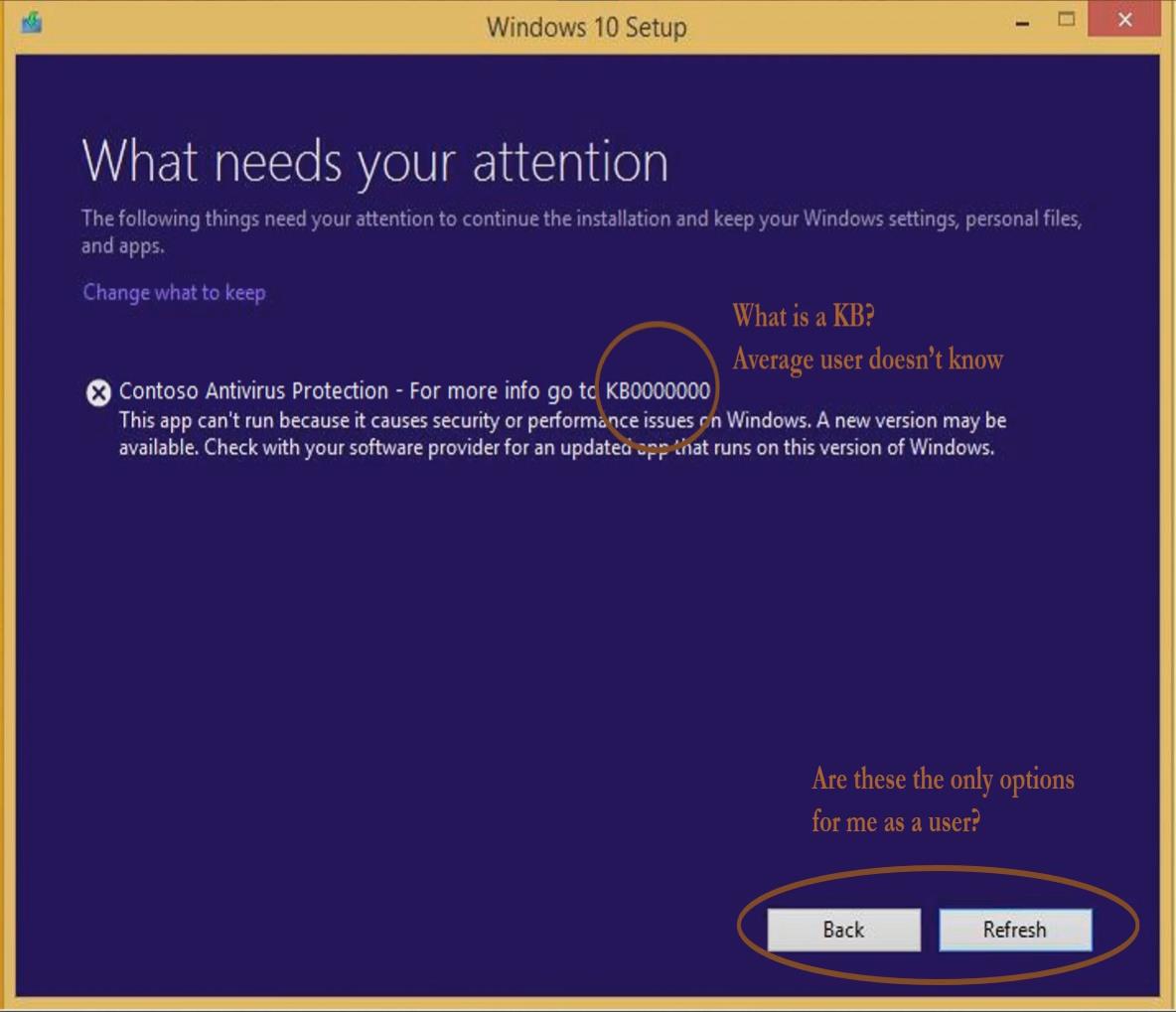
An anonymous reader quotes a report from Ars Technica: The next major Windows release, the Windows 10 April 2019 Update (codenamed 19H1), is going to offer some significant improvements [to error messages]. Microsoft described them on its Windows Insider webcast, and they were spotted initially by WinFuture. Currently, the best case during installation is something like this screen.
The message says that an incompatible application is detected, and a Knowledge Base article is referenced. It turns out that most Windows users don't know what "KBxxxxxxx" actually means, and the article isn't hyperlinked to make accessing it any easier. Issues detected through the other setup experience aren't much better. Windows will offer to uninstall problem applications, but often the better solution is to upgrade the application in question. The new setup process aims to be both more informative and more useful. The general approach is to allow decisions to be made within the setup program where possible and to put meaningful descriptions in the error messages, rather than leaving people with just a KB number to go on. Further, the "learn more" links will take you directly to the relevant Knowledge Base article, rather than hoping that end users know what "KBxxxxxxxx" means. Third-party developers will also be able to provide information about upgrades and updates when applicable to resolving compatibility issues. -
Ajit Pai Helped Charter Kill Consumer-Protection Rules In Minnesota (arstechnica.com)
An anonymous reader quotes a report from Ars Technica: A court ruling that limits state regulation of cable company offerings was praised by Federal Communications Commission Chairman Ajit Pai, who says the ruling supports his contention that the FCC can preempt state-level net neutrality rules. The new court ruling found that Minnesota's state government cannot regulate VoIP phone services offered by Charter and other cable companies because VoIP is an "information service" under federal law. Pai argues that the case is consistent with the FCC's attempt to preempt state-level net neutrality rules, in which the commission reclassified broadband as a Title I information service instead of a Title II telecommunications service.
The ruling was issued Friday by the US Court of Appeals for the 8th Circuit, following a lawsuit filed by Charter Communications against the Minnesota Public Utilities Commission (MPUC). A three-judge panel ruled against Minnesota in a 2-1 vote -- the FCC had filed a brief supporting Charter's position in the case. "[F]ederal law for decades has recognized that states may not regulate information services," Pai said in response to the ruling. "The 8th Circuit's decision is important for reaffirming that well-established principle: '[A]ny state regulation of an information service conflicts with the federal policy of non-regulation' and is therefore preempted." Pai said the ruling "is wholly consistent with the approach the FCC has taken under Democratic and Republican Administrations over the last two decades, including in last year's Restoring Internet Freedom order." The commission says the reclassification should preempt any such attempts at regulating broadband at the state level. -
Researchers Want To Turn Your Entire House Into a Co-Processor Using the Local Wi-Fi Signal (arstechnica.com)
An anonymous reader shares an excerpt from a report via Ars Technica: Researchers are proposing an idea to make your computer bigger. They are suggesting an extreme and awesome form of co-processing. They want to turn your entire house into a co-processor using the local Wi-Fi signal. Why, you may be asking, do we even want to do this in the first place? The real answer is to see if we can. But the answer given to funding agencies is thermal management. In a modern processor, if all the transistors were working all the time, it would be impossible to keep the chip cool. Instead, portions of the chip are put to sleep, even if that might mean slowing up a computation. But if, like we do with video cards, we farm out a large portion of certain calculations to a separate device, we might be able to make better use of the available silicon.
So, how do you compute with Wi-Fi in your bedroom? The basic premise is that waves already perform computations as they mix with each other, it's just that those computations are random unless we make some effort to control them. When two waves overlap, we measure the combination of the two: the amplitude of one wave is added to the amplitude of the other. Depending on the history of the two waves, one may have a negative amplitude, while the other may have a positive amplitude, allowing for simple computation. The idea here is to control the path that each wave takes so that, when they're added together, they perform the exact computation that we want them to. The classic example is the Fourier transform. A Fourier transform takes an object and breaks it down into a set of waves. If these waves are added together, the object is rebuilt. You can see an example of this in the animation here. -
CenturyLink Fights Billing-Fraud Lawsuit By Claiming That It Has No Customers (arstechnica.com)
An anonymous reader quotes a report from Ars Technica: CenturyLink is trying to force customers into arbitration in order to avoid a class-action lawsuit from subscribers who say they've been charged for services they didn't order. To do so, CenturyLink has come up with a surprising argument -- the company says it doesn't have any customers. While the customers sued CenturyLink itself, the company says the customers weren't actually customers of CenturyLink. Instead, CenturyLink says they were customers of 10 subsidiaries spread through the country. CenturyLink basically doesn't exist as a service provider -- according to a brief CenturyLink filed Monday.
"That sole defendant, CenturyLink, Inc., is a parent holding company that has no customers, provides no services, and engaged in none of the acts or transactions about which Plaintiffs complain," CenturyLink wrote. "There is no valid basis for Defendant to be a party in this Proceeding: Plaintiffs contracted with the Operating Companies to purchase, use, and pay for the services at issue, not with CenturyLink, Inc." CenturyLink says those operating companies should be able to intervene in the case and "enforce class-action waivers," which would force the customers to pursue their claims via arbitration instead of in a class-action lawsuit. By suing CenturyLink instead of the subsidiaries, "it may be that Plaintiffs are hoping to avoid the arbitration and class-action waiver provisions," CenturyLink wrote. -
Budget Deal Has Tax Credit Extensions For Nuclear, Fuel Cells, Carbon Capture (arstechnica.com)
An anonymous reader quotes a report from Ars Technica: A two-year budget deal was approved by the House and the Senate this morning and signed by President Trump a few hours later. The budget (PDF) included a slew of tax credit extensions that will affect how the energy industry plans its next two years. Most notably, the deal extended a $0.018 per-kWh credit for nuclear power plants over 6,000MW -- a tax credit that is primarily going to benefit one project in the US. That project is the construction of two new reactors at the Georgia Vogtle nuclear power plant.
Interestingly, a bipartisan effort to increase and extend tax credits for carbon sequestration passed through this budget. The bill was pushed through by Senators Heidi Heitkamp (D-N.D.), Shelley Moore Capito (R-W.V.), Sheldon Whitehouse (D-R.I.), and John Barrasso (R-Wyo.). The bill would offer a tax credit per ton of carbon dioxide that is captured and either sequestered, used for another end product, or used for enhanced oil recovery. The credit applies to any facility that started carbon capture construction within the past seven years, and the credit extends for 12 years.
While the budget deal leaves the federal tax credit scheme for electric vehicles unchanged (automakers can still entice buyers with a $7,500 credit for the first 200,000 electric vehicles that roll off that automaker's line), the budget did include and extend some interesting tax credits for other kinds of non-traditional energy. Fuel cell vehicles saw an extension of tax credits that will allow purchasers of new cars a tax credit of between $4,000 and $40,000, depending on the weight of the vehicle (this is probably good news for potential customers of Nikola's in-development fuel-cell semis). Non-hydrogen alternative fuel infrastructure also scored, as the new budget lets installers of infrastructure for alternative fuels like biodiesel and natural gas deduct 30 percent of the cost of installing the new pumps. Two-wheeled electric vehicle buyers will also see a 10-percent credit extended (though that credit has a $2,500 cap). Per-gallon biodiesel and renewable diesel credits that expired at the end of 2017 will continue. -
AT&T and Comcast Finalize Court Victory Over Nashville and Google Fiber (arstechnica.com)
"AT&T and Comcast have solidified a court victory over the metro government in Nashville, Tennessee, nullifying a rule that was meant to help Google Fiber compete against the incumbent broadband providers," reports Ars Technica. From the report: The case involved Nashville's "One Touch Make Ready" ordinance that was supposed to give Google Fiber and other new ISPs faster access to utility poles. The ordinance let a single company make all of the necessary wire adjustments on utility poles itself instead of having to wait for incumbent providers like AT&T and Comcast to send work crews to move their own wires. But AT&T and Comcast sued the metro government to eliminate the rule and won a preliminary victory in November when a U.S. District Court judge in Tennessee nullified the rule as it applies to poles owned by AT&T and other private parties.
The next step for AT&T and Comcast was overturning the rule as it applies to poles owned by the municipal Nashville Electric Service (NES), which owns around 80 percent of the Nashville poles. AT&T and Comcast achieved that on Friday with a new ruling from U.S. District Court Judge Aleta Trauger. Nashville's One Touch Make Ready ordinance "is ultra vires and void or voidable as to utility poles owned by Nashville Electric Service because adoption of the Ordinance exceeded Metro Nashville's authority and violated the Metro Charter," the ruling said. Nashville is "permanently enjoined from applying the Ordinance to utility poles owned by Nashville Electric Service." The Nashville government isn't planning to appeal the decision, a spokesperson for Nashville Mayor Megan Barry told Ars today. -
AT&T, Comcast Lawsuit Has Nullified a City's Broadband Competition Law (arstechnica.com)
An anonymous reader quotes a report from Ars Technica: AT&T and Comcast have convinced a federal judge to nullify an ordinance that was designed to bring more broadband competition to Nashville, Tennessee. The Nashville Metro Council last year passed a "One Touch Make Ready" rule that gives Google Fiber or other new ISPs faster access to utility poles. The ordinance lets a single company make all of the necessary wire adjustments on utility poles itself, instead of having to wait for incumbent providers like AT&T and Comcast to send work crews to move their own wires. AT&T and Comcast sued the metro government in U.S. District Court in Nashville, claiming that federal and local laws preempt the One Touch Make Ready rule. Judge Victoria Roberts agreed with AT&T and Comcast in a ruling issued Tuesday. Google Fiber is offering service in Nashville despite saying last year that it was waiting for access to thousands of utility poles. "We're reviewing [the] court ruling to understand its potential impact on our build in Nashville," a Google spokesperson said this week, according to The Tennessean. "We have made significant progress with new innovative deployment techniques in some areas of the city, but access to poles remains an important issue where underground deployment is not a possibility." -
Tesla Faces Labor Board Complaint Alleging Interference With Unionization (arstechnica.com)
According to Ars Technica, a federal labor board on Thursday "filed a complaint against Tesla, alleging that the electric vehicle company had discouraged workers from distributing pro-union information, stopped them from talking about employee safety to the United Auto Workers (UAW) union, and in one case, prevented an employee from taking a picture of the Confidentiality Agreement they had to sign." From the report: The Oakland, California-based regional office of the National Labor Relations Board (NLRB) consolidated the complaints of three former Tesla employees, Michael Sanchez, Jonathan Galescu, and Richard Ortiz, as well as complaints made by UAW. The complaint alleges that on numerous occasions between February 2017 and May 2017, security guards and human resources agents working on behalf of Tesla told employees that they had to leave the Fremont, California, factory premises because they were distributing pro-union leaflets. In addition, one employee says that over the course of two meetings, a Human Resources Business Partner and an Environmental Health Safety and Sustainability Specialist "interrogated the employee about the employee's Union and/or protected, concerted activities," as well as the pro-union activities of other employees. In March, the complaint claims, a supervisor told his employees during a pre-shift meeting that they could not distribute any stickers or pamphlets that hadn't been approved by Tesla first, or they would be fired. In another incident, a Human Resources Business Partner allegedly "attempted to prohibit an employee from discussing safety concerns with other employees and/or with the Union." -
Judge Dismisses AT&T's Attempt To Stall Google Fiber Construction In Louisville (arstechnica.com)
An anonymous reader quotes a report from Ars Technica: AT&T has lost a court case in which it tried to stall construction by Google Fiber in Louisville, Kentucky. AT&T sued the local government in Louisville and Jefferson County in February 2016 to stop a One Touch Make Ready Ordinance designed to give Google Fiber and other new ISPs quicker access to utility poles. But yesterday, U.S. District Court Judge David Hale dismissed the lawsuit with prejudice, saying AT&T's claims that the ordinance is invalid are false. "We are currently reviewing the decision and our next steps," AT&T said when contacted by Ars today. One Touch Make Ready rules let ISPs make all of the necessary wire adjustments on utility poles themselves instead of having to wait for other providers like AT&T to send work crews to move their own wires. Without One Touch Make Ready rules, the pole attachment process can cause delays of months before new ISPs can install service to homes. Google Fiber has continued construction in Louisville despite the lawsuit and staff cuts that affected deployments in other cities. -
New Windows Look and Feel, Neon, Is Officially the 'Microsoft Fluent Design System' (arstechnica.com)
An anonymous reader quotes a report from Ars Technica: Earlier this year, pictures of a new Windows look and feel leaked. Codenamed Project Neon, the new look builds on Microsoft Design Language 2 (MDL2), the styling currently used in Windows 10, to add elements of translucency and animation. Neon has now been officially announced, and it has an official new name: the Microsoft Fluent Design System. The switch from "design language" to "design system" is deliberate; Fluent is intended to define more than just the appearance, but also the interactivity. Though visually there are common elements, the system is designed to work across virtual/augmented reality, phones, tablets, desktop PCs, games consoles, using mice, keyboards, motion controllers, voice, gestures, touch, and pen, with the interactivity and input optimized to each particular form factor. Fluent is described as having five "fundamentals": light, depth, motion, material, and scale. "Light" means that the interface should avoid distracting and strive to ensure that attention is drawn to where it needs to be. With "depth," Fluent apps will make greater use of layering and the relationships between objects and interface elements. Fluent will use "motion" to indicate relationships and connections between elements, establishing context. Microsoft is using "Material" to mean making best use of the screen space and giving room to content. "Scale" means building interfaces that can go beyond two dimensions, and go beyond the size of a screen, to embrace new form factors and input methods as they arrive. -
Microsoft Teases Windows 10's Upcoming 'Project Neon' Design Language (windowscentral.com)
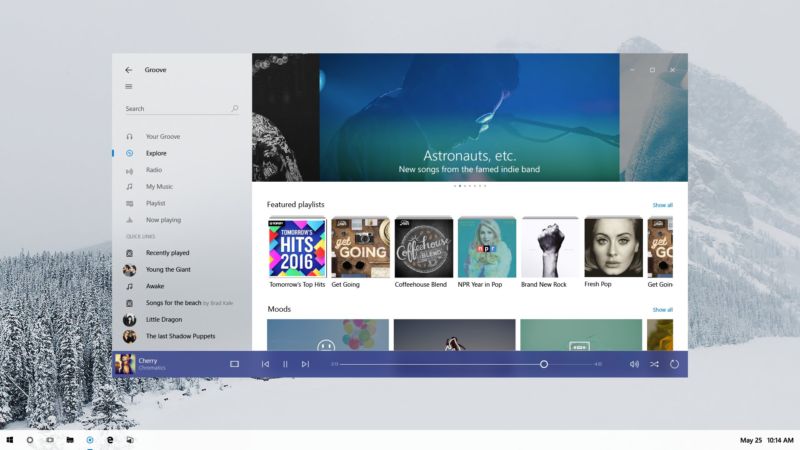
An anonymous reader quotes a report from Windows Central: Microsoft just gave developers a sneak peek at Project Neon, Microsoft's upcoming design language for Windows 10 that aims to add fluidity, animation and blur to apps and the operating system. We exclusively revealed that this was in the works in late 2016, and today Microsoft has given us a first peak at what Project Neon will look like. During the Windows Developer Day livestream, an image of Project Neon was seen the background of one of the PowerPoint slides being shown off on stage. Although not much, it's further confirmation that this is the end goal for Windows 10's UI, and Project Neon will be bringing a fresh coat of paint to apps. Project Neon should benefit all types of Windows 10 devices, including Windows 10 Mobile, HoloLens and even Xbox. We're still several months away from Project Neon being everywhere in Windows 10, and we're expecting to see more at BUILD this coming May. In fact, a lot of the Project Neon APIs are available in the latest Insider Preview builds of Windows 10, meaning developers can already begin taking advantage of these new user interfaces and design language! Animations and transitions are a big deal with Project Neon, with the goal of making the operating system and apps feel like they work together. Peter Bright does a good job summarizing the looks of the screenshot via Ars Technica: "The picture shows a refreshed version of the Groove music app on a Windows desktop. The fundamentals of the app and its layout aren't changed, underscoring that Neon is very much an iteration of the current Metro/Microsoft Design Language (MDL). The window has shed its discrete title bar and one pixel border, with the application content now extending to the very edge of the window. The search text field no longer has a box around it, and the left hand pane has a hint of translucency to it." You can view the screenshot here and judge it for yourself. -
New Analysis Shows Lamar Smith's Accusations On Climate Data Are Wrong (arstechnica.com)
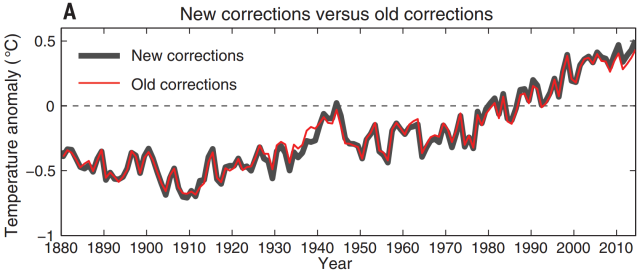
Layzej writes from a report via Ars Technica: In 2015, NOAA released version 4 of their marine temperature dataset called ERSST. The new dataset accounted for a known cooling bias introduced when ocean temperature measurements transitioned from being taken in ship engine intake valves to buoy-based measurements. The warming of the last couple decades increased ever so slightly in NOAA's new analysis. This was a red flag for U.S. House Science Committee Chair Lamar Smith (R-TX), who rejects the conclusions of climate science -- like the fact that the Earth's climate is warming. Suddenly he wanted to see the researchers' e-mails and echoed the accusations of contrarian blogs about scientists' supposedly nefarious adjustments to sea surface temperature measurements. Rather than invoking scientific conspiracies, issues like this should be settled by analyzing the data. A new study, led by University of California Berkeley's Zeke Hausfather, does just that -- and Rep. Smith won't like these results, either. To test the NOAA dataset, Zeke's team created instrumentally homogeneous temperature records from sensors available only over the last couple decades. As it happens, the Argo float data, the buoy data, and the satellite data each hew closer to the updated dataset that NOAA used. The older version (3b) gives a global average that is too cool in recent years, growing to an offset of about 0.06 degrees Celsius. The researchers repeat this same analysis for two more major sea surface datasets that are used by the UK Met Office and the Japanese Meteorological Agency for their global temperature records. Both of those datasets also drift cooler than the comparison data, but less so than NOAA's old dataset. -
Chicago Electronics Recycler Faked Tear-Downs, Sent Hazardous Waste To Overseas Landfills (arstechnica.com)
Federals agents have accused Brian Brundage, the former owner of Chicago-based electronics recycling company Intercon Solutions and current owner of EnviroGreen Processing, of fraud for failing to properly break down and recycle electronic devices according to federal guidelines. Brundage allegedly shipped Cathode Ray Tubes (CRTs) from old computer and TV monitors, which contained "hazardous amounts of lead," and batteries to overseas landfills for disposal. The leftover electronics that weren't shipped overseas were destroyed inappropriately at his businesses or stored in warehouses, which is forbidden by federal guidelines. Ars Technica reports: According to the indictment (PDF), Brundage also improperly resold many of the electronics he acquired. Between 2009 and 2015, Brundage received shipments of calculators from an unnamed technology company in Texas with instructions to disassemble the calculators and recycle them accordingly. But Brundage apparently resold the calculators to another company based in Tampa, Florida, which purchased and sold used electronics. In exchange for the shipments of calculators, Brundage allegedly had the company in Tampa directly pay some of Brundage's personal expenses. Those expense include between $31,000 and $39,000 per year for a nanny and $26,000 to $42,000 per year for a housekeeper, as well as tens of thousands of dollars for jewelry expenses and payments to an Indiana-based casino. Among the more colorful accusations in the US government's indictment of Brundage: the businessman allegedly went to lengths to fool third-party auditors into giving his companies the certifications necessary to keep doing business as an e-recycler. Brundage allegedly invited unknowing customers on sham tours of Intercon's facility. Once there, he "directed Intercon's warehouse staff to set up a staged disassembly line to make it falsely appear as though Intercon regularly processed e-waste in a manner that was consistent with its public representations." The Chicago Tribune published a feature on Intercon in 2007. In it, Brundage is quoted saying, "We put old products on a disassembly line. We break each item down to raw materials and send them off to be smelted and reused." He added, "nothing that leaves here goes to a landfill." -
AT&T Falsely Claimed Pro-Google Fiber Rule Is Invalid, FCC Says (arstechnica.com)
An anonymous reader quotes a report from Ars Technica: The Federal Communications Commission has given a helping hand to Louisville, Kentucky, in the city's attempt to enforce local rules that would make it easier for Google Fiber to compete against ATT. ATT sued the local government in Louisville and Jefferson County in February to stop a One Touch Make Ready (OTMR) ordinance designed to give Google Fiber or other new competitors faster access to utility poles. Today, the US government submitted a statement of interest (full text) on behalf of the FCC, which says that one of ATT's primary legal arguments is incorrect. ATT -- also known as BellSouth Telecommunications in Kentucky -- argued that the Louisville ordinance is preempted by the FCC's pole-attachment rules. The local ordinance "conflicts with the procedures created by the FCC, and upsets the careful balances struck by the FCC in crafting its pole attachment regulations," ATT's lawsuit said. But that is false, the FCC says. The FCC does have rules ensuring reasonable access to utility poles, but states are allowed to opt out of the federal pole-attachment rules if they certify to the commission that they regulate the rates, terms, and conditions of pole attachments. Kentucky is one of 20 states that has opted out of the federal regime and imposed its own rules, the FCC noted. Accordingly, the federal pole-attachment regulations enacted under Section 224 [of the Communications Act] simply do not apply here," the FCC wrote. More generally, One Touch Make Ready rules are consistent with federal communications policies and regulations that seek expanded broadband deployment, the FCC also wrote. -
Facebook Lets Advertisers Exclude Users By Race (propublica.org)
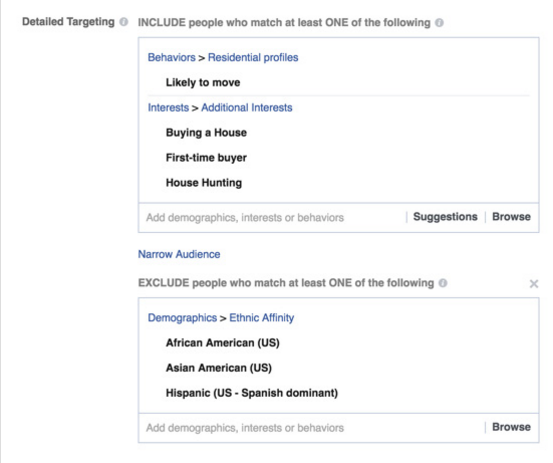
schwit1 quotes a report from ProPublica: Imagine if, during the Jim Crow era, a newspaper offered advertisers the option of placing ads only in copies that went to white readers. That's basically what Facebook is doing nowadays. The ubiquitous social network not only allows advertisers to target users by their interests or background, it also gives advertisers the ability to exclude specific groups it calls "Ethnic Affinities." Ads that exclude people based on race, gender and other sensitive factors are prohibited by federal law in housing and employment. You can view a screenshot of a housing advertisement that ProPublica's Julia Angwin and Terry Parris Jr. purchased from Facebook's self-service advertising portal here. The report adds: "The ad we purchased was targeted to Facebook members who were house hunting and excluded anyone with an "affinity" for African-American, Asian-American or Hispanic people. (Here's the ad itself.) The Fair Housing Act of 1968 makes it illegal "to make, print, or publish, or cause to be made, printed, or published any notice, statement, or advertisement, with respect to the sale or rental of a dwelling that indicates any preference, limitation, or discrimination based on race, color, religion, sex, handicap, familial status, or national origin." Violators can face tens of thousands of dollars in fines. The Civil Rights Act of 1964 also prohibits the "printing or publication of notices or advertisements indicating prohibited preference, limitation, specification or discrimination" in employment recruitment. Facebook's business model is based on allowing advertisers to target specific groups -- or, apparently to exclude specific groups -- using huge reams of personal data the company has collected about its users. Facebook's micro-targeting is particularly helpful for advertisers looking to reach niche audiences, such as swing-state voters concerned about climate change. Facebook says its policies prohibit advertisers from using the targeting options for discrimination, harassment, disparagement or predatory advertising practices. -
Comcast Sues Nashville To Halt Rules That Give Google Fiber Faster Access To Utility Poles (arstechnica.com)
An anonymous reader quotes a report from Ars Technica: Comcast yesterday sued the Nashville metro government and mayor to stop a new ordinance designed to give Google Fiber faster access to utility poles. Comcast's complaint in U.S. District Court in Nashville (full text) is similar to one already filed by AT&T last month. Both ISPs are trying to invalidate a One Touch Make Ready ordinance that lets new ISPs make all of the necessary wire adjustments on utility poles themselves instead of having to wait for incumbent providers like AT&T and Comcast to send work crews to move their own wires. The ordinance was passed largely to benefit Google Fiber, which is offering service in Nashville but says that it hasn't been able to deploy faster because it is waiting to get access to thousands of poles. Nearly all the Nashville utility poles are owned either by the municipal Nashville Electric Service or AT&T. Because Comcast has wires on many of the poles, it has some control over how quickly Google Fiber can expand its network. When Google Fiber wants to attach wires to a new pole, it needs to wait for ISPs like Comcast to move their wires to make room for Google Fiber's. The Nashville One Touch Make Ready ordinance "permits third parties to move, alter, or rearrange components of Comcast's communications network attached to utility poles without Comcast's consent, authorization, or oversight, and with far less notice than is required by federal law and by an existing Comcast contract with Metro Nashville," Comcast's complaint said. Comcast asked the court to declare the ordinance invalid and permanently enjoin Nashville from enforcing it. The pre-existing Make Ready process "seek[s] to ensure that all providers can share available pole space cooperatively and safely, without interfering with or damaging any provider's equipment or services," Comcast said. The new procedures mandated by Nashville "are so intrusive that, tellingly, Metro Nashville has wholly exempted its own utility pole attachments from the Ordinance's coverage." Even though Google Fiber announced yesterday that it will pause operations and cut 9% of its staff, the ISP said it would continue operations in Nashville. -
Judge Skewers Oracle Attorney For Revealing Google, Apple Trade Secrets (arstechnica.com)
An anonymous reader quotes a report from Ars Technica: The federal judge who presided over the Google-Oracle API copyright infringement trial excoriated one of Oracle's lawyers Thursday for disclosing confidential information in open court earlier this year. The confidential information included financial figures stating that Google generated $31 billion in revenue and $22 billion in profits from the Android operating system in the wake of its 2008 debut. The Oracle attorney, Annette Hurst, also revealed another trade secret: Google paid Apple $1 billion in 2014 to include Google search on iPhones. Judge William Alsup of San Francisco has been presiding over the copyright infringement trial since 2010, when Oracle lodged a lawsuit claiming that Google's Android operating system infringed Oracle's Java APIs. After two trials and various trips to the appellate courts, a San Francisco federal jury concluded in May that Google's use of the APIs amounted to fair use. Oracle's motion before Alsup for a third trial is pending. Oracle argues that Google tainted the verdict by concealing a plan to extend Android on desktop and laptop computers. As this legal saga was playing out, Hurst blurted out the confidential figures during a January 14 pre-trial hearing, despite those numbers being protected by a court order. The transcript of that proceeding has been erased from the public record. But the genie is out of the bottle. Google lodged a motion (PDF) for sanctions and a contempt finding against Hurst for unveiling a closely guarded secret of the mobile phone wars. During a hearing on that motion Thursday, Judge Alsup had a back-and-forth with Hurst's attorney, former San Francisco U.S. Attorney Melinda Haag. According to the San Francisco legal journal The Recorder, Haag said that her client Hurst -- of the law firm Orrick, Herrington and Sutcliffe -- should not be sanctioned because of "one arguable mistake made through the course of a very complex litigation." -
NYC Threatens To Sue Verizon Over FiOS Shortfalls (arstechnica.com)
An anonymous reader quotes a report from Ars Technica: New York City officials yesterday notified Verizon that the company is in default of an agreement to bring fiber connections to all households in the city and could file a lawsuit against the company. The road to a potential lawsuit has been a long one. In June 2015, New York released an audit that found Verizon failed to meet a commitment to extend FiOS to every household in the five boroughs by June 2014. City officials and Verizon have been trying to resolve the matter since then with no success, as Verizon says that it hasn't actually broken the agreement. The default letter (full text) sent yesterday by the city Department of Information Technology and Telecommunications (DoITT) says Verizon has failed to pass all residential buildings in the city with fiber. As of October 2015, there were at least 38,551 addresses where Verizon hadn't fulfilled installation service requests that were more than a year old, the letter said. "Moreover, Verizon improperly reduced, from $50 million to $15 million, the performance bond required [by] the Agreement on the basis of Verizon's incorrect representations that Verizon had met the prescribed deployment schedule, when in fact it had not," the letter said. City officials demanded that Verizon restore the bond and wants a response within 30 days. The default letter also accuses Verizon of failing to make records related to its provision of cable service available to the city during its audit. "Officials say they could sue Verizon unless the carrier shows clear plans for stepping up installations," and that the notice is the first step in that process, The Wall Street Journal reported. The citywide fiber agreement lets NYC seek monetary damages from Verizon if it fails to deliver on the fiber promises. -
Clinton's First Email Server Was a Power Mac Tower (arstechnica.com)
An anonymous reader shares with us an excerpt from a report via Ars Technica: As she was being confirmed as Secretary of State, Hillary Clinton contacted Colin Powell to ask him about his use of a Blackberry while in the same role. According to a Federal Bureau of Investigations memorandum published today (PDF), Powell warned Clinton that if it became public that she was using a Blackberry to "do business," her e-mails would be treated as "official" record and be subject to the law. "Be very careful," Powell said according to the FBI. "I got around it all by not saying much and not using systems that captured the data." Perhaps Clinton's troubles began when she switched from a Blackberry-hosted e-mail account to an account on her Clintonemail.com domain -- a domain hosted on an Apple Power Mac "G4 or G5" tower running in the Clintons' Chappaqua, New York residence. The switch to the Power Mac as a server occurred the same month she exchanged messages with Powell. The Power Mac, originally purchased in 2007 by former President Clinton's aide Justin Cooper, had acted as the server for presidentclinton.com and wjcoffice.com. Cooper managed most of the technology support for Bill Clinton and took charge of setting up Hillary Clinton's new personal mail system on the Power Mac, which sat alongside a firewall and network switching hardware in the basement of the Clintons' home. But the Power Mac was having difficulty handling the additional load created by Blackberry usage from Secretary Clinton and her staff, so a decision was made quickly to upgrade the server hardware. Secretary Clinton's deputy chief of staff at the State Department, Huma Abedin, connected Cooper with Brian Pagliano, who had worked in IT for the secretary's 2008 presidential campaign. Cooper inquired with Pagliano about getting some of the campaign's computer hardware as a replacement for the Power Mac, and Pagliano was in the process of selling the equipment off. -
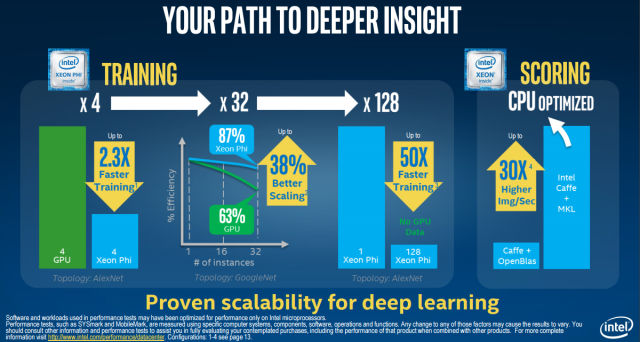
Nvidia Calls Out Intel For Cheating In Xeon Phi vs GPU Benchmarks (arstechnica.com)
An anonymous reader writes: Nvidia has called out Intel for juicing its chip performance in specific benchmarks -- accusing Intel of publishing some incorrect "facts" about the performance of its long-overdue Knights Landing Xeon Phi cards. Nvidia's primary beef is with the following Intel slide, which was presented at a high performance computing conference (ISC 2016). Nvidia disputes Intel's claims that Xeon Phi provides "2.3x faster training" for neural networks and that it has "38 percent better scaling" across nodes. It looks like Intel opted for the classic using-an-old-version-of-some-benchmarking-software manoeuvre. Intel claimed that a Xeon Phi system is 2.3 times faster at training a neural network than a comparable Maxwell GPU system; Nvidia says that if Intel used an up-to-date version of the benchmark (Caffe AlexNet), the Maxwell system is actually 30 percent faster. And of course, Maxwell is Nvidia's last-gen part; the company says a comparable Pascal-based system would be 90 percent faster. On the 38-percent-better-scaling point, Nvidia says that Intel compared 32 of its new Xeon Phi servers against four-year-old Nvidia Kepler K20 servers being used in ORNL's Titan supercomputer. Nvidia states that modern GPUs, paired with a newer interconnect, scale "almost linearly up to 128 GPUs." -
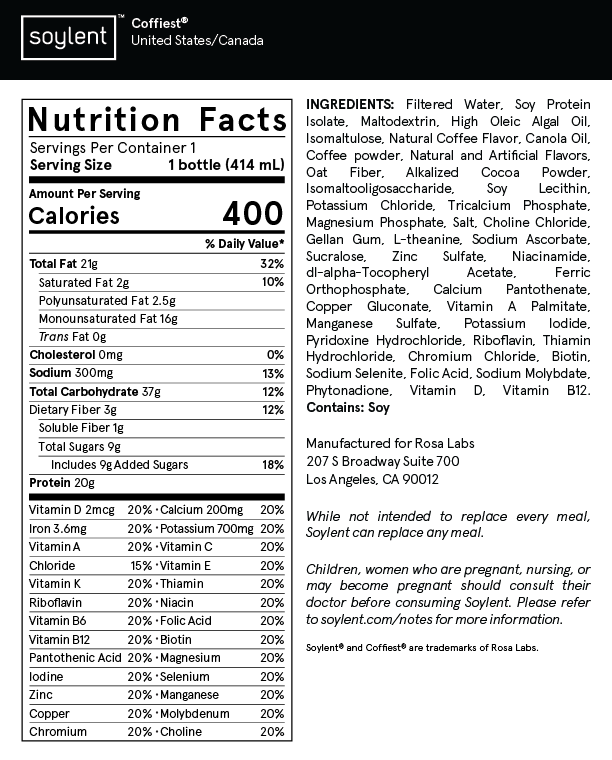
Soylent Coffee: Nootropics, Fat, Carbs, Protein -- But Will It Give You The Toots? (arstechnica.com)
An anonymous reader writes from a report via Ars Technica: Soylent has ventured in a new direction with its latest beverage: breakfast. Called Coffiest, the new offering has the same ingredient makeup, nutritional mix, and 47/33/20 percent fat/carb/protein calorie distribution as the 2.0 premixed version, but it also adds coffee flavoring, 150mg of caffeine per serving, and 75mg of the nootropic L-Theanine. According to Soylent founder Rob Rhinehart, a bottle of Coffiest supplies the drinker with about 400 kilocalories and about 20 percent of the daily recommended values for "all essential vitamins and minerals." "A lot of people are skipping breakfast," Rhinehart told Ars in a phone interview. "We wanted to provide a convenient and also really tasty option for them to enjoy in the morning." Additionally, the company will also be releasing a nutrition bar, called the Soylent Bar. This one will deliver 250 kilocalories per bar, and has a macronutrient breakdown of 38/43/19 percent fat/carb/protein. "Coffee flavor is extremely complex," Rhinehart told Ars. "The direction I gave was a little bit of a more darker, richer roast it's a little darker coffee. A little bit of cocoa powder, just a barely perceptible amount, but it rounds out the flavor nicely." "It was a huge challenge to develop a coffee flavor that would survive processing," he continued. "You can't take any risks with health or safety, so we have to eliminate any sources of contamination from the product and that involves heat. So we had some great food scientists and flavor scientists work out a flavor system that combines natural coffee extracts with an artificial flavor system. And it turned out pretty great." As for the toots, neither Coffiest nor the Soylent Bar will cause consumers to erupt with "horse-killing farts," a complaint made by many of Soylent's customers as well as Ars Technica writer Lee Hutchinson. For those interested in Soylent's latest concoction, Coffiest is available for purchase today at the Soylent site for about $40 for a pack of 12 servings (or $37.05 with a recurring subscription). The Soylent Bar will launch later for about $2 per bar. You can view Coffiest's nutrition facts here. -
Judge Rules FBI Violated Fourth Amendment By Recording 200+ Hours of Audio At A Courthouse (thenextweb.com)
An anonymous reader quotes a report from The Next Web: A federal judge in the Bay Area ruled that the FBI violated the fourth amendment by recording more than 200 hours of conversation at the entrance to a court house. Agents planted concealed microphones around the San Mateo County Courthouse in 2009 and 2010 as part of an investigation into bid-rigging at public auctions for foreclosed homes. In November, lawyers representing five defendants filed a motion that the recordings were unconstitutional on fourth amendment grounds (illegal search and seizure). U.S. District Judge Charles Breyer wrote in an order yesterday: [T]he government utterly failed to justify a warrantless electronic surveillance that recorded private conversations spoken in hushed tones by judges, attorneys, and court staff entering and exiting a courthouse. Even putting aside the sensitive nature of the location here, Defendants have established that they believed their conversations were private and they took reasonable steps to thwart eavesdroppers. The report continues: "The FBI originally used a cooperator wearing a wire to eavesdrop at auctions as well as an undercover agent posing as an investor. At some point though, the cooperating source 'soured' according to FBI testimony and it became 'typical behavior' for the accused to 'walk away from a larger group' and speak 'separate[ly] from [the] informant and undercover agent.' The FBI then adopted the new technique, bugging the courthouse and collecting more than 200 hours of audio over a nine month span. The problem, as pointed out by Judge Breyer, was: '[The FBI was] capturing the conversations of anyone who entered or exited the employee entrance of the courthouse... The FBI never sought judicial authorization for this program.'" -
Frontier Teams With AT&T To Block Google Fiber Access To Utility Poles (arstechnica.com)
An anonymous reader writes from a report via Ars Technica: Frontier submitted a court filing last week supporting ATT's efforts to sue local governments in Louisville and Jefferson County, Kentucky to stop a new ordinance designed to give Google Fiber and similar companies access to utility poles. They're concerned the ordinances will spread to other states. Frontier's filing said, "the issues raised by the case may have important implications for Frontier's business and may impact the development of law in jurisdictions throughout the country where Frontier operates." The ordinance in Louisville lets companies like Google Fiber install wires even if ATT doesn't respond to requests or rejects requests to attach lines. Companies don't have to notify ATT when they want to move ATT's wires to make room for their own wires, assuming the work won't cause customer outages. ATT claims that the ordinance lets competitors "seize ATT's property." Frontier is urging the court to consider the nationwide implications of upholding Louisville's ordinance, saying Louisville's rule "is unprecedented" because "it drastically expands the rights of third parties to use privately owned utility poles, giving non-owners unfettered access to [a] utility's property without the [...] utility in some cases even having knowledge that such third-party intrusion on its facilities is occurring." Frontier said companies should be required to negotiation access with the owners if they didn't pay to install the utility poles. They urged the court to deny Louisville Metro's motion to dismiss ATT's complaint. -
Clinton's Private Email Was Blocked By Spam Filters, So State IT Turned Them Off (arstechnica.com)
An anonymous reader quotes a report from Ars Technica: Documents recently obtained by the conservative advocacy group Judicial Watch show that in December 2010, then-U.S. Secretary of State Hillary Clinton and her staff were having difficulty communicating with State Department officials by e-mail because spam filters were blocking their messages. To fix the problem, State Department IT turned the filters off -- potentially exposing State's employees to phishing attacks and other malicious e-mails. The mail problems prompted Clinton Chief of Staff Huma Abedin to suggest to Clinton (PDF), "We should talk about putting you on State e-mail or releasing your e-mail address to the department so you are not going to spam." Clinton replied, "Let's get [a] separate address or device but I don't want any risk of the personal [e-mail] being accessible." The mail filter system -- Trend Micro's ScanMail for Exchange 8 -- was apparently causing some messages from Clinton's private server (Clintonemail.com) to not be delivered (PDF). Some were "bounced;" others were accepted by the server but were quarantined and never delivered to the recipient. According to the e-mail thread published yesterday by Judicial Watch, State's IT team turned off both spam and antivirus filters on two "bridgehead" mail relay servers while waiting for a fix from Trend Micro. There was some doubt about whether Trend Micro would address the issue before State performed an upgrade to the latest version of the mail filtering software. A State Department contractor support tech confirmed that two filters needed to be shut off in order to temporarily fix the problem -- a measure that State's IT team took with some trepidation, because the filters had "blocked malicious content in the recent past." It's not clear from the thread that the issue was ever satisfactorily resolved, either with SMEX 8 or SMEX 10. -
Clinton's Private Email Was Blocked By Spam Filters, So State IT Turned Them Off (arstechnica.com)
An anonymous reader quotes a report from Ars Technica: Documents recently obtained by the conservative advocacy group Judicial Watch show that in December 2010, then-U.S. Secretary of State Hillary Clinton and her staff were having difficulty communicating with State Department officials by e-mail because spam filters were blocking their messages. To fix the problem, State Department IT turned the filters off -- potentially exposing State's employees to phishing attacks and other malicious e-mails. The mail problems prompted Clinton Chief of Staff Huma Abedin to suggest to Clinton (PDF), "We should talk about putting you on State e-mail or releasing your e-mail address to the department so you are not going to spam." Clinton replied, "Let's get [a] separate address or device but I don't want any risk of the personal [e-mail] being accessible." The mail filter system -- Trend Micro's ScanMail for Exchange 8 -- was apparently causing some messages from Clinton's private server (Clintonemail.com) to not be delivered (PDF). Some were "bounced;" others were accepted by the server but were quarantined and never delivered to the recipient. According to the e-mail thread published yesterday by Judicial Watch, State's IT team turned off both spam and antivirus filters on two "bridgehead" mail relay servers while waiting for a fix from Trend Micro. There was some doubt about whether Trend Micro would address the issue before State performed an upgrade to the latest version of the mail filtering software. A State Department contractor support tech confirmed that two filters needed to be shut off in order to temporarily fix the problem -- a measure that State's IT team took with some trepidation, because the filters had "blocked malicious content in the recent past." It's not clear from the thread that the issue was ever satisfactorily resolved, either with SMEX 8 or SMEX 10. -
Court Stops FCC's Latest Attempt To Lower Prison Phone Rates (arstechnica.com)
An anonymous reader quotes a report from Ars Technica: Prison phone companies have convinced a court to halt new rate caps on inmate calling for the second time this month. The first stay was issued March 7 and prevented the FCC from implementing new rate caps of 11 cents to 22 cents per minute on both interstate and intrastate calls from prisons. But the stay -- which remains in place while the prison phone companies' lawsuit against the FCC is still pending -- did not disturb an earlier "interim" cap of 21 cents to 25 cents per minute that applied only to interstate calls, those that cross state lines. The order also didn't specifically object to the FCC changing its definition of "inmate calling service" to include both interstate and intrastate calls. Seizing on this ambiguity, the FCC decided that it could impose the interim caps on both interstate and intrastate calls. But prison phone companies Securus Technologies, Global Tel Link (GTL), and Telmate all asked the federal appeals court to stop the caps from being applied to intrastate calls. A court order issued Wednesday sided with the prison phone companies, saying that "petitioners have satisfied the stringent requirements for a stay pending court review." As a result, the interim rate caps will still apply only to interstate calls. -
AT&T Defeats Class Action In Unlimited Data Throttling Case (arstechnica.com)
An anonymous reader writes from an Ars Technica article: Customers who sued ATT over its practice of throttling unlimited data plans will not be able to pursue a class-action lawsuit against the company. ATT argued that the customers could not only have their complaints heard individually in arbitration, and Judge Edward Chen of US District Court in Northern California has sided with the cellular company. Chen accepted ATT's argument, noting that the Supreme Court previously upheld ATT's arbitration provision in a 2011 decision. In the 2011 case, ATT Mobility v. Concepcion, the Supreme Court found that the Federal Arbitration Act preempted a California state law that limited the power of companies to force customers into arbitration. [Chen's ruling granting ATT's motion to compel arbitration was issued on February 29 and highlighted in a MediaPost article Friday.] "Plaintiffs argue that the Concepcion Court never addressed the specific issues now raised -- i.e., that enforcement of the arbitration agreements would violate their rights as protected by the Petition Clause of the First Amendment," Chen wrote. "Because there is no state action in the instant case, Plaintiffs lack a viable First Amendment challenge to the arbitration agreements. As Plaintiffs have not challenged the arbitration agreements on any other bases, the Court grants ATT's motion to compel arbitration."
ATT is still being punished by the FCC and FTC. Ars Technica writes, "The FCC last year proposed a $100 million fine to punish ATT for throttling the wireless Internet connections of customers with unlimited data plans without adequately notifying the customers about the reduced speeds. Separately, the FTC sued ATT in an attempt to gain millions of dollars worth of refunds for customers who paid for unlimited data and had their speeds throttled." -
Court: 'Repugnant' Online Discussions Aren't Thoughtcrime (arstechnica.com)
An anonymous reader writes: The U.S. 2nd Circuit Court of Appeals has issued a ruling in favor of former NYPD officer Gilberto Valle — the so-called "cannibal cop." In 2012, Valle was fired and arrested for going online and talking about his fantasies, which included kidnapping, murder, sexual assault, and cannibalism. He was later convicted in a jury trial. A district court judge overturned the conviction, but the government appealed, hoping to make it stick. The Appeals Court has now affirmed Valle's acquittal. In the ruling (PDF), the court notes, "We are loathe to give the government the power to punish us for our thoughts and not our actions. That includes the power to criminalize an individual's expression of sexual fantasies, no matter how perverse or disturbing. Fantasizing about committing a crime, even a crime of violence against a real person whom you know, is not a crime." The court also addressed the government's questionable efforts to use the Computer Fraud and Abuse Act to increase the severity of Valle's punishment: "While the Government might promise that it would not prosecute an individual for checking Facebook at work, we are not at liberty to take prosecutors at their word in such matters." -
Appeals Court Bans Features From Older Samsung Phones
walterbyrd writes with news that Apple has finally emerged victorious in a long-standing patent case against Samsung — though it's more of a moral victory than a practical one. Samsung is no longer allowed to sell some of its older phones unless the company disables features that infringe upon Apple patents. "The market impact will likely be limited, since the lawsuit was filed in 2012 and covers products that came out that year, like the Galaxy S3. Furthermore, software updates to Samsung software mean that the patents may not be infringed anymore. For instance, Samsung's Android phones no longer use a 'slide to unlock' feature on the bottom of the phone. In dissent, U.S. Circuit Judge Sharon Prost paints a sharply different picture (PDF) from the majority. 'This is not a close case,' she writes, noting that Apple's patents cover a spelling correction feature it doesn't use, and two others cover 'minor features' out of 'many thousands.'" -
IMAX Tries To Censor Ars Technica Over SteamVR Comparison
Cutting_Crew writes: An article published last week at Ars Technica looked at the SteamVR virtual reality headset created by Valve. Contained in the article is a quote from game designer Alex Schwartz, who said in reference to the device, "The jump between a regular game and playing a room scale VR experience is X times 100. It’s like saying, 'I have an IMAX theater in my house.' It’s so much better that we can get away with a cumbersome setup." Now, for that single quoted reference, IMAX has sent a trademark complaint to Ars and demanded that they take the story down. "The company said our story required a retraction because it included a brief reference to IMAX—included without IMAX's permission. 'Any unauthorized use of our trademark is expressly forbidden.'"
If you look at the letter from IMAX (PDF), you'll see they think the reference to IMAX is "misleading to readers." They further request that "all future articles regarding this "room-scale" virtual reality system make no reference to our registered trademark." Apparently, IMAX has never heard of the Streisand Effect. Update: 06/19 19:26 GMT by S : IMAX has apologized. -
Learning About Constitutional Law With Star Wars
An anonymous reader writes: In an upcoming paper (PDF) for the Michigan Law Review, scholar Cass Sunstein draws on Star Wars to make a couple key points about how constitutional law evolves. He writes, "Human beings often see coherence and planned design when neither exists. This is so in movies, literature, history, economics, and psychoanalysis—and constitutional law. Contrary to the repeated claims of George Lucas, its principal author, the Star Wars series was hardly planned in advance; it involved a great deal of improvisation and surprise, even to Lucas himself. Serendipity and happenstance, sometimes in the forms of eruptions of new thinking, play a pervasive and overlooked role in the creative imagination, certainly in single-authored works, and even more in multi-authored ones extending over time. ... The misdescription appears to respond to a serious human need for sense-making and pattern-finding, but it is a significant obstacle to understanding and critical reflection. Whether Jedi or Sith, many authors of constitutional law are a lot like the author of Star Wars, disguising the essential nature of their own creative processes." -
Judge: Warrantless Airport Seizure of Laptop 'Cannot Be Justified'
SonicSpike writes with news of a ruling in U.S. District Court that the seizure and search of a man's laptop without a warrant while he was in an airport during an international border crossing was not justified. According to Judge Amy Jackson's ruling (PDF), the defendant was already the subject of an investigation when officials used his international flight as a pretext for rifling through his laptop. The government argued that a laptop was simply a "container," and thus subject to warrantless searches to protect the homeland. But the judge said the search "was supported by so little suspicion of ongoing or imminent criminal activity, and was so invasive of Kim's privacy and so disconnected from not only the considerations underlying the breadth of the government's authority to search at the border, but also the border itself, that it was unreasonable."
She also noted that laptop searches may require more stringent legal support, since they are capable of holding much more private information than a box or duffel bag. And while a routine search involves a quick look through a container, this search was quite different: "[T]he agents created an identical image of Kim's entire computer hard drive and gave themselves unlimited time to search the tens of thousands of documents, images, and emails it contained, using an extensive list of search terms, and with the assistance of two forensic software programs that organized, expedited, and facilitated the task." -
Worker Fired For Disabling GPS App That Tracked Her 24 Hours a Day
An anonymous reader writes: Myrna Arias claims she was fired for refusing to run an app that would track her location even when she was off the clock. She is now suing Intermex Wire Transfer LLC in a Kern County Superior Court. Her claim reads in part: "After researching the app and speaking with a trainer from Xora, Plaintiff and her co-workers asked whether Intermex would be monitoring their movements while off duty. Stubits admitted that employees would be monitored while off duty and bragged that he knew how fast she was driving at specific moments ever since she installed the app on her phone. Plaintiff expressed that she had no problem with the app's GPS function during work hours, but she objected to the monitoring of her location during non-work hours and complained to Stubits that this was an invasion of her privacy. She likened the app to a prisoner's ankle bracelet and informed Stubits that his actions were illegal. Stubits replied that she should tolerate the illegal intrusion...." -
Court Mulls Revealing Secret Government Plan To Cut Cell Phone Service
An anonymous reader writes with the latest in the ongoing legal battle over revealing details of Standing Operating Procedure 303, the government's plan to cut mobile phone service during an emergency. "A federal appeals court is asking the Obama administration to explain why the government should be allowed to keep secret its plan to shutter mobile phone service during 'critical emergencies.' The Department of Homeland Security came up with the plan—known as Standing Operating Procedure 303—after cellular phones were used to detonate explosives targeting a London public transportation system. SOP 303 is a powerful tool in the digital age, and it spells out a 'unified voluntary process for the orderly shut-down and restoration of wireless services during critical emergencies such as the threat of radio-activated improvised explosive devices.'" -
Music Publishers Sue Cox Communications Over Piracy
wabrandsma (2551008) writes with this excerpt from Ars Technica: BMG Rights Management and Round Hill Music have sued Cox Communications for copyright infringement, arguing that the Internet service provider doesn't do enough to punish those who download music illegally. Both BMG and Round Hill are clients of Rightscorp, a copyright enforcement agent whose business is based on threatening ISPs with a high-stakes lawsuit if they don't forward settlement notices to users that Rightscorp believes are "repeat infringers" of copyright. In their complaint (PDF), the music publishers also decided to publicly post IP addresses. -
US Says It Can Hack Foreign Servers Without Warrants
Advocatus Diaboli tips news that the U.S. government is now arguing it doesn't need warrants to hack servers hosted on foreign soil. At issue is the current court case against Silk Road operator Ross Ulbricht. We recently discussed how the FBI's account of how they obtained evidence from Silk Road servers didn't seem to mesh with reality. Now, government lawyers have responded in a new court filing (PDF). They say that even if the FBI had to hack those servers without a warrant, it doesn't matter, because the Fourth Amendment does not confer protection to servers hosted outside the U.S. They said, "Given that the SR Server was hosting a blatantly criminal website, it would have been reasonable for the FBI to 'hack' into it in order to search it, as any such 'hack' would simply have constituted a search of foreign property known to contain criminal evidence, for which a warrant was not necessary." -
CEO of Spyware Maker Arrested For Enabling Stalkers
An anonymous reader writes: U.S. authorities have arrested and indicted the CEO of a mobile software company for selling spyware that enables "stalkers and domestic abusers." The U.S. Department of Justice accuses the man of promoting and selling software that can "monitor calls, texts, videos and other communications on mobile phones without detection." The agency pointed out this is the first criminal case based on mobile spyware, and promised to aggressively pursue makers of similar software in the future. Here's the legal filing (PDF). The FBI, with approval from a District Court, has disabled the website hosting the software.
"The indictment alleges that StealthGenie's capabilities included the following: it recorded all incoming/outgoing voice calls; it intercepted calls on the phone to be monitored while they take place; it allowed the purchaser to call the phone and activate it at any time to monitor all surrounding conversations within a 15-foot radius; and it allowed the purchaser to monitor the user's incoming and outgoing e-mail messages and SMS messages, incoming voicemail messages, address book, calendar, photographs, and videos. All of these functions were enabled without the knowledge of the user of the phone." -
US Government Fights To Not Explain No-Fly List Selection Process
An anonymous reader writes: On August 6, U.S. District Judge Anthony Trenga ordered the federal government to "explain why the government places U.S. citizens who haven't been convicted of any violent crimes on its no-fly database." Unsurprisingly, the federal government objected to the order, once more claiming that to divulge their no-fly list criteria would expose state secrets and thus pose a national security threat. When the judge said he would read the material privately, the government insisted that reading the material "would not assist the Court in deciding the pending Motion to Dismiss (PDF) because it is not an appropriate means to test the scope of the assertion of the State Secrets privilege." The federal government has until September 7 to comply with the judge's order unless the judge is swayed by the government's objection. -
Google Wins $1.3 Million From Patent Troll
An anonymous reader writes Earlier this year, Google sued Beneficial Innovations for breach of contract, ostensibly in defense of its Doubleclick ad technology clients against whom Beneficial Innovations had filed suits despite Google having already paid licensing fees for the technology. Following Google's jury trial win, the company was originally awarded only 'nominal damages of $1 and a judicial order stopping Beneficial from going after more Doubleclick customers.' Now, however, the presiding judge has ruled that Google is entitled to some attorneys' fees in the amount of $1.3 million (PDF). -
$125,000 Settlement Given To Man Arrested for Photographing NYPD
mpicpp sends word of a $125,000 settlement for a man who was arrested for photographing members of the New York Police Department. On June 14th, 2012, the man was sitting in his car when he saw three African-American youths being stopped and frisked by police officers. He began taking pictures of the encounter, and after the police were done, he advised the youths to get the officers' badge numbers next time. When the officers heard him, they pulled him violently from his car and arrested him under a charge of disorderly conduct. The police allegedly deleted the pictures from his phone (PDF). Rather than go to trial, the city's lawyers decided a settlement was the best course of action. -
Drone Search and Rescue Operation Wins Fight Against FAA
An anonymous reader writes: Back in February, officials at the Federal Aviation Administration told a Texas search-and-rescue team they couldn't use drones help locate missing persons. The team, which is called EquuSearch, challenged the FAA in court. On Friday, the court ruled (PDF) in favor of EquuSearch, saying the FAA's directive was "not a formal cease-and-desist letter representing the agency's final conclusion." EquuSearch intends to resume using the drones immediately. This puts the FAA in the position of having to either initiate formal proceedings against EquuSearch, which is clearly operating to the benefit of society (as opposed to purely commercial drone use), or to revisit and finalize its rules for small aircraft entirely. The latter would be a lengthy process because "Congress has delegated rule making powers to its agencies, but the Administrative Procedures Act requires the agencies to provide a public notice and comment period first." -
Microsoft Fends Off Data Request, FBI Gets Data Another Way
An anonymous reader writes "In a time when the government avows that it cannot carry out justice without issuing secret warrants and National Security Letters to anyone other than the suspect, it is truly noteworthy when news breaks that the FBI, facing push-back from the likes of a company such as Microsoft, finds that it can indeed gather the information it needs for its investigation through a regular search warrant applied directly to its suspect. Such was the case on Thursday. Court documents (PDF) reveal that Microsoft filed a petition against the National Security Letter (NSL) it received involving one of its customers, citing violations to the First Amendment. The FBI later withdrew the NSL and went after their suspect in the old, Constitutionally-sound way. A federal judge ruled last year that the NSLs impinge on free speech' That judgement has been stayed, of course, pending appeal." -
'weev' Conviction Vacated
An anonymous reader writes "A few years back, Andrew 'weev' Auernheimer went public with a security vulnerability that made the personal information of 140,000 iPad owners available on AT&T's website. He was later sentenced to 41 months in prison for violating the Computer Fraud and Abuse Act (or because the government didn't understand his actions, depending on your viewpoint). Now, the Third U.S. District Court of Appeals has vacated weev's conviction. Oddly, the reason for the ruling was not based on the merits of the case, but on the venue in which he was tried (PDF). From the ruling: 'Although this appeal raises a number of complex and novel issues that are of great public importance in our increasingly interconnected age, we find it necessary to reach only one that has been fundamental since our country's founding: venue. The proper place of colonial trials was so important to the founding generation that it was listed as a grievance in the Declaration of Independence.'" -
U.S. Supreme Court Declines To Rule On Constitutionality of Bulk Surveillance
An anonymous reader writes "On Monday, the U.S. Supreme Court declined to rule on the constitutionality of the National Security Agency's bulk acquisition and storage of phone record metadata. The petition (PDF) for a Supreme Court ruling was submitted as a result of U.S. District Judge Richard Leon staying his ruling (PDF), pending an appeal, in a suit in which he concluded that collection of phone metadata without probable cause violated the Fourth Amendment. The plaintiffs had bypassed the federal appeals court and applied directly to the high court, given Judge Leon's admission that the case had significant national security interests at stake. The Supreme Court's decision not to rule on the case means that an appeal will need to be submitted to the federal appeals court as per protocol, but there is speculation that the mass surveillance issue will likely be addressed in the legislative and executive branches of government before the judicial branch weighs in. The provision allowing the bulk collection, Section 215 of the Patriot Act, expires June 1, 2015.'" -
U.S. Supreme Court Declines To Rule On Constitutionality of Bulk Surveillance
An anonymous reader writes "On Monday, the U.S. Supreme Court declined to rule on the constitutionality of the National Security Agency's bulk acquisition and storage of phone record metadata. The petition (PDF) for a Supreme Court ruling was submitted as a result of U.S. District Judge Richard Leon staying his ruling (PDF), pending an appeal, in a suit in which he concluded that collection of phone metadata without probable cause violated the Fourth Amendment. The plaintiffs had bypassed the federal appeals court and applied directly to the high court, given Judge Leon's admission that the case had significant national security interests at stake. The Supreme Court's decision not to rule on the case means that an appeal will need to be submitted to the federal appeals court as per protocol, but there is speculation that the mass surveillance issue will likely be addressed in the legislative and executive branches of government before the judicial branch weighs in. The provision allowing the bulk collection, Section 215 of the Patriot Act, expires June 1, 2015.'" -
Stop Trying To 'Innovate' Keyboards, You're Just Making Them Worse
FuzzNugget writes "Peter Bright brings the hammer down on the increasing absurdities of laptop keyboard design, from the frustrating to the downright asinine, like the 'adaptive keyboard' of the new Lenovo X1 Carbon. He says, 'The X1's Adaptive Keyboard may have a superior layout to a regular keyboard (I don't think that it does, but for the sake of argument, let's pretend that it does), but that doesn't matter. As long as I have to use regular keyboard layouts too, the Adaptive Keyboard will be at a huge disadvantage. Every time I use another computer, I'll have to switch to the conventional layout. The standard layout has tremendous momentum behind it, and unless purveyors of new designs are able to engineer widespread industry support—as Microsoft did with the Windows keys, for example—then their innovations are doomed to being annoyances rather than improvements.' When will laptop manufacturers focus on perfecting a standardized design rather than trying to reinvent the wheel with every new generation?" -
DOJ: Defendant Has No Standing To Oppose Use of Phone Records
An anonymous reader writes with news of a man caught by the NSA dragnet for donating a small sum of money to an organization that the federal government considered terrorist in nature. The man is having problems mounting an appeal. From the article: "Seven months after his conviction, Basaaly Moalin's defense attorney moved for a new trial, arguing that evidence collected about him under the government's recently disclosed dragnet telephone surveillance program violated his constitutional and statutory rights. ... The government's response (PDF), filed on September 30th, is a heavily redacted opposition arguing that when law enforcement can monitor one person's information without a warrant, it can monitor everyone's information, 'regardless of the collection's expanse.' Notably, the government is also arguing that no one other than the company that provided the information — including the defendant in this case — has the right to challenge this disclosure in court." This goes far beyond the third party doctrine, effectively prosecuting someone and depriving them of the ability to defend themselves by declaring that they have no standing to refute the evidence used against them. -
Motion To Delay Sanctions Against Prenda Lawyers Denied
rudy_wayne writes with news that the Prenda lawyers recently sanctioned by a federal judge are starting to face consequences. From the article: "On Friday, Paul Hansmeier, a Minnesota attorney who has been pointed to as one of the masterminds of the Prenda copyright-trolling scheme, filed an emergency motion to stay the $81,000 sanctions order while he and his colleagues could mount an appeal. Today the appeals court flatly denied his motion. Two appellate judges signed this order, and it gives Hansmeier the option to make a plea for delay with the district court judge. That would be U.S. District Judge Otis Wright, the judge who sanctioned Hansmeier in the first place. Hansmeier is also getting kicked off a case he was working on that was totally unrelated to Prenda's scheme of making copyright accusations over alleged pornography downloads. On Friday, the 9th Circuit Commissioner ordered Hansmeier, in no uncertain terms, to withdraw from a case involving Groupon since he has been referred to the Minnesota State Bar for investigation. The commissioner has delayed Hansmeier's admission to the 9th Circuit because of Wright's order, which refers to Wright's finding of 'moral turpitude.'" -
Motion To Delay Sanctions Against Prenda Lawyers Denied
rudy_wayne writes with news that the Prenda lawyers recently sanctioned by a federal judge are starting to face consequences. From the article: "On Friday, Paul Hansmeier, a Minnesota attorney who has been pointed to as one of the masterminds of the Prenda copyright-trolling scheme, filed an emergency motion to stay the $81,000 sanctions order while he and his colleagues could mount an appeal. Today the appeals court flatly denied his motion. Two appellate judges signed this order, and it gives Hansmeier the option to make a plea for delay with the district court judge. That would be U.S. District Judge Otis Wright, the judge who sanctioned Hansmeier in the first place. Hansmeier is also getting kicked off a case he was working on that was totally unrelated to Prenda's scheme of making copyright accusations over alleged pornography downloads. On Friday, the 9th Circuit Commissioner ordered Hansmeier, in no uncertain terms, to withdraw from a case involving Groupon since he has been referred to the Minnesota State Bar for investigation. The commissioner has delayed Hansmeier's admission to the 9th Circuit because of Wright's order, which refers to Wright's finding of 'moral turpitude.'" -
Ars's Skeptical Take on Wired's NextFest
jamestech writes "Over the weekend, Wired magazine held its 'NextFest' in Chicago, a demonstration of what the future supposedly holds. Arstechnica's Hannibal visited NextFest, and was not impressed. Regarding a dolphin-shaped water vehicle and exoskeletons for the old, he notes, 'if you're being pursued by a senior citizen then you can use the dolphin to escape.' Wired's been more about style rather than tech since the late 90s, but have they finally dropped science in favor of science fiction?"