Slashdot Mirror
Domain: astronautix.com
Stories and comments across the archive that link to astronautix.com.
Comments · 776
-
This is for reals!According to http://www.fourmilab.ch/documents/spaceguns/ :
The Cold War may be done for, but there are still guns in space, and all of them are Russian. The survival kit in the Soyuz spacecraft which ferries cosmonauts to and from the Mir space station is said to contain, among other things, a pistol and ammunition. This is not so much to put down the occasional space mutiny, but as a precaution in case of an off-course landing in a region with dangerous wildlife. In March 1965, due to failure of the prime retro-rocket system, the crew of Voskhod 2 landed in a remote region in the Ural Mountains and rescue crews could not reach them until the next day. They were forced to retreat to their re-entry capsule to escape wolves in the forest where they landed.
Also, according to http://www.astronautix.com/craft/vosod3kd.htm :Vostok 2 finally landed near Perm in the Ural mountains in heavy forest at 59:34 N 55:28 E on March 19, 1965 9:02 GMT. The crew spent the night in the woods, surrounded by wolves, before being located. Recovery crew had to chop down trees to clear a landing zone for helicopter recovery of the crew, who had to ski to the clearing from the spacecraft. Only some days later could the capsule itself be removed.
Hope they include an axe and cross-country skis, as well. -
Re:Didn't Salyut 3 do this first?Hate to reply to my own post, but I found a reference (it's Wikipedia, but that's something - even if I'm wrong, I'm not the only one):
Salyut 3 was launched on June 25, 1974. It was another Almaz military space station, this one launched successfully. It tested a wide variety of reconnaissance sensors, returning a canister of film for analysis. On January 24, 1975 trials of the on-board 23mm Nudelmann aircraft cannon (other sources say it was a Nudelmann NR-30 30mm gun) were conducted with positive results at ranges from 3000 m to 500 m. Cosmonauts have confirmed that a target satellite was destroyed in the test. The next day, the station was ordered to deorbit. Only one of the three intended crews successfully boarded and manned the sation, brought by Soyuz 14; Soyuz 15 attempted to bring a second crew but failed to dock. Nevertheless, Salyut 3 was an overall success.
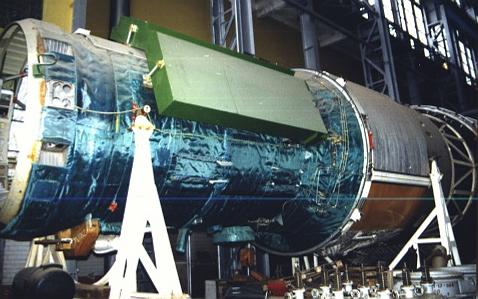
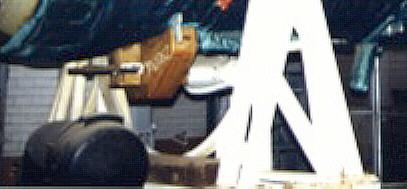
Also, Astronautix has a couple of inconclusive pictures (the purported gun is in the lower left, and while clearly not axially mounted, is at least aligned with the long axis of the craft): large inconclusive pic zoomed in inconclusive pic. For comparison, here's a good picture of an NR-23 autocannon: Nudelmann-Richter 23mm Cannon. -
Re:Didn't Salyut 3 do this first?Hate to reply to my own post, but I found a reference (it's Wikipedia, but that's something - even if I'm wrong, I'm not the only one):
Salyut 3 was launched on June 25, 1974. It was another Almaz military space station, this one launched successfully. It tested a wide variety of reconnaissance sensors, returning a canister of film for analysis. On January 24, 1975 trials of the on-board 23mm Nudelmann aircraft cannon (other sources say it was a Nudelmann NR-30 30mm gun) were conducted with positive results at ranges from 3000 m to 500 m. Cosmonauts have confirmed that a target satellite was destroyed in the test. The next day, the station was ordered to deorbit. Only one of the three intended crews successfully boarded and manned the sation, brought by Soyuz 14; Soyuz 15 attempted to bring a second crew but failed to dock. Nevertheless, Salyut 3 was an overall success.
Also, Astronautix has a couple of inconclusive pictures (the purported gun is in the lower left, and while clearly not axially mounted, is at least aligned with the long axis of the craft): large inconclusive pic zoomed in inconclusive pic. For comparison, here's a good picture of an NR-23 autocannon: Nudelmann-Richter 23mm Cannon. -
Re:The lowest bidder
Well, first, it's a huge business risk. People *have* tried to step in, but nobody has managed to do so successfully. Check out astronautix.com and browse their database for a whole load of things that were promised to be cheaper but weren't. Garry Hudson has tried several times, in fact.
Second, because NASA has done much to discourage competition. Like the point in the 80s where they were trying to shut down Atlas, Delta, and Titan so that everything would launch on the shuttle. -
Re:Probes certinally make more sense.....but
This is so profoundly wrong. If the Russians didn't want to land men on the moon, why did they announce in 1962 that they intended to do just that?
The Russians did not land men on the moon because their plans were politically hashed and once they had developed a vehicle it was too late. -
Jules Verne's opinion
According to this website, Jules Verne also considered Florida to be an ideal spot for launching into space. This was from his 1865 novel, From Earth to the Moon.
-
Getting There, and Costs
STS (the Space [Shuttle] Transportation System) is a flawed system design, with little compromise or tolerance for failures, systemic or political. On that issue alone, STS must be replaced.
A much smaller Shuttle-like orbiter, which can be mated atop a Delta, Titan III or other medium-lift vehicle, is needed. It may look like the Crew Return Vehicle concept that's being rehashed into a shuttle replacement. I think it would have more merit to the old military DynaSoar project. Such a vehicle, unlike the Shuttle Orbiters we have, is not a truck...it would be a human taxi, with a small bay for some replacement consumables. For larger payloads and refurbs, use the old Orbiters--unmanned, remote controlled. If we can run robots from millions of miles away, we can surely do the same from low Earth orbit. In fact, the Russians showed it can be done with their own mortibund Shuttle--it's first and only flight was completely unmanned, from launch to landing. The old Orbiters would also double as rescue vehicles, along with having additional new Shuttle Taxis ready to go on other pads when a flight is in progress. We can't use single-use rockets for ISS refurbs since the pressurized cargo modules (like the special ones used by Orbiters during an ISS crew and experiment transition) has equipment that must come back. Only our Orbiters have the ability to return large equipment modules safely to Earth.
We should be able to adapt single-use rockets to send new ISS components for assembly. The ISS will need more arms, and a new Orbiter replacement might need something like the current Canadian remote arm.
The main thing I would recommend is (1) just make a reusable human taxi that (1) has an abort mode like the old Apollo spacecraft, where the new Orbiter can rocket away from the booster, as well as (2) a durable crew compartment that, in the case of normal reentry failure, could be separated from the larger body and land by parachute.
Baby steps, please. A Shuttle replacement need not be all things as our current ones tried to be. For LEO, a simple crew vehicle will work. Later, the ISS or a moonbase should be used to create new, true spacecraft that ferry and from the Moon, and can use lunar material to build a Mars vehicle.
When someone says that the cost to go to space is too expensive, I have to emphasize where the money goes to build the spacecraft. It's not like we take millions of dollar bills, smelt them into vehicles or stuff bills in the fuel tanks and set them afire. That money goes to WORKERS who build the space vehicles and COMPANIES that make jobs. That's economically a Good Thing. -
Getting There, and Costs
STS (the Space [Shuttle] Transportation System) is a flawed system design, with little compromise or tolerance for failures, systemic or political. On that issue alone, STS must be replaced.
A much smaller Shuttle-like orbiter, which can be mated atop a Delta, Titan III or other medium-lift vehicle, is needed. It may look like the Crew Return Vehicle concept that's being rehashed into a shuttle replacement. I think it would have more merit to the old military DynaSoar project. Such a vehicle, unlike the Shuttle Orbiters we have, is not a truck...it would be a human taxi, with a small bay for some replacement consumables. For larger payloads and refurbs, use the old Orbiters--unmanned, remote controlled. If we can run robots from millions of miles away, we can surely do the same from low Earth orbit. In fact, the Russians showed it can be done with their own mortibund Shuttle--it's first and only flight was completely unmanned, from launch to landing. The old Orbiters would also double as rescue vehicles, along with having additional new Shuttle Taxis ready to go on other pads when a flight is in progress. We can't use single-use rockets for ISS refurbs since the pressurized cargo modules (like the special ones used by Orbiters during an ISS crew and experiment transition) has equipment that must come back. Only our Orbiters have the ability to return large equipment modules safely to Earth.
We should be able to adapt single-use rockets to send new ISS components for assembly. The ISS will need more arms, and a new Orbiter replacement might need something like the current Canadian remote arm.
The main thing I would recommend is (1) just make a reusable human taxi that (1) has an abort mode like the old Apollo spacecraft, where the new Orbiter can rocket away from the booster, as well as (2) a durable crew compartment that, in the case of normal reentry failure, could be separated from the larger body and land by parachute.
Baby steps, please. A Shuttle replacement need not be all things as our current ones tried to be. For LEO, a simple crew vehicle will work. Later, the ISS or a moonbase should be used to create new, true spacecraft that ferry and from the Moon, and can use lunar material to build a Mars vehicle.
When someone says that the cost to go to space is too expensive, I have to emphasize where the money goes to build the spacecraft. It's not like we take millions of dollar bills, smelt them into vehicles or stuff bills in the fuel tanks and set them afire. That money goes to WORKERS who build the space vehicles and COMPANIES that make jobs. That's economically a Good Thing. -
Re:CapsulesDo they even have reusuable capsules?
Yes, the Soviets flew unmanned test missions of these quite a few times in the 1970s. The program was cancelled, however, and they stayed with Soyuz. I've seen recent news reports that a Russian firm wants to bring back the reusable capsule idea.
Besides, when have the rudders ever "jammed"?
That's what the article said. If the faulty actuator had been installed in the higher-stress lower position instead of the upper one, it would likely have jammed and doomed the spacecraft.
-
Re:Wow, Russia finally get a new Space vehicle
A lot of the deaths in the Soviet space program were not publicised. I saw a documentary that mentioned a rocket blowing up during a PR event that killed over 100 people, many civilian.
Kindly substantiate or retract. The only large-scale launchpad disaster I know of (and dollars to donuts, I've forgotten more about the Soviet space program than what you'll ever know) was the R-16 accident. That happened in 1960. Stop proliferating urban myths. -
Re:What happened to the Buran?
There are pictures of a Russian Kiev class carrier group recovering one of the prototypes taken by a New Zeland destroyer as early as later 70'es in the pacific.
Don't accuse others of not knowing Buran history when you cannot get it straight yourself.What was recovered in the Indian Ocean (not the Pacific) was a very small (2-3m) model of an aerodynamic shape very different from Buran. While the Russian have never owned up to exactly what it was a subscale model of, it's believed today to have been a concept test of the BOR-4 spaceplane. The Russians did fly a few subscale Buran's, but those were recovered on land, in Russia. When those craft were sold on eBay, they got confused with the ones recovered in the Indian Ocean, and an 'urban legend' was born.
-
Re:Bullshit: re NIH & Engineering Philosophy
Both the newest Boeing Delta and Lock-Mart Atlas use license-built Russian engines with nary a design change.
Partially correct. While the Lockheed Martin Atlas 3 and Atlas 5 use the Russian RD-180 engine, the Boeing Delta 4 uses the RS-68 engine in its first stage, designed and built by Boeing's Rocketdyne subsidiary. Both vehicles use variants of the RL10 upper stage engine from Pratt & Whitney, another US company.
-
NASA has BETTER than that already
The main difference from the STS being that the shuttle has its main engine on the spacecraft, while Buran was lifted entirely by Energia rocket and attached liquid rocket boosters (i.e. spacecraft did not do any lifting of its own).
Reality check (Google to the rescue!):Now, as far as I know, nobody else including NASA has anything like this. While Energia design could be relatively easily used for lifting cargo other than Buran, I'm not sure the Shuttle main engine could be that easily ported or even comparable in power.
Energiya RD-0120: vacuum thrust 200,000 kgf (roughly 440,000 lbf)
(The RD-0120 was copied from the SSME.)Rocketdyne SSME: vacuum thrust 512,950 lbf
The major difference between Energiya/Buran and Shuttle is the choice of configuration; an Energiya can carry anything within certain size/mass/CG constraints because the cargo is just cargo, while Shuttle can only fly with the Orbiter because the hydrogen engines are attached to it. This does not mean that it would be overly difficult to bolt a bunch of SSME's onto a different airframe so that we could fly 100 tons of cargo instead of 20 tons of cargo inside 80 tons of obsolete spaceplane; on the contrary, putting a new vehicle together would probably be cheaper than keeping the Shuttle program going until 2008.
Could we use Shuttle components to put together a rocket that would launch 660 tons? If we scale from the 3-engine, 100-ton Shuttle we'd need to cluster 20 SSMEs for such a thing. I don't think this is within the realm of practicality, but 200 tons looks fairly reasonable from my relatively in-expert point of view. (Goodness knows what you'd do for the boosters to get the thing off the ground; clustering so many solid rockets would have a very high probability of failure.)
-
Re:What happened to the Buran?
Believe it or not, the main purpose of the Buran was to carry nuclear payloads. The Department of Defense had already voiced an interest in using the planned Space Shuttle for military capabilities back in the 70s, and the Soviets feared the US would be able to quickly and effectively deliver nuclear weapons from orbit with the shuttle. So, they worked very quickly to try and counter that threat by constructing the Buran. They were not as interested in having a reusable orbital vehicle simply for space research.
So, basically, the Buran is a cold war relic.
If you're interested in learning more, the Encyclopedia Astronautica has an interesting read on their web site: http://www.astronautix.com/project/buran.htm
-
The real safety recordThe Soviet inflight safety record isn't that great after all. One of the advantages of a totalitarian system is that you can cover up failures pretty well.
Their ground record isn't so great either. The disaster at Baikonur in 1960 killed at least 165 people. So I guess they don't really have a better safety record.
-
Picture and more info
A nice picture and more information on the plan are in astronautix.com.
The 14.5 tonne reusable lifting body would be used as a space station ferry and lifeboat, or could operate independently to shuttle tourists to space.
This is mainly based on proven technology, so there is a chance it may actually be built. Space tourism is also getting quite hot lately. They are planning to use another Russian designed spacecraft.
-
What Soviet Mission?
Seems to me it was Soyuz 21?
-
Re:Lots of fires in our early Rocket program, too
A common early rocket fuel / oxidizer was Kerosene with Red Fuming Nitric Acid, which was obviously quite NASTY stuff. A technical link to this is here.
I've read that the people who fueled these rockets had to know (a) exactly what to wear because some rubber was eaten by the acid and other protective gear was not, and (b) exactly which way the wind was blowing at all times so they could run upwind if there was a spillage. The stuff apparently became gaseous very quickly and a being in a cloud of nitric acid can ruin your whole day. -
Re:I hope china builds a nuclear rocket
Of course, after writing this, I remembered the Soviet RORSAT series of satellites, that are powered by reactors. I think there's US hardware up there with similar setups, also for surveillance.
So launching a reactor not a first, but using it for propulsion would be. I'd bet it takes a much bigger hunk of U238 to get to Mars than to take pictures of navy bases from space though. -
Re:FYI space programs = nuke programs
A really big stretch you're making, but I will ask a very simple question:
Would you rather have the Chinese military building human-tipped space capsules or Nuclear-tipped missiles? -
Re:Conspiracy Theory
Darn straight! Never trust a university experiment whose name is a variation on HARP. It's always something fscking dangerous.
-
It's already been done in 1985... and scrapped...
I remember something that Lockeed had done a ways back called ERIS. It was a manned space fighter. I don't know if it's real or not but it stands a pretty good chance of it (seeing they have claimed a few launches. Found a couple of links about it here and here. Looks like it started back in 1985... It had two test launches and actually shot down a few things (for the gun crowd out there the 'muzzle velocity' was 44,000 fps). The tech went into cruise missles, ICBM's and missle defense programs.
-
Nothing newThis really isn't anything new. Space-based weapons have been thought of for at least as long as man has been in space.
Starting in the late 1950s the Soviets began working on an nuclear orbital bombardment system that would bypass US early warning systems. There was also Salyut 3 in 1975 which carried a 23mm cannon that was used to fire at a target satellite
-
Re:I bet they do it, too...
Actually, it wasn't just the managers -- see this page on the subject.
Engineers wanted monolithic (non-segmented) SRBs because not having to have segments joined by O-rings would eliminate the possibility of joint failures as occurred on 51L and to a lesser extent on a number of previous missions. They were repeatedly overruled to the point where results of review boards were repeatedly ignored and the worst proposal selected.
The result was a system that was known to be problematic due to post-flight booster inspections, which killed seven people, and which was not replaced even after that fatal accident. To this day SRB segments are routinely sent back to the Thiokol plant in Utah for processing over our rail network, despite the existence of a facility in Florida, near the launch site, that could have built much safer boosters!
In fact, several segments from the STS-114 stack were shipped back to Thiokol just a few weeks ago for test-firing to see how well they perform after a fair amount of time passes after loading with propellant. -
Russian shuttle
-
Re:ESA working on same thingNo, the ATV is intended only as a cargo vessel. It will eventually replace the russian Progress which supply ISS. ATV will offer a significant increase in paylod capacity compared to progress.
Nevertheless, together which this Soyuz successor it makes sense - ESA will provide an enhanced replacement for Progress, Russia is developing a new crew capsule.
I hope that way Europe and Russia can provide a replacement for the aging Shuttle fleet.It would be interesting to know if ESA does transfer technology from ARD to the new russian project....
-
more on the lunar Soyuz
..for those curious about such things *smiles*:
Soyuz 7K-L1A circumlunar
Soyuz 7K-L1A test article
Soyuz 7K-L1E circumlunar test article
Soyuz 7K-L1P prototype, boilerplate capsule
Soyuz 7K-LOK planned lunar orbiter
You might also be interested in reasing baout the Soviet Lunar Lander and the launchsystem they hoped to use. Had everythng gone as planned they could have reached the moon around the same time as the americans... but since their booster just wouldn't work right they lagged behind until they decided to cancell the whole program.
The site I've pulled those links from also has a number of interesting articles on the N1 program, the various soviet manned lunar programs and wether the design of the Soyuz was stolen from the US.
-
more on the lunar Soyuz
..for those curious about such things *smiles*:
Soyuz 7K-L1A circumlunar
Soyuz 7K-L1A test article
Soyuz 7K-L1E circumlunar test article
Soyuz 7K-L1P prototype, boilerplate capsule
Soyuz 7K-LOK planned lunar orbiter
You might also be interested in reasing baout the Soviet Lunar Lander and the launchsystem they hoped to use. Had everythng gone as planned they could have reached the moon around the same time as the americans... but since their booster just wouldn't work right they lagged behind until they decided to cancell the whole program.
The site I've pulled those links from also has a number of interesting articles on the N1 program, the various soviet manned lunar programs and wether the design of the Soyuz was stolen from the US.
-
more on the lunar Soyuz
..for those curious about such things *smiles*:
Soyuz 7K-L1A circumlunar
Soyuz 7K-L1A test article
Soyuz 7K-L1E circumlunar test article
Soyuz 7K-L1P prototype, boilerplate capsule
Soyuz 7K-LOK planned lunar orbiter
You might also be interested in reasing baout the Soviet Lunar Lander and the launchsystem they hoped to use. Had everythng gone as planned they could have reached the moon around the same time as the americans... but since their booster just wouldn't work right they lagged behind until they decided to cancell the whole program.
The site I've pulled those links from also has a number of interesting articles on the N1 program, the various soviet manned lunar programs and wether the design of the Soyuz was stolen from the US.
-
more on the lunar Soyuz
..for those curious about such things *smiles*:
Soyuz 7K-L1A circumlunar
Soyuz 7K-L1A test article
Soyuz 7K-L1E circumlunar test article
Soyuz 7K-L1P prototype, boilerplate capsule
Soyuz 7K-LOK planned lunar orbiter
You might also be interested in reasing baout the Soviet Lunar Lander and the launchsystem they hoped to use. Had everythng gone as planned they could have reached the moon around the same time as the americans... but since their booster just wouldn't work right they lagged behind until they decided to cancell the whole program.
The site I've pulled those links from also has a number of interesting articles on the N1 program, the various soviet manned lunar programs and wether the design of the Soyuz was stolen from the US.
-
more on the lunar Soyuz
..for those curious about such things *smiles*:
Soyuz 7K-L1A circumlunar
Soyuz 7K-L1A test article
Soyuz 7K-L1E circumlunar test article
Soyuz 7K-L1P prototype, boilerplate capsule
Soyuz 7K-LOK planned lunar orbiter
You might also be interested in reasing baout the Soviet Lunar Lander and the launchsystem they hoped to use. Had everythng gone as planned they could have reached the moon around the same time as the americans... but since their booster just wouldn't work right they lagged behind until they decided to cancell the whole program.
The site I've pulled those links from also has a number of interesting articles on the N1 program, the various soviet manned lunar programs and wether the design of the Soyuz was stolen from the US.
-
more on the lunar Soyuz
..for those curious about such things *smiles*:
Soyuz 7K-L1A circumlunar
Soyuz 7K-L1A test article
Soyuz 7K-L1E circumlunar test article
Soyuz 7K-L1P prototype, boilerplate capsule
Soyuz 7K-LOK planned lunar orbiter
You might also be interested in reasing baout the Soviet Lunar Lander and the launchsystem they hoped to use. Had everythng gone as planned they could have reached the moon around the same time as the americans... but since their booster just wouldn't work right they lagged behind until they decided to cancell the whole program.
The site I've pulled those links from also has a number of interesting articles on the N1 program, the various soviet manned lunar programs and wether the design of the Soyuz was stolen from the US.
-
more on the lunar Soyuz
..for those curious about such things *smiles*:
Soyuz 7K-L1A circumlunar
Soyuz 7K-L1A test article
Soyuz 7K-L1E circumlunar test article
Soyuz 7K-L1P prototype, boilerplate capsule
Soyuz 7K-LOK planned lunar orbiter
You might also be interested in reasing baout the Soviet Lunar Lander and the launchsystem they hoped to use. Had everythng gone as planned they could have reached the moon around the same time as the americans... but since their booster just wouldn't work right they lagged behind until they decided to cancell the whole program.
The site I've pulled those links from also has a number of interesting articles on the N1 program, the various soviet manned lunar programs and wether the design of the Soyuz was stolen from the US.
-
more on the lunar Soyuz
..for those curious about such things *smiles*:
Soyuz 7K-L1A circumlunar
Soyuz 7K-L1A test article
Soyuz 7K-L1E circumlunar test article
Soyuz 7K-L1P prototype, boilerplate capsule
Soyuz 7K-LOK planned lunar orbiter
You might also be interested in reasing baout the Soviet Lunar Lander and the launchsystem they hoped to use. Had everythng gone as planned they could have reached the moon around the same time as the americans... but since their booster just wouldn't work right they lagged behind until they decided to cancell the whole program.
The site I've pulled those links from also has a number of interesting articles on the N1 program, the various soviet manned lunar programs and wether the design of the Soyuz was stolen from the US.
-
more on the lunar Soyuz
..for those curious about such things *smiles*:
Soyuz 7K-L1A circumlunar
Soyuz 7K-L1A test article
Soyuz 7K-L1E circumlunar test article
Soyuz 7K-L1P prototype, boilerplate capsule
Soyuz 7K-LOK planned lunar orbiter
You might also be interested in reasing baout the Soviet Lunar Lander and the launchsystem they hoped to use. Had everythng gone as planned they could have reached the moon around the same time as the americans... but since their booster just wouldn't work right they lagged behind until they decided to cancell the whole program.
The site I've pulled those links from also has a number of interesting articles on the N1 program, the various soviet manned lunar programs and wether the design of the Soyuz was stolen from the US.
-
more on the lunar Soyuz
..for those curious about such things *smiles*:
Soyuz 7K-L1A circumlunar
Soyuz 7K-L1A test article
Soyuz 7K-L1E circumlunar test article
Soyuz 7K-L1P prototype, boilerplate capsule
Soyuz 7K-LOK planned lunar orbiter
You might also be interested in reasing baout the Soviet Lunar Lander and the launchsystem they hoped to use. Had everythng gone as planned they could have reached the moon around the same time as the americans... but since their booster just wouldn't work right they lagged behind until they decided to cancell the whole program.
The site I've pulled those links from also has a number of interesting articles on the N1 program, the various soviet manned lunar programs and wether the design of the Soyuz was stolen from the US.
-
wishful thinking
Politics aside, there is enormous opportunity for economizing by applying the recent success of the Chinese manned space program. In a way, it would be the homecoming of an evolved technology as the Chinese Shenzhou is an improved conventional design based largely on studying russian crew return capsules. Last I heard, no new cash has been found for Russian space missions. I'd be very excited if they can even afford to pay for major design work. A shame really. Less I be moderated down as an idealogical loudmouth, I do recognize that such levels of interaction is unrealistic. Assuming Energia is willing to ask, the Chinese will likely refuse. Thus far, the Shenzhou program has too much domestic significance for the Chinese for them to consider sharing it with the rest of the world just yet. I really wish the Chinese leadership have not decided to try and leapfrog their manned space program by establishing the narrow goals they have. Given the cash and other resources, Energia is likely to elegantly pull off any design job for replacing the Soyuz because the Russians have a sturdy tradition and a rich legacy that has been hard earned by developing their own space program. China, on the other hand, is relying on too much borrowed technology with too little home-grown experience. While admirable achievements have been made in the near term, I don't believe Chinese arospace engineers will make any real breakthroughs in space technology because have gotten their hands dirty enough yet by mucking around. God knows there is a large potential for embarassment if the result of Energia's efforts end up obsoleting the Shenzhou. If China contributes now, there might be bragging rights at least in claiming progony. *sigh* Nationalism and politics can be such a drag on inovation.
-
Re:I bet they do it, too...
Buran/Energia
From the site:
The modular Energia design could be used for payloads of from 10 to 200 tonnes using various combinations of booster stages, numbers of modular main engines in the core stage, and upper stages. The version with two booster stages was code-named Groza; with four booster stages, Buran; and the six-booster stage version retained the Vulkan name. The 7.7 meter diameter of the core was determined by the maximum size that could be handled by existing stage handling equipment developed for the N1 programme. The 3.9 meter diameter of the booster stages was dictated by the maximum size for rail transport from the Ukraine.
Propellant selection was a big controversy. Use of solid propellants in the booster stages, as used in the space shuttle, was considered again. But Soviet production of solid fuel motors had been limited to small unitary motors for ICBM's and SLBM's. There was no technological base for production of segmented solid fuel motors, and transport of the motor sections also presented problems. The final decision was to use the familiar Lox/Kerosene liquid propellants for the boosters. In the 1960's Glushko had favoured use of toxic but storable chemical propellants in launch vehicles and had fought bitterly against Korolev over the issue. It is surprising that he now accepted use of Lox/Kerosene. But Korolev was dead, and the N1 a failure. Glushko's position had been vindicated, perhaps he now had to agree objectively that use of the expensive and toxic propellants in a launch vehicle of this size was
not rational.
-
Super Soyuz has been proposed before
Russians have been designing larger and possibly reuseable Soyuz-type spacecrafts for long time. The original mission was ferrying military cosmonauts to Almaz and Polya military space stations. A later design was Zarya resusable space craft to be launched with Zenit booster. Project was cancelled on financial grounds back in 1989, but the technology has been further developed in connection with ISS and Sea Launch projects.
-
Cool, but where's the money?The RSA is starved for cash, this is probably a fantasy until money appears. Based on their history, I would guess that this is a balloon they are floating to try and get parties with deeper pockets (eg, NASA, maybe the ESA) to offer the development funding.
Of interest, NASA had a similar idea in the 1960s with their 'Big Gemini' program and the 'Apollo Rescue CSM' program. It's very feasible, and the Soyuz is a solid design.
-
Cool, but where's the money?The RSA is starved for cash, this is probably a fantasy until money appears. Based on their history, I would guess that this is a balloon they are floating to try and get parties with deeper pockets (eg, NASA, maybe the ESA) to offer the development funding.
Of interest, NASA had a similar idea in the 1960s with their 'Big Gemini' program and the 'Apollo Rescue CSM' program. It's very feasible, and the Soyuz is a solid design.
-
prior art
A mention of prior art in balooning the other planets would be in order. Many people arent aware of the fact that Russian Venera program, what later become Vega, successfully flew two balloons in Venusian atmosphere in 1984.
Geoffrey Landis has a couple very thought-provoking papers on his website, regarding possible further developments of atmospheric flight on both mars and venus, and possibilities for human living in upper atmosphere -
Re:Robots had another purposeYour best source for all things space is Astronautix.com. The page on the N1 is here.
There used to be an excellent book 'Red Star in Orbit' by James Oberg which contained a lot of information about the Soviet Moon program, but that is now out of print.
It was adapted into a 3-part 'Horizon' by the BBC (I think this is rebadged as 'Nova' by WGBH for the American market).
More recently, I can recommend the superb book 'Korolev: How One Man Masterminded the Soviet Drive to Beat the Americans to the Moon' by J. Harford, ISBN: 0471327212. It's a history of the Soviet programme up until the end of the N1 and utterly fascinating. Korolev was incredible, not only was he a genius, but he was once a prisoner in the gulag - that he then turned his talents to beat the rest of the World in the name of the system that imprisoned him is almost unthinkable.
And finally, Channel 4 here in the UK had a one part documentary called 'The rocket that came in from the cold' as part of their Equinox strand. It was about the N1's engines which are still the most advanced engines ever built and are now used by the Atlas V. It's most significant because it has movie footage of the N1 test launches - this was a MASSIVE rocket.
Hope that helps.
Mike. -
Re:Robots had another purposeYour best source for all things space is Astronautix.com. The page on the N1 is here.
There used to be an excellent book 'Red Star in Orbit' by James Oberg which contained a lot of information about the Soviet Moon program, but that is now out of print.
It was adapted into a 3-part 'Horizon' by the BBC (I think this is rebadged as 'Nova' by WGBH for the American market).
More recently, I can recommend the superb book 'Korolev: How One Man Masterminded the Soviet Drive to Beat the Americans to the Moon' by J. Harford, ISBN: 0471327212. It's a history of the Soviet programme up until the end of the N1 and utterly fascinating. Korolev was incredible, not only was he a genius, but he was once a prisoner in the gulag - that he then turned his talents to beat the rest of the World in the name of the system that imprisoned him is almost unthinkable.
And finally, Channel 4 here in the UK had a one part documentary called 'The rocket that came in from the cold' as part of their Equinox strand. It was about the N1's engines which are still the most advanced engines ever built and are now used by the Atlas V. It's most significant because it has movie footage of the N1 test launches - this was a MASSIVE rocket.
Hope that helps.
Mike. -
TransOrbital to Image the Lunokhod Landing Sites
TransOrbital, Inc. has plans to image the landing sites of both the Apollo and Lunokhod programs during their TrailBlazer mission. A description of the mission is available here. There is also some info on the Lunokhod rovers available here.
-
Re:11 months!
The venera missions are incredibly interesting and it is fair to say that the Soviets were far more successful at exploring venus than the USA were. Initial missions to venus were launched expecting to have to deal with atmospheric pressure 10 to 15 times that of earth. After a few trial and error landers they found out that the pressure is actually 100 times that of earth, and the surface temperature was on average 450 c. None of the venera craft lasted much more than an hour on the surface even though their outer shell was thick titanium. The soviets did other cool stuff like sending a balloon to venus that floated in the atmosphere and travelled more halfway round the planet before losing contact.
-
Beeing in the middle
"Thanks to my American science education, I had never heard of this feat."
Well, i'm glad to be from Europe (Austria to be exact), because we were - as a neutral country - beeing subject to both western AND eastern brainwashing and so got information of both sides of the space race
Well, to get the truth to it: Science experiments of Austria have flown on both sides; we even got an astronaut (or Austronaut) to MIR, which is quite a feat for such a small country...
BTW, look at quite a nice Lunokhod picture and also see the US Ranger Program to get a better view of the real pressures in NASA's side of the space race. -
Re:Why not give it to DoD?
Google for 'kh-12' and 'hubble' together, or 'kh-11' and 'hubble'.
http://science.howstuffworks.com/question529.htm
http://www.astronautix.com/craft/kh11.htm
http://www.globalsecurity.org/space/systems/kh-1 2. htm
http://www.janes.com/aerospace/military/news/jsd/j sd011017_1_n.shtml
Actually, that's depressing. We have several Hubble-type satellites up there that our government just flings up there whenever the hell it wants and it won't save the one that people actually care about!? Argh. As if I weren't furious enough... -
Re:Thankfully...
I wouldn't exactly call this a "watercolor concept"... a lot of serious design work went into it before Congress ordered a re-design in an attempt to "cut costs." In fact, Congress ordered five re-designs before we finally arrived at the current design. All those re-designs added tremendously to the cost... if we had just gone ahead and built the original design, we would have spent less money overall, and had a tremendously more capable Station.
-
WRONG
It was never intended to use the ISS as a starting point for planetary missions.
You must be too young to remember: the original Reagan-era vision for the station was that "after 2000, the Space Station would evolve into a space harbour in low Earth orbit for lunar and planetary missions as well as commercial exploitation of space resources." The design included a hangar for on-orbit assembly of large interplanetary spacecraft. Here is one of the sources that will back me up on this.