Slashdot Mirror
Domain: berkeley.edu
Stories and comments across the archive that link to berkeley.edu.
Stories · 441
-
SETI@Home Adds New Search Method
Adam Korbitz writes to point out that SETI@Home has added a new algorithm for use in evaluating signals from outer space. It's called "Astropulse," and they've made the scientific details available. Quoting: "The original SETI@home is narrowband, meaning that it is listening for a particular radio frequency. That's like listening to an orchestra playing, and trying to hear when anyone plays the note "A sharp." Astropulse listens for short-time pulses. In the orchestra analogy, it's like listening for a quick drum beat, or a series of drumbeats. Since no one knows what extraterrestrial communications will 'sound like,' it seems like a good idea to search for several types of signals. In scientific terms, Astropulse is a sky survey that searches for microsecond transient radio pulses." -
SETI@Home Adds New Search Method
Adam Korbitz writes to point out that SETI@Home has added a new algorithm for use in evaluating signals from outer space. It's called "Astropulse," and they've made the scientific details available. Quoting: "The original SETI@home is narrowband, meaning that it is listening for a particular radio frequency. That's like listening to an orchestra playing, and trying to hear when anyone plays the note "A sharp." Astropulse listens for short-time pulses. In the orchestra analogy, it's like listening for a quick drum beat, or a series of drumbeats. Since no one knows what extraterrestrial communications will 'sound like,' it seems like a good idea to search for several types of signals. In scientific terms, Astropulse is a sky survey that searches for microsecond transient radio pulses." -
BOINC Now Available For GPU/CUDA
GDI Lord writes "BOINC, open-source software for volunteer computing and grid computing, has posted news that GPU computing has arrived! The GPUGRID.net project from the Barcelona Biomedical Research Park uses CUDA-capable NVIDIA chips to create an infrastructure for biomolecular simulations. (Currently available for Linux64; other platforms to follow soon. To participate, follow the instructions on the web site.) I think this is great news, as GPUs have shown amazing potential for parallel computing." -
Arecibo Observatory Facing Massive Budget Cuts
SirLurksAlot writes "Many supporters of the SETI@home project have recently received a message informing them of impending budget cuts for the Arecibo Observatory and asking them to show their support for the project by writing to Congress. The letter also informs supporters that there are currently two bills (Senate bill 2862 sponsored by Senator Hillary Clinton, and a similar House bill, H.R. 3737), which are intended to secure funding for the project. According to The Planetary Society, the current plan for the Arecibo Observatory involves cutting funding by more than 60% from $10.4 million to just $4 million by 2011." -
Artist/Astronomer Exhibits Photos Of Spy Satellites
daemonburrito writes "Trevor Paglen, the photographer and co-author of 'Torture Taxi: On the Trail of the CIA's Rendition Flights' and 'I Could Tell You But Then You Would Have To Be Destroyed By Me,' has an exhibit showing in Berkeley of 189 photos of secret US satellites (exhibit page here). Wired says, 'In taking these photos, Paglen is trying to draw a metaphorical connection between modern government secrecy and the doctrine of the Catholic Church in Galileo's time.'" -
"Nightlife" Harnesses Idle Fedora Nodes For Research
A. B. VerHausen writes "If you've given up on SETI, now you can let your idle computer help with other kinds of scientific research. Red Hat employee Bryan Che started a project called Nightlife. He wants people to 'donate idle capacity from their own computers to an open, general-purpose Fedora-run grid for processing socially beneficial work and scientific research that requires access to large amounts of computing power.'" Che hopes to have more than a million Fedora nodes running as part of this project. -
500-fold Increase in Data Flow from SETI Telescope
coondoggie brings us an article from Networkworld about a flood of new data for the SETI@home project. We discussed something similar a few months ago when a new telescope array went live. The vast amount of processing power required to handle the new data is prompting the SETI@home team to make a plea for more volunteers. Quoting the press release: "What triggered the new flow of data was the addition of seven new receivers at Arecibo, which now let the telescope record radio signals from seven regions of the sky simultaneously instead of just one. With greater sensitivity and the ability to detect the polarization of the radio signals, plus 40 times more frequency coverage, Arecibo is set to survey the sky for new radio sources." -
The Future of Google Search and Natural Language Queries
eldavojohn writes "You might know the name Peter Norvig from the classic big green book, 'AI: A Modern Approach.' He's been working for Google since 2001 as Director of Search Quality. An interview with Norvig at MIT's Technology Review has a few interesting insights into the 'search mindset' at the company. It's kind of surprising that he claims they have no intent to allow natural questions. Instead he posits, 'We think what's important about natural language is the mapping of words onto the concepts that users are looking for. But we don't think it's a big advance to be able to type something as a question as opposed to keywords ... understanding how words go together is important ... That's a natural-language aspect that we're focusing on. Most of what we do is at the word and phrase level; we're not concentrating on the sentence.'" -
Citizen Science and Grid Computing
japonicus writes "The Economist has an article summarizing the current state of distributed computing (think SETI@home and its ilk), which suggests that distributed-human projects are going to be the next big thing. (We discussed one such project, the Galaxy Zoo, a few months back.) The distributed-computing platform BOINC is about to expand to human processing. Distributed proofreaders have been a longstanding success (yet inexplicably failed to get even a mention in the article); but there are a lot of other projects waiting in the wings." -
Citizen Science and Grid Computing
japonicus writes "The Economist has an article summarizing the current state of distributed computing (think SETI@home and its ilk), which suggests that distributed-human projects are going to be the next big thing. (We discussed one such project, the Galaxy Zoo, a few months back.) The distributed-computing platform BOINC is about to expand to human processing. Distributed proofreaders have been a longstanding success (yet inexplicably failed to get even a mention in the article); but there are a lot of other projects waiting in the wings." -
Eolas vs. Microsoft Lawsuit Settled and Sealed
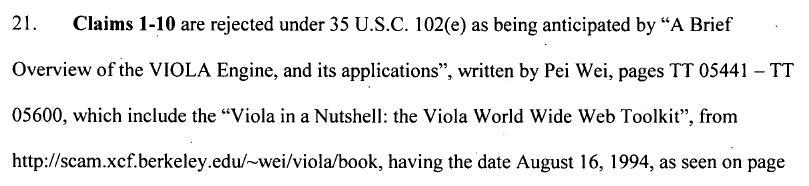
theodp writes "The Seattle P-I's Todd Bishop reports that Microsoft has settled its 8-year-old web browser plug-in patent dispute with Eolas. The spat begat the click-to-activate Web after Microsoft was slapped with a $500+ million patent infringement judgement. Neither Eolas nor Microsoft will be disclosing terms of the deal, although Eolas told investors to expect a dividend (PDF). Microsoft didn't say whether or how the settlement would affect its approach to the underlying technology in IE or other programs. Just last month, the USPTO issued a non-final rejection of the patent's claims, citing the work of Pei-Yuan Wei as prior art." -
Tool Detects "In-Flight" Webpage Alterations
TheWoozle writes "In a follow-up to a recent story about ISPs inserting ads into web pages, the University of Washington security and privacy research group has teamed with the International Computer Science Institute (ICSI) to develop an online tool to help you identify if your ISP is inserting ads or otherwise modifying the web pages you request." -
California to Start Review of Voting Machines
An anonymous reader writes "California Secretary of State Debra Bowen just announced details about the previously discussed 'top-to-bottom review' of almost all voting and counting systems used in the state. The team features big names in e-voting security: David Wagner, Matt Bishop, Ed Felten, Matt Blaze, and Harri Hursti, among others. Vendors have time to submit their machines including documentation and source code until July 1st or face severe restrictions, including decertification, for the 2008 elections. Scheduled to start next week, the review will include a red-team attack and going through the source code." -
Powerful Supernova May Be Related To Death Spasms of First Stars
necro81 writes "The New York Times is reporting on a discovery from a team of UC Berkley researchers, who may have discovered the brightest stellar explosion ever observed. Observations of the cataclysmic explosion of a 100- to 200-solar-mass star began last September, based on data from the Chandra X-ray Observatory. The researchers believe that the explosion is similar to the death spasms of the first stars in the universe. The super-massive star's collapse is believed to have been so energetic as to create unstable electron-positron pairs that tore the star apart before it could collapse into a black hole — seeding the universe with heavier elements." -
Powerful Supernova May Be Related To Death Spasms of First Stars
necro81 writes "The New York Times is reporting on a discovery from a team of UC Berkley researchers, who may have discovered the brightest stellar explosion ever observed. Observations of the cataclysmic explosion of a 100- to 200-solar-mass star began last September, based on data from the Chandra X-ray Observatory. The researchers believe that the explosion is similar to the death spasms of the first stars in the universe. The super-massive star's collapse is believed to have been so energetic as to create unstable electron-positron pairs that tore the star apart before it could collapse into a black hole — seeding the universe with heavier elements." -
Massively Multiplayer Online Birdwatching Game
eldavojohn writes "The shots you take in CONE Sutro Forest don't come from shotguns or sniper rifles. In the game, players manipulate remote control cameras, taking pictures of birds and classifying them. It starts next week with the premise being that the more birds you take pictures of and classify correctly, the more points you get. It's more of an experiment in collaborative technology than a game ... but if you can get your users to do work for you and have fun at the same time, you might have something big." -
Massive Star Burps, Then Explodes
gollum123 writes with a link to the Berkley site about an impressive star explosion that took place some tens of millions of years ago. We first caught sight of it in 2004, when there was a bright outburst, ahead of a massive supernova. "All the observations suggest that the supernova's blast wave took only a few weeks to reach the shell of material ejected two years earlier, which did not have time to drift very far from the star. As the wave smashed into the ejecta, it heated the gas to millions of degrees, hot enough to emit copious X-rays. The Swift satellite saw the supernova continue to brighten in X-rays for 100 days, something that has never been seen before in a supernova. All supernovae previously observed in X-rays have started off bright and then quickly faded to invisibility." -
Stephen Hawking Says Universe Created from Nothing
mr_3ntropy writes "Speaking to a sold out crowd at the Berkeley Physics Oppenheimer Lecture, Hawking said yesterday that he now believes the universe spontaneously popped into existence from nothing. He said more work is needed to prove this but we have time because 'Eternity is a very long time, especially towards the end.' There is also a Webcast available (Realplayer or Real Alternative required)." -
Creating Power From Wasted Heat
Roland Piquepaille writes "Today, about 90 percent of the world's electricity is created through an indirect and inefficient conversion of heat. It is estimated that two thirds of the heat used by thermoelectric converters are wasted and released. But now, researchers from the University of California at Berkeley have found a new way to convert this wasted heat into electricity by trapping organic molecules between metal nanoparticles. So far, this method of creating electricity creation is in its very early stage, but if it can scale up to mass production it may lead to a new and inexpensive source of energy." -
An Overview of Parallelism
Mortimer.CA writes with a recently released report from Berkeley entitled "The Landscape of Parallel Computing Research: A View from Berkeley: "Generally they conclude that the 'evolutionary approach to parallel hardware and software may work from 2- or 8-processor systems, but is likely to face diminishing returns as 16 and 32 processor systems are realized, just as returns fell with greater instruction-level parallelism.' This assumes things stay 'evolutionary' and that programming stays more or less how it has done in previous years (though languages like Erlang can probably help to change this)." Read on for Mortimer.CA's summary from the paper of some "conventional wisdoms" and their replacements.
Old and new conventional wisdoms:- Old CW: Power is free, but transistors are expensive.
- New CW is the "Power wall": Power is expensive, but transistors are "free." That is, we can put more transistors on a chip than we have the power to turn on.
- Old CW: Monolithic uniprocessors in silicon are reliable internally, with errors occurring only at the pins.
- New CW: As chips drop below 65-nm feature sizes, they will have high soft and hard error rates.
- Old CW: Multiply is slow, but load and store is fast.
- New CW is the "Memory wall" [Wulf and McKee 1995]: Load and store is slow, but multiply is fast.
- Old CW: Don't bother parallelizing your application, as you can just wait a little while and run it on a much faster sequential computer.
- New CW: It will be a very long wait for a faster sequential computer (see above).
-
Geminid Explosions On Moon Visible To Amateurs
saskboy writes "The ET scanning project SETI@Home was wildly popular, and the mock project Yeti@Home much less so, but soon there will be a chance for the enthusiastic amateur astronomer to combine those two scanning techniques and spot explosions on the moon with simple telescope and camera equipment at home." From the article: "'On Dec. 14, 2006, we observed at least five Geminid meteors hitting the Moon,' reports Bill Cooke of NASA's Meteoroid Environment Office in Huntsville, AL. Each impact caused an explosion ranging in power from 50 to 125 lbs of TNT and a flash of light as bright as a 7th-to-9th magnitude star... 'The amazing thing is,' says Cooke, 'we've [caught explosions] using a pair of ordinary backyard telescopes, 14-inch, and off-the-shelf CCD cameras. Amateur astronomers could be recording these explosions, too.'... [NASA will] soon release data reduction software developed specifically for amateur and professional astronomers wishing to do this type of work. The software runs on an ordinary PC equipped with a digital video card. 'If you have caught a lunar meteor on tape, this program can find it.'" -
Trap-Jaw Ants Break Speed Records With Jaws
Ant writes to tell us UC Berkeley News is reporting that a species of Ant native to Central and South America is setting speed records with their jaws. The trap-jaw ant has been clocked closing its mandibles at between 78 and 145 miles per hour, said to be the "fastest self-powered predatory strike in the animal kingdom". In addition to blinding speed the ants have also been taped using their jaws to fling themselves into the air. -
Microsoft Zune MP3 Player Interface Revealed
bain writes to tell us that iLounge has put up details on the Zune, Microsoft's MP3 player. According to the article, "Zune is a bit bigger than a standard 30GB iPod, and apparently made entirely of plastic." Interestingly, Microsoft forgoes a touch-sensitive scrollwheel in favor of wheel-shaped buttons. Included are WiFi capabilities, an FM tuner, and (in stark contrast to the iPod) a white-on-black color scheme. The 30GB model is expected to sell for $300. This story selected and edited by LinuxWorld editor for the day Saied Pinto. -
GPS Map Viewer for PSP Released
DCEmu writes "Deniska has released a GPS Map Viewer for the PSP. The program uses imagery from Google Maps, which currently has pretty good coverage of North America, Western Europe, Australia, Japan. There's also a video on YouTube." According to the post, map data can be retrieved via WiFi or an external GPS receiver. This story selected and edited by LinuxWorld editor for the day Saied Pinto. -
Macrovision Wants Old DRM to Work Forever
Grv writes "Macrovision's best-known form of copy protection inserts noise into analog video signals to make it difficult to get a good copy of the DVD or VHS recording. A company named Sima has products that eliminate this noise when digitizing such video, as any good digitizer would do. Macrovision argues that this is a violation of the DMCA, and a court sided with them in June. Now the injunction is being reviewed, and several organizations are siding with Sima and Fair Use, including the American Library Association, the Consumer Electronics Association, the Home Recording Rights Coalition, and the Electronic Frontier Foundation. If it isn't overturned, this decision could make it illegal to develop products for making copies of commercial analog recordings." This story selected and edited by LinuxWorld editor for the day Saied Pinto. -
IT Workers Face Dangerous Stress
feminazi writes "William Cross, CIO and Ph.D., told the IBM Share conference this week that IT workers often face dangerous levels of stress. In a Q&A with Computerworld.com, he described some of the manifestions: "They tend to be less emotionally stable. They tend to react strongly to small things that they might not react to under other circumstances. A change in schedule may be a crisis if somebody is really stressed." What to do? "Easy things. Exercise ... learn to relax, learn meditation, learn breathing exercises, participate in your religion — all of those things are very effective stress managers."" This story selected and edited by LinuxWorld editor for the day Saied Pinto. -
Are Liquid Explosives on a Plane Feasible?
permaculture writes "The Register describes the difficulty of mixing up a batch of liquid explosives on a plane. Further, it opines that such a plot might work in a Hollywood film, but not in the real world. Liquid explosives were used for the 7/7 London bombings in 2005, according to the official account — or not, as now seems more likely." This story selected and edited by LinuxWorld editor for the day Saied Pinto. -
Linus Torvalds- VC Money is Good for Open Source
jpheasant writes "Open Source startups are clearly the hottest thing in Silicon Valley right now, with every VC wanting to invest in an open source player. Linus Torvalds finally speaks up about this." This story selected and edited by LinuxWorld editor for the day Saied Pinto. -
Rewiring (and Unwiring) New Orleans
stinkymountain writes "Is New Orleans bouncing back from Hurricane Katrina with the most advanced telecom system in the country? According to Network World, carriers have invested billions to rebuild the wired and wireless networks in the city, and businesses are taking advantage of new, advanced telecom services." This story selected and edited by LinuxWorld editor for the day Saied Pinto. -
$100 Laptop Takes Flight in Thailand
EmperorKagato writes "Nicholas Negroponte's project for every child to have a laptop will come true for over 500 students in Thailand. Prime Minister Thaksin Shinawatra expects each child to receive a laptop instead of books as the books will be provided electronically. The laptop, mentioned previously on Slashdot, will now be brought to children in Thailand in October and November, with hopes for future shipments to Nigeria, Brazil and Argentina in 2007." This story selected and edited by LinuxWorld editor for the day Saied Pinto. -
Is SETI@home Where Your Cycles Belong?
Yesterday's post about a Wall Street Journal article critiquing the current allocation of distributed number-crunching projects drew a huge range of comments, some favoring the proposition that seemingly quixotic distributed-computing endeavors (specifically, the alien-hunting SETI@home project) were diverting resources better spent on closer-to-home, pragmatic research, such as cancer or climate prediction, or perhaps best never converted to electricity in the first place. Read on for the Backslash summary of the conversation.SETI@home is probably the best-known distributed computing project in the world. Several readers questioned not just the efficiency of spending computer cycles sifting for alien communications with SETI@home, but whether this search is based on a sensible idea in the first place. Reader TheSync, pointing to a Princeton research paper, offered an interesting case for another approach to seeking alien intelligence:
"Radio SETI is really a waste of time. Optical SETI is the logical choice because
- Visible light-emitting devices are smaller and lighter than microwave or radio-emitting devices.
- Visible light-emitting devices produce higher bandwidths and can consequently send information much faster.
- Interference from natural sources of microwaves is more common than from visible sources.
- Naturally occurring nanosecond pulses of light are mostly likely nonexistent, although there are all kinds of radio signals that could be similar to intentional SETI transmissions. Thus Optical SETI does not require grid computing to find signals.
- Exact frequencies of light are not required, as nanosecond unfiltered light pulses would still outshine the planet's star by over 30 times.
Optical SETI detection out to 100 light-years is doable today, with a bit more work optical SETI out to 1,000 light-years is possible."
More generally, reader theCat says he gave up on SETI@home "at the exact moment when I recognized that radio broadcast, even assuming other life forms discover it, is just a quick stepping stone toward more efficient/direct means of distribution, like wires or fiber. Or drums. Or pheremones. Or telepathy. ... SETI has always barked up the wrong tree. Not because there are no intelligent races out there — and I really do suspect there are — but because if they are intelligent in a way that we would even recognize then they've moved on to other forms of communication, or settled into a fine state of just dealing with every day as it comes and not worring about events in their version of Iraq."
Whether or not their approaches are optimal, reader exp(pi*sqrt(163)) defended the more esoteric distributed computing projects like SETI on a pessimistic ground, writing that after two years in computational chemistry for what is now GlaxoSmithKline, "I became strongly convinced that computers do not find cures for diseases - or even give you much understanding of illnesses. Molecular modeling is so far from being able to model in vivo molecules that it's practically worthless. ... [W]e already know that trials at this stage are poorly correlated with actual drug usefulness, simulations are just as much a waste of resources as SETI. ... It seems to me that molecular modeling is actually one of those hard 'macho' (but ultimately pointless) projects that gets funding because to criticize it makes you seem anti-drug, anti-therapy and anti-human-progress. (I'm not saying people shouldn't try to model molecules. This is a great blue-sky goal. But people who are trying to find drugs or therapies shouldn't be wasting their time with such techniques.)"
A persistent suggestion that SETI@home and similar projects were wasteful for failing to deliver enough tangible benefits to present-day society provoked several readers to defend the importance of voluntary participation; Chrisq compared the cycles spent on distributed science to donations to charities, writing "I don't like the way that some animal charities get more money than children's charities. Obviously the people making donations disagree. The point is the donor decides — if someone is giving something away, then they decide."
One reader suggested sarcastically "You know what's a waste of time? Gardening. You spend all this time and energy just to raise a few tomatoes that could have been bought at the store for cheap. ... People should stop gardening and focus their time and energy on solving global warming, but I don't presume to tell anyone what they should be doing with their time."
Another offered a tongue-in-cheek response providing a few facetious parallels: "It's a waste that people use their cars to go see a movie when they could be delivering food to the homeless shelter. It's a waste that people are storing ice cream in the fridge when they could be storing donated blood plasma."
Many readers, though, provided examples of projects that they consider worthy their computing efforts, either instead of or in addition to SETI.
"Personally, I always felt SETI was not very philanthropic — more like an amusing experiment in grid computing," says tedgyz, and suggests that grid.org to users who would like to spend some cycles on medical research. "They provide great features for managing all your computers that run the grid projects. You can even choose which research to participate in. And, to satiate a geek's lust for power, they have rankings for your aggregate compute time."
Perhaps the WSJ article draws a false dichotomy, however: one reader asked "Does Carl realize that it's possible to crunch more than one project at a time with BOINC? Right now I'm attached SETI, Einstein, Rosetta & LHC. It works on one for a bit and then will switch to another for a bit. And so what if SETI@home will never find anything, it's a cool looking screen saver!"
(Another reader reported dissatisfaction with BOINC: "I upgraded from the old SETI@Home client to BOINC when it became available - but the BOINC client required too much effort on my part and was getting in my way. ... I'm donating my CPU cycles to some altruistic cause, I don't want to have to RTFM. I just want to install and forget. For this reason I miss the old SETI client, and have, as a result, now stopped contributing.")
Eventual benefits aside, some readers doubt that the medical research projects' goals parallel their own: one reader writes "... I won't do the ones for the drug companies. My grandfather was denied a chance at surviving cancer in the 60's, but the big drug companies went to the FDA against the doctor who had a good success rate for curing colon/stomach cancer because one of the chemicals used was not FDA approved. The big drug companies are not looking for cures, they are looking for drugs to sell."
In response to fears that medical-research undertakings would exploit their volunteers' contributions to the data crunching, Lars Westergren several times pointed out that the Stanford-based Folding@home protein-folding project, at least, has committed itself to sharing the data generated by its volunteers, citing the project's promise (found in its FAQ) that
"We will not sell the data or make any money off of it. ... Moreover, we will make the data available for others to use. In particular, the results from Folding@home will be made available on several levels. Most importantly, analysis of the simulations will be submitted to scientific journals for publication, and these journal articles will be posted on the web page after publication. Next, after publication of these scientific articles which analyze the data, the raw data of the folding runs will be available for everyone, including other researchers, here on this web site."
In another comment, Westergren argued that "[e]ven if this worst-case scenario did happen [of donated cycles being turned into secret-formula drugs], the cycles donated would not be wasted. You would have helped advance human scientific research, and the medicines created would still be saving peoples' lives."
Along similar lines, as reader lhbtubajon puts it, "[i]f a company starts manufacturing a product so expensive that they cannot make a profit on it, they will soon cease to exist, as will the beneficial product they hoped to give to the world."
Whatever the ends to which the data is eventually put, many readers raised another objection: power consumption. Shisha outlines the inherent uncertainty of whether cycle-donation makes sense:
"All those free computer cycles are not that free. Modern CPUs consume more electricity to do more work and someone has to pay the electricity bills. Busy CPUs need more cooling and fans that run at full throttle for a year do wear out and fail (and you risk burning some important component, even if the PC is designed to shut down when it detects overheating). That's simply because desktop PCs are desktop PCs and not workstations and the assumption is that the fans will have to run at full throttle for maybe half an hour at a time. The real costs are not easy to work out, but it might, just might be more efficient to donate the money to charity."
(This analysis, according to another reader, "[underestimates] the quality of a desktop PC. I ran SETI and climateprediction.net for about 4 years straight on a dual G4 PowerMac. Ran like a champ. 100% CPU for months straight. Never had a problem. They can take abuse.")
Placing the WSJ article into context, FlynnMP3 pointed out that author Gomes isn't trying to force anyone to change their computing behavior, and suggested an argument that SETI@home might specifically hold greater worth than can be divined from its success rate so far:
This is merely an opinion piece. It's easy to take the pragmatic road and donate personal computing cycles to cancer research or something as equally earth based, citing return-of-results arguments.
I postulate that the returns for finding out if there is intelligent life in outer space has greater implications for the world's population. Not immediate concerns mind you (unless something extraordinary happens), but the practical usage will eventually seep out of the acedemic and scientific circles and benefit the population in ways that we cannot possibly imagine."
More succintly, another reader's understatement may explain just why so many people are happy to donate a few watts in the quest for E.T. life: "Odd, I can think of few things that would change life on earth more than a verifiable intelligent signal from outer space. This story reminds me to go download SETI@home again."
Thanks to the readers whose comments helped inform this discussion, especially those quoted above: -
Is SETI@home Where Your Cycles Belong?
Yesterday's post about a Wall Street Journal article critiquing the current allocation of distributed number-crunching projects drew a huge range of comments, some favoring the proposition that seemingly quixotic distributed-computing endeavors (specifically, the alien-hunting SETI@home project) were diverting resources better spent on closer-to-home, pragmatic research, such as cancer or climate prediction, or perhaps best never converted to electricity in the first place. Read on for the Backslash summary of the conversation.SETI@home is probably the best-known distributed computing project in the world. Several readers questioned not just the efficiency of spending computer cycles sifting for alien communications with SETI@home, but whether this search is based on a sensible idea in the first place. Reader TheSync, pointing to a Princeton research paper, offered an interesting case for another approach to seeking alien intelligence:
"Radio SETI is really a waste of time. Optical SETI is the logical choice because
- Visible light-emitting devices are smaller and lighter than microwave or radio-emitting devices.
- Visible light-emitting devices produce higher bandwidths and can consequently send information much faster.
- Interference from natural sources of microwaves is more common than from visible sources.
- Naturally occurring nanosecond pulses of light are mostly likely nonexistent, although there are all kinds of radio signals that could be similar to intentional SETI transmissions. Thus Optical SETI does not require grid computing to find signals.
- Exact frequencies of light are not required, as nanosecond unfiltered light pulses would still outshine the planet's star by over 30 times.
Optical SETI detection out to 100 light-years is doable today, with a bit more work optical SETI out to 1,000 light-years is possible."
More generally, reader theCat says he gave up on SETI@home "at the exact moment when I recognized that radio broadcast, even assuming other life forms discover it, is just a quick stepping stone toward more efficient/direct means of distribution, like wires or fiber. Or drums. Or pheremones. Or telepathy. ... SETI has always barked up the wrong tree. Not because there are no intelligent races out there — and I really do suspect there are — but because if they are intelligent in a way that we would even recognize then they've moved on to other forms of communication, or settled into a fine state of just dealing with every day as it comes and not worring about events in their version of Iraq."
Whether or not their approaches are optimal, reader exp(pi*sqrt(163)) defended the more esoteric distributed computing projects like SETI on a pessimistic ground, writing that after two years in computational chemistry for what is now GlaxoSmithKline, "I became strongly convinced that computers do not find cures for diseases - or even give you much understanding of illnesses. Molecular modeling is so far from being able to model in vivo molecules that it's practically worthless. ... [W]e already know that trials at this stage are poorly correlated with actual drug usefulness, simulations are just as much a waste of resources as SETI. ... It seems to me that molecular modeling is actually one of those hard 'macho' (but ultimately pointless) projects that gets funding because to criticize it makes you seem anti-drug, anti-therapy and anti-human-progress. (I'm not saying people shouldn't try to model molecules. This is a great blue-sky goal. But people who are trying to find drugs or therapies shouldn't be wasting their time with such techniques.)"
A persistent suggestion that SETI@home and similar projects were wasteful for failing to deliver enough tangible benefits to present-day society provoked several readers to defend the importance of voluntary participation; Chrisq compared the cycles spent on distributed science to donations to charities, writing "I don't like the way that some animal charities get more money than children's charities. Obviously the people making donations disagree. The point is the donor decides — if someone is giving something away, then they decide."
One reader suggested sarcastically "You know what's a waste of time? Gardening. You spend all this time and energy just to raise a few tomatoes that could have been bought at the store for cheap. ... People should stop gardening and focus their time and energy on solving global warming, but I don't presume to tell anyone what they should be doing with their time."
Another offered a tongue-in-cheek response providing a few facetious parallels: "It's a waste that people use their cars to go see a movie when they could be delivering food to the homeless shelter. It's a waste that people are storing ice cream in the fridge when they could be storing donated blood plasma."
Many readers, though, provided examples of projects that they consider worthy their computing efforts, either instead of or in addition to SETI.
"Personally, I always felt SETI was not very philanthropic — more like an amusing experiment in grid computing," says tedgyz, and suggests that grid.org to users who would like to spend some cycles on medical research. "They provide great features for managing all your computers that run the grid projects. You can even choose which research to participate in. And, to satiate a geek's lust for power, they have rankings for your aggregate compute time."
Perhaps the WSJ article draws a false dichotomy, however: one reader asked "Does Carl realize that it's possible to crunch more than one project at a time with BOINC? Right now I'm attached SETI, Einstein, Rosetta & LHC. It works on one for a bit and then will switch to another for a bit. And so what if SETI@home will never find anything, it's a cool looking screen saver!"
(Another reader reported dissatisfaction with BOINC: "I upgraded from the old SETI@Home client to BOINC when it became available - but the BOINC client required too much effort on my part and was getting in my way. ... I'm donating my CPU cycles to some altruistic cause, I don't want to have to RTFM. I just want to install and forget. For this reason I miss the old SETI client, and have, as a result, now stopped contributing.")
Eventual benefits aside, some readers doubt that the medical research projects' goals parallel their own: one reader writes "... I won't do the ones for the drug companies. My grandfather was denied a chance at surviving cancer in the 60's, but the big drug companies went to the FDA against the doctor who had a good success rate for curing colon/stomach cancer because one of the chemicals used was not FDA approved. The big drug companies are not looking for cures, they are looking for drugs to sell."
In response to fears that medical-research undertakings would exploit their volunteers' contributions to the data crunching, Lars Westergren several times pointed out that the Stanford-based Folding@home protein-folding project, at least, has committed itself to sharing the data generated by its volunteers, citing the project's promise (found in its FAQ) that
"We will not sell the data or make any money off of it. ... Moreover, we will make the data available for others to use. In particular, the results from Folding@home will be made available on several levels. Most importantly, analysis of the simulations will be submitted to scientific journals for publication, and these journal articles will be posted on the web page after publication. Next, after publication of these scientific articles which analyze the data, the raw data of the folding runs will be available for everyone, including other researchers, here on this web site."
In another comment, Westergren argued that "[e]ven if this worst-case scenario did happen [of donated cycles being turned into secret-formula drugs], the cycles donated would not be wasted. You would have helped advance human scientific research, and the medicines created would still be saving peoples' lives."
Along similar lines, as reader lhbtubajon puts it, "[i]f a company starts manufacturing a product so expensive that they cannot make a profit on it, they will soon cease to exist, as will the beneficial product they hoped to give to the world."
Whatever the ends to which the data is eventually put, many readers raised another objection: power consumption. Shisha outlines the inherent uncertainty of whether cycle-donation makes sense:
"All those free computer cycles are not that free. Modern CPUs consume more electricity to do more work and someone has to pay the electricity bills. Busy CPUs need more cooling and fans that run at full throttle for a year do wear out and fail (and you risk burning some important component, even if the PC is designed to shut down when it detects overheating). That's simply because desktop PCs are desktop PCs and not workstations and the assumption is that the fans will have to run at full throttle for maybe half an hour at a time. The real costs are not easy to work out, but it might, just might be more efficient to donate the money to charity."
(This analysis, according to another reader, "[underestimates] the quality of a desktop PC. I ran SETI and climateprediction.net for about 4 years straight on a dual G4 PowerMac. Ran like a champ. 100% CPU for months straight. Never had a problem. They can take abuse.")
Placing the WSJ article into context, FlynnMP3 pointed out that author Gomes isn't trying to force anyone to change their computing behavior, and suggested an argument that SETI@home might specifically hold greater worth than can be divined from its success rate so far:
This is merely an opinion piece. It's easy to take the pragmatic road and donate personal computing cycles to cancer research or something as equally earth based, citing return-of-results arguments.
I postulate that the returns for finding out if there is intelligent life in outer space has greater implications for the world's population. Not immediate concerns mind you (unless something extraordinary happens), but the practical usage will eventually seep out of the acedemic and scientific circles and benefit the population in ways that we cannot possibly imagine."
More succintly, another reader's understatement may explain just why so many people are happy to donate a few watts in the quest for E.T. life: "Odd, I can think of few things that would change life on earth more than a verifiable intelligent signal from outer space. This story reminds me to go download SETI@home again."
Thanks to the readers whose comments helped inform this discussion, especially those quoted above: -
The Potential of Science With the Cell Processor
prostoalex writes "High Performance Computing Newswire is running an article on a paper by computer scientists at the U.S. Department of Energy's Lawrence Berkeley National Laboratory. They have evaluated the processor's performance in running several scientific application kernels, then compared this performance against other processor architectures. The full paper is available from Computer Science department at Berkeley." -
Explaining Complexity in Software Development?
BMazurek asks: "I'm stumped by how to explain software development complexity (not theoretical big-O notation, that's easy) to non-developers. When it comes to people who aren't in the code, my explanations fall flat. It's not that the people I'm talking to are stupid, they're quite honestly people at the top of their respective (non-tech) fields. How do -you- explain software development complexity to non-developers? What analogies do you use?" "I often try the famous Fred Brooks, Jr. quote (seldom to much success):'Software entities are more complex for their size than perhaps any other human construct because no two parts are alike (at least above the statement level). If they are, we make the two similar parts into a subroutine--open or closed. In this respect, software systems differ profoundly from computers, buildings, or automobiles, where repeated elements abound.'
-
Design Software Weakens Classic Drawing Skills
mosel-saar-ruwer writes "A recent conference, hosted by UC-Berkeley's College of Environmental Design, sought to 'examin[e] the need and role for drawing today in the design professions and fine arts'. In this Reuters summary, via C-NET, the participants seem to agree that the emergence of sophisticated graphics software has coincided with a startling decline in the basic drawing skills of university students. Apparently teenaged boys don't need to practice drawing their nudes when they can just download them off the web." -
Stardust@Home Lets Public Search Grains of Dust
An anonymous reader writes "In a new project called Stardust@home, UC Berkeley researchers are inviting Internet users to help them search for a few dozen submicroscopic grains of interstellar dust captured by NASA's Stardust spacecraft. Rather than relying on the user's spare PC cycles, though, the system depends on their eyes." From the article: "Though Stardust's main mission was to capture dust from the tail of comet Wild 2 - dust dating from the origins of the solar system some 4.5 billion years ago - it also captured a sprinkling of dust from distant stars, perhaps created in supernova explosions less than 10 million years ago." -
Google, Microsoft, Sun to Fund New Internet Lab
brajesh writes "Yahoo! News has an AP story about Google, Microsoft and Sun Microsystems coming together to back a new Internet research laboratory aimed at helping entrepreneurs introduce more groundbreaking ideas to a mass audience. The Reliable, Adaptive and Distributed Systems or RAD lab is scheduled to open Thursday and will dole out $1.5 million annually over five years, with each company contributing equally. From the article : 'Conceivably, the lab's services could help launch another revolutionary company like online auctioneer eBay Inc. or even Google, which has emerged as one of the world's most valuable companies just seven years after its inception in a Silicon Valley garage.'" -
Slashback: BlackBerry, Cloning, Smart Hotels
Slashback tonight brings some correction, clarifications, and updates to previous Slashdot stories, including more news from the BlackBerry case, a follow up on the South Korean Cloning pioneer, China promising a strong continuation in space exploration, a behined the scenes look at Smart Hotel technology, a change in direction for the Massachusetts OpenDocument war, and a slightly different approach to the intelligent design in schools question. Read on for the details.BlackBerry closer to a shutdown. WebHostingGuy writes to tell us MSNBC is reporting that Research in Motion Ltd, the company who makes the BlackBerry is nearer now to a shutdown of their US mobile email service than ever due to the recent ruling handed down. From the article: "U.S. District Judge James Spencer Wednesday ruled invalid a $450 million settlement between RIM and NTP Inc., a small patent holding firm of McLean, Va., that maintains the technology behind the popular BlackBerry infringes on its patents."
Cloning pioneer admits to wrongdoing and resigns. moraes writes "The first research group to clone human embryos ran into some ethical difficulties concerning the source of the eggs - allegations were made indicating that the eggs were taken from junior research assistants. The South Korean pioneer, Hwang Woo Suk, has since resigned his official posts and apologized for lying about the sources of eggs used.."
China on the moon by 2020. IZ Reloaded writes "China will send its astronauts to the moon by 2020 according to the Deputy Commander in Chief of China's manned space flight program. Hu Shixiang said that the goal is subject to the government's funding and their ability to build a rocket with 25 tons capacity."
Behined the scenes with Cisco. molotov writes "Cisco installed the system described in the recent Slashdot article about Smart Hotel Rooms in New York City and has a great video about the technology used in a similar project for the Mandarin Oriental Hotel."
Massachusetts gives Microsoft a second chance. An anonymous reader writes "CNet is reporting that Massachusetts is considering adopting the MS Office XML format as a standard to be used to store the state's documents now that it is under review as an ECMA standard. From the article: 'The commonwealth is very pleased with Microsoft's progress in creating an open document format. If Microsoft follows through as planned, we are optimistic that Office Open XML will meet our new standards for acceptable open formats.' Microsoft still does not intend to support the OpenOffice standard." IBM also took the time to weigh in on the issue with a recent letter to Thomas Trimarco.
University sued for supporting evolution. Hikaru79 writes to tell us that two parents are suing the University of California-Berkeley based on the contents of a website aimed at educating teachers. From the article: "Jeanne and Larry Caldwell, the couple bringing the suit against the site, claim that the site delves improperly into religion. While most debates center around whether or not Intelligent Design is "religion in the classroom," the Caldwells are looking to spin it the other way."
-
Is SETI a Security Risk?
Dotnaught writes "Richard Carrigan, a particle physicist at the US Fermi National Accelerator Laboratory in Illinois, fears the Search for Extra-Terrestrial Intelligence (SETI) may be putting the earth at risk. As reported in the Guardian, Carrigan frets that alien radio signals could pose a security risk. The report cites a 2003 paper entitled "Do potential Seti signals need to be decontaminated?" but Carrigan's website has more details. Basically, he's calling for isolation of SETI computers and additional security measures. He writes, "To paraphrase Cocconi and Morrison for the possibility of a malevolent SETI signal ...the probability of a contaminated SETI signal is difficult to estimate; but if we never consider it the chance of infection is not zero."" Frankly, I'm more worried about some phishing malcontent then I am about the Grays, but maybe that's just me. -
SETI@home Becomes Part of BOINC
Sudoku writes "On December 15th the Seti@home project will stop issuing new work to members and integrate with BOINC, the Berkeley Open Infrastructure for Network Computing. Once members have moved over to the BOINC client they can divide their computing time between such projects as climate prediction, search for gravitational signals emitted by pulsars and yes, you can still look for the aliens." -
SETI@home Becomes Part of BOINC
Sudoku writes "On December 15th the Seti@home project will stop issuing new work to members and integrate with BOINC, the Berkeley Open Infrastructure for Network Computing. Once members have moved over to the BOINC client they can divide their computing time between such projects as climate prediction, search for gravitational signals emitted by pulsars and yes, you can still look for the aliens." -
SETI@home Becomes Part of BOINC
Sudoku writes "On December 15th the Seti@home project will stop issuing new work to members and integrate with BOINC, the Berkeley Open Infrastructure for Network Computing. Once members have moved over to the BOINC client they can divide their computing time between such projects as climate prediction, search for gravitational signals emitted by pulsars and yes, you can still look for the aliens." -
Building a Massive Single Volume Storage Solution?
An anonymous reader asks: "I've been asked to build a massive storage solution to scale from an initial threshold of 25TB to 1PB, primarily on commodity hardware and software. Based on my past experience and research, the commercial offerings for such a solution becomes cost prohibitive, and the budget for the solution is fairly small. Some the technologies that I've been scoping out are iSCSI, AoE and plain clustered/grid computers with JBOD (just a bunch of disks). Personally I'm more inclined on a grid cluster with 1GB interface where each node will have about 1-2TB of disk space and each node is based on a 'low' power consumption architecture. Next issue to tackle is finding a file system that could span across all the nodes and yet appear as a single volume to the application servers. At this point data redundancy is not a priority, however it will have to be addressed. My research has not yielded any viable open source alternative (unless Google releases GoogleFS) and I've researched into Lustre, xFS and PVFS. There some interesting commercial products such as the File Director from NeoPath Networks and a few others; however the cost is astronomical. I would like to know if any Slashdot readers have any experience in build out such a solution? Any help/idea(s) would be greatly appreciated!" -
Keyboard Sound Aids Password Cracking
stinerman writes "Three students at UC-Berkley used a 10 minute recording of a keyboard to recover 96% of the characters typed during the session. The article details that their methods did not require a 'training text' in order to calibrate the conversion algorithm as has been used previously. The research paper [PDF] notes that '90% of 5-character random passwords using only letters can be generated in fewer than 20 attempts by an adversary; 80% of 10-character passwords can be generated in fewer than 75 attempts.'" -
Brute Force
ijones writes "Brute Force, by Matt Curtin, is about an event that many Slashdotters will remember: the cracking of the Data Encryption Standard. In June of 1997, a 56-bit DES key was discovered, and its encrypted message decoded, by an ad-hoc distributed network of computers, cooperating over the Internet. Four and a half months earlier, RSA had issued a challenge to the cryptography community, offering $10,000 to the first group to crack a 56-bit DES encrypted message. In Brute Force, Matt Curtin offers his first-hand account of the DESCHALL team's winning effort." Read on for the rest of Jones' review. Brute Force: Cracking the Data Encryption Standard author Matt Curtin pages 291 publisher Copernicus Books rating 9 reviewer Isaac Jones ISBN 0387201092 summary Volunteers working collaboratively over the internet manage to crack the Data Encryption Standard.
Although I wasn't involved with the DES cracking challenge, I am friends with the author of this book. I took a Lisp course from Matt at Ohio State University and I'll be forever grateful that Matt introduced me to functional programming with a great deal of humor and enthusiasm. I don't think I've ever seen Matt stay so serious for so long, but his enthusiasm comes through clearly in this book.
Brute Force can be enjoyed by both nerds and non-nerds interested in cryptography or codes. Those who have been a part of this or subsequent DES challenges may be particularly interested in this book. Curtin covers some technical details of DES and the brute force attack that the DESCHALL team used to discover a DES key. He also discusses the political and historical significance of this event. This is a fairly technical book, but it goes out of its way to explain non-obvious technical topics, so one doesn't need a lot of technical background to understand it.
Curtin briefly explains a lot of stuff: the C programming language, firewalls, UDP, one-time pads, protected memory, etc., in order to make this book readable for novices. Although I generally did not need such explanations, I did not find them annoying or distracting, as they were fairly brief. In fact, it's fun to read concise explanations of such topics. Occasionally, Curtin does go into just a little too much detail. The chapter on Architecture gives an explanation of some of the many pieces of software that were involved in this effort. This chapter sometimes gets a bit bogged down with explanations of useful scripts that folks wrote to analyze data or forward packets through firewalls.
Brute Force is a very readable and enjoyable book. It is well organized as a narrative, though it is not chronological; Curtin presents the background and substance to each aspect of the story together, rather than chronologically. This can be slightly confusing sometimes, but I think it improves the over-all flow of the story.
In a way, Curtin gives away the ending to the book at the beginning (and in the title), but this isn't ancient history, and most readers will probably already know that DES was defeated by this effort. He still manages to maintain a good sense of suspense throughout the book. He presents tables and analysis of the effort, along with predictions about completion dates that volunteers had made at the time. Unfortunately, he doesn't tell us whether those tables turned out to be correct. What percentage of the keyspace was searched by Macintoshes? How many different kinds of client machines were there in the end? Did Ohio State University try more keys than Oregon State University? Which one is the real OSU?
One of the main themes running throughout the book was that of community. The DESCHALL project was made up of thousands of volunteers from all over the US. Anyone with some spare CPU cycles could get involved by downloading the client software. This may remind you of other distributed computing projects like SETI@home. The community was further broken down into sub-groups like schools who would compete for bragging rights. The organization of the DESCHALL project was much like an open source project, though the key-cracking tools were not open source. Spreading the Word is a chapter about how people started to hear about DESCHALL and what the earliest adopters were like. Some of the tables in a later chapter list the operating system and hardware that the clients were running, which was a pretty cool snapshot of the Internet from 1997. It included lots of OS/2 clients, labs full of SGI machines, and plenty of computers which were only connected to the Internet via dial-up modems. Special scripts were developed for such machines so they could phone home when they needed a new block of keys.
Though the key cracking clients were not open source, they were free as in beer, at least for Americans. Since such cryptography-related software could not be exported at the time, this was a US-only effort. There was a European team, however, with their own software, called SolNet, and Curtin keeps us updated on their progress. In fact the DESCHALL project had an impact on the political debate of this time with regard to the export and control of cryptographic technologies. Curtin gives us interesting periodic updates on the political debate as the DES cracking story moves forward. Cryptography control was defeated at that time, but the use of cryptography is a right that will need continued protection.
The political story of DESCHALL was one aspect of the historical impact of the project. Another impact was the explosion of volunteer distributed computing networks after the DESCHALL project, with SETI@home being one of the most obvious examples. DESCHALL clearly demonstrated the viability of this kind of computation. Curtin touches briefly on this here and there, but does not go into detail. I would like him to more clearly spell out the trends in Internet distributed computing. I would like to hear that DESCHALL was derived from project A and that it inspired projects B, C, and D. Was it was the original Internet distributed computing network? Was it a fad that has abated in the last few years? Curtin touches on this a bit, but says, "Some other distributed computing projects like DESCHALL were around," (pg 200.) He says which ones, but doesn't make any claims that DESCHALL inspired SETI@home, for instance. Perhaps such things are never quite clear in the free exchange of ideas on the Internet.
The political and community aspects of the story wrap up very nicely. Curtin outlines DESCHALL's impact on driving the AES standard, and its (perhaps much smaller) impact on the debates on key escrow and encryption exports. Brute Force is a very enjoyable read about an important event, and I can happily recommend my friend Matt's book to the Slashdot crowd. My only criticisms can really be summed up by saying, "I want to hear more."
You can purchase Brute Force: Cracking the Data Encryption Standard from bn.com. Slashdot welcomes readers' book reviews -- to see your own review here, read the book review guidelines, then visit the submission page. -
Open Design for ~$800 Swarm Robots
An anonymous reader writes "There are lots of multi-robot designs out there. Most are either research platforms well over $2K (often $10K or more), or are hobbyist bots under $400 with tiny brains and few sensors. But George Mason University's new FlockBots wiki is interesting. They're trying to pack as much functionality as possible into a roughly $800, 7" mobile swarmbot, and publish the design and software as a free and open spec. So far their design includes a wireless 200MHz Gumstix Linux computer, a camera, range and bump sensors, wheel encoders, a can gripper, and lots more. It's a great-looking design and I think the cost could drop to $500 with vendors doing consolidation." -
More Info on Google's 3D Maps
Will Stewart writes "You have doubtless read that Silicon Valley Watcher reported on Google plans to use trucks equipped with lasers and digital photographic equipment to create a realistic 3D, online version of San Francisco and eventually other major US cities, but you may not have seen the picture of where the trucks are kept and Berkeley's unrelated research project and published technical research (PDF file)." -
Distributed Computing on Next Gen Consoles
anonymous lion writes "Wired has a story on the need for Xbox 360 and PlayStation 3 to support distributed computing with a non-gaming purpose. The article goes on to discuss SETI@home, distributed.net, and Folding@Home." From the article: "The next generation of console gaming is going to see a huge increase in machine performance and overall computing power. Already planned for both the Xbox 360 and the PlayStation 3 are multiple 3.2-GHz PowerPC processors capable of handling advanced gaming and graphics simulations, along with out-of-the-box internet capabilities such as Xbox Live Silver. With all that horsepower in a machine that is used for only a fraction of a day, we should offer gamers a chance to put these unused resources to good use." -
Rocky Planet Discovered
Fraser Cain writes "Astronomers have discovered a rocky, terrestrial planet orbiting a nearby star, Gliese 876. The planet has approximately 7.5 times the mass of the Earth, double its radius, and orbits its parent star once every two days. This is the most Earthlike extrasolar planet discovered so far." Reader Karthik Narayanaswami points out that "the planet was discovered by the famed Berkeley astronomer Geoff Marcy," and adds a link to the news release from Berkeley. -
Rocky Planet Discovered
Fraser Cain writes "Astronomers have discovered a rocky, terrestrial planet orbiting a nearby star, Gliese 876. The planet has approximately 7.5 times the mass of the Earth, double its radius, and orbits its parent star once every two days. This is the most Earthlike extrasolar planet discovered so far." Reader Karthik Narayanaswami points out that "the planet was discovered by the famed Berkeley astronomer Geoff Marcy," and adds a link to the news release from Berkeley.