Slashdot Mirror
Domain: berkeley.edu
Stories and comments across the archive that link to berkeley.edu.
Comments · 3,539
-
Diva, Ptolemy II and PtplotDiva is a software infrastructure for visualizing and interacting with dynamic information spaces.
Diva is used by Ptolemy II, a set of Java packages supporting heterogeneous, concurrent modeling and design.
Ptolemy II uses PtPlot to plot 2D signals. Ptplot has a backward compatibilty mode with Xgraph, the signal plotter written by David Harrison for X Windows.
Total disclosure: I'm on the Ptolemy II and PtPlot development teams.
-
Diva, Ptolemy II and PtplotDiva is a software infrastructure for visualizing and interacting with dynamic information spaces.
Diva is used by Ptolemy II, a set of Java packages supporting heterogeneous, concurrent modeling and design.
Ptolemy II uses PtPlot to plot 2D signals. Ptplot has a backward compatibilty mode with Xgraph, the signal plotter written by David Harrison for X Windows.
Total disclosure: I'm on the Ptolemy II and PtPlot development teams.
-
Re:i cant wait
until they start using this technology for porn
They've already started
Finding Naked People -
Ptolemy
UC Berkeley's Ptolemy Project has a nice graphing package called Ptplot. It runs as either a standalone application or as an applet, and allows quite a bit of end-user control over the display of the data. There is also a patch available to run Ptplot as a servlet.
-
Ptolemy
UC Berkeley's Ptolemy Project has a nice graphing package called Ptplot. It runs as either a standalone application or as an applet, and allows quite a bit of end-user control over the display of the data. There is also a patch available to run Ptplot as a servlet.
-
5.7 teraflopsAmazing supercomputer. It's
What's 5.7 teraflops in more familiar units? Like SETI@home workunits/day? By my calculations that's 1.5 workunits every second. Give or take. By comparison the entire SETI@home network is currently running at 67 teraflops.
-
Re:Your AIM encryption options
The official AIM client supports encryption via client-side certificates, too. Options -> Preferences -> Security.
I have a self-signed cert generated in OpenSSL.
Instructions here. -
Re:Not really...
MPEG2 is used across the country for any real video work because it is basically uncompressed
What are you talking about? MPEG-2 video is usually compressed somewhere between 8:1 and 30:1. And nobody uses it for (serious) editing. Video is often distributed in MPEG-2 just because there is a very good quality to compression ratio. It's portable, and fits on DVDs because it's compressed. -
Other strange laws in Utah
Utah it self [sic] is noted for odd laws [...]
Yeah - for example, whaling is an offense in Utah.
(For those who don't understand why this is funny, look for UT on a map.) -
Epidemic@home?
It seems like simulations like these should parallelize nicely, and be ideal for a distributed computing project -- Epidemic@home, anyone? It'd be very interesting to watch running, and would help educate people about how diseases are spread. Of course, you'd probably also want to limit the amount of data conveyed to single users, to keep it from being too useful to "Bad People."
-
Re:Is Dark Matter just hidden matter?
-
Re:Now all he needs to do is...
Funnily enough there is an acme.com
Apparently Captain Klutz was fighting in vain?
CC. -
Re:Another Big Victory for MS
Before you cross your fingers for a judge that is 'brave enough to stand up to MS', you may want to look into the issues discussed. Eola's patent is ridiculous, and generic functionality patents like these should be eliminated, not enforced -- even if the 'victim' is Microsoft.
http://www.xcf.berkeley.edu/~wei/viola/aboutEolasM icrosoft.html -
The Viola story
The author Pei Wei tells his story of the Eolas patent here and how prior art was suppressed.
Maybe if knowingly withholding prior art was a federal crime this would not have happenned. -
Re:Does it fix the shyte rendering of slasdot?
If anybody is using Firefox for Fedora Core 3, I made this RPM that incorporates this patch. It's based off the original Fedora Core 3 firefox SRPM. Let me know if you find this package that useful.
-
Re:Cost ?
How about solving problems of radioactive waste disposal
Why dispose it? Why not use it to generate even more power? Not only would you significantly reduce the amount of radioactive waste, the resulting waste would be hazardous for only 300-400 ears. Sounds like a win-win-scenario to me.
And safety issues with reactor technology itself?
Such as? No, Chernobyl is not a valid argument (flawed design + incompetent operators + dangerous experiment = disaster). -
Re:not an apple fan
Perhaps you would be interested in what Raskin has to say about the 1-button mouse:
As for the one-button mouse, I'd observed at Xerox Parc which had a 3-button mouse, that people were very confused as to its use and when I was designing the software for the Macintosh, in designing the interface, I figured that if there was only one button, there would never be any question on what you have to press the number of ways of using a one-button mouse. I think this was probably a mistake, in fact there is an appendix in my book which discusses why I think this was a mistake and what I think I should have done. One of the reasons I made the mistake is that there is a certain school of industrial design dating back to the Bauhaus which says that designs have to be simple, uncluttered, and clean. In particular, don't put writing on it except for brand names or logos. If we had had a multiple-button mouse with two keys, labeled something like "select" and "activate," it would have been much easier to use, but the idea of putting writing on keys did not occur to anybody, including me. So if I was designing one today, it would have two buttons and they would be labeled. The labeling also the other good effect of forcing software designers to use them as labels otherwise it's clear that they are being misused. -
Virus alert or *Microsoft* virus alert?Government money should promote actual computer security and increase public awareness. This announcement looks like it's just government funding for another MS media circus.
Plus the advice summary is bullshit:
Install anti-virus software
That's corrective action. How about prevenaitive action like pointing out secure products and warning the public to avoid defective ones? An ounce of prevention is worth a pound of cure.Keep your anti-virus software up to date
You can't patch fast enough. That includes so called anti-virus software. Someone has to get hit first. AV companies have to then react and update the AV software profile. Then users have to add the updated profile, over a modem that can take time. MS-Slammer reached saturation in 8.5 minutes.Install a personal firewall
Web pages and e-mail go right through that fire wall, they're supposed to, so do outgoing connections usually. Unfortunately most MS malware comes in via MSIE (the web) or MS-Outlook (mail), so how exactly is a firewall going to help? How about swapping out vulnerable applications and services instead?Use Windows updates to patch security holes
There are other systems besides MS-Windows. Currently these do not even get viruses or worms. Some of these (e.g. Ubuntu) are easy to install and work on existing x86 hardware. Macintoshes are low maintenance and work out of the box. Unless you're a heavy gamer, you don't need MS-Windows.Do not open e-mail messages that look suspicious
A virus is only harmless data, unless your system is designed to run it on sight. How about choosing an e-mail client that's not designed to spread viruses. Thunderbird, Mozilla, and Eudora are excellent choices.Do not click on e-mail attachments you were not expecting
Use one of the above mail clients and/or switch to an operating system not designed to spread viruses. -
Re:Connect 4 Solvable As Well
One of my CS class projects involved alpha-beta pruning and game trees. You might find it interesting: Network.
-
the cost to "confederate"?
Didn't we have a whole rivalry a century and four score ago that taught some of us that?
...but seriously, yes there would definitely be massive comm-overhead involved, not to mention the overhead and cost of validating the data to make sure it's an actual result and not a "needle in the haystack" that would hurt or even destroy the precision of the results. Take SETI@home for example.
-
Re:They Claim To "Own" The DataYou shoud try digging before making unsubstantiated claims.
They also make no mention of license terms or client source availability.
They say quite explicitly on the download page (did you read the page beyond the list of the most common binaries?) that the source code is available, and if you bothered to download and inspect the source code, main.C (I can't say why they used an uppercase c) clearly indicates distribution under GPL.
+4. Mods must be just choking back the Marleys -
Re:They Claim To "Own" The DataYou shoud try digging before making unsubstantiated claims.
They also make no mention of license terms or client source availability.
They say quite explicitly on the download page (did you read the page beyond the list of the most common binaries?) that the source code is available, and if you bothered to download and inspect the source code, main.C (I can't say why they used an uppercase c) clearly indicates distribution under GPL.
+4. Mods must be just choking back the Marleys -
The coolest thing about this project is:
The kickass OpenGL screensaver it gives you!
The BOINC versions of Seti@Home and Climateprediction are similar.
You can attach to all of them and have the client devide your CPU time any way you want.
BOINC also has a folding client (predictor@home), but there's no eye candy. -
Re:First line of quote
Are you on crack?
SETI@Home is what brought distributed computing to the computing world at large. It's seen on TV. It's not some geek toy...
There are a *lot* of people crunching work for SETI@Home (and several tens of thousands on SETI@Home II).
-
Late comment on faceted metadata
This is a very pretty demo and I am looking forward to digesting the linked papers. At first glance it seems not so interesting since the functionality provided by the demo would seem to be reproduceable with a simple sql engine.
What I still am not so sure about (and is why I want to read the articles and the code I downloaded - THANKS!) is the following perceptions I had (possibly erroneous) on first glance:
- It is not clear how an semantic web ontology is being used, presumably there is rdf with some rules about e.g. what period is baroque and then some other semantic rules are used as a guide on how to organize the interface (or I suppose you would say along which dimensions to slice the whole n-dimensional mishmash and in what order).
- Having been quite interested in faceted metadata search/navigation engines, I pounce upon seeming drawback of this presentation, in that it forces a hierarchy and browsing direction on a user, whereas it is difficult to discover information laterally starting from a leaf node (basically it feels like you are viewing yahoo a few levels in advance). And also that you don't know how many items are available in a set until you click, though I suppose the "mouse hover and wait" function is supposed to solve that, but it doesn't.
- wrecked keyboard-based advancement of slashdot thread using space bar after viewing in firefox, but could just be some memory flakiness on my machine I suppose.
- why not use perl and a js-based dhtml module instead of php? (since I like perl and also because it would be nice to have programmatic access to your semantically informed rdf browser, maybe)
- relationship of this philosophically and scientifically to faceted metadata browsers such as flamenco (to become OSS we are told) and the work of companies like Endeca, Siderean, etc.
- Why is the user not told about the semantic rules being used? Wouldn't that help inform exploration of a subject?
Otherwise it is an interesting project and I wish you luck.
Matt Rosin -
Ok, lets look at a diff. angle
***Poster flames topic at hand.. "Stupid pile of horseshit never gonna happen"
Ok, going from a very scientific standpoint, there's abnormalities occuring at random number generators at roughly the same time.
What is causing them?
1. Bad hardware?
No, cause they use a multitude of RNG equipment with different ways to make the RNG's.
2. Electric surges?
No, the "eggs" or RNG devices are in different parts of the world.
3. Radiation?
Thats a source of randomness, yet we see un-randomness.
4. Earthquakes?
Possible. Do spikes coorelate with known seismic activity?
5. Neutrino emissions?
The detecters with superpure water should eliminate/validate this.
6. Deviations of Schumann resonance?
Perhaps data from Berkley can clear that up...
Is there ANY global natural phenomena that could make this data consistently go.. 'weird'? -
Supermassive black holes
Recently I saw on Discovery that many galaxies (if not all) were orbiting around supermassive black holes. And that the orbiting speed of the stars is proportional to the black holes' mass. This is known as the "M-sigma" relation.
This meant that the supermassive black holes actually contributed to the process of galaxy formation.
The theory is more or less the following:
In the center of a galaxy-sized gas cloud, a star collapsed, forming a black hole. The black hole began eating the gas around it, forming a quasar (quasars are the matter just about to be swallowed by a black hole, disintegrating and generating enormous amounts of energy).
The quasar, due to its high temperature and rotational speed, heated the surrounding gas cloud, activating a chain reaction that gave birth to all the stars in the new-forming galaxy.
Eventually, the quasar pushed away the stars, so the black hole could only be fed by the quasar itself. After that, the black hole enters a dormant phase (it has nothing else to eat), and the galaxy is already formed (of course, I'm talking about a process that takes billions of years). -
What ever happened to Integral Fast Reactors?Whatever happened to "Integral Fast Reactors" I heard about in the late 1980s, which were also supposed to be meltdown-proof? My understanding was that the configuration of the rods was such that if the reaction moved beyond a certain range, it actually dapened the reaction. (I'm relying on memory, and Google is of limited help, so forgive me for being fuzzy on the details.)
-
Re:and one giant leap...
And lest we forget:
http://planetquest.jpl.nasa.gov/Kepler/kepler_inde x.html
http://herschel.jpl.nasa.gov/
http://wise.ssl.berkeley.edu/
http://planetquest.jpl.nasa.gov/SIM/sim_index.html (Probably delayed a couple years due to new budget)
And for that matter, ground-based interferometry (http://planetquest.jpl.nasa.gov/technology/techno logy_index.html) is very promising as well.
-
It's what you do with them when you've got them.
the user experience of performance hasn't improved much over the past 15 years.
I wouldn't say that. Sure, applications have become heavier and more resource intense but I'm still able to do new things (almost) everyday that I was never able to do a year/month/week/day/nanosecond ago.
It's not how many CPU cycles you have, it's what you do with them when you've got them.
Applications today do far more interesting things than the days of old when computer resources were less.
Example: I know except from 5pm when I get home till 2am when I go to sleep all those CPU cycles are just dust in the wind. That's why I like BOINC because it uses those cycles which wouldn't otherwise get there day in the sun.
Of course, I frown on applications that are ridiculous resource hogs and have no respect for my 1GB of RAM. -
Re:If it ain't broke put in a computer and wait
With the exception that there still is a human at the controls. We won't see a fully computer-controlled plane... ever. (A good thing, I want to be a pilot).
It has already happened. An airbus plane crashed due to computer override of the pilot. See Airbus 320 crash at the Paris Airshow, 1988 The only "benefit" of having this technology in cars is that the problem will liekly be fixed after only one death.
Automobiles would be far safer without humans controlling them, even if the software contained a large number of bugs. Millions of unimpaired drivers are killed every year due to human error, something which would not be considered acceptible in any other context. -
Re:Java is a type-safe language at the VM level...
The total heap size will count up, but it will never, ever count down. Try it. Load up that program and leave it running overnight and throw open your process manager to see if the heap size has shrunk.
It won't.
My bad, I now see you need to add the command-line flag -maxf to the java executable to enable it - by default, it will not shrink it.
E.g. with -maxf0.6 it will release heap memory back to the OS if 60% or more of the heap is free, but will not go below starting heap value (-Xms parameter value)
Interesting googled link that shows the parameters have been in the VM from JRE 1.2 (but IIRC the Windows VM got them in 1.3.x). -
Preserve the bits, not the media
Archivists make a mistake when they focus on the preservation of digital media instead of the preservation of the bits. Since bits can be copied over and over without degradation, they are potentially immortal. Academic disk-based storage systems like Oceanstore http://oceanstore.cs.berkeley.edu/ and commercial systems such as Centera and Permeon http://www.computerbanter.com/showthread.php?t=30
9 50 keep the bits safe using redundancy on multiple servers, geographic distribution, and continuous and automatic migration to new hardware. Just as in biology, the organism (storage cluster) lives much longer than the individual cells (servers). -
Re:Advertisement?
-
Re:Picture
Another picture, with a comparison to not dark matter.
-
I'll never win the Turner Prize...
So I guess I'll never win the Turner Prize with my 7337 combination of The GIMP/Script-Fu and GD/Freetype.
-
Re:RadioTime?
No KALX. No KFJC. A "search" feature that silently returns nothing. Passwords emailed in the clear. And you just refer to pre-existing radio streams. Did you ask those stations before trying to make a buck on their streams? (Probably not necessary, but definitely polite.) Are you going to contribute to the public radio stations you carry? What happens during pledge week / month?
-
A Simple Improvement?
In the images from the harder version of Gimpy, http://www.cs.berkeley.edu/~mori/gimpy/hard/, the grey colour of the text is distinctly darker wherever two letters intersect (eg. where the "o" and "s" intersect in "long" and "sharp" in the upper right corner of the first image).
Now, I'm not suggesting that it is easy for a computer the read these words; but, wouldn't this darker text colour make it easier for a learning algorithm to "dissect" two letters that intersect slightly?
I can't imagine that recognizing the letters without the darker intersections would be much harder for people, but I can see the darker intersections being an advantage for computers. Why not remove them? -
Re:That just doesn't look comfortable...
Just like a bike, a smoothly driven uni wheel gives you lateral stability at speed (due to gyroscopic force).
Except that it's not the gyroscopic force that gives a bike lateral stability. It's the geometry of the fork. (Lean a bike to the left and the front wheel points to the left.)
http://ist-socrates.berkeley.edu/~fajans/Teaching/ bicycles.html -
Pretentiously titled
I've perused the abstract and skimmed the body of the paper. They're fine. But the title is misleading: Automatic Meaning Discovery Using Google.
Their software has discovered meaning no more than paper has when the lexicographer is done writing her dictionary. Meaning is not the grouping of symbols.
For systems that step towards encoding meaning as human brains do, consider the Neural Theory of Language.
-
Re:Need 1 More Purchase: Lucent (& Bell Labs)
the research triangle in North Carolina, consisting of Duke University, UC-Raleigh, and one other university
UC-Raleigh? You must be a Californian. I mean, even if you completely ignore sports you've surely heard of a guy named Michael Jordan (no not that one). It's UNC. Adding the qualifier Chapel Hill is even a little pedantic. Also, the other school you were looking for is NC State. -
'Worst case' contextHere's some relevant bits of info I dug up whilst researching my own rejected submission on this story....
These results were collated from approx. 60,000 separate climate model runs. Here's a link to the actual paper published in Nature (PDF). ClimatePrediction.net passed the 50,000 run mark only a month ago, so it looks like participation is on the up. Kudos to everyone running it! Personally I've switched from SETI@Home to this project. (Of course, you may feel that cancer research into protein folding is more important. One of the nice things about the BOINC framework is that you can contribute to multiple projects at the same time.)
The 'eleven degrees rise over the next century' is of course the worst-case scenario. Of course, climate disruptions of that magnitude really would be catastrophic to human civilisation - for one thing, massive loss of agricultural production, the loss of large areas of expensive real-estate (many of the world's great cities would certainly be under water. I don't know precisely what magnitude of sea level rise 11 degrees would produce but consider that the Greenland ice sheet, which is already showing signs of increased melting, would produce approx. 7m rise - that's goodbye to London and New York and Amsterdam for starters.) Here's a chart from the IPCC's 2001 report showing the various scenarios they based their predictions on. As you can see, the worst-case they foresaw was about 5 or 6 degrees C. The significant thing about these results is that the upper bound of the range of possible temperature rises is shown to be about twice as severe as previously thought. Not only is more and more solid evidence being produced to back the fundamental prediction that human CO2 emissions are causing significant changes in our climate, but the magnitude of those predicted changes is getting greater and greater as time goes on. Note as well that the charts don't suddenly flatline at the year 2100...
Finally I'm looking forward to a discussion on RealClimate.org on this. I've found it to be utterly addictive to see discussions amongst actual researchers in the field, not only showing the areas of legitimate disagreement, debate and uncertainty, but also the solidity of the scientific consensus, as well as busting various common myths - the Crichton garbage, the hockey-stick stuff etc etc. Strongly recommended.
-
Boxer
I tried the Flash demo and the zooming in and out reminds me of a project I worked on at MIT nad later at UCB called Boxer. With Boxer, everything in data and program space is a box, and every object has a place on the screen. You can zoom in and out of boxes for navigation, and create menus by typing in words and putting a box around them. You can share data by naming boxes or create "portals" between boxes (and across networks).
-
Bromeliads are easy and rather cool...
Bromeliads are very low maintenance and every now and then they will have a huge probiscus-like flower thingy that protudes rudely out and will impress everyone. I know someone who used to water one with his leftover tea and coffee and it still lives to this day.
http://www.ucmp.berkeley.edu/monocots/bromeliflora e.html/ -
Not true
Some researchers are working on trojan-resistant/phishing-resistant user interfaces that make it much harder for users to screw things up.
-
Re:cut and HUNG OUT TO BE dried..
Its not that simple. Yes Iran is an economic midget sitting on billions of barrels of oil reserves. Much of the poverty is cultrually/structurally induced. And the poverty and illiteracy serve the Iyatollahs quite well so don't look for great leaps forward any time soon. And that is such a shame. Iranians are as smart as anyone. The web presence in question in the article is NOT something being put up by the peasants. MOST college educated Iranians are necessarily expatriates, if only for 4 years. No one with the resources to study abroad would lack $4 a month to put up a modest web site with e-mail service. And trust me, the modest bourgeoisie that grew up around the Shah had a few billions and neither they nor their money were completely liquidated. And if we suppose instead that the "students" are a front for the Imam's? I bet they could pry a few bucks loose from their Nuclear Weapons budget to inform or disinform as they please via the web.
No, money is not the real problem for any of the players here. -
RoShamBo and Data Compression
As a fun aside, I found this RoShamBo (a.k.a. Rock, Paper, Scissors) Programming Competition entry that guesses what action is optimal based on Lempel-Ziv data compression. As the author explains, "there exists a duality between data compression and gambling. The basic idea is that if you have a sequence of data which you can compress well then the data must be predictable in some sense."
Anyway, try it out. In the long run, it kicks my butt. I try to make 'random' decisions, but still go below
- sm -
Re:Keyboard?wellllll, now that you mention it:
Here is the toilet running Linux.
and I can find nothing about it on
[all this talk about toilets....]brb
-
Re:Don't forget ClearType on your LCD
There are always deviations from the norm, and your absolutely right, there will be *some* crt monitors that display in horizontal strips.
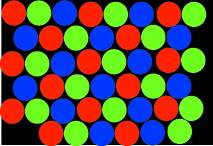
However, a normal CRT monitor has its pixels placed in the triangular pattern I described.
This link shows the standard CRT dot pattern nicely.
Whilst this link shows the standard LCD arrangement. -
Auctions for a cause...I always think it's kind of neat when these sorts of auctions happen, because people tend to bid things up that they could otherwise get for free or cheap (such as something signed by Neil Gaiman - he's a pretty personable guy, and is happy to sign things in person or by special arrangement mailed to certain bookstores that he frequents...and not just books (disclaimer: this site contains Not Safe For Work material, but aside from a few tiny ads way down at the bottom of the page, that particular page is safe)) because the money is going for a good cause. Like the Penny-Arcade Child's Play auction, for instance. (Of course, there are a bunch of first-editions and limited editions in this auction, so that might also be part of it. But I've never really understood the collector's mind.)
Or, perhaps I'm just being too optimistic, and people bid because they go insane at auctions.