Slashdot Mirror
Domain: berkeley.edu
Stories and comments across the archive that link to berkeley.edu.
Comments · 3,539
-
And what is the rest of Ohio up to?Checking the ratings (by results received for unversity teams) at SETI,
Ohio University ranks #3 and Ohio State is #12.
University rankings (world wide):
http://setiathome2.ssl.berkeley.edu/stats/team/tea m_type_7.htmlLooks like it's time to get the ax out and start cuttin' even more dead wood thar in Ohio.
Even large companies/corporation participate in SETI (but please don't tell the stock holders):
http://setiathome2.ssl.berkeley.edu/stats/team/tea m_type_3.html -
See his SETI@Home profileYou can see his SETI@Home user profile here with photo, bio, etc. Interestingly, he lists himself as a "consultant".
You can also theoretically "recommend" his profile by clicking on the "Recommend" button. I don't know what this counts for, but I think this could be a good way to support him and it couldn't hurt. Unfortunately, the button didn't work when I tried it. Maybe it is because I went there thru Google and the URL is not exactly right. Maybe you have to be a logged-in SETI@Home user. Anyway, if you can figure out a way, I suggest you recommend his profile.
-
Re:StorageAbout ten terabytes. Or maybe 20 terabytes. Or maybe as much as 3 petabytes.
Those first two estimates are based on the text content alone. If the graphical contents of those books were rendered into digital format. The third one assumes maps, photographs, sound recordings, etc.
-
Re:StorageAbout ten terabytes. Or maybe 20 terabytes. Or maybe as much as 3 petabytes.
Those first two estimates are based on the text content alone. If the graphical contents of those books were rendered into digital format. The third one assumes maps, photographs, sound recordings, etc.
-
Re:You couldn't make this up!
We have seen multiple times that tightly controlled markets tend to do worse than markets that are more free.
And I can point to a number of other times when a tightly-held monopoly has run amok and trampled the rights of the consumer underfoot.
You can go back a hundred years, or a hundred days for more evidence of this. -
incompetent for sure.And if you're stupid enough to make publically humiliating statements about your (ex) employees, you deserve what you get too.
Yeah, he wanted to prove how clever he was to waste everyone's time by hiring someone stupid. I'm afraid that this is definitive proof that Hayes is incompetent and that incompetents in general don't know how bad they are at things. We can assume much else about the workings of his office. Yep, Windoze, what a dumb fuck. Nothing but the best waste of taxpayer money there.
Sooner or later, he's going to figure out that the "standard" non free software he's using on that "server" is:
- filled with spyware
- filled with malware
- owned by spammers and porn masters
He'll notice it as CNN and the other ways he spends his time run slower and slower. Then he will wish that he had someone to help him fix it and SETI to blame. At least with SETI, he knew what he was running
-
Background on Smith
From his SETI@home website:
"I'm a consultant in the computer business, in Columbus Ohio. SETI@home is running on machines on my network around the house, using 5 Sun processors in the 400MHz range amd one P4 1.8 GHz."
and
"I'm sure extraterrestrial life exists. Will we ever discover it or visa versa? That's anybody's guess. But SETI@home seems like a great idea, and certainly worth putting on machines that sit here and run 24/7 anyway! It does screw up my workload average statistics though
That gives us a little insight on his thought processes about using computers that just "sit here and run 24/7 anyway!" -
Re:redundant
Don't we already have enough codecs, including open source ones?
While I agree strongly that there are a lot of reinvented wheels in OpenSource that add nothing new or unique, audio codecs are a wide open area for innovation. There is a lot of complex mathematical theory involved and while many very smart people have more than just scratched the surface, we could see considerable improvement with more development. Each project serves as a test case for the methods it uses.
Personally, I'm dissappointed that the idea of using genetic programming (or related technology) to develop or improve CODECs has not, at least to my knowlege, taken off. Hopefully the people with the expertise in both fields will at some point come together. That would be a worthy use for the resources we have at our disposal these days, IMO.
I used to think this would only be good for lossless CODEC developement, but perhaps automated fitness tests for lossy CODECs could also be practical. -
FightAIDS@Home
Perhaps this would be a good place to mention FightAIDS@Home, which is a distributed computing project like SETI@Home. It is used for research into newer drugs to keep up with the mutability of the HIV virus, which has been termed computational co-evolution. It only runs on Windows so far. OS X and Linux versions are supposedly in the works, but they've been taking ages.
-
Remedy: Don't trust user/input-unless its correct.
Those 600 purported North Korea computer crackers are NO MATCH against software programs coded to not trust the user or their input unless it's *absolutely* correct.
Unfortunately, there is ALMOST NO DEFENSE against a computer cracker impersonating a legitimate user located at an authorized TCP/IP address that TRACEROUTEs to it in an authentic fashion presenting legitimate system logon credentials in order to infiltrate and compromise a computer system.
There is also ALMOST NO DEFENSE against a 'botnet' launched against the target computer system in the above fashion in order to overwhelm the target system and exhaust their computing resources in the 'classic' Denial-Of-Service style.
Since it is IMPOSSIBLE for the target computer system to tell the difference between a legitimate user and a 'evil computer cracker' who is correctly and successfully impersonating a legitimate user, it is up to the target system's system operators and administrators in 'meatspace' to monitor their systems closely for anything anomolous--no matter how small or insignificant. Case in point: Clifford Stohl's celebrated true-life tale of computer security documented in his book, The Cuckoo's Egg. I read the book when it first came out back in the early 1990s all in one sitting--it took HOURS but was worth it! I even saw the NOVA show based on the book. This book should be required reading by all conscientious people in the computer security industry. If all computer networks were ran by people with the dedication, intelligence, and tenacity of people like Clifford Stohl, computer crackers wouldn't stand much of a chance performing their mischief in cyberspace.
Unfortunately, this would then move the problem into 'meatspace' like never before--with such things as 'line cuts' and 'social engineering' to gain access to the computer systems and networks they want to disrupt, compromise, and/or disable.
Thus, it is up to the computer system operation, administration, support, and security personnel to be conscientious and ever vigilant to thwart these threats--whether they are paid well or barely enough to make ends meet.
If you *TRULY* care about your job in this capacity in the computing industry, the amount of your pay *DOESN'T* dictate the level of your dedication and attention to your job. -
Re:Shape vs. Vibration TheoriesRecent double-blind experiments in March '04 put doubt on this theory, but had no absolute proof of the "shape" theory either.
To quote:
"We didn't disprove the vibration theory. We just didn't find anything to support it," says assistant professor Leslie B. Vosshall, Ph.D., head of the Laboratory of Neurogenetics and Behavior. "All of our data are consistent with the shape theory, but don't prove the shape theory."
However several recent studies support the vibrational theory through differentiation of isotopes, including work at McGill in Quebec and the Berkeley Olfactory Research Project. At BORP, Noam Sobel and Christina Zelano note 23 of 31 subjects misidentified differences in identical samples.Perhaps more interesting is work showing dogs, fish, and even insects can identify isotopes. This research is not consistent with shape theory and seems to support a vibrational explanation of smell.
-
Which is superior.. my brief take on it
If Google is my hands for the web, Clusty is going to be my eye. I can swipe my hand through water in a pond, or sandhills on the beach, and get an idea of what is out there on the web, *in the order of popularity* (because backlinking is so important).
I have no problem with this way Google works, I found backlinking to be tremendously useful when implementing a gigabyte-sized database on htdig, and Google "just works".
Clusty on the other hand works to reduce my information saturation, it will reduce the overload and make me feel better. It seems similar to NorthernLight which did clustering a long time ago, but I believe stopped their public engine and are now going after the enterprise (apparently successfully? They have a linux download too).
I may be biased as I am also very interested now in faceted metadata search engine design, and that seems to be what Clusty is doing. I can't tell if it is the same categories as dmoz.org (which Overture says they leverage), but it seems to work. For example I typed in Northern Light and it gave me the categories of Search Engine, Reviews, Aurora, and even Crude Oil. Crude Oil disappeared when I put quotation marks around the search terms, so I'm impressed, they've taken the trouble to match phrases.
I tried some nonsense words, and discovered connections I didn't know exist (mostly foreign language) - I tried splik, splike, and spli*. Try it yourself in google and clusty. Note Google gives you ten pages for splike while Clusty tells you the knowledge domains they fit into. No more clicking here and there in the google screen list to try and find less-popular links. And Clusty turned spli* into split. And click Details in clusty, and a little yellow information window descends, telling you the different sites (Reuters included) and how many hits from each.
Look at their clustering, it seems good and useful. I searched for something I'm interested in now, the search term was: free bioinformatics tutorials.
Clusty gives me categories like Genomics, some institutes, and the Bioinformatics FAQ. It lets me expand more than one section at a time, and the tiny "More" link at the bottom of the category list continually extends that list each time you click it. That's useful. This leads me to other categories including some C++ libraries, a Computational Biology heading, MDL Chime, and a bunch more. Wow! I haven't studied it much more yet, but I'd like to be able to show a lot of categories the first time (no More button clicking), have more screen width given to the categories column, and display the associations that made it pick certain categories. Also I'd like a yellow popup when I mouse over a category to show the next inner level's category list (at th e moment not too many levels it seems) the way Berkeley's Flamenco does. There is a legend below the category list with a line describing the plus mark as "Expand clusters", but I wanted this to expand all clusters and give me all the categories. About the way I just checked the Flamenco site.. I had to use Google. The first time I typed Flamenco into Clusty and it didn't give me any category called Search Engine, which surprised me. I selected cluster by URL instead of Topic, and when I clicked on berkeley.edu I got a Clusty Error which was reproduceable then but not later. I found it on Google by typing in Flamenco and Berkeley. To be fair, Google took me to an old page that redirected me to the right page. When I went back to Clusty and typde in Berkeley as well and searched by topic, it was fine and took me to the right server the first time. Also the berkeley.edu links worked okay then too, so I want to give them the benefit of the doubt.
About the tech, I'm not sure they went as far as they could even though it works well for me. I thought it seemed to be a faceted metadata engine in some ways because they show the number of hits in each section, th -
Re:HP woes...HP seems to be trying hard to kill everything of substance that they ever had in Carly's attempt to be a low-cost-Dell-clone company.
No more PA-Risc.
No more Alpha.
No more Itanium Workstations
No more open source (except for lip service)
No more Bluestone software (based on open source.
No more HPUX.
No altavista when they bought CPQ.
No more Vision
No more Hewlett Packard name
No more Walter Hewlett or Packard involved.Seems to me that last one triggered when it all started falling apart.
Hewlett and Packard built one of the greatest companies in the history of Silicon Valley; and Carly managed to tank the thing in a couple years trying to pretend she can be a Michael Dell commodity-vendor.
I wish they'd just change the name to Carly&Co to stop trashing the inintials of two of the greatest heros of silicon valley.
If you want to save the thing, people should really bring back Walter Hewlett to the board and make him Chairman. At least he understood what his father's company stood for.
-
You can help: LHC@HomeGo to http://lhcathome.cern.ch/ and join. It's beta... whoops, beta testing ended just yesterday. I guess there's no more 5000 participant limit anymore, so why don't you give it a try. You can use BOINC to calculate seti work units also.
From the LHC@Home FAQ:
"1.2 What does LHC@home do?LHC@home helps the construction of LHC. It simulates how the particles travel trough the 27 km long tunnel. With the help of the calculated information, the magnets that control the beam can be calibrated with greater precision."
-
Re:Bah...Yes, thank you. Quite frankly, I've been a little shocked (although I really shouldn't be, I suppose) at the number of suggestions similar to the grandparent's.
People should read Benjamin's "The Work of Art in the Age of Mechanical Reproduction. It's even more important, IMHO, in the age of electronic reproduction.
-
Fair and balanced news for the Nazi in all of us"It's nice to know the media is deciding what to let through and what to report "in our best interest"."
Once upon a time the media was a friend to the public and a threat to the government. Now the media is controlled by so few companies that the government and media may as well be one in the same.
The blatent censorship is painfully obvious as well. Just check out how much coverage is given to the meetings at Bohemian Grove in Northern California. Hundreds of the most powerful and richest men in the world meet there yearly. This includes Dubbya and many others in high power. Why is this event not all over the news? If three baseball players fart at the same time, you can be assured it will plaster the newspapers. But when world leaders gather to discuss policies and do whatever else, there is nearly no news coverage at all. Hmm...
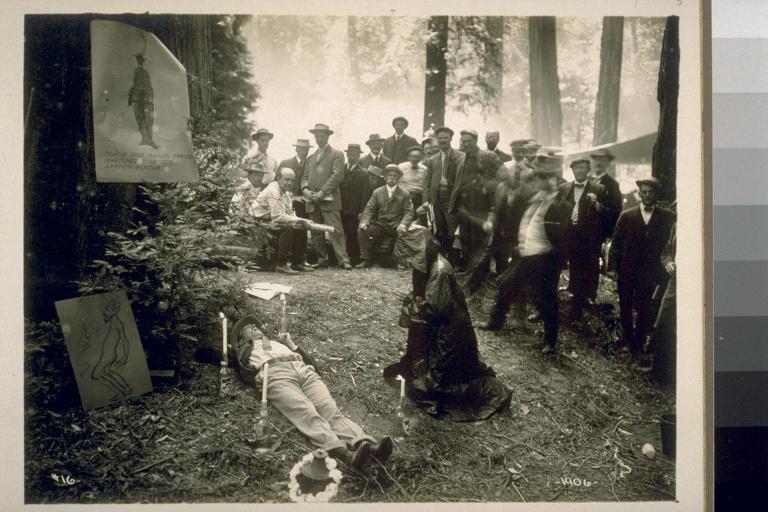
Well then again, if I was a world leader, and doing stuff like this http://sunsite.berkeley.edu/FindingAids/dynaweb/c
a lher/bohemian/figures/I0025343B.jpg I would be inclined to tell my media buddies to keep it hush, hush as well. A bit of research and an open mind is all it takes to see things are seriously wrong.Thomas Jefferson knew how important media is to a true democracy when he stated he ""would rather have newspapers without government than government without newspapers."
For more pics of former grove-mates like above check out the directory listing http://sunsite.berkeley.edu/FindingAids/dynaweb/c
a lher/bohemian/figures/DD
-
Fair and balanced news for the Nazi in all of us"It's nice to know the media is deciding what to let through and what to report "in our best interest"."
Once upon a time the media was a friend to the public and a threat to the government. Now the media is controlled by so few companies that the government and media may as well be one in the same.
The blatent censorship is painfully obvious as well. Just check out how much coverage is given to the meetings at Bohemian Grove in Northern California. Hundreds of the most powerful and richest men in the world meet there yearly. This includes Dubbya and many others in high power. Why is this event not all over the news? If three baseball players fart at the same time, you can be assured it will plaster the newspapers. But when world leaders gather to discuss policies and do whatever else, there is nearly no news coverage at all. Hmm...
Well then again, if I was a world leader, and doing stuff like this http://sunsite.berkeley.edu/FindingAids/dynaweb/c
a lher/bohemian/figures/I0025343B.jpg I would be inclined to tell my media buddies to keep it hush, hush as well. A bit of research and an open mind is all it takes to see things are seriously wrong.Thomas Jefferson knew how important media is to a true democracy when he stated he ""would rather have newspapers without government than government without newspapers."
For more pics of former grove-mates like above check out the directory listing http://sunsite.berkeley.edu/FindingAids/dynaweb/c
a lher/bohemian/figures/DD
-
Vehicular wireless networks
One really cool technology on the horizon is Vehicular Ad Hoc Networks (VANETs). These will use the 5.9 GHz band for Dedicated Short Range Communications (DSRC). Basically, cars will talk to each other and to the roadside, exchanging status information relevant to safety and efficiency. You could be alerted to upcoming traffic jams or approaching emergency vehicles. There is also talk about making traffic signals more efficient by letting them know when cars are coming, way in advance.
VANETs are a variant of mobile networking which have plenty of electrical and computational power available at each node, and where node to node distances are typically small. It's an ideal environment for mobile networking. -
Vehicular wireless networks
One really cool technology on the horizon is Vehicular Ad Hoc Networks (VANETs). These will use the 5.9 GHz band for Dedicated Short Range Communications (DSRC). Basically, cars will talk to each other and to the roadside, exchanging status information relevant to safety and efficiency. You could be alerted to upcoming traffic jams or approaching emergency vehicles. There is also talk about making traffic signals more efficient by letting them know when cars are coming, way in advance.
VANETs are a variant of mobile networking which have plenty of electrical and computational power available at each node, and where node to node distances are typically small. It's an ideal environment for mobile networking. -
Today? Try 1997
Honestly, the technology exists right now to automatically drive my car along a freeway.
Carnegie Mellon's: No Hands Across America
UC Berkeley's platoon of cars at Demo '97
But this will never be a mainstream product in our society. Too many lawyers and other disinterested parties (such as insurance companies).
This is actually pretty close to the truth. This is a major reason why Adaptive Cruise Control is being sold by OEMs as a "convenience" feature rather than a safety benefit. Another major factor is that many of these systems rely on rather expensive sensors (from a car component perspective). Consumer willingness to plunk down thousands of dollars to enable their car with these systems is not present except for the luxury models. -
A Better Site
After the webpage in the article gets
-
Re:Now...
Ah, the Microsoft way:
1. Purchase others' proven talent.
2. ???
3. PROFIT!!!
Seriously, this is all they ever seem to do to some degree of success. I know that they try to hire aspiring talent, but...
OK, so I take a 1-hour CS freshman seminar. Easily this is my favorite class, because we actually talk about interesting stuff. But anyway. So we've spent the last two weeks doing puzzle-type things. One of the ones he showed us he claimed was once asked during Microsoft interviews:
You are shown a picture of a seemingly perfectly symmetrical bus. There are no overt signs that indicate the direction of motion. How do you determine what way the bus is moving? The answer is that the picture shows the side of the bus without the door, and so the end of the bus with the door indicates the direction of motion. Meh, screw it. Adviseth Google: http://www.ocf.berkeley.edu/~wwu/cgi-bin/yabb/YaBB 0 28571067.
The point is that this question involves a ludicrous amount of assumption (On what side of the road does the bus drive? Could not the bus be moving in reverse? My favorite from the above forum thread: could the driver be sitting in the back?) and possibly America-centric (which doesn't exactly help when you're trying to sell to international markets), rendering the question useless for anything except personality study, which can be assertained through more efficient means.
Maybe I'm intentionally being contrary, and it probably matters that I didn't hear the riddle first-hand, but I find this specific nugget of reason to be very self-defeating.
But that whole anecdote isn't proof of anything. I just needed to say it. But my original point stands: do Microsoft itself really innovate? or is it just a bunch of mercenaries at work under the Microsoft label? -
KAP article will probably be half assed
I have a fear that this magazine will unfortunately be a half-assed regurgitation of other peoples' free how-to's. Like many magazines, they'll probably run a companion website that will provide as much or more value as the print version.
In that light, I am going to go ahead and assume that the Kite Photography article will be about 4 pages of cheap ineffective hacks (somewhat akin to the recent engadget articles). Anyone wanting a serious collection of articles on KAP might consider buying the complete archive of The Aerial Eye, a semiannual publication about KAP that ran for 9 years. It is a fantastic reference for $30. -
Re:Despite the cost savings...
AMANDA is a cosmic ray array detector, not an optical telescope.
-
Re:What about...
For anybody that who is interested in this but has no idea where to start, I highly recomend BOINC. It's becoming the standard as more and more distributed projects convert to using it. Right now, SETI, Predictor, ClimatePrediction, and LHC (the particle accelerator). Follow the link for links to each individual project.
http://boinc.berkeley.edu/
With BOINC, you can run multiple projects, and it'll split resources between them. On multiprocessor (or hyperthreaded) machines, you can dedicate a processor to each project. -
Climate simulation @ Home
Many of you are familiar with Seti@Home to look at ET. They moved to their new infrastructure called BOINC. Boinc supports multiple concurrent project.
Well there is a weather simulation project called ClimatePrediction.net where your computer simulate 15 years of the earth climate while you get a cool looking screen saver with the simulated weather. They are calibrating with simulation of past weather. With the calibrated models they will then forecast the next 50 years and hopefully have a best model of global warming.
Join in numbers and help clear up doubt about the future climate. You can share the same machine with SETI@Home if you want. -
Climate simulation @ Home
Many of you are familiar with Seti@Home to look at ET. They moved to their new infrastructure called BOINC. Boinc supports multiple concurrent project.
Well there is a weather simulation project called ClimatePrediction.net where your computer simulate 15 years of the earth climate while you get a cool looking screen saver with the simulated weather. They are calibrating with simulation of past weather. With the calibrated models they will then forecast the next 50 years and hopefully have a best model of global warming.
Join in numbers and help clear up doubt about the future climate. You can share the same machine with SETI@Home if you want. -
on being a planet or something less...
My former advisor here at UC Berkeley, Gibor Basri, has a neat way of discriminating between planets and the lesser (comets, asteroids, etc.). His idea is that if the object has enough self-gravity to force it into a spherical shape, it's a planet... if it doesn't (like Mars' "moons"), it's something less.
Here's a snipet:
How can this be resolved? A consensus is slowly developing (I believe) for the following solution. We can first define what we mean by "planetary mass", and base this only on physical characteristics. Then we can include circumstance into the definition of "planet". I propose the following three definitions:
FUSOR - an object that achieves core fusion during its lifetime.
PLANEMO - a round non-fusor.
PLANET - a planemo orbiting a fusor.
[...]
read on for his full article.
The following is a draft of an article now published in the Nov/Dec 2003 issue of Mercury. Draft of Mar. 20, 2003.
Defining "Planet" by Gibor Basri Univ. of California, Berkeley
Even before they were civilized, people looked into the sky and recognized different celestial objects. The Sun defined daytime, and the stars provided a fixed background of faint, twinkling lights at night. Among them moved the Moon, and a few special steadier lights. The Greeks called those which moved "planets" (it is worth noting that the Sun and Moon were originally included, since motion against the stars was the defining characteristic). Most cultures have an analogous word for these "wanderers". Both the stars and the planets were thought to revolve around the Earth.
After the Copernican Revolution, we recognize the Moon as the only body that orbits the Earth. The Sun is a very nearby example of a star, and the visible planets are other large bodies that orbit the Sun. We see them by reflected sunlight, while stars produce their own visible light. This understanding yields the dictionary (lay public) definition of the word "planet": a large heavenly body that shines by reflected light and orbits the Sun. In the past century we gained much understanding of our Solar System, and even visited most of the planets robotically. Yet today, professional astronomers find themselves unable to agree upon a succinct definition of "planet". Replacing "the Sun" with "a star" is obviously necessary now that many extrasolar planets have been discovered, but the problem goes well beyond that.
Two recent controversies that found their way to the popular press illustrate further difficulties. One is the "Pluto controversy". This arose because of the discovery of a large belt of icy objects beyond Neptune. They are the outer remains of the original protoplanetary disk. This "Kuiper Belt" is a natural outcome of incomplete planet formation in the outer Solar System, and is the source of some of the comets we see. As Kuiper Belt objects (KBOs) were discovered in increasing numbers in the 1990s, including a population of "Plutinos" which share Pluto's orbital characteristics (somewhat different from the other planets), some astronomers began to suggest that Pluto itself (which shares many properties with, but is the largest KBO known so far) does not qualify as a planet. The recent discoveries of Varuna and Quaoar (which are KBOs half the size of Pluto, like its moon Charon) may presage the time when we find another Pluto-sized KBO.
The current situation is much like that in the early 1800s, when the first asteroids were discovered. Ceres was originally hailed as the fifth planet, particularly since one in its position was expected from "Bode's Law" of planetary spacings. It lost its status within a few years, when other members of the asteroid belt began turning up. Herschel, who had been the only person to have discovered a new planet before then, aided the effort to demote Ceres. The arguments against its pl
-
More JC Jokes
More spiels and jokes:
http://www.themedattraction.com/jungle.htm
Famous Pranks
http://www.csua.berkeley.edu/~yoda/disneyland/jpra nks.htm
# Dropping a rubber spider on guests' heads as they disembark and pass under the boathouse bridge (OK, I gotta take credit for this one... I Imagineered this prank in the Summer of '95. My most notable victim... Carrie Fisher of Star Wars fame)
# Fishing from the "catwalk" (center dock). The fishing line usually has a rubber fish or snake attached to it, waiting for a cast member to pull it up in a moment of glee with the entire boathouse audience watching.... one time somebody had put a broken "stroller parking" sign out on the catwalk with a stroller on it.
# Making jars of "baby piranha" to display in the dispatch office (Yep, I Imagineered this one, too. -- We'd bring in an aquarium fish net and scoop up those little minnows that live in the river, labeling the jar "baby piranha")
# Playing chess with a fellow cast member in the "luggage storage" part of the queue building.
# Playing dead on the infirmary bed upstairs in the queue building.
# re-routing the queue so the line goes in a circle, but never to the loading area (only works when there is only a few people in line)
-
Re:Not that great..
There are actually quite a few applications like that. This kind of CPU is perfect for distributed computing applications, which use every CPU cycle and thread they can get. Clients based on the new BOINC computing platform, and the distributed.net client, are already set up to take full advantage of this kind of CPU.
-
Re:A few points
I'm still waiting for the really bad one...
A really bad one could be almost unbelieveably nasty. Try reading about Warhol Worms, and then think about one with a destructive payload that targeted a zero day Windows vulnerability. A worm like that could take down a substantial fraction of the world's computers before anyone realized that there was a problem. A more subtle threat- like a slow worm that caused subtle data corruption- might be able to mess things up pretty badly before being wiped out, too.
-
Maybe he should check out DIBS
b s/ -
Redundant Array of Network Devices [RAND]
During the early 2000's an idea like this had already surfaced during the much hyped Storage Service Provider (SSP) rush. While most companys like the now defunct StorageNetworks (NASDAQ:STOR) were just building massive terabyte clusters into CoLo's around the country one provider Digital Knox was creating a system very similar to the OceanStore concepts from Berkeley. The idea was not using P2P however since this required users to volunteer space. Simply put take the idea of a RAID array with parity and instead of drives think CoLo. Now that the data is spread across multiple centers having just one go down will not effectively kill it. The only draw back of course is time to recover the data which would be slower but far more resiliant to natural disasters (hurricanes, terrorist attacks, etc).
These ideas were published in a book, written by former CTO of DigitalKnox, "Fundamentals of Secure SAN" although the book isn't available yet. The biggest problem of course is the fact that most clients do not like sending their sensitive data to others. For this reason an additional layer of obscurity was added in the form of EFS. This would allow for non RAND type storage to remain secret even from the storage provider. More importantly it eased concerns that *other clients* of the storage service could somehow sneak a peek at their data.
The problems only multiply at this point since now key escrow and remote searching become an issue. The speed tradeoff seemed accetable to many but only for long term storage. The problem hasn't gone away obviously but the market dropped off the face of the planet. One of the only major survivors was Iron Mountain who not only stores your data online but will keep backup tapes in secure vault locations around the country. -
Lots of other projects
Nothing new here. Check out Berkeley's OceanStore project for an idea of a global storage solution impervious to local disasters.
-
Oceanstore project at Berkeleyhttp://oceanstore.cs.berkeley.edu/
Overview from the homepage:
OceanStore is a global persistent data store designed to scale to billions of users. It provides a consistent, highly-available, and durable storage utility atop an infrastructure comprised of untrusted servers.
Any computer can join the infrastructure, contributing storage or providing local user access in exchange for economic compensation. Users need only subscribe to a single OceanStore service provider, although they may consume storage and bandwidth from many different providers. The providers automatically buy and sell capacity and coverage among themselves, transparently to the users. The utility model thus combines the resources from federated systems to provide a quality of service higher than that achievable by any single company.
OceanStore caches data promiscuously; any server may create a local replica of any data object. These local replicas provide faster access and robustness to network partitions. They also reduce network congestion by localizing access traffic.
We must assume that any server in the infrastructure may crash, leak information, or become compromised. Promiscuous caching therefore requires redundancy and cryptographic techniques to protect the data from the servers upon which it resides.
OceanStore employs a Byzantine-fault tolerant commit protocol to provide strong consistency across replicas. The OceanStore API also allows applications to weaken their consistency restrictions in exchange for higher performance and availability.
A version-based archival storage system provides durability which exceeds today's best by orders of magnitude. OceanStore stores each version of a data object in a permanent, read-only form, which is encoded with an erasure code and spread over hundreds or thousands of servers. A small subset of the encoded fragments are sufficient to reconstruct the archived object; only a global-scale disaster could disable enough machines to destroy the archived object.
The OceanStore introspection layer adapts the system to improve performance and fault tolerance. Internal event monitors collect and analyze information such as usage patterns, network activity, and resource availability. OceanStore can then adapt to regional outages and denial of service attacks, pro-actively migrate data towards areas of use and maintain sufficiently high levels of data redundancy.
Many components of OceanStore are already functioning in isolation. A complete prototype is currently under development.
-
DIBS
Cringley is adding nothing new here. We've all already seen this on Slashdot. Hell, the websiteeven mentions how it's like P2P but not.
-
Antony van Leeuwenhoek
-
Re:You Bastards!
LOL.. That's even funnier if one knows something about georgian.
With wonderful phrases like: "gvprc'k'vni" (He's ripping us off!).. no vowels for miles. And they're really prounounced without vowels!!
(Unlike Russian and other slavic languages where vowels sometimes look like they're missing, but just aren't written out. For instance 'v' in russian meaning 'in', which is pronounced like something between 'v' and 'va') -
Re:Or maybe...Accessing filesystems as SQL data has always been a dream of anyone who has had many files. They just never knew about it.
Since I have ended up being a SQL Monkey (again) at work, I assure you that I have no desire to use SQL to access my file system. I don't even want a middle layer that translates to SQL. Heck, I am not even sure I want a relational database for a file system.
I would rather they start, by looking at the speed of the file system and take some hints from the file system for Sprite and maybe some of the capabilities of Plan 9's filesystem / model.
Once, that is handled, look at all the trouble people have mapping our current batch of Object-Oriented Languages to SQL. Know, that you will write a natural language query engine for the end-users, so developers need an API / Object Hierarchy that works. Pick something that will be easy to program, allow decent, extendable meta-data, and fits nicely with objects.
-
alternate link
Well, since the mentioned site is slashdotted try this one instead for some aerial kite photography.
-
Re:Religion and Schooling
against atheism, which is not a religion
Others have covered it already. But the point should be reitereated--atheism is not a "third way", but atheists like to believe that they are the unbenighted keepers of the Truth, so I'm unsurprised by your statement.
A lot of important science raises serious questions that make people of many religions uncomfortable.
And a lot of religious questions make scientists uncomfortable as well, such as "If natural selection is so great, why are we actively working to protect untenable genes with doctors and opthamologists and boob-jobs?" Science, regardless of the high opinion its practitioners have of themselves, do not have all the answers.
But it should still be taught, undistorted.
But it's not being taught, undistorted. If your "science" requires NewSpeak in order to make sense, I question its value.
I also take issue with this, though my point is more subtle here.
I take issue with the grandparent's point as well, but for different reasons. I believe that there are, sometimes, very simple, black and white issues. Abortion would be one of them. Is that mass of cells alive, or is it not? If it's alive, we have a responsibility to protect that life. Is it not alive? Then we can do what we want.
Almost every reasonable person would agree that mass of cells is certainly alive. Left unchecked, it will definitely be born just like any other baby, barring unfortunate events that are normally considered "tragedies", such as birth defects or stillbirth. Most people know this, but they want to have the option of killing that life when it becomes inconvenient, embarrassing, or otherwise less-than-ideal. They wrap this desire under the disingenuous label of "choice", and start talking about grey areas.
the thing he said that struck him about the United States was how everyone is so determined to be patrotic here.
The reason he's so amazed is because he doesn't much care for his own country, he can't imagine that there are people who do love their country.
The Anti-Patriotism Patriots always insinuate that American patriotism is half-ignorant jingoism. It never occurs to them that most of America really loves America. What a loony idea! People who think they are more "nuanced" (that's you) tend to think that America is a crappy country because we killed a lot of Indians, or we bombed Japan, or we didn't sign the Kyoto protocols, or whatever, and that patriotism for this crappy country must be some brain-washing caused by flags and country music. It's nothing of the sort. You hate America for your own reasons. A lot of the rest of America loves it. Their patriotism is no less real than your lack of it.
It wasn't the everywhere-stars-and-stripes that brought the U.S. together after 9/11
For most of the country, it was the flag; and prayers, love of our fellow citizens, anger at the attackers, and a dozen other things. We don't gather in groups and hold candles and pray for the victims of Hezbollah, or at least not that often. Why? Because they're Israelis! Who the fuck cares about Israelis? Israel does.
You sound like a secular humanist. Not surprising--I'd say most of Slashdot is inhabited by your ideological brothers. But as a group, you are very much distanced from a lot of Americans, and that realization makes you uncomfortable. So you label the opposition with such things as "unscientific" and "nationalism" in your quest to feel better about yourself. Which, ironically enough, is most certainly is a trait of humanity that is shared by all who are born of woman. Maybe we can all get together and sing Kumbaya on self-absorbtion one day--at least on that we can all agree.
-
Read the article, read some historyTo quote from the article (which most folks have not read, as usual):
The DBFS does not actually store files, it holds references to files on the underlying hierarchy based file system.
That line alone should answer many of the questions re backup, speed of FS performance, etc.At a deeper technical level, nany of the questions asked here have historical answers or clues in The Design and Implementation of the Inversions File System. The abstract reads:
This paper describes the design, implementation, and performance of the Inversion file system. Inversion provides a rich set of services to file system users, and manages a large tertiary data store. Inversion is built on top of the POSTGRES database system, and takes advantage of low-level DBMS services to provide transaction protection, fine-grained time travel, and fast crash recovery for user files and file system metadata. Inversion gets between 30% and 80% of the throughput of ULTRIX NFS backed by a non-volatile RAM cache. In addition, Inversion allows users to provide code for execution directly in the file system manager, yielding performance as much as seven times better than that of ULTRIX NFS.
Note that this paper was published in early 1993. Many of the issues it addresses are relevant to DBFS, and many of DBFS's advantages are foreseen by that paper. IMHO DBFS has chosen a direction that should have better performance than inversion, not to mention lower risk and easier failure recovery.Inversion was built on POSTGRES, which makes one wonder what happened to the source.
-
Article on UC Berkeley's website
UC Berkeley's NewsCenter has a nice article about this. The astronomer is from UC Berkeley.
-
Re:If anything brings the Internet down...Anything hackers can do can be sensed, and the appropriate code put in place to stop the leak.
Yes, but will the hacker already have won before your new code is in place?
I'll agree that the lawyers/politicians are a more probable and immediate threat; they can be dangerous without having to think-- which is common enough. The skills necessary to code a well-designed multi-platform rapidly distributing worm are rare, more so when combined with either the carelessness, cluelessness, or viciousness needed to release such a well designed and malicious beastie into wild-- but there may be a non-zero intersection of those traits in the global population. Take a look at Ted Kaczynski's background; before becoming the Unabomber, he was a talented mathematician. Fortunately, he's in jail.
-
MOND
Someone had to ask: wonder if anyone's simulated the universe using MOND. How did the researchers account for all this dark matter that's supposed to be around? It's far more likely that we got the force law wrong. Do these dark matter guys still believe in Santa Claus? BTW has anyone successfully simulated a galaxy and produced results that correspond to observations? I think this problem is still open...
-
How about Boinc?
"a task that needed 60,000 years, the computer scientists devised a couple of tricks to reduce the amount of computations"
OR
60,000 Computers all running accrros the globe in a simulated computing project.
http://boinc.berkeley.edu/
Now i know theres problems with this. They were using a more powerful computer than any of us have in our homes, plus the problems with simulations going wrong but overall its possible i think.
http://climateprediction.net/ manage to predict the the weather (well, we think they have!). -
Re:as soon as it gets hacked in to RPMActually, Red Hat were using binary diffs a long time ago - see rhmask. Of course, when they switched from shipping some proprietary software (CDE, Red Baron, Metrolink's(?) X11) to only shipping 100% FOSS, rhmask fell into disuse.
It probably wouldn't take much to take rhmask and update it to use xdelta or something, though. Note what the xdelta manpage says about using it on compressed data, though:
Gzip processing
Attempting to compute a delta between compressed input files usually
results in poor compression. This is because small differences between
the original contents causes changes in the compression of whole blocks
of data. To simplify things, Xdelta implements a special case for
gzip(1) compressed files. If any version input to the delta command is
recognized as having gzip compression, it will be automatically decom-
pressed into a temporary location prior to comparison.
[...]
There is one potential problem when automatically processing gzip com-
pressed files, which is that the recompressed content does not always
match byte-for-byte with the original compressed content. The uncom-
pressed content still matches, but if there is an external integrity
check such as cryptographic signature verification, it may fail.That would clash with rpm's MD5 and GPG signature checking.
-- -
Go look for yourself
-
still a good candidate
i don't know what the BBC was on about. The signal SHGb02+14a is still in the top 25 candidates with a good score of 2.567e-09 so i assume they'll investigate further.
-
Delay tactic
My sources indicate that the message was along the lines of "take me to your leader", but the folks over at the SETI project want to wait until after the US election in November before replying. BTW, here's a sample of the results that users have submitted.