Slashdot Mirror
Domain: blogspot.com
Stories and comments across the archive that link to blogspot.com.
Stories · 3,021
-
IsoHunt Guilty of Inducing Infringement
roju writes "The MPAA has won a summary judgment against torrent indexing site isoHunt for inducing copyright infringement. Michael Geist notes that '[t]he judge ruled that the isoHunt case is little different from other US cases such as Napster and Grokster, therefore concluding that there is no need to proceed to a full trial and granting Columbia Pictures request for summary judgment.' Attorney Ben Sheffner, who worked on the case for Fox, explains some of the implications, noting that 'the most significant ruling in the opinion was the court's holding that the DMCA's safe harbors are simply not available where inducement has been established.' This case could have implications on other indexing sites, and creates a gap in the DMCA safe harbor provisions that could have far-reaching implications on other sites." -
Amazon Kindle Proprietary Format Broken
An anonymous reader writes "The Register reports that the proprietary document format used by the Amazon online store and Amazon's Kindle has been successfully reverse engineered, allowing these DRM-protected documents to be converted into the open MOBI format. Users of alternative e-book readers rejoice." Here are the hacker's notes on the program he is calling "Unswindle," and here is the (translated) forum where the Kindle challenge was posed and answered. -
Widenius Warns Against MySQL Falling Into Oracle's Hands
jamie sends in a blog post from MySQL co-founder Monty Widenius calling for help to "save MySQL from Oracle's clutches." While the US DoJ approved Oracle's purchase of Sun back in August, the European Commission has been less forthcoming. Widenius points out that Oracle has been using their customers to put pressure on the EC, and he questions Oracle's commitment to MySQL, saying their vague promises aren't good enough. He writes: "Oracle has NOT promised (as far as I know and certainly not in a legally binding manner): To keep (all of) MySQL under an open source license; Not to add closed source parts, modules or required tools; To not raise MySQL license or MySQL support prices; To release new MySQL versions in a regular and timely manner; To continue with dual licensing and always provide affordable commercial licenses to MySQL to those who needs them (to storage vendors and application vendors) or provide MySQL under a more permissive license; To develop MySQL as an Open Source project; To actively work with the community; Apply submitted patches in a timely manner; To not discriminate patches that make MySQL compete more with Oracle's other products; To ensure that MySQL is improved also in manners that make it compete even more with Oracle's main offering." -
Google Demonstrates Quantum Computer Image Search
An anonymous reader sends along this quote from New Scientist: "Google's web services may be considered cutting edge, but they run in warehouses filled with conventional computers. Now the search giant has revealed it is investigating the use of quantum computers to run its next generation of faster applications. Writing on Google's research blog this week, Hartmut Neven, head of its image recognition team, reveals that the Californian firm has for three years been quietly developing a quantum computer that can identify particular objects in a database of stills or video (PDF). Google has been doing this, Neven says, with D-Wave, a Canadian firm that has developed an on-chip array of quantum bits — or qubits — encoded in magnetically coupled superconducting loops." -
Google Releases Experimental Phone To Employees
alphadogg, as is his wont, sends in a Network World piece on the resurgent rumors of a Google Phone. "Google has handed out a new mobile phone running its Android software to some employees, stirring another wave of speculation that the oft-rumored Google Phone is real. In a blog post on Saturday morning, Google said the phones are being distributed so that workers can experiment with new mobile features. It did not say the device will be a Google-branded phone. Since even before Google unveiled Android, onlookers have wondered whether the search giant will release its own phone. Instead, it released an open source operating system that other hardware vendors can use to make phones." -
Global Deforestation Demoed In Google Earth
eldavojohn writes "On Google's official blog, they claim a 'new technology prototype that enables online, global-scale observation and measurement of changes in the earth's forests.' Ars has more details on what Google unveiled at Copenhagen. If you have Google Earth installed, you can find a demonstration here. Many organizations and government agencies are on board with this initiative to put deforestation before the eyes of the public. If only satellite data of North America existed before the logging industry swept in!" It's interesting to contemplate the implications for intelligence gathering of Google's automated tools to compare satellite photos. -
US Patent Office Fast Tracks Green Patents
eldavojohn writes "A new initiative is being piloted where 'green' patents are given special priority over other patents in the backlogged system. David Kappos (Under Secretary of Commerce for Intellectual Property and Director of the USPTO) said, 'Every day an important green tech innovation is hindered from coming to market is another day we harm our planet and another day lost in creating green businesses and green jobs. Applications in this pilot program will see a significant savings in pendency, which will help bring green innovations to market more quickly.' The details of how you qualify for a green patent (PDF) are available with patent blogs offering opinions on this initiative." -
Court Says Fair Use May Hold In Some RIAA Cases
NewYorkCountryLawyer writes "In SONY BMG Music Entertainment v. Tenenbaum, the Boston RIAA case in which the defendant, represented by Charles Nesson of Harvard Law School, admitted liability at his trial, the Court has entered judgment in favor of the RIAA for the monetary award of $625,000 fixed by the jury. However, the Court left open the questions of whether the amount is excessive, and whether attorneys fees and/or sanctions should be awarded, and has scheduled further briefing of those issues. The Court granted the RIAA much, but not all, of the injunctive relief it requested. In an unusual step, the Court issued a 38-page decision (PDF) explaining in some detail the Court's views of the Fair Use defense in the context of cases like this, and indicating that there are some factual scenarios — not applicable in this particular case — in which it might have concluded that the claims were barred by Fair Use. E.g. it declined to rule out the possibility that creation of mp3 files exclusively for space-shifting purposes from audio CDs a defendant had previously purchased might constitute fair use." -
Personalized Search From Google Now Opt-Out
An anonymous reader writes "CNet reports that 'Google now intends to deliver customized search results even to those searching its site without having signed into a Google account.' This may be what finally drives me to seriously experiment with cookie-free browsing. I consider non-personalized search results to be of value. They quasi-subconsciously give me a better perspective of the full range of information and ideas on the net. That, and I'm also a bit paranoid about a coming world with push-button infrastructure for personalized mis/disinformation." -
Copyright and the Games Industry
A recent post at the Press Start To Drink blog examined the relationship the games industry has with copyright laws. More so than in some other creative industries, the reactions of game companies to derivative works are widely varied and often unpredictable, ranging anywhere from active support to situations like the Chrono Trigger: Crimson Echoes debacle. Quoting: "... even within the gaming industry, there is a tension between IP holders and fan producers/poachers. Some companies, such as Epic and Square Enix, remain incredibly protective of their Intellectual Property, threatening those that use their creations, even for non-profit, cultural reasons, with legal suits. Other companies, like Valve, seem to, if not embrace, at least tolerate, and perhaps even tacitly encourage this kind of fan engagement with their work. Lessig suggests, 'The opportunity to create and transform becomes weakened in a world in which creation requires permission and creativity must check with a lawyer.' Indeed, the more developers and publishers that take up Valve's position, the more creativity and innovation will emerge out of video game fan communities, already known for their intense fandom and desire to add to, alter, and re-imagine their favorite gaming universes." -
Google Launches Public DNS Resolver
AdmiralXyz writes "Google has announced the launch of their free DNS resolution service, called Google Public DNS. According to their blog post, Google Public DNS uses continuous record prefetching to avoid cache misses — hopefully making the service faster — and implements a variety of techniques to block spoofing attempts. They also say that (unlike an increasing number of ISPs), Google Public DNS behaves exactly according to the DNS standard, and will not redirect you to advertising in the event of a failed lookup. Very cool, but of course there are questions about Google's true motivations behind knowing every site you visit." -
Scientology Charged With Slavery, Human Trafficking
eldavojohn writes "A formal complaint was filed in California (caged PDF) last week by John Lindstein naming David Miscavige and the Church of Scientology International as defendants. Lindstein claims that for sixteen years (from age 8) he was forced to work as a slave at Gold Base, a secret CoS site run by Golden Era Productions with 'razor wire, security guard patrols, surveillance posts, and three roll calls each day.' The pay was $50 a week. The allegations include 'Violations of wage and hour laws as well as unfair/illegal business practices actionable under California B&P 17200 Et. Seq.' and a complaint under the 13th Amendment of the US Constitution, which abolished slavery. Members of the group Anonymous praised the summons." -
Google Eliminates Gizmo5 Client For Linux
cuttheredwire writes "Evidence on the Gizmo5 forum (login required) confirms that since Google's takeover of Gizmo5, only the Windows, Mac, and iPhone clients are available for download from the official Web page. The Linux download link no longer works. This is a potential problem for happy Linux users with paid-up credit in their Gizmo5 accounts if they need to reinstall the software. A back-door download is still available, although it is speculated on the forums that it will go away soon. Does this mean that (as with other Google projects such as Google Talk) Linux will be the poor relation for Google Voice also?" -
Would You Use a Free Netbook From Google?
Glyn Moody writes "The response to Google's Chromium OS has been rather lukewarm. But suppose it's just part of something much bigger: a netbook computer from Google that would cost absolutely nothing. Because all the apps and data are stored in the cloud, storage requirements would be minimal; screens are getting cheaper, and the emphasis on lean code means that a low-cost processor could be used. Those relatively small hardware costs could then be covered by advertising in the apps — after all, they are just Web pages. Interestingly, Google has not only rolled out advertising to more of its services recently, it has also started running AdSense ads in the desktop application Google Earth. Would you accept a free Google netbook — or is the price you would pay in terms of the company knowing even more about what you do on an hour-by-hour basis just too high?" -
Would You Use a Free Netbook From Google?
Glyn Moody writes "The response to Google's Chromium OS has been rather lukewarm. But suppose it's just part of something much bigger: a netbook computer from Google that would cost absolutely nothing. Because all the apps and data are stored in the cloud, storage requirements would be minimal; screens are getting cheaper, and the emphasis on lean code means that a low-cost processor could be used. Those relatively small hardware costs could then be covered by advertising in the apps — after all, they are just Web pages. Interestingly, Google has not only rolled out advertising to more of its services recently, it has also started running AdSense ads in the desktop application Google Earth. Would you accept a free Google netbook — or is the price you would pay in terms of the company knowing even more about what you do on an hour-by-hour basis just too high?" -
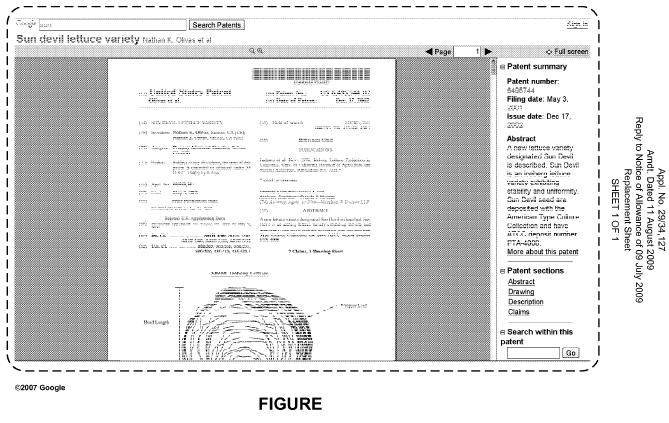
Google Patents Displaying Patents
theodp writes "Google has actually managed to patent displaying patents. The USPTO issued US Patent No. D603,866 to six Google inventors for their 'graphical user interface for display screen of a communications terminal.' Among the six inventors is the guy who introduced Google Patents. Ironically, Google Patents can't seem to find the new Google patent for Google Patents." -
Microsoft Applies For Patent On Tufte's Sparklines
jenkin sear writes "Data visualization guru Edward Tufte developed Sparklines, a great way to display condensed data as an inline graphic. Excel's new version has incorporated the design element — and Microsoft has applied for a patent on them — without so much as a by-your-leave from Tufte." -
Google Releases Source To Chromium OS
Kelson writes "Google has released the source to what will eventually become Chrome OS, and will begin developing it as an open source project like Chromium. The OS differs from the usual computing model by (1) making all apps web apps (2) sandboxing everything and (3) removing anything unnecessary, to focus on speed." Reader Barence adds "Google said consumers won't be able to download the operating system — it will only be available on hardware that meets Google's specifications. Hard disks are banned, for instance, while Google said it will also specify factors such as screen sizes and display resolutions. Google said it plans to officially launch Chrome OS by the end of next year." -
Free Software For All Russian Schools In Jeopardy
Glyn Moody writes "Last year, we discussed here a Russian plan to install free software in all its schools. Seems things aren't going so well. Funds for the project have been cut back, some of the free software discs already sent out were faulty, and — inevitably — Microsoft has agreed to a 'special price' for Windows XP used in Russian schools." -
The "Hail Mary Cloud" Is Growing
badger.foo writes "The Australian rickrolling of jailbroken iPhones only goes to prove that bad passwords are bad for you, Peter Hansteen points out, as he reports on the further exploits of the password-guessing Hail Mary Cloud (which we've discussed in the past). The article contains log data that could indicate that the cloud of distributed, password-guessing hosts is growing. 'With 1767 hosts in the current sample it is likely that we have a cloud of at least several thousand, and most likely no single guessing host in the cloud ever gets around to contacting every host in the target list. The busier your SSH deamon is with normal traffic, the harder it will be to detect the footprint of Hail Mary activity, and likely a lot of this goes undetected.'" -
Google Files a Revised Books Settlement Proposal
At 14 minutes to midnight last night, Google, the Authors Guild, and the Association of American Publishers filed a revised settlement agreement with a US district court in New York. Here is the blog post of Dan Clancy, Google Books engineering director. Google has provided an outline of the differences from the original settlement (PDF) and a FAQ (PDF); the full revised settlement (PDF) is also available. In brief, the changes include limiting the settlement to books published in the US, UK, Canada, and Australia; a court-appointed fiduciary to represent the rights of orphaned works' (undiscovered) rightsholders; and further opening up Google's library to competitors in ways that don't favor Google. The new plan was immediately criticized as a "sleight of hand" by the Open Book Alliance, a consortium of Google's opponents including Microsoft and Amazon. The Internet Archive said, "None of the proposed changes appear to address the fundamental flaws illuminated by the Department of Justice and other critics that impact public interest." -
Dashboard Reveals What Google Knows About You
CWmike writes "Ever wonder exactly what Google knows about you? Google took a step today to answer that question with the unveiling of Google Dashboard, which is designed to let users see and control the copious amounts of data that Google has stored in its servers about them. 'Over the past 11 years, Google has focused on building innovative products for our users. Today, with hundreds of millions of people using those products around the world, we are very aware of the trust that you have placed in us, and our responsibility to protect your privacy and data,' Google said in a blog post today. 'In an effort to provide you with greater transparency and control over their own data, we've built the Google Dashboard.' Dashboard is set up so that users can control the personal settings in each Google product that they use. Google said the tool supports more than 20 products, including Gmail, Calendar, Docs, Web History, YouTube, Picasa, Talk, Reader, Alerts and Google Latitude. Consumer Watchdog said in a statement today that it applauds Google for giving users a single place to go to manage their data. But at the same tine, the group also came down hard on Google, contending that it needs to give users a vehicle for stopping the company from collecting any personal data." -
Lawmakers Caught Again By File-Sharing Software
An anonymous reader writes "A document, apparently a 'confidential House ethics committee report,' was recently leaked through file-sharing software to the Washington Post. According to the article, 'The committee's review of investigations became available on file-sharing networks because of a junior staff member's use of the software while working from home.' Of course, P2P software is entirely at fault for this incident. If you begin seeing more interest in DRM from Congress, you now know why." Reader GranTuring points out that the RIAA took the opportunity to make a ridiculous statement of their own. They said, "the disclosure was evidence of a need for controls on peer-to-peer software to block the improper or illegal exchange of music." -
Decline In US Newspaper Readership Accelerates
Hugh Pickens writes "The Washington Post reports that US newspaper circulation has hit its lowest level in seven decades, as papers across the country lost 10.6 percent of their paying readers from April through September, compared with a year earlier. Online, newspapers are still a success — but only in readership, not in profit. Ads on newspaper Internet sites sell for pennies on the dollar compared with ads in their ink-on-paper cousins. 'Newspapers have ceased to be a mass medium by any stretch of the imagination,' says Alan D. Mutter, a former journalist and cable television executive who now consults and writes a blog called Reflections of a Newsosaur. According to Mutter only 13 percent of Americans, or about 39 million, now buy a daily newspaper, down from 31 percent in 1940. 'Publishers who think their businesses are going to live or die according to the number of bellybuttons they can deliver probably will see their businesses die,' writes Mutter. 'The smart ones will get busy on Plan B, assuming there is a Plan B and it's not already too late.' Almost without exception, the papers that lost the least readers or even gained readership are the nation's smallest daily newspapers which tend to focus almost all of their limited resources on highly local news that is not covered by larger outside organizations and have a lock on local ad markets." -
Android 2.0 SDK Released, Google Maps Navigation Announced
stoolpigeon writes "The Android 2.0 SDK is now available from Google. This puts to bed concerns about Google not releasing the SDK or perhaps being in some kind of exclusivity deal with Verizon around 2.0. The release notes give a nice overview of what is there. Those who already have the SDK can grab the updated tools as SDK components; everyone else will pick up everything when downloading the new SDK." Relatedly, reader riffzifnab reports that Google has also announced Google Maps Navigation, a GPS application for Android 2.0 that takes voice input and integrates with internet searches and Street View. -
Google Voice Now Works WIth Existing Mobile Numbers
IP-192.com was one of several readers to note that Google Voice users can now utilize their existing mobile phone number for collecting voice messages instead of applying for a Google Voice number. From the post at the Google Voice blog: "Up until now, if you wanted to use Google Voice, you needed to choose a new number. Taking calls through your Google number allows us to offer features like call recording, call screening and getting text messages via email." Not all features (like conference calling) are available to those bringing their own number, but voice messages by email is my favorite feature. -
Comparing the Freedoms Offered By Maemo and Android
An anonymous reader writes "Maemo 5 and Android have received a lot of publicity lately, despite the former not even shipping yet. Both have become famous partly for using the Linux kernel, but now that we have a choice, how do we pick one? Is the issue as mundane as choosing your favorite desktop distribution, or is there a more significant difference? This article compares the two from an end user and developer perspective, emphasizing root access and ease of sharing code." -
Data Entry Errors Resulted In Improper Sentences
shrik writes "Slate has a look at the efforts of Emily Owens, in 2005 a Ph.D student in economics at the University of Maryland, who 'came across thousands of inconsistencies and errors in the sentencing recommendations provided to judges' by the Maryland State Commission on Criminal Sentencing Policy. Quoting: 'The sentencing guidelines for judges were based on a work-sheet [PDF] that "graded the severity of a convict's crime and his risk to society", ostensibly to make the rulings meted out more objective in nature. But on carefully studying her data, Owens noticed something wasn't adding up — the system seemed to be producing 1 error in every ten trials. She also realized that this "recommendation system" actually mattered: crimes and criminals analyzed to be quite similar were resulting in systematically different punishments correlated with the work-sheet.' The source of these discrepancies was ultimately found to be a simple, but very significant, PEBKAC: 'More than 90 percent of errors resulted from the person completing the work sheet [usually the DA, but signed off by the defense attorney] entering the figure from a cell next to the correct one. ... The remaining errors came mostly from incorrect choice of criminal statute in calculating the offense score and from a handful of math errors (in operations that were literally as simple as adding two plus two).' Timo Elliott's BI Questions Blog lists the morals of the story." -
Google Partners With Twitter For Search
An anonymous reader writes "According to the Google blog, it has partnered up with Twitter to bring tweets into its search results in the next few months. While this is exciting news, how the feature is going to present itself is a huge question. Indiblogger presents a comprehensive list of how it should be. From the article, the points discussed are: relevance of tweets with the search term, twitter and Google advertising, even a Google-Twitter API." -
MySQL Cofounder Says Oracle Should Sell Database To a Neutral 3d Party
alphadogg writes "Oracle should resolve antitrust concerns over its acquisition of Sun Microsystems by selling open-source database MySQL to a suitable third party, its cofounder and creator Michael 'Monty' Widenius said in a blog post on Monday. Oracle's $7.4 billion acquisition of Sun is currently being held up by an investigation by the European Commission. The Commission's main concern seems to be MySQL, which was acquired by Sun in January 2008 for $1 billion. A takeover by the world's leading proprietary database company of the world's leading open source database company compels the regulator to closely examine the effects on the European market, according to remarks made by Competition Commissioner Neelie Kroes last month. The key objective by Widenius is to find a home outside Oracle for MySQL, where the database can be developed and compete with existing products, including Oracle's, according to Florian Mueller, a former MySQL shareholder who is currently working with Monty Program AB on this matter." Richard Stallman agrees. -
Google To Send Detailed Info About Hacked Web Sites
alphadogg writes "In an effort to promote the 'general health of the Web,' Google will send Webmasters snippets of malicious code in the hopes of getting infected Web sites cleaned up faster. The new information will appear as part of Google's Webmaster Tools, a suite of tools that provide data about a Web site, such as site visits. 'We understand the frustration of Webmasters whose sites have been compromised without their knowledge and who discover that their site has been flagged,' wrote Lucas Ballard on Google's online security blog. To Webmasters who are registered with Google, the company will send them an email notifying them of suspicious content along with a list of the affected pages. They'll also be able to see part of the malicious code." Another of the new Webmaster Tools is Fetch as Googlebot, which shows you a page as Google's crawler sees it. This should allow Webmasters to see malicious code that bad guys have hidden on their sites via "cloaking," among other benefits. -
Why Microsoft's EU Ballot Screen Doesn't Measure Up
An anonymous reader writes "A lengthy interview on Groklaw discusses the EU's case against Microsoft. The case is supported by Opera, Google, Mozilla, ECIS, and the Free Software Foundation Europe. The EU has demanded that users be offered a 'ballot screen' to make it easier for users to select other browsers. Microsoft has responded by implementing the ballot screen as a web page inside IE. While this may nominally satisfy EU's demand, it is unlikely to satisfy users who prefer other browsers. In order to select another browser, users must be running IE. Also, users will be shown security warnings when choosing from the ballot. Microsoft's ability to charge patent fees in Europe is also discussed: why are they allowed to charge patent fees where software patents are not recognized?" -
FCC To Probe Google Voice Over Call Blocking
Over the past few months, we've been following the FCC's inquiry into Apple and AT&T after they rejected Google Voice from the App store. A couple weeks ago, AT&T did their best to deflect the FCC by dangling a shiny object in front of them — the use of Google Voice to block calls. It now appears the FCC has taken the bait, as they've sent an official inquiry to Google asking why the service restricts connections. "In its letter, the FCC asked Google to describe how its calls are routed and whether calls to particular numbers are prohibited. It also asks for information on how restrictions are implemented, how Google informs customers about those restrictions, whether Google Voice services are free, and if Google ever plans to charge for them in the future." Richard Whitt has already posted a brief explanation on Google's Public Policy blog. "The reason we restrict calls to certain local phone carriers' numbers is simple. Not only do they charge exorbitant termination rates for calls, but they also partner with adult sex chat lines and 'free' conference calling centers to drive high volumes of traffic." The FCC also received a push from members of the House of Representatives on Wednesday. -
Sloppy Linux Admins Enable Slow Brute-Force Attacks
badger.foo passes on the report of Peter N. M. Hansteen that a third round of low-intensity, distributed brute-force attacks is now in progress — we earlier discussed the first and second rounds — and that sloppy admin practice on Linux systems is the main enabler. As before, the article links to log data (this time 770 apparently already compromised Linux hosts are involved), and further references. "The fact that your rig runs Linux does not mean you're home free. You need to keep paying attention. When your spam washer has been hijacked and tries to break into other people's systems, you urgently need to get your act together, right now." -
Android Modder Tries To Outmaneuver Google
itwbennett writes "Google recently sent a cease-and-desist letter to Steve Kondik, the creator of Cyanogen, a popular souped-up version of Android, asking him to stop distributing applications such as Gmail with his modified software. 'We make some of these apps available to users of any Android-powered device via Android Market, and others are pre-installed on some phones through business deals,' wrote Dan Morrill on the Android developer blog. 'Either way, these apps aren't open source, and that's why they aren't included in the Android source code repository.' Now, Kondik thinks he's found a workaround. He plans to release a 'bare bones' version of Cyanogen without the applications, leaving it to modders to make a backup copy of the Google applications that shipped with their phone for later reinstallation before hacking away at the Android software. 'The idea is that you'll be able to Google-ify your CyanogenMod installation with the applications and files that shipped on your device already,' Kondik wrote." -
Nominum Calls Open Source DNS "a Recipe For Problems"
Raindeer writes "Commercial DNS software provider Nominum, in an effort to promote its new cloud-based DNS service, SKYE, has slandered all open source/freeware DNS packages. It said: 'Given all the nasty things that have happened this year, freeware is a recipe for problems, and it's just going to get worse. ... So, whether it's Eircom in Ireland or a Brazilian ISP that was attacked earlier this year, all of them were using some variant of freeware. Freeware is not akin to malware, but is opening up those customers to problems.' This has the DNS community fuming. Especially when you consider that Nominum was one of the companies affected by the DNS cache poisoning problem of last year, something PowerDNS, MaraDNS and DJBDNS (all open source) weren't vulnerable to." -
Google Brings Chrome Renderer, Speedy Javascript To IE
A month after we discussed Google's bringing SVG to IE, several readers let us know that Google is expanding the beachhead by offering Chrome's renderer and speedy Javascript execution in an IE plugin. This effort is in service of allowing IE to participate in Google Wave when that technology's preview is extended in a week's time. The plugin, currently in an early stage of development, is called Google Chrome Frame. -
Forkable Linux Radio Ad Now On the Air In Texas
christian.einfeldt writes "Everyone is familiar with the Linux video ads created by IBM, Red Hat, and Novell, but until recently, there have not been any professionally backed forkable radio ads. Now, Austin-based Linux advocate Ken Starks has obtained the services of a professional radio talent in creating a high quality voice track, which can easily be adapted by local providers of Linux computer services. The raw material (mp3, ogg) addresses end-user frustration with Microsoft Windows malware, and promotes Linux as a more stable alternative. Starks hopes the raw material will seed pro-Linux ads across the US, and he offers his own final product as an example of how the raw material can be remixed with music. He has released all of the raw material and final work under the Attribution-Share Alike 3.0 Unported license, and has waived the Attribution requirement in his blog. Starks's provocative ad is currently on the air in the Austin market during the popular talk show of Kim Komando, who just happens to be a Microsoft Windows enthusiast." -
Google, Apple Joust Over Rejected Voice App
ZipK writes with an update to last month's FCC inquiry that landed Apple and AT&T in hot water over the apparent rejection of a Google Voice app for the iPhone. All three companies submitted statements to the FCC — Apple claimed the app hadn't been rejected at all, that they were simply "studying" it further. The public version of Google's statement contained a redacted section, which they politely referred to as "sensitive," but after seeing Apple's comments, they decided to reveal the entire document. Google's FCC filing directly contradicts what Apple said: "Apple's representatives informed Google that the Google Voice application was rejected because Apple believed the application duplicated the core dialer functionality of the iPhone. The Apple representatives indicated that the company did not want applications that could potentially replace such functionality." (PDF, page 4.) Apple quickly released a statement reiterating that they did not reject the app. -
Casual Games Quickly Transforming the MMO Market
An anonymous reader writes "Activision Blizzard CEO Bobby Kotick disclosed that their forthcoming, unnamed MMOG will have 'a little more broad appeal' than its market-leading MMO World of Warcraft. This is adding to speculation that the game might be free to play, since such games now take more in digital revenue than any other genre. In his GDC Austin keynote today, Sony Online Entertainment president Jon Smedley said, 'As a company, we knew we had to evolve ... to expand [our] audience ... and to get a much wider female audience.' The article notes that SOE hasn't abandoned hardcore MMOs, but his talk focused on Free Realms, SOE's free-to-play MMO that has grown to 5 million users in 5 months. Marketed to kids, 51% of Free Realms gamers are under 13, with around 75% under 18, who pose a challenge to attract and retain. Since they only play for about 20 minutes per session and aren't focused on the mechanics of the game, SOE can get away with changes that are unfair to some players, as shown by a recent, oddly-handled item nerf in Free Realms." -
Professor Posts "Illegal Copy" of Guide To Oregon Public Record Laws
An anonymous reader writes "Copyright law has previously been used by some states to try to prevent people from passing around copies of their own government's laws. But in a new level of meta-absurdity, the attorney general of Oregon is claiming copyright over a state-produced guide to using public-records laws. That isn't sitting well with one frequent user of the laws, who has posted a copy of the guide to his website and is daring the AG to respond. The AG, who previously pledged to improve responses to public-records requests, has not responded yet." The challenger here is University of Oregon Professor Bill Harbaugh. -
France Passes Harsh Three-Strikes Legislation, Again
shrik writes "After having it struck down as 'unconstitutional' by the Conseil Constitutionnel once, Sarkozy's controversial 'three-strikes' law (known as HADOPI) was once again passed by the French National Assembly, this time allowing for a judge to order the disconnection (without requiring the presence of the accused party!), thus placating some of the administrative concerns. Opponents say they will 'challenge the law again in front of the Constitutional Council because it deprives the accused of being able to defend themselves properly.' Coverage at Ars also points out a provision that says, 'all Internet users must keep their connections 'secure' and are responsible for what happens on them.'" -
First Private Manned Orbital Flight Announced
Miroslav Ambrus-Kis wrote in to tell us that Inter-orbital Systems has announced that Nebojsa Stanojevic and Miroslav Ambrus-Kis will be the astronauts aboard the first completely private orbital flight. This is part of their bid for the Google Lunar X-Prize. -
Russia's New Official Holiday — Programmer's Day
Glyn Moody writes "Russia's president, Dmitry Medvedev, has decreed a new holiday for his country: Programmer's Day. Appropriately enough, it will be celebrated on the 256th day of the year: September 13th (September 12th for a leap year). Do programmers deserve their own holiday ahead of other professions? Should the rest of the world follow suit?" -
Indie Game Dev On the Positive Side To DRM
spidweb writes "The online backlash against DRM has gotten a bit excessive, especially since the purpose of DRM is entirely admirable: to stop thieves and free riders and to help creators actually get paid for their work. This blog entry calls attention to XBox Live, a place where strong DRM is helping to encourage quality games at low prices which make money for their developers. Quoting: 'If I could snap my fingers and give myself the same absolute control over the games I make that XBox Live has over theirs (in return for lower prices), I would. The freedom of the current system is nice, but it comes at too high a cost. Honest people need to pay extra to subsidize thieves. The unfairness is just this side of intolerable, and it's only getting worse. DRM is fair if, for what the corporations take, we get something in return.'" -
Facebook Ordered To Turn Over Source Code
consonant writes "A Delaware District Court judge has ordered Facebook to turn over ALL its source code to Leader Technologies, who allege patent infringements by Facebook. The patent in question appears to be for 'associating a piece of data with multiple categories.' Additionally, while the judge in question deems it fine to let Leader Technologies look at Facebook's source (for a patent, no less!) in its entirety for a single feature, it would be 'overboard to ask a patent holder to disclose all of their products that practice any claim of the patent-in-suit.'" -
C64 Emulator Finally Approved For iPhone
Gi0 writes "After a couple of months of rejection, the C64 Emulator has finally been approved for the iPhone (and is available at the app store now). 'BASIC has been removed for this release; however, we hope that working with Apple further will allow us to re-enable it. Despite its absence, BASIC is not our focus; ultimately, fans of the C64 want games.' It comes with 5 bundled games and will certainly give you that retro fix for your iPhone." -
Google Patents Its Home Page
theodp writes "A week after new USPTO Director David Kappos pooh-poohed the idea that a lower patent allowance rate equals higher quality, Google was granted a patent on its Home Page. Subject to how the design patent is enforced, Google now owns the idea of having a giant search box in the middle of the page, with two big buttons underneath and several small links nearby. And you doubted Google's commitment to patent reform, didn't you?" -
Coders At Work
Vladimir Sedach writes "Aside from authoring narrowly focused technical books, teaching university courses, or mentoring others in the workplace, programmers don't often get a chance to pass on the knowledge of the practise of programming as a profession. Peter Seibel's Coders at Work takes fifteen world-class programmers and distills their wisdom into a book of interviews with each of them." Keep reading for Vladimir's review. Coders at Work author Peter Seibel pages 632 publisher Apress rating 8 reviewer Vladimir Sedach ISBN 978-1430219484 summary How the best programmers in the world do their job The list of coders interviewed includes some geek household names like Donald Knuth and jwz, but also some not so well-known ones such as Bernie Cosell (one of the programmers behind the ARPANET IMP, the first Internet router) and Fran Allen (compiler pioneer). The full list of people interviewed is available on the book's website. The eras embodied by the interviewees range from the very beginnings of software as we know it today, to the heyday of the Internet boom, when people like Brad Fitzpatrick made their mark.
Seibel himself is a coder and author (having the well-received Practical Common Lisp under his belt). It is then no surprise that the interviews are packed with technical details, which (with one exception, explained below) restricts the intended audience of the book to those already familiar with programming.
Coders at Work manages to communicate the wisdom of programmers of bygone eras, while simultaneously being heavily colored by very contemporary issues. JavaScript, its consequences and its discontents, is a topic recurring throughout the book. More than just a recounting of history, Coders at Work should inspire readers to learn about the wider context of their craft and stop the reinvention of the proverbial wheel decried by several of the interviewees in its pages.
Given the related subject matter, the people interviewed in Coders at Work who played a role in creating major programming languages (Armstrong, Eich, and Steele), and close publication dates of the two books, inevitable comparisons will be drawn between Coders at Work and Federico Biancuzzi and Shane Warden's Masterminds of Programming (I previously reviewed Masterminds of Programming on my blog). There is a lot of common ground between the two books in terms of technical areas covered, but Coders at Work clearly comes out on top.
Part of the reason has to do with the fact that Seibel's choice of interviewees is stellar. Masterminds of Programming's niche focus on programming language designers meant that its authors had a tougher job than Seibel, but details like the omission of Alan Kay (creator of Smalltalk and one of the most influential programming language designers in the field's history) from Masterminds are nothing short of dumbfounding.
Just as important to making Coders at Work a good book is the fact that Seibel is a great interviewer. Seibel's questions felt more open-ended than those in Masterminds, and the resulting interviews have a flow and narrative that makes them engrossing to read and gives the programmers interviewed a chance to explore details in-depth.
A refreshing aspect of Coders at Work are the interviewees who don't shy away from strong opinions or humor, as shown in this remark by Peter Deutsch, "I think Larry Wall has a lot of nerve talking about language design--Perl is an abomination as a language." One aspect where Coders unintentionally shines is as a guide to finding and hiring programming talent. Even non-technical managers will benefit greatly by reading those excerpts of the interviews concerned with hiring programmers.
Another unexpected aspect of the book is the breadth of topics discussed — everything from debugging machine code to women's issues in computing workplace and education.
One area where Coders could stand improvement is in its length. Not all of the coders interviewed possessed the gift of brevity, and many interview answers could have been edited to reduce their length without affecting the message.
In her interview, Fran Allen makes an interesting assertion — programming and computer science need to become more socially relevant. Other scientific and engineering fields are filled with well-known personalities, described in prominent interviews, biographies, and major Hollywood films. The only "software people" to appear in the public spotlight are the CEOs of major software firms. Ultimately, its role in helping programming assert its status as a socially relevant profession may be the most important contribution of Coders at Work.
You can purchase Coders at Work from amazon.com. Slashdot welcomes readers' book reviews -- to see your own review here, read the book review guidelines, then visit the submission page. -
Game Over For Sony and Open Source?
Glyn Moody writes "Sony has never been much of a friend to hackers, and its infamous rootkit showed what it thought of users. But by omitting the option to install GNU/Linux on its new PS3, it has removed the final reason for the open source world to care about Sony. Unless, of course, you find Google's new distribution alliance with Sony to pre-install Chrome on its PCs exciting in some way."